




Abstract
This study explores how mobile phone-savvy Asian college students use mobile news, especially news posted on mobile-accessible Twitter-like microblogs, to stay informed about current events. Our survey of more than 3500 college students in Shanghai, Hong Kong, Singapore and Taiwan asks why young people turn to mobile phones for news and how the news-getting behavior is related to the level of press freedom in their respective societies. The results show that using mobile phones to read news and follow news posts on mobile-accessible microblogs is rapidly on the rise and significant differences among respondents in the four cities exist; press freedom was found to be negatively related to reading and following news via mobile phones. Finally, the study discusses the role of press freedom in accounting for these societal-level differences.
Goals of study
Youth in Asia have embraced the mobile phone in all aspects of their lives (Donald et al., 2010). Arguably, the mobile phone is the most influential medium among young people in Asia (Wei and Lo, 2006), many of whom keep their phone on 24/7. In this study, we explore the extent to which Asian college students from four cities with similar cultural backgrounds but different political environments use their phones to read mobile news, focusing on examining their motivations of reading mobile news. We also investigate how expectancy values, such as personalization and interactiveness of mobile news, affect the use of mobile phones for news-getting. Finally, we examine whether and how press freedom accounts for the differences in use of mobile phones to get news.
Previous studies (e.g., Baron and Af Segerstad, 2010) suggest that even nations sharing cultural similarities show differences in mobile communication practices. Therefore, to investigate how differences in political systems, the media environment and levels of press freedom affect mobile news-getting behavior, we employ a research design that enables us to compare college students sampled in four major Asian cities: Shanghai, Hong Kong, Singapore and Taipei. We will pursue the comparative analysis by exploring the similarities and differences in their use of mobile phones to get news. In doing so, we will be able to identify some key societal factors that contribute to the similarities and differences.
This large-scale comparative study is timely because the versatile mobile phone represents an emerging but less regulated medium for disseminating news and information in Asia. Only few studies have examined the news-seeking behavior associated with this new medium. For example, Chan-Olmsted et al. (2012) reported that young adults’ news consumption patterns and preferences played a role in adopting mobile news. Our study responds to the need for a systematic understanding of the phenomenon of consuming mobile news. It not only examines the behavior of reading mobile news, but also the behavior of following news posted on popular social media sites that are accessible from the mobile phone. Antecedents that predict the frequency of reading and following news posts on mobile microblogs are identified and empirically tested.
Literature review
Sociopolitical and cultural influences on mobile communication
Hofstede (1991: 5) defined culture as the “collective programming of the mind which distinguishes the members of one group or category of people from another.” As Servaes (1989) suggested, culture influences institutions, behavioral patterns, norms or social formats within a society. More importantly, previous mobile telephony research shows that culture also plays a role in influencing use of the mobile phone. As Ishii and Wu (2006) argued, even though youth in different countries use the same worldwide standardization of communication technologies, they differ culturally in their personal relationship patterns, resulting in different mobile phone usage trends. Significant cultural differences in the usage of mobile phones were reported in several studies (Baron and Af Segerstad, 2010; Campbell, 2007; Westlund, 2010).
Use of the mobile phone in public places was found to be particularly influenced by cultural norms and tradition. Comparing the Netherlands and the United States, Mante (2002) found both the Dutch and Americans were sensitive to the intrusion of the mobile phone in public settings. However, Americans were found to have a stronger sense of responsibility for being reachable to their colleagues and friends, resulting in more frequent use of the mobile phone in public places than the Dutch, according to Mante (2002). Comparing patterns in mobile phone use in Sweden, the United States and Japan, Baron and Af Segerstad (2010) reported a number of culture-based differences in reachability via the mobile phone. With regard to use of mobile phones for getting news, Westlund (2010) found that Japanese respondents were more favorable to accessing news through the mobile phone than were Swedes.
Furthermore, past research has explored the similarities and differences in mobile communication within a culture (Fortunati, 2002; Sundqvist et al., 2005). According to Wei and Kolko (2005), a range of political and economic factors was considered as determinants of different mobile phone use within a culture. In a comparative study among Western European countries, Fortunati (2002) found some significant differences in the perceptions of the mobile phone in facilitating social relationships. As Forunati (2002) reported, the Italians were most favorable toward social uses of the mobile phone, followed by the French, the British, the Spanish and the Germans.
Mobile news
First appearing in the late 1990s, mobile news refers to news available to mobile devices in the forms of text messaging, news apps or mobile versions of news websites. The first mobile news service delivered via SMS appeared in Finland in 2000 (The Cellphones Nowadays Blog, 2012). Mobile news services grew fast as a type of on-demand news that was pushed by numerous news organizations to millions of subscribers. An industry survey conducted in France, Germany, Italy, Spain, the UK and the US reported that 16.9% of consumers accessed news via mobile devices (Newspaper Association of America (NAA), 2008). Mobile phone users not only view news, but also follow news on social media sites such as Twitter via the smart phone. A Pew study (Smith, 2011) found that 47% of surveyed American adults used their mobile phone or tablet computers to get local news and information. According to the annual Internet survey (CNNIC, 2011) conducted in China in 2011, a total of 318 million Internet users relied on their 3G smart phones for Internet connectivity, accounting for 65.5% of China’s total Internet population of 485 million. The China National Network Information Center (CNNIC) tracking data (2011) show that mobile Internet users increased by 204 million in just two years between 2008 and 2010.
However, Huang (2009) and Westlund (2007, 2010) have suggested that young people are less enthusiastic about accessing news from the mobile phone because of the cost and inconvenience. Therefore, we were curious if use of mobile phone for news-getting would differ from one Asian society to another in a range of Asian cities that differ in socio-economic development, diffusion of new media, the media environment and the marketing strategies of mobile phone companies. Asia’s leading cities of Hong Kong, Shanghai, Singapore and Taipei offered a good case for study. They are very similar in terms of Internet penetration rates (68.8%, 65.1%, 77.8% and 70.1%, respectively, see World Internet Stats, 2010). In terms of mobile phone penetration, the rate is all above 100% among the four cities (160%, 109.6%, 143% and 116%, respectively, see Hong Kong Telecoms, 2010; Shanghai Statistics Bureau, 2010; Singapore Telecoms, 2010; Taiwan Mobile Market, 2010). Table 1 summarizes the range of available mobile services across the four cities.
A comparison of mobile network operators in four Asian cities.
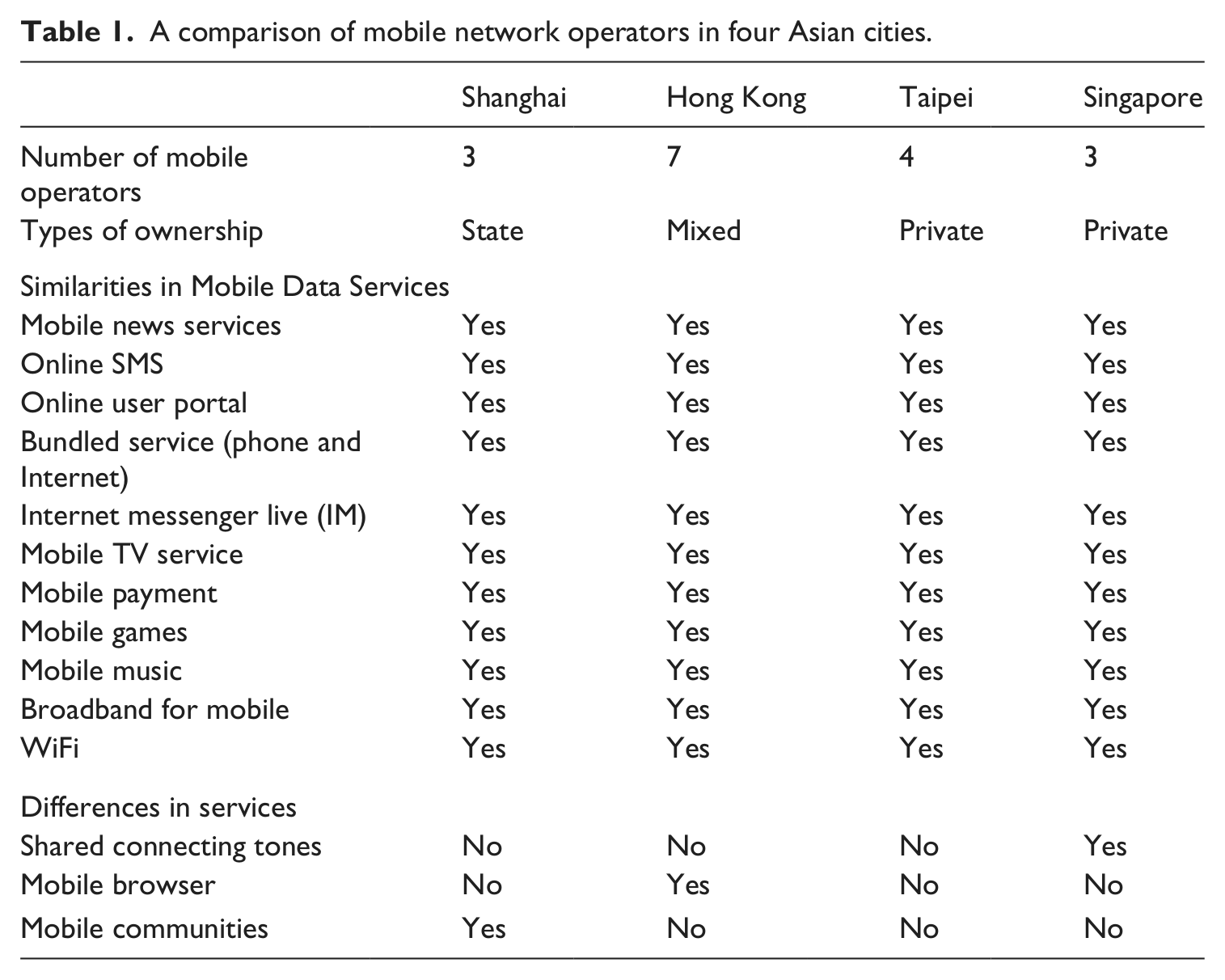
Technologically, at least as far as information and communication technologies (ICT) and mobile telephony are concerned, the four cities are about equally advanced. Culturally, they are also similar in many aspects. Sharing a strong Confucian culture, the four Asian cities all score high in Hofstede’s power distance index (see Table 2) in terms of acceptance of hierarchy and centralization of power. This means that people in these cities are less willing to challenge the authority in the presence of expected control, indirect communication and selective information flow (Hofstede, n.d.). Another similarity among these cities is that they are all collectivistic with a low score on individualism measurement (see Table 2). This means residents of these cities tend to be more group-oriented, more harmony-conscious and more connection-focused (Hofstede, n.d.).
Cultural characteristics of four Asian cities.

Source: Hofstede (n.d.).
A cultural difference among the four cities, however, lies in the femininity–masculinity dimension. Shanghai and Hong Kong are supposedly to be more masculine (“success oriented and driven”), while Taipei and Singapore tend to be more feminine (“working in order to live”) (see scores in Table 2) (Hofstede, n.d.). Another difference is that Shanghai, Hong Kong and Singapore tend to be more adaptable and ambiguous since they score low on “uncertainty avoidance” (Shanghai at 30, Hong Kong at 29 and Singapore at 8), while Taipei scores higher on uncertainty avoidance at 69. As far as long-term orientation is concerned, Shanghai (at 118), Hong Kong (at 96) and Taipei (at 87) tend to be more long-term oriented and to save for the future, while Singapore (at 48) tends to be more pragmatic in terms of long-term orientation (Hofstede, n.d.). Table 2 summarizes these subtle yet critical cultural similarities and differences among the four leading Asian cities.
In the presence of strong Confucian influence in China, Japan, Korea and Taiwan, interpersonal harmony was endorsed the most by the participants of the study conducted by Zhang et al. (2005), followed by relational hierarchy and traditional conservatism. According to Zhang et al. (2005), the participants in China gave the highest ratings to interpersonal harmony and relational hierarchy among the four societies. Locating localized subtleties in strong Confucian-influenced societies, Zhang et al. (2005: 114) called for further research into the “ways in which modern lifestyles compete and coexist with the Confucian values” in Asian societies and more studies of the “direct link between endorsement of values (traditional and modern) and specific communication practices.”
One of the connections between endorsed values and mobile news use is that the more the government control there is over mainstream news media, the more eager mobile users are to turn to mobile platforms to expect engaging and empowering mobile news features, such as making comments on news, correcting errors in news, rating news, voting for top stories, providing tips for reporters, sharing news, customizing news, offering a different account of what happened and doing a follow up story (Xu, 2011).
Given the centrality of the mobile phone in college students’ lives situated in largely similar cultural backgrounds and framed within localized subtleties, the first research question explores the extent to which college students in Asia use mobile news:
RQ1: To what extent is the mobile phone used as a medium for reading news among college mobile phone users in the four Asian cities?
Mobile news as Twitter-like microblog posts
The most significant development in mobile news is the wedding of smart phones with the Internet, which makes it possible to access social media sites via 3G/4G phones. The convergence of the smart phone and the Internet resulted in the explosive growth of mobile Internet users in China between 2008 and 2010. In the same time span, there was a phenomenal growth of microblogs, a Twitter-like social media (known as Weibo in Chinese). According to the survey of CNNIC (2011), the total number of microblog users in China leaped from 63.11 million to 195 million within a year. The same survey reported that as many as 34% of China’s mobile Internet users had microblog accounts by 2010. Other Asian societies, however, did not join the microblogging bandwagon.
A number of factors explain why the microblog accessible via the mobile phone has become the top application of mobile Internet service among Chinese mobile Internet users: the technical attributes of the mobile platform for sharing and disseminating information quickly and easily in text (in 140 characters) or multimedia format (photos or graphics); and its role as a form of social networking service to connect with friends, families and fans. A user can follow any microblog. Likewise, anyone with a microblog account can be followed by anyone without the clumsy approval steps such as Facebook’s. A celebrity’s microblog can attract millions of followers/fans. Most importantly, as an emerging platform for news dissemination and information sharing, the microblog offers a rare channel of uncensored news in China’s tightly controlled media environment – anyone can post a “tweet” without prior censorship by heavy-handed authorities.
Understandably, as an instant communications tool, microblogging has become a new outlet for China’s investigative journalists (Yu, 2011), who tend to publish their uncensored stories first through microblog posting. Almost all of the big name journalists in China have a presence in the micro-blogosphere, which allows them to expose corruption and wrongdoings in the country. For instance, a microblog post first reported the misuse of charity funds at China’s Red Cross Society. At the same time, the low technological threshold made mobile microblogs a popular platform for average mobile phone users to practice citizen journalism.
From the perspective of mobile users in China, their mobile phone is the platform to get breaking and thrilling un-sanctioned news posted on microblogs. Moreover, using a mobile phone to post news on a microblog is effective at generating an immediate buzz. Generally speaking, when a total of 2000 followers or fans forward a post to someone else, the posted story is to likely be an agenda-setting story. According to Yu (2011), official media and traditional media would follow up on the story in their own reporting after a microblog post garnered public interest. In sum, Twitter-like microblogging is, to date, the only emerging new medium that the resource-rich Chinese authorities have not figured out a way to control. This is why mobile news is highly popular and used extensively in the country. It undermines the Chinese government’s stronghold over information control. Against this background, this study further explores the behavior of following news posted on microblog social sites via the mobile phone:
RQ2: Will college students in China be more likely to follow news posts on mobile microblogs than their counterparts in other Asian societies?
Expectancy value as antecedent of media use
Informed by Fishbein’s and Ajzen’s (1975) emphasis on the strength of beliefs in influencing behavior, the expectancy-value approach (Palmgreen and Rayburn, 1985) in mass communication research aims at explaining media use by analyzing a combination of perceived benefits offered by the medium and the differential values associated with those benefits. Palmgreen and Rayburn (1982) extended Fishbein and Azjen’s model to study the consumption of television news. They argued that the overarching principles of uses and gratifications embody a set of theories regarding uses, perceptions, gratifications and functions of the media, as well as other subjects involved in mass communication. To them (Palmgreen and Rayburn, 1982), gratifications sought is equal to the belief that a subject has attributes that will lead to a particular outcome multiplied by the evaluation of that outcome. Accordingly, media use is assumed to be under an individual’s control and guided by perceptions of the probability and expected value of the potential consequential benefits. To put it differently, the behavior or behavioral intention concerning media use is a function of value expectancy or beliefs about the media.
The expectancy-value approach has been applied in studying the adoption, use and consumption of media. Babrow and Swanson (1988) found that beliefs about a news outlet predict the seeking of it for gratifications of info-seeking, para-social interaction and entertainment. Babrow (1989) found that attitudes toward soap opera watching and strength of beliefs about the consequences of exposure affected soap opera viewing behavior. Leung and Wei (1999) reported that exposure to news via the pager was related to the expectancy value of using the pager as a channel for news; the level of exposure to the news via the pager was predicted by the expectancy value of the pager as a news medium. Cooper et al. (2001) applied expectancy-value theory to measure beliefs associated with viewer attitudes toward stories about preventive behaviors for health issues. Their findings confirmed the importance of viewing the stories in light of the expectancy-value model before trying to gain interest.
Other studies (e.g., Westlund, 2010) demonstrated that usefulness and cost factors determined whether Swedish and Japanese mobile phone users would use the mobile phone to access news. Perceived usefulness of information via mobile phones can be an important influence on mobile news-seeking. According to Venkatesh and Davis (2000), for any emerging information technologies, perceived usefulness is an important determinant of users’ intention of acceptance and usage behavior. Incorporating concepts used in expectancy theory, Triandis (1980) proposed that the expected consequences of the behavior should be an antecedent. Individuals evaluate the consequences of their behavior in terms of perceived usefulness and base their choice of behavior on the desirability of the perceived usefulness. Therefore, if the mobile phone, as a novel news platform, does not offer features such as constant accessibility and interactivity, it will not motivate mobile phone users to use the mobile phone for news-getting.
Drawing on the value-expectancy literature, we advanced two hypotheses to test the role of expectancy value in affecting the consumption of mobile news at two levels: expectancy values concerning the general use of mobile phone and expectancy values concerning specific attributes of mobile news:
H1: Expectancy beliefs about the mobile phone in general, especially the expectancy of information facilitation, will be positively related to reading mobile news and following news posts on mobile microblogs.
H2: Expectancy beliefs about the attributes of mobile news (e.g., personalization) will be positively related to reading mobile news and following news posts on mobile microblogs.
Finally, we anticipated that press freedom would be significantly but negatively related to reading mobile news and following news posts on mobile microblogs. The four cities in our study differ significantly in terms of government type, civil rights and liberties, and press freedom. Shanghai is a municipality of a communist state under a heavy-handed authoritarian regime. Hong Kong is a limited democracy. Singapore is a parliamentary republic. Taipei is the capital city of a full-blown democracy. Hong Kong enjoys partial free status in terms of political rights and civil liberties, while the US-based Freedom House classified Shanghai as not free. Singapore enjoys only partial free status, while Taipei is considered as a free society. With regard to press freedom, both Shanghai and Singapore are classified as not free, while Hong Kong enjoys only a partly free status and Taipei has total freedom of the press (Table 3 shows a summary).
A comparison of four Asian cities by government type, level of press freedom and Internet penetration.
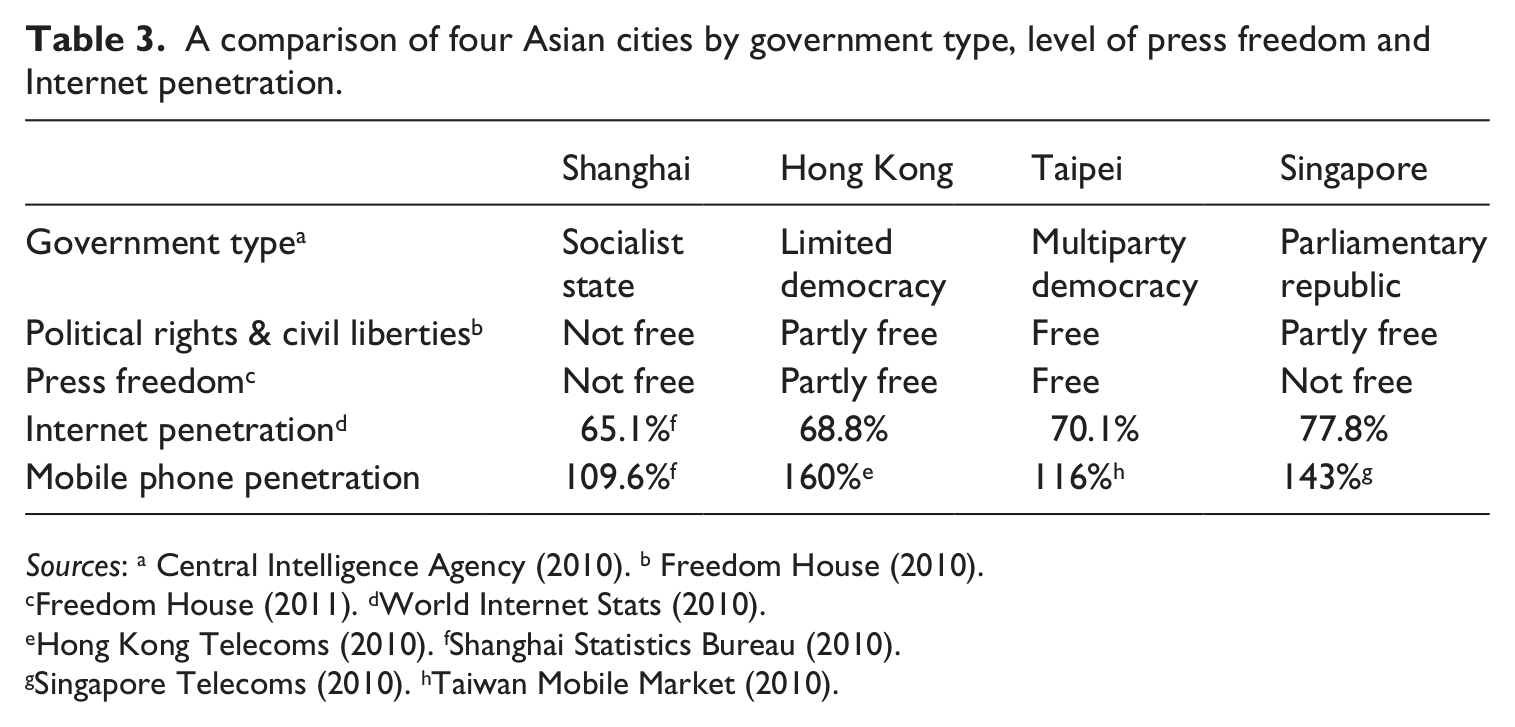
Sources: a Central Intelligence Agency (2010). b Freedom House (2010).
Interestingly, theses societal differences in general and press freedom in particular were considered to be key factors affecting use of the mobile phone. For example, according to Verclas (2008: 6), in “not free” countries, people tend to turn to the Internet and mobile phones to “read about themselves in foreign uncensored media.” Pestin (2011) argued that these people also tend to rely more on the mobile phone for news because their mobile phone is also their Internet, their access to the Web and social media. These arguments highlight the fact that mobile phones play a crucial role in bypassing authoritarian information control in countries with no or limited press freedom (UNESCO, 2011). Pestin (2011) cited the 2011Arab Spring uprisings as a showcase that mobile phones played a vital part in helping people get and follow news, as well as in mobilizing populations.
Based on the above review, we anticipate that the more press freedom people enjoy in a society, the less pressing the need will be for them to use mobile phones as an alternative channel to get news. We hypothesize that the varying degrees of press freedom among the four studied Asian cities will make a difference in using the smart phone for news-getting. Accordingly, we proposed the third hypothesis:
H3: The level of press freedom will be significantly but negatively related to reading mobile news and following news posts on mobile microblogs.
Method
Data were collected in four parallel surveys of college students systematically selected in Shanghai, Hong Kong, Taipei and Singapore. A standardized questionnaire was used to ensure comparability. In each city, the survey used a multistage sampling plan to draw a probability sample. In Shanghai, Taipei and Singapore, the sample was drawn from five randomly selected universities, and six in Hong Kong. Three classes were randomly chosen from each university in the four cities. The self-administered questionnaires were distributed during an eight-week period from mid-December 2010 to mid-January 2011.
Respondents were assured of anonymity and participation was completely voluntary. The completed sample totaled 3538, including 723 (20.4%) from Shanghai, 587 (16.6%) from Hong Kong, 1200 (33.9%) from Taipei and 1028 (29.1%) from Singapore. Of the sample, 41.9% were males and 58.1% were females. The average age was 20.73 years (SD = 2.54, ranging from 17 to 42). Among the 3538 respondents, 34.5% were freshman, 30.0% were sophomores, 18.5% were juniors and 16.7% were seniors.
Operationalization
General mobile phone use
Respondents were asked to report how many calls they made and received via their mobile phones per day. The two items were averaged to form a measure of “frequency of calling” (M = 4.41, SD = 4.46). Respondents were also asked about the number of text messages they sent and received via their mobile phone per day. The two items were also averaged to form a measure of “frequency of text messaging” (M = 13.86, SD = 18.84).
Reading mobile news and following news posts on mobile microblogs
Respondents were further asked to report how often they used their mobile phone to (1) read news on websites; (2) read news on mobile versions of websites; (3) read news via RSS feeds; (4) access news, weather, sports or other information; (5) watch television news; and (6) listen to radio news. To measure the frequency of following news posts on mobile microblogs, respondents were asked to indicate how often they used their mobile phone to (1) follow a news organization on a social networking site; (2) follow a specific journalist on social networking sites; (3) follow a news blog; (4) follow a news blogger; (5) follow Twitter updates from a news organization; and (6) follow Twitter updates from a specific journalist. The responses categories ranged from “1” (never) to “4” (often).
Results of a principal component factor analysis showed that the 12 items grouped into two factors, which accounting for 73.31% of the total variance. The first factor contained the six items that measured the frequency of following news posts on microblog social media sites via the mobile phone, explaining 39.91% of the variance (eigenvalue = 4.79). The six items were combined to form an index of “following news posts on mobile microblogs” (M = 1.62; SD = .78; alpha = .95). The second factor contained the six items concerning the frequency of reading news via the mobile phone, accounting for 33.40% of the variance (eigenvalue = 4.01). The six items were averaged as an index of “reading mobile news” (M = 1.76; SD = .77; alpha = .88).
Expectancy value of the mobile phone in general
Respondents were next asked to rate the usefulness of the mobile phone as an outlet for news on a five-point Likert scale (“1” meant “not really useful” and “5” meant “extremely useful”). Principal component factor analysis of these items with Varimax rotation resulted in a three-factor solution, accounting for 75.04% of variance. Three composite variables were created accordingly. The first factor consisted of four items that reflected the expectancy values of using the mobile phone to relax, to relieve boredom, to pass time and to have fun (eigenvalue = 4.75; 25.53% of variance). The four items were combined to form a composite variable labeled as “fun and relaxation” (M = 3.49; SD = .84; alpha = .86). The second factor consisted of four items: to stay in touch with family members; to stay in touch with people you do not see often; to keep up-to-date with people; and to interact with other people (eigenvalue = 2.13; 25.51% of variance). The four items were averaged to form a measure of “sociability” (M = 3.95, SD = .73, alpha = .85). The third factor contained three items that reflected the belief that the mobile phone is helpful to get news, to seek information about products and services, and to search for consumer information (eigenvalue = 1.37; 24.0% of variance). A composite measure of “information facilitation” was created by averaging the three items (M = 2.59; SD = 1.09; alpha = .92).
Expectancy values of mobile news
Respondents were further asked to rate the importance of the following attributes of mobile news on a five-point Likert scale (“1” meant “not important at all” and “5” meant “extremely important”): (1) allow me to personalize when news should be delivered to my mobile phone; (2) allow me to personalize how news should be delivered to my mobile phone; (3) allow me to personalize what news should be delivered to my mobile phone; (4) allow me to comment on news; (5) allow me to correct factual errors in news stories; (6) allow me to share news stories via email, instant message (IM), Twitter, etc.; (7) allow me to rate news stories; (8) being important to me personally; (9) giving me useful information; (10) reporting new information; (11) relating to my job or interests; and (12) telling me how I can improve my life. Principal component factor analysis of these 12 items with Varimax rotation led to a two-factor solution, accounting for 78.32% of the variance. Two summated scales were created accordingly. The first seven items that were loaded on the first factor (eigenvalue = 5.38; 44.86% of variance) were combined to form a measure of “interactiveness of mobile news” (M = 2.48; SD = 1.04; alpha = .92). The second factor consisted of items 8–12 (eigenvalue = 4.02; 33.46% of variance). The average was used to build a measure of “personal value of mobile news” (M = 2.92, SD = 1.04, alpha = .96).
Freedom of the press
Based on the Freedom of the Press index, level of freedom enjoyed by the press in each city was ranked on a scale of 1–4, where “1” represents the least free and “4” the most free. Specifically, level of freedom of the press was coded as follows: “1” meant Shanghai, “2” meant Singapore, “3” meant Hong Kong and “4” meant Taipei.
Findings
All of the 3538 respondents were mobile phone users. Among them, 51.9% owned a smart phone and 48.1% had a non-smart phone. Among the four cities, respondents in Taipei had the fewest number of users of smart phones, while Singapore and Shanghai had the most. The respondents had used mobile phones for periods ranging from less than one year to 15 years (M = 6.41 years, SD = 2.80). They also used their mobile phones a great deal. The average of calls made per day was 4.42 (SD = 4.71) and the average of calls received was 4.43 (SD = 4.72). The average of text messages sent per day was 13.76 (SD = 19.13) and the average received was 14.17 (SD = 19.28).
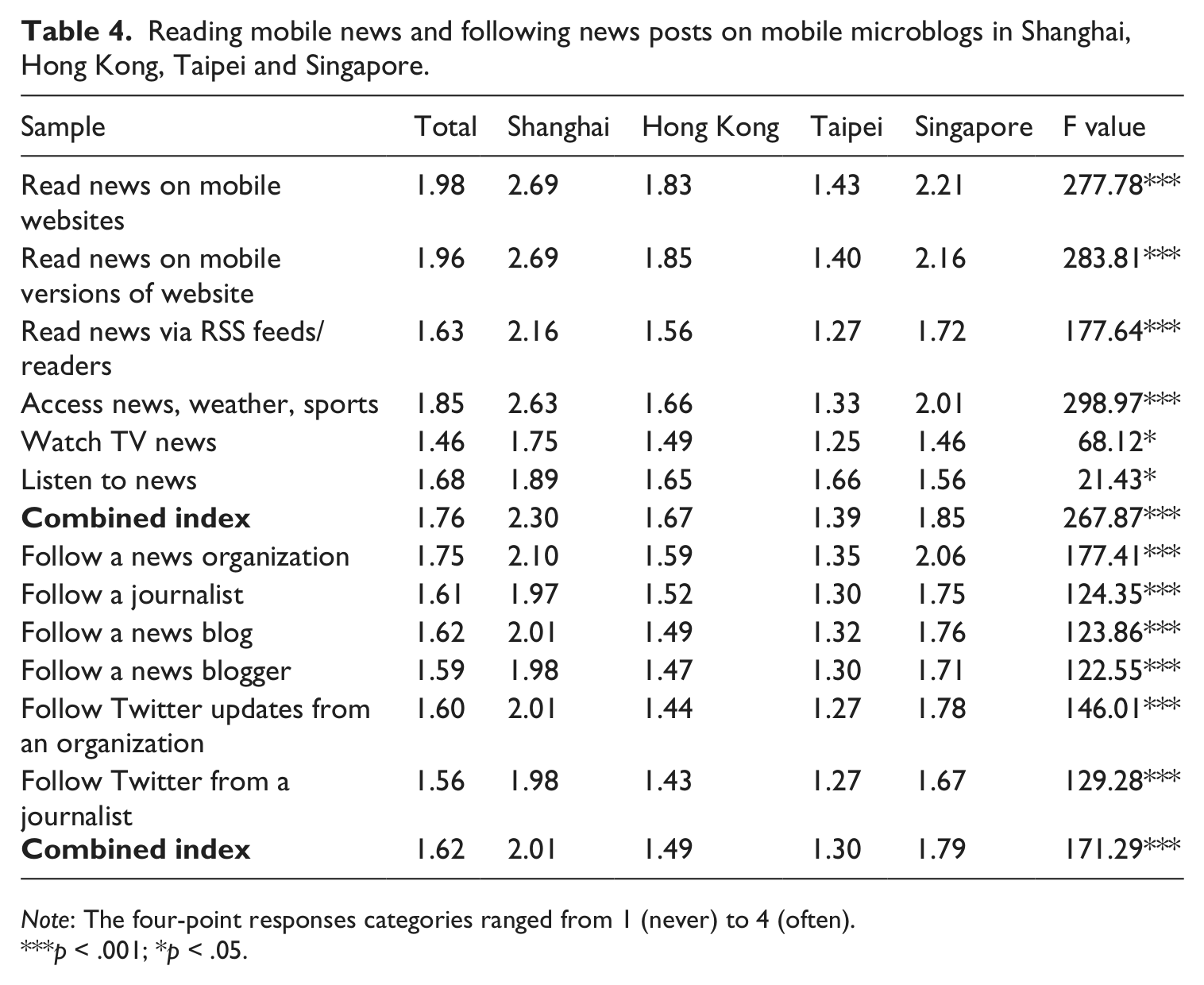
RQ1 explored the behavior of reading news posts on mobile microblogs across the four Chinese cities in Asia. As Table 4 shows, frequency analysis indicated that the most frequent means to read news via mobile phone across the four samples was reading news from mobile websites (M = 1.98, SD = 1.09), followed by reading news on mobile versions of websites (M = 1.96, SD = 1.08), accessing news, weather, sports or other information through the mobile phone (M = 1.85, SD = 1.06), listening to radio news through the mobile phone (M = 1.68, SD = .87) and reading news via RSS feeds (M = 1.63, SD = .89). The least frequent means was watching television news via the mobile phone (M = 1.46, SD = .77). These results suggest that college students in the four cities read a variety of news packaged for the mobile phone screen. The frequency, however, appears to be low.
Reading mobile news and following news posts on mobile microblogs in Shanghai, Hong Kong, Taipei and Singapore.
Note: The four-point responses categories ranged from 1 (never) to 4 (often).
p < .001; *p < .05.
RQ2 explored the question whether college students in China were more likely to follow news posts on mobile microblogs than their counterparts in other Asian societies. To address it, a series of one-way analyses of variance (ANOVAs) were performed. The respondents from the four cities differed in using their mobile phone to follow news posts on microblog social media sites (see Table 4). Results of a Scheffe test revealed that the Shanghai respondents were most likely to follow news posts on microblogs via the mobile phone (M = 2.01, SD = .88), followed by the Singaporean respondents (M = 1.79, SD = .80) and Hong Kong respondents (M = 1.49, SD = .66). Taipei respondents were the least likely to follow news on microblog sites via their mobile phone (M = 1.30, SD = .56). Again, the Scheffe test showed that all the differences in the behavior of following news posts on mobile microblogs among the Shanghai, Singapore, Hong Kong and Taipei respondents were significant at the p < .001 level. Thus, the answer to RQ2 was positive. College students in China were more likely to follow microblog news posts than their counterparts in other Asian societies.
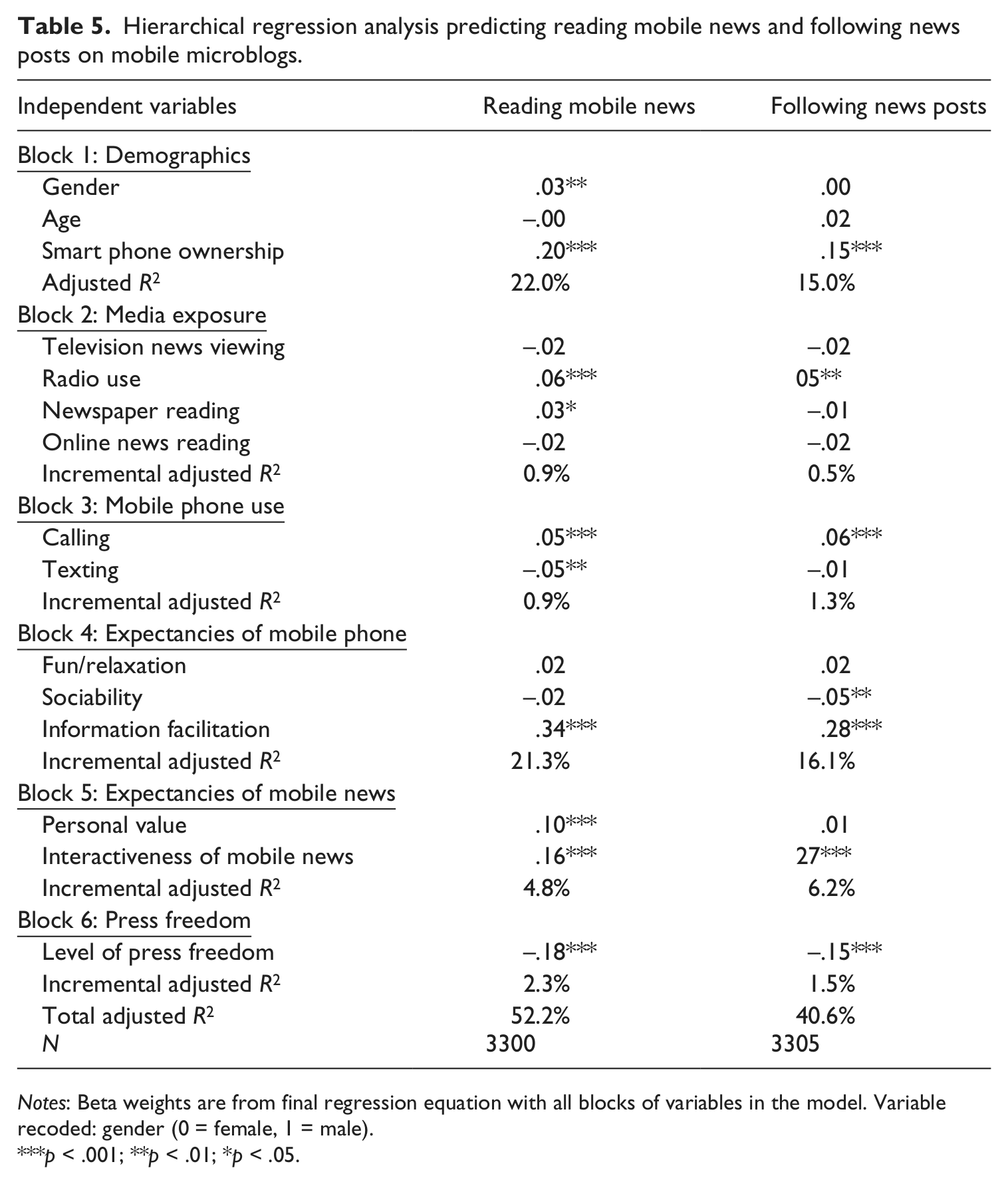
H1 predicted that expectancy beliefs about the mobile phone in general, especially the expectancy of information facilitation, would be positively related to reading mobile news and following news posts on mobile microblogs. Two separate hierarchical regression analyses were performed. Table 5 summarizes the results of the analyses in which gender, age and smart phone ownership were entered first into the equation as control variables, followed by television use, radio use, newspaper use and Internet use. The third block included the two mobile phone use variables. Smart phone ownership was used as a control variable because only half of the respondents (51.9%) had a smart phone. The fourth and fifth blocks entered the expectancy-values variables. The final block entered press freedom. As Table 5 shows, in terms of beta size, information facilitation was the strongest predictor of reading mobile news, as well as following news posts on mobile microblogs. Sociability was not a significant predictor of reading mobile news, but it was negatively related to following news posts on mobile microblogs. Finally, fun and relaxation were not significant predictors of the two mobile news-getting behaviors. H1 was partially supported.
Hierarchical regression analysis predicting reading mobile news and following news posts on mobile microblogs.
Notes: Beta weights are from final regression equation with all blocks of variables in the model. Variable recoded: gender (0 = female, 1 = male).
p < .001; **p < .01; *p < .05.
H2 predicted that expectancy beliefs about the attributes of mobile news would be positively related to reading mobile news and following news posts on mobile microblogs. Results of the hierarchical regression analyses (shown in Table 5) demonstrated that personal value of mobile news was a significant predictor of reading news via the mobile phone, but it was not significantly related to following news posts on mobile microblogs. However, interactiveness with mobile news was a significant predictor of both reading mobile news and following news posts on mobile microblogs (see Table 5). H2 was partially supported.
H3 predicted that the level of press freedom would be negatively related to reading mobile news and following news posted on mobile microblogs. Results of the same regression analyses showed (see Table 5) that the level of press freedom was indeed a significant but negative predictor of both reading mobile news (Beta= –.18, p < .001) and following news posted on mobile microblogs (Beta= –.15, p < .001). H3 was supported.
Discussion
In the era of 3G, the mobile phone has become a popular platform to deliver news and consumer information. More importantly, the 3G smartphone enables users to post and follow mobile news in the form of Twitter-style microblog updates thanks to the convergence of the mobile phone and the Internet. Findings of our study show that mobile news-reading behavior via the mobile phone is rapidly on the rise – users read a variety of news packaged and delivered for the mobile phone screen. This particular finding differs from past research (e.g., Westlund, 2010) that suggests mobile news usage in Asia was less common despite the availability of news functions on their mobile devices. The frequency, however, appears to be low in the pooled sample. The lack of smart phones appears to be the major reason. In addition, Asian college students may be still learning about this novel news platform. We anticipate the usage of mobile news will increase among this generation as their experience in getting news via the mobile phone builds up and they form a mobile phone-oriented news-getting habit.
Our findings further show that the greater the respondents’ belief that the mobile phone in general helps information-seeking, the more they read mobile news and follow news posted on mobile microblogs. In addition, the higher the value of mobile news considered to be personally valuable and interactive, the more the respondents read mobile news. Higher expectancy value of mobile news as interactive also was a positive predictor of following news posts on mobile microblogs.
Furthermore, our findings reveal some major differences in reading mobile news and following news posted on mobile microblogs among the surveyed youth in the four Asian cities. The Shanghai respondents were most likely to get mobile news, both mobile news itself and following news posted on mobile microblogs. The Taipei respondents were the least likely to do both. In addition, the Shanghai respondents had the highest expectancy values for the mobile phone’s values for information facilitation; this expectancy belief of the mobile phone in turn held predictive power over the behavior of reading mobile news and following microblog news posts in the Shanghai sample.
What might account for the differences between the Chinese respondents and their counterparts in three other Asian cities? We offer two explanations: (1) the rate of smart phone adoption (the higher the rate, the more frequent mobile news-reading behavior); and (2) the level of press freedom (less freedom means more mobile phone use for news – both reading and following news on mobile microblogs, which provide an alternative to state-controlled media in China). It seems that mobile telephony, which is the least regulated medium in China, offers a buffer space for the mobile generation to stay informed about current events and news in a society with a hierarchical power structure, where people are less willing to challenge the authority in the presence of expected control, indirect communication and selective information flow (Hofstede, n.d.). On top of more leeway given to mobile media for economic reasons, new media technologies in China have led to “diverse new media practices” and have “opened up new spaces for multiple modes of expression” “within tensions and contradictions of the government’s desire to simultaneously expand new media technologies and control” what are perceived as a “‘harmful’ influence” on new media platforms, as Wallis (2011: 406) analyzed. Our findings are consistent with other studies, which indicate that the majority of breaking-news is reported first in China on the uncensored environment of Twitter-like microblogs, called Weibo (see Ying, 2010).
Therefore, our finding that Chinese college students are the most active users of mobile news makes good sense. At a societal level, the lack of press freedom in China creates a dire need to disseminate and receive news that is unavailable in official media. Twitter-like microblogs have filled the void. Millions of Chinese smart phone users have caught up with the technology as an outlet to get and share news from non-official sources. The finding that college students in Taiwan are the least likely in the four Asian cities to use mobile phones to get news validates these conclusions, because Taiwan enjoys total press freedom. There is little need for college mobile phone users to seek news from an “underground” type of press.
Finally, our findings show that respondents read mobile news and follow news posts on mobile microblogs when they believe more strongly that the mobile phone can facilitate communication, that they can customize news to personal interests and that they can interact with it. These findings are consistent with the Leung and Wei’s (1999) study on using the pager for news-seeking. Expectancy values function as motivating factors for mobile news-getting. Our results show that the information facilitation was the strongest predictor of getting and following mobile news, explaining more variance than any predictor. Because of this, we were able to explain a substantial amount of variance in getting mobile news (adjusted R2 totals 50.2%) and following mobile news (adjusted R2 totals 40.6%). These results indicate that we have included the right set of predictors in explaining the behavior of using the mobile phone for reading news and following news posts on mobile microblogs.
To explore the extent to which our findings can apply to the general populations in the four Asian cities, more studies are needed. Future research should consider using cross-sectional samples from the general populations. Future research should also attempt sampling of both Asian and non-Asian mobile phone users to conduct cross-cultural comparative analyses. Finally, more studies can examine the role of reading mobile news and following news on social media sites via the mobile phone in facilitating political discourse and engagement among residents in those Asian cities.
Footnotes
Funding
This research received no specific grant from any funding agency in the public, commercial or not-for-profit sectors.