



Abstract
This article explores new forms of ethnic humor as emergent in a salient arena of contemporary culture: our electronic mailboxes. We argue that two processes underpin the manifestations of ethnic humor as it ‘goes online’: the global turn and the turn to genre plurality. We examine the implications of these processes through (1) content analysis of 1000 Israeli humorous ‘forwards’ and (2) a grounded analysis of 130 texts representing ethnic groups with varying degrees of proximity to Israeli culture. Regarding the global turn, we found that non-local ethnicities are ‘imported’ to the local symbolic sphere via new forms of humor. Regarding the turn to genre plurality, results indicate that while old forms of ethnic humor typically include explicit stereotyping, new forms introduce a wider variety of stances towards ethnic stereotypes, ranging from their reproduction in visual language to a polysemic stance, and finally to their neutralization.
Introduction
Mocking ethnic groups is almost as ancient as humor itself. Manifestations of such humor have been documented since the days of ancient Greece, when Athenians frivolously scorned their allegedly unsophisticated neighbors (Davies, 1990). Yet, while Athenians’ mockery of Phrygians, Abderites, and Boeotians was performed orally and interpersonally, ethnic humor in the following centuries has assumed new forms, shaped by the various technologies mediating it.
One of the most salient arenas for the contemporary diffusion of ethnic humor is the internet. This medium bears a unique role with regard to ethnic humor, especially since concern for political correctness has problematized expressions of such humor in public domains (Apte, 1987). 1 The handful of studies that has thus far dealt with internet-based ethnic humor illustrates its offensiveness, enabled by anonymity and lack of legislative control (Billig, 2001; Kuipers, 2006; Weaver, 2011). These studies have shed light on the content of web-based ethnic jokes and on their social workings, giving special attention to extreme case studies such as comic websites associated with the Ku Klux Klan. In this paper we wish to focus not only on content, but also on the many forms ethnic humor may assume in the digital age. In addition, we focus not on specialized websites but on mainstreamed expressions of ethnic humor, as apparent in mundane humorous email forwards.
The overarching questions we address are: In what sense did the internet change the manifestation of ethnic humor, and what are the possible implications of this transformation? The assumption underpinning these queries – that the internet indeed impacted ethnic humor – is based on studies showing that the cultural and technological affordances of the internet have led to new modes of humorous expression and to the emergence of new joking topics (Kuipers, 2002; Shifman, 2007).
In the first part of this paper, we highlight two features that characterize the scholarship of ethnic humor in the pre-digital era: the link between ethnic humor and national boundaries and a focus on specific genres (particularly jokes). We then argue that two corresponding processes may reshape ethnic humor in the digital age: (1) the global turn – manifested in the ability to propagate content across national borders and thus to circulate humor about ‘distant’ groups in local spheres and (2) a turn to genre plurality – namely, the circulation of new visual forms of humor that incorporate both explicit and implicit references of ethnicity. The main part of the article describes the results of a combined qualitative–quantitative study of 1000 email forwards, aimed at assessing the implications of these two turns on contemporary ethnic humor.
Studies of ethnic humor in the pre-digital era
Ethnic humor is defined as ‘humor directed at racial and nationality groups, denigrating alleged attributes of those groups’ (Schutz, 1989: 167). Widespread around the world for many decades, this kind of humor is based on ethnic stereotypes or ‘scripts’ that contain shared sets of beliefs about ethnic groups (Raskin, 1985). In a large-scale comparative analysis of ethnic humor around the world, Christie Davies (1990) showed that ethnic jokes tend to mock traits positioned along binary oppositions, of which the stupidity/craftiness dyad is especially salient.
The social implications of ethnic humor have been widely contested. Some scholars linked it with hostility, stressing its demeaning treatment of minority groups (e.g. Billig, 2001; Weaver, 2011) and its promotion of tolerance towards discrimination (Ford and Ferguson, 2004). Taking the opposing stance, other researchers treated ethnic humor as a benign form of expression (Davies, 1990) that may be utilized by minorities as a source of pride (Rappoport, 2005) or as a weapon of liberation against those in power (Boskin and Dorinson, 1985; Mintz, 1986). An additional argument relates to ethnic humor as a peaceful way of reducing tension, and even an integral component in the creation of a pluralist society (Lowe, 1986; Schutz, 1989).
Despite debate regarding the functions and consequences of ethnic humor, most work in the field seems to share two features: (1) the association between ethnic humor and local boundaries and identities and (2) the tendency to focus on one genre of humor.
Ethnic humor has been identified as a phenomenon that is closely linked to national borders. According to Davies (1990), it targets the familiar rather than the ‘alien’: people tend to tell ethnic jokes about groups positioned in the periphery of their society. The narratives of such jokes often reflect the perceived failings of majority groups. Ethnic humor has also been associated with local dynamics due to the knowledge required to encode ethnic stereotypes. Thus, ethnic humor flourishes at times of immigration, when new groups are introduced into society (Boskin and Dorinson, 1985; Davies, 1990; Shifman and Katz, 2005).
The second tendency apparent in research of ethnic humor is its focus on specific genres in which ethnic stereotypes are explicitly discernible. The clear majority of the literature we surveyed focused on ethnic jokes. Another stream of research focuses on comic strips and caricatures. Constrained by relatively limited space, comics rely on stereotyping as a way to enhance narrative effectiveness. Prejudice is often highly evident in comics, since race and ethnicities are condensed into graphic language (Royal, 2007; Soper, 2005). 2
Both the association of ethnic humor with national borders and its examination through specific genres have been challenged in the digital age. In what follows, we focus on the ‘global turn’ and ‘the turn to genre plurality’, demonstrating their possible implications on ethnic humor.
The new faces of ethnic humor in the digital age
The global turn
Globalization is a process in which people, media, technologies, capital, and ideas ‘flow’ across national borders (Appadurai, 1996). While globalization has a long history, it has accelerated dramatically in recent decades following technological innovations in transportation and communication. Since the 1990s, the rapid growth of the internet has raised new hopes, anxieties, and debates about globalization (e.g. Castells, 2001; Ess and Sudweeks, 2001). More than any previous medium, the internet provides technological facilities for global flows of content, as it allows (technically at least) the effortless transcending of national borders. The realization of this potential, however, depends on the choices made by internet users across the globe: they may choose to propagate global images imported from other countries or to disseminate mainly local and familiar content.
Humor is a unique arena to examine the intersection between globalization and the internet. Several studies have indicated that humor on the internet often spreads globally. For instance, disaster jokes disseminated across various countries in the aftermath of 9/11 demonstrated humor’s role in the bottom-up global circulation of content (Ellis, 2001; Kuipers, 2002). As they travel across borders, jokes are translated into different languages, sometimes undergoing cultural adaptations (Shifman and Thelwall, 2009).
This global flow of humor across national borders requires a re-assessment of the local nature of ethnic humor: Is ethnic humor in the digital age still focused on close and familiar neighbors, or does it import new and distant actors into local symbolic spheres? And if the latter is true, what are the implications of such an augmented exposure to distant others? While some scholars suggest that constant mediated exposure to other cultures enables the emergence of a cosmopolitan mindset (Beck, 2003), others highlight the power relations embedded in global flows, underscored by the distorted image Western culture holds of otherness (Hall, 1992; Kraidy, 2002; Said, 1978). An empirical investigation into the ways in which non-local otherness is constructed in contemporary humor may shed light on this debate.
The turn to genre plurality
The internet is not only a technology through which content is circulated globally; it is also a sphere that enables new forms of cultural expression and content consumption. Coined by Henry Jenkins (2006), the term ‘convergence culture’ describes, among other things, the constant flow of content across multiple media platforms. Within minutes a story can migrate from a TV set to a computer and then to a mobile phone, assuming new forms in the process. Understanding this fragmented semiotic landscape requires an account of its various modes of expression, spanning verbal language; image; sound; motion; and page design. While verbal language is characterized by the logic of time and sequence, new forms of web-based expression require a multimodel approach that realizes the logic of space and simultaneity (Kress, 2003).
Humor quickly adapted to the internet’s ample semiotic landscape. While the classic joke is still salient online, the convergence of media on the internet generated a new array of humorous expressions. Comic texts of varied genres and sources are circulated online, thus creating genre plurality. The intersection between script, image, and sound has also led to the invention of new, hybrid, humorous genres such as Photoshop- or PowerPoint-based humor (Frank, 2009; Kuipers, 2002; Shifman, 2007).
It is still unknown whether and how this mélange of digital communication morphologies affects the humorous treatment of ethnicity. As a start, the internet’s widening semiotic landscape may require a broader definition of ethnic humor. In his analysis of web-based racist jokes about Afro-Americans, Weaver (2011) criticized Raskin’s (1985) characterization of ethnic humor as a form that necessarily contains ethnic stereotypes. According to Weaver, ethnic jokes might demonstrate racism without explicitly referencing stereotypes. Although he focused on verbal jokes, Weaver’s argument may be even more applicable for the analysis of visual texts. As noted in previous research (Shifman, 2007) new, implicit, forms of ethnic humor may be emerging through digital-visual genres. For example, a video or a photo may present a protagonist with a marked ethnic identity without addressing explicitly the whole ethnic group. Nonetheless, in such cases the appearance of ethnicity plays a vital part of the texts’ ‘joke work’ (Weaver, 2011). In broadening the definition of ethnic humor, we argue that any visual comic text that introduces human protagonists conveys a message about ethnicity. This notion is informed by TV representation studies that emphasize the ideological constructs of visibility on screen (e.g. Lewis, 1991). We therefore suggest a broader understanding of the relationship between humor and ethnicity, one that includes stereotypical ethnic humor as well as ethnicity as a performance within the humorous text.
In what follows, we will examine the implications of the global and multimodel turns on digital humor disseminated in a particular domain – Israeli web-based humor.
The Israeli case study
In recent decades, two central spheres of ethnic tension have been prominent in Israeli society. The first revolves around the complex relationship between the Jewish and the Arabic populations. Arab citizens constitute a large ethnic minority group within the State of Israel, but are also part of a larger ethnic group in external conflict with it. The enduring conflict between Israel, the Palestinians, and other Arab countries generated humorous expressions from its early days, characterized by a high level of aggression (Nevo, 1984).
A second sphere of ethnical controversy relates to internal divides within the Jewish population deriving from Israel’s history as an immigration-based society. The major ethnic tension hovering above Israel since its establishment is that of Western or Ashkenazi (European and North American) Jews versus Eastern or Mizrahi/Oriental (North African and Asian) Jews. Nonetheless, more recent waves of immigration from the former Soviet Union and Ethiopia added to this sizzling melting pot (Elias and Kemp, 2010). Ethnic humor in Israel is therefore unique because a significant portion of it targets groups within the Jewish population.
To date, the limited academic scholarship dedicated to ethnic humor in Israel has focused on the East–West dichotomy. Groups that are perceived to be too Western are often ridiculed for being over-civilized and rigid, whereas humor about representatives of the ‘Levant’ depicts them as primitive, yet also as authentic Israelis (Oring, 1981; Salamon, 2007; Shifman and Katz, 2005; Shohat, 1989). While this dichotomy is still a major theme in humorous and serious discourses, televised humor has introduced more complex and polysemic representations of the East–West divide in the last two decades (Shifman, 2008). Since internet-based Israeli humor has not yet been subjected to academic research, the present study also aims to shed light on contemporary constructions of ethnicity in Israel.
Research questions
As aforementioned, the overarching questions guiding this research were as follows: In what sense did the internet change the manifestation of ethnic humor, and what are the possible implications of this transformation? Postulating that these changes relate to globalization and to the proliferation of new visual humor genres, we asked the following.
The global turn
RQ1: To what extent do humorous emails circulated by Israeli students refer to local as opposed to non-local ethnic groups?
RQ2: What are the prevailing stereotypes regarding local and non-local ethnic groups and what are their possible social functions?
The turn to genre plurality
RQ3: To what extent is the presentation of ethnicity associated with ethnic stereotyping?
RQ4: Do new, visual, forms of humor differ from old, verbal, ones in respect to ethnic stereotyping?
Method
Sampling funny forwards
The sample for this study is comprised of humorous email ‘forwards’. Described as modern folklore, email forwards are a central arena of content distribution on the internet (Kibby, 2005), in which humor has been documented as salient (Phelps et al., 2004). Since forwards reflect live and updated content that people actively choose to pass along, their analysis may shed light on cultural preferences and norms (Frank, 2009). 3
Sampling content circulated by email is particularly challenging, as it involves not only collecting data from the monstrously huge network, but also depends on the goodwill of people agreeing to share the content of their mailboxes with researchers. To meet this challenge, we applied a sampling tool utilizing the social networking website Facebook, which is particularly popular in Israel. An invitation to participate in the research (in return for a reward lottery) was sent to 80 student groups on Facebook representing a variety of academic institutions across Israel. Students were selected as informants for this study because they represent a population that is relatively savvy both technologically and globally – attributes that correspond with the two turns discussed earlier. In addition, since the 1990s, the higher education system in Israel has expanded dramatically, resulting in a student population that is highly heterogeneous for a broad range of geographic and socioeconomic variables. Our call was responded to by 95 participants, all from the Hebrew-speaking Jewish population. 4 They forwarded to the research inbox over 2400 humorous messages between April 2010 and October 2010. A sample of 1000 texts was built using a stratified sampling method in order to represent light, moderate, and highly frequent email forwarders. Of course, because this sample is based on voluntary participation, it can by no means be counted as representative of Israel’s general student population; however, in a follow-up survey we found that respondents were quite varied in their socio-demographic and political backgrounds. 5
Analysis
The study combines a content analysis of all sampled texts (n = 1000) with a grounded qualitative analysis of selected texts (n = 130) attained from the main sample.
Content analysis: Coding categories
Coders were asked to identify the humorous genre that the text was based on. Genre categories were later classified in light of their novelty according to three clusters: (1) ‘old humor’ – humorous genres that were widely transmitted in the pre-internet age, mainly via oral communication (e.g. jokes); (2) internet-mediated humor – humorous genres whose interpersonal circulation is enabled by internet technology (e.g. funny advertisements); and (3) internet-generated humor – new humorous genres that dwell on the affordances of internet technology and participatory culture (e.g. digitally manipulated images).
Texts were also coded for ethnic representation. Coders were asked to identify any clear visual or verbal reference to ethnicity. Categories included various local and non-local ethnic ‘out-groups’ – Caucasian/white, African-American/black, Hispanic, East Asian, and Arab – as well as common categorizations of the ethnic ‘self’: Jews in general and ethnic sub-groups within the Jewish identity (Oriental Jews, Western Jews, Russian Jews, and Ethiopian Jews). These categories combine ethnic classifications used in representation studies (e.g. Mastro and Behm-Morawitz, 2005) as well as categories expected to be found in a corpus of Israeli-based humor.
Finally, coders were asked to report whether the text introduced clear stereotypical frames of the ethnic category represented.
Coding procedure and inter-coder reliability
The comic texts were evaluated by two coders (male and female graduate students). To practice coding, they used texts that were not included in the final sample. The training period lasted three months, during which the codebook was modified several times. Once satisfactory inter-coder reliability was achieved, the whole sample was coded. Final inter-coder reliability scores (Krippendorff’s Alpha) calculated for 13% of the sample (n = 130) were .85 for genre, .80 for ethnic identity, .77 for Jewish ethnic sub categories, and .71 for stereotypical ethnic framing. While some of the categories had relatively low reliability scores, they were all above the minimum bar (of .66) acceptable for initial conclusions (Krippendorff, 2004). The percentage of simple agreement between coders ranged between 84% and 97%.
Qualitative analysis
A sub-sample of texts was subjected to further qualitative analysis. Drawing on the first, quantitative phase, we extracted texts mentioning the in-groups of Western, Oriental, and Russian Jews and the out-groups of Arabs, African-Americans/blacks, and Asians (n = 130). These specific groups were selected because they represent a continuum of ‘local’ and ‘distant’ identities – sub-categories of Jewish ethnicity represent ethnic in-group targets and are rooted in the local Israeli context; Arabs represent an out-group, albeit one that is close and familiar in the Israeli context; Asians and African-Americans/blacks represent distant identities that are relatively marginal in the Israeli symbolic sphere.
Applying principles of semiotics and multimodality in qualitative analysis (e.g. Kress, 2003; Larsen, 1991), we examined the prevailing stereotypes for each of these groups. In order to evaluate the different comic mechanisms associated with the stereotypes, we used three Meta theories related to the causes and functions of humor as analytic tools: (a) the superiority theory, which asserts that laughter is generated by a feeling of superiority or triumph that people have over others; (b) the incongruity theory, which claims that humor derives from an unexpected encounter between two incongruent fields; and (c) the release theory, which suggests that humor provides relief for mental or psychic energy and tension, offering a socially acceptable outlet for distress caused by the suppression of sexual and aggressive drives (Lynch, 2002).
A global turn? The comic depiction of local and non-local groups
In RQ1, we asked to what extent humorous emails circulated between Israeli students depict local as opposed to non-local ethnic groups. Ethnicity was marked in about 50% of the texts. In these texts, the Caucasian/white identity was most frequently represented (n = 205). Jews were represented in 170 of the texts. Within the Jewish group, Western Jews were most frequently represented (n = 33), followed by Oriental Jews (n = 24), Russian Jews (n = 9), and several identities combined (n = 11). Ethiopian Jews were not represented at all in the sample. Within the out-group, Arabs were most frequently represented (n = 22), followed by East Asians (n = 19), African-Americans/blacks (n = 16), and Hispanics (n = 4). In 60 additional texts, several ethnicities were represented together (see Figure 1).
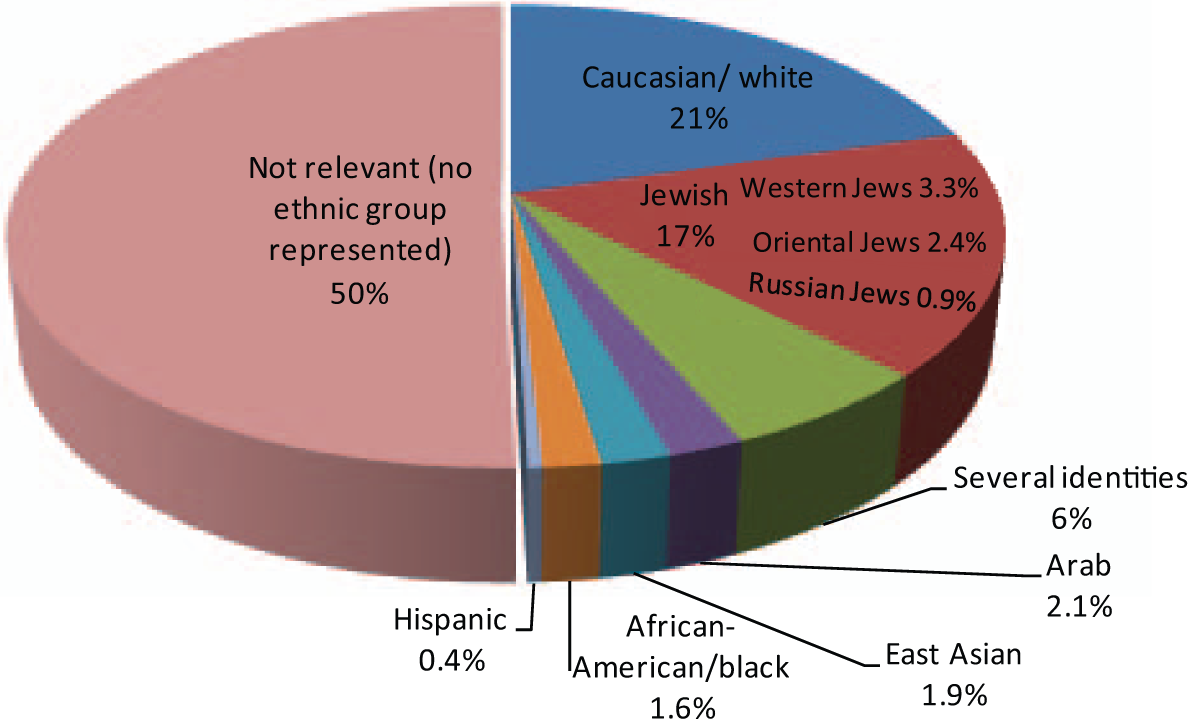
Ethnic representation in the sample.
Thus, results indicate that the sample was mainly Jewish- and white-centered. The general Jewish category, which is not confined solely to local boundaries (it is a common ethnic script around the world), was salient in the sample, yet Jewish sub-ethnic categories that are more locally oriented were relatively marginal, and the frequency of their appearance did not differ significantly from the representation of Arab, East Asian, and African-American/black others. This may indicate that domestic ethnic humor, so popular throughout Israel’s comic history, is beginning to give way to a global and multi-ethnic symbolic sphere.
This hypothesis is supported by the correlation between ethnic identity and humor genres. A comparison between the Jewish in-group and all other out-group categories indicates that Jewish protagonists were relatively evenly represented in all forms of humor (30% appeared in old forms of humor, 44.7% in internet-mediated forms and 24.7% in internet-generated forms). In contrast, the out-group categories were seldom apparent in old forms of humor (7.1%), but were highly represented in internet-mediated forms of humor (40.9%) and internet-generated forms of humor (52%). The difference between groups was significant (X2 = 60.6, df =2, p < 0.001). This finding indicates that the classic ethnic joke does indeed target mainly familiar groups, as described in the literature. However, new forms of humorous expression serve as importers of otherness into the local humorous symbolic sphere.
So far, we have shown that non-local ethnicities are imported – to a limited extent – into the local digital humorous sphere. In the qualitative phase of this study we aimed at understanding the implications of this transition, addressing RQ2 about the prevailing stereotypes of various groups and their possible social functions. We traced the prominent stereotypes about local groups (Western, Oriental, Russian Jews, and Arabs), as well as non-local ones (African-Americans/blacks and Asians), analyzing them in light of the three major theories of humor.
The comic depiction of local groups
Texts depicting ethnic sub-groups within the Jewish population were based on well-established yet simplistic stereotypes. The most salient stereotype was that of the Polish (Jewish) woman, portrayed as castrating, frigid, over-talkative, and complaining. For instance, a list of ‘Facebook rules’ stated that ‘Polish women will always report about headaches and PMS on their status update’. The majority of texts representing Oriental Jews were based on the frame of stupidity or lack of modernity. References to low intelligence, lack of understanding of modern society, and defective language or accent were particularly common in this group. The obnoxious Polish woman and the primitive Oriental Jew stereotypes indicate that inferiorization of the targeted groups was the main humorous mechanism at work. Thus, superiority theories of humor seem to be highly relevant to the analysis of these texts.
If Jewish sub-groups represent local in-group humor, comic texts about Arabs target a local and familiar out-group. The representation of the Arab identity was most heavily associated with the frame of terror. This frame was clearly ethnicized – the butt of these texts was often the general ethnic category (‘Arabs’) rather than a specific terrorist organization or person. The association between ‘Arabness’ and terror was based on two strategies. One depicted Arabs as clumsy terrorists, unsuccessful in their missions. In these texts, superiority over the protagonist’s failure was the central humorous mechanism. The second strategy was to convey the message that Arabs use terrorism in the guise of human rights efforts, thus breaching moral codes. Here, again, the texts used superiority as a humorous mechanism, as Arabs were assigned moral inferiority.
Non-local comic constructions: Depictions of blackness and Asianness
The major recurring trope in the representation of African-American/black protagonists was the association between the black body and sexuality. Subjected to a frame of grotesqueness, overweight or disproportionately formed black female protagonists appeared in texts with highly graphic visual depictions of intimate settings (such as the shower). Black male protagonists were framed as desirable – yet again, highly sexualized – lovers. For example, an advertisement for Coloreria Italiana fabric dye depicts a black man as an upgraded version of a white husband (see Figure 2). Another familiar example is the Old Spice Cologne viral commercial. In both examples the black body is framed as an object of admiration. Close-up shots of the semi-nude protagonists focus on their muscular physique. Flirting with a female audience in the case of Old Spice and contrasted to a white spouse in the case of Coloreria Italiana, both texts pose black male protagonists as prototypes of the ideal sexual partner. While the association between blackness and sexuality is an established stereotype often discussed as demeaning and fetishizing (Hall, 1992), most texts did not introduce explicit mockery. Rather, they suggested narrative victory (for male protagonists) or plain voyeurism (of female protagonists). Thus, whereas inferiorization on the basis of sexual fetishism could have been a deeper mechanism in most texts, on the surface it seems that the blatant expressions of sexuality posit release as the main humorous mechanism: the exotic black body serves as a conduit to reduce tension surrounding sexual taboos. In both feminine-and masculine-led texts, the representation of black protagonists is underlined by the motif of playful sexual behavior, devoid of inhibitions.
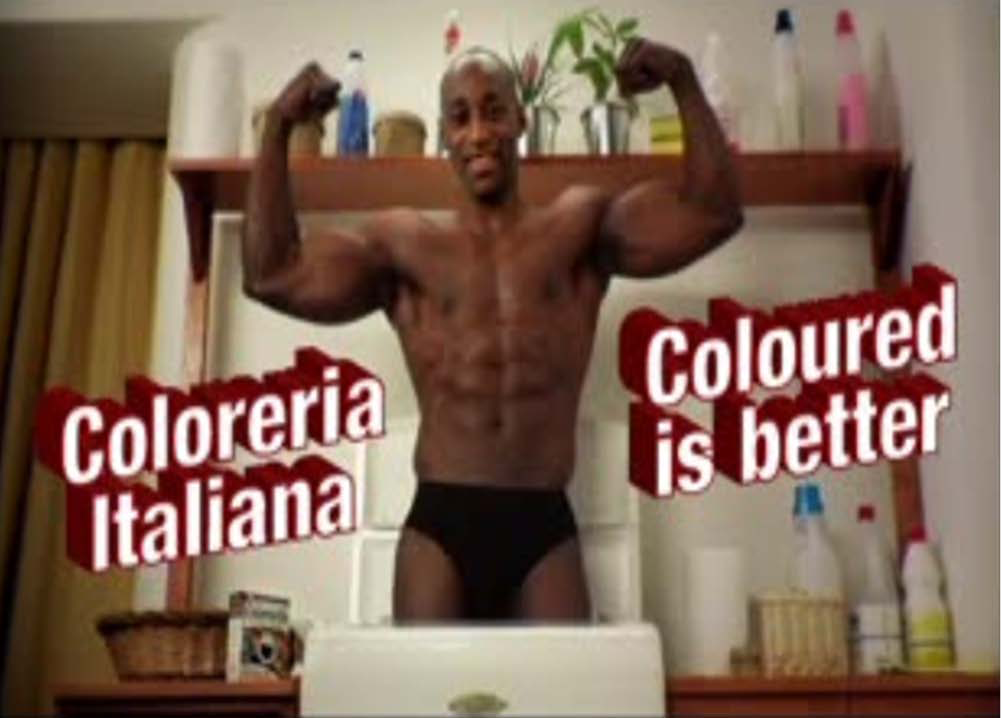
Coloreria Italiana: blackness and sexuality.
If the black body was associated in the comic texts with the sexual, the Asian body was mainly associated with the mechanical. Henri Bergson’s ([1899] 2003) argument that the comic derives from a human acting in a mechanical manner seems highly relevant to these texts. Asians were frequently represented either along the lines of a unique physical talent or as rhythmic machines, repeatedly articulating speech and gestures. For example, an extract from Zuiikin’ English, a Japanese television series, depicts three ‘Zuiikin gals’ teaching English phrases by performing synchronized exercises while chanting a phrase hypnotically to techno-pop sounds (see Figure 3). As with the representation of blackness, these texts did not explicitly mock or show Asians as inferior; their main humorous mechanism was the fundamental incongruence between the human and the mechanical, highlighting the absurdity entailed in the over-purposeful use of the human body. An additional but less salient frame that did inferiorize Asians represented them as underdeveloped, Third World inhabitants.

Zuiikin’ English: human–mechanical incongruity.
A comparative analysis of local and non-local ethnic groups in light of the three humor mechanisms points to a certain pattern. While superiority was a crucial component of ‘internal’ ethnic humor, comic mechanisms of release and incongruity seemed to be more central to the depiction of distant ethnic groups. The heavy reliance on superiority in relation to local groups may suggest that the implantation of inferiorizing humorous ethnic scripts requires a certain degree of cultural familiarity. Moreover, superiority may play an important role in negotiation over national identity.
In the Israeli case, the inferiorization of Arabs and Jewish sub-groups may be associated with national identity-related boundary work. Regarding inferiorization of Jewish sub-groups, it seems that a mainstream definition of Israeliness is being constructed by sending mocking arrows towards society’s binary Eastern and Western poles. Israel’s complex ethnic landscape has become convoluted over time. Cross-ethnic marriages resulting in a generation of offspring bearing hybrid ethnic identities have altered Israel’s socio-cultural blend (Sagiv, 2012). The survival of humor recycling exaggerated binary ethnic stereotypes amidst the ethnic and cultural shifts in Israeli society may indicate an attempt to construct shared values by negating undesirable attributes associated with both Eastern and Western Diasporas. In other words, contemporary Israeli identity – much like in the old days of pre-state Israel (Oring, 1981) – is defined in opposition to its presumed past: modern Israelis are constructed as the negation of both uptight Western Diaspora Jews and ‘primitive’ Eastern ones. The inferiorization of Arabness, on the other hand, usually pointed at Arabs who are not Israeli citizens, demonstrates outward mockery, an emphasis on national unity by exclusion of and differentiation from a presumed familiar rival.
Whereas humor about familiar groups may cater to national identity-related needs, humor about distant groups may serve as a venue through which more abstract concerns, spanning beyond national identity, are negotiated. For example, in this study we identified a binary opposition between the raw sexuality embodied in the representation of blackness and the hyper-technicality expressed in the depiction of Asianness. This finding seems to correspond with Davies’s (1990) thesis about the dichotomous nature of ethnic humor around the world. According to Davies, the dyads underpinning ethnic humor – such as stupidity versus canniness and promiscuity versus sexlessness – tune in to concerns shared across modern Western-capitalist cultures. By mocking two extreme modes of human behavior – taking the world too seriously and not taking it seriously enough – ethnic jokes address people’s anxieties about striking the right balance between material success and leisure/enjoyment. Focusing on the human body, texts in our sample representing black and Asian protagonists may relate to Davies’s promiscuity/sexlessness dyad. While he refers to this dyad as the female equivalent of the male-dominated stupid/clever dyad (adapted to the domestic sphere of family and marriage), our findings suggest that such binary treatments of the body are not limited to female protagonists. Both male and female black protagonists were associated with sexuality, while male and female Asians alike were depicted as mechanical bodies – a frame that strongly implies sexlessness. Nevertheless, these contrasting framings can still be interpreted as a metaphor for what Davies described as a rudimentary concern shared by Western cultures: the striving to find the golden path between pure lighthearted leisure (associated with carefree displays of black sexuality) and target-oriented serious work (associated with over-mechanical images of the Asian body).
The turn to genre plurality: Implicit and explicit ethnic targeting
So far, we have focused on what we term the global turn of ethnic humor. We now address the second transformation underpinning web-based humor: the turn to genre plurality. We suggest above that as digital humorous texts introduce a mélange of new genres, heavily oriented towards visual comic effects, humor may incorporate a growing portion of implicit references to ethnicity.
In RQ3 we asked to what extent the representation of ethnicity is associated with explicit ethnic stereotypes. We found that overall, stereotypical ethnic humor remains a popular theme – it appeared in more than 25% of the texts in the sample (n = 276). The Jewish in-group was frequently stereotyped: 63.6% of texts representing Jewish protagonists included ethnic stereotypes. Texts representing out-group identities introduced a more varied level of stereotyping. Stereotypical references were apparent in 56% of African-American/black, 47% of East Asian, and 63.6% of Arab representations. 6 In contrast, only 12.7% of the texts depicting Caucasian/white protagonists included stereotypes (X2 = 71.8, df = 4, p < 0.001). The difference between groups falls in line with Dyer’s (1988) analysis of cinematic representations, in which he shows that ‘whiteness’ is constructed as a transparent representation, while non-white protagonists are commonly contextualized by their affiliation to a larger ethnic category. Yet our findings also indicate that whereas ethnic stereotyping is a dominant component in the representation of most ethnic groups, the two do not completely overlap. In other words, ethnic groups may be represented without being stereotyped.
We explored the nature of this gap between ethnic performance and ethnic stereotyping through a qualitative analysis of ethnicity in different comic genres. This analysis addressed the fourth research question, which asked about the difference between verbal forms of ethnic humor and new visual forms in respect to ethnic representation.
The analysis confirmed that humor packed in old formats was relatively more stereotypical than new humor. Out of the 32 texts classified as old humor, 23 included explicit stereotypes. The targeted ethnic categories in this cluster of texts were verbally signified and their associative stereotypes served as a background script that surfaced in the joke’s punch line. These old and stereotypical forms of humor represented mainly local ethnic groups: 17 of the 23 texts targeted Jewish sub-groups or Arabs.
In contrast, new multimodel forms of humor (involving text, image, sound, and motion) are not dependent on verbal explicitness, and thus demonstrate a more complex pattern of association with stereotyping. Paraphrasing Kress’s (2003) argument, these texts shift from telling ethnicity to showing it, in multifaceted ways. We identified three central formulations of ethnic representation in new humorous genres: (1) the visual reproduction of stereotypes; (2) polysemy; and (3) the neutralization of stereotypes.
Visual reproduction of stereotypes
Many texts in the sample (58 out of 130), depicting all six ethnic groups, included a visual reproduction of stereotypes. This re-articulation of stereotypical images was employed through two main practices, typical of internet-based humorous genres.
The first – found mainly in funny photos and home videos – is what we tag the untouched image. These are allegedly natural images, incidentally captured in the photographer’s lens, supposedly indexing the reality ‘out there’. Untouched images are often framed using a caption or email subject line. This practice of humorous ethnic representation pretends to generate authenticity through the conceived power of the image as a reflection of reality (Lister, 1997). For example, a photo entitled ‘Diaper Substitute in China’ represented an Asian infant lying on his back, with a punched paper cup serving as a replacement for a diaper (see Figure 4). Genuinely authentic or not, the rhetoric of this picture is of an uncensored real-world image. The use of the paper cup – an absurd, improvised, hygienically questionable, and clearly impractical version of the disposable diaper used extensively in the West – encodes several meanings that correspond with stereotypical conceptions of China as an undeveloped nation. One possible reading of this photo posits Chinese ‘technology’ as inferior to Western. A second reading ascribes China with primitive and hygienically backward qualities. This photograph was originally circulated on the internet in gender-based contexts, appearing under titles such as ‘Don’t let men babysit!’ and ‘Men can fix anything’. However, its arrival in the Israeli cyber-sphere was accompanied by erasure of the original title and its replacement with the generalizing title about Chinese practices. This phenomenon demonstrates the modularity of supposedly authentic images and the agency involved in internet users’ meaning-making. With a light keystroke, local internet users re-charged the photo with ethnic associations and stereotypical framings.
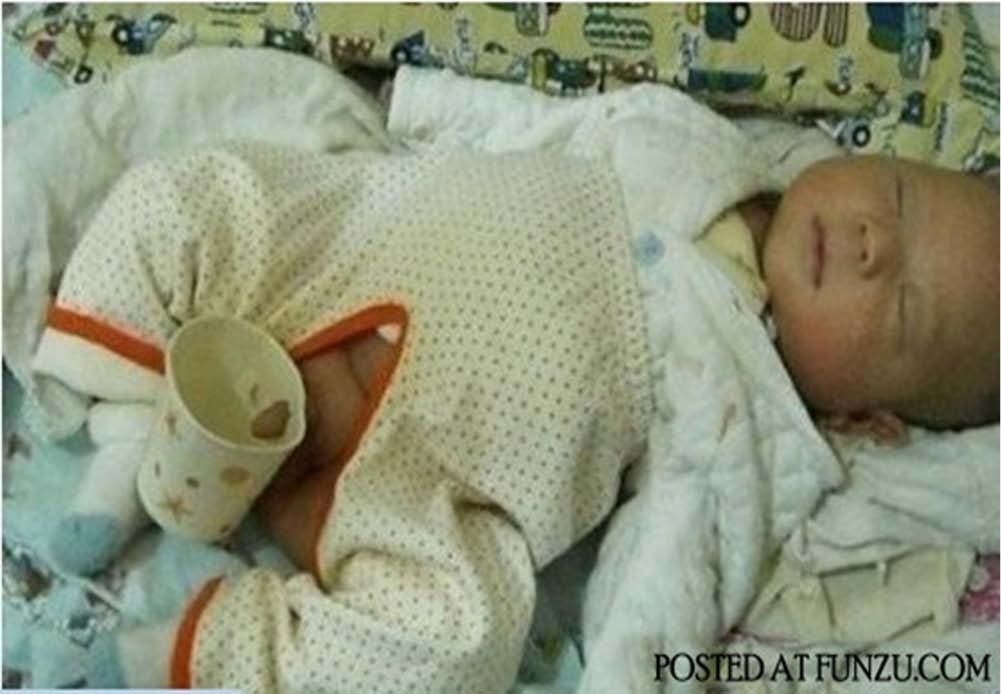
Untouched image: diaper substitute in China.
The second practice applied to the reproduction of stereotypes involves tendentious editing in the form of implemented subtitles, implemented soundtrack, animation, and image juxtaposition using software such as Photoshop. These manipulations reflect a cut-and-paste or bricolage culture, in which users creatively translate prevailing stereotypes into visual language. For example, a photo entitled A Moroccan Family Dinner used digital manipulation to replace silverware with guns and flick knifes, thus reproducing a stereotype of this Jewish sub-group as associated with violence and delinquency through visual language (see Figure 5).

Tendentious editing: Moroccan Family Dinner.
Polysemy
A small cluster of texts (n = 12) represented ethnicity in a complex manner, enabling the emergence of competing interpretations. While one chain of signifiers pointed to a certain ethnic stereotype, an additional chain implied at an oppositional meaning, sometimes undermining the original stereotype. A salient characteristic of polysemic texts was the use of intertextuality (Kristeva, 1980). Citations of other texts created a polysemic understanding of ethnicity as it was associated with an additional source of signs and meanings. Another mechanism that enabled polysemity was redundancy – the overflow of stereotypical ethnic signifiers – which often led to an absurdity that enabled subversive interpretations.
For example, a video clip entitled ‘Arab Boy Band’ depicted a group of Israeli-Arab men, employees of a restaurant, trying (unsuccessfully) to woo an Israeli-Jewish girl. Referencing the genre of pop boy bands, the men perform a meticulously choreographed love song to the Jewish customer. The Arab protagonists (all played by Jewish actors) are highly inferiorized through offensive mimicry and stereotypical roles. However, the overflow and exaggeration of ethnic slurs creates a competing understanding according to which what is ridiculed in the text is the stereotype itself, criticizing Israeli society for racism. The simultaneousness in the appearance of different signifiers that characterizes new forms of visual humor enables higher levels of openness in comparison to the classic form of the ethnic joke. This category of polysemic texts was almost exclusively representative of local groups − 5 of the 12 texts featured Arabs and 6 represented Jewish ethnic groups.
Neutralization of ethnicity
In the third cluster of texts (n = 27), protagonists were represented in a natural manner, devoid of ethnic stereotypes. To put it simply: ethnicity was a non-issue in these texts. For example, in ‘Telephone Remake’, a homemade video clip, black and white American soldiers stationed in Afghanistan perform a choreographed lip dub of Lady Gaga’s hit ‘Telephone’. Soldiers of both ethnic groups playfully mimic the song without alluding to any specific ethnic stereotype. Texts of this sort have a liberating potential: they allow the viewers to laugh with the protagonists regardless of their ethnic classification, rather than laugh at them on the basis of their ethnicity. 7 This form of representation includes mainly motion-based images, mostly originating in professional media content such as advertisements and pranks on TV broadcasts. The clear majority of texts in this group represent black protagonists, usually alongside white ones, and most texts seem to have originated in the United States. Thus, the liberating potential of these texts was limited to (idealistic) visions of American multi-culturalism.
Conclusions
The main argument presented in this paper is that the internet’s technological and cultural affordances have led to major transformations in the articulation of ethnic humor. Two main attributes of contemporary ethnic humor were traced and analyzed.
The global turn
Findings indicate that: (a) new forms of humor import, to a limited extent, non-local ethnic groups into the local symbolic sphere; and (b) non-local groups are constructed differently than local ones. Whereas local and familiar groups were mocked mainly by means of inferiorization, distant groups were often represented through mechanisms of release and incongruence. We linked this difference in humorous expression to the identity needs of the forwarders. Thus, superiority aimed at familiar groups is a conduit for negotiation over national identity, whereas the comic construction of distant groups serves as a metaphor for abstract fears and dilemmas, shared across western cultures.
The turn to genre plurality
In order to fully grasp the relationship between humor and ethnicity in an increasingly visual landscape, the definition of ethnic humor has been broadened to include both explicit forms of stereotype-based humor and more subtle forms of ethnicity as a performance within the comic text. If in the verbal joke the representation of ethnicity is based on stereotypical telling, the new array of internet-based formats encapsulates a continuum of connections between ethnic appearance and stereotypes through practices of showing. On the derogatory end of this continuum we found texts that reproduced ethnic stereotypes into visual language. On the continuums’ open end, ethnicity was manifested in competing meaning systems (thus enabling polysemy), or in a neutralized setting in which the performance of the ethnic body was detached of stereotypes.
Until now we have analyzed the global and the genre-plurality turns separately. By way of conclusion we wish to link these processes and their possible implications. Figure 6 illustrates the relationship between locality, humorous mechanisms, and degrees of stereotyping in contemporary Israeli ethnic humor. It demonstrates that ‘stereotypical showing’ – the reproduction of stereotypes through new digital means – is realized with regards to both local and non-local ethnic groups. Nonetheless, in some cases digital-visual tools are also used for the deconstruction of stereotypes. What our framework indicates is that local and non-local groups embody different subversive potentials. The subversive potential associated with non-local groups relates mainly to neutralized performances of ethnicity; in contrast, that of minority groups within the local sphere stems from comic ambiguity. Since local groups are entwined in local power structures, comic texts about them often relate to hegemonic stereotypes conveying superiority. Polysemic texts offer the opportunity to deconstruct such stereotypes; yet the realization of this potential requires an active, inclined, and oppositional reader. In other words, subversion in the local sphere is hard work.
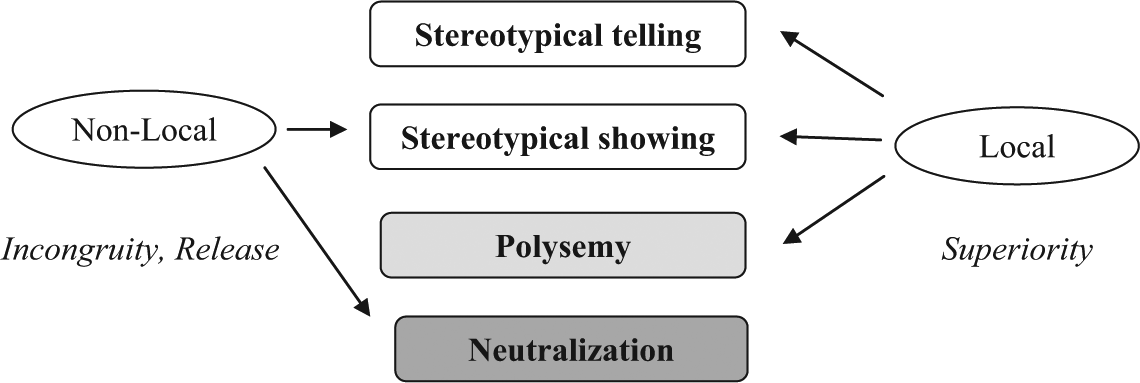
The relationship between comic targets’ locality, humorous mechanisms, and positioning along the stereotype continuum.
This exploratory study of digital ethnic humor focuses on the Israeli case. It accounts for humor formulated in a specific time, place, and medium. Moreover, the study is limited by its examination of texts provided by a voluntary sample. While, as reported earlier, this sample was varied in many socio-demographic aspects, it constitutes mainly young members of the Jewish majority group. Thus, a follow-up study focused on the Arab minority population and on older age groups would be a worthwhile endeavor.
Despite these limitations, the conceptual framework the study yields will hopefully contribute to future research. Possible directions for further inquiry include cross-cultural comparisons, trans-media analysis, and effect-related experiments. While the specificities of ethnic representations are different in varying contexts, concepts of locality; humorous mechanisms; and degrees of stereotyping serve as analytical tools with which the digital construction of ethnicity in various places could be evaluated. In addition to an expansion in space, future research could broaden the scope of examination across media. Ethnic humor is circulated through a variety of technologies and applications, spanning TV sets and iPhones, social networking sites and instant messaging. A trans-media analysis based on our suggested framework may reveal that features such as global orientations and degrees of ethnic stereotyping differ between platforms, responding to their cultural and technological affordances. Finally, a question that remains unanswered in this research concerns the effect new forms of web-based humor have on recipients. While previous research has shed light on the influence traditional forms of ethnic joking have on prejudice, further experiments could determine whether the visual reproduction of stereotypes has a stronger effect on bigotry than classic ethnic jokes and, in contrast, whether exposure to neutralized performances of ethnicity in humorous texts reduces prejudice.
Footnotes
Acknowledgements
We are indebted to Dafna Lemish, Esther Schely-Newman, Asaf Nissenboim, and two anonymous reviewers for their useful comments and help.
Funding
This research received funding from the Israeli Science Foundation (ISF).