




Abstract
This study investigated to what extent sons and daughters influence their parents’ adoption of digital media, particularly the internet, compared to other influence sources. It also explored structural factors that play a role in this bottom-up process, such as socio-economic differences and gender. Finally, it examined the relationship between this bottom-up technology transmission process and parents’ levels of internet self-efficacy and online activities. Drawing from socialization and diffusion of innovation research and using a self-administered random mail survey, we found that children play a role in including their parents in the digital environment, particularly among women, people who are older (35 years old and above), and belong to lower socio-economic groups. We also found that this bottom-up technology transmission is somewhat negatively associated with parents’ internet self-efficacy. Implications and possible interpretations of these results are discussed.
Keywords
The generational divide is, perhaps, the most consistent digital gap. The younger generation is more familiar with new technologies than their parents or grandparents to the point that they have been called “digital natives” (Prensky, 2001). Although this term has been reasonably criticized for treating young people as a monolithic group (e.g., Correa, 2010; Correa and Jeong, 2011; Selwyn, 2009), the figures consistently show that younger people are more connected than their older counterparts. The Pew Internet Project has reported that 95% of teenagers and young people between 18 and 33 years old go online. After that age, the percentages steadily decrease. Three fourths of people 50–64 years old are online and 41% of people 65 years old and older are connected (Zickuhr, 2010; Zickhur and Smith, 2012). However, research by the Pew has also found that adults’ online activities have grown substantially, particularly their usage of social networking sites (SNSs). For example, the group of people 65 years old and older that use the internet has more than tripled in the last decade (Zickhur and Smith, 2012). In the case of SNSs, the adult population has tripled in the last four years (Brenner and Smith, 2013).
It is often seen that older generations are incorporated in the digital environment by their sons and daughters. In fact, the industry is beginning to focus on this youth role. Based on their own family experiences, people who work at Google launched in December 2010 TeachParentsTech.org, a website that provides technical support for adults with brief videos that show from how to send emails to create blogs (Manning, 2011).
Consumer research has shown that when teens consider a product important and are well-informed about it, they influence their family decision-making (Beatty and Talpade, 1994). Thus, youth’s greater interest and aptitude in new technologies may influence their parents’ adoption and usage of digital media. Therefore, they may become significant agents when including older generations in the digital environment. For instance, when the home computer and the internet were in their earlier diffusion stages, interviews revealed that teenagers were crucial in teaching and providing support to older members of their families, particularly their parents (Kiesler et al., 2000; Wheelock, 1992). More recent studies that include ethnographies, interviews, and a survey have also revealed that children can act as intermediaries within their families (Correa, in press; Ito et al., 2009; Katz, 2010). Thus, scholars have concluded that teens can help families adjust to technological changes and become agents of social change in their family. Even though we see this phenomenon in our everyday lives, very few investigations have explored it empirically. Drawing from socialization research and diffusion of innovation theory (Rogers, 1995), this study explores to what extent sons and daughters influence their parents’ adoption of digital media, particularly the internet, compared to other influence sources. It also investigates some structural factors that intervene in this process, and the potential outcomes of the process by exploring the relationships between the role of children as internet brokers and parents’ online activities and internet self-efficacy.
Literature review: Conflicting views
Studies consistently find that households with children are more connected than those without them. More than one decade ago, Livingstone et al. (1999) found that people living with secondary school children were more likely to adopt digital media. More recent studies conducted in the US found the same pattern: households of married couples with children are more likely to use the internet and cell phone, own computers, and adopt broadband than other household arrangements (Kennedy et al., 2008). Thus, it is reasonable to expect that children have a direct or indirect influence on their parents’ adoption and usage of new technologies.
Scholars, however, hold somewhat conflicting views on the influence youths exert on their parents on adopting digital technologies. While a few minimize youths’ role in their parents’ adoption and usage of technology (e.g., Selwyn, 2004), others posit that they play a key role (e.g., Correa, in press; Horst, 2009; Katz, 2010; Livingstone and Bovill, 2001; Van Rompaey et al., 2002). Selwyn (2004) concluded that although children were often the official reason for a family to adopt a computer, there were other factors that played a role in the acquisition of computers. He also demonstrated that although parents with children tended to engage in skillful activities such as manipulation of photos, interviews showed that they learned by different experiences, including self-learning and the work place. Therefore, the author suggested their influence should not be overstated.
Other scholars suggest that the potential benefit to children is central to parents’ adoption of digital media (Livingstone and Bovill, 2001). Just by persuading their parents about the benefits of the new medium, children play an important part in the process (Van Rompaey et al., 2002). In a model of adoption of technology in the household, Brown and Venkatesh (2005) found that in households with children, the utility for children was a significant predictor in the adoption of computers.
When the computer was first diffusing, interviews with 32 families revealed that most parents learned from their children how to use the computer (Wheelock, 1992). Similarly, a study that investigated internet diffusion found that teens became a link between the family and computer support professionals and helped others in the family to manage the Web (Kiesler et al., 2000). A more recent study based on ethnographies and interviews found that parents interacted with their children by trying to learn and buy new devices (Ito et al., 2009). For instance, in a middle-upper class tech savvy family, the son triggered an interest in podcasting in his father (Horst, 2009). Another current investigation that surveyed parents and children in Chile found that between 30% and 40% of parents had been taught by their children how to use computers, internet in general, and SNSs (Correa, in press).
Theoretical framework
Socialization means the learning of new social roles, values, attitudes, and customs (Putney and Bengston, 2002). Even though the socialization literature includes different agents of socialization, such as teachers, peers, and the media, it argues that parents are the primary sources of influence (Grusec and Davidov, 2007). Although socialization now is seen as a more bi-directional, interactive process, where both parents and children influence each other, parents are still seen as crucial socialization agents. Nevertheless, the literature has not explored in depth how this top-down process can be reversed in some contexts. For instance, studies indicate that sons and daughters can reverse the top-down model of political socialization and affect their parents’ acquisition of political knowledge (McDevitt and Chaffee, 2000). There is also evidence that daughters can influence their legislator fathers voting on women’s issues (Washington, 2006). We argue that one of the most relevant situations in which this traditional top-down family socialization can be reversed is in the adoption and usage of digital media. We do not contend, however, that top-down technology transmission does not matter. It does. However, because younger generations are more familiar (and have greater levels of authority) with digital media, technology capital can be transmitted to their parents in a reversed way. Although this process does not necessarily eliminate gaps between technology-rich and technology-poor families, it may allow incorporating older generations in the digital environment.
Children as digital media brokers: Reversing the influence
The diffusion of innovations theory (Rogers, 1995) explores the process in which a new idea is spread among people in a social system (e.g., the family). Interpersonal channels are generally the most effective in persuading people to accept a new idea. Two interpersonal roles are particularly important: opinion leaders and change agents. Opinion leaders are people who acquire information from different sources (e.g., mass media, peers) and then influence others in informal settings. Compared to followers, opinion leaders are more exposed to external communication, act as entry points of new ideas into their system, are accessible to their followers, have higher social status, and are more innovative. Change agents are people who use opinion leaders to spread the information. Although change agents usually have professional training and higher social status, most importantly they have to develop need for change by making their clients aware of the needs and develop credibility in their skills.
Younger people meet several characteristics in the definition of these interpersonal channels in the context of the diffusion of digital media within their families. Firstly, they tend to have more exposure to external communication than older generations by experiencing new digital applications via their school, work, and friends. Thus, they may serve as entry points for new ideas in their families. Also, children are accessible to their parents through face-to-face communication in informal settings (i.e., the household), which give them opportunities to exert influence. Although, according to the theory, change agents would be the companies and organizations that promote technological devices, children can also fulfill the role of a change agent by persuading their parents about the need for the new technology in the household, about their competence with digital media, and by developing empathetic strategies to motivate an interest in the technology (Van Rompaey et al., 2002).
Other terms to describe the phenomenon are children as “gurus” (Kiesler et al., 2000), “ambassadors” (Selwyn, 2004), “mediators,” and “brokers” (Katz, 2010). Because in the communication field the term “brokering” has been employed as the “way that children facilitate their parents’ connection to and understanding of traditional and new communication technologies” (Katz, 2010: 299), we think that the label “digital media broker” is appropriate to describe the phenomenon where children mediate between their parents (or guardians) and the digital media environment.
Bottom-up technology transmission
We propose that children (i.e., sons and daughters) influence their parents’ use of digital media such as the internet. The influence on technology usage can occur directly by teaching their parents, for example, how to use the internet. Domestication research (Silverstone, 1994) suggests that it is important to take into account social contexts in which new technologies are domesticated, including the household’s socio-economic status and gender roles. Thus, it is also hypothesized that this bottom-up influence process is more (or less) likely to occur depending on several factors. In this study we focused on structural factors such as socio-economic status of the family and gender roles.
Socio-economic status of the family
Financial and educational resources can act as a barrier or facilitator to acquire and effectively use digital media (Newhagen and Bucy, 2004; Rojas et al., 2012). For example, in the early 2000s, case studies showed that some parents argued that they refused to acquire internet access, despite their children’s persuasive strategies, because they did not have enough money (Van Rompaey et al., 2002). Individuals’ income and level of education are powerful predictors to acquire and use new technologies (Newhagen and Bucy, 2004). Therefore, a minimal investment capacity and education are necessary to acquire and use digital media such as the internet.
At the same time, the role of sons and daughters as brokers or mediators between new technologies and their parents or guardians is particularly important among families from lower socio-economic status (Katz, 2010).The social networks of low-income and low-educated parents are less likely to have extensive access to new technologies compared to middle and upper class people. Thus, their children’s external links are more likely to provide them with opportunities to use the new technologies and applications. Therefore, lower socio-economic status children may become technology brokers in their families by translating websites and helping to find and search information. For instance, Tripp and Herr-Stephenson (2009) described how Rose, an immigrant from El Salvador who lived in Los Angeles, California, was being taught by her daughter how to use the computer, send emails, and pay bills online. Also, Rojas et al. (2012) found that in many Hispanic and African American families, daughters and granddaughters bought and taught their older generations how to use cell phones, computers, and the internet. Thus, it is hypothesized that children’s influence on internet adoption will be stronger among lower socio-economic status families than higher socio-economic status families.
Gender roles
Research has found that there are gender differences in the level of influence children exert on their parents’ technology usage. For instance, although boys were as likely to help both parents about internet usage, girls were more likely to provide help to women. Also, although mothers were often described by children as “clueless” regarding technologies (Horst, 2009), they are often the most likely to receive help from their children (Correa, in press; Wheelock, 1992). These gender differences are expected, given the persistent gender gap in technology adoption and usage; people have been consistently socialized with the idea that technology is a male domain (Cooper, 2006; Dholakia et al., 2004; Meraz, 2008). Thus, we hypothesize that mothers are more likely to be influenced on internet adoption by their children than fathers.
Transmission process, internet self-efficacy, and online activities
Research on the bottom-up technology influence from children to parents has only focused on the process itself. In other words, using mostly qualitative techniques, scholars have explored whether children influence their parents in the adoption of new technologies and help their parents on how to use it. This study also explores how this bottom-up influence from children to parents may also be related to people’s beliefs regarding digital technologies. On the one hand, parents may feel more technologically empowered after the interaction intended to influence adoption and usage. Scholars who have investigated digital workshops have suggested that the training sessions made people feel more empowered and efficacious regarding their digital skills (Tufekci, 2003). Developed by Bandura (1977), self-efficacy means a form of self-evaluation in which people feel able to perform a task regardless of their skill. Applied to the internet, it refers to the individuals’ self-perceptions on their abilities to perform internet activities regardless of their skills. It refers to people’s perceptions about their skills. Research has found that internet self-efficacy is a strong predictor of online activities (Broos and Roe, 2006; LaRose and Eastin, 2004; Livingstone and Helsper, 2007; Ryan, Rigby, and Przybylski, 2006). However, prior experience with the technology is necessary to reach satisfactory levels of internet self-efficacy (Correa, 2010; Eastin and LaRose, 2000). Thus, children may help their parents to get exposed and experiment with the internet, which in the end increases their levels of internet self-efficacy and usage. On the other hand, it is also expected that people who have lower levels of self-efficacy and lag behind in internet skills and activities compared to other people will rely on their children as a learning source. Therefore, it is possible that if we investigate this group using a cross-sectional survey, we may find that those who receive help from their sons and daughters have lower self-efficacy and lag behind in online activities. Therefore, we pose the question: What is the relationship between the role of “children as internet brokers” and parents’ internet self-efficacy and online activities?
Methodology
To investigate the influence exerted from children to parents in internet adoption, this study relies on a self-administered mail survey called the “Austin Internet and the Global Citizens Survey” conducted in Austin, Texas. Because the goal of this study is to assess digital media usage across populations from different socio-economic backgrounds, a self-administered mail was an appropriate method because it includes people who may not have a landline phone (Kempf and Remington, 2007), and who do not feel comfortable filling out a survey online (Hargittai and Walejko, 2008). This type of survey has other advantages: it allows respondents to answer at their own pace, provides privacy, and insulates respondents from the expectation of the interviewer (Mangione and Van Ness, 2009), which yield to less social desirability biases in the responses and greater validity and reliability.
The survey was conducted in November–December, 2010, among a random sample of 15,000 adults (18 years old and older). The city purchased a dataset of 15,000 addresses, 12,000 of which were a random set of residential addresses that belong to the metropolitan area of the city. In addition to these 12,000, another 3,000 were oversampled from zip codes or areas with poorer and increased minority populations. A postcard notifying about the survey was sent two weeks before the respondents would receive the mail questionnaire. When respondents received the survey, they received a separate sheet that gave the respondents the option to participate in a drawing for a netbook computer valued at US$400 as an incentive. A total of 1,701 surveys were mailed back, for a simple response rate of 11.3%. Because a comparison of this survey with the 2010 Census and the 2009 American Community Survey showed an overrepresentation of women, white and better educated people, studies that used this survey weighted the data based on gender, race, age, and education so as to have results that more accurately reflect the city population (see., e.g., Chen et al., 2013). Sample weights were conducted using Stata’s weight procedure. This procedure adjusted the demographic distribution of the sample following the city’s general population parameters based on the 2010 Census and the 2009 American Community Survey. To guarantee greater generalizability of the results, we applied the sample weights to all analyses.
Description of survey variables
Children as internet brokers
To assess to what extent sons and daughters act as technology brokers in their families (i.e., teach their parents how to use a new technology such as the internet compared to other sources of learning experiences), the following question was used: “Who taught you how to use the internet?” The answers were in a “check-all-that-apply” format and included: my father or mother; my brother or sister; my spouse or partner; my son or daughter; another relative; a friend; a teacher; myself; other.
Structural factors
To analyze the degree to which structural factors such as family socio-economic status and gender intervene in the bottom-up technology transmission, three socio-demographic questions were used: education, income, and gender. For age, an open-ended question was asked: “What year were you born?” Then the variable was recoded as a continuous variable from 18 and older, and into six categories (18–24, 25–34, 35–44, 45–54, 55–64, 65 and older). For education the question was: “What is the highest degree or level of school you have completed.” The responses included five categories: less than high school; high school; technical certificate, two-year college degree or some college; four-year undergraduate degree (e.g., BA or BS); graduate or professional degree. For income, respondents were asked: “Last year in 2009, what was your total family income from all sources, before taxes?” The answers included eight categories: from less than 10,000 to 75,000 and above. These categories were collapsed into four groups: less than US$19,000, US$20,000–39,000, US$40,000–74,000, US$75,000 or more. For the regression analyses, a socio-economic status variable was created by standardizing and aggregating education and income. Finally, gender (“Are you male or female?”) was recoded as a dummy variable (male = 0, female = 1).
Internet self-efficacy
To investigate to what extent the bottom-up teaching process was related to parents’ internet self-efficacy, a scale to measure this concept was created using the following six statements measured with a five-point Likert scale: blocking spam or unwanted content; adjusting my privacy settings on a website; bookmarking a website or adding a website to my list of favorites; comparing different sites to verify the accuracy of information; creating and managing my own personal profile on a social network site; creating and managing my own personal website (α = .89).
Online activities
To examine whether the bottom-up technology transmission was related to online activities, an index of digital media usage was created based on frequency of engaging on a number of online activities. On a five-point Likert scale, respondents rated the frequency from “never” to “daily.” The activities included in the index were: read or send email, buy a product online, pay bills online, read blogs, use a social network site.
Results
Sample overview
In this sample of 1,701 randomly selected adults in Austin, a little bit over half were males (52%) and white (54%). Whites were followed by Hispanics (31%), African Americans (8%), and Asians (6%). Also, more than one half of the sample was 35 years old and older (54%). People tended to have higher degrees of education: 16% had a post-graduate degree, 28% a BA or BS and 23% some college education, while 33% had high school or less. Regarding income, 18% were poor (less than US$19,000) and 35% earned US$75,000 or more. Finally, the vast majority (82%) was born in the US. Regarding internet access, most of the sample uses the internet (88%), and mostly from home (94%), although they also access it from work (62%). In the subsample of people 35 years old and older, which was used in most of the analyses because these respondents had greater chances of having children of at least 10 years old, the majority was men (56%) and white (58%). Then, 23% were Hispanics, 9% blacks, 8% Asians, and 5% from other racial categories. Also, most of them were middle-aged (36% were between 35 and 44 years old and 29% were between 45 and 54). Half of the sample had either a two-year or a four-year college degree and 29% had high school or less. Finally, 27% of the respondents’ households made between US$40,000 and US$74,000 per year and 35% made less than US$40,000 per year.
Children as internet brokers
To investigate whether sons and daughters influence their parents in adoption of internet compared to other learning sources, frequencies and chi-square tests of the different learning sources were conducted. Firstly, Table 1 shows that people learned how to use the internet from different sources at the same time. If we look at the total sample, which includes 18-year-old respondents and older, people checked “myself”, “teachers”, and “friends” as the most important sources from which they learned how to navigate the Web. However, if we focus on a subsample of people 35 years old and older, who have greater chances of having children of at least 10 years old, Table 1 revealed that sons and daughters were the third most important source to learn about the internet, after self-learning and friends (which may include co-workers).
Internet learning source (check all that apply).
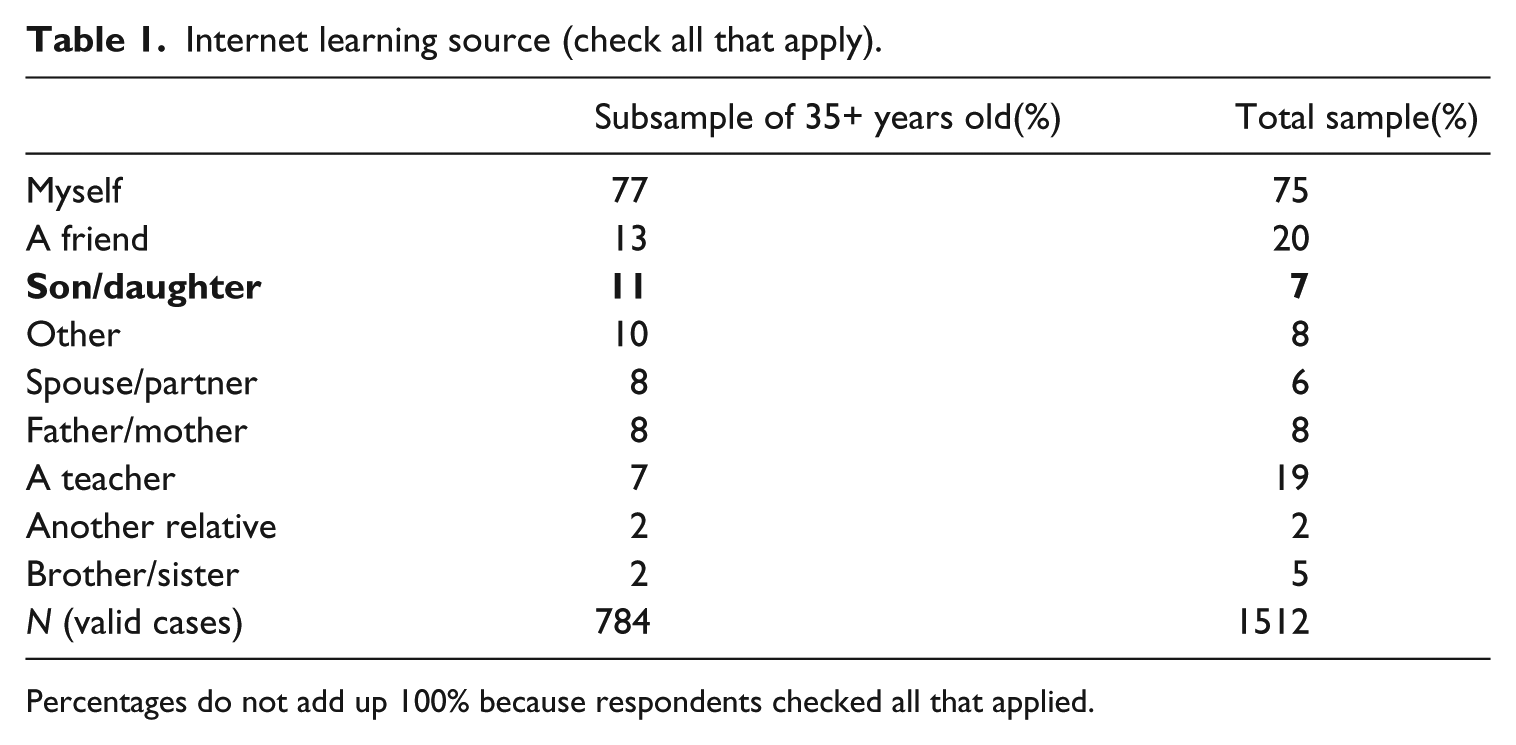
Percentages do not add up 100% because respondents checked all that applied.
The analysis of the role of children in the internet adoption of their parents by respondents’ age shows that their influence significantly increased as parents grow older (see Table 2). While 5% of people who are between 35 and 44 years old said their children taught them how to use the internet, that percentage increased to 20% or greater for the older cohorts (55–64 and 65 and older). Furthermore, for people 55 years old and older, their sons and daughters were the second most important learning source after self-learning.
Internet learning sources by age.

Chi-square test.
Percentages do not add up 100% because respondents checked all that applied.
Socio-economic status and gender as intervening factors
This study also explored the structural factors, such as socio-economic status and gender, which may intervene in this bottom-up socialization process. Socio-economic status was explored using education and income. As Tables 3 and 4 show, groups from lower education and lower income were more likely to rely on their children to learn how to use new technologies. These differences were statistically significant. While 35% of people with less than high school education and 20% of people who just finished high school said that their children taught them how to use the Web, only 4% of respondents with college education relied on their son and/or daughter (see Table 3). We found the same pattern when we analyzed by income. The role of children on their parents’ internet adoption steadily decreased as income increased. While 31% of people whose family income was below US$19,000 relied on their children, only 4% of the group who earned US$75,000 or more did the same (see Table 4). Self-learning (i.e., “myself” as learning source) followed the opposite pattern: as education and income decreased, fewer people said they learned by themselves.
Internet learning source by education (35+ years old).
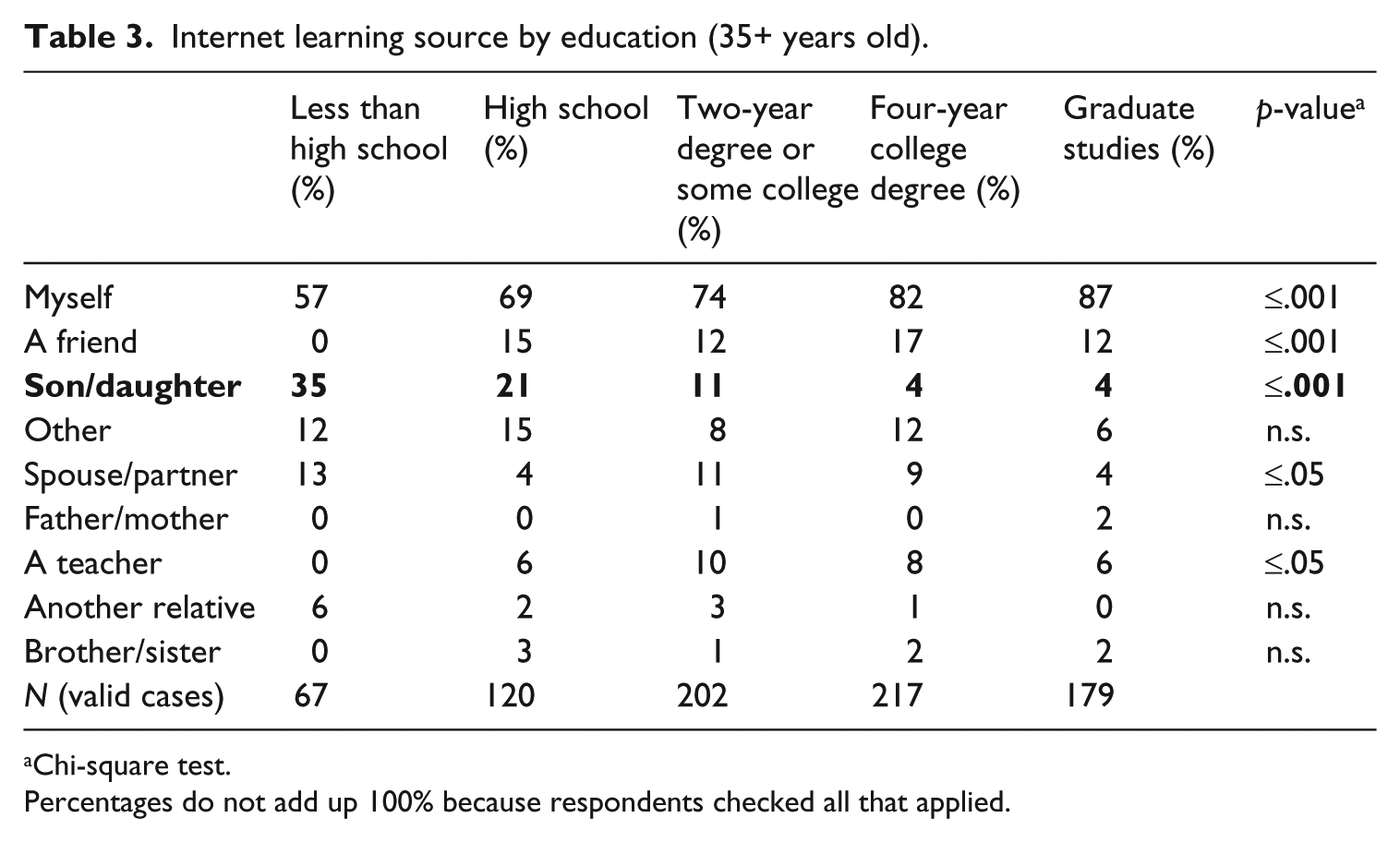
Chi-square test.
Percentages do not add up 100% because respondents checked all that applied.
Internet learning source by income (35+ years old).

Chi-square test.
Percentages do not add up 100% because respondents checked all that applied.
Also, as hypothesized, the study revealed gender differences in the role of children as internet brokers. That is, women were more likely to receive help from their children than men. While 8% of men included their son/daughter as a learning source, two times as many women (16%) asserted that their children taught them how to use the Web (see Table 5). Furthermore, for women their sons and daughters were the second most important learning source after self-learning. It is also noteworthy that women tended to include self-learning as a source less often than men (71% versus 82%). In addition, women tended to learn from their spouses or partners more often than men (11% versus 6%).
Internet learning sources by gender (35+ years old).
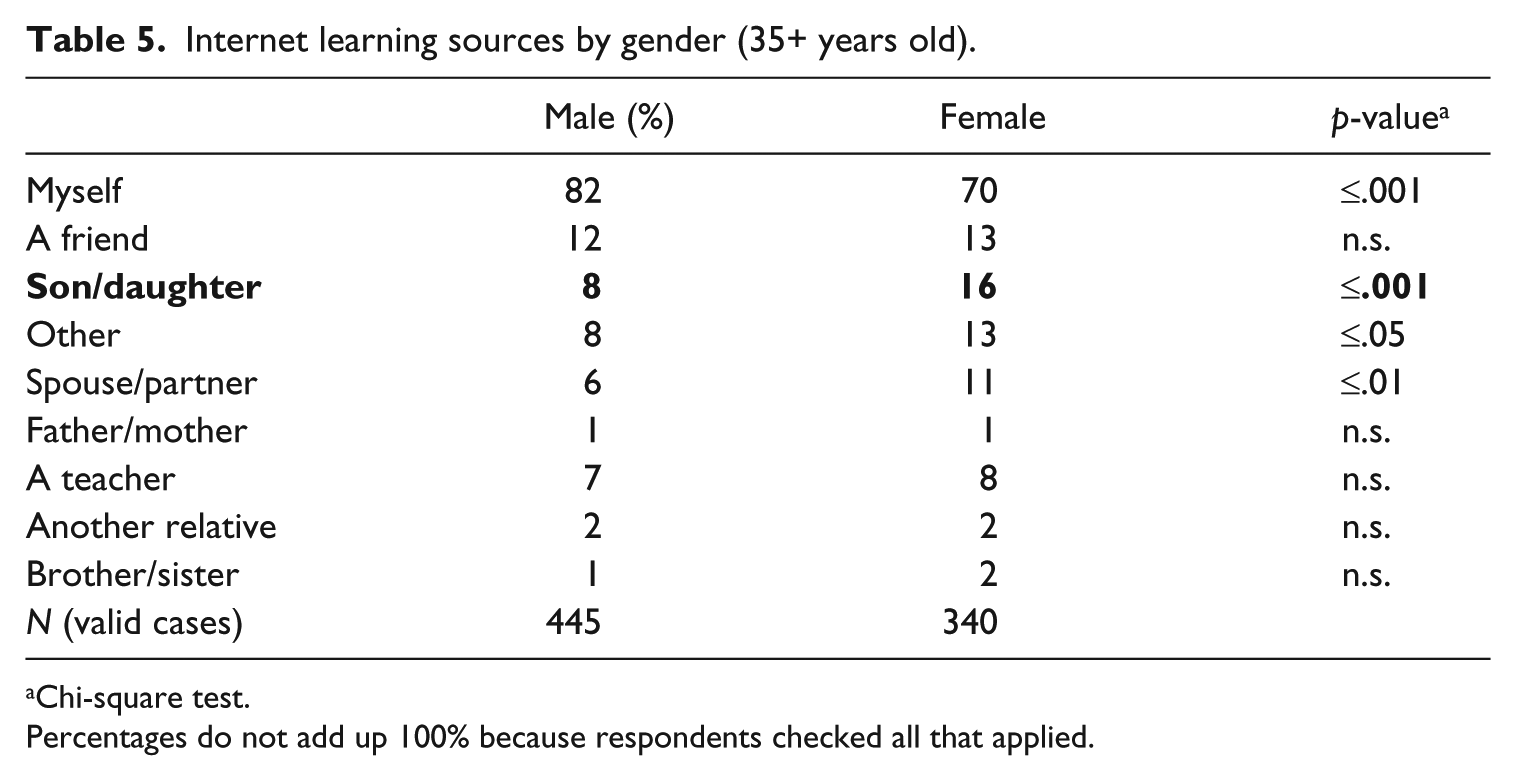
Chi-square test.
Percentages do not add up 100% because respondents checked all that applied.
To do a more stringent analysis and see how each of these structural variables was associated with having children as internet brokers controlling for the rest of the factors, a logistic regression was conducted. As Table 6 shows, age, socio-economic status, and gender were significantly related to having children as internet brokers. In other words, holding everything equal, the odds of being introduced to the internet by your own children increased when respondents were women, older, and had lower socio-economic status. These findings confirmed our hypotheses.
Logistic regression: factors related to having children as internet brokers.

Nagelkerke R2 = 12.3%.
Cox & Snell R2 = 6%.
N = 1178%.
Children as internet brokers, self-efficacy, and online activities
This study also explored how this bottom-up transmission process was related to parents’ self-efficacy and online activities. To explore these relationships, we conducted two multiple regressions where “children as internet brokers” (i.e., whether parents were taught by their children on how to use the internet) was the main predictor of a scale that measured internet self-efficacy and an index of online activities. These relationships were controlled by socio-demographics (i.e., age, socio-economic status, and gender) and self-learning (i.e., whether the respondents learned to use the internet by themselves). The latter variable was included as control because, as Table 1 revealed, the vast majority of people included “myself” as an internet learning source.
In Table 7 the regression shows that younger people had higher levels of efficacy and performed more online activities. Also, male and lower socio-economic status individuals tended to have higher internet self-efficacy and conducted more activities on the Web. In addition, self-learning was positively related to self-efficacy and online activities. Finally, controlling for socio-demographics and self-experimentation, being taught by sons and daughters was not associated with the number and frequency of activities respondents’ perform online. It also showed a negative, although marginally significant, association with people’s level of self-efficacy. In other words, the group that relies on their children may have lower levels of internet confidence compared to those who did not use their sons and daughters as a learning source. This result suggests that people who received help from their offspring may be a technology-needy group, although this result is weak and needs further testing.
Hierarchical regression: factors predicting online activities and internet self-efficacy.

N = 771, 746.
p ≤ .10, *p ≤ .05, ** p ≤ .01, ***p ≤ .001.
Conclusion
This study investigated to what extent sons and daughters influence their parents’ adoption of digital media, particularly the internet, compared to other influence sources. We also explored structural factors that play a role in this bottom-up process, such as gender and socio-economic status. Finally, we examined the relationship between this bottom-up process and parents’ levels of online activities and internet self-efficacy. Using a self-administered mail survey, respondents had to select all the learning sources from which they learned how to use the internet. As expected, three fourths of the respondents asserted that they learned by themselves. That is, self-learning is crucial when including people in the digital environment. This result is positive because research consistently finds that self-experimentation is a strong – or sometimes the strongest – predictor of digital self-efficacy and digital skills (Correa, 2010; De Haan, 2004, Hargittai and Hinnant, 2008; Livingstone and Helsper, 2007). That is, those who self-experiment with technologies are more likely to be more digitally included.
When we looked at the subsample of people 35 years old and older, a group that is more likely to have children older than 10 years old, we found that sons and daughters played a moderate role in including older generations in the digital environment. Ten percent of people said they were taught by their children. This was the third most important learning source after “myself” and “friends.” This percentage doubled among the group who is 55 years old and older, and became the second most important internet learning source after self-learning. These results suggest that children become internet brokers in their families, particularly for older people who were not raised in a digital environment or were not exposed to these digital technologies through school or peers. However, the percentages were not very high and, as Selwyn (2004) suggested, offspring are not the only factor in the digital inclusion process among older generations. This is a complex process where a myriad of factors play a part. Nevertheless, the role played by sons and daughters merits attention and more detailed investigations.
Theoretically, this result demonstrated that in some contexts, such as technological realms, the top-down traditional patterns of diffusion and socialization can be reversed. This result is in line with other findings that demonstrated reverse influences, such as the influence children exerted on their parents’ political knowledge after attending a civic program in their school (McDevitt and Chaffee, 2000), or the influence daughters exerted on their legislator fathers regarding women’s issues (Washington, 2006). Because new technologies are deeply ingrained in our daily life, this reverse pattern of influence may consistently alter traditional family and socialization roles.
In this study, we explored two structural factors that may play a role in the bottom-up transmission process, socio-economic status and gender roles. Supporting our hypotheses, we found that this bottom-up influence is stronger among lower socio-economic status individuals and women, even when controlling for each other (see the logistic regression in Table 6). These results were expected because the roles of the household’s members organize how technologies are introduced into the family (Haddon, 2006). In this sense, children that belong to lower socio-economic status families act as important culture and language brokers between their family and the outside environment (Kam, 2011; Katz, 2010). Because children are more exposed to technological inputs through their school and peers and digital media represent a new environment for lower socio-economic status people, children from poorer families are more likely to transmit their knowledge to their families than children from higher socio-economic families.
In the case of gender, women traditionally lag behind men in technology adoption and usage because individuals have been socialized with the idea that technology is a “male world” (Cooper, 2006; Dholakia et al., 2004; Meraz, 2008). Therefore, women need not only more help from their children but may be more willing to receive it because they do not have to fulfill expectations of being “technology gurus” and they may not feel that their authority as technology savvy is threatened. In addition, these results are consistent with previous qualitative research that had found that women were more likely to receive help from their children (Wheelock, 1992).
The fact that this bottom-up technology transmission occurs more frequently among lower socio-economic families and women even when it has been investigated with different methodologies in diverse cultures (Correa, in press; Katz, 2010; Straubhaar et al., 2012; Tripp and Herr-Stephenson, 2009) has significant consequences. Older people, the poor, and women are less likely to have the knowledge, skills, perceived competence, and positive attitudes toward digital media (e.g., Cooper, 2006; Hargittai and Hinnant, 2008; Van Dijk, 2005). Therefore, children’s networks such as peers and schools may serve as critical agents who open opportunities for people who suffer “triple technology jeopardy” from being older, poorer, and women.
Even though we investigated these two structural factors as intervening variables in the bottom-up process, there are probably many other factors that interfere in this phenomenon, including children’s persuasive strategies, and parents’ attitudes toward technology. Future research should delve into these factors to have a better idea on how this process works. This more detailed investigation would help to develop policy-making strategies through schools to indirectly incorporate parents – and older generations – in the current digital environment. In addition, future research should investigate how this daily bottom-up influence from children to parents may alter traditional socialization and family roles in other realms.
Finally, we analyzed the relationship of this bottom-up technology transmission and parents’ self-efficacy and online activities. We found a mild negative association between children’s influence on internet adoption and parents’ internet efficacy. That is, people who received help from their offspring were more likely to have lower levels of internet self-efficacy. There are two possible interpretations of this outcome. One possibility is that the bottom-up technology transmission process lowers people’s level of self-efficacy. Another option is that people who rely on their children for help and internet adoption may tend to have lower levels of internet self-confidence and lag behind in internet usage. In other words, people who receive help from their children are a needier group in technology matters. This is consistent with the fact that individuals from lower socio-economic status and women, two groups who traditionally lag behind in technology adoption and usage, are more likely to receive help from their children than their counterparts. In this scenario, the effect of the bottom-up transmission on people’s internet self-efficacy should be seen over time and cannot be captured with a cross-sectional survey such as this one. Thus, future research should conduct a panel survey to figure this process out. Future investigations could also explore the effect on other outcomes, such as level of connectivity, people’s social capital, and well-being in general.
Besides being a cross-sectional study, which limits the possibility to explore cause–effect relationships, this survey had a low response rate. This phenomenon is within the overall tendency in survey research of steadily decreasing response rates (De Leeuw and De Heer, 2002). The concern for low response rates is based on the assumption that the sample obtained reflects non-response bias and thus is not representative of the population. However, evidence suggests that the relation between response rates and non-response bias is not strong (Groves, 2006; Merkle and Edelman, 2002). Furthermore, a meta-analysis conducted by Groves and Peytcheva (2008) found that few biases remain when (1) respondents are involved and have an established relationship with the sponsor of the survey, (2) behavioral measures are employed, rather than latent concepts such as attitudes, and (3) the survey is self-administered instead of interviewer-administered. This survey was sponsored by the City of Austin and the University of Texas at Austin – both fairly familiar entities for residents –, most of the items in the questionnaire gauged behaviors, and the survey was self-administered. Furthermore, the data were weighted based on the 2010 Census and the 2009 American Community Survey, which intended to counteract sampling biases. Although the low response rate may represent a weakness of the study, the aforementioned actions intended to ensure the quality of data.
Footnotes
Acknowledgements
We appreciate the help from Rondella Hawkins, Terry Dyke, and Ryan Robinson from the City of Austin.
Funding
This work was supported by the City of Austin, Texas, and the College of Communication, University of Texas at Austin.