




Abstract
Studies of political discussions online have been dominated by approaches that focus exclusively on deliberation, ignoring other equally relevant communication norms. This study conducts a normative assessment of discussion spaces in two prominent web platforms—Twitter hashtags and newspaper comment sections devoted to particular political issues—applying the norms of communitarianism, liberal individualism, and deliberation. The platforms’ distinct design features and users’ left/right issue stances emerge as significant predictors of normative differences.
The rise of the Internet as a space for political discussion has inspired a wide variety of research questions. Early studies that conceptualized the Internet as a monolithic force exerting a singular influence on political communication (Davis, 1999; Jankowski and Van Os, 2004; Janssen and Kies, 2005; Wilhelm, 2000) have in recent years given way to more sophisticated research that addresses specific online platforms and uses (Papacharissi, 2009; Pasek et al., 2009; Wright and Street, 2007). Similarly, the best current research eschews the cyber-optimism/pessimism dichotomy that formerly held sway on this subject, opting for more nuanced approaches (e.g. Hirzalla et al., 2010; Wright, 2012).
Two theoretical traditions dominate research on citizen communication online: one concerned with content production that asks how deliberative online citizen messages are, and a second consumption-oriented branch that focuses on selective perception and ideological fragmentation. This article argues that both are ultimately concerned with the same underlying democratic norm—deliberation—which prescribes a strict set of desirability criteria for political discussion. However, deliberation is not the only democratic norm available, and alternatives should be incorporated into research designs to fully assess the potential of online political discussion. To address this imperative, I apply a multi-norm assessment framework in a content analysis of political messages within two online platforms, finding distinctive normative patterns of communication within each. Two variables in particular emerge as key predictors of differences in normative message content: the technological design of the platform and the left/right issue stance of the message author.
Political discussion norms
Norms of political discussion are simply sets of evaluative criteria that specify which communicative acts count as “good.” Deliberation, which celebrates civility, reciprocity, openness, reason-giving, and communication across lines of political difference (among other qualities), is undoubtedly the most-studied norm in political communication research (Davies and Gangadharan, 2009; Davis, 1999; Price and Cappella, 2002; Stromer-Galley, 2007; Wright, 2012; Wright and Street, 2007). 1 In a recent book chapter, Althaus advocates a research program devoted to what he labels normative assessment, an analytical technique that “clarif[ies] the implications that empirical findings have for normative theories about the ends and means of democratic politics” (2012: 99). One of the ways it does so is by identifying distinctive characteristics of communication that evince particular normative commitments on the part of the communicator. For example, the statement “I see your point, but nevertheless disagree completely” implies a commitment to the deliberative norm by expressing civil disagreement with an individual of an opposite opinion. On the other hand, the blatantly uncivil statement “screw you” violates the deliberative norm. Normative assessment is not new, its importance having been recognized by no less an authority than Lazarsfeld (1957), but in Althaus’ view it has largely been neglected in recent political communication research. The literature reviewed in this article suggests otherwise: normative assessment is an active research area, although it is not always filed under that label.
Two prominent traditions in the study of online political communication by citizens can claim substantial normative components. One of these, the online deliberation literature, explicitly embraces the spirit of normative assessment: its core tasks are to evaluate the “deliberativeness” of both existing and custom-designed online discussion spaces. A popular method here is to operationally define a set of “deliberative” textual criteria and then ascertain the proportion of a dataset of online texts that meet these criteria (Jankowski and Van Os, 2004; Jensen, 2003; Stromer-Galley, 2007; Wilhelm, 2000; Wright and Street, 2007). When the proportion of such messages is high, the forum under analysis is proclaimed to be deliberative; when low, it is declared non-deliberative. The consensus finding of this research is that most popular online forums are not very deliberative (Janssen and Kies, 2005). One sub-branch of online deliberation research is dedicated to developing new platforms that facilitate deliberative experiences that surpass currently available options (Muhlberger, 2005; Price and Cappella, 2002).
A second domain of normative assessment in online political communication research focuses on selective exposure. The capacity of digital media services to create personalized information environments that filter out unwanted content has greatly raised the profile of selective exposure on the political communication research agenda. Like online deliberation research, studies grounded in selective exposure are at bottom motivated by the normative assumption that exposure to a diverse array of information sources is good for democracy, while the exclusive consumption of opinion-reinforcing content is problematic (Bennett and Iyengar, 2008; Sunstein, 2007). Thus, both the selective exposure and online deliberation traditions embrace the same normative ideal—deliberation. In evaluating various online media according to this ideal, selective exposure studies have yielded mixed results, with some finding strong evidence of cyberbalkanization (Iyengar and Hahn, 2009; Johnson et al., 2009) and others finding very little (Gentzkow and Shapiro, 2011; Kobayashi and Ikeda, 2009). This lack of empirical consensus is probably due in part to the recent insight that when given a choice, people generally select opinion-reinforcing content without systematically avoiding opinion-challenging content (Garrett, 2009; Knobloch-Westerwick and Meng, 2009; Munson and Resnick, 2010). This conclusion is also supported by research on forums that do not focus mainly on politics, which has found strong evidence of openness to new voices and ideas (Graham and Wright, in press; Wojcieszak and Mutz, 2009). Selective exposure appears to consist of two orthogonal dimensions, reinforcement-seeking versus -aversion and challenge-seeking versus -aversion. The traditional formulation of the concept refers to the reinforcement-seeking/challenge-aversion combination, which is anathema to the deliberative perspective.
While both the online deliberation and the selective exposure research traditions engage in normative assessment, two inherent limitations therein leave important questions unaddressed. Firstly, their overwhelming focus on deliberation as the sole norm of relevance ignores other equally valid standards of political behavior that may prove more prevalent online. These include communitarianism, which celebrates collaborating with like-minded others to advance ideologically specific goals and disengaging with outsiders; and liberal individualism, or the single-minded pursuit of uninhibited self-expression, usually at the expense of civility and responsiveness. Failing to investigate such alternative norms may leave critical dimensions of online political communication unrevealed.
The second limitation of online deliberation and selective exposure is methodological. Each concerns itself primarily with one empirical aspect of its preferred norm: online deliberation examines the content of political speech but not the relationship between speaker and addressee, while selective exposure does the opposite. Online deliberation studies generally assess the deliberative content of the messages in their samples without considering whether the messages were directed at individuals on the same side of the issue as the speaker or on the opposite side. Conversely, most selective exposure studies analyze survey or experimental data to ascertain the extent to which participants interact with content or individuals of opposing opinions without investigating whether those encounters are civil, adversarial, or outright insulting. However, fully understanding the normative implications of political communication requires investigating both its content and the ideological relationships between the communicators. The normative interpretation of a given message depends on both factors: for example, reasons given and questions asked between like-minded individuals are common occurrences within tightly knit political communities, but extending the same courtesies to ideological adversaries demonstrates a strong commitment to deliberation.
A multi-norm framework
Fortunately, a conceptual resolution to these limitations is already at hand. Studies in political communication and journalism have identified and compared multiple democratic norms (Dahlberg, 2001a; Habermas, 2006; Wahl-Jorgensen, 2001), and at least two have applied them empirically (Vromen, 2008; Wahl-Jorgensen, 2001). These studies make very similar analytical divisions (albeit using different terminology), distinguishing between a deliberative norm that entails asking questions, giving reasons, and avoiding insults when communicating across lines of political difference; a communitarian norm that celebrates those same behaviors within lines of difference along with advocacy of political action; and a liberal individualist norm in which adherents express themselves uncivilly and without listening to others. The simultaneous use of multiple norms allows a greater degree of online political behavior to be categorized and understood than would otherwise be possible. Multi-norm frameworks add a means of understanding the various types of “non-deliberative” communications that have been dismissed as worthless or unproductive by deliberation-centric researchers such as Davis, who asserts that “Th[e] broad vision of Internet civic participation is hampered by the absence of actual deliberation in Internet political discourse” (1999: 177; see also Jensen, 2003; Wilhelm, 2000).
In this article I discuss only briefly the theoretical roots of each prong of the multi-norm framework and refer interested readers to in-depth treatments elsewhere (e.g. Freelon, 2010). Deliberation requires the least elaboration of the three, being theoretically and empirically familiar to most political communication scholars. Its most influential architects include Dryzek (2000), Habermas (1989), and Mansbridge (1983), among others, and its most salient characteristics include respect for political difference, use of reasons to support opinions, the asking of questions in good faith, and a civil tone. The norm of communitarianism discussed here draws less on the strict sense of the term articulated by Etzioni (1994) and more from scholars such as Anderson (2006), Fraser (1990), and Mouffe (1999), each of whom captures the core notion of groups of individuals held together by shared understandings of the world. Community members in this sense tend to be strongly interested in advancing community prerogatives and relatively uninterested in engaging cooperatively with non-members. Communitarianism manifests itself in part as heavy levels of conversation and participation with like-minded others with comparatively little direct interest in outsiders except as adversaries. Finally, liberal individualism embodies the single-minded pursuit of self-expression without regard to civility or reciprocity. Its theoretical roots lie in the work of rational-choice economics scholars (Downs, 1957; Simon, 1955) who consider individuals and their inalienable rights as the main concerns of democracy in practice. From this perspective, individuals are considered bounded, atomistic units whose political preferences are entirely endogenous. In public arenas, they often behave as though no one else exists, which is consistent with aggregative models of democracy in which reciprocal communication is entirely absent (Dryzek, 2000; Gutmann and Thompson, 2004). Liberal individualism as a norm of democratic communication manifests primarily as a tendency to speak freely without listening or considering the opinions of others.
With this study’s basic analytical framework now in place, I now turn to a discussion of two key variables that may predict normative differences in online discussion spaces: discourse architecture and left–right ideology.
Discourse architecture
One factor that seems likely to influence normative expression within online discussion spaces is discourse architecture. Discourse architecture is the practice of classifying and analyzing networked environments that support conversation, discussion, and exchange between people (Jones and Rafaeli, 2000; Sack, 2005). Distinct discourse architectures can be thought of as packages of technological characteristics that work together to enable and constrain different norms of democracy. Such characteristics include whether users can pre-select desired content, the amount of text they are allowed to enter per post, the presence of “reply” features, and the ability to filter or report offensive behavior. The developmental branch of the online deliberation literature is premised on the assumption that certain discourse architectures can encourage users to deliberate (Davies and Gangadharan, 2009; Wright and Street, 2007). The concept of discourse architecture extends this basic insight from deliberation to other democratic norms, including but not limited to communitarianism and liberal individualism. That is, if we grant that online deliberation platforms can effectively nudge users toward deliberation, other online platforms should be able to do the same for communitarianism and liberal individualism.
Once an online discussion platform’s discourse architecture is identified, its influence on discussion characteristics becomes predictable. Other things being equal, spaces designed to be deliberative should contain more deliberative characteristics compared to non-deliberative spaces, and the same applies mutatis mutandis for communitarian and liberal individualist spaces. This does not mean that deliberative platforms will contain no message content from other norms, but only that said content should lean measurably toward the deliberative norm. The non-deterministic influence of discourse architecture on individual behavior is expected to manifest probabilistically in the form of increased incidences of expected normative behavior as compared to unexpected normative behavior.
What technical characteristics might lead us to judge an online discussion platform as belonging to one discourse architecture or another? Examples abound in the online deliberation literature and include synchronous voice chat (Iyengar et al., 2004), moderators trained to filter out uncivil messages (Price and Cappella, 2002), direct lines of communication to government officials (Jankowski and Van Os, 2004), and extended project timeframes that allow participants to develop expertise and confidence with the platform (Muhlberger, 2005; Price and Cappella, 2002). As prior studies have not specifically conceptualized communitarianism or liberal individualism as discourse architectures, identifying their distinctive characteristics requires a bit more creativity. Since communitarianism is mainly concerned with the maintenance of ingroup/outgroup borders, it stands to reason that discourse architectures based on it would facilitate two key behaviors: bonding between members and the exclusion of non-members. These outcomes are readily apparent in what Karpf calls community blogs, whose discourse architectures “promote community engagement and foster organizational identity” (Karpf, 2012: 74) and cater exclusively to either progressives or conservatives. Twitter, from which this study draws some of its data, also allows users to opt in to preferred information streams via both their individualized timelines and topic-specific hashtags. Finally, the spirit of liberal individualism seems readily apparent in the designs of “anarchic” online spaces such as Usenet (Burnett and Bonnici, 2003; Jensen, 2003), which allow their users a broad degree of expressive latitude. The key characteristic of liberal individualist discourse architectures is a lack of restriction on what or how much can be written.
The following hypotheses and research question derive from the foregoing discussion:
H1: Discussion spaces with communitarian discourse architectures will host messages with more communitarian characteristics than spaces with other discourse architectures.
H2: Discussion spaces with liberal individualist discourse architectures will host messages with more liberal individualist characteristics than spaces with other discourse architectures.
RQ1: Which discourse architecture will host the most deliberative characteristics?
Issue stances
Discourse architecture’s influence has limits. No matter how finely crafted a discussion platform’s design, those who oppose its core norm will either abandon or attempt to defy it. One variable that may help explain individual differences in normative preferences is left/right issue stance. A handful of recent studies have explored this potential link in US online contexts, finding that conservatives seem more interested in liberal individualist modes of online interaction, while progressives are more communitarian and at times deliberative. Several studies have contrasted the horizontal, decentralized (and thus more communitarian) structure of the online left to the top-down, less participatory (i.e. more liberal individualist) structure of the online right (Karpf, 2012; Kerbel, 2009; Lawrence et al., 2010; Shaw and Benkler, 2012). Some have suggested that these differences may result from fundamental differences between left and right, with progressives’ long history of social movement-building inclining them more toward activism compared to conservatives (Kerbel, 2009; Lawrence et al., 2010; Shaw and Benkler, 2012). Deliberation has also been cited as a specific penchant of progressives, who some see as desiring to restrict free speech in the pursuit of an anodyne but insincere civility (Bennett, 2011; Posner, 2004). On this reading, conservatives do not shy away from inconvenient truths, no matter who may be offended, while progressives insist on the use of politically correct terminology regardless of unintended consequences. Conservative allegations about the left’s censorious “new Fairness Doctrine,” while unfounded, attest to this sentiment (Jennings, 2009).
If progressives and conservatives do differ in their preferred democratic norms, these differences should emerge in their political speech online. We should therefore expect to see, ceteris paribus, more instances of liberal individualist speech among conservatives, and more communitarian and deliberative speech acts by progressives. The multi-norm assessment framework allows a robust test of these predictions: the finding that conservatives deliberate significantly more than progressives, for example, would clearly cut against them.
The literature thus suggests the following hypotheses:
H3a: Users who adopt progressive issue positions will express more communitarian sentiments than those who adopt conservative issue positions.
H3b: Users who adopt progressive issue positions will express more deliberative sentiments than those who adopt conservative issue positions.
H4: Users who adopt conservative issue positions will express more liberal individualist sentiments than those who adopt progressive issue positions.
Methods
Data sources
This study’s data are drawn from three online discussion platforms representing two distinct discourse architectures. Three Twitter hashtags focusing on specific political issues—immigration, global warming, and gays in the military—were chosen as communitarian exemplars, while reader comments drawn from two newspapers on those same topics represented liberal individualism. Twitter hashtags are unbroken strings of letters and numbers that begin with a hash sign (#) and function as repositories of up-to-date information for their focal topics. Compared to user-specific timelines, which can be finely customized to each individual’s peculiar interests, issue hashtags hold a greater potential to attract communities of interest around individual topics. This has proven to be the case for ideology-specific hashtags such as #p2 (Progressives 2.0) and #tcot (Top Conservatives on Twitter) (Conover et al., 2011).
In contrast, many newspaper comment sections lean more liberal individualist in their designs. A common input interface consists of a simple text field and a “Submit” button at the end of each news article. Comments generally appear in chronological order after the end of the article. Some sites enforce comment length limitations, but these are often generous—at the time of data collection, the Washington Post allowed up to 3000 characters per comment. Another common feature is a requirement that users register with the site in order to post comments. Many newspaper sites do not require users to use their real names, but the persistence of screen names means that messages are not technically anonymous, as in spaces like 4chan. Rather, pseudonymity is the rule in newspaper comment sections, with prolific authors being readily identifiable between articles. The resulting discourse architecture is highly compatible with liberal individualism. With so few affordances in place to encourage users to communicate in any particular way, many newspaper comment sections tend to host a more freewheeling, no-holds-barred style of discourse than other spaces (Singer, 2009; Trice, 2011).
Data collection
Three US issues that were hotly debated in 2010—global climate change, the US military’s “Don’t Ask Don’t Tell” (DADT) policy concerning gays in the military, and immigration—were selected to bound this study’s sample. The corresponding Twitter hashtags used for sampling were, respectively, #climate, #dadt, and #dreamact (this was chosen over #immigration because the latter included significant amounts of non-US content). Each tweet sample was drawn from the month of October 2010 via the following procedure: firstly, for each hashtag, a partial archive covering October 1, 2010 to October 31, 2010 was collected using the Twitter archiving service TwapperKeeper. Next, three days in October from which to draw tweets were randomly selected (October 1, 11, and 15). Specific dates were used instead of randomly selecting tweets from the entire archive so as to retain context for any reciprocal conversations that might occur in the data. For each date and hashtag archive, 200 sequential tweets were chosen starting from the end of the day moving backwards in time. This resulted in an initial sample size of 1800 tweets—200 tweets per date, three dates per hashtag, and three hashtags. Thirty-eight tweets had to be removed because they were either exact duplicates or in a non-English language, resulting in a final total of 1762 tweets.
Two nationally known daily newspapers—the Washington Post and the Seattle Times—were selected from which to draw online news comment samples. These were chosen based on the relative simplicity and similarity of their commenting interfaces and the prominence of both papers’ brands. The same three political issues used to sample from Twitter were reused for the newspaper comments. To identify relevant subsets of articles from which to sample comments, the following quoted keywords were entered into both sites’ archive search databases: “climate change,” “don’t ask don’t tell,” and “DREAM Act.” All articles from 2010 matching each keyword in the headline were archived locally along with their comments. Next, all comments were extracted and saved in CSV format using a custom PHP script. Only the first 500 characters of each comment were analyzed, as many comments were quite lengthy. Three hundred comments were selected per issue per newspaper for analysis, starting from December 31, 2010 moving backward in time. (This date was chosen so as to maximize the time overlap between the Twitter and newspaper samples.) The initial sample consisted of 1800 comments: 300 comments per issue, three issues per site, and two sites. Forty-eight comments had to be removed because they were either duplicates or in a non-English language, resulting in a final total of 1752 comments.
Measuring democratic norms
Multiple metrics for each democratic norm were identified in the data through content analysis. All content analysis variables were coded by five trained content analysis coders. They were trained over a period of several weeks on all variables until intercoder reliability reached acceptable levels. In all platforms, the unit of analysis was the individual message. Intercoder reliability was assessed on 360 randomly selected messages—180 drawn from the hashtags and 180 drawn from the newspapers. For all variables, Krippendorff’s alpha values ranged between .70 and .85 and percent agreement exceeded 80%.
Some, but not all, of the normative metrics were constructed by combining coders’ original variables. For example, the two criteria for cross-cutting reasons (a deliberative indicator) were the co-presence in a message of (1) a reason given for an opinion, and (2) the screen name of someone who had taken an issue position opposite the speaker’s. In other words, coders did not identify “cross-cutting reasons” directly—instead, they sought out reasons and participants’ issue stances separately, and the cross-cutting reason variable was constructed based on the conjunction of those two original variables after coding was finished. By contrast, calls to action were directly identified by the coders and analyzed in their original form. The results and discussion will focus on the concepts being measured, describing the constituent content analysis variables as relevant.
Left–right issue stance
To detect issue stances, the coders analyzed each message for evidence that the speaker embraced one side of the issue or the other. To take climate change as an example, coders reviewed each climate-related message and decided whether it expressed (1) the stance that anthropogenic climate change is a major problem and/or that action should be taken to counteract it, (2) the stance that global warming either is not occurring or that nothing should be done about it, or (3) unknown opinion. If a user expressed a particular issue stance in one message, all other messages by that user were coded as supporting that stance. The following issue stances were coded as “left”: supporting action to counteract climate change, opposing DADT, and supporting immigrant rights or liberal immigration laws such as the DREAM Act. The opposing stances were coded as “right.”
Deliberation
Three deliberative metrics were applied in this study: question-asking, opinion justification, and acknowledgment across lines of political difference. These metrics were all drawn from existing online deliberation research (Janssen and Kies, 2005). Question-asking is fairly self-explanatory; opinion justification occurs when users support their opinions with some form of evidence or reasoning (“I support climate action because over 97% of scientists do”); and acknowledgment signals a degree of interest or value in someone else’s statement without necessarily endorsing it (“I hear what you’re saying”). 2 Each action was considered to cross a line of difference when an individual endorsing one issue stance included it in a message that also included the screen name of another individual of the opposite opinion. For example, a pro-DADT user asking a question of a specific anti-DADT user would be considered a cross-cutting question.
Communitarianism
Members of political communities tend to engage overwhelmingly with one another as opposed to outsiders, and many of these exchanges hew to the “enclave deliberation” standard described by Sunstein (2007). Four indicators of communitarianism were chosen for this study: questions, justifications, and acknowledgments within lines of political difference; and calls to political action (Freelon, 2010). The first three metrics demonstrate the principle that the normative valence of a statement often depends upon its intended recipient: acknowledging members of one’s political ingroup is an act of communitarian solidarity, but doing so for an adversary is an act of deliberation. On the other hand, calls to political action (e.g. “sign this petition against DADT!”) do not need to be addressed to anyone in particular because their assumed audience is those who agree with the cause in question.
Liberal individualism
Being idiosyncratic by nature, liberal individualism is the least intuitive of the norms to operationalize. However, prior theoretical work has offered several suggestions, including insults and monologic messages (Janssen and Kies, 2005; Papacharissi, 2004). Insults are defined in this study as instances of ad-hominem pejorative language and negative group stereotypes (e.g. “jerk,” “idiot,” “wingnut”). Monologic statements are those that do not contain the screen names of other users and are thus addressed to no one in particular. These two metrics indicate a lack of interest in what others have to say and an overriding interest in freedom of expression.
Results
Descriptive statistics
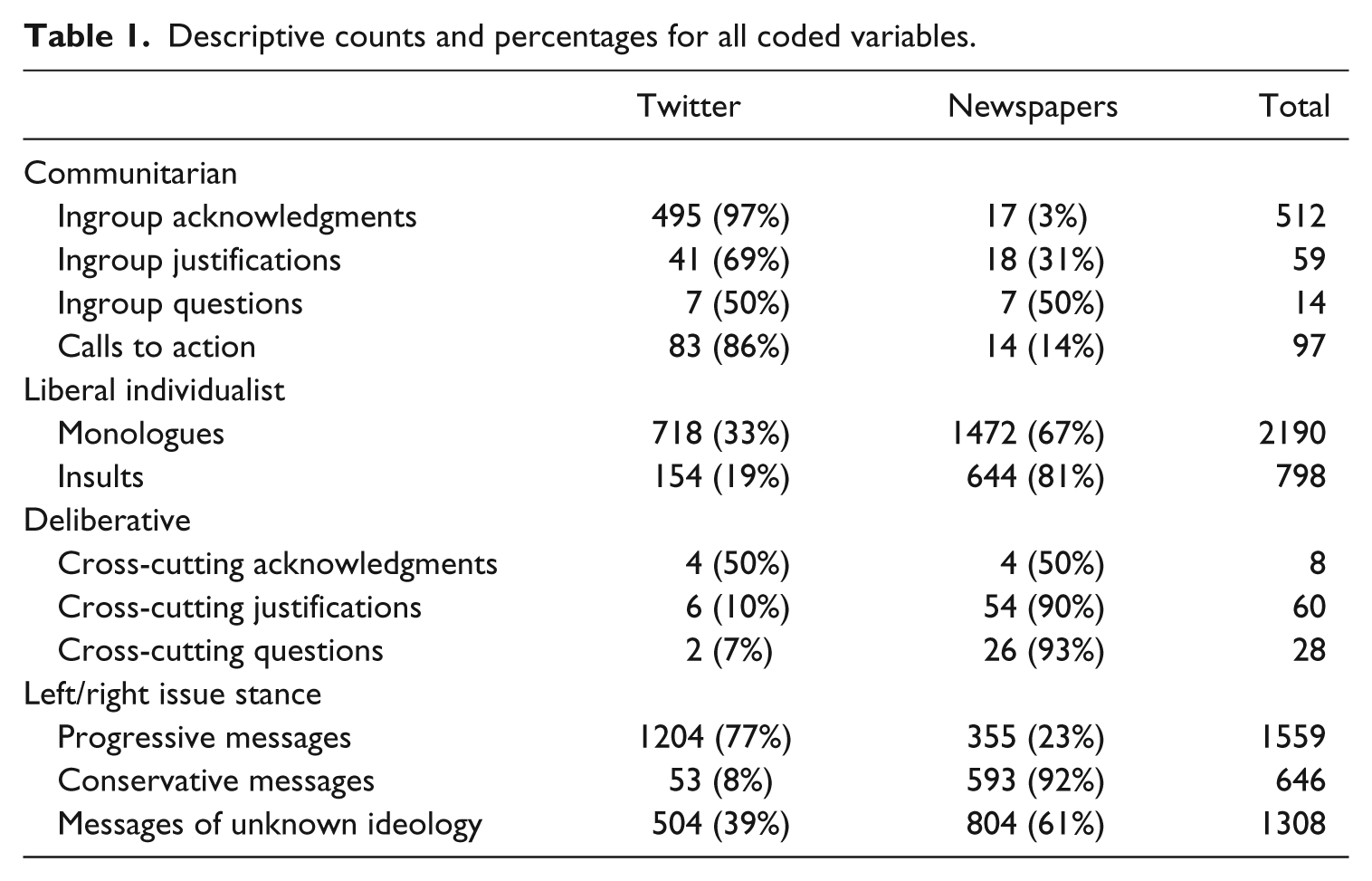
Table 1 displays the descriptive statistics for all variables, and clearly shows that some variables were more prevalent overall than others. For example, there were only 14 ingroup-directed questions and eight cross-cutting acknowledgments throughout the entire sample. However, most variables are numerous enough to make meaningful comparisons between discourse architectures and left/right issue stances. Consistent with prior research, deliberation is low across the board, thus justifying the inclusion of alternative normative criteria that are more prevalent. The percentages of communitarian and liberal individualist variables within each discourse architecture are consistent with H1 and H2, although these will be tested more rigorously below. Unexpectedly, the Twitter hashtags examined in this study turned out to be overwhelmingly progressive, while the newspaper comment sections were overwhelmingly conservative. This may be in part related to discourse architecture, but it likely also reflects the issues chosen, and in the case of Twitter, the particular issue hashtags analyzed.
Descriptive counts and percentages for all coded variables.
H1 predicted that communitarian discourse architectures will host more communitarian characteristics than other types of spaces. This study used binary logistic (logit) regression to evaluate this hypothesis and the others in this study, because all variables are nominal in measurement level. To determine whether the between-platform differences in communitarian characteristics remained robust in the presence of alternative explanatory variables, one binary logistic regression (or logit model) was constructed for each communitarian outcome variable, resulting in a total of four tests. The following equation demonstrates the form of all regressions presented in this article:

where p is the probability of the presence of the variable in question; X1 is a dummy variable representing the two discourse architectures; X2 and X3 are dummies representing the left and unknown positions on each issue; and X4 and X5 are dummies representing the climate and DADT issues.
A few explanatory notes are in order regarding the predictor variables. In all models, the reference category for discourse architecture is the one not named in the hypothesis. For example, in the H1 models, the discourse architecture reference category is “liberal individualist,” so that the odds ratios can be interpreted as the difference the communitarian discourse architecture makes in the outcome variable. In all models, the reference category for the ideology variable is conservative, which means that significant odds ratios for progressivism and unknown ideology represent significant differences from messages expressing conservative viewpoints. However, because the unknown ideology category contains an unknown mix of viewpoints, results for it are not interpretable. Finally, the issue dummies will receive minimal attention in the analyses that follow due to lack of theoretical development on the influence of issues on discussion norms.
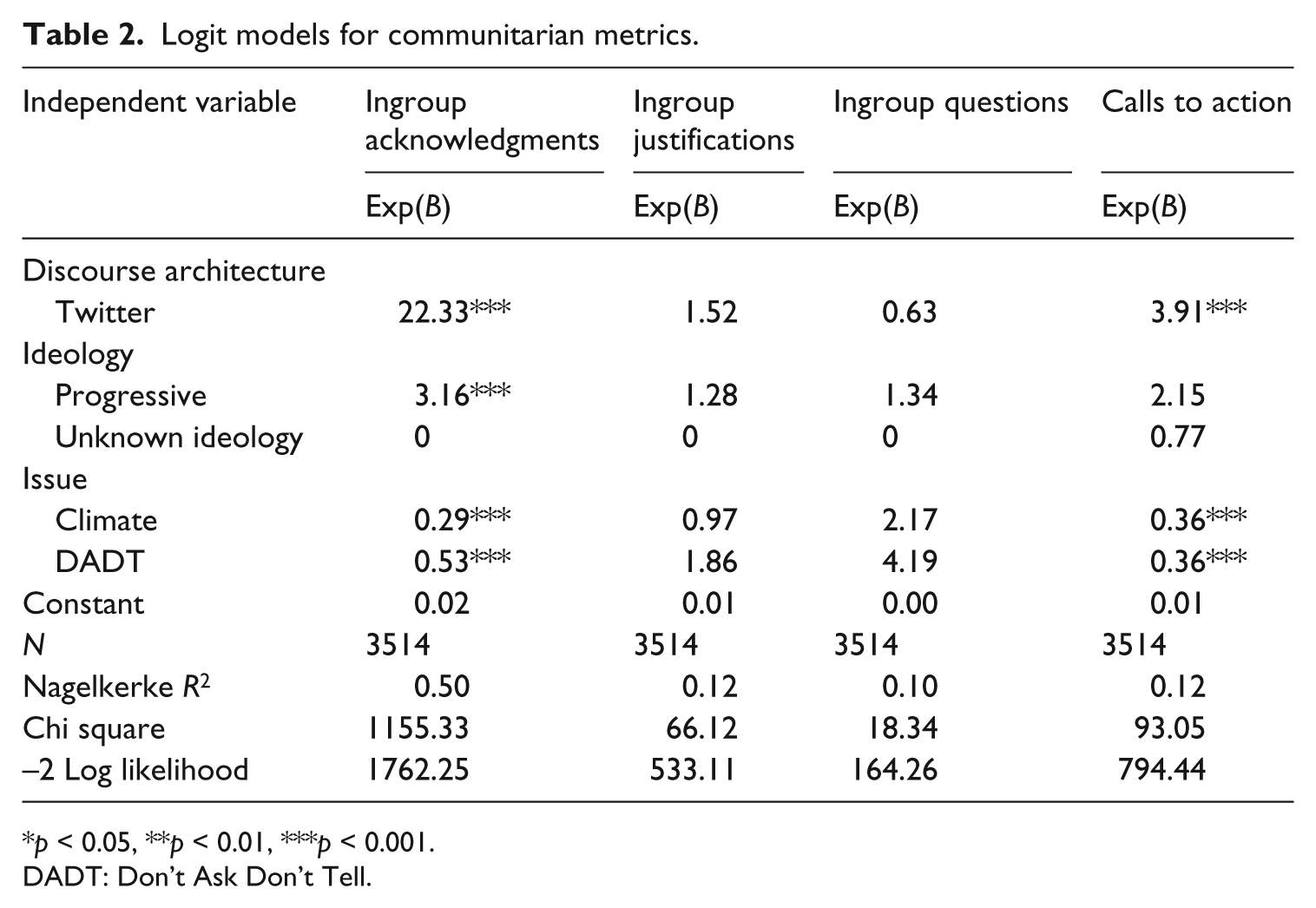
Table 2, which contains the logit models for the communitarian metrics, shows moderate support for H1. Twitter issue hashtags were significantly more likely than newspaper comment sections to contain two communitarian indicators, ingroup acknowledgments (22.33 times as likely) and calls to action (3.91 times as likely). Given the presence of the control variables, these findings suggest a key role for discourse architecture in facilitating different kinds of normative behavior. However, results for the remaining two variables did not achieve significance. Ingroup justifications and questions seem not to have been popular activities throughout the entire sample, which is likely part of the reason for the lack of significance. Questions were in no short supply throughout the sample, but they were rarely exchanged between individuals who could be definitively identified as being on the same side of the issue.
Logit models for communitarian metrics.
p < 0.05, **p < 0.01, ***p < 0.001.
DADT: Don’t Ask Don’t Tell.
H2 predicted that liberal individualist discussion spaces would host significantly more liberal individualist content than other types of spaces, and Table 3 displays the results of the relevant logit models. Recall that in these models, the reference category for discourse architecture has been reversed: the odds ratio now represents the magnitude of change in the outcome variable accounted for by the newspaper comment architecture as compared to the Twitter hashtags.
Logit models for liberal individualist metrics.

p < 0.05, **p < 0.01, ***p < 0.001.
DADT: Don’t Ask Don’t Tell.
Both liberal individualist variables furnish support for H2: newspaper commenters are significantly more likely than Twitter users both to spout insults and to post monologic messages. These spaces were not completely overrun with insults—as Table 1 shows, messages containing insults constituted a minority of both tweets and newspaper comments—but relative to the former, newspaper comment sections were far ruder spaces. A third of all monologues were found among the hashtags, which is perhaps inevitable given that failing to address another user explicitly is the default state of most online messages. Still, the fact that twice that proportion came from the newspaper comments illustrates how commenters tend to use these spaces much more as one-to-many soapboxes than for back-and-forth discussions.
Tables 2–4 address the hypotheses that progressives lean communitarian and deliberative while conservatives lean liberal individualist. Progressive issue stance turns out to be a strong predictor of acknowledging other members of one’s ingroup but of no other communitarian metric; therefore H3a receives only minimal support (Table 2). There are no significant differences between progressives and conservatives on ingroup justifications, ingroup questions, or calls to action, suggesting that both sides embrace communitarianism to comparable degrees.
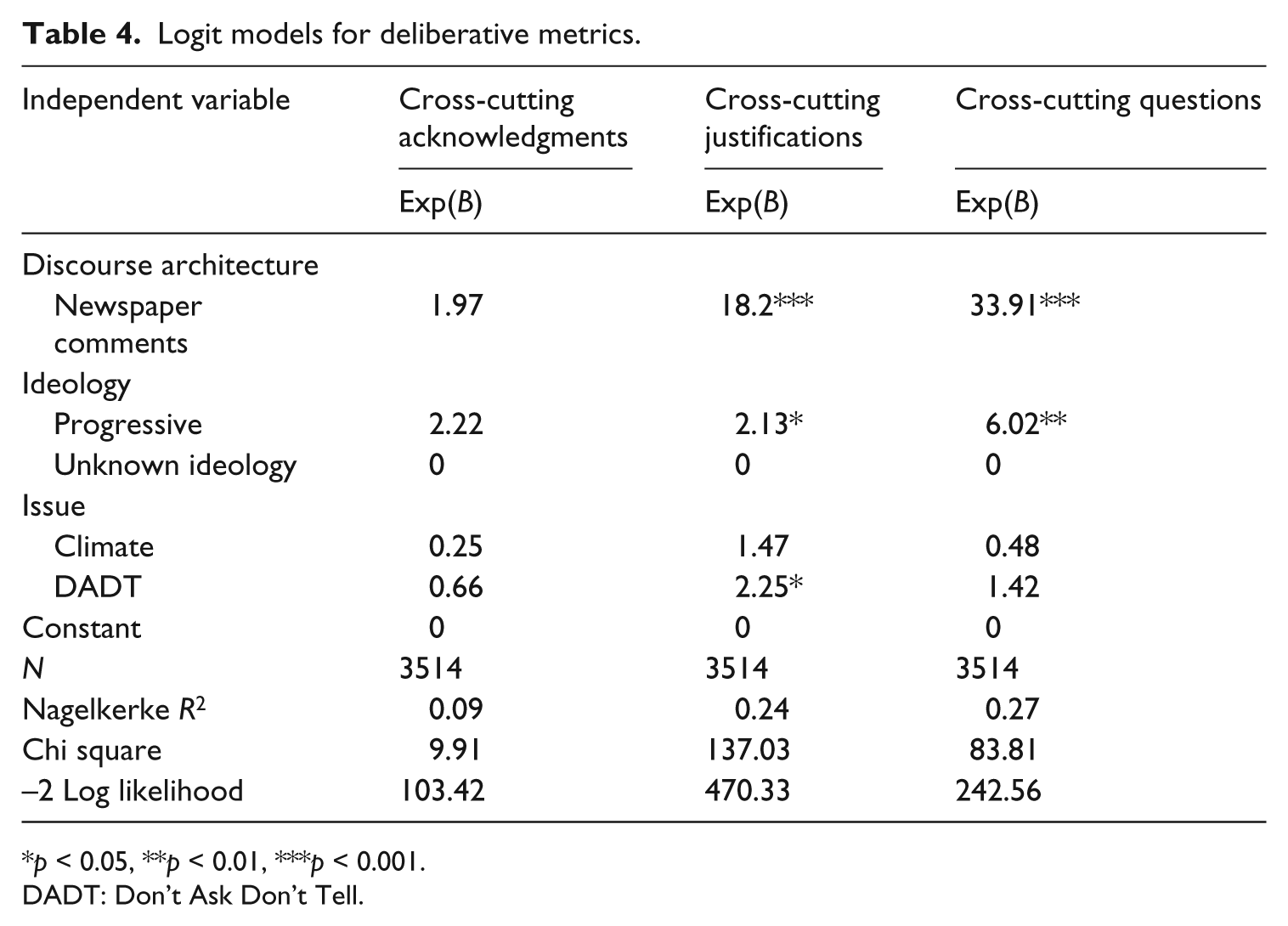
Logit models for deliberative metrics.
p < 0.05, **p < 0.01, ***p < 0.001.
DADT: Don’t Ask Don’t Tell.
Table 4 shows that progressives are more deliberative than conservatives on two of three metrics—cross-cutting justifications and cross-cutting questions—lending some support to H3b. The extremely low incidence of cross-cutting acknowledgments probably contributed to the lack of any significant predictors for that outcome variable. Conservatives are significantly more likely to speak in monologues and post insults than progressives (Table 3), thus supporting H4 through both metrics of liberal individualism.
On the question of which discourse architecture hosts more deliberative activity (RQ1), the clear answer is newspaper comment sections, which were significantly more likely to contain both cross-cutting justifications and cross-cutting questions (Table 4). Moreover, the effect sizes are substantial: newspaper comments are over 18 times more likely to contain cross-cutting justifications than the hashtags, and almost 34 times more likely to contain cross-cutting questions. However, as explained above, the newspaper comments also leaned strongly liberal individualist. This presents somewhat of a contradiction from a normative standpoint, as deliberation and liberal individualism are often discussed as incompatible (Chambers, 2003; Dahlberg, 2001a). These results should prompt a reconsideration of this notion.
Discussion
The purpose of this study was to discover the extent to which discourse architecture and left/right issue position predict differences in democratic communication norms. Its hypotheses received varying levels of support. Discourse architecture emerged as a moderate-to-strong predictor of all three norms, with its weakest showing among the communitarian metrics, of which it significantly predicted only two of four. Given that each discourse architecture hosted different issues and political viewpoints, these results offer robust evidence that the common features in each space are facilitating particular patterns of communication norms.
The two discourse architectures examined in this study exhibited marked normative differences. Twitter issue hashtags appear to render half of the communitarian indicators more likely, while newspaper comments seem biased toward both deliberation and liberal individualism. The design features of hashtags would thus appear to fit the normative priorities of those interested primarily in pushing ideological agendas. In contrast, the newspaper comment sections are spaces of both liberal individualism and deliberation. Interestingly, while neither type of space conformed exactly to its corresponding normative ideal, each exhibited a pronounced leaning toward one or two. Had both discourse architectures shown similar distributions of normative indicators, the case for discourse architecture as a consequential variable in normative assessment would have been undermined.
The coexistence of both deliberative and liberal individualist characteristics in the same discussion spaces poses something of a conundrum for normative theory. On the one hand, the insults and lack of reciprocation of liberal individualism are supposed to be the scourge of deliberation’s signature civility. Yet in the newspaper comments they coexist, sometimes within the same message. In these cases, commenters use facts and questions to substantiate their points but punctuate them with non-deliberative personal attacks, a curious juxtaposition that might be called “deliberative individualism.” The following example of deliberative individualism is drawn from the comment section of a Seattle Times article on global warming (Redlead is another commenter on the same article): Hmmmm? Liar or sucker? Let’s see who the liars/suckers are: A plurality of the world’s leaders; a near totality of climate scientists who have studied the subject; Al Gore. Now the truth-tellers/non-gullible: psuedoscience types with alphabet soup behind their names who study unrelated subjects; Limbaugh; Beck et al. Now who is the sucker Redlead? Hopefully it won’t hurt too much when they rip the hook out of your mouth.
This commenter reasons that global warming is occurring by noting the numerous knowledgeable parties who believe in it and pointing out that many skeptics are not scientists. The comment concludes by insultingly implying that Redlead is a “sucker” and comparing Redlead to a fish that has been fooled by an attractive lure. Both deliberation and liberal individualism are in full evidence here: the author apparently respects Redlead enough to offer opinion justifications, but not enough to refrain from insulting language. How can we best understand such an incongruous combination?
One answer to this question begins by noting that deliberative individualism poses a glass half-full/half-empty interpretation choice for deliberative democrats (although probably less so for liberal individualists). On the one hand, the fact that newspaper comments contain many recognizably deliberative characteristics is cause for optimism. On the other, insults may thwart the ostensibly salutary effects of deliberation. Indeed, there is reason to suspect that insults may exert a stronger influence than reasonable talk: the negativity bias, amply documented in personality psychology (Rozin and Royzman, 2001), holds that people tend to emphasize negative over positive information when making evaluations. Participants in deliberative individualist spaces may thus find that the insults disincline them to read the deliberative portions charitably. However, the fact that the latter are already present means that the deliberative solution is simple, if not easy: remove the insults and the deliberative aspects can shine through unadulterated. Such an undertaking seems well-suited for solutions grounded in discourse architecture: for example, designs that allow moderators not only to remove offensive comments but also to explain why the comments were removed so that participants avoid violating the rules repeatedly.
Left/right issue position also emerged as a potent predictor of several types of normative behavior. Progressives were significantly more likely than conservatives to engage in two of the three deliberative metrics: cross-cutting justifications and questions. They also tended to extend more ingroup acknowledgments than conservatives, but otherwise did not differ from them on the other three communitarian metrics. For their part, conservatives contributed more monologues and insults than progressives. These outcomes support the emerging theoretical narrative that deliberation is a more progressive characteristic, while conservatives tend to adopt a more liberal individualist tone (Bennett, 2011; Kerbel, 2009; Shaw and Benkler, 2012). The fact that these differences persist across platforms highlights the limits of discourse architecture in shifting normative behavior—strong ideologues may already be committed to particular ways of talking about politics.
The other potential influence on democratic communication was the issue being discussed. This variable was sporadically relevant—climate and DADT showed significant differences from immigration in several instances—but the meaning of these findings is not immediately clear. Unfortunately, the field of political communication has not developed effective conceptual means of interpreting differences between political issues. Perhaps the only theory that comes closest is Carmines and Stimson’s (1980) “hard” and “easy” issues, a distinction that can be difficult to apply (Cizmar, 2010). However, the general idea that some issues may be inherently prone to certain types of democratic discourse remains intuitive. Bennett et al. (2007) briefly allude to this possibility when they note that some issues (such as abortion) are more difficult than others for elites to take the lead in framing. Whether it is possible to generalize the characteristics of political issues that tend more toward particular discourse norms is beyond the scope of this article; I raise the question primarily as a departure point for further inquiry.
Limitations and future research
This study was not without limitations. Firstly, some potentially relevant variables were omitted from the logit models for lack of a feasible collection method. These include demographic variables such as ethnicity, gender, age, nationality, education, and income level, as well as platform-level variables such as degree of visibility as measured by the site’s number of visitors per month. A second limitation derives from the fact that substantial minorities of Twitter messages (28.6%) and newspaper comments (45.9%) could not be coded as either for or against the issue in question. Normatively interpreting messages exchanged between users when the stance of at least one was unknown was therefore impossible using the current methods. Improved methods for ascertaining user positions may ameliorate this shortcoming in the future. Finally, there may have been interesting normatively relevant behaviors present in the data that this study’s empirical framework could not detect. However, given that it would be impossible to develop a typology of political norms broad enough to cover all possible modes of political behavior, the increased breadth of this study relative to its predecessors represents a fruitful step forward.
Future studies should endeavor to overcome these limitations. One way to test the effects of additional covariates would be to create multiple online discussion platforms whose features correspond to different discourse architectures and have participants complete pre- and posttests. A study design in which researchers fully controlled the different discussion environments could reveal much about who does and does not participate in online political discussions and how discourse architecture influences these tendencies. For example, if users were explicitly asked about their political preferences in the survey, the potential link between ideology and use of platform features could be probed further. Participants could also indicate their views on each issue directly, thus eliminating the need to identify them from their public postings, and pre/posttest designs could monitor changes in opinion. Finally, more theoretical work needs to be done to link other potentially relevant political norms with both platform features and online speech acts. This research should be coupled with empirical observations to ensure that the normative frameworks it produces will be useful in understanding how people talk about politics online.
Footnotes
Funding
This research received no specific grant from any funding agency in the public, commercial, or not-for-profit sectors.