



Abstract
With the growing sophistication of social media, virality of online content has become an indicator of online message effectiveness. We argue for a comprehensive definition that extends virality to social networking and microblogging sites, by emphasizing users’ behaviors beyond shear access and viewership. Across two studies, we investigate viral behavioral intentions (VBIs) toward pro-social messages shared on Facebook and Twitter. We further explore how motivations and uses of Facebook and Twitter predict VBIs toward messages shared on these websites.
Keywords
With more than a billion Facebook users and 500 million Twitter users (Facebook.com, 2013; Lunden, 2012), social media have redefined the way we communicate and interact with products, brands, social and political issues. From facilitating sociopolitical revolutions to generating buzz around advertisements, these web services put the social element back into persuasion. Contrary to past top-down approaches to disseminating persuasive messages, companies and organizations are engaging with users in two-way communication and disseminate content online that consumers find intriguing enough to interact with on social media (Scott, 2013). These consumer interactions have been loosely termed “virality,” as a way of capturing consumers’ online behaviors toward content made available in that space.
Virality has become the industry buzzword for online success. Most approaches to defining virality focus on viewership (e.g., number of YouTube video views; Learmonth, 2011), and exclude multi-modal (e.g., text, images) and multi-platform (e.g., Facebook, Twitter, Tumblr) content provision methods, and other forms of behavioral responses to persuasive messages. We argue for a more comprehensive definition of virality that emphasizes users’ behaviors in relation to viral reach, affective evaluation, and message deliberation. Within the context of pro-social messages shared on Facebook and Twitter, evidence from two experiments illustrates the value inherent in behavioral responses to online messages. We explore differences in viral behavioral intentions (VBIs) and how social media motivations and uses predict virality.
Defining virality
Virality = access, eWOM, or engagement?
Definitions of virality can be grouped into three main approaches. The first approach focuses on access to, spread, and propagation of online content in a short period of time (Bonchi et al., 2013; Guerini et al., 2012; Tucker, 2011). This is similar to using click-through-rates (CTRs) and page views as measures of effectiveness online, which have been discarded for deficient reliability (Drèze and Hussherr, 2003). Secondly, virality is defined as electronic word-of-mouth (eWOM) by focusing on content sharing, while disregarding other behavioral responses (De Bruyn and Lilien, 2004; Eckler and Rodgers, 2014; Golan and Zaidner, 2008; Kaikati and Kaikati, 2004; Pastore, 2000; Phelps et al., 2004; Thomas, 2004; Welker, 2002; Wilson, 2000).
The third approach focuses on engagement, and argues that users’ behaviors, including accessing, liking/disliking, sharing, and commenting, collectively qualify engagement as a measure of online ad effectiveness (Tucker, 2011). While access focuses on viewership and eWOM focuses on the act of spreading an online message, engagement encapsulates the psychological responses to online messages. This approach is limited because engagement (a) is hard to define, and (b) does not capture specificity of social media behaviors. How does engagement differ for television, newspapers, and Facebook? Engagement is a psychological process that can lead to virality, but is not in and of itself a definition of virality.
A behavioral approach to virality
We define message virality by looking at determinants of user interactivity with a message disseminated and shared online beyond viewing it and passing it along. In doing so, our definition reflects the sophistication of interactivity on social media, where content becomes viral. We take a tripartite approach to defining virality. Each component is conceptualized below.
Viral reach
Building on traditional WOM and eWOM, viral reach refers to the volume of message sharing and forwarding by Internet users. It indicates the number of users that have proactively shared and forwarded a message with their online and/or offline social networks. Online, users can email the message to others, post and repost it to their social networking site (SNS; e.g., Facebook, Twitter, Pinterest), or embed it on their websites, blogs, or Tumblr pages. Even though invisible, online messages can also be shared offline, which is difficult to track and quantify. In addition, borrowing from traditional media exposure metrics (Drèze and Zufryden, 1998; Hong and Leckenby, 1996), viral reach can also be expressed as the number of users who viewed the online message. Viewership and access are meaningful on websites such as YouTube, where such numbers are visible to users. However, they might not be so meaningful or possible on other websites (e.g., Facebook, Twitter, Tumblr).
Affective evaluation
Social media users express their affective responses to online messages in ways that are visible to others. For example, users can “like” a Facebook message, “like” or “dislike” a YouTube video, and make a tweet a “favorite” on Twitter. Using conceptualizations of affect (Bolls, 2010; Maio and Haddock, 2007; Nabi, 2010), we argue that affective evaluation reflects both an explicit emotional response and an attitudinal evaluation of messages, and thus should be regarded as a component of virality.
Message deliberation
Message deliberation deals with Internet users’ active and public deliberation of online messages. Media sharing sites and SNSs enable users to comment on messages. Both the volume and tone of message deliberation are indicative of virality. Tone refers to the explicit emotional tone of a comment, which varies in direction (valence) and intensity (arousal; Cacioppo and Berntson, 1994).
Eckler and Rodgers (2014) categorized research on virality within the context of online advertising into studies that focus on the following: (1) structural features (e.g., Golan and Zaidner, 2008; Porter and Golan, 2006); (2) functionality (e.g., Chiu et al., 2007; Gangadharbatla and Smith, 2007; Palka et al., 2009; Phelps et al., 2004); and (3) information processing (e.g., Bardzell et al., 2008; Brown et al., 2010; Chiu et al., 2007; Eckler and Bolls, 2011). These studies deal with messages that have gone viral. Our study investigates differences in VBIs as well as medium-specific factors affecting virality with focus on SNS motivations and uses. Next, we review the uses and gratifications (U&G) approach within the context of persuasion.
The medium counts: Uses and gratifications and persuasion
The U&G of SNSs
The U&G approach posits that audience members are active and goal-oriented media consumers who select media channels and messages to satisfy different needs. Media users are aware of their interests and motives and have certain expectations of media that aid in media choice and needs gratification (Katz, 1959; Katz et al., 1973). Rosengren (1974) argues that media effects on individual and societal levels occur when users seek gratifications from media and other sources, driven by motivations that vary based on basic human needs, individual differences, and contextual societal factors.
U&G is criticized for its vague conceptual framework, lack of explanatory power, and overuse of the active audiences’ assumption (Rayburn, 1996). However, the nature of the Internet has reignited U&G’s applicability as a framework for understanding media choices and effects (Dicken-Garcia, 1998; Morris and Ogan, 1996; Newhagen and Rafaeli, 1996; Rayburn, 1996; Ruggiero, 2000). Internet users not only select but also create their own media messages. Further, the level of audience activity varies depending on the message, medium, and user characteristics. Examples of Internet gratifications include information seeking, interpersonal utility, parasocial interaction and surveillance, diversion and entertainment, passing time, and inducing good feelings (Charney and Greenberg, 2001; Papacharissi and Rubin, 2000; Ruggiero, 2000), which can be grouped into content, process, and social gratifications (Stafford et al., 2004).
SNS use motivations can be categorized as (1) cognitive (information); (2) entertainment (relaxing, diversion); (3) social connection (social utility, companionship, relationship maintenance, social interaction, inclusion); (4) habitual use (passing time); and (5) identity (self-expression, recognition; Leung, 2009; Papacharissi and Mendeson, 2011; Park et al., 2009; Pempek et al., 2009; Shao, 2008; Sheldon, 2008; Urista et al., 2009). Other motivations include mood management, affection, venting negative feelings, narcissism, media drenching, performance, and aesthetic experience (Gülnar et al., 2010; Hsu, 2007; Leung, 2009; Poon and Leung, 2011; Shao, 2008).
Past research showed that motivation to use social media websites and services predicts the use of, attitudes toward, and perceived outcomes of using SNSs (Alhabash et al., 2012; Papacharissi and Mendeson, 2011; Park et al., 2009). We extend this framework to predicting behavioral responses to persuasive messages shared via SNSs. Our question is: How can we predict behavioral responses to persuasive messages from medium-specific characteristics and user experiences? In other words: What does the medium have to do with persuasion outcomes?
U&G and persuasion
Persuasion models have focused on attitude and behavior changes as a function of exposure to persuasive messages. The elaboration likelihood model (ELM; Petty and Cacioppo, 1981, 1986) and the heuristic-systematic model (HSM; Chaiken, 1980, 1987; Chaiken et al., 1989) posit that persuasion outcomes are directed by two processing styles. Central route (systematic) processing is more cognitively demanding and involves greater deliberation of the message’s arguments. In peripheral route (heuristic) processing, individuals rely on cognitive shortcuts to process information. The ELM and HSM identify a number of message characteristics (e.g., emotional appeal, argument strength, model attractiveness) that facilitate persuasion. While message characteristics are essential to investigate, they alone are not sufficient for predicting audience responses. The growing popularity and sophistication of SNSs is evident in their garnering a multitude of users, who not only use them differently but also have different motivations to use them. Due to the fact that media have grown more social and personal than ever, we argue that how and why individuals use them would affect what they get out of them when interacting with persuasive messages.
Fazio and Olson (2003) argue that attitude activation and change – classical persuasion outcomes – are dependent on (1) having sufficient cognitive resources for processing (ability) and (2) the motivation to process, which is usually guided by message relevance to the information processor. We argue that motivations to use SNSs would facilitate persuasion by creating conducive states for exposure and, thus, persuasion. The current paper reports results from two experiments focusing on the effects of anti-cyberbullying (Study 1) and anti-alcohol (Study 2) messages shared on Facebook and Twitter, respectively.
Study 1: Anti-cyberbullying Facebook status updates
Cyberbullying refers to use of information communication technologies to perform repeated intentional acts of aggression that reflect a power imbalance “where the offender demonstrates power over the target” (Langose, 2012: 285). Cyberbullying is not space- or time-bound and can be performed anonymously, thus leading to serious psychological and physical consequences. Lenhart et al. (2011) report one-fifth of teens say their peers are unkind to them online, 15% report being the victim of cyberbullying, and 90% have observed cyberbullying. While most research on cyberbullying focuses on pre-adult populations, Alhabash et al. (2013) found that a quarter of college students have been recently cyberbullied, and 70% reported observing others being cyberbullied. SNSs and text messaging were the media where cyberbullying happened most frequently. With this in mind, Study 1 explores how anti-cyberbullying messages can become viral. Here, we are exploring differences in VBIs and how SNS motives and uses predict VBIs.
As humans are often described as “cognitive misers” (Fiske and Taylor, 1984; Macrae and Bodenhausen, 2001), we predict participants will report greater likelihood of engaging in less cognitively demanding behaviors on Facebook. Intuitively, liking a status update is less cognitively demanding than sharing or commenting on an update, respectively. Sharing an update involves a more elaborate cognitive process, where users are evaluating and endorsing the message. Commenting is the most cognitively demanding as it involves evaluation and decision making following deliberation and articulation of the user’s opinion about the message. We predict:
Study 1 also explores the relationship among users’ motivations and uses of Facebook and VBIs. With limited past research, we asked:
Method
This is part of a larger study on the effects of emotional tone and virality features (likes and shares) on attitudes and VBIs. The study used a 2 (affective evaluation: low versus high likes) × 2 (viral reach: low versus high shares) × 3 (emotional tone: positive versus negative versus coactive) × 3 (repetition) mixed factorial design, with affective evaluation and viral reach as between-subjects factors, and emotional tone and repetition as within-subject factors. Participants (N = 365) were recruited from Michigan State University and received course credit for participation. They completed the experiment online using SurveyGizmo.com, where they viewed nine anti-cyberbullying Facebook status updates posted by a fictitious non-profit organization designed specifically for this study (see Figure 1). Messages varied in terms of tone, affective evaluation, and viral reach to ensure ecological validity, yet these variations are not a focus of subsequent analyses. Participants were mostly female (63.3%), white (75.8%), sophomores and juniors (70.7%), and aged 21 years (SD = 1.89).

Study 1 sample stimuli.
Measures
Viral behavioral intentions
Participants indicated their agreement on a nine-point scale (1 = “Strongly Disagree”, 9 = “Strongly Agree”) to the following statements: “I would like this status update on Facebook;” “I would share this status update on Facebook;” and “I would comment on this status update on Facebook.” Items were averaged for all messages.
Facebook use measures
Participants rated six items about cognitive and affective evaluations of Facebook (1 = “Strongly Disagree”, 9 = “Strongly Agree”; Ellison et al., 2007). Upon satisfactory factor and reliability analyses, these items were averaged into one variable: Intensity to use Facebook (see the Appendix). Participants also responded to open-ended questions about total number of Facebook friends 1 and average time spent daily on Facebook (Ellison, Steinfield and Lampe, 2011; Ellison, Vitak, Gray and Lampe, 2011).
Motivations to use Facebook
Participants rated 19 statements about why they use Facebook (1 = “Strongly Disagree”, 9 = “Strongly Agree”; Liu et al., 2010). Upon satisfactory factor and reliability analyses, items were averaged into seven variables: information sharing, self-documentation, social interaction, entertainment, escapism, self-expression, and medium appeal (see the Appendix).
Results
Descriptive results
The vast majority of participants reported having a Facebook account (95.3%). On average, participants have 669 Facebook friends (SD = 470.66), and spend 91 minutes daily on Facebook (SD = 107.57 min). As illustrated in Figure 2, entertainment was the highest rated motivation to use Facebook (M = 6.28, SD = 2.11), followed by medium appeal (M = 6.10, SD = 2.16), and information sharing (M = 5.71, SD = 2.03), with self-documentation as the lowest rated motive (M = 4.64, SD = 2.07).

Means for motivations to use Facebook.
VBIs
H1 predicted participants would be more likely to like a status update than share it or comment on it, respectively. Data for liking, sharing, and commenting were submitted to a one-way repeated-measures analysis of variance (ANOVA). As seen in Figure 3, the three types of VBIs were significantly different (F(1.61, 585.01) = 178.35, p < .001, η2 p = .33). Confirming H1, participants were more likely to “like” the status update (M = 4.86, SD = 2.32) than to share (M = 4.03, SD = 2.24) or comment on it (M = 3.20, SD = 1.95). These mean differences were qualified by pairwise comparisons (p < .001).

Means for viral behavioral intentions to anti-cyberbullying Facebook status updates.
Predicting VBIs
To answer RQ1, three separate yet identical linear regression analyses were run to predict each VBIs type (i.e., liking, sharing, and commenting). Predictors included the seven Facebook motivations, intensity of Facebook use, number of Facebook friends, time spent on Facebook, and gender. The model was significant in the regressions predicting liking (R2 = .11, F(11, 353) = 4.02, p < .001), sharing (R2 = .14, F(11, 353) = 4.67, p < .001), and commenting on (R2 = .14, F(11, 353) = 3.37, p < .001) status updates (see Table 1).
Regression results for the effects of Facebook motivations and uses on liking, sharing, and commenting on anti-cyberbullying status updates (Study 1).

Notes. † p < .10; * p < .05; ** p < .01; *** p < .001.
All three behaviors were significantly predicted by the social interaction motivation and the number of Facebook friends. Facebook intensity negatively predicted the three VBIs. Females were more likely than males to like and share the status update, but not for commenting. Information sharing negatively predicted commenting on the status update, where the more that participants use Facebook to share information, the less likely they are to comment on a status update. Self-documentation was marginally significant in predicting commenting, and entertainment was marginally significant but in the negative direction (i.e., the higher participants’ motivation to use Facebook for entertainment, the less likely they were to comment on the status update).
Study 2: Anti-alcohol tweets
Study 2 focuses on anti-alcohol messages shared on Twitter. The Centers for Diseases Control report that young adults (18–24 years old) form the largest group of binge drinkers (35.5%; Schiller et al., 2012). Given the health risks associated with binge drinking (Centers for Disease Control and Prevention, 2012) and the fact that the alcohol companies’ promotional budgets dwarf the budget for anti-alcohol messages (Wolburg, 2001), it is essential that anti-alcohol messages be efficient in reaching their target and effective in terms of return on investment. Again, we examine VBIs as a measure of message effectiveness in Study 2 by testing a hypothetical anti-alcohol intervention via Twitter.
While many think of Twitter and Facebook as SNSs or online social networks (ONSs; Krishnamurthy, 2009; Schneider et al., 2009), Sterne (2010) distinguishes Facebook as a SNS and Twitter as a microblogging site. While the argument that Twitter can still be regarded as a SNS or ONS, distinctions extend to actions users take when interacting with content shared on both platforms. The most common activity on Twitter after self-posts is retweeting, which, according to our definition of virality, reflects viral reach. Other functions on the site include replying to a tweet, which can be understood as message deliberation, and making a tweet a “favorite,” which indicates an explicit affective evaluation. These functions present an interesting contrast to Facebook functions. Similar actions have different functions on Twitter and Facebook, noting they were added as the platforms evolved. While “liking” a message on Facebook is the most common and the least cognitively demanding activity compared to sharing and commenting, “favoriting” a tweet is most cognitively demanding as it involves explicit endorsement and a heightened emotional response to the message. We argue that participants will more likely retweet an anti-alcohol status update, than reply to and favorite a tweet, respectively. We hypothesize:
Similar to Study 1, we explored the relationship among the motivations and uses of Twitter and the different types of VBIs. Thus, we asked:
Method
This is part of a larger study examining the effects of Twitter user race and gender on attitudes and VBIs. The study used a 2 (race: black versus white) × 2 (gender: male versus female) × 4 (repetition) mixed factorial design, with race as the only between-subjects factor. Race and gender were excluded from analyses reported here to allow for comparison with Study 1. Students (N = 164) from Michigan State University participated in return for course credit. Participants viewed identical anti-drinking tweets posted either by a black or white Twitter user (see Figure 4). They were mostly female (73.5%), white (80.4%), sophomores and juniors (56.4%), and aged around 21 years (SD = 1.92). Data collection took place in a computer lab using MediaLab and DirectRT software. Twenty-five outlier cases (±2 SD from the mean) were removed from analyses reported here, resulting in a final sample of 139.

Study 2 sample stimuli (picture source: www.corbis.com).
Measures
VBIs
Participants rated the following statements: “I will retweet this message”, “I will reply to this message”, and “I will make this tweet one of my favorite tweets” using nine-point scales anchored by “Strongly Disagree” and “Strongly Agree.” Items were averaged for all messages.
Twitter use measures
Similar to Study 1, participants rated six items about their cognitive and affective evaluations of Twitter (nine-point scales; Ellison et al., 2007) that were averaged upon satisfactory factor and reliability analyses (see the Appendix). Participants also reported the total number of people they follow on Twitter, the total number of their own Twitter followers, and the average time spent daily on Twitter.
Motivations to use Twitter
We also used Liu et al.’s (2010) 19-item scale to measure the following motivations to use Twitter: information sharing, self-documentation, social interaction, entertainment, escapism, self-expression, and medium appeal (1 = “Strongly Disagree”, 9 = “Strongly Agree”) (see the Appendix).
Results
Descriptive results
The majority of participants reported having a Twitter account (80.4%), with an average 97 Twitter followers (M = 96.82, SD = 77.74), following 135 Twitter users (M = 134.58, SD = 98.06), and spending 31.42 minutes daily on Twitter (SD = 31.41 min). As illustrated in Figure 5, the motivation to use Twitter for entertainment was highest (M = 6.48, SD = 2.34), followed by medium appeal (M = 6.00, SD = 2.29), and information sharing (M = 5.64, SD = 2.25), with self-documentation as the lowest rated (M = 4.30, SD = 2.28).
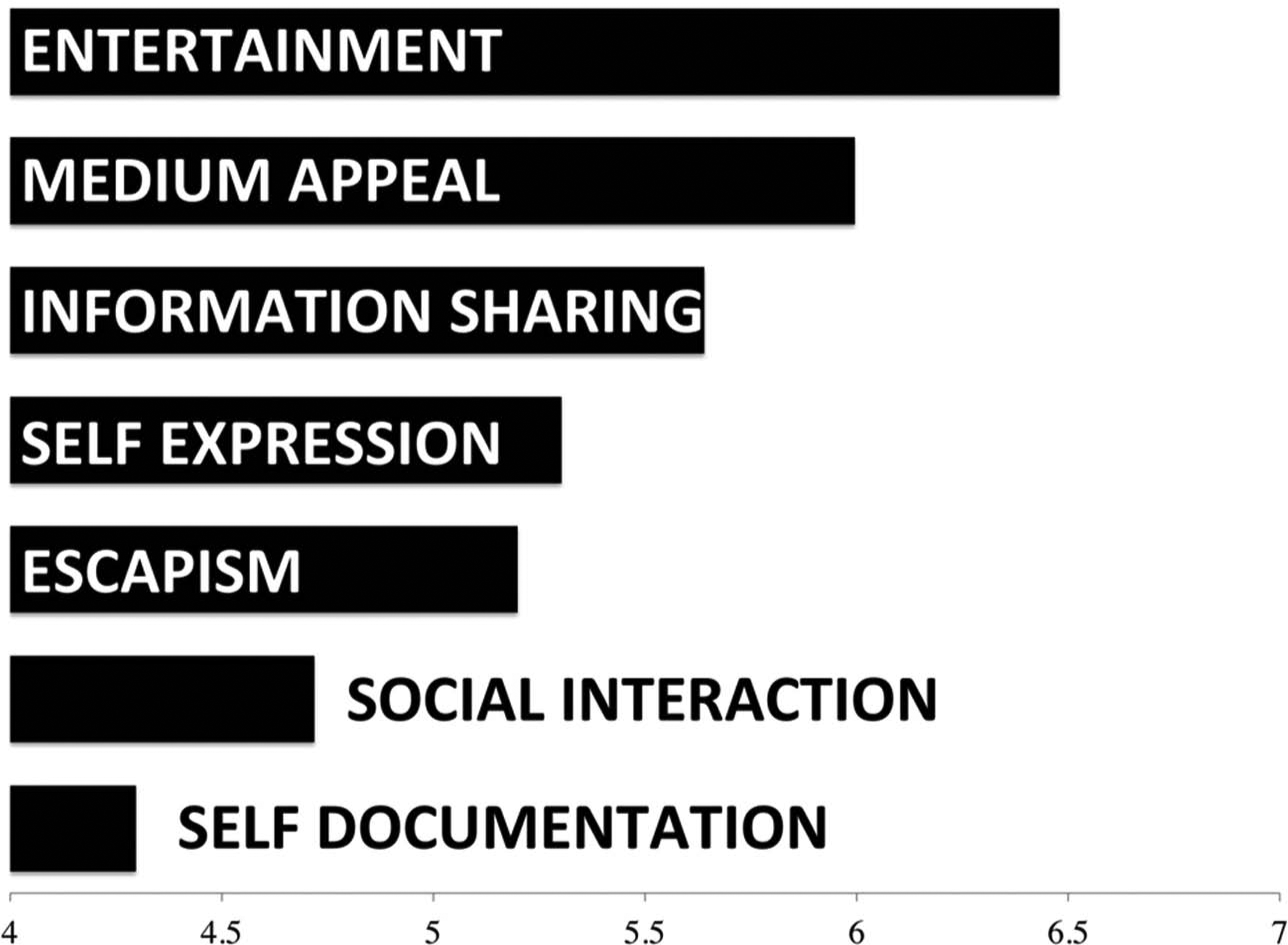
Means for motivations to use Twitter.
VBIs
H2 predicted participants would be more likely to retweet than reply to or favorite a tweet, respectively. Data for retweeting, replying, and favoriting were submitted to a one-way repeated-measures ANOVA. The results, illustrated in Figure 6, showed that VBIs were significantly different (F(1.67, 230.71) = 55.60, p < .001, η2p = .29). Confirming H2, participants were more likely to retweet an anti-alcohol message (M = 4.20, SD = 2.32) than reply to it (M = 3.44, SD = 2.25) or make it a favorite on Twitter (M = 3.30, SD = 2.31). All pairwise comparisons were significant (p < .001), except for the difference between replying and favoriting, which was marginally significant (p = .09).
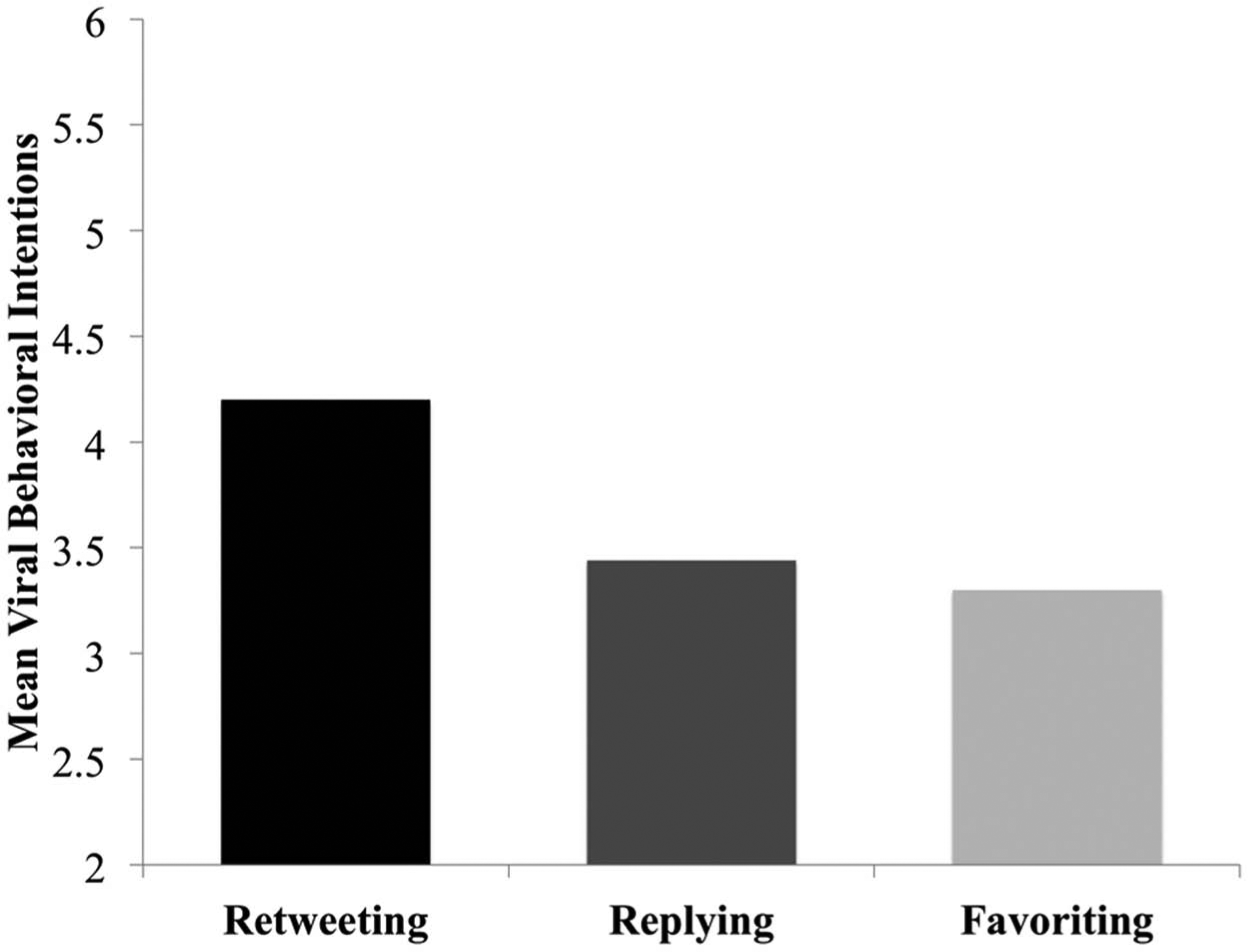
Means for viral behavioral intentions to anti-alcohol tweets.
Predicting VBIs
To answer RQ2, three separate and identical linear regression analyses were run to predict three VBIs (i.e., retweeting, replying, and favoriting). Predictors included seven Twitter motivations, intensity of Twitter use, number of Twitter followers, number of Twitter users participants are following, time spent on Twitter, and gender. The model was significant in predicting retweeting (R2 = .21, F(12, 126) = 2.85, p < .01), replying (R2 = .19, F(12, 126) = 2.41, p < .01), and favoriting (R2 = .24, F(12, 126) = 3.22, p < .001) the tweets (see Table 2).
Regression results for the effects of Twitter motivations and uses on liking, sharing, and commenting on anti-alcohol tweets (Study 2).

Notes. † p < .10; * p < .05; ** p < .01; *** p < .001.
Females were more likely to engage in the three VBIs than males. The three VBIs were significantly and positively predicted by time spent on Twitter, and negatively by Twitter intensity (marginally for retweeting). Medium appeal significantly predicted retweeting and favoriting. Self-expression negatively predicted replying and favoriting (see Table 2).
Discussion
We have proposed a comprehensive definition of virality centered on users’ online behaviors when interacting with persuasive messages on social networking and microblogging sites. In addition, we reported results from two studies investigating differences in VBIs and exploring how medium-specific motivations and uses predict those intentions.
Our findings show that VBIs were unique for Facebook and Twitter. Study 1 results indicated a greater likelihood of liking a status update than sharing it, which in turn was greater than the likelihood of commenting. Study 2 results showed that retweeting had a higher likelihood than replying to and favoriting a tweet, respectively. Taken at face value, our findings indicate that participants were more likely to carry out the least cognitively demanding behavior. These findings are therefore consistent with the HSM (Chaiken, 1980, 1987; Chaiken et al., 1989), which assumes individuals’ decision making relies on cognitive shortcuts. Interestingly, there is a mismatch between level of cognitive and emotional engagement with these behaviors and their psychological meanings. Affective evaluation on Facebook is expressed through liking a message, while on Twitter it is expressed in favoriting. Our findings suggest these two responses might have different cognitive demands, where liking a message on Facebook requires less cognitive demand than favoriting a tweet. Similarly, the intention to spread the message (viral reach) was the easiest response on Twitter, but the second most easy on Facebook. Message deliberation appeared to be the second highest in terms of cognitive demand on Twitter (replying), and the most cognitively demanding on Facebook (commenting). This also suggests the changing nature of these functions on Facebook and Twitter. For example, boyd et al. (2010) dissect retweeting as a form of conversation. A more in-depth exploration of what these viral behaviors mean across different contexts and users is needed.
Alternatively, this difference can be explained by the functional ease associated with each group of viral behaviors on Facebook and Twitter. This is especially important when looking at patterns of SNS use on mobile devices. An individual using a smartphone to check Facebook or Twitter might find it functionally easier to click the “like” button on Facebook, and the “retweet” button on Twitter. Other behaviors may require greater motor engagement through repeated sequential clicks.
Despite differences between Facebook and Twitter in terms VBIs and cognitive demand, results across both studies showed a commonality where females engage in more VBIs than males. Our results also point to diversity of platforms in terms of how SNS motivations predict VBIs. While liking, commenting, and sharing on Facebook were significantly predicted by the motivation to use Facebook for social interaction, medium appeal (positively for retweeting and favoriting) and self-expression (marginally and negatively for replying to and favoriting tweets) predicted VBIs on Twitter. These results demonstrate that structural and functional features of both SNSs lead to varied relationships between SNS motivations and VBIs. It is plausible that sharing pro-social messages on Facebook heightens participants’ desire to interact with other Facebook users, whereas the nature of Twitter interactions (communication through 140 characters) enhances the fascination with the site’s immediacy (i.e., medium appeal). In addition, it is plausible that participants who are motivated to use Twitter to express themselves are more focused on contributing with content than with replying to anti-alcohol tweets and making them favorites. Participants might be more interested in expressing themselves, rather than starting a conversation on Twitter and endorsing others’ tweets. In addition, motivations such as self-documentation and information sharing, which arguably reflect the original set of functions on Twitter and Facebook, were not significant in predicting VBIs. It is possible that these platforms evolved to encapsulate a different set of functions. Future studies should investigate such evolutions in longitudinal settings.
The identified relationship between intensity of Facebook and Twitter use and VBIs is rather counter-intuitive. The more intensely participants used Facebook and Twitter, the less likely they are to engage in all VBIs. It is plausible that avid users are oversaturated with content on these two SNSs, and thus the more intensely they use them, the less likely they engage in viral behaviors. In addition, we found that the larger the network size on Facebook, indicated by the number of Facebook friends, the more likely participants are to like, share, and comment, whereas this relationship was not significant on Twitter, aside from marginal significance for the relationship between the number of Twitter users the participants followed and favoriting tweets. Taken together, this suggests that avid SNS users are selective of what to endorse and engage with on Facebook and Twitter. However, specific to Facebook, one’s network size predicts content engagement.
Our results offer several exciting theoretical implications. In general, we find that user behaviors toward messages shared on SNSs can be understood within the framework of virality, yet these behaviors have different meanings and are arguably sensitive to cognitive and emotional involvement with a message. Future research should explore cognitive effort in relation to these activities. Our findings also suggest that behavioral responses to online messages are both medium-specific, and, more importantly, driven by users’ motivations and uses of these media. New communication technologies have revolutionized our lives and the way we communicate. Persuasion theories must then refine our understanding of persuasion in the digital age. Specifically, behavioral intentions elicited by traditional mediated communication (e.g., TV advertisements) are different from those elicited by persuasive messages shared on social media sites. Persuasion scholars, then, should widen the scope of the type of behaviors resulting from persuasive messages.
On a practical level, as more companies and non-profit organizations use social media to disseminate information and interact with consumers, social media campaigns need to be personalized, tailored, and medium-specific. Many companies understand this logic. Skittles started a campaign where consumers contribute photos of themselves with the product to be featured on their Facebook page as “Skittles’ Best Fan Forever” (Skittles, 2013). Country Time Lemonade pays consumers to tweet and upload photos to Facebook, and in return the company donates to its foundation fighting childhood cancer (Country Time Lemonade, 2013). Ford Mustang created a Facebook application where consumers can design their own Mustangs, share their creations with friends, and compete amongst one another (Stampler, 2013). The examples are abundant. Our findings echo these strategic practices, which encourage us to provide a few managerial recommendations. Firstly, advertisers and marketers should understand the differences in online behaviors and reflect them in their expectations, goals, and objectives when designing campaigns. Secondly, as advertisers and marketers are paying more attention to what motivate users to use a website and their influence on effectiveness of social media campaigns, our findings provide evidence-based support for this common practice, and more prominently provide medium-specific insights regarding which motivations best predict virality. Social media campaigns should capitalize on reflecting these specific intentions and refrain from disseminating top-down information to consumers. Finally, avid users are harder to persuade in responding to social media messages, yet the larger their network, the more likely they are to engage with these messages. Advertisers and marketers should note that online content must stimulate consumers’ interest for them to act on it, and once they do, there is a better chance for a higher reach to their large networks of online friends.
Despite our intriguing findings, there are limitations. Both studies dealt with pro-social messages in social media. Future research could investigate these relationships in response to commercial advertising messages shared on those sites. Secondly, the results regarding behavioral responses showed means close to or below the scale midpoint, indicating the difficulty in “getting viral.” Future research could use messages that have already gone viral or manipulate message features that have been known to generate buzz and virality. Finally, despite the fact that both studies dealt with pro-social issues, the stimuli were constructed differently. In Study 1, the entity posting the anti-cyberbullying messages on Facebook was a fictitious non-profit organization, while in Study 2, average people were the messages’ sources. Future research should investigate the effects of source types and source credibility within the context of affecting VBIs.
Conclusion
We set out to investigate differences in behavioral responses specific to SNSs and microblogging sites to develop a more comprehensive view of virality. Indeed, our findings do not tell the full story. More research is needed to untangle this complex phenomenon. Our findings, though, answer questions about what virality means as behavioral responses to online messages and shed the light on ways in which user characteristics, motivations, and media uses affect the likelihood of VBIs.
Footnotes
Appendix
Descriptive statistics, factor analysis and reliability results for the intensity and motivations to use Facebook and Twitter.

| Facebook (N = 365) |
Twitter (N = 139) |
|||||
|---|---|---|---|---|---|---|
| M | SD | Factor loading | M | SD | Factor loading | |
|
|
|
|
– |
|
|
– |
| (_____) is part of my everyday activity | 6.77 | 2.42 | .842 | 4.99 | 3.07 | .927 |
| I am proud to tell people I’m on (_____) | 5.60 | 2.28 | .764 | 5.71 | 2.43 | .777 |
| (_____) has become part of my daily routine | 6.55 | 2.47 | .832 | 5.12 | 3.15 | .925 |
| I feel out of touch when I haven’t logged onto (_____) for a while | 5.62 | 2.60 | .825 | 4.10 | 2.94 | .806 |
| I feel I am part of the (_____) community | 5.86 | 2.41 | .896 | 5.09 | 2.75 | .861 |
| I would be sorry if (_____) shut down | 5.48 | 2.74 | .788 | 5.17 | 2.84 | .762 |
| Eigenvalue (% of var. explained), Cronbach’s α | 4.09 (68.20%), .926 | 4.29 (71.51%), .936 | ||||
|
|
|
|
– |
|
|
– |
| I use (_____) to share information. | 6.04 | 2.20 | .923 | 6.03 | 2.60 | .751 |
| I use (_____) to share information useful to people. | 5.57 | 2.19 | .904 | 5.34 | 2.59 | .715 |
| I use (_____) to present information on my interests. | 5.51 | 2.24 | .809 | 5.55 | 2.64 | .888 |
| Eigenvalue (% of var. explained), Cronbach’s α | 2.32 (77.47%), .910 | 1.86 (62.09%), .826 | ||||
|
|
|
|
– |
|
|
– |
| I use (_____) to record what I do in life. | 4.84 | 2.32 | .909 | 4.90 | 2.78 | .818 |
| I use (_____) to record what I have learned. | 4.27 | 2.24 | .847 | 4.10 | 2.56 | .687 |
| I use (_____) to record where I have been. | 4.81 | 2.38 | .772 | 3.89 | 2.70 | .785 |
| Eigenvalue (% of var. explained), Cronbach’s α | 2.14 (71.31%), .879 | 1.76 (58.60%), .807 | ||||
|
|
|
|
– |
|
|
– |
| I use (_____) to connect with people who share some of my values. | 5.28 | 2.26 | .908 | 5.42 | 2.61 | .726 |
| I use (_____) to connect with people who are similar to me. | 5.47 | 2.32 | .893 | 5.64 | 2.56 | .868 |
| I use (_____) to meet new people. | 3.49 | 2.38 | .471 | 3.09 | 2.39 | .508 |
| Eigenvalue (% of var. explained), Cronbach’s α | 1.84 (61.43%), .785 | 1.54 (51.28%), .736 | ||||
|
|
|
|
– |
|
|
– |
| I use (_____) because it is enjoyable. | 6.14 | 2.22 | .935 | 6.30 | 2.51 | .877 |
| I use (_____) because it entertains me. | 6.41 | 2.13 | .935 | 6.65 | 2.47 | .877 |
| Eigenvalue (% of var. explained), Cronbach’s α | 1.75 (87.36%), .933 | 1.54 (76.87%), .870 | ||||
|
|
|
|
– |
|
|
– |
| I use (_____) because it helps me pass the time. | 6.42 | 2.29 | .879 | 6.06 | 2.72 | .962 |
| I use (_____) because I have nothing better to do. | 5.26 | 2.49 | .759 | 5.14 | 2.72 | .442 |
| I use (_____) because it relaxes me. | 4.59 | 2.38 | .635 | 4.39 | 2.59 | .521 |
| Eigenvalue (% of var. explained), Cronbach’s α | 1.75 (58.41%), .797 | 1.39 (46.39%), .653 | ||||
|
|
|
|
– |
|
|
– |
| I use (_____) to show my personality. | 5.04 | 2.35 | .921 | 5.63 | 2.68 | .838 |
| I use (_____) to tell others about myself. | 5.05 | 2.35 | .921 | 4.97 | 2.62 | .838 |
| Eigenvalue (% of var. explained), Cronbach’s α | 1.70 (84.74%), .918 | 1.40 (70.16%), .825 | ||||
|
|
|
|
– |
|
|
– |
| I use (_____) because I like that I can post things I want to say immediately. | 5.08 | 2.47 | .689 | 5.80 | 2.71 | .809 |
| I use (_____) because it is easy to use. | 6.04 | 2.20 | .949 | 6.11 | 2.50 | .895 |
| I use (_____) because it is convenient. | 6.15 | 2.23 | .943 | 6.08 | 2.40 | .848 |
| Eigenvalue (% of var. explained), Cronbach’s α | 2.27 (75.51%), .887 | 2.17 (72.44%), .885 | ||||
Funding
This research received no specific grant from any funding agency in the public, commercial, or not-for-profit sectors.