



Abstract
This experiment explores the effects of a role-playing videogame on participants’ attitudes toward Israelis and Palestinians. Participants (N = 172) were randomly assigned to the role of either an Israeli or a Palestinian leader in PeaceMaker, a videogame simulation of the Palestinian–Israeli conflict. Participants’ explicit and implicit attitudes toward both groups were assessed before and after a 20-minute gameplay experience. Results showed that gameplay changed participants’ explicit stereotypes of the two national groups in a role-congruent fashion. Participants assigned to play the role of the Palestinian President or the Israeli Prime Minister negatively changed their evaluations of the opposing national group. Moreover, implicit bias moderated stereotype change. Results are discussed within the framework of self-persuasion and an associative-proposition evaluation model of attitude change.
Keywords
The Palestinian–Israeli conflict has persisted for the past six decades despite numerous efforts to resolve it. Among the many complexities of this conflict is the role of mediated communication on public opinion in the United States, as evidenced by a great deal of research (i.e. Ackerman, 2001; Aqtash et al., 2004; Beaudoin and Thorson, 2002; Donohue and Hoobler, 2002; Gilboa, 2002; Noakes and Wilkins, 2002; Ross, 2003; Shaheen, 2001, 2003, 2009). While acknowledging the complex dynamics of long-term conflicts between large groups of people, it is fair to say that a common element of any conflict is one party’s negative attitude toward the other. This study is about the implicit and explicit components of these basic attitudes, and their potential to be changed by participation in a role-playing videogame.
Using PeaceMaker, a videogame simulation of the Palestinian–Israeli conflict, we investigated the effects of in-game role-play on the change in evaluations of Palestinians and Israelis. Additionally, the study investigated how baseline implicit evaluations moderated the effect of role-play on stereotype change. We begin by conceptualizing attitudes and attitude change in relation to evaluations of ethnic and cultural groups, followed by explicating the effects of persuasive games through self-persuasion. Next, the associative-proposition evaluation (APE) model (Gawronski and Bodenhausen, 2006) is reviewed as the study’s theoretical framework. Finally, the experimental procedures employed in this study are described, and the results are reported and discussed.
Stereotypes and social categorization
Stereotypes are simply ways of categorizing people according to a particular attribute. Brewer (2007) posits that stereotypes represent evaluations of others based on how we cognitively categorize them into ingroups and outgroups. These evaluations are generally driven by ingroup favoritism and outgroup discrimination. In most cases, they stem from inherent preferences for people like us, and aversion to people not like us.
These preferences may be moderated by a number of factors. Evidence from the Princeton Trilogy (Gilbert, 1951; Karlins et al., 1969; Katz and Braly, 1933) showed that stereotypic associations of 10 different ethnic groups, as expressed by Princeton students, faded away over the course of 30 years. Despite the methodological flaws of these studies (e.g. recruiting only male Princeton students), this evidence led to another stream of research that distinguished personal beliefs and cultural stereotypes. This paradigm argued that stereotypes have not faded away, but rather people’s ability to control their automatic responses has been altered (Devine, 1989; Devine and Elliot, 1995; Madon et al., 2001).
The expression (or withholding the expression) of stereotypes originates in two independent yet interconnected cognitive systems that are affected by excitary (automatic) and inhibitory (control) factors (Bodenhausen and Macrae, 1998). When it comes to evaluating individuals belonging to different ethnic or social groups (outgroups), processes of social categorization and stereotypic thinking are activated automatically. Whether people express these evaluations or not is dependent on inhibitory factors that are intrinsically (i.e. personal egalitarian values) or extrinsically (i.e. the need to sound politically correct) driven (Bodenhausen and Macrae, 1998; Bargh and Chartrand, 1999).
Stereotypes of Palestinians and Israelis
Our study focuses on evaluations of Palestinians and Israelis by American college students. Existing public opinion data suggest that this population considers both groups to be outgroups. Data from 81 Gallup polls conducted between June 1967 and February 2010 showed that while the trend of sympathy toward Palestinians and Israelis is anything but linear, Americans consistently expressed higher sympathy toward Israel than Arabs and/or Palestinians (Jewish Virtual Library, 2011; Phillips, Lengyel, and Saxe, 2002). Several scholars turned to news media, entertainment, and literature in search of Arab stereotypes (i.e. Sabbagh, 1990; Said, 1978; Shaheen, 2001, 2003, 2009). Shaheen (2003) analyzed over 900 Hollywood movies and concluded that Arabs were portrayed as “brutal murderers, sleazy rapists, religious fanatics, oil-rich dimwits, and abusers of women” (p. 172), all of which are negative attributes.
With regard to stereotypes of Israelis, while they garner greater sympathy and favorability in the United States, they have also been subject to stereotyping, partly due to associations with stereotypes of Jews (Dundes, 1971). Brodkin (1998, 2006), on the other hand, argued that political and legal developments in the United States transformed Jewish Americans from a working-class Eurocentric immigrant community to a suburban middle class, thus diminishing their stereotypes. Such transitions, along with strong pro-Israel internal advocacy efforts and public policy stances in the United States, might explain the higher favorability of Israelis compared to Palestinians (Carter, 2006, 2009; Mearsheimer and Walt, 2007). Thus, we hypothesized the following:
H1.1: Prior to playing PeaceMaker, participants would express more positive stereotypes toward Israelis than Palestinians.
This study is unique in that it uses both explicit and implicit measures, thus distinguishing between automatic and controlled processes involved in evaluating the two groups, and most importantly, investigating whether these evaluations change as a function of playing PeaceMaker. To this end, we used the affective misattribution procedure (AMP; Payne et al., 2005) to measure automatic evaluations of each group. Our sample of American college students has had, for the most part, limited direct and personal experience with the two national groups. This creates a void of internal and external motivations to withhold stereotypic thinking, which is why we argue that implicit evaluations (AMP) would match explicit ones. We hypothesized as follows:
H2: Prior to playing PeaceMaker, participants would report higher AMP scores (more pleasant automatic evaluations) for Israelis compared to Palestinians.
Now that we have defined attitudes and stereotypes in relation to evaluations of Palestinians and Israelis, the following section focuses on ways in which such evaluations would change after playing persuasive games as a means of self-induced persuasion.
Games and self-persuasion: We all like to win!
Persuasive videogames, a genre growing in terms of industry and scholarship, combine entertainment with a learning and persuasive intent. In other words, persuasive games aim at changing the players’ evaluations and perceptions of a certain person, issue, or object. Bogost (2006, 2007) uses procedural rhetoric to explicate the psychosocial effects of persuasive videogames. Persuasive game designers use computer algorithm (procedure) to convey a certain persuasive message that represents their own narrative (rhetoric). This is different from traditional direct persuasion, such that in a gaming context persuasion is indirect and the narrative (persuasive intent) is rather incomplete. It purposefully includes gaps that the player has to fill in through actions taken and decisions made throughout the game experience in order to advance from one level to another.
PeaceMaker aims at educating players about the two sides of the conflict and engages them in strategic decision-making geared toward the peaceful resolution of the conflict (Burak et al., 2005). Burak et al. (2005) state that there is a general educational purpose behind the design of PeaceMaker, and that is to educate individuals about the Palestinian–Israeli conflict, the complexity of the peace and negotiation processes, and, in general, the complex nature of the conflict.
In PeaceMaker, players can play as either the Palestinian President or the Israeli Prime Minister. The game can be played in three difficulty levels: calm, moderate, and violent. While the game mechanics are maintained constant across different difficulty levels, the intensity and speed of events happening on the screen vary as a function of difficulty level. The game is a two-dimensional (2D) strategy simulation game, where players are faced with events taken from news accounts of the conflict. When an event breaks, a red dot starts blinking on the screen which comprises the map of the region. Once the player clicks the red dot, he or she is exposed to a description of the event; usually a brief text description, along with a static (photo) or moving (video) graphic. After exposure to the information about the event, the player decides from a menu of 19 different actions that range on the peaceful–violent continuum. The player’s performance in the game is scored as a combination of multiple internal and external interest groups. For example, if the player is playing the role of Palestinian President, then Hamas and other Palestinian political fractions are part of assessing the player’s performance. The game has bi-anchored outcome that ranges between winning the game as becoming a Peace Maker, and losing the game by becoming a War Criminal.
The repeated actions within a gameplay session reflect what Bogost described as mobilizing “a technique for making arguments with computational systems” (p. 3), where the player weighs his or her own narrative against that presented by the game. The general process in the game is geared toward learning about the events and resolving the conflict by pleasing all different stakeholder groups. In doing so, the game facilitates, what Bogost (2007: 14) calls “process with process.” The learning processing, enabled through knowledge acquisition, is geared toward shifting attitudes and resulting in a persuasive outcome that is different from the baseline.
From a procedural point of view, PeaceMaker is designed to change individual’s attitude and allow for knowledge acquisition about the Palestinian–Israeli conflict. However, there is no linear or one way to win the game. This is where an individual’s narrative interacting with the game designer’s narrative (rhetoric) comes to play. The player brings his or her own biases, previous knowledge, and preexisting attitudes to interact with the different events in the game. The change in attitudes and knowledge comes as a result of this interaction. Based on this, PeaceMaker is regarded as a persuasive game (for more details, see Alhabash and Wise, 2012).
We argue that the playing PeaceMaker leads to self-induced changes in the evaluations of the two groups, especially that playing persuasive games entails indirect communication, which is different from being exposed to a direct persuasive message. Aronson (1999) explains that self-persuasion involves “placing people in situations where they are motivated to persuade themselves to change their own attitudes or behavior” (p. 875). Cacioppo et al. (1994) defined self-persuasion as the “consequence of thoughts, ideas, and arguments that the recipients themselves generate” (p. 265). Stemming out of the cognitive dissonance paradigm, self-persuasion is understood as a process of dissonance reduction (Aronson, 1999; Gordjin et al., 2001; Zimbardo, 1965). Traditionally, dissonance has been characterized as an unfavorable or unpleasant feeling that results from the discrepancy between one’s own beliefs and his or her attitudes and behavior. Once detected, the individual seeks to reduce dissonance by harmonizing such dissonant cognitions (Aronson, 1999).
Self-persuasion arguably results in more durable changes in attitudes and behavior (Aronson, 1999). Pierce and Stoltenberg (1990) showed that women exposed to a series of sequential cognitive self-persuasion techniques during a 4-week-long orientation to change their weight-loss behavior by joining a physical exercise facility had less attrition rate and proportions. Similarly, Friedrich (1990) illustrated that students instructed to write an essay showcasing the value of empirical research in psychology (treatment) had higher favorability toward items measuring empirical orientation compared to those instructed to write an opinion essay about the school system (control).
Earlier studies on self-persuasion dealt with the effects of role-play on attitude change (Elms, 1966; Greenwald and Albert, 1968; Janis and King, 1954; Watts, 1967). In these studies, not only did role-play result in greater attitude and behavior changes compared to passive reception of persuasive messages but also these changes were maintained for longer periods of time. Aronson (1999) argues that as individuals deliberate on the persuasive arguments internally coupled with a heightened level of motivation, a stronger persuasive outcome is realized. These two conditions of internal deliberation and motivation are facilitated by persuasive games (Bogost, 2007). When playing persuasive games, individuals do not explicitly rehearse or express arguments. Instead they interact with the game, its characters (i.e. avatars), their roles, and the different content-related and audiovisual objects provided by the gaming environment (internal deliberation) with the intent of winning the game (motivation). In doing so, they experience cognitive dissonance between their in-game actions and preexisting attitudes, beliefs, and behaviors, which leads to self-induced persuasion. The question, however, deals with the nature of this self-induced attitude change. In other words, would individuals experience attitude change as a function of playing PeaceMaker on the explicit and the implicit levels?
Theoretical framework: The APE model
Gawronski and Bodenhausen (2006) proposed the APE model as a framework for understanding attitude change on the explicit and implicit levels. They explain that associative processes (implicit attitudes) are those that are activated automatically when one is exposed to the attitude object. Propositional (explicit) attitudes are “evaluative judgments that are based on syllogistic inferences derived from any kind of propositional information that is considered relevant for a given judgment” (p. 694). They also argue that changes in implicit attitudes would occur in two situations. First, implicit attitudes can change as a reflection of changes in the associative structures of the attitude object—such as consistent exposure to the pairing of an attitude object with positive or negative attributes. Second, changes in pattern activation can also lead to implicit attitude change. In this case, contextual cues about a familiar attitude object are sufficient to induce changes in the pattern of associations for the particular attitude object. On the other hand, explicit attitude change, the authors argued, takes place in three cases: (1) changes in the associative structures of the object being evaluated, (2) changes to the propositions needed for making an evaluation (new information or reevaluating preexisting information), and (3) cognitive dissonance.
Gawronski and Bodenhausen (2006) argued that in cases of cognitive dissonance, attitude change would only occur on the explicit but not the implicit level. As we have previously argued that playing a persuasive game would lead to self-induced persuasion (Bogost, 2007), and that self-persuasion is a case of dissonance reduction (Aronson, 1999; Bem and McConnell, 1970; Cialdini et al., 1981; Gordjin et al., 2001; Zimbardo, 1965), we predict changes in explicit, and not implicit, evaluations of the two national groups as a function of playing PeaceMaker.
A number of studies illustrated the effect of videogame role-play on players’ explicit attitudes and behaviors. Lee et al. (2010) showed that participants assigned to play the role of a police officer in True Crime, a violent videogame, were more accepting of crimes committed by policemen compared to those in the control group (did not play the game). Eastin et al. (2009) had participants play as either a Black or a White avatar in a violent videogame. Results indicated that both Black and White participants were more violent when playing as a Black avatar compared to a White avatar. Finally, authors (2012) illustrated that after playing PeaceMaker, participants’ attitudes toward Palestinians and Israelis changed in a role-congruent manner. Therefore, we hypothesized as follows:
H3.1: Participants assigned to play the role of Palestinian President would observe a positive change in their stereotypes of Palestinians and a negative change in their explicit stereotypes toward Israelis.
H3.2: Participants assigned to play the role of Israeli Prime Minister would observe a positive change in their explicit stereotypes toward Israelis and a negative change in their explicit stereotypes toward Palestinians.
As playing persuasive games leads to self-persuasion facilitated through cognitive dissonance, and stemming from Gawronski and Bodenhausen’s (2006) argument that cognitive dissonance leads to changes in explicit but not implicit attitudes, we argued that players would not change their implicit stereotypes (measured by the AMP) toward the two groups (Gawronski and Bodenhausen, 2006). Thus, we hypothesized as follows:
H4: Participants’ AMP scores (implicit stereotypes) would not change from pretest to posttest as a function of role-play.
Considering the argument that participants would not observe any change in their implicit evaluations of both national groups as a function of role-play, we argue that implicit bias, measured at the baseline (pretest), could moderate the effect of role-play assignment on the change in stereotypes of Palestinians and Israelis. Due to limited research in this area, we reverted to asking the following research questions:
RQ1: How do baseline implicit evaluations (AMP scores) moderate the effect of role-play on stereotype change?
Method
Design and participants
This study employed a 2 (role-play: Palestinian President vs Israeli Prime Minister) × 2 (national group evaluated: Palestinians vs Israelis) × 2 (time: pretest vs posttest) mixed factorial design. Participants (N = 172) were recruited from introductory courses at a large Midwestern university and were compensated with course credit. The majority of the sample (60.5%) were female, Caucasian/White (75.6%), freshmen or sophomores (69.8%), with a mean age of about 21 years (M = 20.80, SD = 2.89). The sample size for the AMP was reduced to 158 due to computer malfunction and participants’ knowledge of Chinese (14 cases discarded).
Independent variables
Role-play
Role-play referred to the role that each participant assumed in the videogame. It was manipulated between subjects with two levels: Palestinian President (N = 85) and Israeli Prime Minister (N = 87). Participants were randomly assigned to either condition.
Time
Participants completed explicit and implicit evaluation tasks before and after playing PeaceMaker.
Dependent measures
Explicit stereotypes
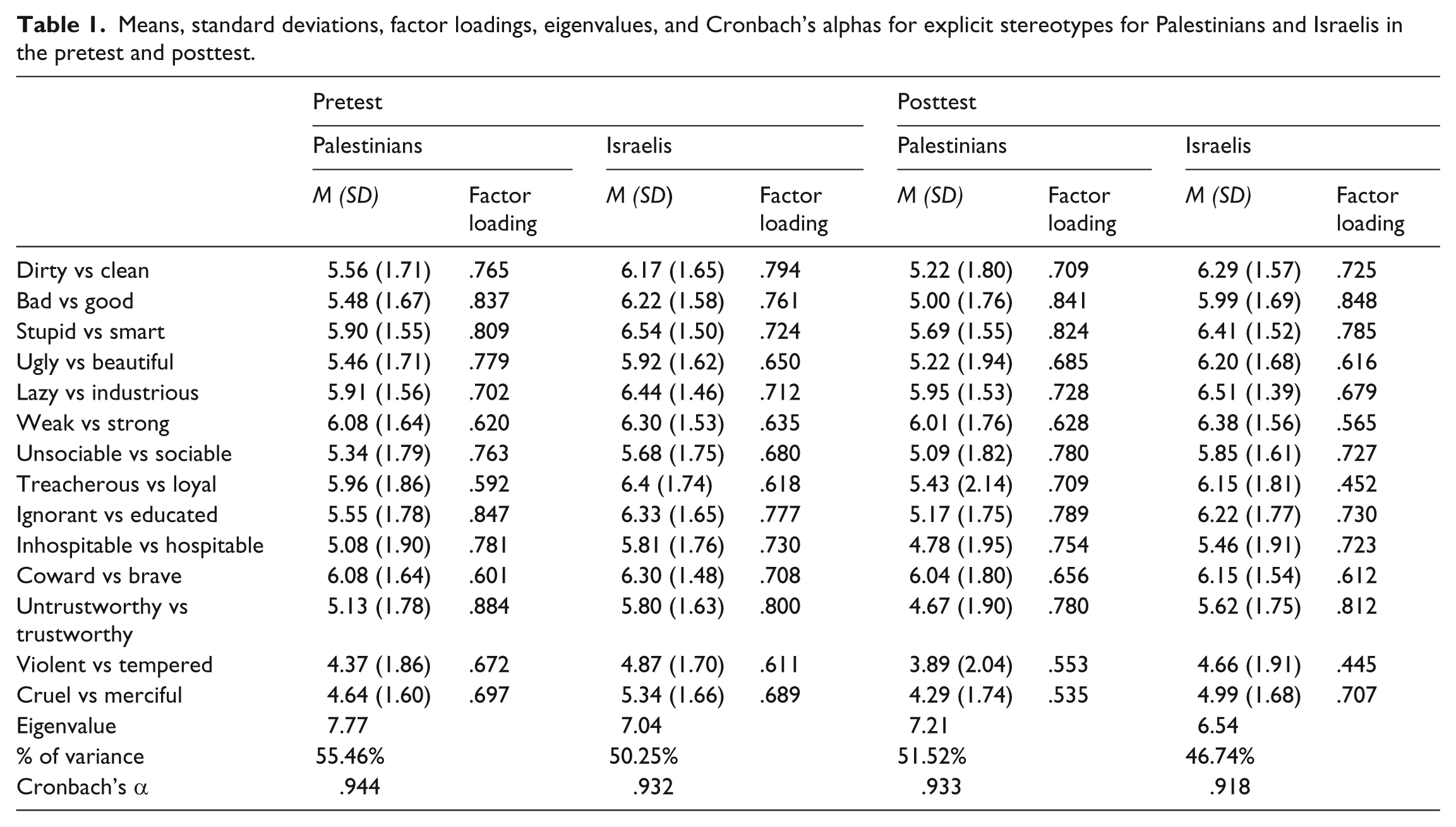
Following Bar-Tal and Labin (2001), explicit stereotypes of Palestinians and Israelis were measured by asking participants to indicate whether stereotypic traits are characteristic of both national groups. Following Bar-Tal and Labin (2001), respondents will be asked to rate 14 different semantic differential items (7-point scale) for each of the two national groups. These items include clean/dirty, good/bad, smart/stupid, beautiful/ugly, industrious/lazy, strong/weak, sociable/unsociable, loyal/treacherous, educated/ignorant, hospitable/inhospitable, brave/coward, trustworthy/untrustworthy, tempered/violent, and merciful/cruel. Upon satisfactory factor and reliability analyses, items were factor-analyzed and reduced to four variables: (1) pretest explicit stereotypes of Israelis, (2) posttest explicit stereotypes of Israelis, (3) pretest explicit stereotypes of Palestinians, and (4) posttest explicit stereotypes of Palestinians (see Table 1).
Means, standard deviations, factor loadings, eigenvalues, and Cronbach’s alphas for explicit stereotypes for Palestinians and Israelis in the pretest and posttest.
Implicit stereotypes
Participants’ implicit affect toward each group was measured using Payne et al.’s (2005) AMP. The AMP is a measure of automatic evaluations that has been previously applied to measure evaluations of affective stimuli, racial groups, alcohol, and smoking cues, among others (Payne et al., 2005, 2007, 2008). Each participant completed two AMP tasks (pretest and posttest). Each task consisted of four blocks of 12 trials (48 trials in total: 24 for Palestinians and 24 for Israelis; presented at complete random) using pictures of both national groups that were pretested on recognition of nationality, valence, arousal, and attractiveness. Each trial consisted of a white screen (1000 ms), target picture (75 ms), a Chinese pictograph (200 ms), and a noise image. Participants were told that they would complete a speed judgment task, where pictures of people (target) would flash quickly on the screen to notify them of the Chinese pictographs that they are to evaluate. They were asked to disregard the target picture and instead rate the Chinese pictograph as pleasant or unpleasant using clearly marked keyboard keys. The percentage of pictures evaluated as pleasant was calculated for each national group for the pretest and posttest. While AMP scores were used as dependent measures for certain analyses, the baseline (pretest) AMP scores were used as moderators in other statistical analyses, considering that baseline evaluations satisfy the conditions for moderation (Hayes, 2013).
Procedure
Participants were run in 10–15-person sessions. A trained experimenter seated each participant by an individual computer equipped with a 17″ monitor, a keyboard, and headphones. First, participants were trained and quizzed on correctly identifying Palestinian and Israeli pictures that have been pretested on group identification (Palestinian vs Israeli), attractiveness, positivity, negativity, and arousal. The average correctness score on the quiz was 97%, where participants were instructed that they can only complete the study if they receive a score of 80% or better. Next, participants completed the explicit stereotype questionnaires and the AMP task. Pictures used in the AMP task were the same as those used in the quiz administered at the beginning of the study. Participants were then instructed to play PeaceMaker for 20 minutes in accordance with their role assignment using the “violent” difficulty level, and were instructed to restart the game with the same role assignment and difficulty level if the game ended in less than 20 minutes. After playing the game, participants took a posttest that included the explicit stereotype measures and AMP task. Participants were thanked and dispelled.
Results
Verification of randomization
To ensure the quality of randomization, we tested for differences in baseline (pretest) explicit stereotypes of Palestinians and Israelis between participants assigned to the two role-play conditions. With regard to stereotypes of Palestinians, participants who played the role of Palestinians President (M = 5.41, SD = 1.28) did not differ significantly from those assigned to play the role of Israeli Prime Minister (M = 5.52, SD = 1.34), t(170) = −.56, ns. Similarly, participants assigned to play the role of Palestinian President (M = 6.12, SD = 1.12) did not differ significantly from those assigned to play the role of Israeli Prime Minister (M = 5.90, SD = 1.24) in their stereotypes of Israelis, t(170) = 1.23, ns. These results ensure the success of randomization.
Baseline evaluations
Hypothesis 1 predicted that participants would report more positive explicit stereotypes of Israelis compared to Palestinians at the baseline (in the pretest). To test this hypothesis, data for pretest stereotypes of Palestinians and Israelis were submitted to a paired-samples t-test. Results, illustrated in Figure 1, showed that participants expressed significantly more positive stereotypes of Israelis (M = 6.01, SD = 1.18) than Palestinians (M = 5.47, SD = 1.31), t(171) = 4.75, p < .001, d = .43. Based on this, Hypothesis 1 was supported.
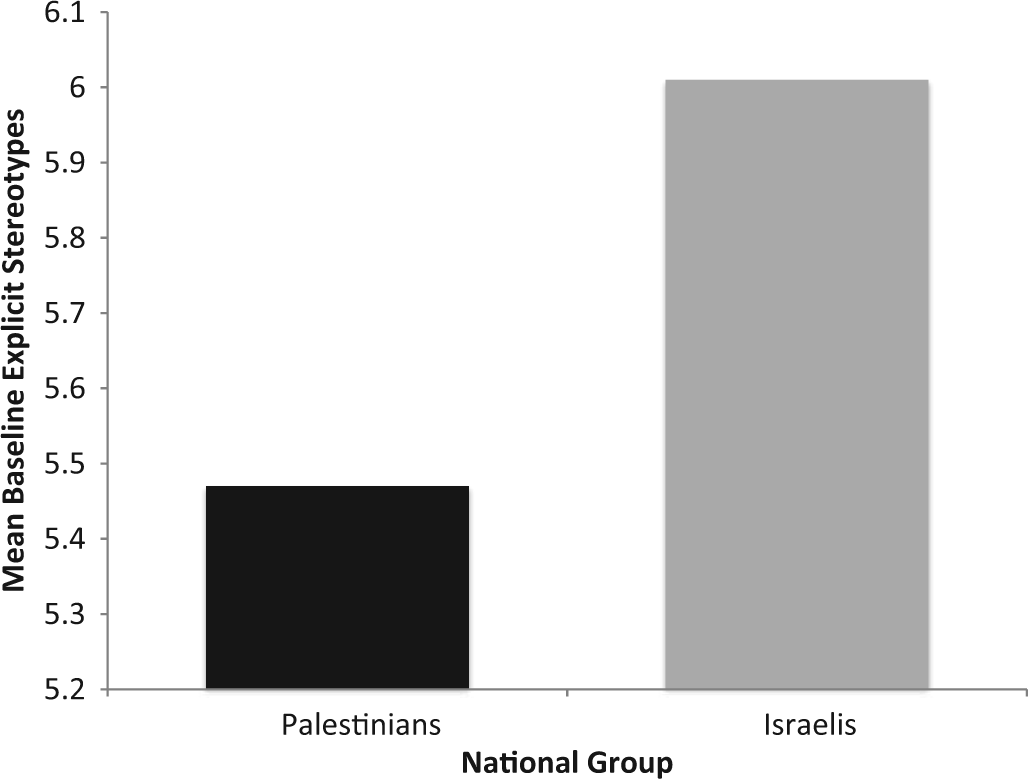
Mean baseline explicit stereotypes of Palestinians and Israelis (pretest).
Hypothesis 2 predicted that participants would report less bias (more pleasantness) for Israeli faces compared to Palestinians faces on the pretest AMP. To test this hypothesis, pretest AMP scores (percent pleasantness) were submitted to a paired-samples t-test. Results, illustrated in Figure 2, showed that participants associated more pleasantness with Israeli faces (M = 64.34%, SD = 18.68%) than Palestinian faces (M = 58.76%, SD = 20.80%), t(160) = 3.30, p < .01, d = .28. Hypothesis 2 was supported.
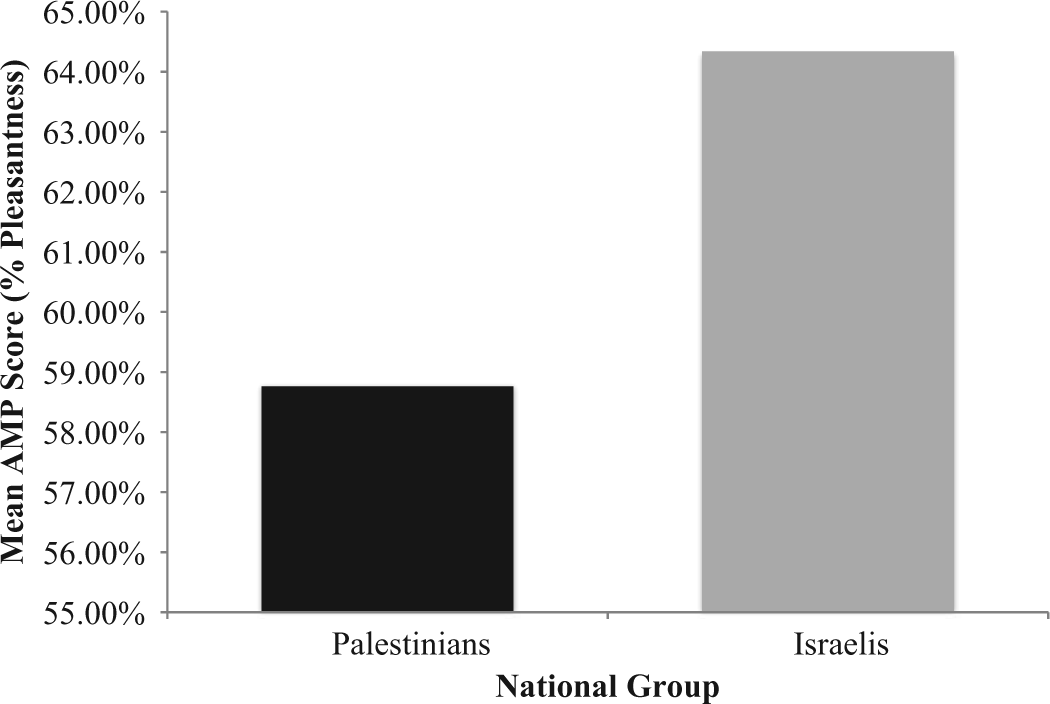
Mean AMP scores for evaluations of Palestinians and Israelis (percent pleasantness).
Effect of PeaceMaker on change in explicit stereotype
The third set of hypotheses predicted that participants would change their explicit stereotypes toward Palestinians and Israelis as a function of playing PeaceMaker. More specifically, Hypothesis 3.1 (H3.1) predicted that playing PeaceMaker in the role of Palestinian President would lead to positive changes in explicit stereotypes of Palestinians and negative changes in explicit stereotypes of Israelis. Conversely, Hypothesis 3.2 (H3.2) predicted that playing PeaceMaker in the role of Israeli Prime Minister would lead to positive changes in explicit stereotypes of Israelis and negative changes in explicit stereotypes of Palestinians.
To test H3.1 and H3.2, data for explicit stereotypes were submitted to a 2 (role-play assignment) × 2 (national group 1 ) × 2 (time) repeated measures analysis of variance (ANOVA), with repeated measures on the last two factors. The three-way interaction among role assignment, national group, and time was statistically significant, F(1, 170) = 4.20, p < .01, ηp2 = .05 (see Figure 3). Participants who played the role of Palestinian President observed a significant negative change in their explicit stereotypes of Israeli between the pretest (M = 6.12, SD = 1.12) and posttest (M = 5.87, SD = 1.15), t(84) = 2.78, p < .01, yet they did not observe a significant change in their explicit stereotypes of Palestinians between the pretest (M = 5.41, SD = 1.28) and the posttest (M = 5.28, SD = 1.18), t(84) = 1.40. H3.1 was partially supported.
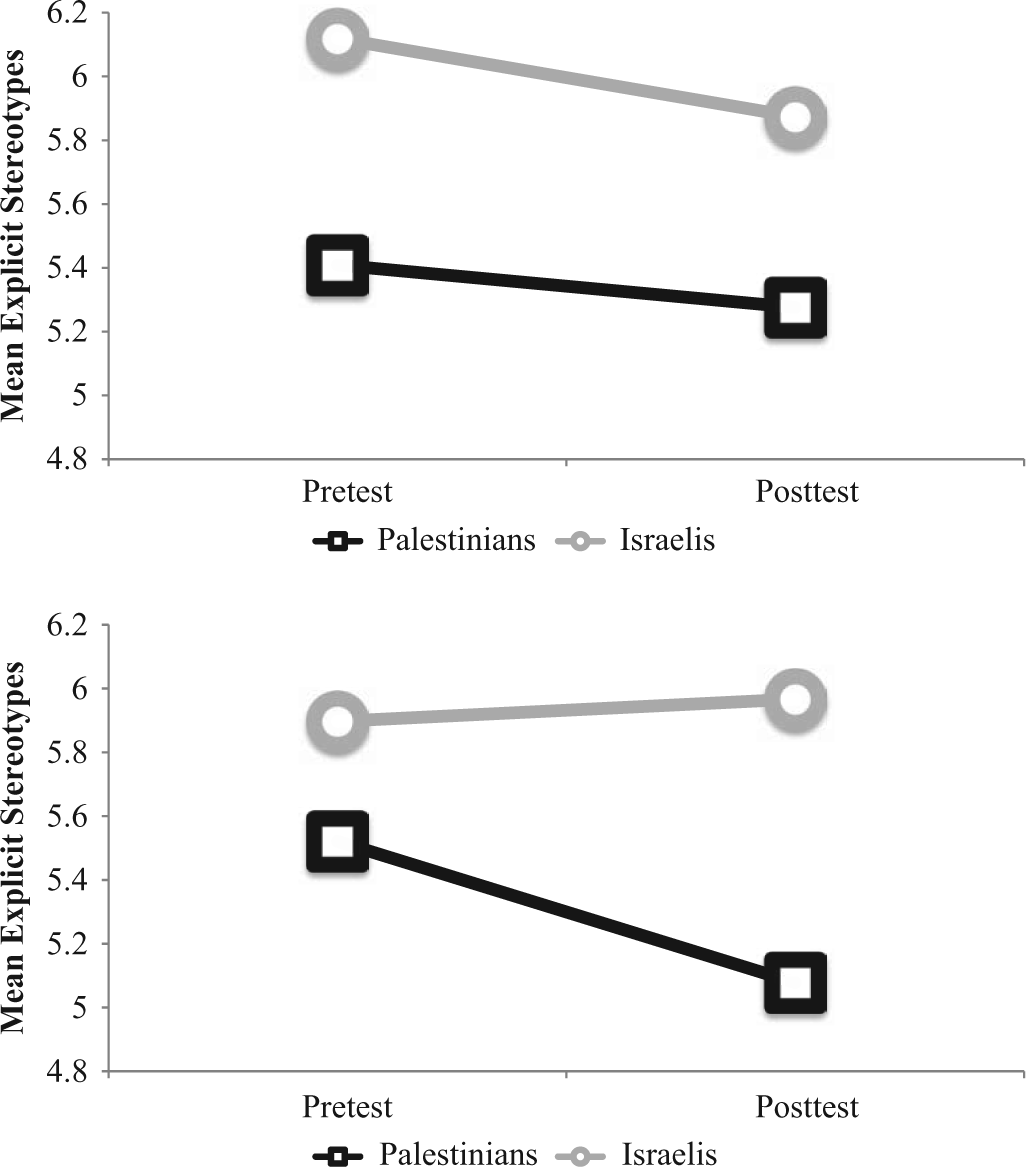
Change in explicit stereotypes of Palestinians and Israelis as a function of role-play assignment: Palestinian President (top) and Israeli Prime Minister (bottom).
Participants who played the role of Israeli Prime Minister showed a significant negative change in their explicit stereotypes of Palestinians between the pretest (M = 5.52, SD = 1.34) and the posttest (M = 5.08, SD = 1.47), t(86) = 4.16, p < .001, while they did not observe a significant change in their explicit stereotypes of Israelis between the pretest (M = 5.90, SD = 1.24) and posttest (M = 5.97, SD = 1.19), t(86) = −.74, ns. H3.2 was partially supported.
Effect of PeaceMaker on change in implicit stereotypes
The third hypothesis predicted that participants would not observe any changes in their implicit stereotypes of Palestinians and Israelis as a function of role-play assignment in PeaceMaker. To test this hypothesis, AMP scores were submitted to a 2 (role-play assignment) × 2 (national group) × 2 (time) repeated measures ANOVA, with repeated measures on the last two factors. Results showed that the three-way interaction of role-play assignment, national group, and time was not statistically significant, F(1, 156) = .001, ns, thus confirming Hypothesis 3.
Moderating effect of baseline implicit stereotypes
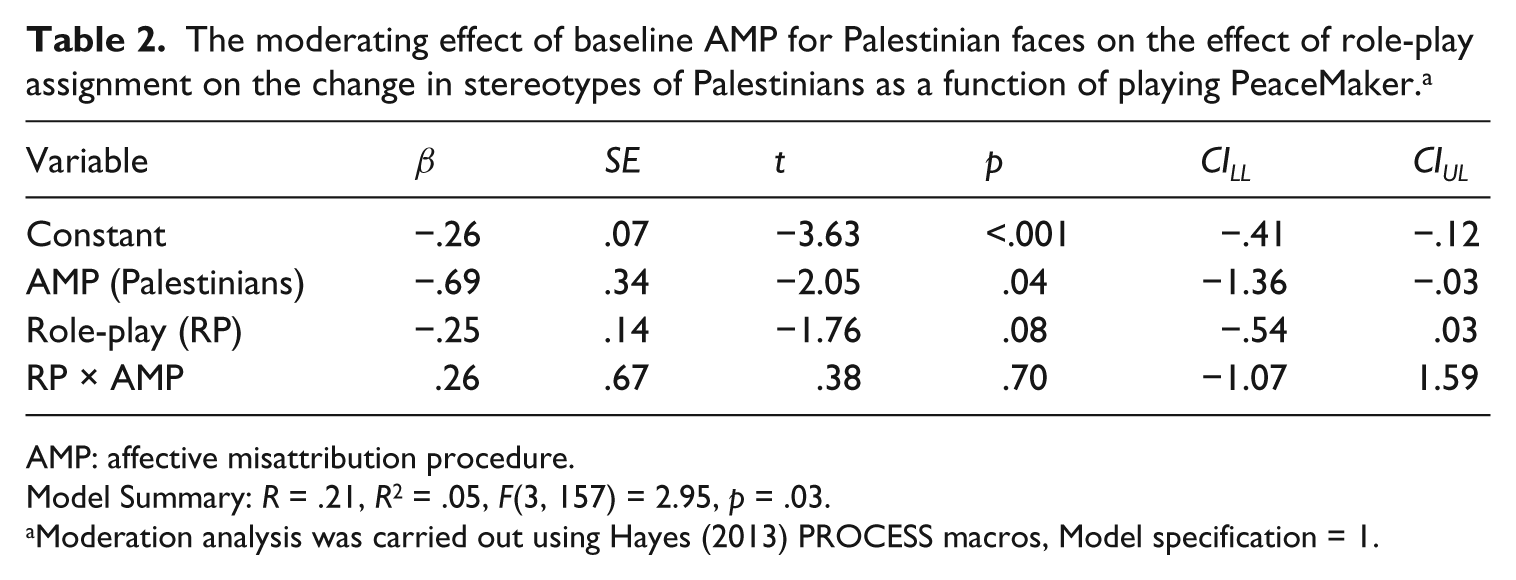
Research Question 1 asked about the ways in which implicit stereotypes (bias), measured by AMP scores, would moderate the effect of role-play assignment on the change in explicit stereotypes. To answer this research question, we calculated change scores for stereotypes of Palestinians and Israelis by subtracting the pretest from posttest scores, thus a positive value indicates a positive change, and conversely, a negative value indicates a negative change. We ran a set of moderation models using Hayes’ (2013) PROCESS macros. Each of the models is described below.
The first model dealt with the change in explicit stereotypes of Palestinians as a result of playing PeaceMaker. We specified this model by entering role-play assignment as an independent variable (X), the change in explicit stereotypes of Palestinians as an outcome (dependent) variable (Y), and the AMP score for Palestinian faces as a moderator (M). Results, illustrated in Table 2, indicated that the regression model was statistically significant, R = .21, R2 = .05, F(3, 157) = 2.95, p = .04. Results showed that role-play assignment marginally affected the change in explicit stereotypes of Palestinians (β = −.25, standard error (SE) = .15, t = −1.76, p = .08, 95% confidence interval (CI95): LL = −.54, UL = .03), indicating that those playing the role of Palestinian President had a greater likelihood for positive change in explicit stereotypes of Palestinians as a result of playing PeaceMaker. The AMP for Palestinian faces, indicative of implicit stereotypes of Palestinians, was a significant predictor of explicit stereotype change (β = −.69, SE = .34, t = −2.05, p = .04, CI95: LL = −1.36, UL = −.03), indicating that lower AMP scores of Palestinian faces (greater implicit bias toward Palestinians) was associated with greater positive change in explicit stereotypes of Palestinians. The interaction between role-play assignment and AMP score was not significant (β = .26, SE = .67, t = .28, ns).
The moderating effect of baseline AMP for Palestinian faces on the effect of role-play assignment on the change in stereotypes of Palestinians as a function of playing PeaceMaker. a
AMP: affective misattribution procedure.
Model Summary: R = .21, R2 = .05, F(3, 157) = 2.95, p = .03.
Moderation analysis was carried out using Hayes (2013) PROCESS macros, Model specification = 1.
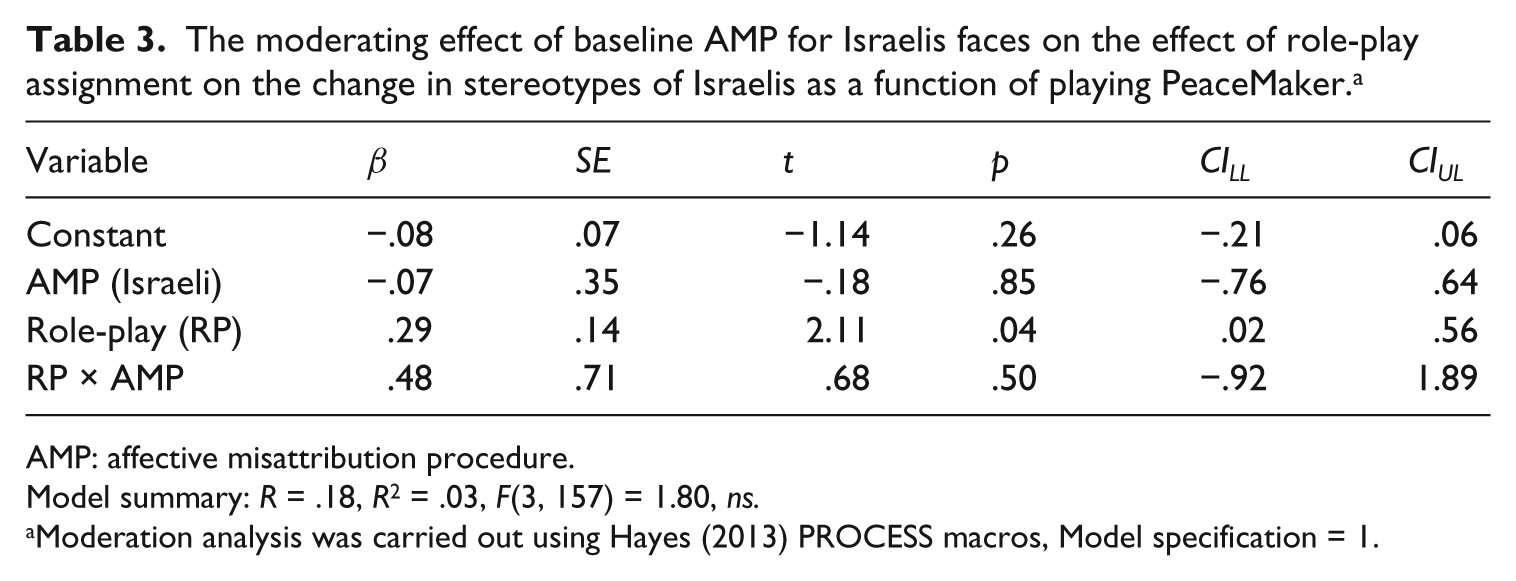
The second moderation model was similar to the one described above, except that it dealt with change in explicit stereotypes of Israelis. For this model, role-play assignment was entered as an independent variable (X), change in explicit stereotypes of Israelis was entered as an outcome (dependent) variable (Y), and AMP score for Israeli faces (implicit stereotypes) was entered as a moderator (M). Despite the fact that role-play assignment was a significant predictor of change in stereotypes (β = .28, SE = .14, t = 2.11, p = .04, CI95: LL = .02, UL = .56), results showed that the regression model was not statistically significant, R = .18, R2 = .03, F(3, 157) = 1.80, ns (see Table 3). AMP scores did not significantly predict explicit stereotype change (β = .07, SE = .35, t = −.18, ns).
The moderating effect of baseline AMP for Israelis faces on the effect of role-play assignment on the change in stereotypes of Israelis as a function of playing PeaceMaker. a
AMP: affective misattribution procedure.
Model summary: R = .18, R2 = .03, F(3, 157) = 1.80, ns.
Moderation analysis was carried out using Hayes (2013) PROCESS macros, Model specification = 1.
Discussion
This study investigated the effects of role-play on the change in explicit and implicit stereotypes of Palestinians and Israelis using PeaceMaker, a videogame simulation of the conflict. Before discussing the results related to the persuasive effects of PeaceMaker, it is worth noting that the baseline evaluations of the two national groups provide interesting insights from a social psychological perspective. Contrary to previous studies focusing on evaluations and stereotypes of ethnic groups (i.e. Blacks, Whites, Hispanics, etc.; Bargh and Chartrand, 1999; Bodenhausen and Macrae, 1998; Brigham, 1972; Devine, 1989; Plant and Devine, 1998), findings of this study showed no discrepancy between explicit and implicit stereotypes. This is plausibly due to the lack of external motivations to withhold stereotypic and/or prejudicial thinking, especially with the polarized political climate surrounding the conflict.
The study showed that playing PeaceMaker for 20 minutes led to changes in explicit stereotypes of Palestinians and Israelis as a function of the assigned in-game role. Playing the role of the Palestinian President led to a negative change in participants’ explicit stereotypes of both national groups, while playing the role of Israeli Prime Minister led to a negative change in explicit stereotypes of Palestinians and no significant change in explicit stereotypes of Israelis. The study hypothesized that there would be role-congruent changes in attitudes, such that participants would observe positive changes in their attitudes toward the group representing the role they played (Palestinian President and Palestinians, Israeli Prime Minister and Israeli), and negative changes in evaluations of the opposing group. Our findings showed that stereotypes of the opposite group changed negatively, while they remained unchanged for the group representing the role participants played. This is plausibly due to instructing all participants to play in the most difficult level of the game (violent), which might have made it hard to win the game, thus producing any desired positive effects. In addition, consistent with predictions of the APE model (Gawronski and Bodenhausen, 2006), changes in evaluations were only observed on the explicit level, and not the implicit level.
Results of the moderation models indicated that baseline implicit stereotypes were only significant moderators of the change in explicit stereotypes of Palestinians. Interestingly, our findings showed that greater bias toward Palestinians was associated with greater positive changes in explicit stereotypes. There are two plausible explanations for this finding. First, it is possible that participants who had the greatest implicit bias toward Palestinians benefited the most from the game and changed their explicit stereotypes positively. The other plausible explanation deals with the potential effect of cognitive control mechanisms employed throughout the experiment between the pretest and posttest evaluations of Palestinians. In other words, it is possible that those with the greatest implicit bias worked hard on controlling their explicit stereotype expression and saw the need to indicate more positive explicit evaluations in the posttest. This requires further exploration that can be best addressed through a triangulated approach of qualitative and quantitative methods to understand the meaning behind implicit bias and its effect on gameplay-induced stereotype change.
Limitations, future studies, and conclusion
Despite our interesting findings, a few limitations are worth noting. First, participants only played PeaceMaker for 20 minutes, which might not be ecologically valid in relation to the amount of time spent playing video and computer games. Future studies should investigate the effects of role-play in videogames in a longitudinal way.
Second, to simplify the study design, we only used the most difficult level of PeaceMaker for all participants. This might have influenced our results. Future studies should empirically test differences between various levels of difficulty and intensity in relation to role-play effects on attitude change. Future studies should also control for perceived difficulty and in-game performance (win vs lose).
Despite the fact that we used explicit and implicit measures of attitudes and stereotypes, future studies should look at the dynamic cognitive and emotional processes involved with playing a certain role in a game like PeaceMaker, which would offer insights not only to self-persuasion but also to decision-making patterns through videogames.
To guard against the lack of clear differentiation between Palestinian and Israeli faces, we instructed participants to learn these differences using a quiz at the beginning of the study. We instructed participants that they have to get a score of 80% on the quiz in order to continue with the study. For this task, we used pictures that have been previously tested on a set of factors, yet could have elicited stereotypic thinking at the onset of the study as they represented stereotypic representations of the two national groups. This could have affected the baseline responses to the implicit and explicit tasks that followed. Future studies should explore the possibility of learning group identification a few days before the gameplay portion of the study to ensure a baseline representative of the individual’s preexisting attitudes.
Finally, this study did not control for gaming experience. Past studies (e.g. Fine, 1983; Nardi, 2010; Newman, 2002; Taylor, 2006) suggest an influence of individual-level characteristics related to gameplay. Future studies should include previous gaming experience as an intervening conditional variable that could possible influence the effects of role-play on stereotype change.
In conclusion, the study illustrated that playing a certain role in a persuasive videogame leads to role-congruent self-persuasion, characterized by changes in explicit and implicit evaluations toward the different national groups.
Footnotes
Acknowledgements
The authors would like to thank ImpactGames and Mr. Eric Brown for providing copies of PeaceMaker to be used in this experiment. Additionally, the authors would like to thank the three anonymous reviewers, the editor, and editorial staff of New Media & Society for their invaluable feedback to this manuscript.
Funding
This research received no specific grant from any funding agency in the public, commercial, or not-for-profit sectors.