



Abstract
Several recent studies have explored social networking sites, such as Facebook, in light of the uses and gratifications approach. However, research has tended to ignore the latter part of this paradigm. This article uses Q methodology to explore user experiences of Facebook, allowing further exploration of gratification from site usage. Four distinct viewpoints were found: Facebook as a superficial environment; Facebook as a valid and valuable social environment; Facebook as an environment of surveillance; and Facebook as a destructive environment. Although the viewpoints show elements of user satisfaction, some users view Facebook in an almost entirely negative way. The article concludes by theorising a model of Facebook usage, drawing upon a metaphor from Star Trek, specifically an analogy with the Borg. It is argued that a level of ‘collective investment’ resides over social networks that may sometimes promote compliance.
Introduction
Facebook is the most used social networking site (SNS) in the United Kingdom, and has over one billion users worldwide (Fowler, 2012). Compared to other SNSs, Facebook holds several distinguishing features. For instance, it is heavily associated with a user’s offline world (Ross et al., 2009) creating a ‘nonymous’ environment (i.e. one in which users are expected to be highly identifiable). Furthermore, over the past year Facebook has developed further than previous SNSs by partnering with external sites with the use of social plug-ins, allowing users to share their Internet activity with others. Thus, one’s Facebook profile has evolved into a hub of individual Internet and offline activity.
Although a large amount of research has been conducted on Facebook, research has somewhat neglected to explore specific differences between user experiences within Facebook (c.f. Anderson et al., 2012). With such increased importance within everyday social maintenance, it is important that psychologists establish the consequences of using Facebook for differing users. Previous research has attempted to explore such differences by using the Uses and Gratifications (U&G) paradigm (Katz et al., 1974), which examines potential motivations for using Facebook and resulting gratifications through usage. However, although the approach highlights differing reasons for choosing the media, it lacks descriptive detail and is unable to capture the Facebook experience as a whole. This study therefore uses Q methodology to explore user perceptions, allowing for a much more descriptive exploration of how users view and experience Facebook than previously available. Essentially, Q methodology uses an inverted factor analysis to group similar subjective experiences, allowing for a narrative breakdown of key viewpoints surrounding a particular topic, in this instance, Facebook usage. These viewpoints can then be compared. Although several studies have used Q methodology to explore various aspects of Internet experiences (e.g. Anandarajan et al., 2006; Hogan, 2008; Lee, 2000), research exploring social networking is much more limited. Indeed, although Wint (2013) has explored perceptions of cyberbullying on Facebook, no further Q studies were found to explore Facebook usage specifically.
This article will first discuss what is known about the Facebook experience from previous studies, before moving on to discuss the Q study undertaken and an interpretation of the four resulting viewpoints from this study. The article will conclude by discussing the implications of these viewpoints. More specifically, the discussion focuses on a potential model of Facebook that has evolved from the resulting Q study viewpoints. This model will elaborate on how user experience may feed into continued usage and Facebook activity. Specifically, it focuses on the idea of a potential ‘collective investment’, in which some users may maintain usage despite perceived negativities due to the prevalence and importance of Facebook to those around them. Star Trek’s ‘Borg’ concept is used as a metaphor of reference to highlight similarities with the TV show’s depiction of a powerful collective based on innate communication.
The uses and gratifications approach to Facebook
Since the 1940s, the U&G approach has been traditionally used to explore media uptake (Wimmer and Dominick, 1994). The approach suggests that audiences actively seek out media to fulfil their individual needs and goals. These are usually viewed as motivations for use. If the chosen media is able to satisfactorily gratify these needs or motivations as a consequence of continued usage, the user adheres to that media above others (Katz et al., 1974). SNSs offer an intriguing environment to explore U&G. The amalgamation of synchronous and asynchronous communication features, combined with the offline visual saliency of the site, makes it a competitor to many previous media. Furthermore, its diversity should lend to the possibility of serving a large variety of needs.
U&G has been used throughout previous literature to explore SNS usage. For instance, Bumgarner (2007) used U&G to look at both practical uses of Facebook and motivations driving use. Motivation components discussed include diversion, personal expression, collection and connection, directory, initiating relationships, voyeurism and social utility and herd instinct (conformity). Joinson (2008) found seven U&G pertaining to Facebook usage including social connections (creating and following Friendship links), shared identities (using group and event features), photographs (viewing, tagging and sharing photos), content gratifications (use of apps and games), social investigation (looking for new contacts and ‘stalking’ profiles), social network surfing (looking through profiles of those outside one’s immediate network) and status updating (making and monitoring statuses and use of the ‘news feed’ function). Finally, Orchard et al. (2014) discuss 10 motivations driving Facebook usage: procrastination, freedom of expression, conformity, information exchange, developing new connections, ritual tendencies, social maintenance, escapism, recreation and experimentation.
Although the above research helps us to identify reasons why individuals are drawn to Facebook, that is, the uses, they cannot demonstrate the full impact of Facebook on users, that is, gratifications, without also shedding light on their experiences. A previous criticism of the U&G approach stipulates that the audience’s perspective and perception of the way they experience media is rarely considered (Lometti et al., 1977) even though they offer valued insight into how U&G correspond. Therefore, it is argued that gratifications cannot be fully understood without first exploring the overall experience of users.
Potential elements of the Facebook experience
Research has already begun to explore potential consequences and outcomes of Facebook use. Although such research tends to cluster around specific topics, a discussion of this research allows insight into how the Facebook experience may be viewed.
First, Facebook is thought to improve well-being through increased social capital. Social capital in its basic definition refers to the increased benefit individuals may obtain from the resources of a community (Lin and Lu, 2011). For instance, Ellison et al. (2007) propose that Facebook use can increase individual self-esteem and psychological well-being, despite the large number of weak ties held across the network, while Young (2011) found that users reported enhanced communication through the site and argued that this facilitated offline socialisation. In line with social capital, it has also been suggested that Facebook reduces levels of loneliness (e.g. Burke et al., 2010). Indeed, Beer (2008) argues that Facebook has the potential to develop friendships that would otherwise be ignored. Moreover, Gonzales and Hancock (2011) argue that modifying one’s profile can lead to heightened self-awareness, subsequently enhancing self-esteem.
Second, the concept of e-empowerment (Amichai-Hamburger et al., 2008) can be applied to SNSs, which suggests a large number of benefits across three levels: personal, interpersonal and group. On the personal level, users can experiment and reframe their identity and increase their self-efficacy through trialling their social skills and behaviour within an online environment. On the interpersonal level, interactions may run smoother or with beneficial consequences. The authors argue that users have increased control over interaction responses, lending itself to a potential ‘poor-get-richer’ scenario of well-being (where socially unskilled users can benefit from interaction structuring). At the group level, users are able to find similar others with relative ease (e.g. by searching for new friend connections via groups dedicated to specific interests or topics). However, the authors admit that their article only focuses on general positives surrounding these issues and recommend caution in interpretation. Facebook may offer an empowerment tool, but it is up to individual users to utilise this to their benefit. Within certain contexts, empowerment of an individual or group may not be beneficial for others. As a recent example, the 2011 UK riots were said to be incited by SNSs with users promoting violence within strengthened groups. Furthermore, individuals or groups may partake in anti-social acts of ‘flaming’ and ‘trolling’, whereby users deliberately post malicious and offensive comments (Lea et al., 1992).
Third, several studies have focused purely on potential negatives surrounding Facebook use. Tokunaga (2011), for instance, identifies three unique characteristics, which enhance negative outcomes within the SNS environment. These are uncertainty surrounding contextual social norms, uncertainty surrounding the true definition of the Facebook Friend and low social presence. Through open-questioning, 10 key categories of potential negative events emerged. The most salient of these were negative responses to friend requests (being deleted or ignored), deletion of user content and ranking behaviours within ‘top friend’ applications. These ideas also reflect observations made by boyd (2006). Furthermore, the notion of user uncertainty is supported by Ballam and Fullwood (2010), who found that SNS users often seek clarification from others and appreciate guidance towards their online social behaviour.
Fourth, a relatively large amount of research has focused on relationship breakdowns. It is suggested that Facebook promotes jealousy and can be potentially detrimental to relationship formation and maintenance. Elphinston and Noller (2011) assert that high scorers on the Facebook Intrusion Questionnaire (based on levels of addiction behaviours) were more likely to experience jealousy in their offline romantic relationship. These results echo the findings of Muise et al. (2009), who argue that increased Facebook use increases jealousy by encouraging users to search for ‘incriminating’ information. Research by Chou and Edge (2011) suggests that users judge those on Facebook to have happier and better lives than themselves, which follows Jordan et al.’s (2011) findings that individuals overemphasise the happiness of others. This research may be closely related to potential acts of ‘Facebook stalking’ or monitoring behaviours. Indeed, Darvell et al. (2011) found that a user’s partner trust and log-in usage predicted monitoring of their partner’s SNS usage. The authors concluded that further research needs to focus on the negative implications surrounding this. Furthermore, in an exploration of married couples, Helsper and Whitty (2010) found that in 45% of couples at least one partner reported using online monitoring behaviours. Wives were more likely to monitor their husbands, which the authors suggest is due to higher levels of worry and easy access. However, despite negative connotations surrounding Facebook stalking, Young (2011) argues that some users perceive it is a positive experience, as perhaps a form of passive communication.
Finally, drawing on from negative consequences of Internet addiction (e.g. Young and Rogers, 1998), the term ‘Facebook depression’ has been coined (O’Keefe and Clarke-Pearson, 2011) to reflect a number of studies and anecdotal suggestions linking Facebook use to symptoms of clinical depression. For instance, Kalpidou et al. (2011) found that those spending more time on Facebook had lower self-esteem. However, caution surrounding a cause and effect relationship should be maintained. In other words, it is also possible that those who experience higher levels of depression turn to Facebook to help alleviate this.
Research has tended to focus on either a positive or negative viewpoint, yet a balance of these elements is needed to gauge a better understanding of Facebook as a social experience. Furthermore, exploratory research may uncover more unexpected outcomes. Although research of this nature is limited, a study by Johnstone et al. (2009) does view the Facebook experience as a whole. The authors conducted a thematic analysis on interviews of Facebook users. The authors focussed their discussion on the key theme of social connections, defined either directly through user interactions or indirectly through profile browsing. It is suggested that Facebook promotes meaningful and essential social interaction, through maintenance or even resurrection of existing relationships, and by promoting free interaction that may be inhibited in an offline context. Additionally, the authors stated that Facebook was of particular benefit for men who were able to enhance disclosure and intimacy through the site. However, the themes also identified feelings of rejection or apprehension, which was attributed to one’s need for affiliation and fear of exclusion. Furthermore, perceived exclusion from a non-friend request negatively impacted upon self-esteem and sense of belonging. Although Johnstone et al. provide a comprehensive exploration of user experiences, the study cannot distinguish between differing types of user experience. By using Q methodology, this investigation will explore multiple viewpoints, allowing for a comparison of experiences between differing users.
Study aim
Although the above studies add a unique insight into Facebook, the literature generally lacks a specific focus on overall outcome experience for differing users. Instead studies have tended to focus on key issues within Facebook usage, rather than identifying niche experiences of Facebook. This study aims to understand how Facebook is experienced by investigating user viewpoints towards the site. More specifically, Q methodology is used to develop specific viewpoints about Facebook.
Method
This study relies on Q methodology (Stephenson, 1953). The method requires participants to sort a number of predefined statements relating to the topic on a quasi-normal distribution grid. An inverted factor analysis strategy can then be applied, which groups individuals with similar attitudes. These viewpoints can then be presented as social narratives (Stephenson, 1965) to gain a better understanding of how the topic may be experienced by differing individuals. It is this statement sorting procedure (known as a Q sort), combined with the use of the by-person factor analysis, which differentiates Q from any other methodology (Watts and Stenner, 2012).
Materials
The first step of a Q study is to develop a comprehensive array of communication, knowledge and information relating to the particular research question being explored. Collection of this information is known as the concourse, which will eventually lead to the development of statements used within the Q sort. For this study, the concourse was developed through a thematic analysis of discussion board forum posts discussing the Facebook experience. Posts were passively collected from www.thestudentroom.co.uk, a well-known UK-based student forum, which encourages general discussions relating to student life. The Q study was based on student participants and so it was important that the concourse reflected the participant group to ensure engagement with the statements. Posts were located by searching the forum for the terms: ‘Facebook is’ OR ‘Facebook makes me’. This tallied a total of 3120 results. From the initial 20 pages of search results, forum threads were subjectively explored for suitability. Altogether 29 individual threads were analysed, consisting of a total of 1768 posts. The analysis did not follow a particular epistemology, but rather was conducted by the authors following guidelines set out by Braun and Clarke (2006), which offers a six-stage framework of analysis. These stages are briefly discussed here: (1) Data familiarisation – selected threads were repeatedly read to increase data acquaintance. (2) Initial code generation – interesting postings were coded to highlight initial ideas. (3 and 4) Theme initialisation and Review of final themes – the initial codes were reviewed for associations to form emerging themes. Following several amendments, the final themes were chosen based on goodness-of-fit and interpreted importance from participants. (5 and 6) Theme definition and Production of the report – data extracts were reviewed more explicitly to identify those that most encapsulated the themes. For further information pertaining to thematic analysis, the reader is directed to Braun and Clarke (2006).
Although a full thematic analysis is not required to generate a concourse, it was thought that the analysis would aid interpretation of the Q study and generate a level of rigour within statement selection. The thematic analysis uncovered eight themes: perceived control, opinions of Facebook, offline circumstances, social comparisons, social empowerment, social exclusion, social detriment and social impact. Representative quotes were taken from each theme (Stages 5 and 6 of the analysis) to develop a comprehensive array of statements. These are known collectively as the Q set. The final Q set consisted of 54 statements, which were modified from forum postings.
Participants (P set)
Within Q methodology, sample size is not of large importance. Indeed, given the inverted factor analysis employed, from a statistical viewpoint the Q set statements may be considered as participants, while individuals may be considered as study variables (Watts and Stenner, 2012). Furthermore, the method does not aim to explore generalisability of viewpoints, but rather uncover the existence of such viewpoints (Brown, 1980). Thus, it is advocated that a smaller number of participants should be specifically and strategically selected to ensure a representative compilation of opinions (Theiss-Morse et al., 1992). Previous literature has suggested that individual differences may impact upon the U&G of particular media (Katz et al., 1974). Furthermore, personality has a strong impact upon the manner in which people engage with the Internet (e.g. Orchard and Fullwood, 2010). In order to ensure a reasonably representative view, selective sampling was undertaken to obtain participants of varying personality types and demographics. Eysenck’s EPQ-R (Eysenck Personality Questionnaire–Revised) short scale (Eysenck and Eysenck, 1991) and Beck’s SAS (Sociotropy Autonomy Scale; Beck et al., 1983) were used to distinguish high and low scorers on the following personality traits: Extraversion – a person’s level of social confidence and need for external stimulation, Neuroticism – a person’s level of innate worry and anxiety, Psychoticism – a person’s level of anti-social tendencies, Sociotropy – a person’s reliance upon social approval and need for interpersonal relationships and Autonomy – a person’s need for control and independence. These personality types have already been highlighted within past research to affect motivational differences behind using SNSs (Orchard et al., 2014). Following personality testing of a larger initial sample, the three highest and lowest scorers from each personality trait were contacted to request participation in the study. The final P set consisted of 20 undergraduate participants, which fulfils expected guidelines stating an approximate 3:1 statement to participant ratio (Webler et al., 2009). Participants were of varied demographics (80% females and 20% males), with an age range from 18 to 45 years (Mdn = 19; M = 23.65).
Procedure
Participants were provided with an information sheet, instruction sheet (with the sorting instruction: ‘Thinking of your experience of Facebook, to what extent do you agree/disagree with the statements provided’) and consent form. The researcher guided participants through each stage of the Q sort process.
Statements were presented to participants in a random order. Participants were first asked to pre-sort the Q set statements based on their initial ‘gut feeling’ of ‘agree’, ‘disagree’ and ‘neutral’. Once all statement cards had been initially sorted, participants were introduced to the sorting grid. The grid ran from a scale of −5 to +5 and allowed space for all 54 statements under a quasi-normal distribution. To ensure participants considered their own personal point of view, the scale was labelled ‘Least like how I think’ to ‘Most like how I think’ at each extreme. Participants were first asked to arrange their pre-sorted ‘agree’ statements in order on the right-hand side of the grid. They were then asked to arrange the disagree statements on the left-hand side of the grid, and to complete the grid by filling in the remaining neutral cards. Participants were given time to review the grid and encouraged to move items if they wished to do so. The final distribution was recorded.
Throughout the Q sorting procedure, participants were encouraged to openly verbalise their view on the statements. Such thoughts were noted with the participants’ permission. Following completion of the Q sort, participants were asked a series of follow-up questions to further establish their viewpoints. Questions were asked in a semi-structured manner, depending on the participant’s responses. Full transcriptions were not taken.
Analysis
Q methodology analysis relies on an inverted factor analysis whereby participants are grouped on viewpoints as opposed to statements. Q sorts were analysed within PQMethod (Schmolck and Atkinson, 2002). The programme helps guide analysis by calculating intercorrelations between Q sorts in order to group similar participants into an idealised grouping. The software automatically creates a comprehensive result summary, allowing the researcher to identify and interpret such ‘idealised’ viewpoints.
For this analysis, Principal Component Analysis was conducted with Varimax rotation. A ‘trial and error’ approach was applied to factor extraction in search of the most parsimonious result. The presence of at least two loading participants on each factor was required to substantiate that factor as a valid viewpoint (Watts and Stenner, 2005). The final analysis extracted four factors which accounted for 54% of the variance, with 16 pure loading participants.
Interpretation
The four extracted factors will be discussed in turn in an ‘idealised’ manner describing a typical viewpoint of a subscriber to the factor. The interpretations are based on the given factor array and distinguishing statements for each factor as detailed through the PQMethod output, and follow-up questioning pertaining to each Q sort.
Factor A: Facebook as a ‘Superficial’ environment
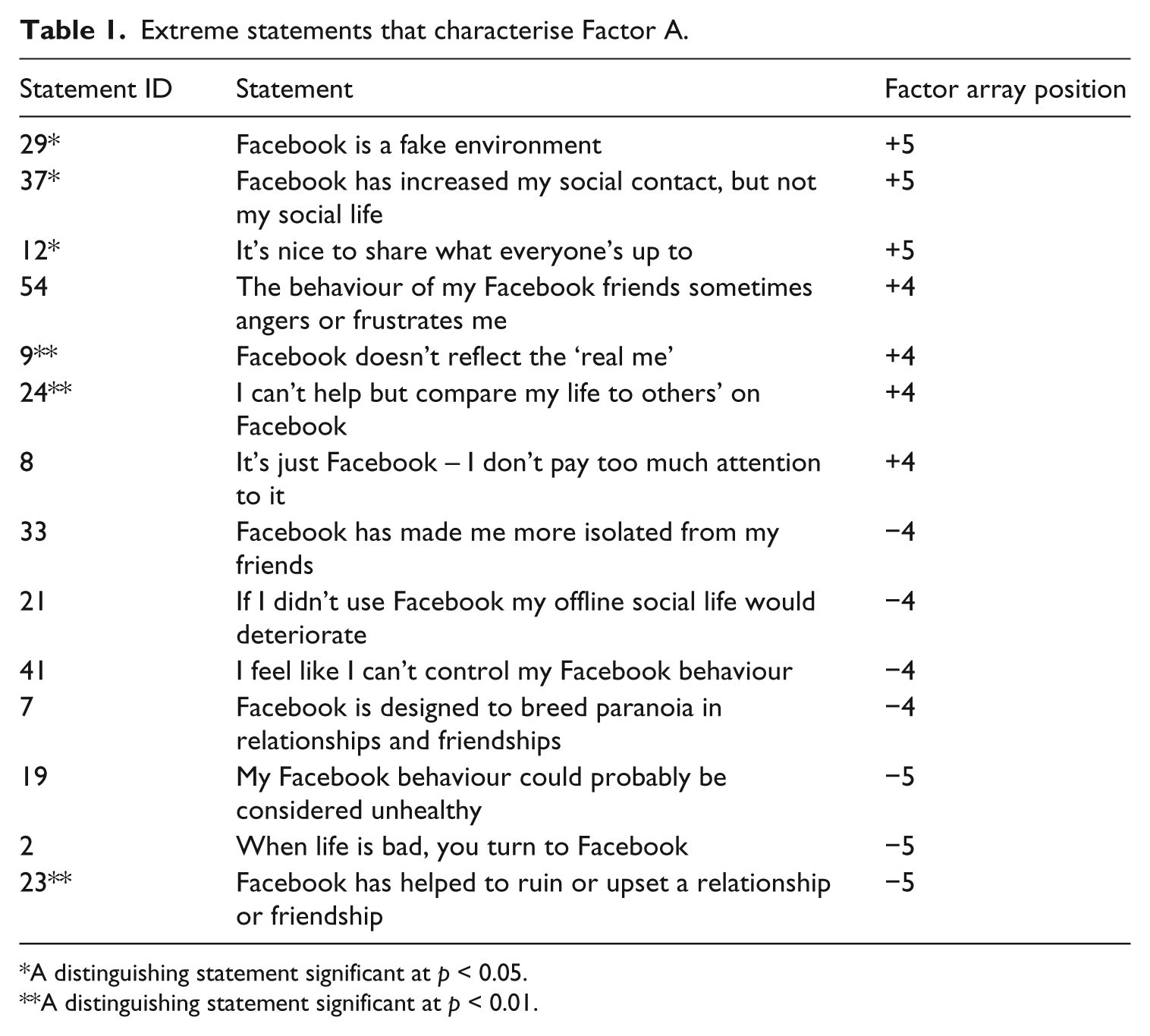
Factor A explains 15% of the variance. Four participants had pure loadings on this factor. Table 1 highlights the seven statements rated at each extreme (14 in total). These items will be referred to heavily within the factor description.
Extreme statements that characterise Factor A.
A distinguishing statement significant at p < 0.05.
A distinguishing statement significant at p < 0.01.
Factor A represents a belief that Facebook is a rather superficial social environment (29, 8 and 9). It should be valued perhaps for its practicalities of keeping in touch with distant friends (12) but not as an integral part of one’s offline social life (37 and 21). These participants are very aware of some of the negative consequences of Facebook use (24). Indeed, they may be more prone to social comparison behaviours on Facebook, suggested by the distinguishing statements ‘Facebook sometimes makes me feel like a loser compared to everyone else’ and ‘I feel socially inadequate when I see my friends have been somewhere without me’, which were ranked higher than most factors (although still weakly at +1 and +3 respectively). Yet they acknowledge that they are not personally negatively affected (23, 33 and 7) due to the way they view and use Facebook – that is, in a non-addicted, controlled manner (19, 2 and 41). Indeed, within the follow-up questions it became clearly apparent that they believe a lot of the negative consequences from Facebook stem from obsessive or unhealthy use by others who take Facebook too seriously (54). Again this is supported by the distinguishing statement ‘My mood affects how I perceive things on Facebook’, ranked as +3. This was higher than all other factors.
Factor B: Facebook as a ‘Valid and Valuable Social’ environment
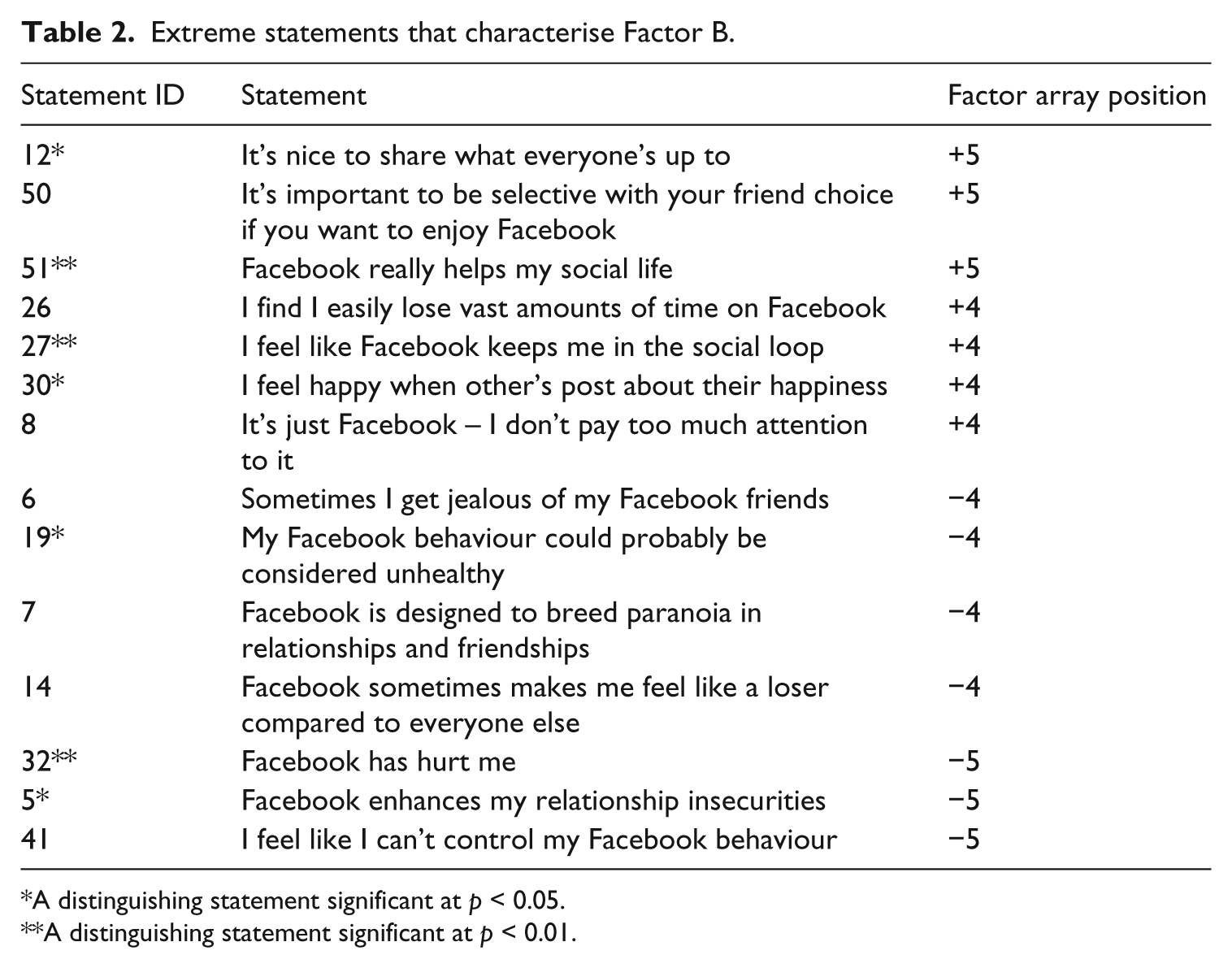
Factor B explains 18% of the variance. Table 2 highlights extreme scoring statements. Six participants had pure loadings on this factor.
Extreme statements that characterise Factor B.
A distinguishing statement significant at p < 0.05.
A distinguishing statement significant at p < 0.01.
Those who load onto Factor B believe Facebook is a positive environment (12 and 30) that has valuable features to benefit their social life (51 and 27). This is confirmed by distinguishing statements ‘Facebook can really cheer me up’, ‘Facebook does more good than harm’ and ‘Facebook has increased my offline self confidence’, which were all ranked significantly higher than other factors (ranked +3/+3/+2). Factor B participants very much see Facebook as an integral and equal part of their social life. This is confirmed by the distinguishing statements ‘Being deleted/rejected marks the end of the offline friendship’, ‘Being deleted/rejected on Facebook is the ultimate insult’ and ‘There’s no escape from Facebook. No Facebook = Social Recluse’, which were all rated higher than in other factors (+2/+2/+1), and ‘My personality differs on Facebook to real life’, which was rated lower than in other factors (−2). They enjoy Facebook, and consequently may lose large amounts of time when logged in (26). However, they do not believe it should replace one’s social life – but rather be valued as an additional medium (8 and follow-up questioning). Similar to Factor A, they believe they have control over their use (19 and 41), which prevents them from experiencing any of the negative consequences of use such as relationship detriment (5 and 7) or lowered self-esteem (32, 6 and 14). This was supported through follow-up questioning, whereby participants commented on how more addictive usage is more likely to result in negative effects.
Factor C: Facebook as an environment of ‘Surveillance’
Factor C explains 10% of the variance. The factor had three pure loadings. Table 3 highlights extreme statements from the idealised factor array.
Extreme statements that characterise Factor C.

A distinguishing statement significant at p < 0.05.
A distinguishing statement significant at p < 0.01.
Factor C is characterised by a juxtaposition of enjoyment on the site (3), yet experience of negative social consequences (38 and 32), such as relationship jeopardy (5 and 23). This seems to stem from their usage of the site. Participants perhaps view the site as a ‘Big Brother’ method of surveillance, valuing the ability to snoop or monitor the behaviour of others. The user feels self-soothed by knowing what is happening (43), which may increase perceived social standing (33). This is further supported by the distinguishing statements ‘Facebook sometimes makes me feel popular’ and ‘I sometimes feel better about myself when I see the Facebook drama of others’, which are both ranked as +3 (higher than all other factors). However, as a consequence of such snooping behaviour, the user is more likely to uncover ‘visual evidence’ of things they do not like, which perhaps accentuates the negative outcomes experienced as mentioned previously (35 and the distinguishing statement ‘I have felt betrayed by someone because of what’s happened on Facebook’ rated as +3 above all other factors). These ideas are summed up in the follow-up questioning of one loading participant who suggested that they had a love/hate relationship with the site. Furthermore, another loading participant commented that they sometimes see things on Facebook that they do not want to see, but then once they’ve seen these things they want to know more. This idea fits well with the highest positioning of statement 42 and the distinguishing statement ‘My Facebook behaviour could probably be considered unhealthy’ rated as 0, with all other factors rating as −5 or −4. People pertaining to Factor C see Facebook as an important domain holding strong importance within their social life (9 and 17). This is further evidenced by the negative positioning of distinguishing statements ‘Facebook is a fake environment’ and ‘It’s just Facebook – I don’t pay too much attention to it’, ranked −3 and −1 (lower than all other factors). There is a belief, however, that they do not need Facebook (21, 16 and 2), which does not appear to fit the remaining profile. Perhaps this belief stems from a defence mechanism whereby sorters are aware that they have strongly agreed with many of the negatively worded items and want to balance their view by emphasising that they are not dependent on Facebook.
Factor D: Facebook as a ‘Destructive’ environment, enforced by others using the site
Factor D explains 11% of the variance. Three participants had pure loadings on this factor. Refer to Table 4 for extreme statements from the factor array output.
Extreme statements that characterise Factor D.

A distinguishing statement significant at p < 0.05.
A distinguishing statement significant at p < 0.01.
Factor D participants see Facebook as a destructive, negative environment (46), which is threatening traditional offline social existence. Reported detrimental effects relate to the destruction of the user’s offline social life (23, 20 and 22, and distinguishing statement ‘Facebook is designed to breed paranoia in relationships and friendships’ [ranked +3]), rather than personal self-esteem issues (11, 42 and 18). Furthermore, they strongly believe that Facebook use does not result in positive benefits (39, 45 and the distinguishing statements ‘I feel like Facebook keeps me in the social loop’ and ‘Facebook has increased my social contact, but not my social life’ ranked as −2 and −1 respectively, lower than all other factors). Factor D users strongly disagree that their Facebook behaviour is unhealthy (19). They perceive the behaviour of those who enjoy using Facebook as unhealthy, and somewhat blame them for continuing its existence – if others did not use it, they would not need to either. Thus they are not fans of the site (3) and feel compelled to use it out of necessity because others do. This is supported by the follow-up questions and a higher ranking of the distinguishing statement ‘Facebook has made me more isolated from my friends’ than other factors (+1). They rank statement 26 highly as they spend more time than they would want to on the site. This again may be linked to anxiety surrounding consequences of not using the site. Indeed, the high ranking positions of statements 44 and 50 suggests that these participants are worried about their presence on Facebook, and perhaps continue to use the site in order to gain control over this presence. The higher ranking (+2) of distinguishing statement ‘When life is bad, you turn to Facebook’ compared to all other factors may seem surprising. However, this could relate to the fact that these participants blame Facebook for the ‘bad’ in their life, and they are turning to Facebook as the source of the fault.
Discussion
This study has successfully identified four unique viewpoints towards the Facebook experience as a social environment. These viewpoints range dramatically in their outlook and can be visualised on a continuum scale of positive to negative (B, A, C, D). The results as they stand show support for both beneficial and negative consequences of Facebook use in terms of well-being.
It is evident that some users seem to be utilising Facebook as a positive social resource (Viewpoints A and B). However, some users appear to have developed a love–hate relationship for the site (Viewpoint C), while some seem to experience the site in an entirely negative way despite continued usage (Viewpoint D). Viewpoints A, B and C may be explained simply with reference to a ‘gratifications sought-gratifications obtained’ paradigm. These users appear to be gratifying particular needs via their continued use of the site. For instance, those in Viewpoint A feel that the practicalities of Facebook allow them to satisfy their need to keep in touch with distant friends, while those in Viewpoint B feel that Facebook features allow them to maintain an active social life. Despite strong negative outcomes, Viewpoint C users are still gratifying their social needs through surveillance or monitoring behaviours. However, it is much harder to reconcile Viewpoint D’s continued use of the site despite experiencing it in an almost entirely negative way with reference to the traditional U&G model. This suggests that broader social and cognitive factors need to be taken account of to explain their Facebook consumption. Indeed, in a study of Internet usage, LaRose and Eastin (2004) already suggest altering the conceptual framework of U&G to incorporate ‘expected outcomes’ as opposed to ‘gratifications sought’. Moreover, they built upon the U&G paradigm by taking inspiration from Social Cognitive Theory (SCT). Consequently, they were able to substantially increase the predictive power of their model by changing the conceptual focus to incorporate SCT (including factors such as status outcomes, Internet self-efficacy, habit strength and deficient self-regulation). Similarly, the interpretation of the Q study supports the need to explore wider factors of consideration.
As part of a social network, Facebook members need to ultimately take into consideration the feelings, attitudes, beliefs and values of others. Previous research (e.g. Ballam and Fullwood, 2010; Tokunaga, 2011) has highlighted the conflict that many members experience surrounding uncertainty in social norms. One area which may produce further uncertainty centres on how leaving the site may be interpreted. Other members would be aware of this and may interpret this in a number of ways – for example, they may assume that the member has ‘unfriended’ them or considers himself or herself to be superior to other members or is simply not interested in maintaining social bonds. The implications of all of these potential interpretations could therefore be socially damaging to the individual who may desire to leave Facebook behind.
It could therefore be argued that Facebook can be seen as a collective space of interaction, whereby the community itself takes precedence over the individual. Moreover, this might be a consequence of social interactions being played out so publicly, which might emphasise the importance of group cohesion (i.e. the public nature of Facebook may make it more obvious to larger groups when individuals are not coalescing). Although this collective space may promote positive outcomes (views A, B and C), for some its intrusion may seem overwhelming (view D). Yet, the consequences of being outside of this collective space may be feared. One may consider Facebook using the Star Trek analogy of the ‘Borg’. Within the TV show, the Borg refers to a collective of individuals with a constant innate group communication system. Once assimilated into the collective, it becomes very difficult to break the bonds of the group. Indeed, the character ‘Seven of Nine’ suffered feelings of exclusion and loneliness once her connections to the Borg collective had been severed. When considering this analogy, it may be argued that there is a sense of ‘collective investment’ or collective power, which enforces members to contribute to the collective group. Those in Viewpoints A, B and C are gratified by the collective and will subsequently enjoy the collective nature of the site. Those in Viewpoint D, however, feel that the collective has too much control and do not value the site socially. They would therefore prefer to leave the site. However, as they have already been assimilated, their collective investment is high (i.e. they hold a strong belief in the power of the collective) and they will subsequently feel they need to stay on the site. We argue therefore that there may be a conflict for some individuals between wanting to disengage from the site because it does not meet their particular interactional needs with the necessity of remaining part of the collective. Thus it is their collective investment which drives their compliance to the Facebook Borg. Seeking gratification in a social sense requires positive reinforcement but collective investment simply offers inclusion and provision of communication rights. Those with a high collective investment fear the collective’s power. Although they despise the collective gaining their control, the alternative is greater isolation and further lack of control and this may be more intolerable than low status in the collective community. Those with low collective investment may choose to leave the site or rather not sign up in the first place. It is this collective investment which may also drive those within Viewpoint C towards monitoring behaviours despite perceived negative consequences.
When combined with previous research, the viewpoints allow an insight into Facebook as a media entity. The active nature of Facebook, along with its collective popularity, may distinguish it from past media. A tentative proposed model of Facebook usage incorporating these ideas is proposed in Figure 1.

Proposed model of Facebook usage.
In line with the U&G approach, a user’s motivations for use may feed into his or her actual usage and type of engagement. For instance, a need for personal expression may be gratified by updating ones profile (Bumgarner, 2007), or the need for social connection can be gratified through creating and following friendship links (Joinson, 2008). Motivations and site engagement in turn determine experiences or outcomes and consequences of use. Those in Viewpoint A, B and C take value from the collective and feel that Facebook’s features allows them to improve social capital (Lin and Lu, 2011) through continued site usage. This promotes continued usage of the site. Viewpoint C individuals suffer a number of negative consequences; yet these are seemingly outweighed by the positive benefits of their gratification from Facebook site features. Indeed, Joinson (2008) has already highlighted that individuals may be gratified by using Facebook for social investigation, which reflects Viewpoint C’s surveillance behaviours. From Viewpoint D, however, one could tentatively argue that it is not Facebook itself which promotes continued usage, but rather their collective investment. A high level of collective investment may enforce continued compliance despite low gratification satisfaction; whereas a low level may result in non-usage. Non-users will find an alternative and more suitable means to gratify their social needs. Future research into this model would benefit from exploring the ‘Facebook dissenter’, that is, those who have used Facebook but opted to leave the site following unsatisfactory outcomes. Such research will enhance the validity and scope of such viewpoints and shed light on the concept of collective investment itself. For instance, it is logical to suggest that those of a particular personality type (e.g. sociotropy) may be more susceptible to collective investment.
Limitations and further considerations
A student sample was used within the Q sort. Furthermore, Q statements were derived from a thematic analysis of a student forum. Students may have larger social circles than other societal groups, and their constant interaction with technology may necessitate site usage. Such pressurised use (through friends and course demands) may reflect different experiences to Facebook than those from a non-student sample.
The interpreted viewpoints can only be based on the statements included. In retrospect, some items may have over-relied on specific experiences rather than generic experiences or opinions. For instance, the item ‘Facebook has helped to ruin or upset a relationship or friendship’ may have resulted in extreme placing (±5) as its saliency as a social memory is so apparent. The results as they stand only show the potential range of viewpoints and do not indicate their generalisability beyond this. The discussion has explored viewpoints in a particularly isolated fashion. However, it is worth noting that individuals will have an opinion on all viewpoints. Furthermore, it is possible for individuals to load onto multiple factors. Taking the example of personality, mid-scorers on the sociotropy scale may be conflicted between viewpoints.
This study offers a valuable starting point to further explore such viewpoints and the theoretical suggestions surrounding them. The use of Q methodology specifically has allowed insight from a user perspective, which previous methodologies have missed. Q methodology provides a unique research angle to audience subjectivity by combining the richness of qualitative data with the advantages of a quantitative structure. Furthermore, it allows a data-driven approach to promote and explore initial theoretical discussion (Davis and Michelle, 2011). The generation of categorical viewpoints is of current interest but will also allow further research to explore types of Facebook user. For instance, those pertaining to Viewpoint C may be considered ‘at risk’ by using Facebook from a well-being perspective, and as an example, further research may benefit from exploring this viewpoint in relation to cyberbullying. It is suggested that future studies draw upon these viewpoints and aim to further develop the theoretical notion of collective investment.
Footnotes
Funding
This research received no specific grant from any funding agency in the public, commercial or not-for-profit sectors.