




Abstract
This article contributes to research on the felt-experience of new media. It describes how the body’s corporal capacities are augmented through one 12-year-old boy’s play of the video game, Minecraft, while hospitalized. Expanding player-centric perspectives of video gameplay, the authors leverage work on place-events to develop an intra-actional methodology aligned with their relational materialist analysis. Their analysis illuminates how multiple human and nonhuman bodies become entangled in gameplace-events and potentially generate affective atmospheres. Analysis shows how these atmospheres reverberate and adhere within social space, revealing experiences of new media as less a one-to-one transaction between player and game and more an affective experience felt across multiple bodies and temporalities. Implications, suggesting both how intimate atmospheres developed during gameplay and how those atmospheres (re)shaped care in the hospital, point toward new media’s potential to engage users in uniquely meaningful felt-experiences made visible—and felt—through methods of intra-action and relational materialism.
In this article, we explore the feeling of video gameplay as an experience shared between multiple bodies. We ground this exploration in an analysis of our experiences playing and learning the video game Minecraft (Mojang, 2010) with a 12-year-old male patient, Parker, in a children’s hospital. To better understand our shared felt-experiences of gameplay with Parker, we draw from work in cultural geography that has conceptualized affective atmospheres as a feeling of envelopment produced through the emanations of multiple bodies (Anderson, 2009), especially those engaging with new media (Ash, 2013). Developing this conception of affective atmospheres, we situate our contribution in conversation with work that has considered the embodied experience of gameplay (Ash, 2010a, 2010b, 2012; Giddings, 2009). For example, research has described gameplay’s somatic impact upon the body, illustrating how the body’s corporal capacities are augmented and reshaped between imbricated digital–physical environments (e.g. Ash, 2010b). Thus, rather than conceptualize bodies as sedentary during gameplay, such work shows that gameplay experiences facilitate the construction of active, sensing bodies.
Our analysis extends this research, showing how the relational experiences between multiple bodies—both human and nonhuman—generate feeling, and it challenges research on the embodied experience of gameplay that remains too player-centric. We conceptualize the embodied experience of gameplay as more than a one-to-one exchange between game and body, questioning how multiple bodies encounter the field of our gameplay with Parker in social intra-action. With intra-action (Barad, 2003), we consider these multiple bodies to include both human and nonhuman material things that have equal agency, equal potential to affect. Thus, in our analysis of our gameplay with Parker, we examine how the felt-experience of gameplay reshapes the social, relational space in which Parker cares, and receives care, for his body, and we understand this space as populated with agentive, affecting and affected bodies—both human and nonhuman.
However, we proceed carefully not to overstate our claims in this theorization: We are not making an argument about the health benefits of video games in a children’s hospital. Still, we contend that over the course of 1 month of playing Minecraft with Parker in the hospital we witnessed moments during gameplay in which the social textures of being in the hospital were (re)shaped: Care for Parker, and by Parker, was amplified. Thus, gameplay holds the potential to alter the felt-relations between bodies, attuning them to each other, and, potentially, evoking a deeper sense of each others’ bodies in resonate affective atmospheres. In short, we provide a portrait of how affective atmospheres are constructed in situ within learning and care environments involving new media experiences with video games.
Related literature
Theoretic perspectives on the experience of video gameplay: from player-centric to atmospheric
Although player-centric approaches pervade video game studies (Consalvo, 2009) and understandings of the practices around gaming in which players engage (Steinkuehler, 2006), some researchers have challenged this anthropocentric view, arguing that it reduces video games to “just limp skins that may exist, but only in lesser form, until they are filled out and activated by players” (Bogost, 2009: n.p., as cited in Behrenshausen, 2013: 878). They argue additionally that the player-game perspective simplifies gameplay into falsely dichotomous struggles between “player-agents” and “game-structures.” Thus critical of player-centrism, researchers have traced the various forms of power that circulate throughout any gaming situation, arguing that limp skin approaches “cannot completely account for the complex, variegated operations of power relations … whose domains entail the juridicial, proctological, infrastructural, racial, geopolitical, algorithmic, cultural, and economic” (Behrenshausen, 2013: 881).
Continuing this critique of anthropocentric approaches, recent research has addressed the complexity of the gaming situation by emphasizing, for example, the assemblage (Deleuze and Guattari, 1987), or the “mangle” of gameplay: the intersection of game designer’s intentions, player’s goals, and broader, cultural issues (Steinkuehler, 2006: 211). Working from an understanding of gameplay experience as assemblage has allowed some researchers, then, to de-center the role of the human-player, instead placing agency on user-interface modifications that shape gameplay experiences (Chen, 2012; Taylor, 2009). From this perspective, players “do not simply play, but are played” (Taylor, 2009: 336).
Beyond this agentive (re)balancing, from player alone to player-user-interface, others have analyzed the part(icipant)s of gameplay experiences (Aarseth, 1997). Combining the notion of part(icipant)s with that of the assemblage, Giddings (2009) contrasted human-centered micro-ethnographic methods with Deleuzian body-based micro-ethologic methods to describe the “mutual becomings of a micro world or the micronature of part(icipant)s,” including “fingers and thumbs, mushrooms and data projectors … playing bodies both human and non-human, rather than the a priori establishment of human, mechanic, or textual bodies” (p. 152). Rather than in the player alone, from this perspective agency is distributed among multiple emergent bodies interacting in the player-interface-screen assemblage.
Pushing this focus on embodiment further, ethological approaches have underscored the somatic qualities of gameplay (Ash, 2009; Colman, 2008), detailing, for instance, the ways in which players’ bodies are distributed “into the environment on the screen” (Ash, 2010b: 427), focusing specifically on players’ perception and sense of presence. From this perspective, gameplay leads to a “somatic re-organization of the human being,” which has been demonstrated through the analysis of two players navigating the world of Lego Star Wars. In this analysis, players’ bodies were reorganized when
the relation between the avatars that they controlled, their hands which controlled their avatars, and the ethological environment of the game which inhibited and allowed movement and interaction became blurred to the extent that cardinality was no longer a “property” of the body, but emerged from the ecological relations between the affects of the environment and user. (Ash, 2010b: 424)
Similarly, gameplay may reorganize the experience of time via technicity—the ways in which game players develop new spatiotemporal units while playing (Ash, 2012). For example, Ash analyzed how what one participant called “p-linking,” or the pressing of two buttons simultaneously while playing Street Fighter IV, “open[ed] up the temporal window” for other, more lengthy, button combinations. During this process, the player both created new time and felt more time as the temporal habit of p-linking became inscribed in embodied action (Ash, 2012: 200).
Ash (2012) takes “video gaming as an exemplar of screened images” that has an affective materiality, a capacity to affect the whole body across various levels—biologically, existentially, and sensorially. Yet, Ash’s analysis—and ethological analyses—have been limited to players’ experience of a “screened ecology” wherein players’ corporal capacities are understood as augmented only among player-interface-screen, and parceled out into parts and pieces, buttons and thumbs, mushrooms and princesses. Expanding from player-interface-screen ecologies, we work to understand the nature of gameplay experiences as lived experiences that include what is not-representable, or what is “always in excess of any representation … which doesn’t mean that it is unthinkable but that we approach it in thought without fully grasping it” (Grosz, 2001: 28). We wonder, what exceeds player-interface-screen in the felt-experience of gameplay as event-in-the-making? How do bodies beyond those of player-interface-screen affect how gameplay experiences feel?
With the notion of affective atmospheres—moving further from player-centrism and toward atmospherics—we address what exceeds representation in the experience of gameplay and a unified event-in-the-making. We thereby extend theoretic approaches to understanding video gameplay, with attention to the feeling of being at play, or the affects of being at play as they emanate from and across multiple bodies into an atmospheric, subjective event. In these events, we understand affect as preconscious sensations generated between bodies (Massumi, 2002). Specifically, we contend that during gameplay experiences, bodies—human and nonhuman—generate affective intensities in excess of representation that they may not fully grasp in situ, but that inform the intertwining of perception and the real virtual environment (Ehret and Hollett, 2014). We name this intertwining the affective atmosphere of video gameplay.
The place-event of “Bean’s World”: toward gameplace-event
We engage emergence theories of place and relational materialism as one route to knowing how the intertwining of perception and embodied activity produces affective atmospheres. From an emergence perspective, place is as an ongoing open possibility or an event “in the simple sense of the coming together of the previously unrelated, a constellation of processes rather than a thing. This is place as open and as internally multiple … Not intrinsically coherent” (Massey, 2007: 141). From the perspective of place as event, or place-event, researchers have described the feeling of being-in-place as emplacement (Fors et al., 2013), as an ongoing meshwork of affective forces and potentials (Ingold, 2011), and as a simultaneity of stories told so far (Massey, 2007). For example, Pink (2011) used emplacement to understand the generation of an atmosphere during a Spanish bullfight, analyzing a bullfighter’s body-in-place and describing the activity as a singular “event” formed through the convergence of various actors, including sensations, physical objects, and emerging narratives.
The perspective of the place-event opens up conceptions of place to the feeling of bodies moving through it. Thus, the concept of place-event holds potential for describing how bodies generate atmospheres with the capacity to affect other bodies during video gameplay. We contend that Parker’s gameplay within Minecraft generates affective atmospheres within and across place-events that do not flow in and out of the game world; rather, affective atmospheres are fluid through the constantly becoming place-events of what we will hereafter refer to as “Bean’s World”—the name Parker gave to his Minecraft-generated world. “Bean’s World” is an ongoing place-event in which atmospheres are felt across bodies in shared affective experiences, spilling out from the screen and into the hospital.
With this stance toward our data, we show how thinking about experience through place-events makes it possible to understand how affective atmospheres emerge through embodied activity. We pose place-event as a development of player-centric views of gameplay. Whereas player-centric views acknowledge interactions between player and game—even assemblages of player-game through which culture and power flow—we analyze the gameplace-events of our experiences with Parker as emerging from intra-actions between players-things-game, where material things—beanbags, zombie moans, nurses, intravenous (IV) poles—are agentive, affective bodies. Gameplay is always a place-event: a gameplace-event.
Research questions
We pose the following questions to guide our analysis:
RQ1. How do bodies intra-act to generate affective atmospheres in “Bean’s World”?
RQ2. How does intra-activity (re)shape the social texture of “Bean’s World” during video gameplay?
RQ3. How do previous affective experiences adhere in the present and amplify or attenuate the affective intensities in Parker’s hospital room? How do these previous experiences affect the felt-experience of care?
Methods
Research site and researcher roles
Data analyzed in this article come from an ongoing ethnographic study in a children’s hospital located in the southeastern United States. The second author, Christian, has been a participant observer in the hospital school for over 2 years, volunteering as a tutor and working to design academic enrichment opportunities with new media. As both researchers and tutors, we have designed learning opportunities for hospitalized adolescents informed by our developing understandings of their needs and desires. For example, the first author, Ty, entered the site to design learning opportunities with Minecraft for patients like Parker, who expressed the desire to become better at video games, produce machinima, and draw more subscribers to their YouTube channels.
Parker
In this analysis, we focus on our response to Parker’s (all names, including Bean, are pseudonyms) desire to learn Minecraft during his hospitalization. At the time of data collection, Parker was a 12-year-old oncology patient, hospitalized for 4 weeks. Parker—or Bean, short for Jellybean—made his hospital room into a microcosm of his life at home in the rural southeast: colorful flags representing his favorite college football team, a turkey blind pinned up over his bed. Hospital school teachers referred Bean to us after noticing his affinity for LEGO MINDSTORM building sets. When we spoke with Bean about possible building projects, he expressed the similarity between building with LEGOs and the Minecraft worlds he constructed on his iPad. His mother purchased the more expansive Xbox version of Minecraft for Bean to learn and play during his hospitalization. However, Bean found the Xbox version of Minecraft “too complicated and hard” to learn, and asked if, instead of LEGOs, we might teach him the Xbox version of Minecraft.
Minecraft
Minecraft is a recent phenomenon. Available on personal computer (PC)/Mac, iOS, and XBox 360, Minecraft is a game about breaking and placing blocks, operating from a first-person perspective (although players can toggle between first- and third person). As of this writing, the game has sold more than 12 million copies on PC alone, and more than 30 million copies across various platforms. Players can choose between one of two modes: In survival mode, a player might mine various resources (e.g. wood, stone), constructing simple tools (e.g. a pickaxe, a sword), hoping to avoid, and survive, an attack from a zombie, creeper, or spider. With time, players may build castles, farms, pistons, and more, all the while exploring the world by traversing various biomes (e.g. jungle, forest, plains). In creative mode, a player has instant access to all of the game’s resources and can thus build anything, from replicas of the Starship Enterprise to forms of pixel art (e.g. a giant Pikachu).
Data sources
Data analyzed come from four gameplay sessions with Parker over a period of 1 month. Each session lasted approximately 2 hours. The first and last sessions took place in a playroom on Parker’s floor at the children’s hospital, which included various board games as well as an Xbox 360 and Nintendo Wii. The other two sessions took place in Parker’s hospital room, where he had his own Xbox 360 from home. Because of the intimate research setting, and Parker’s initial timidity, we felt it best to record only audio and capture video of the television screen during the first session. During the following sessions, we recorded audio-video, directed the camera toward the gamers, and captured, for instance, Parker’s talk, his mother’s commentary, and frequent visits by nurses checking in on him.
Because our primary aim as participant observers was to respond to Parker’s desires to learn with new media while hospitalized, we did not intrude in his care with formal interviews. Instead, and aligned with our theoretic stance toward lived experience as always-becoming place-events, our analysis of Parker’s experience in gameplace-events extends from our felt-experience of being with him, talking with him, and playing with him.
Relational materialism as methodology and analytic approach
The core of our methodological approach to understanding how atmospheres are generated in gameplace-events rests in the distinction between inter- and intra-activity (Barad, 2003). The former indexes interpersonal relationships between at least two people who, or things that, are clearly separated from one another. The latter refers to a relationship between any organism and form of matter between which there are no boundaries; they are continuously intra-acting. Describing intra-action in their data, Hultman and Lenz Taguchi (2010) use an image of a girl playing in a sandbox:
The girl and the sand have no agency of their own. Rather, what is understood as “agency” in a relational materialist approach is a quality that emerges in-between different bodies involved in mutual engagements and relations: muscles lifting the arm and hand which slowly opens up and lets go of the sand, which by the force of gravity falls with specific speed into the bucket. (p. 530)
Hultman and Lenz Taguchi understand the sand to be an active force in this transaction; in fact, the sand, they argue, is just as active and “playing with the girl” as much as the girl plays with the sand (p. 530). Moreover, the girl and sand come into play. The girl “is in a state of becoming with the sand, and the sand is in a state of becoming with the girl” (Hultman and Lenz Taguchi, 2010: 530, emphasis original).
With this methodological focus, and aligned with our emphasis on gameplace-events, we understand ourselves and Parker to be in a constant state of becoming with the game and, likewise, the game is in a constant state of becoming with us and the other human and nonhuman bodies intra-acting throughout “Bean’s World.” This relational materialist analytic approach challenges the anthropocentric gaze in which other bodies—chairs, lights, game characters, or sand—fall to the background.
Our analytic method draws upon recent poststructural attention to materialism, informed by diffraction (Haraway, 2008) and agential realism (Barad, 2003). Diffraction is a means to explore “sociomaterial entanglements” (Barad, 2007: 88), emphasizing an agential realist ontology, one that takes phenomena as primary epistemological unit rather than “independent objects with inherent boundaries” (Barad, 2003: 815). In other words,
We do not uncover pre-existing facts about independently existing things as they exist frozen in time like little statutes positioned in the world. Rather, we learn about phenomena–about specific material configurations of the world’s becoming. (Barad, 2007: 90–91)
By diffracting our data we, in fact, “thicken it” (Haraway and Goodeve, 2000: 108). We describe Parker’s gameplay as a “thick gathering” (De la Bellacasa, 2012: 201)—not as something to be disentangled, but as a tangle itself. For example, the tangle of Parker’s gameplay in one instance consists of the intra-action among the lighting in the room, the sounds of zombies, and the chatter of co-present others entangled in the experience. Rather than distilling Parker’s experience to a singular this and that, and becomes “the predominant word here—more than ‘or,’ ‘either’ and ‘rather’” (De la Bellacasa, 2012: 201), indeed, more than part(icipant)s.
In our analysis, we first identified focal moments during the tangle of gameplay, moments that interfered with or interrupted our experiences. Next, we analyzed the affects of these interruptions—and the affects leading up to them—upon the multiple bodies—people in the room, zombies in the game—moving through the room in order to understand how those bodies—resonating from the interruptions—generated an atmosphere.
Relational materialist unit of analysis: focal moments
To identify these moments—and the relations that enable them, emerge from them, and are reshaped by them—we use the notion of “the interruption” (Dawney, 2013) as a tool for investigating “corporeal moments” that disrupt the flow of experience. In this theorization, moments of interruption are felt upon bodies and cause them to move unexpectedly. Interruptions are somatic reactions triggered by sociomaterial entities, for example, bodily reactions to hateful inscriptions carved into a fence, barefooted volleyball players’ encounter with dog excrement. Here, bodies become “site[s] of intensity through which feelings, textures, and resonances emerge” (Dawney, 2013: 635). Our focal moments thus lead us to a nuanced understanding of how the entanglements of bodies intra-act and generate affective atmospheres during the experience of gameplace-events.
Findings
Welcome to “Bean’s World”
When entering and creating any new environment in Minecraft, the player’s avatar spawns at a predetermined location. Every world is different in Minecraft, the layout, terrain, and biomes predetermined by an algorithmic code called a seed. Thus, if Parker decided to create another version of his world, it would look, and feel, completely different than the original. In the event that an avatar—referred to as Steve by Minecrafters—does not survive during the course of gameplay, it will spawn once again at the starting location; lives are unlimited. In our analysis, we evoke the real virtual relationship between Parker and Steve by using the abbreviation P-S, rather than referring to one or the other during gameplay (Leander and Lovvorn, 2006). At times, Ty entered gameplay as well, and we signal his play through T-S (Ty and Steve). Because we had access to only one controller, we played the game in single-player mode. We begin this and subsequent subsections with thick description to contextualize the focal moments of interruption we then analyze. We interweave bits of dialogue and physical movement that overlapped with and occurred alongside Parker’s play.
Day 1: Zombies, spiders, and intimate intra-actions
In the following subsection, we analyze Parker’s initial moments learning to play Minecraft. Four people were present in the room as our first Minecraft session began: Parker, Ty, Christian, and a hospital tutor, Sarah, who had been working with Parker on spelling and wanted to stay and watch Parker play. The room contained a 38-inch flat screen TV, mounted on a wall. Ty and Parker sat in chairs facing the TV, Sarah sat on a beanbag to Parker’s right, and Christian sat, initially, on a wooden chair a few feet away from the group. This analysis addresses our first research question: How do bodies intra-act to generate affective atmospheres in “Bean’s World”?
P-S’s gameplay began by exploring a snowy area around his spawn point. It was daytime. Minecraft days last roughly 20 minutes, with 10 minutes of daylight and 10 minutes of darkness. Since P-S began without any tools, he had to work quickly to build them and then create a rough shelter for cover from monsters (or “mobs”), who spawn at night. Ty first taught P-S how to gather wood (“punch the tree!”) and how to craft tools (e.g. pickaxe, sword, shovel). Learning to build tools was time consuming, and daylight soon waned. A sense of anticipation began to set among the group as the sun began to lower. Ty warned, “Zombies are gonna come soon!” and Parker responded with a loud, “What!?” followed by the rapid tapping of buttons. Sarah jumped in, saying, “Go, go, go, go, go, go, go, push the button, double-time, double-time!” signaling that she was scared; at the same time, Ty thought he saw a zombie. As the sun began to set, P-S frantically began digging a hole in the ground trying to make a small barricade in which to hide, away from the searching eyes of the nearby mobs. The anticipation boiled over for Parker, as he yelled “Here!” and forced the controller into Ty’s hands, chastising him, “Why didn’t you tell me to build a house during the middle of the day?” Sarah increased the affective intensity, playfully humming the Jaws theme as T-S tried to build up the barricade. As the sun began to rise, light reflected off the snow, making the surrounding area slightly more visible. Parker was not confident in T-S, however: “Oh Lord, you’re gonna die,” he said.
T-S, feeling brave, ventured out of the ditch despite the nearby mobs—zombies, spiders, and skeleton archers. He avoided them, winding his way through the woods until he came to an open plains biome. Noting that this area looked suitable to build a house, he handed the controller back to Parker so that he could now collect stone with which to build. Unfortunately, time dissipated quickly once again and the sun began to set with P-S collecting only nine stone blocks. Parker frantically handed the controller back to Ty, hoping he could do something, anything, to ensure survival through the night. T-S decided to build a large column by placing one block on top of another so that he could stand high above any monsters down below.
As the darkness surrounded T-S in the game, the group turned off the lights so they could see the screen better, a window from behind still provided ambient light (Figure 1). With the room lights off, the screen—and the monsters on it—were easier to see. The red eyes of nearby spiders, for instance, glowed, letting all spectators and players know that danger was nearby. The growling of nearby zombies, too, felt ominous. As T-S continued to wait for the sun to rise, he spun around on top of the column, where he stood scanning the surrounding area and pointing out the various mobs that were nearby. “There’s a zombie over there,” he said, “see him moving? And that’s a skeleton archer!” As he was spinning his avatar around, though, noting the various mobs, T-S drifted slightly to the left, causing him to plummet to the ground, a spider waiting to pounce on him. Everyone in the room screamed simultaneously. T-S tried to battle the spider but, the Xbox controls somewhat unfamiliar, and the spider prevailed. The screen turned red, letting everyone know that they had died, and sending T-S back to the spawn point.
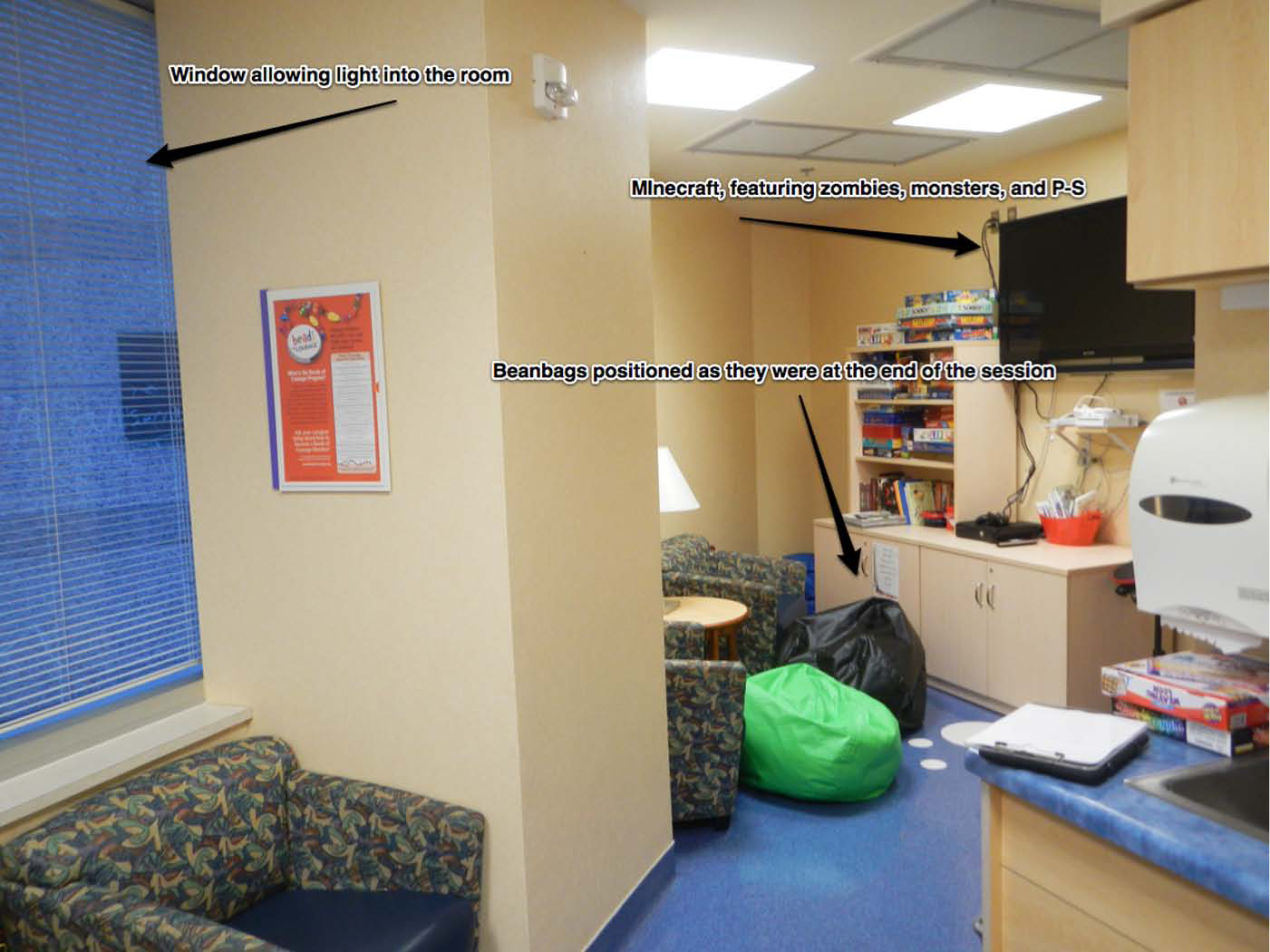
The room setup from the first day, including various nonhuman intra-actors that generated intimacy.
Analysis of interruption
We identify the moment in which T-S plummeted to the ground as a focal moment of interruption, a moment when bodies—Parker, Ty, Christian, and Sarah—took interest. Of course, our physical bodies were alert prior to this focal moment: They leaned in on chairs and forward from beanbags; eyes and ears sensed spiders and zombies poised to attack P-S. The fall, however, interrupted the flow of experience, an experience in which affective relations including the mood evoked by game mechanics, talk, the sensory environment, and the socio-spatial organization of bodies generated potential for shared affective intensity. For example, the intra-action between the sensory environment in the room and the game mechanics generated a suspenseful mood that put human bodies on edge. The darkness in the room not only set a mood for gameplay, but it also enabled players and audience alike to see enemies better, namely, the glowing red eyes of the spiders. Moreover, these enemies only came out in game-night, thus the game’s mechanics entered the relational field in intra-action with the sensory environment of the room: suspenseful affectivity resonating between bodies. In other words, the darkness in the room and the darkness in the game intra-acted: They were constitutive factors working together to contribute to the suspenseful atmosphere.
But this intra-activity among bodies, sensory environment, and game mechanics was part of a larger relational field of intimacy that amplified the felt-experience of interruption, an interruption that intensified the suspenseful atmosphere. In contrast to contemporary media discourses that perpetuate video games as violent, for instance, Parker’s gameplay—and the intra-acting bodies involved—generated an affective atmosphere of intimacy. Parker, wanting Christian to feel more welcomed into the gameplay, encouraged him to take a seat in a nearby beanbag rather than in a hard, wooden chair in the back of the room. Sarah, having heard of Minecraft through a younger sibling, peppered both Parker and Ty with questions, trying to make comparisons to her brother’s play of other games. Parker joked with Ty, telling him he was “gonna die”; Sarah set the mood further by invoking Jaws. Thus, the spatial orientation of our own bodies, bits of dialogue, and playful jokes collided with spiders, zombies, and darkness, all blending together to deliver this singular, intimate experience. As a group of players sharing this moment, our senses were indeed heightened during gameplay.
But it was our feeling of the various bodies intra-acting in the room that caused us to absorb that moment of interruption more intensely. This arrangement of feeling bodies into an intimate relational field made the atmosphere more intensely felt in the moment of interruption. This was not just an instance of playing a game; it was an instance of this gameplace-event, at this moment, with these people, saying these things, to create this atmosphere; indeed, this arrangement of feeling bodies into an intimate relational field made the atmosphere more intensely felt in the moment of interruption.
Day 2: Carescapes and the atmospheric (re)shaping of the social through gameplay
In this subsection, we address our second research questions: How does intra-activity (re)shape the social texture of “Bean’s World” during video gameplay? We show how the relational field of intimacy, and the affective atmosphere generated therein, extended to Parker’s hospital room when the authors returned for a second gameplay session. Furthermore, we describe how this atmosphere (re)shaped social interactions in the room and affected what we call the carescape, or the social, spatial, temporal, and affective organization of care for Parker.
Our second gameplay session took place in Parker’s hospital room. A large “We love you Bean!” banner covered the front door. Parker’s family connected his Xbox to the wall-mounted television in front of him. Parker played from his bed. Ty sat to his left, Christian to his right. Parker’s mom, welcoming and gregarious, was also present in the room, reading, and talking with nurses and social workers, as well as with us, while we played. Gameplay consisted primarily of exploring a village, which was populated with nonplayer characters (Figure 2). These villages are scattered throughout each generated world, but are oftentimes difficult to find. P-S was fortunate to find one quickly as the structures can provide refuge from monsters early on in the game. P-S sought to take one of the homes for himself. While doing so, P-S became accustomed to key components of the game, including mining wood and stone blocks, building crafting tables and furnaces, obtaining coal for torches and wool for a bed, and, crucially, harvesting animals for food and cooking them for greater nourishment (eating raw food can make the player sick). Initial exploration after a limited tutorial facilitated by Ty led P-S to an even bigger find: a massive castle complex about a 3-minute walk from his village.
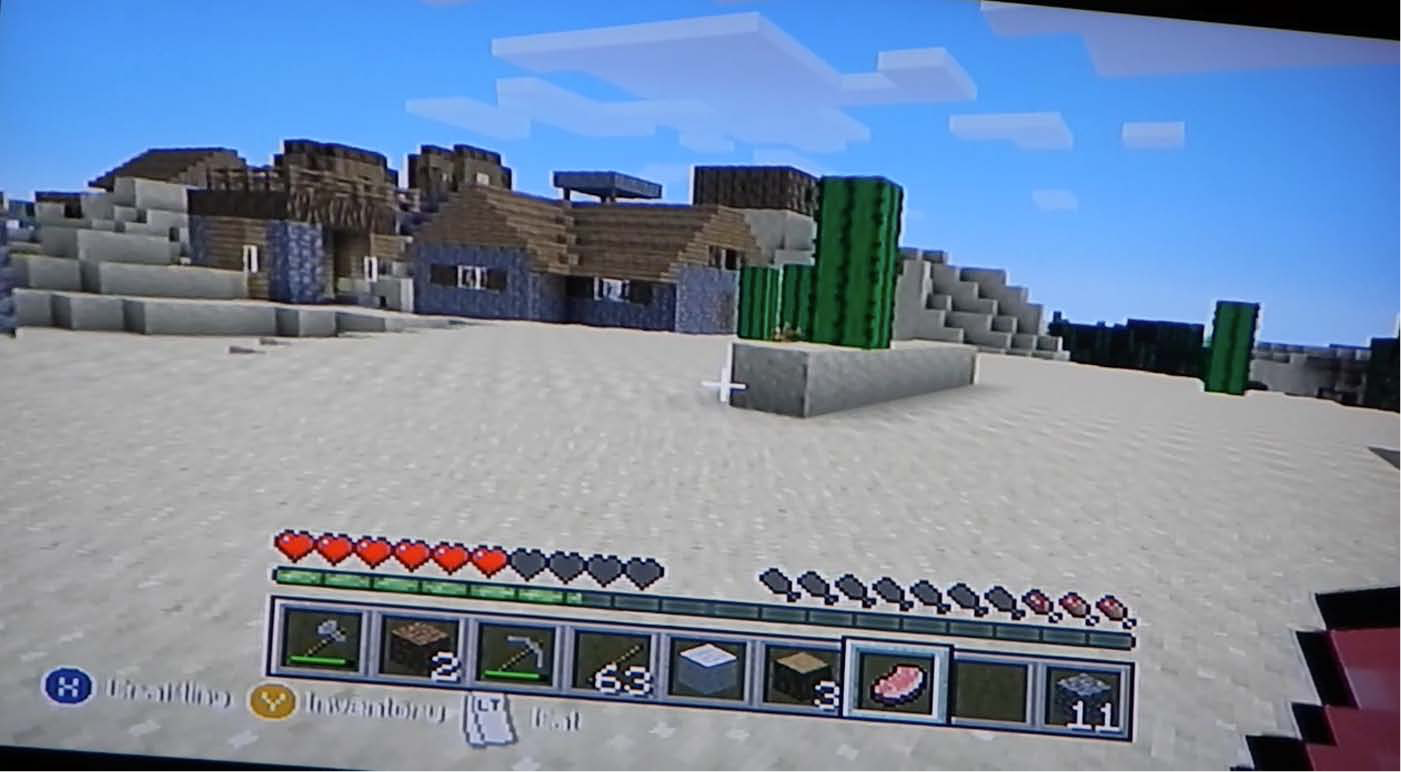
P-S making his way toward a nonplayer-character village, looking for refuge from zombies and spiders (screen capture by author).
As Parker and A1 played, a nurse came into the room to check on Parker. The nurse, surprised to see Parker so animated and focused on the game, asked what he was doing. Absorbed in gameplay, Parker did not respond. The nurse then appealed to the others in the room leading A2 and Parker’s mom to describe the game:
It is a long story. It’s the story of humanity. Like if you could imagine being in a world with …
… Nothing.
Nothing. And you’re building with dirt and rock and you’re turning that into glass and finding coal and making fire. And at night zombies come out, so you have to build a house …
So that you can go in and …
… be safe.
Well, Parker found an entire castle that he’s gonna live in now …
Of course he did (loud laughter)
At this point, however, Parker’s mom and the nurse turned from the game, talking generally about Parker’s day. As we describe this focal moment, we emphasize the ways in which the affective atmosphere initiated within gameplay spills out from the game itself, reshaping not only Parker’s care-schedule at the hospital but the carescape.
Analysis of interruption
We identify the moment in which the nurse enters to administer medication to Parker as one of interruption. Playing on either side of Parker, we occupied the bedside space the nurse needed. We felt awkward, in the way, worried about impeding her care for him. The nurse was caught off-guard, both surprised to see two grown men playing a video game with Parker and surprised to see him completely focused on his play. The interruption was felt between bodies. In a real virtual encounter with Bean, the nurse looked toward the screen for cues on when to approach him; Bean’s mom deliberately positioned the game players—A1 and A2—next to him on either side of the bed. This spatial arrangement re-established the intimate relational field that attuned bodies to each other, and this relational field, inclusive of the screen, affected where and how often the nurses approached their patient.
This atmosphere also reshaped the temporality of the carescape, as evidenced in Bean’s mom’s description to the nurse of the morning’s events prior to our session:
He’s been sleeping all day. I said “Bean, you gotta get up.” He said, “I’m too hot.” Come on. Then we had music [therapy], Miss Jenny [who teaches guitar to children] came in, we played a few chords. And then I’m like, “Okay, the Minecraft guys are out there, are you ready,” and he’s like, “Yeeeeeeah!” He wasn’t even half-awake!
Parker’s mom continued to describe how another therapist repeatedly came to see Parker, but “lost out” and, today, was “kicked to the curb” because of his desire to play Minecraft. The texture of care encounters was thus reshaped by the gameplay socially, spatially, and temporally; furthermore, the carescape was reshaped in a way that (re)oriented Bean, for a moment, as more in control of his body and how others responded to it. The experience of this carescape was affected in a relational field that included gameplay, and that generated an atmosphere in which bodies were attuned newly to Bean’s body not just as infirm but as agentive. The nurse’s eyes darted from us, to the screen, to Parker. The tone of her voice registered at a higher pitch, less sure of how to interact with her patient in a space—the hospital room—where her social role was well defined. The gameplay dominated the social space in which the nurse’s medical expertise normally affected her tone and positionality. Instead, the atmosphere generated by the gameplay—and the other intra-acting components of the relational field—positioned Bean as an expert both in what she said to him and how she said it, thus alleviating, for a moment, a central desire in adolescents’ experience of hospitalization: the lack of control over and knowledge about their situation (Coyne and Kirwan, 2012).
Days 3: Affective adherence across gameplace-events
In this final subsection, we answer our third research question: How do previous affective experiences adhere in the present and amplify or attenuate the affective intensities in Parker’s hospital room? How do these previous experiences affect the felt-experience of care? We show the ways in which Parker’s body, physiologically, registers the felt-affects of gameplay, with specific emphasis on a focal moment initiated by a spider chasing P-S back to his castle. In addition, we detail the ways in which the care Parker receives is in response to his intra-action with the game and the reverberations of historical affective atmospheres surrounding his play.
On the third day, we began our session back in the castle where our previous session ended. Parker played from his bed, while Christian sat to his right and Ty to his left. His mother was also present, reading a magazine, and making light-hearted jokes about Parker’s gameplay. Unlike other sessions, Parker had a finger pulse oximeter attached to his finger to monitor his oxygen levels and a white, accordion-like hose hanging over his left shoulder, providing more oxygen. P-S showed Ty a secret passageway, or a portal, that he found which led to a final area called “The Nether.” Parker described how he found the portal behind a picture that was hanging on a wall in the castle. When they entered The Nether, P-S was quickly attacked. Ty joked about how that area “was for the big boys” and that P-S had some “prep work to do” before venturing back. Parker consistently punctuated gameplay with bursts of “Look!” as they came across new things, like chests filled with records playable on a jukebox. Eventually, night fell again and P-S found himself in a race back to the safety of the castle with a spider on his tail.
In addition to Parker’s exclamations, the beeping of a medical device sounded—a slow, elevator-going-up tone. As it started beeping, Ty wondered if he had done something to elicit the sound. Parker’s mom assured Ty he did nothing, but believed the finger pulse oximeter triggered the beeping. In referencing the “punching” that P-S was doing when trying to collect resources, she asked, “Parker, you haven’t used that finger punchin’[referring to the finger connected to the pulse oximeter]?” Parker continued to play without responding. Suddenly, the tone of the beeping changed, becoming more rapid, signaling a low blood-oxygen level. Although Parker’s mom pressed a button on the device to stop the beeping, a nurse came in to check on Parker. The nurse believed that “he’s not taking his deep breaths” and recognized that “he’s concentrating on something else.” The nurse and Parker’s mom laughed, with Parker’s mom stating, “Hey, this is the first time he’s perked up all day today.” After a few minutes of slower beeping, signaling a higher blood-oxygen level, the beeping again became more rapid. Parker’s mom laughed, chiding, “Parker, are you breathing?” The nurse, still hovering about, smiled, and came to the foot of the bed, telling Parker to “take a deep breath.”
Analysis of interruption
We identify the moment of rapid beeping as an interruption. It breaks the flow of experience. Parker’s body became affected in such a way that was not visible unless connected to the finger pulse oximeter. Thus, Parker’s affective reaction to the game was explicitly apparent to us: Parker was not breathing in the ways in which the monitor, the nurse, and his mother expected. As in previous sections, we explore the surrounding relational field from this interruption.
At the moment of the rapid beeping, P-S has found himself in a precarious position. Similar to our initial analysis, it was night and a spider was nearby and both of those game elements factored into the relational field. However, in this instance, rather than being on top of a column, P-S was roaming freely near his castle. P-S did not want to battle the spider, so he decided to escape into the castle to try to sleep in a bed (because sleeping would make the game become daytime again and the monsters would disappear). P-S sensed the spider behind him, but did not have the time to turn to look behind him to see if he was making an escape from it. He made a run for the castle, arrived at the bed, and slept.
The bed became a part of this relational field. Collectively, players knew that getting to the bed would assure survival. P-S knew that the bed was nearby and believed he could make it there unscathed. Still, this was a tense moment—tense enough to set off the alarm on Parker’s pulse oximeter. The darkness, the spider, the proximity of the bed, and intra-acted with one another—and with Parker, the monitor, and his own oxygen levels—to signal that Parker was not breathing adequately. This heightened moment of affectivity interrupted Parker’s gameplay; his body tensed; his breath was short and shallow.
And his bodily experience—visible, felt, and now heard, both from his body and from the monitor—affected the spectators in the room. The nurse, for instance, observed Parker’s play, aware that his engagement was something positive, something, perhaps, with which she should not interfere. Thus, she gently coaxed him to “take a deep breath,” although she knew his concentration was elsewhere. His mother, too, acknowledged the intra-action between Parker and the game, jokingly asking, “Parker, are you breathing?” before turning to this nurse and saying, “Hey, this is the first time he’s perked up all day.”
The atmosphere on this day, however, was replete with affective intensities that adhered in the present, for example, our history of playing together, of suspense and screaming when plummeting to a spidery-death on day 1, of becoming the expert in the room on day 2. These affects reverberated throughout the room at various amplitudes—some felt intensely from the start, others bubbling under the surface. Parker’s energy level on this day, for instance, had been down, thus the need for additional monitoring by nurses and devices for breathing. Our history with Parker, however, reverberated throughout the room as well, an intensity that affected Parker, causing him to “perk up” in a way that he previously had not that day. The rise in Parker’s energy level, however, did not stem simply from only our presence and his opportunity to play Minecraft, but from Parker’s earlier solo play which led him to find the portal to “The Nether.” Parker anticipated showing us this in-game area. That anticipation was present in the room prior to our arrival, reverberating at a low amplitude. Our presence spiked the amplitude of anticipation, evidenced in Parker’s eager display of this newfound zone. These intensities reverberated throughout the room at various amplitudes, emerging through the intra-action of seemingly disparate components.
Conclusion: feeling new media and-
In this article, we have shown how employing relational materialism as analytic method where affectively intense moments of interruption become felt focal points for analysis differently illuminates gameplay as social intra-action among multiple bodies. Specifically, this approach helped us to feel—not just see—the unfolding of a carescape, of an intimate atmosphere that reverberated and adhered across temporalities and that positioned Parker, in at least one moment, as agentive and in control of his body and how others responded to it.
We wonder how this approach may illuminate how atmospheres are generated as other bodies become entangled in other gameplace-events, or in other experiences coming into play with each other around new media. For example, we wonder how a similar approach might make atmospheres known to researchers as they emerge within mobile mediascapes, or augmented realities, born at the confluence of technology, code, and specific space/time configurations (Graham et al., 2013). How might what new media researchers have understood as user-generated representations of space (i.e. Flickr photos) become known differently as bodies’ intra-acting through in situ felt-experiences? What emerging scapes might this illuminate and what does this mean for understanding everyday experiences of new media? We believe that a relational materialist analysis is one way forward not only to understand the everyday-ness of the new media experiences that enrich human lives but also to “make sense of the highly distributed ways in which content and code are shaped and reshaped, enacted and re-enacted” (Graham et al., 2013: 14). What phenomena that are more felt than seen contribute to this shaping and reshaping, this enacting and reenacting?
As our analysis shows, such felt phenomena are better conceptualized as emerging from place-events, as atmospheric wholes, which cannot be reduced to parts and pieces. Disrupting the anthropocentric gaze to not just see but also feel the tangled intensities of gameplay enables our coming to know the affectively charged atmosphere that permeated the hospital. What more might be gained from noticing affects’ accruals across time and their coalescences into atmospheric wholes? From not subtracting in order to analyze, but assembling in order to feel? To feel-think the experience of new media and-
In this study, the and- always included researchers’ bodies. We had our own visceral encounters while playing with Parker, screaming with fear alongside him, and sensing the intimate relationship that was a by-product of our intra-actions. Our analysis involved not just our “minds” “interpreting” and “analyzing,” but our bodies feeling and experiencing. In other words, we sought to become activated by the “waves of relational intra-actions” (Hultman and Lenz Taguchi, 2010: 537) that emerged throughout our gameplay together. In doing so, we further elucidated—further felt—the social texture that surrounds this gameplace-event, textures that pressed upon bodies as a result of the intra-action among diverse human and nonhuman entities and the subsequent atmospheric conditions.
Footnotes
Funding
This research received no specific grant from any funding agency in the public, commercial, or not-for-profit sectors.