



Abstract
Media users receive an overwhelmingly large supply of media content from multiple media, yet much research on media use examines the use of a single medium. This study investigates patterns of media use across multiple media platforms by taking a media repertoire approach. Using single-source data that merge television peoplemeter data and a survey on other media use of the same respondents, this study identifies five distinctive media repertoires (TV-Oriented Entertainment, Internet Only, News on Traditional Media, Tabloid Newspapers, and Cable TV Only). This study finds significant differences in user background characteristics, total news media use, political interest, and political knowledge among representative users of each media repertoire. Regression analyses on factor scores reveal that media repertoires are explained by individual and structural factors of media choice discussed in previous research. The implications for future research on media repertoires as news, information, and entertainment sources are discussed.
Keywords
The first decade of the 21st century has experienced the multiplication of media outlets and content options. According to Nielsen’s report on the state of cross-platform media use (The Nielsen Company, 2013), the average American media user watches over 5 hours of video content per day across different media platforms, including traditional TV sets, home computers, DVD, digital video recorder (DVR), game consoles, and mobile devices. The market trend clearly shows that media multi-tasking (e.g. using TV and the Internet simultaneously) has become a part of emerging patterns of media use in an era of media abundance (Enoch and Johnson, 2010). Research suggests that people select a combination of different media platforms to satisfy their needs or availability (Phalen and Ducey, 2012). 1
One way to cope with the proliferation of media outlets is the use of repertoire (Heeter, 1985; Webster and Phalen, 1997). Previous research has examined how media users—especially television users—select a set of channels and form their channel repertoires in the multi-channel media environment (Ferguson and Perse, 1993; Heeter, 1985; Yuan and Webster, 2006). Recent studies acknowledge that measuring the use of a single medium only provides a partial picture of what is happening in people’s media use patterns. They take a more comprehensive approach by expanding the concept into media repertoire—a collection of media sources that people regularly use—to better examine cross-platform media use behavior in the current media environment (Hasebrink and Popp, 2006; Taneja et al., 2012; Van Rees and Van Eijck, 2003; Webster and Ksiazek, 2012).
The few studies on media repertoire help us understand what combinations of media platforms emerge from individuals’ media use patterns and what factors predict the formation of different media repertoires. This study takes a further step by focusing on media repertoire as news, information, and entertainment sources and examines the characteristics of media users who employ different types of media repertoires. The purpose of this study is (1) to identify media repertoires using more detailed measures of media use including different type of medium and media content, (2) to examine user characteristics of representative users of each media repertoire identified, and (3) to investigate factors that predict the use of each media repertoire. Furthermore, this study contributes to this line of research by looking at patterns of media use in a non-Western context. In doing so, this study employs single-source data that combine TV peoplemeter data and a survey of the same respondents in South Korea (Korea, hereafter).
The next sections review the literature on theoretical framework on media choice and the concept of repertoire from both single-medium or multi-media contexts, followed by research questions and hypotheses. Then, a description of the unique data used in this study and the findings from statistical analyses are presented. This article concludes with the social and political implications of the findings and suggestions for future research.
Theoretical background on media choice
Research on media choice has adopted two distinct theoretical frameworks to explain the choice of medium and content. The first approach focuses on individual factors—individual preferences, needs, or psychological states—to predict media use behavior. Theoretical frameworks such as uses and gratifications (Katz et al., 1974; Rubin, 2002), economic models of program choice (Owen and Wildman, 1992; Rust et al., 1992), and mood management (Zillmann, 2000) have examined individual predispositions as determining factors of media choice. The second approach emphasizes the explanatory power of structural factors such as audience availability, access to or cost paid to media, and programming strategies in predicting media choice (Cooper, 1993; Webster, 2009).
More recent studies have attempted to integrate these two competing theories by suggesting an integrated approach that incorporates both individual and structural factors into a single model (Cooper and Tang, 2009; Wonneberger et al., 2011). The integrated model resonates with what Webster (2011) calls “the duality of media,” a conceptual framework adopted from Giddens’ (1984) notion of “the duality of structure.” The duality of structure posits the mutual constitution of agents and structures. It is the recursive process between agents and structures in which structures set boundaries of possible social practices of agents, while agents reproduce social systems using the very rules and resources (i.e. structures). In the context of media environment, media users (i.e. agents) enact their preferences and gratify their media use motivations using resources surrounding them (i.e. structures), whereas the process of media choice is also constrained by various media structures such as infrastructures of media environments, policies and laws, audience availability, or programming strategies. Thus, both individual and structural factors mentioned above, while affecting each other, constitute the duality of media.
Audience fragmentation and use of repertoire
In an era of media abundance, an infinite number of media outlets compete for people’s attention. The media market is flooded with traditional media outlets, newer media outlets such as cable and satellite television, and countless web sites on the Internet, to name a few. The expansion of media outlet calls for consideration of how people select certain media content among the apparently unlimited array of information sources. It implies that media users can find content options that satisfy their preferences more easily if they are aware of these options. At the same time, people may feel overwhelmed with too many choices available to them.
One of the well-documented media use behaviors that people adopt to cope with the abundance of media choices is the use of repertoire—the subset of available media offerings that an individual regularly (or frequently) uses (Webster and Phalen, 1997). Rather than exploring the entire set of available channels, people sample a small set of content that gratifies their needs or matches their preferences. Most literature on the use of repertoire has been confined to television viewers. Since Heeter et al. (1983) first used the term channel repertoire—the set of channels watched regularly by an individual or household (cited from Heeter, 1985: 133)—many scholars have refined the concept and confirmed the existence of channel repertoires in various television-viewing contexts (for a review of the channel repertoire literature, see Yuan and Webster, 2006). Early studies on channel repertoire have identified the size of repertoires (Heeter et al., 1983; Lochte and Warren, 1989). Subsequent studies have found factors that predict the size and composition of repertoires, such as cable subscription (Ferguson, 1992; Yuan and Webster, 2006), audience background characteristics or lifestyle (Ferguson and Melkote, 1997; Ferguson and Perse, 1993), and motivations or attitudes of television viewers (Ferguson and Perse, 1993; Neuendorf et al., 2001).
Recent research has expanded its scope to take a more comprehensive approach to media use patterns in the contemporary media environment. These studies have pointed out that focusing only on the repertoires in a single-medium context does not fully reflect media use across multiple platforms. They coined a term “media repertoire” to examine a combination of media platforms and/or content types people regularly use (Hasebrink and Popp, 2006; Jeffres et al., 2004; Schroder and Steeg Larsen, 2010; Taneja et al., 2012; Van Rees and Van Eijck, 2003; Webster and Ksiazek, 2012). These studies on media repertoire have identified clusters of media offerings used together or factors associated with different types of media repertoires.
Media repertoire as news and information sources
Some of the media repertoire studies further investigated the role of media repertoire as news and information sources. The earliest study in this line of research is Van Rees and Van Eijck’s (2003) work on the composition of media repertoires of the Dutch population. Applying both cluster analysis and factor analysis, they identified eight media repertoires and found distinctive audience characteristics (e.g. gender, age, education, income, occupation, family size, political interest, and religion) associated with each media repertoire group. Similarly, Hasebrink and Popp (2006) examined German media users’ information repertoires using 12 types of hard news use including newspapers, television, and radio. They found three information repertoires and six clusters of media users that have systematic differences in gender, age, education, income, and political interest. In a Chinese context, Yuan (2011) found six different news media repertoires and the differential agenda setting effect depending on people’s selection of different media combination. Taneja et al. (2012) used 59 detailed media use items and found four “user-defined” repertoires that represent cross-platform media use patterns of American media users. They also found that age and education play a crucial role in predicting which media repertoire media users select. Table 1 presents a summary of the prior research on media repertoire.
Summary of previous research on media repertoire.

The findings from these studies indicate that people in the current media environment do not solely rely on a single medium for acquiring news and information, but rather mix diverse types of media and/or content to make sense of public issues. Also, there are systematic differences in individual and structural factors (e.g. demographic variables, social status, availability, political interest) associated with different media repertoires, suggesting the influence of both individual and structural factors (i.e. the duality of media). Another interesting finding is that some media repertoires are formed around media (e.g. TV), while others are established around content types (e.g. news). This is an important finding because it may suggest how orientation toward media or content impacts the process of media choice. Recurring patterns of media repertoires comprising several single-medium repertoires (e.g. Taneja et al., 2012) confirm that people’s orientation toward media platform precedes content preference. On the other hand, media repertoires of similar content across different media platforms show that content preference outweighs media orientation during the media choice process (e.g. Van Rees and Van Eijck, 2003).
This study follows a repertoire approach and explores media repertoires emerging from Korean media users. Based on theoretical foundations on media choice and previous studies on media repertoire, this study poses the following research questions and hypotheses.
RQ1. Across all media outlets, what types of media repertoires are identified?
RQ2. What are the user characteristics associated with each type of media repertoire?
RQ3. Which orientation (i.e. orientation toward medium or content type) is more evident from the media repertoires identified?
H1. Individual factors (age, gender, education, income, news preferences) will explain the use of different media repertoire.
H2. Structural factors (audience availability, region) will explain the use of different media repertoire.
Methods
Data collection
Data for this study were drawn from the 2008 Study of the Television Quality Index, a telephone survey targeted 1500 members of the Taylor Nelson Sofres (TNS) household TV peoplemeter panel in Korea. 2 This study used unique data that combined TV peoplemeter data and a survey of the same respondents in the peoplemeter panel. The use of electronically recorded measures of TV viewing improved the accuracy of measuring time spent on TV. In addition, the survey data provided a wide array of information about the respondents including newspaper reading, Internet use, news preference, political interest and knowledge, as well as demographic variables.
The sample was selected based on the quota sampling method that reflected demographic ratios acquired from the 2006 national census. Two different data collection methods were used. First, a telephone survey was conducted by trained interviewers to obtain information including demographics, detailed use of media other than TV (e.g. daily newspaper, sports newspaper, free daily newspaper, various types of Internet use) and political variables such as political interest and knowledge. Second, TV-viewing log data of the same respondents were gathered from their peoplemeter device installed at home. A single-source data set was created by matching the IDs of the two data sets. The telephone survey was conducted from 16 June to 30 June 2008 after television-viewing log data were collected from 26 May to 15 June 2008.
Measures
User characteristics
Regarding gender, both genders were well represented (male: 48.7%, female: 51.3%). Participants were asked their age, and the original age variable was recorded into six categories (15–19, 20–9, 30–9, 40–9, 50–9, over 60 years). The respondents in this study were somewhat highly educated. More than half of the sample had either received some college education or held a college degree or a graduate degree. Approximately one-third of the sample had a high school degree (31.73%), and the rest had a lower level of education. There was considerable diversity in the level of monthly household income. One-third of the sample (n = 500) lived in Seoul, the capital and largest city in Korea.
Media use
Media use variables were collected in two different methods: TV viewing on four major terrestrial channels (KBS1, KBS2, MBC, SBS) was electronically measured using peoplemeter devices installed in sample households. Information on Internet use and newspaper reading was collected by asking respondents to report the usage level of the given medium for various purposes. Four types of TV viewing based on program genre (i.e. news, drama, entertainment, information) were created. These four variables were again sub-divided by television outlets (i.e. whether the outlet is a public or a commercial broadcaster), creating eight media items for terrestrial TV. Respondents were asked to answer how many minutes in a typical day they read newspapers or use the Internet for reading news. To collect a detailed information on other media use that is equivalent to various TV use measures, newspaper reading was recorded as reading (1) national daily newspapers, (2) sports newspapers, and (3) free daily newspapers such as RedEye in the United States or Metro in the United Kingdom. Internet use was categorized into (1) watching clips online (e.g. TV programs, movies, or user-generated content), (2) searching and reading news, (3) information searching including shopping, and (4) using emails and social media such as blogs or community boards. All media use variables were positively skewed and thus log-transformed. Due to the difference in measurement units, the logged variables were standardized for statistical analyses.
Total news media use, news preference, and political variables
Total media use was calculated by summing the minutes spent on using all media platforms (e.g. TV, newspapers, Internet) per day. Total news media use was measured by summing the minutes spent on daily newspapers, network TV, and the Internet. News preference was calculated as the percentage of time spent watching TV news and Internet news, divided by the total time spent using network channels and the Internet. Thus, this is “revealed” news preference reflected in news media use behaviors (Samuelson, 1938; Varian, 2006). Political interest was measured by asking participants how much they are interested in politics using a seven-point Likert scale. Political knowledge was created by asking five questions on factual political knowledge and counting the number of correct answers. Table 2 presents the descriptive statistics of media use variables, political interest, and knowledge.
Descriptive statistics of media use on a daily basis (N = 1500).
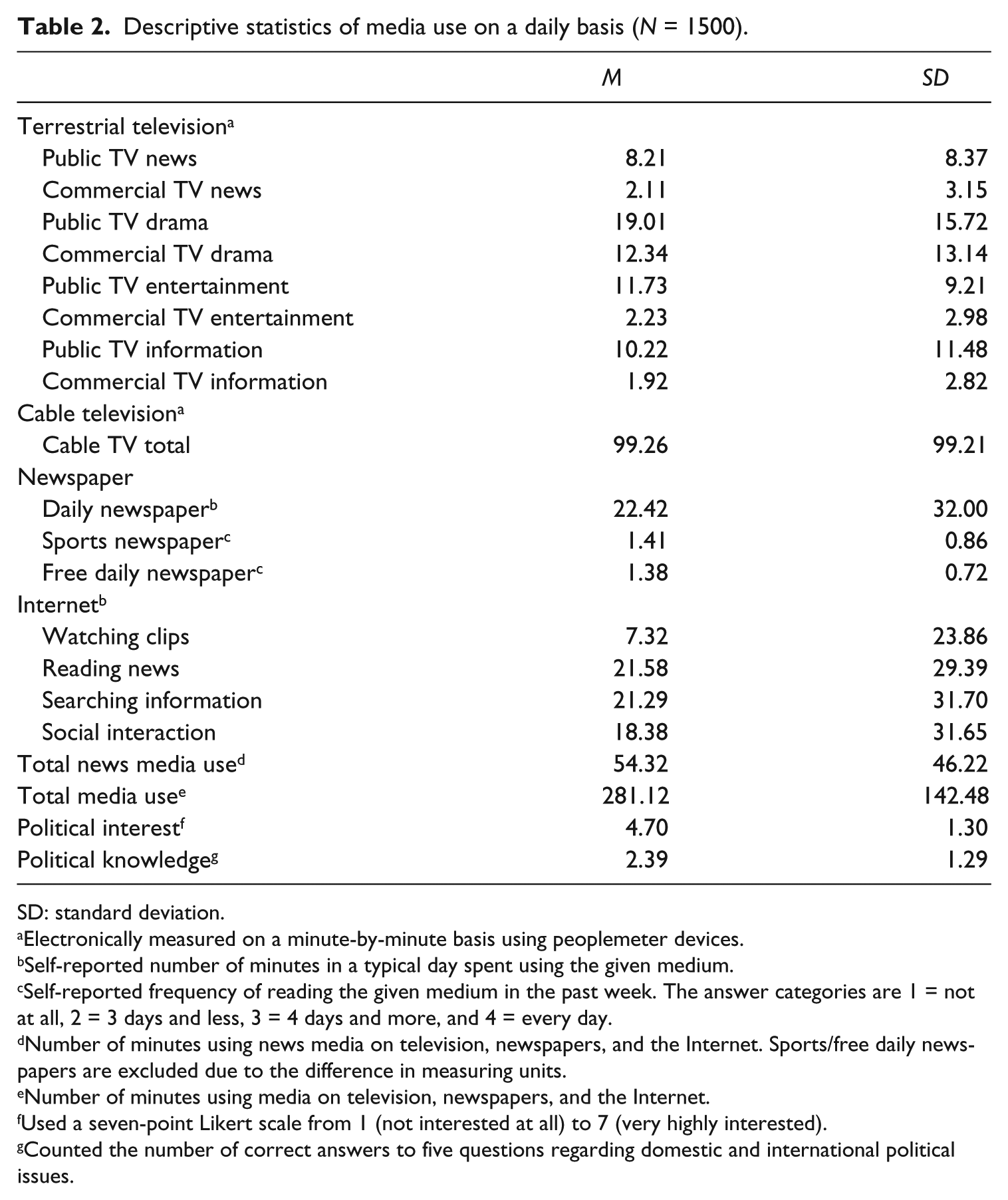
SD: standard deviation.
Electronically measured on a minute-by-minute basis using peoplemeter devices.
Self-reported number of minutes in a typical day spent using the given medium.
Self-reported frequency of reading the given medium in the past week. The answer categories are 1 = not at all, 2 = 3 days and less, 3 = 4 days and more, and 4 = every day.
Number of minutes using news media on television, newspapers, and the Internet. Sports/free daily newspapers are excluded due to the difference in measuring units.
Number of minutes using media on television, newspapers, and the Internet.
Used a seven-point Likert scale from 1 (not interested at all) to 7 (very highly interested).
Counted the number of correct answers to five questions regarding domestic and international political issues.
Individual and structural factors of media choice
Among the variables mentioned above, age, gender, education, income, and news preference were used as individual factors of media choice. Structural factors of media choice included audience availability and region (i.e. whether a participant lives in Seoul—Metropolitan area—or not). Total media use was used as a proxy for audience availability following previous studies (Wonneberger et al., 2011; Yuan and Webster, 2006).
Analytic procedure
To answer RQ1 and RQ3, 16 media use items were factor-analyzed. Principal component factor analysis with varimax rotation was used because the primary purpose of factor analysis was to identify different media repertoires. Then, respondents’ score on each media repertoire dimension was added as a new variable. To answer RQ2, a user profile was created using each respondent’s factor score on each media repertoire dimension. Following Van Rees and Van Eijck’s (2003) study, respondents whose factor score on each dimension was within the upper quartile were defined as active members of the given media repertoire. Using the upper quartile as a cutoff value, a description of user characteristics in each media repertoire is presented to see the similarities and differences among the active users of different media repertoires. To answer H1 and H2, ordinary least squares (OLS) regression analyses were conducted to predict the influence of individual and structural factors of media choice on factor scores of media repertoires identified.
Results
Media repertoires
RQ1 asks what types of media repertoires are identified among a number of media platforms and content types. To answer this question, a factor analysis was conducted using 16 media use items in Table 2. A principal factor analysis with varimax rotation was used to identify different types of media repertoires. Since one item (watching clips online) was cross-loaded on two factors, a second factor analysis was performed after deleting this item. 3 The following criteria were used to determine the number of factors: (1) eigenvalue greater than one, (2) a scree plot, and (3) prior studies using principal component factor analysis with similar media use items (Van Rees and Van Eijck, 2003; Hasebrink and Popp, 2006). Media items with factor loadings of 0.32 (10% overlapping variance) and above were interpreted (Tabachnick and Fidell, 2007). The result suggested a five-factor solution, with 58.84% of the total variance explained. Factor scores were computed by calculating a mean of media items that belong to each factor. Except for the last factor, which only had a single media item (cable TV), other factors showed a modest to high level of reliability (Cronbach’s alpha is .74 for factor 1, .68 for factor 2, .46 for factor 3, and .60 for factor 4).
Table 3 presents the five-factor solution obtained from the factor analysis. The first factor included TV dramas and entertainment programs on public and commercial channels as well as information programs on a commercial channel. This factor was labeled as “TV-Oriented Entertainment.” It solely explained 16.13% of the total variance. The second factor, which consisted of only Internet-related media items, was labeled as “Internet Only” and explained about 15% of the total variance. The third factor was made up of news media, especially traditional news media such as TV and newspapers. This factor was named as “News on Traditional Media” and contributed to 11% of the total variance. The next factor included sports and free daily newspapers that delivered more soft news items such as sports, entertainment, and celebrity gossips. This factor was named “Tabloid Newspapers” and about 10% of the total variance was explained by this factor. The last factor consisted of a single item, cable TV, thus it was labeled as “Cable TV Only.”
Factors solution for media repertoires (N = 1500).
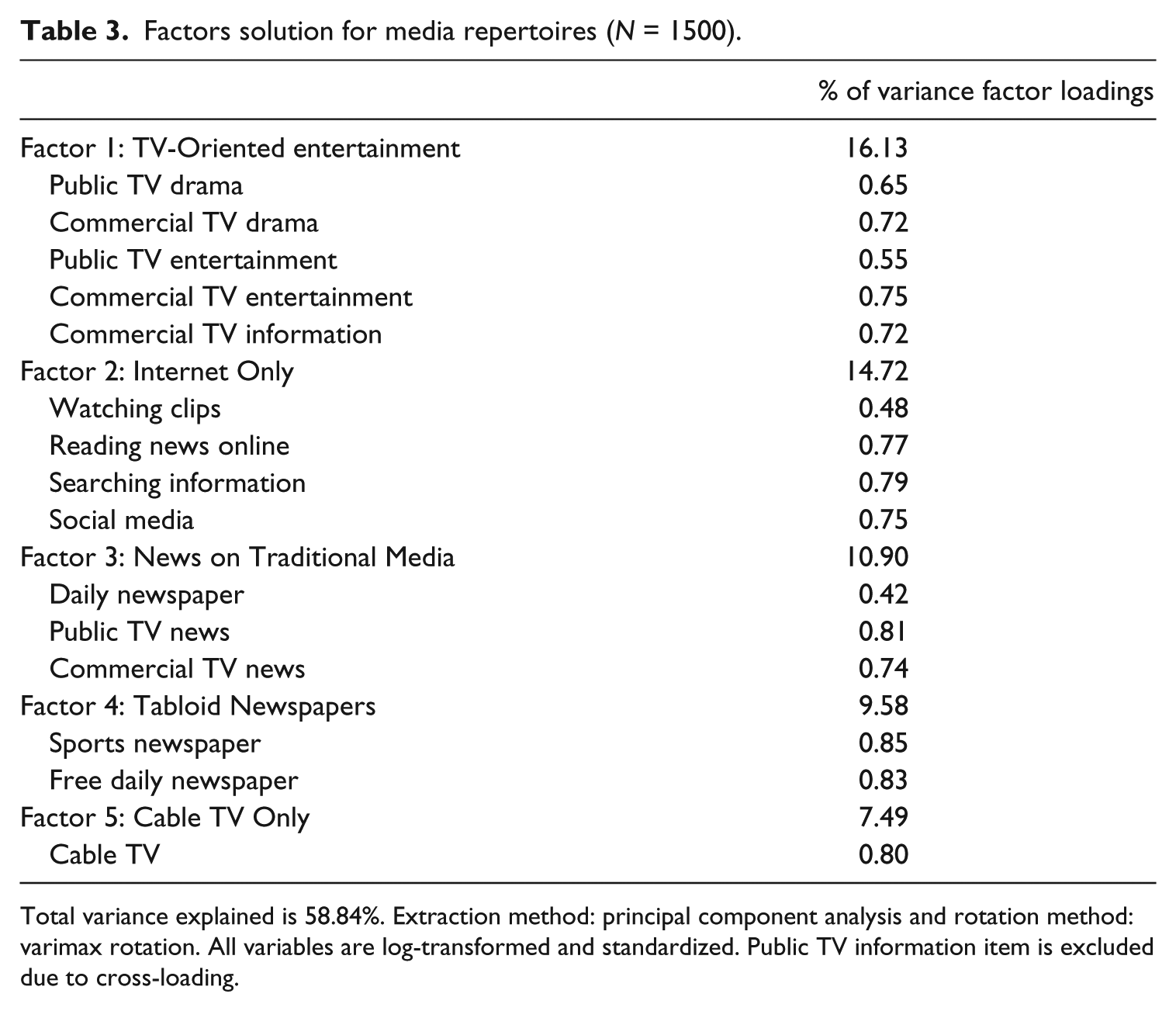
Total variance explained is 58.84%. Extraction method: principal component analysis and rotation method: varimax rotation. All variables are log-transformed and standardized. Public TV information item is excluded due to cross-loading.
Regarding RQ3, most factors seem to consist of media use items that belong to the same media platform (e.g. factor 1—terrestrial TV, factor 2—the Internet, factor 4—newspapers, factor 5—cable TV) at first glance. However, a closer inspection of the results reveals that three among the five factors can also be grouped in terms of content types (e.g. factor 1—drama and entertainment, factor 3—daily news, factor 4—soft news). This suggests that people’s choice of media repertoires is a complicated process in which people’s orientation toward medium and preference for content types work together during media selection process. For newer forms of media such as the Internet, it appears that people have a preceding orientation toward medium over content preferences. In other words, people first choose to go online and then search for content that satisfies their needs. For certain content types such as daily news or hard news, people seek out similar content and choose to use a combination of traditional media outlets that provide such content.
User characteristics in each media repertoire
RQ2 asks what user characteristics are related to each type of media repertoire. To answer this question, this study follows the approach in Van Rees and Van Eijck’s (2003) study. To identify “representative” media users in each media repertoire, each respondent’s factor scores on the five factors were added as new variables. Then, respondents whose factor score in a given factor dimension fell into the upper quartile of that particular factor dimension were defined as “representative” users of that media repertoire. For example, if a respondent had a factor score above the upper quartile on the first factor (i.e. TV-Oriented Entertainment), that respondent is considered as a representative member of the “TV-Oriented Entertainment” repertoire. This entails a loss of information since only a quarter of the sample is used in the analysis. Nevertheless, this approach is useful in “providing a description of the typical representatives of a certain dimension (Van Rees and Van Eijck, 2003: 481).” In addition, having a quarter of the sample (i.e. n = 375) is still sufficient to conduct statistical analyses by using subgroups that were sufficiently large enough to produce reliable results. Tables 4 and 5 summarize the user characteristics associated with the representative media users of each media repertoire. Table 4 presents demographic information and Table 5 provides a summary of the level of total media use, total news media use, political interest, and knowledge.
User characteristics of representative media users in each type of media repertoires (n = 375).
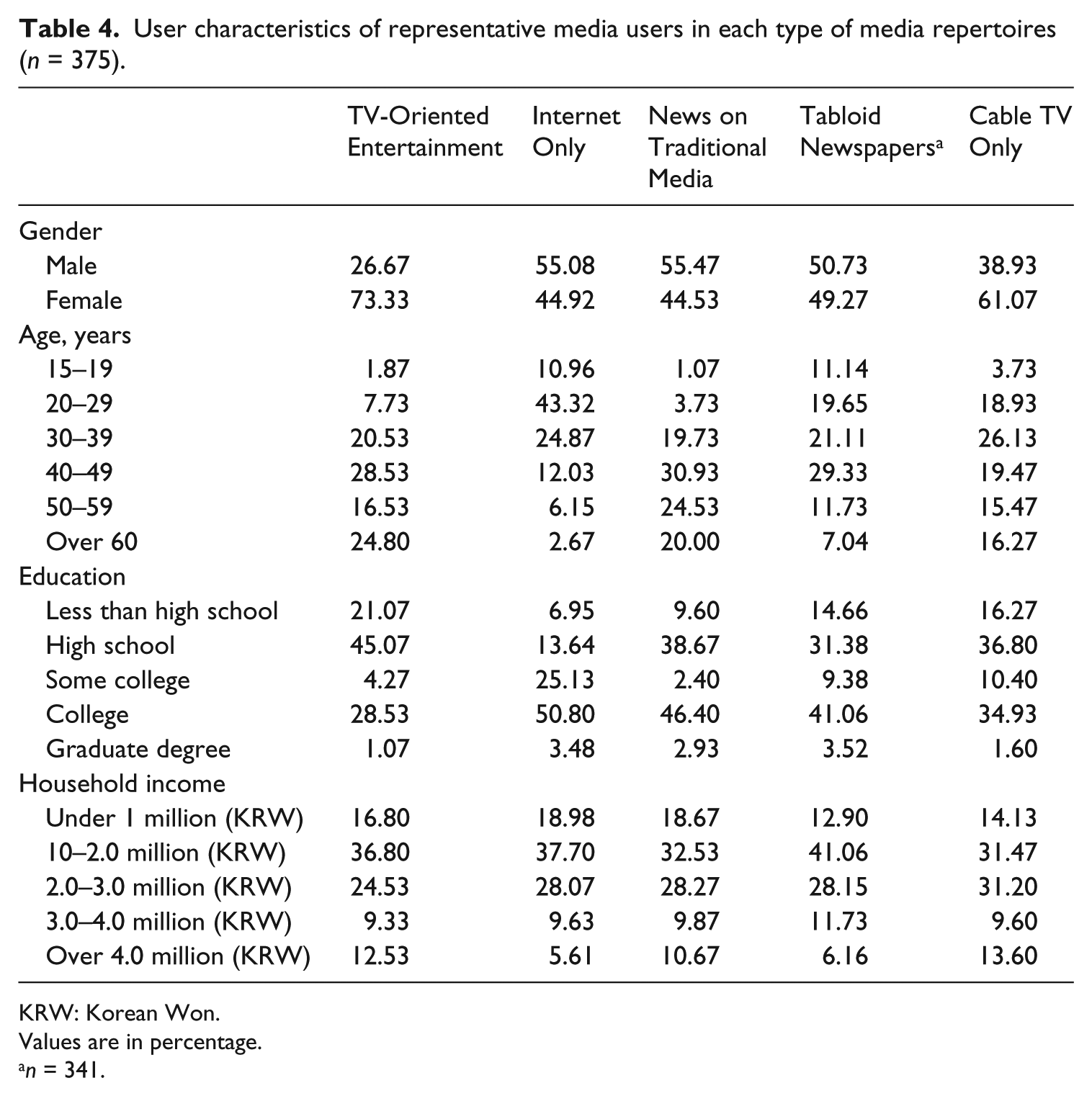
KRW: Korean Won.
Values are in percentage.
n = 341.
Descriptive statistics of media variables and political variables of representative media users in each type of media repertoires (n = 375).
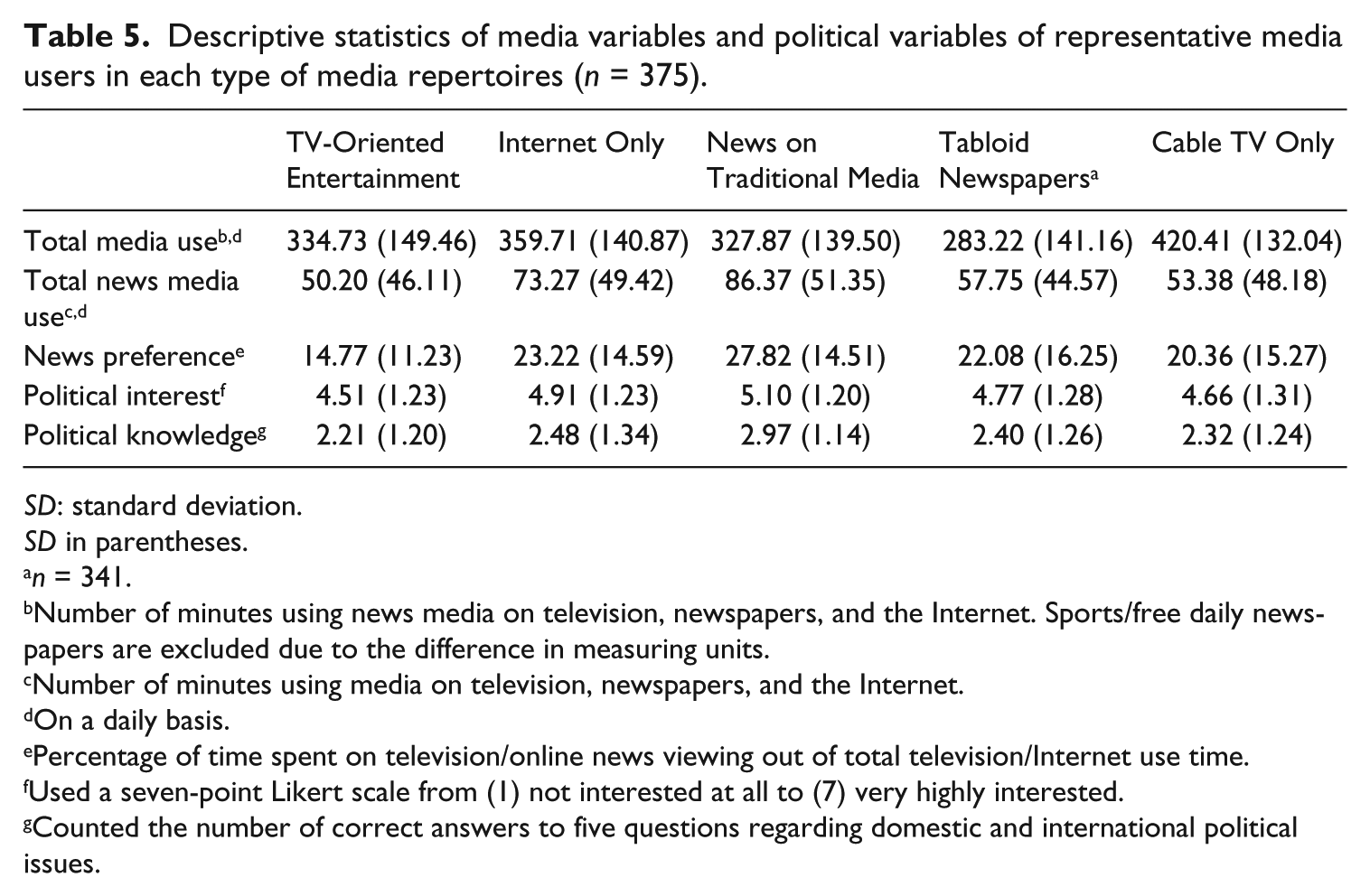
SD: standard deviation.
SD in parentheses.
n = 341.
Number of minutes using news media on television, newspapers, and the Internet. Sports/free daily newspapers are excluded due to the difference in measuring units.
Number of minutes using media on television, newspapers, and the Internet.
On a daily basis.
Percentage of time spent on television/online news viewing out of total television/Internet use time.
Used a seven-point Likert scale from (1) not interested at all to (7) very highly interested.
Counted the number of correct answers to five questions regarding domestic and international political issues.
The “TV-Oriented Entertainment” repertoire had a strong gender bias. The typical users of this media repertoire were mainly female (73.3%) and least educated (65% of them having less than high school education). They were also least interested in news and politics. They spent over 5 hours per day for overall media use, but allocated only 50 minutes to using news media. Their political knowledge was also lowest among representative users of the five media repertoires. In contrast, the active users of the “Internet Only” repertoire, who predominantly used the Internet for their daily media diet, were the youngest and most highly educated. More than 75% of the people in this group were under 40 years and were college students or had a college or graduate degree. They were also the second highest in terms of total news media use, news preference, political interest, and knowledge, possibly reflecting their high education level.
The third media repertoire, the “News on Traditional Media” repertoire, was used by the oldest media users among the five types of media repertoire users, showing the strong relationship between news media use and age. It is noteworthy that there was an even split between people who have college or higher degrees and those who received some college education or less in this media repertoire. It is known that news media use is positively related to one’s level of education, but for people with a lower level of education, traditional news media plays a crucial role as a dominant outlet that delivers news and information in an easily comprehensible and accessible way, which in turn, motivates their political engagement (Graber, 2001). This point was well reflected in the finding that they used news media the most (86 minutes daily) and were most interested in and knowledgeable about politics. The representative users of the “Tabloid Newspapers” repertoire were not much different from the characteristics of the entire sample, except that there was a higher proportion of people in their 40s. This seemed reasonable given that sports newspapers and free daily newspapers in Korea are usually read when people commute to work in public transportation. The active users of the “Cable TV Only” repertoire, like those of the “TV-Oriented Entertainment” repertoire, were mainly females and less educated. However, compared to other media repertoire users, they were younger and less interested in news and politics. On average, the typical members in this group used media for 7 hours per day, but watched news programs for only 53 minutes. They also exhibited low levels of news preference, political interest, and knowledge, being the second lowest among the representative users of the five media repertoires.
The comparison of the representative users of the five distinctive media repertoires gives us a sense of how choice of different combinations of media and content relates to media users with different characteristics. Moreover, the choice of different media repertoire is associated with different levels of total news media use, political interest, and knowledge, suggesting the role of media in providing information on public issues and motivating interest in politics.
Individual and structural factors of using different types of media repertoire
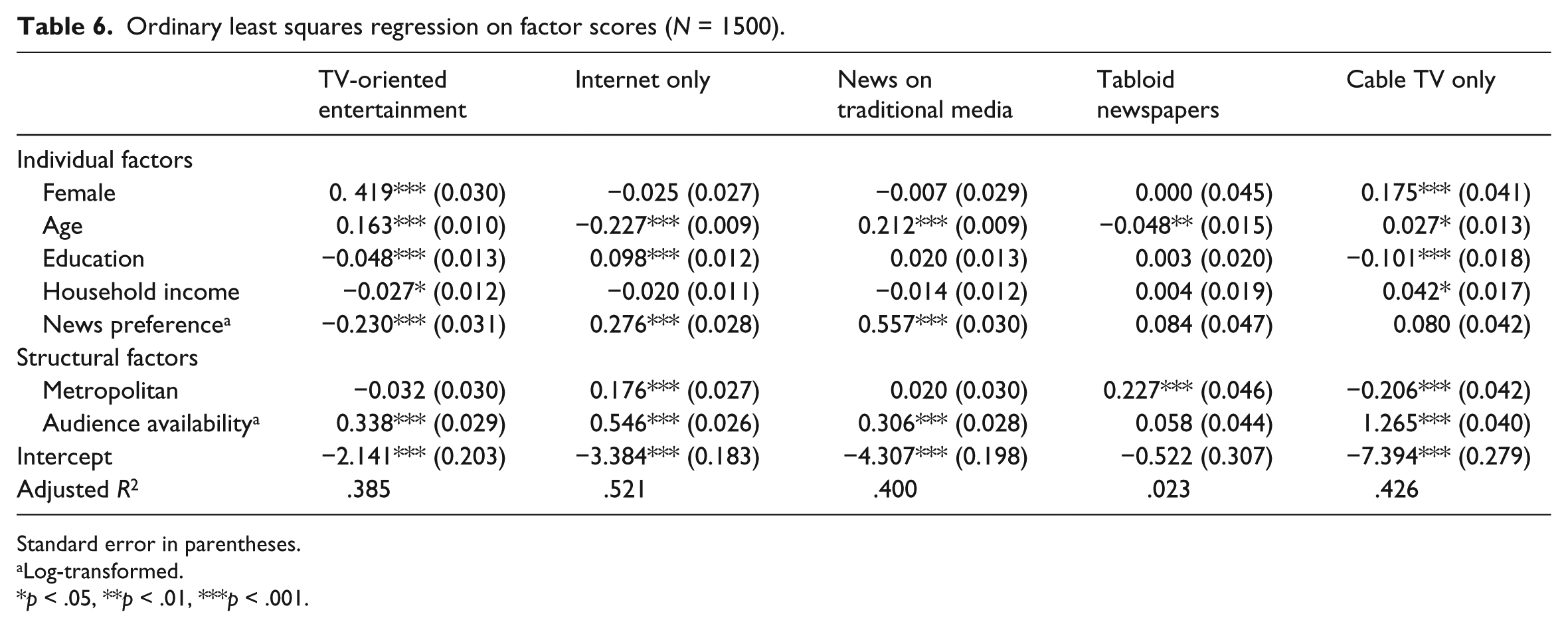
The description of the representative users in each type of media repertoires helps us understand the similarities and differences in user characteristics between people having different media repertoires; however, it is also important to consider which factors explain the degree of use in different types of media repertoires. To test the two hypotheses on the explanatory power of individual and structural factors of media choice (H1 and H2), regression analyses were conducted using the entire sample. OLS regression analyses were performed, employing individual factors (i.e. gender, age, education, household income, and news preference) and structural factors (i.e. region and audience availability) as predictor variables and factor score of each media repertoire as an outcome variable. The results of the five OLS regression models are presented in Table 6.
Ordinary least squares regression on factor scores (N = 1500).
Standard error in parentheses.
Log-transformed.
p < .05, **p < .01, ***p < .001.
Except for the model for the “Tabloid Newspapers” repertoire, the models showed a modest level of variance, ranging from 39% to 52%. For all five models, both individual characteristics and structural factors significantly explained each media repertoire, thus supporting H1 and H2. Among individual factors, age was a significant predictor of all five media repertoires: older media users are more likely to use media repertoires that include traditional media platforms such as terrestrial TV or daily newspapers, while they are less likely to use media repertoires with newer forms of media (e.g. the Internet or tabloid newspapers). Education and news preference also played a crucial role: both have a negative association with “TV-Oriented Entertainment” and a positive association with “Internet Only.” These findings suggest that more educated people or those who prefer news content over other content types tend to use the “Internet Only” repertoire more, but use the “TV-Oriented Entertainment” repertoire less. The media repertoires with only TV-related media items such as “TV-Oriented Entertainment” and “Cable TV only” were positively predicted by gender (i.e. being female), showing women’s affinity with TV.
Among structural factors, audience availability was positively associated with all five media repertoires. This implies that those who have more available time to use media are more likely to use each media repertoire, except “Tabloid Newspapers” which did not show a significant association. Whether a person lives in a metropolitan area positively predicted the use of “Internet Only” and “Tabloid Newspapers,” but negatively predicted the use of “Cable TV Only,” suggesting that the structure where one’s media environment is grounded matters for the choice of different media repertoires. For those who live in the metropolitan area, easier access to the Internet and tabloid newspapers seem to contribute to more active use of these repertoires.
Discussion
This study took a repertoire approach to media use on multiple media platforms to deepen our understanding of patterns of media use in the contemporary media environment. Using a single-source data that combined respondent-level peoplemeter data and a survey of the same respondents, this study identified five media repertoires: (1) TV-Oriented Entertainment, (2) Internet Only, (3) News on Traditional Media, (4) Tabloid Newspapers, and (5) Cable TV Only. A close examination of representative users of each media repertoire revealed that those who were actively using each repertoire differ by their demographics, socio-economic status, and levels of political interest and knowledge. Use of each media repertoire was also explained by individual and structural factors of media choice that constitute the duality of media.
An interesting finding is that media repertoires were formed in combination of types of medium and content options. A majority of the media repertoires identified were grouped in terms of medium, as observed in previous studies (Hasebrink and Popp, 2006; Taneja et al., 2012; Weibull, 1992). However, when it comes to news media usage, we see media repertoires that consist of traditional media outlets such as daily newspapers and TV news programs. This pattern of media repertoire composed of similar content resonates with selective exposure hypothesis that posits people’s tendency to choose content that satisfies their needs and preferences (Klapper, 1960). The existence of media users who heavily use traditional news media has been found in previous research (Kim and Webster, 2012; Ksiazek et al., 2010; Prior, 2007; Van Rees and Van Eijck, 2003). They are news hounds who actively seek out news from increasing sources of news and information.
The findings also reflect the duality of media where media users and structures influence each other in the process of media selection and usage. First, people decide to seek gratifications (e.g. surveillance, killing time, mood management, and so forth). They do this in a context where structural factors come into play, for example, audience availability, which limits choice or orientation toward particular media. Given the chosen medium, they read, watch, or listen to the content that is selected from the choices available. This leads to gratifications or needs fulfilled, and to particular effects. Across time, we observe this accumulated media use behavior as a repertoire, or pattern that reflects personal preferences, orientations, and needs.
The predictive models using individual and structural factors of media choice clearly show the role of both agents (i.e. media users) and structures (i.e. media environment, social context, etc.) in creating the duality of media. In the current media landscape, agents and structures influence each other to create different patterns of media use across platforms. The finding that age and audience availability were powerful predictors of most of the media repertoires tells us that patterns of media use are closely related to people’s life stage and the structure of everyday life (Taneja et al., 2012). Younger users develop an affinity for newer media technologies, whereas older users tend to use more traditional media that they have a long habit of using. Whether one is available to use any kind of media precedes all other factors of media choice (Cooper, 1996). In addition, females are more likely to use media repertoires on TV than any other medium. News preference was positively associated with using traditional news media outlets and the Internet. These findings all indicate how choosing a media repertoire is influenced by one’s own social status, predisposition, and/or social milieu in which one is situated. It deserves replication across different populations and countries to see to what extent these patterns are generalizable regardless of national cultures.
It is also noteworthy that we do not see any content-oriented media repertoires of drama or entertainment. Given that entertainment has been a frequent topic of “transmedia storytelling” (Jenkins, 2006), it is surprising that we only observe news-oriented media repertoires. The finding may suggest that from media audiences’ point of view, they enjoy the experience of reading or watching similar news stories across different platforms. TV is a medium that can elicit an initial interest in news stories with its visual and auditory cues. Interested viewers then can look up more in-depth information using daily newspapers. We may not see any drama-oriented or entertainment-oriented repertoire because of the time when the data for this study were collected (2008). It would be also interesting to replicate this study with more recent data that include information on newer forms of media such as social media, digital radio, or mobile. A recent study on cross-media practices of contemporary radio (Edmond, 2014) shows how media uses have begun to interact with radio programs in multiple media platforms such as blogs, social media, mobile app, as well as live performances in theaters. More recent data may reveal diversified media repertoires that capture the process of receiving transmedia storytelling of entertainment content.
Finally, the representative users in each media repertoire differed greatly by their demographic compositions and levels of news preference, total news media use, as well as political interest and knowledge. These findings imply how different media repertoires were adopted by distinctive groups of media users and what political implications there exist depending on media repertoires individuals choose. In particular, the comparisons between “TV-Oriented Entertainment” and “News on Traditional Media,” and between “Internet Only” and “Cable TV Only” are noteworthy. The representative users in the “TV-Oriented Entertainment” and “News on Traditional Media” repertoires shared similarities in age, income, and the total amount of time they spent on media. However, they differed significantly by gender, education, and the levels of news media use, political interest, and knowledge. Active users of the “TV-Oriented Entertainment” repertoire were dominantly female and least educated and interest in news and politics, whereas those who actively used the “News on Traditional Media” were highly educated, interested in news and politics, and spent a quarter of their total media use time on news media. For the “Internet Only” and “Cable TV Only” repertoires, users from both groups consisted of relatively younger people with similar levels of income and total media use. The major differences between these two groups existed in education and news media use. The “Internet Only” users were highly educated and spent a good portion of their time using news media, while the “Cable TV Only” users were mainly female, less educated, and allocated a small portion of their time on news media.
Overall, this study shows the value of a repertoire approach to cross-platform media use. Media repertoires demonstrated the orientation that media users have toward media platforms available to them. The formation of media repertoires can be understood as a process of audience fragmentation based on this media orientation (Van Rees and Van Eijck, 2003). This is essential to understanding how media users cope with an abundance of media offerings in the contemporary media environment. The findings also contribute to the repertoire literature by investigating how media users in a non-Western context form their media repertoires as sources of news, information, and entertainment and what political implications we may observe. More recent findings suggest that those who use news media across multiple platforms have higher levels of political knowledge, efficacy, and trust than those who use a single medium for obtaining news (Papathanassopoulos et al., 2013). Future research should consider what would be the long-term consequences of using different media repertoires, for instance, how it may affect the process of acquiring news and information and lead the public to be engaged with civic and political issues.
Footnotes
Acknowledgements
The author thanks Drs. James Webster, James Ettema, and Eszter Hargittai for their valuable comments. The author also thanks Dr. Namjun Kang and the Foundation for Broadcast Culture in South Korea for making the data available.
Funding
This research received no specific grant from any funding agency in the public, commercial, or not-for-profit sectors.