




Abstract
While there has been a great deal of research on younger people using Social Networking Sites (SNSs), there has been less work on older people and non-users. We present a mixed-methods design with a technology-acceptance survey and focus-group interviews to study older Norwegian non-users’ perceptions of SNSs. Our study reveals that most non-users in our sample deliberately do not use SNSs. They perceive SNS communication as cold and narcissistic and view the usefulness of SNSs to be low. This finding indicates a generational culture gap in how young versus older people experience SNSs. Privacy and security concerns are also prevalent. Non-users, expressing an interest in SNSs, believe SNSs could increase contact with family and friends, but perceive lack of competence to be a barrier.
Introduction
Population ageing is global, and the life situation of elderly increases age-related social challenges such as less mobility and loss of friends and loved ones (Gibson et al., 2010; Leikas et al., 2012; Lindley et al., 2008). This has raised expectations that Social Networking Sites (SNSs) 1 can encourage social participation among elderly (Nef et al., 2013) and help elderly maintain social relationships that would otherwise be difficult to preserve (Chung et al., 2010; Erickson, 2011; Leist, 2013; Leikas et al., 2012).
Studies on younger age groups have found that SNSs are important for maintaining social relationships. The social value of SNSs, above all Facebook, is often associated with social capital and sociability, particularly regarding bridging social capital (Brandtzæg, 2012; Burke et al., 2011; Ellison et al., 2007). SNSs have also been found to be associated with bonding social capital supporting contact with strong ties such as family and friends (Brandtzæg, 2012; Burke et al., 2010) and relational closeness (Ledbetter et al., 2011). The latter is important as older people often prioritize close and emotionally meaningful relationships (Carstensen et al., 2003).
Yet, even if SNSs might appear valuable for elderly, elderly typically do not recognize the relevance and benefit of SNSs (Bloch and Bruce, 2011; Hakkarainen, 2012). Understanding how non-users of SNSs are different from those who use these services is an important contribution to discussions about SNSs (Hargittai, 2007).
We do not assume that all elderly must use or will benefit from SNSs. Our motivation for this study is to understand elderly non-users in a society where online and offline social spheres are closely entangled and investigate reasons and motivations for being a non-user, whether being a non-user is a reasoned choice, if non-use is due to barriers such as low digital competence and potential consequences of non-use for experiences of social inclusion/exclusion. Moreover, we study whether elderly believe SNSs can help them maintain social connections and potential triggers that could encourage future use of SNSs.
Our study was conducted in Norway. Given Norway’s high Internet and Facebook connectivity (Vaage, 2014), experiences of Norwegian elderly non-users are interesting. Feelings of social exclusion might be more significant for non-users in Norway compared to countries with lower adoption rates for SNSs. This research context can therefore indicate future prospects and challenges for older people and non-users of SNSs. Our study contributes to this research field by applying a mixed-methods approach to develop stronger inferences about the factors predicting non-use and how the elderly experience social connectedness in an increasingly digital society.
The participants in our study ranged from 53 years of age upwards, but with a high average age. The average age among survey respondents was 73 and 75 years for focus-group participants. This age focus is in line with the existing understanding of elderly, where the ‘elderly’ have been defined as those individuals 65 years or older, while those from 65 to 74 years old are referred to as the ‘early elderly’ and those over 75 years old as the ‘late elderly’ (Orimo et al., 2006).
SNSs and the elderly
Age has been regarded as the most important variable explaining acceptance of new technologies such as SNSs, and elderly people’s adoption of SNSs lags behind younger age groups in the United States (Gibson et al., 2010) and Norway (Vaage, 2014). In Norway, 85% use the Internet daily. Of these, 65% use SNSs daily. In the 67- to 79-year-old age group, 52% use the Internet daily and 31% of them use SNSs daily (Vaage, 2014). Number of older SNS users is increasing (Brenner and Smith, 2013), and we might regard elderly as typical laggards in Rogers’ (2010[1962]) conceptualization of the notion, depicting the last ones to adopt an innovation. In accordance with Rogers’ model, age alone does little to explain why elderly lag behind, and we are interested in why elderly tend to be non-users, not necessarily suggesting that all elderly non-users in the end will become users. Existing research on elderly, information and communication technology (ICT) in general and SNSs in particular, suggests some explanations.
Elderly people’s perceptions of new communication technology affect their willingness to learn about and use the technology (Xie et al., 2012). Reported barriers include feelings of alienation and perceptions of being too old to learn to use new technologies (Turner et al., 2007), a lack of realization concerning the relevance and benefits of SNSs, pre-established negative attitudes, as well as privacy and information-security concerns (Bloch and Bruce, 2011; Hakkarainen, 2012; Karahasanović et al., 2009b; Xie et al., 2012). Additionally, older people often regard the Internet as a functional tool rather than as a tool for social interaction and participation (Paul and Stegbauer, 2005; Selwyn, 2004).
Yet, as a considerable number of social and societal activities take place online, elderly non-users risk feeling socially excluded. Lindley et al. (2008) argue that as the elderly value existing and close relationships more than new ties, social technologies that strengthen existing relationships are particularly important. Waycott et al. (2013) point towards how technologies can be used to help the elderly forge new social connections as their networks decrease. More than representing divergent views, these studies demonstrate the importance of treating the elderly as heterogeneous with different social needs. A number of studies have piloted smaller or new and designated social services for elderly participants (Gibson et al., 2010; Lehtinen et al., 2009; Waycott et al., 2013) to support older users with simpler tools, where privacy concerns can be mitigated. Yet, as these tools have had limited value in connecting with close friends and family, the social benefit of using SNSs has remained obscure for the elderly participants (Gibson et al., 2010; Lehtinen et al., 2009).
A review of the research on elderly and SNSs hence points towards the importance of privacy and information security, maintaining close ties and perceptions about SNSs as irrelevant for the relationships elderly prioritize. Yet, in an increasingly digital society where online and offline are closely entangled, it is important to enquire further about reasons for non-use – whether non-use is deliberate or a consequence of lack of competence or preconceptions.
User acceptance of online communities and SNSs
Some studies have employed the technology-acceptance model (TAM) (Davis, 1989) to investigate age-related differences in intention to use online communities (Chung et al., 2010) or SNSs (Braun, 2013). TAM studies rely on the original TAM constructs of perceived ease of use (PEOU), perceived usefulness (PU) and potential users’ behavioural intention (BI) to adopt the technology in question. With regard to SNSs, TAM constructs are adapted to be relevant for these types of services, and relevant constructs are additionally included. Chung et al. (2010) constructed a model consisting of Internet self-efficacy, perceived quality, perceived technology affordances, perceived privacy protection (PPP), PEOU, PU and BI. Braun (2013) constructed a model consisting of PU, PEOU, social influence, trust, Internet SNS usage and intention to use. Both studies tested whether PU predicts BI and found support for this hypothesis. These studies found mixed results concerning how PEOU predicts BI. In addition, Chung et al. (2010) found that privacy had a significant effect on BI. Braun (2013) found a similar significant effect between trust and BI. Finally, age was found to predict BI in Chung et al.’s (2010) study, yet this relationship was only partially supported by Braun.
TAM studies are useful for modelling factors associated with intentions to use or not use a given technology, depicting such decisions as automatic responses. This also demonstrates a shortcoming of acceptance studies, where efforts are made to include additional predictors, but where the end result does little to explain why different constructs predict intention to use (Bagozzi, 2007). TAM is a simplistic and deterministic model, which leaves little room for human agency and which at the same time does not capture how human behaviour often ties in with group compliance and social internalization processes (Bagozzi, 2007).
Method
Analytical framework, hypotheses and research question
To provide a better understanding of why elderly tend to be non-users of SNSs, we apply a mixed-methods design, combining a TAM study with qualitative data (focus groups and open-ended questions from a survey). A mixed-methods design enables us to address confirmatory, exploratory and explanatory research questions (Venkatesh et al., 2013) and thus identify aspects of non-use more accurately and comprehensively.
Based on our review of the extant literature, we can expect the reasons for non-use to be related to a perceived lack of relevance, pre-established negative attitudes, perceived lack of competence, and privacy and information-security concerns (Bloch and Bruce, 2011; Erickson, 2011; Gibson et al., 2010; Hakkarainen, 2012; Lehtinen et al., 2009; Xie et al., 2012). These reasons align with constructs applied in Chung et al. (2010) and Braun (2013), and we adapt their constructs and hypotheses for this study:
H1a. PEOU will be positively associated with intention to use SNSs.
H1b. PU will be positively associated with intention to use SNSs.
H1c. PPP will be positively associated with intention to use SNSs.
H2a. PEOU will be positively associated with PU.
H2b. PPP will be positively associated with PU.
H2c. Age will be negatively associated with PU.
H3a. Age will be negatively associated with PEOU.
H3b. Internet self-efficacy will be positively associated with PEOU.
H4. Age will be negatively associated with PPP.
H5. Age will be negatively associated with Internet self-efficacy.
The results from the hypotheses tests will have confirmatory value by suggesting predictive constructs for BI; yet, they will be less useful for explaining why these associations are found. In our research design, we apply qualitative data in an explanatory way to elaborate the quantitative results. We are interested in elderly people’s reasoning for non-use and how elderly interpret the potential social value (or lack thereof) of SNSs. We thus seek to answer the following research question:
How do elderly explain their non-use of SNSs and how do they depict SNSs as social?
Sample and data collection
The study includes an online survey (N = 290) and 10 focus groups with Norwegian elderly (N = 39). The survey included open-ended questions, where respondents who did not use SNSs were asked to explain their non-use.
Survey
Invitations to the online survey was distributed by an e-mail link to 3500 members of an association working to include Norwegian senior citizens as users of Internet services. The survey was open from November 2010 to January 2011. The respondents were thus already using e-mail and were comfortable replying to an online survey. A total of 899 respondents completed the survey (a response rate of 26%). In our study, 290 respondents (34%) from the total sample were non-users of SNSs. Studies of technology acceptance often include only non-users in the final sample (Chung et al., 2010). These 290 non-users therefore constitute the sample used to test the hypotheses. Both the mean age and median age were 73 years, and the minimum and maximum ages were 53 and 88 years, respectively. Of the respondents, 57% were women and 43% were men.
Survey: TAM measurement
SNS usage
To ensure the respondents had a unanimous view of what SNSs are, we defined SNSs and asked whether they used a number of SNS services. Non-users were asked whether they would want to use SNSs (completely agree–completely disagree) and to provide open answers explaining their response.
Internet self-efficacy
This was measured with the 10 items used by Chung et al. (2010). Our factor analysis suggested that self-efficacy could be distinguished as two different constructs: basic self-efficacy (α = .79) and advanced self-efficacy (α = .85).
PPP
This was measured by adapting items from IBM’s Multi-National Privacy Survey (Harris Interactive, 1999: 169): (1) whether users believe they can control how personal data are used by the service provider and associated commercial actors, (2) whether users perceive that service providers handle personal information in a proper and confidential way and (3) whether users perceive that existing laws and organizational practices provide privacy protection. A fourth item was also included: (4) whether users perceive that other members handle personal information in a proper and confidential way (α = .86).
PEOU
This was measured by adapting the three items used by Chung et al. (2010) and by adding two extra items: ‘It would be easy for me to (1) register as a member of an SNS, (2) learn to use an SNS, (3) find my way around the SNS, (4) communicate with others in the SNS and (5) share content such as photos and links in the SNS’ (α = .92).
PU
This was measured by adapting and extending the six items used by Chung et al. (2010): ‘For me, SNSs would be valuable/useful for (1) getting to know new people, (2) keeping in touch with children/grandchildren, (3) keeping in touch with friends, (4) to receive help and advice, (5) emotional support, (6) to get insight into how friends and contacts are doing, (7) discussing and deliberating, (8) entertainment, (9) information acquisition and (10) sharing content such as photos and links’ (α = .93).
Qualitative data
In addition to the open-ended answers to the survey, focus groups were conducted with 39 senior citizens in November and December 2012. Participants were recruited in collaboration with four municipalities. The average age of the focus-group participants was 75 years (minimum: 59; maximum: 95). Most were non-users of SNSs, although eight participants used Facebook. Their viewpoints have not been omitted from the analysis, as these participants explicate the experiences of the processes involved in shifting from being non-users to becoming users of SNSs. We asked questions about their everyday life, social networks and their use and perceptions of communication technologies. Participants were opinionated about the usefulness or lack thereof of SNSs, perceptions about their own Internet self-efficacy and whether or not they believed SNSs were easy to use. The qualitative data thus yielded insight into how elderly interpret SNSs and were valuable to delineate to what extent being a non-user is a considered choice.
Qualitative data-analysis approach
In coding and analysing our qualitative data, we have mixed inductive and deductive methods. We first conducted a thematic analysis, where codes and categories were induced from the data. A thematic analysis allows for general issues to be determined prior to the analysis, yet specific codes and categories are explored in the process of coding the data (Ezzy, 2002). Lack of interest and relevance, lack of competence, waste of time, privacy concerns and exposing of self/narcissism were all prevalent motivations induced from the data. We also found an intention to start using SNSs as a prevalent theme; however, this was typically combined with a perceived lack of competence. In a deductive manner, we next applied a simple pattern-matching logic and compared the patterns we found in our data with the expected patterns (cf. Yin, 2009). We thus analysed how the themes that emerged in the coding and analysis of the data fitted the patterns deduced from the relevant literature and theory (cf. Ezzy, 2002). Finally, results from the TAM analysis were used to identify aspects with non-use, warranting further qualitative inspection.
Results
TAM analysis
A correlation analysis and a series of multiple linear regression analyses were used to test the hypotheses. The correlation matrix for hypothesis tests is shown in Table 1. Coefficients among all the variables were below the recommended threshold of .70. As presented in Table 1, age was negatively associated with basic self-efficacy (r = −.126, p < .01) and advanced self-efficacy (r = −.121, p < .05), supporting H5. Age was positively associated with PPP (r = .109, p < .05), which is the opposite of what we expected from H4.
Correlation matrix.
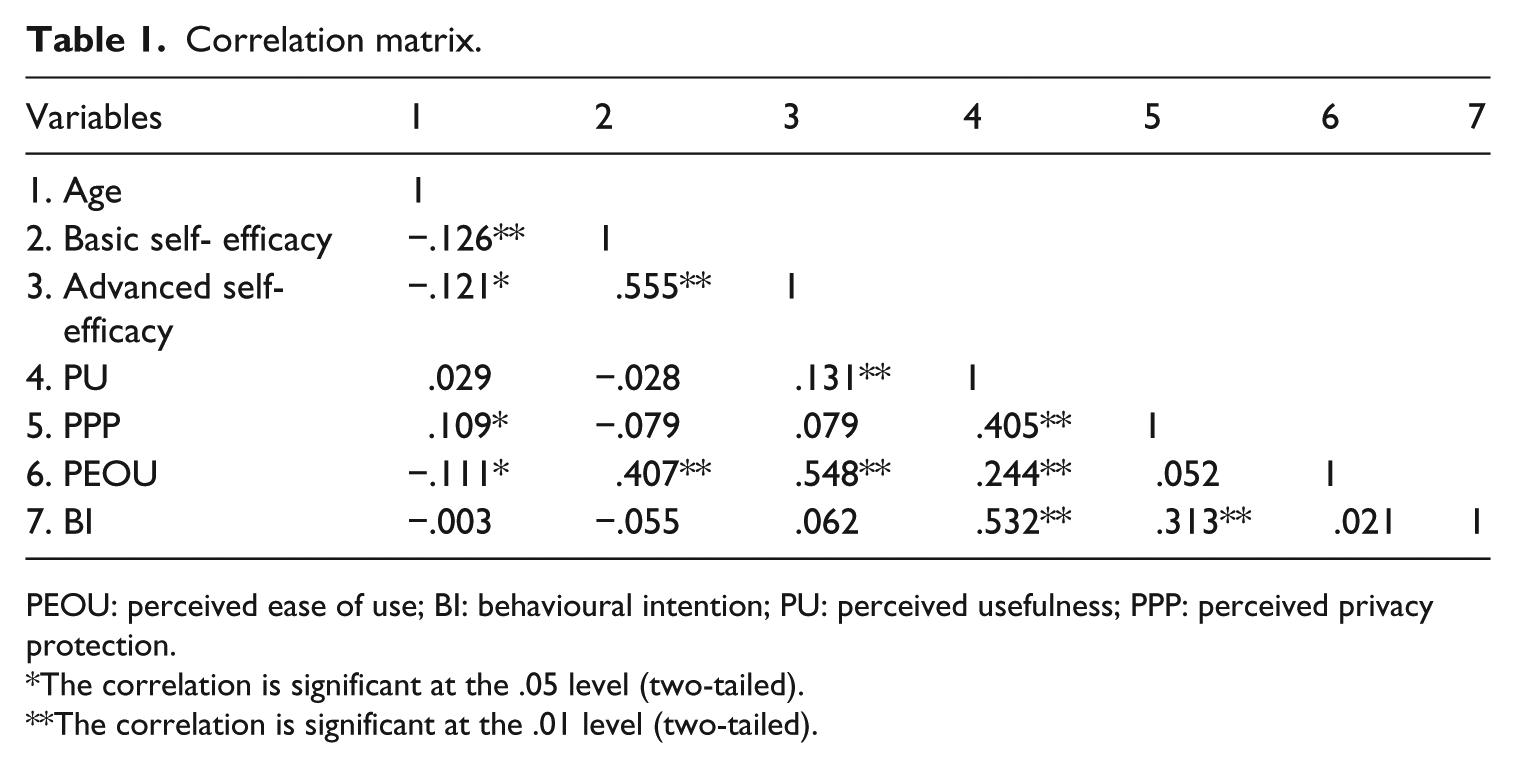
PEOU: perceived ease of use; BI: behavioural intention; PU: perceived usefulness; PPP: perceived privacy protection.
The correlation is significant at the .05 level (two-tailed).
The correlation is significant at the .01 level (two-tailed).
The results from the multiple linear regression analyses are presented in Table 2. For the dependent variable of BI, PEOU was negatively associated (β = −.113, p < .01), PU was positively associated (β = .511, p < .001) and PPP was positively associated (β = .110, p < .01), supporting H1b and H1c. The association between PEOU and BI (H1a) is significant, but not as expected: Seniors who perceive the usability to be higher are less likely to want to use SNSs. The analysis of the qualitative data below suggests some reasons for this unexpected negative relationship.
The results from the linear regression analyses.

PEOU: perceived ease of use; BI: behavioural intention; PU: perceived usefulness; PPP: perceived privacy protection.
p < .10; *p < .05; **p < .01; ***p < .001.
For the dependent variable PU, PEOU was positively associated (β = .207, p < .001) and PPP was positively associated (β = .348, p < .001); thus, H2a and H2b were supported. There was no significant association between age and PU. H2c was thus not supported.
For the dependent variable PEOU, there was no significant association between age and PEOU, and H3a was not supported. Basic self-efficacy was marginally significant (β = .085, p < .10) and advanced self-efficacy was positively associated (β = .470, p < .001), supporting H3b. Table 3 summarizes the results from the hypotheses testing.
Summary of hypothesis tests.
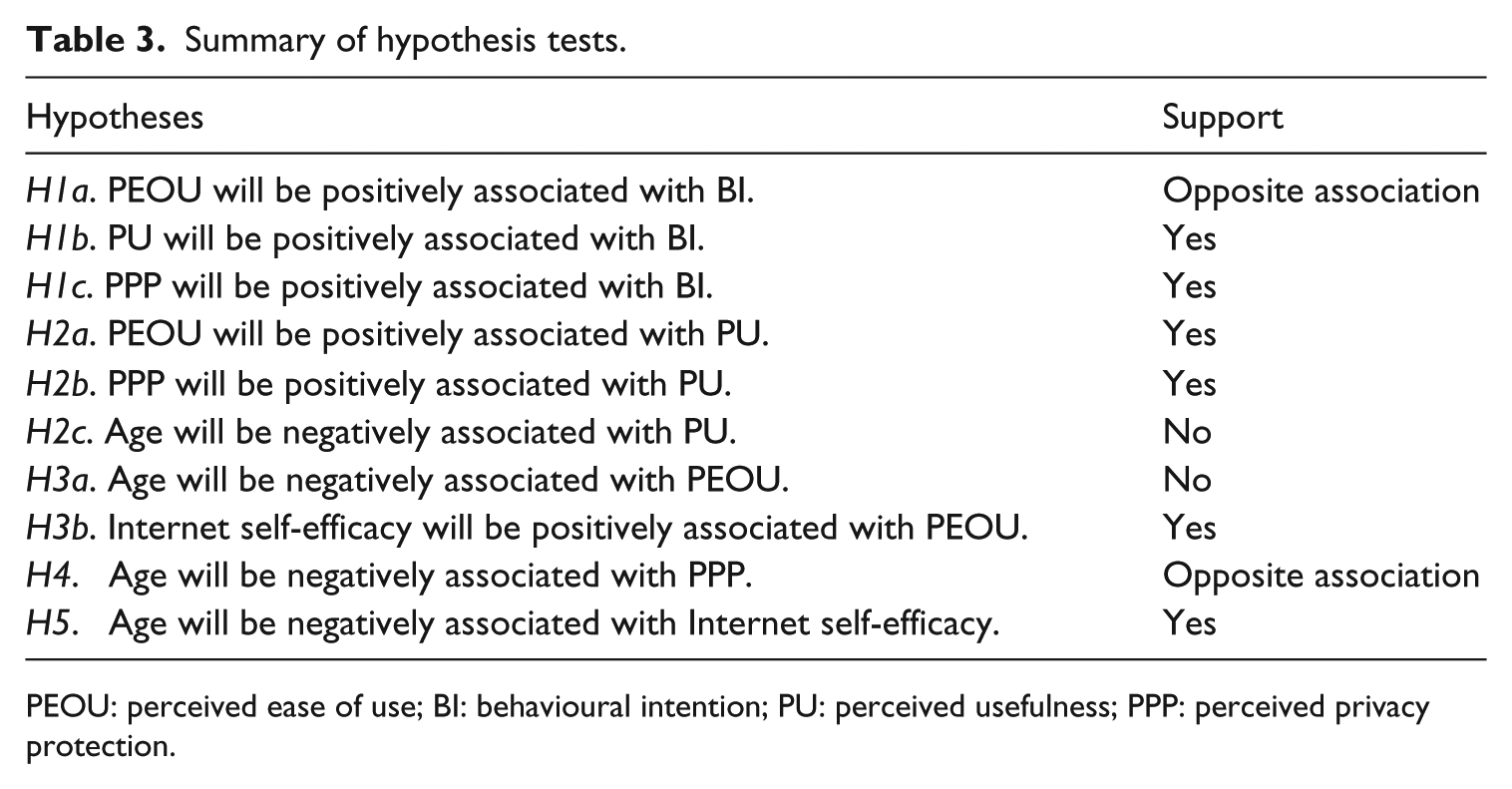
PEOU: perceived ease of use; BI: behavioural intention; PU: perceived usefulness; PPP: perceived privacy protection.
The quantitative findings will be further discussed in the below qualitative analysis. The qualitative part of the study is particularly useful for explicating the results with regard to H1a, H1b, H1c and H5. Our qualitative data provide insights into why PEOU shows a negative relationship with BI (H1a) and how basic self-efficacy might not be sufficient for learning to use SNSs (H5). Our qualitative data also provide details to elderly non-users’ perceptions about what SNSs are about (usefulness/H1b) and their opinions about privacy and SNSs (H1c). Our qualitative data enable us to explore elderly people’s reasons and motives for not using SNSs and their general experience of social participation. The congruence between the quantitative and qualitative findings implies that the quantitative findings validate the qualitative patterns and the qualitative findings help explain the quantitative findings.
Qualitative analysis
Perceived lack of relevance, pre-established negative attitudes, perceived lack of competence, and privacy and information-security concerns were reasons for not using SNSs, as deduced from the literature review. When comparing these reasons with the induced reasons from our qualitative data, we amended the reasons for not using SNSs as follows:
Non-users regard SNSs to be cold and narcissistic forms of communication and gossip of little use to maintain strong ties. A consequential lack of interest is prevalent, which is to be expected from the strong association between PU and BI found in the TAM analysis. Lack of relevance also relates to SNSs being perceived as a waste of time.
Privacy and information-security concerns are common among some non-users, aligning with what was expected from the literature review.
Non-users who express an interest in using SNSs typically perceive a lack of competence to be a barrier.
An important motivational factor to start using SNSs is to increase contact with family and close ties.
Cold and shallow forms of communication for gossip and self-obsessiveness
As we expected, PU is strongly and positively associated with BI (H1b). In the TAM analysis, PU is measured with items reflecting the social benefits of SNSs. In the qualitative part of our study, participants were able to express what they believe SNSs are about, and the results provide narratives that balance the beneficial presentation of SNSs, implicitly embedded in the PU items. Non-users typically perceive SNSs to be about gossiping and the sharing of mundane and uninteresting stories with an extended social network. Sharing private content with a large number of ties is regarded as inappropriate, risky, cold and narcissistic. Neither are they interested in the status updates from weak ties nor in re-connecting with old relations at all: I’ve never learnt to use SNSs, and I’m not sure I want to … I don’t have the need to contribute or read about all sorts of things to/from my ‘friends’. (Survey respondent) I don’t have the need. […] Isn’t it primarily for talking about yourself to others? (Survey respondent)
SNSs are perceived as anti-social. As lamented by one focus-group participant, ‘I can’t think of a colder medium. I mean, to be social is to be part of real social interactions’. Technology, they argue, does not bring people closer, but rather separates people from each other: People chat and they use Twitter, and god knows what it all is. […] I can’t bear that it seems impossible to communicate face-to-face. (Focus-group participant) I have no need for the ‘virtual world’ when it comes to social contact. I experience it as ‘fake’. (Survey respondent)
The elderly fear that social cohesion will deteriorate. They are wary of how the younger generations constantly gaze into their smartphones, detached from the real world: ‘They communicate via their phones; they don’t communicate with each other. I think it’s frightening’ (focus-group participant). The personal relations are lost, they explain, as people sit with their phones, tapping and replying to messages that are invisible to the other people present. Real connection, they argue, requires meeting people and hanging out with significant and close ties.
The survey and focus-group participants are not antagonistic to technology per se. Many appreciate the computer as an instrumental tool: ‘I use the computer for certain functional needs – writing notes, e-mailing, stock-purchasing, editing photos’ (survey respondent). This is similar to findings by Bloch and Bruce (2011) and Selwyn (2004), where elderly participants held the view that the Internet was a one-way information source and a functional tool. They also emphasize that technology can be socially meaningful, if directed and symmetrical such as phone conversations, e-mail and Skype. The reluctance to SNSs relates more to how they see close ones being immersed in a mediated sphere detached from the here and now and to the broadcasting form of communication, where messages are crafted for an undefined audience: We use e-mail to communicate with our real friends. I think it’s important to ‘talk’ personally to each of them and not similarly to several. (Survey respondent) Text messages are great, like if you’re just making an appointment, I’m in the shopping centre, and we agree to meet at the coffee shop. […] I use text messages a lot, but not if I want to have a chat. (Focus-group participant)
Previous research has found that complexity and fear of new technology are barriers to SNSs usage among older people (e.g. Hakkarainen, 2012; Karahasanović et al., 2009a; Xie et al., 2012). Our findings hint at important cultural communication differences between generations: SNSs reflect a culture of communication where broadcasting and visual traces for an extended network of contacts are perceived to supplant symmetrical communication among strong ties. This communication culture is perceived by older people as cold, unfamiliar and strange. Non-use of SNSs might therefore reflect a generational culture gap, where the rapid and often broadcasting communicative forms facilitated by SNSs are experienced as estranging. Their reflections demonstrate critical assessments of the potentially negative social implications of SNSs and are consistent with motivations for not using Facebook in other age groups (Baumer et al., 2013). They witness family and friends being occupied in online spheres even when they are spending time co-located in the same time and place, express concerns about a lack of devotion to the here and now of co-presence and fear humanity is losing the social skills to connect in the ‘real world’ (see also Turkle, 2011). Our findings, moreover, support the social importance of existing and strong ties for the elderly (Carstensen et al., 2003; Lindley et al., 2008), and for such relationships, dedicated and dyadic face-to-face, via the phone, e-mail or Skype forms of communication are regarded as more valuable.
SNSs are hence perceived as impersonal, vain and time-consuming. Considering these negative impressions, it comes as no surprise that they do not regard SNSs to be relevant or socially valuable. Additionally, non-users include the elderly who believe that they are too old to use SNSs and who are already fully occupied with other interests and hobbies. They do not see how SNSs can fit into this schedule, and they do not see the need for using these sites (in line with Turner et al., 2007): I’m an elderly 80-year-old woman, and I have enough of activities every day, reading, keeping my apartment tidy, visiting friends or going to the cinema or the theatre, taking a stroll and exercising. My need to learn to use SNSs is not big enough for me to mobilize the time and effort it takes to sit down several hours every day to learn this. I’ve been to some courses, maybe I’ll take more but for the time being, I’m fine without. (Survey respondent) No, I don’t think I have time for Facebook. I’m e-mailing friends, and I have a rather busy schedule, I couldn’t sit down and write a lot of stuff on Facebook, that’s like too much I think. But then, I’m not there, maybe it would be nice, but I have resisted thus far. (Focus-group participant)
The emphasis on a shortage of time in the qualitative data suggests that time could be a central factor to include in future TAM studies with regard to SNSs.
Our qualitative data suggest that non-use is an intentional and reasoned response. We will later return to PU as seen from non-users who in fact want to use SNSs.
Privacy and information-security concerns
Some participants voice concerns regarding privacy and information security. Such concerns take two forms: sharing private information with commercial providers of SNSs and losing control over who can access information shared in one’s own network of friends and contacts. Both concerns are reflected in the items used to measure PPP in the TAM part of the study and align with Raynes-Goldie’s (2010) distinction between institutional privacy and social privacy: I strongly oppose Facebook: it’s packed with advertisements; often with products I do not want to advertise for. In their license agreement, you agree to submit to the jurisdiction of the courts in California. I’m not an American citizen. I don’t want to submit to these terms. (Survey respondent)
Non-users additionally mention the risk of being hacked and of virus attacks. These concerns correspond to previous research on Facebook and privacy, where older users are more aware of the need for privacy and the ability to control it (Gibson et al., 2010; Karahasanović et al., 2009a; Xie et al., 2012). Participants in the focus groups had similar discussions on terms of services, privacy and jurisdiction, for example, concerning the ownership of content published on Facebook: Because when you publish photos on Facebook, Facebook actually owns those photos. They can use these photos for whatever they like. […] Of course, with that many people using Facebook, it’s not very likely that they will find your photos and use them, but yet. (Focus-group participant)
Second, non-users are concerned with social privacy and the consequences of sharing information with people not belonging to their immediate sphere of close ties. Some are advanced ICT users and have made considered choices with regard to not using SNSs: I’m deliberate about living a life outside of cyberspace, and I’ve chosen to stay away from SNSs. I want to have control over how much personal information gets disseminated to the public via friends of friends. I know that it’s possible to moderate that risk, but I haven’t been willing to learn about how to take such caution. I’m not technophobic, I surf a lot every day, and I stream a bit (also to my iPhone and iPad), I’ve used e-mail since the stone age, I shop a lot online, write a dozen text messages every day and sometimes MMS. (Survey respondent)
Social privacy concerns are also ostensible among the participants who are not as technically competent as the above respondent. Hearsay, knowledge about how friends and family use SNSs and media coverage on SNS risks contribute to raising the awareness about social privacy risks. Research typically points to the challenge of social context collapse in SNSs with users simultaneously performing for ties of various strengths (Brandtzæg et al., 2010; Vitak, 2012). Given the preference that the participants have for dedicated and dyadic forms of communication rather than broadcasting forms of communication across ties of various strengths, disinclination and wariness with regard to a lack of social privacy due to context collapse in SNSs are reasonable and sound.
Lack of competence as a barrier
Whereas the above reasons are typical for non-users who are critical of SNSs, others express an interest in using SNSs, yet experience a lack of competence and difficulties in learning to use SNSs. These non-users acknowledge the benefits of SNSs, for example, as a way to keep in touch with family and grandchildren, but report SNSs as being too complex to use. They can thus be considered as involuntary non-users.
The survey was conducted as a web-survey, and the respondents who were able to reply were expected to have basic computer competence. Yet, even if all respondents had the competence to complete the survey, these respondents reply that they lack the required knowledge and competence to use SNSs and explain that they need help to learn to use SNSs. Recall that the association between advanced self-efficacy and PEOU was much stronger than that between basic self-efficacy and PEOU (H5): I have kind of never got around to it. I sometimes get help from my grandchildren, but we haven’t got to SNSs yet. (Survey respondent) I have registered on Facebook, but I don’t understand the system. I had a course, but when I get home, I can’t manage. If I had somebody to ask about how I should think and understand this, then I would learn. (Survey respondent)
We initially expected PEOU to be positively associated with BI (H1a). The association was confirmed to be significant, yet the opposite association was found: PEOU is negatively associated with BI. The findings from the qualitative data suggest an explanation. Elderly non-users who want to use SNSs experience SNSs as being too difficult to learn to use. Some have taken courses, yet find it difficult to apply what they learn: My children – who are now grown up and have their own kids – only tell me ‘this is so simple. You can do this!’ I’ve taken courses, but with poor memory and group courses, and sometimes with a different operating system – continuous learning is difficult. (Survey respondent) We received a leaflet when I attended a course on SNSs, but it was insufficient, it didn’t say anything about how to use it after having registered, like how do you change things. How do you upload photos, how do you write? (Focus-group participant)
Despite technical difficulties, the usefulness of these services is becoming evident. In the survey, a couple of respondents answered why they did not use SNSs even if they did use Facebook. As SNS rookies, their answers explicate how the benefits of SNSs are becoming evident: My daughter registered me on Facebook two years ago when she was over here from the USA, but I’m not good at using it a lot. My whole US family are on Facebook so I find lots of photos and content from my family. I should get some training though. (Survey respondent) I waited for a long time before I registered on Facebook. I thought it was all about gossip, but I was eventually interested when I realized how many people use it and how it works. (Survey respondent)
If we compare these responses to the typical critical sentiments with regard to a lack of usefulness, relevance and privacy protection, these two respondents experience Facebook to be socially valuable and relatively safe. A conversation between a non-user and a user in one of the focus groups demonstrates a similar increasing awareness of the benefits of Facebook:
It seems you could find Facebook useful?
Yes, you know what, I have been thinking about it. Should I? Isn’t it …
I use it. Oh yes, but I have to. Because of children and grandchildren in Australia, you know […] I see photos of my new great-grandchild and everything you know. So, it’s great.
Participants emphasize the importance of having children and grandchildren as support people when learning to use SNSs and as primary motivators for why they would want to use SNSs. With regard to the former, they suggest that learning to use SNSs from close family ties would make SNSs less intimidating, and several point to how people they know have benefitted from SNSs. Unlike the critical elderly who stress how SNSs are deteriorating social cohesion, these elderly participants experience the opposite: They are beginning to acknowledge a potential social value of SNSs:
Oh yes, it can. […] Like, unfortunately, I’ve kind of become more a-social, I don’t go out and meet a lot of people, but you have your social network available through your computer.
So it’s kind of less committing, or?
Yes, that also. Clearly, you can’t say that no, it doesn’t help [your social life]. But you can’t say yes either. It’s all up to what you make of it.
These participants continued by discussing online dating and referred to friends who had found their partners online and how SNSs might be valuable for the elderly with less mobility, who could then maintain and extend their social networks.
Elderly non-users who are motivated to use SNSs appear to change their opinions from perceiving SNSs as nonsense to realizing that SNSs can be valuable for maintaining close ties as they grew older. These non-users hence perceive the usefulness of SNSs to be potentially substantial (H1b). They want to use SNSs, yet a lack of digital competence is perceived as a significant barrier. Our qualitative data hence suggest why PEOU in our study is negatively associated with BI (H1a).
Growing old and lonely?
The participants express satisfaction with their social lives, and our findings support that maintaining strong and meaningful ties appears more important than a continued extension of social networks (Carstensen et al., 2003). However, we found that they fear loneliness as their social networks become smaller: I have my sewing circle. We’ve been meeting for the last 46 years. But now, they are rapidly dying, there are only three of us left. (Focus-group participant) And you lose parts of your social circle, and many do not take the initiative to get out and get new friends. (Focus-group-participant)
There is a community potential for SNSs to help elderly renew or develop social contacts. However, it would be simplistic to expect that SNSs alone can fill the void as people grow older and less mobile and, moreover, experience close ties and loved ones dying. Existing research suggests that the social value for most users is significant, although it also points to the importance of balancing online and offline sociability, as heavy SNS usage seems to amplify feelings of loneliness (Brandtzæg, 2012). Hence, future studies are needed to address the implications with regard to loneliness on elderly users of SNSs.
Limitations and future research
Some research limitations in this study are worth noting. First of all, age is a crucial variable to understand how people approach SNSs. However, our study did not examine possible associations between education, previous profession and urban/rural residence as independent variables and TAM constructs as dependent variables. Similarly, our qualitative data do not provide insight into patterns between the backgrounds of the participants and their opinions and experiences of SNSs. Previous research has also found gender differences in SNSs usage and social capital, with females using SNSs more frequently and more socially than males (Brandtzæg, 2012). Whereas there was a strong rational for choosing Norway as a research context, national culture, differences in usage patterns and family cultures may also be critical factors. To examine the relations between cultures, gender and older citizens’ experiences of SNSs will require more research from a comparative cross-country perspective, where gender disparities and other external factors such as family situation and social context are also investigated. Moreover, future studies addressing specific types of SNSs and comparing these are interesting for disclosing whether some are more easily adopted by elderly.
Second, our method for recruiting survey respondents by e-mails enabled us to recruit a large and unique sample of non-users of SNSs, yet further research should draw on a more representative sample of elderly.
Finally, this study used a mixed-methods approach, where the integration of and balance between different approaches might be an issue (Onwuegbuzie and Johnson, 2006). Findings from our mixed-methods approach were complementary rather than conflicting. Yet, assessing the validity of the approach can be complex, and similar studies should be replicated in future research.
Concluding discussion
The quantitative and qualitative parts of our study are complementary, and the most interesting results concern how elderly non-users’ interpretations of what SNSs are about influence BI. PU particularly relates to whether or not non-users perceive SNSs to be valuable for strong tie relationships. Strong ties are confirmed to be important for the elderly in our study, and the preference for maintaining close ties explains why some deliberately remain non-users of SNSs and why others acknowledge SNSs as socially valuable.
Deliberate non-users depict SNSs to facilitate a cold, shallow, broadcasting form of communication, appropriate for maintaining weak ties, and thus of little relevance. They have no need for a ‘virtual world’, perceived as prone to privacy and information-security risks, and prefer symmetrical interaction, such as face-to-face interaction, phone conversations and e-mail. Non-use of SNSs among elderly might therefore reflect a generational culture gap, where the rapid and broadcasting communicative forms facilitated by SNSs are experienced as estranging and asocial. Non-usage is therefore not only a consequence of lack of digital competence or privacy and security concerns. The key barrier among many elderly participants in our study is how SNS communication is not perceived to support their preferred culture of communication. SNSs are also experienced as supplanting ‘real communication’, with elderly non-users describing feelings of social exclusion when friends and family members are ‘somewhere else’ in shared social settings.
The importance of strong ties is also evident for involuntary non-users. They see how SNSs complement and enrich other forms of keeping in touch, particularly with strong family ties. Some also see SNSs as useful to extend social networks. These non-users want to use SNSs, yet explain they do not feel competent to do so. As SNS non-users, they feel left out of important social spheres.
It is not a problem that many older people deliberately choose not to use SNSs. Yet, when non-users feel socially excluded, this is a problem that must be mitigated. We can expect the SNS adoption rate among elderly to increase as they realize these sites also hold value for maintaining strong social ties. Yet our study reveals how SNSs represent strange and complex worlds both requiring advanced technical self-efficacy and becoming comfortable with a different culture of communication.
Footnotes
Acknowledgements
The authors would like to thank Edith Roth-Gjevjon, Anne Moen, Elisabeth Østensen, Tone Øderud and Ida Maria Haugstveit for their participation in conducting the focus-group interviews.
Funding
This work was supported by Regionale Forskningsfond – Hovedstaden (grant number 217609/97231).