




Abstract
There is an increasing interest in improving youth digital citizenship through education. However, the term ‘digital citizenship’ currently covers a broad range of goals. To improve education, the current article argues for a narrower focus on (1) respectful behavior online and (2) online civic engagement. Using this definition, a digital citizenship scale was developed and assessed with a sample of 979 youth, aged 11–17 years, and confirmatory factor analyses (CFAs) supported measurement of both constructs: online respect (7 items, Cronbach’s α = .92) and online civic engagement (4 items, Cronbach’s α = .70). Online respect scores decreased with youth age, and scores on both subscales were higher among girls than boys. Both online respect and civic engagement were negatively related to online harassment perpetration and positively related to helpful bystander behaviors, after controlling for other variables. Implications of the study findings for developing and evaluating digital citizenship educational programs are discussed.
Internet safety education efforts developed quickly in response to public concern about the potential risks that youth face when online, but the direction of youth education in this area is evolving as more is understood about youth behavior and experiences using new technology. The increasing focus on teaching digital citizenship skills is an example. The concept of digital citizenship has been the topic of books (Mossberger et al., 2008; Ribble and Bailey, 2011), online reports (Common Sense Media, 2011; Microsoft, n.d.), and lesson materials for teachers (Borovy, 2012; Cable in the Classroom, n.d.; Common Sense Media, 2012). Early use of the term referred to online access (e.g. “increasing the number of youth digital citizens”) (Mossberger et al., 2008; Shelley et al., 2004), but it has been used more recently to refer to safe and responsible behavior online. One author defined digital citizenship as comprising the concepts of responsibility, rights, safety, and security (Ribble and Bailey, 2011). Others describe it as involving “appropriate technology usage,” and “making safe, responsible, respectful choices online” (Common Sense Media, 2011; Microsoft, n.d.). A media education program (Common Sense Media, 2012) has translated digital citizenship education into curricula on the following topics: Internet safety, privacy and security, relationships and communication, cyberbullying, digital footprints, reputation, self-image and identity, information literacy, and creative credit and copyright.
If the trend toward teaching digital citizenship skills is a conscious move away from the fear-based strategies that marked earlier Internet safety education efforts (Jones, 2010), then this is likely a helpful change for youth. Research has shown that fear-based approaches are not effective public health strategies (Clayton et al., 1996; Petrosino et al., 2003). However, if digital citizenship is going to become a new educational focus that is marketed to schools, a significant amount of conceptual and evaluation work is needed to ensure that its goals are well-defined and its outcomes successfully achieved. Below, we present recommendations that digital citizenship education focus on advancing youth skills in two specific areas: (1) using respectful online behavior and (2) practicing online civic engagement. Using this definition, we summarize preliminary psychometric data on a digital citizenship scale, tested with a large sample of middle-school and high-school youth, and discuss implications of the findings for developing and evaluating digital citizenship education programs.
Defining digital citizenship
As a first step in reducing some of the existing term confusion and improving the focus and evaluation of educational efforts, we recommend distinguishing digital citizenship education from digital literacy education (Internet and computer technical skills). Many in the field already use the term ‘digital literacy’ to refer to computer and Internet-based skills such as knowing good search strategies, understanding and using privacy settings, practicing identity theft protection behaviors, creating safe passwords, correctly citing online information, and avoiding spam and e-scams (Koltay, 2011; Sonck et al., 2011). Digital literacy requires a very specific set of educator knowledge and teaching skills compared to other goals currently under the digital citizenship umbrella.
A second recommendation is to focus digital citizenship education on helping youth build and practice specific online social skills versus admonitions against problem behaviors like cyberbullying and sexting. Cyberbullying and sexting have complex causal roots in adolescent identity-formation, peer struggles, self-esteem, romantic exploration, and sexual decision-making (Hinduja and Patchin, 2010; Jones et al., 2013; Lenhart et al., 2008; Mitchell et al., 2012; Raskauskas and Stoltz, 2007; Sumter et al., 2012; Ybarra et al., 2012). Reducing these problems likely requires evidence-based bullying prevention and relationship and sexual education programs (Jones et al., 2014b; Nation et al., 2003; National Institutes of Health, 2004; Pentz, 2003).
By separating it from digital literacy education and cyberbullying prevention, digital citizenship education can instead be focused on using Internet resources to have youth (1) practice respectful and tolerant behaviors toward others and (2) increase civic engagement activities. As we describe below, this definition of digital citizenship more closely aligns with direction of general youth citizenship education and could provide a useful roadmap for programs interested in increasing positive online youth citizenship behaviors. There is a growing appreciation that the Internet can provide important opportunities for youth to exercise positive social skills and engage with their community in ways that may have positive outcomes for offline civic engagement (Flanagan and Gallay, 1995; Kahne and Sporte, 2008; Sherrod et al., 2002; Zaff et al., 2008).
Aligning digital citizenship education with youth citizenship goals
While traditional citizenship studies have focused on public participation in the political process (Westheimer and Kahne, 2004a, 2004b), conceptualizations of citizenship are becoming more inclusive of a range of civic behaviors such as participating in community activities, working to improve community or societal problems, and addressing social injustices (Levine, 2007; Sherrod et al., 2002; Thorson, 2012; Westheimer and Kahne, 2004b; Zukin et al., 2006). Scholars on youth citizenship note that although the definition of good citizenship varies, a key aspect is “the ability to move beyond one’s individual self-interest and to be committed to the well-being of some larger group of which one is a member” (Sherrod et al., 2002: 265).
For youth, respectful behavior toward others can be considered a preliminary step in contributing to the well-being of a larger group, signaling tolerance of those with different perspectives and opinions (Hammett and Staeheli, 2011; Westheimer and Kahne, 2004b; Youniss et al., 2002). Respectful behavior, conflict resolution strategies, and tolerance of differences are taught in social–emotional learning (SEL) programs, which themselves evolved from youth character education programs (Durlak et al., 2010, 2011; Greenberg et al., 2003; Leming, 1997). Current digital citizenship education programs and literature already promote respectful behavior online, although typically through a focus on the harms of cyberbullying. We propose that tolerance and respect become a more direct focus of digital citizenship education. Educational programs could, for example, have youth practice perspective-taking and respectful, supportive actions when witnessing or participating in disagreements in the variety of online communities in which they participate.
Civic engagement, on the other hand, has not yet been a major focus of digital citizenship definitions or educational directions, but it closely aligns with the conceptualization of youth citizenship in general (Westheimer and Kahne, 2004b; Youniss et al., 2002; Zaff et al., 2008). Civic engagement refers to behaviors intended to benefit the common good (Lenzi et al., 2012; Zaff et al., 2008). These behaviors can include political participation, but also can include volunteer work, supporting charities, and sharing hobbies and skills with a larger community (Sherrod et al., 2002; Youniss and Levine, 2009). Creative educational initiatives are developing in an effort to improve youth civic engagement (Flanagan et al., 2007; Kahne and Sporte, 2008; Lenzi et al., 2012; Sherrod et al., 2002) and educators play an important role (Kahne and Sporte, 2008).
By defining digital citizenship specifically to include civic engagement, these two areas of education can inform each other and create new synergies. It is already recognized by civic engagement researchers that the Internet provides exciting new arenas and opportunities for youth (Bennett et al., 2011; Jenkins, 2009; Kahne et al., 2012, 2013; Lenhart et al., 2008; Van Hamel, 2011). Online civic engagement opportunities could be appealing to youth in particular by providing a wider array of engagement opportunities than are locally available, and offer the possibility for private or even anonymous civic involvement. Jenkins (2009) argues, for example, that online participatory cultures are an ideal place for learning, joining, and being a part of a collective effort to achieve a greater goal. A longitudinal study found that youth participation in nonpolitical, interest-driven online activities predicted greater traditional civic participation (volunteerism, solving a community problem) and political involvement 1–2 years later, even after controlling for a range of related variables (Kahne et al., 2013).
There is some possibility as well that digital citizenship programs that help youth practice respectful online disagreement and debate and engage in online civic activities could aid efforts to reduce online bullying and harassment behaviors and victimization. There is no indication that current strategies to reduce cyberbullying, which typically rely on awareness-raising strategies, have been effective (Jones et al., 2014a). Research on prevention instead has found that positive, interactive strategies are most effective in reducing youth aggression and related social and emotional problems (Cooper et al., 2000; Durlak et al., 2011; Nation et al., 2003). Efforts to enhance the role of bystanders (Davis and Nixon, 2012; Nickerson et al., 2014; Polanin et al., 2012) and influence social norms (Jones et al., 2011; Perkins et al., 2011; Salmivalli and Voeten, 2004) are increasingly a focus of programs to reduce bullying. If, instead of instructing youth on the harms of cyberbullying, digital citizenship education efforts helped youth practice using respectful behavior during online disagreements, taking others’ perspectives, and supporting individuals who were being targeted negatively, there is a possibility that it could also result in decreased online harassment.
There is less research currently supporting the connection between increasing civic engagement and reducing negative online behaviors such as bullying, but there is some limited evidence that civic engagement behaviors could potentially influence positive interpersonal behaviors. There is some indication, for example, that offline youth civic participation improves behavior problems, at least for some groups of youth (Vieno et al., 2007). Additionally, the potential impact of civic engagement on positive social and emotional outcomes underpins much of the youth positive development research and literature, and research has found connections between youth participation in community activities and improved social, emotional, and leadership skills (Mueller et al., 2011; Zaff et al., 2003). While we do not want to overstate the potential impact of digital citizenship educational efforts on cyberbullying, there is some basis for hypothesizing and evaluating whether such a focus would have more success than current approaches.
The current study
We discuss above that refocusing digital citizenship education on two key strategies, increasing respectful behaviors toward others online and increasing youth online civic engagement activities, could focus and improve educational efforts. The current study seeks to operationalize our proposed definition of digital citizenship, measure the construct with a preliminary sample of youth, and explore its association with online harassment victimization, perpetration, and bystander experiences. Using the definition of digital citizenship behaviors defined above, we developed a short scale and examined psychometric findings as part of a larger study on cyberbullying with a sample of 979 middle-school and high-school-aged youth from New England.
Methods
Procedures
An anonymous online survey was administered to 979 students in the 6th through 10th grades at five middle schools and one high school 1 in Northern New England. Consent and assent procedures were approved by the Institutional Review Board (IRB) and by each participating school principal prior to administration. Parents were sent information about the study 2 weeks ahead of time and were instructed to let the school know whether they did not want their youth to participate. Students were told, prior to beginning the survey, that it was anonymous and that they could skip questions or submit a blank survey if they did not want to participate. Survey administration occurred at school computers and was overseen by a contact person at each school. A debriefing form was provided to students following the survey with information on bullying and Internet safety and recommendations that students talk with parents or teachers if they should have any concerns related to these issues.
Sample
The survey was administered to an initial 1065 students across the six participating schools. This represented between 62% and 97% of possible student respondents at each school. Whole classes participated, but in some schools, scheduling made it difficult for every class to participate. After examining results, survey responses from 14 youth were eliminated either because there were extensive missing data or because response patterns suggested that it was highly probable they were non-accurate responses (e.g. all items in the survey were answered using the most extreme selection). An additional 72 students who had 20% or more missing data on the digital citizenship scale were dropped from analyses in the current article. The final sample included 979 youth.
Respondent demographic information has been included in Table 1. The sample was split roughly equally between male and female students. In all, 51% of students were aged 13–14 years, 35% were aged 11 or 12 years, and 13% were aged 15–17 years. Most student respondents described themselves as White (80%); a significant percentage were Hispanic or Latino (14%). Smaller percentages of youth labeled themselves as Black/African-American (6%), Asian/Pacific Islander (5%), American Indian/Eskimo (3%), or “Other” (5%). We were not able to collect any additional socio-demographic information on participating students. The involved schools were located in a combination of rural, suburban, and large city areas. The percentage of students participating in reduced and free lunch programs at each school ranged from 26% to 47%, compared to a state average of 26%.
Respondent characteristics and online harassment experiences (N = 979).

Multiple responses possible.
Measures
Digital citizenship scale
An 11-question online citizenship scale was developed with 7 items asking respondents about respectful online behaviors (“If I disagree with people online, I watch my language so it doesn’t come across as mean”) and 4 asking about civic engagement behaviors defined as using the Internet to help others or share skills (“I have used the Internet to learn how I can help a friend or help other kids in general”). Response options used a 5-point scale ranging from “not at all like me” to “very much like me.” All scale items are provided in Table 2. All 11 scale questions had some level of missing data with no one question missing more than 1.5%. Missing data were recoded to the sample mean.
Online digital citizenship scale item psychometrics (N = 979).
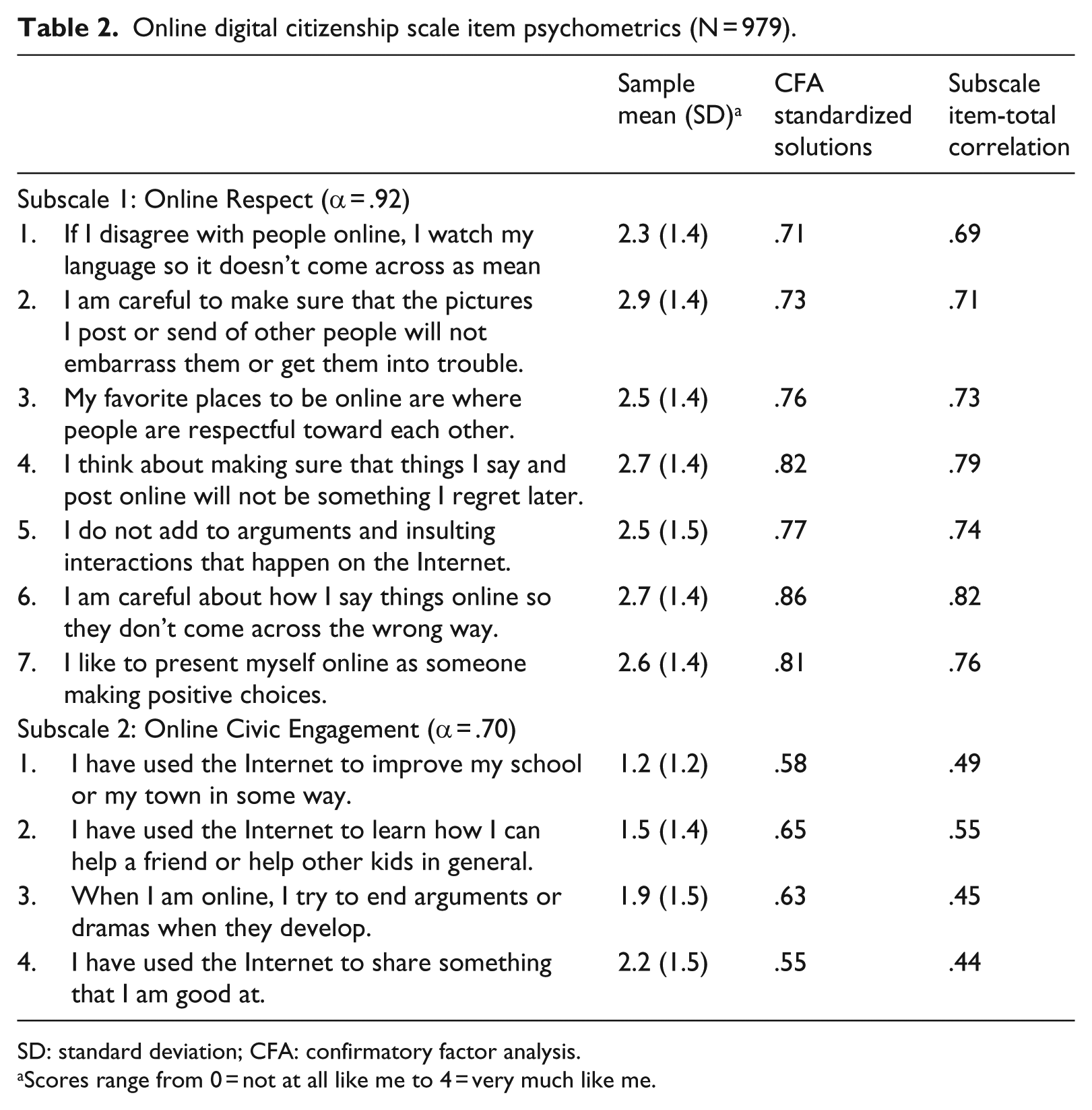
SD: standard deviation; CFA: confirmatory factor analysis.
Scores range from 0 = not at all like me to 4 = very much like me.
Online harassment victimization and perpetration
Victimization and perpetration questions were adapted from the Youth Internet Safety Survey (YISS) (Jones et al., 2013). Youth were considered a victim of online harassment if they positively endorsed any one of 5 items in the past 3 months. Examples include “Someone made rude or mean comments online to you” and “Something about you was shared online with others that was meant to be private” (see Table 1 for a list of all 5 items). Youth were considered a perpetrator of online harassment if they said they did any of these same five actions toward someone else in the past 3 months. One additional perpetration item asked about participation in an online group or social networking site where the focus was making fun of someone you know.
Bystander behavior
Youth were asked, “In the past 3 months, how often have you seen a situation where someone you knew was having problems being harassed or made fun of online?” Response options were never, 1 time, 2 times, 3–5 times, and 6 or more times. For those youth who saw such a situation at least once, a series of questions about their reaction was queried. The final score identified whether respondents did any of the following actions: (1) told the person causing the problem to stop, (2) talked to the harasser’s friends to help it stop, (3) got friends to try and help, (4) reported the problem to a website, (5) talked to an adult at home, and (6) talked to an adult at school.
Demographic and Internet use characteristics
Youth reported on their sex (male or female), age (11–17 years), and race/ethnicity. Average hours of day youth used the Internet was also queried ranging from 1 hour or less to more than 3 hours.
Data analyses
Based on our a priori interest in defining digital citizenship as a two-factor combination of online respect and online civic engagement, CFA with structural equation modeling was used to test the hypothesized structure of the digital citizenship scale (Brown, 2015; Jackson et al., 2009; Schreiber et al., 2006; SPSS, 2012). Goodness of fit was evaluated using the root mean square error of approximation (RMSEA) (good model fit ⩽ .05), adjusted goodness-of-fit index (AGFI) which adjusts for degrees of freedom (good model fit ⩾ .90), standardized root mean square residual (SRMR) (good model fit < .05), non-normed fit index (NNFI) (>.90 is acceptable fit), and the comparative fit index (CFI) (should be >.90 to accept the model). The hypothesized two-factor model was compared to a single-factor scale structure. Factorial invariance across groups was tested by examining goodness-of-fit indices separately for girls and boys, and for three different age groups (11–12, 13–14, and 15–17 years).
Scale statistics including reliability and inter-item correlations statistics were calculated and reviewed. Total and subscale scores were then created and compared by respondent age and sex. Finally, construct validity of the scale was examined using a series of logistic regressions to assess the relationship of the total score and subscale scores with online harassment victimization, online harassment perpetration, and bystander involvement. Missing data in all analyses were handled with listwise deletion.
Results
CFA
CFA results on the hypothesized two-factor structure of the digital citizenship scale indicated an overall good fit of the model according to the indices we examined: χ2 = 122.22, df = 36, p < .001; RMSEA = .05; AGFI = .98; SRMR = .04; NNFI = .98; and CFI = .96. The two-factor model provided a better fit than a single-factor model: χ2 = 358.25, df = 44, p < .001; RMSEA = .08; AGFI = .94; SRMR = .08; NNFI = .94; and CFI = .95. See Table 2 for standardized solutions for the two-factor model. We ran preliminary tests for factorial invariance across subgroups by examining goodness-of-fit indices and found that the two-factor model was a good fit for both girls and boys, and for younger (aged 11–12 years) and middle (13–14 years) adolescents. The model was weaker for older adolescents (aged 15–17 years), although adequate according to some of the fit indices (χ2 = 81.78, df = 36, p < .001; RMSEA = .097; AGFI = .90; SRMR = .09; NNFI = .93; and CFI = .96.). Given the limited diversity in our sample, we were not able to test for invariance by racial and ethnic groups.
The first subscale labeled online respect was made up of 7 items (e.g. “If I disagree with people online, I watch my language so it doesn’t come across as mean”; “I am careful to make sure that the pictures I post or send of other people will not embarrass them or get them into trouble”). Cronbach’s α for this subscale was .92, indicating very strong reliability. The mean for the 7-item online respect subscale (0–4) was 2.6 (standard deviation (SD) = 1.18). The second subscale was labeled online civic engagement and was made up of 4 items (e.g. “I have used the Internet to improve my school or my town in some way”; “I have used the Internet to learn how I can help a friend or help other kids in general”). Cronbach’s α for this subscale was .70, indicating adequate reliability. The mean for the 4-item Online Helpfulness subscale (0–4) was 1.7 (SD = 1.03). The two subscales were strongly correlated with each other (r = .64, p < .001).
Total and subscale score differences were calculated by age and sex (see Table 3). Overall digital citizenship scores and online respect behaviors, in particular, decreased with age. No differences were noted between 11- to 12-year-olds and 13- to 14-year-olds; the oldest teens (aged 15–17 years) scored significantly lower than both younger age groups. Youth aged 15–17 years reported significantly less online civic engagement than those aged 13–14 years (no differences with 11- to 12-year olds were noted). Overall, girls scored higher on digital citizenship than boys; the same was found for both subscales.
Digital citizenship scale and subscale mean scores (SD) by age and gender.
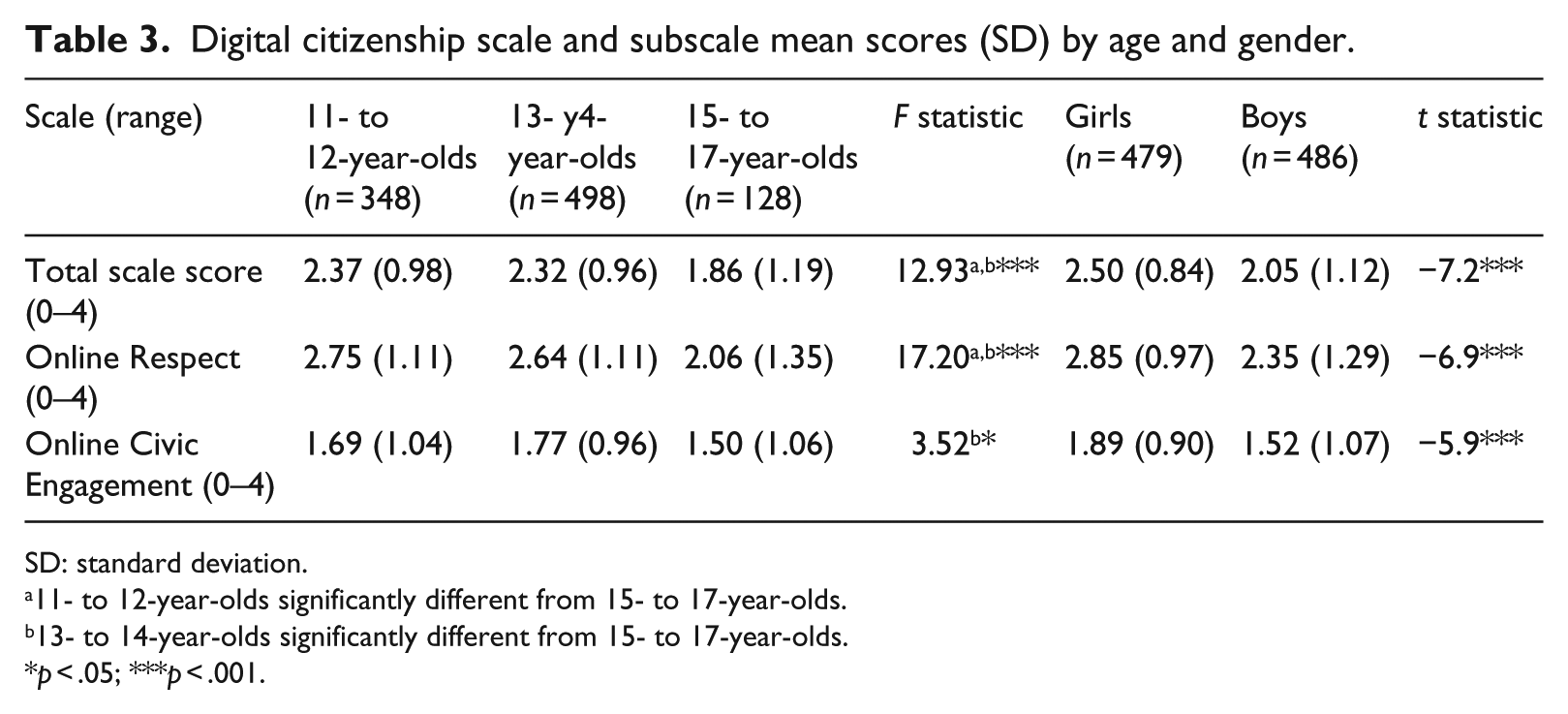
SD: standard deviation.
11- to 12-year-olds significantly different from 15- to 17-year-olds.
13- to 14-year-olds significantly different from 15- to 17-year-olds.
p < .05; ***p < .001.
Correlations with online harassment experiences
Online harassment
Students were asked a series of questions about their experience with negative or harassing experiences involving the Internet or cell phones. In all, 35% of students (n = 371) reported that they had been the target of at least one of five harassment experiences in the last 3 months; 28% (n = 296) said they had harassed someone else in the same time period; 23% of youth overall reported being both a victim and a perpetrator (n = 222); 13% were only victims (n = 129); 6% were only perpetrators (n = 63); and 58% (n = 565) reported being neither a victim nor a perpetrator in the past 3 months.
The relationship between digital citizenship scores and online harassment experiences was examined through a series of logistic regressions between the digital citizenship scale total score, subscale scores, and measures of youth online harassment victimization and perpetration (see Table 4). All logistic regressions were adjusted for youth age, sex, and hours spent online per day. All variables were entered in one step. Higher scores on the total digital citizenship scale were related to less online harassment victimization (conditional odds ratio [COR] = 0.77, 95% confidence interval [CI]: [0.66, 0.89], p < .001) and perpetration (COR = 0.55, 95% CI: [0.47, 0.64], p < .001). A similar pattern was noted for the online respect subscale. Higher scores on the online civic engagement subscale were related to less online harassment perpetration. No relationship was noted between this subscale and online harassment victimization.
Logistic regression of digital citizenship scores on online harassment victimization, perpetration and helpful bystander behavior (last 3 months).
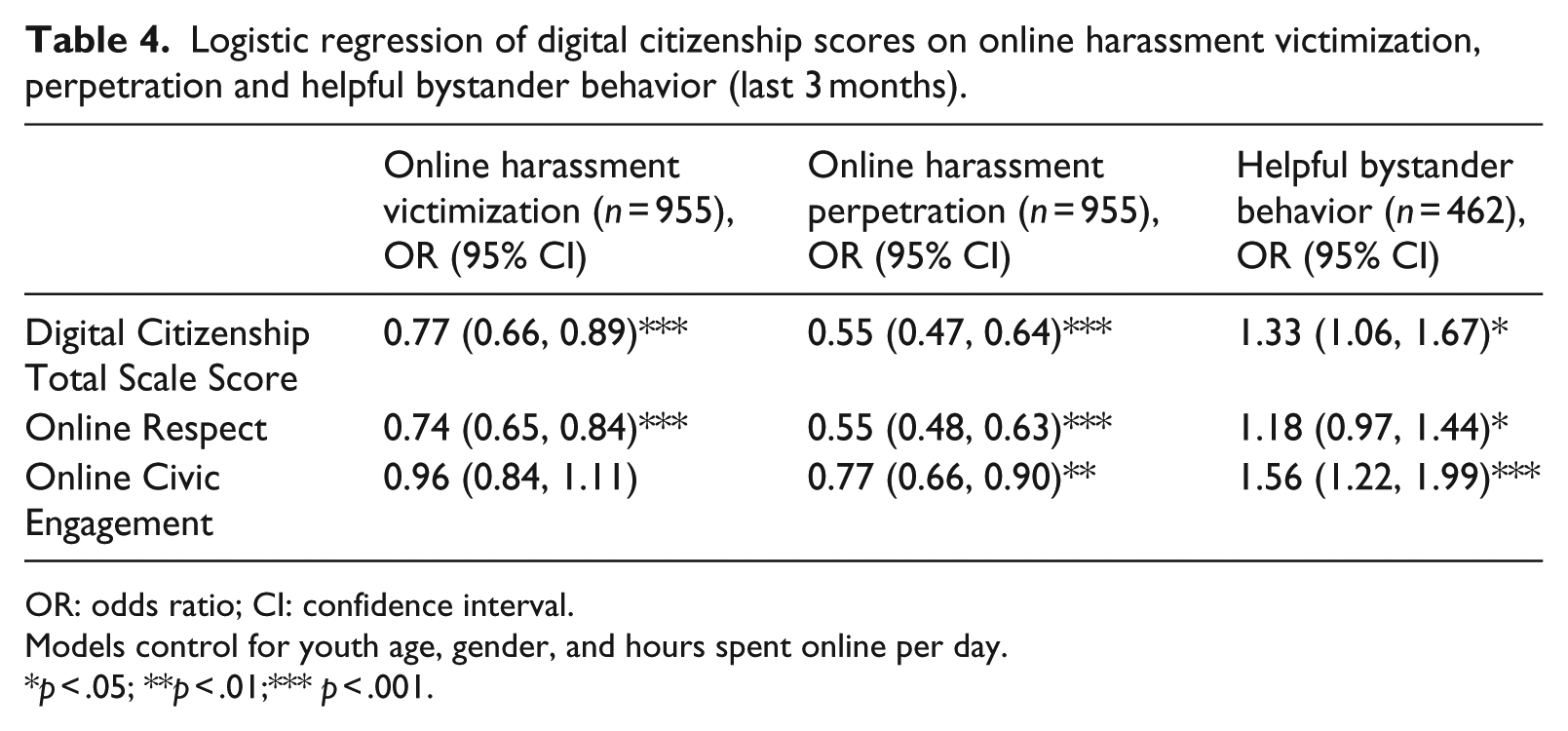
OR: odds ratio; CI: confidence interval.
Models control for youth age, gender, and hours spent online per day.
p < .05; **p < .01;*** p < .001.
Being a helpful bystander
In all, 49% (n = 477) of youth said they had witnessed a situation where someone they knew was having problems being harassed or made fun of online in the past 3 months (see Table 1). Of these youth who witnessed such an event, 72% said they helped the person being harassed in some way (35% of respondents overall). Youth helped by telling the person causing the problem to stop (58%), talking to the harasser’s friends to help it stop (30%), getting friends to try and help (36%), reporting the problem to a website (18%), talking to an adult at home (22%), and talking to an adult at school (15%).
The relationship between digital citizenship scores and being a helpful bystander was examined with a series of logistic regressions between the digital citizenship scale total score, subscale scores, and a measure of youth bystander involvement (see Table 4). The same adjustments noted above were included in these models as well. Higher scores on the total digital citizenship scale were related to a higher likelihood of being a helpful bystander (COR = 1.33, 95% CI: [1.06, 1.67], p < .05). A similar pattern was noted for the online respect subscale. The online civic engagement subscale was positively related to being a helpful bystander.
Discussion
The current study operationalized the term “digital citizenship” in order to facilitate educational efforts and help researchers evaluate those efforts. A self-report scale was developed using the proposed definition of youth digital citizenship: a combination of respectful, tolerant online behavior and online civic engagement activities (e.g. finding information to help the community or other youth; sharing skills). Psychometric analyses supported the scale’s measurement of these two constructs with adequate internal reliability. There was also evidence of validity for the digital citizenship scales. Youth who scored higher on the measure’s online respect subscale reported less harassment victimization, less perpetration, and were more likely to have taken action to help a target of online harassment. Youth who scored higher on the online civic engagement subscale were significantly less likely to report harassment perpetration behaviors, and were more likely to try to help as a bystander.
Mean differences on scale and subscale scores identified by student age and gender showed boys scoring significantly lower than girls on both subscales; and older adolescents (aged 15–17 years) scored lower than younger adolescents. CFA results indicated that the psychometric structure of the scale itself was weaker with the older group of adolescents. Future research on digital citizenship will need to explore how the concept of digital citizenship is expressed differently with older adolescents and how it can best be measured with this group.
Digital citizenship and online harassment
Both of the digital citizenship subscales were related to online harassment experiences reported by youth. It makes intuitive sense that youth who are proactively respectful and supportive online will be less likely to harass others, but it was encouraging that we also found that online civic engagement behaviors were related to less harassment perpetration and helpful bystander behavior. Future research should examine this relationship more extensively. It would be informative, for example, to have more information on what kinds of youth online civic engagement behaviors attract youth who are also less likely to harass others and more likely to intervene to support others online. Furthermore, although the correlational findings do not necessarily mean that increasing online civic engagement behaviors with digital citizenship education programs will reduce online harassment behaviors, there is the possibility of an effect. Future evaluation research should examine the possibility that digital citizenship education programs focused on teaching positive skills such as respectful action and civic engagement could potentially influence online harassment behavior and experiences, a goal of particular interest for schools.
Implications for digital citizenship education
Our initial definitional and scale development work on digital citizenship provides a pathway for those interested in developing better digital citizenship educational programs and curricula. If digital citizenship education is going to be embraced by schools as the next direction for Internet safety education, then it should follow several critical steps: (1) it should be well-defined, (2) it should incorporate effective educational strategies such as active learning, (3) it should target specific educational goals and outcomes, and (4) the impact on intended behavioral outcomes should be evaluated. Our proposed definition of digital citizenship provides more distinct and active directions for education, and the presented scale provides a tool for evaluating progress. This process has been lacking in previous Internet safety education efforts, resulting in widespread but unfocused efforts to protect children from general negative experiences with new technology. By including many disparate topics when referring to digital citizenship and Internet safety, prevention and education efforts are diluted and the behavioral targets of the education are unclear, making educational success difficult to evaluate.
Based on our more targeted definition of digital citizenship education, it is possible to imagine a number of directions for curricula. In seeking to increase “respect and support,” a curricula might, for example, guide educators in holding discussions with youth about what “respect” means to them, how that would look online, and have them define examples of online social support. A lesson might have youth practice being supportive to those who are showcasing talents or providing opinions online. It could also have youth find debates and disagreements online, either within their own social networks, or in anonymous online networks, and have youth engage in perspective-taking activities or practice using respectful language to voice opinions. The goal would be to reduce a reliance on lectures about what kinds of behavior youth “should” and “should not” exhibit online, and instead provide them with interesting opportunities and activities to practice support and respect in their personal online environments.
Digital citizenship curricula could also increase youth engagement and participation in larger communities. There are already creative ways that educators are using the Internet to involve youth in civic engagement projects and community service goals For example, websites like TakingItGlobal (https://www.tigweb.org/tiged/) provide educators with opportunities to connect with other classrooms around engaging students to help solve global challenges. Similarly, organizations such as the Center for Information and Research on Civic Learning and Engagement (CIRCLE) (http://www.civicyouth.org/tools-for-practice/learning-community) provide tools for engaging youth in a range of civic learning opportunities. One could imagine digital citizenship curricula aimed at helping students build skills and experiences with many different aspects of civic engagement: sharing talents and knowledge with others online, helping peers research school or social problems, improving their community through online outreach and organization, and addressing national and international social problems through online connections. These kinds of curricula lend themselves particularly well to having youth design the projects, increasing their active learning.
These kinds of approaches might be particularly beneficial for high-school students. The findings of the current study found that endorsement of online respect and civic engagement decreased for the oldest group of youth (15- to 17-year-olds). This is also the age group for which there are the fewest available SEL and bullying prevention programs. The developmental stage of this age group requires very creative programming that takes into account their greater sophistication and independence. It may be that programs engaging older adolescents to help others online and develop and execute civic engagement projects could be novel way to structure effective prevention education for this age group. Many older youth enjoy using new technology and understand it well; their expertise here can be used to build positive change (Lenhart et al., 2008).
Study limitations
The study findings represent an initial effort to define and measure digital citizenship, and findings should be considered in light of study limitations. The sample of youth used in the study was drawn from six schools in one state and is not representative of youth in the United States. Additional psychometric work will need to be done using more diverse and representative samples. In particular, we were not able to test the consistency of factorial structure and outcomes by different racial and ethnic groups. Furthermore, data were correlational and hypotheses about causal relationships will need to be tested with evaluation research. Correlational findings may also be related to or influenced by unmeasured variables such as social desirability and socio-economic differences, and future research should include these possibilities. Finally, we were not able to include measures of student involvement in traditional civic engagement efforts or respectful behaviors offline. Such additional measures would provide an important understanding of digital citizenship as it relates to general, traditional “good citizenship” behaviors. It is recommended that future research approach the study of digital citizenship within this broader context.
Conclusion
While youth Internet safety concerns have spurred an interest in improving digital citizenship, the lack of conceptual clarity of the term has hindered educational initiatives. The current study operationalizes the concept as distinct from digital literacy and finds strong psychometric support for measurement of two proposed components of digital citizenship: online respect and online civic engagement. The digital citizenship scale can be used to advance evaluation efforts seeking to verify the effectiveness of youth digital citizenship curricula.
Footnotes
Funding
This research was supported by a grant from the U.S. Department of Justice, National Institute of Justice (NIJ) (2009-SN-B9-0004). Its contents are solely the responsibility of the authors and do not necessarily represent the official views of the National Institute of Justice.