




Abstract
We study what determines whether someone is an early Facebook adopter in a context in which Facebook is still relatively new compared to a far more popular Dutch social networking site (SNS) (Hyves). We use representative survey data of 4363 adolescents aged 14–15 years. First, adolescents who participate in more leisure activities, who have more digital resources, and who have more friends who are SNS members are more likely to be SNS members. Second, we hypothesize and show that for adopting communication technology that highly fluctuates in popularity and is highly time-dependent, individuals are more likely to be early Facebook adopters when the number of their friends who are Facebook members increases. Finally, non-native adolescents are also more likely to be early Facebook adopters.
Introduction
In the past decade, the popularity of social networking sites (SNSs) has increased spectacularly (boyd and Ellison, 2008). Millions of users of Web services such as Facebook, Instagram, and Twitter connect through virtual “friendship” networks, using them to share information, experiences, opinions, and emotions.
The literature on the consequences of SNS usage for various outcomes is rapidly growing, and many studies show that SNSs play an important role in people’s lives. For instance, several studies have found that people who use SNSs more frequently experience greater well-being (Burke et al., 2011; Steinfield et al., 2008). Other studies have observed that more intense SNS users have more bridging social capital, that is, they have a greater potential to access novel information via interaction with acquaintances who are connected to different foci (Brandtzæg, 2012; Brooks et al., 2014; Ellison et al., 2007, 2014).
Although the consequences of SNSs for various outcomes have been extensively studied in the literature, remarkably few studies have examined the causes of SNS membership and activity. However, it is important to examine these causes because a key characteristic of SNSs is that their popularity is highly time-dependent. For example, MySpace was founded in the United States in 2003; it rapidly became popular between 2003 and 2008, but following that period, it lost many members. Facebook started in the United States in 2004 and has continued to grow there; subsequently, it has spread worldwide and became popular in other nations. With more than 1.3 billion members, Facebook is now the largest SNS in the world. Given these enormous fluctuations, it is important to study variations in SNS membership. Who is joining a particular SNS and who is not? Who are the early adopters of a new SNS and who are the followers? In this study, we aim to contribute to this underdeveloped literature on the causes of SNS membership. Specifically, we study the identities of the Netherlands’ relatively early adopters of Facebook in 2010 and 2011, and we then compare those adopters’ characteristics with the members of Hyves, a Dutch SNS that at the time was far more popular. In addition, we study what determines whether a person becomes an SNS member.
Our study therefore elaborates on the few studies of the determinants of SNS membership and activity. Prior research has shown that ethnicity and race are related to SNS membership. In the United States, Asian Americans use Twitter less often than other ethnic and racial groups (Hargittai and Litt, 2011). Gender differences have also been found. Hargittai (2008), using survey data from an American college, has found that women are more likely than men to be SNS users. Based on a sample of MySpace user profiles, Thelwall (2008) has found that MySpace users are disproportionally female. Moule et al. (2013), using a US convenience sample, found that women were more likely to be SNS members than men and that being younger and having a phone promote SNS membership. Women value maintenance of relationships on SNSs more than men do (Orchard et al., 2014), and since these are SNSs’ prime purposes, it stands to reason that women are more likely to be members. Using surveys of college students in Hong Kong, Cheung et al. (2011) have found that the intention of Facebook usage is influenced by others’ opinions of Facebook.
We elaborate and extend these earlier studies by investigating the determinants of relatively early adoption of Facebook. The setting that we use is the Netherlands between October 2010 and April 2011. We compare membership in Facebook with membership in Hyves, a Dutch SNS that was then far more popular and reached its peak membership numbers in 2010. Figure 1 shows the popularity of Facebook versus Hyves, in which we see large changes in the interest in both websites. We examine which people were relatively early Facebook adopters in addition to or instead of Hyves: the innovators, early adopters, and a small part of the early majority in Rogers’ (2003) terminology. We focus on adolescents because particularly among this subpopulation, SNSs have become an important medium for social interaction (Brandtzæg, 2012), and we can gain insight into why some adolescents select Facebook rather than Hyves. Knowledge on Facebook adoption also provides insight into boundaries to social interaction between different groups of adolescents, in the sense that some groups are more likely to come into contact with other groups via SNS membership.

Google search queries (standardized) for Facebook and Hyves in the Netherlands: 2005 – 2014.
Our study investigates what determines the early adoption of platforms that experience fluctuations of literally millions of members in rather short periods by contrasting membership of the popular Hyves with membership of the relatively new Facebook. Moreover, our study context allows us to gain innovative knowledge about a process that typically is highly dynamic: early adoption and the rise of one of the most prominent communication innovations in the last decade (Facebook) during a unique historical context in which there is already a rather similar innovation (Hyves) on the market. Hyves’ spectacular rise and demise in the Netherlands at the hands of Facebook illustrate the volatility of media used for online interaction. From the perspective of both financial investors and SNS providers, it is crucial to gain insight into the processes that govern the dynamics of SNS membership fluctuation. Hyves was purchased in 2010 for €43.7 million, whereas it depreciated to €7.7 million in 2013, for a loss of 82.4%.
We use large-scale, nationally representative data (N = 4363) about adolescents instead of the convenience samples—such as (United States or United Kingdom) college students—that were often used in previous work (e.g. Hargittai and Litt, 2011; Moule et al., 2013; Orchard et al., 2014). This makes generalizable claims to a broader population on early Facebook adoption more convincing, and we shed light onto potential sample selection biases in the abundance of studies that focus on consequences of SNS usage.
Theory
The research context of SNSs
Following boyd and Ellison (2008), we define SNSs as … web-based services that allow individuals to (1) construct a public or semi-public profile within a bounded system, (2) articulate a list of other users with whom they share a connection, and (3) view and traverse their list of connections and those made by others within the system. (p. 211)
Hyves and Facebook are good examples of SNSs and are relatively similar. Users create a profile, provide personal information, and invite other users to become connected. With these connections, users can interact via personal messaging, post directly on others’ personal profile pages, and react to others’ posts (Caers et al., 2013).
Hyves was a Dutch SNS with approximately 10 million members out of a Dutch population of 16 million, thus comprising a large portion of the Dutch population. The vast majority of users (86%) were Dutch (Corten, 2012). After its peak in 2010, Hyves became less and less popular and eventually was shut down in December 2013. By that time, Facebook had completely taken over as the dominant SNS. Dutch translations of Facebook’s pages were available from May 2008. In 2010, approximately 30% of the adolescents aged 14–15 years who we study were on Facebook, and in 2014, this proportion increased to more than 95% among this age group.
To understand why some Dutch people in 2010 were among the 30% of first adopters of Facebook or members of the dominant Hyves, or both, we first identify some conditions that generally affect SNS membership. Next, we propose hypotheses to understand why some people adopted Facebook relatively early.
Membership of an SNS
In this section, we derive hypotheses about why adolescents become SNS members, whereas others do not, and we distinguish among three mechanisms.
First, SNS membership might be explained by adolescents’ activity levels. 1 Following the line of reasoning by Moule et al., (2013), we assume that certain lifestyles are related to adoption of SNSs (Rogers, 2003). We assume adolescents with higher activity levels are more likely to be SNS members. Some individuals are cognitively more capable than others of pursuing a broader range of activities in their leisure time (e.g. Sullivan and Katz-Gerro, 2007) and are considered to be cultural omnivores, which is associated with having higher leisure-time activity levels such as going to the cinema, going to parties, visiting family, or reading a book. We argue that SNS membership is a leisure activity engaged in by adolescents, and therefore, SNS membership is more likely among adolescents who have generally higher activity levels (i.e. a combination of diversity and time spent on these activities) in their leisure time. This indicates that those adolescents are more capable of pursuing a broad range of activities and that SNS membership is one of those activities. In addition, when adolescents engage in more leisure-time activities, they might also want to share the experiences obtained from these activities with their friends. In other words, when individuals read a book, SNSs provide them with an outlet to share their opinions about the book. Highly active adolescents might have the preference to display their activities or even to coordinate those activities with peers by means of interaction on SNSs. Thus, our first hypothesis is as follows:
H1. Adolescents with higher activity levels are more likely to be members of SNSs than are adolescents with lower activity levels.
A second mechanism that could explain SNS membership is that of exposure to digital resources. SNSs are digital by nature, and therefore, we assume that SNS membership is more likely to occur when there are more resources at one’s disposal that result in more digital connections. There are two reasons why such an influence might work. First, individuals who have more resources to be exposed to SNSs have greater likelihood of being exposed to them. We assume that greater exposure to SNSs already increases the likelihood of becoming an SNS member (Hargittai, 2008) because of the knowledge that individuals gain from this exposure. For example, adolescents can be invited by online gaming friends to become an SNS member or watch a news broadcast on the topic of SNSs. This is contingent with Rogers (2003), who argues that those who have more exposure to mass media communication are more likely to adopt new technologies. Second, when individuals have a greater ability to register as SNS members, they are more likely to be SNS members (Hargittai, 2008). This entails that a person has more resources available to actually register as an SNS member. For instance, when a person owns a smartphone or a computer for personal use, registering with an SNS is easier. Thus, we assume that the likelihood of registering as an SNS member increases with increased possibilities of doing so. We assume that when adolescents have their own smartphones, their own computers, home Internet access, gaming consoles, and televisions, they are more likely to be exposed to SNSs and have more opportunities to register. We call these resources digital resources and hypothesize the following:
H2. Adolescents with more digital resources are more likely to be members of SNSs than adolescents with less digital resources.
Rogers (2003) argues that there are social diffusion processes in adopting technologies. Following Rogers, we argue that the final mechanism that might cause an individual to become an SNS member is peer influence, which captures the tendency of friends to increasingly resemble one another based on individual characteristics (McPherson et al., 2001). In line with what Hargittai (2008) and Hargittai and Litt (2011) expect and suggest as a topic for closer investigation, we assume that an individual’s SNS membership is affected by his or her friends’ SNS memberships. There are three reasons why such a peer influence might exist. First, because of the social nature of SNSs, becoming an SNS member is more attractive when more of a person’s friends are already members: this is the effect of network externalities. This implies that the benefits derived by individuals from using a service (e.g. SNS adoption) increase when the number of other individuals who also use this service (e.g. others’ SNS adoption) increases (Liebowitz and Margolis, 1994). In other words, being SNS member is more fun when one’s friends are members because the SNS provides novel ways to interact, to share content, and to stay informed about one another. Second, joining an SNS might be a result of imitation. During adolescence, individuals go through important life changes and cope with many insecurities (Corten and Knecht, 2013). Consequently, adolescents look to their friends as examples of appropriate behavior (Marsden and Friedkin, 1993). In our context, because of imitation, adolescents become SNS members if their friends are also members. Finally, there might be norms within groups that push conformity among friendship groups. In essence, this means that within friendship groups, SNS membership is a norm and friends expect membership. When more friends in an adolescent’s class are SNS members, it is more likely that the adolescent will also join because of the abovementioned processes. Classes within schools are a particular attractive context to study peer influence processes because they consist of well-defined social contexts (Corten and Knecht, 2013). Furthermore, adolescents spend a large portion of their time in class, and from this fact alone, adolescents could be influenced by their peers in class. Therefore:
H3. Adolescents with more friends in class who are SNS members are more likely to be SNS members than adolescents with fewer friends in class who are SNS members.
Early adoption of Facebook
In this section, we develop hypotheses that could explain why some adolescents were among the relatively early adopters of Facebook.
Early adoption of Facebook might be the result of a social diffusion process in class, in which case friends are among the first users (Rogers, 2003). Because of peer influence processes, we assume that adolescents select a particular type of SNS. Adolescents have an incentive to join Facebook if the friends with whom they interact are also Facebook members. Specific SNS membership coordination leads to the hypothesis:
H3a. Adolescents who had more friends in class who were early adopters of Facebook (Hyves) were themselves more likely to be early adopters of Facebook (Hyves).
The early adopters of Facebook might also have adopted Facebook because of its international character. Unlike Hyves, Facebook is an international SNS, and therefore, it was particularly attractive to some adolescents. Specifically, we expect that adolescents with friends and family abroad were more likely to be early Facebook members and were less likely to use only Hyves. Approximately 86% of Hyves members were Dutch (Corten, 2012), whereas a maximum of 4.1% of Facebook members were Dutch. We assume that adolescents with immigrant backgrounds are more likely to have friends and family abroad. Thus, adolescents with a non-Dutch national origin coordinated their SNS membership with friends or family in the country of origin and reached their goals by interacting with these friends or family members via Facebook. Therefore:
H4. Adolescents with a non-Dutch national origin were more likely than Dutch adolescents to be early adopters of Facebook.
If adolescents with a non-Dutch national origin were more likely than Dutch adolescents to be early Facebook adopters, then the friends of those adolescents of other national origins might have also positively affected early adoption of Facebook, independent of national origin. Under the assumption that adolescents coordinate their SNS membership with their friends, if adolescents with a non-Dutch national origin were more likely to be early Facebook members, then adolescents with more friends of non-Dutch national origin were more likely to be Facebook members themselves. Thus:
H5. Adolescents who had more friends of non-Dutch national origin were more likely to be early adopters of Facebook than were adolescents with more Dutch friends.
Elaborating further on the role of social diffusion mechanisms, age might also play a role in early Facebook membership. Facebook’s initial target population was college students in the United States (Caers et al., 2013)—a selective population that was approximately 18–25 years of age. After granting access to all college students, Facebook was launched among US high school students at the beginning of 2005 (boyd and Ellison, 2008). In 2010, our period of interest, those high school students (or at least a considerable fraction of them) were likely to have made the transition to college. We assume that through a social diffusion process, adolescents in the Netherlands were “infected” and became Facebook members. This was possible, thanks to connections with US college students via summer schools, internships, or exchange programs, where Dutch and US college students interacted and Dutch students made contact with Facebook. In other words, Dutch college students might have been the first group of Dutch residents who were Facebook members. Given that networks are segregated by age (e.g. McPherson et al., 2001), we assume that older Dutch adolescents were more likely to be friends with older individuals such as Dutch college students (who were likely to be Facebook members) instead of or in addition to high school students. Consequently, we assume that these older friends (e.g. college students) may have positively affected adolescents’ Facebook membership via the peer influence mechanisms elaborated earlier. Hence:
H6. Adolescents who either had older friends (H6a) or were older themselves (H6b) were more likely to be early adopters of Facebook than adolescents with younger friends and adolescents who were younger themselves.
Early adoption of Facebook might also be caused by mechanisms other than social diffusion. The choice of a new SNS such as Facebook might be driven by the need for distinction—in essence, to differentiate oneself from other classroom peers who used Hyves. We assume that popular adolescents in particular make “risky” decisions and are more likely to explore new pathways and behaviors than do less-popular adolescents. Popular adolescents are considered attractive because of behaviors and characteristics that deviate from the behavior of their “normal” peers (Dijkstra et al., 2009), including risky behaviors such as smoking. Popular adolescents make choices that are associated with higher social status and “coolness” (Brechwald and Prinstein, 2011). These choices are most likely more distinctive than the choices of less-popular adolescents. In 2010, Facebook was a relatively new SNS and it might be that popular adolescents became Facebook members: selecting a not-yet-popular SNS might be a strategy to distinguish oneself from the majority of SNS users and from other adolescents. In other words, popular adolescents are the trendsetters, adopting the new and much more “progressive” Facebook. In addition, Facebook was a much more risky to select because outcomes in terms of social interaction were uncertain: fewer people were members. Thus:
H7. Popular adolescents were more likely than less-popular adolescents to be early adopters of Facebook.
Data
We use data from the first wave of the Dutch section of the “Children of Immigrants Longitudinal Study in Four European Countries” (CILS4EU) (Kalter et al., 2013) to test our hypotheses. The data were collected in four European countries: Germany, The Netherlands, Sweden, and the United Kingdom. Data were collected from October 2010 to April 2011. Data were collected among (primarily) adolescents 14–15 years of age, with an oversampling of immigrant minority youth (approximately 30% in the Dutch data). The survey consists of a self-completion questionnaire concerning many individual characteristics, attitudes, and leisure-time activities. The survey also includes complete classroom social network data. Data collection took place at high schools, and the sample is stratified on the proportion of immigrants of non-Western origin within schools. Within these strata, schools were selected with a probability proportional to their size (using the number of pupils in the relevant educational level). Within schools, two classes were randomly selected. Research teams visited schools to give standardized instructions about how to complete the questionnaire, and researchers were present while students completed the questionnaire. In the Netherlands, 100 schools, 222 classes, and 4363 students participated. Schools’ initial response rate was 34.9%. If a school refused to participate, a willing replacement school with the same characteristics was sought, which increased schools’ response rate to 91.7%. In these schools, 91.1% of the pupils participated.
Measurements
Dependent variables
SNS membership
The first dependent variable we create is a binary variable if a respondent is a Facebook or Hyves member (1) or not (0). Respondents answered the question, “Are you on Hyves: Yes/No” and “Are you on Facebook: Yes/No.” If respondents answered “Yes” for Hyves, but were missing on Facebook (or vice versa), respondents score a 1 on this variable.
SNS categories
Among the respondents who are an SNS member, we study whether respondents are (1) only Facebook member, (2) only Hyves member, or (3) member of both SNSs. For both dependent variables, the number of observations is displayed in Table 1.
Descriptive statistics of SNS membership and SNS categories.

SNS: social networking site.
Independent variables
Activity levels
Respondents indicated how often during their leisure time they did the following eight activities: “visit family,” “go to the cinema,” “go out to a café/disco/party,” “read a book,” “go to an association: sports/music/other,” “go to a concert/dance party,” “go to a museum,” or “read a paper.” Answer categories ranged from 1 (“never”) to 5 (“every day”), and we averaged the items.
Digital resources
We measure how many of the following resources respondents reported as available to them: “personal computer”; “smartphone, for example, iPhone or Blackberry”; “television”; and “a game console, for example, Playstation, Wii or X-Box,” ranging from 0 to 4.
Number of SNS/Facebook/Hyves members among classroom friends
Respondents answered the question, “Who are your best friends in class (you can write down a maximum of 5 friends)?” We know from these friends (see section “SNS membership”) whether they were members of Facebook, Hyves, or neither. We count the absolute number of SNS members (and members of Facebook and members of Hyves) within the respondent’s friends ranging from 0 to 5.
National origin
We construct a variable that indicates respondents’ national origin, distributed over the seven largest national-origin groups in the Netherlands: 1, “Native Dutch”; 2, “Turkish”; 3, “Moroccan”; 4, “Surinamese”; 5, “Antillean, Aruban (including Curacao, Bonaire, Sint Eustatius, and Saba)”; 6, “Other: Western (Europe or English speaking)”; and 7, “Other: non-Western.” We measure national origin by the country of birth of a biological parent, reported by the parent himself or herself (as requested in an additional, parental survey) as a more reliable source. We obtain country of birth from the partner/spouse reported by the surveyed parent if that partner/spouse is also a biological parent. When these values are missing, we acquire the biological parents’ country of birth as reported by the child. When respondents have one or more native Dutch parent, they belong to the national origin of the other parent. When children have parents from different countries, children belong to the national origin of the mother.
Number of friends with non-Dutch national origin
Respondents indicated “Who are your best friends”? They were permitted to nominate a maximum of five friends both inside and outside of class, and they indicated whether those friends were “Dutch,” “Turkish,” “Moroccan,” “Surinamese,” “Antillean,” or had an “Other” background. We create a variable that counts the number of friends with a non-Dutch national origin.
Age
We construct a variable that measures the age of respondents in months. We calculate for each respondent the number of months between the date of birth and the date of the interview. We exclude the respondents aged 17 years or older from the analyses (N = 13) because they are extreme outliers (>3 standard deviation [SD]) who might disproportionally affect our results.
Age of oldest best friend
We measure the age in years of the oldest best friends mentioned by the respondents as occupying their core networks (i.e. for the best friends mentioned). We exclude the extreme outliers out of the analyses (N = 24, >3SD), which means that we measure the age of the oldest friend up to 25 years.
Indegree: popularity nominations in class
We construct a variable to measure respondents’ popularity. Respondents answered the question, “Who are the most popular students in class (you can write down a maximum of five names)?” We construct a variable that indicates what percentage of classroom students mention the respondent as the most popular student. This is calculated by dividing the total number of classmates’ popularity nominations by the total students in class, minus 1.
Control variables
We control for respondents either being female (1) or not (0). Second, we control for high school educational track. We create dummy variables indicating the adolescents’ high school track. In the Netherlands, when adolescents transition to high school, they are classified into different educational tracks, which differ in terms of level and type of education. These tracks range from 1 “lower preparatory vocational education” to 6 “university preparatory education.” Thus, age is not correlated with educational level. Third, because individuals’ psychological traits affect their use of SNSs (Orchard et al., 2014), we control for behavioral problems. We averaged six statements where respondents noted how often these statements were true for them, ranging from 1 “Never true” to 4 “Often true.” These statements are as follows: “I worry a lot,” “I get angry quickly,” “I am afraid,” “I am sad,” and “I feel worthless” (Cronbach’s α = .745). We also control for self-esteem, ranging from 1 to 5, averaged over the following items: “I have many good qualities,” “I have a lot to be proud of,” “I am satisfied with myself the way I am,” and “I think that I have a bright future” (Cronbach’s α = .798).
Finally, we added number of best friends mentioned and the number of best friends mentioned in class to our models to control for varying network sizes. Table 2 shows descriptive statistics for the exogenous variables.
Descriptive statistics for the independent variables.

SD: standard deviation; SNSs: social networking sites.
Hypotheses tests
Analytical strategy
We perform two sets of statistical analyses to test our hypotheses. First, we estimate a random effect logistic regression for the effect of our independent variables on the binary variable SNS membership. Because our data are hierarchically structured (pupils within classes), we add a random term for a class identifier (Snijders and Bosker, 2012). Therefore, we control for class-specific tendencies in SNS membership selection. We report average marginal effects (AMEs) of the independent variables on SNS membership. AMEs are more intuitively interpreted than odds ratios (Mood, 2010). In addition, it is problematic to interpret odds ratios as substantive effects due to the unobserved heterogeneity that they reflect (cf. Mood, 2010). For dummy variables, AMEs show the difference in probability of being an SNS member between the two values, estimated over all the observed values of the other variables in the model. For categorical variables, AMEs are interpreted as the difference in the probability of being an SNS member between the categories included in the analyses and the omitted reference category, calculated over all other observed values of the independent variables. For continuous predictors, AMEs are interpreted as the probability increase or decrease in being an SNS member when the predictor variable increases with one unit, estimated over all the possible values of the variables. We use listwise deletion for missing values, which results in a loss observations of approximately 12.1% (N = 530).
Second, we estimate a multinomial logistic regression to test whether our independent variables affect being a member of Facebook only, a member of Hyves only, or a member of both SNSs as our categorical dependent variable. We use a cluster correction for a unique class identifier. In this manner, we adjust standard errors for 221 clusters, obtain robust standard errors, and reduce the likelihood of underestimated standard errors. The results for the multinomial logistic regression are found in Online Table 5, and the hypotheses are tested using a post-estimation technique after this initial analyses. This technique implies that we estimate AME of the independent variable of interest on a specific outcome, given that respondents are members of an SNS. Technically, this means that AMEs on specific SNS membership of a variable are divided by 1 minus the AME on the category not member of an SNS. When we do not consider AME on a specific outcome conditional upon membership, we might mis-specify our model because a considerable number of respondents are then excluded (N = 613). Thus, the AMEs of independent variables in this analysis are interpreted as the increase or decrease in average probability of being, for example, a Facebook member, given that one is a member of an SNS. We control for all variables used in the previously mentioned logistic regression: activity levels, digital resources, female, educational track, behavioral problems, self-esteem, and number of friends inside and outside of class. When we estimate the effect for being a member of Facebook (or Hyves), we predict an AME both for being member of only Facebook (or only Hyves) and for being a member of Facebook and Hyves because both categories indicate that a person is a member of Facebook (or Hyves). In addition, we predict the AME for being on Facebook (or Hyves) combined for these two categories (being a member of one SNS plus being member of both SNSs). Finally, we use listwise deletion of missing values, resulting in a loss of 15.3% (N = 667) of the observations in this analysis.
Membership of an SNS
The results of the random effect logistic regression are displayed in Table 3. At least one of the predictors differs significantly from 0 (Wald χ2(20) = 308.670; Probability > χ2 = .000).
Random effect logistic regression: effects of the independent variables on membership in Facebook and/or Hyves.

Presented are AMEs. Level 2 observations = 220; SNS: social networking site; df: degrees of freedom.
Hypotheses.
Average marginal effect.
Delta-method Standard errors.
Two-sided p-values.
First, the probability of being an SNS member increases when an adolescent has a higher activity level. For every additional step that an adolescent scores on the variable activity levels, the probability that he or she is an SNS member increases by .44, estimated over all observed values of the other variables. This can be considered a rather large effect, and thus, we find evidence to support H1.
When adolescents have more digital resources, they are more likely to be SNS members. The existence of one additional digital resource increases the average probability of being an SNS member by .23, averaged over all observed values of the variables. Thus, we find evidence to support H2.
Third, we find evidence to support H3; for every additional friend (with a maximum of five) in class who is an SNS member, the average probability of being an SNS member increases by .29. When one moves, for example, from zero to three friends who are SNS members, the average probability of being SNS member increases by .87. Thus, we find evidence for the substantial effect of classroom peers on SNS membership.
Early adoption of Facebook
The results of the post-estimation of the multinomial logistic regression analysis are shown in Table 4. At least one of the predictors differs significantly from 0 (Wald χ2(72) = 1240.610; Probability > χ2 = .000).
Post-estimation of the multinomial logistic regression analysis.
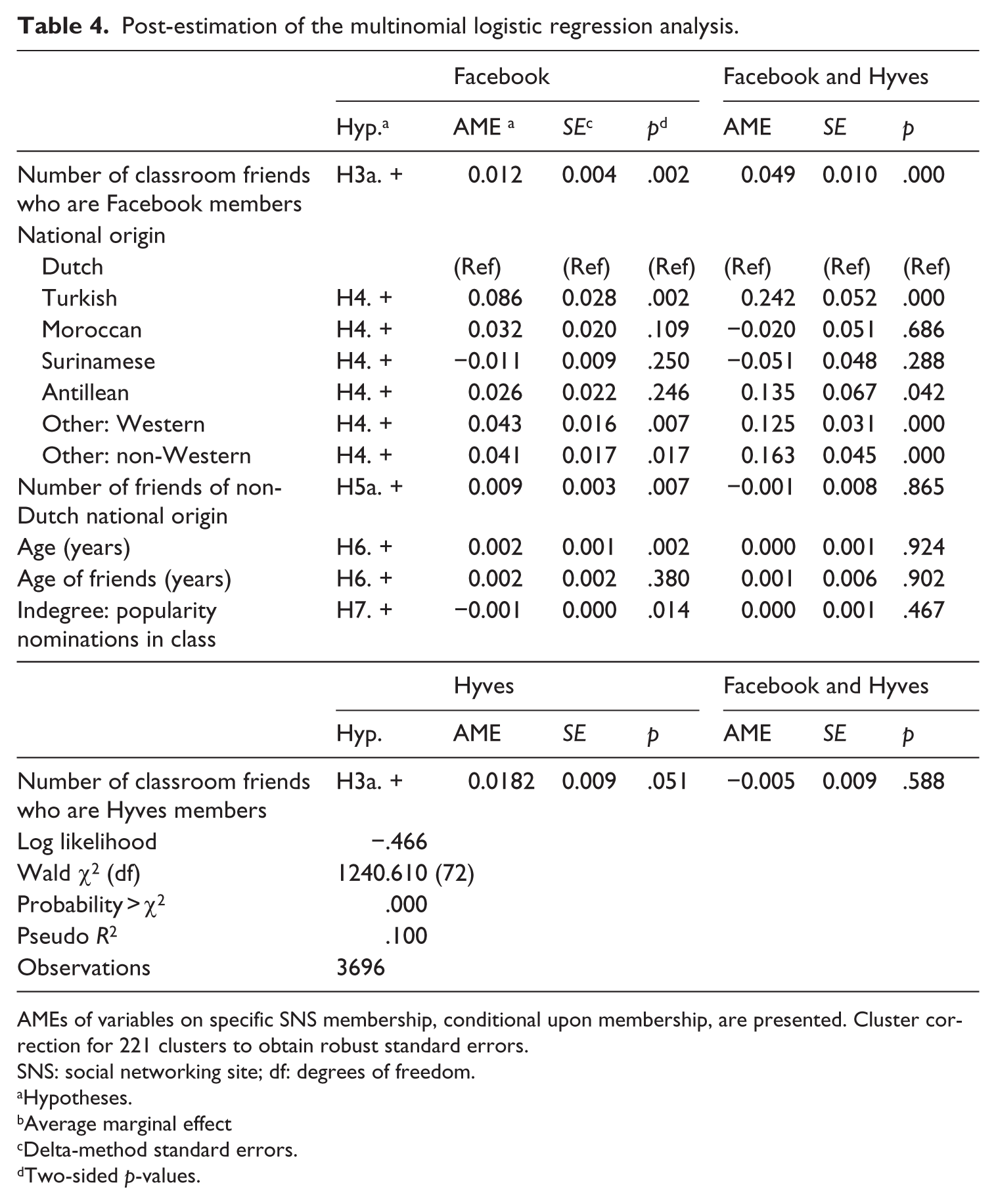
AMEs of variables on specific SNS membership, conditional upon membership, are presented. Cluster correction for 221 clusters to obtain robust standard errors.
SNS: social networking site; df: degrees of freedom.
Hypotheses.
Average marginal effect
Delta-method standard errors.
Two-sided p-values.
We find evidence to support H3a; the probability of being an early adopter of Facebook increases with the number of classroom friends who are early adopters of Facebook (given that one is an SNS member). When one moves from zero to five friends on Facebook, the average probability of being an early Facebook adopter increases by .06, given that one is a member of any SNS. Furthermore, when one moves from zero to five friends who are on Facebook, the average probability that one is an early member of Facebook and a member of Hyves increases by .25. Finally, when one moves from zero to five friends who are Facebook members, the average probability that one is an early Facebook adopter (only Facebook plus Facebook and Hyves) increases by .29 (p < .001, not reported in Table 4), given that one is an SNS member. In addition, when one moves from zero to five friends who are Hyves members, the average probability that one is a Hyves member only increases by .09. In contrast, we do not find that classroom friends who are Hyves members are related to membership of both Facebook and Hyves (p > .05). However, when we combine the categories (Hyves only plus Facebook and Hyves), the average probability that one is member of Hyves is .15 when one has five friends in class who are Hyves member (p < .001, not reported in Table 4).
The results also show that among SNS members, native Dutch have a lower average probability of being early adopters of only Facebook than are adolescents with Turkish (.09), Moroccan (.03, p < .1), other Western, (.04), and other non-Western backgrounds (.04). In addition, native Dutch have a lower average probability of being a member of both Facebook and Hyves than are adolescents with Turkish (.24) and Antillean backgrounds (.14), other Western national origins (.13), and other non-Western national origins (.16). Finally, when we combine the categories of Facebook members and members of both Hyves and Facebook, native Dutch adolescents are less likely to be members of Hyves than are adolescents with Turkish (.29) and Antillean (.16) backgrounds, other Western national origins (.16), and other non-Western national origin groups (.19). Because in all three cases we see that at least four out of six national-origin groups are more likely to be early Facebook adopters, we conclude that there is considerable evidence to support H4: Adolescents of non-Dutch origin were more likely to be early Facebook adopters.
Furthermore, we find very moderate evidence for H5: for every additional friend of non-Dutch national origin, the average probability of being an early Facebook adopter only increases by .01, whereas no significant relations were found for the other categories (p > .05).
Adolescents’ age seems to be related to early adoption of Facebook only: an increase of 24 months in age increases the average probability of being a member of Facebook only by .05, which is a relatively small effect, given that one is a member of any SNS. Age is not correlated with membership of Facebook and Hyves, nor is it related to the categories Facebook and Facebook and Hyves combined (p > .05). Friends’ ages are not related to Facebook membership for any of the three possible outcomes (p > .05). These findings only indicate very moderate support for Hypothesis 6a and 6b: age is positively related to early adoption of Facebook-only membership and best friend’s age does not affect Facebook membership. Finally, we do not find convincing support that adolescents who are more popular are more likely to be Facebook members. On the contrary, we find a very small but significant relation that indicates that popularity negatively affects Facebook membership: when moving from the minimum popularity score to the maximum popularity score, the average probability of membership of Facebook decreases by .10. However, the fraction of classroom students who nominate the respondent as popular is neither related to Facebook and Hyves membership nor Facebook membership in total (p > .05).
Discussion and conclusions
In 2014, Facebook is by far the most popular SNS in the Netherlands; more than 95% of adolescents aged 14–15 years are members. The process of Facebook’s transition from being a new SNS in the Netherlands to achieving its current monopolistic status occurred over just a few years, commencing somewhere between 2007 and 2011. Hyves, which was at that time the most popular SNS in the Netherlands, suffered from Facebook’s increasing popularity and was eventually terminated in December 2013. The aim of this study is to obtain more insight into Facebook’s relatively early adopters during this unique historical period in the Netherlands, studying SNS membership of a nationally representative sample of adolescents in 2010–2011. At that time, approximately 30% of adolescents were on Facebook, whereas more than 90% were on Hyves.
In our study of the characteristics of these relatively early adopters of Facebook, we find that some conditions generally promote SNS membership. Given the abundance of studies on the (positive) consequences of membership and usage of SNSs such as Facebook, it seems imperative from a methodological perspective and the issue of sample selection bias to know which social categories were the focus of those studies. How selective were the groups of users studied in those time contexts? Adolescents who are more socially active and do many things in their free time are more likely to be SNS members. We find that exposure to digital resources, such as having a computer or smartphone, is associated with SNS membership. Finally, adolescents are more likely to be SNS members when their classroom friends are also members, presumably due to peer influence processes (Brechwald and Prinstein, 2011). Thus, in 2010–2011, we investigated the selectivity of the group of SNS members.
We identified a second set of conditions that specifically promoted the early adoption of Facebook. For one group of adolescents—namely, those of non-Dutch origin—Facebook had an important advantage over Hyves: Facebook is international, whereas Hyves is Dutch. This advantage is important because many adolescents in Europe who are of immigrant origin have transnational ties (Schimmer and Van Tubergen, 2014). For adolescents of a non-Dutch background, communication with friends and relatives in the country of origin (of their parents) might have made Facebook attractive. This might be the reason that adolescents of non-Dutch national origin adopted Facebook earlier than did native Dutch adolescents.
At the same time, our study shows that social diffusion plays an important role: when classroom friends join Facebook, the likelihood of using Facebook increases sharply. Thus, when classroom friends belonged to the first 10% of Facebook users in the Netherlands, they might have affected their friends, and so forth, which possibly led to a cascade of Facebook joiners. We show that these social diffusion processes played an important role in early Facebook adoption, in line with what Hargittai (2008) and Hargittai and Litt (2011) suggested.
Differences in adoption of new SNSs among social groups can be a source of inequality. Non-natives might experience less of the positive effects of SNS membership on well-being and social capital (Ellison et al., 2007; Steinfield et al., 2008) because they are less often members of SNSs.
We framed our hypothesis on the influence of the social environment as peer influence, but to convincingly sustain causal inferences on peer influence, dynamic social network data are needed to separate influence from selection effects (Steglich et al., 2010). In our context, selection entails that individuals select their friends based on their SNS memberships, which generates a correlation between friends’ memberships that may resemble influence. Altogether, to convincingly sustain causal claims, future research should use longitudinal data to study which individual characteristics determine SNS membership.
We could not study the dynamics of joining and leaving an SNS, nor study how active people are on an SNS. Follow-up research is encouraged to address these questions about dynamics. Although Facebook remains the dominant SNS in the Netherlands, its popularity might be diminishing (see Figure 1), and new SNSs may take over in coming years. A question for future research would be to study early leavers of Facebook: Exactly when and why do adolescents substitute Facebook for different platforms?
Footnotes
Acknowledgements
We thank Jeroen Weesie from the Utrecht University Department of Sociology/ICS for advice on methodological issues. We would like to thank participants in the Migration and Social Stratification seminar at the ICS for feedback on a preliminary version of this article. Discussions at the “Dag van de Sociologie 2014” in Antwerp and in the online social networks session of the “1st European Conference on Social Networks” in Barcelona helped to improve this research. Finally, we are grateful to two anonymous reviewers for their feedback on an earlier draft of this article.
Funding
This research benefited from the support of the NORFACE research program on Migration in Europe—Social, Economic, Cultural and Policy Dynamics and from the support of the Dutch Scientific Organization (NWO) research talent grant titled “Ethnic segregation of on-line social networks and its relationship to off-line networks and prejudice” (grant number 406-12-004).