



Abstract
Cyberbullying has become a critical social issue, which severely threatens children and adolescents’ physical and psychological health. The current research systematically examined the predictors of cyberbullying from the social cognitive and media effects approach. Specifically, this study identified 16 predictors of cyberbullying perpetration and victimization and examined the magnitude of the effects of these predictors by meta-analyzing 81 empirical studies, which represented a total sample of 99,741 participants and yielded 259 independent correlations. The results revealed that risky information and communications technology (ICT) use, moral disengagement, depression, social norms, and traditional bullying perpetration were the main predictors of cyberbullying perpetration, while risky ICT use and traditional bullying victimization were the major contributors of cyberbullying victimization. According to the moderator analyses, country of the sample, sampling method, age, and media platform were significant moderators of the relationships between some specific predictors and cyberbullying perpetration and victimization. Implications for future cyberbullying research were discussed.
Keywords
With the rise of information and communication technologies (ICT), individuals, especially children and adolescents, are able to access a large amount of information and interact with others. This brings many benefits to their social and emotional development (Kowalski et al., 2008). However, these communication technologies have also exposed children and adolescents to cyberbullying, which threatens their psychological and physical health (Kowalski et al., 2008).
Cyberbullying refers to “an aggressive, intentional act carried out by a group or individual, using electronic forms of contact, repeatedly and over time against a victim who cannot easily defend him or herself” (Smith et al., 2008: 376). In recent years, with the proliferation of social media, cyberbullying has become one of the most common social issues worldwide (Görzig and Frumkin, 2013). In the United States, approximately 30% of middle school students reported having experienced cyberbullying (Patchin and Hinduja, 2010). The National Children’s Home of United Kingdom (NCH, 2005) has found that 20% of the children aged between 7 and 11 years in the United Kingdom have been cyberbullied. Besides, Lwin et al. (2012) examined online harassment among 537 teenagers in Singapore and found that 51% of the respondents claimed to have been cyberbullied.
Furthermore, the large number of cyberbullying incidents, coupled with the high severity of the incidents, has threatened the mental and physical health of children and adolescents, with victims experiencing harmful consequences such as psychosomatic symptoms (Kowalski et al., 2008; Patchin and Hinduja, 2006), anti-social behaviors (Low and Espelage, 2013), and suicidal behaviors (Hinduja and Patchin, 2010).
In order to curb cyberbullying, many researchers have started to investigate this issue. Numerous descriptive studies exploring the prevalence of cyberbullying have been conducted earlier (Dehue et al., 2008; Slonje and Smith, 2008). Tokunaga (2010) conducted a meta-synthesis to list different definitions of cyberbullying and to examine the prevalence of cyberbullying and the relationships between demographic factors and cyberbullying. In more recent years, researchers have conducted numerous studies to examine the predictors of cyberbullying from different perspectives, including media exposure (Akbulut et al., 2010; Erdur-Baker, 2010), personal factors (Grabe and Holfeld, 2012; Patchin and Hinduja, 2010), and environmental factors (Festl and Quandt, 2013; Xiao and Wong, 2013). Furthermore, Kowalski et al. (2014) conducted a meta-analysis to explore predictors and outcomes of cyberbullying among adolescents based on empirical studies from 2002 to early 2013. Although comprehensive, this meta-analysis had a number of limitations. First, their study focused only on adolescents, without taking into consideration other vulnerable groups such as children and emerging adults. Next, although they analyzed studies in North America and Europe, they did not include studies from Asia. It is important to include Asian samples into the meta-analysis as recent reports have shown that the highest incidences of cyberbullying are occurring in countries such as China and India (Microsoft, 2012). Finally, due to the fact that the general aggression model was used as a theoretical framework in their meta-analysis, they highlighted certain predictors but overlooked several other important factors, such as social norms and popularity. Many studies have used the social dominance theory and the theory of planned behavior to explain the phenomenon of cyberbullying (Espelage et al., 2013; Heirman and Walrave, 2008; Lazuras et al., 2013). As popularity and social norms are key factors in these theories, they should be important in exploring cyberbullying. These research gaps, coupled with the fact that many new empirical studies on cyberbullying have sprung up over the last 2 years, gave us the impetus to examine cyberbullying with a different theoretical perspective.
In order to clarify the research gaps in the domain of cyberbullying and to offer directions for future cyberbullying research, the current research applies the social cognitive and media effects approach to systematically meta-analyze the entire range of empirical studies across all age groups and countries from 2004 to 2015. Specifically, this study seeks to analyze 16 predictors of cyberbullying and to examine the magnitude of the effects of these predictors across 81 empirical studies. Besides, we select and analyze four potential moderators: country, sampling method, age, and media platform to explain the variance in the magnitude of the effects of these predictors across different studies.
Theoretical framework
Social cognitive theory suggests human functioning as an interaction of personal, behavioral, and environmental influences and posits that both personal factors and environmental factors can affect human behavior (Bandura, 1986). The theory has been widely applied in traditional bullying (TB) (Hymel et al., 2005; Mouttapa et al., 2004) to understand the complexity and social nature of TB. Like TB, cyberbullying is heralded as individuals’ social behavior, which can also be explained by personal and environmental factors (Xiao and Wong, 2013). In addition, the media effects model suggests that media can affect audiences’ thoughts and behaviors, especially aggressive behaviors (Ball-Rokeach and DeFleur, 1976; Felson, 1996). Many studies have indicated that how individuals use media could affect their involvement in cyberbullying (Festl et al., 2013; Mark and Ratliffe, 2011). Based on these considerations, this study integrates the social cognitive theory and media effects model as a theoretical framework to identify three main categories of factors in order to explain cyberbullying: media exposure, personal factors, and environmental factors.
Media exposure
Based on the media effects model, media have an influence on individuals’ behaviors (Valkenburg and Peter, 2013). In the context of cyberbullying, many studies have found that individuals who spend more time using ICT are more likely to be involved in cyberbullying (Akbulut et al., 2010; Bauman, 2009; Zhou et al., 2013). This is consistent with the online disinhibition effect (Suler, 2004). The absence of rich emotive cues and immediate feedback in online interactions create a disinhibition effect, which diminishes self-censorship. In the online environment, individuals generally feel less restrained and are likely to express their thoughts more freely (Ho and McLeod, 2008; Suler, 2004). This encourages aggressive behavior toward others (Espelage et al., 2013).
Additionally, risky ICT use has been considered as an important factor of cyberbullying victimization. Many studies have indicated that engagement in risky Internet activities, such as sharing personal information or photos online (Kwan and Skoric, 2013; Mesch, 2009) and adding strangers as online friends (Görzig and Ólafsson, 2013; Kwan and Skoric, 2013), accounts for a higher likelihood of becoming victims of cyberbullying. Therefore, frequency of ICT use and risky ICT use are positively associated with both cyberbullying perpetration and victimization.
Personal factors
According to the social cognitive theory (Bandura, 1986), personal and environmental factors are the main determinants of individuals’ behaviors. Personal factors could include personality traits, belief, skill level, available effort, and experiences (Gifford and Nilsson, 2014; Gist and Mitchell, 1992). In the context of cyberbullying, 10 and 8 personal factors have been identified to predict cyberbullying perpetration and victimization, respectively.
Specifically, extant empirical studies on cyberbullying have documented that moral disengagement (Bussey et al., 2015; Perren and Sticca, 2011), narcissism (Braithwaite et al., 2009), depression (Kowalski et al., 2008), and self-efficacy (Bussey et al., 2015;) are positively associated with cyberbullying perpetration. On the other hand, self-esteem (Pyżalski, 2012; Yang et al., 2006), emotional management (Kellerman et al., 2013), popularity (Buelga et al., 2015), and school commitment (Hemphill et al., 2014) are negatively associated with cyberbullying perpetration.
Additionally, research examining cyberbullying victimization has demonstrated that moral disengagement (Almeida et al., 2012) and depression (Didden et al., 2009; Low and Espelage, 2013) are positive predictors of cyberbullying victimization. Conversely, self-esteem (Brewer and Kerslake, 2015; Yang et al., 2006), emotional management (Hemphill et al., 2014), and self-efficacy in defending (Chang et al., 2015a; Depaolis and Williford, 2015) are negatively associated with cyberbullying victimization.
In addition, TB perpetration and victimization have been considered as crucial personal factors, which are positively associated with both cyberbullying perpetration and victimization (Hemphill et al., 2012; Sticca et al., 2013; Ybarra and Mitchell, 2004). Therefore, this study explores the degree to which these personal factors are associated with cyberbullying perpetration and victimization.
Environmental factors
According to the social cognitive theory, besides personal factors, environmental factors are another category of determinants of individuals’ behaviors, which could promote or inhibit violent behaviors (Bandura, 1986). Environmental factors refer to the roles played by parents, peers, and other persons who are important to an individual (Bruning, 1999). The values, attitudes, and feedback provided by these referent groups could drive individuals’ behaviors (Ho et al., 2014). In terms of cyberbullying, extant studies have revealed that general parental interaction (Cappadocia et al., 2013) and parental mediation of child’s ICT use (Roberto et al., 2014; Shapka and Law, 2013) are negatively associated with both cyberbullying perpetration and victimization. Besides, some studies have found that social norms, including subjective, descriptive, and injunctive norms, are also positively related to cyberbullying perpetration (Bastiaensens et al., 2015; Heirman and Walrave, 2008). Therefore, this study examines the extent to which these environmental factors are associated with cyberbullying perpetration and victimization.
Research questions
According to the literature review in the preceding section, the following research questions are proposed:
RQ1. To what degree are the following 14 factors—(a) frequency of ICT use, (b) risky ICT use, (c) moral disengagement, (d) narcissism, (e) depression, (f) self-efficacy, (g) self-esteem, (h) emotional management, (i) school commitment, (j) TB perpetration, (k) TB victimization, (l) social norms, (m) parental interaction, and (n) parental mediation—associated with cyberbullying perpetration?
RQ2. To what degree are the following 11 factors—(a) frequency of ICT use, (b) risky ICT use, (c) self-esteem, (d) moral disengagement, (e) depression, (f) self-efficacy in defending, (g) emotional management, (h) TB perpetration, (i) TB victimization, (j) parental interaction, and (k) parental mediation—associated with cyberbullying victimization?
Method
Literature search
To identify relevant studies, the first step was to locate studies using the following key words: cyberbullying, cyberbullying perpetration, cyberbullying victimization, cybervictimization, cyberbully, cybervictim, online bullying, online victimization, Internet bullying, Internet victimization, online harassment, Internet harassment, online aggression, and Internet aggression. The following databases were searched: PsycINFO, MEDLINE, Communication & Mass Media Complete, EBSCO, Educational Resources Information Center (ERIC), Web of Science Direct, PubMed, and Nursing & Allied Health Source. To be thorough, this study reviewed the reference lists of the collected publications for additional studies. We also reviewed non-peer-reviewed papers, such as book chapters and conference papers, to reduce the potential influence of publication bias (Sohn, 1996).
Filter process
Studies were included in this meta-analysis based on the following inclusion and exclusion criteria:
The article should focus on predictors of cyberbullying which is defined as an aggressive, intentional act carried out using electronic forms of contact (Smith et al., 2008). As a result, studies focusing on online harassment or aggression were also included in this meta-analysis.
The quantitative information for meta-analytical purposes that could be computed or converted into effect size estimates must be available in the selected studies. Essential data include sample sizes, test statistics, means, correlations, and odds ratios.
If one study used two or more data sets, it was considered as two or more studies.
The original search process identified 1037 related studies. After going through the abstracts of all 1037 articles, only 139 examined predictors of cyberbullying. Furthermore, 80 of the 139 studies provided the quantitative information for calculation of effect sizes, but one of these studies used two data sets. Therefore, after the filtering process, the final sample for this meta-analysis was 81 studies, which represented a total sample of 99,741 participants and yielded 259 independent correlations.
Coding procedures
Prior to coding, two coders were trained based on the specific coding criteria. Following this, they were asked to practice coding. Any discrepancies were resolved, and the decision rules were established to avoid ambiguities. Following this, the two coders individually coded all 81 studies. Specific study characteristics, predictors, moderators, and statistical indexes in each study were coded. The inter-rater agreement (Cohen’s κ) ranged from .80 to 1.00, with the average κ = .83.
Calculation of effect sizes
To compute effect sizes, we took the statistics of comparable formats as reported in each study. The data formats mainly included correlations, odds ratios, and means with standard deviations. We entered all the data to the Comprehensive Meta-Analysis (CMA) software program and then converted the data into one uniform form of Pearson product-moment correlation (Pearson’s r). According to Cohen’s guidelines of effect size for social science (Cohen, 1988, 1992), small effect size is indicated by Pearson’s r of .10−.23; medium effect size is indicated by Pearson’s r of .24−.36; and large effect size is indicated by Pearson’s r of .37 or higher. The total effect sizes of each predictor and dependent variables (cyberbullying perpetration or victimization) were averaged Pearson’s r across studies, weighting each observed correlation according to the study’s sample size and standard error (Hedges and Olkinm, 1985).
With respect to the homogeneity test, the Q statistic was used in this meta-analysis. According to the guideline presented by Hedges and Vevea (2007), we used the random effects model because most Q statistics were significant.
Results
Description of the studies
First, we provide a summary description of all the 81 studies included in this meta-analysis. Among the 81 studies, 9 (11.11%) were published from 2004 to 2009, while the remaining 72 studies (88.89%) were published between 2010 and 2015. This revealed that there was a noticeable increase in cyberbullying research since the term “cyberbullying” was coined by Belsey in 2004. Of the 81 studies, 67 (82.72%) examined the predictors of cyberbullying perpetration, while 56 (69.14%) explored the predictors of cyberbullying victimization. Most studies employed samples from North America and Europe: 34 studies (41.98%) used samples from North America (the United States and Canada); 31 studies (38.27%) were from European countries, such as the United Kingdom, Belgium, Greece, and the Netherlands; and the remaining 16 studies (19.75%) were from the Asia-Pacific region, such as Australia, China, and Singapore. Most studies used samples of adolescents (85.19%). Only nine studies (11.11%) examined cyberbullying among adults and three (3.70%) studies focused on children. Finally, 47 (58.02%) studies used non-random samples, whereas 34 (41.98%) studies applied the random sampling method.
Weighted correlations
Cyberbullying perpetration
Weighted correlations between predictors and cyberbullying perpetration are presented in Table 1. For media exposure, the predictive power of risky ICT use (r = .29, p < .05) was stronger than frequency of ICT use (r = .20, p < .05) when predicting cyberbullying perpetration. According to Cohen’s guidelines of effect size (Cohen, 1988, 1992), the association between frequency of ICT use and cyberbullying perpetration was small, while the association between risky ICT use and cyberbullying perpetration was medium. Both predictors’ weighted effect sizes were significantly distinguished from zero because their 95% confidence intervals did not cross zero.
Meta-analysis of predictors of cyberbullying perpetration.

CI: confidence interval; ICT: information and communications technology; TB: traditional bullying; k: number of studies; N: total sample size for all studies combined; effect size: Pearson’s r; 95% CI: lower and upper limits of 95% CI for effect size.
Effect size calculations were based on the random effects model.
p < .001.
With regard to personal factors, the strongest positive predictor was TB perpetration (r = .39, p < .05). The effect size was large. Moral disengagement (r = .28, p < .05), depression (r = .25, p < .05), narcissism (r = .23, p < .05), and self-efficacy (r = .21, p < .05) were also positively associated with cyberbullying perpetration, but their effect sizes were medium or small and weaker than those of TB perpetration. The weakest effect size was noted for TB victimization (r = .19, p < .05). On the other hand, self-esteem (r = −.13, p < .05), school commitment (r = −.10, p < .05), and emotional management (r = −.09, p < .05) had weak negative associations with cyberbullying perpetration. All the above effect sizes were significantly different from zero. However, the results showed that popularity was not a significant predictor because its 95% confidence intervals crossed zero.
In terms of environmental factors, social norms were positively associated with cyberbullying (r = .27, p < .05). The effect size was at a medium level. Besides, parental interaction (r = −.17, p < .05) and parental mediation (r = −.07, p < .05) were weak negative predictors. These effect sizes were significantly different from zero.
Cyberbullying victimization
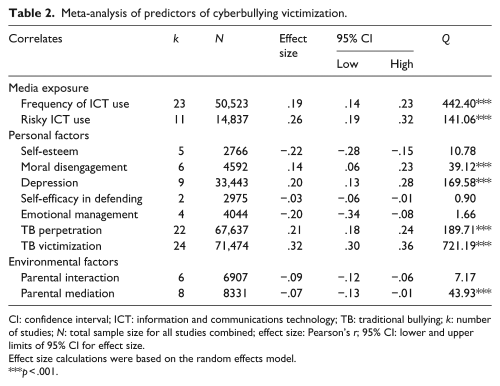
Weighted correlations between predictors and cyberbullying victimization are shown in Table 2. For media exposure, risky ICT use (r = .26, p < .05) had a larger effect size than frequency of ICT use (r = .19, p < .05) with respect to being cybervictims. Based on Cohen’s guidelines (Cohen, 1988, 1992), the former’s effect size was medium, but the latter’s effect size was small. Both effect sizes were significantly different from zero. Among personal factors, TB victimization (r = .32, p < .05) had moderate positive correlations with cyberbullying victimization. TB perpetration (r = .21, p < .05), depression (r = .20, p < .05), and moral disengagement (r = .14, p < .05) were also positive predictors, but their effect sizes were small. Conversely, self-esteem (r = −.22, p < .05), emotional management (r = −.20, p < .05), and self-efficacy in defending (r = −.03, p < .05) had weak negative effects on cyberbullying victimization. All these effect sizes were significantly different from zero.
Meta-analysis of predictors of cyberbullying victimization.
CI: confidence interval; ICT: information and communications technology; TB: traditional bullying; k: number of studies; N: total sample size for all studies combined; effect size: Pearson’s r; 95% CI: lower and upper limits of 95% CI for effect size.
Effect size calculations were based on the random effects model.
p < .001.
In terms of environmental factors, both parental interaction (r = −.09, p < .05) and parental mediation (r = −.07, p < .05) were negatively associated with cyberbullying victimization. Their effect sizes were small, but significantly different from zero.
Moderator analyses
Based on the recommendations of many scholars (e.g. Cook et al., 2010; Rosenthal, 1991), we conducted moderator analyses for factors with heterogeneous effect sizes across studies because a significant Q statistic indicates significant heterogeneity of effect sizes across different studies. Specifically, we employed country of the sample, sampling method, and age as potential moderators of all the factors with heterogeneous effect sizes across studies and cyberbullying. In addition, media platform was used as a potential moderator of media exposure factors and cyberbullying. The selections were based on findings from previous studies as well as recommendations from scholars. Previous studies have indicated cross-cultural differences in cyberbullying, in which adolescents in Asia were more likely to be involved in cyberbullying than their counterparts in the West (Microsoft, 2012; Perren et al., 2010). Besides this, some scholars suggested that the varying prevalence rates of cyberbullying across previous studies might be due to the use of different sampling methods and the assessment of participants from different age groups (Bauman, 2013; Kowalski et al., 2012). Moreover, Brandtzæg et al. (2009) found that children’s experience of cyberbullying can differ when they use different media platforms. Therefore, based on these considerations, this study employed these four factors as potential moderators.
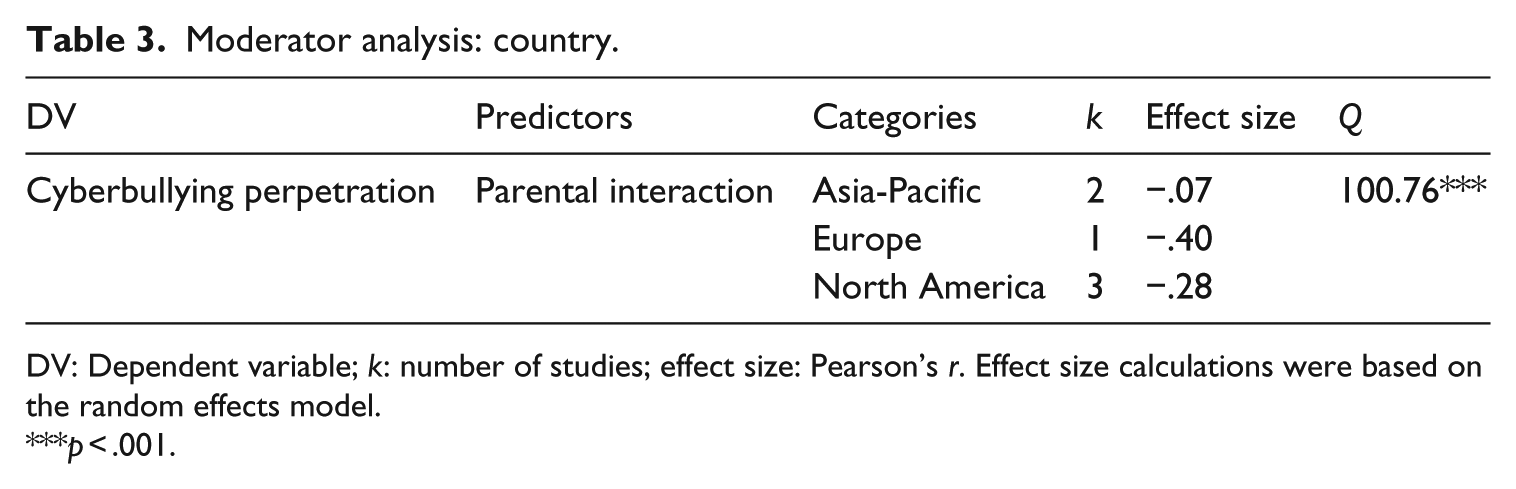
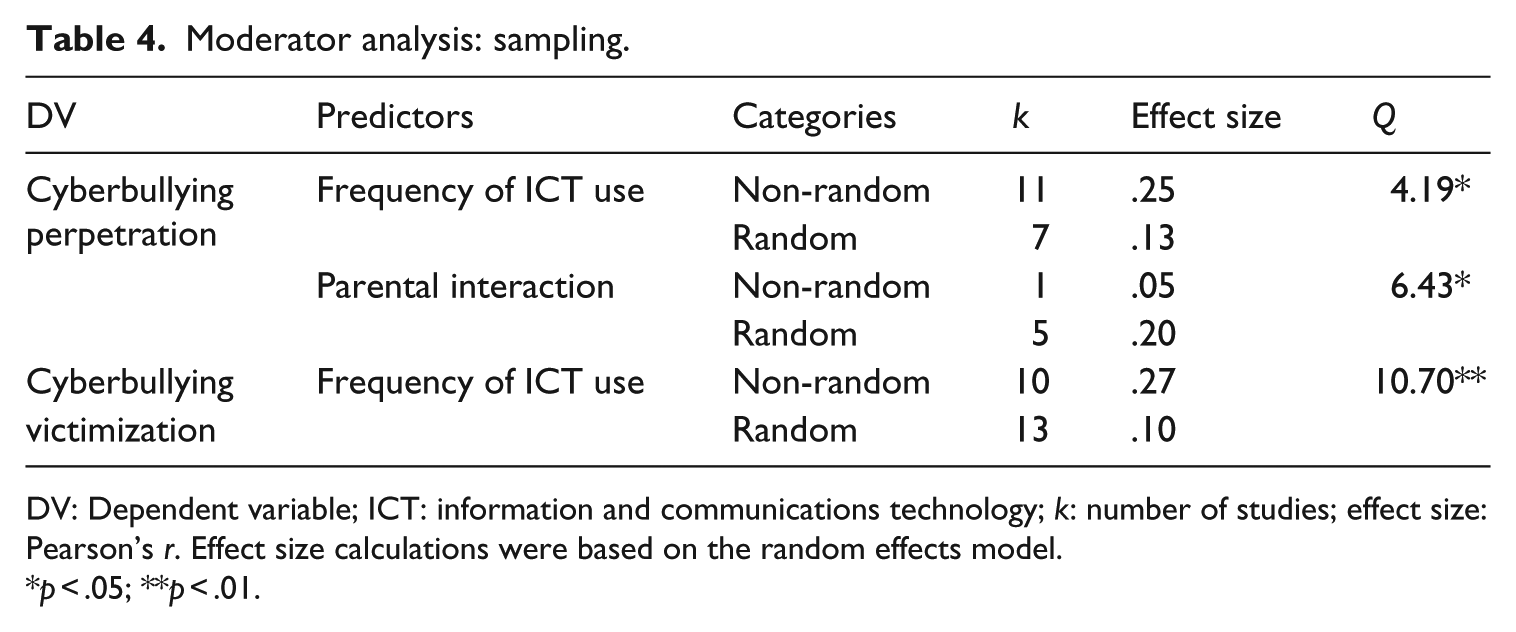
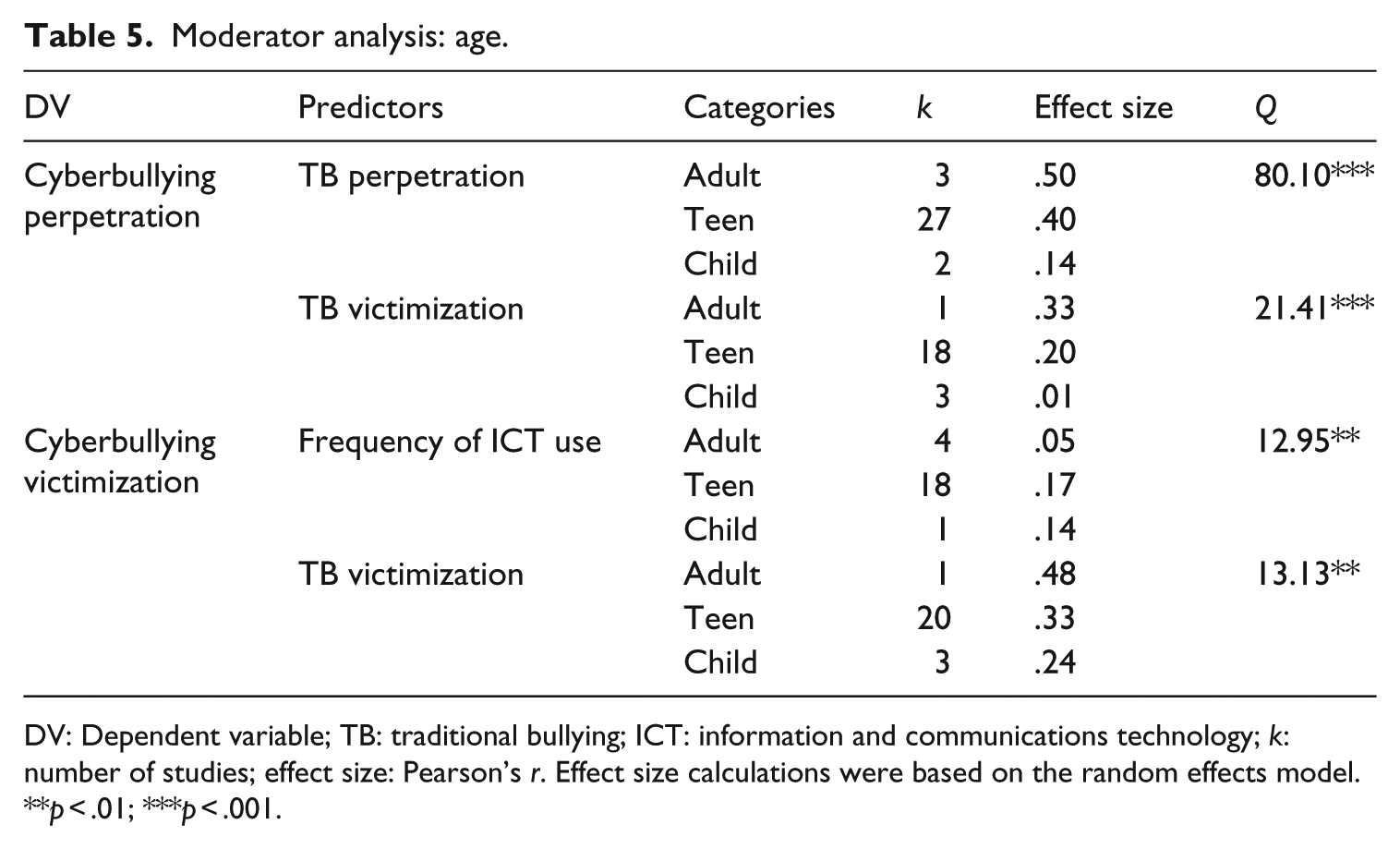
According to the moderator analyses, first, country of the sample significantly moderated the association of parental interaction (QB = 100.76, p < .05) with cyberbullying perpetration (see Table 3). Second, sampling method significantly moderated the associations of frequency of ICT use (QB = 4.19, p < .05) and parental interaction (QB = 6.43, p < .05) with cyberbullying perpetration. Moreover, it was a significant moderator of frequency of ICT use and cyberbullying victimization (QB = 10.70, p < .05) (see Table 4). Third, age was a significant moderator, which can explain the differences among effect sizes of TB perpetration (QB = 80.10, p < .05) and TB victimization (QB = 21.41, p < .05) when assessed for cyberbullying perpetration. Moreover, it significantly moderated the associations of frequency of ICT use (QB = 12.95, p < .05) and TB victimization (QB = 13.13, p < .05) with cyberbullying victimization (see Table 5). Finally, media platform significantly moderated the relationships between frequency of ICT use and cyberbullying perpetration (QB = 12.14, p < .05) and cyberbullying victimization (QB = 23.12, p < .05) (see Table 6).
Moderator analysis: country.
DV: Dependent variable; k: number of studies; effect size: Pearson’s r. Effect size calculations were based on the random effects model.
p < .001.
Moderator analysis: sampling.
DV: Dependent variable; ICT: information and communications technology; k: number of studies; effect size: Pearson’s r. Effect size calculations were based on the random effects model.
p < .05; **p < .01.
Moderator analysis: age.
DV: Dependent variable; TB: traditional bullying; ICT: information and communications technology; k: number of studies; effect size: Pearson’s r. Effect size calculations were based on the random effects model.
p < .01; ***p < .001.
Moderator analysis: media platform.
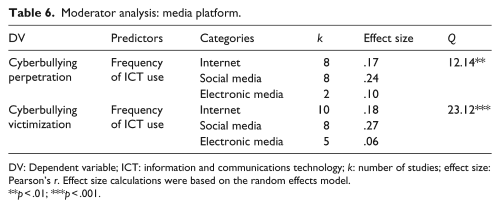
DV: Dependent variable; ICT: information and communications technology; k: number of studies; effect size: Pearson’s r. Effect size calculations were based on the random effects model.
p < .01; ***p < .001.
Discussion
This meta-analysis not only identifies the main predictors of cyberbullying perpetration and victimization but also examines the magnitude of the effects of these predictors. Primarily, the results revealed that all the proposed factors from the social cognitive and media effects approach, with the exception of popularity, significantly predicted cyberbullying perpetration or victimization. This indicates that integrating the social cognitive theory and media effects model provides a promising theoretical framework to explore the phenomenon of cyberbullying.
Furthermore, the results show that risky ICT use, moral disengagement, depression, social norms, and TB perpetration were more strongly related to cyberbullying perpetration than other predictors. Their aggregated effect sizes were large or medium based on Cohen’s guidelines of effect size (Cohen, 1988, 1992). According to our findings as well as empirical evidence from recent studies (e.g. Akbulut, 2014), it is worthwhile for educators to conduct workshops or seminars to guide students on how to use ICT safely in order to curb children and adolescents’ aggressive behavior online. Moreover, educators should also advocate moral engagement by developing children’s abilities to employ both substantive knowledge and moral reasoning when evaluating the events (Colby and Ehrlich, 2003) and mitigate the onset of depression in children by understanding children’s emotional situation, providing a relaxing environment, and encouraging their autonomy (Beyondblue, 2011). As social norms have a relatively strong effect on cyberbullying perpetration, correcting individuals’ misperception about the prevalence of cyberbullying among their peers could also be important. Besides, educators and parents should pay more attention to offenders of TB and increase their awareness of the negative outcomes of cyberbullying. Additionally, the results revealed that only small associations were established between frequency of ICT use, self-esteem, narcissism, self-efficacy, emotional management, school commitment, TB victimization, and cyberbullying perpetration. Moreover, popularity is not a significant predictor of cyberbullying perpetration. Despite this, we cannot simply conclude that these factors are not important. One reason for the weak or null relationships might be due to the fact that only a small number of studies have focused on these predictors. Thus, the effect sizes were calculated based on limited studies. Another reason might be due to the fact that some predictors have a long-term effect on cyberbullying, but cross-sectional studies are not able to capture it.
In addition, this study examined the relationships between 11 proposed predictors and cyberbullying victimization. Similar to cyberbullying perpetration, risky ICT use was a relatively strong predictor of cyberbullying victimization. Besides, TB victimization was another major contributor of cyberbullying victimization. These two predictors’ effect sizes were at medium level. Thus, educators and parents should pay more attention to TB victims to increase their awareness of cyber safety in order to protect them from cyberbullying victimization. Additionally, weak associations were found between frequency of ICT use, self-esteem, depression, moral disengagement, self-efficacy in defending, emotional management, parental interaction, parental mediation, TB perpetration, and cyberbullying victimization.
According to the results of the moderator analyses, country of the sample significantly moderated the negative relationship between parental interaction and cyberbullying perpetration. Moreover, the negative relationship was stronger in Western countries than in Asian countries. It is plausible that Western parents are more likely to employ autonomy-supportive style instead of punitive parenting style when interacting with their children than Asian parents (Kim and Wong, 2002). Children with supportive parental behaviors tend to be less aggressive (Finkenauer et al., 2005). Thus, children who interact frequently with their parents in Western countries are less likely to cyberbully others than children in Asian countries.
Second, sampling method significantly moderated the relationships between frequency of ICT use and cyberbullying perpetration and victimization. Moreover, it was a significant moderator of parental interaction and cyberbullying perpetration. Specifically, the associations between frequency of ICT use and cyberbullying perpetration and victimization were stronger in studies that used non-random samples compared to studies that used random samples. In addition, the relationship between parental interactions and cyberbullying perpetration was smaller in studies that used non-random samples than in studies that used random samples. One possibility for these differences might be due to the fact that most non-random samples were also respondents in niche environments (Paul et al., 2000). For example, one of the studies (Bauman, 2009) included in our meta-analysis examined the associations of frequency of ICT use and parental interaction with cyberbullying based on rural intermediate school students. In another study included in our meta-analysis, Festl et al. (2013) explored the influence of frequency of ICT use on cyberbullying by focusing on academic track school students. Compared with regular schools, rural intermediate schools and academic track schools might have less opportunities and resources to provide workshops or seminars regarding cyberbullying for their students. As such, students in these niche schools who use ICT frequently might be more likely to be involved in cyberbullying than regular school students. Besides, parents living in rural areas are relatively less educated and are less likely to use supportive parenting practices when interacting with their children (Scott et al., 2012). Since children who interact frequently with their parents exhibit lower levels of aggression (Clauss-Ehlers, 2010), parental interaction in rural areas might, therefore, be less effective than in urban areas in protecting children from cyberbullying. Based on these considerations, effect sizes varying across different studies may be due to the fact that non-random samples tend to be students in niche schools or environments.
Third, age significantly moderated the relationships between two TB factors and cyberbullying perpetration and the association between TB victimization and cyberbullying victimization. Moreover, the relationships were stronger when studies focused on the older people. One possible explanation is that young people tend to solve physical bullying by fighting, whereas older individuals were more likely to extend offline bullying to online (Perren et al., 2010). Besides, age significantly moderated the association of frequency of ICT use with cyberbullying victimization. Moreover, the association was stronger when studies examined younger people than adults. It is plausible that adults are better able to manage their online behaviors and protect themselves when using ICT compared to adolescents and children.
Finally, media platform significantly moderated the associations between frequency of ICT use and cyberbullying perpetration and victimization. It is not surprising that frequency of social media use has a stronger effect on cyberbullying perpetration and victimization than other media platforms. Indeed, many studies have documented that cyberbullying is most rampant on social media (Smith et al., 2008). One plausible explanation is that social media are extremely popular among children and adolescents, thus becoming an essential part of their social life. Moreover, social media integrate online discussion forum, chat room, blog, and e-mail, which allow users to send private messages, comment on others’ postings, post personal information, and upload photos. Thus, cyberbullying is more likely to manifest in social media than in other media (Kwan and Skoric, 2013).
Conclusion
The findings of this meta-analysis present some practical implications for educators and parents. For example, according to our findings, educators and parents could remind students to refrain from adding strangers as online friends and disclosing personal information online. Educators and parents should also encourage students to use ICT in appropriate ways in order to protect themselves from cyberbullying. In addition to media exposure, the results indicate that parent–child interactions and parental mediation have a negative association with cyberbullying. Thus, parents could increase the interactions with children, be more involved in their lives, and manage children’s ICT use to prevent cyberbullying.
Additionally, this meta-analysis provides guidelines for the direction of future cyberbullying research. Our moderator analysis shows that the frequency of social media use has a stronger effect on cyberbullying than other media platforms. Moreover, research has indicated that cyberbullying is most rampant on social media (Smith et al., 2008). However, only limited studies have examined the predictors of cyberbullying on social media (Kwan and Skoric, 2013). Future studies should focus on examining cyberbullying on social media. Next, while many children have become offenders and victims of cyberbullying, only a few studies examined predictors of cyberbullying perpetration or victimization in childhood. Our moderator analysis reveals that age could significantly moderate the relationships between many predictors and cyberbullying perpetration and victimization. Thus, future studies should explore cyberbullying among primary or elementary school students and compare cyberbullying across different age groups. Finally, most existing studies on cyberbullying were from North America and Europe, but limited studies used Asian samples. As pointed out, Asia has the highest level of cyberbullying (Microsoft, 2012). Our moderator analysis indicates that cultural difference exists in the associations between parental interaction and cyberbullying perpetration. Moreover, previous research has indicated that cyberbullying varies across different cultures (Li, 2007; Microsoft, 2012). Thus, it is necessary to investigate cyberbullying in Asia in future studies.
Footnotes
Funding
The author(s) disclosed receipt of the following financial support for the research, authorship, and/or publication of this article: This work was funded by the Singapore’s Ministry of Education Tier 1 Grant (Grant No.: M4011117).