



Abstract
The study examines how persons in a close relationship with a gamer of massively multiplayer online role-playing games (MMORPG) perceive relationship problems caused by the gaming hobby. Revisiting the concept of pure relationships by Anthony Giddens, we analysed eight deep interviews with persons who claim their relationship with the gamer had ended or turned downhill due to the volume of the gaming. The study formulates a conception of the clashes of interest in areas of (1) situational clashes in everyday choreography, (2) shifts in long view prioritizing, (3) deficient communication and (4) understandings of self and autonomy in relation to gaming and relationship. These conceptual paths serve to understand the problems from a sociological perspective. On a more general level, the study demonstrates the timeliness in devoting attention to the premises under which intimacy and commitment are negotiated in offline and online relationship constellations.
Introduction
The idea of people being detached from face-to-face interaction due to a great absorption in online whereabouts has had great penetration in popular and expert discourse. Scientists all over the world are trying to comprehend this phenomenon and its possible problematic aspects for individuals and societies. Immersion, flow and cognitive absorption are examples of concepts that have been employed for describing people’s captivation in online realms (Valtin et al., 2014: 51). In the fields of psychology and psychiatry, yardsticks such as diagnostic tools are developed for measuring and quantifying the severity of excessive online engagement (see, for example, Dhir, 2015; Petry and O’Brien, 2013). In comparison, the more interpretive sociological contributions on harms to human relationships seem modest.
In this study, we inquire into the strains on close relationships caused by the gaming of Massive Multiplayer Online Role-Playing Games (MMORPGs). The MMORPGs require participants to spend enormous amounts of time soaked up in digital worlds disconnected from offline activities and have therefore come to be considered the main culprit in addictive online gaming (Van Rooij et al., 2010). We analyse how close family members, spouses and friends conceptualize large-scale gaming as causing troubles in the relationship with the gamer. We will account for the main rationales underpinning the perceptions of the problems, and propose a grid for conceptualizing the gaming – or any consuming hobbies for that matter – as a space of negotiation in close relationships.
Social harm caused by excessive Internet engagement
For some time already, there has been a call for a switch from mere documentation to actual analysis of the kinds of relationships that the Internet does (and does not) foster in different constellations of offline/online whereabouts (Quandt and Kröger, 2014; Wellman, 2011). Among scholars of today, it is widely recognized that offline and online ‘beings in the world’ are integrated and that they affect each other and blend together (see Matzat, 2010). However, the MMORPG-gaming is an activity that still offers a rather strict separation between the two: you must either be alert in the game, ready to partake (in WoW a raid typically takes around 2–3 hours at a time), or you must refrain from partaking in the group tasks altogether. The typical MMORPG-gamer may spend around 20–25 hours a week on their hobby, and they often report deteriorating offline interpersonal interaction (Ng and Wiemer-Hastings, 2005).
Due to their time-consuming and hooking nature, the MMORPGs have on many occasions been suggested to be the most hooking, or ‘addictive’, Internet activity (Peters and Malesky, 2008). Even though there are hesitant voices raised to the description of a distinctly social and culturally encoded hobby as an ‘addiction’ (see, for example, Hellman et al., 2013; Majamäki and Hellman, 2015), it is largely on the basis of psychological research on MMORPG-gaming that the ‘internet gaming disorder’ was included in the fifth edition of the American Psychiatric Association’s Diagnostic and Statistical Manual of Mental Disorders 1 (see Kuss and Griffiths, 2014).
MMORPG-gamers are known to be avidly social individuals and their gaming is primarily reinforced by online social interaction (Bartle, 2014; Herodotou et al., 2014; Kowert and Oldmeadow, 2013 [2014]). Gamers develop a joint culture with adherent setups of communication codes cultivating trust and commitment to each other (Ratan et al., 2010; Welles et al., 2014). Therefore, any comparison of the division of MMORPG-gamers engagement between online and offline pastime is by the non-gamer in their closest environment likely to be a comparison made between competing social worlds.
What, then, do we know about how the immediate environment perceives the extent and nature of problems evoked by large-scale MMORPGs gaming? In a survey study with 349 couples, Ahlstrom et al. (2012) reported a clear negative association with the marital satisfaction of gamers and their non-gaming spouses: 70–75% of the couples reported that their marriages had been negatively affected by gaming. At the same time, in a study by Cole and Griffiths (2007), only 20% of a sample of international MMORPG players (of various backgrounds) reported that their gaming negatively affected relationships with non-gamers. When it comes to the types of problems reported, so-called ‘gamer widows’ have expressed experiences of isolation and other negative feelings; wives of large-scale gamers of MMORPGs have shown to perceive the gaming hobby as directly effecting the marital relationship in a negative way (Northrup, 2008; Northrup and Shumway, 2014). In an attempt to evaluate effects that online gaming may have on close interpersonal relationships, Hertlein and Hawkins (2012) reviewed 18 articles published between 1998 and 2010 covering online gaming and interpersonal relationships. By hermeneutically interpreting the studies, they conclude two possible reasons for negative effects: First, because MMORPGs are played in groups, emotions arise when the non-gaming partner perceives the gaming partner as giving the online partners a higher priority. Second, the connection that the gaming partner develops online with members of their guilds/teammates can forge jealousy because of the exclusion the non-gaming partner feels regarding the gaming partner’s world (Hertlein and Hawkins, 2012: 21).
What seems to be scarce in the literature on gamers’ spouses and family members are more meaning-based sociological interpretations of areas of interaction in which breakages of the social contracts of the offline relationships are perceived. A good example of a study that takes such an approach, although concerning family members of gamblers, is the one by Norwegian sociologist Anita Borch (2013). Borch sees the family members’ experience of problematic gambling as an experience relating to a semiotic process tied to the meaning-making of the gambling behaviour through different conceptions over time. By this approach, she is able to conceptualize how perceptions of gambling behaviour arise and change over time while the gambling activity proceeds and gets increasingly problematic.
What Borch is able to fit into her approach is a recognition of the complexity of the ways in which everyday habits are continuously negotiated in a reflexive interplay with norm apparatuses tied to moral emotions. In order to adjust behaviours of others, the human moral apparatus employs such impetuses as corrective emotions, including shame, guilt and embarrassment (see, for example, Tangney et al., 2007). The question of how a person’s behaviour affects the well-being of others is thus a difficult one, permeated with moral evaluations of how people should behave and feel about their own behaviour in view of how others perceive it.
According to Anthony Giddens’ (1991) pure relationship theory, modern relationships are cultivated through a continuous, interactive and reflexive input by the partners involved. They demand conscious participation and a capability to be sensitive to and take into account needs and tensions. By doing so, we participate actively in upholding the relationship. The relationship is reflexively organized so that partners continuously make judgements of emotional satisfaction, intimacy and commitment. Although the concept of pure relationships has been criticized at times (Jamieson, 1999; Ketokivi, 2010), it is worth revisiting for our purposes, as its main idea is the one of an ideal intimate relationship involving active partners who adjust their investment into the relationship in accordance with their knowledge and interpretations of the needs and wishes of the partner. We see that it is in the understandings of such a contract being broken that the negative consequences of the gaming are articulated by the non-gamers of this study.
A well-known phenomenon in addiction research is that of a family member’s addiction problems becoming an organizing principle of family life, impacting the behaviour and identity of the family as a whole (Hurcom et al., 2000). At the heart of definitions of addiction are characteristics such as ‘progressive neglect of alternative pleasures or interest’ and persisting with habit ‘despite evidence of harmful consequences’ (see West, 2006: 15). The symmetry and mutual alignment needed for the proper level of balanced commitment in a relationship will therefore inevitably be affected by addiction and dependency problems (Giddens, 1991: 93)
Exaggerated online engagement can, no doubt, challenge a person’s capacities to govern life content, and the time spent on online role gaming is often argued to be taken away from time spent with family members (Peters and Malesky, 2008; Visser et al., 2013). An often occurring underlying popular viewpoint is that the face-to-face interaction is more valuable than the gaming (see Cummings et al., 2002). Here, we will not take a stand on the value of online versus offline interaction, but we are merely looking for dimensions that mark borders in a liminal space between the perceived problematic and non-problematic from the perspective of a person in a close relationship with a gamer. In couples’ conceptualizations of their relationship problems, this liminal space has, for example, been shown to be negotiated through border constructs drawn between ‘my’ and ‘our’, self and self-in-relation (Froude and Tambling, 2014). As we rely solely on the narratives of our interviewees, we have only insight into their views on the right and the wrong surrounding such negotiations. Nonetheless, Duncombe and Marsden (1995) have shown that the use of the construct of a strived-for, voluntary and equal pure relationship can serve to tone down emotional binary positionings such as the one of ‘workaholics versus whingeing women’. We view the constructions presented by the interviewees as moving in a liminal space between understandings of the problematic and the non-problematic with the ideal pure relationship as a yardstick underpinning the claim of a movement towards the problematic. We aim at pinning down the conceptual paths within which the problems are viewed as moving from the non-problematic to the problematic.
Material and method
Research has shown that people close to MMORPG-gamers experience the gaming as disturbing when it alters the gamer’s personality, when its sabotages or makes a ‘normal’ shared life difficult (see Northrup, 2008). We set out to find out the rationales according to which people who had experienced negative consequences of excessive gaming in a close relationship with a gamer would conceptualize the gaming-evoked strains on the relationships. This is a timely and relevant question in Finland, where digital gaming (all sorts of games) is a popular hobby. Around 74% of the Finnish population game at least occasionally. Of these, male gamers represent a slightly larger share than female, but in recent years, the gender difference has decreased (Mäyrä and Ermi, 2014).
The material consists of eight thematic deep interviews gathered in Helsinki in the spring of 2014. The interviewees were recruited through the social media such as Facebook and some popular discussion forums (e.g. Frozen Dawn, Meidän perhe [‘Our family’], vauva.fi [online discussion threads]), but we also sent invitations through a project called Pelitaito (‘Gaming skills’) – a project (2010–2014) run by the preventive substance abuse work organization EHYT ry and funded by Finland’s Slot Machine Association. The criteria for the recruitment were that participants had lived with the gamer during times that he or she had gamed the most, and that the gaming was experienced both as a problem in itself and as a cause of stress on the relationship. In all, eight persons were recruited for deep interviews, which lasted between 50 minutes and up to 135 minutes each. The interviews were taped and transcribed, and a total of over 10 hours of interview material was collected. Although eight may seem like a small number of informants, the interviews were exhausting, resulting in over 200 pages Intelligent Verbatim.
Two of the interviewees were men, six were women. Five of the interviewees were spouses, one was a former spouse, one was a friend and one was a sibling. None of the gamers were described as being in a marginalized socioeconomic position; they were employed or in education and they were all described as taking care of themselves. The gamers came from different backgrounds, and it is not possible to sketch them in a uniform manner. The age range of the interviewees was 25–63 years, and they came from different parts of Finland. The interviewees’ background details are displayed in Table 1.
Interviewees’ background details.
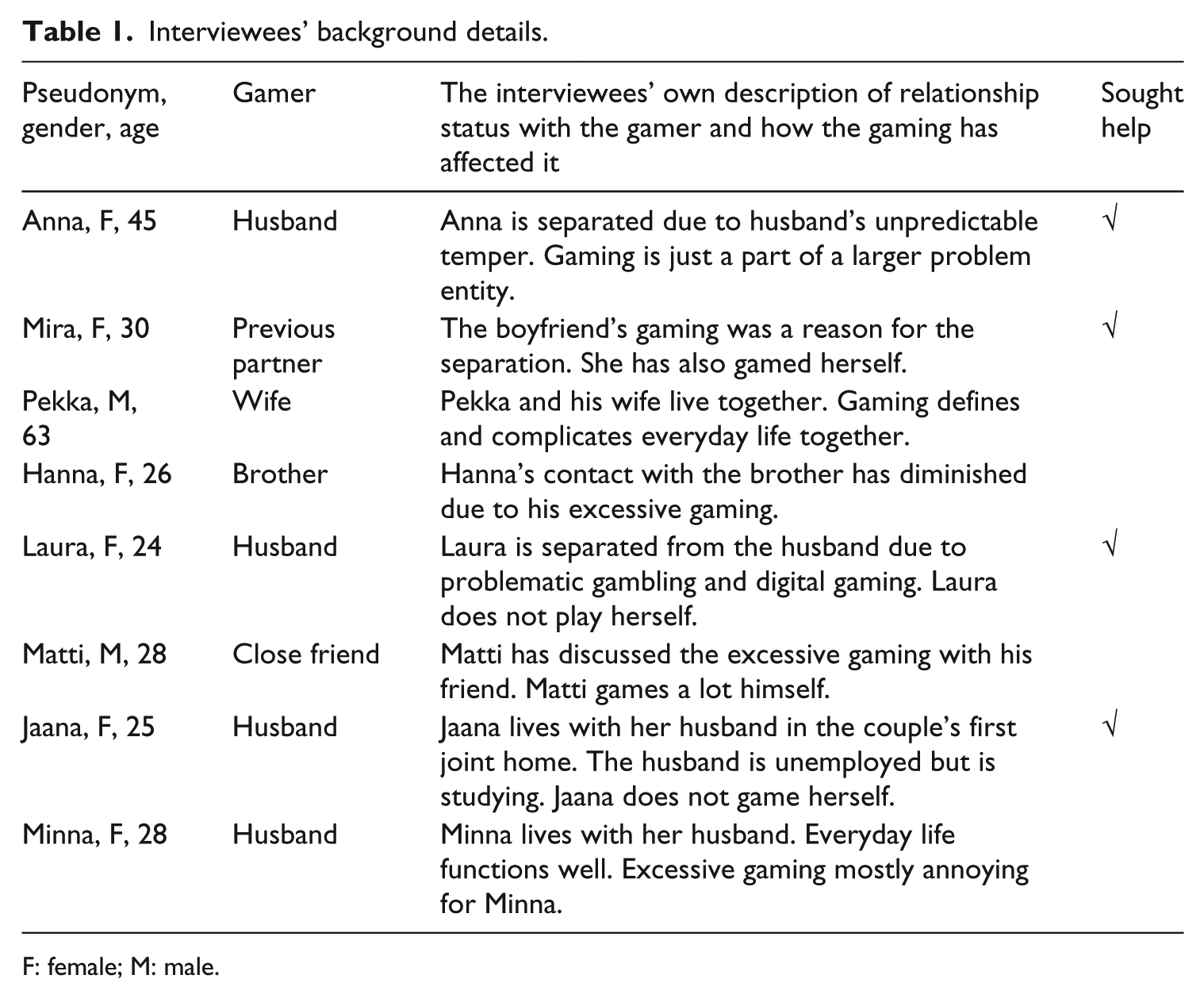
F: female; M: male.
We grouped the transcribed interview material in the qualitative coding software of ATLAS.ti, marking explanatory circumstances given by the interviewees for why ways of being, certain behaviours or situations were seen as harming the relationship. We then interpreted these sequences looking for the key aspects in explanations to the gaming-related (negative) changes in the relationship – in other words, why the interviewees felt that the gaming was problematic, how the problem concerned them and was experienced as a ‘real’ and ‘actual’ problem in their Everyday life (EDL). After we had marked all utterances regarding how the gaming was perceived as harming the relationship, these utterances were grouped according to categories of clashes, that is, the main conflicts of interest materialized from the interviews. We found four partly overlapping areas of conflicts, namely (1) situational clashes regarding prioritizing in EDL, (2) long view shifts in prioritizing pertaining to patterns of being and acting, (3) deficient communication and interaction in EDL and (4) views on the self and autonomy in relation to the gaming and the relationship. In the next section, we will account for these conceptual paths and try to summarize what the findings imply. We will use the concept of EDL for emphasizing the circumstance of the relationship between the interviewee and the gamer as an ongoing ‘being’ and ‘living’. Here, EDL connotes everyday practice that makes up continuous and partly repetitive and predictable action involving a reality building of entangled constructions of self, social relationships and society (see, for example, Newman, 2013; Ouellette and Wood, 1998). It is important to remember that the accounts are one-sided: Interviewees were, to some extent, encouraged to speak of negative aspects, so the material will inherently entail narratives of ‘what went wrong’ with the gamer inevitably taking the centre stage as a figure drifting into a wrong direction.
Results
Situational clashes
The first group of accounts covered conflicts of interest regarding prioritization in EDL action and situations. The interviewees portrayed concrete situations where the gamer had prioritized gaming over something else. Often, these were events that the interviewees connected to the first time that they had realized a certain abnormal extent of gaming engagement by the gamer. Below is a typical interview excerpt: Laura 24: - - We’d made food together and I’ve laid the table. He walks away, sits himself down at the computer, and I’m left there on my own at the table.
Laura’s husband could have chosen to eat dinner at the table, but instead, he chooses to eat in front of the computer. Constructs in this first category of clashes are thus one-dimensional in the sense that online and offline whereabouts are separated as ‘either or’ contexts, as conscious choices made by the gamer. The online is prioritized over the offline in a new order that has not been there before: Mira 30:/–/ It was around Christmas, I think, when I noticed that he was having a Christmas break from school. It’s quiet at work, but there’s like no time for me. I tried to suggest that we go see a film and stuff, but no, no can do, as he needs to do this drive, he’s fixed something already. This is where I started to think, like, wait a minute, this is not how it’s supposed to be …
Situations which are seen as especially disturbing are those when the gamer ends up in front of the computer screen even if he or she is expected to be involved in offline interaction, such as watching films with friends or meeting up with relatives.
Previous studies (e.g. Northrup and Shumway, 2014) confirm a clear discord between the time that gamers spend on gaming and the wished-for shared time by the non-gamer as typical situations of conflict. Gaming time budgets are put in relation to the kind of daily intercourse that produces added value and strengthens the relationship (see also Peters and Malesky, 2008; Visser et al., 2013). In our material, the discourse on concrete situational time use prioritization often involved an idea of voluntarism as the gamer is portrayed as an agent of his or her own action and chooses to act in a certain way. The prioritization of time use is construed in terms of a ‘workable’ and changeable circumstance, and the actor to work upon and adapt his or her behaviour is the gamer. In this path of reasoning, the gamers were thus provided high agency, the choice to prefer the gaming activity being a deliberate one.
Shifts in prioritizing
The interviewees provided not only examples of situational clashes in prioritizations. Their speech also involved a determinate component pertaining to the structure and patterns that will underpin the choices being made over time. These structures were conceptualized as more deep-seated long-view shifts in gamer’s prioritization. The greater changes in the gamer’s life path and being in the world caused by the large-scale gaming were articulated as some sort of displaced prioritization. These constructs suggest a certain prioritized content of EDL in relation to overarching norms, ethics and ideals of how to live. In these utterances, the interviewees expressed the view that the gamers had, over time, started to deviate from staked-out, expected or normative paths of life, or just from the goals and visions that they had set for themselves and their relationships in pre-gaming times.
This group of conceptualizations consists of varying descriptions of how repeated prioritizations of gaming before offline whereabouts would lead to what was perceived by the interviewees as a displaced value setup. If in the first category of constructs the gamer was described as prioritizing gaming over the relationship in single situational events, this second category of utterances concerned the ways in which these single choices had become patterns with consequences for both the gamer’s and the near one’s lives.
For example, the gaming could be described as having distanced the gamer from previous friends, hobbies; from work, colleagues and studies; from a life path that the interviewee thought the gamer would have liked or actively strived for in pre-gaming times: Mira 30:/–/ he was on the computer and never had the time to really get to know my friends./—/ This began to restrict my life too. All plans had to be made on the basis of what was happening in the game. There was very little left of my own social life. Somehow, when I would’ve wanted for us to visit my mum, it was always like, come on now, let’s go together.
Values of friendship and socialization codes like showing consideration are tied to greater circumstances than the mere prioritization of the gaming activity. The gamer’s personality, biology, upbringing and background are embedded into the explanations as parts of the ‘displaced being’. Anna, for example, suspects that part of the gaming problem has to do with her husband’s self-esteem: Anna, 45:/—/ because he lacks inner self-esteem, only external things can give him a feeling of self-worth. It’s really sad. Once, when he was feeling honest about it, he told me that he knew that he had no backbone. It crushes you to have a self-image like this.
The interviewees often present a narrative in which the stability of a ‘normal’ or ‘good’ goal-oriented life path is connected to gamer’s good and ‘healthy’ relationships with others, and the withdrawn and isolated existence is seen as problematic. The problems have escalated over time: Hanna 26:/—/ I feel that he’s a little different now than when he was younger/–/ The [gaming] problem has got worse, I think, things have piled up. He’s totally withdrawn these days. /–/ He’s like, he’d go mad just like that and could go into a terrible rage.
The strived-for overall life goals would in the interviewees’ utterances typically pertain to education, taking responsibility for raising a family or doing other things that are viewed as signifying mature, morally justified and good life choices. For example, the interview material contains two cases where the gamer has left education or employment due to the gaming.
The very hum of the computer and the tapping on the keyboard is described as causing anxiety among the interviewees, reminding them of the gamers’ prioritized online whereabouts and the disorder it is causing their relationship.
The accumulating troubles over time in relationships with MMORPG-gamers is recognized from previous studies describing shared routines as fading away, the parties of the relationship doing fewer things together and the gamers starting to neglect housework and social relations (e.g. Northrup and Shumway, 2014). In view of the rationales found in our material, according to which the interviewees account for breakage with gamers’ previous long-term intentions or speculate on the constitutional or circumstantial reasons for the changes to take place (like Anna’s husbands low self-esteem), we saw a need to clearly separate these constructs of long view shifts from the irritating situational clashes in EDL choreography of the first category.
Deficient communication
The third category of accounts of clashes is that concerning format and quality of interaction and communication between gamer and non-gamer but also between gamer and outside-game environments. The interviewees express a wished-for language and interaction mode that they would like to accomplish in order to enjoy life and friendship with the gamer. Over time, they see that the convention of communication and interaction has changed significantly. The gaming-related relationship problems are conceptualized in breakages with norms, expectations or habits pertaining to communication. This can be conceptualized in the communication theoretical terms of redundancy and entropy. Redundancy is communication with high level of expected elements, whereas entropy connotes unexpected non-conventional content.
The premise for a pure relationship is that partners live in the kind of interaction that cultivates open, mutual and equal disclosure. This can be viewed as the strived-for conventional and redundant content of the relationship’s communication, which is crucial for upholding the intimacy of the relationship (Giddens, 1991: 97). This is comparable to a therapeutic ethos, according to which relationships draw their strength from full and open communication (e.g. Bellah et al., 1985) and conflicts emerge when the exchange becomes more difficult, deteriorates or when the parties have little in common to talk about. One interviewee describes this in terms of not understanding the gamer’s constant talk about games. The gamer appears to be speaking a language that the partner does not understand – or even wish to understand. Hanna reports a breakage with the pure relationship’s communication conventions that involves a sensitivity to signals and needs: Hanna 26: And then [over time], I don’t know, he started to talk about nothing else than the games, using only those words. Things I don’t understand. And when I try to tell him that I don’t want to talk about this, that I don’t understand what you’re saying. What you’re saying is like you’re speaking a foreign language. Then he gets angry about this too. And he goes on talking about it all the same; he doesn’t even realise it, even if I give it to him straight.
A study by Stebbins (1992) has pointed out how such ‘language use’ surrounding other types of serious leisure can lead to misunderstandings with friends, relatives and spouses, who are uncertain why their near ones are so passionate about their hobby. From the point of view of the close one, the poor level of interaction and communication seems to give rise to additional annoyance and negative feelings. The interviewees keep referring to the gamers as being there, present yet absent at the same time. This tells us something crucial about the experience of changing interaction that the gaming has presented the relationship over time. Gaming at home involves a physical presence conventionally connected with high likelihood of redundancy; the gamer is there to speak, listen, show and explain. Still, he or she is fully immersed in the gaming world in front of the computer and not able to or not likely to disconnect in order to speak to the non-gamer (the foreign language, in Hanna’s words), creating entropy in the interaction between gamer and non-gamer. Fluent and functioning communication and interaction are presented as social needs and signs of a good relationship. While communication seems to run smoothly with the gamer peers, a scenario arises where there is constant competition between the social realms of the online and the offline.
In line with a study by Patford (2009) on wives of problem gamblers, in our study, too, the interviewees may seek to control the gaming by trying to communicate to the gamer that something is wrong. In these cases, the gamer may take offence and become defensive of his or her actions. According to the interviewees, it is more or less impossible to establish interaction with the gamer while the game is on. The frustration of the non-gamer escalates and may lead to impulsive action, such as pulling the plug to the computer. This is a telling manifestation of directly disconnecting the gamer from the competing online interaction. It also speaks volumes of a feeling of exclusion by the non-gamer: Laura 24: - - /–/ I was also disturbed by the verbal diarrhoea at the computer. He went on about all kinds of things and you could hear this frantic tapping on the computer. But it was like if I asked him how he was, he’d be like I don’t know. I was kinda jealous of his gaming friends. Why should he talk to them and not to me?
Laura perceives that it is easier and more attractive for her husband to communicate and be sociable online than in face-to-face interaction with her. The gamers are sometimes perceived by the interviewees as actively avoiding social interaction of the real world, preferring the Internet. In fact, research has shown that to a gamer, well-functioning online friendships may be experienced as even more valuable than face-to-face relationships (Eklund, 2012; Karlsen, 2013; Ng and Wiemer-Hastings, 2005). The interviewees sometimes defended the gamer, for example, when they talked about certain life circumstances as background factors for the gaming. At the same time, the material also contains accounts which blame the gamers for choosing an easy option – online sociability – over face-to-face interaction. Pekka, 63, describes this ambivalence: In the end it [the gaming] apparently satisfies a kind of need for socialisation. It makes it easier, like; you don’t have to go anywhere or phone anywhere. You’ve got everything right there on the screen. You can in theory contact people when you want. I suppose you can define who you want to contact too … It’s the ease of communication, the ease of maintaining that communication that I’d say is the biggest reason [for preferring the gaming world].
Especially, the spouses of this study experienced decreased involvement in social activities with the partner. The gaming would constrict social life through neglect and broken-off ties or through shame and isolation caused by the gaming-related problems. Time and time again, the interviewees would find themselves puzzled over why the games and the fellow gamers are more fascinating than they are. In the words of one spouse, going home is like ‘going to prison’: she felt that the gaming had taken over the EDL in such a comprehensive manner. The competing realm of the gaming world is experienced as downsizing gamers’ investment in the relationship with the interviewee. The gamers are perceived as preferring to uphold trust and intimacy in the interaction with the gaming peers.
Self and autonomy
The fourth category of constructs concerns autonomy. They entail positionings of the interviewee and gamer as ‘selves’. In a pure relationship, each person must be authentic, autonomous and sure of his or her self-worth to the extent that all parties involved can rely on what is said or done. Trustworthiness and self-mastery thus become necessary conditions (Giddens, 1991: 96). Understandings of identity and the self connect individuals to their social context, and a conceptualization of the self as a competent actor can influence, and in many cases determine, the nature of experience of situations and action (Markus and Kitayama, 1991). The idea of addiction, which connotes decreased or absent autonomy and agency (see, for example, Reinarman, 2005), has long served as a convention for describing a crossing to a type of problematic excessive repetitive habitual behaviour that negatively influences well-being, health, life situation and close relationships. When it comes to MMORPG-gaming, especially, the sociality and cultural complexity of the gaming worlds are circumstances that may challenge the concept of addiction in terms of a compulsory empty repetition or a chemical inscription in the brain (Hellman et al., 2013)
On the experiential level, the partners of the relationships of this study are both linked to one another and as autonomous individuals. Through a shared close relationship, the parties construct an understanding of ‘us’, and as parties of the relationship they also hold individual ideas of their own selves. In the ideal model of a pure relationship, a working relationship needs to be close, communicative and requires mutual trust. The individuals act as subjects seeking and working on a common object – the life shared together, their ‘shared history’ (Giddens, 1991: 97). The perception of the relationship becomes directly affected by the expectations of commitment and of participation (see, for example, Ketokivi, 2010). The consequences of problematic gaming appear differently depending on the nature of the social context in which they are experienced. In our material, the interviewees lived/had lived together with the gamers as spouses, in matrimony, as boy/girlfriends, siblings and friends. Whenever the word addiction is used by the interviewees to describe the loss of control over gaming and the neglect of the relationship and other life content, it tends to signify a dramatic and rapid change and a serious problem. It underlines a position of the gamer as needing help beyond the one that a family member or friends can provide. There are some differences between the discussions by Pekka, 63, who has been married to his gaming wife for many years, on the one hand, and the younger participants in the study, on the other. Pekka, who does not notably refer to the concept of addiction, is able to reflect on identity and autonomy in the relationship in a long-term perspective. He emphasizes that he and his wife have always given each other space: [since] we’ve both been able to do our own things, whatever they’ve been, it doesn’t in a way disrupt our lives together … /-//—/ maybe it’d be different, if this had happened 20 years ago. We’re getting older now, and the priorities of an intimate relationship keep changing of course. And then there’s the question where this relationship was grounded way back or in general. This too has an effect; if we were more dependent on each other, this could be a really big problem.
Pekka’s wife has started to avoid offline gatherings with people, and instead, she prioritizes the gaming ‘since it is easier’. In this way, she has become more autonomous in relation to old friends and certain expected formats of socializing. On the other hand, the gaming is making her dependent on an Internet connection. She and Pekka used to travel a lot, which made them feel free and mobile. Nowadays, her freedom is restricted by the demand for an Internet connection and the need to bring along all the gaming tools on vacations. The increased gaming has detached the autonomous gamer from certain expectations and social situations, while making them increasingly dependent on others.
The younger interviewees often associate the gamer’s behaviour with the concept of addiction. The addiction perspective emphasizes that the gamer’s action has shifted from a hobby to a compulsion. The gamer no longer appears as in control but as defined by a compulsive seeking of pleasure overtaken by a product of the gaming industry which the interviewees claim is designed with aims of hooking and addicting. The addiction construct seems to offer a comfortable way of explaining the gaming as deviating from normal, more reasonable amounts of gaming (Borch, 2013: 58; Hellman et al., 2013). It may be easier to name gaming as a problem than focusing on a broader problematic that may be working in the background. Although the addiction idea is used for emphasizing the seriousness of the problem, it may also enhance empathy and understanding towards the gamer alleviating blaming or annoyance felt for the gamer.
An important circumstance to stress is that gaming is a versatile hobby; the gamer learns languages, problem-solving skills, the games strengthen social skills and may teach the gamer techniques of cooperation and organization (Granic et al., 2014). These circumstances are no news to family members of the gamers. People who are drawn to such a multifaceted hobby may be persons whose autonomy to engage in their favourite leisure activity is perceived as more valuable to preserve than for example the one by a drunkard or a gambler.
Discussion and conclusion
Today, face-to-face projects of commitment, trust and intimacy are competed in ways never witnessed before. We are only some keyboard presses and clicks away from a myriad of possibilities to create real and meaningful relationships with people that we may never meet in ‘real life’. The MMORPGs cultivate relationships between gamers with components of the Giddensian pure relationship (see Ratan et al., 2010). These are likely to sometimes compete with offline engagements regarding gamers’ whereabouts and time use. We have studied how close relatives, spouses or friends perceive how a large-scale MMORPGs involvement is affecting their intimate relationships with the gamer. The four conceptual paths identified as underpinning the relationship problems are presented in Table 2.
Four areas of clashes and their adherent problem conceptions as described by the interviewees.

In the first dimension of problem conceptualizations, the interviewees identified a neglect of the relationship work in different EDL situations, interpreted as a neglect of the expected input and sensitivity that the relationship work would require. The gamer was ascribed a high level of agency, emphasizing the consciousness of their choices of action. The wrong-doing was perceived as a lack of sensitivity for the non-gamer’s needs and a lack of interest in contributing to and upholding the quality of the relationship. Still, these situations were presented as adjustable and workable by some small input of awareness by the gamer.
In the second set of problem conceptualizations, the common trait of reason concerned a continuing neglect of the joint relationship goals over time, and the joint project of a ‘shared history’ (Giddens, 1991: 97). The gamer was perceived as abandoning the project of cultivating the bond between the parties and this was apprehended in terms of a displaced prioritization in relation to overall life goals and orders of worth. The repeated pattern of prioritizing gaming over relationship work was described as leading to more deep-seated long-term consequences, for example, in social life, academic ambitions, capability of taking care of oneself, career and family. This area of concerns does not only imply a clash of goal-oriented prioritization between the partner and the gamer but it also relates to what the gamer wants out of life in the long run, in general terms. This idea of sort of a switch of relationship project from the offline to the online could beneficially be studied in relation to new research on the social immersion and user experience of MMORPGs over time (see Quandt and Kröger, 2014), but also on a more general level, it should be integrated in discussions on the ways in which the online realm competes with and/or substitutes offline human relationships.
The breakage with an ideal relationship’s communication and interaction is in the third category of conflicts conceptualized in amount and quality of communication. The expected, required and conventional pure relationship communication is decreasing over time. Again, the core question becomes the one of two competing social worlds; of two paradigms of relationship work, of codes and signs that co-exist. At times, the interviewees accounted for how the gamers had a need to speak about the MMORPGs worlds and activities, while they, themselves, as listeners, were not willing to take in the information or engage themselves. The gamers’ talk was seen as an interruption of the staked-out relationship path, or a breakage with the pure relationship’s sensitivity in communication. In order to unfold this problem, we see that barriers must be lowered to both realms of relationship work (online and offline) in a non-prejudice manner from both counterparts.
In the fourth category of conflicts, autonomy is negotiated in view of trustworthiness and self-identity. The interviewees presented a strived-for condition where parties’ identity and self-worth would be expressed and confirmed according to norms and codes that had been cultivated in the relationship in previous times. The autonomy of both gamer and the close one was perceived as altered due to the gamers’ dependency on entertainment, excitement and social appreciation in the gaming realm. Nevertheless, Pekka, 63, who had a long view on his wife’s gaming, hinted of the circumstance that she, in fact, may be more autonomous in relation to non-game social worlds. The MMORPG-gaming may involve important functions for increasing competence and independence and feeling valuable and skilful. There is a need for further scholarly discussion about how and why this experience should be separated between the online and the offline. Based on the interviews of this study, the fourth area of concerns seems to be a very difficult one, notably involving ideas of addiction problems. These concerns would need to be studied more in-depth in the light of scholarly discussions on autonomy, agency and addiction (see, for example, Levy, 2006).
Figure 1 illustrates how the four conceptualizations form paths of crossings between the problematic and the non-problematic in terms of excess and normality. These are tied to overall norms of how to live that what is valued in life, what one needs and who one is. We suggest that these traits may be valuable when addressing the problems, but also for overall theorization on how excessive habits and lifestyles are causing relationship conflicts in today’s world.

The four dimensions as crossing paths between the excessive and the normal behaviour.
Finally, it is important to remind the reader that this study has been problem-focused. It has downplayed the circumstance that Internet activities have cultural and societal functions, of which the majority is positive (Mäyrä, 2013: 160). We have asked how research can conceptualize negative experiences of extensive online involvement by non-gamers in close and intimate relationships with gamers. The four dimensions discerned on the basis of this study may be advantageous for any attempt to develop a greater understanding of the problems in the future.
Footnotes
Funding
The author(s) disclosed receipt of the following financial support for the research, authorship, and/or publication of this article: This work was funded by the Academy of Finland, funding decision 258480.