



Abstract
Research on non-hedonic entertainment suggests the experience of elevation as an important construct leading to beneficial outcomes such as prosocial motivation. This study builds on first findings in this realm by distinguishing between different meaningful media contents. In a 3 × 4 between-subjects online experiment, we varied type of video (beauty of the earth, unity of humankind, portrayals of human kindness, and funny control videos) and context of proliferation (presentation on an unknown video platform or on YouTube with low vs high number of views). Meaningful videos indeed led to greater elevation, more universal orientation, and prosocial motivation—with videos showing human kindness standing out against other forms of meaningful videos. Human kindness videos additionally fostered more positive attitudes toward stereotyped groups—mediated by the feeling of elevation and the subsequent feeling of universal orientation.
Introduction
The longstanding assumption that meaningful fiction and narratives motivate individuals to become better humans is aptly argued by Haidt (2003). He quotes Thomas Jefferson (1771/1975) who from an educational point of view recommends to read fiction: Every thing is useful which contributes to fix us in the principles and practice of virtue. When any … act of charity or of gratitude … is presented either to our sight or imagination, we are deeply impressed with its beauty and feel a strong desire in ourselves of doing charitable and grateful acts also. … Now every emotion of this kind is an exercise of our virtuous dispositions; and dispositions of the mind, like limbs of the body, acquire strength by exercise. (pp. 349–350)
Haidt (2003) uses this quote to illustrate the power of an emotion that he terms elevation. Consistent with Haidt’s argument, several studies have shown that elevation, resulting from observing moral beauty and human virtue, motivated people to engage in prosocial and altruistic acts (Algoe and Haidt, 2009; Freeman et al., 2009; Schnall et al., 2010). Likewise, studies in media psychology within the emerging field of non-hedonic entertainment have demonstrated that observing meaningful contents, in which media characters display unselfish, prosocial behavior, can increase prosocial motivation (Oliver et al., 2012c).
We expand upon this research by (a) distinguishing more clearly between different media contents and (b) extending evidence on the social effects of the media-induced experience of elevation. Regarding (a), we systematically compare the effects of three different forms of meaningful media content. Accordingly, portrayal of humans engaging in unselfish acts of human kindness will be compared to contents showing similarities across humankind and to beautiful landscapes showing the wonders of the world. This allows us to examine whether the concept of elevation actually is as specific as recent research suggests (Oliver et al., 2012a). With respect to (b), we assume that elevation also functions as a motivator for affiliative behaviors and social bonding, leading to feelings of social connectedness and universal orientation (Haidt, 2003). Therefore, we posit that the interplay of elevation experience and the sense of universal orientation (as outcome of experiencing elevation) are associated with a reduction in social stereotypes. Unlike recent studies demonstrating the power of fictional narratives to reduce stereotypic attitudes (Vezzali et al., 2012, 2014), we propose an alternative to the parasocial contact hypothesis which has been suggested as underlying mechanism when changing stereotypical attitudes via narratives (Schiappa et al., 2005). Instead, we argue that elevation and its power to make individuals feel more open to and connected, also with outgroup members, play an important role even if the content itself is not related to these groups.
As more and more media content is broadcasted via social media, viewing media content in the context of emerging technologies may also influence perceptions of elevating media portrayals and, hence, subsequent attitude formation. In particular, the perception that many others have also seen a video (as indicated by the number of views) might influence the feeling of unity with people around the world. As a consequence, videos that are perceived as widely viewed may more strongly affect the intention for future interaction with outgroups and lead to cognitions that modify stereotypes. In sum, we examine the effects of these perceived collective emotional experiences on individual’s emotional and cognitive responses to others.
(Social)psychological effects of entertainment
While entertainment has traditionally been characterized in terms of hedonic feelings and equated with enjoyment, fun, or escapism (Vorderer, 2001), current theorizing argues that hedonic enjoyment is only one facet of the entertainment experience (Tamborini et al., 2010). Vorderer (2001) was among the first to suggest that entertainment might include experiences that are enriching and meaningful. Consistently, Oliver and Woolley (2011) differentiated between “hedonic happiness” and “true happiness”—the latter also referred to as “eudaimonia.” Whereas hedonic happiness is based on pleasure and joy, “eudaimonia” is more closely associated with self-development, personal growth, and meaningfulness. Oliver (2008; Oliver and Woolley, 2011) argued that some entertainment choices reflect these eudaimonic concerns, such as greater insight about what makes life valuable, or poignancy, that although not necessarily pleasurable may nevertheless be gratifying.
Consequently, it is now common to distinguish two dimensions of the entertainment experience: enjoyment (i.e. hedonic experiences) and appreciation (i.e. eudaimonic experiences). Appreciation is used as umbrella term for all media-induced experiences that are not just fun or enjoyable but include more complex reactions which are not necessarily related to positive affect but are characterized by mixed affect. Appreciation is first and foremost elicited by “meaningful” media content, that is, bittersweet or thought-provoking portrayals (Oliver, 2008). This also includes moral content such as altruistic depictions including acts of human kindness (social justice, correcting injustice, and care for the weak) which also appears to elicit emotional responses akin to elevation (Oliver et al., 2012c).
Elevation as emotion induced by acts of human kindness
Introduced to research on entertainment experiences by Oliver et al. (2012c), elevation can be described as an affective reaction elicited by meaningful media contents. The term was originally described by Haidt (2000): “Elevation is a warm, uplifting feeling that people experience when they see unexpected acts of human goodness, kindness, and compassion […]. It makes a person want to help others and to become a better person himself or herself” (no pagination specified article). Elevation is seen as a positive emotion and part of the so-called “moral emotions” and more specifically “other-praising emotions,” originating when one observes other people doing good deeds (Haidt, 2000). Freeman et al. (2009) extended the concept to include admiration and defined the subjective experience of moral elevation “as consisting of a distinctive feeling of warmth and expansion, which is accompanied by admiration, affection, and even love for the person … whose exemplary behavior is being observed” (p. 74).
The effects of elevation also include physiological reactions and distinct feelings and experiences: Independent of their culture, people describe elevation experiences as associated with the following physiological reactions: warmth, goose bumps, chills, or lump in throat (Haidt, 2003). People also describe elevation as involving a mixture of different affective states (uplifting and moved) and resulting in an increased motivation to become a better person (Algoe and Haidt, 2009; Freeman et al., 2009; Schnall et al., 2010). The finding that elevation leads to increased prosocial motivation has led to the assumption that elevation fulfills social functions in the sense of motivating social bonding and attachment (Oliver et al., 2012a).
Elevation as moral entertainment
Since elevation is described as a state developing when observing moral beauty or human virtue (“a manifestation of humanity’s ‘higher’ or ‘better’ nature,” see Haidt, 2003: 282), it can be elicited by portrayals of acts of charity, kindness, and self-sacrifice (Haidt, 2000, 2003). Given that these portrayals are often part of films (especially dramas or other meaningful films or clips), elevation has been suggested to be an important facet of entertainment experiences (Oliver et al., 2012a). Specifically, it is seen as one aspect of appreciation since it is connected to contemplating about human virtue and moral beauty and is related to complex and mixed affect instead of feelings of only joy or enjoyment.
Consistent with the argument that media portrayals can elicit elevation, early laboratory studies used media material to induce elevation. For example, Haidt et al. (2002) compared the effects of a 10-minute film about Mother Theresa with an emotionally neutral documentary and with funny clips. They found different patterns of physical feelings as well as motivations: Elevated participants more frequently reported physical feelings in their chest (warm or tingling feelings) and wanting to help others, become a better person, and affiliate with others. In sum, “elevation seemed to open people up and turn their attention outward, toward other people” (Haidt, 2003: 282). Similarly, Oliver et al. (2012c) showed that meaningful cinematic entertainment which includes portrayals of moral virtues elicits elevation which leads to self-reported prosocial motivations such as being a better person or helping others. While these studies merely included self-report measures of prosocial motivation, other studies have demonstrated that elevation actually leads to altruistic behavior (in terms of helping the experimenter; Schnall et al., 2010).
Following the literature as well as with a view to focusing on the current conceptualizations, we define elevation as an emotion which is (a) elicited by meaningful media content, presumably especially by acts depicting human kindness (antecedents) and is dependent on this elicitor; (b) accompanied by experiences such as a reflection on human kindness as well as specific (mixed-)affective as well as bodily responses (experiences); and (c) leads to prosocial motivation and universal orientation (consequences/outcomes). Based on the theoretical assumptions and results presented above, we assume that meaningful media content will lead to a sense of elevation and its accompanying affective responses and bodily reactions. Furthermore, we predict that it will lead to prosocial motivations. Given the assumption that elevation also leads to “attention to others” and affiliative behavior (Haidt, 2003), we additionally assume that meaningful media content will lead to an increased universal orientation, with viewers perceiving greater similarity between all humans (Phillips and Ziller, 1997) and stronger ties to their social network and beyond. That media-induced elevation can indeed enhance feelings of intergroup connectedness has recently been demonstrated by Oliver et al. (2015) in the sense that watching inspiring videos was associated with heightened feelings of overlap between the self and humanity. Thus, we assume the following:
H1. Compared to funny videos, meaningful videos will elicit (a) a higher sense of elevation, (b) increased affective responses and (c) bodily reactions, (d) increased prosocial motivation, and (f) universal orientation.
An additional goal of the article is to distinguish between different forms of meaningful media content that may be inspiring (in the sense that they foster the experience of meaningfulness or awe) but that might not focus specifically on portrayals of moral beauty or human virtue in the sense of a manifestation of humanity’s higher or better nature and therefore do not elicit elevation experiences and their consequences in terms of prosocial motivation and universal orientation to the same extent:
H2. The effects assumed in H1 will be greater for a video portraying acts of human kindness compared to videos showing other meaningful content like the beauty of the earth or the unity of humankind.
Elevation and reduction in stereotypes
Focusing on the socio-motivational effects, the present work also examines whether elevation can also lead to a reduction in social stereotypes. A recent series of studies have demonstrated that narrative fiction is able to reduce stereotypes (Vezzali et al., 2012, 2014). Vezzali et al. (2012) had 11–13-year-old children read books in which characters from different cultures had positive interactions with characters from the participants’ culture. Results showed that participants displayed improved attitudes and behavioral intentions as well as decreased stereotyping toward immigrants. More recently, Vezzali et al. (2014) conducted three studies testing whether extended contact through reading the popular books of Harry Potter could improve attitudes toward stigmatized groups. Indeed, reading Harry Potter decreased stereotypes. This effect was moderated by identification with the main character. The authors explain their findings by referring to intergroup contact which has been shown to be successful when improving attitudes between groups (Hodson and Hewstone, 2013).
As it is often not possible to establish contact with outgroup members, research has analyzed the potential effectiveness of an extended contact hypothesis—knowing that an ingroup member has outgroup friends (Wright et al., 1997). This research generally shows support for the effectiveness of extended contact (Stasiuk and Bilewicz, 2013). This effect has also been shown to work when participants read stories involving contact between ingroup and outgroup characters (various stigmatized groups such as refugees and disabled people; Cameron and Rutland, 2006). Likewise, the parasocial contact hypothesis has been proposed and substantiated (Schiappa et al., 2005), showing that cognitive and affective responses following exposure to media characters equal those achieved by direct contact. Together, these studies highlight the potential of (narrative) media portrayals to effectively increase positive outgroup attitudes (see also Oliver et al., 2012b).
In this study, we also posit that certain narratives will lead to more positive attitudes toward stereotyped groups, but the mechanisms we propose are different. Specifically, we assume that clips showing an act of human kindness will be especially prone to improve the attitude toward stigmatized groups. We propose that the emotion of elevation is responsible for this effect and, therefore, acts as a mediator. This assumption is based on the finding that elevation does not only lead to prosocial motivation but also to opening up to other people (Haidt, 2003) and feeling connected to others (Oliver et al., 2015). Additionally, we propose a further psychological mechanism operating: As shown by Phillips and Ziller (1997), perceiving universal orientation (in the sense of valuing similarities over differences between others and oneself) can reduce the discrimination of minorities. Given that elevation has been proposed to foster the attention toward others and affiliative behaviors (Haidt, 2003), we argue that the effect of elevation on the reduction in stereotypes is especially fueled by the sense of universal orientation:
H3. Video clips showing acts of human kindness (compared to funny control videos) will lead to more positive attitudes toward stigmatized groups mediated by the sense of elevation as well as by universal orientation.
Media context
In today’s media landscape, a very common environment for watching videos are social media platforms such as YouTube with more than 1 billion monthly users. Since YouTube displays user statistics of each video, it is easier than ever before to see how widely any given video is viewed or disseminated. While some videos have been watched by less than a few hundred people, others spread by viral mechanisms and are seen by a large part of the (Internet) population.
Because every user is made aware of how frequently others around the world have viewed the videos on YouTube, it is important to consider this information when examining whether video clips can change people’s attitudes and reduce stereotypes. Given that online video platforms are accessible in almost all countries, we believe that universal orientation that may be induced by watching (popular) online videos could also be related to an increased motivation to deal with people of different races and religions—thereby functioning to overcome stereotypes. On theoretical grounds, this can be traced back to “bandwagon” cues. While these are typically only considered as stimulating heuristics such as “what many others have seen/selected, will be good” (e.g. for purchasing products; Sundar et al., 2009), the socio-emotional effects of these cues have not been researched before. We propose that “bandwagon” cues may express not only popularity but also a worldwide common ground that may suggest to viewers that no matter where a person lives, the interest in acts of human kindness is universal. Besides the fact how many people see a specific video, the platform in which the video is embedded is another aspect of the media context worthwhile to consider: Since some online platforms are more popular than others, the platform might also influence how the video affects the viewer’s experience and subsequent attitude formation. This leads us to our final hypotheses:
H4. Higher viewing numbers in the context of a YouTube website will lead to more positive attitudes toward stigmatized groups compared to a YouTube website with low viewing numbers and an unknown website.
H5. The effects of a YouTube video with higher viewing numbers (compared to one with low viewing numbers) on more favorable attitudes toward stigmatized groups are mediated by universal orientation.
Method
Sample
The final sample consisted of N = 749 (415 females, 5 not specified). The experiment was announced to be part of a study on film evaluation. Two different recruiting techniques were used: People were recruited to answer a German version of the questionnaire online via postings in private and professional networks like Facebook and Xing as well as several online forums. Participants had the chance to win one of 16 coupons for online shops of their choice (1 × 200€, 2 × 100€, 3 × 50€, 5 × 20€, 5 × 10€). Additionally, participants were recruited to answer an English version of the questionnaire via Amazon Mechanical Turk (see Cohen and Lancaster, 2014, for an overview on advantages of using MTurk). Here, participants were paid US$0.75 for answering the 15-minute questionnaire. Participants who did not view the video clip to its end were excluded (n = 22 German-speaking sample; n = 36 English-speaking sample). Altogether, N = 426 German-speaking (251 female; 4 not specified) and N = 323 English-speaking (164 females, 1 not specified) participants completed the experiment in the respective language (N = 749). Age ranged from 17 to 73 years (M = 29.74, standard deviation [SD] = 11.36).
Analyses of variance (ANOVAs) revealed several main effects for the sample (in the sense that the English-speaking sample provided more positive ratings), but interactions with the conditions were rare. Therefore, both samples were collapsed in order to achieve more generalizable results.
Design and independent variables
A 4 × 3 between-subjects design was conducted by means of an online experiment. The content of the clip (videos showing beauty of the earth, unity of humankind, acts of human kindness as well as funny videos as a control) as well as media context (YouTube video with a high number of views, YouTube video with a low number of views, unknown video platform) was varied.
Videos
For each video type, two different videos were chosen based on an extensive search and informal pretesting. According to the assumptions and hypotheses, we searched for three different types of meaningful videos. The first type depicted the beauty of the earth, the second type showed the unity of humankind in the sense that all humans are shown as being alike/doing similar things, and the third type showed kind, unselfish behavior which was assumed to trigger elevation. Additionally, two funny videos were chosen as controls. For each type, values were collapsed over the two videos (after testing that they do not differ significantly with regard to evaluation).
The videos showing the beauty of the world included one 55-second video depicting beautiful landscapes and another 53-second video depicting wonders of the world (from the movie Planet Earth). The videos suggesting the similarities of humankind included a 1-minute 43-second video of a man dancing in various places and with locals throughout the world (“Where the hell is Matt?”) and a 1-minute 45-second movie trailer of everyday life among people throughout world (Life in a Day). The videos depicting portrayals of human kindness included a 45-second video of a young girl who cuts her hair for her brother going through chemotherapy and a 2-minute 2-second video about a doctor who provides free medical service to a man who had helped him during childhood. The control videos included a 1-minute 28-second video of news bloopers and a 1-minute 22-second video of funny dog antics.
Media context
The media context was varied by showing the videos in three different types of social media environments. In condition 1, the video was shown in a YouTube environment indicating a high number of views. Condition 2 looked the same but indicated a low number of views. In condition 3, the video was shown in an unknown video platform (see Figure 1).
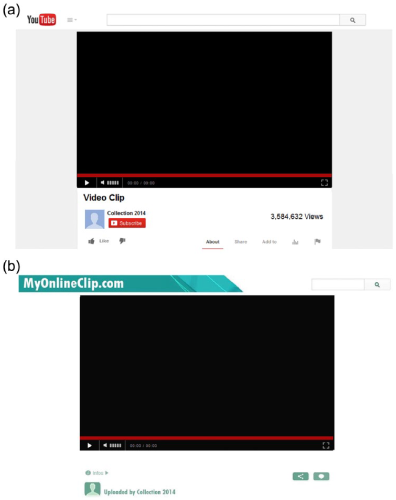
Sample mock-ups of the manipulation of the media context, showing (a) the YouTube platform with a high number of views and (b) a unknown video platform.
Dependent variables
To measure the sense of elevation, we developed new measures and also made use of measures employed in the literature (all items displayed in Table 1). Based on theoretical suggestions (Haidt, 2003), we developed 10 items assessing the experience of elevation by combining cognitive and affective reactions in each item. On 7-point Likert scales (1 = strongly disagree, 7 = strongly agree), participants rated the extent to which the statements reflected their current mood, for example, “Currently I’m feeling moved to see the good sides of humankind.” Drawing on the measures used by Oliver et al. (2012c), we assessed affective responses with the help of 15 items and bodily reactions based on 11 items on 7-point scales (1 = not at all, 7 = very much). To identify the factor structure of these measures and to ensure that elevation experience is distinct from accompanying affective and bodily responses, we conducted a principal component analysis (Oblimin rotation) which yielded six factors (overall explained variance: 74.99%). Factor 1 “elevation experience” comprised 10 newly developed items (α = .97; M = 4.12, SD = 1.75). Factor 2 “negative affect” referred to negative responses such as “depressed” or “sad” (α = .87, M = 2.32, SD = 1.39). Factor 3 “eudaimonic affect” included items covering affective states such as “meaningful” or “touched” (α = .95, M = 4.26, SD = 1.70). Factor 4 “hedonic responses” comprised statements on positive affective and physical responses such as “happy” or “laughter” (α = .91, M = 3.54, SD = 1.49). Factor 5 “bodily reaction: tension” referred to items representing physical tension such as “crying” or “muscles tensed” (α = .64, M = 2.51, SD = 1.16). Factor 6 “bodily reaction: warmth” included physical responses such as “rising or open chest” or “warmth in chest” (α = .84, M = 2.76, SD = 1.52).
Principal component analysis (pattern matrix) for the sense of elevation.
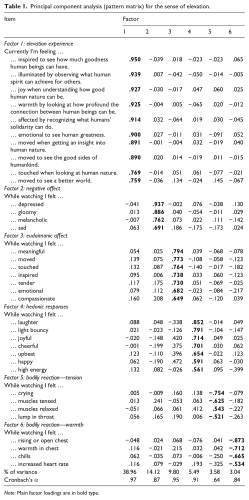
Note: Main factor loadings are in bold type.
To assess prosocial motivations, we used a scale by Oliver et al. (2012c): Five items on intentions toward prosocial behavior and adjusting one’s life (“be a better person,” “do good things for other people,” “seek what really matters in life,” “live my life a better way,” “adjust my life to what I really want”) (1 = not at all, 7 = very much) were summed up (α = .95, M = 3.57, SD = 1.93).
Universal orientation was assessed using items from Piedmont (1999) and Phillips and Ziller (1997). People were asked to indicate their opinion about six statements (1 = strongly disagree, 7 = strongly agree), for example, “At one level of thinking, all humans are the same,” “All life is interconnected” (α = .85, M = 4.90, SD = 1.37).
Attitude toward and interaction intention with stereotyped groups were assessed using items from Zick et al. (2011) and Husnu and Crisp (2010). The items had been designed to assess prejudices and negative attitudes toward six different social groups (immigrants, Jews, Muslims, Black people, persons of the opposite sex, and homosexuals) in order to take the most common stereotypes into account. For each of the six groups, a set of three questions was asked: (1) “How much do you intend to interact with […] in the future?,” (2) “How much time do you think you might spend learning about […] in the future?,” and (3) “How much do you expect to enjoy interacting with […] in the future?” (1 = not at all, 7 = very much). As is adequate when measuring stereotypes and negative attitudes, the items are rather subtle. In order to assess general prejudices instead of specific ones, we averaged across the six groups and the three questions (α = .94, M = 4.52, SD = 1.09).
Procedure
After logging in to the online questionnaire, participants were asked to watch a video (randomly chosen out of the eight videos) and instructed to fill in the questionnaire which ended with questions on social demographics. Subsequently, participants were debriefed and informed how to receive their money or take part in the draw, respectively.
Results
To test the hypotheses, 4 × 3 multivariate analysis of variance (MANOVA) was run, including type of video and website/video popularity as independent variables and the constructs described above as dependent measures. Additionally, we always ran an analysis of covariance (ANCOVA) including age and frequency of YouTube usage. This, however, only led to minor improvements of the effects and will therefore not be reported in detail. Post hoc comparisons were conducted with Bonferroni correction.
With regard to H1 and H2, several main effects of video content were found.
A significant main effect of video type regarding the experience of elevation emerged (F(3, 737) = 37.23, p < .001, ηp2 = .13). Post hoc tests resulted in differences between all videos. Elevation was highest for the videos regarding human kindness, followed by the videos of the type “we are one kind,” followed by the “earth is beautiful” videos, and lowest for the control videos (see Table 2).
Main effect of video types on dependent variables.

SD: standard deviation.
Means with different subscripts within a row are statistically different from each other (p < .05).
A significant main effect of video type on the three factors of affective reactions was also detected: eudaimonic affect (F(3, 737) = 130.5, p < .001, ηp2 = .35), negative affect (F(3, 737) = 84.82, p < .001, ηp2 = .26), hedonic responses (F(3, 737) = 30.23, p < .001, ηp2 = .11). Post hoc tests for eudaimonic affect revealed that all videos differed significantly from each other except for videos depicting “earth is beautiful” and “we are one kind.” Highest eudaimonic reactions were observed for the videos depicting human kindness, lowest for the control condition. The same pattern was also obtained for negative affective reactions. For hedonic reactions, all conditions differ from the videos showing human kindness—which yields lowest values for hedonic reactions (see Table 2).
Analyses regarding bodily reactions resulted in significant main effects of video type on bodily reactions: tension (F(3, 737) = 75.61, p < .001, ηp2 = .24) and bodily reactions: warmth (F(3, 737) = 41.63, p < .001, ηp2 = .15). Post hoc tests for tension revealed that all videos differed significantly from each other except for the videos “beauty of the earth” and “we are one kind,” both of which also did not differ significantly from the control video. The video showing human kindness received highest values; the “beauty of earth video” was the lowest. Post hoc analyses with regard to bodily reactions: warmth showed that all videos differed from the control condition but not from each other. Here, the “acts of human kindness” videos received highest ratings and the control videos the lowest (see Table 2).
Analyses regarding prosocial motivations resulted in a significant main effect of video type (F(3, 737) = 88.52, p < .001, η = .27). Post hoc tests showed that the control video (lowest prosocial motivation) differed from all three types of meaningful videos. Additionally, the videos showing human kindness differ significantly from the other two kinds of meaningful videos (see Table 2).
Furthermore, analyses showed a significant main effect of video type on universal orientation (F(3, 737) = 3.26, p = .021, ηp2 = .01). Here, post hoc tests showed that the control videos differed from the “we are one kind” and—however on a 10% significance level—the videos showing human kindness—with the control videos yielding lowest ratings on universal orientation (see Table 2).
In sum, H1 is supported as the control group differs significantly from most of the meaningfulness conditions with regard to all dependent variables (sense of elevation, affective reactions, bodily reactions, prosocial motivation, and universal orientation).
Also, H2 is supported for some of the dependent variables: As the videos depicting human kindness in several cases receive the most pronounced ratings, they differ not only from the control group but also from the other two conditions showing meaningful media contents. This is true for sense of elevation, all three factors of affective reactions and both factors of bodily reactions, as well as for prosocial motivation.
Analyses run to test H3 resulted in a significant main effect of video type on interaction intention with stereotyped groups (F(3, 737) = 3.75, p = .011, ηp2 = .02). Post hoc tests reveal that the human kindness videos—which have the highest values with regard to attitude toward stereotyped groups—differ from the control videos as well as from the “we are one kind” videos (see Table 2).
To test the hypothesized mediation, we conducted a mediation analysis using the PROCESS macro (Hayes, 2013). The bootstrap results (using 5000 resamples with a percentile-based 95% confidence interval) supported H3: The effect of the video on the intention to interact with stereotyped groups diminishes when the sense of elevation and universal orientation are considered in the model. Both variables fully mediated the effect (path estimate of the indirect effect: .16, confidence interval [CI] = [.09, .25]). Within this model, it should be noted that the positive effect of human kindness videos on universal orientation (cf. Table 2) became negative. A sub-model revealed that the elevation experience mediates the relation between watching the video and universal orientation. Generally, when comparing the coefficients in the multiple mediation (see Figure 2), it becomes apparent that elevation has the larger value. Still, when universal orientation is excluded, the path explains less variance (R2 = .14) compared to when it is included (R2 = .2).
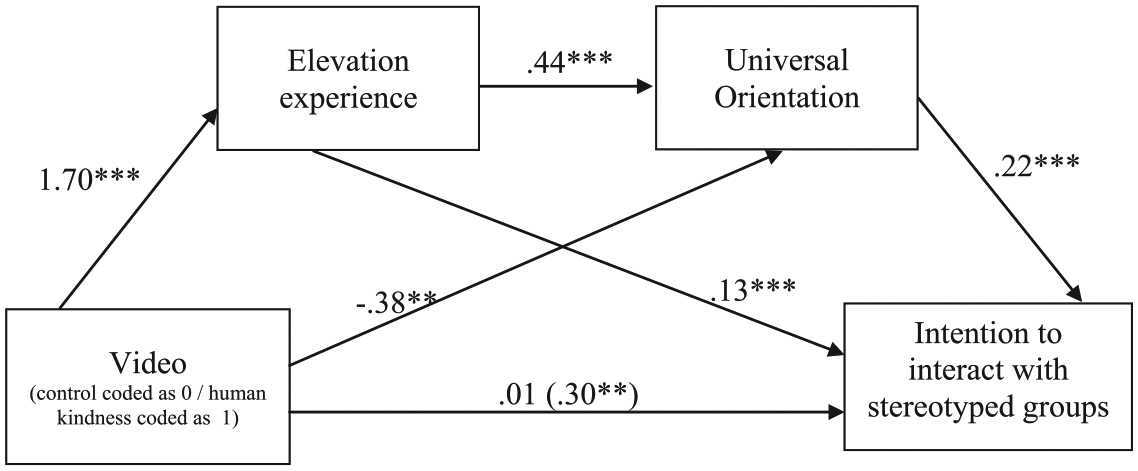
Mediation model including unstandardized regression coefficients for the type of the video as independent variable, elevation experience and universal orientation as mediators, and intention to interact with stereotyped groups as dependent variable. The unstandardized regression coefficient between type of video and intention to interact with stereotyped groups without controlling for the mediator is in parentheses.
Contrary to expectations in H4, we did not find a significant main effect of the media context in the sense of video platform environment on the attitudes toward stigmatized groups. Also, there was no interaction with the content of the videos. In additional analyses, we excluded those participants who did not pass a manipulation check in which we tested whether they would correctly remember whether the video was watched by a high or low number of people and what platform the video was shown on. However, the calculations after exclusion of N = 171 and N = 164 participants did not yield significant results. Also, the indirect effect of media context on attitudes, mediated by universal orientation (H5), was not found in the mediation analysis. Hence, H4 and H5 are not supported.
Discussion
The goal of this article was to amend research on the effects of meaningful media content by extending the concepts on which meaningful clips have an impact and to distinguish more systematically between different meaningful media content. Additionally, the context in terms of the environment and corresponding information on distribution of a video was considered. An experimental online study with an international sample yielded several interesting results.
As hypothesized, meaningful videos have distinct effects compared to merely hedonic videos in that they lead to more pronounced affective reactions as well as bodily reactions. As is already summarized in the literature (Oliver, 2008), meaningful videos elicit more mixed-affect reactions than hedonic media. While these results— as well as the results regarding prosocial motivations (see Oliver et al., 2012c) showing that meaningful videos led to higher prosocial orientation than funny videos—replicated the state of the art in appreciation research, the inclusion of further variables such as universal orientation and attitudes toward stereotyped groups yields additional insights. Results concerning universal orientation demonstrate that meaningful videos, which either depict humankind as one of a kind or show unselfish acts of human kindness, lead to an increase in universal orientation. This means that participants are inclined to think that humans are the same or that there is a certain beauty in everyone after watching a meaningful video informing about human nature or human kindness.
With regard to our goal to show the discriminant value of elevating content, we were able to show that videos depicting acts of human kindness have distinct effects compared to other forms of meaningfulness. With regard to the feeling of elevation and affective and bodily reactions, the effects of videos showing human kindness stood out from all other videos. The patterns are what can be expected from the literature (Haidt, 2003; Oliver et al., 2012a, 2012c): The sense of elevation is highest when acts of human kindness are shown, and bodily and affective reactions are characterized by mixed-affect and more negative than positive experiences in comparison with other videos. There is, however, no distinct effect on universal orientation. This finding is plausible, though, as universal orientation should also be strongly affected by seeing that all humans are alike (e.g. showing different ethnicities joining in one dance or conducting similar everyday life activities). Additionally, we found that prosocial motivation was increased by all types of meaningful videos but led to the highest values after having observed videos on human kindness. This is consistent with the literature, which states that prosocial orientation is a specific outcome of elevation (Algoe and Haidt, 2009; Freeman et al., 2009; Haidt, 2003; Schnall et al., 2010). However, the fact that pictures of beautiful landscapes also invoke prosocial motivation—albeit to a lesser degree—has to be explored in further studies. Here, future research could consider related emotions such as awe. After all, prosocial motivation might not be as specific to the observation of human kindness as has commonly been assumed. Nevertheless, the present research has yielded initial evidence pointing to the idea that meaningfulness has various facets. These findings on the specificity of different meaningfulness “themes” like beauty of the earth, unity of humankind, or human kindness indicate that future research should systematically distinguish between different forms of meaningfulness.
Most interestingly, the study yielded results on the effects of the videos on the attitude toward stigmatized groups. Here, the expected distinctness of the videos showing acts of human kindness was observable: The elevation-inducing videos stood apart from most of the other videos and had the most pronounced positive effects on attitudes toward stereotyped groups. Even more informative was the pattern that was revealed in the mediation analysis. Specifically, exposure to human kindness videos elicited elevation, which in turn was associated with heightened perceptions of universal orientation, which was then associated with more favorable attitudes toward stereotyped groups. This is in line with results of Phillips and Ziller (1997), showing that universal orientation is associated with a reduction in prejudices. But most importantly, this finding adds another mechanism to the state of the art (Vezzali et al., 2012, 2014): Thus, reduction in stereotypes cannot only be triggered by parasocial contact with media characters but also by merely observing how media characters show acts of charity (even if the content is not connected to specific stigmatized groups) and by the related perception that all humans are the same. This does not necessarily falsify or contradict the assumption that the parasocial contact hypothesis makes but adds another mechanism that is worthwhile considering in future studies which will have to clarify the mechanisms in greater detail. Two potential paths why videos depicting human kindness should lead to less stereotypical attitudes via elevation and universal orientation can be envisioned: By seeing that humankind is good and conducts good deeds, (a) one is primed that oneself (as a human) is also good and therefore is prone to have prosocial attitudes without prejudices (as this is socially desirable in the sense that this is what is expected from “good humans”), and (b) the awareness that other humans are good people is raised which leads to a positive evaluation of other people and hence to more universal orientation and less prejudice. Besides these open questions on the relevant processes, future research also has to engage in more systematical validity testing of the scales to measure elevation. This has to be done in order to provide valid measures but more importantly with a view to reducing fuzziness of the concept.
Against our expectations, there was neither a main effect nor any interaction with regard to media context in terms of popularity of the platform or the number of views displayed. This might be due to the fact that most people did not perceive and remember the information given as it may not seem to be relevant. In line with this interpretation, our manipulation check showed that most people were not able to recall the number of views or specific platform correctly. However, even if only those participants who noticed platform and number of views are considered in the calculations, the manipulation did not have an effect. Altogether, we were not able to demonstrate that context variables might also have an effect on variables like universal orientation or attitudes toward stereotyped groups. If these variables do not yield sufficient attention in a controlled experiment, this means that probably in real-life situations, this kind of information also is not perceived as a relevant cue for social connection to the world. As the covariance analyses show, there was also no effect when controlling for age or familiarity with YouTube, so we can also rule out that our sample might not have included a sufficient number of experienced users.
This work has several theoretical implications: With regard to entertainment research, the data underline the complexity of non-hedonic entertainment. First, elevation appears to be one facet of appreciation, distinctive from other experiences such as facing aesthetic beauty. Second, elevation might be associated with other psychological effects (e.g. affiliative behavior) more so than other non-hedonic experiences. Therefore, not only empirical but also theoretical research is needed in order to outline differentiated mechanisms leading to momentary experiences (such as elevation) and also to short- and long-term outcomes (such as reduction of social stereotypes). This work might have opened up new perspectives for further exploring the non-hedonic entertainment experience of elevation and its accompanying psychological effects.
With regard to practical implications, the results of this study suggest that specific kinds of online videos can be employed by non-governmental organizations (NGOs) or community initiatives to foster an egalitarian perspective. These findings should be helpful in deciding which kinds of videos may be beneficial in fostering support for a cause and achieving specific effects. Respective videos might be especially fruitful in a context like YouTube as they have a good chance of being forwarded.
Limitations
One limitation can be seen in the sample and the way participants were recruited. Using two different languages in the questionnaire and different ways of recruiting participants, we tried to collect a sufficiently broad sample to be able to generalize the results across cultures, educational levels, and age groups. However, both, recruiting via social networking sites and via Mechanical Turk, yield convenience samples. Still, given the clear and plausible patterns we see in the data which are in line with theoretical assumptions and based on literature advocating the usage of MTurk (Cohen and Lancaster, 2014), we do not think that this limitation is severe. Similar limitations are true for the video material. Here, also, results are constricted in the sense that we—necessarily—selected very specific material. However, our research, by being the first to systematically differentiate three types of meaningful videos and by using two videos of each type, covered a broad range of materials and can therefore address the possibility that effects might be due to the specific features of one specific video. With regard to the measurement of negative attitudes, our approach can, of course, be criticized as being susceptible to social desirability effects. We tried to preclude this by selecting measures which are more subtle by referring to future intentions to interact, but explicit measurement is always prone to biases. Since we have distinct results, biases in terms of general social desirability are probably not very relevant here, as this would have affected all conditions in an equal way (unless one would want to follow our assumption discussed above that videos showing human kindness specifically prime socially desirable behavior). Instead, demand characteristics of the experiment might be influential as people might have felt urged by the setting to show less stereotyped attitudes after seeing the videos depicting human kindness. Therefore, future studies should apply implicit measures. Also, we only were able to measure short-term effects and intentions instead of actual (prosocial) behavior or behavior toward stereotyped groups. Future studies should be conducted in the laboratory in order to be able to consider both implicit attitudes as well as actual behavior. Additionally, physiological measures could be employed in order to consider physiological correlates of the feeling of elevation. Finally, we have to acknowledge that—although we find a fairly consistent pattern of results which thereby lend credibility to the findings—the effect sizes are relatively small.
Conclusion
This work identifies a further motivational outcome of the sense of elevation: The more intensely people experience elevation by watching acts of human kindness, the more they perceive humans as equal and the more they open up to other people, including stereotyped groups. After perceiving elevation, people are more willing to deal with stigmatized groups and report more positive attitudes. This finding might stimulate future research focusing on psychological and behavioral effects related to the experience of elevation which appears to be associated with (socially) desirable changes in recipients’ cognitive, emotional, and motivational system. Given the specific and positive effects of videos with elevating content that this study showed and the related prospect that by watching simple video clips the world might become a bit friendlier and better, watching (specific) YouTube videos seems to be a less dispensable endeavor than commonly assumed.
Footnotes
Funding
The author(s) received no financial support for the research, authorship, and/or publication of this article.