




Abstract
This article presents and discusses results from a study of radical left-wing activism online carried out by the Swedish Media Council, a report that suggested that the Internet (i.e. the web, web 2.0, and social media) is not a prioritized arena for propaganda and recruitment for the radical left in Sweden. The purpose of this article is to re-evaluate some of these findings and add to the discussion on online activity and connectivity in political communication online, as well as to problematize simplified notions of radicalization and recruitment to pro-violent groups. Based on a hermeneutic inquiry regarding modes of communication, representations of political visions, and community, the article shows how the sites and groups studied favor one-way communication before interactivity, that political visions are limited to short-term goals in the immediate future, and that they give very little information about their activist activities to recruit supporters.
Introduction
In a recent book on social movements’ appropriation of technology for communication, Milan (2013) quotes a farewell note published by Indymedia London in October 2012, a note that marked the end of a 13-year-long operation as Independent Media Center: “Over the last 13 years, the internet and the way people use it has changed dramatically. In many ways Indymedia won, because it pioneered approaches which have now become mainstream” (quoted in Milan, 2013: i). In the early 2000s, Indymedia heralded a new type of media activism. By making use of the Internet to take control of means of production as well as of distribution of news, it sparked a new interest in alternative media, as well as for the Internet as a public for radical politics (early accounts include Downey and Fenton, 2003; Milioni, 2009; Platon and Deuze, 2003). The shut-down of Indymedia London, as well as the general decline of the global Independent Media Center movement, as described in Wolfson (2014), might serve as point of departure for a discussion regarding how the radical left has left off and abandoned digital online communication. This article intends to contribute to that discussion by sharing some observations from a recent study of online activities of the radical left where absence seemed to dominate over presence.
While carrying out a study for the Swedish Media Council (2014) that concentrated on representations of radical left-wing activism online, it became increasingly clear to me that these online activities hardly could be described according to theories on alternative or radical media (e.g. Atton, 2001, 2004; Atton and Hamilton, 2008; Downing, 2001; Dubois and Langlois, 2005; Lievrouw, 2011), as their factual content involved very little news reporting or comments on current affairs. Neither could it be described in terms of an alternative public sphere or radical counter-public (Milioni, 2009), because the person-to-person interaction on the sites studied was very low in frequency. Furthermore, it seemed as if the online activities of these groups contradicted much of what have been reported on in recent literature on radical politics online that stresses connectivity, accessibility, and interactivity for social change (Castells, 2009; Gerbaudo, 2012; Hands, 2011). Against the backdrop of these observations, I want to take the opportunity in this article to probe some features of the content regarding the modes of communication used on the sites under scrutiny, how these modes of communication are related to the political visions being communicated, and the sense of community being represented. The purpose is to add to the discussion on online activity and connectivity in political communication online, as well as problematize simplified notions of radicalization and recruitment to pro-violent groups over the Internet. It is not a study of how social movements and activists use the Internet and social media for internal communication but of the material that presents these activities for an external audience, that is, the presence and presentation of these groups on the web.
The article is divided into two parts. In the first part, I give a brief presentation of the background and design of the study conducted by the Swedish Media Council and comment on its general findings. In the second part, I will discuss these findings from three general themes that I identified when revisiting the material presented in the report: I will argue that the sites and groups studied favor one-way communication before interactivity, that the political visions presented are limited to short-term goals in the immediate future, and that they give very little information about their activist activities to recruit supporters.
Background and general findings of the report
There is an immediate political context to this article and the report it builds on. In 2011, the Swedish government launched an “Action plan for protecting democracy against pro-violence extremism.” This governmental initiative should be understood in context of a wider international project of “radicalization awareness” and “counter-extremism” where the Internet has been identified as a potential site for “violent radicalization” (House of Commons Home Affairs Committee, 2012; Silber and Bhatt, 2007). This, paired with the popular notion of online filter bubbles and ideological echo chambers (e.g. Fenton, 2012; Sunstein, 2007), motivated a charting of Swedish online milieus where pro-violent and anti-democratic messages are published. The governmental action plan has since been subject to heavy criticism, especially from experts on political radicalization and social movement studies who in the plan see a conflation between legitimate extra-parliament activities, such as civil disobedience, and terrorism (for an illustration of the debate, see Kaun, 2015).
The project was assigned to chart and describe the presence of “anti-democratic and pro-violent messages on the internet.” This was done through an overview of three milieus pre-defined by the assignment: the extreme right, militant jihadist, and the autonomous left. Here, an important contextual point must be made about the use of the term “autonomous.” Originally, the assignment built on a terminology borrowed from the Swedish secret service and Swedish National Council for Crime Prevention who use “autonomous” not as a term referring to a specific socialist ideology, but as a catch all phrase to denote anarchist, left-libertarian activists, and autonomists. In fact, this milieu has a relatively short history in Sweden dating from the 1980s/1990s (Jämte, 2013; Jämte and Sörbom, 2014). Added to this, most groups associated with this milieu have a history of non-violent repertoires of action (Jacobsson and Sörbom, 2015). Hence, a problem with the design was to identify autonomist leftist groups present on the Internet that met the criteria of being “anti-democratic” and promoting violence. This in turn proved complicated since many groups associated with the autonomous left are not anti-democrats per se—that is, they do not promote dictatorship—but might actually argue for an expansion of the democratic influence on society and voice opinions that are fundamentally skeptical to authority (Curran, 2006; Katsiaficas, 2006 [1997]; Romanos, 2013). The sample was restricted to groups that explicitly promoted or in other ways presented the use of violence as a legitimate means of political pressure. This left us with a quite small sample as some of the more central sites associated with the autonomous milieu had to be left out (these include the hub motkraft.net , discussion board socialism.nu, and anarchist web-zine yelah.net).
It is arguably problematic to make comparisons of these milieus: They are ideologically very different; as are their official attitudes toward democracy and political violence. However, even though the material does not lend itself to strict comparisons that seek overlapping evidence about how pro-violent and anti-democratic groups communicate and recruit followers online, each case points to specific facets of online communication: For instance, significant features of the online activities in the autonomous milieu become visible when viewed in contrast to what was observed in the extreme right.
Type of material: websites and online video
The assignment targeted “internet and social media,” which is quite broad in scope. In order to narrow it down and make it methodologically manageable, the report concentrated on websites, popular social networking sites (Facebook and Twitter), and online video (YouTube). The latter has been identified as a recurring and preferred object in studies on radical politics online (Askanius, 2012). The groups associated with the autonomous movement seldom come in the shape of strict organizations; more often, they appear as more or less ephemeral activist networks. In international research, it has been proposed that autonomists constitute a formation in the intersection between subculture and social movement (Gautney, 2009; March and Mudde, 2005; Schwarzmeier, 1999). Still, there were groups who hosted organizational websites that published statements, activity reports, information, and sometimes news, and who quite openly promoted an apologetic attitude toward violence. These were mainly associated with militant anti-fascism and animal liberation. Three websites were found to meet the criteria and hence included in the analyses: First, there was http://antifa.se, a website connected with militant anti-fascist network Antifascistisk Aktion (AFA) that had been inactive for 3 years when it was re-launched in March 2013. The site consisted of a short declaration of the networks’ aims and purpose but did not report any news, nor did it provide any platform for interactivity; second, http://djurensbefrielsefront.com, a site connected to the Swedish branch of the Animal Liberation Front (DBF), contained a large quantity of information and activity reports on animal liberation activism, but seemed to be inactive, as the last post was from 2010; and finally, there was http://revfront.org (RF), the only site connected to the autonomous left that was updated on a regular basis and published content that explicitly spoke in favor of violence as a political means. It was also the only site that published comments on current affairs and news. One important observation was that none of these sites was interactive, they gave no opportunities for comments or feedback, and they were based strictly on one-way communication.
Table 1 below (Swedish Media Council, 2014) shows what type of online presence was found with the three groups described above. It shows how one stands out as “communicative,” being active both on the “traditional” web and web 2.0, and in social media, while the others show more sporadic activities.
Web presence with three entities active within the autonomist milieu.

AFA: Anti-fascistisk Aktion; RF: http://revfront.org; DBF: Swedish branch of the Animal Liberation Front.
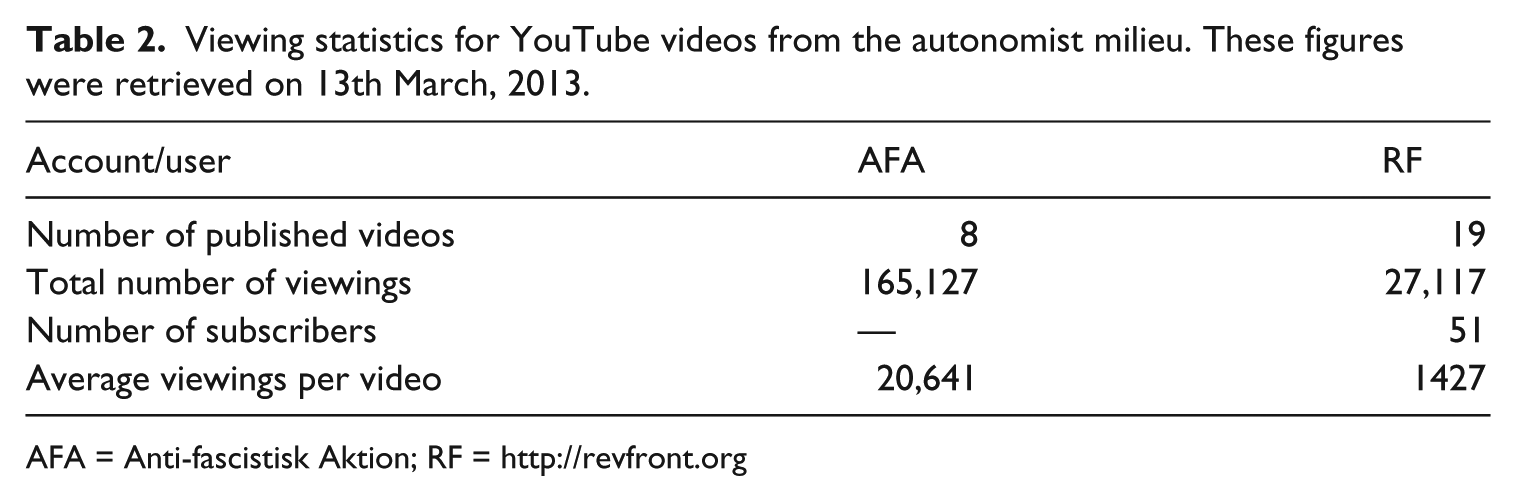
Two of these groups (AFA and RF) had video content accessible through YouTube, albeit few videos had been uploaded and viewed, as could be seen in Table 2 below (Swedish Media Council, 2014).
Viewing statistics for YouTube videos from the autonomist milieu. These figures were retrieved on 13th March, 2013.
AFA = Anti-fascistisk Aktion; RF = http://revfront.org
Besides this descriptive charting of platforms and outlets, the report was designed as a propaganda study that considered qualitative data. This included standard text-analytical approaches such as genre analysis and analyses of modes of address, modalities, and forms of expression. It should be noted that even though the primary sample was quite restricted, observations made from sites with a broader scope supported the general findings. For instance, http://motkraft.net, a site that functions as a central hub of left-libertarian activism in Sweden did not meet the criteria for being “anti-democratic” but could be seen to show a similar pattern as the sites studied, when it came to communication affordances: sporadic updates, and little activity in commentary sections.
The report (Swedish Media Council, 2014) showed that the extreme right stood out as the most active and elaborate online milieu, both in terms of platforms, outlets, activity, and level of participation. The sites connected to jihadist environments showed, at the time of the study, very little interest in domestic affairs, concentrating on global and international issues and conflicts. As for the results from the autonomous left, it proved to be a relatively small online environment with few accessible sites, little activity, and a seemingly low level of participation. For a more detailed analysis and discussion on results, these are published in Pro-Violence and Anti-Democratic Messages on the Internet (Swedish Media Council, 2014).
Analytical framework and approach
After having identified and described the online activities of these autonomous leftist groups, and contrasted their (limited) use of online communication with that (extensive use) of their political adversaries on the extreme right, I was faced with the following question: What does this absence and lack of activity mean? How could it be understood in relation to the literature on radical politics online and assumptions concerning the Internet as a site for radicalization and recruitment to violent groups? What does it say about the groups studied? This set of questions suggested a hermeneutic approach that not only describes and analyzes symbolic communication (what the text says), but also aims at an understanding of who says it (Ricoeur, 1981). It should be noted that this is not equal to making speculations about intentions, but an interpretation of what the expressions have to say about the one expressing them. In the words of Schleiermacher, “To understand the author better than he understands himself” (quoted in Ricoeur, 1981: 151). Although the quote might suggest psychoanalytical pretenses, my ambition is rather to explore what the modes of communication and representations have to say about the groups and the milieu studied. For the sake of structure, I have gathered the questions above in three themes.
The first theme addresses the question of what type of communication takes place. Grounded in sociological theories about publics and counter publics, studies such as Milioni’s (2009) research into Indymedia Athens have argued that online alternative media serve more purposes than providing information; they also allowed for civic training in democratic processes through networking and interaction. Hence, offering a space for debates and deliberation has been a cornerstone in the theoretical apprehension of alternative media online. Basically, this example brings together two classical perspectives of mediated communication: transmission of information and the ritual model of sharing and participation. Both of these perspectives address meaning in some sense; the former equals meaning with information, while the latter puts a meaningful relation at fore.
This is relevant when looking at the second theme, namely, online media’s role in inviting people to engage in mobilization and to raise anticipation. In short, how does the material mobilize enthusiasm for a radical political project? Askanius and Uldam (2011) have studied activist online mobilization videos that build expectations before an event. Gerbaudo (2012) describes an online/offline interplay of mobilization leading up to the demonstrations of Spanish Los Indignados-movement, where social media were used “as a means of generating an emotional impetus towards the protest, by firing up people’s enthusiasm and constructing a contagious sense of anticipation for the upcoming event” (Gerbaudo, 2012: 87). Connectivity has been highlighted as a central feature in online media and social movements (Bennett and Segerberg, 2013). Related to this is the question of what temporal dimension is present in the material: When does activism occur, and how does it relate to the past and the future? Scholars like Kaun (2016a) and Barassi (2015) have pointed to how new media have had consequences for how time is structured and perceived in protest movements.
A third theme concerns the notion of autonomy and the questions of how the activism of the group is made attractive and what sense of community is presented. Autonomist scenes are described as secluded milieus with restricted access for outsiders. Previous research (e.g. Peterson, 2001) describes the autonomist left as repeatedly uninterested in disseminating propaganda and recruiting new followers through the Internet. Interview studies with activists display indifference toward the idea of reaching outsiders with their websites, while their adversaries design their websites to attract curious young people and recruit followers via the web (e.g. Back et al., 1996; Statzel, 2008; Whine, 2012).
While the primary focus of the report was on the symbolic level of visual, audiovisual, and lexical signs (how do these groups present themselves and their activities on the Internet?), the material that is being considered conveys its meaning on at least one more level. That level includes the affordances for participation and interactivity and how these affordances are put to use. “Affordances” is a term generously used in the fields of human–computer interaction and online communication (Das, 2010; Neff et al., 2012). It was introduced as a theoretical concept by Gibson (1986 [1979]) and means “actions possibilities.” In the analysis, the concept is used to describe possibilities for action and communication in relation to the content analyzed, and, when possible, observations of how these affordances are put to use. For instance, a website that offers few or no possibilities for interaction (such as commenting) says little about the activity on the site, while a webpage that offers interactive possibilities that are not put to use by visitors is arguably more evidently inactive as available communicative affordances are ignored.
Needless to say, there are some limitations with this approach: A study like this cannot say anything about how actual users respond to the material, or about the intention of the publishers. Furthermore, the study was limited to a short time period (September 2012 to April 2013), and online communication and content tend to change quite rapidly, which makes it difficult to present up-to-date data. Finally, the study was carried out in Sweden with a relatively small anarchist/autonomist scene compared to some other European countries. There is reason to believe that comparative case studies in other countries would show different results.
Environments of absence
The online content associated with the parts of the radical, autonomous left that was included in the study is best described in terms of a significant absence: On the manifest level, there was no alternative news production, or extensive debates and discussions; and on a deeper level, this was matched with the absence of visionary political narratives as well as absence of descriptions of what the movements or groups have on offer for presumptive members. In the following, I will present and discuss these absences in detail.
One-way communication and the absence of news
What constitutes Internet’s uniqueness by modes of communication has been described as the integration of personal communication, mass communication, and mass self-communication (Castells, 2009). The ability to act and react, to talk back and make one’s voice heard, has also been part of the scholarly attention paid to alternative online media (Atton, 2004), and could be seen in the “we won”—quote from Indymedia London that opened this article.
It is, therefore, peculiar to find that sites for radical left-wing political discourse in the autonomist milieu online included in this sample are so static in their communication affordances. For instance, websites that promoted pro-violent sentiment were few and not very popular (based on the estimate of visitor statistics, from freewebsitereport.org). Those that did often did so in a manner that involved the theme of political violence in lengthy textual accounts of political theory and history. While it was somewhat easy to find material that defends violence as a political method, not all texts were easily accessible in the sense of being easy to comprehend. It could even be asserted that such material used simple modalities (text-based) that are poorly adapted to the media-specific conditions that Internet technology involves (since lengthy theoretical texts might prove easier to read in book form than on a screen). This lack of adaptation to new communicative affordances could be thought of in relation to a long-standing leftist critique concerning the role of the media in modern society and the (dis)ability of the revolutionary left in participating or to take advantage of new media; perhaps most famously voiced by Enzensberger (1970) in the late 1960s, “Marxists have not understood the consciousness industry and have been aware only of its bourgeois-capitalist dark side and not of its socialist possibilities” (p. 28).
If one of the defining aspects of alternative media is to constitute an alternative to the mainstream (Bailey et al., 2008), that is, by providing news and information not found elsewhere, it seems as if there is quite little alternative media online in this milieu. There are very few websites that publish and analyze news and current events on a daily or weekly basis. Ideological news reporting and re-contextualization of news do not exist to any considerable extent in the autonomist scene online. In 2001, a Swedish subsection of Independent Media Center (Indymedia) was started, but their website has been inactive since 2010. Why is there no alternative (news) media to be found in this milieu? The absence of strategic, active work on ideological news reporting may to some extent be explained by the fact that the fundamental social analysis found in the autonomist milieu is shared with larger parts of the (mainstream) left, such as the labor union movements; there are also plenty of outlets close to the mainstream media where questions and perspectives relevant to the milieu (e.g. anti-racist or anti-sexist) are discussed. There seemed to be little antagonism against mainstream media, which could be illustrated by how revfront.org in an appreciative manner linked to public service radio documentaries on their webpage. In other words, the need to create alternative media, both in terms of serving a community and constituting an alternative to the mainstream seems fairly small in the milieu being studied here.
Besides a lack of alternative (news) media, these outlets also showed limited accessibility in terms of communication affordances. For instance, when it comes to interactivity and the opportunity for interaction between publisher and reader, the analysis showed how comment functions were implemented sparingly, and in cases where the opportunity to comment did exist, it was seldom used.
One example was http://motkraft.net, the site mentioned earlier as a central hub for left-libertarian activism (albeit not meeting the criteria of being “anti-democratic”). The postings on this site had comments functions, but these showed no sign of being used during the sample period. Another example is the organization RF who hosted both a Twitter account and two YouTube channels, but had set limits to the affordances for social interaction on these services: The comment function on the YouTube channels was switched off, and the content on the Twitter account was hidden for outsiders. One could perhaps say that social media such as Twitter and YouTube prove problematic to the radical leftist groups since they are not technologies that allow complete control. YouTube may offer great opportunities to make material available to a larger public with small means, but it is also a tool that publishers have very little control over, especially with regard to the context in which one’s films appear.
From these observations, it is clear that the groups in this study do not favor communication in the dialogical sense, but make use of the online means of communication as mere transmitters of information (albeit not much news). It could be added that a similar observation of limited interaction was recently made in a study of how mainstream politicians in Sweden use social media (Svensson and Larsson, 2016).
Politics in the present tense
In the previous section, I showed that there are few, if any, alternative media in the sense of alternative news outlets present in the milieu that was studied. Neither could the content be described as a “media of the alternative” (Andersson, 2012): It is not an outlet that displays what an alternative political organization would look like. Instead, the online content produced by these groups was found to be concentrated on the present or immediate future. It is the case of a politics in present. Presentations or discussions on a future to come, often believed to be a central part to understanding how radical social movements attract sympathizers (Koehler, 2014), are however absent. The only appearance of a future is in the case of a very near future: in terms of mobilizing for demonstrations or manifestations to come.
The socialist tradition has a long history of utopianism (as expressed by Saint-Simon, Fourier, Owen), and in the more radical manifestations, perhaps even militant revolutionary romanticism (Rote Armee Fraktion, Brigate Rosse). Given this background, the absence of utopianism in the material from the autonomist online content is quite notable. We receive little to no information about what kind of world, or society, that these groups are propagating and what they struggle for (apart from general references to a world without racism, sexism, homophobia). There is not much of a “grand narrative” to be found either. If anything, the groups in the study seem more prone to present themselves and their analyses in terms of a critical materialism that, from Marx and onward, fed into a critical debate between utopianism and materialism.
It should be noted that the groups included are action-oriented (militant action groups), and other parts of the libertarian left might show different results when it comes to political utopian visions, but in the comparative context with militant jihadists and the extreme right—both for whom grand narratives of utopia played an important part of propaganda—the absence of utopian visions among these groups is striking.
The content on the websites and the online videos are concentrated to the present or the very near future. In the milieu, there is a significant presence of what could be described as mobilization videos (Askanius and Uldam, 2011). These videos have a focus on violent confrontation and scenes of action, set to an intense musical score. However, what makes these videos interesting from a hermeneutic perspective is their focus on the here and now and a very restricted account of the future. For those who turn to the autonomist groups for visionary tales of a utopian future, there is not much to find here. Perhaps part of the explanation to this could be found in the ideological perspective of the autonomist politics, as a “first-person politics” (Leach and Haunss, 2009: 262). There are few demands from the autonomists other than that they wish to be left alone and build their political vision here and now, often in the form of a squat or a social center. The creation and defense of such “autonomous zones” are more prolific than portrayals of a utopia to come, and what to expect “after the revolution.” One example of this action-oriented autonomist position could be found in the following quote from antifa.se: Despite the fact the majority of our work occurs with “peaceable” methods, we are often criticized when we consider resorting to violence to be justified. We do not, however, have any ambition of scoring political points, trying to win votes or perhaps being written about in the media. (http://antifa.se, 08 Mar 2013; Translation by Swedish Media Council (2014))
By emphasizing their indifference toward “political points” or favorable media exposure, AFA make sure that they act on their own terms, and could be understood in relation to a long history of adverse representations in mainstream media (Jämte, 2013). The outspoken disinterest in media exposure even resonates with the group’s own use of media outlets. Their original website was deactivated sometime in 2010, and their absence from the web spawned online speculations about there not being a network anymore, given the lack of official presence of the network on the web. In the beginning of March 2013, however, a new website for the national AFA network was started with the same url, but it had no content other than a short declaration of program (such as the quote above), as well as contact information for local AFA groups.
Related to the wish to proclaim autonomy is the absence of open doctrines or dogmatism in the material. When it comes to ideological content in this autonomist web milieu, it is worth noting that the majority of such texts have been authored by collectives, and not by individual authorities (which can be said to be significant for this milieu in contrast to both the extreme right and militant jihadist online propaganda): There is no official strong leader or interpreter of “the true doctrine” present in the material. Partly, this corresponds with a socialist tradition of emphasizing the strength of the collective before individual front figures. It does, however, make the messages somewhat confusing. Who are behind this? What do they want? To an outsider, it appears as if the political propaganda is oriented toward the ones who are already in-the-know, not to advertise the agenda to the outer world. Compared to radical leftist groups from previous decades, who were inspired by Leninism, the autonomous appears to be unwilling to put forward any leader figures in the material. Videos and imagery portray collective action, and in those instances where individuals stand out, they appear in ski masks or other type of disguise.
The absence of something to offer
Part of the overall purpose with the report was to analyze “how recruitment strategies can be identified and understood in various communicative contexts” (Swedish Media Council, 2014: 9), because the assignment included a presumption that radical groups recruit members and find sympathizers through the Internet. Such recruitment strategies could include presenting the group or movement as attractive, and being a member as something desirable (cf. Koehler, 2014). The report showed that videos from both the extreme right and militant jihadist environments included material of this kind, while this element was virtually absent among the groups in the autonomous milieu. In short, nothing in the material seems to communicate any sense of community. In fact, more often, these groups explicitly discourage people from joining them.
One explicit example that illustrates the disapproval to make contact over the Internet could be found in the following quotation pulled from the website of the Swedish branch of the militant animal rights group, Animal Liberation Front: Please do NOT contact us if you want to join Djurens befrielsefront [ALF], or if you otherwise want to carry out actions for animals. We cannot help with such contacts; furthermore, it is a security risk to send such information via e-mail. […] For information on how DBF [ALF] is organized, you can read our booklet När skymningen faller [When Twilight Falls]. […] Please do NOT contact us about ordering När skymningen faller, either. The DBF SG [support group] handles distribution. (http://www.djurensbefrielsefront.com/default.php?subaction=showfull&id=1122166330&archive=&start_from=&ucat=1&; (retrieved 130221; translation by Swedish Media Council (2014))
Secrecy and seclusion have been a central part of Swedish anarchist/autonomist activism for some time (cf. Jacobsson and Sörbom, 2015; Peterson, 2001), and perhaps that explains the lack of inclusive modes of address in the material. Already in the research on autonomous scenes conducted by Leach and Haunss (2009), it is described how communications within the milieu take place primarily through personal contacts at parties, concerts, and meetings, or through posters, stickers, and flyers in the urban landscape. Even if the Internet is occasionally credited as a further source of information about what is happening in the autonomist scene, it still seems to be subordinate to physical social interaction.
In terms of material for recruiting new members to the cause, the websites and online videos studied do a poor job of presenting activist life as something appealing. For the most part, it could be argued that the case is quite the contrary. Hyper-masculine rites of passage or homo-social comradery are recurring themes in the online videos posted by groups in the extreme right and militant jihadist groups, while the groups associated with the autonomous left remain secret about what the benefits of activist life might be. Again, the online content seems to fill other purposes than attract curious visitors to activist life.
Nor does the online milieu offer much in terms of a sense of community as there is little activity and participation on the websites. It is difficult to see how anyone would log onto these sites in order to find a sense of community. There is little of the “emotional impetus” of anticipation, as described by Gerbaudo (2012: 87) as an important factor for understanding social media’s role in mobilization for a cause to be found in this material. However, it cannot be ruled out that the secrecy in some sense serves as an attractive factor for presumptive supporters in a similar fashion as might be found among secret societies (Erickson, 1981; Simmel, 1906). The possibility to be “in-the-know” might just as well be the attraction here.
Control and seclusion
The purpose of this article was to add to the discussion on online activity and connectivity in political communication online, as well as problematize simplified notions of radicalization and recruitment to pro-violent groups over the Internet. The report from the Swedish Media Council concludes that it would be ill-informed to assume that the Internet serves as a prioritized platform for propaganda and recruitment to pro-violent radical left-wing movements in Sweden. Given this lack of activity online, it is still interesting to ask what could be said about the content that is there: What is left of the radical left online?
First, when it comes to what modes of communication are put to use in the milieu, much of the web content was founded on static modes of one-way communication. There are too few outlets and too little activity in terms of regular updates to talk about alternative news media. It is equally difficult to describe the online milieu as an online counter-public because there are few cases of open interactions. It is reasonable to ask what the social meaning is of an online presence that makes little use of the web’s communicative affordances in accessibility and interactivity. One possible interpretation is that for these groups, control is more important than communication, and that communication is restricted to transmission of information, not discussion. However, as Svensson and Larsson (2016) have shown, this also seems to be the case with mainstream political communication online.
Second, talking about representations of political visions, or rather the absence of political visions in the online content, it becomes apparent that the groups included in the study do not prefer the Internet as a means of conveying grand narratives of a utopian future “after the revolution.” Instead, what is presented is a politics not only in the first person, but also a politics in the present tense. What could be the attraction of such one-dimensional political narratives? While rooted in a Marxist social analysis of capitalism, which in itself serves as a grand narrative of what “we” are against, there are no clear depictions of what “we” are for, apart from very vague occasional references to a “future socialist society.” Consequently, this milieu has little to offer those who look for elaborate utopian visions or tales of past glory.
Finally, the sites and videos studied seemed to have very little to offer in terms of a sense of community for presumptive followers. To speak of “recruitment strategies,” where radical groups are assumed to attract sympathizers by displaying their activities online, this finds little resonance in the static websites that explicitly discourages people from making contact. Of course there is a possibility that this dismissive mode of address might appear appealing to those who wish to be part of the secrecy—similar to the logic that makes secret societies attractive—but such speculations are beyond the scope of what conclusion could be drawn from this study. Still, the secret and distancing attitude reinforces the notion that these websites, and the online presence of these groups are not primarily directed toward interested outsiders.
Like with all hermeneutic approaches, the result of this inquiry is rather a set of implications for further research than undisputed conclusions (Dahlgren, 1988). One such implication is that the use of online digital media for radical political projects is a complex phenomenon that not only includes presence but also absence. Recent work on non-participation suggests that this could be understood as a strategy for activism (e.g. Casemajor et al., 2015). Whether the absence and inactivity presented in this analysis are coincidental or the result of active choice can only be measured through methodologies that include interviews and observations, an approach that would take in the perspective from users as well.
It is also close at hand to assume that the sample period took place at the end of a cycle, both of radical politics in Sweden (Jacobsson and Sörbom, 2015), as well as of radical activism online. Hence, it would be useful to conduct longer, perhaps trajectory studies that could capture what and how content and modes of communication, and address change over time. Recent research on radical politics and communication has pointed to the significance of putting seemingly current phenomena in a historical perspective (Kaun, 2016b; Neumayer, 2013; Wolfson, 2014). Such an approach would perhaps lead us to ask not only what’s left, but also what’s next for the radical left online.
Footnotes
Acknowledgements
The data analyzed in this article were collected in a research project hosted by the Swedish Media Council.