




Abstract
Launching in September 2012, Tinder has become a popular phenomenon in the world of online dating and hookup culture. Simultaneously, it carries notorious reputation for being home to hypersexual and toxic masculine expressions. This analysis examines Tinder Nightmares, an Instagram page featuring failed attempts at hooking up, as a site that promotes counter-disciplining the deliberate toxic masculine performances on Tinder. Through a Foucauldian lens, we argue that this page delimits the toxic masculine performances through the outward display of crude performances, the showcasing of witty responses from Tinder users, and the extension of counter-discipline through digital circulation practices on the page. Given that Tinder is a location-aware app, the discipline offered through Tinder Nightmares surfaces in interpersonal, physical, and networked spaces, as Tinder users become multiply implicated public subjects of shame across media platforms.
Keywords
Launching in September 2012, the mobile dating app Tinder, which allows users to connect with (swiping right) or passing on (swiping left) others nearby through simple profiles, has become a popular cultural phenomenon in the dating world. As of 2014, over 50 million people have been active on Tinder with over 1.6 billion profile views and 12 million matches made (Shontell, 2014). As a location-aware app, Tinder connects users within a particular radius, meaning that “swiping right” can connect potential mates that are nearby. Online dating applications have fundamentally changed the nature of dating (Blackwell et al., 2015) and, for college-age adults, have become intertwined with “hookup culture” (Sales, 2015), which is characterized by a carefree attitude toward engaging in frequent, casual sexual encounters with relative strangers (Armstrong et al., 2010; Currier, 2013; England et al., 2008). Demographically, men outnumber women at least two-to-one on Tinder, and it has earned a reputation for crude and “lascivious intentions” from men toward women (Hakala, 2015) or supporting a “misogynistic” culture (Sales, 2015).
Enter Tinder Nightmares, an “unspirational,” Instagram page maintained to document the lewd and perverted courtship attempts by men and the humorous and witty efforts women offer in response. Tinder users are invited to anonymously submit screenshots of these failed interactions to the Tinder Nightmares website. Tinder Nightmares then reposts the screenshots to their Instagram page inviting comments from all Instagram users to laugh at, scorn, and ridicule the Tinder interaction. While humorous, Tinder Nightmares also engages a counter-disciplinary function upon the toxic and heterosexist performances found on Tinder. The seemingly private interactions between potential mates are publicized through Tinder Nightmares and circulated through social media sites which challenge and reframe the original performance. In this essay, we examine Tinder Nightmares and the ways that it counters performances of toxic masculinity, thereby confronting the heterosexist normative conceptions of masculinity commonly found in hookup culture (Currier, 2013). We ask the following questions: (1) How does Tinder Nightmares expose the performances of toxic masculinity as found on Tinder? (2) How do users of Tinder Nightmares respond to these performances of toxic masculinity? (3) What is the relationship between the original (private) Tinder interaction and its (public) circulation via social media on Tinder Nightmares? We contend that Tinder Nightmares exposes toxic masculinity through the public display of private misogynistic performances, promotes the discursive agency of women by showcasing their witty improvisation, and turns the disciplinary framework back upon performances of toxic masculinity by digital circulation via social networks and physically proximal sites such as Tinder.
Gender, discipline, and the machine: mobile dating and masculinity
To begin, we review several lines of theorizing that inform this essay, including online/mobile dating, masculinities, and Foucauldian notions of sexuality and discipline. Tinder and Tinder Nightmares are situated at the nexus of dating, gender and sexuality, and technology. Each of these theoretical lines contributes to our analysis of Tinder Nightmares as a discursive space that challenges particular masculinist performances. Tinder Nightmares serves as both an extension of Tinder and a distinct social media page on Instagram, meaning that the site relies upon the communicative practices inherent to each. Tinder has many similar features of traditional online dating sites such as pictures, online conversations, and detailed profiles (Fullick, 2013). Research on online dating has recognized the central role of profiles for user “self-presentation” (Ellison et al., 2006; Gibbs et al., 2011; Manning, 2014). Looking at user interactions, Manning (2014) asserts that online dating involves contestation over and “articulations regarding how specific relationships should operate” as well as “value dimensions of particular relationship types” (p. 311). Such articulations guide users’ attitudes toward dating and dating sites, making for interesting identity management practices on dating websites such as Match.com and OkCupid (Ellison et al., 2006; Gibbs et al., 2011). Extending Goffman’s work on the performative self, many scholars have recognized how roles and scripts are followed within online dating (Ellison et al., 2006; Gibbs et al., 2011; Manning, 2014). Interactions on dating sites can be performative in that they encourage users to engage in an “arrangement which transforms an individual into a stage performer … being an object that can be looked at in the round and at length without offense, and looked to for engaging behavior, by persons in an ‘audience’ role” (Goffman, 1974: 124). Typically, the audience role is taken up privately by other users on the dating site.
Tinder is similar to online dating, but is accented with a locative sensibility as a smartphone app. In contrast with previous research that focused on thoroughly manicured “Internet personals” on eHarmony, Match.com, or Yahoo! Personals (Ellison et al., 2006; Gibbs et al., 2011), self-presentation on Tinder is reduced to a profile picture, which will be swiftly “liked” or discarded, although select details drawn from users’ Facebook page can be accessed. Beyond this scant information, the user’s performance is limited in scope. As a performative space, Tinder users have a relatively private audience that includes nearby potential mates that swiftly judge profile pictures. Once a connection is made through reciprocal “likes,” users continue their performance through direct dialogue. During this performance, this “stage”—the chat window—often influences the (male) performer to put on a show in accordance with gendered scripts (Butler, 1988). Unbeknownst to many offending Tinder users, this private stage can extend outward through Tinder Nightmares and Instagram, thereby transforming the private audience of one into a public audience of thousands.
Transforming online dating to mobile dating, Tinder disconnects dating from static desktop machines accessing cyberspace to a hybridized form of dating that collapses physical and digital spaces (De Souza e Silva, 2006). This reconfiguration invites new theorizing about the roles and relationships between the self, machine, physical space, and digital networks (Hess, 2015). For dating, this relatively new phenomenon has changed how relationships are valued. As Quiroz (2013) puts it, “In a world of radical individualism, multiple identities and dynamic relationships, unfettered markets and consumer capitalism, mobile dating is perfectly suited to a mobile society where relationship tourism has become a way of life for millions of people” (p. 184). Mobile dating apps combine proximal physical space with digital dating profiles in nuanced ways. Indeed, the idea of space/place is used strategically as users display particular locations in order to maximize their chances. In their research on Grindr, another mobile dating app specifically designed for men seeking men, Birnholtz et al. (2014) found that users “distinguish between notions of knowing that somebody is nearby (as in Grindr), knowing where somebody is in the sense of their geographic coordinates, and knowing the socially defined space that somebody currently identifies with” (Disclosing Location section, para. 3). Similarly, Blackwell et al. (2015) found that “proximity-based co-situation,” or being digitally present and networked through an app in a physical space, “led to complex layering of virtual and physical places and conflation of their boundaries. This affected how people formed impressions of others and presented information about themselves” (p. 1131). For Tinder, physical proximity to and potential hookup with a sexual partner put additional social pressure on the performance of all users. Given that Tinder is perceived as a competitive space, men may feel pressured to engage in certain articulations of toxic masculinity that aid in establishing their power over women.
Masculinity, as we conceive it, is a complicated facet of gender and identity, especially since the 2008 US Great Recession. Since the recession, men and masculinity have been challenged, even spawning the term “mancession” (Thompson, 2009) based upon the relative job losses and changing domestic roles unemployed men took up. The significance and accuracy of the “mancession” have been questioned (Christensen, 2015); however, the relevant issue is that masculinity is quite malleable—even vulnerable (Kimmel, 2013)—and reflects its historical context. Masculinity is often assumed by mass culture to be a fixed element that is labeled by phrases such as “real man” (Connell, 1995: 45), which reduces masculinity to an essentialized element of men’s identity, thereby silencing “an exploration of diverse cultures of masculinity” (Seidler, 2007: 11). Instead, scholars have opened up masculinity to be explored beyond the binary of masculine and nonmasculine/feminine, or often within a range of masculinities that are socially hierarchized (Connell and Messerschmidt, 2005), including recent forms of toxic masculinity that encourage men to be sexually aggressive, to value dominance and control, and to position women as inferior, especially in digital spaces (Banet-Weiser and Miltner, 2016; Marcotte, 2016). Looking more closely, Tinder provides an even more defined context in which particular performances of toxic masculinity are often expressed: hooking up.
Tinder features squarely within “hookup culture” (Sales, 2015). While traditionally connected to college campuses (England et al., 2008; Hess et al., 2015), “hookup culture” has been usefully applied to the larger population of college-age adults who engage in spontaneous sex with random partners (Freitas, 2013). England et al. (2008) contend that hookup culture is remarkably gendered, supports the sexual double standard, and prioritizes men’s sexual pleasures above women’s. One predominant feature of hookup culture is the maintenance of hegemonic masculinity and emphasized femininity, through which men “[experience] both subtle and overt pressure from other men to achieve and maintain a socially acceptable level of ‘masculine’ behavior and displays” (Currier, 2013: 19). These heterosexist performative displays often conform to dominant stereotypes about men’s sexual prowess—of being on the hunt and seeing sex as a competition (Bird, 1996)—which may encourage some men to engage in deliberate misogynistic behaviors when seeking dates with women. These performances often appear in the form of outward displays of sexism, such as vulgar and lewd cat-calls by strangers in public, which Wesselmann and Kelly (2010) argue are frequently enacted when in group contexts because of the relative anonymity within the group and because they support group bonding and reinforce patriarchal power relations, rather than actually seeking a date. However, Tinder is relatively private (user-to-user), lacks a group bonding context, and includes actual identifying details via profiles, making it an even more interesting case for understanding how women respond to such vulgarity. 1 Thompson (2016) surmises that, because dating apps like Tinder limit men’s ability to control conversations, men may feel a “masculine identity threat.” Although we cannot know the exact motivation for men’s performances and certainly not all men engage in displays of toxic masculinity on Tinder, we do believe that these performances are guided by larger heterosexist gender scripts—both online and offline (Banet-Weiser and Miltner, 2016; Jane, 2016)—that invite misogyny.
We analyze masculinity through focused attention on performative elements of gender in online spaces. Fullick (2013) notes that constructing and selling one’s gendered self involve using a “new kind of literacy” and necessary skills for “constructing an appropriate self-presentation through textual and visual cues” (p. 547). This means that constructing one’s gendered self requires a literacy that, while founded in cultural scripts, is performed and improvised through particular media platforms. In other words, we conceptualize the original interactions on Tinder as role performances marked with improvisation and supported by existing cultural and gender scripts (Goffman, 1959). Similarly, Walker and Eller (2015) analyzed profiles on popular dating sites such as Match.com and found that constructions of masculinity included labeling oneself as “laid back,” adventurous, and fearless. The construction of masculine identity in dating sites therefore relies upon strong cultural scripts and norms, which guide the performance, especially when snap judgments—swiping left or right—are made about potential connections.
To analyze the performative elements on Tinder Nightmares, we follow both Foucauldian and Butlerian theorizing. Foucault (1978) extrapolated the taboo nature of sexuality, arguing that “sex was not something one simply judged; it was a thing one administered” (p. 24). Discourses of sexuality, which were primarily used as disciplinary powers to police sexual deviancy, adhere to the notion that “discipline presupposes a mechanism that coerces by means of observation” (Foucault, 1979: 170) or by making visible those sexual behaviors that are deemed more or less appropriate. The disciplining of sex frequently emanates from it being “mobilized and incited by constraints, even sometimes requiring them to be produced again and again” (Butler, 2004: 15). This means that gender is “performatively produced and compelled by regulatory practices of gender coherence” (Butler, 1999: 33). Although Foucauldian analyses have been extended (and challenged) by feminist theorizing regarding the construction of women (Bartky, 1997; Bordo, 1993; Butler, 1999), scholarship has less often attended to the disciplinary constraints placed upon men, and especially those performances by women that intend to constrain toxic masculinity. Tinder Nightmares provides a compelling case of the exercise of toxic masculinity that not only attempts to discipline femininity much in the way that other online dating spaces have in the past (Thompson, 2016) but also features counter-disciplinary behaviors by women through a public display of shame. Therefore, we heed Connell and Messerschmidt’s (2005) call for paying “closer attention to the practices of women” given that “women are central in many of the processes constructing masculinities” (p. 848), especially when engaging in empowering responses to the performative displays found on Tinder. Women on Tinder Nightmares often depart from previous notions of “emphasized femininity” (Currier, 2013), such as sexual compliance with men’s pleasures while downplaying their own desires.
Moreover, given that micropolitical discursive exchanges have been fruitful arenas for analyses of sexual discipline, we focus our attention on the rhetorical performances, gendered scripts, and inherent sociality found within social media microcontexts. Social media provides “an arena of public communication where norms are shaped and rules get contested” (Van Dijck, 2013: 19). Following this, we focus our attention on the nature of gender as a normative behavior and the performance of masculinity displayed through Tinder Nightmares. Online discourses of masculinity often parallel the types of misogynistic discourse found offline, leading to an overall “popular misogyny” that circulates within media structures (Banet-Weiser and Miltner, 2016: 172). Previous research into the gendered elements of social media has strongly established the presence of misogynistic discourse found on online dating sites like Tinder (Thompson, 2016). In response, many women have taken up what Jane (2016) calls “feminist digilantism,” which includes “tactics such as ‘calling out’ and/or attempting to ‘name and shame’ their antagonists” (p. 285). Similarly, the women on Tinder Nightmares have found the means to “name and shame” their antagonists on Tinder. Thus, given the cultural context of post-recession masculinity, performative possibilities within social media, and misogynistic discourse common on Tinder, Tinder Nightmares offers a unique space for analyzing the expression of toxic masculinity and types of responses women offer.
Method
At the time of this writing, Tinder Nightmares features 845 screenshots and has 1.7 million followers, who can comment upon or “favorite” posts. The number of comments per post ranges from a few hundred to more than 18,000, leading to a large and constantly shifting textual landscape and experience. Rather than analyzing the site by reading each and every comment, we engage the site through an ethnographic and participatory spirit (Jenkins et al., 2013) informed by a critical rhetorical perspective (Pfister, 2014). This means that we approached Tinder Nightmares as a playfully diffuse and fluid text in need of both analysis and interaction. Experiencing Tinder Nightmares as merely a text would miss some of the nuance of the interactive elements typical of social media. Silvestri (2013) argues that “as rhetorical critics move toward more digitally diffuse, but culturally specific texts, they will need to adopt more ethnographically minded lenses” (p. 134). A number of rhetorical scholars have taken up ethnographic approaches to studying textual production (Dunn, 2016), accenting their work with a participatory epistemology (Middleton et al., 2015) that assists in simultaneously apprehending the particular interactions and larger contexts of in situ rhetorical performances.
We participated in Tinder Nightmares via both the website (tindernightmares, 2015) and the Instagram app between May 2015 and October 2015, 2 accessing comments dating back to early 2015 and interacting with the site as many Instagram users wouldby keeping track of the posts and updates made to the page, and reading replies to original posts. Following an ethnographic spirit, we remained open to varying forms of masculinity constructed in this space and the culturally informed responses. Given the scope and fluidity of the site, reading each and every comment would be nearly impossible. Instead, we sought after vertical and horizontal points of saturation in our close reading of the Instagram site. Reading vertically, we examined comments in individual Instagram posts in depth. We looked to images that showcased toxic masculine performances by men, women’s replies and responses to these performances, and even the advances from men that did not receive a reply from women. Horizontally, we sought out patterns across posts and comments, looking for larger themes in response to the toxic masculine performances as a whole. In so doing, we analyzed Tinder Nightmares to understand both the overall rhetorical purpose of the site and the interactive features inherent to the structure of each post, including the original screenshot, the performances by men, responses from (usually) women, and the broader cultural conventions practiced by users such as commenting and tagging (Figure 1). All posts in this date range were considered for their evincing of toxic masculinity and feminist response, gradually leading toward a larger state of ethnographic saturation whereby we could apprehend the purpose of Tinder Nightmares.
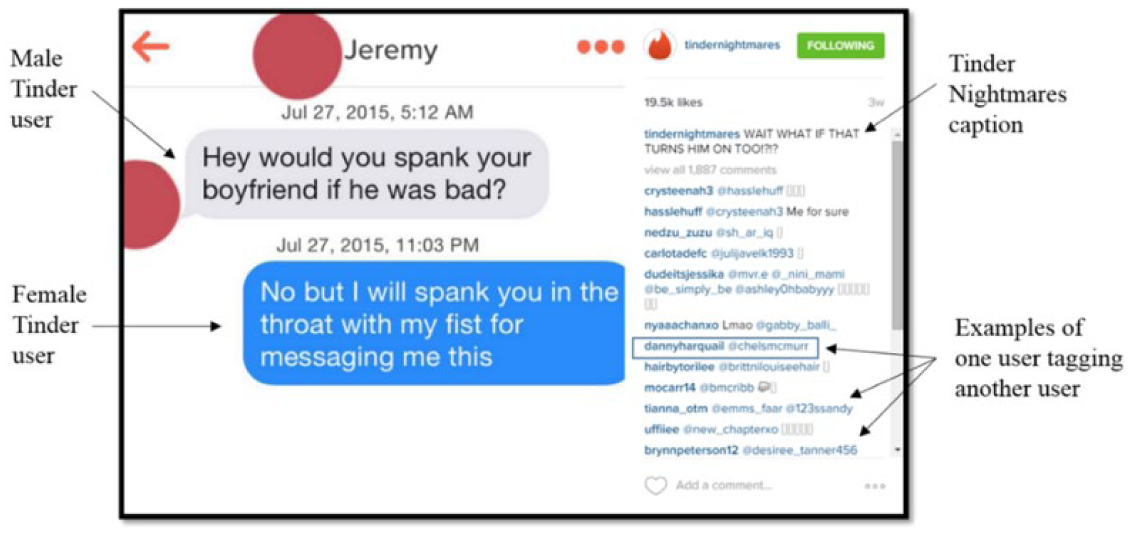
Screenshot from Tinder Nightmares’ Instagram page.
Analysis
Before turning to our analysis, it is important to note that we presume a stark gender divide on Tinder Nightmares. In examining the site, we found that when names are given for original posts, they are almost entirely typical male names, and replies are almost entirely by women. 3 Although women are infrequently featured, we focus our attention on the failed performances by men. We do so not to conflate sex and gender but to underscore the constructed nature of masculinity within the demographic skew found on Tinder. To analyze Tinder Nightmares, we, first, analyze the initial display of toxic masculinity as it is performed by men attempting to hook up. Second, we extend our analysis to focus on how women improvise responses to the performance of toxic masculinity. Finally, we examine how Instagram users extend the public shaming to other users, implicating them into the disciplining of masculinity.
Outing toxic masculinity: creeps, assholes, and fuckboys
Tinder Nightmares primarily serves as a space to document crude performances of masculinity and the ways male Tinder users attempt to engage with women. This strain of toxic masculinity is often parallel with the ways gender performance is articulated in other digital spaces (Fullick, 2013; Thompson, 2016), especially when the masculine performance is markedly misogynistic. Tinder Nightmares showcases moments of this toxic masculinity as being especially deserving of ridicule. The individuals sent up for public shaming on Tinder Nightmares are those whose attempt at hitting on women was especially crass and who are commonly referred on the site as being “creeps,” “vulgar,” “fuckboys,” or “assholes.” Below, we outline three types of heterosexist performances that are on display at Tinder Nightmares: groan inducing failed pickup lines, hypersexual declarations, and objectification through consumption. Taken together, we argue that Tinder Nightmares presents an image of toxic masculinity that its users are able to counter-discipline. While somewhat of a straw figure—certainly, not all men on Tinder engage in these behaviors—the image of toxic masculinity rings true for many commenting users who swiftly judge the original post, as we articulate in our final section of the analysis.
Groan inducing failed pickup lines
Of the more salient hypersexual performances, many users express hypermasculinity through failed pickup lines, featuring particularly poor attempts to hit on women. For example, one male user commented, “Damn girl I’d make you a single mother of two,” and another rhymed, “Twinkle twinkle little star/Let’s have sex inside my car.” As poor attempts at pickup lines, they signal a significant failure in creativity by the male Tinder user. Women respond in many ways, which we discuss below, but often will incredulously ask whether these failed lines are actually working. Many lines are often prepackaged and recycled as a performative strategy to gain attention. One user sent the following message: “You probably have the best smile I have seen in America:) Although its been only 3 weeks for me in this country but you top the chart:).” The receiver takes issue with the message by responding, “Dude. You sent me the EXACT same message 2 weeks ago. At least update your numbers. So lame.” In another example, two different users sent the following prepackaged lines: “Congratulations! You have just been enrolled into a relationship with Erin/Brian. To keep receiving these messages reply with ‘HEY’ or to unsubscribe reply with ‘FUCK OFF’.” The use of prepackaged messages indicates that Tinder users rely on a predominantly performative approach to engaging the space of Tinder (Goffman, 1959, 1974). These performed—and often preformed—pickup lines emanate from larger gender scripts (Butler, 1988), which inform their performance on Tinder.
Hypersexual declarations
Another unsurprising element is the overt sexualization of the female body. Many messages begin with a desire to commit crude sexual acts onto recipients. One user, after providing a benign greeting 5 days prior, sends a follow-up message saying, “I want to put a baby inside of you.” User Ben, who was captioned as the “worst person alive,” asked his match, “Ever been drenched? Basically I’m looking for a new slam pig.” Finally, user Matt is featured for asking, “I just finished a round of golf, wanna be my 19th hole today?” At the core of these toxic messages lies an inherent assumption that men can be successful in courting women through direct sexualization of their bodies. Many of the declarations seen on Tinder Nightmares, although crass and hypersexual, indicate that the performative nature of gender and sexuality is sedimented through normalized gender practices (Butler, 1988). Tinder Nightmares isolates these normative hypersexual displays from their (private) hookup context, allowing users to plainly see their gross attempts at courting and to unmask the common assumptions about masculine sexual prowess inherent to hookup culture (Currier, 2013; Jane, 2016).
Objectification through consumption
Another strain of misogynistic masculine advances is the use of food or consumption metaphors, which equates the consumption of food with the consumption of women. Shugart (2008) argues that the use of food in film signals the gendered consumption of otherness. Many of the Tinder messages we analyzed contained frequent references to food as a way to not only attract women to conversation but also to connect women to the act of consumption. Messages hinting to this include, “How many chipotle bowls am I gonna have to buy you before we rub ice cream all over each other and fuck?” “Do you like ramen noodles? Cause I’m gonna be ramen my noodle in ya,” “How do you feel about me licking nutella off your body,” and “are you gonna let me lick whipped cream off you or nah cuz if not let’s end this here.” The relationship between sexuality and food has been critically documented in feminist literature (Bordo, 1993; Hines, 1999). In her linguistic analysis, Hines (1999) contends that the use of metaphoric language to transform women into desserts maintains a cognitive structure of “women-as-sex-objects” (p. 145). Such is the case on Tinder Nightmares, where this somewhat strange association between food and sexual intercourse drawn upon by Tinder users underscores a misogynistic masculinity that objectifies women.
Taken together, these three elements construct an image of toxic masculinity that Tinder users and followers of Tinder Nightmares alike can tear down. Similar to how online dating encourages ideal self-presentation as the key for successful interactions (Gibbs et al., 2011), Tinder users also attempt some form of ideal self-presentation, even if that ideal is hypermasculine and attempts to discipline women. Tinder users seemingly feel obliged to send messages based on what they perceive to be socially acceptable form of masculinity in this space (Currier, 2013). Furthermore, Tinder Nightmares becomes a place for witnessing these performances, which are challenged and countered through the page and its specific practices. One such practice is the ability of recipients to respond to and improvise against users who offer toxic masculine performances.
Responding to toxic masculinity
Two primary responses from women are featured on Tinder Nightmares: silence and witty improvisation. First, many posts found on Tinder Nightmares do not feature a response from women. While difficult to know the exact intention behind not responding, we believe this silence is meaningful. Silence typically receives less attention as a lesser part of the binary shared with speech (Acheson, 2008). Instead, the role that silence plays in the conversational moments on Tinder Nightmares largely amounts to “the conspicuous and meaningful absence of a linguistic sign” (p. 536). Brummett (1980) gives attention to silence used in politics as being more meaningful than signaling mere avoidance. Silences on Tinder Nightmares are similarly significant as they alert men of their poor attempts at courtship, as well as notify them that there is little possibility of being dignified with a response. What is of interest is that silence not only functions as a strategy to meaningfully cease all communication, but it often forces the hand of hypermasculine Tinder users, causing them to “up” the performance—even from benign pickup lines to misogynistic or hypersexual outbursts—indicating that silence is rhetorically influential by instigating additional comments, adding to their already toxic performances and inviting more scorn from Tinder Nightmares followers. For example, one user started with “Why did the chicken cross the road?” With no response, the user follows up 5 days later with “I like muff diving.” In another example, one “poetic” male user offered, “Brittany Brittany oh so witty/send me a picture, show me some titty.” When no response was given, the male user doubled down on the rhyme, offering another that ended with a request for sex. The female user finally responds with a rhyme of her own: “Jason, jason you’re out of luck. You think you’re clever, but you’re just a lame fuck.” Moments like these indicate that silence can be deliberate and meaningful as an active performative response to the misogyny found on Tinder.
Whereas many women engage in strategic silence, others directly respond to performances of toxic masculinity. Against the use of scripted pickup lines and misogyny, many women respond through an improvisational style. These conversational moments not only qualify them as worthy for display on Tinder Nightmares but also work to challenge toxic masculinity on Tinder broadly. For example, upon being asked by Jeremy if she would spank her boyfriend if he was bad, one woman replied by saying, “No but I will spank you in the throat with my fist for messaging me this.” User Chris is met with disdain after asking, “Ok so if I were a stool, would you sit on my face?” to which the recipient says, “I’d shit on it.” After being questioned about what sexual acts she would be willing to commit, one user replies, “Since your response, I’ve already thought of 4 different ways I’d murder you.” In another example, a male user asks for sex because he is “on a bit of a dry spell.” The woman replies, “That just made my vagina a dry spell.” Finally, the improvisational nature of Tinder conversations is highlighted through the use of emojis (see Figure 2).
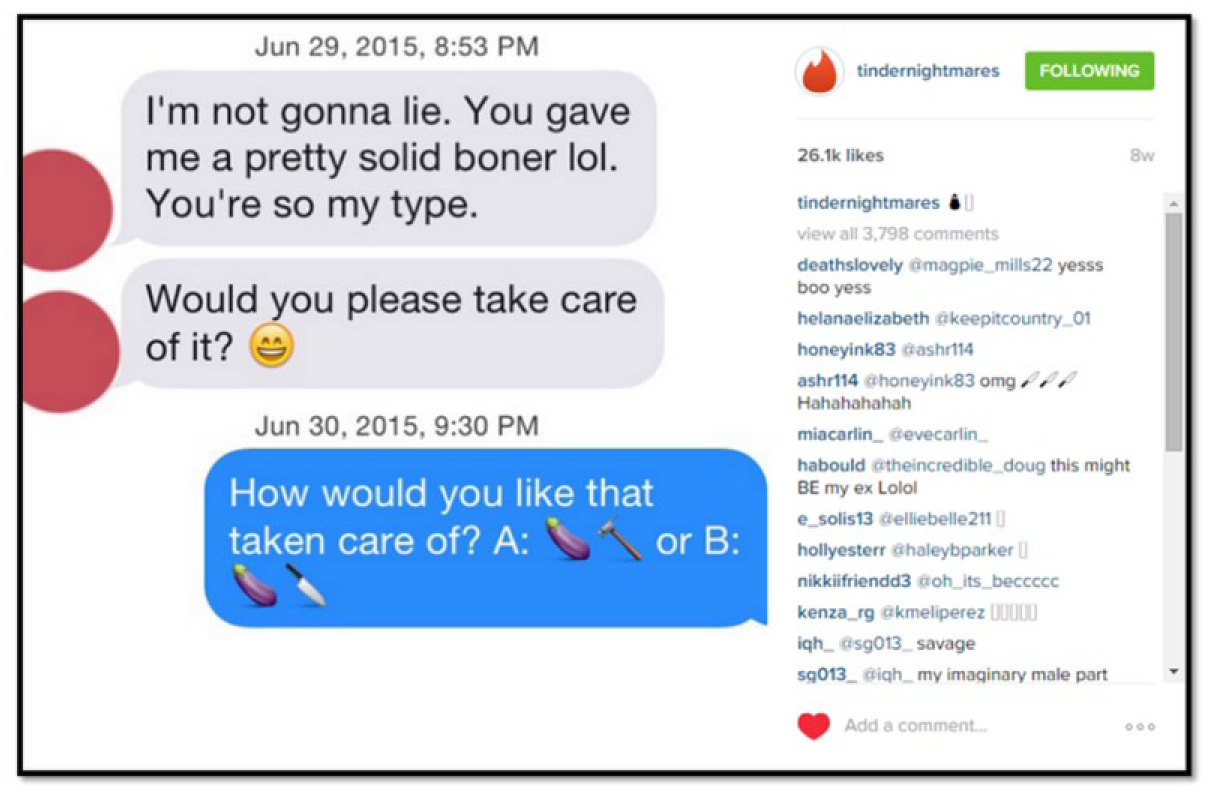
The use of emojis in response to men on Tinder.
In other instances, women on Tinder respond to toxic masculinity by calling out the failed pickup line for what it is. For example, women respond with “How well has that one been working for you?” “I hope for your sake that this pickup line is not representative of your abilities in bed …,” or “Adorable. What’s the success rate with this line?” In these cases, the women on Tinder Nightmares refuse to play the performative game of Tinder (Sales, 2015) and separate the failed line from the act of performing the line. In another example, the user Luke performs both the consumptive objectification and hypersexual elements of toxic masculinity: “Yogurt. Cereal. Soup. Sidney from Tinder. These are all things I want to spoon.” In response, his Tinder match replies, “Did you copy and paste that from a conversation you had with a girl named Sidney and forget to change the name?” These responses deflate the puffed up hypermasculinity offered by the men of Tinder, ridiculing their failures on the site. Some responses invoke Tinder Nightmares with simple replies of “Tinder Nightmares” or “boom, tindernightmares,” meaning that Tinder users are recognizing the function of Tinder Nightmares to assist in calling out toxic masculine performances.
Two implications arise from the conversational aspect of Tinder interactions on Tinder Nightmares. First, the responses are improvisational in nature. Lockford and Pelias (2004) argue that successful improvisation “hinges upon a variety of linguistic, historical, cultural, interpersonal, and theatrical contingencies” (p. 435). Although they reference theater performances, the performative atmosphere of Tinder and hookup culture offers a space to improvise as well. Indeed, improvisation can be a useful concept for understanding unique moments of dialogue that may unfold (Bateson, 1993; Hess and Sobre-Denton, 2014). Following Butler’s (1999) theorizing regarding gender performances, the men of Tinder are often following the scripts of hypermasculinity, both in the larger sense of toxic masculinity as a desirable performance and in the smaller sense of pickup lines as scripted attempts at playing the hookup “game.” In response, the women featured on Tinder Nightmares go “off script” by not engaging with men in the preferred way. Rather, they improvise their lines in this performance. Second, for Lockford and Pelias (2004), improvisation is a form of communication that negotiates, and even breaks, boundaries. We see the improvised moments on Tinder Nightmares, even those that are seemingly minor, as moments of breaking the heterosexist disciplinary constrictions of the original performance and turning the larger discourse of shaming and disciplining back upon toxic masculinity. These crafty responses are rewarded for their effort by being openly shared on Tinder Nightmares as examples of how to address toxic masculine performances and subsequently circulated through Instagram to invite additional responses and shaming.
Circulating shame
Keeping in mind that Tinder Nightmares is on a social networking site (Instagram), we now turn our attention to the sharing and outward circulation features that extend the public audience of Tinder Nightmares. Circulation establishes a clear relationship between original posts and social media outlets that make said posts spread. In this way, the audience for Tinder Nightmares becomes integral to the distribution and “spreadability” of the site. As Jenkins et al. (2013) argue, “media industries have begun to reconceptualize their audiences as active participants” in the success of their products (p. 45). Both Tinder Nightmares and Instagram feature circulatory digital practices for the sharing of posts. Below, we culminate our analysis by considering the social media nature of Tinder Nightmares and implicate the massive circulation of the site through Instagram.
Following many social media sites, Tinder Nightmares invites user comments and tagging of other Instagram users (Figure 1). This practice not only is tied to larger digital literacies inherent to social media but also has a particular function on Tinder Nightmares that relates our analysis above. The original posting of the Tinder screenshot reinforces the idea that men who engage in hypermasculine performances should be publicly disciplined for their performance. The women who successfully respond with witty comments on Tinder or who go “off script” from the hookup game are lauded through both their display on Tinder Nightmares and in the comments section. Looking to those comments, our initial contentions about the shaming function of Tinder Nightmares are often confirmed. Comments on individual images include a sarcastic “smooth,” “how to talk to boys lesson 1,” laughter (“hahahaha” or “lol”), and calling the failed attempts “awkward.” Looking deeper, comments become much more critical in their disciplinary function. For example, one woman on Tinder corrected the spelling of a failed pickup line (“Then tits doe”) from a male Tinder user, who then responds with “Fuck you. Fuck you. Fuck you.” A number of commenters extend the discipline, saying, “HE CANT FLIRT TO SAVE HIS LIFE,” “He got so aggressive,” and “a little violent.” In an aforementioned example that connected buying “chipotle bowls” and sex, users call out the performance as “weird shit,” say that “guys are so annoying” and even “fuck that guy, game over.” These comments indicate that many commenters agree that these posts are indeed nightmares and their male authors worthy of scorn.
While evidence exists that many decry the misogyny found on Tinder, two other elements of the comments are worth noting. First, a vast majority of the comments are tags—one user including username of another—of the Tinder Nightmares post to other individuals, meaning that one person has sent the original post to another (see Figure 1). While seemingly meaningless, these frequent tags reveal the circulation of Tinder Nightmares on a micro level. Second, another common practice is the inclusion of a simple line along with the tagging, saying “you on tinder” “was this you?” “could this be you?” or “sounds like something you would say.” These moments serve as warnings about inappropriate behavior or calling out particular individuals for their own performances of toxic masculinity. Together, the comments and tagging of Instagram followers to view a particular image are resources that not only augment Tinder Nightmares as a space to learn about how not to act on Tinder but also extend the disciplinary function of the page.
In this sense, Tinder Nightmares and its expansion across Instagram carry a form of disciplinary power. Foucault (1979) contends that, in contrast with sovereign power, disciplinary power makes subjects visible and individualized so as to order and arrange them: In discipline, it is the subjects who have to be seen. Their visibility assures the hold of the power that is exercised over them. It is the fact of being constantly seen, of being able always to be seen, that maintains the disciplined individual in his subjection. (p. 187)
In extending these arguments into the realm of sexuality and biopower, Foucault (1978) argues that [s]uch a power has to qualify, measure, appraise, and hierarchize, rather than display itself in its murderous splendor; it does not have to draw the line that separates the enemies of the sovereign from his obedient subjects; it effects distributions around the norm. (p. 144)
Social media exemplifies this distribution, providing expansive means by which the populace engages in (self) control (Bucher, 2012; Stern, 2011; Van Dijck, 2013). Although the use of discipline originally surfaces in the hypermasculine and misogynistic discourse often offered by men toward women, it is also the case that women counter these discourses with the public circulation and humiliation of men’s performances.
On Tinder Nightmares and the social media apparatus behind it, users are made visible and hierarchized in multiple ways. Certainly, users who engage in toxic masculine performances are made visible through original posts, and the women who respond are made visible through their improvisational wit, which accents the overall visibility of toxic masculinity. Looking further, tagging others, which occurs with incredible frequency, also makes those individuals visible and subject to the disciplinary function of the site. Bucher (2012) argues that social media in general, and Facebook in particular, can be understood as sites of discipline through making the self (in)visible to others. For Tinder Nightmares, a similar practice occurs, except it is making the other visible within the disciplining of misogynistic discourses. Instagram users who tag others on the Tinder Nightmares page are making them visible into a disciplinary space against toxic masculinity in hookup culture.
Implications and conclusion
Examining Tinder Nightmares’ documenting of toxic masculinity yields three interrelated implications. First, individual images and the Instagram page function as both micro- and macro-discourses that work to govern gender (Foucault, 1978). In contrast with how femininity has been disciplined (Bartky, 1997; Bordo, 1993), Tinder Nightmares attends to the overt performance of toxic masculinity and the hypersexual male body. In instances where women have been the subject of these discourses, “female bodies become docile bodies—bodies whose forces and energies are habituated to external regulation, subjection, transformation, ‘improvement’” (Bordo, 1993: 166). For Tinder Nightmares, our theorizing of discipline departs from typical understandings of Foucauldian disciplinary power. Men performing hypersexual masculinity in order to discipline women are subject to a counter-disciplinary challenge and external regulation by women who respond to them and the thousands of shares across social media platforms. Although the motivation of these toxic performances is difficult to ascertain—perhaps men engage in these behaviors merely for the sake of them or even to appear on Tinder Nightmares—they are guided by the “Guy Code” (Kimmel, 2008: 7) and stronger misogynistic discourses found online and offline. Male users frequently adhere to gendered performance scripts that continuously constitute “the illusion of an abiding gendered self” (Butler, 1988: 519)—in this case, the masculine self. The outward display and ridicule of these performances disrupts the illusion and regulate the male body through emasculation, thereby challenging the habits within hookup culture. For example, when men present phallic emoji or colorfully portray their penis, women on Tinder Nightmares symbolically castrate (Figure 2) and ridicule them, directing them to “keep it in your pants.” Counter-disciplining these sexually charged engagements provides learning moments for other users about how to properly perform on Tinder and how to not appear on Tinder Nightmares.
Second, the public counter-disciplinary use of Tinder Nightmares provides women with discursive agency to challenge the heterosexist masculine norms inherent to both hookup culture and Tinder. Although past research on online dating has focused on ideal self-presentation (Ellison et al., 2006; Gibbs et al., 2011), our analysis of Tinder Nightmares critically examines how women and other users undermine the performance of toxic masculinity and create new normative expectations for mobile dating. Previous research regarding hookup culture or other permissive sexual relationships (Currier, 2013; England et al., 2008) has struggled to articulate whether women engaging in casual sex leads to a sense of feminist empowerment or sexual agency. Largely in contrast with the vision of demure women subjugated by disciplinary powers (Bartky, 1997) or the emphasized femininity common to hookup culture (Currier, 2013), Tinder provides women with an opportunity to forcefully speak back to toxic masculinity and heterosexist gender scripts in hookup culture. Tinder Nightmares accents this discursive agency by spreading the performance across social media, whereby the circulation of the post shifts the focus of attention from the private context to a public discussion of men and online misogyny (Jane, 2016). The growing amount of content circulated on Tinder Nightmares provides women with exemplary moments of witty comebacks that stand up to toxic masculinity, thereby collectively equipping them with the discursive tools necessary to challenge heterosexist masculine norms on Tinder and in hookup culture. Whether this leads to sexual agency remains unknown; however, through the tactics of “feminist digilantism” (Jane, 2016), women who are featured on Tinder Nightmares and the Instagram users who circulate the page have found an empowering means of countering toxic masculinity through discipline.
Third, when combined with disciplinary elements, the function of Tinder Nightmares as a social media site and Tinder as a locative app add to the nature of agency afforded women. By being location-aware, Tinder provides a sense of “co-situation,” which Blackwell et al. (2015) argue “layers virtual and physical places in ways that affect people’s visibility to each other … [and] creates tension in users’ strategies for self-presentation as they craft positive identities in an environment where identifiability by outsiders may be perceived negatively” (p. 1118). For Blackwell and colleagues, the nature of identifiability was particular to gay identity on Grindr. For us, the discursive disciplinary function of Tinder Nightmares intersects with the physical proximity of users on Tinder. This means that the discursive shame and ridicule offered on Tinder Nightmares manifests in physical, material ways as device, app, physical user, and network intersect, and that the subject becomes multiply implicated in each (Hess, 2015). The posts on Tinder Nightmares are not simply anonymous responses from random online users; they are experienced in public proximal spaces. Although it is difficult to know the response men have to Tinder Nightmares, the potential scorn felt by many male users who receive a reply of “#tindernightmares” from a woman on Tinder is extended into the physical space of user proximity, implicating the body of the user as well. The sharing of the post via Instragram then sends the disciplinary act into massively networked spaces (Bucher, 2012; Van Dijck, 2013). In those social networks, the circulatory disciplining of particular users through tagging extends the visibility of the misogynistic masculine subject. In other words, the discipline offered through this locative and social media site surfaces in interpersonal, physical, and networked ways.
By outing the performance of toxic masculinity, Tinder Nightmares provides women with a form of discursive agency through the showcasing of witty replies. In responding directly on Tinder and circulating these responses through Instagram, women’s agency in the context of hookup culture is bolstered, as users discipline others through warnings about potentially negative behaviors. Tinder Nightmares provides a compelling case for how toxic masculinity can be counter-disciplined through extensive public and digital circulation. For men who adhere to hypermasculine and heterosexist codes, it appears that the dream of successfully hooking up with women through these performances is over.
Footnotes
Acknowledgements
The authors would like to thank Steve Jones and Jenny Korn for their editorial assistance and the anonymous reviewers for their feedback on this essay. An earlier version of this manuscript was presented at the 87th annual conference of the Western States Communication Association in San Diego, CA.
Funding
The author(s) received no financial support for the research, authorship, and/or publication of this article.