




Abstract
This study employed a functional approach to conceptualize the Facebook Like button as a social cue that allows users to convey various meanings while enacting multiple interpersonal functions. Participants reported on their general reasons for using the Facebook Like button, as well as their most recent actual uses. Results discussed the following: the general predictors of Liking frequency, the specific meanings that participants sought to express by clicking Like (i.e. relational-based and content-based), the larger interpersonal functions that participants hoped to accomplish (i.e. relational facilitation, self-presentation, and metacommunication), the associations between intended meaning and interpersonal functionality, and finally, the additional response buttons that participants wish Facebook offered (e.g. Dislike, Sympathy, Congratulations, Agree, Disagree, Interesting, Funny, Love, and Got It).
Keywords
The Like button is a popular Facebook feature that enables users to communicate through the single click of a button. Hayes et al. (2016) conceptualize the Like button as a “paralinguistic digital affordance” of social media that “facilitates communication and interaction without specific language associated” (p. 5). In defining the term paralinguistic digital affordance, Hayes et al. suggest that the Like button is similar to forms of phatic communication (e.g. waving or saying “hey”; see Malinowski, 1972), which allow individuals to acknowledge others, observe politeness norms, and enact social grooming without nuanced communication. As such, the ease of use and array of potential meanings are two of the Like button’s most important features because they allow users to interact in prosocial ways when they do not have anything particularly enlightening to contribute to a conversation. Miller (2008) concurs that phatic communication is becoming an increasingly prominent way to avoid substantive information exchange in new media environments.
All communicative cues (i.e. both linguistic and nonverbal) are open to interpretation, yet the phatic nature of the Like button facilitates particularly high levels of communicative ambiguity. Some people seem to use the Like button as a multipurpose reaction to any content that seems worthy of a social response: the Facebook equivalent of a head nod. That said, the Like button might sometimes go beyond the realm of shallow sociability to function as a purposeful—albeit minimalist—form of communication. In these cases, users must discern whether the Like is meant to convey literal liking or is being appropriated to communicate some other meaning. Although Hayes et al. (2016) astutely describe the Like as a way to communicate without clear language, the word like carries a fairly clear connotation of enjoyment and positive regard. Using the Like button might therefore create a sense of denotative hesitancy in which the word like and its assumed positive connotation fails to accurately capture the array of intended sentiments and desired outcomes.
Due to its multipurpose and ambiguous nature, the Like button can be fruitfully investigated using an approach that examines both meaning and functionality, such as the functional approach to computer-mediated communication (CMC). This approach draws from the longstanding functionalist tradition, which has been employed in multiple disciplines (e.g. philosophy, psychology, and sociology) to argue that psychological and social phenomena can be best understood by exploring their functional purpose within larger systems (Levin, 2013). Burgoon et al. (1989) draw upon the functionalist tradition to describe a functional approach to nonverbal communication that offers three claims: “A single nonverbal cue may serve multiple functions. A single function may be accomplished through multiple nonverbal cues. A single function typically requires the coordination of verbal and nonverbal behaviors” (p. 26). As such, the functional approach provides understanding of how communicative cues function within larger conversational and relational contexts.
Walther and Ramirez (2009) extended the functional approach to computer-mediated contexts by arguing that any cue (e.g. mediated or face-to-face) can communicate multiple meanings. Moreover, individuals can select from a wide array of cues when attempting to communicate a particular message. Hence, Communicators use whatever cues they have at their disposal when they wish to communicate sociably … the study of CMC is best premised on the interactions of time, cues, and interpersonal motivations, on the relational functions which it may reflect. (Walther and Ramirez, 2009: 266)
The Facebook Like button fits Walther and Ramirez’s definition of a time-saving cue that can be best understood in conjunction with the messages that motivate its use, and the resulting interpersonal functions that are accomplished.
Researchers are increasingly aware that social network sites (SNS) are not monolithic entities, but rather, sets of distinct communicative cues combined within a single interface (Smock et al., 2011). The functional approach to CMC provides a way to analyze specific SNS cues, such as the Like button, in relation to larger interpersonal processes. This study therefore utilizes the functional approach to understand (1) the general user characteristics that predict Liking behavior, (2) the meanings that users intend to convey by clicking Like, (3) the larger relational functions that are enacted by Liking, and (4) the interplay between the intended meaning and desired functionality of Liking behavior. Knowing that the Like button is only one potential way to communicate and enact interpersonal functions, this study also explores other response buttons that users wish existed for these purposes.
Facebook and the Like button
SNS are prominent ways for individuals to display their identities while interacting within their social networks. Data from the PEW Research Center indicates that 74% of online American adults use SNS (Duggan et al., 2015). The same data reveal that Facebook is the most popular SNS with a 71% user rate among online adults, in comparison with user rates in the 20% range for Pinterest, LinkedIn, and Instagram. Facebook users also appear to visit the site habitually, with 1.13 billion active daily users and 1.71 billion active monthly users as of June 2016 ( Facebook.com , 2016).
Bryant et al. (2011) infer that Facebook’s large and remarkably active user base is indicative of the important relational functions that the site enables. The most salient reason for using SNS appears to be the maintenance of existing offline relationships (Walther and Ramirez, 2009). Facebook provides a relatively easy way to amass social capital by articulating connections and interacting with both weak and strong social ties (Ellison et al., 2011). While doing so, users engage in identity management by portraying their desired selves and censoring content that threatens their image (Madden and Smith, 2010). A growing body of research has explored the gratifications sought from using SNS (e.g. virtual community, diversion, self-presentation, relationship maintenance, relationship building, and information seeking; Chen and Kim, 2013), as well as the psychological and social needs that motivate SNS use (e.g. the need to belong and the need for self-presentation; Nadkarni and Hofmann, 2012). These general reasons for using SNS might, however, be tied to certain cues within the interface.
Most SNS consist of user-generated content and therefore involve masspersonal communication: the one-to-many style of broadcast messaging in which users disseminate personal and relational information via public posts (Carr and Hayes, 2015). The Facebook Newsfeed interface encourages users to browse their friends’ posts, and provides various options for responding to this masspersonal content (e.g. sharing, commenting, and Liking). Most Facebook users are more likely to respond to others’ content than they are to generate original content (Hampton et al., 2012), making SNS response options a topic of great importance.
The Like button, one of the quickest and easiest Facebook response options, has become immensely popular since its introduction in 2010. The multifunctional utility of the button can be inferred from its astronomical usage of 4.5 billion Likes per day ( Facebook.com , 2013). Most existing research regarding the Like button has focused on aspects other than its interpersonal functionality. Saxton and Waters (2014), for example, explored how stakeholders use the Like button to react to nonprofit organizations’ posts. Gerlitz and Helmond (2013) similarly described the Like button as a traceable user engagement metric in which social information is ranked based on Like popularity. These lines of research suggest that Liking behavior can help marketers and organizations understand their audiences’ attitudes, enact public relations strategies, and determine the success of existing campaigns.
A smaller body of research has begun to look at social uses of the Like button. Using researcher-derived items, Lee et al. (2016) found that enjoyment of content and interpersonal relationships were the two most common motives for Liking. In addition, participants’ Liking attitudes and behaviors were related to various personality traits (i.e. openness and self-esteem), as well as perceptions regarding social norms and ease of use. It is important to note, however, that this study’s exploratory factor analysis grouped items such as “It helps me show support to others” and “It helps me feel or express caring” under the content enjoyment motive rather than the more conceptually fitting interpersonal relationships motive. The results might therefore be clarified by qualitative research regarding Liking motivations.
In one such study, Hayes et al. (2016) asked participants to explain their motivations for using and receiving paralinguistic digital affordances such as Likes, Upvotes, +1s, and Favorites. They concluded that these buttons are sometimes used in a faithful manner (e.g. literally liking the post), yet are also used in an ironic manner that violates the literal phrasing (e.g. sending a social message). Motives were found to include the following: giving a literal interpretation of liking a post, acknowledging having viewed a message, engaging in social grooming, and keeping a record of a post. Compared to other response buttons that were described as being used quite selectively (e.g. the Twitter Favorite), participants in Hayes et al.’s study claimed to use the Facebook Like as a relatively aimless and therefore somewhat devalued way to acknowledge their friends. The authors’ broad focus on sending and receiving multiple SNS buttons, however, facilitated breadth rather than in-depth understanding of the meanings and interpersonal functionality of the Facebook Like.
This study
This study examines the applied use and functionality of the Facebook Like button. Hayes et al. (2016) called for additional research exploring the frequencies and antecedents of paralinguistic digital affordance buttons. In one existing study, Hampton et al. (2012) reported that the average Facebook user hit Like 14 times per month, yet received approximately 20 Likes per month. The authors did not seek to determine which factors predicted Liking behavior, but their results indicated that women generate more Facebook content than men, and that a small segment of “power users” generated and received disproportionately large amounts of content. Usage statistics have likely changed since Hampton et al.’s study, yet their results imply that Liking frequency might be predicted based on both individual characteristics and generalized characteristics of SNS use. This study therefore explores the following question:
RQ1. Which aspects of general SNS behavior (i.e. number of SNS used, intensity of Facebook use, and level of active Facebook engagement) and participant characteristics (age and biological sex) predict the frequency of Facebook liking behavior?
The Like button is an inherently communicative cue that has adopted a more liberal range of meanings than the term “like” implies. Existing research has either asked participants to rate researcher-derived motives for Liking posts (Lee et al., 2016) or has explored general motives for using various SNS’ platform buttons (Hayes et al., 2016). This study will build on this research by asking participants to identify their most recent Facebook Likes and describe the messages that they meant to communicate within each. The assessment of actual Likes provides two main advantages. First, grounding questions within the context of a particular Like enables participants to recall specific intentions without concern for their broader patterns of use. Second, the use of actual Likes enables quantitative examination of the frequencies in which various meanings motivate real behavior. As such, the following will be addressed:
RQ2a. What meanings do Facebook users intend to communicate by clicking Like?
RQ2b. Which meanings are most frequently cited as motivating Liking behavior?
The functional approach is useful because it considers not only the intended meanings that motivate Liking but also the larger interpersonal functions that are accomplished by doing so. Bryant et al. (2011) identified six relational functions of SNS: relationship initiation, relational maintenance, relational reconnection, identity experimentation, impression management, information seeking, and metacommunication. The authors presented these functions as theoretically describable processes that occur both online and offline yet are commonly enacted via SNS. Their functions, however, were a heuristic for understanding all forms of SNS communication and were developed by reviewing existing research rather than conducting original empirical analysis. This study extends this line of research by qualitatively and quantitatively examining the functionality of the Like button:
RQ3a. What are the interpersonal functions of Liking a Facebook post?
RQ3b. Which interpersonal functions are mostly frequently cited as desired outcomes of Liking a Facebook post?
This study conceptualizes the Like button as a social cue that allows individuals to efficiently engage in both phatic and more goal-driven communication. In this sense, a relationship might exist between what people meant to communicate (i.e. the intended meaning of a Like) and what they hoped this particular Like would accomplish (i.e. its interpersonal functionality). This speculation aligns with Walther and Ramirez’s (2009) claim that cues should be considered in regard to the interplay of motivation and functionality, and leads to the following question:
RQ4. Do the intended meanings that motivate individuals to click Like relate to the interpersonal functions that are enacted through use of the button?
Finally, this study explores whether users desire additional Facebook buttons. One problem with the paralinguistic and phatic nature of the Like button (Hayes et al., 2016) is its somewhat ambiguous meaning. Facebook users who wish to clarify their Like often do so by writing a comment that, somewhat ironically, undermines the phatic affordances of the button. For users who wish to avoid commenting, the Like button could be insufficient at communicating messages beyond literal liking and might therefore fail at achieving desired interpersonal outcomes. The following will thus be explored:
RQ5. Which additional response buttons would Facebook users like to see offered?
Methods
Participants and procedures
A convenience sample of 156 participants (37% male, 63% female) was recruited via Facebook. Participants displayed great diversity in age, ranging from 18 to 82 years (M = 29.24, standard deviation [SD] = 14.69), yet were predominantly Caucasian (81%). The researchers posted the call for participation and increased diversity by recruiting other network members to repost the call. At this point, analysis of the research questions revealed that theoretical saturation had been reached; themes were robust and the latter portion of responses was confirming existing themes rather than revealing new ones. After providing consent, individuals were provided with a screening page indicating that participants must (1) actively use Facebook and (2) have access to their Facebook account.
Instrumentation
General SNS, Facebook, and Like button use
The first section of the questionnaire contained a series of items assessing participants’ general use of SNS, as well as their specific uses of the Facebook Like button. Participants were provided with an open-ended numerical textbox and asked to indicate the number of SNS used in the previous week. The frequency of Facebook Liking behavior was assessed by asking participants how many times they click on the Facebook Like button during an average day (open-ended numerical textbox).
Ellison et al.’s (2007) scale was used to assess intensity of Facebook use. This 8-item scale (α = .77) included the number of Facebook friends (M = 681, SD = 449.61), the average minutes spent on the site per day (M = 75, SD = 76.45), and six items concerning the personal importance of Facebook (e.g. “Facebook has become part of my daily routine”).
An indicator of active Facebook engagement was created using the following prompt: Facebook users vary in their level of engagement, or the extent to which they use the site actively (for example, by regularly engaging in the site by posting, Liking, and/or commenting), or more passively (for example, by viewing the site without positing, Liking, and/or commenting).
Participants were asked to rate their own level of engagement on a 7-point scale (1 = very passive to 7 = very active) and reported a mean of 4.13 (SD = 1.58).
Finally, participants were provided with an open-ended textbox and asked to explain what, in general, they hope to accomplish using the Like button. This resulted in 156 unique answers regarding the perceived general functionality of the Like button.
Examination of actual Facebook Likes
The second section of the questionnaire asked participants to open their Facebook “Activity Log” and identify their three most recent Likes. Several participants elected to report on only one or two Likes, resulting in data regarding 365 specific Likes. For each Like, participants were asked to (1) identify their relationship to the poster, (2) copy-and-paste the text of the Liked post and describe any non-text aspects, (3) explain what they hoped to accomplish with this particular Like, and (4) describe what other word or phrase might more accurately capture their intended meaning.
New Facebook button ideas and demographics
The final section of the questionnaire asked participants to describe any additional Facebook buttons that they would like to see implemented, using an open-ended textbox.
Data analysis
Predicting the frequency of Facebook Liking
RQ1 asked whether the frequency of Facebook Liking could be predicted based on participants’ personal characteristics and general SNS behavior and was tested using a linear multiple regression with the frequency of Liking as the criterion. Participants’ age, biological sex (dummy-coded), number of SNS used, intensity of Facebook use, and active Facebook engagement were entered as single-step predictors. The final model (see Table 1) predicted 26% of the variance in Liking frequency: total R2 = .30, adjusted R2 = .26, F(5, 109) = 8.74, p < .001. In response to RQ1, the level of active Facebook engagement (M = 4.25, SD = 1.58, β = .46, p < .001) emerged as the sole univariate predictor of Liking frequency (M = 10.71, SD = 14.26), with intensity of Facebook use falling just short of significance.
Final model predicting frequency of Facebook liking behavior (N = 109).
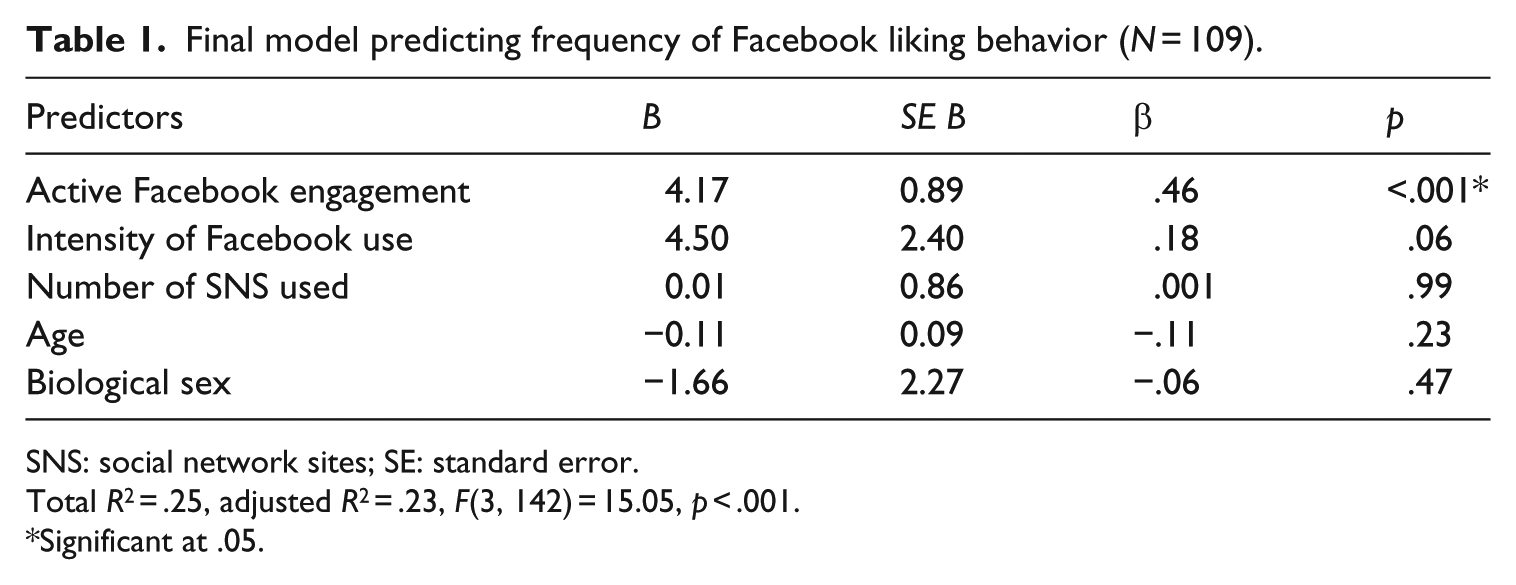
SNS: social network sites; SE: standard error.
Total R2 = .25, adjusted R2 = .23, F(3, 142) = 15.05, p < .001.
Significant at .05.
The meanings that motivate Facebook Liking behavior
Within this study, participants demonstrated an acute awareness of the complex set of potential meanings for the Like button. As one person explained, “Like can mean like, or it can mean I am sorry, or I am thinking of you, or many other things … it is generally understood based on the type of post what the Like button means.” This participant, however, placed immense trust in users’ ability to accurately decipher each other’s intended meanings.
To explore the question of intended meaning more thoroughly, RQ2a was examined using constant comparison (Glaser and Strauss, 1967) of the 365 open-ended answers that participants provided when asked what word or phrase might better explain what they meant to convey with a specific Like. Constant comparison was utilized because it enabled the inductive development and iterative refinement of themes throughout the analytical process. Analysis revealed two main types of intended meaning: content-based and relational-based.
Content-based meanings
Participants frequently indicated using the Like button for the very reason that the term implies; they wanted to communicate that they liked something about a post’s content. In some cases, users wished to convey that they agreed with the sentiment being shared, and the Like was meant to imply, “this is correct information. I enjoy or approve of the content.” In other instances, participants indicated that their Likes were meant to imply that the content of the post was “encouraging,” “thought-provoking,” “informative,” “useful,” “cute,” “funny,” “exceptional,” “creative,” or otherwise “important and interesting.” Regardless of the exact phrasing, these meanings involved using the Like button to communicate content-related messages such as endorsement, agreement, amusement, or interest.
Relational-based meanings
A substantial portion of Liking behavior was described as having more to do with relationships than with actual content. As one participant summarized, “I didn’t mean that I like the sad post, I meant that I support her.” In these instances, the Like button can be seen as a way to convey relational meanings such as “I like you,” “I care about you,” “I support you,” “I appreciate you,” “I’m here for you,” and even “I’m sorry.”
RQ2b built upon the analysis of RQ2a by examining the frequency with which relational and content meanings were cited as the underlying messages that motivated a Like. The 365 responses were coded as Likes that conveyed (1) content-based meaning, (2) relational-based meaning, and (3) both content and relational meaning. For example, participant responses such as “I meant that I found the piece of art really impressive,” “I want to try the recipe,” and “This is funny” were all coded as content-based messages. Conversely, responses such as “I meant it to support my friend,” “I am paying attention to you,” and “I’m happy for you” were coded as relational-based messages. Finally, responses such as “I like her and Disney,” and “It is a cute picture of them and he is a great person” were coded as intending to convey both content and relational meanings. Regarding RQ2b, participants described having Liked 191 posts (52%) based on their desire to signal purely content-based meanings, 85 posts (23%) to convey purely relational-based meanings, and 87 posts (24%) to convey both types of meaning.
The interpersonal functionality of the Like button
RQ3a and RQ3b sought to understand the interpersonal functions that are enacted by Liking a post. Due to its exploratory nature, RQ3a was analyzed using a constant comparison of the 156 responses to the open-ended question that asked what participants generally seek to accomplish by Liking posts. Results revealed that the Facebook Like button serves three primary functions: relational facilitation, self-presentation, and metacommunication.
Relational facilitation
Participants revealed that a large portion of their Liking behavior occurs as a function of their relationship with the person who posted it. The relational facilitation function of the Like button therefore represents a combination of Bryant et al.’s (2011) relational initiation and maintenance functions.
Participants overwhelmingly indicated that clicking Like is a low-cost way to facilitate the growth and maintenance of social ties. First, Liking a new Facebook friend’s post is an easy way to build social capital by reaffirming weak social connections. As one participant explained, “It kind of makes you feel more connected with people you wouldn’t normally keep in contact with.” Indeed, the Like button was said to signal a “just right” amount of closeness for weak ties: “it can be a nice way of interacting in a small way. An acknowledgment that I am still interested in the person even if I don’t have a lot to say.” Another participant indicated, “it is more socially acceptable to Like a post from someone you don’t know well than it is to comment.” Leaving personalized comments might feel too intimate for many weak ties, and the Like button accomplishes the same relational facilitation function in a less intimidating manner.
Despite the immense relational utility of the Like button within weak tie relationships, participants explained that, “the same post becomes more likely to receive a Like the closer I am to the person in question.” Important relational partners were singled out as being particularly worthy of Likes: “when I just really like the person—for example, a close friend or loved one—I tend to like the majority of their posts.” Another participant explained that he Likes everything his girlfriend posts because “She’s my girlfriend. I don’t have a choice ☺.” In this sense, the Like button might feel like an obligation for the equitable exchange of positive regard in close relationships and is simply one of many tools that individuals use to maintain strong social ties.
Participants also indicated that the Like button facilitates the enactment of social support, which is an important relational behavior for both weak and strong social ties. One individual explained that Liking is “a way of saying I have read this and I am supporting you.” Another noted that “when someone posts that their (whoever) has cancer and they are asking for prayers. People Like it but mean that they are praying.” That said, some participants revealed that it feels inherently wrong to Like a negative post as a sign of social support, such as “when someone posts something sad or tragic.” Hence, participants were aware that the social support functionality of Liking requires a degree of tact to ensure that their supportive meaning is clear.
Self-presentation
The public nature of the Like button leads many users to consider how others might interpret their Like. As summarized by one participant, “I really put a lot of thought into my Likes. I like more posts than I tend to show simply because I know those Likes will be seen/judged.” This individual described a common dilemma in which she literally likes the content of a post, yet strategically chooses whether to publicly align herself with the post by clicking Like. The self-presentation function is a blending of Bryant et al.’s (2011) identity experimentation and impression management functions. Participants reported using the Like button as a function of their own self-presentational goals, such as (1) helping portray one’s identity and (2) maintaining positive impressions by upholding social norms and expectations.
Many participants displayed a “you are what you Like” mentality that reflected the identity aspect of the self-presentation function. Some participants claimed to Like posts to “show my philosophical positions and values” and “signal an agreement and alignment with political or social arguments.” In other cases, Liking can reveal that a post “relates to what’s going on in my life” or that the participant “identified with what is being said or shown, it holds significance to what I find important in my life.” Similar to many aspects of SNS use, self-presentation via the Like button was said to require a level of social awareness. As one participant explained, “Knowing that others can see the things I Like, I Like things based on what I want others to see I like, or things that I agree with or find funny, still noting that others can see them.”
Participants also suggested that Liking posts is a relatively low-stakes way to align themselves with important topics and beliefs, especially when compared to other SNS options such as writing, commenting, or sharing a post. Many participants suggested that Liking someone else’s post allows them to test how a particular identity claim would affect them if they were to more fully commit to it. Several users indicated that they often wish to share their beliefs on Facebook but fear that doing so would invite negative feedback. These users suggested that they instead wait for somebody else to articulate the same belief, with the assumption that “seconding the opinion” via Liking is less socially risky than making the initial claim.
Social pressure also seemed to play a role in participants’ decision to click Like. Most people want to be viewed in a positive manner, and there are times in which clicking Like is a strategic attempt to craft positive impressions. Many participants felt pressure to follow the crowd by Liking posts that “have a lot of other Likes.” In addition, multiple participants called out the reciprocal nature of Facebook Liking, and claimed that those who fail to uphold it will look bad: “you have to dish out Likes to get Likes.” This form of reciprocation was distinct from the relational function because the participants did not claim to be concerned with their friends’ feelings, but rather, their own image.
In sum, the Like button often functions as a way for users to signal their identities by saying, “I agree, relate to, and support” the post. In fact, many participants said that they avoid Liking posts that directly go against their own thoughts on a topic, even if they generally like the person who posted it. This suggests that the self-presentation aspect of identity portrayal is a prominent function of the Like button.
Metacommunication
Metacommunication involves communication about communication (Bateson, 1956), and the utilization of situational and contextual cues to shape unarticulated meaning (Ruesch and Bateson, 1951). The metacommunication function of SNS was identified by Bryant et al. (2011), and emerged as an important function of the Like button.
Facebook users know who belongs to their friend network yet have no way to ascertain who actually reads their posts, or how these individuals react. It is therefore unsurprising that participants used the Like button to enact metacommunication in the form of “simple affirmation of what has been posted,” and as a way of “acknowledging that I read the post and feeling like I need to respond without wanting to type a response.” In this way, Liking functions as a way for participants to indicate receipt of the message and provide the equivalent of a nonverbal response (e.g. nodding or laughter).
Despite its socially positive connotation, multiple participants indicated that use of the Like button, as opposed to a comment, reveals their degree of prosocial engagement and enthusiasm for a post. One individual claimed to click Like “when my approval for a post can be adequately expressed with a Like rather than a full comment.” Another participant claimed that “Liking something is a little less meaningful than leaving a comment, so I normally will scale my reaction accordingly.” A different participant clarified that she might Like a funny story that her friend posted but would write a comment if a close friend got engaged.
Whereas RQ3a explored participants’ responses regarding the interpersonal functionality of the Like button in general, RQ3b examined the frequencies with which these functions were cited as desired outcomes of the 365 specific Facebook Likes described by participants. To allow for multi-functionality within a single Like, the presence of each function was coded in a binary manner; the participant either did or did not mention the function. The following statement, for example, was coded as possessing both relational facilitation and self-presentation functions: “I am excited for her to go traveling and wanted to show support. I also identified with her own excitement because I just got back from studying abroad.” The statement, “My Like conveys to my friend that I saw the photo,” was coded as metacommunication.
In response to RQ3b, 169 of the Likes (46%) were described as addressing the relational facilitation function, 115 (32%) as fulfilling a self-presentation function, and 214 (59%) as enacting the metacommunication function. When examining the overall complexity in participants’ answers, 67% of the responses described only one function, 27% signaled two functions, 4% implied a desire to enact all three functions, and 2% did not clearly align with any function (e.g. “not sure”). These results imply that metacommunication, though often overlooked, is a vital desired outcome of Liking on Facebook.
Examining the intersection of meaning and functionality
RQ4 asked whether participants’ intended meanings are related to the perceived functionality of a specific Facebook Like. This question was tested using a series of cross-tabulations examining the intended meaning (i.e. content only, relational only, or both) on the presence or absence of each of the three interpersonal functions (see Table 2).
Intended meaning * functionality of a Like crosstabluations.

p < .001.
Results were significant for the relational facilitation cross-tabulation: χ2 (2, N = 363) = 249.47, p < .001, Φ = .83. Of note, the relational facilitation function was only present in 8.3% of the purely content-based Likes. Conversely, participants were similarly likely to describe a relational facilitation function when their Like was meant to convey either purely relational meaning (46.2%) or both relational and content meanings (45.6%).
Results were also significant for the self-presentation cross-tabulation: χ2 (2, N = 362) = 39.39, p < .001, Φ = .33. Analysis of specific frequencies suggested that the majority of Likes with self-presentation functionality were accompanied by content-only meaning (73.9%).
Finally, results were significant for the metacommunication cross-tabulation: χ2 (2, N = 363) = 73.86, p < .001, Φ = .45. Similar to self-presentation, the metacommunication function appeared to be most closely aligned with content-only meanings (63.6%).
Beyond Liking … exploring the potential for new Facebook buttons
To analyze RQ5, participants were provided with an open-ended item asking them to describe any additional buttons that Facebook should consider implementing. More than 200 words or phrases were provided. To increase parsimony, similar responses were grouped under a single category. For example, “that sucks,” “I’m sorry,” and “hugs” were collectively labeled as the desire for a Sympathy button. Table 3 summarizes the nine categories that were mentioned by at least five different participants.
Potential alternative response buttons.

The top request was for a Dislike button. The 43 participants who requested this button did not specify what Dislike meant, but rather, left it as an ambiguous counter-sentiment to the existing Like. Conversely, 26 participants used the open-ended question space to specify that Facebook should not expand beyond the Like, saying that “the Like button is the optimal option.” An additional 16 participants left this space blank, thereby implying that they did not desire any additional buttons. Many respondents explained that ambiguity and simplicity are two of the Like button’s best features, and that they appreciate the ability to leave a vague Like and let others infer whatever they want. Beyond the options of leaving only the Like or adding a Dislike, participant-desired new Facebook buttons could be fairly well grouped into the content-based and relational-based sentiments that were detected in RQ2.
Relational-based sentiment button ideas
Two of the most frequently requested Facebook buttons involved ways to enact the relational facilitation function by communicating specific support-based sentiments. First, a Sympathy button would enable Facebook users to show support for a friend who shares bad news, especially when the user does not know what to say. One participant summarized, “sometimes I hesitate to Like a post about something negative that occurred in someone’s life because Like has a positive connotation when what I really mean to say is that I feel sorry or sad on their behalf.” Another individual explained feeling stuck because “if it’s a sad post, I’m not happy that the sad thing happened, but I want to acknowledge it.” A Sympathy button would enable Facebook users to clearly signal the supportive nature of their sentiment without having to articulate a substantive comment. This potential popularity of a Sympathy button is evident in the fact that it was the most requested button behind the Dislike.
The second relational-oriented suggestion was for a Congratulations button, which was geared toward providing social support of a more positive nature. Facebook has become a vital information source through which individuals share positive life updates such as job opportunities, weddings, and birth updates. Participants indicated that they currently click on the Like button to communicate sentiments such as “happy for you” and “way to go” when a friend shares exciting news yet wished they had a Congratulations button.
Content-based sentiment button ideas
The remaining six button ideas conveyed content-based messages and would facilitate the self-presentation and metacommunication functions by providing slightly more clarity behind users’ intended meanings.
Two of these ideas were the Agree and Disagree buttons, which participants felt would more accurately enable them to reflect their identities and opinions. Interestingly, these content-based buttons also align with the self-presentation function and would allow users to more accurately portray their identity by revealing whether a post matches their own viewpoints.
Three of the content-based button ideas would enable more specific articulation of what a person likes about a post and how much they like it. Participants thought that an Interesting button would allow them to specify that the information is cool, useful, or otherwise worthy of having been shared. An Amused button would allow Facebook users to signal that the post made them laugh. In addition, participants reported that they like some posts more than others and wanted a Love button to show their degree of positive sentiment. All these potential buttons tap into the metacommunication function in that users wished to accurately convey the nature and degree of their positive reaction to a post using a single button.
The final requested content-based button also built upon the metacommunication function of the Like button; it is often used as a form of nonverbal acknowledgment. Participants revealed that they often co-opt the Like button to signal message receipt yet did not appreciate that doing so implies actual liking of the post’s content. To avoid this issue, many participants wished they could click on a Got It button that would “provide simple affirmation of what has been posted” without an implied positive reaction.
Discussion and implications
The Like button is just one of the many social cues within the Facebook user interface, but it is an immensely popular one that that is utilized more than 4.3 billion times per day ( Facebook.com , 2013). Within this study, participants reported clicking Like an average of 10.71 times per day, with users’ degree of active Facebook engagement (i.e. their tendency to actively engage with the site rather than passively browse the site) emerging as the sole predictor of Liking frequency. The main utility of the cue lies within its paralinguistic and phatic nature, which enables users to save time and maintain ambiguity by clicking Like and letting others make their own inferences (Hayes et al., 2016).
This study employed a functional approach to identify the Facebook Like button as a social cue that allows users to convey various sentiments and enact multiple interpersonal functions. The past research has articulated the basic components of the functional approach within CMC contexts (Walther and Ramirez, 2009) and has used the approach as a heuristic organizational framework for discussing the relational functions that appear in extant SNS research (Bryant et al., 2011). The study provided the first known empirical application of the functional approach to an applied CMC context, the Facebook Like button. By utilizing a mixed-mode methodology, this study was able to (1) examine the predictors of Facebook Liking frequency, (2) reveal the intended meanings and desired relational functions that underlie use of the Like button, (3) provide empirical evidence regarding the prominence of each meaning and function based on actual Liking behaviors, (4) demonstrate the interplay between intended meanings and desired functionality, and (5) identify other response buttons that might help users to clarify their communication while taking advantage of paralinguistic digital affordances. As such, this analysis offers many important contributions toward aligning motives with functionality using the functional approach.
The multiple meanings and functions of the Like button
Within the functional approach, the difference between meaning and functionality can be best captured by asking two questions in relation to a specific cue. What did the communicator mean to say? And, what did the communicator hope to accomplish by saying it? In regard to meaning, scholars (e.g. Ruesch and Bateson, 1951; Watzlawick et al., 1967) have long argued that verbal and nonverbal messages can be interpreted as communicating both content-level information (i.e. the literal meaning of the message) and relational-level information (i.e. how the message both reflects and shapes the nature of the relationship between sender and receiver). This study, along with the past research (Lee et al., 2016), reveals that the Like button is used to signal one or both levels of meaning. Of the 365 Likes, 52% were meant to convey content-related thoughts, 23% were meant to communicate relational-based sentiments, and 24% were said to contain both types of meaning. This signals that regardless of added interpersonal utility, the Like button is still predominantly used to convey some sort of content-based message. The variety of intended meanings also supports Hayes et al.’s (2016) claim that paralinguistic digital affordances can be used in both faithful and ironic ways. Other users must therefore discern which type of meaning is being implied with a Like, and in doing so, might make false attributions. The potential for misunderstanding matters because the past research (see Taylor, 2011) indicates that perception plays a key role in the social support process. Individuals are not likely to benefit from a social support message unless they notice the message and recognize it as supportive in nature. The future research should therefore examine whether Facebook users who receive Likes are able to correctly perceive support from their friends’ Liking behavior.
This study also revealed that the Like button is multifunctional and facilitates the enactment of broader interpersonal processes. Approximately two-thirds of the examined Likes included metacommunication functionality, which is interesting yet not surprising given that the button enables users to communicate the equivalent of nonverbal reactions. Nearly half of the Likes were described as possessing relational facilitation functionality, and nearly one-third included self-presentation functionality. These results suggest that the Like button facilitates some of the most basic relational processes within the field of interpersonal communication and is thus an important social cue for scholars to examine as they attempt to understand relationships in the digital age. In particular, scholars might examine how Facebook Liking affects interpersonal outcomes such as uncertainty, closeness, support, and satisfaction.
It also appears that the intended meanings and perceived functionality of the Like button possess a nuanced interplay. The nonparametric nature of cross-tabulation tests did not enable the statistical testing of differences between particular cells yet certain trends emerged. As one might expect based on the labels, the relational facilitation function was rare when participants described purely content-based meanings yet was almost equally common when participants clicked Like to signal purely relational-based meanings or blended relational and content meanings. Interestingly, the self-presentation and metacommunication functions both appeared to be most closely aligned with purely content-based meanings of a Like and were quite rare when individuals reported purely relational-based meanings. As a whole, these results imply that the intended meaning of a Like aligns fairly closely with its intended interpersonal functionality. Unfortunately, other Facebook users might not be able to discern between Likes that are self-presentation or content-oriented, and Likes that are meant to be supportive, potentially undermining the Liker’s intended sentiments and outcomes.
Beyond the Like … an exploration of potential new Facebook buttons
Participants in this study revealed mixed feelings about whether Facebook should introduce additional response buttons beyond the Like. Many participants would appreciate being able to more accurately convey their thoughts using specific buttons. For example, relational-based sentiments could be conveyed through buttons such as Sympathy and Congratulations. Likewise, content-based sentiments could be more clearly captured using buttons such as Agree, Disagree, Interesting, Funny, Love, or Got It. It is important to note, however, that a substantial number of participants did not want additional buttons, and felt that introducing additional buttons would undermine the simplicity and ambiguity that makes Liking so popular.
This study’s results are intriguing in light of the fact that Facebook expanded beyond the Like button during February 2016—shortly after this study’s conclusion. The new Reactions buttons (i.e. Like, Love, Haha, Wow, Sad, and Angry) might clarify a user’s intended meaning in ways that were not possible with the single Like button. Indeed, the Reactions buttons align fairly well with the desired buttons that participants described in this study yet are more focused on emotional reactions (e.g. Sad) than on functional goals (e.g. Got It) or specific content-based meaning (e.g. Agree). The future research can extend this study by discerning how users are employing the newly extended set of Facebook response options, and whether these buttons reduce the ambiguity of their message.
Although Facebook has already expanded beyond the Like, the results for RQ5 might also apply to other SNS that are considering a response-button expansion. With this in mind, the researchers would like to call attention to one possible middle-ground solution, which would be to introduce only one additional option, labeled as the Support button. Implementing a broad Support button could facilitate an array of relational messages, while an existing Like-type button could then be used as a more catch-all for content-related messages.
Limitations and conclusion
This study provided understanding of participants’ actual use of the Facebook Like button, but it is not without limitations. First, the use of a convenience sample raises generalizability concerns. Second, this study focused purely on the sender of a Like. Hayes et al. (2016) point out that perspective matters. A Like might not accomplish the desired interpersonal functions if the receiver fails to infer the same meanings as the sender intended. The future research should therefore examine functionality and outcomes of Liking behavior from the perspective of receivers or using a dyadic approach.
Relatedly, participants in this study were asked to discuss the thought process behind their Likes using their own words. This methodology was incredibly valuable but only enabled the examination of meanings, functions, and new button ideas that participants actively suggested. It is possible that certain meanings and relational functions extend beyond the realm of conscious behavior. Likewise, the popularity of each meaning, function, and potential button might shift if participants were asked to select from a set of defined options, which is something that researchers should pursue in the future.
In sum, the functional approach is a heuristically rich concept that can be utilized to identify the meanings and relational processes that underlie the use of communicative cues. Each function can then be understood and tested based on relevant relational theories (Walther and Ramirez, 2009). This study revealed that the Facebook Like button is a multifunctional tool that is used to convey relational and content-based sentiments, while enacting larger interpersonal processes such as relational facilitation, self-presentation and metacommunication. The future research can employ this study as a springboard for examining other mediated cues using a functional approach and for studying the newly expanded set of Facebook Reaction buttons.
Footnotes
Funding
The author(s) received no financial support for the research, authorship, and/or publication of this article.