




Abstract
The practice for journalists to present an identity and brand the self on social media has become common across many newsrooms, yet its practice is still poorly understood. Focusing on journalists’ self-representations on the social network site Twitter, this study aims to address the lack of empirical understanding through an analysis of the identities which political journalists present on their Twitter profile pages. A total of 679 accounts of parliamentary press gallery journalists in Australia, Canada, New Zealand and the United Kingdom were analyzed, with a focus on various textual and visual pieces of professional and personal information. The article develops scales of corporate and personal identity, finding that UK and Canadian journalists most strongly differentiate between personal and corporate identities. Differences across countries are linked to political and economic aspects of the respective media systems.
Introduction
Social media’s role in reshaping journalistic practices has attracted growing attention from journalism scholars in recent years. Whereas platforms like Twitter and Facebook were originally viewed with considerable skepticism by journalists, and adopted reluctantly, they now play an integral role in journalistic practice across many technologically advanced societies (Hermida, 2010). As a result, scholars have increasingly studied whether and how social media impact journalistic practices and even journalistic cultures more broadly.
Research on these influences has typically focused on three main areas (Canter, 2013). First, the impact of social media on journalistic transparency and ideas of objectivity and neutrality has attracted considerable attention due to the ways in which they are redefining journalistic boundaries (Singer, 2015). A second focus has been on the use of Twitter for sourcing information, including the problems this practice creates for traditional practices of verification (Hermida, 2015). Third, a growing body of work has been concerned with the opportunities which social media present for journalists to develop an online persona and engage in branding (Molyneux and Holton, 2015; Ottovordemgentschenfelde, 2017). Of particular concern has been the divide—or growing lack thereof—between personal and professional, or even corporate, identities—a popular area of study for communication research more generally (Ford, 2011). In journalism, this aspect remains understudied, however, arguably because it is a very recent phenomenon and journalists themselves are still experimenting with social media for brand promotion (Hanusch and Bruns, 2017).
Focusing on the social media platform Twitter, this study focuses on the strategies journalists employ in crafting their identity online by examining the information provided on their public accounts. Combining textual and visual analysis of the Twitter accounts of 679 parliamentary press gallery journalists in four Westminster democracies—Australia, Canada, New Zealand and the United Kingdom—the article studies in detail how journalists present corporate and personal identities. While political journalists’ behavior on Twitter has been understudied in the past (Lawrence et al., 2014), this group of journalists is important due to their continuing relevance in political communication processes.
Background
Social media platforms are increasingly popular among journalists in many countries. While exact figures are difficult to determine, studies suggest quite substantial proportions of journalists now hold social media accounts, with Twitter sign-up rates of around 70–80% in Western countries (Cision, 2015; Gulyas, 2013; Hedman, 2015). Day-to-day usage may be lower, with just over 50% of US journalists reporting they use microblogs such as Twitter regularly (Willnat and Weaver, 2014), although this compares to a reported 75% in the United Kingdom (Cision, 2015). Increasingly, news organizations require their journalists to use social media regularly, or face termination of their contracts (Barnard, 2016).
The popularity of Twitter as a tool for sourcing, reporting, sharing and promoting news has led to a corresponding surge in research into how social media impact journalistic routines and practices (see, for example, Hedman, 2015; Hermida, 2013; Lasorsa et al., 2012). A recurring issue has been the extent to which social media contribute to the breaking up of traditional boundaries between the personal and professional. Twitter is often seen in this context as responsible for blurring “the objective and the subjective” (Canter, 2015: 889), which has caused considerable debates over online behavior for journalists and their employers.
To be successful on Twitter, one needs to develop a brand, which tends to require the combination of personal attributes alongside professional ones (Marwick and boyd, 2011). Some argue that it is not enough for journalists to merely promote their own or their employer’s news stories, which could quickly lead to a relatively static Twitter account. Instead, they need to also engage with other users and provide some degree of commentary or background on the news, requiring them to reveal part of their own personality (Hedman and Djerf-Pierre, 2013; Hermida, 2013). Yet, personal identities on Twitter can also clash with employers’ brands and values, leading to considerable anxiety for news organizations, who want their journalists to be successful on Twitter, thus promoting the corporate brand, but equally worry about them damaging this brand.
To deal with such issues, many newsrooms have developed social media guidelines in the hope of eliminating uncertainties over online behavioral expectations. Such rules are rarely embraced by journalists, who believe they are able to adapt their social media use to professional norms without them (Opgenhaffen and Scheerlinck, 2014). At the same time, there have been numerous high-profile cases of journalists getting in trouble with their employers and even being fired over their social media use (Farhi, 2014). Increasingly, there is evidence that employers require, or at least strongly encourage, their journalists to portray a more corporate identity on social media that does not clash with the employer’s brand (Holton and Molyneux, 2017). How this plays out on platforms such as Twitter is an issue that scholars are still trying to better understand. Of particular concern here is the extent of personal and corporate branding in journalists’ social media account profiles.
Journalists’ self-presentations on Twitter
Goffman’s (1959) seminal work on questions of self-presentation and identity provides the theoretical basis for research on self-presentations on social media. His broader approach of examining identity as being, like actors, performed on- and off-stage has been widely adopted in journalism and communication studies in order to examine social media users’ performances of identity online, that is, on-stage (see, for example, Marwick and boyd, 2011). The arrival of social media has enabled journalists to perform on-stage personae but simultaneously allow their audiences a glimpse into their backstage, or personal identities, by providing details about their personal lives, such as family status, hobbies, interests, or just generally what they do in their time outside of work. The degree to which this occurs in the first place, that is, whether journalists activate a social media profile, is still controlled by individual journalists, although evidence is emerging that journalists are increasingly coerced into being active on social media by their employers (Barnard, 2016; Holton and Molyneux, 2017). Even when journalists have a social media account, they tend to control the information they provide, and therefore the extent and type of online persona they want to present. Curating their online persona with the strategic management of online relationships can be referred to as self-branding (Gandini, 2016), which allows users to achieve influence and visibility that subsequently also transfers into the offline world (Page, 2012). Branding offers an opportunity to differentiate themselves from others and to become an online celebrity which may in turn raise the level of brand recognition for their employer. In this way, journalists can accumulate social and economic capital, increasingly important aspects in a precarious work environment for many journalists who need to demonstrate they can add value for employers (Molyneux and Holton, 2015).
Scholars are still attempting to more fully understand online branding’s impact on journalistic practices and cultures. Of particular concern is the aforementioned boundary between personal and professional identities. A traditional tenet of journalism has been the separation of the two, but on social media, the rules of the game require identities which, at their most successful, may not always be purely professional. Users want to know more about journalists, who are struggling with how much information they should provide, in part because of a fear that they may lose claims to objectivity (Brems et al., 2017). Journalists themselves are increasingly aware of the need for such branding, although the extent to which they strategically employ their social media profiles in this way appears to differ quite substantially (Hanusch and Bruns, 2017; Ottovordemgentschenfelde, 2017).
Social media account profiles provide an opportunity for journalists to develop their “digital business cards or digital portfolios, deliberately crafted to differentiate the journalist and establish competitive superiority” (Ottovordemgentschenfelde, 2017). This can occur in a number of ways. Journalists may or may not include their employer’s name in their account information, they may provide an email or not, they may reveal personal details about their lives, and so on. A study of Swedish journalists found a number of differences in the extent of personal and professional attributes displayed on their Twitter account profiles (Wiik and Hedman, 2015), while a study of Flemish sports reporters showed this group was not yet taking full advantage of the opportunities afforded them (Deprez et al., 2013). A recent study of Australian journalists found a majority sticking to a professional persona, although many also combined professional and personal characteristics (Hanusch and Bruns, 2017)—an aspect also noted in a recent study of US political journalists (Ottovordemgentschenfelde, 2017). Increasingly, there appears to be some pressure from employers that journalists should focus more on corporate aspects in their account profiles, a development that many journalists dislike and some try to resist (Holton and Molyneux, 2017).
So far, most studies of journalists’ social media accounts have tended to focus on textual self-representations. This has come at the expense of visual clues to identities, which are also important parts of augmenting online personae (Ottovordemgentschenfelde, 2017). In an increasingly visual world, it is crucial to go beyond textual analyses and study visual self-representations on social media (Mendelson and Papacharissi, 2010). Journalists’ self-presentation in such images is an important component of self-branding, particular as there is some evidence suggesting that social media users’ first look is at a person’s profile image (Kessler, 2011). Most social media users are aware of this and therefore select images for their accounts carefully (Hum et al., 2011). Indeed, the profile image “is now a central component of online presentation, and one that is critical for relational success” (Hancock and Toma, 2009: 368). So far, however, only very few studies have examined users’ visual self-representations on social media (Emmons and Mocarski, 2014; Hum et al., 2011; Mendelson and Papacharissi, 2010), and even fewer, if any, have examined journalists’ uses of images on such platforms. Twitter provides two main opportunities for journalists to engage in visual branding: users’ profile images which also appear next to their tweets, as well as their accounts’ header photo, which only appears on their Twitter account site. In both cases, journalists can present a professional persona by showing images of themselves at work and providing visual clues about their employers such as logos; or they can show more personal images, such as of themselves in casual clothing, pursuing a hobby or including a humorous photograph (Ottovordemgentschenfelde, 2017).
Twitter accounts thus provide a myriad of ways for journalists to engage in self-representation, and to combine any variety of personal and professional characteristics. Yet, research on these aspects is still only emerging, and it is important to examine in particular the personae that political journalists—among the most influential journalists in a society and who play a crucial role in democracy (Albæk et al., 2014)—adopt. Furthermore, thus far, studies of journalists’ branding activities have focused on single-nation contexts, which can limit our understanding of the phenomenon. As the wide range of comparative studies of journalists has shown in recent years (see, for example, Hanitzsch et al., 2011; Patterson and Donsbach, 1996; Weaver and Willnat, 2012), there are significant differences in their professional views and practices across countries, making it crucial to examine journalists’ activities on social media across different societies. Thus, the following research questions were developed:
RQ1: What are the levels of corporate and personal identification in political journalists’ account information on Twitter?
RQ2: What are the similarities and differences in political journalists’ online personae across countries, as identified through their Twitter account information?
RQ3: In what way is journalists’ self-presentation related to their activity levels on Twitter?
Methodology
To examine the research questions, it was decided to examine the Twitter accounts of political journalists working in the parliamentary press galleries of Australia, Canada, New Zealand and the United Kingdom. These four countries were selected because they share many political, economic, cultural and media systems characteristics, thus enabling a most-similar-systems design that allows researchers to reduce complexity and restrict the number of factors to which one can attribute any differences in results (Przeworski and Teune, 1970). Of particular relevance for this study are differences in terms of economic influences (Molyneux and Holton, 2015), with the United Kingdom arguably the most competitive media system for political journalists, while Australian and New Zealand journalists have been working in systems with comparatively less competition (Davis, 2014; Young, 2010). Similarly, while relationships between politicians and political journalists are often somewhat symbiotic, this is arguably the most pronounced in the United Kingdom, where journalists have become trusted advisers for politicians and thus play an important role in political processes (Davis, 2009). As such, these political and economic differences, as small as they may be across the four countries compared with other political systems, may account for some differences in the present study.
Publicly available lists of parliamentary press gallery journalists were downloaded, and manual checks conducted for whether journalists had active Twitter profiles. Based on these lists, it appears that UK press gallery journalists are the most likely to have a Twitter profile. Of the 224 members listed, 183 had Twitter accounts (81.7%). Penetration was somewhat lower in Canada (69.1%) and lowest in Australia (62.5%) and New Zealand (62.2%). Overall, these percentages are similar to those reported by broader studies of journalists’ presence on Twitter (Cision, 2015; Gulyas, 2013; Hedman, 2015). It should be noted that the vast majority of journalists appeared to have only one account on Twitter, with the practice of multiple profile maintenance, where users maintain both a corporate and a personal account (Stutzman and Hartzog, 2012) not widespread, as far as could be ascertained from the analysis of profile information. Where multiple accounts for the same name did exist, the account identifying the person as a journalist was chosen. This was done to prevent the inadvertent selection of a different person’s account who happened to have the same name. This decision means that the Twitter profiles examined here are likely to lean more toward professional accounts.
In total, 679 Twitter accounts were identified and profile information was captured for them on 19 February 2016 by extracting all available profile information into a spreadsheet, using the public Twitter Application Programming Interface (API). Employing the command-line tool t (Michaels-Ober, 2014), all 679 accounts were queried for standard user information provided by the users/lookup API request. This information included an account’s Twitter ID, date of joining Twitter, date when user last tweeted, number of tweets posted, number of posts favorited, number of user-curated lists in which the account is included, number of accounts the user follows, number of followers, screen name (Twitter handle), “real” name provided by the user, whether the account is verified by Twitter, whether the account is protected (making its tweets visible only to approved followers), profile description provided by the journalist, content of last tweet, location of user as provided to Twitter, and any information provided in the URL link option. In order to study visual aspects of the profiles, all 679 Twitter websites were captured as screenshots on the same date, and subsequently coded to identify various visual branding aspects. This included analysis of account profile images as well as background or header images or colors. Because of the fluidity of Twitter activity, changes in journalists’ work arrangements, and the tendency of some users to revise their account information regularly, all information examined in this study is only current as of 19 February 2016.
Measures
Twitter profiles were coded in two steps. First, textual information was drawn from the accounts downloaded through the Twitter API to code for a variety of variables that can be considered of interest to studying journalistic self-presentations. Guided by previous studies’ suggestions (Hanusch and Bruns, 2017; Ottovordemgentschenfelde, 2017), the following dichotomous variables were created: whether a profile identified the user as a journalist, whether it identified the journalist’s employer, whether it listed a URL or an email address (both corporate or personal), asked for story ideas (e.g. “DM me with your news tips,” “story idea?” “spin me a yarn,” “tell me something interesting”), provided disclaimers (“views my own” or “retweets don’t equal endorsement”), and whether it provided personal, non-work-related information. Examples of the latter included mostly family status (e.g. “father of two,” “husband, dad,” “mum of 4”), hobbies (e.g. “running,” “avid golfer,” “chess player,” “broadway musical enthusiast”), or sports teams they supported (e.g. “Collingwood supporter,” “long suffering Leafs’ fan,” “Somerset cricket”). We also examined whether an organization was named as part of a user’s Twitter handle or screen name, and whether a profile linked to an employer’s Twitter handle. In addition, bios were examined for any form of irreverence, such as humor. Examples included “Devout believer in the power of lady finger bananas,” “More beard than man. More man than animal. More animal than truck. More truck than jeep,” or “Views are my own as is the obsession with cat videos.”
In a second step, the visual information of Twitter profiles was coded for the presence or absence of a variety of branding-related information, partly based on previous studies that examined social media photographs (Emmons and Mocarski, 2014; Hum et al., 2011). First, the main profile image was coded for users’ appearance, such as whether the image was a professional photo shoot, whether users were dressed in professional or casual clothes, whether the image showed users at work, and whether it included any information identifying their employer, such as corporate logos. Second, the header photo, introduced by Twitter in 2012 (Agarwal, 2012), was coded for similar information. This included whether the image contained any corporate logos, provided a work-related image (such as images of the parliament or press conferences), or whether it showed the journalist at work. Such photos could also be coded as personal header photos when they included images not related to work, such as images of landscapes, animals, cityscapes, or holiday photos. Similar to the textual variables, images were also coded for whether they contained irreverence or humor. Examples include a photo of the body of a seagull next to a sign saying “please do not feed the seagulls,” a photo of a pedestrian crossing with the pedestrian carrying a guitar, and photos of people pulling funny faces.
For sample background, journalists’ gender was coded, as well as position in the newsroom—ascertained either from the account information or through published sources such as LinkedIn or official news organization accounts—to determine whether journalists were members of the rank-and-file (e.g. reporters, correspondents, photojournalists), or in managerial positions (e.g. political editors, news editors, deputy editors, parliamentary bureau chiefs). Third, journalist’s main platform was established through profile information or other published information. This analysis is somewhat complicated due to the converged nature of much news work (Dailey et al., 2005). Hence, Hanusch and Bruns’ (2017) approach to code for a news organization’s main platform was adopted, distinguishing between digital-only outlets, print media, broadcasters (both commercial and public service), as well as for news agencies, which play an important role in parliamentary press galleries.
All profiles were coded by one coder, while a second coder examined 76 profiles (11.6%) to ensure data validity. Inter-coder reliability using the stringent Krippendorff’s alpha test for nominal coding was excellent, with reliability for all except one variable in the range of 1 to .814. Only the variable measuring whether irreverence was present in the bio, did not receive excellent reliability, but at .701 was still highly satisfactory, particularly given the difficulty of coding for humor or irreverence.
Sample parameters
A comparison of key characteristics of the political journalists examined here shows a dominance of men in the sample, with the disparity particularly pronounced in the United Kingdom (Table 1).
Sample parameters.
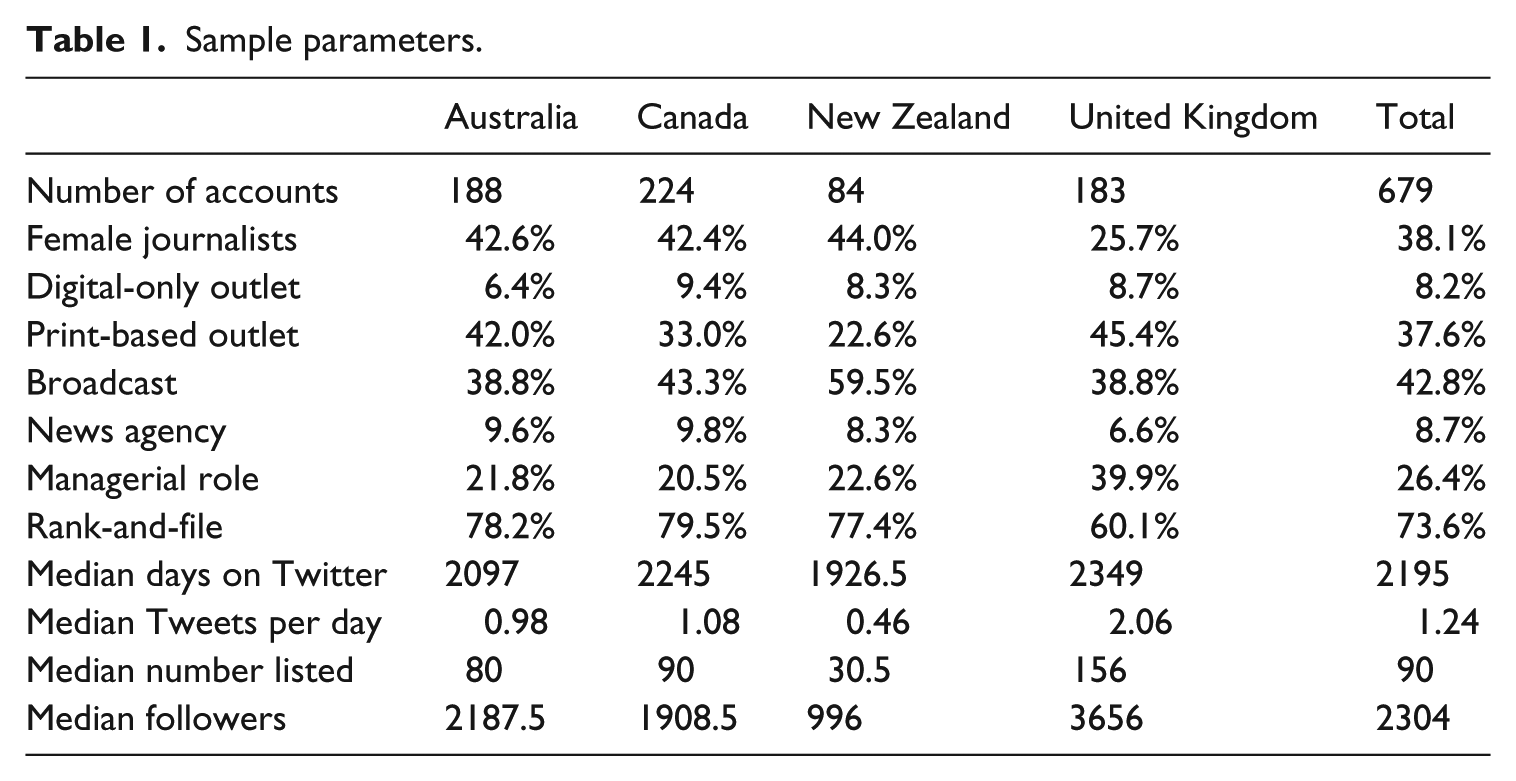
The male dominance is in line with evidence that political journalism more generally is dominated by men (Albæk et al., 2014; Van Zoonen, 1998). The majority of journalists are employed at traditional print and broadcast media, and can be categorized as rank-and-file journalists. In the United Kingdom, there are markedly more journalists in managerial roles than in the other three countries, owing to a larger number of regional bureau chiefs. UK journalists tend to have had a Twitter account the longest, and are also the most active, with a median number of tweets per day of 2.06, compared with roughly half that number in Canada, even less in Australia, and only 0.46 in New Zealand. Similarly, UK journalists are far more likely to be listed by other users, indicating their prominence in Twitter communities, and they also have the largest median number of followers.
The sample parameters thus point to a picture of UK journalists as not only the most likely to be on Twitter, they are also the most prolific users. In contrast, New Zealand journalists are the least likely to be on Twitter, and are also the least active. Canada and Australia are somewhere in between these two extremes, exhibiting somewhat similar levels of activity.
Results and discussion
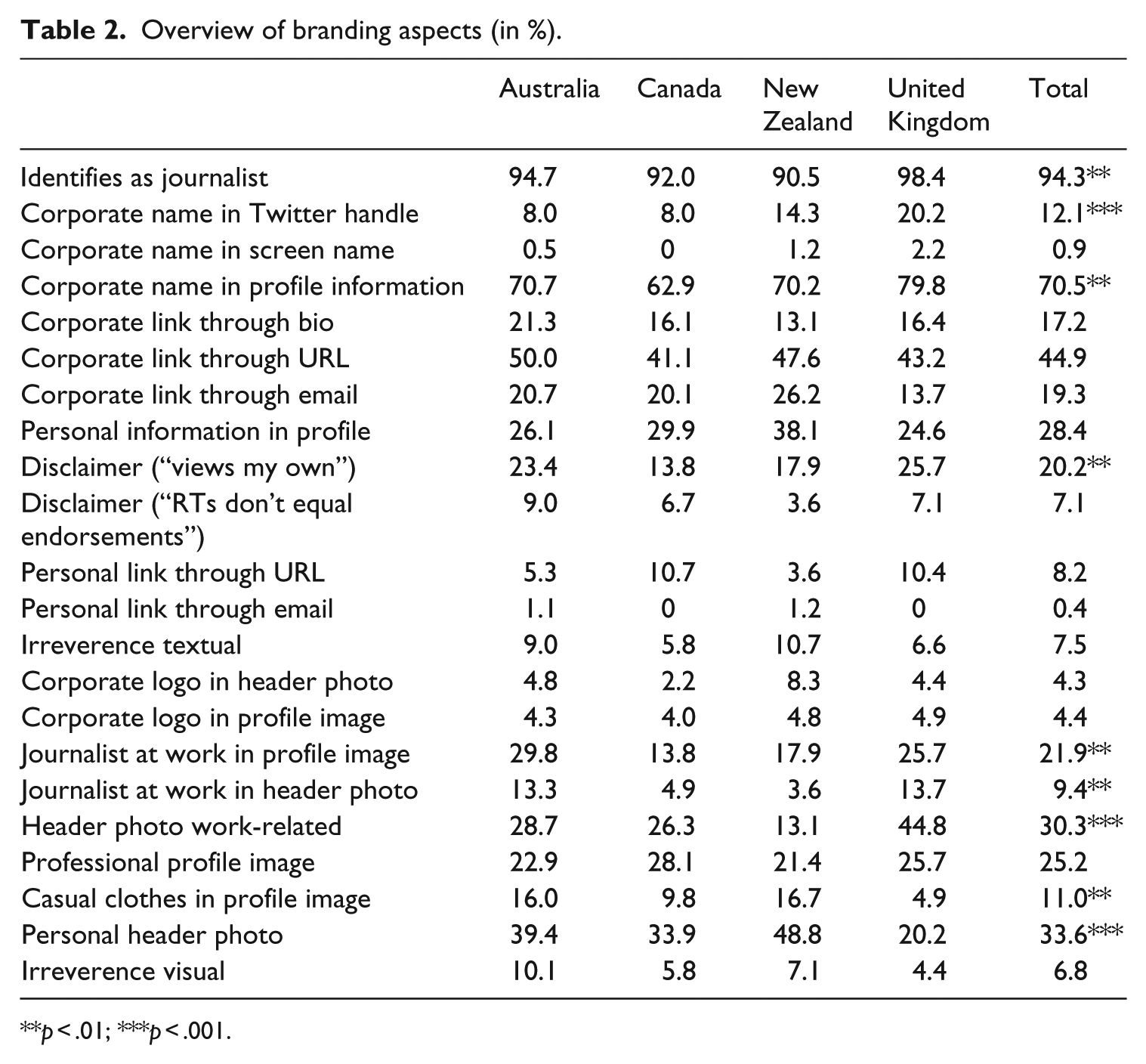
The vast majority of journalists with a Twitter profile across all four countries identify themselves as journalists, that is, on-stage, they take on a professional persona, suggesting they use their accounts mostly for work purposes (Table 2). This is not particularly surprising, given findings elsewhere (Hanusch and Bruns, 2017), as well as the fact that, as discussed earlier, where ownership of an account was not clear, journalists’ professional accounts were examined.
Overview of branding aspects (in %).
p < .01; ***p < .001.
Despite the generally high levels of professional identification, we can also see that journalists in the United Kingdom are the most likely to identify as journalists, with only 1.6% not doing so. On the other hand, journalists in New Zealand are least likely to state any connection to their work as journalists. The differences across the four countries are statistically significant, χ2(3) = 10.148, p < .05, V = .122.
A large majority—at least two-thirds in each country—also provide their employer’s name in their profile information. However, while in Canada only 62.5% of journalists include their news organization’s name, 79.8% do so in the United Kingdom, again a statistically significant difference, χ2(3) = 13.745, p < .01, V = .142. UK journalists also stand out when including their organization’s name as part of their Twitter handle (e.g. @SimonMaresITV, @BBCPeterH, @AmberSkyNews). This approach is also somewhat popular in New Zealand, but less so in Australia and Canada, χ2(3) = 18.229, p < .001, V = .164. When it comes to hyperlinking with their employer’s websites or Twitter account, no statistically significant differences can be found between countries, but general trends are detectable. Around half in each country link to their employer by providing a separate URL, while fewer include a link to their organizational email account or their employer’s website.
While a majority of journalists have at least some corporate link in their account, the provision of personal information is still not as widespread, supporting results from previous studies (Hanusch and Bruns, 2017). Around one-third of journalists chose to divulge personal information that was not work-related, such as marital or parental status, hobbies, or personal interests. New Zealand journalists appear the most active in that regard, although the difference is not statistically significant. Significant differences are found in the use of disclaimers, with UK and Australian journalists far more likely than their Canadian and New Zealand counterparts to state that their views are their own, χ2(3) = 10.528, p < .05, V = .125. Use of “retweets don’t equal endorsement” is generally less frequent, supporting an earlier finding by Hanusch and Bruns (2017). Links to personal websites or email accounts are also rare, with only around 8% of all journalists providing a personal website, with links to personal emails negligible. There was some use of irreverence in the account descriptions, with examples of humor or irreverent details slightly higher in New Zealand and Australia, suggesting a possible link to the two cultures’ history of larrikinism (Bellanta, 2012). While the overall differences between the four countries were not statistically significant, the results suggest that further comparative studies into the possible link between cultural attitudes, humor, larrikinism, and use of social media would be a fruitful field of research, building on earlier work in this area (Holton and Lewis, 2011; Molyneux, 2015).
While the amount of corporate identification is relatively high in account descriptions, it is much less so in visual content. At around 4%, journalists rarely include corporate logos in either their profile images or their header photos. More frequent is the generic depiction of themselves at work. This allows them to visually identify as journalists, without necessarily linking to their employer. Around one out of five journalists chose to include an image of themselves at work as their profile image, while around 10% did so in their header photo. Differences between countries are significant, with the practice most widespread in the United Kingdom and Australia, while it is less common in New Zealand and even less common in Canada—profile image: χ2(3) = 17.655, p < .001, V = .161; header photo: χ2(3) = 15.868, p < .05, V = .153. In addition, almost one in three journalists included a work-related image as their header photo, such as images of politicians or—the most frequent option—images of their country’s parliament to signify their place of work. Again, we can see highly significant differences in the use of this option. Journalists in the United Kingdom made this choice by far the most frequently, while the practice was uncommon in New Zealand. These differences were statistically significant, χ2(3) = 31.875, p < .001, V = .217. Around one-quarter overall make sure that as their profile image, they present a professional persona by including a professional photograph.
On the other hand, a minority include photos of themselves in casual clothing, with Australian and New Zealand journalists more likely than especially their UK counterparts to do so, χ2(3) = 14.652, p < .01, V = .147. The use of personal, non-work related images, such as images of animals, nature, or cityscapes, is most common in New Zealand, while it is far less common in the United Kingdom, χ2(3) = 26.213, p < .001, V = .196. In terms of irreverence, New Zealand and Australian journalists stand out again with a more frequent use in images than their Canadian or UK counterparts.
Combining personal and corporate identities
Because journalists can combine professional and personal personae to differing extent, two scales measuring corporate and personal identity were created, which speak to the much-discussed distinction between corporate and personal aspects of news work in social media (Canter, 2015). To measure corporate identity, the following eight variables were given a score of 1 if the aspect was present on the journalist’s account information, and 0 if it was not. We assessed whether journalists (a) named their organization in their Twitter handle, (b) included their organization’s name in their screen name, (c) named their employer in their bio text, (d) provided a link to their employer in their bio text, (e) linked to their employer through the URL field of their account, (f) provided their corporate email address, (g) included a corporate logo in their profile picture, or (h) included a corporate logo in their header photo. Because each of these categories is distinct, it was possible for journalists to reach a total score of 8. In reality, the maximum score was 5, reached by three journalists. In all, 69 journalists scored 0, indicating they provided no identifying information about their employer.
To measure personal identity, 10 variables were included, measuring whether journalists provided (a) personal details in their account information, (b) a personal email, (c) a personal website link, (d) the disclaimer “views my own,” (e) the disclaimer “retweets don’t equal endorsement,” (f) any irreverence in text form, (g) any irreverence in visual form, (h) a profile photo of them wearing casual clothing, (i) a profile image of them not at work, or (j) a personal header photo. The highest overall score was 6 (four journalists), while 227 journalists scored 0. For comparison, the two scales were subsequently normalized by dividing each journalist’s score on each scale by its relevant actual maximum score. The overall mean score for the corporate identity scale was .35 (standard deviation [SD] = .199), while for personal identity it was .22 (SD = .213). This further emphasizes the finding that journalists were more likely to portray corporate than personal personae. Corporate identity scores were highest in New Zealand (M = .37, SD = .23), the United Kingdom (M = .37; SD = .18) and Australia (M = .36; SD = .19), while Canada has the lowest score (M = .31; SD = .20). An analysis of variance (ANOVA) shows a significant result F(3, 675) = 4.31, p < .01, although Games-Howell post hoc tests reveal significant differences exist only between Australia and Canada and the United Kingdom and Canada.
New Zealand also scored highest on the personal identity scale (M = .26; SD = .22), followed by Australia (M = .25; SD = .23), while Canada (M = .21; SD = .21) and the United Kingdom (M = .18; SD = .19) score the lowest. Again, an ANOVA was significant, F(3, 675) = 4.62, p < .01, with Games-Howell post hoc tests revealing significant differences only between Australia and the United Kingdom, as well as between New Zealand and the United Kingdom. Overall, a very weak negative correlation between corporate and personal identity was found between the two scales, r = −.076, p < .05, but analysis on the country level showed a significant correlation only in the United Kingdom, r = −.199, p < .01. This indicates that UK journalists strongly differentiate between corporate and personal personae, which resonates with a finding in Sweden that suggested that journalists who did not provide a professional affiliation in their account profiles were more likely to provide personal information about themselves (Wiik and Hedman, 2015).
Because journalists tend to combine their brand identities to varying extents (Ottovordemgentschenfelde, 2017), four groups of identity combinations were constructed. The first group contained journalists who scored lower than the overall mean across all countries for corporate identity, as well as lower than the overall mean across all countries for personal identity. The second group included those who scored lower than average on corporate identity, but higher than average on personal identity. Journalists in the third group scored higher than average on corporate but lower than average on personal identity, while those in the fourth group scored higher than average on both corporate and personal identity. Across the entire sample, as well as in each country, the third group was the largest (Figure 1).
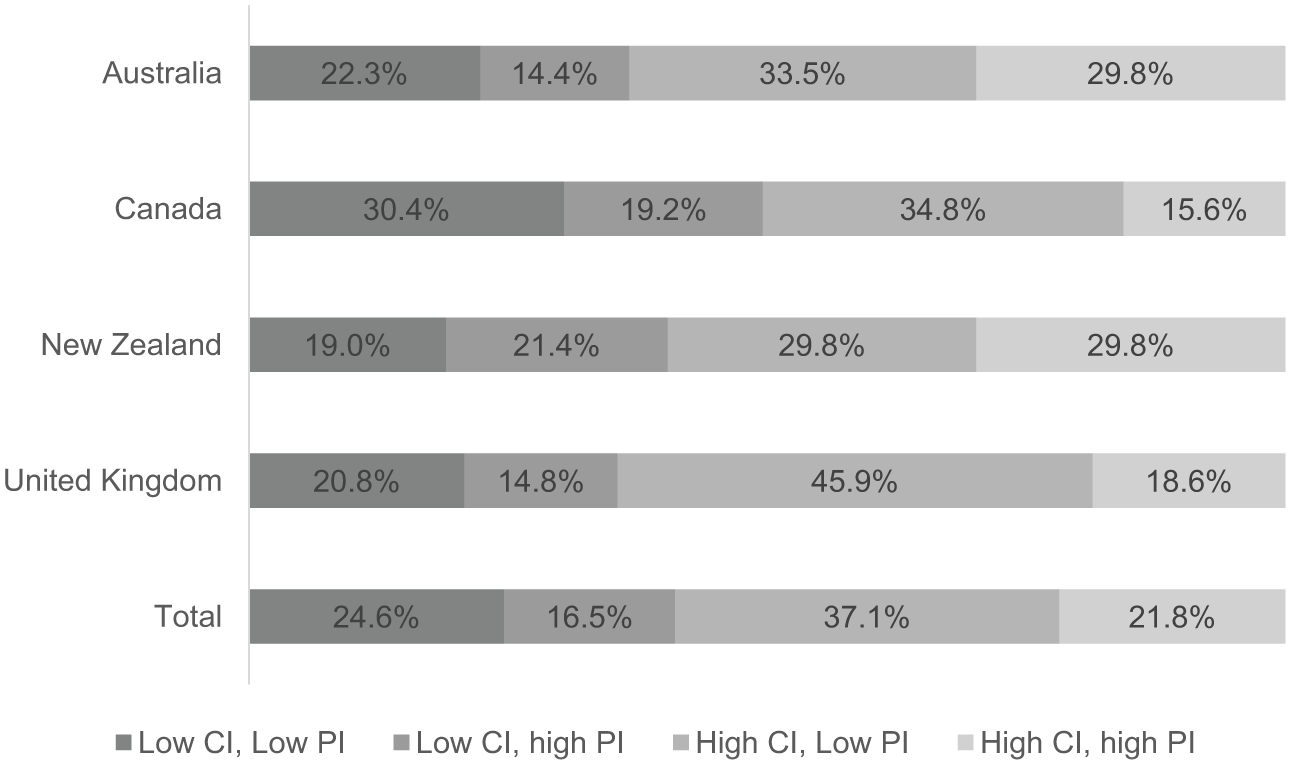
Groups of personal and corporate identities.
While in the United Kingdom this group is far larger than others at 45.9%, in New Zealand, it is only equally largest along with journalists with above-average corporate identity and above-average personal identity, each at 29.8%. A similar trend is observed in Australia, while in Canada, the second largest group includes journalists who score below average on both corporate and personal identity. Overall, the differences are statistically significant—χ2(9) = 25.815, p < .01, with V = .113 indicating a small effect. Importantly, too, no statistically significant differences could be found in respect of journalists’ ranks, gender, or publishing platform, which suggests that national-level determinants are paramount in this respect, a finding in line with recent research in other aspects of journalistic practice (Brüggemann et al., 2014).
The third and final research question asked to what extent journalists’ self-presentation might be related to their activity levels on Twitter. Here, we find that journalists in the high corporate, high personal identity group tweet more regularly, favorite more tweets, and follow more other users than any of the other groups (Table 3).
Examples of behavior on Twitter.

Kruskal–Wallis analyses of variance (ANOVAs) were conducted as distributions were not normal. Figures given in table are medians.
p < .001.
They also constitute the group with the second-most followers, while the group with the largest number of followers includes those who score high on corporate identity, but low on personal identity. This group is also the most likely to be listed by other users, and ranks second in the number of tweets and the number of accounts they follow. Displaying a corporate identity on Twitter is thus associated with high use of Twitter—regardless of the extent to which journalists display personal characteristics. Looking at the number of followers and the number of times they appear on Twitter lists, it may thus not be damaging to journalists’ brands if they do not display personal characteristics. On the other hand, those who display a personal identity in addition to a corporate identity appear to be more frequent users of Twitter. Obviously, however, these results can only report rather abstract measures of Twitter behavior, and more detailed examinations of actual tweets would allow us to better understand these processes.
Discussion and conclusion
This analysis of 679 political journalist members of parliamentary press galleries in four Westminster systems has identified some significant differences in how journalists present themselves on Twitter. Most importantly, these are found most predominantly on the national level, suggesting that factors such as rank, gender, or main publishing platform are not important predictors for journalists’ self-presentation strategies on Twitter, which highlights the importance of comparative research in this field. While most journalists across the entire sample have an account on the social medium, UK journalists appear to be ahead of the curve, with a higher penetration rate, longer history on Twitter, and more regular activity. Arguably, the logic of Twitter is more pronounced in UK political journalists than elsewhere, and these journalists are also the most likely to focus on mainly a corporate identity at the expense of a personal identity.
While there is evidence that traditional boundaries between the professional and personal are breaking down in journalists’ self-branding online (Singer, 2015), this appears to be occurring to different extent even in countries that are otherwise quite similar in political, economic, and cultural terms. The boundary is still relatively firm for UK journalists, who prefer to portray a corporate identity, revealing little about their personal life. In Canada, journalists are averse to providing information about themselves in general, and are somewhat divided over portraying a corporate persona. All the while, they are even more averse to combining both corporate and personal identities than their UK counterparts, evidence which suggests the boundary between professional and personal is also still very much alive in Canada. In New Zealand and Australia, on the other hand, journalists see much less of a problem in combining corporate and personal personae in their Twitter profiles. Here, the boundaries seem to have broken down much more.
Possible reasons may be found in the larger economic conditions of news organizations across the four countries. As was suggested earlier, while arguably all Western countries have in recent years experienced an economic downturn in journalism and a transition in political journalism (Kuhn and Nielsen, 2014), the UK market is one of the most competitive, and in particular, political news is a highly commercial and competitive field, at least in newspapers (Davis, 2014). This pronounced commercial logic may lead journalists to focus more strongly on a corporate identity as they feed off, as well as contribute to their employer’s brand. Past evidence suggests such a link between competition and Twitter activity and branding (Wiik and Hedman, 2015). Furthermore, the competitive environment may also result in stronger pressure on journalists to identify their employer, as has been shown to be the case elsewhere (Holton and Molyneux, 2017). In the United Kingdom, possible reasons for the relatively low amount of personal information on journalists’ Twitter profiles may be due to (a) pressure from employers to portray a corporate identity, but also (b) a firmer boundary between professional and personal in journalism, in a country with a long tradition of a focus on unbiased, objective, and independent journalism (Donsbach and Klett, 1993; Hampton, 2008). Another reason may lie in a relatively strong professional culture, which does not appear to exist to similar extent in the other three countries (see, for example, Weaver, 1998).
This explanation may also be understood in line with the original theoretical starting point in the work of Goffman (1959) and journalists’ performance of online personae. When “on-stage,” journalists provide “off-stage” information, such as personal background about themselves, to differing extent in different countries. Reasons provided here include commercial logics, but when examining performance through the eyes of Goffman, it is also important to ask who journalists are performing for. While an examination of journalists’ Twitter networks was beyond the parameters of this study, recent evidence suggests that political journalists predominantly interact with—and thus arguably perform for—other journalists first, but also a significant number of politicians (Broersma and Graham, 2016; Nuernbergk, 2016). In the United Kingdom in particular, the relationship between journalists and politicians has been exceptionally intertwined, with politicians attempting to make use of reporters as sources of information about policy and politics (Davis, 2009). This has resulted in journalists having “themselves come to act, often inadvertently, as political sources, intermediaries and political actors” (Davis, 2009: 215). With such close links, it is possible that journalists, in performing their on-stage personae for politicians, may focus on an almost exclusively professional, indeed corporate identity for fear they may be seen as untrustworthy if they were to divulge too much of their own off-stage personae.
For United Kingdom—and to some extent Canadian—journalists, the boundary between professional and personal still holds more firmly, while in New Zealand and Australia, we can identify a stronger mix of corporate and personal identities. To use Canter’s (2015) words, at least in terms of their profile information, journalists in these Antipodean countries have crossed “the historic line between the professional and the personal” to a larger extent (p. 889). In particular, the finding in relation to Australia is supported by similar evidence from a broader study of Australian journalists’ Twitter profiles (Hanusch and Bruns, 2017). While both Australia and New Zealand have also been experiencing considerable declines in their numbers of journalists and increased competition (Hanusch, 2015; O’Donnell et al., 2012), comparatively speaking, they have for quite some time benefited from a less competitive environment than their counterparts in the United Kingdom (Young, 2010).
In terms of the relationship between Twitter activity levels and the groups of online personae identified, the study established a link between high corporate identity and journalists’ tweeting levels, as well as their popularity on Twitter. Personal information, on the other hand, seemed to matter little. Twitter is therefore predominantly used as a corporate tool among journalists, and users arguably tend to follow journalists for their professional expertise. This finding, however, is based only on very rough indicators of Twitter popularity such as the number of followers. Further in-depth studies linking journalists’ self-presentation with actual tweets or network analyses would shed more light on the phenomenon.
There are, of course, other limitations that need to be acknowledged. For a more comprehensive understanding of journalists’ branding and self-presentation activities, studies into journalists’ motivations and rationales for providing information on Twitter are necessary. Such inquiry, which could be conducted via in-depth interviews and surveys, could also assess the extent to which journalists are pressured to portray a certain persona online (Holton and Molyneux, 2017). Furthermore, it is not yet clear how branding requirements may change journalists’ perceptions of their role or may impact their broader work practices. More work is therefore needed to better assess the relationship between online branding and journalism.
Footnotes
Acknowledgements
The author would like to thank Peter Maurer, as well as two anonymous reviewers for their helpful suggestions and constructive feedback on earlier versions of this manuscript.
Funding
The author(s) disclosed receipt of the following financial support for the research, authorship and/or publication of this article: This work was supported by an Australian Research Council Discovery Grant (DP160101211).