



Abstract
As a hybrid, journo-activist space, tweeting #Ferguson quickly emerged as a way for activists and journalists to network and spread information. Using a mixed-methods approach combining digital ethnographic content analysis with social network analysis and link analysis, this study examines journalistic and activist uses of Twitter to identify changes in field relations and practices. Employing the lenses of field theory and mediatization, this study finds parity and divergence in the themes, frames, format, and discourse of journalist and activist Twitter practices. While the traditions of objective journalism and affective activism persist, notable exceptions occurred, especially following acts of police suppression. The networked communities of professional and activist Twitter users were overlapping and interactive, suggesting hybridity at the margins of the journalistic field. Given the hybridizing of journalistic and journo-activist practices, this case study examines the role of social media in efforts to report on and bolster social change.
Keywords
On 9 August 2014, Michael Brown, an unarmed Black teenager, was shot and killed by a White police officer in Ferguson, Missouri. The shooting was quickly shrouded in controversy, due in part to the contradictory accounts from dozens of witnesses (Santhanam and Dennis, 2014). Public concern was compounded by the handling of Brown’s body, the now-well-documented, systemic injustices committed by police against Ferguson’s mostly poor, Black residents, as well as of the use of force against demonstrators (Balko, 2015; Berman and Lowery, 2015). Protests were a regular occurrence throughout Ferguson in the months that followed, and they occasionally turned violent—sometimes resulting in clashes with police and in the destruction and looting of local businesses. Ferguson itself was described as a “powder keg” after the Justice Department found overwhelming evidence of racial discrimination in the department’s policing (USA Today, 2015). This included the use of an illegal quota system along with other practices that resulted in a “disproportionate number of arrests, tickets, and use of force [stemming from] ‘unlawful bias’” against African-Americans (Berman and Lowery, 2015).
Beyond serving as a microcosm of the ongoing racial conflict in the United States, the case study is an ideal–typical example of networked journalism and activism in a time of mediatization. Many networked activists and journalists took to Twitter to organize and document protests, call attention to their efforts, and keep up with events as they unfolded. Thus, the #Ferguson hashtag emerged alongside #BlackLivesMatter and many others to signify calls for racial justice and criminal justice reform after Brown’s death. In the days following Brown’s death, the streets of Ferguson and the tweets of #Ferguson were shared by both professional and citizen journalists. 1 But many would soon share more than physical and discursive space, as the increasingly militarized police forces began teargassing and arresting journalists and protestors alike.
This sharing of experiences and converging of networks contributed to a common identity and consciousness, thus leading to episodes of more sympathetic media coverage (Araiza et al., 2016). Nevertheless, even the most considerate of media frames can pose challenges for movement organizers, who are constantly working to shape what gets covered and how (Gitlin, 2003; Sobieraj, 2011). Although the challenges social movement activists face are considerable, the growing mediatization of everyday life provides new opportunities for members of the public to participate in, and potentially shape, political and journalistic discourses. While uses of networked technologies for political and individual empowerment have been criticized for their lack of bearing on material realities (Barnard, 2016a; Morozov, 2014a), alternative forms of expression on social media have grown popular in political–activist cultures, often used to call attention to their cause and coordinate protest actions, therefore playing an important role in processes of social change. The case of Ferguson serves as an ongoing example of such reform, given the slow but notable changes in local, state, and federal policy, made possible in part by the persistence of networked activists (Wagner, 2016).
The visibility and salience of #Ferguson has led scholars from a variety of fields to conduct research on the uses of networked technologies to document and respond to systemic racism (Araiza et al., 2016; Bonilla and Rosa, 2015; Chaudhry, 2016; Clark, 2016; Freelon et al., 2016; Jackson and Welles, 2016; LeFebvre and Armstrong, 2018). These studies have found that although traditional gatekeepers generally adhere to professional norms, Twitter functioned as a visible site of resistance and discursive influence for well-connected activists (Freelon et al., 2016; Jackson and Welles, 2016; LeFebvre and Armstrong, 2018). Furthermore, while studies of #Ferguson and similar events have revealed notable trends in the volume of coverage mainstream media outlets dedicated to the issue (Hitlin and Vogt, 2014), few have offered an in-depth analysis of the Twitter discourse and how it maps onto the converging fields of journalism and activism. Accordingly, this study seeks to fill this gap by providing a mezzo-level analysis of the content and context of networked journo-activism as seen on Twitter and beyond.
Literature review
Twitter, social media, and the new journo-activist field
Field theory, which suggests that actors operate in separate but related spheres of social action (Bourdieu, 1993; 2005), has been adopted by many scholars interested in the evolution of journalistic spaces and practices (Benson, 2006; Benson et al., 2012; Bourdieu, 1999; Powers and Vera Zambrano, 2016). Within fields, social actors leverage and exchange various forms of capital (social, cultural, symbolic, and economic), which they embody through dispositions (habitus) that inform, and are informed by, the norms and values (doxa) particular to each field (Bourdieu, 1993). However, the growing hybridity within the fields of journalism and politics suggests a need to reconsider the way these fields intersect and diverge.
Drawing insights from field theory, Chadwick (2013) details the ongoing hybridization of these fields given the emergence of a media system defined by “struggles between older and newer media logics” (p. 12). Although the journalistic and political fields are marked by clear differences in norms, values, and practices—for example, the use of objective versus persuasive styles of communication—there are also clear trends toward hybridization and mediatization, resulting in the emergence of shared media logics, both of field structures and practices. While many scholars have examined the relationship between these two fields in more traditional, institutional settings (Bourdieu, 2005; Herman and Chomsky, 2002; McChesney, 2008; Starr, 2005), the relative publicness of digital communication provides a unique opportunity to reconsider such questions in light of recent shifts in technology and field dynamics. Twitter provides one such space where the convergence of fields is most visible (Barnard, 2016b).
Since its emergence in 2006, scholars have become ever-more attuned to Twitter’s cultural (Brock, 2012), political (Kreiss, 2014), journalistic (Barnard, 2016b; Hedman, 2015; Hermida, 2010; Zeller and Hermida, 2015), and activist implications (Tremayne, 2014). As of 2014, approximately 23% of online adults (19% of all American adults) use Twitter (Duggan et al., 2015), and roughly half of them use it for gathering or sharing news (Hitlin and Vogt, 2014). Journalists and activists are two groups that are especially well represented on Twitter. So too are African-Americans, given that “22% of online Blacks are Twitter users, compared with 16% of online whites” (Krogstad, 2015; Smith, 2014). This overrepresentation may help explain the prominence of Black culture on Twitter, often referred to as “Black Twitter” (Brock, 2012).
Despite the hybridity of mediatized fields, there are many boundary spaces—such as political conventions and highly visible hashtags—that allow for the convergence of multiple fields of action, especially the journalistic and political fields. These boundary spaces can lead to a form of “active spectatorship” for citizen–participants (Kreiss et al., 2015) that can “reshape the pattern of call and response relationship with mainstream media” (Russell, 2013: 904). For example, Russell (2013) examines how boundary work between journalists and environmental activists at a commingled UN Climate Summit reveals overlaps and fissures in the journalistic field. In addition to highlighting the hybrid yet distinctive positions and practices of networked actors, this case also renders visible the dual function of objectivity, which serves as both a bridge and a divide between “legacy” and activist-oriented media.
Although one of objectivity’s latent functions is to foster processes of deliberative democracy through a separation of fact from value (Schudson, 1981), instances where legacy journalism permits “affective news flows” can actually create “more space for critical interpretation of news events and issues” (Russell, 2013: 918). In other words, allowing opinion and emotion to help render visible points of (dis)agreement about an issue, no matter how politicized or scientific, has the potential to strengthen democratic discourses rather than hinder them. Given its mediatized structure and affordances, including its publicness, conversational structure, and popularity across a variety of fields, Twitter is well situated to lay bare the dynamics of political activism, journalism, and democracy (Maireder and Ausserhofer, 2014).
According to an in-depth study of online discourse about police violence and racial injustice (Freelon et al., 2016), networked activists’ use of Twitter brought significant attention to the issue and directly resulted in the mainstreaming of #BlackLivesMatter. Through their analysis of over 40 million public tweets, 21 million of which were from #Ferguson, Freelon and his colleagues identified a variety of unique but interconnected communities, which included activists as well as mainstream news outlets. Furthermore, they discovered that both tweets and hyperlinks played an important role in disseminating information about the movement, particularly through gaining coverage from mainstream news sites (Freelon et al., 2016: 17).
As the #Ferguson events make clear, there are numerous channels for actors to influence the gatekeeping process, whether they are located solidly within or at the boundaries of the (professional) journalistic field (Bruns, 2003; Shoemaker and Vos, 2009). While many journalists report an adherence to traditional doxa of independence, those working in more networked subfields, such as political and online contexts, are more likely to use social media in their selection and shaping of news (Raeymaeckers et al., 2015). This additional time spent in the mediatized field also provides additional opportunity for members of the public to influence the reporting process, including but not limited to helping shape what issues are covered as news (gatekeeping), and what aspects of those issues are discussed (framing). One increasingly popular way activists frame and spread their messages is through social networks such as Twitter. Given the growing potential for ties between networked journalists and journo-activists, the various modes of curation amount to new “flows” that often converge and influence one another despite hinging upon different logics (Thorson and Wells, 2015).
Mediatization in the field: affective publics, social networks, and the links that connect
The proliferation of networked technologies has ushered in significant shifts in the terms and consequences of communication. To account for these emergent changes, scholars have adapted new conceptual frameworks. The concept of mediatization highlights the extent to which the spread of new media and communication technologies contribute to new, hybrid dynamics of social relations and change. Mediatization research seeks to account for the structural and cultural significance of networked communication. Numerous studies have demonstrated the implications of mediatization for social relations, including journalism (Backholm et al., 2012; Rees, 2012), activism (Mattoni and Treré, 2014), politics (Strömbäck, 2008), culture (Chen, 2015; Hepp, 2013), conflict and memorialization (Cottle, 2006; Lindgren, 2012), and beyond (Couldry and Hepp, 2013).
Mediatization is more than a matter of scale. Indeed, the concept emphasizes the qualitative changes to communicative action brought about by hyper-mediation (Hjarvard, 2013). In mediatized fields, social action is not only bound by traditional institutional relations but is also constantly augmented by media(ted) dynamics, which can amount to a fundamental shift in the form and function of fields (Barnard, 2016c; Couldry, 2014; Jurgenson, 2012). The proliferation of #BlackLivesMatter—both as a hashtag and a networked social movement—illustrates how a hybrid, mediatized political–journalistic field can operate. In this case, networked publics’ use of common platforms and hashtags to document, contextualize, and amplify cases of police violence against people of color helped link together individual cases, revealing an undeniable pattern explained only by structural racism. If not for the mediatized field(s) and practices, many have argued, popular discourses such as #BlackLivesMatter would not exist, and the struggle for social justice would remain on the margins.
While it has long been used in rather amorphous ways, the concept of affect seeks to highlight the emotive influence on decisions, expressions and interactions (Himelboim et al., 2014). Despite the prominence of journalistic conventions like objectivity and independence, emotion and subjectivity inevitably seep into the reporting process. Although the historically private nature of reporting has rendered much of this affective labor invisible, the affective elements of communication are increasingly evident due to mediatization (Himelboim et al., 2014; Papacharissi, 2015). Within the field of networked journalism, emerging forms of affective news blend objective information with opinion and emotion to create hybrid news frames (Meraz and Papacharissi, 2013: 155). Whereas activists and citizen journalists have long been known to communicate affectively, the network convergence of journalists and nonelite political actors has given rise to more hybrid forms (Araiza et al., 2016; Poell and Rajagopalan, 2015). Thus, the ability to live-tweet protests and political events in public, mediatized spaces provides opportunity for the formation of affective publics (Papacharissi, 2015).
Another way users participate in the spread of affective news is through sharing and linking (Molyneux, 2015). Like other forms of (meta)data, links are inherently locative: they convey a sense of meaning and context, which augment the interpretation of text (Carlson, 2016). Links also have a quantitative component, as the more links a site or story receives, the more central and important it is said to be. While link analysis has been most frequently applied to traditional media and web content to examine cross-citation (Adamic and Glance, 2005; De Maeyer, 2013; De Maeyer and Holton, 2015), social network analysis (SNA) has largely been deployed to examine more robust engagement and interactional ties on social media (cf. Graeff et al., 2014; Meraz and Papacharissi, 2013). Thus, network analysis offers a way to visualize discursive connections through engagement on social media, while linking analysis (LA) provides a window into discursive patterns.
When viewed in conjunction with the ties and characteristics exhibited by networked interactions on Twitter, links offer a way of locating social actors and understanding their practices. Despite the commonality of the “power law” phenomena, where a small number of users produce a disproportionate share of content, network structures do not universally privilege like-minded and powerful actors (Earl and Kimport, 2011). To the contrary, nonelite and nonpolitical sources have been shown to carry increased influence in some online contexts (Freelon and Karpf, 2015; Meraz and Papacharissi, 2013). Overall, the tracing of network connections, whether through hyperlinks or interactional ties on social media, offers a means of mapping the structure of mediatized (sub)fields.
Methods and data
This study is guided by three main research questions:
What themes and formats are apparent in tweets from #Ferguson? Are there similarities and differences between professional journalists and citizen journo-activists?
What is the structural composition of the field of actors tweeting #Ferguson? In what ways are journalists and journo-activists engaging in shared practices and experiences?
To what extent is this contributing to the emergence of a new hybrid space, and what implications does this hold?
To address these questions, this study employs a mixed-methods approach consisting of digital ethnographic content analysis (DECA), LA, and SNA. DECA is a method that utilizes online participant-observation in a digital community to inform data collection, coding, and analysis of emergent themes (Barnard, 2016b; cf. Altheide and Schneider, 2012). By contrast, LA and SNA entail the plotting and examination of hyperlink patterns and network ties using metadata derived from Twitter-based communication. Given the interest in the themes of journalistic and activist practices, and in particular the hybridity apparent in these mediatized fields, this study combines DECA with LA and SNA to examine Twitter discourse on #Ferguson.
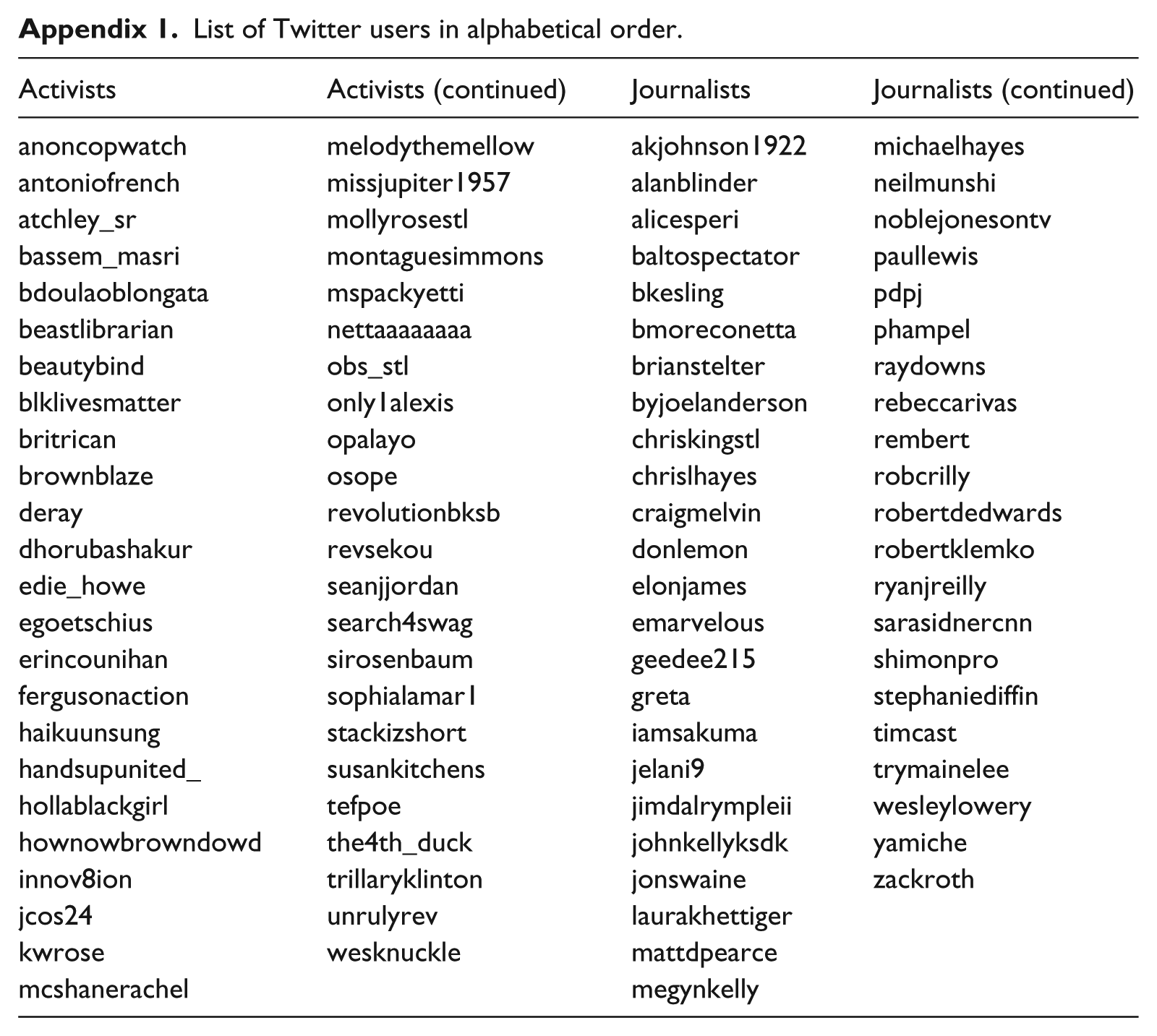
While other studies have focused specifically on Twitter influencers through the “top tweets” function (Neuberger et al., 2014), this study examines all issue-related tweets by a set of users identified as influential in their respective networks. After months spent conducting regular observations of #Ferguson, which began on 10 August 2014, the researcher identified relevant Twitter “lists” featuring journalists and activists tweeting about #Ferguson. 2 With deduplication, this amounted to 81 Twitter users. In total, 11 users were added, and a small portion reclassified as either journalist or activist, according to their Twitter bio and observed participation in #Ferguson. This yielded a sample of 92 users, 45 of which were professional reporters, while 47 were activists at the time the events in Ferguson occurred (see Appendix 1). 3 The researcher identified four peaks in the #Ferguson Twitter discourse, which ranged from 6 to 13 days (average 10 days). These peaks, which occur once a month for 4 months—the time when mentions of “Ferguson” and “#Ferguson” were greatest—correspond with major actions taking place in Ferguson, Missouri. Although the number of journalists’ tweets was nearly equal to activists’ tweets in the first few weeks following the event, activists’ tweets made up a majority of the dataset (70%) overall (see Figure 1). 4
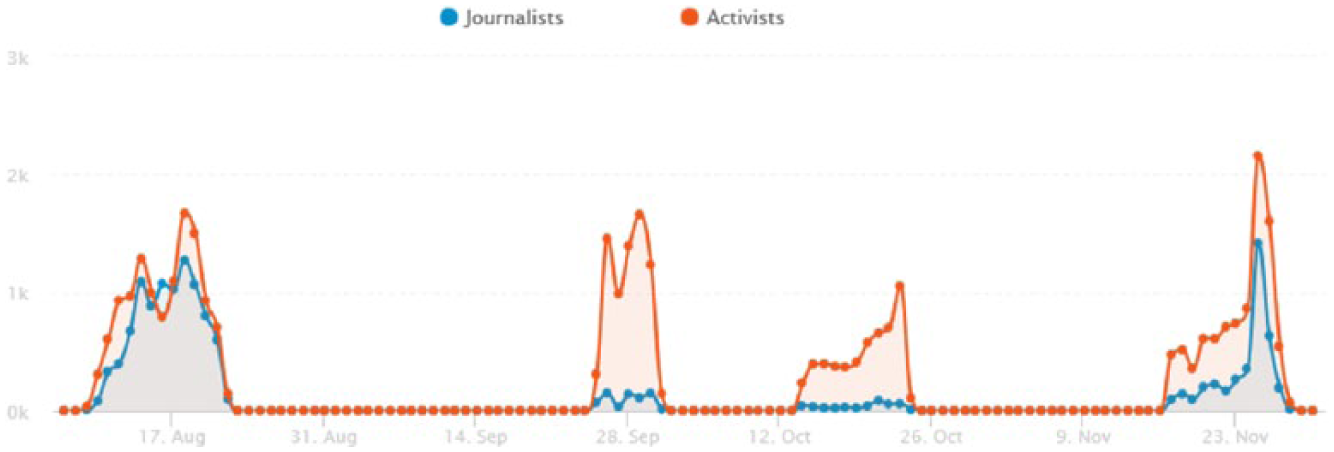
Distribution of tweets in sample.
Using the social data analysis platform, Pulsar, tweets were analyzed by applying a variety of human and computer–assisted metrics. The link and network analyses performed in this study examined (dis)connections between users’ field position and the discursive ties created by their posts. 5 After examining patterns at the macro-level, a DECA was performed on a subsample of theoretically relevant tweets. Coding addressed the tweets’ format (text, link, image, retweet, and/or reply), frames (what is being discussed, and how), themes (patterns in the text), and discourse (the fields of meaning, relevance, and audience) (Altheide and Schneider, 2012: 51–53). 6 The coding procedure, which was invariably guided by contextual insights gathered through digital ethnography, followed Altheide and Schneider’s (2012) “double loop of analysis,” as the initial open coding led to more refined, selective codes based on emergent patterns and theoretically grounded questions (Barnard, 2016b; Strauss and Corbin, 1998). Given Pulsar’s use of metadata to automatically code for format and provide an approximation of discourse (through social network and influence metrics), the qualitative coding procedure focused primarily on identifying frames and themes in the text of the tweets.
Results
This analysis yielded numerous findings about how journalists and activists tweeted #Ferguson. Results are organized to correspond with the research questions stated above.
Themes: similarity across difference
Organizing
Activists regularly tweeted information about their whereabouts or protest action plans. Organizing tweets often included the time and place of protests and were sometimes accompanied by additional information, such as newsletters or flyers, through links and images. For example, one prominent activist simply tweeted: “Walmart. Rock Road. St. Charles. #Ferguson.” Others offered information about opportunities for donation, safe places to rest, or the whereabouts and temperament of police. Many organizing tweets contained additional hashtags for added visibility (see below). Journalists typically refrained from using Twitter to organize in this way, likely because they either tended to work independently, or preferred more private forms of communication to coordinate travel and coverage. Overall, while organizing tweets often served a dual function of disseminating news about the planned actions, the organizing theme was distinguished by its explicit emphasis on providing support and direction to activists.
Amplifying
One of the predominant affordances of social media such as Twitter is the ability to spread messages to broader audiences beyond one’s own network. This, of course, is the ideal–typical function of a hashtag. While the vast majority of tweets analyzed for this study (83%) contained the #Ferguson hashtag, many users also deployed other hashtags. For example, “Meet us on shaw and klemm tonight at 9pm!! #Ferguson #VonDerritMyers #shawshooting #MikeBrown #FergusonDecision.” Other common secondary hashtags included #BlackLivesMatter, #FergusonDecision, #HandsUp, #DontShoot, #ShutItDown, and #STL, among countless others. The use of secondary hashtags functioned as a way to bridge parallel—but sometimes competing—discourses on a topic as well as to boost visibility. Expectedly, activists were far more likely to use hashtags in this context given their motivation to inform the public and pursue systemic reforms. Occasionally, journalists also helped spread information with parallel hashtags, though this was often a latent function resulting from journalists’ retweeting of activists’ content.
News dissemination
One obvious use of Twitter was to disseminate news. Journalists frequently opted to publicize their work by directing followers to their proprietary content platforms. For example, “turn on Fox News @seanhannity—he has latest on #Ferguson—starts in 4 minutes!” or “BREAKING: @evanperez live on CNN with new details on #ferguson. Grand Jury didn’t reach decision friday. Unclear when deliberations resume.” Many more experienced Twitter journalists, who were more likely to work for digital than legacy news sites, frequently tweeted updates more native to the platform, although they too directed content to other sites on occasion. For example, “Still a lot happening in Ferguson, so we’re still running our live blog for those of you not glued to Twitter: http://t.co/9Pirbv2eDL.” Activists, however, were understandably less interested in self-promotion or driving traffic to other media sources and instead shared in ways similar to the more Twitter-savvy journalists. For example, one activist tweeted this update along with photos of the scene: “#Ferguson police has advanced to the other side of the street where protesters are standing.” Although tweets ranged in focus and frame, this strategy of sharing information from a personal perspective was common among activist tweets.
Police criticism
As expected, police criticism was a dominant theme and remained consistent over time. However, explicit criticisms increased in volume, tone, and visibility during or shortly after police actions. For example, one activist shared a local media story (“Cop in Ferguson Tweets Lies to Justify Tear-Gassing Protesters In Their Own Backyard http://t.co/1HbAGtf80y”), while a journalist tweeted an original post with a more objective tone (“Here are photos of the Saint Louis County cop who assaulted me yesterday. #Ferguson http://t.co/z8Y7jrCrRd”). There is a notable difference between such factual (read: objective) accounts of police violence, and the more affective responses more likely to be seen from activists. For example, a sizeable number of tweets from activists directly criticized police actions, such as “ONLY PPL RIOTING IN STL ARE THE POLICE. #STL #FERGUSON #FergusonMO” or “It’s incredible how nobody talks about Mike Brown in these press conferences. But they talk about property. Tons. #Ferguson.”
Media criticism
A small but notable portion of the data (nearly 3%) explicitly referenced “media,” and a clear majority of those tweets were focused on media criticism. While some criticisms were structural, most were episodic in nature. For example, one activist tweeted, “This is more than police-positive spin in #Ferguson … there are outright lies being released, and some media are reporting them uncritically [sic].” Around the same time, a journalist offered an illustration: “CNN incorrectly reporting there was no tear gas in #Ferguson tonight. I can still taste it. That said it was far, far, quieter.” Although these posts were similar in message, their tone was notably different, falling in line with the normative frames of protestors’ affectivity and journalists’ objectivity. Other users offered even more targeted media criticisms, including instances where activists directly confronted reporters about their coverage, whether in person or on air. Most strikingly, a number of protesters were shown on live television chanting “fuck CNN” behind a reporter—purportedly in response to coverage they deemed unfair and misleading (Feldman, 2014).
Shared experience
Despite activists’ criticism of reporting on the movement, there is notable evidence of journalists’ solidarity with protestors. Amid the fog of war, many journalists posted messages of shared experience, including instances of police threatening to arrest or otherwise punishing them for doing their job. For example, one journalist tweeted, “Police shooting tear gas directly at journalists now. Flashing lights so cameras can’t record. #Ferguson #MikeBrown,” while many others documented incidents of tear gas, rubber bullets, and other “less lethal” devices being used against journalists and activists alike. Some journalists tweeted images of police who “assaulted” or arrested them but more commonly reported on the experiences of others. For example, another journalist tweeted, “Photo of reporter I believe to be @ryanjreilly being cuffed and put in a police van minutes ago in #Ferguson http://t.co/l6olRUPk13.” The following day, the arrested journalist tweeted this message along with a photo: “Fellow reporter takes a lesson from my arrest, writes phone numbers on her arm #Ferguson http://t.co/KhFwfwTd9j.” Additionally, like journo-activists, a number of journalists expressed hope for justice and reform. Some even shared messages of friendship and solidarity for the subjects of their reports: “It wasn’t all bad tonight. I made friends with at least a handful of folks who didn’t threaten me with batons and tear gas. #Ferguson.” This discovery—that is, of journalists tweeting with a more affective tone—resonates with other studies investigating the shared experiences between journalists and activists in Ferguson (Araiza et al., 2016).
Meta-discourse
Another commonality between journalists’ and activists’ tweeting of #Ferguson was the use of Twitter to reflect on the significance of their practices and the role of social media in them. Approximately 1% of tweets directly referenced Twitter, while a greater number reflected more generally on media. Numerous posts described the contents of Vine videos or explained their importance to the cause. For example, one journo-activist offered a candid celebration of social media’s informative function: “Make no mistake: if not for Twitter, Vine, Livestream etc, we’d have NO IDEA what was happening to protesters in #Ferguson. Police would lie.” Another tweeted, “Were it not for Twitter, #Ferguson would have remained just another town no one outside of St. Louis ever heard of.” Others reflected more on their networked community, tweeting messages of thanks to supporters for donations, as well as more generalized appreciation, including a picture of a chalk message reading “Thank You #Blacktwitter #Handsup #Dontshoot.” Journalists, however, opted to reflect on their use of the platform, comment on its significance for members of the public, find crowdsourced information, and occasionally find support from others in the network. For example, one journalist tweeted, “Not trying to persuade anyone on Twitter today, just letting #Ferguson #shawshooting protestors know our general approach to 2 incidents.” Another posted, “Phone dying, tweets will stop. Chants of ‘Hands up, don’t shoot’ and ‘what if this was your town’ will continue tonight in Ferguson.” This mixture of commentary, community engagement, and reporting by journalists differed significantly from activists’ meta-discourse containing media criticism and celebration of social media.
Format: what is in a tweet?
On average, activists were more reactive and conversational, as measured by replies and retweets, while journalists were more authorial. Just over half of journalists’ tweets were original posts (50.8%), whereas activists were more likely to reply and retweet (58.3%). 7 Similarly, journalists were a little more likely to link (18.9%) and share photos (27.8%), compared to activists (15.2% and 24.7%, respectively). Activists, however, were a little more likely to tweet videos (7.9%) and text-only (52.2%), compared to journalists (7.2% and 46.1%, respectively; see Figure 2).
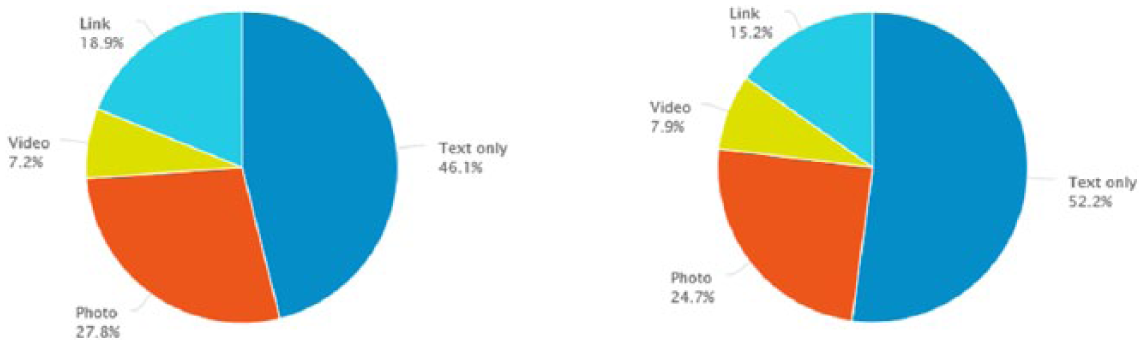
Comparison of tweet formats for journalists (left) and activists (right).
Discourse: separate but overlapping communities
Journalists and activists largely exist in distinct but connected discursive communities. By mapping discursive connections (i.e. retweets, replies, and links), it is possible to visualize the structural composition of journalists’ and activists’ subfields on Twitter. As Figure 3 shows, professional journalists appear less connected than activists, who were much more likely to engage with other users on Twitter. However, that engagement frequently crossed boundaries, as activists were also quite likely to retweet or reply to journalists (see Figure 4). This is one indication of a hybrid, if episodic, field structure where convergence occurred either through shared experience or shared (discursive) space. Although the average journalist was more influential on Twitter than the average activist, as represented by the size of each node, activists had stronger and more numerous ties in #Ferguson.
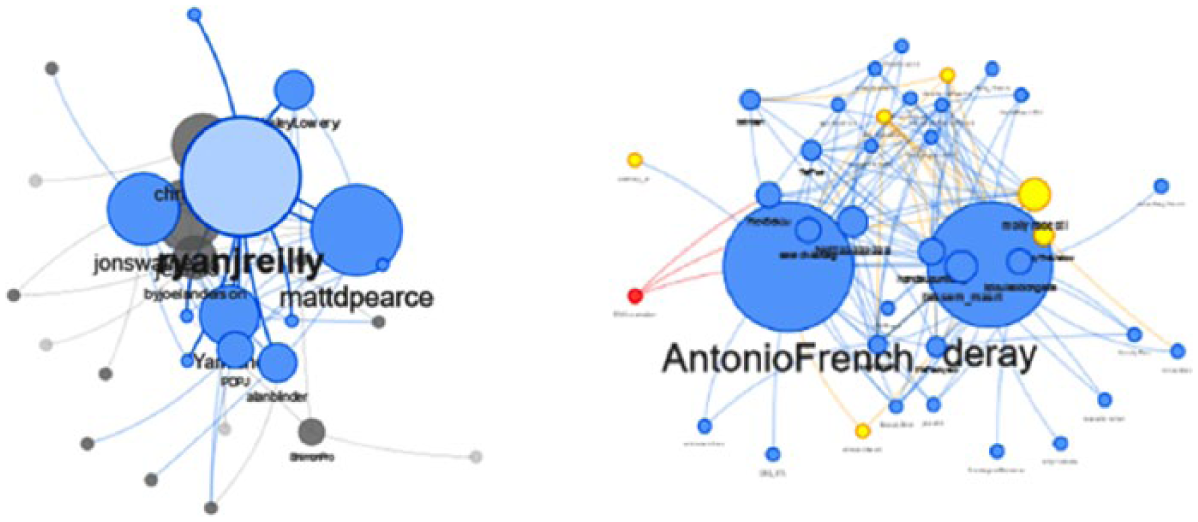
Comparison of influencer networks for journalists (left) and activists (right).
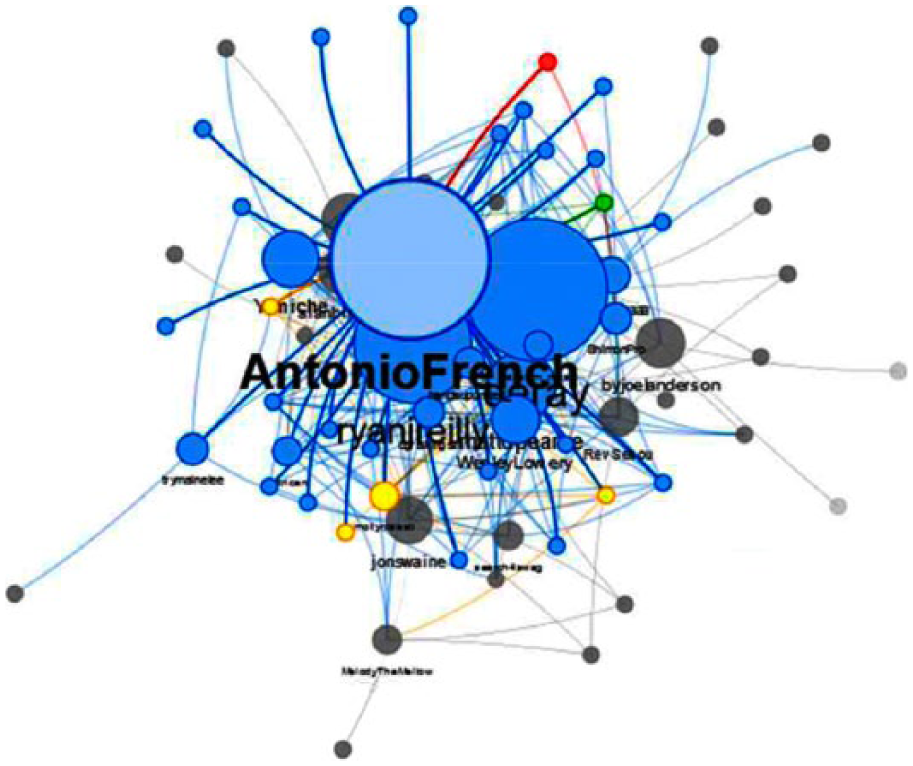
Combined map of influencer network.
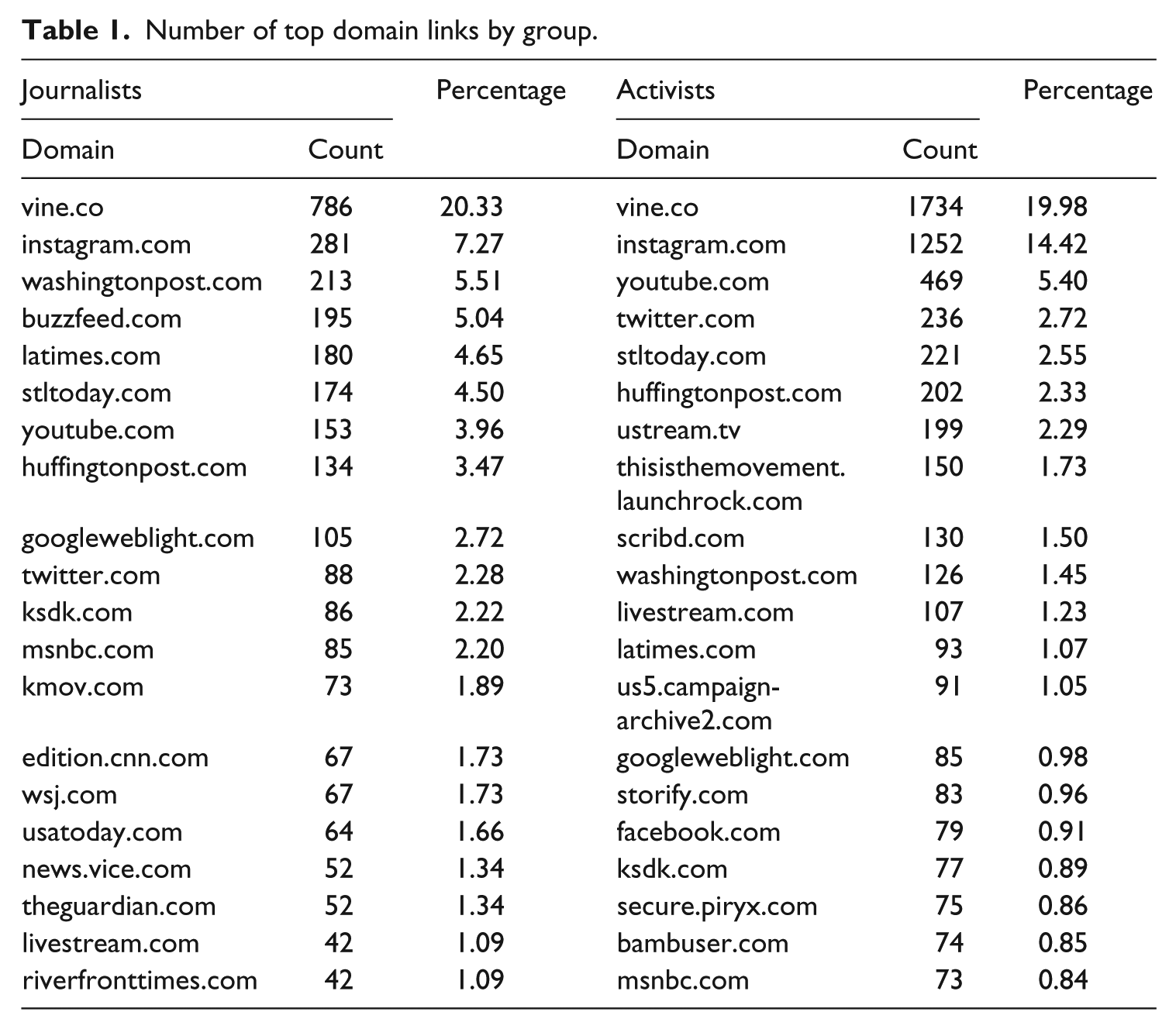
As Twitter is a relatively open system, users act and interact in a variety of ways that span far beyond the platform, and the data created render visible patterns of discursive connection. Table 1 depicts the 20 most frequently linked to sites from each group. Percentages are reported as the number of links to the site among all tweets with links from that group. As expected, professional journalists were somewhat more likely to link to legacy and digital news sites from national (Washington Post, LA Times, Buzzfeed, MSNBC, Guardian, etc.) and local sources (KSKD, KMOV, Riverfront Times, etc.). However, activists were more likely to link to social and alternative news sites, including Instagram, YouTube, and various livestreaming sites. Nevertheless, like the overlapping network maps, the commonality of links to legacy, digital, and social media sites across both groups illustrates the shared discursive ground as well as the convergence of journalist and journo-activist subfields.
Number of top domain links by group.
Hashtags and keywords serve as another indicator of discursive community. While there were common trends across both groups, activists’ tweets were much more likely to include the #Ferguson hashtag as opposed to the keyword “Ferguson” (ratio 6.3:1). Journalists also preferred the hashtag to the keyword (ratio 3.6:1). Thus, controlling for the number of tweets from each group, activists were nearly twice as likely as journalists to include the #Ferguson hashtag in their tweets than the keyword alone. Furthermore, activist users were significantly more influential on average; the top 10 influential accounts in the dataset all belonged to activists. While it is clear that both journalist and activist users have a place in the discourse, the prominence of activist tweets in the dataset (just over 70%), the greater sociality of their tweets (i.e. hashtags, retweets, and replies), as well as their greater influence, suggests that activists had a deeper commitment to tweeting #Ferguson. Finally, there was also notable variance in user influence, with a small minority of users responsible for a disproportionate number of tweets in the dataset—a finding that falls squarely in line with many other studies of the web that find power law dynamics in digital discourse (Earl and Kimport, 2011).
Discussion and conclusion
Journalists’ and activists’ tweeting of #Ferguson revealed much about the ongoing mediatization of the journalistic field. Despite observable differences in themes, frames, communicative forms, and engagement in discursive communities, there were also notable points of convergence. In addition to clear connections within and across fields, both through (re)tweets and links, affective forms of reporting were found among both groups. Given that journalists have previously been found to use Twitter to share personal messages and connect with members of the public, it is not surprising to find journalists tweeting affectively on occasion (Barnard, 2016b). Nevertheless, given the experiences of #Ferguson journalists, many of whom were teargassed, arrested, or otherwise obstructed, one might also expect even less objective, more critical coverage. By contrast, while activists typically employed affective frames, they also borrowed reporting practices from the professional repertoire, often mixing objective (and occasionally verified) information with opinion and emotion. Whether because of persistent engagement, shared experience, or the emergent mediatization of discursive space, the journalist and journo-activist fields of #Ferguson converge significantly on Twitter.
Expectedly, many of this study’s findings resonate strongly with Freelon et al.’s (2016) analysis of social media posts from #Ferguson and beyond. First, like Freelon and his colleagues, this study found notable ties between journalist and activist communities. Second, this study identified similar themes pertaining to news dissemination and amplification, criticism of media and police, as well as the tendency to engage in affective framing. These similarities appear to demonstrate the robustness of findings pertaining to trends in the use of social media for journalistic and activist ends. By contrast, this study’s discovery of relevant meta-discourse, where Twitter users reflect directly on the significance of the platform for their practices, resonates with research particular to the journalistic field (Barnard, 2016b; Carlson, 2015b), and thus demonstrates another possible site of hybridity between journalist and activist practices. This finding, like those related to users’ sharing of personal experiences as well as the variations in the format of their tweets, may be explained in part by the targeted nature of the sample, which included a closer examination of less influential tweets and users.
Another notable implication of this research is related to the transformation of journalistic practices. Like previous studies (Barnard, 2016b), there is evidence to suggest that the elements of journalistic practice are experiencing a shift toward mediatized repertoires that demonstrate the centrality of digital technologies in the reporting process. Depending on organizational culture and policy, Twitter can play a central role in the creation and dissemination of news. This has obvious implications for the norms and values (doxa), dispositions (habitus), and measures of skill and status (capital) of the journalistic field (Bourdieu, 1993). While many of the professional journalists tweeting #Ferguson clearly operated under a Twitter-first motto, those working for legacy news organizations were more likely to use Twitter in a manner similar to traditional media—that is, to broadcast proprietary content. While the latter strategy prioritizes more traditional means of accumulating capital—especially economic—through clicks and engagements, the decision to embrace the social nature of news allows for the generation of social, cultural, symbolic, and even economic capital. In a hybrid, mediatized field context, this capital is indeed transferable. Of course, these observed shifts in structure and practice, whether pertaining to the journalistic or political fields, do not mark the end of traditional divides, as the majority of organizations and subfields still adhere to predominant (professional) norms.
Overall, these findings demonstrate the ongoing shift toward a mediatized journalistic field (Couldry, 2014) characterized by more hybrid reporting practices and greater interaction between professional journalists and members of the public (Zúñiga et al., 2018). However, it is important to note that actors’ field position and influence as seen on Twitter are not necessarily representative of the field as whole. In fact, despite the visibility of action in mediatized fields, many journalists and activists shown to be influential in their Twitter subfields hold much less powerful positions in the broader journalistic and political fields. Thus, although these findings may not be fully representative, they are revealing of the current and unfolding state of networked journalism and are consistent with other studies of journalistic practice as it intersects with other fields (Araiza et al., 2016; Barnard, 2016b).
This study also has implications for the broader literatures of mediatization and field theory, and it seeks to bolster greater conversation between them. Whereas mediatization research has been applied most fruitfully to analyses of traditional politics and journalism, this study demonstrates the importance of considering how the dynamics of mediatization could contribute to a diminished distinction between the two fields due to increasing hybridity and emergent media logics (Couldry, 2014; Esser and Strömbäck, 2014). This is not to say that each field has not retained its own structure, practices, and status markers, but rather that the marginal positions and dispositions where they converge are increasingly visible and consequential in a mediatized context. The slippery nature of objective and affective frames, the overlapping of network ties, and the limited convergence of discourses as seen through links each serve as illustrative examples. Yet, it is unclear—on Twitter, at least—whether the norms of journalistic engagement apply equally to controversies mired by racism and police violence against protestors and journalists alike. While the #Ferguson case may be exceptional in its representation of these issues, the extent to which it models the hybridity of journalism and activism could demonstrate a new normal in an increasingly networked, mediatized field context.
Footnotes
Appendix
List of Twitter users in alphabetical order.
| Activists | Activists (continued) | Journalists | Journalists (continued) |
|---|---|---|---|
| anoncopwatch | melodythemellow | akjohnson1922 | michaelhayes |
| antoniofrench | missjupiter1957 | alanblinder | neilmunshi |
| atchley_sr | mollyrosestl | alicesperi | noblejonesontv |
| bassem_masri | montaguesimmons | baltospectator | paullewis |
| bdoulaoblongata | mspackyetti | bkesling | pdpj |
| beastlibrarian | nettaaaaaaaa | bmoreconetta | phampel |
| beautybind | obs_stl | brianstelter | raydowns |
| blklivesmatter | only1alexis | byjoelanderson | rebeccarivas |
| britrican | opalayo | chriskingstl | rembert |
| brownblaze | osope | chrislhayes | robcrilly |
| deray | revolutionbksb | craigmelvin | robertdedwards |
| dhorubashakur | revsekou | donlemon | robertklemko |
| edie_howe | seanjjordan | elonjames | ryanjreilly |
| egoetschius | search4swag | emarvelous | sarasidnercnn |
| erincounihan | sirosenbaum | geedee215 | shimonpro |
| fergusonaction | sophialamar1 | greta | stephaniediffin |
| haikuunsung | stackizshort | iamsakuma | timcast |
| handsupunited_ | susankitchens | jelani9 | trymainelee |
| hollablackgirl | tefpoe | jimdalrympleii | wesleylowery |
| hownowbrowndowd | the4th_duck | johnkellyksdk | yamiche |
| innov8ion | trillaryklinton | jonswaine | zackroth |
| jcos24 | unrulyrev | laurakhettiger | |
| kwrose | wesknuckle | mattdpearce | |
| mcshanerachel | megynkelly |
Funding
The author(s) received no financial support for the research, authorship, and/or publication of this article.