



Abstract
While the benefits of play have been widely recognized, carrying out activities with toys at adult age is still often seen as stigmatizing behaviour. Some adults solve this issue by referring to their toy activities as either hobbies or collecting. Yet, the primary purpose of toys is play. People may therefore utilize their toys for new kinds of play. One popular decision is the utilization of toys in photographs and videos aiming at personalization and storytelling on social media. Using eight interviews, we point out that this visual contextualization of play ties into not only the adults’ sublimation of their desires to use their toys but also to threads of cultural history in which sublimated or substituted artistic uses have been found for objects. Finally, we show that this activity too is a form of play, made possible by the existence of photo-sharing sites like Flickr and Instagram.
Introduction: state of toy play in the ludic era
I assume that collecting and the making of photographic stories can be thought of as an adult way of playing, even though I distance myself from the word itself. (Sylva, b. 1986; all direct quotes in this article translated from Finnish by K.H.
1
)
This was how one of our interviewees, an adult toy player, explained her relationship with toys and play. It crystallizes the visual way in which she avoided the potential shame of being an adult into toy play, a word (in Finnish leikki) from which she ‘distances herself’. Adults theorize play and position of play as first and foremost understood as the activity of children – in fact at many times as the work of the child. When used in reference to adults, ‘play’ is often considered as pointing to serious, goal-oriented activities such as sports – or when discussing sex as play (Harviainen and Frank, 2018; Heljakka, 2016). It seems that we have come to a situation in which Western societies are beginning to understand and value play more in terms of an important element of everyday culture, as envisioned by Brian Sutton-Smith (1997: 149). Playing with things (or, object play), however, largely remains a stigmatized activity when conducted at adult age.
In the Western world of the 21st century, toys are nevertheless more perceivable outside the realms associated with childhood. As creatively cultivated objects, toys have come to have significance for people of different ages. They are adopted, collected and cherished, and aesthetically valued. Toys are even anthropomorphized to the degree that they have in some cases come to represent substitutes for pet animals and family members for their owners. For many people, however, adult activities with playthings traditionally considered ‘children’s’ toys – such as the character toys described in this study (i.e. dolls) – form a strange, stigmatizing combination.
In many societies, one is expected to leave play (excluding certain formalized forms such as sports) behind as one grows up (Heljakka, 2013b; Paley, 2004). This maybe a part of a ‘protestant ethic’ that opposes leisure as a waste of time (in the sense of Weber, 1905: 175), or ‘taking life seriously’, or something similar. Although adult play has begun to obtain recognition during the second half of the 20th century (Sutton-Smith, 2017), being an adult and owning toys not intended for one’s children is still seen as stigmatizing. Stigma, in this case, means a stain upon one’s social identity (as per Goffman, 1963). Some adult toy enthusiasts solve this issue by referring to their activities as collecting, but that too carries a catch: if one uses the collected toy for its intended purpose – play – even once, it can lose some of its monetary value. 2
The Collins English Dictionary refers to the toy as an object designed to be played with. The primary purpose of toys is, thus, to be employed in play. As we show in this article, some toy-collecting adults utilize their toys for play in new ways, ones not typically associated with children’s play. One popular type of those practices is visual contextualization through the use of technologies, the utilization of toys in screen-based play practices. This strongly ties into cultures of visual self-expression on social media, including selfies (e.g. Rettberg, 2014), picture-sharing subcultures (some of which also try to navigate stigma, for example, Ging and Garvey, 2018; Wargo, 2017) and hobbyist communities the members of which share their achievements on video and photo sites.
This article analyses the ways in which some adult owners of dolls navigate their interest to use the dolls in some way, by creating and sharing photographs of those dolls. The argument is built by presenting interview data together with existing research, and then discussing the implications of those data. We first look at the theory grounding this research and the methods utilized in it. Then, we turn to the affordances play is given in current-day culture and the ways in which photoplay ties to those. Following that, we examine our case, Blythe, and then its role on photo-sharing social media. Finally, we discuss the implications of this for new media and stigma avoidance related to playful practices.
Theory and methodology
In this article, we use the case example of adult play with Blythe dolls, a specific type of doll with a large head, big eyes, and often a collector value. Blythe dolls are marketed by the toy company, Tomy Takara under a licence from Hasbro. Blythes offer a useful point of departure for analysing adult-oriented object play. Alongside Barbie and Pullip dolls, which are the most prominent examples, they represent contemporary doll types presented in social media contexts that are favoured by adult users of toys, such as Flickr.
More importantly, Blythes and the creative cultures of play surrounding this doll type represent a relevant case for investigations in adult object play, as Blythes achieved popularity among adult players precisely through visual practices such as photoplay. When shared on social media, the artistic uses of the doll resulted in representations with mimetic potential, meaning that the ludic practices around Blythe started to gain recognition and appreciation through new players joining in the ‘game’ of creative cultivation of the doll through customization practices and technologically enhanced play patterns such as digital photography (Heljakka, 2013b).
Through the example, we show that visual play ties into not only the adults’ sublimation of their desires to have use for their toys but also to a larger thread of cultural history, in which sublimated or substituted, artistic uses have been found for objects. This is furthermore a part of the current trend spread by social media, manifested in mimetic phenomena like Instagram pictures of mundane details of everyday life such as meals (Murphy, 2010) and ‘pix or didn’t happen’. We believe that visual documentation and sharing of images have become not just an activity connected to toys, meals and events, but a significant extension of them. It is one that can no longer be told apart the same way as painting a Stilleben of grapes and the edibility of those grapes once was. The photographing of toys, or, photoplaying (with) them represents an avenue for ludic experimentation for adults that entails the use of creativity in combination with camera technologies and activities on social media (Heljakka, 2011).
Our set of interviews 3 with adult toy owners, together with Gibson’s (1977, 2015) theory of visual affordances, serves as a point of entry to the investigation of the relationship between toys and contemporary adult play. We use the theory of visual affordances to show how adult uses of toys are largely conducted with visual culture and technologies in mind. The study contributes to the still limited discussion on adult activities with toys, mostly referring to collecting and hobbying, by demonstrating how the appropriated affordances of toys together with mobile technologies result in visual play patterns such as photoplay. Our primary set of empirical data comes from qualitative, thematic interviews with adults who are actively using toys (particularly Blythe dolls) in non-professional activities, as ‘everyday players’. 4
The interviews were conducted between 2014 and 2016 by K.H. and then analysed and contextualized with the use of content analysis. Eight thematic interviews (as per Hirsjärvi and Hurme, 2008), with all-female interviewees recruited from participants of Blythe doll meetings and a doll conventions, of ages 30 to 60+ years, were conducted in person, by phone, and by email. Each interviewee chose either a pseudonym or name by which they wanted to be referred to in the study.
Furthermore, a visual analysis of images posted by the interviewees on Flickr and toy-related blogs was employed during 2014 to 2016. The images, which numbered in the thousands, were analysed as background for the interviews and used as tools for question construction, as well as in the form of an interpretative framework provided by this contextualization. The visual analysis of the respondents’ own photoplay focussed on the degree of customization of the doll, the style of dress, the environment for photoplay (whether indoors or outdoors, in famous touristic locations, etc.), and whether the play scenario features props originating outside the world of toys, such as miniatures or souvenirs. K.H. also conducted participatory observation (having with [them] dolls and pictures, to foster connection forming) during ‘adult play dates’ organized in Finland, and at the doll convention Blythecon Europe in Amsterdam in July 2014. 5 Finally, K.H. also engaged in photoplay of (their) own with Blythes, for the purposes of understanding how the practices, poses and conventions function. This is an established practice in toy research, known as ‘autoplay’, and creates insight into, for example, first-person interaction with the toys (Heljakka, 2013b: 66–69).
The gender distribution of the respondents results from the fact that potential male interviewees as Blythe players (although known to exist) were not present at the occasions (e.g. doll market and meetings) where interviewees were recruited. Dolls, like action figures, have been considered highly gendered objects in the past, but more gender-neutral characters such as soft toys have later started to emerge on the toy market. While Blythe represents a highly feminine doll type in its original design, we have noted that even Blythes have been customized into androgynous personalities or male dolls. At the same time, contemporary doll types such as the MakieDoll (MakieLab, 2013–2016) have acknowledged the need for dolls to break traditional gender roles, by, for example, starting to use the term ‘action doll’ for the toys instead of simply calling them fashion dolls. In this way, a discussion on dolls’ suitability as playthings for different gender has been challenged. Our sample nevertheless can be viewed as representing the perceived gender of the great majority of Blythe players.
Using this interview contextualization process regarding both research materials and methodology, we answer the research question, how do Blythe doll owners present their activities and interact on social media? Our hypothesis is that through visual contextualization of toys on social media platforms, that is photoplay, people avoid the possible stigma previously associated with adult toy play. Although they do not necessarily use works like ‘stigma’ or ‘shame’, we believe that they are nevertheless engaged in stigma avoidance, as a careful reading of their wordings shows.
This case study represents a part of a larger body of research interested in adult toy play practices and cultures, the rhetoric surrounding adult object play, and studies focussing on the relationship between play with physical toys and technologically oriented media, such as digital photography and social media platforms, as sites for ludic interaction. The groundwork for the exploration of adult play in contemporary toy cultures has been laid out by K.H. (Heljakka, 2013b) and later explored in further studies on the subject (Heljakka, 2016b).
We believe that even our quite restricted number of interviews is sufficient for exploring the general motivations of adult toy players, and to formulate their activities with dolls such as Blythe as something else than understandings of play in its traditional sense. Comparisons regarding the discursive accentuation of ‘collecting’ of and ‘hobbying’ with toys rather than ‘playing’ with them can be made with, for example AFOLs (Adult Fans of Lego), and adults who own Star Wars toys (see Heljakka, 2018). We therefore next turn to adult play.
Affording adult play in contemporary toy cultures
One could mistakenly see adult toy play as a recent phenomenon, based on the influence of online cultures. However, as the cultural history of playthings shows, toys have had appeal to other demographic groups than children, even as the play of adults may have been stigmatized (see, for example, Fleming, 1996; Stewart, 1993: 92). From time to time, the interest of adults to acquire toys for themselves becomes more distinct, most recently through online environments and then social media. For example, according to Miller (2005), American doll collecting changed around 1996 with the launch of eBay: ‘The doll community began to talk excitedly of eBay, an online auction where you could buy dolls from your home in pajamas and discover incredible finds’ (p. 59).
6
Like children, adults may also receive toys as gifts, as illustrated by one of our interviewees, ‘Leena’. In this case, the children of the interviewee have recognized the wish of their mother to have a doll and purchased one to her as a surprising holiday gift:
I thought of buying [a Blythe doll] for myself with the help of my daughter, but surprise, surprise, Santa Claus got me a doll as a gift. In other words my children bought their 62-year-old mother one as a Christmas present. (Leena, b. 1953)
The discursive choice of categorizing toys as gifts is one way to complicate these objects of being associated with ludic interaction traditionally thought of as the pastime of children. Consequently, for the most part, adults are still not addressed as toy players. Rather, the interaction with playthings is spoken of in the name of hobbying and collecting, not playing with them (Heljakka, 2018). Adult toy enthusiasts labelled as hobbyists, ‘cult collectors’, fans, and sometimes participators of geek culture (and who often use these categorizations themselves) are usually of marginal interest to the toy companies operating within the industries of play, particularly in mass production (Heljakka, 2013b, 2018);
7
This stigma avoidance rhetoric is apparent when exploring the utterances made not only by scholars but also by the industries of play as in global toy companies selling ‘collectable’ items to mature audiences. This discursive accentuation is also used by the toy-enthusiastic adults themselves, as expressed in comments made by the interviewees of this study, ‘Pinkkisfun’ and ‘Seyera’, who recognize the ‘negative echo’ of play in association with adults or wish to distance themselves altogether from play by refusing to call their activities with the doll play, positioning the role of the toy as a ‘precursor’ needed in social interaction with other like-minded ‘collectors’:
In my thinking both [being a fan of toys or playing at adult age] have a negative echo […] It’s just that adults should not play and should at least not play with dolls. But one does not play with dolls, one may collect them. (Pinkkisfun b. 1975) I do not play with Blythes. I may change the outfits of my dolls for meetings, but otherwise they are always in their glass cabinet. […] When we organize meetings with other collectors, Blythe is only a precursor. The idea of the meetings is to spend time with people who are alike and dolls, in this context are secondary, even if they are present. One may busy oneself with the dolls, such as customizing them, but that is not the end in itself of the meetings. (Seyera, b. 1987)
In the time of the proposed ludic turn or era, meaning that the spirit is more playful and therefore more allowing to play (Combs, 2000; Raessens, 2006; Sutton-Smith, 1997), technologies invite transgenerational audience to toy with themselves, even in reference to playthings. Thus, a significant part of play practices is in one way or another connected with different screens today: technology together with social media platforms enable players to first document and then share their play in online environments in ways that were unimaginable in times when toy and game enthusiasts communicated mostly through hobbyist conventions, newsletters and fanzines (Heljakka, 2016c).
As toy play of the 2010s seems to intertwine closely with visual and social media, it becomes possible to claim that play in the 21st century is largely an oculocentric practice. One notable direction that seems to have grown in popularity since the launch of social media platforms is the sharing and circulation of images, both still and animated (Suominen et al., 2013). Videos relating to toys and play add another layer of information to the toy stories and the play knowledge, which can be derived from the player-created documentations of contemporary forms of play. Videos depicting children playing with their toys, filmed by the children themselves, already exist (Heljakka, 2013a).
Adults’ play has multiple types of engagement, many of which have different levels of social acceptance. Artistic enjoyment is, according to Groos (2010: 234–235), the highest and most valuable form of adult play. It also functions as a way for avoiding social stigma (Julius, 2002). As spectating other people’s toy collections and artists ‘toying’ with playthings on social media can be seen as both acceptable and enjoyable, adult toy enthusiasts, however, rarely seem to be as open about play activities with their own toys. Instead, information on adult toy play must be sought in other types of documented play – in socially shared photographs of toys, or photoplay, in ‘toy stories’ (written toy-related narratives) shared in blogs or collected through interviews, and other possible forms of play knowledge.
Diehl et al. (2016) found consistent evidence that photo-taking heightens enjoyment of positive experiences in a variety of real-life situations. In our study, the photographing of toys is viewed as the primary positive experience. In it, various play patterns in association with object play (such as creativity through physical alteration of the toy in parallel with storytelling), visual contextualization and appropriation of technologies and social media platforms together afford both interpersonal and intrapersonal ludic gratification.
Our emphasis is on photoplay as a new form of ludic activity conducted by adults. Although collecting represents the most recognized form of adult toy activities, here we argue for the existence of other forms of adult object play, which are contextualized in visual practices. Moreover, as will be demonstrated, these new forms of adult play may be explored by investigating the affordances (as per Gibson, 2015) in connection with the toy objects, which may be analysed in terms of (1) designs of the toys, (2) the technological devices used as extensions in toy play and finally and (3) the playscapes in which adults use toys in their play.
The theory of affordances, as formulated by Gibson (2015) who coined the term in 1977, implies that ‘to see things is to see how to get about among them and what to do or not to do with them’ (p. 213). By designing playful affordances and integrating those action possibilities into the toy, the designer may suggest various ways of use (Norman, 1988). 8 For example, the designer may encourage the player to pose a doll (by designing movable joints), to engage in hair play (by giving the doll hair that affords styling) or to change the eye colour of the doll (by giving the player the chance to change the eye ‘chips’). This is the case with the dolls explored in this article, Blythes.
Objects can be manufactured and manipulated, graspable or not, notes Gibson (2015: 125). A detached object of the appropriate size to be grasped affords carrying and in this way is portable (Gibson 2015: 34). When considering object play of adults, the graspable nature of physical toys especially character toys, which often represent the human form to some degree, is important. They are displayable, portable and posable playthings, which may be used both in domestic environments and outdoors. In this way, they are artefacts which reside both in the intimate spaces of adults’ living environments and in the public sphere of outdoor spaces and have multiple possibilities for play. Some of the possibilities have not been intended by the designers, at least not primarily. We next turn to those, in the form of our case example, Blythe.
Case example: perception, imagination and creative play with Blythe
The story of the doll under inspection here, Blythe, begins in the United States in the early 1970s: The doll was designed in 1972 by Allison Katzman and marketed by toy company Kenner during just 1 year, after which its production was terminated. Blythe became popular, however, 25 years after its birth, when TV producer Gina Garan received an original Kenner doll from one of her friends and started to use the doll in practising photography. 9 The immaterial rights of the doll passed to Hasbro when it acquired Kenner, and the dolls became prized possessions of enthusiasts. Both the newer and especially the original editions are expensive, with a vintage Kenner doll easily costing several hundred dollars on eBay.
By analysing the play practices around Blythe, one may quickly reach the conclusion that most fans accentuate quantity over the qualities of ‘one special girl’. There is an urge to collect the constantly renewing repertoire of Blythe dolls and versions, which carry a variety of, for example, facial expressions (e.g. differently shaped lips) and hair styles (colour and hairdo). New dolls come with a variety of accessories, but the face is considered the most important motivation for doll collectors when acquiring new Blythes. These toys may furthermore be appreciated purely for their aesthetic qualities. For some fans, the dolls are family members, for others artefacts with which they decorate interior spaces.
This variance is significant. Roger Caillois (1961) distinguishes between paidia, uncontrolled fantasy play, and the structured, rule-bound ludus, which is ‘completely impractical, yet requires an ever greater amount of effort, patience, skill, or ingenuity’ (p. 13). A remarkable direction of adult toy activities, in the relation to dolls such as Blythe, is the creative and productive play which can be both paedic and ludic in nature. As illustrated by our interview excerpts, photoplaying with Blythe represents a creative outlet for adults that offers paedic, imaginative and personal gratification, as well as ludic (and public) interaction with outdoor environments:
Do you see your activity with Blythe as creative?
Yes, it is very creative. The photographing, styling, customization – all of these require creativity (Tiina, b. 1984).
In this context, creative play refers to the activities that the doll inspires, in addition to any traditional play in which the doll functions as a vehicle for imaginative (paedic and self-rewarding, autotelic) play. With Blythes, creativity reveals itself through an owner’s ability to recognize and use a doll’s affordances. One of the most prominent forms of creative Blythe play is photographing, including the choice of locations and placements, which many fans confess to practise with their doll(s):
Yes [I do photograph the dolls]. Apart from collecting, it is the most important part of my hobby. Mostly at home, in the dollhouse, when the weather is good, outdoors. (Pinkkisfun, b.1975)
Blythe seem to offer itself particularly well to creative play, as described above and thus can be seen to include a creative potential built in to the toy through its designed affordances. This is exactly what most of the Blythe players interviewed are doing with the doll, according to the research material collected in the thematic interviews. There are different levels to play, understood by the players as either simple or complex as in the interview excerpt that follows. Simple play may entail styling of the doll, whereas more complex play includes detailed character-building and storytelling. In both cases, the interviewees are manipulating, re-creating and representing Blythe in creative ways, such as in terms of photoplay. In the next quote, we see how one enthusiast describes the difference between collecting and creative play:
Myself, I think that collectors just collect [to have] a collection of for example dolls, but a hobbyist does other things with the dolls than just admires them ‘standing on ceremony’ in a glass cabinet. For instance, one photographs, customizes, makes clothes to them and perhaps brings them along to doll meetings. There are different levels to play, in its most simple form playing is the photographing and changing of clothes that I do as a hobby, but those who have more imagination and eagerness, build their dolls permanent or changing personalities and stories. (Tiina, b.1984)
Here, we see the toy’s call to play. ‘Tiina’ is stigmatizing collecting, as a ‘less creative’ approach to toys. According to ‘Tiina’, the imaginative uses of toys at adult age resemble children’s play with character toys, yet they also differ. Children’s toys are rarely displayed in glass cabinets or semi-permanent dioramas built in bookcases, but adult-owned toys may inhabit spaces devoted to them. Whereas children are expected to keep their toys in their own spaces tucked away, and preferably out of sight when in shared rooms, adult-owned toys such as doll houses have been considered as displayable items to be adorned – and consumed – by the eye (Stewart, 1993: 62).
Visual perception serves behaviour, and behaviour is controlled by perception (Gibson, 2015: 213). What is perceived visually is of significant importance in contemporary toy cultures of adults. As Yano notes,
Visuality situated in global capitalism also means that […] crucial contexts often reside in unexpected places, because images and other visual products go places and signify different things in different places, and thus literally exercise what I would call ‘signification in action’. (Shih, 2007: 12–13, cf. Yano, 2013: 201)
As noted above, one of the most prominent activities in relation to toys at adult age is the use of camera technologies and social media as extensions to traditional object play employing physical playthings, or, photoplay – the photographing and videoing of toys. Maines (2009) claims that the history of photography is largely written from the viewpoint of professionals, ‘who are usually seeking efficient, cost-effective technologies, marketable reproduction quality, and image permanence’ (pp. 6–7). Hobbyists–amateurs are looking for something else. For people interested in toys outside their professional activities, this ‘something else’ may when referring to photography be interesting for different reasons, such as seeking for information, inspiration and playful pleasure. Sometimes, the photoplay of others inspires an adult to become a toy enthusiast (and later toy owner) himself or herself:
I saw pictures [of Blythes] on Flickr. I googled more information and found blogs and other websites with Blythe. (Tiina, b. 1984)
Visual culture and activities on social media, meaning actions taking place in the networking sites of the Internet, reveal the ‘real’ toy stories of people who are coming more actively out of their toy closets. They present their toys and practices around these objects through the means provided by applications of social media. Yet, these ‘toy stories’ are not often perceived as play. We believe that the culture of visual representations of toys arises from this ambiguity. One desires to own things like character toys, yet finds it difficult, stigmatizing and/or maybe even uninteresting to play with them the way a child would. Yet, to leave toys on shelves would be to undermine the playful side of their value.
This process creates cognitive dissonance (as per Festinger, 1957) in an adult who expresses enthusiasm for toys. The natural ecology of a toy is in play. Therefore, one loses access to many of the primary affordances of the toy, once one cannot, or does not want to engage in play with it. One’s connection to toys nevertheless may stay as something based on the idea of play, expanding what Winnicott (1971) describes as the ‘potential space’ between the toy and the player to new directions. Because of this, owners of the toys are still able to relate to them through what Ricoeur (1975) calls ‘imaginatio’, metaphoric thought based on sameness, rather than the rational processing of ‘intellectio’. The playful nature of the items calls out for more play.
As noted by Gibson (2015), many natural affordances of items are based on visual recognition. Visual recognition plays a significant role also in engagement with current social media platforms. Therefore, it should come as no surprise, when many adult toy owners opt for new kinds of visual play for their toys. That the Internet easily now provides access to like-minded individuals eases this process significantly: neo-tribal communities (as per Maffesoli, 1996) of Blythe enthusiasts, or, for example, male fans of My Little Pony (‘bronies’; Heljakka, 2015), provide safe spaces where the potentially stigmatizing nature of the activity becomes a marker of group identification and even a badge of courage.
In addition to community support, the playfully visual use of a toy grants its creator another social alibi and a new ecology of recognized affordances, that of artistic self-expression. To define one’s play with a toy in those terms allows one to change social frame, in Goffman’s (1974) terms, to a less stigmatizing one. By changing the context of their interaction with the dolls, Blythe owners change frame and discourses from play to expression and creativity, as exemplified in the quotes above. As noted by art theoretician, Anthony Julius (2002), artistic expression gives its creators an antinomian right by removing limits on the imagination. While it may not prevent moral critique, the approach at the very least allows the artists themselves to cross such boundaries and alleviate the stigma, in this case that of playing with toys. By taking pictures of toys, the collector–artist invokes what Julius (2002) calls the aesthetic alibi: because the collector is using the toys to create things of potential aesthetic value, instead of engaging in socially stigmatizing and presumably meaningless play, their utilization and even ownership of the toys is transformed into a valued activity. Customization and staging, especially in the context of photoplay, exemplify this.
In adult play activities with Blythes, the dolls are given personalized looks and they are photographed in different environments. The camera functions as a tool for changing social frame. Adult activities with Blythe also include displaying of dolls, toy tourism (see Figures 1 and 2) and media-related play patterns, which all often tie in with photoplay (Heljakka, 2013b). The toy photographs are displayed and shared on social media platforms such as Flickr, Instagram and sometimes sold on for example, etsy.com. 10 Blythe photographs, as in other types of photography shared in similar environments, are evaluated and appreciated based on their aesthetic, humorous and inventive qualities. These evaluations circle around the specific – and special – character that Blythe as a doll represents:
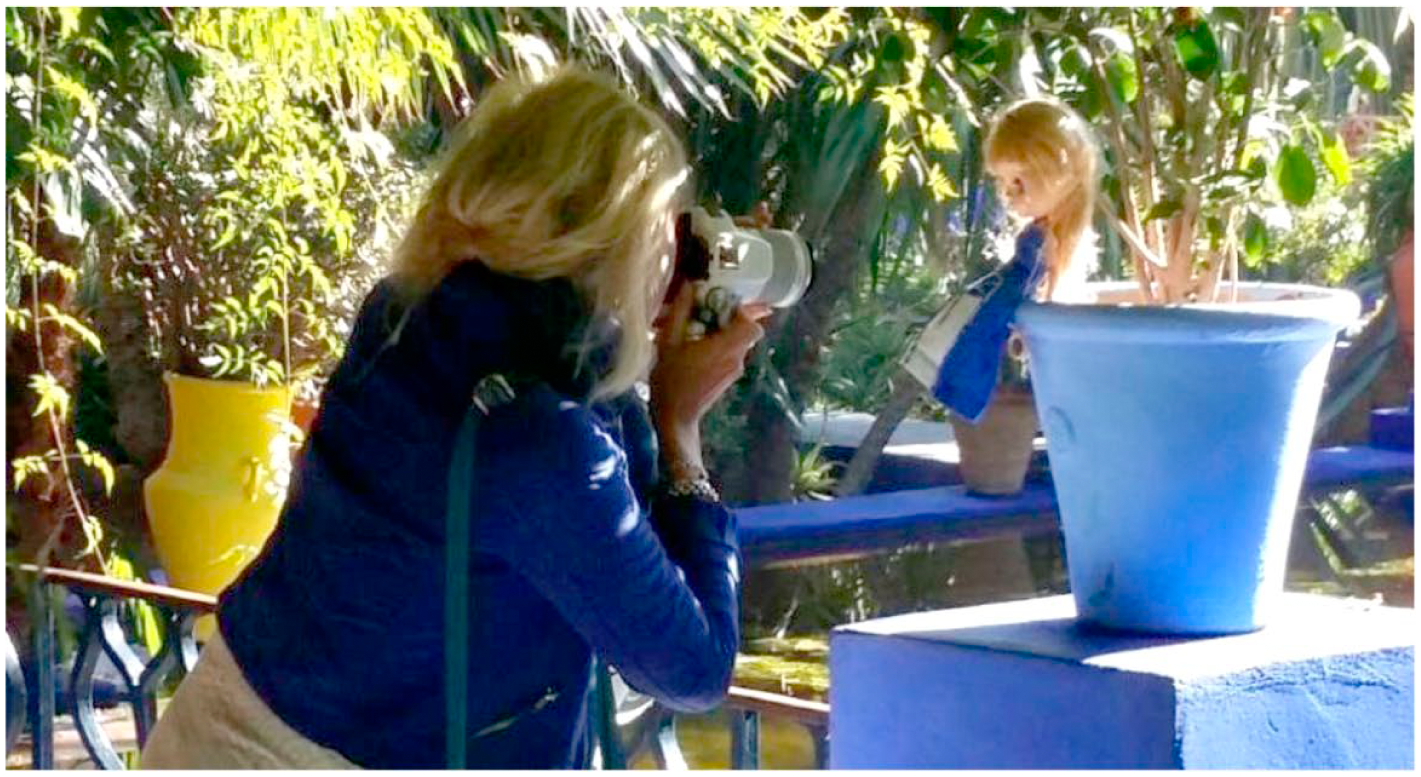
A Blythe doll photoplayed by K.H. during ‘toy tourism’ in Marrakech, 2016.
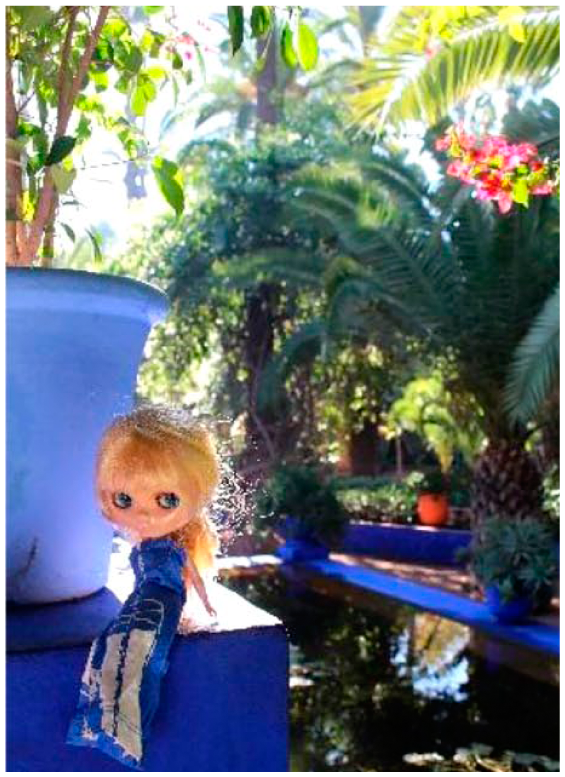
A different perspective picture from the same set.
I make different displays and photograph them [Blythes], sometimes I dress them and do the hair so that they would look more groomed, sometimes I may just admired their cuteness/beauty. (Pinkkisfun, b. 1975)
As shown, these studied adults are endlessly ‘toying with’, that is, re-appropriating the uses, appearances and narratives of their playthings. The plaything, as a creatively cultivated and an artistically photographed artefact, affords other kinds of playful enjoyment as well. For instance, Blythes are employed in photoplay as playthings which afford toying with both inside domestic interiors and outdoors in public spaces, as demonstrated by interviewee ‘Tiina’:
Many of my dolls do live inside a glass cabinet, but I also change the clothes of my dolls or make displays of them and sometimes photograph them, so one may say that I play with them too, apart from that they are [considered] decorative items. […] When I photograph them, I usually take the photos in my home, but sometimes also outdoors in the park. (Tiina, b. 1984)
According to our interviewees, photoplay is experienced as an enjoyable activity both solitarily and socially. This relates to the joy that one experiences when photoplaying with the toy and the enjoyment from being able to share this form of ludic engagement with others. The portability and poseability of toys as affordances for play are, together with the practices of photoplay, important starting points in exploring the ways in which to ‘animate the inanimate’. The dolls not only have an anthropomorphic character but also stories of their own, as the phase ‘dolls live’ above illustrates. Experiences of stories and sharing may even enliven the toy characters in imaginative ways, some of which are active and others more passive, as described by interviewee Hannhell, owner of multiple character toys:
Dolls and toys are for me decorative items at home, peaceful items [which] I look at on a daily basis and when the time allows, I also try to photograph [them], come up with stories for the toys. What I like is that some toys and dolls have to do with memories if I have received one from a friend, or I have like-minded friends who develop stories with similar toys as well. (Hannhell, b. 1965)
Social media as a site for interactive photoplay
Social sharing turns photoplay into more than just a personal frame change. Danet (2001: 7–8) sees the online environment as a site for play, because it affords all kinds of activities related to pretending and make believe, both familiar in terminology defining different forms of play. Digital media scholars, Saarikoski et al. (2009: 261–262), support this view by arguing that play, or rather, playfulness, has been one of the most important factors tempting people to online activities. According to Panksepp (1998), playfulness as a ‘joyful social exchange’ is central to all socialization (p. 284). To establish relationships marked with good fellowship and to develop social capacities, both children and adults turn to social play that extends from ordinary chat to mutual adornment of ‘soul-stirring spectacles’ (Groos, 2010: 211, 213, 221, 234, 235). However, although recognized by many as sites for playful interaction, the connections between play and social media practices are difficult for some to grasp:
I don’t play with others. The social side of my Blythe hobby restricts to the sharing of my photographs in photo management applications and on doll hobbyist forums. (Tiina, b. 1984)
Photoplay is not limited to toy photography only, but closely associates with the concept of socially shared visual experiences that manifest in online environments. For example, various ‘photo challenges’ communicated online have gained popularity over the past few years. One example of mimetic photoplay with toys is the aforementioned toy tourism. Other examples are different ‘projects’ and challenges conducted with toys in photoplay (see, for instance, the My Little Pony players in Heljakka, 2015). Creativity, humour and clever ways of solving artistic photoplay challenges have an impact on the interaction between photoplayers:
It is fun to have feedback for photographs on Flickr. It is a shame there is less of that nowadays. The interaction with others who are interested in fashion dolls is a crucial part of this thing. I would like myself to have more ‘play moments’ and sharing IRL [in real life] with others who have gone crazy. (Liiolii, b. 1975) In Flickr the playing continues if it generates discussion. (Sandy, b. 1974)
The Internet is a focal point for groups of people with similar interests, and as convergence culture enables new forms of participation and collaboration between, that is, fan groups (Jenkins, 2006: 256), a playful attitude and engagement towards culture have become even more perceivable. Social networks represent one of the most typical realms and are often considered crucial for sustained interaction between adults with toy relations:
What role does the internet play in your Blythe activities?
Without [the internet] I would not even had heard of Blythe or would have been able to buy my dolls. The internet enables the communication and sharing of information between the hobbyists. […] The Blythe groups on Flickr are the most important channels for me. (Tiina, b. 1984)
Jenkins (2006) writes of fans seeing intellectual property, such as media content, as ‘shareware’, something that accrues value as it moves across different contexts, gets retold in various ways, attracts multiple audiences, and opens itself up to a proliferation of alternative meanings (p. 267). The materials presented in this article suggest that the actions of contemporary adult toy players point to the same direction: the narratives around the Blythe doll circulate and accumulate to dimensions perhaps never imagined by Katzman, the original toy designer credited for the form and visual, tactile and mechanical ‘storytelling quality’ of this doll – its primary play(ful) affordances.
In the light of the given examples, social media platforms seem to offer themselves as a playground full of potential and possibilities of visual contextualization and ludic interaction even for adult players, where forms of creative play are cultivated and appreciated as non-stigmatizing, but rather as empowering. Consequently, the Internet seems to attract adult toy users as a permissive place to carry out, cherish and appreciate enthusiasm towards toys and, on the other hand, a pleasurable, visual form of play:
For me Blythe is much more than just a doll. It makes me photograph, sew, make arts and crafts, to meet with other people, to travel. Other work (may it be doll houses, clothes, customizations, singular images, whatever) and looking at it creates powerful feelings to the extent that one needs to avoid it right before going to bed because they are so breathtaking. (Pinkkisfun, b. 1975)
Discussion
Our time is seeing an increase in photographic content production in various contexts, ranging from the playful to the professional, the restaurant to the workplace. The use of toys as content for such processes in many ways exemplifies the trend: in it the visual, the aesthetic alibi, community acceptance and the enjoyment of a type of play that might be otherwise seen as stigmatizing all combine to create a new frame of reference for the toy enthusiast. By taking pictures of one’s toys, or, visually contextualizing it by sharing those pictures, and then gaining feedback, the playful collector, or adult toy player, engages with a new, rewarding set of affordances provided by the toy. At the same time, it offers the creators of those toys a core of fan-based, free marketing material, and the status of collectors’ items, things that are appreciated by artistic adults. In the case of toys like Blythe, this may even affect a change in the perceived affordances of the toy itself: the originally substitute activity, by repetition and a defined target audience, becomes the primary affordance associated with that particular toy.
The desire to ‘play’ and yet not ‘play’ is central to understanding the relationships underlying much of photoplay. The owners wish to utilize the dolls, to interact with them on different levels (such as on a ‘simple’, interpersonal level involving solitary uses, or more complex, intrapersonal level meaning socially shared uses such as employing the doll for storytelling), but in a manner befitting their own adult status and behaviour (e.g. Figures 3 and 4). That wish is translated into a mediated form, which gives a new, additional meaning to owning Blythes. It also protects the owner from the social stigma that may arise from the way the concepts of ‘toy’ and ‘immaturity’ are associated together. Even though people who stand closest to the adult toy player would experience the toy activities of their partner as deviant or even disturbing, a more understanding reception can be found in digital playscapes, especially the realms of social media and sites like Flickr and Instagram.
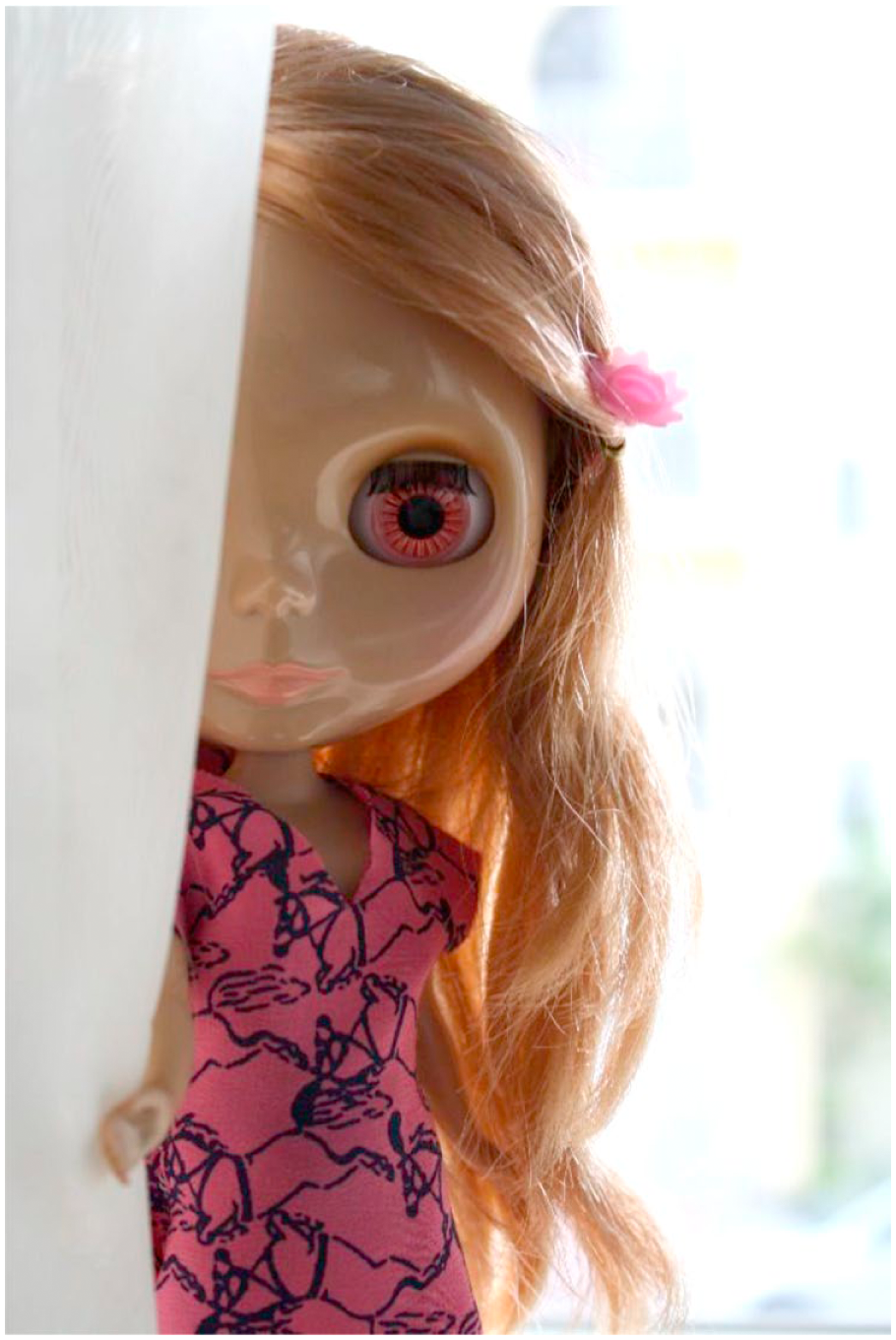
Rosebud (2010) photoplayed by K.H.
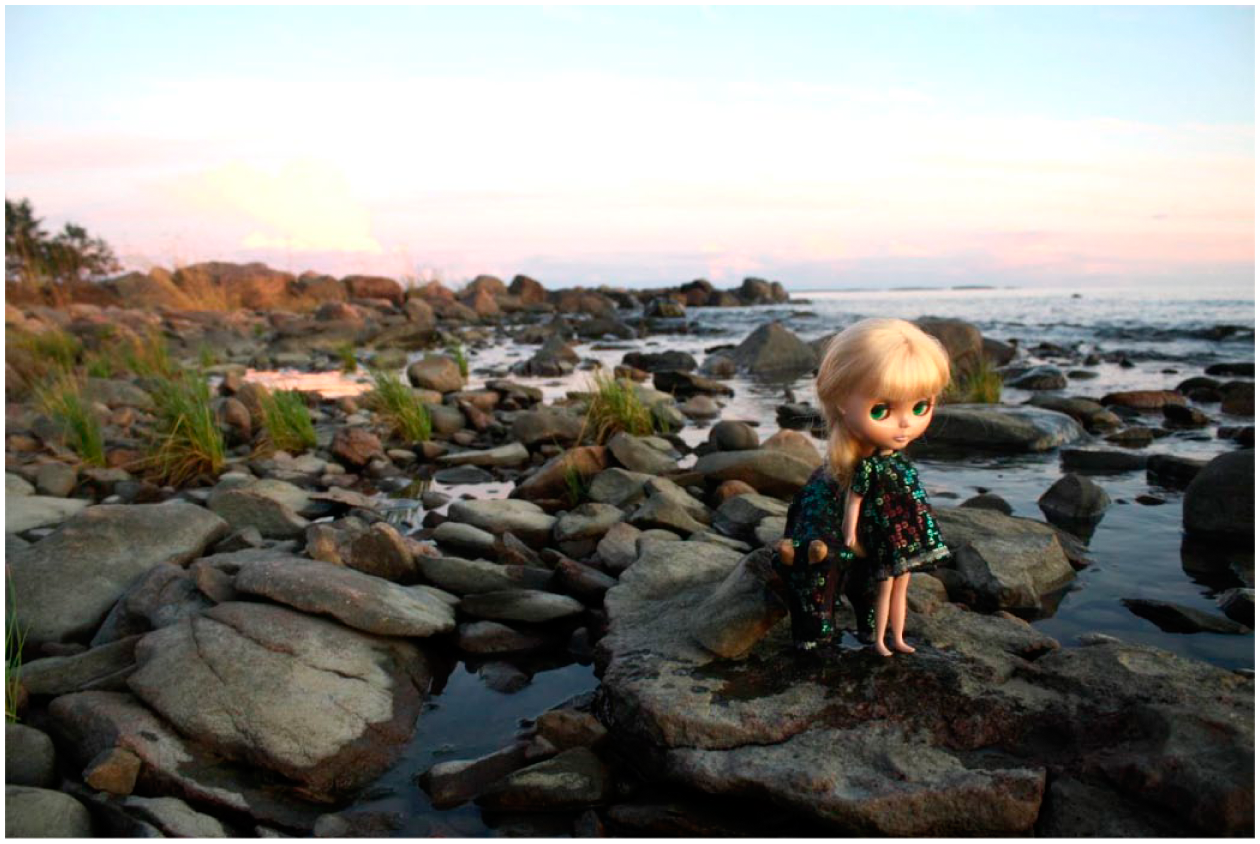
August glitters (2011) photoplayed by K.H.
It is nevertheless difficult for adults to call their activities play, even as they would recognize the behaviour as such. Society and governmental organizations in general have certain ideas about what constitutes the ‘play age’ of a person. At the same time, the rhetoric surrounding play situates this form of human behaviour in the childhood context. Even though many understand the positive and therapeutic values of play, these are rarely spoken of when referring to material playthings and even more rarely in reference to adults as toy players. Instead, adults who confess to owning toys and who admit to doing something with these playthings often use other wordings than ‘play’ for their activities. In doing so, the play aspect of the behaviours of these adults remains unarticulated and perhaps disguised as well. This conspicuous absence of the solo word ‘play’ in these obviously playful activities, but its presence in the connected form of ‘photoplay’, is at the core of this stigma avoidance. The use of a camera turns playful behaviour permissible once more.
It appears that adult users of toys as well as the toy industry tend to seek stigma avoidance instead through statements like ‘This is not a toy. This is a collector’s item’. Essentially, they have chosen a strategy that feeds the stigma, not alleviates it, and yet it produces an excuse for those who would be stigmatized. Additionally, it works in the advantage of those whose core interest in toys is indeed in viewing them as collectibles.
Providers of playthings such as the toy industry could, however, benefit from this new development pattern that is also referred to, perhaps more positively, as ASYL (‘Adults Staying Younger Longer’). As a countertrend to the well-known and identified development especially among people working in the toy industry, KGOY, that is ‘Kids Growing Older Younger’, adults staying younger longer and maybe thus more playful with objects traditionally thought of as children’s playthings, could be seen as potential new target audiences for toys, and most importantly, their new players (Hjarvard, 2013).
Conclusion
Based on our interview data and background knowledge, it is possible to see that adult’ relationships to toys are multifaceted and multifunctional. As we have argued, the relations of adults to toys do not restrict themselves to simple ownership of toys – in many occasions collecting extends to hobbying, which again may include many forms of creative object play practices, such as photoplay.
Some playthings carry on to have meaning in adulthood, not only as aesthetically appreciated and collectable artefacts but more importantly as objects which encourage their players to improve their skills and to acquire new ones through creative self-expression of various kinds. The employment of dolls such as Blythe function as evidence for adult play: adults are using their imaginations to develop personalities and narratives for the dolls and then utilize them in their visual contextualization of play. This is exemplified by photoplay activities, including camera-based technologies and interaction with peer players on social media platforms.
Photoplay presents itself as a new form of adult play. It is an activity that challenges the stigma previously associated with adults who partake in activities with toys. On the level of the individual, photoplay seems to result in both productive, allotelic (goal-oriented) outcomes and occasional, personal, autotelic (intrinsic) enjoyment: skill building, artistic play and imaginative storytelling which manifests in photoplay – photographic representations of toys depicting play scenarios in actual environments both indoors and outdoors. On the social level, this activity often leads to technologically mediated and sometimes more long-term interaction, which not only is rewarding in itself but also attracts possible new players to join in play.
In sum, adult interaction with toys does seem to follow both autotelic and allotelic ends. According to our interviewees, photoplay, once conducted in public environments, both online and offline, is also an empowering activity. Once the fear of stigma is overcome through visual contextualization of toys, and an adult openly plays with toys in public spaces, feelings of pride start to take over. It is a known fact that photo-sharing sites are used as a form of legitimization and stigma avoidance by certain groups, ranging from pro-ana (see, for example, Ging and Garvey, 2018) to LGBTQ youths (Wargo, 2017), and even the alt-right movement. It therefore comes as no surprise that toy owners apply the method for their own purposes as well, as both a stigma avoidance strategy and a form of artistic expression.
Footnotes
Funding
The author(s) disclosed receipt of the following financial support for the research, authorship, and/or publication of this article: This study has been funded by the Academy of Finland and Finnish Funding Agency for Technology and Innovation, and is a part of the research projects Ludification and the Emergence of Playful Culture (275421) and Hybrid Social Play (2600360411).