




Abstract
The digital media environment changes the way citizens receive political information, also during an election campaign. Particularly first-time voters increasingly use social media platforms as news sources. Yet, it is less clear how accessing political information in such a unique social setting affects these cohorts’ decision-making processes during an election campaign, compared to experienced voters. We compare effects of these two groups’ political information exposure on their vote choice certainty during the 2015 Danish national election. We furthermore test how the relation between exposure and certainty can be mediated by active campaign participation. An 11-wave national panel study was conducted, using a smartphone-based assessment of citizens’ (n = 1108) media exposure and vote choice certainty across the campaign period. Results suggest that first-time voters’ social media exposure is responsible for their increase in certainty as the campaign progresses, while this effect is absent for experienced voters.
Keywords
Forming a vote decision is an important, reoccurring task for most citizens in Western democracies. Citizens base their voting decision on prior voting experiences, existing attitudes, and on different sources of direct and mediated communication (Redlawsk, 2002). Research shows that media play an important role in the formation of a vote decision, along with communication with peers and direct encounters with political actors (Beck et al., 2002; Boomgaarden and Schmitt-Beck, 2016; Schmitt-Beck, 2003). Yet, little is known about whether media can help citizens increase their vote choice certainty, that is, the subjective feeling of being sure which party or candidate to vote for (Alvarez and Franklin, 1994). What we do know is that citizens who are certain whom to vote for are more likely to turnout. This is especially relevant in times with high voter volatility when swing-voters make their vote decision late in the campaign or make no decision at all (Boomgaarden and Schmitt-Beck, 2016; Geers and Bos, 2016).
Social media platforms are increasingly popular as sources of political information during election campaigns along with traditional offline or non-social online media outlets. Interestingly, not only do these platforms provide access to political information from news media for an increasing share of the population (Newman et al., 2017), but platforms like Facebook or Twitter also cater two other important factors in citizens’ development of a certain vote choice: peer discussions about political issues and the possibility of direct communication with political actors (Aldrich et al., 2016; Beck et al., 2002). The role of media use in the process of vote decision formation therefore needs an evaluation that is able to determine whether potential effects are dependent on the media channel citizens use.
While media, based on the information they provide, may be able to increase vote choice certainty directly, direct experiences and engagement with an election that go beyond media use can offer guidance for citizens to successfully perform a political act, such a making a vote choice (Austin and Nelson, 1993). In the context of an upcoming election, it is therefore possible that media exposure not only informs citizens about electoral issues and party standpoints but also activates them to engage further with the election by participating in campaign activities. Campaign participation describes acts that are specifically related to an upcoming election and fulfills the function of additional information intake and processing as well as interpersonal communication about and campaigning for a candidate or party. Although acts may require little additional effort, we are especially interested in this way of engaging with the election beyond merely following media. Research has demonstrated that especially social media exposure can mobilize citizens to actively participate in a campaign (Dimitrova et al., 2014; Holt et al., 2013; Kahne et al., 2013). However, it remains an open question if media exposure can mobilize such direct experiences that subsequently increase citizens’ vote choice certainty.
For young citizens, developing a vote decision is part of their socialization (Colwell Quarles, 1979; Moeller et al., 2014) and is thereby determined by information received via media and school and peer talk about political topics (McLeod, 2000; Shah et al., 2005). It is therefore likely that their vote choice formation as part of this socialization is based on the same pillars. Social media combine two of those elements, namely exposure to political information in a unique social setting. Hence, these platforms might be especially impactful sources for first-time voters, compared with exposure to non-social online and offline media. We investigate if exposure to political information via social media, non-social online and offline media directly affects citizens’ vote choice certainty and whether there is an indirect effect through mobilization of active campaign participation. We compare these effects on first-time voters and experienced voters in the 2015 Danish parliamentary election. Thereby, the study tests whether young citizens in their political socialization process are especially susceptible to receiving political information in a social setting. We use panel data from a 2-wave online survey and an 11-wave smartphone-based media and election diary study. This allows us to model individual changes in vote choice certainty across the campaign period and thereby extend insights from prior research, which mostly relies on cross-sectional data to model this period (e.g. Ha et al., 2013; Hargittai and Shaw, 2013; Kaid et al., 2007; Kushin and Yamamoto, 2010).
Uncertainty, social media and first-time voters
All citizens face uncertainty in the political decision-making process. Nevertheless, the political system relies on them to frequently make political choices with real-world consequences (Alvarez and Franklin, 1994). Uncertainty thus conflicts somewhat with the democratic idea that an election aggregates preferences for all groups of the electorate (Downs, 1957). To know and be certain about its preferences, the electorate needs accurate information and reliable sources of information (Colwell Quarles, 1979). It is the task of traditional mass media to deliver such information, provide guidance, act as watchdog, and offer a forum of diverse views for citizens (Christian, 2009). They thereby play a crucial role in citizens’ decision-making process. However, other communication processes like interpersonal communication and direct political communication (i.e. campaigning) are additional factors citizens base their vote decision on (De Vreese and Semetko, 2004).
Social interaction with peers about political issues is an especially important driver of young citizens’ civic engagement (Shah et al., 2005). Research finds that exposure to news from digital media outlets is a crucial antecedent of personal interaction online, that is civic messaging (Ekström and Östman, 2015; Lee et al., 2012; Moeller et al., 2014). In the context of developing a certain vote choice, it is likely that information received from media play an initial role for citizens to engage with election-related topics and to process them further in interpersonal communication settings. Studies that look at media effects during election campaigns mostly distinguish between information received online and offline. Little research, however, has examined if the social environment political information is received in on social media has a special function for citizens’ formation of vote choice. In other words, does the “socialization of the media consumption process” (Messing and Westwood, 2014) help voters to become more certain about their vote?
Vote choice certainty
The concept of uncertainty is generally understood as having only imperfect or incomplete information available, it is an individual feeling and thereby an inherently subjective evaluation (Alvarez and Franklin, 1994). Uncertainty thus understood may have significant impact on citizens’ decision-making. Their vote choice certainty and thereby their ability to cast an informed vote are most important in a citizen’s decision-making process (Verba et al., 1995). Undecided voters are a common phenomenon in election campaigns (Kitchens et al., 2003). Furthermore, studies have shown that misinformed voters vote differently than they would have had they been fully informed (Bartels, 1986; Kuklinski et al., 2003). Of course, voters who are uncertain about which party to vote for could decide not to turnout (Sanders, 2001); however, turning out is one condition for a functioning democracy (Strömbäck, 2005).
The growing share of volatile voters or swing-voters (Dalton and Wattenberg, 2002; Geers and Bos, 2016) and the fact that vote choices are made later nowadays (Boomgaarden and Schmitt-Beck, 2016) may partly be indications of the growing uncertainty among the electorate. It is therefore of great interest how vote choice certainty can be increased and whether exposure to political information from different media sources could strengthen voters’ ability to make sense of information. Niemi et al. (1991) described this process as “one’s own competence to understand, and to participate effectively in, politics” (p. 1407). An increase in vote choice certainty is thereby linked to higher internal political efficacy in an electoral context. We stress that a certain vote choice does not necessarily mean a well-informed vote; however, casting a certain vote is desirable in the context of turnout in an election.
Young voters are inexperienced voters and may lack guiding factors that experienced voters rely on, such as satisfaction with the incumbent government and party identification (Colwell Quarles, 1979; O’Keefe and Liu, 1980). Their first vote is furthermore part of their political socialization, which is not complete at this point. Their vote choice certainty may therefore potentially be lower than that of experienced voters. Being certain about whom to vote for can furthermore be understood as an efficacious feeling during an election campaign. Kaid et al. (2007) found lower information efficacy among younger voters, and Kenski and Stroud (2006) found age to be a negative predictor of external and internal efficacy in an election campaign. We therefore expect that
H1. When an election campaign starts, first-time voters have lower vote choice certainty than experienced voters.
Differential media effects
Voters consult the media when forming their vote decision, but in a digital media environment, media effects might not be uniform. The digitalization of information has created a hybrid media system, in which information constantly spreads across different media channels (Chadwick, 2013; Schulz, 2014). Information flows are highly interconnected between channels and it is difficult to discern a single source of a news story. Nevertheless, citizens still receive information via distinct media channels; studies have found that which channel citizens get their political news from can determine how their political behavior is affected (see Dimitrova et al., 2014; Moeller et al., 2016). Hence, our study looks at channel effects rather than effects of exposure to specific contents.
There are three main access points to political information (Lee et al., 2014): offline media (print, television, and radio), non-social online media (news outlets, political blogs, or party websites) and social media platforms (e.g. Facebook, Twitter, or Instagram). Recent developments show that in many Western democracies, offline media channels experience a decline while online media are becoming the main source for political information. Within the category of online media, the share of social media exposure increases steadily, while fewer people receive political information via non-social online media (Newman et al., 2017). Especially young citizens in the age of first-time voters show a high inclination to receiving political information via social media (Ohme, 2017; Mitchell et al., 2017). This grand pattern of changing political information access has manifested itself over the past years and is especially interesting to study, considering that offline, non-social online and social media are characterized by different affordances.
All three channels provide access to political information, which may be partly similar in content. The 12 major Danish news outlets receive their largest share of online traffic (38%) from users following links from social media (Birkmose, 2016). But while content may be overlapping across channels, offline, non-social online and social media channels differ in terms of their information access and social environment of exposure. First, they differ in the amount and diversity of information they can provide. While offline media offer a fixed amount of information in a one-fits-all manner per outlet (e.g. newspaper and news broadcast), non-social websites offer an infinite amount of information due to unlimited space and ubiquitous availability (Klinger and Svensson, 2015). However, accessing information from different sources on non-social online media requires effortful, numerous individual search and collection activities (Messing and Westwood, 2014). Social media, in turn, offer single-spot access to very different information sources that are combined into a single news stream. The push mechanism constantly delivers information from pre-selected sources that are displayed based on algorithmic decisions, resulting in a personalized news diet (Thorson and Wells, 2015). Hence, social media platforms can provide access to a greater amount of information with less effort for the recipient. Tailoring of information based on the pre-selection of sources may furthermore facilitate access to information from sources and about topics with higher relevance for the formation of citizens’ vote choice. These mechanisms may also be responsible for exposure biased toward like-minded viewpoints, so-called “filter bubbles” (Pariser, 2011). However, inadvertent content exposure on social media may also be possible (Fletcher and Nielsen, 2017) and research so far is inconclusive with respect to systematically created echo chambers for users on social media (Zuiderveen Borgesius et al., 2016). In a political context, information can include posts from friends and followers or from political actors along with original posts by news media. The inclusion of information from personal contacts and political actors into their personalized social media diet may be especially relevant for first-time voters, for whom traditional news media may be less able to provide information about topics that are relevant to this small group of the electorate (Moeller et al., 2016).
Second, an information item on social media is augmented with social endorsements, be it recommendations from friends, the number of reads, views or reactions, such as the like-button of Facebook. Messing and Westwood (2014) found that such endorsements drive users’ selection of information on social media. It is furthermore likely that such social evaluations shape the interpretation of an issue. Offline or non-social online media less often include social endorsements (Thurman and Schiffers, 2012). Hence, offline and non-social online media may mainly increase citizens’ knowledge about topics in an upcoming election, while social media exposure may direct the development of a vote choice, based on social cues received on these platforms. Such “communication patterns at the micro-social level contribute […] to the individual’s autonomous political identity” (Austin and Nelson, 1993: 420). Voting for the first-time is inseparable from the formation of young citizens’ political identity (Gerber et al., 2003; Sears and Brown, 2013), and their socialization with politics and the political system is strongly dependent on media use, communication with peers, and political education (McLeod, 2000). Media use may therefore fulfill a different function in the development of first-time and experienced voters’ vote choice formation.
Studies have shown that interpersonal communication is especially important for young people and that it activates political behavior (Ekström and Östman, 2015; Lee et al., 2012; Moeller et al., 2014; Shah et al., 2005). Communication with peers provides young citizens with different ideas about and interpretations of issues and can support them in situations when they are uncertain how to form a decision. Furthermore, direct political communication (either by following political actors or through targeting; see Kruikemeier et al., 2016) is most important for young citizens’ motivation to turnout (see Aldrich et al., 2016). Wells and Dudash (2007) found (based on focus groups interviews) that young voters who used online information and personal conversations as their most important information sources in an election campaign felt rather certain about whom to vote for. Since cues and guidance offered in interpersonal communication are increasingly interwoven with a news item on social media, it is likely that first-time voters are more affected by political information on social media than by information they receive via other media channels. We therefore expect that:
H2. Exposure to political information on social media platforms increases first-time voters’ vote choice certainty more than exposure to information from offline or non-social online media.
First-time voters are perceived as a special electoral group with higher susceptibility to media information and weaker dependence on party identification and satisfaction with the incumbent government (Aalberg and Jenssen, 2007; Colwell Quarles, 1979; O’Keefe and Liu, 1980). Of course, also experienced voters rely on media information when they form a vote decision (De Vreese and Semetko, 2004). A few studies have investigated whether the use of media can actually help voters form a more certain vote decision. Kitchens et al. (2003) found no effect of information seeking in traditional offline media on vote decision, whereas Fournier et al. (2004) showed that exposure to campaign information has a positive effect on undecided voters’ decision. However, empirical studies that compare the susceptibly of first-time voters and experienced voters to media information when a vote decision is made, are sparse. We therefore ask the question:
RQ1. Do first-time voters exhibit a different susceptibility to political information from offline, online and social media sources when forming their vote choice, compared to more experienced voters?
Campaign participation and uncertainty
Following campaign developments via the media is one way for voters to engage in an upcoming election. Another, maybe more important way is to participate in campaign activities that go beyond merely following the media. We define campaign participation as acts that are specifically related to an upcoming election and fulfill the function of additional information intake and processing as well as interpersonal communication about and campaigning for a candidate or party (see Dimitrova et al., 2014; Shah et al., 2007). Active campaign participation can be an antecedent of actually turning out (Foot and Schneider, 2006), and direct experiences with actors and topics of the elections may increase citizens’ vote choice certainty (Austin and Nelson, 1993). Media may play an important role in fostering active participation in campaign activities, and studies confirm differential media effects on campaign participation (Aldrich et al., 2016; Dimitrova et al., 2014; Gil de Zuniga et al., 2010; Kahne et al., 2013; Shah et al., 2007). Active involvement in small activities during a campaign may be particularly helpful for first-time voters in forming their vote choice, because they are in direct contact with the election, candidates, or topics that are new to them. A possible subsequent process here is that active campaign participation reduces uncertainty due to closer and unmediated contact with candidates and their positions and a stronger processing of information. However, it remains untested whether engaging in a campaign affects voters’ uncertainty. We therefore ask the following:
RQ2. Does active campaign participation increase vote choice certainty among first-time and experienced voters?
Previous studies have found a reinforcing effect of political social media exposure on active campaign participation (Ohme, 2017; Dimitrova et al., 2014). We want to examine a possible mediation of social media exposure on vote choice certainty through campaign participation. According to Austin and Nelson (1993), the acquisition of knowledge is related to gaining efficacy, which then positively influences a skill performance. If we understand “voting” as a skill that especially first-time voters have to learn, then vote choice certainty may be a necessary way of feeling efficacious to actually turnout. Exposure to political information thus plays a crucial role in terms of increasing certainty about one’s vote choice. However, based on social cognitive theory, Bandura (1989) states that knowledge about a topic is necessary for behavioral success (in our case, voting), but not the only predictor. He adds that, next to knowledge, vicarious experiences can affect the efficacy, especially for individuals with little first-hand experience to evaluate how well they will perform the skill. Because first-time voters have no previous election and voting experience, active campaign participation might work for them as a vicarious experience, increasing their efficacious feeling to be certain about their vote choice. Being in contact with other voters via campaign activities might thereby make them more secure that turning out is a rewarding action that others are willing to perform as well. This feeling and first-hand contact to actors and topics in a campaign might thereby help them find a party or candidate to vote for.
We want to extend prior research that focuses on direct effects between information exposure and political efficacy (Kenski and Stroud, 2006) by examining whether taking part in campaign activities (e.g. attend campaign events, take a vote advice application, discuss campaign topics on social media) can help voters form a more certain vote choice. In other words, we ask:
RQ3. Is the effect of exposure to political information on vote choice certainty mediated by voters’ campaign participation?
RQ4. Is the potential mediation between exposure to political information and vote choice certainty through campaign participation moderated by being a first-time voter or an experienced voter?
Method
To test for influences of political information exposure on vote choice certainty, we rely on data from a pre- and post-election online panel survey and an 11-wave smartphone diary study conducted around the Danish national election campaign in 2015. Due to its high turnout rate (over 80%; Bhatti et al., 2016), high level of news consumption (Schroeder, 2015), high Internet penetration (91% of households), and high number of persons using smartphones (98% of Danes own a smartphone; Danmarks Statistik, 2016), Denmark is a well-chosen case to examine the impact of political information exposure on vote choice certainty.
Sample
The sample consists of 1108 respondents. Of these 199 are first-time voters (18–22 years at the time of election) and 909 “experienced” voters (23 years and older). All respondents took part in the pre- and post-election survey and at least four mobile diary surveys. The latter were fielded 11 times during the 3-week election campaign period. This provides a comprehensive assessment of their media exposure during the election campaign.
Respondents were recruited using a pollster’s database and the use of national register data. Three different groups were included: a general population sample, a sample of elderly population, and a youth sample. The general and the elderly samples were recruited from the pollster’s database, which is representative of the Danish population. The sampling strategy relied on a light quota on age and gender. In the general population sample, 10,315 were invited to take the online survey of which 45% (n = 4641) did. Similarly, 60% of the elderly people (62–91 years) agreed to participate (n = 1831). For the youth sample, 13,700 persons aged 17–21 years at wave 1 were randomly sampled, using national register address data; 1 19% (n = 2653) did participate. In total, 9125 (4641 + 1831 + 2653) participated.
The pre-election wave, which was the third wave of a longitudinal study, included 2946 respondents from the national sample (attrition rate from wave 1 [n = 4641]: 36%). The elderly sample included 1369 respondents (attrition rate from wave 1 [n = 1831]: 23%) and the youth sample 1051 (attrition rate from wave 1 [n = 2653]: 61%). In the post-election wave conducted the day after the election, 2680 respondents in the general sample, 1292 respondents in the elderly sample, and 769 respondents in youth sample were retained (overall retention rate: 88%). Of the respondents participating in pre- and post-election wave, 1349 (28%) participated in the mobile election diary study. Out of these, 82% participated at least 4 times in the mobile dairy leading to a final sample of 1108. 2
Measures
Exposure to political information (EPI) was assessed by asking respondents every second day via the smartphone-based diary from which media channels they had received political information. We did this to reduce respondents’ memory burden (Slater, 2004) and to apply a fine-grained structure of an exposure measure, assessing media use with the concept of Audio, Page, and Stream exposure (Engel and Best, 2012; see Appendix B) rather than exposure categories like television, print or online, which might be less applicable in today’s convergent media environment. This measurement has shown good applicability in general and is especially helpful for the assessment of political social media use compared to mere time exposure measures in previous studies (Ohme, Albæk, & de Vresse, 2016). To account for the diary structure of the data with varying participation days among respondents, a relative exposure measurement was calculated on an individual data level. The frequency of exposure to offline (listening to radio, reading the newspaper, watching television) non-social online (listening to online radio, reading websites of newspapers, other media outlets and other websites, watching videos on broadcasters websites and other websites), or social media (reading and watching on social media platforms) was divided by the days each respondent had participated in the survey. The relative measure ranged from 0 to 1, with 1 indicating exposure to the information from the relevant environment on all days the respondent had participated. First-time voters used social media platforms significantly more (M = 0.37, SD = 0.27) than experienced voters (M = 0.23, SD = 0.29) and offline sources significantly less (M = 0.28, SD = 0.18) than experienced voters (M = 0.51, SD = 0.26). No significant differences for online exposure between the two groups (first-time voters: M = 0.14, SD = 0.14; experienced voters: M = 0.13, SD = 0.14) were detected.
Vote choice certainty
A direct measure of uncertainty was proposed and tested by Alvarez and Franklin (1994). The respondents’ vote decision certainty was assessed with the mobile diary every fourth day of the election campaign (i.e. 6 times 3 ) by asking “How certain are you about which party to vote for in the upcoming election?” with a five-point scale response category (1 = very uncertain to 5 = very certain; see Appendix C for daily descriptives).
Campaign participation
We asked respondents about participation in 12 different activities (see Table 1). We combine approaches by Dimitrova et al. (2014) and Shah et al. (2007), asking about offline activities (e.g. attended public meetings, discussions, debates, and lectures about the election), online activities (e.g. used a vote advice application), and activities on social media (e.g. expressed support for a party or candidate). Respondents were asked if they participated in any of these activities over the course of the election. An index of campaign participation was subsequently calculated and showed sufficient reliability (Cronbach’s α = .74, Min = 0, Max = 12, M = 3.3, SD = 2.1).
Campaign participation by vote experience.

Controls
Age (M = 48, SD = 19, Min = 18, Max = 80), gender (45% women), formal education, income, political interest (M = 6.8, SD = 2.3, Min = 0, Max = 10) and being a first-time voter were added as control variables to the model.
Results
To address potential effects of media exposure during the campaign on vote choice certainty, two analytical strategies were used. First, we developed a lagged dependent variable model, including the vote choice certainty right at the beginning of the campaign (t1) to predict vote choice certainty on the day of the election (t2) in the regression model (Table 2). Second, to model the development of vote choice certainty over the course of the campaign, we built a parallel process latent growth curve model with group comparison, using structural equation modeling (see model Appendix A). This allows us to take all six measurement points of vote choice certainty into account and thereby model a development. The parallel process model furthermore allows us to connect the respective exposure measured over the course of the campaign to the development of vote choice certainty (Acock, 2013; Preacher, 2008). Due to the results from the lagged dependent variable model, we modeled whether an increase of vote choice certainty over time is caused by exposure to political information on social media. To be able to take cases with missing values into account, we used full information maximum likelihood estimations (mlmv; Acock, 2013). The following goodness-of-fit indices suggested a satisfactory model fit: χ2(116) = 410.869, p < .001, root mean square error of approximation (RMSEA) = 0.5, comparative fix index (CFI) = 0.967, Tucker–Lewis index (TLI) = 0.962.
Predicting vote choice certainty on Election Day.
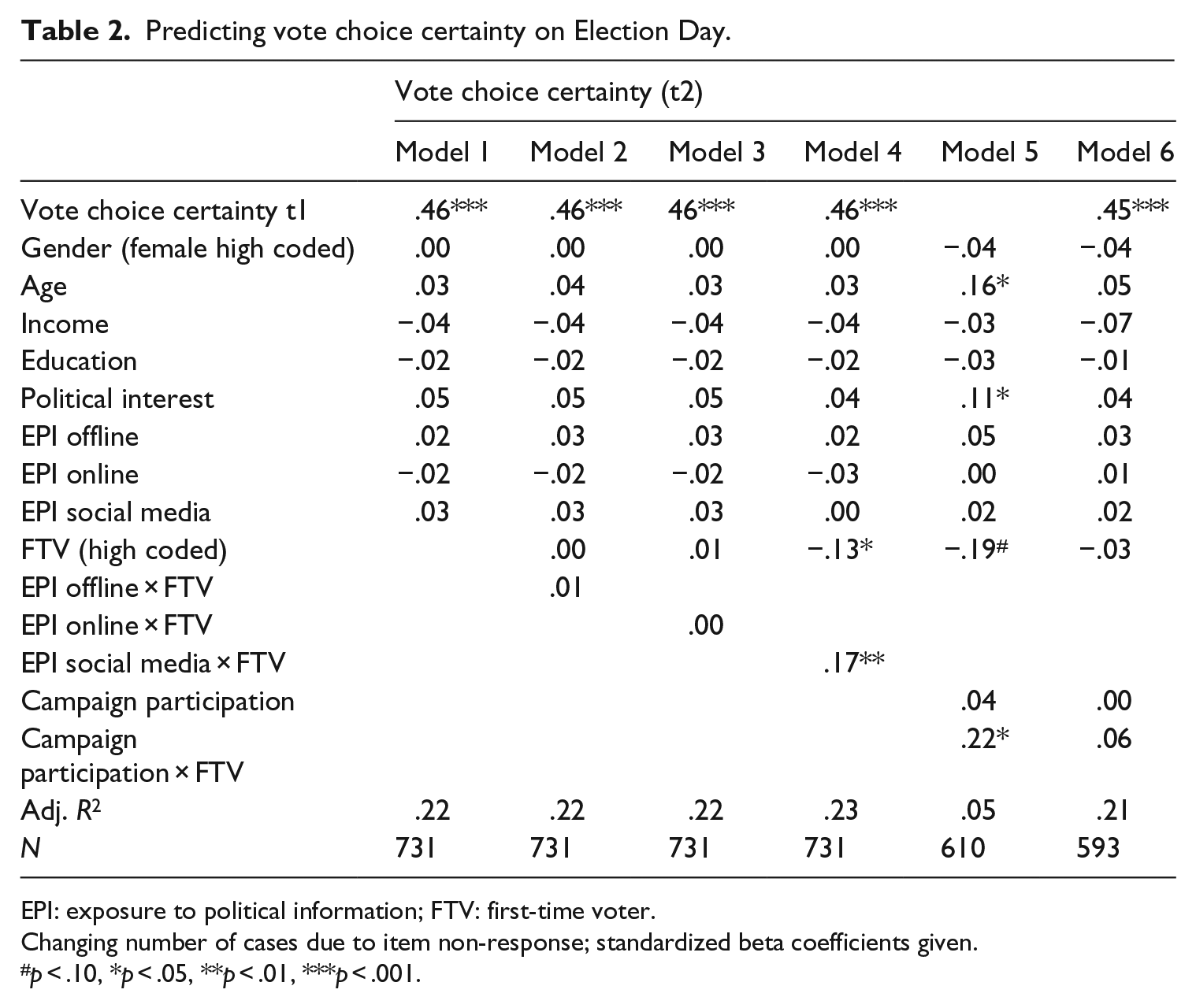
EPI: exposure to political information; FTV: first-time voter.
Changing number of cases due to item non-response; standardized beta coefficients given.
p < .10, *p < .05, **p < .01, ***p < .001.
We predicted that exposure to political information on social media has a more positive effect on young voters’ vote choice certainty than exposure to other media channels (H2). We then compared the effects of exposure to political information on young voters’ and experienced voters’ vote choice certainty (RQ1). Model 1 (Table 2) assesses the potential effect for all voters and shows that only the lagged dependent variable (t1) has an effect on vote choice certainty at the end of the campaign while media exposure does not predict an increase in vote certainty over the course of the campaign. To test for the effect of different media sources, specifically for first-time voters, we again conducted different ordinary least squares (OLS) regressions with interaction effects. Interestingly, we find no interaction effects for first-time voters with exposure to offline or online media. In Model 4, however, we find a significant and positive interaction effect of being a first-time voter with social media exposure on vote choice certainty. While being a first-time voter predicts a lower vote choice certainty on Election Day in general, first-time voters with higher exposure to social media during the campaign have higher vote choice certainty when casting their vote. H2 is therefore supported.
To examine this finding further, we looked at the group comparisons from our latent growth curve model (Table 3). The differences in the slopes of vote choice certainty indicate that first-time voters indeed have a lower starting point but show a steeper increase in vote choice certainty across the campaign period compared to experienced voters (see also Appendix C). This first of all confirms the prediction of initial lower vote choice certainty for first-time voters (H1). Furthermore, while our lagged dependent variable model possibly suggests that the exposure to social media is responsible for this increase in vote choice certainty, we only find limited further evidence for this assumption when we look at the relation between vote choice certainty and exposure to social media. The covariance of the intercepts is significantly positive, indicating that first-time voters who had higher social media exposure at the beginning of the campaign also had a higher vote certainty. This relationship is almost three times stronger for first-time voters than for experienced voters. Because a stronger effect of first-time voters’ social media exposure on vote choice certainty also becomes visible in our fourth lagged dependent variable model (Table 2), we find that first-time voters show higher susceptibility to social media information than experienced voters, which leads to a partly affirmative answer to RQ1.
Estimates of LGC parallel process model with group comparison.
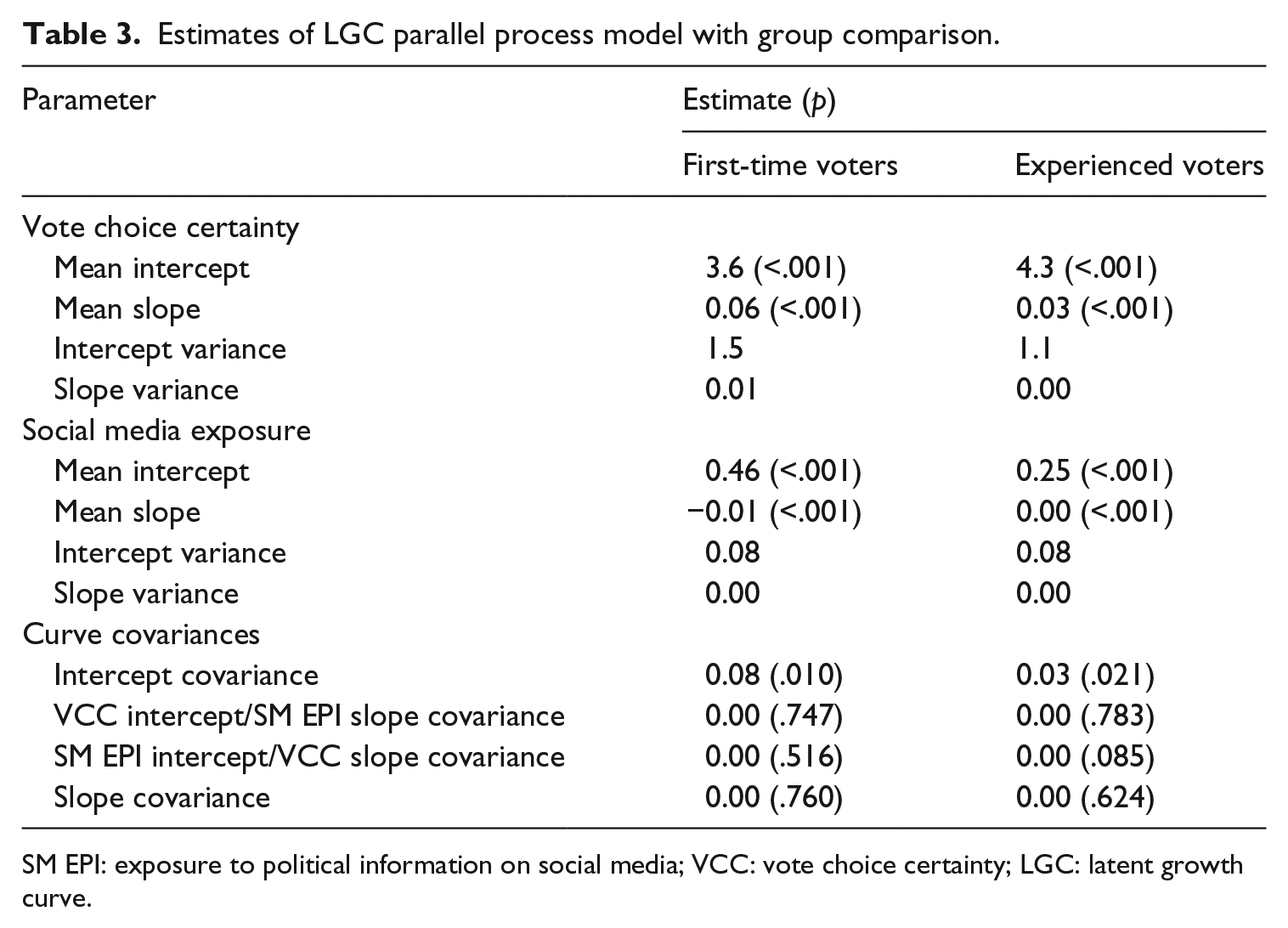
SM EPI: exposure to political information on social media; VCC: vote choice certainty; LGC: latent growth curve.
Finally, we were interested in direct effects of campaign participation on voters’ certainty (RQ2), a possible mediation effect of campaign participation on the relationship of media exposure on vote choice certainty (RQ3), and a potential moderation of this effect by vote experience (RQ4). We included campaign participation in the OLS regression model predicting vote choice certainty at t2 (Model 5). Interestingly, we found no direct effect of campaign participation on vote choice certainty but a significant interaction effect for first-time voters. First-time voters who participate more often in campaign activities therefore exhibit higher vote choice certainty on Election Day. This effect diminishes, however, when we include the lagged dependent variable (vote choice certainty at t1) in the model (Model 6).
To investigate a possible mediation effect for first-time voters further, we again used structural equation modeling to build a moderated mediation model. We are looking at conditional indirect effects of exposure to social media on vote choice certainty, mediated by the extent of campaign participation and moderated by being a first-time voter or not. By using multiple group comparison and the full information maximum likelihood estimation, we reached a satisfactory model 4 fit, χ2(1) = 0.10; p = .74, RMSEA = 0.0, CFI = 1.000, TLI = 1.026. We did find a strong, significant indirect effect of social media exposure on vote choice certainty through campaign participation for first-time voters (β = .32, SE = 0.15, p = .04) but no significant effect for the same route for experienced voters (β = .10, SE = 0.07, p = .21). This means that first-time voters’ social media exposure predicts their campaign participation and that campaign participation has a significant influence on the increase in vote choice certainty. However, for first-time voters whose exposure to social media did not increase their campaign participation, vote choice certainty did not increase. Mere exposure to political information on social media therefore does not have an assuring effect, but increasing campaign participation increases vote choice certainty (see Figure 1).
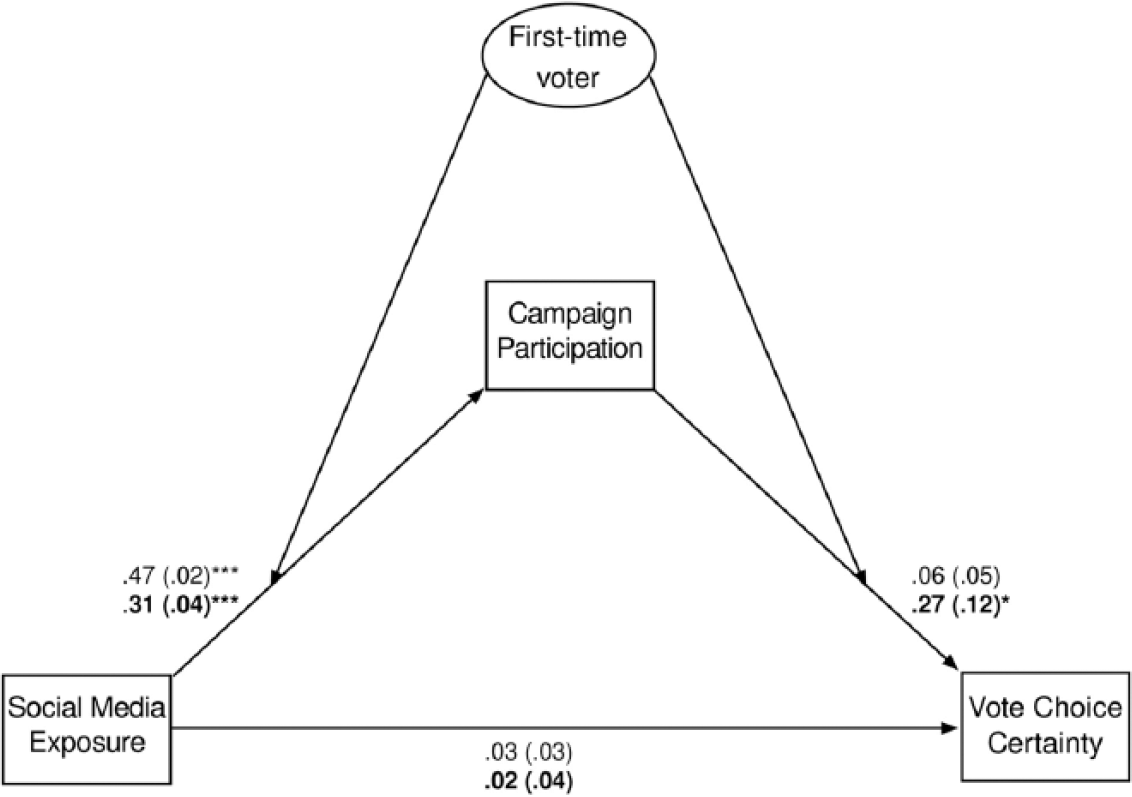
Moderated mediation with group comparison.
Discussion
First-time voters are indeed less certain about topics and candidates in the weeks leading up to the election. This greater uncertainty may be a result of their inexperience with voting, as suggested by Colwell Quarles (1979) and O’Keefe and Liu (1980). But although they are more uncertain whom to vote for at the beginning of the campaign, they seem to find a way to significantly increase their vote choice certainty over the course of the campaign, compared to experienced voters.
Election campaigns have always been rife with political dispute and contradicting information, as the mass media provide guidance in voters’ political decisions making process (Boomgaarden and Schmitt-Beck, 2016; De Vreese and Semetko, 2004). However, this task might become more difficult for multifaceted topics, such as European immigration, which has played a major role in most recent elections. At the same time, users nowadays can access political information during a campaign in different ways. Since offline and non-social online media differ from social media in the amount and diversity of information as well as the social environment they provide them in, we expected that especially social media exposure may be suited to increase vote choice certainty. Young voters’ first vote is part of their political socialization in which peer talk about politics plays an important role (McLeod, 2000). The social endorsement and evaluation of information on social media appears to be an especially attractive way for young citizens to make sense of election information and find their political home. Interestingly, our study does not produce evidence that mere media exposure helps neither young nor older voters reduce their uncertainty. Other studies confirm an effect of active peer communication and civic messaging online on political behavior or turnout (Ekström and Östman, 2015; Moeller et al., 2014; Shah et al., 2005). However, if such social evaluation is directly interwoven with information exposure, it seems to be less likely to shape young citizens’ vote decision. Future research should explore whether peer communication online or offline can be more effective in increasing vote choice certainty.
We do find evidence that following campaign information on social media can help first-time voters make sense of this information and subsequently increase their vote choice certainty. Young voters’ habitually high social media news use in non-election times (Mitchell et al., 2017; Newman et al., 2017) seems to be the main provider of political information during an election campaign as well (Ohme, 2017). This frequent exposure helps them engage more intensely with the campaign and subsequently leads to higher vote choice certainty. Hence, our study confirms previous findings regarding mobilizing effects of social media exposure for political participation (see Baumgartner and Morris, 2010; Ekström and Östman, 2015; Gil de Zúñiga et al., 2012; Tang and Lee, 2013). Such mobilization is not necessarily the endpoint in a political process but can have implications for citizens’ political decision-making processes. Our study is among the first to support the idea that political participation can be a stepping-stone for citizens during their formation of a vote choice.
The absence of a direct effect of social media exposure on vote choice certainty on the one hand contradicts previous research that sees political social media use as a predictor of polarized (and thereby more certain) political viewpoints (Kim, 2011; Lee, 2016) but supports more recent literature that challenges this direct effect (Fletcher and Nielsen, 2017; Zuiderveen Borgesius et al., 2016). Nevertheless, it is likely that first-time voters, if they follow politicians, parties, and selected news media on social media during an election campaign, create their own political filter bubble. But if this (by no means unpolarized) exposure inspires first-time voters to engage with campaign activities, process and discuss party positions and information more thoroughly and thereby helps them find their political home, this can be seen as good news for the future.
We find that first-time voters are slightly better equipped in fulfilling their democratic duty of developing a certain vote choice than we might have expected, although we notice that a certain vote does not indicate how well-informed their vote choice actually is. Young voters choose social media as source of information, become mobilized to additional engagement with the campaign and thereby more certain. This pattern is absent for experienced voters. Our study finds no strong evidence that experienced voters can reduce uncertainty during a campaign based on their election-related media exposure. Mass media are an important provider of information in the democratic system (Colwell Quarles, 1979; Downs, 1957), and they confront citizens with information that make them reconsider or re-evaluate their standpoints. The lack of media exposure effects on vote choice certainty can therefore also be seen as an indication that mass media provide information that does not reinforce existing political viewpoints. However, experienced voters exhibited rather high vote choice certainty already at campaign start; hence, existing political predispositions left little room for the media to increase certainty.
Limitations
First of all, not all first-time voters use social media as information source during election campaigns (Ohme, 2017), and not everyone who uses social media is mobilized to participate in a campaign. We have to keep in mind that the interesting pattern we found applies only to a certain share of this already special group of first-time voters.
This is connected to our second limitation. Although our comparative perspective helps us extract effects that are specific to first-time voters, we cannot make reliable statements as to whether our findings resemble a life cycle or a cohort effect (Kaid et al., 2007). It may well be that findings are generalizable to future first-time voters but not to this recent cohort’s later life stages, although research suggests important implications of the first vote on subsequent votes (Gerber et al., 2003). Third, our empirical mediation model is a new approach to understanding how a direct effect of media exposure on vote choice certainty can be mediated by vicarious experiences like campaign participation. Although we find evidence for this mediation, further testing of the theoretical assumptions is needed; not least since our understanding of campaign participation is rather straightforward, especially chosen to examine the initial threshold from mere media exposure to further active campaign engagement. We hereby follow an approach used in previous studies (Dimitrova et al., 2014; Shah et al., 2007), but future research should survey differential ascertaining effects of specific campaign activities in more detail. It furthermore has to be noted that we do not test for effects on actual behavior, namely voting. The traditionally high turnout rates in Denmark (over 80%; Bhatti et al., 2016) help us assess the uncertainty of voters on a uniquely broad basis, but it also causes a lack of empirical variance in our data, potentially reinforced by inaccurate self-reported turnout rates (Leshner and Thorson, 2000). Therefore, our study cannot answer whether an increase in the efficacious feeling of being certain whom to vote for eventually increases the turnout. Fourth, uncertainty is a personal feeling and thereby an inherently subjective evaluation. This challenges the empirical measurement of uncertainty (Alvarez and Franklin, 1994) and we should keep in mind that we are working with direct, self-reported measurements. Fifth and finally, using panel data and an innovative smartphone-based survey mode relies on the frequent participation of respondents; however, it comes at the expense of panel attrition. Our sample deviates slightly from the original sample in our project with representative characteristics for the Danish population. The respondents have a slightly higher political interest and education and are thereby marginally older than respondents in the main sample. We found no deviances for gender and social media use. Nevertheless, the results of this study have to be read against these deviations.
All in all, we find no alarming levels of uncertainty among Danish citizens but our study cannot confirm media effects on vote choice certainty either. However, the fact that media exposure does not increase vote certainty during an election campaign raises the question which sources of information citizens actually base their vote choice on. One possible explanation is that the pure provision of information is not what helps people make a choice. This questions the effectiveness of the plethora of election-related information on all media channels in the weeks leading up to the election. It may rather be the social evaluation of information that can help voters make up their mind for a specific party, especially among young citizens. Earlier, discussions with peers were the main provider of such social evaluation of political information (McLeod, 2000; Shah et al., 2005). Today, social media platforms increasingly connect personal suggestions and interpretations by peers with exposure to political content (Moeller et al., 2014). Our study implicates that such exposure in a unique social setting can engage young citizens more strongly with an upcoming election and thereby helps them finding their political home.
Footnotes
Appendix
Development of vote choice certainty across campaign by vote experience.

| Variable | M | SD | n | t | df | |
|---|---|---|---|---|---|---|
|
|
||||||
| Campaign Day 4 | First-time voters | 3.7 | 1.42 | 125 | 5.29*** | 828 |
| Experienced voters | 4.3 | 1.15 | 705 | |||
| Campaign Day 8 | First-time voters | 3.8 | 1.33 | 108 | 5.43*** | 777 |
| Experienced voters | 4.4 | 1.07 | 671 | |||
| Campaign Day 12 | First-time voters | 3.8 | 1.40 | 123 | 6.55*** | 844 |
| Experienced voters | 4.5 | 1.01 | 723 | |||
| Campaign Day 16 | First-time voters | 3.9 | 1.38 | 106 | 6.41*** | 720 |
| Experienced voters | 4.6 | 0.91 | 616 | |||
| Campaign Day 20 | First-time voters | 4.0 | 1.39 | 114 | 6.48*** | 763 |
| Experienced voters | 4.6 | 0.91 | 651 | |||
| Campaign Day 21 | First-time voters | 4.3 | 1.18 | 127 | 3.71** | 800 |
| Experienced voters | 4.6 | 0.92 | 675 |
Changing number of cases due to item non-response.
p < .05, **p < .01, ***p < .001.
Funding
The author(s) received no financial support for the research, authorship, and/or publication of this article.
Notes
Author biographies
 ) and has published widely on media effects, public opinion, political journalism, electoral behaviour, and the EU.