



Abstract
Bidirectional associations between being cyberbullied and cyberbullying others have been suggested, as well as bidirectional patterns of online prosocial behavior (reciprocity). However, so far, these relations have been studied as population-level associations, and it is not clear whether they also reflect within-person behavioral patterns. Therefore, this study aimed to disentangle between-person and within-person processes in online antisocial (cyberbullying) and prosocial behavior over time. Random intercept cross-lagged panel models were used to examine long-term within-person patterns of involvement in cyberbullying and online prosocial behavior. The findings showed no within-person effects between cyberbullying victimization and perpetration over time. In contrast, results did reveal significant within-person autoregressive effects of performing and receiving online prosocial behavior over time, and within-person cross-lagged effects between receiving online prosocial behavior and acting prosocially later on. These results indicate long-term positive, reinforcing spirals of prosocial exchanges, but no long-term negative spirals of cyberbullying perpetration and victimization.
Keywords
Introduction
In the last decades, digital technologies have created new opportunities for social behavior, which can now also take place online. Accordingly, online forms of social behavior have emerged, such as cyberbullying. A large and growing body of literature has examined cyberbullying and the factors related to it, and a few studies have investigated and confirmed the association between cyberbullying victimization (CBV) and cyberbullying perpetration (CBP) (Ak et al., 2015; Festl et al., 2015; Festl and Quandt, 2016; Kowalski et al., 2014; Schultze-Krumbholz et al., 2015; Vandebosch and Van Cleemput, 2009; Walrave and Heirman, 2011; Wright and Li, 2013). However, questions remain about the causal and temporal direction of the association at the level of the individual (i.e. do cyberbullies become cybervictims, or vice versa?).
The link between performing and experiencing a behavior has not only been shown for antisocial behavior, such as bullying and aggression but also for prosocial behavior, such as in reciprocal helping (Trivers, 1971). Online prosocial behavior has received much less research attention than its counterpart—online antisocial behavior. 1 Although some studies have examined online prosocial behavior in specific contexts, such as couchsurfing (Lauterbach et al., 2009) and online gaming communities (Nelson and Rademacher, 2009), no previous research has examined associations over time between being a recipient and being an actor of general online prosocial behavior. Moreover, at present, cyberbullying and online prosocial behavior have not been studied simultaneously, although studies on offline social behavior have examined bullying and prosocial behavior together (Menesini and Camodeca, 2008; Warden and Mackinnon, 2003). Therefore, in this study, we aim to shed light on the longitudinal within- and between-person dynamics of online antisocial and prosocial behavior by examining the associations between CBV and CBP on the one hand and receiving and performing online prosocial behavior on the other hand, using random-intercept cross-lagged panel modeling.
In what follows, we first review the literature on CBV and CBP and on prosocial behavior. Then we discuss how the associations between performing and experiencing these behaviors have been analyzed so far and what the added value of using random-intercept cross-lagged panel modeling is. This is followed by a detailed discussion of the methods and the results of this study.
CBV and CBP
Cyberbullying is an intentional negative behavior that occurs via electronic technologies (Smith et al., 2008). An extensive body of literature has explored cyberbullying and its associated antecedents and consequents (for a meta-analysis, see Kowalski et al., 2014). Some of these studies have examined the relationship between victimization and perpetration of cyberbullying, and most suggest a positive association (Ak et al., 2015; Festl et al., 2015; Festl and Quandt, 2016; Kowalski et al., 2014; Schultze-Krumbholz et al., 2015; Vandebosch and Van Cleemput, 2009; Walrave and Heirman, 2011; Wright and Li, 2013). Notably, individuals who are both victim and perpetrator of cyberbullying (often called bully-victims or aggressive victims) seem to fare worse psychologically than “pure” cyberbullying victims or bullies (Bayraktar et al., 2014; Sourander et al., 2010; Völlink et al., 2013).
Although there is evidence for a link between CBP and CBV, the dynamics behind this association have not been fully uncovered. One suggested explanation is that cybervictims take revenge or retaliate and turn against the bully (König et al., 2010). Cybervictims may experience anger and frustration, and as some form of maladaptive coping strategy, may turn to cyberbullying as a way to vent their negative feelings.
In addition, when someone cyberbullies others, this may lead to that person becoming a target of cyberbullying him- or herself, resulting in cycles of cyberbullying (Kowalski et al., 2012). Hence, the association between cyberbullying and cybervictimization could be bidirectional. Bidirectionality of aggressive acts is postulated in the General Aggression Model (GAM, Anderson and Bushman, 2002) as one of the mechanisms behind violence. The GAM is a comprehensive framework that integrates the role of social, cognitive, personality, developmental, and biological factors to explain aggression (Allen et al., 2018). According to the GAM, aggression can be understood as a combination of distal and proximate processes. Distal processes involve a combination of biological and persistent environmental processes, which can influence personality through altering knowledge structures, and thereby shape proximate processes (Anderson and Bushman, 2002). Proximate processes operate during specific aggressive episodes in three stages, namely, inputs, routes, and outcomes (Anderson and Bushman, 2002). Person and situation factors serve as inputs which influence appraisal and decision processes (outputs) through present internal state variables (cognition, affect, and arousal). These appraisal and decision processes can guide aggressive or non-aggressive actions, which can in their turn reshape the person and situation inputs, leading to a new cycle of proximate processes (Allen et al., 2018). According to the GAM, “most acts of violence result from a series of conflict-based interactions that involve two (or more) parties trading retaliatory behaviors in an escalating cycle” (Anderson et al., 2008: 463). One person’s retaliation provokes a retaliatory reaction from the other, resulting in an escalating cycle of aggression, a so-called violence escalation cycle (Anderson et al., 2008). Applied to cyberbullying, the violence escalation model predicts that a triggering event (e.g. a provocation online from person A), that is perceived as intentional, harmful, or unjustified, may elicit an aggressive online response from person B, which in turn provokes a retaliatory reaction from person A, and so on, developing into a reinforcing cycle of cybervictimization and cyberperpetration. However, (cyber)bullying is a special type of aggression, characterized by a power imbalance between the victim and the bully. Therefore, in (cyber)bullying, the likelihood that the victim retaliates against the bully may be smaller, because the bully is (perceived as) more powerful. Nevertheless, this does not preclude that a (cyber)victim would react aggressively toward another person than the original perpetrator (as some form of indirect retaliation). Furthermore, because of the possibility to act anonymously online, retaliation might be easier in cyberbullying than in offline bullying. Also, the online disinhibition effect (Suler, 2004), which describes the lowered restraint people experience in online versus offline communication, may lower the threshold to retaliate online versus offline.
Prosocial behavior: dynamics and online manifestations
Antisocial behavior, such as cyberbullying, is behavior that harms or lacks consideration for the welfare of other people. Yet, people also often behave in ways that promote others’ well-being. Prosocial behavior is voluntary behavior that is aimed to benefit particular others or to promote harmonious relationships (Dovidio et al., 2006; Eisenberg et al., 2006; Van Rijsewijk et al., 2016). Helping, comforting, or sharing resources with others are ways of behaving prosocially.
Cyclic patterns of behavior have not only been investigated in the domain of antisocial behavior; cycles of prosocial behavior have also been reported (Bartlett and De Steno, 2006; Keysar et al., 2008; Stanca, 2009). Chains of positive exchanges between individuals are examined under the umbrella of “reciprocity.” 2 Two forms of reciprocity have been distinguished: direct and indirect reciprocity (Rankin and Taborsky, 2009; Roberts, 2008). Direct reciprocity entails “paying it back”: Returning a favor after having received one. Indirect or generalized reciprocity entails “paying it forward”: Doing someone a favor after having received one from someone else or doing a favor to someone who has helped someone else. The existence of both forms of reciprocity has been established in experimental research (Bartlett and De Steno, 2006; Gray et al., 2014; Rankin and Taborsky, 2009). Furthermore, there are some indications that generalized reciprocity also occurs online (Lauterbach et al., 2009; McLure Wasko and Faraj, 2000; Nelson and Rademacher, 2009). Moreover, research on cooperative behavior in the specific context of video game playing has reported that playing violent video games cooperatively may increase later helping and cooperative behavior (Ewoldsen et al., 2012; Greitemeyer and Cox, 2013; Velez et al., 2014).
Two theories may be drawn upon to explain these findings: the theory of bounded generalized reciprocity (Yamagishi et al., 1999) and the reinforcing spirals model (Slater, 2007). According to the theory of bounded generalized reciprocity (Yamagishi et al., 1999), people’s prosocial behavior in social interactions in groups is influenced by their expectations of positive and reciprocal behaviors (i.e. generalized reciprocity) from other group members. When people expect others to behave positively and to reciprocate favors, it is in their self-interest to behave positively themselves and to reciprocate these favors to other group members. If they do not, they risk being perceived as a freeloader and this diminishes their likelihood to receive favors from anyone else in the group. The theory of bounded generalized reciprocity predicts that when people perceive a norm of generalized reciprocity, for example, by observing others behave prosocially or by being treated positively by others, they will behave prosocially themselves. In this way, reinforcing sequences of being the recipient and the actor of online prosocial behavior may develop. Applied to online contexts, this phenomenon can also manifest itself, especially in contexts in which group membership is salient, such as on social network sites and in group chat conversations. As group membership shapes reciprocal behavior and social media facilitate group communication (Lai and Turban, 2008), norms of reciprocal prosocial behavior may quickly develop in online social networks when people witness others behaving prosocially or are the recipient of prosocial behavior themselves and feel that it is expected of them to do the same. This process may even be more widespread online than offline, because online actions have the potential to reach a wider audience and to be witnessed long after they have actually taken place, compared to offline actions, which can only be witnessed by the people present at that particular place and time.
Alternatively, the reinforcing spirals model (Slater, 2007) proposes that media use affects individuals’ attitudes and behavior, which in their turn influence subsequent media use through selection and attention processes, resulting in a spiral that is mutually reinforcing over time. Applying this theory to online social behavior, it predicts that adolescents’ exposure to computer-mediated interactions influences their own cognitions and behaviors related to normative online behavior and shapes their subsequent computer-mediated interactions. Regarding online prosocial behavior, it could be that when adolescents experience social support and recognition from peers online, these experiences stimulate them to interact more frequently with those peers (selection effect) and reciprocate their behavior, resulting in a positive reinforcing cycle of prosocial interactions.
So far, a few studies (cited above) have provided indications for the existence of reciprocity online in specific contexts (online video game communities, freecycle communities, and couchsurfing.com); however, to the best of the authors’ knowledge, no previous research has directly examined general online prosocial behavior in terms of associations between being a recipient and being an actor of that behavior. With general online prosocial behavior, we refer to online prosocial interactions between peers, such as comforting or complimenting others through online messages.
Analysis of the dynamics of online social behavior
So far, online antisocial and prosocial behaviors have mainly been studied independently, in different research disciplines and populations, and with differing methods. Online prosocial behavior has often been studied either with experimental research, by observing people’s behavior in social exchange contexts (e.g. Stanca, 2009), or with questionnaires, interviews or focus groups, by asking participants what drives their actions online (e.g. Lauterbach et al., 2009).
With regard to online antisocial behavior, the cyberbullying–cybervictimization relationship has mainly been analyzed in cross-sectional studies, investigating the rates of individuals reporting to be involved both as perpetrator and as victim, or assessing correlations between cyberperpetration and cybervictimization. These types of analysis focus on inter-individual variation and yield between-subject or population-level associations (Molenaar and Campbell, 2009). Specifically, a positive cross-sectional correlation indicates that individuals who cyberbully others more than the group average are also more often than average victimized online. However, drawing inferences from patterns observed between persons to patterns within persons over time is not warranted (Kievit et al., 2013; Molenaar and Campbell, 2009). Cross-sectional population-level associations do not shed light on the causal and temporal directions of the association at the individual (or within-person) level (i.e. do cyberbullies become later cybervictims, or vice versa?). To examine within-individual associations and processes over time, longitudinal data are needed.
Traditional longitudinal methods: cross-lagged panel models
Fortunately, some cyberbullying studies have used longitudinal data to examine the cybervictimization–cyberperpetration association over time, and these could provide more insight into the sequence of behaviors. Several of these studies have used traditional cross-lagged panel structural equation models as method of analysis (Barlett and Gentile, 2012; Espelage et al., 2013; Pabian and Vandebosch, 2015; Van den Eijnden et al., 2014). Cross-lagged panel models (CLPMs) are often used to study the influence of two variables measured on more than one occasion on each other over time. In these models, each variable is regressed on its own previous score and on the other variable’s previous score. This results in two types of regressions: autoregressive and cross-lagged. Autoregressive paths are believed to represent the stability of a variable over time. Cross-lagged paths are believed to represent the association between two variables over time (or the change in one variable related to the previous score on the other variable), controlling for the stability of the constructs involved. By comparing the relative strength of the (standardized) cross-lagged regression coefficients, researchers estimate which variable has the strongest causal influence.
With regard to cyberbullying, positive autoregressive relations for cyberperpetration and cybervictimization, interpreted as stability over time, have consistently been reported (Barlett and Gentile, 2012; Espelage et al., 2013; Pabian and Vandebosch, 2015; Van Den Eijnden et al., 2014). The findings for cross-lagged relations from cyberperpetration to cybervictimization and vice versa are mixed. One study among university students reported positive cross-lagged associations in both directions (Barlett and Gentile, 2012), two studies among middle school students found positive cross-lagged associations between cybervictimization and cyberperpetration but not the other way around (Barlett and Wright, 2017; Espelage et al., 2013), another study did not report significant cross-lagged associations (Pabian and Vandebosch, 2015), and a final study among adolescents found a negative association between cybervictimization and cyberperpetration (Van Den Eijnden et al., 2014), although the authors noted that this could be an artifact of their multivariate analysis.
With regard to online prosocial behavior, to the best of the authors’ knowledge, so far CLPMs have not yet been used to study the long-term dynamics of this behavior.
Alternative longitudinal methods: random-intercept cross-lagged panel models
CLPM are attractive because they seem to provide insight into the causal processes between variables, accounting for their stability over time. However, these models have been criticized for not accounting for “the right type of stability” (Hamaker et al., 2015: 102). Hamaker et al. (2015) argue that autoregressive parameters fail to control for trait-like, time-invariant stability in the constructs. The autoregressive parameters in CLPM only account for temporal stability, not trait-like, time-invariant stability of constructs. In this way, it is not possible to separate within-person variability from between-person variability, and only between-person variability is estimated. This may result in invalid conclusions regarding the causal processes involved, as the CLPM-parameter estimates only reflect inter-individual, rather than intra-individual processes.
Applied to cyberbullying, using traditional CLPM assumes that there are no trait-like, time-invariant individual differences at play in cyberbullying involvement. This seems a questionable assumption, as research on bullying has shown stable individual differences in involvement in bullying. For instance, regarding victimization, some people are never bullied, whereas others are chronically victimized (Barker et al., 2008; Bowes et al., 2013; Smokowski et al., 2014). Moreover, victimization and perpetration can be predicted by (stable) personal and family features (Ang, 2015; Arseneault et al., 2010; Guo, 2016).
Similarly, prosocial behavior is associated with stable individual characteristics, such as intelligence and temperamental features (Veenstra, 2006), and shows consistent between-person differences (Eisenberg et al., 2002).
It is important to take those stable inter-individual differences into account in order to disentangle between-person effects (e.g. pooled across all people, are cybervictimization and cyberperpetration associated over time?) and within-person effects (e.g. does being victimized increase the likelihood of cyberbullying others over time and vice versa?). In this regard, Hamaker et al. (2015) have proposed an alternative to the traditional CLPM, called the random-intercept cross-lagged panel model (RI-CLPM), which includes a random intercept to account for invariant, trait-like stability in the involved constructs (i.e. between-person effects), in addition to temporal stability. The RI-CLPM takes into account the multilevel structure of longitudinal data, namely, that measurement occasions are nested within individuals and separates the within-person level from the between-person level. This model does make it possible to separately assess within-person and between-person variability over time and allows for more accurate estimates of within-person change and stability (Hamaker et al., 2015). The RI-CLPM has already been applied in studies on perceived social support and post-traumatic stress (Birkeland et al., 2016), parental monitoring and adolescent problem behavior (Keijsers, 2016), and health anxiety and online information-seeking (Te Poel et al., 2016) but to the best of our knowledge not to online antisocial or prosocial behavior.
This study
In this study, we aim to shed light on the within- and between-person dynamics of online antisocial and prosocial behavior among adolescents. We focus on cyberbullying as a proxy of online antisocial behavior, because the majority of research about online antisocial behavior has been conducted on cyberbullying, and previous studies on offline social behavior have also contrasted prosocial behavior with bullying (Menesini and Camodeca, 2008; Warden and Mackinnon, 2003). Although a large body of research has explored the inter-individual processes, there remains a paucity of research on the intra-individual processes behind cyberbullying. Moreover, very little attention has been paid to adolescents’ online prosocial behavior and the dynamics behind it.
Therefore, this study explores the dynamics behind adolescents’ online social behavior by examining the associations between CBV and CBP on one hand and receiving and performing online prosocial behavior (ROPB and POPB, respectively) on the other hand, using RI-CLPMs. To this aim, we conducted a three-wave panel study among 12- to 14-year-old adolescents. This population was selected because research has shown that cyberbullying shows a peak during adolescence (Barlett and Coyne, 2014; Pabian and Vandebosch, 2016) and that significant developments in prosocial behavior take place during this life phase (Van Hoorn et al., 2016). Based on previous research findings and propositions of the GAM (Anderson and Bushman, 2002), the theory of bounded generalized reciprocity (Yamagishi et al., 1999), and the reinforcing spirals model (Slater, 2007), we propose the following hypotheses:
H1. Cyberbullying victimization (respectively, perpetration) increases subsequent cyberbullying perpetration (respectively, victimization).
H2. Receiving (respectively, performing) online prosocial behavior increases subsequent performing (respectively, receiving) of online prosocial behavior.
Method
Procedure
This study comprised three data collection waves separated by a 6-month time lag, administered between March 2015 and May 2016. To recruit participants, 30 randomly selected secondary education schools from one province in Belgium were asked to participate and 13 schools consented. In each school, all the students from the first year (equivalent to US grade 7) participated in the first wave, and all the students from the second year in the second and third wave (because a new school year started after the first wave). The school principals and the students provided active consent, and the students’ parents provided passive consent. Of all the students who were asked to participate, 13 did not provide consent themselves or did not receive consent from their parents to participate. The Ethics Committee for the Social Sciences and Humanities of the University of Antwerp provided ethical approval for the study.
The participants completed a questionnaire in their classrooms during school hours, either on paper or electronically, in the presence of the first author and/or school personnel. In classes where the author was not present during administration, the school personnel was thoroughly informed about the survey procedures. Participants were encouraged to ask questions and to signal any items that were unclear during administration. They were informed that their data would be treated confidentially. To be able to link participants’ data from the three waves, a few biographical questions were asked (e.g. the first letter of their mother’s name), but these data were not coupled to their answers on the survey.
Participants
The total number of participants was 2168. In the first wave, 1721 students (45.7% boys) participated, 1746 (45.1% boys) in the second wave, and 1590 (44.3% boys) in the third wave. Practical issues in data collection led to the non-participation of four classes in the first wave, two classes in the second wave, and eight classes in the third wave. Participants’ mean age was 13.01 years (standard deviation [SD] = 0.55) in the first, 13.55 years (SD = 0.55) in the second, and 14.08 years (SD = 0.56) in the third wave. The majority of the participants were in general education, and 11–14% of participants in vocational education.
Measures
CBP and CBV
The European Cyberbullying Intervention Project Questionnaire (Brighi et al., 2012; Del Rey et al., 2015; Schultze-Krumbholz et al., 2015) was used as a measure of CBP and CBV. For each of 11 items (e.g. “Say mean things to someone or call someone names”), participants rated how often in the past month they had performed (for perpetration) or experienced (for victimization) each behavior on digital media on a 5-point Likert-type scale with ratings from 1 (never) to 5 (every day). The item “Post embarrassing videos or pictures of others online” was omitted because participants remarked that they perform this behavior for fun on Facebook for a friend’s birthday. Mean scores were computed using the remaining 10 items (each) on CBP and CBV (CBP: MW1 = 1.22, MW2 = 1.22, MW3 = 1.26; CBV: MW1 = 1.22, MW2 = 1.21, MW3 = 1.25). Cronbach’s alpha values at waves 1, 2, and 3 were .71, .76, and .79 for CBP and .78, .80, and .82 for CBV.
POPB and ROPB
The Online Prosocial Behavior Scale (Erreygers et al., 2017) was used as a measure of receiving and performing online prosocial behavior. This scale was specifically developed to measure adolescents’ online prosocial peer interactions, and it has been shown to be a valid and reliable instrument (authors, under review). Many items of the measures of online antisocial and prosocial behavior mirror each other (e.g. “say nice things to someone” vs “say mean things to someone” and “exclude someone from a group conversation” vs “include someone in a group conversation”), illustrating the link between these concepts. For each of 10 items (e.g. “Cheer someone up” and “Offer help to someone”), participants rated how often in the past month they had performed (POPB) or been recipient (ROPB) of each behavior using digital media on a 5-point Likert-type scale with ratings from 1 (never) to 5 (every day). Mean scores were computed for each subscale (POPB: MW1 = 3.33, MW2 = 3.31, MW3 = 3.32; ROPB: MW1 = 2.99, MW2 = 2.99, MW3 = 3.00). Cronbach’s alpha values at all waves were .90–.91, for both subscales.
Statistical analysis
Structural equation modeling (SEM) was applied to analyze the associations between CBP and CBV, and between POPB and ROPB, using Mplus 7.4 (Muthén and Muthén, 2015). Two RI-CLPMs (Hamaker et al., 2015) were modeled to examine the directional effects in cyberbullying and online prosocial behavior, following the approach outlined by Hamaker et al. (2015). First, in each model one random intercept was created for CBP, CBV, POPB, and ROPB each, by regressing their observed composite (mean) scores of the three waves on one latent factor and constraining the factor loadings to one. These random intercepts reflect the invariant, trait-like interpersonal differences in the variables, and in this way, the between-person variability can be separated from the within-person variability. Second, latent variables of the observed scores were created by regressing these scores on latent factors while constraining the factor loadings to one and constraining the variances of the observed variables to zero. These latent factors take into account the within- and between-person variability. The covariances between the random intercepts and the latent variables of the observed scores were constrained to zero, as well as the means of the observed variables. Because the intervals between the waves were equally spaced, the lagged parameters were constrained to be equal across waves. 3 To take the non-normality of the data into account, maximum likelihood estimation with robust standard errors (MLR) was used. Full information maximum likelihood (FIML) estimation with robust standard errors was applied to handle missing data.
Results
First, the intra-class correlation coefficients for each construct were calculated in SPSS 23 to examine the proportion of the variance accounted for by between- and within-individual differences. These were .526 for POAB, .486 for ROAB, and .611 for both POPB and ROPB, meaning that 49–61% of the variance in these variables over time was due to inter-individual differences, whereas 39–51% of the variance was due to variability (or fluctuations) within individuals. Traditional CLPM-models do not take into account these stable inter-individual differences; therefore, we applied RI-CLPM in which the random intercepts account for the stable inter-individual variability (see Figure 1 for the model for cyberbullying; an equivalent model was used for online prosocial behavior).
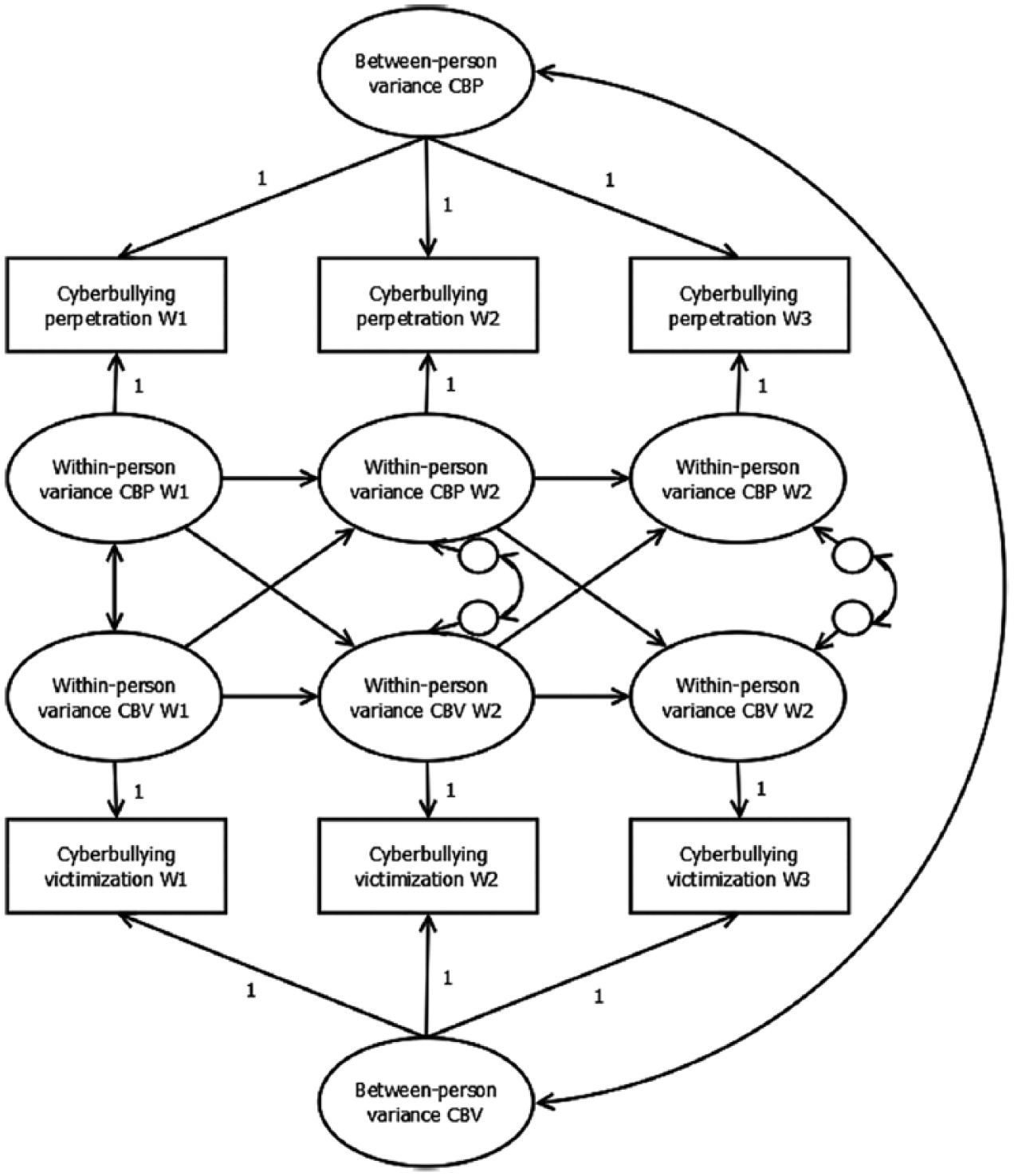
Random intercept cross-lagged panel model (RI-CLPM) for the association between cyberbullying perpetration (CBP) and cyberbullying victimization (CBV) across three waves. The two random intercepts (“between-person variance CBP” and “between-person variance CBV”) represent stable inter-individual differences. The autoregressive and cross-lagged paths between the latent factors, the correlation between the latent factors at wave 1, and the correlated residuals at wave 2 and 3 represent within-person processes.
Cyberbullying
The RI-CLPM showed an excellent fit for the associations between CBP and CBV, χ²(9) = 15.131 (p = .088), root mean square error of approximation (RMSEA) = .018 (90% confidence interval [CI] = [.000, .033]), comparative fit index (CFI) = .994, Tucker–Lewis Index (TLI) = 0.989, and standardized root mean square residual (SRMR) = .026. The parameter estimates (see Table 1) indicate that stable between-person differences in cyberperpetration are positively associated with stable between-person differences in cybervictimization. This means that, across waves, adolescents who reported to be more often than average engaged in CBP also reported to be victims of cyberbullying more often. Furthermore, the significant wave 1-covariation and wave 2 and 3-residual covariations indicate that within-person change (or deviation from an individual’s expected score) in CBP and within-person change (or deviation from an individual’s expected score) in CBV are also associated. Hence, adolescents who reported increasing CBP at a particular point in time also reported more CBV at that time point. This association is not linked to changes in cyberbullying involvement 6 months earlier but is attributable to an (unknown) time-varying process. Most strikingly, by explicitly modeling the inter-individual differences in cyberbullying, no significant autoregressive or cross-lagged paths emerge. This means that over time there are no within-person influences of adolescents’ CBP on their later perpetration or victimization and vice versa.
Unstandardized (B) and standardized (β) parameter estimates of the random intercept cross-lagged panel model (RI-CLPM) for the longitudinal associations between cyberbullying perpetration and victimization, and between performing and receiving of online prosocial behavior, across three waves.
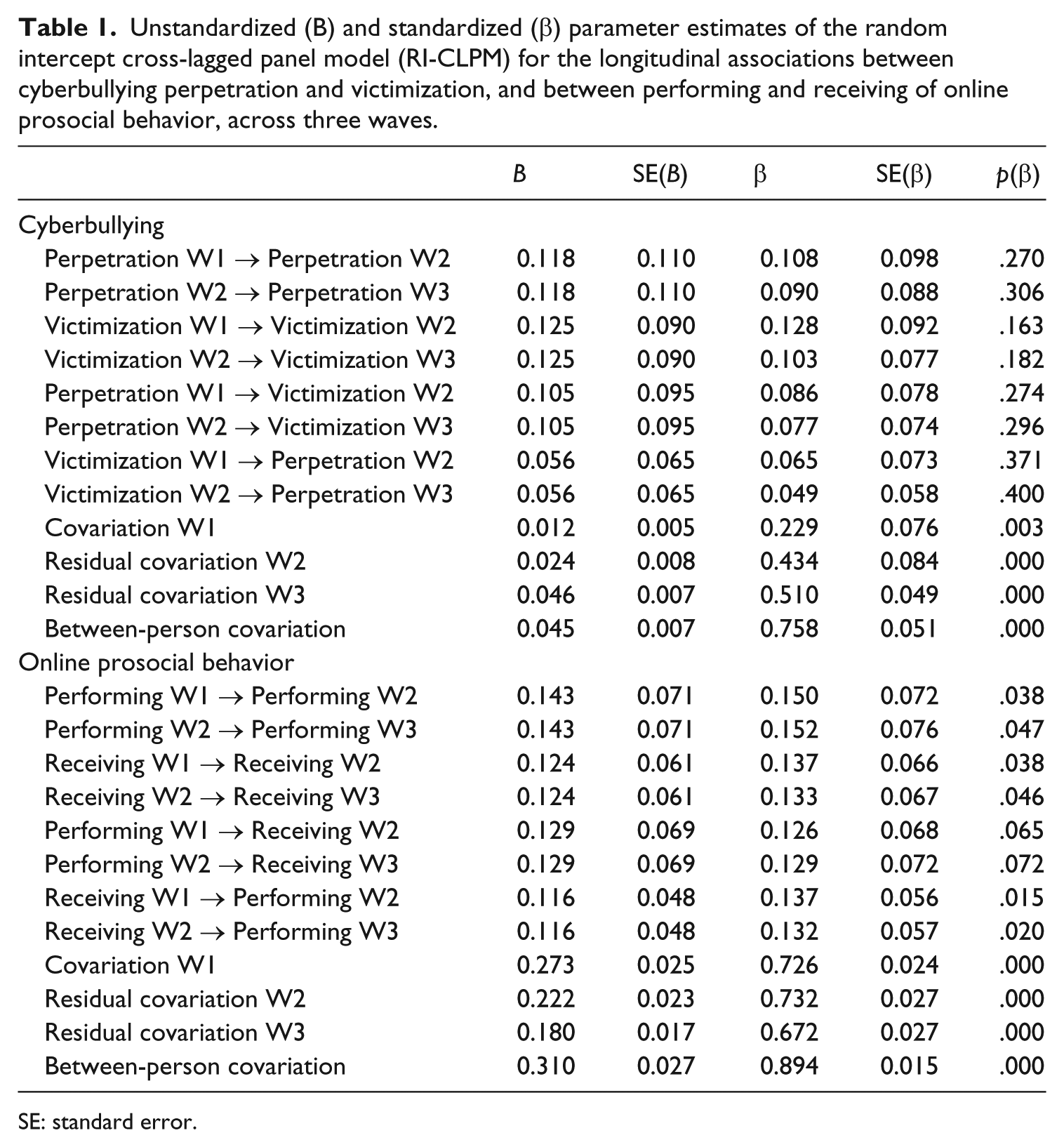
SE: standard error.
Online prosocial behavior
The RI-CLPM for online prosocial behavior also showed an excellent fit, χ²(9) = 2.821 (p = .971), RMSEA = .000 (90% CI = [.000, .000]), CFI = 1.000, TLI = 1.002, and SRMR = .006. The parameter estimates (see Table 1) indicate that performing and receiving online prosocial behavior are significantly correlated, both at the stable, between-person level, as at the time-varying within-person level. In other words, adolescents who reported to behave more prosocially than average online also reported to be recipients of prosocial behavior performed by others more often. Furthermore, the autoregressive paths of POPB and ROPB are significant, indicating that within-person deviations from expected scores on POPB predict later deviations from expected scores on POPB, and likewise for ROPB. In other words, within persons, an increase in performing (or receiving) online prosocial behavior leads to even more performing (or receiving) of prosocial behavior later on. Finally, the cross-lagged paths from ROPB to POPB are significant, reflecting that deviations from adolescents’ own expected score on ROPB are predicted by deviations from their own expected score on POPB 6 months earlier. Stated differently, receiving more online prosocial behavior leads to increases in prosocial acting online later on.
Discussion
This study aimed to provide insight into the within- and between-person processes behind the associations between the performing and receiving of online antisocial and prosocial behavior. Applying RI-CLPMs in a sample of 2168 adolescents, the longitudinal associations between perpetration and victimization of cyberbullying on one hand and performing and receiving online prosocial behavior on the other hand were tested across three waves of data collection spaced 6 months apart.
The results suggest that CBV and CBP are positively associated at the stable between-person level and covary in the same direction over time, but within individuals, involvement in cyberbullying at one time point does not predict later CBV or CBP. Stated differently, we did not find evidence for a long-term pattern in which individuals who are cyberbullied later cyberbully others and vice versa. Thus, the current findings do not indicate the presence of long-term negative spirals of online antisocial behavior, specifically cyberbullying. Our findings do not support an over-time escalating cycle of cyberbullying others and being cyberbullied oneself.
Our findings on the absence of bidirectional relationships between cybervictimization and cyberperpetration contrast with predictions from the GAM (Anderson and Bushman, 2002) and with some of the previous findings on the longitudinal associations in cyberbullying (Barlett and Gentile, 2012; Espelage et al., 2013; Pabian and Vandebosch, 2015; Van Den Eijnden et al., 2014). However, this study is the first to use RI-CLPM, a method that allows to disentangle between-person effects from within-person effects in the link between cybervictimization and cyberperpetration. Our results do confirm the previously reported association between cybervictimization and cyberperpetration when examined at a between-person level of analysis: Adolescents who are more frequently victimized online also cyberbully others more often. In addition, within-person deviations in CBV are also linked to within-person deviations in CBP (the variables covary across time). Thus, CBP and CBV rates vary synchronously both between and within individuals.
Between-person differences in variables which have been identified as risk factors for cyberbullying, such as family or personal characteristics (Ang, 2015; Guo, 2016; Kowalski et al., 2014), may play a role in this association, especially because research has shown that there is a significant overlap in the antecedents of CBV and CBP (Kowalski et al., 2014). The findings are also consistent with those of previous studies using person-centered clustering techniques (latent class or transition analysis) to examine involvement in cyberbullying, which have shown that for most adolescents cyberbullying involvement most often entails co-occurring victimization and perpetration, and not exclusive victimization or perpetration (Festl et al., 2017; Schultze-Krumbholz et al., 2015). Furthermore, factor analyses of cyberbullying instruments have shown that many items measuring CBP and CBV load on one single “cyberbullying victimization/perpetration” factor (Law et al., 2012; Menesini et al., 2011). In sum, our findings confirm the link between CBV and CBP but do not provide support for a long-term dynamic process in which being cyberbullied leads to cyberbullying others 6 months later and vice versa.
In contrast, the association between being the beneficiary of online prosocial behavior and behaving prosocially online does reflect within-person reinforcements of this behavior over time. In other words, the findings reveal positive spirals of online prosocial behavior within adolescents, such that (1) those who behave more prosocially online will increase this behavior over time, (2) those who benefit more from others’ online prosocial behavior toward them will increasingly benefit over time, and (3) will increasingly act prosocially toward others themselves. (The findings also provide some indications that more often performing online prosocial behavior leads to later increases in receiving this behavior, but these results are only significant at p < .10.) These findings are consistent with the theory of bounded generalized reciprocity (Yamagishi et al., 1999) in online contexts, which posits that when people observe others behaving prosocially, this creates an expectation of reciprocal prosocial behavior and motivates them to behave prosocially themselves.
It might be that cycles of negative behavior online occur more rapidly than cycles of positive behavior. Perhaps the sequences of CBV and CBP happen on a short term or almost simultaneously, for example, immediately bullying back after having been bullied, whereas the sequences of prosocial exchanges take more time or last longer. Nevertheless, the results of our study suggest that being the recipient of online prosocial behavior has long-lasting increasing effects on acting prosocially online, whereas this is not evident for online antisocial behavior.
Another possible explanation for the existence of a positive spiral but the lack of a negative spiral may be found in the emotions linked to these behaviors. When individuals are the beneficiary of others’ prosocial behavior, they are likely to experience positive emotions, such as gratitude and happiness, and these may stimulate them to act prosocially toward others themselves (Bartlett and De Steno, 2006). In contrast, when people are the target of others’ negative actions, this may elicit negative emotions which prepare approach (e.g. anger stimulates revenge) or avoidance (e.g. fear and sadness stimulate withdrawal) action tendencies (Frijda, 1986), that is, stimulate or inhibit reactions against the other. However, due to the possibility for anonymity online it may not always be clear who the perpetrator is, hence, reacting against the perpetrator is not always possible. Furthermore, victims may be less technologically skilled (Vandebosch and Van Cleemput, 2008) or the costs of retaliation may outweigh the benefits (cf. social exchange theory, Emerson, 1976), making retaliation less likely. An alternative explanation may be derived from the reinforcing spirals model (Slater, 2007), which posits that media use influences individuals’ cognitions and behavior, which shapes their subsequent media use. On one hand, when adolescents are exposed to online peer social support and recognition, this may motivate them to interact more frequently with those peers and imitate their behavior, resulting in a positive reinforcing cycle of prosocial interactions. In contrast, when adolescents are exposed to antisocial online behavior, they often turn to others for help to stop the harassment or avoid further contact with the offender, for example, by unfriending or blocking (Šléglová and Černá, 2011; Weinstein et al., 2016). Consequently, the exposure to that behavior may decrease, and reinforcing spirals do not develop.
As our study sample was limited to young adolescents, caution should be applied when generalizing these results to other populations. Furthermore, the data were solely based on participants’ self-reports. These may have been subject to social desirability bias, leading to underreporting of cyberbullying involvement or overreporting of prosocial behavior. Future studies could benefit from including other-reports to obtain a view of how others perceive the participants’ behavior. Notwithstanding these limitations, the findings of this study provide a better understanding of the processes at play in adolescents’ online antisocial and prosocial interactions. Our results suggest a long-term mutual reinforcement of being the recipient and actor of online prosocial behavior, whereas no evidence was found for a within-person longitudinal bidirectional relationship between being a cyberbully and being a cybervictim. In conclusion, this study shows that online prosocial behavior engenders long-term positive spirals of prosocial exchanges, but cyberbullying does not result in long-term negative spirals of antisocial interactions.
Footnotes
Declaration of Conflicting Interests
The author(s) declared no potential conflicts of interest with respect to the research, authorship, and/or publication of this article.
Funding
The author(s) disclosed receipt of the following financial support for the research, authorship, and/ or publication of this article: This work was supported by the Research Foundation Flanders, Grant FWO G.0335.14N.
