



Abstract
The overarching aim of this study is to analyse how social media communication can impact the formation of cultural trauma discourses in the aftermath of disruptive societal events. The article focuses on how the hashtag #openstockholm was used on Twitter for support, sharing and cooperation after the Stockholm lorry attack in 2017. Much of the content posted with this hashtag had a light-hearted tone, flouting the conventional trauma discourses of grief and sorrow in a way that was surprising, and perhaps even provocative, to some. A thematic analysis of tweets shows the different uses of the hashtag over time, as well as distinguishes two conflicting discourses that either downplayed or amplified the cultural trauma narrative. The study shows that the responses to traumatic events may depend on a culturally specific logic of collective action frames which implies the need for contextual understandings of how cultural trauma discourses are negotiated.
Introduction
Following terror attacks or other forms of societal disruption, the anticipated reaction from a governmental and political standpoint is one of public panic. However, studies have shown that this reaction in fact is rare (Sheppard et al., 2006) and that people are often even more cooperative and focused after incidents of terror than they were before (Durodié and Wessely, 2002). Professional guidance in times of societal disruption has come to play an increasingly important role in the disaster response of communities. The professionalised aspect of society’s disaster responses only shows the misconception of how people react to traumatic incidents, expecting them to be too vulnerable to be capable of resiliency (Durodié, 2004).
Twitter has previously functioned as a space for framing issues, for example, in relation to social movements (Pond and Lewis, 2017), and scholars have even called this form of gathering around different issues a form of hashtag public (Rambukkana, 2015). The social media response to previous terror attacks has shown that people offering help to one another has been an important function of these platforms, such as the #portesouvertes hashtag after the terror attacks in Paris in November 2015 (Onorati et al., 2016). Hashtags such as this, and #ikwilhelpen after the Brussels terror attacks in 2016, show the potential for social media platforms to function as a balance to the risk-centred and sensationalist reporting on such attacks. When communication is performed on social media, where the public itself formulates the message, public panic is not the natural reaction towards the news of traumatic events, and this makes this newer form of media an important space for the formation of counteracting discourses.
This article investigates the function of tweeting using the #openstockholm hashtag in the aftermath of the lorry attack in Stockholm in 2017. The overarching aim of the study is to analyse the social media reaction after this attack and the way this may have shaped the collective understanding of it. The research questions aim to further the knowledge on the role of social media for the formation of cultural trauma discourses in relation to traumatic events:
(a) What different uses of this hashtag can be identified in the data? How did these modes of usage differentiate over time?
(b) How do different discursive understandings of the attack, expressed as tweets, affect how the event is constituted as cultural trauma (or not)?
Research context: cultural trauma, social media and resilience
On 7 April 2017, a hijacked lorry was driven at a high speed into crowds along Drottninggatan (Queen Street), the central pedestrian street of Stockholm, before crashing into the corner of an Åhléns department store. Five people died as a result of the attack, including an 11 year-old, and 15 people were injured, 9 of whom had serious injuries (Stockholms läns landsting, 2017). A 39 year-old rejected asylum seeker from Uzbekistan was later detained and confessed to terrorist crimes through murder.
News updates in the mainstream media covered every development with live broadcasts, from several different television and radio channels, for several hours; with invited guest experts on the threat of terrorism in Europe and Sweden; and with rolling imagery of CCTV footage of the lorry speeding through Drottninggatan, and people fleeing into stores along the route. When CCTV footage of the suspected perpetrator was uncovered, images of the suspect were broadcast continuously throughout the day until the suspect was captured in a Stockholm suburb.
The hashtag #openstockholm 1 was started by a student in Stockholm, after having followed the events via Twitter and realising that many people in her network, similar to the response of Brussels and Paris via #ikwilhelpen and #portesouvertes, respectively, were offering housing and transportation to those affected by the shutdown of central Stockholm following the attacks (Cardell, 2017). The hashtag helped to coordinate assistance, quickly becoming a trending topic on Twitter and being widely used, both for real-time coordination on the ground and for sending love and emotional support to the people of Stockholm. These tweets were quickly praised by the Twitter community for their openness, where users shared their homes and cars with people unknown to them, and for doing so without the fear expressed in the mass media.
In the mainstream media, the sensational aspects of traumatic events stand at the forefront of the reporting, and this content, with images of injured individuals and the damaged building and with experts expressing concerns about the increased prevalence of terror attacks, helps to formulate a cultural trauma discourse in the aftermath of such events. Social media may, in this sense, assist in forming a more nuanced understanding of these events.
Research on cultural traumas places emphasis on the societal reaction and the cultural responses to such events as a ‘tear in the social fabric’ (Eyerman, 2011: 12). In other words, these events are simply understood not only as being traumatic for the victims of the crime but also as being traumatic for society as a whole (Alexander et al., 2004). This means that certain events may be understood as culturally traumatic and others may not, but the types of events may be largely different. Terror attacks, mass violence, death of certain celebrities or even natural disasters may be understood as traumatic to a wider public, while some may not receive that response. Not all terror attacks are discursively understood as cultural traumas by the wider public, and not all of these events may have such a ‘tearing’ effect. The historical construction and the political uses of the word ‘trauma’ as a natural reaction to unnatural events has been critiqued by Fassin and Rechtman (2009) who argue that our contemporary ideas of trauma are influenced by political notions of solidarity and the expected outcomes of being affected by traumatic events. This may, in turn, influence the ways in which victims are seen as ‘passive recipients of the label “traumatised”’ (Fassin and Rechtman, 2009: xi), independent on individual dispositions, differences in expression as well as the nature of the event itself.
Analyses of cultural traumas have focused on the mainstream media reporting on these events, such as after the death of Princess Diana or in the aftermath of 9/11. The Hillsborough tragedy has been understood as a cultural trauma due to persistent nature of the traumatic experience in the Liverpool society, as it has been represented in the mainstream media, almost 30 years after the incident caused the death of 96 football supporters in the Hillsborough stadium (Hughson and Spaaij, 2011). However, the discursive responses to terror attacks or other traumatic events are not merely formed through news reporting of the event but also through the use of social media and specific hashtag-based communities, or as suggested by Bruns and Burgess (2015), which can be recognised as ‘ad hoc publics’. These digitally based communities have changed the ways in which terrorism, natural disasters or celebrity deaths may be understood and handled. This has been evident on social media after events such as the 2011 Norway attack, commonly known as Utøya (Eriksson, 2016), the Virginia Tech massacre (Lindgren, 2012), after Hurricane Katrina (David, 2008; Ostertag and Ortiz, 2013) and after the death of Princess Diana (Stone and Pennebaker, 2002).
Erving Goffman’s (1974) frame theory adds another dimension to how meaning is created and upheld by specific frameworks. In this article, the concept of collective action frames is utilised in order to analyse how different uses of the hashtag #openstockholm can be understood as a frame alignment process (Snow et al., 1986). Collective action is assigned meaning depending on the ways in which specific frames are activated in the articulation of meaning. Framing is a concept which has been applied previously in, for example, studies of social movements in digital spaces (cf. Dahlberg-Gundgren and Lindgren, 2014). How these frames are aligned and connected to one another actively shapes the conversation and collective action through the specific articulations of meaning. In this sense, hashtags are not merely a form of indexing feature but also the space in which such frames are created and reiterated.
Previous research has shown that social media may function as a space for meaning making in the aftermath of traumatic events, such as the 2011 Norway attacks, where the conversation changed throughout the first 6 days, showing that the collective understanding of the attack changed from being centred around discussions about the Norwegian nation and togetherness, in favour of negotiating the explanations behind the attacks (Eriksson, 2016). Social media may in fact change the ways in which we experience crises, which was apparent after Japan’s earthquake and tsunami disaster in 2011 (Hjorth and Kim, 2011). As Bruns and Hanusch (2017) have suggested, the audiovisual content shared and produced by social media users after terror attacks may reshape the public understanding of such crisis events, either contesting or reinforcing mainstream media reporting. Qu et al. (2011) found that people used the Chinese microblogging platform Sina Weibo for four different purposes during and after the 2010 Yushu earthquake, varying in importance over time: situation update, opinion expression, emotional support and calling for action.
Studies on the actual content of tweets referring to events like natural disasters and terror attacks show the importance of information and logistical information in tweets, as, for example, after the Boston Marathon bombing in 2013, where this informational type of tweeting was the most common form, regarding logistics of the crisis response and information on road blockages and openings (Sutton et al., 2013). In addition to using Twitter as a space for information sharing, memorialisation practices have also had an important place in the conversation, such as during and after the Typhoon Haiyan in the Philippines where, in addition to being used for information sharing, social media played a pivotal role in allowing users to express grief and sorrow for those affected (Takahashi et al., 2015). These platforms also have a purpose for the continuation of conversation and the process of sense making in the aftermath of events causing societal crisis, such as after school shootings, where platforms allow both the sharing of information and the ability to build a sense of community (Heverin and Zach, 2012).
After the 2010 Pakistan floods, Murthy and Longwell (2013) found that Pakistani Twitter users were linking to social media content to a far greater extent than international Twitter users, signalling a high level of legitimacy for social media content in third-world countries experiencing disasters. This may be the case for other on-the-ground disaster communications and is an important contribution to the challenging of mainstream media outlets in relation to traumatic events. Twitter has attracted interest from emergency services as a form of social media that can be used to help mitigate disasters, and research is showing that Twitter may function in such ways (Bruns and Burgess, 2013; Carley et al., 2016; Landwehr et al., 2016; Spiro et al., 2012).
The concept of social resilience, as used in this context, is understood as the ability of individuals and societies to persist even after shock (Durodié, 2004: 5). According to Sapirstein (2006), social resilience consists of four main components, namely, response, self-organisation, learning and adaption. The first component, the communal response, has to do with mobilisation of resources in a quick and effective way. Sapirstein states that communal inaction may contribute to psycho-social complications in the aftermath of traumatic events. Self-organisation refers to activities that a community engages in to restore its social functioning to a pre-disaster level. The process of learning, on the other hand, is the time of reflection and discussion of what can be learned from the experience. The final phase of adaption refers to how communities implement the lessons learned from the traumatic experience and how they move forward with this knowledge rather than harbouring resentment for the incident itself.
Social media has the potential to become a space for both resilience and self-governance in communities facing traumatic events, which has been shown in Kaufmann’s (2015) study of how people in Oslo used social media as a way of regaining control and a sense of calm after the 2011 Norway attacks. The study shows that the infrastructure of social media platforms themselves provided a space for self-governance by allowing individuals to collect information and form collectives in a way that advanced resilience.
Research design
In order to address the research questions introduced above, 7100 tweets were downloaded via Twitter’s public search application programming interface (API), with the #openstockholm hashtag as the search query, from the date of the attack on 7 April up until 2 August 2017. However, since the hashtag rapidly declined in usage, the analysis was focused on the first 7 days after the attack. Since data were not collected with full access to Twitter’s data stream, the search results that are returned in this way present issues of representativity, as some tweets are excluded from the search results, and the information about how much of the data are lost is not disclosed on Twitter’s own site (Gaffney and Puschmann, 2014). Some other limitations of the material must also be addressed. Since the aim of the study was to gauge the textual dimensions of the discourse surrounding the hashtag, those tweets simply using the hashtag without any other content (or in the cases where the hashtag was used together with a link to another website) were then discarded from the material to be analysed. Many different languages are represented in the corpus, but as this study was focused on tweets primarily from those on the ground and not on international attention, tweets in languages other than Swedish and English (as many Swedes and tourists used English) were disregarded as well. The resulting corpus of tweets thus contained 6162 tweets.
As a major societal event unfolds, one or two hashtags tend to become the most prominently used by Twitter users as reliable markers of tweets relating to the event, and as such, hashtags may help researchers zoom in on the online expressions relating to the event (Bruns and Burgess, 2013). As other researchers have suggested, while there may be a co-occurrence of different hashtags relating to the same events, formed by different communities on Twitter, there is a tendency for a specific ‘meta-hashtag’ to emerge within tweets as the main and most commonly used hashtag relating to the specific event (Rocheleau and Millette, 2015). News events, such as national conventions of political parties or crisis events, have shown to cause spikes in numbers of tweets, indicating Twitter’s information-sharing function (Hughes and Palen, 2009).
A thematic analysis of the tweets was performed manually in order to understand the different uses of the hashtag as well as their discursive understanding of the attack. The different usages of #openstockholm in the collection were categorised as a way of understanding the tweeting activity centred around the hashtag. Each tweet was read and coded in accordance with these specific functions, that is, the content of the tweets was the determinant of which category of usage modes it was assigned to. Since the coding was performed inductively, the first stage of coding resulted in a diverse and fragmented corpus of codes showing different modes of usage which, at the second stage of coding, were clustered into a broader understanding of their particular functions (Clarke and Braun, 2017). For example, the tweets later grouped according to their coordinative function were, at the first stage of coding, dispersed and referenced as having different functions, while at a later stage they were understood to be coordinative (e.g. sharing information about public transportation and instructing Twitter users to use the hashtag). This coding was done in order to understand how these different modes of tweeting constituted the understanding of the hashtag and the actual attack.
At a second stage of analysis, the tweets within different clusters of usages of the hashtag were investigated further via discourse analysis. This approach to discourse analysis took both textual and contextual factors into consideration (see Carpentier, 2017, for a further discussion on materiality in discourse theory). The process of thematically coding the tweets in accordance with their identifiable themes allowed the analysis more discursive aspects of the tweeting activity after the event, such as showing how tweets were actually formulated and in which sense they may have served to either contest or agree with a cultural trauma narrative, which was addressed in the second research question.
From the perspective of research ethics, Twitter – contrary to Facebook or Instagram, where privacy is oftentimes restrictive and the platforms themselves are often experienced as personal spaces where individuals interact with their peers – has been more prominent as a platform for political, often heated, discussion, with few private accounts. The usage of the platform itself can in this way guide the researcher into ways of acting ethically in their individual cases. Although tweets are, in the uttermost cases, open for everyone, the ethical approach to publishing tweets in this article has taken their anonymity into account. For example, tweets have not been quoted in their original form, but altered in order for them to not be ‘googleable’, that is, not traceable in their original form through online searches of direct phrases. This is a way for researchers to increase the gap between the sender of digital texts and the reader of Internet research, as the anonymity of the source of the textual content should be protected (Markham, 2012). In the same way, usernames or real names have been deleted from the dataset.
Different uses of #openstockholm
The hashtag #openstockholm quickly became a central part of the social media reaction to the lorry attack. Six primary ways of using this hashtag were identified by this study, showing different aspects of social media response in the aftermath of the attack. These six modes of uses were identified as (1) coordination, (2) appreciation, (3) news, (4) concern, (5) memorialisation and (6) opposition. These themes will be further explained in the sections below.
First, the hashtag came to mobilise the efforts of Stockholm citizens to offer and request both shelter in each other’s homes and lifts within the city, and to and from other locations, and the first theme reflects this very prominent function of coordination. This coordinative function of tweets here also includes those sharing general information about the status of public transportation in Stockholm as well as calling upon other Twitter users to use this specific hashtag for their requests. Within this cluster of tweets, there were also calls for correct usages of the hashtags as well as cautionary warnings on the dangers of sleeping in unfamiliar homes.
The second mode of usage found in the material showed a general appreciation for the hashtag’s existence and the efforts of local Twitter users in terms of the above-mentioned coordination. This appreciation reflected both the fact that the hashtag had been formed for this purpose, as well as the specific tweeting activity centred around this hashtag. Within this appreciative tweeting, there was also gratefulness directed towards the medics and police force and the help they provided immediately following the attack. Third, news updates concerning the attack itself as well as news concerning the hashtag were shared in relation to #openstockholm. News concerning the attack itself was followed up with updates concerning, for example, photos from CCTV cameras in the Stockholm subway system of the perpetrator fleeing from the scene of the crime and general updates concerning, for example, the death toll and missing persons. These news-related tweets were mostly followed by a URL to the mainstream mass media coverage on these events and seldom to commentaries on the content from the Twitter users themselves.
A fourth mode of usage consists of, but is not limited to, tweets expressing concern about the attack and the status of the victims. Many of these tweets use hashtags with the prefix #prayfor, for example, #prayforstockholm or #prayforsweden, in addition to #openstockholm. Tweets referring to similar expressions of sadness, anger or despair are included in this theme. A fifth form of usage reflects the memorialisation practices in relation to the attack, both physically through manifestations and moments of silence, as well as expressing remembrance and awareness in the aftermath of the attack. As manifestations and moments of silence were organised in the days following the attacks, this memorialisation became an even more important usage of the hashtag.
Finally, a sixth mode of usage of the hashtag consists of the opposition expressed towards the #openstockholm hashtag and the way it was used for expressing openness towards others and a sense of calm. A part of this theme, and an important aspect of it, was the use of hashtags created as an opposing narrative towards the #openstockholm hashtag ecology, for example, using the hashtag #closestockholm, #closesweden and #openstockholmsyndrome, referring to the idea that the threat of Islamic terror (and often also Muslims in general) is not taken seriously and that the tweets using #openstockholm are an expression of the love for this potential perpetrator, referencing the psychological condition in which hostages form strong personal bonds with their captors. Within this theme, the aspect of #openstockholm that is foremost opposed is not the actual coordination of offering housing and lifts, but rather the tendency to express appreciation for this action as an act of defiance against the narratives of fear and trauma. This theme thus expresses the need to identify the threat and the need for action to avoid future events such as the lorry attack, which these Twitter users most often understand as a need for mass deportation of Muslims and refugees.
These six modes of usage of the #openstockholm hashtag were of different importance over the course of the first 24 hours after the lorry attack happened, shortly before 3 p.m. in the afternoon on 7 April 2017. The coordinative function, which the hashtag aimed to gauge, was important for the first few hours after the attack, as well as for showing appreciation for the hashtag and the expression of openness and the helping function of this hashtag usage. However, from the very start of the hashtag’s existence, it was also used for the spread of news, expressing concern regarding the incident itself.
As the days progressed and the general tweeting about the incident and the hashtag usage declined, from 3822 tweets on Day 1 in English and Swedish, there was a drop to a mere 32 tweets by the seventh day after the attack had happened. Figure 1 illustrates this drop in tweeting activity as superimposed on a stacked bar chart of the content of these tweets for each day. As shown in this figure, the coordinative function of #openstockholm dropped considerably after the first day, while other modes of tweeting became more important in this post-attack tweeting. Concern, through the spread of, for example, #prayforstockholm, became greater during the second day and continued to be used over the course of the subsequent three days. News concerning the attack increased somewhat from the first day, as news updates were rarely shared in the immediate time after the attack had occurred. The third day became important for the memorialisation of the attack, with moments of silence as well as a ‘manifestation of love’ in downtown Stockholm, with speeches and live music performances on the third day after the attack, which is represented by a large block in Day 3 in the figure below.
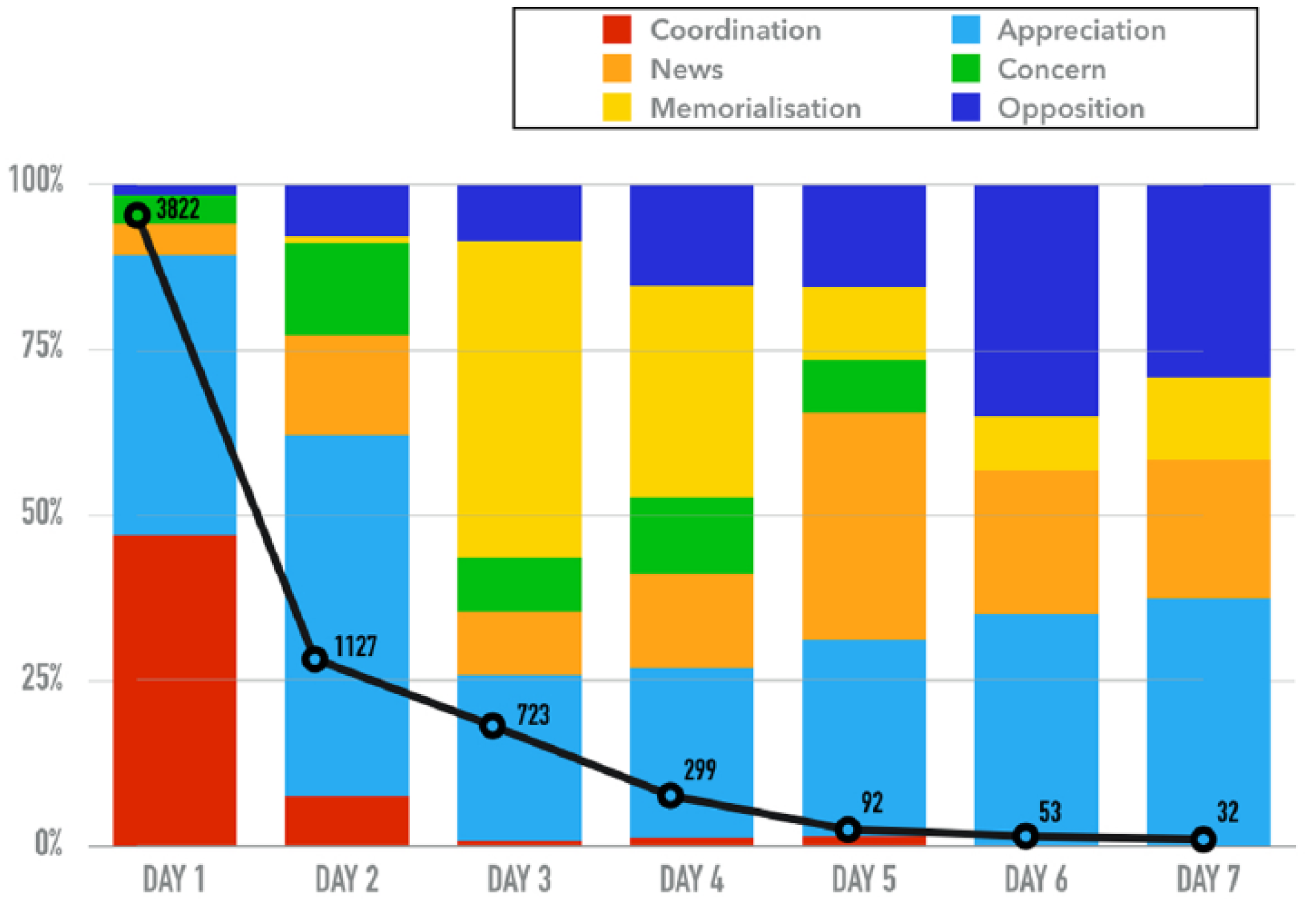
The amount of tweets posted in English and Swedish over the first 7 days, over the frequency of tweets within the different themes over the course of 7 days.
The opposition against the #openstockholm hashtag, through specific counter-hashtag usages such as #closestockholm or #openstockholmsyndrome, as well as simply referring to the hashtag in a discouraging way, became considerably more common in the days following the attacks, as seen in the figure. It is, however, important to be aware of the fact that general tweeting activity had decreased in relation to the #openstockholm hashtag by the end of the first week after the attack. However, this opposing function of tweeting is interesting in the context of how the hashtag became a place for critique against specific politicians and left-wing politics in general. This will be further discussed in the following sections, concentrating on the (textual) content of tweets representing specific discursive themes of the #openstockholm hashtag.
Conflicting discourses
The usages of #openstockholm, addressed above, reveal a multiplicity of ways of using the hashtag and its different functions. However, there are other structures that divide this Twitter activity in a discursive sense. On the one hand, the response after the attack is moderated and almost downplayed through its light-hearted tone, while, on the other hand, there is a discursive turn opposing the openness of the hashtag that instead is focused on amplifying the sense of threat and fear. The negotiation of these two discursive themes will be further addressed below.
In the aftermath of the attack, the hashtag was spread as a way of coordinating help by people on the ground, offering and seeking aid in different forms. This was how the hashtag was mainly used in the hours following the attack. The frame articulations of a large proportion of these tweets, however, are also characterised by a humorous and casual tone, suggesting another dimension of tweeting in the midst of the terror attack. In addition to offering help, these tweets reference, for example, alcohol, cupcakes, cats and video games. These tweets seem to be focused on toning down narratives of fear that was spreading in the mass media outlets at the time. This partly aligns the framing of #openstockholm as a critique towards mainstream media’s often fearful narratives, as, for example, after 9/11 in the United States (Altheide, 2006). These tweets are, in a sense, welcoming and open, as are most tweets within the corpus, but add the dimension of a light-hearted tone. They provide information about where they are located (address or borough in the Stockholm area), but in addition to offering a place to stay, they also offer, as exemplified in the tweets below, the company of pets and an opportunity to play video games: Vasaplan! You’ll find a kitten and some coffee at our place. We welcome all! #openstockholm I’ve got 1 or 2 beds, if stuck in Knivsta. Chips, dip and Xbox. Call me [phone number]. #openstockholm
These tweets, which display a light-hearted tone, may at first glance imply a sense of calm in the midst of the attack, almost a feeling of being back in normalcy, just hours or even minutes after the attack has occurred. Few of the coordinative tweets in general seem to imply the possibility of those in need having traumatic experiences and being in need of recuperation. Cultural trauma research has previously stated that ‘[t]rauma requires narration of a different kind, one in which neither irony or humor is possible: the shock to the system is experienced as too great’ (Eyerman, 2011: 13), but in these tweets, there is an unexpected light-heartedness and humorous tone, showing a hasty ability to bounce back from a traumatic event such as a terror attack, even when it occurs in your own city. While there were many who applauded the hashtag for the expressions of resiliency very quickly after the attack had happened, the need for learning and adaption that is connected to resiliency processes seemed unnecessary within this conversation. The food-and-drinks aspect appeared at times to be more important than the actual housing situation. As in the following two tweets, by the same user, focus is quite clearly put on the (diminishing) availability of beer in the household: Got 2 rooms but only 3 beers. Slussen/Mosebacke. #openstockholm #coldone Scrap that. Only 1 beer left. #openstockholm
Tweets like these suggest a light-hearted tone towards the attack. It is difficult to say whether such expressions are the result of the use of levity as a coping mechanism, or a form of resilience, or even the result of a numbing down effect following the increased occurrence of terror attacks in European cities. As suggested by De Choudhury et al. (2014), in their study of political conflicts in the Mexican drug war, affective desensitisation may occur when exposed to the reality of violence in conflict areas, and in their study this desensitisation was expressed in the online response to news of violence in these affected areas. Either way, this category of tweets represents a more moderated emotional tone than expected after a terror attack, as in the following tweets, referencing a specific pub in the outskirts of Stockholm and the availability of beer: If you’re stuck in Sollentuna, I’m at the [pub name] having a drink. There’s a bed if you need one. #openstockholm St Eriksplan? We’ve got pizzas now. Soon there’ll be beers. Holla if ur in the neighbourhood. And take care of each other. #openstockholm
The spread of fake images from the attack, with photoshopped dark-skinned women looking nonchalantly at scenes depicted as including injured bodies and infrastructural damage, was condemned and attacked in this moderated social media response. This form of tweeting seemed to be aimed at spreading a sense of calm in the midst of the attack and not turning to fake news updates spreading xenophobic ideas and right-wing issue framings. In addition to this, there was an outspoken call for more media attention from mainstream sources, and of responses other than fear and trauma in these circles. Some Twitter users urged the mainstream media to direct their attention to the social media expressions of resilience on #openstockholm and the help that was provided by it: Would be fantastic if you could include #openstockholm in your reporting! We’re coming together, helping each other out, and joining hands.
This moderated discourse of #openstockholm shows the sense of calm and adaption after the attack and, however it is interpreted, may have functioned as a way of hastily bouncing back after instance of violent crime and terror. In this sense, the hashtag can be seen as having a specific function as moderator of cultural trauma readings of the attack and may flout the sense of disruption and fear that may spread in the mainstream media.
The downplaying tendency of this social media response seemed to irritate certain users, who appeared exasperated towards the hashtag itself and the reaction it was spurring. In contrast to this moderating discourse of the hashtag, there was an immediate backlash to this reaction from another direction, which instead focused on how the event should be understood as traumatising and, as such, worked to amplify the sense of trauma and shock. These users seemed to interact by using the hashtag as a way of counteracting this by ridiculing Twitter users who used this calm tone in their tweets. The following example shows how the food aspect of #openstockholm was commented upon in such a way as to ridicule its function: How do eating pizzas etc. prevent future extremist attacks? #openstockholm
Much of this conversation seemed to amplify the sense of threat and danger of violent crime and specifically Islamic terror, and even emphasised the danger of the Muslim faith overall. By such means, these tweets show an amplification of a cultural trauma discourse as a reaction to the attack, in opposition to the moderated discourse seen in the previous section. The Twitter users involved in using the #openstockholm hashtag were mocked in these circles as clueless to the dangers of terrorism, often referring to this reaction as an instance of Stockholm syndrome, indicating that these Twitter users had developed an emotional bond with their ‘captivator’, referring to Muslims in Sweden. This was expressed in several forms, as exemplified below: The prevalence of #stockholm syndrome is 2nd highest in Sweden ATM. The world’s Muslim women have the highest. #openstockholm Hey #morons, Stockholm Syndrome much? #openstockholm It’s called ‘Stockholm Syndrome’ for a good reason. #svpol #openstockholm
The general response after incidents of mass violence may differ from case to case depending on the context of the crime. For example, in their study of school shootings in Finland, Oksanen et al. (2010) found that the reaction of the local communities suffering from the shootings did not have faith in the welfare state’s ability to have prevented it. Crimes such as these may reveal local issues of distrust when coming from within the same community – that is, when the perpetrator has lived among the local residents long before the crime was committed (Lindgren and Lundström, 2010). Disbelief often follows as a reaction to such events. After Columbine, however, attribution of blame through specific issue frames was directed towards different actors or phenomena, especially handgun laws (Haider-Markel and Joslyn, 2001). These issue frames are contextually bound depending on the circumstances of the crime itself as well as the predisposed knowledge of the actors themselves. Issue frames have been understood as being formed by public or political elites, but since social media has entered the field, these issue frames may involve not only formal figures in the public space but also expand to include participatory online production of such issue frames.
The issue frames employed by Twitter users giving expression to this amplifying discourse appeared to direct the blame towards the individuals who support the immigration of Muslims and asylum seekers to Sweden, emphasising the perceived danger in the religious belief of the perpetrator and understanding this attack as the consequences of the ‘reality’ of Islam and Muslim men. As the moderated discourse, previously discussed, was critical to the spread of images, and specifically fake images from different sources, within this amplified discourse, images from the attack were widely spread as a way of further suggesting the severity of the incident, as in the following tweet: All of you pro-Muslim-immigration Swedes, YOU are responsible for this woman’s body torn in half. THIS is Islam. #svpol #Openstockholm [link]
Assigning blame on the political climate in Sweden reflects the issue frames used to understand the attack by blaming specific politicians or political parties, as well as their voters. The Swedish PM was held accountable, specifically for allowing immigration from specific countries in need. These types of tweets, reflecting a right-wing, often radical, perspective on Swedish politics, are commonly hashtagged #svpol, short for Swedish politics in the Swedish Twitter sphere. Several of the quotes in this more amplified discourse use this hashtag as their only addition to #openstockholm or more neutral hashtags such as #stockholm, as in the case below: If anybody sees the @SwedishPM, pls scream and ask why these ppl are allowed into the country #openstockholm #svpol #stockholm
Tweets in this amplifying discourse also critiqued the mainstream media reporting on the attack, which was similarly done by the trauma moderating tweets analysed in the previous section, but in a quite different way. Here, the mainstream media instead became the subject of critique for downplaying the severity of the attack and the threat of Islam and, as in the following tweet, covering the occurrence of racist narratives in its aftermath: So ‘racists’ are worse than Islamic terror according to [news agency’s Twitter handle] #Openstockholm #prayforsweden #svpol #drottninggatan [link]
The coverage of #openstockholm also became the subject of critique, in a similar manner as the tweets focusing on the idea of Twitter users being clueless to the real dangers of terrorism. In the following tweet, the potential threat of accepting help by others was suggested, along with critiquing the media for potentially understating this threat: Wonder how many sexual assaults there’ll be in relation to #openstockholm? But I’m sure media won’t report on that.
This amplification of a cultural trauma discourse points to an anger and resentment towards specific actors held accountable for the terror attack. Even though this could be seen as a way of agreeing to the mainstream media message of fear and severity, this appears to not be the case. Instead, this should be seen as a specific counteraction to the sense of resiliency and calm in the majority of tweets using the #openstockholm hashtag in general, without joining in on the mainstream media message. As such, this amplifying discourse works as a counterpart to the resilient tweeting within the hashtag and follows the cultural trauma logic of understanding the attack with issue frames differing from the mainstream media discourses.
Concluding discussion
As mainstream media outlets sensationalised and kept the news updates coming after the lorry attack in Stockholm 2017, cancelling their initial programmes and reporting live from their studios, the social media approach showed a greater sense of resilience and emphasised a swift return to normality, both practically and emotionally.
It has been shown in this study that coordination, appreciation, news, concern, memorialisation and opposition were the most prominent modes of usage that developed over the course of the week following the attack. The coordinative function, and various ways of showing appreciation for the hashtag itself, became the most salient ways of using #openstockholm, and while, for example, news updates were in fact shared in this online space throughout the week, news sharing never became its foremost function.
Interestingly, within the material lies an antagonism between conflicting discourses that highlight different understandings of the event. While the #openstockholm hashtag was mostly used as a way of flouting the cultural trauma discourses that were widely spread in the mainstream media, there was also the counteracting discourse of amplification, which focused on the ways in which the attacks were, in fact, troublesome and showed a need for political action against Islam and a call for stronger immigration policies. This shows that the social media response to the mainstream mass media discourse was not undivided, and that the hashtag itself functioned as a platform for both of these politicised understandings of the attack.
The ways in which the downplaying was expressed may be interpreted as blunt or insensitive, but they may also be seen in terms of the logic of connective action (Bennett and Segerberg, 2012), where the specific logic of political action entails sharing personalised content on social media platforms in a connected and networked way. Following the Segerberg and Bennett theory of connective action, this moderated tone of tweeting may also be construed as a ‘personalized action frame’ in the sense that it simply constitutes a framework of expression, where help is offered but in a very specific and personalised way, which in this case includes references to food, drinks or other types of enjoyment. In this sense, the light-hearted tweeting expressed in this way can be seen as a way of joining in on a specific mode of connecting, which at the same time also happens to express the idea that the attack itself was, if not benign, then at least not cause for excessive worry for individual citizens. In other words, the downplaying tone within this moderated discourse, where the cause for alarm is flouted, comes into expression both through the mere format, or genre, of tweeting and in the actual content of tweets.
However, several scholars have identified a need to further develop the theory of connective action by taking into account the culturally situated logic of this form of political action, which may not merely be understood by its level of connectivity (see, for example, Pond and Lewis, 2017). In this moderating discourse, the political climate in Sweden may be an important key to understanding this relaxed tone towards the attack, as a way of counteracting the narrative of fear, often used in right-wing circles for the purpose of framing issues of, for example, immigration control.
The framing of the connective action at play within the #openstockholm hashtag may be understood as highly contextual, following Pond and Lewis (2017), due to the issue frames of specific communities assigning their agenda to the discursive understanding of the event itself. This may further respond to why ‘traumatic’ events such as the 2017 Stockholm lorry attack may not generate a cultural trauma discourse. This may then be due to the contextual framing of the connective action which is, in turn, depending on cultural and ideological predispositions and due to the actual expression of these agendas through relying on specific issue frames. Future studies need to further address the contextual element of the negotiation of cultural trauma discourses, especially looking at how networks operate to frame traumatic events in specific ways and how this works to either amplify or downplay cultural trauma discourse.
Footnotes
Funding
The author(s) disclosed receipt of the following financial support for the research, authorship, and/or publication of this article: This research was supported by funding from The Wallenberg Foundations.