



Abstract
This article summarizes a longitudinal study on the role of technology in obtaining the information behind print and online news in Israel, across 15 years. Rather than taking the benefits of innovation for granted, knowledge acquisition technologies should be evaluated according to their ‘epistemic bandwidth’, involving the scope of knowledge-seeking opportunities they afford, the convenience of challenging this information, and its verifiability via the same channel. Hence, innovative technologies are very likely to have broader bandwidth when bypassing human agents. However, when human sources are concerned, traditional channels, like face-to-face and telephone, have broader bandwidth. Findings show that telephone is losing its historical dominance and face-to-face is declining in favour of emails and messaging. Even though textualization may afford greater accuracy and less deniability, and emancipate journalists from functioning as ‘oral relays’ of sources, it provides them with less space to interrogate their sources and confront them with interview techniques.
Keywords
Introduction
Not many years ago, prominent scholars in journalism criticized the scarcity of technology studies in journalism (Boczkowski, 2004; Pavlik, 2000; Schudson, 2000). Today, on the other hand, following the torrent of new technologies, one can find an unprecedented broad scholarly interest in the ‘material objects’ of journalism and its transformative imparts (Anderson, 2015; Deuze, 2009; Ekdale et al., 2015; Lewis and Westlund, 2015; Livingstone and Bennett, 2003; Mitchelstein and Boczkowski, 2009; Porcu, 2017; Steensen, 2009, 2011). However, many of the existing studies leave four main lacunae that the current study wishes to fill.
First, numerous studies do not make clear distinctions between the functionality of technologies and their contribution to news processing, storage, distribution, consumption or interpretation and the core-activity of knowledge production, that is, detecting and obtaining information (Deuze, 2009; Domingo et al., 2008; Pavlik, 2000). In their epistemic capacity, these technologies are shaping what journalists and their audiences can or cannot know under given circumstances, and the nature and certainty of their knowledge. Unlike most technologies, whose role is shaped intrinsically between journalists and news organizations (Ekdale et al., 2015; Porcu, 2017), news information technologies are shaped extrinsically, between journalists, external actors and actants. They aren’t embedded into the routines of reporters and sources without both parties’ mutual cooperation.
Second, most studies focus on new technology (Anderson, 2015; Boczkowski, 2004; Steensen, 2011), often on a single artefact (Bentivegna and Marchetti, 2017; Broersma and Graham, 2012; Garrison, 2004; Hedman and Djerf-Pierre, 2017). This narrow focus not only fragments and decontextualizes the overall role of technology (Ekdale et al., 2015) but also leads to over- or underestimations (Paulussen et al., 2017), being unable to demarcate the contribution of the studied artefact relative to the broader portfolio of technologies, let alone cases in which journalists avoided using any technology whatsoever, relying on face-to-face interviews or news scene attendance (Archetti, 2014; Reich and Godler, 2017; Zelizer, 2007).
Third, since most studies focus on a certain point in time, their validity might be questionable in rapidly changing news environments (cf. Lewis and Westlund, 2015; Lund, 2012; Patterson, 2013; Ryfe, 2012; Siles and Boczkowski, 2012; Zelizer, 2015).
Fourth, while some studies maintain a critical perspective on the role of innovative technology on journalism (e.g. Anderson, 2013; Usher, 2014), many others take for granted its positive impact (Pavlik, 2000; Prenger and Deuze, 2017) focusing on its ‘assets’ (Steensen, 2011), often with utopian expectations to improve journalism (Domingo, 2006, cited by Ekdale et al., 2015; Steensen, 2011).
The current study, on the other hand, proposes that technologies that contribute news information should be evaluated according to their ‘epistemic bandwidth’ – the scope of knowledge-seeking opportunities it affords. As shown below, under most circumstances, traditional channels may have greater epistemic bandwidth than innovative ones.
This article presents a longitudinal study of the role of all channels: old, new, mediated and non-mediated, and their relative contribution to the published news. Findings are based on four waves of face-to-face reconstruction interviews (2001, 2006, 2011, 2016–2017) in which reporters from leading Israeli online and print news organizations described, contact by contact, how they obtained a random sample from their recent publications.
Wishing to encompass different types of technology-mediated and direct coverage, it is necessary to clarify some minimal terminology as used in this article:
Technology. Any device that contributed to the published item by communicating with a human source or by accessing information.
Non-mediated coverage. Direct coverage without the use of any technology (including face-to-face interviews and news scene attendance).
Human source. A person who contributed information to a particular story via technology or a non-mediated contact.
Non-human sources. Repositories, such as databases, public records and group messages, that are not traceable to a particular author.
Channels. The means by which the journalist has accessed a source, be it through technology mediation or non-mediated.
Literature review
The scholarly literature addresses the epistemic affordances of different communication channels, while focusing on specific ones such as data-driven journalism (DDJ; Anderson, 2015; Coddington, 2015; Parasie, 2015), documents (Anderson, 2010; Latour, 2011; Mor and Reich, 2017), oral exchanges (Ericson, 1998; King and Schudson, 1995; Reich, 2013) and first-hand witnessing (Reich and Godler, 2017; Zelizer, 2007).
This article goes one step further, suggesting that each channel has its own ‘epistemic bandwidth’, according to the scope of knowledge-seeking opportunities it affords.
This ‘bandwidth’ is especially consequential among news reporters who tend to employ only a couple of channels per item (Tiffen et al., 2014). Hence, each channel is more influential and has greater ‘bandwidth’ when they allow verification via the same channel – to obtain information independently, critically and proactively, based on reporters’ own impressions and judgements and on richer data and evidence. However, the ‘bandwidth’ may vary dramatically according to the type of news sources. As far as human sources (and news events) are concerned, greater bandwidth characterizes channels that minimize or eliminate distance between parties and allow them more intimate and nuanced exchanges. On the other hand, where non-human sources are concerned, greater bandwidth characterizes channels that allow journalists more distance from specific people, bypassing them and their vested interests in the respective story.
As we show below, in the case of human sources, broader bandwidth characterizes traditional channels, such as news scene attendance, face-to-face and telephone interviews that allow journalists learn how things look or at least sound like, and evaluate the trustworthiness of sources based on rich sensory data and interview techniques.
On the other hand, when reporters wish to bypass human sources, or reveal information they try to hide, evade, deny, or embellish, broader bandwidth may characterize more current channels such as web searches, databases, algorithms and public records. Obviously, all these are human artefacts, not free of their authors’ biases (Benjamin, 2014; Evensen, 2008; Maguire, 2015; Rich, 2011), yet they can be less fickle than human recollections, less malleable to people’s interests in a particular story, generated for other purposes such as bureaucratic routines, public accounts and so on.
The scholarly literature is in congruence not only with the broader concept of ‘epistemic bandwidth’ but also its distinctions between channels according to the type sources.
Human sources
Reliance on more traditional channels is compatible with positions that acknowledge the enduring dominance of human sources as suppliers of news information (Allan, 2004; Cook, 1998; Ericson et al., 1989; Lippmann, 1922; Manning, 2001; Tiffen et al., 2014).
Face-to-face encounters are regarded as the ‘gold standard’ (Guirdham, 2015: 12), not only in journalism (Fishman, 1980; Frank, 1999; Tait, 2011; Zelizer, 2007) but also in interpersonal communication, urban geography, sociology and pragmatics (Guirdham, 2015: 12; see also Boden and Molotch, 1994; Fidler, 1997; Giddens, 2010; Goffman, 1972; Hutchby, 2001; Hutchby and Barnett, 2005; Rogers, 1986; Urry, 2001). According to Guirdham (2015), physical presence
offers most channels (including verbal behavior, paralinguistic behavior which includes voice, tone, pace, loudness, pauses, silence and alterations as well as non-verbal behavior called also body language including facial expression, posture, gesture, proxemics, kinesics and the alterations of all these over the duration of the interaction).
Co-presence embodies the highest degree of ‘social presence’ – a ‘focused interaction’ that maximizes sensory richness (Rogers, 1986) enabling one ‘to know what is really going on’ and ‘what the place is really like’ (Boden and Molotch, 2004: 102; see also Giddens, 2010: 15; Urry, 2001: 261). According to Boden and Molotch (2004), co-presence becomes mandatory when information is sensitive, complex, uncertain and susceptible to misunderstanding, requiring intimacy, trust, assessment of commitment and detection of lies.
While the ‘gold standard’ of physical co-presence is mostly unattainable in journalism (Reich and Godler, 2017; Zelizer, 2007), its ‘silver standard’ could be audio-visual co-presence, such as video conferencing; however, these are rarely used in journalism (Reich, 2013). Instead, journalists widely rely on auditory co-presence, using telephones (Machill and Beiler, 2009; McLuhan, 1964; Reich, 2013; Strentz, 1989). The supremacy of the telephone as a news-gathering tool was recognized already by Marshal McLuhan and others who explained its journalistic lure through its immediacy and spontaneity, enabling reporters to employ interview techniques, negotiate source versions and develop ‘chatty’ relationships with sources (McLuhan, 1964: 214; see also Harcup, 2004; O’Sullivan and Heinonen, 2008; Pavlik, 2000; Reich, 2008; Strentz, 1989). Telephones were seen as the ultimate technology-mediated channel for human communication (Boden and Molotch, 2004; Fidler, 1997; Hutchby and Barnett, 2005), sharing more resemblance than difference with physical presence. They allow intimacy and ‘conversationality in a way that preserves all the personality, recognizability and inflections of the ordinary voice’, and the ‘paralinguistic’ attributes of voice, tone, speed of speech, non-verbal cues and ‘identifying markers’, such as the other party’s age, gender, ethnicity and social position (Boden and Molotch, 2004; Fidler, 1997; Giddens, 2010: 154; Guirdham, 2015; Hutchby, 2001; Hutchby and Barnett, 2005; Ong, 1982; Strentz, 1989).
Non-human sources
Non-human sources are ‘evidentiary objects’ (Anderson, 2015) such as documents, maps, databases, web searches, public records and so on, which are widely discussed in the literature (cf. Benjamin, 2014; Ettema and Glasser, 1998; Loosen et al., 2017; Patterson, 2013).
According to Anderson (2015), changes of ‘evidentiary objects’ are associated with changing news practice and journalists’ knowledge. For example, according to Anderson, the rise of DDJ marks a shift from ‘record’ to ‘report’, from individualized narrative to social scientific insights and from revelation of hidden facts to deeper comprehension of already known trends. On the other hand, the rise of the interview in 1830s in the United States marks a ‘documentary disenchantment’ and a shift from ‘paper to people’ (p. 356).
Two main types of non-human sources pertinent to news reporting are discussed in the literature relating to their epistemic character: documents and DDJ, both of which are more prevalent among investigative journalists than ordinary reporters (Benjamin, 2014; Ettema and Glasser, 1998; Loosen et al., 2017).
Documents are not foolproof (Evensen, 2008; Maguire, 2015; Rich, 2011), yet they can convey ‘the best evidence’ (Maguire, 2015). According to Bruno Latour (2011), this is thanks to their nature as mobile, immutable, presentable, readable and combinable (with one another) artefacts and ‘the belief that a written inscription must be believed more than any contrary indications from the senses’ (p. 70).
Unlike investigative reporters who have a ‘documented state of mind’ (Ettema and Glasser, 1998: 40) and court reporters surrounded by a hyped-documented environment (Haltom, 1998), news reporters tend to avoid using documents (Ericson, 1998; King and Schudson, 1995; Reich, 2013), considering them dull, difficult to obtain and understand, time-consuming (Maguire, 2015) and necessitate complementary interviews to read them between the lines, add quotes and ‘enliven’ the story (Evensen, 2008: 58). Journalists who do use documents are attracted by their capacity to deliver messages in their originality throughout time and space (unlike hazy human recollection), and expose hidden truths, their relative accuracy, lower deniability and superior legal protection (Anderson, 2015; Maguire, 2015; Rich, 2011).
The second type of non-human sources, DDJ, is considered a ‘quantitative turn’ in journalism (Coddington, 2015) though preceded by precision journalism, computer-assisted reporting and computational journalism (Anderson, 2015; Coddington, 2015; Parasie, 2015). DDJ combines the treatment of data as a source to be gathered and validated, the application of statistics to interrogate it and visualizations to present it (Benjamin, 2014). Although data sets do not intrinsically imply truth, according to Nick Diakopoulos, ‘we can find truth in data’. Hence, they must be treated with scepticism, ‘from origin to quality to hidden biases’ (Benjamin, 2014: 19).
DDJ enables journalists to perform distinctive cognitive tasks such as pinpointing hidden trends and connections between phenomena, test hypotheses, map tacit power relations, put stories in broad context and shift gears from the unique and the deviant to focus on regularities, patterns and trends in the spirit of social science (Anderson, 2015; Coddington, 2015; Parasie, 2015). Yet, DDJ is used routinely in resource-rich, predominantly Anglo-American news organizations (Loosen et al., 2017).
Advocates for greater reliance on ‘evidentiary objects’ tend to emphasize the inherent weaknesses of human sources (Koch, 1991; Patterson, 2013). According to Koch (1991), journalists serve as their sources’ ‘oral relays’ (p. 318) ‘bestowing a patina of truth […] to their individual points of view’ (p. 316). According to Patterson (2013), political reporting is deteriorating into ‘he said, she said’ partisan disputes that ‘leave open the question where truth lies’ (p. 48).
According to Kovach and Rosenstiel (2010: 52), in order to address their widening roles, journalists need a dramatically more diverse technological palette. ‘It is as if journalists used to build houses with only a hammer, saw, screwdriver, and now have access to all the power tools available at Home Depot’ (Kovach and Rosenstiel, 2010: 183).
Research question and hypotheses
Studies that tried to explore broader technological portfolios often found adherence to traditional news practices at least in the core role of news gathering (Domingo et al., 2008; Machill and Beiler, 2009; O’Sullivan and Heinonen, 2008; Reich, 2014; Ryfe, 2012; Steensen, 2009, 2011). Today, however, technology use might have shifted substantially due to three major reasons:
Mounting work pressures and dissatisfaction with the current situation. Following waves of layoffs and accelerated news cycles, journalists are expected to produce more news with less time and fewer resources (Abdenour, 2017; Lund, 2012; Pickard, 2016; Ryfe, 2012; Witschge, 2013). Accordingly, journalists and their employers are experiencing increasing dissatisfaction, which drives innovation in journalism (Prenger and Deuze, 2017).
New technology. Journalists find at their disposal a growing portfolio of new and older technologies, including DDJ, social media (Broersma and Graham, 2012; Hermida, 2017), instant messaging (IM; Church and de Oliveira, 2013; Malka et al., 2017) and plenty of online repositories, that have never been so easily accessible (Patterson, 2013; Shapiro et al., 2013). The emergence of the smartphone and its maturation as a news-gathering tool (Westlund, 2017) has particular potential to change news routines due to their nature as a ‘polymedia’ environment (Madianou, 2014) replete with different adjustable functions and applications. The transformative capacities of the smartphone were seen among ordinary users who developed preferences to texting over conversations (Madianou, 2014; Smith, 2015; Turkle, 2015) – a trend that might be of special consequence if found also among journalists and sources. Furthermore, due to their ‘always-on-always-on-you’ nature (Turkle, 2015: 27), smartphones can revitalize older technologies such as Internet searches that formerly required a computer with Internet connectivity.
The ‘technomyopic’ distortion. The impact of technology tends to be overestimated in the short run and underestimated in the long run (Paulussen et al., 2017; Prenger and Deuze, 2017). Hence, even if studies had shown conservative use of technology in the short run, it is worthwhile revisiting their use in the long run.
Research question
Based on this literature, we present an overarching research question, a single hypothesis and a series of sub-hypotheses:
RQ1. To what degree have journalist–source relations moved from an oral to a written culture, and if so, what are the consequences?
The research question is accompanied by one hypothesis:
H1. Findings will show substantial changes, especially between 2011 and 2017, manifested across the following six sub-hypotheses:
H1a. Considerable decline is expected in reliance on non-mediated channels – due to the mounting pressures on journalists.
H1b. Considerable decline is expected in telephone-mediated coverage – as already seen among ordinary smartphone users in favour of ‘texting’.
H1c. Older textual channels (mainly faxes and pagers) will conclude their longitudinal decline (seen in former waves of this study).
H1d. A substantial rise is expected in the use of Internet and email (now ubiquitously available) thanks to the ‘always-on-always-on-you’ nature of smartphones.
H1e. A substantial rise is expected in reliance on social media, as suggested by several scholars (Broersma and Graham, 2012; Hedman and Djerf-Pierre, 2017; Hermida, 2017).
H1f. A substantial rise is expected in reliance on IM thanks to its flexible, multi-modal, informal and cost-free uses (Church and de Oliveira, 2013), and its proliferation among ordinary users and journalists (Malka et al., 2017).
Methodology
Exploring the role of new and old technology, and their relative contribution to news, is becoming more and more challenging in current media environments. The first hurdle is physical: exchanges of information are becoming ever more fluid, unobservable and fragmented, flowing across an increasing number of platforms, inside and outside newsrooms. Second, observing how journalists contact their informants might infringe the ethical tenet of maintaining source confidentiality. Third, studies in this field suffer from a ‘methodological deficiency’ (Steensen, 2009: 322), being dominated by content analysis, surveys and interviews. Published contents, however, say very little about their production processes, while surveys and interviews cannot establish the frequencies in which journalists rely on specific technologies (Manning, 2001; Sigal, 1972; Steensen, 2011).
Trying to overcome these hurdles, the current study used a series of face-to-face reconstruction interviews – a method that has shown its viability in exploring technology use (Reich, 2005, 2008, 2013) and broader news processes (Albak, 2011; Brüggemann, 2013; Phillips, 2012). In this method, a sample of reporters are interviewed face-to-face, 1 while the respective items are before them, and asked to recreate – contact by contact – the contribution of each channel to the information behind a random sample of their recent publications. The series of channels that the reporters mentioned were recorded straightforwardly, without any inferences or processing.
The interviews were preceded by three steps. The first was a random selection of beats and reporters from leading national print and online news organizations.
The list covered three clusters of beats: politics (e.g. diplomatic and parliamentary affairs), domestic affairs (e.g. police, environment and education) and business affairs (e.g. banking, treasury, finance and real estate). The final reporters were chosen randomly, according to the overall proportion of the cluster in the entire reporting workforce.
The second step was identification of all published items of the selected reporters during the 4 weeks that preceded the interviews. The third step was a random sampling of news items for the interviews. Table 1 summarizes the sampling scheme of the four waves of the study.
The sampling scheme.

The first period included only print reporters since online was just beginning.
Items per reporter were reduced across time since the questionnaire became more elaborate.
Except for Haaretz and Haaretz Online reporters (who worked for both print and online) and hence were asked to reconstruct eight print and eight online items.
During the interviews, the reporter and the interviewer sat on either side of a table. The sample of items was presented to the reporter while the interviewer recorded reporters’ replies and assigned them to categories in a closed quantitative questionnaire.
To enhance uniform results in case of documents, that can arrive in numerous ways (e.g. email or Twitter link), our interviewers were instructed to record the vehicle technology that carried the document. Hence, only in a minority of cases, when documents were already in reporters’ hands, were they marked as ‘documents’. Yet, realizing that this way we might overlook the role of documents, the 2016–2017 study included a special question whether the items involved a document (or another link/attachment) that made an informative contribution.
Despite our efforts to maintain methodological continuity, there were a few slight differences between the studied periods; however, these could not have any substantial impact on our data.
First, the sample of reporters tried to follow the changes that leading Israeli newsrooms had undergone over time. As detailed in Table 1, the 2001 wave covered the three major print news organizations (online was in its infancy). The 2006 study added the three websites of the same newspapers, and the 2011 wave added Walla, an online only news organization, instead of nrg, whose editorial activity had declined substantially. The 2016–2017 wave included more newsrooms, to cover a parallel mix of beats, despite substantial staff downsizing. Despite our adherence to the same news beats, 72% of the journalists were interviewed only once, thanks to the rapid turnover of the reporting workforce and the need to include reporters from different news organizations, as described below.
Second, the number of items per reporter was reduced, since the interviews, which were part of a larger project, became longer and more detailed (75 minutes on average, now ranging between 56 and 146 minutes).
Third, while fieldwork in the former rounds of the study took 1 month, using large teams of interviewers, the 2017 study lasted 9 months, employing two interviewers. This couldn’t bias our findings substantially, since interviewee order was random, avoiding sequences of specific media, beat and news organization.
Two reporters in 2001, 9 in 2006, 5 in 2011 and 11 in 2017 were replaced with others from the same beat cluster after refusing to participate.
Each channel’s relative contribution was calculated straightforwardly as its numeric proportion out of the channels used in a specific item. For example, if a specific item was based on two telephone calls, one Internet search and one social media post, the channels were given the values 50% for the telephone contacts, 25% for Internet and 25% for social media. The channel scores per item were then averaged across items. To explore whether the informative contribution of each channel differs from this calculation, we asked the 2016–2017 reporters to estimate the proportion of information yielded by each channel. The differences were found negligible, as detailed at the end of the findings.
Clustering of channels was mostly straightforward combining non-mediated contacts (face-to-face and news scene attendance), social media and so on. Instant messages were kept as a distinct category, since they involve brief, unilateral and potentially immediate and mobile messages (despite the recent emergence of IM desktop apps). While websites were clustered as Internet channels, news sites were classified as a sub-category of media since they involve second-hand reliance on content already identified by another journalistic entity, just like print, radio or television items.
To test the significance of differences between the studied periods across these clusters, we used multivariate analysis of variance (MANOVA). Since 2001 data cover only print reporters, significance was calculated twice, with and without the year 2001. Both calculations were found equally significant.
Following McManus (1994), the study differentiated between two news phases: news discovery, during which the reporter learns for the first time about a potential new story, and news gathering, during which he or she obtains the actual building blocks of the story. For a detailed explanation of the reconstruction method, see Reich and Barnoy (2016).
Findings
Findings allow an unprecedented longitudinal perspective on the changing epistemic role of technology in news reporting.
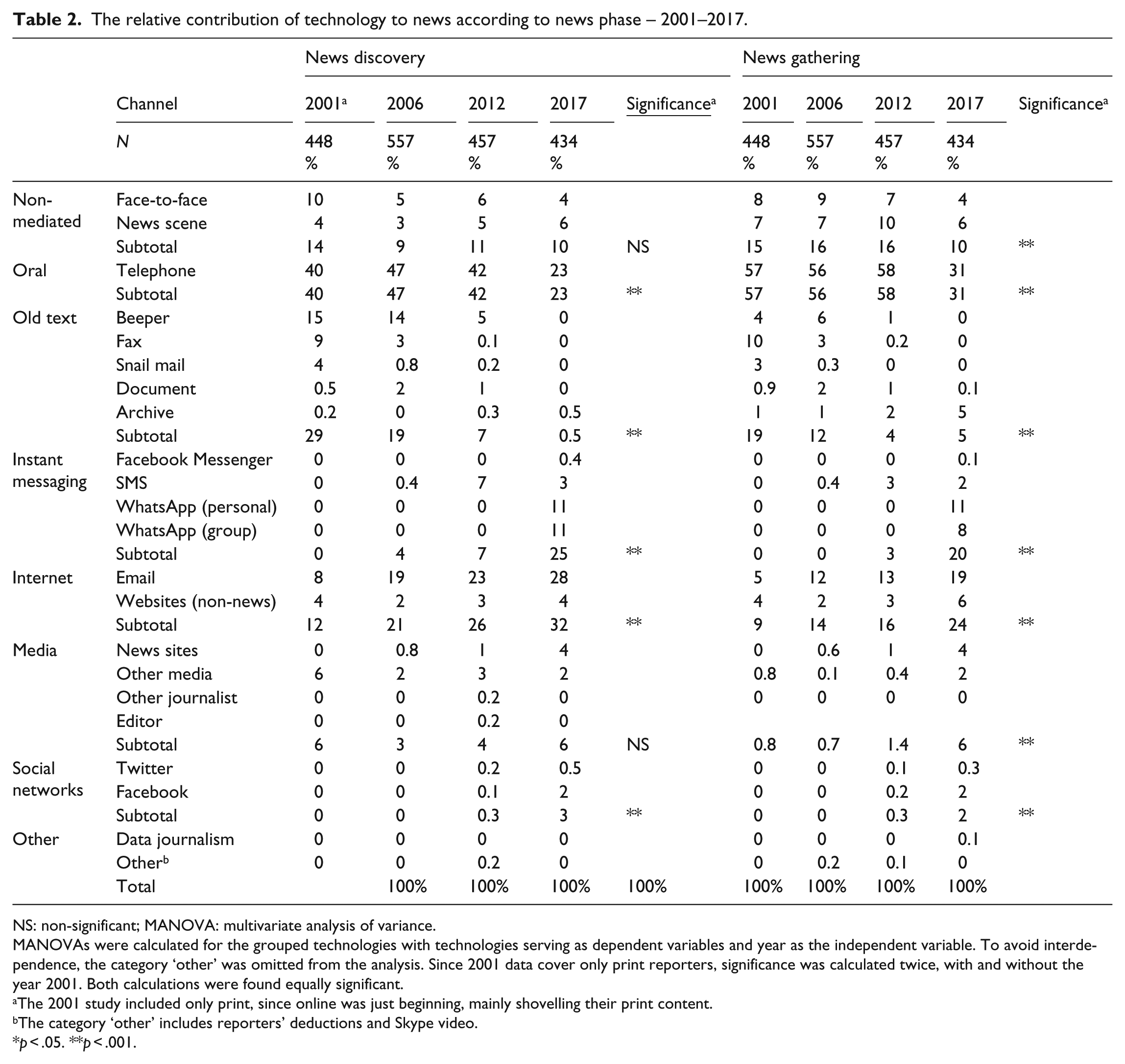
As can be seen in Table 2, after years of relative stability, reporters’ mix of channels has recently been undergoing transformative changes. In order to obtain the day-to-day news information behind their published stories, journalists still don’t use cutting-edge gizmos like drones and algorithms, but rather more mundane artefacts such as telephones, emails and IM.
The relative contribution of technology to news according to news phase – 2001–2017.
NS: non-significant; MANOVA: multivariate analysis of variance.
MANOVAs were calculated for the grouped technologies with technologies serving as dependent variables and year as the independent variable. To avoid interdependence, the category ‘other’ was omitted from the analysis. Since 2001 data cover only print reporters, significance was calculated twice, with and without the year 2001. Both calculations were found equally significant.
The 2001 study included only print, since online was just beginning, mainly shovelling their print content.
The category ‘other’ includes reporters’ deductions and Skype video.
p < .05. **p < .001.
The first sub-hypothesis, which expected shrinking reliance on non-mediated channels (face-to-face interviews and news scene attendance), was supported partially, showing a significant decline in the news-gathering stage (where reporters obtain the building blocks for their stories).
Face-to-face interviews are significantly declining in both discovery, F(3, 1892) = 5.43, p = .001, and gathering, F(3, 1892) = 5.359, p = .001 (significance between specific channels was calculated using analysis of variance [ANOVA]).
The declining reliance on non-mediated channels is not very dramatic, as the role of these channels was marginal to begin with. These findings confirm one of the common criticisms of modern news reporting on the limited use of direct contacts with sources and events.
The second sub-hypothesis, which expected a substantial decline in reliance on the telephone as a dominant channel for raw news data, is strongly supported. After years of persistent dominance, the telephone had lost almost half its share of contacts by 2016–2017. Yet, despite its dramatic decrease, the telephone remains the most prevalent channel in 2017.
The third sub-hypothesis expecting a continuing decline in older textual channels is supported too. Pager and fax messages, and snail mail are zeroing out. The only channel that shows some growth in this cluster are archive materials, either because reporters need them more for context or because digital archives have become more easily accessible.
The fourth sub-hypothesis is also supported, showing a substantial rise in reliance on emails and the Internet, now accessible 24/7. Yet, while email shows a significant rise in both in the discovery, F(3, 1892) = 23.474, p = .001, and gathering stages, F(3, 1892) = 22.884, p = .000, reliance on the Internet is more fickle and limited, probably since Internet searching demands more proactive and time-consuming efforts.
The fifth sub-hypothesis expecting a significant rise in reporters’ reliance on social media is also supported. Journalists rely significantly more than previously on Facebook and Twitter (no other social networks were indicated); however, the overall share of social media remains marginal. The potential reasons are elaborated in the discussion.
The final sub-hypothesis expected a substantial rise in reliance on IM, which, unlike the older SMS, affords real-time exchanges of multi-modal content between individuals and groups at no cost, with visual feedback on delivery, receipt and viewing of messages. WhatsApp, the most used app in the studied case, shows the most striking rise of a new technology in the wave of 2016–2017, supplying circa 20% of news-discovery and news-gathering contacts, divided almost evenly across individual (possibly exclusive, from personal contacts) and group messages (often distributing source materials to groups of journalist subscribers).
To further explore the implications of these findings, the 2016–2017 study included a complementary question, whether the item involved documents or other types of attachments or links (e.g. video, still image, audio) that made an informative contribution. This may enable establishing first whether the demise of the dominant auditory channel means that raw news information has become textualized. This question is especially important regarding both rising channels, WhatsApp and emails, which, unlike traditional textual channels, enable transmission of multimedia files. Second, the attachment/link question may allow better estimation on the contribution of documents that might be underestimated due to our systematic adherence to the vehicle technology that served to transmit the document.
Findings indicate that despite their multi-modal potential, emails and WhatsApp are used predominantly for textual exchanges. Only 12% of personal WhatsApp messages, 13% of group WhatsApp messages and 6% of emails were accompanied by any non-textual attachment playing an informative role. All in all, less than 7% (6.9%) of the items involved a non-textual file (video, audio and still image), while no less than 23.5% of the total items contained a document.
Based on these data, we may cautiously establish that raw information behind the news is becoming not only less auditory but also more textual, despite being exchanged over channels that afford multi-modal transmissions. This ‘textual turn’ in journalism is of consequence since more textual raw materials means more chances for putting words in journalists’ mouths, using more unilateral dispatches of ready-made source versions and greater chances for ‘cut and paste’ journalism.
The ‘textual turn’ is even higher due to the fact that almost a quarter of the items involve a document. While having no parallel former data, this mere frequency suggests that journalists are much less document-averse than described in the literature. Yet, as many scholars note, documents are probably used less frequently in news reporting and play a more informative than an evidentiary role compared to investigative reporters, who are characterized by their ‘documented state of mind’ (Ettema and Glasser, 1998: 40).
Finally, to explore whether the contribution of the studied channels was different to their arithmetic share (presented in Table 2), we asked the 2016–2017 interviewees to assess what percentage of the published information was contributed by each channel. Obviously, these are only estimations; however, they were carried out contact by contact, while the items were in front of them. Differences were minute, concentrated in only three channels: telephone (whose weighed contribution to item information was 4.7% lower than their arithmetic share in the channel mix), email (3.5% higher) and archive (2.1% lower). Considering the high similarity between both calculations, it seems reasonable to adhere to the arithmetic share that doesn’t depend on reporters’ evaluations.
Discussion
Findings show a dramatic shift in the role of technology after years of relative stability. The auditory channel is losing its long-term dominance governing news work, but when did this dominance start? Probably since the telephone became an ordinary artefact in US newsrooms during the 1880s (Salcetti, 1995), or perhaps even since the ‘auditory turn’ in 1830s in the United States, with the emergence of the interview and the ‘documentary disenchantment’ that pushed journalists from ‘paper to people’ (Anderson, 2015: 356).
Thus, information is growingly exchanged via emails and IM, involving increasing amounts of text-based information, sent predominantly from public relations (PR) sources. 2 Furthermore, emails and IM have a dramatically narrower ‘epistemic bandwidth’ than telephone and face-to-face interviews, lacking physical and auditory co-presence, limiting the number of back-and-forth exchanges they allow and affording much less depth and richness of the exchanges and less space for adversarial questions and interview techniques. This way news is becoming not only less ‘what someone says has happened or will happen’ (Sigal, 1986: 25) but also less ‘negotiated’ (Berkowitz and TerKeurst, 1999; Cook, 1998; Tuchman, 1978).
Obviously, oral channels have their own shortcomings. As critics of traditional reporting practices hoped, the relative decline of auditory channels emancipated journalists at least partially from the shackles of sources’ ‘oral relays’ (Koch, 1991: 318). Furthermore, according to Walter Ong and others, oral texts are ephemeral vocal utterances, loosely structured, replete with redundancies, inconsistencies, self-corrections that sound like ‘denial and patchwork’ (Fidler, 1997; Ong, 1982: 104, 107) and multiple, interwoven threads of thought. Hence, textual channels might be less prone to errors, inaccuracies, misunderstandings, misquotes and source statements taken out of context. They can enhance the accuracy of news, allowing sources greater opportunity to clarify their positions and versions, with greater control over verbalization, precision, lexical richness and grammatical sophistication. Thanks to their digital trail, they make source’s exchanges less deniable.
Does the shrinking role of human voice mark a broader decline in the role of human sources? The answer is yes, at least to some extent. While 86–87% of the news-gathering contacts in 2001 and 2006 clearly relied on human sources, today only 66% of the contacts are unequivocally human. However, half of the sources that are not clearly human (17% of the total) were contacted via ambivalent channels like group messages and news scenes that may or may not involve a specific human agent. 3
Findings support, to some extent, the transformationist positions, according to which adoption of new technology transforms news production, however only in the longer run (Paulussen et al., 2017; Prenger and Deuze, 2017). Their slow and delayed pace of adoption indicates that reporters and sources need time to embed a new technology in their intricate dyadic relationships, routines and practices (Ryfe, 2012; Swidler, 2001).
The share of social media looks surprisingly limited for a channel celebrated as ‘vital everyday tool for journalists’ (Hermida, 2017: 407; see also Hedman and Djerf-Pierre, 2017). However, many of its uses mentioned in the literature have no direct contribution to published news, serving functions such as social networking, testing story ideas, self-branding and discussing topical issues. Other practices such as following sources for leads, targeting eyewitnesses, researching and ‘adding flavor’ to stories may have more direct contribution to the news; however, their magnitude remains unknown (Broersma and Graham, 2012; Hedman and Djerf-Pierre, 2017; Hermida, 2017).
As any single national case study, findings of this article invite cautious generalizations. While Israeli media shares many aspects that characterize Western news markets (e.g. dominant private ownership, shrinking manpower and job security), some of its structural factors may affect the results. Levels of direct accessibility to sources and events might be more limited in larger countries, where social, political and physical distances are greater and reporter–source relationships are more formal (Dimitrova and Strömbäck, 2009). Greater prominence of textual exchanges can be expected in ‘softer’ news beats, such as sports and entertainment, where sources and PR people are more dominant, putting greater emphasis on news subsidies (Lewis et al., 2008).
Despite our careful sampling, we were unable to focus on exactly the same newsrooms and reporters, due to the constantly changing terrain. Yet, in each period, we tried to cover the most prominent online, print and increasing number of hybrid reporters. The differences between periods seem large enough – sometimes even dramatic – and significant.
Another limitation of the data is its dependence on reporters’ own testimony, which is prone to social desirability. Yet, the fact that interviewees admitted how rarely they rely on practices such as first-hand witnessing, document research and data analysis adds credibility to their testimony.
Further studies should test and refine the concept of ‘epistemic bandwidth’, analysing source–reporter discourse, trying to elicit the changing power relations between parties in shaping raw news information over different channels. They should pay extra attention to the roles of real-time oral exchanges (telephone and face-to-face) vs more textual channels, and the extent to which the latter contribute to less adversarial coverage, more ‘cut and paste’ reporting and greater success in putting words in reporters’ mouths.
Footnotes
Acknowledgements
The author thanks Aviv Barnoy and Gilad Halpern for their role in data gathering and Tali Avishay-Arbel for her statistical advice.
Funding
The author(s) received no financial support for the research, authorship, and/or publication of this article.