



Abstract
Guided by the Uses and Gratifications 2.0 approach, this study examines the role played by three classes of affordances (i.e. modality, agency, and interactivity) in explicating the gratifications derived by older adults on Facebook. Data from a content analysis of Facebook profiles and an online survey with older adults (aged 60 years and older) who have used Facebook for at least 1 year (N = 202) show that while status updating and posting personal stories are associated with activity and community-building gratifications respectively, profile customization is key for obtaining agency-enhancement gratification, and participating in conversations on comment threads plays an important role in providing interaction gratification. These findings advance our understanding of social networking site (SNS) use among older adults and suggest interface designs that maximize gratifications for older adults.
Introduction
As popular technological tools, social networking sites (SNSs) offer various affordances (i.e. action possibilities; Norman, 1988) for effective social interaction, but it is not clear how they contribute to uses and gratifications for different groups of users.
To begin with, there are a variety of affordances and uses. SNSs have common or shared technological affordances that support users’ initiatives to connect with each other. Just as SNS use has increased, so have the action potentials for users to take socially directed action (Majchrzak et al., 2013). Self-presentation and asynchronous communication tools enable online users to engage in impression management (Walther, 2007). Chatting tools are known to help users control their social interaction with others in a computer-mediated communication (CMC) system (Bradner et al., 1999). More broadly, social affordances (e.g. broader bandwidth, always connected, wireless portability and globalized connectivity) afford social interaction in everyday life (Wellman et al., 2003). Social affordances are particularly important in the context of SNSs in that features embedded in SNSs are likely to generate sociality-related action possibilities for maintaining and enhancing the reciprocal relationship between and among users and the SNS environment (Kreijns and Kirschner, 2001).
In the context of Facebook, Burke et al. (2011) highlight three affordances of SNSs: directed communication with individual friends, passive consumption of social news, and broadcasting. These social affordances are associated with positive outcomes related to user psychology (e.g. social connectedness) and health (e.g. well-being; Burke et al., 2011). Burke and Kraut (2014) also discovered that tie strength increases by using directed communication features (e.g. posts, comments, messages) and consuming broadcasted content (e.g. status updates, photos).
Clearly, different affordances of SNS technology serve different purposes, together motivating the widespread adoption and use of SNSs such as Facebook. While extant research has provided rich insights on how college students and adults use Facebook, we know relatively less about the ways in which older adults engage with this technology. According to Pew research (Anderson and Perrin, 2017), 34% of Americans aged 65 years and older use SNSs, an increase of 7% from 2013. Given that the use of SNSs has been increasing among older adults, it is important to understand how technological affordances on SNSs enable older adults to use SNSs to improve their social lives.
Of various SNSs, Facebook is the most popular among older adults (Greenwood et al., 2016). Therefore, this study investigates how older adults use Facebook and obtain particular gratifications from specific technological affordances on Facebook. This research draws on the Uses and Gratifications (U&G) framework for understanding various gratifications derived from engaging with different SNS affordances. Guided by the Modality, Agency, Interactivity, and Navigability (MAIN) model, it identifies the key affordances of social networking technology that may support older adults and thereby contribute to the effective design of communication technologies for the elderly. We first provide a background of theory and research on media uses and gratifications, highlighting the recent scholarly attention to newer media in this literature. We then describe how older adults use Facebook before we present the rationale and hypotheses for linking specific technological affordances with specific gratifications obtained from Facebook use by older adults.
Background: media uses and gratifications
The U&G perspective is concerned with how people select media depending on their needs or motivations. The U&G perspective comes from functionalist sociology. It explores the use of different media and is related to differences in expectations and gratifications sought (McQuail, 2000). Specifically, this perspective suggests research avenues stressing the role of active audiences in media usage. Given the theoretical assumptions of U&G, scholars have identified distinct sets of gratifications. Cutler and Danowski (1980), for example, proposed two types of gratifications: content gratifications and process gratifications. Content gratifications are obtained when people consume media for its messages, that is, when individuals use media to gain knowledge and increase their understanding. For example, a newspaper is usually used to find out information about current events. Process gratifications, however, are obtained when people consume media for reasons other than its content. For example, viewers often watch television to pass time rather than to obtain any specific information. In accordance with Rubin’s (1983) study, content gratifications represent “instrumental use” and process gratifications represent “ritualized use.”
In addition to these gratifications, Stafford et al. (2004) suggested social gratifications for social networking and online interpersonal communication. In particular, the interaction aspects of online media have been seen as important. People now use the media to exchange information with each other, and this is especially true online. In particular, online media allow us to generate as well as consume content; the traditional sender–receiver model has been replaced by a relational model that operates with various transmitters and receivers (Jacobi and Freyberg-Inan, 2015). This active-user paradigm makes U&G theory particularly relevant for studies of interactive online media (Chen, 2011). U&G perspective is especially useful for SNSs to understand why and how SNS technology has become integrated into our social lives (Quan-Haase and Young, 2014).
Based on these three types of gratifications (i.e. content, process, and social), researchers have analyzed new media. For example, Leung (2009) identified four gratifications of online user-generated content: recognition needs, cognitive needs, social needs, and entertainment needs. In the context of social media, Quan-Haase and Young (2010) identified six gratifications obtained from Facebook: pastime, affection, fashion, share problems, sociability, and social information. Chen (2011) found that the frequent use of online media gratifies a need for connection with other people.
Although informative, these gratifications all rely on the psychological trait paradigm of gratifications by employing traditional measures designed for older media. Lichtenstein and Rosenfeld (1983) proposed a modification to this approach, by arguing that media characteristics, not just psychological needs, are important in predicting gratifications. This implies that gratifications do not necessarily come from users’ pre-existing needs but could also be triggered by the medium itself. In line with this argument, Ruggiero (2000) emphasized the importance of recent technological features (e.g. interactivity, synchronicity, hypertextuality, and demassification) for future U&G studies using new media. The previous measures do not fully capture the potential gratifications associated with new media; most gratifications in convergent media like the Internet are conceptualized broadly (e.g. information-seeking, entertainment). However, new media offer several unique technological features that do not exist in traditional mass media (Sundar and Bellur, 2011). Therefore, medium-specific gratifications should be identified to increase our understanding of the gratifications resulting from the use of specific features in a medium (Sundar and Limperos, 2013). Several communication scholars have found new gratifications from newer media. For example, Song et al. (2004) found virtual community as a gratification from the Internet, and Wei and Lo (2006) proposed mobility as a new gratification from using cell phones.
To address such concerns, Sundar and Limperos (2013) proposed a framework of affordance-based gratifications. The concept of affordance was developed from a psychological perspective; it is often dependent upon interface features that provide users with possible actions, which are signaled to users via visual cues on the interfaces of digital technologies. However, gratification refers to user satisfaction regarding their experience, which implies that users’ gratifications are reinforced through their positive experience with media (Li et al., 2017). According to Sundar’s (2008a) MAIN model, each affordance manifests itself on the interface in the form of cues that trigger heuristics (rules of thumb or mental shortcuts) about the underlying content, thus affecting users’ perceptions. It proposes four broad classes of media affordances: modality, agency, interactivity, and navigability. These affordances signify technological features that provide action possibilities. For example, the modality affordance of photo sharing provides users with the action possibility of uploading their pictures in addition to textual content, while agency affordances in SNSs enable users to assert their agency by performing such actions as clicking the Like button and tagging other users. Given that users’ gratifications are obtained by experiencing particular media after adoption, the use of specific features providing such affordances can lead to important gratifications, according to U&G 2.0 (Sundar and Limperos, 2013).
Older adults’ use of Facebook
As emerging technology, SNSs have different usage patterns based on user age. Pfeil et al. (2009) found that older adults are more likely to form small social groups with varying ages, while teenagers tend to extend their social networks to a larger group with similar ages. In addition, Chang et al. (2015) suggest that older adults prefer to have greater proportion of actual friends in their social networks on Facebook compared to younger adults. Given their unique social goals, there are also different preferences in using SNS features among older adults, as shown in the study by Jung and Sundar (2016a), which found that older adults have different levels of using each Facebook feature that contributes to their overall use of Facebook. Mitzner et al. (2010) also demonstrate that older adults have a particular preference for convenient features that can reduce cognitive effort. This implies that simple interaction tools such as Like button would be preferable for elderly users because of their relative physical and cognitive impairment (Pfeil et al., 2009).
Photo viewing is older adults’ favorite social network activity (Brandtzæg et al., 2010). In particular, they enjoy viewing family photos, which help them keep in visual touch with family members who are physically far from them (Brandtzæg et al., 2010; Righi et al., 2012). Ferreira et al. (2017) also find that digital photo and video are useful tools for older adults to document family stories or events. Recent studies have shown that viewing pictures on Facebook is effective in maintaining companionship with family and close friends for older Facebook users (Jung et al., 2017; Quan-Haase et al., 2017).
More generally, older adults’ use of specific Facebook features may be a reflection of their engagement with specific affordances of SNS technology, as described in the following sections, with consequences for gratifications sought and obtained.
Modality affordance
A modality affordance is the action possibility provided by the interface for sending information through the modality of their choice, such as text, pictures, audio, and video (Sundar, 2008a). MAIN model (Sundar, 2008a) posits that the use of certain modalities could trigger several specific heuristics. For example, the realism heuristic (it seems real, so it is credible) is heightened by the video modality, compared to text, because “seeing is believing.” The being-there heuristic (“I am part of the action, therefore it is credible”), which is related to the degree to which users feel like a part of the world created by digital media (or sensorily immerse themselves in the digital environment), can likewise be triggered by a vivid modality such as virtual reality (Sundar et al., 2017). Sundar and Limperos (2013) explain that realism and being-there are gratifications that users now expect in a mediated-communication environment or a virtual environment. As various modalities on advanced digital interfaces extend the “perceptual bandwidth” for interaction (Sundar, 2008a), users expect realness and the sense of being-there when using digital media and may not be satisfied with their user experience if these modality-based gratifications are not available in a particular device or site. In recent research on the use of multiple modalities, Yang et al. (2015) found that one of key motivations to use photos on news websites is realistic content, and video use on the websites satisfies the need for realism in connecting with others. Limperos et al. (2015) also demonstrated that the addition of audio to textual lecture material facilitates better interaction between students and instructors by triggering the being-there heuristic.
How does this theoretical insight relate to older adults’ Facebook use? Several studies have reached the consensus that older adults are most satisfied on SNSs when sharing photos (Brandtzæg et al., 2010; Righi et al., 2012). Fuchsberger et al. (2012) demonstrate that social presence is important in intergenerational online interactions. Older adults usually live apart from their families, and therefore, they have fewer opportunities to meet with family members. Quan-Haase et al. (2017) suggest SNSs allow older adults to decrease the social distance necessary for maintaining relationships with their family members. This is in part because SNS sites rely quite heavily on sharing of pictures and videos. The use of such multimodality features can enhance social presence of others and thereby gratify their need for realism and being-there (Sundar and Limperos, 2013). When an older adult sees a picture of his or her newborn grandchild, it is more real than being simply told about the birth. Likewise, seeing a video of that grandchild playing in the park provides the older adult a greater feeling of having been there with his or her grandchild compared to reading a textual description of the activity. Given this, the following hypotheses are proposed:
H1a. Older adults will obtain greater realism gratification from frequent use of multimodality features (i.e. photo, video) on Facebook.
H1b. Older adults will obtain greater being-there gratification from frequent use of multimodality features (i.e. photo, video) on Facebook.
Agency affordance
Agency affordances allow any entity (e.g. machines, organizations, other users) to serve as a source of communication, with users able to assert their own agency as well as recognize the distinct agency of other entities (Sundar, 2008a). In this study, an agency affordance is conceptualized as the ability of individuals to serve as an interface agent that generates an action.
According to the Agency Model of Customization proposed by Sundar (2008b), technological features on the interface can enable individuals to serve as a source of information, thus increasing their involvement with the interface, projecting their identity onto it, and having greater control over it. For example, a user perceives himself or herself as a source when interacting with interface features on SNSs. In particular, social media offer users the opportunity to customize their profiles, which enables them to control their own information.
By extension, customization allows users to become a content creator or source of the information in the digital media environment, which leads users to be more agentic. Studies show that customization significantly influences a person’s sense of agency (Sundar et al., 2012). For example, Kim and Sundar (2009) found that customization in the virtual world (i.e. Second Life) gave users a strong sense of identity and control in their interactions. Sundar and Limperos (2013) posit that such agency-enhancement is a gratification that users have come to expect from newer social media because these media allow them to express themselves through their preferences. Based on this rationale, the following hypothesis is proposed:
H2. Older adults will obtain greater agency-enhancement gratification from more customized items on Facebook profile.
In addition to customization, SNSs allow users to create their own content by way of posting and commenting. This can induce feelings of “self as a source” (Sundar et al., 2012). In particular, Facebook generally offers two forms of self-expression: story generation and story sharing. Previous studies have found that creating and sharing imbue different levels of sense of community. Stavrositu and Sundar (2012) found that personal journaling (i.e. self-created content) gives users a higher sense of psychological empowerment by increasing a sense of community than filter blogging (i.e. forwarding other-created content). Consistent with this finding, Sundar et al. (2012) confirmed that active blogging elicits a higher sense of community than filter blogging. Lazar et al. (2017) also found that older bloggers share their interests (e.g. ageism) with others, which demonstrates that their online discourse on social media like blogs allows them to feel more connected with their community of peers. Other research has found that disclosing oneself, when maintaining relationships, develops a sense of community-building by facilitating shared thoughts and behaviors (Hamm and Faircloth, 2005). Posting personal stories affords SNS users ways to improve their ability to join the interaction with others (Stavrositu and Sundar, 2012). In sum, it appears that by being agentic and intimate, that is, by expressing oneself through personal experiences, problems, feelings, and so on, users tend to seek and build community with other users in a social media platform. Therefore, users are likely to obtain the gratification of building a community by posting their own stories on SNSs (Sundar and Limperos, 2013). Thus, the following hypothesis is proposed:
H3. Older adults will obtain greater community-building gratification from frequent posting of personal stories on Facebook.
Interactivity affordance
Among the various kinds of interactivity, message interactivity (Sundar, 2007) is most closely related to the activities on SNSs, which enable users to interact with each other and carry on an extended dialogue. The most common functions are comment posting and instant messaging. These features create visual cues that show the extent to which users exchange their messages in a system (Sundar, 2008a). For example, chat windows provide users with a place to communicate with each other synchronously, while comments are public and asynchronously listed under an original post. These message-interactivity cues serve to trigger the interaction heuristic (i.e. the higher the reciprocal action, the better the interaction) and the activity heuristic (i.e. active medium better than passive medium), both of which have positive halo effects on the quality of their communication.
Contingency (i.e. threadedness) in the interaction allows users to communicate with others reciprocally. Prior research has shown that as the message interactivity increases, there are more positive feelings of relatedness (Bellur and Sundar, 2017). For example, Greene et al. (2011) revealed that interactions through the commenting function on Facebook increases actual interpersonal and community support. Users who received more comments from their Facebook friends have more informational and emotional support than those who received fewer comments. A recent survey of Facebook use among older adults found that use of message-interactivity features (e.g. commenting, replying, chatting) on Facebook is important for building social bonding and bridging (Jung and Sundar, 2016a).
Interactivity features on any interface can cue interaction and activity heuristics. When applied to Facebook, such heuristics are triggered by the status update feature (activity heuristic) and the comment function (interaction heuristic), according to the MAIN model (Sundar, 2008a). These heuristics have become gratifications since individuals have come to expect them on interfaces (Sundar and Limperos, 2013). This leads us to the following hypotheses:
H4. Older adults will obtain greater activity gratification from frequent use of status updates on Facebook.
H5. Older adults will obtain greater interaction gratification from more comments received and replies to the comments on Facebook.
Methods
This study involves multiple methods utilizing online survey and content analysis of older users’ Facebook profiles. After obtaining Institutional Review Board (IRB) approval from the University, participants older than 60 years, who have used Facebook for at least 1 year, were recruited from retirement centers in the United States through email invitation and in-person visits from November 2014 to February 2015. Of the 174 retirement centers contacted by us, 27 permitted us to recruit older adults, with the administrators emailing recruitment messages to their members. Once older adults in the recruited centers agreed to participate in this study, the researcher sent an online survey link for their participation. In order to directly collect the amount of their Facebook activities, they were also asked to add a researcher as their Facebook friend at the end of online questionnaire. The purpose of this activity (i.e. adding a researcher to their Facebook friend) was informed and participants were free to choose whether or not to add a researcher as their Facebook friend. The final dataset include responses from participants who both completed the online questionnaire and added the researcher as their Facebook friend.
Profile of the participants
The final valid number of participants is 202, after excluding those who refused to add the researcher as their Facebook friend or were identified as outliers in the content analysis.
There were 161 female participants (79.7%) and 41 male participants (20.3%). The average age of participants was 69.37 years (standard deviation [SD] = 5.88), ranging from 60 to 86 years. Most participants were Caucasians (94.6%, N = 191). 48% of participants (N = 98) had a master’s degree or higher, followed by college graduates (19.8%, N = 40), those who attended college or had a technical school degree (16.3%, N = 33), individuals who attended a professional school (9.9%, N = 20), and high school graduates (5.4%, N = 11).
In terms of Facebook usage, participants visited Facebook four times per day (median = 3, SD = 7.71) on average. In addition, content analysis revealed that their average number of Facebook friends was 222 friends (median = 147, SD = 305). On average, they published 99.41 posts during the year on average (median = 83.5, SD = 69.56).
Measures
Content analysis was used to observe Facebook activities, and an online survey was used to measure affordance-based gratifications, demographics and other variables, as described below.
Facebook activities were coded through content analysis, which includes photo/video sharing, profile customization, posting personal stories, comments and replies, and status updates. We chose to code Facebook activities for one full year in order to observe the general usage pattern of each feature among participants by smoothing over fluctuations of activity during particular months (e.g. birthday). The period of content created by Facebook users, which we coded, is different depending on each participant’ date of completion of the online survey. For example, if a participant responded to the online questionnaire on 11 February 2015, coders coded the number of Facebook features used by that participant from 11 February 2014 to 10 February 2015. Two graduate students were employed to code the following activities on participants’ Facebook timelines, which had a high level of inter-coder reliability with the average of Krippendorff’s alpha of .90. We used log transformations to normalize the count data because they were all highly skewed.
Modality affordance is concerned with multimedia use on Facebook. To examine participants’ use of modality-related features, each participant’s timeline was coded for the number of posts that contain photos and videos for one year.
Agency affordance was coded for two Facebook activities: profile customization and personal stories posted by a profile owner on Facebook. In terms of profile customization, items contained in Facebook’s profile section were coded as 0 (missing) or 1 (not missing). The example items were profile cover picture, work, education, places lived, and others. The second activity coded under this affordance is the number of personal stories posted by the participant (i.e. profile owner) on the Facebook timeline.
Interactivity affordance includes Facebook activities of commenting and status updates. The number of comments received from a participant’s (i.e. profile owner’s) Facebook friends and a participant’s replies to his or her friends’ posts on the Facebook timeline were coded. In addition, the number of posts published by the participant (i.e. profile owner) was measured.
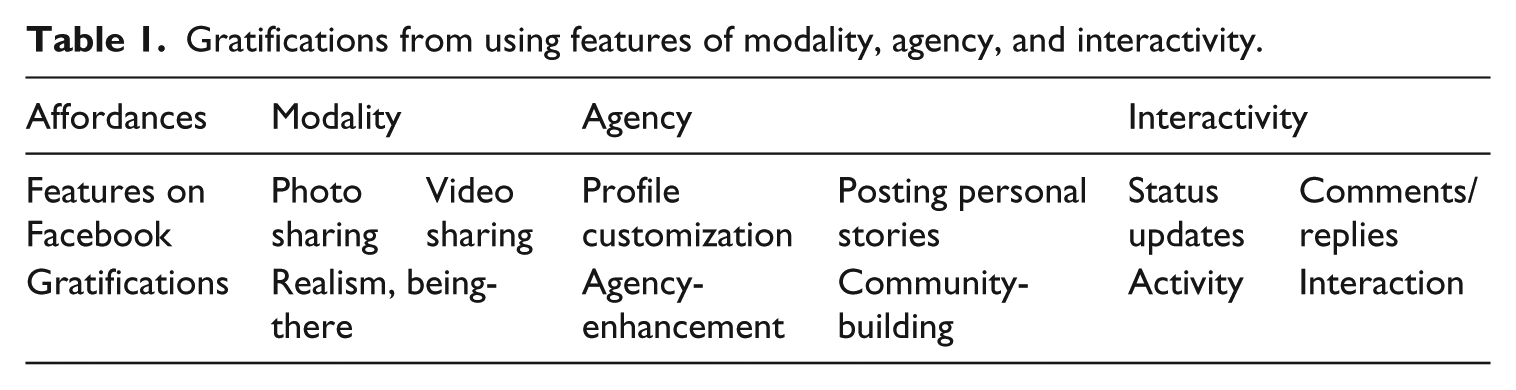
Affordance-based gratifications were based on a modification of the scale proposed by Sundar and Limperos (2013). Responses to six affordance-based gratifications were gathered on a scale from 1 (strongly disagree) to 7 (strongly agree). Participants were asked about three key affordances (i.e. modality, agency, and interactivity). Table 1 describes the predicted gratifications from using technological features on Facebook. The measures for each affordance-based gratification begin with the prompt, “I use Facebook because”: realism (“I know the content that appears on my Facebook page is real and not made up,” “communicating via Facebook is like communicating face-to-face,” “the experience on Facebook is very much like real life,” “Facebook lets me see things for myself”), being-there (“Facebook helps me immerse myself in places that I cannot physically experience,” “Facebook creates the experience of being present in distant environments,” “I feel like I am able to experience things without actually being-there”), agency-enhancement (“I have my say on Facebook,” “I can assert my identity on Facebook,” “I can send my thoughts to many on Facebook,” “I can have the power to broadcast to my Facebook friends”), community-building (“I can expand my social network on Facebook,” “I can be part of a community on Facebook,” “I can build social connections on Facebook”), interaction (“I expect to interact with Facebook,” “I can perform a number of tasks on Facebook,” “I can specify my needs and preferences on an ongoing basis,” “I can maintain relationships with others,” “I can keep in touch with others”), and activity (“I feel active when I use Facebook,” “it is not a passive medium,” “I get to do a lot of things on Facebook”). All the scales showed acceptable levels of reliability: realism, α = .80; being-there, α = .91; agency, α = .88; community-building, α = .89; interaction, α = .78; activity, α = .87.
Gratifications from using features of modality, agency, and interactivity.
Power usage is the degree to which individuals perceive their own ability to use technologies, as well as their level of interest and expertise (Sundar and Marathe, 2010). This variable is used as a control variable because previous research with new media suggests that power usage can determine adoption of new technological features (e.g. Sundar et al., 2012; Zhong, 2013). Some users are more likely than others to find a given medium easy to use as well as useful, two key predictors of adoption according to Technology Acceptance Model (Davis, 1989). These users will not only adopt the technology earlier than others but also become more expert at using it, leading to an individual difference in any sample of users. In the realm of SNS use by older adults, at least one study has shown a positive association between Facebook usage and power usage (Jung and Sundar, 2016a). In light of this correlation, 12 items capturing various facets of power usage were measured on a 7-point Likert-type scale (e.g. “I make good use of most of the features available to me in any technological device”). Overall, the power usage scale was quite reliable (α = .87).
Overall Facebook use involves number of Facebook friends and Facebook visits. The number of Facebook friends was measured through content analysis, which provides more accurate information about participants’ Facebook general usage than self-reported measures. In addition, the number of Facebook visits was measured by asking how frequently participants log on to Facebook.
Demographic variables include age, gender, and level of education.
In the same survey, respondents were administered a series of questions pertaining to intrinsic motivation, enjoyment, and subjective well-being. Analyses of these variables, guided by self-determination theory and motivational technology model, are reported elsewhere (Jung and Sundar, 2016b).
Results
In order to test H1 through H5, a series of hierarchical regression analyses was performed, examining whether Facebook features that individuals used would predict affordance-based gratifications. Hierarchical regression allows the researcher to specify the order in which blocks of predictors are entered into the model based on theoretical rationale. In this study, the blocks were entered in the following order: demographic variables (i.e. age, gender, education), power usage, number of Facebook friends, and frequency of Facebook visits.
H1 stated that older adults will obtain greater realism (H1a) and being-there (H1b) gratifications from frequent use of modality features (i.e. posting photos and videos) on Facebook. Two hierarchical regressions were conducted to examine whether the number of photos and videos predicted realism gratification and being-there gratification, separately. The level of education and number of Facebook friends significantly predicted realism gratification (β = –.16, p < .05; β = .16, p < .05, respectively). However, after controlling for demographics, power usage, and Facebook usage-related variables, the numbers of photos (β = .07, p = .39) and videos (β = –.07, p = .35) were not significantly associated with realism gratification (Table 2).
Hierarchical regression analyses for predicting affordance-based gratifications.
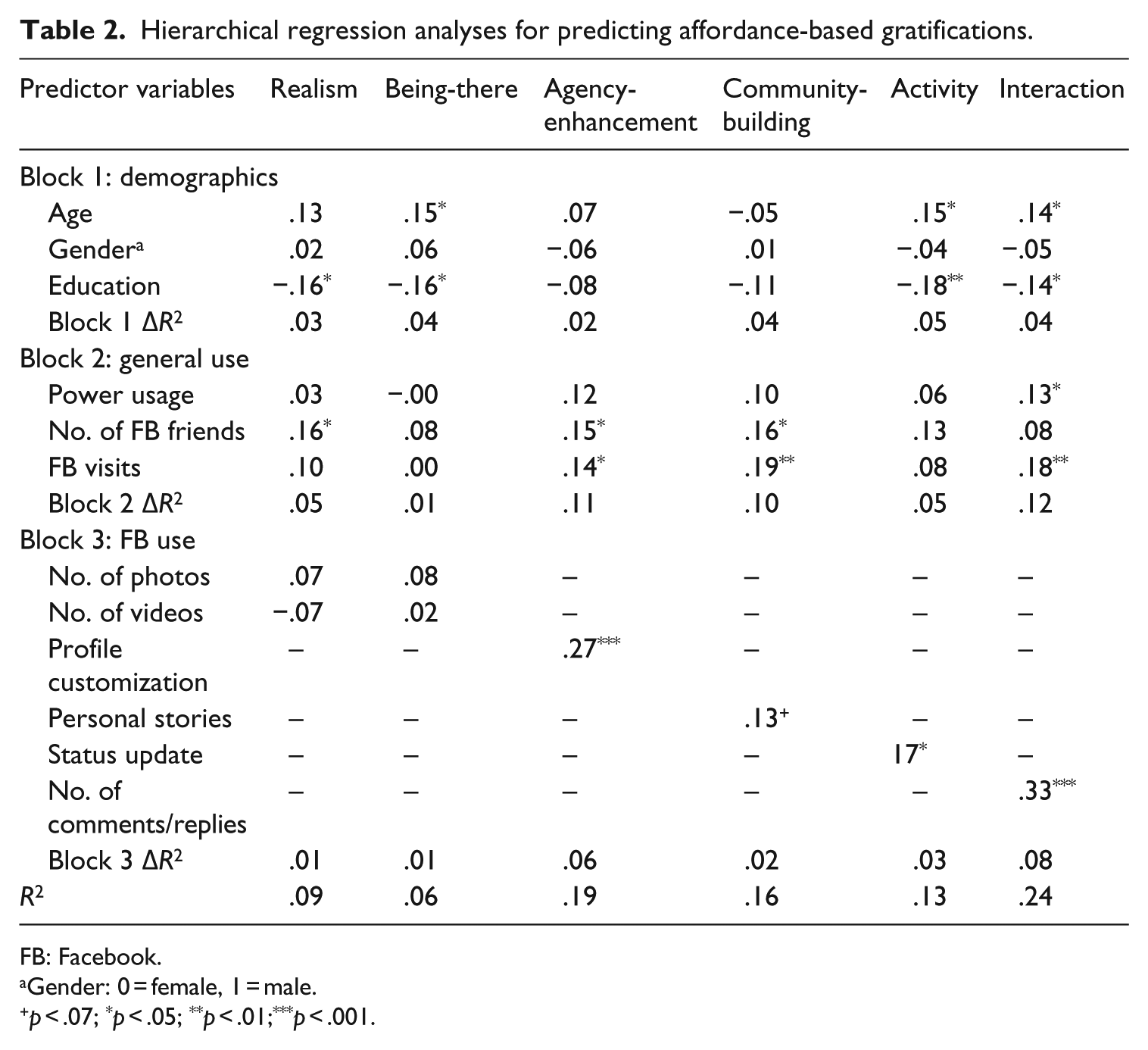
FB: Facebook.
Gender: 0 = female, 1 = male.
p < .07; *p < .05; **p < .01;***p < .001.
Another hierarchical regression analysis revealed no significant association between the numbers of photos (β = .08, p = .33) and videos (β = .02, p = .78) and being-there gratification (Table 2). Age was positively associated with being-there gratification (β = .15, p < .05), while education level was negatively associated with being-there gratification (β = –.16, p < .05). Therefore, H1 was not supported.
H2 predicted that older adults would obtain greater agency-enhancement gratification from more items customized on their Facebook profiles. As shown in Table 2, Facebook usage-related variables had significant positive associations with agency-enhancement gratifications (β = .15, p < .05 for number of Facebook friends; β = .14, p < .05 for Facebook visits). Even after controlling for demographics and Facebook usage-related variables, the number of items customized on Facebook profile was significantly and positively associated with agency-enhancement gratification (β = .27, p < .001). Thus, H2 was supported.
H3 proposed that older adults would obtain greater community-building gratification from frequent posting of personal stories on Facebook. The number of Facebook friends (β = .16, p < .05) and Facebook visits per day (β = .19, p < .01) were significant and positively associated with community-building gratification. The final model of the hierarchical regression analysis indicates that the number of personal stories posted on respondents’ Facebook timeline was a marginally significant positive predictor of community-building gratification (β = .13, p = .06), and therefore, Hypothesis 3 was marginally supported (Table 2).
H4 stated that older adults would obtain greater activity gratification from frequent use of status updates on Facebook. Several covariates were significantly associated with activity gratification: age (β = .15, p < .05), education level (β = –.18, p < .01), and the number of status updates posted by a respondent were all significantly associated with activity gratification (β = .17, p < .05), as shown in Table 2. Thus, H4 was supported.
Finally, H5 posited that older adults would obtain greater interaction gratification from more comments received and replies to the comments on a Facebook timeline. As shown in Table 2, the final model of the hierarchical regression analysis showed that the number of comments received from Facebook friends (and replies respondents made in return) was a significant positive predictor for interaction gratification (β = .33, p < .001). This indicated that the greater the number of comments and replies, the higher the interaction gratification, which supports H5. In addition, age (β = .14, p < .05), power usage (β = .13, p < .05), and number of Facebook visits (β = .18, p < .01) positively predicted interaction gratification, whereas education level (β = –.14, p < .05) was negatively associated with interaction gratification.
Table 3 shows a summary of results for all the hypotheses.
Summary of hypothesis testing results.

Discussion
As SNSs have become popular among older adults, this study explored the specific gratifications obtained by them from modality, agency, and interactivity affordances provided by Facebook. Our data clearly show that profile customization and posting personal stories on Facebook are key activities for obtaining agency-based gratification (i.e. agency-enhancement and community-building), and status updates and back-and-forth conversations on comment threads play an important role in attaining interactivity-based gratification (i.e. activity and interaction).
In terms of agency features, the number of items customized on one’s Facebook profile was positively associated with the agency-enhancement gratification reported by the profile owner. Given that the customization feature allows a user to control his or her personal profile and thereby communicate their identity on Facebook, it can be seen as a key affordance on Facebook for older adults to enhance their agency. According to life-span theory of control (Heckhausen and Schulz, 1995), older adults have a pronounced tendency to control their external environment as an agent in life-span development. It is little wonder, then, that Facebook features such as profile customization are associated with perceived agency among older adults. This finding is consistent with that of Nie and Sundar (2013), which showed that college students’ sense of agency is positively related to the number of items customized in their profiles. Thus, the role of shaping one’s profile on Facebook in predicting agency among older adults is similar to that found among younger users.
Another activity relating to agency affordance is user posting. Stavrositu and Sundar (2012) suggested several types of posting (e.g. posting personal story, social issues, political issues, scientific issues, and content using links from outside sources). Among them, posting personal stories is closely related to agency-based activity in that personal stories serve a self-expression function, thereby connecting to others in their social networks. Nardi et al. (2004) also found that personal journaling is used to document an individual’s life, with a focus on building connections with family, friends, and colleagues. Clearly, posting personal stories on Facebook is a crucial activity that seems to gratify users’ need to not only express themselves but also build community on Facebook.
As for interactivity-related activities on Facebook, the number of status updates on Facebook was positively associated with “activity gratification.” Coined by U&G 2.0 (Sundar and Limperos, 2013), activity gratification is triggered by features that allow users to be active in the medium. In the specific context of Facebook, the status update feature is a feature for users to share news or information through their timeline (e.g. Deters and Mehl, 2012; Smock et al., 2011). By doing so, Facebook users can feel that they are active on Facebook, which enables them to obtain the activity gratification. Java et al. (2007) also suggested that the status update feature is important for motivating users to engage with the interface.
Furthermore, the number of comments and replies was positively related to interaction gratification. As comments arouse attention and lead to replies to them, the contingency of messages exchanged on the comments section serves as an interaction cue (Rafaeli, 1988; Sundar, 2008a), which triggers interaction gratification. This result also supports the claim of Smock et al. (2011) that direct communication features, such as commenting, private messaging, and chatting, satisfy social interaction needs since these features promote more one-to-one communication with friends on Facebook. A national survey of older adults by Jung and Sundar (2016a) also highlighted the importance of message-interactivity features, such as chatting, in building social capital (i.e. social bonding and social bridging), implying that contingent exchange of messages is a critical factor that improves social interaction on Facebook among older adults. Consistent with these previous findings, the results from this study show that Facebook features supporting back-and-forth interaction between users, like the Comment function, serve to gratify users’ need for interaction. Despite the documented challenges among older adults in reading comments on broadcast sites like YouTube (Sayago et al., 2012), it appears that they have come to expect message exchanges with others via SNS interfaces.
However, none of the relationships between the number of photo and video posts and modality-based gratifications (i.e. realism and being-there) were significant. One possible reason could be that the number of photos (mean [M] = 51.1) and video clips (M = 2.09) that our participants shared on their Facebook timeline was too little to obtain realism and being-there gratifications, considering that 350 million photos are uploaded to Facebook per year (Smith, 2016). Moreover, various attributes of photo content (e.g. photos of people in close or special relationship) can make a difference in determining users’ realism and being-there gratifications. In addition, the use of newer features embedded in photos (e.g. 360 degree view of places) would allow users to feel greater co-presence with others or places in the photos. Unfortunately, these attributes were not coded in our content analysis. An alternative explanation could be that our participants may not be seeking realism and being-there gratifications, as they may be in regular offline contact with their friends and relatives. This would explain the relatively sparse use of modality features examined in this study.
Theoretical and practical implications
The findings support the theoretical framework of U&G 2.0 (Sundar and Limperos, 2013), which posits that specific technological affordances of new media stimulate more nuanced gratifications that were not evident during the use of traditional media. Furthermore, the findings extend U&G 2.0 to the context of SNSs by identifying the significant relationships between use of specific features providing three technological affordances and affordance-based gratifications obtained in Facebook. The discovery of gratifications related to activity, interaction, agency-enhancement, and community-building is significant because they help us understand the distinct appeal of social media and pinpoint the key ingredients for future interactive media that aspire to provide these gratifications, especially to older adults.
Specifically, the results show that customizing one’s Facebook profile is significantly associated with the agency-enhancement gratification, whereas posting personal stories on Facebook is related to the community-building gratification. The strong relationship between profile customization and agency-enhancement is consistent with the Agency Model of Customization (Sundar, 2008b) suggesting that users gain a sense of agency or identity in their online interactions when affordances of the medium enable them to be “sources” by allowing them to customize and/or create their own content and interaction. In addition, posting personal stories on Facebook can serve to improve user agency, which gratifies users’ need for building social connections on Facebook. This finding extends previous literatures emphasizing the important role of self-disclosure in fostering intimacy and enhancing relationship quality and stability (e.g. Sprecher and Hendrick, 2004).
The findings also suggest that the status update feature is related to greater activity gratification, and the comment function is associated with interaction gratification. As one of the principal user-initiated activities on Facebook (Smock et al., 2011), status updates foster active engagement on the interface, which leads to greater activity gratification. In addition, the visual presentation of message contingency in the comment function is effective in motivating older adults to use Facebook for obtaining greater interaction gratification. Not only user actions but also the cues provided by the Facebook interface appear to influence user responses, thus supporting MAIN model (Sundar, 2008a).
The gratifications noted above may even have behavioral consequences. When the aforementioned correlation between conversational activities (comments and replies) and interaction gratification is juxtaposed with the finding from Jung and Sundar (2016a) that message-interactivity features, such as chatting, play a vital role in greater Facebook use among older adults, a theoretical mechanism linking affordances, gratifications, and use emerges. In this way, it extends existing knowledge about the powerful role of affordances in shaping not only user gratifications but also their behaviors, especially, their tendency to return to the medium and use it on a frequent basis.
In addition to theoretical extensions, this study has important practical implications. First, it argues for the design and development of a whole suite of agency related features on SNS interfaces for older adults. In particular, customization function on Facebook can be an effective tool for them to demonstrate their identity. Somewhat contrarily, previous studies have suggested that non-power users, like older adults, have negative attitudes toward customization features (e.g. Sundar and Marathe, 2010). In addition, because older adults tend to be concerned about invasion of privacy on SNSs, the customizable interfaces were not expected to mesh well with older adults’ SNS usage (e.g. Brandtzæg et al., 2010; Gibson et al., 2010). However, the findings of this study show that customization plays a critical role in providing agency-enhancement gratification. Clearly, the simplicity of profile customization provided by Facebook is manageable for older users, at least those who participated in our study. Moreover, customization is an integral part of setting up one’s Facebook account, so it is likely to be a one-time activity rather than an ongoing chore. An additional factor could be that some older adults have a greater need than others to filter out the many trivial and time-wasting posts (Gibson et al., 2010) on their feeds. Perhaps most importantly, profile customization serves to alleviate the significant privacy concerns that older adults have about SNSs (Jung and Sundar, 2016a). Since social networking content is typically publicly disclosed, older adults have an innate need to customize their presence on SNS. Therefore, an important design challenge for SNSs is to come up with features that promote their identity while simultaneously protecting their privacy.
Second, the Facebook activity of status updates and commenting and replying seem to be important for older adults to obtain the gratifications derived from interactivity affordances. Their use of these functions can increase their interactions with others on Facebook. This implies that SNS tools featuring high levels of message interactivity, such as the comment function, are useful for enhancing their interactions on the interface. In addition to the action of interactivity, explicit message-interactivity cues (e.g. message contingency) can be crucial for promoting perceived social support. In other words, greater visual presentation of reciprocal communications on users’ Facebook feeds can help convey the richness of their interactions with their Facebook friends. In sum, other SNSs would benefit by implementing more features that encourage users to exchange messages and visualize them on the interface.
Limitations and further research
The limitations of this study should be noted to guide further research. First of all, most of our participants were female and Caucasians. This may lead to biased results derived from distinct sample characteristics. Therefore, future research should consider diverse demographic groups to explore the relationship between SNS use and its gratifications. Furthermore, additional studies are necessary to examine the theoretical links with other age groups. It will be helpful to understand diverse SNS use behaviors by comparing different age groups. In particular, it would be interesting to see how older users are different from and similar to college-age users who are relatively active users of SNSs.
Second, this study collected actual Facebook usage data by asking participants to add the researcher as their Facebook friend upon participants’ agreement, but this method is difficult to implement. And, since content was coded after the fact, we could not capture user navigation patterns, which would have helped us investigate navigability-related gratifications (e.g. scaffolding/navigation aids, browsing). Future research may benefit by considering automated SNS data collection tools that detect specific usage behaviors on SNSs (e.g. application programming interface [API] method and SNS data scraping or crawling services), which is especially useful for capturing navigability affordances related to SNS activities (e.g. searching for menus or applications within SNS, lurking activities, revisiting posts).
Finally, this study only used Facebook to explore the SNS features that gratify older adults’ needs. Other social media outlets (e.g. Twitter, Pinterest), mobile media (e.g. smartphone, tablet), or wearable devices (e.g. Fitbit, smartwatch) and their technological features (e.g. @-mentions, retweets, hashtags, touch screen, tracking health information) should also be investigated because they represent a broader range of communications. For example, it will be interesting to examine how older adults in various communication contexts (e.g. interpersonal communication, sharing political issues) are gratified by using newer media features that correspond to specific technological affordances related to modality, agency, interactivity, and navigability. By doing so, it will be possible to explore other kinds of affordance-based gratifications derived from SNSs or other new media that we did not capture in this study.
Conclusion
Most studies on the U&G of social media among different populations tend to focus on the frequency and amount of using SNSs such as Facebook. Given that social media encompass a slew of technological affordances, it is important to ascertain which aspects of the media gratify which needs. This study represents a contribution in this direction, by isolating affordances that can provide important gratifications related to agency and interactivity for older adults, as they become more engaged and active users of social media.
Footnotes
Funding
The author(s) received no financial support for the research, authorship, and/or publication of this article.
