




Abstract
Social networking sites are important platforms for visual self-presentation online. This article investigates how content producers present their gender identities on the social networking site, Instagram. We draw upon and develop Goffman’s analytic framework to understand the self-presentation techniques and styles users employ online. Conducting a visual content analysis of clean eating–related top posts, we examine how users deploy clean eating hashtags and how the architecture of Instagram constrains and enables certain identities around shared lifestyles and commercial interests. Our findings reveal the symbolic significance of hashtags for group membership and the degree to which gender identities on Instagram are configured around platform interfaces.
Keywords
Introduction
Instagram is an increasingly popular platform for self-presentation online. The social networking site has become an important space for visual communication, providing the opportunity for users to edit and experiment with their public personas. The public nature of Instagram makes the platform a pertinent topic for sociological analysis. Social networking sites are configured around the presentation of self online. This emphasis on self and identity is commonly conceptualised through Goffman’s (1959) work on The Presentation of Self in Everyday Life. While Goffman explored face-to-face interactions prior to the digital age, his dramaturgical approach is regularly employed to examine self-presentation in digital contexts. Approaches of this kind tend to focus on how the individual actor strategically performs their identity online, with much research demonstrating the democratic potential for users to experiment with their identities and manage their performances. Social networking sites not only provide new opportunities for self-presentation, but they also afford new opportunities for social interaction (boyd, 2011, 2014). Just as physical settings inform standard face-to-face encounters (Goffman, 1959), online spaces encourage and discourage certain forms of identity and social exchange. Recently, scholars have analysed the identities afforded by hashtags on social media. For example, Sharma (2013) has explored how racial identities are materialised by the use of racialised hashtags on Twitter. Herrera (2018) has examined how Instagram hashtags operate as ‘boundary objects’ (Star and Griesemer, 1989), which enable and foreclose certain modes of sexual identity. With social interaction increasingly occurring online, important questions emerge about the ways in which identity is structured by the architecture of online spaces.
This article explores how gender is performed online. Extending Goffman’s (1979) study of Gender Advertisements, we examine whether social media permits more dynamic representations of gender than those conveyed in traditional media advertising. Given the long-standing connection between diet and gender, we focus on how gender identities are presented on the social networking site, Instagram, using clean eating hashtags. The clean eating movement is a popular dietary practice characterised by adhering to eating patterns that are predicated on consuming foods perceived to be ‘clean’ and ‘pure’ (Nevin and Vartanian, 2017). Clean eating is highly relevant to the study of gender because it is an embodied endeavour, using the body to signify health, status and character. As a dietary practice, the clean eating movement is a system of classification. It enables practitioners to classify themselves in relation to their lifestyle, habits and tastes, feeding into middle class values about the importance of unprocessed, organic, sustainable food (Mycek, 2018). Exploring how Instagram users deploy clean eating–related hashtags is of significance because it reveals how the body is idealised online in relation to health and structured around axes of cultural difference. Our findings reveal the ways in which gender identities are configured around platform interfaces, drawing on the more underexplored aspects of Goffman’s work.
Goffman and visual communication
Ritualised expression and the presentation of self online
Erving Goffman’s writings are drawn upon as the theoretical frame for this article. Goffman (1967) observes that every ‘person lives in a world of social encounters, involving himself either in face-to-face or mediated contact with other participants’ (p. 5). This contact mandates that we glean clues about others from their conduct and appearance. From this viewpoint, the self can be seen as a ‘dramatic effect arising diffusely from a scene that is presented, and the characteristic issue, the crucial concern, is whether it will be credited or discredited’ (Goffman, 1959: 253). This emphasis on impression management is at the heart of Goffman’s notion of dramaturgy that invokes the metaphor of the theatre to explain how situationally appropriate presentations of identity occur in dynamic and situationally dependent ways. Goffman (1959) contends that expressions presented about the self tend to be ‘idealised’, meaning that when individuals disclose attributes or experiences about themselves they will ‘incorporate and exemplify the official accredited values of the society, more so, in fact, than does his behaviour as a whole’ (p. 35). In such instances, a level of concealment is practised whereby facts that appear incompatible with the idealised version of the performer will be minimised, omitted or redacted.
Goffman was primarily an analyst of co-present interaction, exploring face-to-face interactions. Following the advent of the digital, however, Goffman’s writing has received considerable attention in contemporary studies of new media. This is because, as Pinch (2010: 411–412) observes, ‘new media technologies have become part and parcel of everyday interaction … Goffman as the observer and theorist of everyday interaction par excellence seems an appropriate starting point’. Goffman (1983) too hints at this application: ‘Modern technology, of course, has exploded this interaction institution to include vast distal audiences’ (p. 7). Goffman’s output provides a fertile ground to explore digital contexts, so much so that Jenkins (2010) remarks, ‘this virtual world is, indeed, a stage, and Goffman’s dramaturgical model has surely found a new world to conquer’ (p. 265). Goffman’s contemporary relevance is exemplified by the recent applications of his work to understand digital environments. For example, Bullingham and Vasconcelos (2013) use Goffman’s idea of the embellishment of the self to examine how blogging identities are ‘anchored’ to one’s offline self. Van Dijck (2013) employs Goffman to explore how social networking sites configure and constrain online expression, compelling users to present their persona in predetermined ways giving rise to ‘more conscious acts of self-staging as people’s presence and popularity was increasingly measured by their online manifestation’ (p. 202).
While Goffman’s approach is employed to examine subjectivity in digital contexts, applications of his work tend to draw on a reading of Goffman’s ‘Presentation of Self model’: a view of social life whereby actors contrive their social demeanour and use their ‘backstages in order to plot how they will deceive and control others on the front stage’ (Collins, 2004: 21). Concepts such as ‘impression management’, ‘presentation of self’, ‘front stage’ and ‘backstage’ behaviours, and ‘territories of the self’ are invoked to explore the various ways different digital situations are perceived, experienced and enacted by social actors (see, for example, Blackwell et al., 2015; Goulden et al., 2018; Lincoln and Robards, 2016; Marwick and boyd, 2010; Sutko and Silva, 2010). As Collins (2004) notes, a ‘whole field of research has grown up around this interpretation’ (p. 22), focusing on the ways in which reflexive individuals strategically present their selves online.
Another way to approach Goffman’s analysis of interaction is to consider how such interactions are implicated in social structures and the social order. Goffman’s interest in social behaviour cannot be reduced to cataloguing strategies deployed during interaction; his primary aim was to investigate how such actions contribute to maintaining the normative social order. In this regard, Goffman subscribes to the Durkheimian tradition in sociology that traces how the moral order of society is established and maintained through ritualised actions and behaviour. Goffman examines techniques of interaction, ‘insofar as they were the vehicles for participants’ moral enterprises’ (Drew and Wootton, 1988: 7; emphasis in original). Therefore,
Unlike Mead, Thomas, and Blumer, the self in Goffman is not something that individuals negotiate out of social interactions: it is, rather, the archetypal modern myth. We are compelled to have an individual self, not because we actually have one but because social interaction requires us to act as if we do. (Collins, 1986: 107)
Goffman did not simply replicate Durkheim’s sociological approach. The social order that Goffman describes so convincingly and uniquely was ‘fragile, impermanent, full of unexpected holes, and in constant need of repair’ (Burns, 1992: 26). The fragility of the social order results in a behavioural trade-off where to engage in ‘situations “taxes” the individual, who in return gets protection from unpredictability and membership in something larger’ (Hochschild, 1983: 214). While there are countless occasions when such interaction breaks down, Goffman’s point is that ‘there is a readiness on the part of most people to see order restored, whenever it has been disrupted’ (Burns, 1992: 31). It is this particular reading of Goffman focused on the ritualised dimensions of social life that we will draw upon in order to understand how interaction is connected to larger social structures that bring a sense of connection and order to the platform of Instagram.
Gender advertisements
Goffman’s writing on gender provides a rich grounding for our exploration of the presentation of gender on Instagram. In Gender Advertisements, Goffman (1979) conducts a form of ‘pictorial pattern analysis’, a type of content analysis of advertisements and other commercial pictures from the 1970s, with the aim of deconstructing the presentation of gender. Though ‘under-exploited sociologically’, four decades on from its publication, it qualifies as a classic in visual sociology (Smith, 1996). Goffman’s aim was not simply to document gendered imagery but to explain how gender display in such imagery can be understood as a staged performance. Goffman rejected the idea that gender is a corollary of biological sex. Instead, he aimed to interrogate how gender is communicatively constructed, displayed and more appositely, a ‘schedule for presenting’ pictures of masculinity and femininity. Goffman’s work on gender display has inspired contemporary understandings of gender as a routine accomplishment embedded in everyday interaction achieved through a process of ‘doing’ in so far as there is no pre-existing being behind the act (West and Zimmerman, 1987). Like Goffman, Butler (1990: 25) notes, ‘the deed is everything’ and thus ‘identity is performativity constituted by the very expressions that are said to be its results’. While Goffman has been criticised for implying that gender roles are optional in their ‘scheduling’ (West and Zimmerman, 1987: 130), his conception of gender as a collective endeavour achieved through interaction, rather than an individual pursuit, provides a useful basis for our analysis.
Of equal relevance is Goffman’s examination of gender and its contemporary application to new media. While at first blush clean eating posts on Instagram may appear unrelated to gender display, on the contrary we contend that they are intricately connected. Rather than solely concerned with the visual representation of food, the clean eating movement on Instagram is characterised by the aesthetic display of bodies that are highly gendered, representing an online space replete with imagery of ‘hegemonic masculinity’, normatively affirming forms of heightened masculinity and emphasised aspects of femininity while subordinating other variants (Connell, 1987: 183). Drawing on Goffman’s approach is useful here because his work seeks to disentangle the habituated perceptions of gender present in advertising imagery, providing tools to analyse the specifics of empirical performances found in visual culture (Smith, 1996). Goffman’s (1979) analysis of gender display suggests that this was modelled on parent–children relationships: ‘ritually speaking, females are equivalent to subordinate males and both are equivalent to children’ (p. 5). The focus on commercial imagery was fundamental because, rather than removed from the everyday, they are understood to ‘not only carry over from the real world … but may find their purest expression there’ (Kang, 1997: 983). Gender displays in advertising, therefore, form part of the same repertory:
[A]dvertisers do not create the ritualized expression they employ; they seem to draw upon the same corpus of displays, the same ritual idiom, that is the recourses of all of us who participate in social situations, and to the same end: the rendering of glimpsed action readable. (Goffman, 1979: 84)
Döring et al. (2016) develop and apply the categories Goffman (1979) coined in Gender Advertisements to the contemporary phenomenon of the self-portrait photograph (selfie) (see also Walsh and Baker, 2017). While representing only one of the more recent extensions of Gender Advertisements, their work is significant because of its focus on user-generated photographs disseminated on Instagram. These approaches share the same interest with respect to the embedding of visual culture, given that Instagram by its very design is a visual sharing application and Goffman’s Gender Advertisements is concerned with visual culture. It is this examination of the ritual idiom of gender display within photographs that we seek to explore by examining clean eating posts on Instagram.
The coding categories developed by Goffman seek to identify through static photography how nonverbal communication, such as bodily gestures and placement, facial expression and relational positioning, serves as a foundation for ‘interactional manifestations of gender differences’ (Smith, 1996). Goffman explores the following: ‘relative size’, characterised by observable differences in height and posing, with women depicted as smaller; ‘feminine touch’, where women are shown using their fingers and hands to trace, cradle and caress the surface of objects; ‘function ranking’, which signifies the display of traditional male roles and settings; ‘ritualisation of subordination’, in which women are placed in lower positions than men to symbolise their subordination; and ‘licensed withdrawal’, where women appear withdrawn from the social situation and in a state of introversion. Following the proliferation of selfies on Instagram, Döring et al. (2016) augment these categories to include the following: ‘body display’, if the subject wears little or no clothing with the intention of sexualising the depiction; ‘kissing pout’, where the individual manifests a particular facial expression that protrudes the lips in an outward direction, ostensibly to appear sexually attractive; ‘muscle presentation’, where the muscular features of those depicted are accentuated through the use of framing, focus and physical priming; and ‘faceless portrayal’, whereby the face of the individual is concealed to accentuate the body. These categories established by Goffman, and expanded upon by others, provide our analysis of clean eating top posts on Instagram an anterior empirical footing. We inductively developed codes in concert with this literature to account for the variety of visual phenomenon examined.
Instagram is a social networking app designed to share photos and videos from a mobile device. Users create an account from which they can upload posts in the form of photos and videos. When users post a photo or video on Instagram, these posts are displayed on their profile and made visible to their ‘followers’ on their news feed. Instagram has a directed friendship model. Users choose accounts to follow and accumulate followers of their own. There is no technical requirement of reciprocity. Users regularly follow accounts that do not follow them in return. This is particularly the case with celebrity accounts which tend to exemplify ‘para-social relationships’, in which intimacy is presumed and one-sided (Horton and Wohl, 1956). Launched in October 2010, Instagram is the fastest growing social networking site with more than 800,000,000 users. In 2014, 300,000,000 people were ‘sharing real moments’ on the platform and by April 2017 the company had 700,000,000 users, with the final 100,000,000 users joining at an unprecedented rate. The founders describe the company as a ‘global community’ that captures and shares the world’s moments on the service (Instagram, 2017c).
The presentation of self on Instagram
Instagram is configured around the contemporary. The app is designed to document moments in time with posts ordered sequentially on the user’s profile. Posts can be uploaded and viewed online using a desktop or mobile digital device. These digital methods allow posts to be produced, disseminated and consumed in close to real-time (as indicated by the platform’s prefix ‘insta’). Instagram privileges the visual. The platform showcases visual moments. Users can edit photos and videos by applying filters, effects and borders to adjust the brightness, size and colour of an image or to give it an aged appearance and nostalgic feel. The availability of effects and filters on Instagram is one of the many ways in which users can edit, and experiment with, how they present themselves online. Whereas social media technologies, such as Twitter, focus on text-based messages, Instagram’s main mode of communication is visual imagery.
One exception is the use of hashtags. Despite primarily being a pictorial medium, Instagram encourages users to present their identities with words in the form of hashtags. Users can add hashtags in the caption or comments section of their posts. If users add hashtags to a post that is set to public, the post will be visible on the corresponding hashtag page. Instagram hashtags are a way of organising and categorising photos and video content. A fitness blogger, for example, might post a picture of a fruit salad accompanied by the hashtags #cleaneating and #health. These hashtags function both to define the image as ‘healthy’ and to categorise the post with similar health-related photos and video content on Instagram. Hashtags are an effective way to make posts discoverable and visible to a public audience (and to grow one’s following). Different types of hashtags are designed for different audiences. Brand hashtags, which often contain a brand name or slogan, are designed to promote products or campaigns. Community hashtags, conversely, are designed to increase a post’s reach among users who share similar tastes, interests and opinions, in the process creating online communities by connecting like-minded users on a shared digital platform (Moorley and Chinn, 2014). In this regard, hashtags function to establish and maintain what boyd (2011) refers to as ‘networked publics’, an imagined community of users that emerges as a result of the intersection of people, technology and practice. Hashtags, then, both collate content on Instagram and signify community membership. Instagram is public by default and private by effort. Unlike private posts which are designed to be viewed by a select audience (approved followers often known directly by the user), public posts can be viewed by anyone with access to the Internet. It is precisely because the use of hashtags on Instagram is self-consciously used to communicate the meaning of an image – and the identity of the user – that hashtags are the focus of our study.
Method
To understand how gender is presented on Instagram, we examined photographs and videos categorised under the hashtags #cleaneating and #eatclean. Clean eating is a popular diet predicated on consuming foods perceived to be ‘clean’ and pure. While there is a long-standing connection between diet and gender in advertising, which has typically focused on women (Goffman, 1979), the clean eating movement is a relatively recent phenomenon and a highly embodied practice that provides the opportunity to examine current forms of gender display. Searching for hashtags on Instagram is categorised into top posts and most recent: ‘Top posts appear on trending hashtags and places to show you some of the popular posts tagged with that hashtag or place’ (Instagram, 2017b) – trending in the context of social media referring to the most relevant and talked about subjects on a platform. Instagram displays the nine tops posts and the nine most recent posts at any point in time. While the exact algorithm for top posts remains unknown, the application programming interface (API) – an engineered interface that facilitates user access to the functionality and data contained by a software service or programme – ranks top posts according to the quantity of engagement (e.g. ‘likes’, comments) and the quality (the engagement rate of interaction by followers).
Social media is engineered to encourage users to seek recognition and approval as made measurable by metrics, such as ‘likes’, followers and comments. One of the primary motivations for employing hashtags is to attract viewers to a particular post who act as an ‘affirming audience’ by ‘liking’ and commenting on one’s photographs and videos (Herrera, 2018). These metrics not only reveal influence and status, they also function as an online ‘acknowledgement ritual’ (Pate, 2006) through which members of a particular community affirm one another’s identities. Top posts reveal those posts that are considered to be the most popular among users of a particular hashtag. While top posts reveal popularity, and can therefore be interpreted as a sign of influence and social validation, they by no means represent the entire community that uses a particular hashtag. Instead, they represent popular forms of identity presentation and display. Although images can achieve top post status as a result of rigging – savvy users gaming the system by helping each other boost a post’s engagement rate through algorithmic manipulations, including rapid-fire commenting and liking – top posts nevertheless represent status and recognition. Whereas recent posts privilege communication from the standpoint of the producer, with the exception of ‘likes’ and comments, they provide little sense of how a post has been received. The value of analysing top posts for a given hashtag is that these data signify high status images likely to be modelled by others.
For this study, the nine top posts uploaded daily on Instagram under the popular hashtags #cleaneating and #eatclean were collected over a period of 8 days. In all, 18 top posts were collected each day (9 pertaining to each hashtag), with a total of 144 top posts subject to analysis. The sample was taken from posts that were made publicly available on Instagram. Images were scraped from Instagram together with textual and metadata, including the user’s username and the caption, hashtags and comments that accompanied each image. For ethical reasons, no personal details identifying users were collected so as to ensure the anonymity of those involved. Visual content analysis was employed to examine the variety of phenomena found in clean eating posts; further consideration was then made with respect to gender display on Instagram. Our coding, while not replicating Goffman’s (1979) categories in Gender Advertisements, was inspired by and developed in light of more recent literature (see Döring et al., 2016). Drawing on Goffman’s broader analytic framework and supplementing this with codes that reflect the variance of visual phenomena represented in clean eating top posts, we sought to examine how gender is represented on Instagram. Identifying common visual attributes, we inductively settled on eight codes to classify the posts. These included the following:
Glamour Shot was coded if the subject was adorned in makeup or active wear;
Kissing pout was coded if the subject made a kissing pout;
Food was coded if the focus of the photo was food;
Before/After Shot was coded if a collage was used to document a person’s physical transformation over time;
Muscle Presentation was coded if the person posed to show off and provided an exaggerated display of their bodily muscles;
Advertisements were coded if the post was used to advertise a service or product;
Nature Shot was coded if the image displayed the subject in nature;
No Category was used to describe those posts that did not clearly fit into one of the identifiable categories listed above.
Separate categories were also used to quantify the sex of the subject in the image and the number of subjects portrayed in the image.
In the following section, we discuss the four most featured categories: the glamour shot, before and after shot, muscle presentation and advertisements (kissing pout and nature shot rarely identified in the sample). Given that this article is specifically focused on the gendered body, those posts categorised as food or no category were not the focal point of our analysis. ‘Because gender is a way of structuring social practice in general, not a specific type of practice, it is unavoidably involved with other social structures’ (Connell, 1995: 75). Recent scholarship has explored the ways in which gender intersects with race (Crenshaw, 1991; McCune, 2014) and class (Mycek, 2018; Rose, 1993; Schippers, 2007). One limitation with our findings is that we do not examine how gender intersects with other social categories (e.g. race, sexuality, class). While clean eating top posts appeared to represent a largely White, heterosexual, middle-class pursuit, further research is required to understand how gender is implicated in, and intersects with, other systems of inequality.
Findings and discussion
The curation of clean eating posts on Instagram makes a strong connection between lifestyle, gender and identity. Most of those depicted on the platform appear to be late teens or young adults in their 20s and early 30s. This can be explained in part by the demographic that use Instagram. Men were represented more frequently than women and subject to even greater forms of gender stereotyping. There was a relative absence of Black bodies represented in clean eating top posts, with only three posts featuring Black subjects, all of which were men. While Asian subjects featured a number of times in our sample, top posts were comprised mostly of White subjects (albeit diverse ethnicities). Very little content that achieved top post status was produced by celebrities or well-known brands (although, as we argue, a significant number of posts contained native advertising, a subtle form of advertising where the ad experience follows the natural form and function of the user experience in the context in which it is placed; Figures 1 to 3).
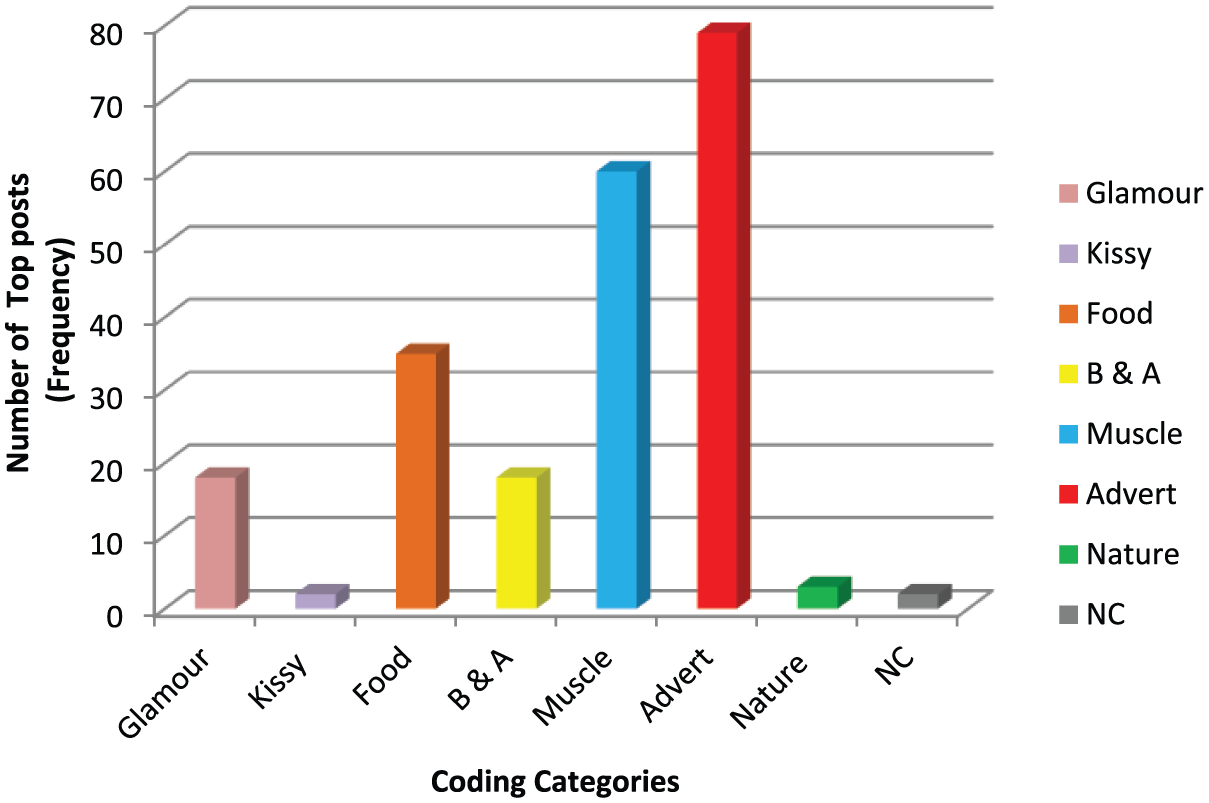
Number of top posts for #cleaneating and #eatclean hashtags.
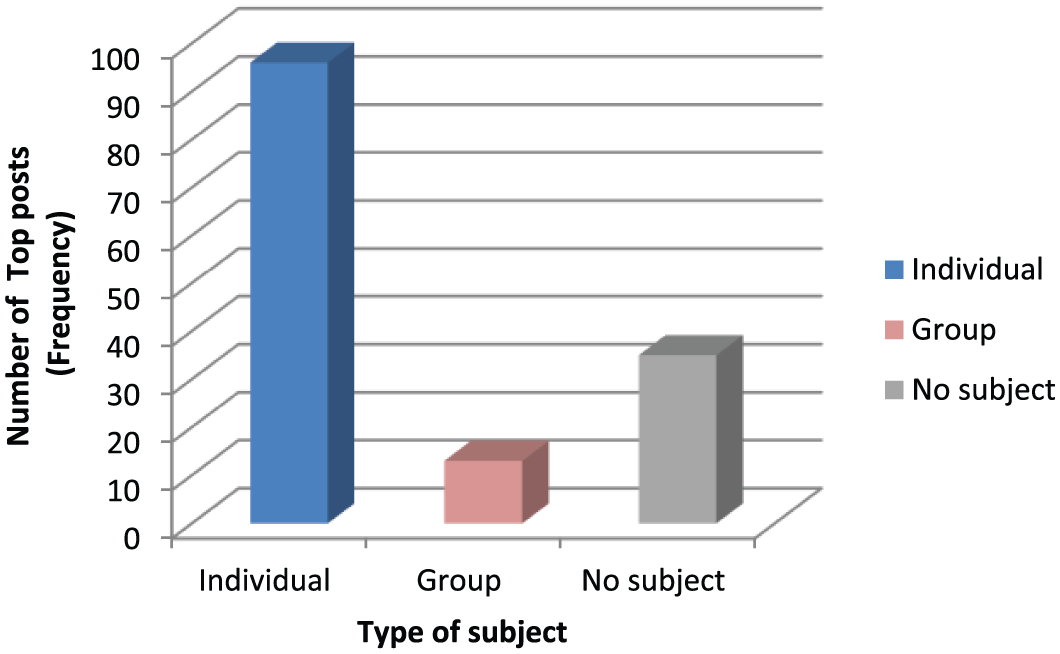
Number of subjects featured in clean eating posts.
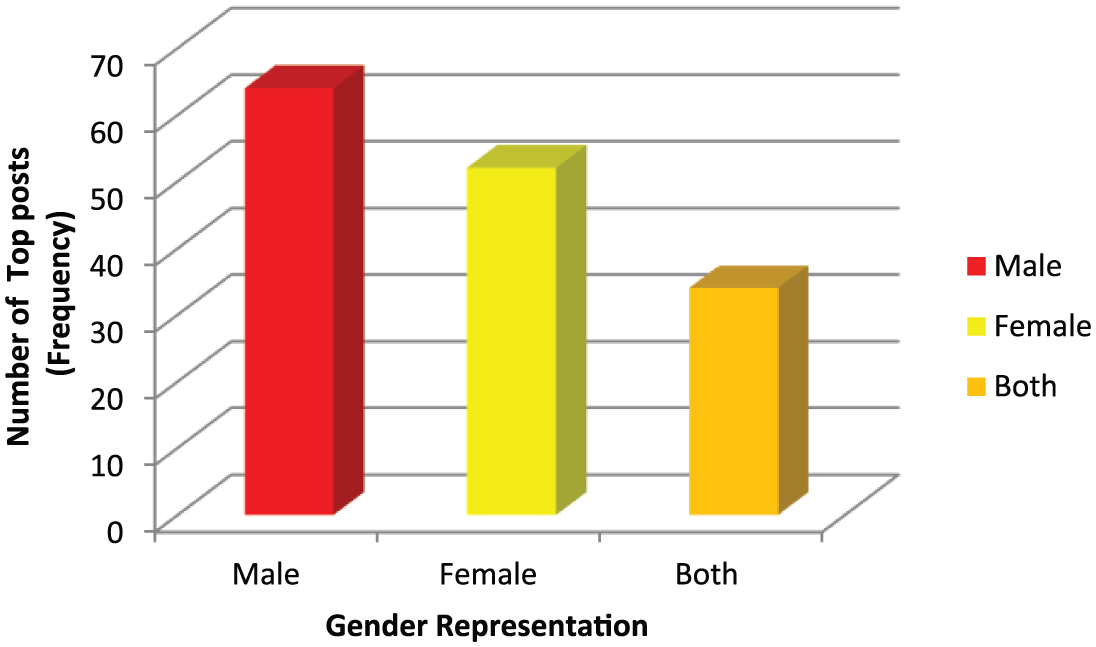
Gender subjects in clean eating posts.
Individualised conceptions of health and identity
It is striking that the majority of photographs aggregated under the hashtags #cleaneating and #eatclean did not include food. Rather, the emphasis was on the body and, more specifically, the effects of clean eating. Only 24% of posts were identified as food-related images. Instead, most photographs displayed the body to demonstrate the positive impact of clean eating. For example, 13% of posts were categorised as before and after shots. Posts of this kind typically took the form of a collage documenting the same person’s weight loss over time to signify their physical transformation. Images were regularly accompanied by metrics to quantify the user’s weight loss journey. In almost all instances, the user would present themselves as visibly healthier, happier and more attractive as a result of their lifestyle, making a connection between lifestyle, appearance and identity. By documenting a person’s journey over time, the before and after shot signified self-improvement and the benefits of adhering to a certain lifestyle. Such bifurcated imagery provides a stark example of Goffman’s concept of idealisation, whereby individuals offer those observing them an impression of themselves that is idealised. As Goffman (1959) suggests, ‘his performance will tend to incorporate and exemplify the official accredited values of the society, more so, in fact, than does his behaviour as a whole’ (p. 35). While such performances are embedded in static imagery, the presence of this type of image is designed to demonstrate stark transitions in physical form. The image ‘works’ because the ‘before shot’ is structurally situated concurrently with the ‘after shot’; idealisation occurs through the comparison that is exaggeratingly displayed (the more mundane and lacklustre the before shot, the starker contrast achieved by the after shot transformation).
Glamour shots, in which the subject was adorned in makeup and active wear to convey health and beauty, accounted for 13% of posts. The focal point of the glamour shot was the body, often exposed and highly sexualised (e.g. the subject gazing seductively at the camera and pouting their lips). Posts of this kind were mostly represented by women who displayed ‘emphasized femininity’, an idealised form of gender, emphasising heightened displays of femininity, oriented towards accommodating the desires of men (Connell and Messerschmidt, 2005: 848). While all clean eating posts include an element of performance, glamour shots appeared to be more overt in their staging (e.g. the subject emulating the poses and expressions typically found on magazine covers) compared to other categories, such as the muscle shot, which were generally presented as spontaneous and unrehearsed (e.g. the subject seemingly unaware of the camera) although most presumably involve a high degree of performance. These images are certainly not ‘candid’ photographs, in which subjects are ‘unaware that a camera is where it is, or that they are so deeply caught up in other vital matters that they either give no weight to the fact that they are being photographed’ (Goffman, 1979: 13). Rather, they are carefully staged and require considerable preparation for optimal execution. Glamour shots often doubled as fitness tutorials that instructed viewers about how to construct their gendered body. Easy to follow and accessible to the general public, these videos were used to promote the idea that health and happiness are about self-management. In almost all cases, the user was depicted alone, indicating a sense of free will and individual responsibility around dietary and lifestyle choices.
Muscle presentation, in which the subject was shown flexing their muscles to display strength and power, comprised 42% of clean eating top posts. Typically featuring men, posts of this kind served as prototypical visual representations of ‘hegemonic masculinity’, where physical strength, athleticism and competitiveness are valued over other masculine forms (Connell, 1987). While clean eating and meatless diets are ostensibly viewed as feminine practices, these diets were framed as a rational choice (both for the individual’s health and the environment), therefore upholding the traditional connection between reason and masculinity (Mycek, 2018). Often staged in a gym, posts of this kind focused on the individual subject, emphasising the hard work involved in training and ‘eating clean’. Muscle presentation was used not only as a synonym for masculine strength but as a sign of meritocratic achievement. Hashtags that accompanied these images regularly featured the words ‘determination’, ‘motivation’, and ‘healthy choices’, feeding into narratives about the importance of adopting a healthy lifestyle as a personal decision. The popular caption ‘no excuses’ gave credence to the belief that well-being was an individual choice and responsibility. In this regard, top posts pertaining to the clean eating movement can be seen to promote individualised conceptions of health that have come to characterise public health in many Western nations. With the majority of images (67%) featuring an individual, engaging alone in physical activity (compared to just 9% featuring two or more subjects), health was presented as an individual concern rather than a state or social responsibility. But while this shift towards self-management of health is presented as a lifestyle choice, particularly in the media (Lewis, 2006: 535), it would be limited to suggest that Instagram users are encouraged to display their gendered bodies in dynamic and unique ways. Health, like gender display, on Instagram is a staged performance, configured around social expectations and platform interfaces; the crucial concern here is whether such performances are ‘credited or discredited’ (Goffman, 1959: 253).
Lifestyle as community
Adopting a healthy diet on Instagram was depicted not only as an individual choice but as a means of collective membership into a community with other like-minded individuals. People used the platform to brand themselves as lifestyle icons and devotees. Continued reference to the hashtag ‘fitfam’ (‘fam’ slang for family) in the caption and comments section, for example, signified the idea of lifestyle as a communal activity. The term refers to a group of individuals who support one another in their fitness endeavours. Users of the ‘fitfam’ hashtag regularly addressed an imagined audience when posting on Instagram:
That moment when it all makes sense. Good morning fitfam GOOD MORNING fitfam. I want to wish everyone an awesome weekend, don’t forget to work out and let’s crush it fitfam.
In this context, the imagined other – whose presence was enabled by the use of a hashtag – was greeted reflexively as part of the user’s taste performance. Users drew upon a common vocabulary (e.g. hashtags ‘determination’, ‘motivation’, ‘no excuses’) to define their posts and, in turn, their identity. These textual references function as important signifiers, signifying a post’s meaning and that of the group. They suggest that clean eating is about more than the consumption of food; by following the lifestyle, you become part of a community.
While the conception of media consumers as communities is nothing new, social media emphasises users’ tendency to share knowledge and culture in online communities (Van Dijck, 2009). This is because social media is predicated on user-generated content and sharing. Sharing has become the default mode of Web 2.0 interfaces like Instagram. In digital contexts, however, the term ‘community’ appears to pertain more to groups with common cultural interests than those involved in a common cause (Van Dijck, 2009). 1 Groups with a communal preference in art, music or films are referred to as a ‘taste community’. The term is used to describe taste as an activity that binds individuals to a social group (Hennion, 2007) – as distinct from Liu’s (2007) notion of ‘taste performances’, which describes how cultural interests are listed on social media sites to express prestige and differentiation. When using a hashtag to enter a taste community on Instagram, the user is seeking cohesion rather than differentiation. Those using hashtags self-consciously seek to been seen by, and belong to, a community by presenting ‘those things that hold us together’ (Hennion, 2007). Taste, in this context, is not subtle and hidden, in the Bourdieusian sense; rather, taste is actively articulated by drawing on a common repertoire of visual styles and textual vocabularies identifiable to a taste community. In these instances, social networking sites function as public platforms in which taste performances can be staged before a taste community. What is novel about these online platforms is how we treat space. Hashtags enable users to reach a target audience and to connect with fellow users in their taste community. Free from the confines of time and space, the user can access taste communities via hashtags on the mobile sharing app at any time and from any space.
Goffman’s analytical framework can be applied to Instagram to understand how the aesthetic display and presentation of bodies are gendered. Goffman’s (1967: 3) approach was designed to understand situations. He emphasises the study not of individuals and their moments but rather of moments and their individuals: ‘it is the individual and their responsibility to the situation that has taken on a central role in the symbolic panoply’ (Ling, 2008: 62). Although clean eating posts present the individual displaying and subscribing to specific health and fitness ideals, these performative expressions connect to a larger social order – an identification with a taste community through a purposeful display and adoption of specific visual codes. Through individual images, we view the isolated individual performances of a healthy self. Yet, these images can be traced to wider notions of community, as the term ‘fitfam’ suggests. The connections between individual performances and group order parallel Goffman’s own approach to the study of ritual interaction and situations – not simply for the purpose of understanding performance strategies used during interactions, but how such properties of performance contribute to ‘maintaining the normative order of society’ (Collins, 1986: 107). Similar to Goffman’s exploration of embarrassment and other ritual interaction faux pas, these demonstrate that everyday life is not automatic but finely crafted interaction work that seeks to demonstrate individuals’ moral enterprises (Collins, 2004: 20).
Community as commodity
Social media has been characterised by discussions about the promise of Web 2.0 and the idea of participatory culture (Van Dijck, 2009). While Web 1.0 technologies were centrally conceived and focused on provider-driven content, Web 2.0 is more locally conceived and characterised by user-generated content. User-generated content is perceived to decentralise control from media providers and enable self-expression – an idea echoed by Instagram who state that on the platform ‘people now have more ways than ever to express themselves and feel closer to what matters to them’ (Instagram, 2017a). While scholars question the democratic potential of social media by pointing to the ways in which public identities are shaped through platform interfaces (Van Dijck, 2009), the platform provides the opportunity to explore whether social media permits more fluid and diverse gender identities than those identified by Goffman in the late-20th century.
Goffman’s (1979) categories in Gender Advertisements point to the ritualised subordination of women in advertising imagery. ‘Infantilisation’, for example, is used to highlight the infantilisation of grown women in advertising, blurring the lines between women and girls, womanhood and childhood: ‘In a word, there is a tendency for women to be pictured as more akin to their daughters (and to themselves in younger years) than is the case with men’ (Goffman, 1979: 38). Such imagery suggests that ‘[b]oys, as it were, have to push their way into manhood, and problematic effort is involved. Girls merely have to unfold’ (Goffman, 1979: 38). Following Goffman and Döring et al.’s (2016) investigations, we anticipated that clean eating top posts would continue to represent women exhibiting versions of ‘emphasized femininity’. As Döring et al. (2016) reveal, ‘Instagram selfies reproduce traditional gender stereotypes and do so even to a larger extent than magazine adverts’ (p. 961). Thus, one might expect to detect a continuity with respect to the visual representations of women’s ‘ritualisation of subordination’, ‘whereby women are visually framed in less important positions compared with men, and instances of ‘licensed withdrawal’, in which women are removed ‘psychologically from the social situation at large, leaving them unoriented’ (Goffman, 1979: 57).
Instead, we found that men were represented more frequently in clean eating top posts than women. For example, only 13% of posts were identified as glamour shots in which the subject was adorned in makeup and active wear to convey health and beauty. Even more striking, a mere 1% of posts were categorised as kissing pout, in which the subject (typically female) displayed a pouting expression to convey seduction. While kissing pout is a popular expression on social media (Döring et al., 2016), it rarely featured in the top posts examined. It is noteworthy that some women enacted what are perceived to be more traditionally masculine displays, such as muscle presentation, in their Instagram posts. However, while these images could be seen to support Hochschild’s (1990) and Wedel’s (1978) critique of Goffman’s conception of femininity as ‘archaic’ and ‘monolithic’, they remained statistically low (revealing conceptions of gender in flux, rather than transformed). For the most part, top posts conformed to conventional gender stereotypes, with men represented more frequently and subject to even greater forms of ‘hegemonic masculinity’ (Connell, 1987); 42% of posts were categorised as muscle presentation in which the (mostly male) subjects were shown flexing their muscles to display strength and power. The reason for this emphasis on masculine strength can be explained, in part, by the clean eating movement’s focus on the body, particularly physical displays of health. It is the idealised qualities of virile masculinity, constructed in relation to weaker feminine forms, that assumes symbolic significance (Schippers, 2007). While there are ‘multiple masculinities’ represented on Instagram (Connell, 1995), hegemonic masculinity maintains cultural authority over others, normatively requiring all other masculinities to position themselves in relation to it, by signifying achievement and desirability. Such exaggerated displays only reinforce the extent to which these images showcase gender and are choreographed, ‘in social situations in order to achieve their end, namely, the presentation of a scene that is meaningful, whose meanings can be read at a flash’ (Goffman, 1979: 27).
If these images echoed the style described in Gender Advertisements (Goffman, 1979), it is because they mostly comprised advertisements. The most prominent category coded for this study was advertisements, with 55% of clean eating top post ads for weight loss programmes, supplements and food products. While there was an absence of overt advertising on Instagram, over half of the images collected were used to promote health-related products and services. Ads often featured in the form of online tutorials and inspiring images accompanied by links to fitness programmes, cookbooks and health products. This was particularly the case with those images that focused on the body (e.g. glamour shots, before/after shots, muscle presentations), with attractive bodies doubling as advertisements by feeding the desires of the aspirational. For example, one muscle presentation post was accompanied by the caption ‘Make progress not excuses. Make a change today and let me take your physique to the next level’ – the image of a muscular man at the gym operating as an ad for a personal trainer. One reason for the significant representation of advertising in top posts is that Instagram has become a profitable enterprise. The platform is built around the power of the visual with bloggers using their image to influence others to purchase services and products. The proliferation of commercially driven material disguised as lifestyle advice is noteworthy. When analysing top posts collated under the clean eating hashtag, the hashtag was used as both a branded hashtag (to promote a business) and a community hashtag (to connect like-minded users around a specific topic of interest). It is this notion of community as commodity – enabled by the use of hashtags – that makes Instagram users ‘an attractive demographic to advertisers’ (Van Dijck, 2009: 47).
Conclusion
Instagram plays an important role in the interaction rituals that comprise everyday life. With social networking increasingly taking place online, Instagram has become a popular platform for self-presentation and public display. Instagram extends our ability to reach public audiences, through the use of hashtags providing the opportunity to enter and interact with taste communities comprising like-minded individuals. Just as mobile communication traditionally achieved ritual ties using voice-and text-based interaction (Ling, 2010), the photo and video sharing app achieves and augments the possibilities for ritual interaction through the use of mobile visual communication. Instagram not only opens up the possibility to interact with specific communities, it incentivises users to deploy hashtags as an ‘acknowledgement ritual’ (Pate, 2006) to achieve visibility, status and recognition from an affirming audience.
Instagram informs gender identities. The platform invites users to join the community by conforming to the ideals of healthism (privileging clean eating and fitness over other priorities) and the responsible self-management and monitoring of one’s health and body. These displays of health and gender are about more than the individual. Top posts collated under clean eating hashtags drew upon a limited repertoire of styles and images. The degree to which top posts imitated each other in style and form highlights the role of ritual in establishing and maintaining social cohesion. As Goffman (1967) contends, if societies are to exist, they ‘must mobilize their members as self-regulating participants in social encounters. One way of mobilizing the individual for this purpose is through ritual’ (p. 44). Despite the common assumption that social media allows for more fluid presentations of gender, top posts conformed to hegemonic conceptions of gender. In this regard, to achieve top post status required more than performance; it required users to adhere to the values and practices of the clean eating community.
The presentation of gender on Instagram is choreographed and commercialised to achieve specific readings of a situation and acceptance in a community. The data analysed in this article demonstrate how gender is performed on Instagram using an analytic framework conceived by Goffman, but which revises it in significant ways. The digital is built around attention and visibility. By publicly uploading images onto the platform, we put ourselves up for public display and judgement: through the use of hashtags self-consciously seeking the approval of our taste community. Conceived in this way, the presentation of self on Instagram is not merely about creative self-expression, but how the gendered display of health operates as a form of collective identity. Despite the potential for users to create content on social media, user-generated content does not automatically lead to more dynamic gender portrayals. Gender stereotypes were routinely observed and adopted on Instagram with those images that achieved the status of a top post imitated and reproduced by users. Impression management in this context transcends the individual with users adhering to the style and language of clean eating advertisements in their desire for acceptance and recognition from their taste community. Suffused with the logic and language of marketing and advertising, clean eating top posts blur the distinction between community and branded hashtags. This blurring of the boundary between advertising and communal relationships is encapsulated through the term, ‘community as commodity’. This notion of community as commodity, enabled by platform features such as top posts and hashtags, points to the ways in which identity is commodified on Instagram.
Footnotes
Funding
The author(s) received no financial support for the research, authorship and/or publication of this article.