



Abstract
The Panopticon is a popular metaphor in discussions about mass surveillance. Drawing on deterrence theory and chilling effects, we provide two empirical tests of this analogy to examine whether perceptions of online government surveillance suppress or entirely eradicate an array of sensitive online activities. Study 1 indicates that surveillance significantly deters individuals’ intentions to engage in illegal offenses, an effect that extends to political, but not privacy-protective behaviors. Study 2 retests the pervasiveness of this effect with a sample of Muslims who reside in the United States. Results indicate that restrictive chilling effects are not specific to any one online population, experimental stimuli, or political context. Implications for US political and social systems are discussed.
Privacy theorists often employ the Panopticon metaphor as a means to describe the US government’s online surveillance programs (Campbell and Carlson, 2002; Dinev et al., 2008; Greenwald, 2014; Kietzmann and Angell, 2010; Schneier, 2015). The Panopticon—a theoretical prison design in which inmates know they may be monitored but are unable to discern exactly when—is believed to function as the ultimate mechanism of social control, whereby individuals reform their behavior to adhere to expected norms under the threat of omnipresent surveillance (Foucault, 1977). Parallels to the government’s dragnet collection of online data clearly dovetail, but like the prison itself, remain purely hypothetical.
Seeking empirical evidence for the Panopticon analogy, we conducted two experiments that show perceptions of government surveillance do indeed suppress individuals’ behavioral intentions about sensitive online activities through deterrence and chilling effects. In keeping with the original intent of Panopticon, we first tested surveillance’s deterrence effect on individuals’ intentions to engage in illegal activity, such as downloading copyrighted music and movies, before extending our investigation to examine its chilling effect on normatively desirable political and protective behaviors, like engaging in online discussions about politics and securing one’s online identity. In a robust assessment of these effects, we retested our findings with a sample acutely affected by this issue, Muslims residing in the United States, to examine whether surveillance would not just chill, but freeze out minority political behavior altogether. Results point to a restrictive—but not absolute—chilling effect that persists across different online populations, experimental stimuli, and political contexts.
Online government surveillance
From the onset, one of the largest critiques of mass surveillance has been its lack of transparency (Lyon, 2015; Reddick et al., 2015). The government programs, which originated under the Patriot Act, were only made public after a top-secret document leak in 2013. Documents revealed collaboration between the US government and prominent internet companies that provided backdoor access to user photos, instant messages, search histories, and other data. Although a 2017 FISA case reformed part of this PRISM program (Savage, 2017), it remains notoriously indiscriminant, requiring only a marginally better than chance likelihood of correctly identifying surveillance targets (Lee, 2013). Other US efforts, in collaboration with the Five Eyes alliance, seek to continuously monitor every internet connection worldwide (Bamford, 2015). Data collected through such programs can be shared with other governments and an array of US federal agencies to prosecute charges unrelated to national security (Balko, 2016), and they remain unbound by independent oversight (Clarke et al., 2013).
The stated goal of this surveillance is to glean as much information about every user as possible, based on the untested premise that patterns of typical online behavior must be observed in order to identify suspicious or deviant individuals (Greenwald, 2014; McStay, 2017). Investigations of collected data reveal that the National Security Agency possesses far more data on ordinary internet users than it does on foreign targets (Gellman et al., 2014). While the government uses these surveillance powers primarily to monitor ordinary citizens’ internet activity (Krueger, 2005), these electronic surveillance tools are employed to a greater degree to suppress legitimate political dissent (Troyer, 2003) or monitor individuals simply because of their political beliefs, demographics, or affiliations (Donner, 1980; Solove, 2004).
These practices lack accountability, but they are far from invisible. The online environment is now flagged with markers of government surveillance, including news stories, website terms of agreement statements, and privacy reminders, such that an overwhelming majority of Americans (87%) report awareness of these efforts (Gao, 2015) but have little understanding of how their personal data and online activities are affected (Rainie, 2016). Thus, intentionally or otherwise, the US government has successfully implemented a sophisticated monitoring system that mimics a Panoptic design—resulting in continuous monitoring that is simultaneously visible and unverifiable to all that it surveils.
Bentham’s Panopticon
Jeremy Bentham’s original Panopticon was an octagonal prison design that encircled an inspection tower with individual cells constructed into its circumference. The cells were backlit such that anyone within the inspection tower could clearly watch all prisoners, but the shadowed tower was not visible to inmates. This architecture was intended to isolate individuals and instill a state of extreme duress in inmates who would consequently believe they were under constant surveillance, without knowing precisely when. “The major effect of the Panopticon was to induce in the inmate a state of conscious and permanent visibility that assures the automatic functioning of power” (Foucault, 1977: 201). The belief was that if the Panopticon could trigger such a mental state in the populace, disciplinary punishment would no longer be necessary (Brignall, 2002). This mental state is one of deterrence, wherein individuals continually assess the costs and benefits of legal and illegal activity and reform their behavior accordingly.
Even in its original conception, Bentham (1791) argued that the Panopticon could extend beyond prisons to control other sectors of society, including schools, the military, businesses, and even entire cities. By arguing that power under Panopticon is visible and unverifiable, it naturally became a dominant metaphor in the surveillance literature, prompted by Michel Foucault’s (1977) seminal work, Discipline and Punish, and in the decades since, has gained traction as it relates to digital technologies and online government surveillance (e.g. Brignall, 2002; Campbell and Carlson, 2002; Greenwald, 2014; Harcourt, 2015).
Foucault conceived that this Panoptic surveillance system would transform deviants into obedient individuals through “a whole set of techniques and institutions for measuring, supervising and correcting the abnormal … which, even today, are disposed around the abnormal individual, to brand him and to alter him” (Foucault, 1977: 199). Therefore, Foucault (1977) identified political deviants as the primary focus of government surveillance, who would react with either docility or political resistance. Docility, or deterrence, is theorized to occur when the surveillance system isolates individuals and prevents them from observing the surveillance, whereas political resistance is more likely when monitoring is mutual and individuals can communicate amongst themselves (Foucault, 1977).
Deterrence theory and chilling effects
The Panopticon’s power to reform behavior is theorized to operate through deterrence, a utility theory that has been used for centuries to explain why individuals forgo deviant acts. It rests on two central propositions—first, individuals are rational actors who seek to minimize costs while maximizing benefits, and second, individuals weight the certainty of detection as the most significant cost (Ariel et al., 2015). In other words, individuals are likely to engage in a restricted activity when it provides a tangible benefit and chances of detection are low. Evidence of surveillance—like the Panoptic tower or an online privacy warning—serve as visible reminders that detection is likely, which force individuals to update their cost–benefit considerations of engaging in a crime or indiscretion. Deterrence can manifest as either restrictive or absolute, by either mitigating the severity and frequency of a compromising behavior or eradicating it altogether (Gibbs, 1975).
In offline contexts, there is evidence to support that monitoring systems, like closed-circuit televisions, are effective at restrictive deterrence (e.g. Welsh and Farrington, 2009). For example, Ariel et al. (2015) showed that equipping police with body cameras decreased use of force by nearly half, and Forys et al. (2016) found that alerting citizens to video surveillance with visible signage led to significantly less trespassing on closed property. Both of these interventions produced desirable short-term behavior change.
However, less research has investigated whether surveillance can produce absolute deterrence or whether its effects extend into more anonymous, online environments where cybercrimes, like copyright infringement, gambling, and siphoning wifi, are pervasively committed by large proportions of users (Karaganis and Renkema, 2013). Ordinarily, both the costs (detection and sanctions are unlikely) and benefits (e.g. free access, watching a music video) of these offenses is relatively low, but new or updated information about digital surveillance has the potential to alter this calculation.
The Bayesian learning model specifies that each individual’s unique previous experiences contribute to a baseline probability of detection for criminal offenses (Matsueda et al., 2006). But these calculations are dynamic. As people encounter new information—like others’ consequences for similar behaviors or new practices and policies—they incorporate it into their cost–benefit assessments and update their probabilities accordingly (Anwar and Loughran, 2011). Thus, an individual’s decision is a combination of his or her past experiences and the acquisition of new information. As certainty of detection for an illegal or undesirable action becomes more likely, rational individuals are expected to reform their behavior—either in part or altogether—to reduce the risk of sanctions. We theorize that online news stories, terms of service, and other surveillance artifacts provide information that prompts individuals to adjust their probabilities of detection, such that it curtails high-incidence cybercrimes. H1: Perceptions of government surveillance will significantly deter individuals from engaging in illegal online activities.
While curbing illegal behavior is a commendable goal, Panoptic-like surveillance has been widely criticized for violating citizens’ universal rights to privacy (e.g. Bernal, 2016; Brown, 2015), and posing deleterious consequences for US democracy by deterring, or chilling, online information seeking (Penney, 2016, 2017) disclosures (Dinev et al., 2008), political discussions (Stoycheff, 2016a), tolerance (Stoycheff et al., 2017), and may even pose ramifications for offline behavior (Marder et al., 2016). Schauer (1978) has argued that such chilling effects occur when overextended and ill-defined policies deter individuals from exercising their constitutional rights; Schneier (2015) bluntly refers to it as government intimidation. Simply put, chilling is the deterrence of lawful behavior out of fear that it is suspect. And it, too, can manifest as restrictive or absolute. Information that informs individuals of continual monitoring may call into question the consequences associated with quotidian and even normatively desirable online behaviors, like those meant to engage the citizenry in politics.
A thriving democracy requires rigorous debate, access to information, and the free exchange of ideas, which have increasingly moved into online spaces (e.g. Shah et al., 2005; Valenzuela et al., 2012) where they are now vulnerable to government interception and indefinite preservation. Initial research has provided preliminary evidence that surveillance may trigger a political chilling effect (Penney, 2016, 2017; Stoycheff, 2016a), but to date, no study has empirically observed Panoptic behavior reform over time. We test the central premise of the Panopticon metaphor by theorizing that encounters with information about government surveillance prompts individuals to reassess the risks associated with sensitive online behaviors, altering their cost–benefit calculations in such a way that political activity is deterred. H2: Perceptions of government surveillance will significantly chill individuals’ political online activities.
Supporters of mass surveillance have tried to mitigate these costs by arguing that law-abiding Americans should have nothing to fear or hide from incidental data collection, likening the practice to surveying a “field of dots,” wherein “[i]f you are not communicating with [a] terrorist, your dot is not touched” (Thiessen, 2013). Under this view, individuals have no reason to try to evade detection. However, many protective steps touted as necessary to online security—masking identities, frequently changing passwords and removing cookies, virtual private network (VPN) use (Chen et al., 2016)—may be viewed as efforts to do just that. This contradiction is precisely the quandary that Schauer (1978) lastly argued might make individuals feel unintentionally suspect and susceptible to chilling effects. This leads us to hypothesize: H3: Perceptions of government surveillance will significantly chill individuals’ privacy-protective online activities.
Overview of the studies
To test these hypotheses, we conducted two repeated-measures experiments embedded in online questionnaires. The first was a longitudinal design that examined whether a news story about general and untargeted government surveillance may deter or chill individuals’ illegal, political, and privacy-protective internet activities. Given the political nature of H2, this study was conducted during the 2016 presidential primaries because US elections are one of the only times when much of the American citizenry engages in politics; these primaries, in particular, generated unusually high interest (Prior and Bougher, 2018). During election cycles, political participation tends to be highly individualistic because citizens are tasked with making an individual choice—their vote—as opposed to organization-led participation that dominates non-election periods (Miller et al., 1981). An examination of individual, rather than collective, political activities is important because surveillance is theorized to instill greater docility when individuals are isolated from one another and the surveillance apparatus (Foucault, 1977).
The restrictive, or partial, chilling effects that emerged from the first study inspired a retest of the political hypothesis (H2) to determine if there were circumstances in which political behavior may be eradicated altogether, enabling absolute Panoptic policing. To do so, we selected a sample of US Muslims—a population that has chronic experience with government monitoring, and likely to elevate their perceived level of risk. The post-9/11 War on Terror created a narrative that depicted this religious minority as political deviants (Khalid, 2011) who require heightened scrutiny. Both intelligence and law enforcement agencies have targeted US Muslims (Greenwald and Hussain, 2014) at disproportionate rates, making this a highly relevant population in which to examine the extremity of surveillance’s effects. Together, these studies provide tests of the restrictive and absolute nature of surveillance’s deterrence and chilling effects.
Study 1
Sample and procedures
To empirically investigate the within-subject and between-group differences of internet users under mass surveillance, a longitudinal online experiment was conducted via Amazon’s Mechanical Turk (MTurk). MTurk is a voluntary, online worker pool with limitations similar to student samples (Sprouse, 2011), but offers greater demographic diversity, such that it better reflects the US population at large (Berinsky et al., 2012). Previous research has shown that MTurk participants produce no significant differences in effect sizes from other samples in decision-making research (Goodman et al., 2013) and is optimal for longitudinal designs (Stoycheff, 2016b). For the purposes of this study, only US MTurk workers were eligible to participate.
On 1 February 2016, 232 MTurk workers volunteered to take part in the study’s first session, which consisted of an online questionnaire inquiring about individuals’ media use behaviors, political beliefs, online behavioral intentions for the following week, and demographic information. Upon completing the questionnaire, participants were asked to provide their email addresses for a follow-up session in 1 week. On 8 February 2016, participants were re-contacted to participate in the experiment’s second session and were randomly assigned to either a treatment condition or a control group. In the treatment condition, participants were exposed to a generic Associated Press news story about how online Terms of Service agreements include provisions that enable government surveillance of ordinary citizens’ activity; participants in the control condition encountered no such story. This stimuli was intended to mimic website Terms of Service statements and news stories that are naturally occurring heuristics in the online world that serve as visible artifacts of mass surveillance (see Appendix 1). A manipulation check confirmed that participants who encountered this Terms of Service statement were more likely to believe that the government violates their online privacy, t(154) = 3.78, p < .001, d = 0.61, and reported greater awareness of government monitoring when they use the internet, t(154) = 2.61, p = .01, d = 0.42.
After exposure to the Terms of Service statement, participants were presented with a series of distractor lifestyle questions (e.g. how often do you plan to visit the movie theater, gym, and dine at a restaurant) to prevent hypothesis guessing, interspersed with questions about their online behavioral intentions for the following week, which were identical to those asked in the previous session. Individuals also self-reported their approval of elected officials, their attitudes toward mass surveillance programs, and were debriefed. A total of 156 participants completed the study’s second session, amounting to a 67.2% response rate. The resulting sample largely mirrored the US general population and was 53.8% female, 45% college educated, with an average age of 38.17 (SD = 12.88). On 1–7 scales, participants self-reported a moderate level of political interest (M = 4.72, SD = 1.61), and, on average, leaned slightly politically left (M = 4.40, SD = 1.74). None of the participants in Study 1 identified as Muslim.
Measures
The focal independent variable of interest—perceptions of online government surveillance—was dichotomously measured by whether a participant was randomly assigned to the news story treatment group (N = 84) or a no-exposure control (N = 72). The primary dependent variables were individuals’ online behavioral intentions for the following week, asked identically in both the study sessions. Each item was measured on a 7-point scale and captured how likely participants were to engage in illegal online behaviors, political online behaviors, and privacy-protective online behaviors on a scale from “not at all likely” to “very likely.” Illegal online behaviors included unlawfully downloading/streaming movies, television shows, and online gambling (Time 1 M = 1.79, SD = 1.21, Cronbach’s α = 0.74; Time 2 M = 1.62, SD = 1.06); political online behaviors included sharing political opinions online, searching for information about conspiracy theories, criticizing the government or a government policy, and searching for information about the 2016 presidential candidates (Time 1 M = 3.05, SD = 1.20, Cronbach’s α = 0.63; Time 2 M = 3.28, SD = 1.29); and privacy-protective online behaviors were activities often touted as the basic means to secure one’s online identity (e.g. Chen et al., 2016), including deleting browser history and cookies, and changing passwords (Time 1 M = 4.06, SD = 1.73, Cronbach’s α = 0.79; Time 2 M = 4.14, SD = 1.63).
To ensure these online behavioral intention scales did indeed represent three unique constructs, we conducted a confirmatory factor analysis with Varimax rotation using SPSS AMOS 24 on the behavioral intention items from the first session. Hu and Bentler (1999) recommend using joint criteria to retain a model such as the comparative fit index (CFI) and the root mean square error of approximation (RMSEA), using the following cutoff points (Browne and Cudeck, 1993; MacCallum et al., 1996): values less than .05 indicate a good fit, values as high as .08 represent a reasonably good fit, values ranging from .08 to .10 indicate a mediocre fit, and those greater than .10 indicate a poor fit. The results of the measurement model indicate a satisfactory fit (χ2 (32, N = 232) = 65.176, p < .000, χ2/df = 2.037, CFI = .960, RMSEA = .066). These results, therefore, indicate that the measurement model is a reasonable explanation of the covariances in the data.
Results
To first ensure random assignment accounted for all meaningful differences between the experimental groups, consequently dismissing the need for covariates, chi-square and independent-samples t-tests were conducted and revealed no significant differences in the treatment and control conditions in terms of participants’ age t(154) = 0.79, p = n.s., sex X2(1, 156) = 0.01, p = n.s., level of education t(154) = 0.24, p = n.s., political interest t(154) = –0.62, p = n.s., or political ideology t(154) = 1.29, p = n.s.
To test the proposed hypotheses, a 2 × 2 mixed-model analysis of variance (ANOVA) with repeated measures was conducted on each dependent variable. The results show that perceived surveillance significantly interacted with time to deter participants’ likelihood to engage in illegal online behaviors, F(3, 156) = 4.23, p < .05, ηp2 = .026, lending support for H1. The mean difference in these types of activities was 0.23, meaning participants exposed to the surveillance information were significantly less likely to intend to engage in illegal online activities the following week, while participants in the no-exposure control experienced no change, as can be seen in Figure 1.
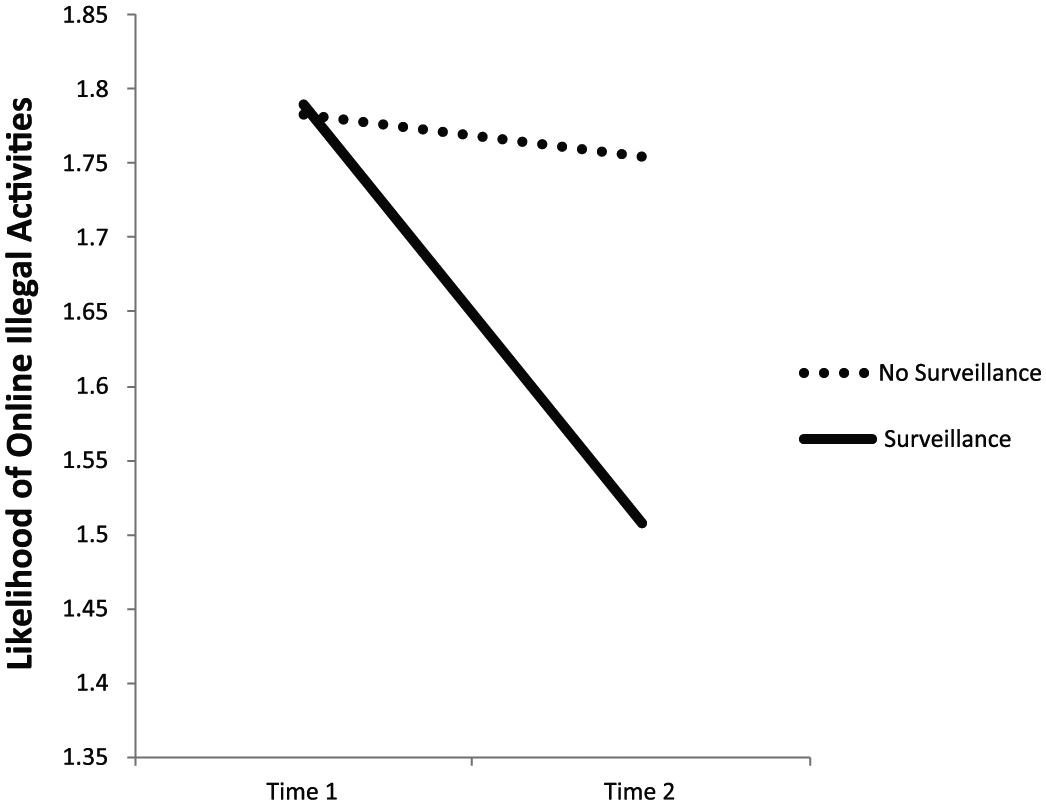
Perceived government surveillance on individuals’ likelihood to engage in online illegal activities over time.
Turning to H2, surveillance also chilled individuals’ willingness to engage in political online behaviors; however, the directionality was not as predicted. Participants in both the treatment and control conditions experienced a spike in expected online behaviors during the second study session, likely due to the intervening Super Tuesday primaries that occurred during this week, wherein a critical mass of 12 states held presidential primary elections. While both groups expressed greater likelihood of participating in online political activities the following week, the effect was significantly chilled among those who perceived they may be under government surveillance, meaning they may be still likely to seek out political information online, just not to the same extent F(3, 156) = 4.09, p < .05, ηp2 = .027, lending support for H2. This effect is illustrated in Figure 2.

Perceived government surveillance on individuals’ likelihood to engage in online political activities over time.
The final mixed ANOVA that predicted participants’ online privacy-protective behavioral intentions revealed no significant differences between groups over time, F(3, 156) = 0.47, p = n.s., ηp2 = .005. Individuals exposed to surveillance were no less likely than those in the control condition to intend to secure their online identities over the following week, leading us to accept the null for H3.
Study 2
Sample and procedures
Adults who identified as Muslim were recruited through local mosque listservs and closed social media pages to participate in a single-session online survey; participants were also encouraged to invite their friends and family who identified as Muslim to participate, resulting in a snowballed sample (N = 213), collected from December 2016 until early 2017. Participants were compensated with Amazon gift cards. This sample was 62.9% female, 70.6% college educated, and had an average age of 27.28 (SD = 8.58). Comparable to the sample in Study 1, on 1–7 scales, participants self-reported a moderate level of political interest (M = 4.97, SD = 1.66) and, on average, leaned slightly politically left (M = 4.61, SD = 1.32).
The study design was a single session with repeated measures. Individuals’ political online behaviors at both times were captured on 7-point scales ranging from “very unlikely” to “very likely.” This measure included sharing political opinions online, communicating about politics with friends and family who live abroad, criticizing the government or a government policy, and revealing to others that they are Muslim in online discussions, which can be an “othering” political identity (Green, 2015; Cronbach’s α = 0.72). Participants were first asked to report their likelihood of engaging in these activities during the following week, followed by a long series of personality trait measures and other distractor questions, which took approximately 10 minutes. Midway through the questionnaire, a randomly assigned subset (N = 106) was exposed to a Terms of Agreement statement that alerted participants that all data they personally provided in the remainder of the survey may be subject to government surveillance (see Appendix 2). The other half of participants received no such stimuli. This stimulus differed from that in Study 1 in that it connected government surveillance directly to the participant’s own online behavior. A manipulation check showed that those who encountered the surveillance stimulus were more likely to report feeling cautious about their online activities t(206) = 3.78, p < .001, d = 0.46, as the chilling effects theory predicts. Participants were again asked to assess their likelihood of participating in online political activities the following week, demographic information, and were debriefed.
Results
To retest H2, a mixed-model ANOVA with repeated measures was conducted on individuals’ online political behaviors. The results presented in Figure 3 again show that perceived surveillance significantly interacted with time to chill participants’ intentions to engage in online political activities, F(1, 206) = 3.87, p < .05, ηp2 = .018, but it did not eradicate them altogether. This lends further support that perceptions of government surveillance produce significant changes in one’s online behavioral intentions.

Perceived government surveillance on self-identified Muslims’ likelihood to engage in online political activities over time.
Discussion
While the US surveillance apparatus does not freeze out political activity entirely, it does indeed reform individuals’ online behavioral intentions, as others have cautioned (e.g. Brown, 2015; Greenwald, 2014), rendering the Panopticon metaphor an apt comparison. When individuals detect surveillance in their online environments, they exhibit restrictive deterrence, whereby they decrease the frequency with which they are willing to engage in illegal online activities, an effect that problematically transcends into the political sphere. Our findings illustrate a restrictive chilling effect among both US Muslim and broader US samples of internet users, prompted by two different types of stimuli. This work complements initial research on the chilling effect (Penney, 2016, 2017; Stoycheff, 2016a) and contributes to a growing body of evidence that mass surveillance is not as innocuous as its supporters purport (Thiessen, 2013). More importantly, this article also specifies the relationship between government internet surveillance and online behavioral intentions, which provides nuanced insight into the ongoing debate about whether surveillance powers adversely influence citizens (Lim, 2002; Lowi, 1975; Staples, 1997). While defenders of government surveillance often downplay the effect it has on ordinary citizens by alleging the infrequent use of these surveillance capabilities (Krueger, 2005), this study suggests that a government that suppresses minority actions severely undermines its ability to represent all citizens.
Limitations
The findings we provide in support of restrictive deterrence and chilling effects are a direct consequence of our methodological decision-making, and some limitations should be noted. The two studies conducted here offer parallel—but not truly replicative—support for the theorized effects. Results from both the studies rely on self-reported behavioral intentions rather than behavior logs, which may poorly correlate with actual use (Scharkow, 2016). Trends and records of user behavior, like those Penney (2016) employed, would be preferable and are necessary to further validate these results. In addition, questions about sensitive online behaviors—including those regarding explicit illegal activity—are susceptible to social desirability biases, a limitation that has been minimized with the use of a repeated measures design. Very low means of illegal activities in this sample underestimated projections of these practices by at least 20% (Karaganis and Renkema, 2013), which likely resulted in a floor effect. Therefore, logs that more accurately capture variance in user behavior may produce even stronger deterrence effects than our measures were able to detect. These results also capture an effect immediately after exposure, and the lasting consequences of prolonged monitoring have yet to be determined. Similar studies that employ CCTV and license plate surveillance suggest that deterrence dissipates over time if and when individuals perceive enforcement is unlikely (e.g. Koper et al., 2013), but it is unclear how this may translate to unknown threats to one’s legal online behavior, like political activity. Documenting any residual effects (or lack thereof) is an important next step.
Surveillance’s chilling effect did not extend to privacy-protective activities. This likely resulted from an operationalization that only included commonly practiced actions among the general population in order to maximize variance. However, it does correspond with Bradshaw (2017) who showed how media professionals, who are intimately aware of the consequences of government surveillance, have been slow to adopt digital protections. Other research has shown a significant spike in the use of more sophisticated privacy-protective measures, like Tor, immediately following the 2013 surveillance leak (Bodó, 2015), which suggests that perceptions of government monitoring may amplify, rather than chill, these types of behaviors. More research is necessary to better understand this relationship and determine whether other advanced protections, like VPN use and encryption, are affected, especially among populations that are more digitally literate (Park, 2013), or reside in authoritarian countries.
Implications
The Panopticon was intended to create an obedient populace that would acquiesce to authority. And the government’s mass surveillance apparatus appears to exercise this power. While it may be tempting to interpret our restricted deterrence findings with optimism, especially when one considers the prolific copyright infringement (Karaganis and Renkema, 2013) and incivility (Borah, 2014) that occur in online spaces, a system that has the ability to significantly reform behavior is also highly susceptible to abuse. In fact, Foucault (1977) argued that a rotating chain of command with ambiguous motives would make conformity even more pervasive, as it increases individuals’ uncertainty, noting that the system would produce identical effects under a tyrant and a democrat.
The lack of accountability and legal haziness that surrounds such programs has attracted many high-profile critics. Supreme Court Justice Sonia Sotomayor has argued that government surveillance may “alter the relationship between citizen and government in a way that is inimical to democratic society,” (United States v. Jones, 2012) and the President’s Review Group on Intelligence and Communication Technologies ominously warned that “if people are fearful that their conversations are being monitored, expressions of doubt about or opposition to current policies and leaders may be chilled, and the democratic process itself may be compromised” (Clarke et al., 2013).
The political chilling effects documented here justify the review committee’s alarm. Study 1 showed how government surveillance chilled online political participation intentions during the height of the US election season, one of the most critical junctures in American politics. Any measures that dissuade citizens from meaningfully engaging in the election process need to be viewed as an imminent threat to democracy and immediately reformed. Study 2’s chilling effects on Muslim political activities, including expected disclosures of their religious identities, are reason for further concern. Although surveillance did not freeze their expression altogether, like general internet users, it did suppress individuals’ intended participation. Studying this subpopulation is particularly important because government surveillance disproportionately isolates and targets these individuals, which heightens their vulnerability to adverse effects. This group constitutes one of the most prosecuted and politically vulnerable minorities in the United States, and the protection of minority views and rights is a centerpiece of healthy democratic governance.
The Panopticon, in its many iterations, is only one of many conceptual tools that can be used to explain the presence and effects of government surveillance (for a review of alternatives, see Galič et al., 2017). For example, Haggerty (2006) advocates abandoning the Panoptic metaphor in favor of a governance lens, which he argues provides a more balanced fit for surveillance’s power and advocacy functions. Deleuze (1992) alternatively proposes that surveillance studies must account for both corporate and government influences, a critique that has become even more salient in recent years. However, the Panopticon continues to dominate the surveillance literature and provides a useful jumping off point for connecting with other areas of empirical scholarship, including self-censorship, privacy management, spiral of silence, and theories of personal freedom and responsibility (e.g. Altman, 1975; Petronio, 2002; Taddicken, 2013). Similarly, the chilling effects literature has largely been confined to the legal domain, but as surveillance entrenches further into individuals’ digital lives, and the internet is increasingly used as a research platform, chilling effects may pose a new hurdle to understanding true attitudes and behavioral intentions. Thus, we encourage fellow New Media & Society scholars who survey and experiment in online spaces to consider whether similar chilling effects may shape their outcomes of interest as well.
There remain many unknowns about the US government’s mass surveillance, including how operations have expanded post-2013 and how future administrations will handle troves of citizen data. This uncertainty is key to its effectiveness. Disrupting such a power structure begins by shedding light on its operations and effects, such that individuals are no longer isolated and can mobilize in resistance (Foucault, 1977). This and complementary research (Penney, 2016, 2017; Stoycheff, 2016a) confirms that indiscriminate surveillance makes individuals less free. It alters the cost–benefit considerations associated with deviance and dissent, which in moderation are necessary for societal progress (Schneier, 2015). Communication researchers, journalists, and policymakers alike must continue to push for greater transparency to rein in government surveillance’s Panoptic power.
Footnotes
Appendix 1
Appendix 2
Acknowledgements
The authors are grateful to Annisa Rochadiat for her contribution with data collection.
Authors’ Note
Juan Liu is now affiliated with Columbus State University, USA and Kunto Wibowo is now affiliated with Universitas Padjadjaran, Indonesia.
Funding
The author(s) disclosed receipt of the following financial support for the research, authorship, and/or publication of this article: The authors received funding from a Wayne State University Research grant to conduct this research.