




Abstract
Digital communication has become ubiquitous to the non-profit sector, globally, and non-profit organizations (NPOs) have adopted multiple digital media channels and platforms in attempts to connect with and influence external stakeholders. This article examines how non-profits in New Zealand (NZ) are using metaphoric language around their deployment of digital media channels. Since its inception, digital information technology has been explained in terms of transport metaphors such as information superhighway and digital traffic. These metaphors have become largely invisible. A combination of empirical and interpretative analyses was deployed to examine the metaphorical framework at work in NPO discussions of their digital media engagements. The analysis uncovered rhetoric that valued movement over destination, de-emphasized the stakeholder perspective and narrowly restricted the power to contribute to organizational meaning.
Introduction
For non-profit organizations (NPOs), whose survival depends on engaging audiences and soliciting their participation, digital media platforms offer many enticements. NPOs have enthusiastically adopted multiple channels (Briones et al., 2010; Curtis et al., 2010; Paek et al., 2013; Schoenmaker, 2014; Waters et al., 2009; Wright and Hinson, 2013). However, the same factors motivating NPOs to adopt digital platforms – the time and money constraints affecting the non-profit sector globally (Briones et al., 2010; Levine and Zahradnik, 2012; Mueller et al., 2005) – problematize the use of those platforms. These constraints often limit consideration of the characteristics and strategic usefulness of individual channels, preventing close scrutiny of the supposed benefits of adopting multiple platforms (Briones et al., 2010; Gray et al., 2015; Wells, 2012). Assumptions around the desirability of increasing digital traffic need probing if NPOs are to maximize the benefits of message dissemination and move their audiences beyond mere clicks (Karpf, 2010).
Whether digital media use and platform proliferation has resulted in the desired responses on the part of NPOs’ publics is a question of undoubted urgency for NPOs, whose mission is only accomplishable if they secure responses from their audiences; answers would require a large-scale study of a range of NPOs, their stated goals and data on specific outcomes in relation to individual digital platforms. Underlying questions, less obvious but arguably more significant, will be the primary focus of this article. How have underlying conceptual frameworks shaped NPO understanding around the use of digital channels, and therefore influenced action? Has the rhetoric in play militated against organizations undertaking needed strategic communication development? And should this rhetorical framework not be critically considered before digital communication strategy can be appropriately addressed?
Given the small population of New Zealand, the non-profit sector in New Zealand is sizeable and dynamic. New Zealand has one NPO for every 170 people (McLeod, 2017). In 2013, the most recent figures available, these organizations contributed NZ$6 billion annually to the New Zealand economy, which, along with the contribution of volunteer labour, represents a total contribution of 4.4% of national GDP (StatisticsNZ, 2017). In 2017, a major analysis of New Zealand’s NFP sector reported that the percentage of philanthropic giving has remained flat since 2004, at approximately 15% of sector income, while the growth in total expenses during this time (6.0%) has surpassed the growth in revenue, resulting in ever-shrinking margins (McLeod, 2017: 5) and ever-increasing pressure on supporters and volunteers. The report also revealed steadily declining levels of individual donation activity since 2000. While acknowledging the diverse missions and goals of organizations, available data suggests the New Zealand non-profit sector, as a whole, faces increasingly urgent needs to mobilize stakeholders to donate, volunteer and otherwise support NPOs.
Building on Lovejoy and Saxton’s (2012) schema of non-profit communications either dispersing information, building community or spurring action, Guo and Saxton (2014) propose a three-stage model for social media advocacy communication that moves from reaching out to people, to ‘keeping the flame alive’ to ‘stepping up to action’(p. 70). However, both statistical measures and recent scholarship suggest that for NPOs, propelling stakeholders to take steps to action is increasingly difficult. Gillespie (2010) has suggested of twenty-first century information networks that connection has replaced destination in the metaphorical frameworks employed by policymakers and regulators. Gillespie’s contention suggests a launching point for an inquiry into the rhetorical and specifically metaphorical construction of digital information networks in different kinds of organizational discourses. This article trains a focus on digital communication metaphor use within the New Zealand non-profit sector, seeking to unpack the conceptual and practical implications of that usage in relation to the achievement of organizational goals. Metaphor analysis may unearth communication patterns of which the communicators themselves are unaware or only partially aware, and suggest factors contributing to a problematic dearth of stakeholder action. Arguably, the metaphorical underpinnings of NPO discourse may challenge the operationalizability of Guo and Saxton’s pyramid framework, possibly hampering stakeholder progress from one stage to the next. Given the fact that improving message effectiveness can mean the accomplishment or the withering of mission in the non-profit sector, understanding the implications of metaphor usage may be of great assistance for organizations.
Background to metaphor
Metaphors can shape what is understood and what is expected – both by those hearing/receiving the message and those producing the message. Often, this process of transferring and shaping meaning goes unnoticed and unquestioned. The English word metaphor, drawing from the Greek in which μεταϕορα means transportation, denotes ‘a figure of speech in which a word or phrase is applied to something to which it is not literally applicable’ (Concise Oxford Dictionary). Thus, meaning is applied or transported by a metaphor from the source domain to the target domain, in order to emphasize points of similarity, while also recognizing points of difference. Metaphors may operate well beyond an initial association, and evoke a wide range of related correspondences; this multifariousness of correspondence has been labelled discursive resonance (Black, 1993). Furthermore, a metaphor is polysemous, meaning it may yield multiple different meanings; for example, metaphor can also ‘move’ readers in an emotional sense, whether drawing/compelling them or repelling them.
In an organizational sense, metaphors are important because they help constitute not just perceptions, but behaviours. Conceptual Metaphor Theory (CMT), building on Lakoff and Johnson’s (1980) work, contends that the imaginative and metaphoric constructions that help humans understand our world underpin not just our language but also our thought and our action, providing frameworks that help shape what we recognize and how we learn (Ortony, 1993). Most studies of the role of metaphor in organizational communication acknowledge the germinal work of Morgan (1986), who argued that ‘all theories of organization and management are based on implicit images or metaphors that lead us to see, understand, and manage organizations in distinctive yet partial ways’ (Morgan, 2006: 4). Morgan also foregrounded the fact that when a particular metaphor or set of metaphors is given prominence, other features of an organization’s operations may become less visible. Effective readings of organizational metaphors may be generative, producing insights and catalyzing action, but may also be hegemonic: they may dictate conceptual frameworks, constrain opportunities or operate, as Gabriel et al. (2011) note, as vehicles of domination.
A wide range of studies have examined the possibilities for organizational development offered by metaphor, explicating its inspirational role – it can, for example, enhance communication and catalyze action (Jacobs and Heracleous, 2006), enable new ways of acting and thinking (Barrett and Cooperrider, 1990) and engage organizational actors with change (Broussine and Vince, 1996; Burke, 1992). Change management has been a particular focus for scholars arguing the potential advantages of metaphor deployment: Burke (1992), for example, suggests leaders can use metaphor to influence employees’ interpretations and thus shape attitudes.
In response to the claims about the operation of metaphor made in the literature of organizational analysis, scholars have attempted to impose an array of frameworks. Oswick and Grant (1996), for example, propose a hierarchy of metaphors, ranging from superficial to intermediate to meaningful. Inns (2002) has proposed ‘a preliminary taxonomy of the main uses of metaphor found in the literature of organizational analysis’ (308), noting that an analysis may combine several approaches (see Table 1).
Preliminary taxonomy of uses of metaphor in the literature of organizational analysis (Inns, 2002: 308).
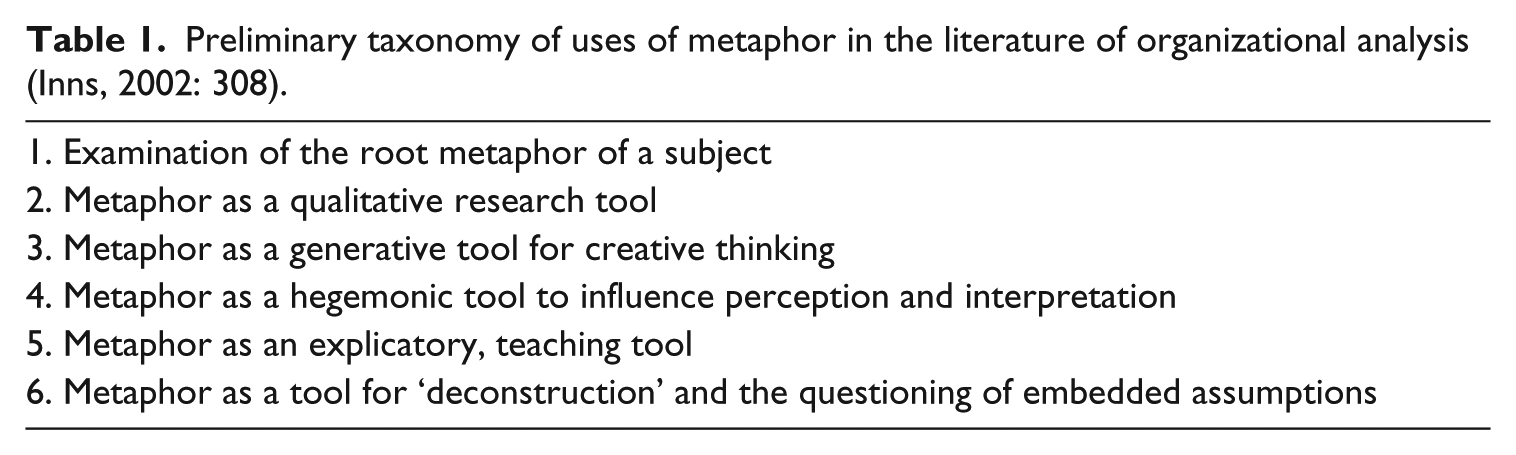
While Inns suggests metaphor may be used as a tool for the deconstruction of particular ideologies, metaphors themselves may need to be queried and deconstructed as a part of that project of challenging organizational assumptions. Even innovative new metaphors, if they are widely adopted and deployed for a period of time (e.g. ‘streaming video’), may become ‘discursive resting points’ (Bazerman, 1999, cited in Gillespie, 2010: 348), meaning that subsequent considerations will expect that the object described will continue to adhere to the characteristics of that metaphor. Bourdieu (1991) suggests such terms ‘sanction and sanctify a particular state of things, an established order’ (119), helping constitute both expectations and perceived reality. Morgan (1996) and Chia (1996) both encourage the kind of exploration via metaphor that would uncover the assumptions hidden behind supposedly common-sense viewpoints; Chia describes this as ‘a slow and stratified deconstructing of deeply entrenched and therefore “taken-for-granted” modes of ordering, concepts, categories and priorities’ (p. 131). This study, following Morgan and Chia, adopts an inductive approach, examining existing metaphors as a part of a project to inform the sector of the consequences of the language it deploys, suggesting how existing metaphorical patterns influence ways of thinking and seeing, and how they may circumscribe thought, hide tensions and contradictions, and shape action (or inaction). Thus the approach adopted in this article adopts and adapts the sixth of Inns’ terms, deploying metaphor as a tool for deconstruction and simultaneously seeking to deconstruct metaphors that themselves are deeply embedded in the organizational discourse of the non-profit sector.
Chia (1996) applies the term ‘metaphorization’ to this process of dismantling conventional wisdom (p. 129), to be undertaken ‘by directing attention onto the recursively implicated organizing logic that we consistently depend upon in generating categories of thought for the purpose of analytical comprehension’ (p. 130). The phrase ‘recursively implicated’ is particularly important, because metaphors help generate explanatory frameworks and they help dictate what is thinkable. In quite a real sense, they self-perpetuate. Thus metaphorization involves recognizing the ideological, not arbitrary or neutral, operation of metaphor, which privileges one understanding of reality over that of others (Chilton, 1996; Smith and Eisenberg, 1987). Deconstructive metaphorization, then, is a deeply challenging process that queries the often obscure operations of power.
The ideological operations of metaphor outlined above sound very definitive and intentional. But it is important to draw attention to the degree to which metaphor may escape intentionality. Like Inns (2002) and Chia (1996), I recognize the elusive as well as the allusive power of metaphor. Metaphors are certainly political and interested, but they are also multivalent, presenting an interpretative flexibility that may escape their producers’ control (Reissner et al., 2011). While readers (or organizational employees) may ‘unpack’ a text in multiple ways, this article aims to illuminate the ways in which metaphors may shape the understanding and limit the expectations of even the deployers of a given metaphor. When analysed, these metaphors may reveal uninterrogated assumptions about the wielding of power and legitimacy in organizational meaning-making.
Transport, traffic and digital media
The etymological connection of metaphor and transport with which this article began explicitly connects the suggestiveness of metaphor analysis to the discourse of digital media. Like the broader discourse of information technology (IT), digital media discourse is grounded in a root metaphor that connects the relaying of information to transport (which is also linked to the root metaphor of technology as progress.) The suggestive power of metaphor analysis specifically for IT discourse was noted by Morgan (1996) more than 20 years ago: Metaphor opens the way to new modes of theorizing and new modes of understanding that are ideally suited to the flux and change of an electronic world. […] In metaphor we find an organic, self-organizing concept that’s ideally suited for exploring the nature of an organic, self-organizing world. (p. 234)
By connecting a known source domain to an unfamiliar target domain, metaphors draw on available cultural vocabulary to familiarize something entirely foreign, helping people understand challenging new phenomena. ‘Metaphors generate categories, organize processes, and establish oppositions and hierarchies’ (Scolari, 2012: 206). Thus, dubbing the Internet an ‘information superhighway’, per the New York Times in October 1993, helped readers conceptualize the basic function of this new and mysterious technology, ‘which will link everyone at home or office with everything else’ (NYTimes 26 Oct 1993: C9/1; quoted in the OED). Having envisioned such a superhighway,1 a natural corollary was to imagine communications moving along like traffic from sender (point of origin) to recipient (destination). Microsoft asked its customers ‘where do you want to go today?’, and Internet traffic swiftly entered the cultural lexicon. Interestingly, the first OED definition of traffic is ‘the transportation of merchandise for the purpose of trade; hence, trade between distant or distinct communities; commerce’. Profit-orientation is rendered explicit in the OED’s second definition of traffic: ‘The buying and selling or exchange of goods for profit; bargaining; trade’. Also notable is the two-way interaction embedded in this mercantile sense of traffic.
Beginning in the nineteenth century, traffic began to be used in a significantly different sense: ‘The passing to and fro of persons, or of vehicles or vessels, along a road, railway, canal, or other route of transport … and the vehicles, etc, collectively’. Traffic thus began to be divorced from points of issuance and arrival and from the essentially linear rhetoric that is still embodied in the term ‘journey’, and to be used to designate the vehicles themselves. The OED records the earliest use of traffic in specific relation to telecommunications (‘the messages, signals, etc, transmitted through a communication system; the flow or volume of such business’) as occurring in 1878. This telecommunications valence is now ubiquitous, but the layers of meaning embedded in traffic – that is, its links to profit-seeking enterprise, its assumption of two participating parties – remain, and on each use of the term are, arguably, freshly contestable. Usage of the traffic metaphor unavoidably foregrounds questions of agency and transitivity: who – or what – is moving whom – or what? And the superhighway metaphor foregrounds, as Lyman (2004) has argued, inescapably economically based questions of policy, power and inequality.
A number of provocative studies of metaphor in relation to information technology and/or new media point out the political and specifically regulatory functions that have been undertaken by metaphorical constructions (see, for example, Gillespie, 2010; Horwitz, 1989; Lyman, 2004; Nafus, 2003). Lyman (2004) pays particular attention to the economic and political implications of the metaphor ‘information superhighway’, arguing that if the Internet is defined as a transportation technology, information must be viewed as property, and explaining persuasively that this metaphor protects the property rights of large industrial corporations. Gillespie (2010), in a discussion of the strategic use of the term ‘platform’ by content providers, writes ‘in the age of the “network” … an emphasis on total connectivity has supplanted direction as the key spatial emphasis’ in policy-focused discussions of information networks (p. 357). Gillespie suggests that a de-emphasis of directionality in the discourse has helped content providers limit their liability for facilitating users’ expression, and has also helped delimit regulatory frameworks.
The root relaying information as transport metaphor in NPO digital communication discourse has what Black (1993) has labelled ‘resonance’, in so far as the metaphor may be unpacked to reveal layers of implications or entailments (Koch and Deetz, 1981). The resonance of the metaphor underpins its widespread use and perceived utility but may occlude its limiting power. In this study of the operation of metaphors of transport and direction within digital communication discourse in the particular context of the New Zealand non-profit sector, research questions include: RQ1 – How are metaphorical constructs being used by NPO communication personnel to understand the role of digital communications, and the relationship between the organization and its external stakeholders? RQ2 – How might better understanding of this conceptual metaphor framework assist NPOs in the creation of communication strategy? RQ3 – What are the implications for both practice and theory arising from this usage?
Method
Data collection
The data for this study were derived from 83 semi-structured interviews, undertaken between mid-2014 and January 2016. NPOs interviewed represented all the major sub-sectors: Culture, sport and recreation; Education and research; Health; Social Services; Environment; Development and Housing; Law, advocacy and politics; Grantmaking and fundraising; International; Religion; and Business/professional associations. Interviews were generally conducted with individuals listed on the organizations’ websites as the contact for communications (occasionally the interviewer was referred to another representative for the interview). The titles and job descriptions of these individuals varied widely, and included Communications Officers, Heads of Public Relations, and also CEOs. This variety should be understood in the particular context of the New Zealand non-profit sector: New Zealand has a very high number of small NPOs (McLeod, 2017: 9), meaning many NPOs have tiny budgets and a small number of staff who frequently fill a number of roles. In fact, up to 90% of NPOs in New Zealand rely solely on volunteers and do not employ any paid staff (StatisticsNZ).
The average interview length was 25 minutes, similar to the 23-minute average in the study undertaken by Briones et al. (2010). Interviews contained a combination of closed and open questions about the organizations’ present and ongoing efforts at communication with external stakeholders, and their length varied depending on the interviewees’ fullness of response to the 12 open questions. Questions were posed about the range of digital communication channels being used, the key goals/purposes for communicating with external stakeholders via particular channels, the feedback that had been received from the communications’ target audiences and the existence of an organizational communication strategy. The interview inquired specifically into the perceived relationship between different digital communication platforms. Questions were phrased neutrally, and follow-up questions replicated as much as possible the interviewees’ own language, in order not to intrude other metaphors and not to alter the interviewees’ own operating metaphors (Koch and Deetz, 1981).
All interviews were recorded and transcribed verbatim by research assistants. The interview transcripts yielded almost 209,000 words of text.
Data analysis
Close reading
To identify instances of interviewee phrases and words linked to the root metaphor of relaying information as transport, initial close readings of a random sample of 10 interview texts were undertaken by the researchers: these words included arrive, carry, connect, drive, journey, path, road, route, send, traffic and vehicle. Following an open coding process, this initial reading sought not to apply predetermined categories but rather to identify as fully as possible the metaphorical terms that emerged from the corpus. It is important to note that terms of key interest were identified by the researchers prior to analysis using the WordSmith software: a particular affordance of WordSmith is its ability to identify high-frequency ‘keywords’ within a corpus and compare that frequency with that occurring in a reference corpus, to identify significant disparities (see, for example, Bory et al., 2016). ‘Keywords’ were not identified or used in that way in this study, as terms related to the root metaphor of relaying information as transport were determined as the point of focus at the study’s conceptualization stage; their frequency in the discourse is less important than the way they are functioning in the discourse.
WordSmith analysis
Subsequent to the initial reading, WordSmith 7 software (Scott, 2016) was used to analyse the corpus. WordSmith enables analysts to ‘identify syntactical features of texts which can then be semantically interpreted’ (Stubbs, 1994: 218). Word frequency, cluster frequency and concordances were assessed to identify the presence and particular deployment of a range of words and phrases related to the root transport metaphor. WordSmith software allows ‘the central ideas or emphasis words [to] be extracted empirically rather than personally or experientially, removing some of the subjectivity that human judgement entails’ (Touri and Koteyko, 2015: 605).
First, a simple wordlist was generated enumerating the instances of each word used in the whole corpus (almost 5500 individual words). This wordlist reported the frequency within the corpus of each of the key root-metaphor-related terms that had been identified in the initial close reading stage, but in addition the full wordlist was closely examined to identify further key transport-related terms that had not emerged from the close reading stage.
Next, a concordance was created for each key term from the expanded list, to read each in context. These concordances helped the researchers identify where each term was being used in a purely denotative sense rather than a metaphoric sense (‘road’ and ‘engine’ being two cases in point), and eliminate literal usages from consideration. Also eliminated at this stage were instances in which the term had appeared in the question rather than in the interviewee’s answer. Finally, word clusters were examined to illuminate the range of different ways in which individual speakers had used key metaphorical terms. Examining word clusters helped identify the most common groupings of words: for example, while ‘traffic’ was obviously a key word, examining word clusters identified the frequency with which ‘traffic’ was considered in connection with sender or target (e.g. ‘stakeholder traffic’), with a specific vehicle (‘twitter traffic’) or with a specified direction (e.g. ‘traffic to the website’).
Metaphor analysis
Finally, interpretive metaphor analysis was undertaken, moving beyond purely quantitative counting of instances of usage to interpret interviewees’ ways of using these metaphors. The researchers closely examined metaphor usage to analyse interviewees’ constructions of understanding and action, with a particular focus on how the metaphors figured conceptions of agency, and revealed possible sites of contestation. The analysis that follows recruits a number of specific textual extracts and analyses of particular terms in order to draw out connotations and implications for the whole corpus. The necessarily subjective position of the researchers in the interpretative undertaking, both at the concordance analysis and metaphor analysis stages, must be acknowledged. As Baker (2006) points out, ‘a concordance analysis is as good as its analysts’ (p. 89), because researchers identify and explain linguistic patterns according to their own unavoidably interested frameworks. However, human interpretation via metaphor analysis enables the identification and probing of cultural, generic and other contextual factors that computer-based analyses are unable to perform, as Touri and Koteyko (2015: 604) note. Thus, a combination of analysis of empirical indicators with contextualized and contextualizing metaphor analysis both recognizes and illuminates the complexity and multivalence of the (linguistic, cultural, ideological) processes producing meaning in any discourse. The combination of the two approaches enables a reflexive process that can produce systematic and rich analysis.
Results
In addition to analysing the transport metaphors that appear in the corpus, and their particular entailments, this section will identify certain entailments of the transport metaphor which may have been elided or ignored within New Zealand non-profit sector discourse. All organizations have been anonymized in the following discussion.
All 83 organizations were asked to identify the primary purposes for which they employ digital channels (NB: organizations report using varying numbers of platforms, from one to eight). While all 83 agreed with that ‘communicating with supporters’ is a primary purpose of their digital messaging, 62.65% stated fundraising is a primary purpose (n = 52), 44.58% stated recruiting volunteers (n = 37), 49.40% stated advocacy (n = 41) and 72.29% stated growing reputation/credibility is a primary purpose (n = 60).
The noun ‘traffic’ appears frequently in interviewee statements about purposes and goals. Once questions were excluded, 31 instances of the term ‘traffic’ appeared in the corpus, from 24 different organizations’ interviews (29% of the total number of interviews). ‘Traffic’ is used almost without exception in positive or aspirational formulations, as something organizations wish to maximize. For example: sometimes we’ll have blog posts that we’ll put through on social media and it’ll get a little bit of traffic back to the blog, but if we put the blog link in the e-newsletter, we’ll get a lot more traffic to it. (Org54)
Sometimes, communicative traffic is conceptualized as organically occurring, sometimes as being actively produced by the organization. On occasion, however, the deliberative agency of the organization is called into question by the particular deployment of the term ‘traffic’: ‘Facebook is the main link. We do a bit of traffic on Twitter, but Facebook is going quite well’ (Org58). ‘We do a bit of traffic’, claims the organization, with an imprecision of verb that calls into question both the ultimate aim of this traffic, and the organization’s decisive power. Another instance of the metaphor illuminates a similar organizational uncertainty: All my links feed through to the website. Traffic must go there because it tells the wider story – that’s where the business is done, that’s where you convert people. … Once they’re there, I don’t know what they do. I would like to know how many of them stay there, or just drop off. (Org33; emphasis added)
Only one of 31 deployments of ‘traffic’ engages with another, potentially negative valence of the metaphor: when asked what makes an e-newsletter effective, one interviewee muses: ‘That’s getting harder and harder, because everyone gets so much email traffic’ (Org82). Potential traffic jams are conjured as a negative facet of the metaphor, recognizing the potentially stultifying nature of the multiple tasks and demands embedded in email communication. This concession, however, is unique in the corpus – in all other figurings, ‘traffic’ is an entirely good thing, to be maximized.
Usage of other nouns related to the root transport metaphor, including ‘road’, ‘route’ and ‘journey’, was carefully scanned. ‘Highway’, intriguingly, is missing entirely from the corpus. Only two instances of ‘road’ or ‘roads’ appear in the corpus, and only one is relevant to the transport metaphor: In my head, all roads lead to the website. […] I see all of that whole social media thing as kind of multi-dimensional. Twitter is the minimum kind of casting a net of intrigue; people who are a little bit more interested would perhaps go to your Facebook page … We actually really want to direct people to the website and that’s where all the information is. (Org51)
Notable in this figuration is the desired interconnection of multiple communication channels; it is desirable that all stakeholders be mobilized, via differing ‘roads’ or channels, to arrive at the one ultimate channel, the website.
While ‘traffic’ is the most frequently used transport-metaphor-related noun, ‘drive’ is the most frequently used transport-metaphor-related verb. ‘Drive’ appears 19 times in the corpus (in 13 different interview texts), along with a number of variants (see Table 2). These variants were lemmatized and assessed in concordance as a group (48 total).
Extract from wordlist: Drive – driving.
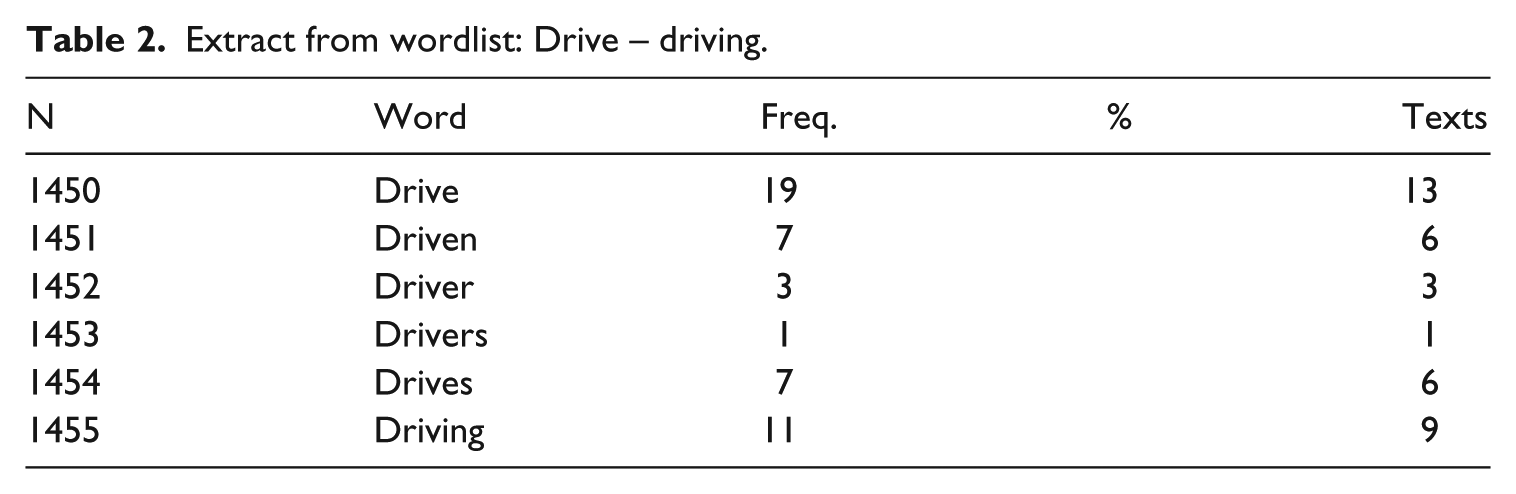
Of the 48 total instances, ‘drive’ variants are used by interviewees as part of a recognizable transport metaphor in 24 instances. The three most frequent collocations are ‘driv* people’, ‘driv* traffic’ and ‘driv* website’. The most frequent cluster associated with ‘driv*’ (16 instances) is ‘to the website’, illustrating the primary destination to which NPOs aim to direct their stakeholders. Representative examples include: All our e-news drives traffic to either our website or our social media … we embed some content on our website and then we drive people to it (Org46). one of our main purposes for having our e-newsletter is to drive traffic to our website and we are hoping that when people are within the website they will start to move around, having a look … its very much whenever we send out our e-newsletter that our website traffic peaks. (Org49) Depending on what sort of outcome you’re looking for, the e-newsletter will usually drive people somewhere and usually that’s to the website to either donate or read a new article or blog post or take an action of some sort. (Org79; emphasis added)
As observed above with regard to ‘traffic’, the ultimate destination for ‘driven’ readers is often under examined: ‘[e-newsletters] drive the subscriptions and drive things to our website, and people tend to go from there’ (Org52; emphasis added). Precisely where visitors tend to go ‘from there’, or to do precisely what, remains in many cases unspecified. In the rare instances in which a specific goal is mentioned, it is usually articulated as a financial target, a numerical figure divorced from human activity and agency, as partially recognized in the quote below: We have a target specifically for the amount of money that comes through on the website and in order to make sure that we drive people to the website we send an email […] about three or four a month. … So [email] has become a pretty crucial part of a few of our different campaigns in terms of fundraising but I don’t think I could give you an accurate idea of how it’s actually affected visit numbers unfortunately. (Org22; emphasis added)
What visitors are ultimately doing, how many of them are doing it, is literally not counted here. At a technical level, the organization in question may simply not be utilizing web analytics, but at a broader, conceptual level, metaphors of ‘drive’ and ‘traffic’ are being used almost exclusively in relation to conveyance and conveyances, to the near-complete elision of the people being conveyed, their volition and their ultimate action. In a grammatical sense, transitivity is essential to ‘traffic’ metaphors: ‘traffic’ as a verb requires a direct object to complete its sense, as something (or someone) must be trafficked; ‘traffic’ as a noun similarly implies a direct object, as something is being moved somewhere. However, transitivity in this NPO discourse is regularly and strikingly elided: transport metaphors frequently direct focus not to the information or the people that are being moved, or the people doing the moving, but solely to the movement itself: ‘we do a bit of traffic’. By extension, the motivation for the movement is rendered invisible.
‘Invisible’ metaphors
Examination of key transport-related metaphors in context revealed an unanticipated absence: consideration and figurations of endpoints proved largely missing from the rhetoric of transport. To further investigate this, a second scan of the wordlist was undertaken to examine the frequency of terms including destination, arrive/arrival, end and goal.
‘Destination’ does not appear in the corpus at all. ‘Arrive’ and ‘arrives’ appear altogether 10 times in the corpus (‘arrival’ never), but of the 5 instances in which ‘arrive/s’ is used in a sense connected with communication, each instance solely refers to organizational communications arriving at a recipient or reader. The term is never used in the sense of the recipient arriving at an understanding or some other endpoint; at no point is the recipient’s agency or intellect figured as engaged.
While the corpus contains 85 instances of ‘end’, only three are connected (by two interviewees) to the sense of ‘end-goal’, and both interviewees use notably tentative expressions: ‘What I’ve learnt over the years is that you’ve got to be conscious of what was the end game, what was the end result [of communication efforts]?’ (Org18); ‘I think, whether the end result of actually getting donations through for the fundraising messages … I think we can always improve on that’ (Org22: elision in original).
‘Goal’ and ‘goals’ appear in the corpus 15 and 12 times, respectively, in a total of 19 interviews. After excluding irrelevant and literal usages, and usages that appeared in questions, 19 instances are relevant for this metaphor analysis, as for example: ‘generating conversions and sales is probably a huge one for us … we really need to boost up our conversion rate. So that’s a huge goal that I have’ (Org77). In one interesting locution – ‘movement to the website is an additional goal’ (Org33) – movement itself is figured, not as the means to an end, but as the end in itself. In some cases, a ‘goal’ is articulated that seems to embody a kind of communicative circularity: They all do have the same goal. We do try – the newsletter goes on to Facebook. Somebody else does our Facebook and Twitter feed. Sometimes I look on to see if there’s something I should echo – perhaps I could do that a bit more. There may be people reading the newsletter and Facebook. … I try to cover that possibility by not just repeating what’s on our Facebook feed but by doing different stuff. Everything that goes out on Facebook also goes out on Twitter. We also have a written newsletter and I do refer to that quite a bit in our e-newsletter. We like to remind people that it’s there. If you’re a financial supporter of [organization], then you get a copy of that. By talking about it, I’m directly encouraging people to get the written newsletter. I’m not sure if that works, but it all helps. (Org29)
In this quite complex rendition of a web of communications, the interviewee simultaneously advocates and seeks to avoid replicating material, and promotes sending stakeholders from one channel to another. This self-perpetuating and self-enclosed loop seems almost antithetical to the idea of an ultimate, realizable intention.
Finally, interviewees offer several quite startling admissions of a lack of both overarching strategy and specific communicative goals: Currently, we’re trying to set better objectives around [digital communication strategy]. At the moment, we’re sort of actually reassessing and stepping back, so we will hopefully be meeting expectations in a few months because we will actually have clear goals and objectives. (Org9) I think what we need to do is formalize some goals that we can set and then look at some plans around measuring the effectiveness of those goals and the value that we’re getting from sending the newsletter. So in terms of monitoring from a set of clear objectives and goals … I don’t think we’ve done that yet, so I can’t really say if the expectations have been met. (Org81)
Both the above extracts reveal a keen awareness that endpoints for the multifarious communicative traffic are unarticulated, even non-existent.
When questioned about the existence of an organizational digital communication strategy, only 5% of respondents knew of an extant, articulated strategy (n = 4). Org69 describes the construction of its different messages and platforms as ‘quite ad-hoc, I wouldn’t say it has an overall strategy at all’. The absence of overarching communication strategy is often connected by interviewees to uncertainty around both the setting and the accomplishment of specific communicative goals, beyond that of generally increasing digital ‘traffic’ and/or platforms: [a set of expectations for digital messaging] was never voiced. The decision was made that, this is what we should do, and that’s what we proceeded to do. … We didn’t ever set any goals and … we haven’t really evaluated it (Org20). It’s hard to say – yes and no. We keep our regular communication going on this end, but how much of it is read and how much of it is actioned by the volunteer … that’s something we’d need to measure, at some point … .(Org24: emphasis added)
As with Org 81 above, absence of analytics is implicated. It is important to note that the diversity of the sector means a diversity of goals and that many NPOs do not, for example, actively solicit funds or volunteers. They might have a solely informational mission, a primarily advocacy focus or may receive funding from government agencies, meaning they do not or cannot solicit donations from their membership. For organizations like Org4, which describes its mission as ‘purely information-sharing’, moving a stakeholder from one source of information to another would not be perceived as impact-less, but rather as successful. In a related vein, Org21 reflects on longer-term goal actualization, suggesting a worthwhile outcome of its various digital communications is ‘more awareness about the ways to donate’ – even if actual donation activity is not (immediately) provoked. However, the majority of interviewees indicated both the desire for specific action goals from their digital communications and a sense of uncertainty as to whether those goals were being met, other than the goal of increasing ‘traffic’. The potential impact of increasing ‘traffic’ on the accomplishment of other goals will be discussed in the next section.
Discussion
The findings from this analysis of NPO stakeholder digital communication have a number of practical and conceptual implications for organizations, and additionally make a contribution to theory. Despite the widespread use and usefulness of transport metaphors, Benjamin Franklin’s adage that motion should not be confused with action is particularly applicable in the context of the non-profit sector, in which the articulation of communicative goals and key performance indicators (KPIs) is already complexly inflected. Close analysis of transport metaphors within the discourse of New Zealand’s NPO digital communication reveals a number of assumptions around how communicators see their organization’s goals and their audience. Producing and increasing digital ‘traffic’, for example, is figured in the corpus as almost exclusively positive and desirable, with virtually no consideration of its potentially negative aspects. The goal of increasing traffic was voiced by many interviewees as allied to the accomplishment of other, financial, recruitment- and reputation-oriented goals. The implications of this proliferation of communications and channels have, however, not been properly interrogated by the sector, and metaphor theory suggests underlying metaphorical constructions are shaping a traffic orientation that is inimical to an action orientation. As such, the conception-rooted problem proves more foundational and systemic than the (in)competence of communication personnel, has more wide-ranging implications and requires different kinds of responses.
The implications and ideological underpinnings of that metaphoric foundation remain largely unrecognized. It is important to note that interviewees hold differing degrees of decision-making power with regard to communications. In larger organizations, dedicated communications practitioners perform under and promote the communication strategy formulated by senior leadership. In smaller organizations, prevalent in the New Zealand context, communication officers also often hold senior management roles: some are Chief Executives. Such persons may directly produce communication strategy, and thus, regardless of whether strategy is actually articulated and enacted (on which this research casts considerable doubt), the narratives and metaphors of these individuals may have arguably significant impact on the framing of communications. Overall, the researchers observed a consistent overlooking of the interestedness of metaphorical discourse; communications seemed to be conceived as operating in a self-sufficient and self-referential vacuum.
While the traffic metaphor connects profoundly with the discourse of mercantile exchange, involving two parties, analysis of the metaphor’s use in New Zealand NPO communication discourse revealed that usage is moving away from encompassing a sense of transaction-based, bipartite relationship to a more limited focus on conveying and the conveyance itself. ‘Traffic’ has shrunk to mean ‘digitally-based activity’, with little reference to either the instigators or the enactors of that activity: relationality and connection between the sender of a communication and the recipient of that communication is significantly de-emphasized. Thus, while findings from this analysis provide support for Gillespie’s (2010) observation that ‘total connectivity’ is replacing direction as a key emphasis in discussions of information networks, importantly, the emphasized connectivity does not involve people, but rather parcels of information, and channels for information. Communications often connect only to themselves, not to stakeholders and not to specified end-goals, whether those relate to donations, recruitment, advocacy or reputation enhancement. Relatedly, the regular elision of transitivity within metaphors of traffic in this corpus leads to the disappearance of consideration of what (or who) is being transported. Interviewees voiced uncertainty as to what the people contacted via their communication platforms subsequently undertake. The work of Chia (1996), Inns (2002) and others argues that taken-for-granted metaphorical constructions tacitly shape organizations’ understandings and ambitions, and thus contribute to the lack of attention to and understanding of stakeholder/visitor activity observed in this study.
Analysis further revealed that even when stakeholder movement of some kind is instigated, it is not always measured. While some interviewees reported surges of web visits when e-newsletters were sent, outcomes were often vague and in many cases web analytics were not used to ascertain the precise movements of (for example) visitors to organizational websites. Organizations thus lacked valuable insights into what communications catalyzed what activity, a finding that correlates with the various challenges around NPO measurement of digital communication reported by Campbell et al. (2014), Lovejoy and Saxton (2012) and Hou and Lampe (2015).
Relatedly, transport metaphors manage in a number of ways to elide KPIs altogether. A circularity of figuration renders invisible any articulated endpoint for the target audiences: the ‘point’ seems to be all about movement, from one channel to another. Close examination of what was invisible as well as visible in the metaphorical figurations in this corpus revealed an occasionally startling lack of stated end-goals. The dearth of goal-oriented strategy underpinning communication efforts was also starkly evident, and explicitly recognized in some NPO interviews. While lack of insight into the limitations of the metaphorical discourse cannot be charged with hindering the development of a digital communication strategy, these two observable lacunae evidence the same gap in strategic thinking, both need to be addressed, and they would profitably be addressed in tandem. As has been argued elsewhere, the development of a detailed and coherent digital communication strategy is profoundly needed by the New Zealand non-profit sector (Gray et al., 2015). The lack of specific KPIs and communication goals may be partially explained by the specific organizational context; Millar and Abraham (2006) note the essentially social rather than commercial culture of the non-profit sector, which tends to valorize social returns, in contrast to corporates’ primary objective of profit maximization. The present research supports Wells’ (2012) description of NPOs’ strategies, objectives and behaviour as necessarily ‘multifaceted and fluid as they respond to social, economic, and political change in an attempt to remain relevant and functional’ (p. 86). However, this study also suggests that, beyond contextual factors, specific metaphorical constructions contribute to NPOs’ inattentiveness to articulating and achieving KPIs, despite the potentially grave consequences of such inattention. Arguably, the root transport metaphor may be not just permitting but actually helping produce a ‘slacktivist’ non-active involvement with NPOs and their missions (Karpf, 2010). That is, recipients of digital communications may in fact be prompted to move to another digital channel, but may see that movement as the limit of their needed action or engagement. In NPOs’ reflections on their digital communication process, what is getting moved – information or people – was regularly subordinated to the process of moving, and agential goals were missing.
Within this sometimes confoundingly connected web, stakeholder needs, as well as agency, were overlooked. The mechanistic nature of transport metaphors may obscure consideration of the true motivations and needs of the stakeholders who are targets of these communications. When the movement or propulsion of audiences is considered an end in itself rather than just the means, organizations are blinded to consideration of potential ends that the audiences might themselves need or desire. NPOs are missing the opportunity to take into account the definitions and conceptualizations of stakeholders themselves and how they may wish to interact – or envision interacting – with the organization.
It follows that organizations may be blind to other potentially valuable outcomes of their digital communications, also. As Smith and Eisenberg (1987) note, metaphors have implications for what is thinkable; interviewees in this study, wedded to transport metaphors, were possibly blind to other ‘unthinkable’ outcomes. Furthermore, conceptualizing challenges in particular metaphoric terms ‘leads to particular kinds of solutions and precludes consideration of others’ (Koch and Deetz, 1981: 12). Fundamentally, the conceptual framework for transport constructs no movement as antithetical to the conduct of transport. Devalorization of motionlessness leaves no room for stillness, reflection, contemplation of one’s audiences or close consideration of organizational values. What is more, when technology is progress, then stillness may be seen as effectively regressing, obscuring the pressing need for NPOs in particular to engage people in thought. Arguably, the persuasive aspect of ‘moving’ has been lost: as NPOs seek to compel people in a direction in a purely mechanistic sense, they are overlooking the emotional importance of ‘compelling’ messaging, that is, of making people care on an emotional level. ‘Keeping the flame alive’, the second level of Guo and Saxton’s pyramid (2014), will remain challenging without the catalyzation of reflective thought.
While this research has implications for sector practice, it also suggests a refinement of theory. Digital communications, as conceived by this sample, stuck primarily to an ‘information’ function; interviewees particularly rarely considered the ‘action’ function (Lovejoy and Saxton, 2012), although we note that Lovejoy and Saxton’s categories may be less applicable to a broader range of platforms than Twitter, their primary focus. Importantly, no support was found in this research for any actualization of Guo and Saxton’s (2014) three-stage pyramid model of mobilization-driven relationship building through social media. This study suggests that Guo and Saxton’s (2014) pyramid may remain aspirational without initial metaphor analysis, and subsequent reconsideration, of NPO discourse and messaging. It suggests the wider valence and more nuanced applicability of Gillespie’s (2010) diagnosis of narrow connectivity-focus on the part of the sector. Finally, the study may point to a revisioning of the non-profit sector’s relationship to the for-profit sector. NPOs’ differences from and similarities to the corporate sector are embodied in and enacted by language. This study does not recommend the wholesale adoption of a profit orientation, rather, a thorough examination of the sector’s articulation and figuring of a range of goals, both financial and relational. The stakes are survival: the starting point is language.
Conclusion and future directions
This article demonstrates the usefulness of metaphor analysis as a tool to investigate and ultimately improve digital communication practice within a sector that is particularly dependent on the optimized use of digital platforms. Studies of the non-profit sector globally reveal a downturn in donations, volunteer numbers and other measures of stakeholder support. This research reveals New Zealand NPOs’ uncertainty as to their digital communications’ contribution to their stakeholder goals. Metaphor analysis of the root transport metaphor embedded in their digital communication discourse reveals a discursive privileging of connection over direction/action, suggesting one potentially fruitful area for the organizations to examine and revise, besides and in explicit conversation with an increased focus on the construction of a goal-oriented digital strategy.
The first research question sought to illuminate how metaphors are being used to understand the role of digital communications. This research revealed communication personnel are presenting the movement of information, via metaphors of traffic, as an end in itself, not the means to an end – meaning digital communications may not be tied to specific targets. It further revealed that metaphors were shaping the relation between organization and stakeholders, by diminishing focus on the information or people being moved, and paying no attention to the motivations or needs of stakeholders. In a self-referential communication loop, communications connect solely to themselves. Deployment of transport metaphors denies agency to stakeholders, and creates and enforces a meaning-making system with only one player – the organization itself. Such a relationship-effacing system may prove inimical to achievement of NPOs’ missions.
The second research question queried how better understanding of metaphoric discourse can help strategic decision-making. While interviewees freely admitted a lack of digital communication strategy, strategic development was arguably discouraged by a metaphoric discourse that perceived movement for movement’s sake as sufficient. While strategic decision-making needs to be informed by knowledge about activity and outcomes, a lack of analytics around digital communications demonstrated the paucity of such information, and the metaphoric discourse’s de-emphasis of end-actions or goals has not oriented communication professionals towards measurement or analytics.
Finally, implications for practice and theory were produced. The researchers suggest New Zealand NPOs entertain a more reflective and strategic process around formulating stakeholder-oriented messages, and also work to incorporate a more dialogic process founded on recognizing and respecting interlocutor agency, and the various points of view of those interlocutors. Capturing and transmitting stakeholder voice back to NPOs will improve the organizations’ understanding both of what their digital communications are presently achieving and what stakeholders actually desire to do. NPOs further need to revisit the focus on specific outcomes that may have been obscured by transport metaphors, and make a concomitant commitment to investing in both communication strategy production and appropriate measurement. As a part of this communication strategy, deliberation, stillness, reflection and engagement in thought need to be recognized as valuable goals. The research has suggested a nuanced revision of Gillespie’s (2010) connectivity focus for a specifically non-profit context. It suggests the Lovejoy and Saxton (2012) model may remain aspirational unless communication discourse is critically examined and adjusted. And while the research found no evidence of operation of Guo and Saxton’s (2014) mobilization-driving relationship building model, further research into the operationalization of the model in specific non-profit contexts, subsequent to metaphor analysis and revisioning of communication strategy, would be illuminating.
This article suggests New Zealand NPOs will reap a series of benefits from a better understanding of how metaphor works. Because different metaphors suggest different possibilities for action and for change, scrutinizing buried metaphors may make more solutions ‘thinkable’. By leading to recognition of cognitive blocks, delving into conceptual frameworks may prove profoundly generative of much-needed action.
Footnotes
Authors’ Note
All the authors have agreed to this submission, and the article is not currently being considered for publication by any other print or electronic journal.
Funding
The author(s) received no financial support for the research, authorship and/or publication of this article.
