



Abstract
Recent scholarship suggests that overreliance on social networks for news and public affairs is associated with the belief that one no longer needs to actively seek information. Instead, individuals perceive that the “news will find me” (NFM) and detach from the regular habit of traditional news consumption. This study examines effects of the NFM perception on political knowledge, political interest, and electoral participation. Drawing on a nationally representative panel survey from the United States (N = 997), this study finds that the NFM perception is negatively associated with both political knowledge and political interest across two time periods. The NFM perception also leads to negative, indirect effects on voting as the relationship is mediated through lower reported levels of political knowledge and interest in politics. The findings add to current conversations about the ability of personalized information networks to adequately inform and engage the public.
Keywords
As news audiences shift attention away from broadcast era media platforms and toward the socially mediated, multi-platform media environment, individuals may no longer feel that they need to regularly follow traditional news media. Instead, people increasingly rely on their extended friend networks for news and information relevant to them (Matsa and Shearer, 2018). This practice is associated with the perception that active news use is not necessary because the “news finds me” (NFM) without regular attention to professional news outlets (Gil de Zúñiga et al., 2017). NFM is a perception that one will remain well informed through peers and online social networks, and it is a direct outcome of emergent media practices (Gil de Zúñiga et al., 2017: 105). This perception has developed, in part, because news feeds and social media offer a greater potential for inadvertent and passive exposure to news online (Haim et al., 2018; Lee and Kim, 2017). In addition, the contemporary news environment is characterized by “ambient awareness” through smart phones and mobile devices where individuals have instant access to a variety of personally relevant news sources, content updates, and notifications (Hermida, 2010; Levordashka and Utz, 2016). Recent scholarship suggests that the ability to shift from traditional news media to various online media, along with the elevated role of relying on friends to provide information needs, may have important outcomes for political behavior (Aldrich et al., 2016; Bennett et al., 2018; Lu and Lee, 2019).
Reliance on the ambient information environment might lead to a general attitude of detachment from traditional surveillance uses of news media. Surveillance use of media is characterized by regular attention to news for the purpose of gathering information about one’s environment (David, 2009; Norris, 1996). The displacement of traditional surveillance practices is important since regular, even passive attention to traditional news media has long been associated with higher levels of political knowledge, political interest, and political participation (Boulianne, 2011; Chaffee and Frank, 1996). As media choice becomes more prevalent, scholars argue that surveillance uses of news media are in decline (Hopmann et al., 2016). One area of research has argued that this shift leads to pro-democratic outcomes, like a tendency to participate in politics (Bennett et al., 2018) or stumble across counter-attitudinal discussion (Lu and Lee, 2019). Yet another line of research suggests the opposite is true; people who rely on social media for news are less knowledgeable about current events and public affairs (Lee and Xenos, 2019; Yamamoto et al., 2018) and they are more susceptible to tabloid news and misinformation (Chadwick et al., 2018).
One reason for these conflicting narratives is that changes in the media environment correspond with changing orientations toward the media itself (for a splendid example of uses of social media, for instance, see Boczkowski et al., 2018; Diehl et al., 2018). The NFM perception may account for how a shift in one’s surveillance practices—from traditional news media to social networks and online information—influences political attitudes and behavior. Previous work introduced the NFM concept and examined its relationship with patterns of attention to news and political knowledge (Gil de Zúñiga et al., 2017). In response to that literature, this study employs a nationally representative panel survey from the United States to explore how the NFM perception relates to the following political outcomes: (1) interest in politics, (2) knowledge of current events and political institutions, and (3) voting in national and local elections. The study proposes a theoretical model, where voting is influenced by an individual’s NFM perception, and the influence is mediated by individual levels of political interest and knowledge of public affairs.
Literature review
Habits of news consumption and the shift in surveillance practices
Most adults in the United States (68%) get some news from social media, with about half using Facebook (48%), a fifth using YouTube (21%), and one tenth using Twitter as a gateway to news (12%; Matsa and Shearer, 2018). People around the world are increasingly turning to private messaging apps and services like WhatsApp to communicate (Newman, 2018). These news sources are also mobile, thus reducing the effort required to follow the news, and increasing the speed at which one can stay informed. Young people now get their news online or through social media, and when they do, it is sporadic; young people are less likely to read newspapers and are more likely to say that they only check the news from time to time (Molyneux, 2018). The algorithms that filter content on these platforms also tend to favor friend influence over news values in story selection (DeVito, 2017).
Changes in news consumption patterns are a regular concern for scholars and political analysts, because news consumption is thought to foster an informed, politically engaged electorate (Bachmann and Gil de Zúñiga, 2013; Chambers, 2003; Norris, 1996). The connections between patterns of news consumption and pro-democratic behaviors depend, in part, on one’s motivations for media use. Motivations are an internal form of implied reasoning that individuals apply to make decisions related to attaining a goal or achieving a desired outcome (Atkinson, 1964; Bandura, 2001). Motivations for news use have long been associated with the goal of learning about one’s environment; a motivation referred to as the surveillance need (Wright, 1960). Surveillance needs are connected to increased attention to the news because they fulfill certain psychological goals. For example, prior work suggests that both the needs for cognition (thinking about things) and the need for evaluation are pre-cursors to surveillance motivations (David, 2009). Individuals who are motivated by surveillance needs tend to consume news media in order to monitor their social, political, and community surroundings (Shoemaker, 1996).
Surveillance activities illustrate a basic normative feature of democratic citizenship. Few people spend their time with direct political concerns. Instead, the so-called “monitorial citizen” uses media to scan the environment and only acts when the “alarm bell” is heard (Schudson, 1998). Several studies show that surveillance uses of traditional news media not only predict news consumption but also stimulate interest in politics and political knowledge (David, 2009; Eveland, 2001). Those who use the media to fulfill information needs tend to learn more from the news, because they are more motivated to reflect upon and act on that information (Eveland et al., 2003; Kim et al., 2018). Much of the literature on surveillance practices and their effects assume that people should pay at least passive attention to news media.
In the modern media environment, professional news outlets must compete for the public’s attention with a myriad of information sources, from online news and entertainment to social information and constant updates and notifications. This leads to a sort of “ambient awareness” of one’s information environment (Hermida, 2010; Levordashka and Utz, 2016). In response to this experience, people are inclined to shift their attention from traditional news sources toward their peers and social networks. This shift is borne of a qualitatively different type of media experience. Accordingly, surveillance practices are displaced from traditional news media. Instead, individuals develop the perception that they can remain informed without monitoring the news per se, as they use their networks to navigate an ever-complex flow of information.
These changes in attitudes about one’s media environment—namely, the shift in surveillance practices from traditional news media sources to peer groups and networks—have a direct impact on how and why people respond to their information environment. If the monitorial citizen waited for the news media to alert them about political issues or opportunities, the modern media consumer is one step detached from this type of surveillance. They monitor their social feeds and online networks instead. Surveillance practices are associated with cognition about one’s environment and therefore precipitate, or at least influence, political behavior. Therefore, any change in surveillance practices and associated orientations toward the news media should have a direct impact on political behavior as well.
Political knowledge, political interest, and voting
Informed voters are able to identify their political preferences and opportunities, and then translate those preferences into support for a candidate or issue (Carmines and Stimson, 1980). As Delli Carpini and Keeter (1996) point out, those who are more knowledgeable about politics tend to participate in elections more than less knowledgeable people. There are two simple reasons for this. First, knowledge of politics promotes other pro-democratic behaviors, like political interest and efficacy. This is because citizens are able to discover politically relevant issues and problems. Second, knowledge enables individuals to identify opportunities and connect them to their political needs. These decisions are guided by information gathered from the news media. In this sense, political activity is an outcome of so-called “mobilizing information” (Lemert, 1981). Where, when, and how to vote are all possible when one has some basic knowledge of and interest in politics.
Several studies provide empirical evidence for the relationship between political knowledge and political interest to voting behaviors. In particular, media uses for news and information often lead to a mutually re-enforcing relationship between news consumption, levels of knowledge, and interest, particularly in those already interested in politics (Norris, 1996; Verba et al., 1995). Based on the centrality of knowledge and interest in politics to voting in elections, the following hypotheses are proposed:
H1: Political knowledge (W¹) is positively associated with voting in time (W²).
H2: Political interest (W¹) is positively associated with voting in time (W²).
NFM perception and political knowledge
As media technologies change, the underlying social, political, and institutional forces that shape news consumption also change (Bimber, 2003; Williams and Delli Carpini, 2011). These changes might also influence an individual’s attitudes toward their needs for surveillance. As Bimber et al. (2015) argue, there is no reason to think that all media technologies stimulate political interest and electoral participation in the same way. Depending on how people pay attention to media, surveillance needs alone may not lead to electoral participation. Individuals instead take cues about what is, and what is not important from their extended social networks (Kaiser et al., 2018). That is, individuals may shift from a surveillance use of traditional news media, and instead rely on peers and social information generated in their self-curated networks. Exposure to more passive forms of news filtering through algorithms and friend connections may lead to the perception that one is informed about issues of the day—even when they are not.
In response to these changes in the patterns of attention to and use of new media technologies, people may develop a corresponding perception about their need to actively seek news. This attitude has been called the “news finds me” (NFM) perception, and is theorized as an intersection of three related concepts. The NFM perception—in contrast to other related concepts like incidental exposure or entertainment preferences—is an individual’s perception that (1) they are well informed about current events, despite not purposely following the news, because (2) the important information, “finds them” anyway through their general media use, peers, and social connections; and (3) they rely on social media for news (Gil de Zúñiga et al., 2017).
The reliance on self-curated networks and news feeds on social media platforms can lead individuals to perceive that they will get the news that they personally find important, and they can be well informed about public affairs by doing so. However, empirical evidence suggests that few people completely avoid mainstream news (Trilling and Schoenbach, 2013). Therefore, we expect that people might be inadvertently exposed to some news through their social networks. This is particularly the case for selective exposure to news online. One may also distinguish between popular topical news and in-depth reporting, where the former is more likely to be transmitted through social networks. These experiences reinforce one’s assumption that the “news will find them” through their social media habits. The more one gets exposed to information through their networks, the less likely they are to actively seek news. This tendency leads to the perception that the media environment will fulfill their surveillance needs.
Findings from surveys on this concept show that the NFM perception is associated with increased reliance on social media for news and a decrease in print and television news consumption (Gil de Zúñiga et al., 2017). Findings from experiments show that news exposure on social media depends on the political sophistication and homogeneity of their networks (Kaiser et al., 2018). These developments are particularly troubling for those concerned with the potential of social media to create an informed electorate. It stands to reason that if one overly relies on their extended social networks for news (and avoids traditional news), the extent to which they are able to identify their basic political needs and opportunities would also decline over time. NFM perceptions compound this problem because these individuals hold a false sense of their needs for surveillance uses of news media.
Although political learning can take place for passive attention to political information online (Elenbaas et al., 2014), reliance on social platforms and messaging apps for news has also been empirically linked to lower levels of political knowledge (Lee and Xenos, 2019; Yamamoto et al., 2018). One explanation for the inconsistent findings in this area is that orientations toward the media are not considered. Since online and social media news exposure is usually more passive, when these patterns of media use are combined with the NFM perception, political learning is less likely to take place (Gil de Zúñiga et al., 2017). The implication for political knowledge is that NFM represents a type of self-delusion where people think they are informed, even though they are not. Therefore, we expect the NFM perception to be negatively related to political knowledge:
H3: “NFM” perception (W¹) is negatively associated with political knowledge in time (W²).
NFM perception and political interest
Most measures of political involvement are dependent upon the extent to which individuals report that they pay attention to politics. In particular, those with interest in politics tend to have the motivations and knowledge to make the best use of information they come across online (Bimber, 2003; Verba and Nie, 1987; Xenos and Moy, 2007). This leads to divergent possibilities for the impact of the NFM perceptions on political interest. On one hand, the perception that one can stay informed through their networks is influenced by the political sophistication of others in the social network (Kaiser et al., 2018). Thus, highly sophisticated groups can isolate themselves online (Sunstein, 2018). These isolated networks might create their own clusters, thus stimulating a level of political interest not possible without the Internet and social media (e.g. Prior, 2005). Thus, NFM perceptions might be associated with increased interest in politics.
On the other hand, NFM perceptions are more likely to be inversely related to political interest in the general public. The displacement of surveillance uses of media suggest that if one relies on their networks and curated information filters, they are more likely to consume news sporadically (Molyneux, 2018). Without regular exposure to news, individuals will be less able to identify politically relevant information, and even less likely to translate that information into political interest. Politics is only rarely a topic of centrality on social networking sites, and few use politics as a filter when they build and maintain their networks (Bisgin et al., 2012). Thus, it follows that NFM perception implies that people will assume that politically relevant information will find them, regardless of whether they are actually interested in politics at all. Based on this theoretical rationale, the following hypothesis is proposed:
H4: “NFM” perception (W¹) is negatively associated with political interest in time (W²).
NFM perception and voting
Literature on voting tends to offer at least two explanations for why people decide to vote: resources and the cultivation of a civic norm. The resources tradition argues that political participation is an expensive enterprise requiring time, money, and organizational skills (Verba et al., 1995). Therefore, large gaps exist between those who participate and those who do not, based on their use of and access to those resources. The ability for the digital media environment to spur civic engagement is dependent upon informational uses of news media. The rationale cited in conceptual work in this area suggests that networked communication technology provides additional resources for getting involved in politics. In this context, media choice seems to be accelerating gaps in electoral participation between high and low social status groups (Prior, 2007).
Other scholars have explored voting as a product of cultivating civic norms. This tradition suggests that voting is a civic duty, cultivated early in one’s life. Individuals vote because their parents did, or they pick up the notion of voting as a civic duty in high school (Campbell, 2006). Civic norms may also be transmitted through the media. Community norms are transmitted through the news media by setting standards of behavior for social groups (Bandura, 2001). For example, it is hard to imagine a case where the news media did not cover an election. The implicit transmission of voting norms is also apparent in the ubiquity of campaign coverage and staged media events. In this context, the “dutiful” or “monitorial” citizen takes cues about when it is time to participate in politics from the news media (Schudson, 1998; Gil de Zúñiga, 2012; 2017).
Implications of the NFM perception as hypothesized here are that individuals will be less informed and less interested in politics. News avoidance (as reflected in the increased reliance on cues from friend connections and social news feeds), in combination with less consumption of traditional media, lends theoretical support to the idea that NFM individuals are not being exposed to civic norms as they are transmitted by the mass media. Displacement of surveillance uses of media denies people the benefits from the so-called “virtuous circle” (Gastil and Xenos, 2010; Norris, 1996) where news use stimulates increased political interest and political participation. In addition, those who disproportionately rely on social networks for their information are more likely to prefer alternative modes of political engagement (Aldrich et al., 2016; Bennett et al., 2018). This is because the nature of participatory resources enabled by mobile and social platforms favors forms of online mobilization and protest (Tufekci and Wilson, 2012).
Based on the conceptual implications of the NFM perception, it is likely those who report higher levels of the NFM perception will also be less likely to say that they voted in the last election. They are less likely to be exposed to the normative prompts for participation provided by traditional news media. The resources provided by online and social platforms are situated away from institutionalized politics. Finally, the proposed inverse relationship between the NFM perception and political interest and knowledge implies that there is an indirect (mediated) influence on voting. Scholars have yet to address the direct and indirect relationships between NFM perceptions and voting. Therefore, the following are proposed as research questions:
RQ1: What, if any, is the relationship between “NFM” perception (W¹) and voting in time (W²)?
RQ2: What, if any, are the indirect effects of “NFM” perception (W¹) on voting (W²), through political knowledge and political interest (W¹)?
Methods
Sample
This study draws from an online, custom panel survey created at the University of Texas at Austin. The data collection was contracted to the media polling company Nielsen. For an accurate representation of the US population, Nielsen specified a quota based on gender, age, education, and income. This sampling procedure, and its limits, has been discussed at length elsewhere (e.g. Callegaro et al., 2014). The first wave of the survey (W¹) was conducted between 15 December 2013 and 5 January 2014. The final number of valid cases in Wave 1 was 1813. The response rate was 34.6%, which is within the acceptable parameters for online panel surveys (American Association for Public Opinion Research [AAPOR], 2016; Bosnjak et al., 2016; RR3). Second wave (W2) data were collected from 15 February to 5 March 2014, with 1024 cases (retention rate of 57%). 1 The sample was slightly older than current population estimates for the United States, more educated, and included fewer Hispanics than the US Census. Yet, the overall sample is sufficiently similar to the US census, and also comparable to other surveys utilizing similar sampling strategies.
Outcome variables in the model
NFM perception
The independent variable of interest, NFM perception, was measured with the following items. Respondents were asked to respond to the following prompt: The way people get their news may have changed because of social networking sites and digital media. Please tell us how much you agree or disagree with the following statements where 1 = strongly disagree and 10 = strongly agree; “I rely on my friends to tell me what’s important when news happens,” “I can be well informed even when I don’t actively follow the news,” “I don’t worry about keeping up with the news because I know news will find me,” and “I rely on information from my friends based on what they like or follow through social media” (four items averaged scale, W¹ Cronbach’s α = .73; M = 3.58; SD = 1.76).
Political knowledge
Knowledge of public affairs and political facts was measured in accordance with prior literature (Delli Carpini and Keeter, 1996). A scale was created that included measures of respondents’ awareness of current policy issues, rules of the US political system, and institutional actors. Questions were a mix of multiple choice and fill-in-the-blanks. Correct responses to each item were coded as 1, and incorrect responses were coded as 0, range = 8, eight items additive scales; W¹ Kuder–Richardson 20 (KR20) = .75; M = 4.58, SD = 2.17; W2 KR20 = .71; M = 4.48, SD = 2.07.
Political interest
Respondents were asked about their willingness to pay attention to politics (Lupia and Philpot, 2005; Verba and Nie, 1987) and rate their degree of interest in “information about what’s going on in politics and public affairs,” as well as their level of attention to “information about what’s going on in politics and public affairs,” two items averaged scale, W¹ Spearman–Brown (SB) coefficient = .96; M = 6.67, SD = 2.70; W2 SB coefficient = .97; M = 6.29; SD = 2.63.
Voting
The dependent variable of interest in this study asked respondents about their voting habits (Pew, 2012). Two items asked, “How often do you vote in local or statewide elections” and “How often do you vote in federal or presidential elections” (W2 SB coefficient = .93; M = 8.2, SD = 2.91). 2
Demographics and control variables
Demographics
The survey recorded respondent’s gender (49.7% females), age (M = 52.71, SD = 14.72), and race (77.9% White). Level of education was operationalized as highest level of formal education completed (M = 3.61, Mode = some college); and income, which was measured from eight categories related to annual household income (M = 4.46, Mdn = $50,000–$99,999).
Control variables
Because voting and political antecedents are related to a range of individual characteristics, we included a full battery of control variables from Wave 1, using survey items based on previous research. Most items rely on 10-point scales, except where noted. They are discussion network size (2-item total scale, logged: M = 0.33, Mdn = 0.24, SD = 0.37, skewness = 1.32), frequency of political discussion (4 items: Cronbach’s α = .805; M = 4.46; SD = 2.28), internal political efficacy (2 items: SB coefficient = .87; M = 5.34, SD = 2.56), strength of partisanship (single-item folded, 6-point scale: M = 2.1, SD = 1.87), social media news use (11-item averaged index: Cronbach’s α = .89; M = 2.0, SD = 1.36); overall news use: TV (7 items, Cronbach’s α = .79; M = 5.1, SD = 2.0), newspapers (3 items, Cronbach’s α = .68; M = 4.5, SD = 2.5), radio news (2 items, SB coefficient = 84; M = 4.4, SD = 2.8), news aggregators (2 items, SB coefficient = 55; M = 2.5, SD = 1.8), and citizen journalism websites (including blogs) (2 items, SB coefficient = 65; M = 1.9, SD = 1.7); and finally, incidental news exposure (7 items, Cronbach’s α = .82; M = 4.2, SD = 1.8).
Statistical analyses
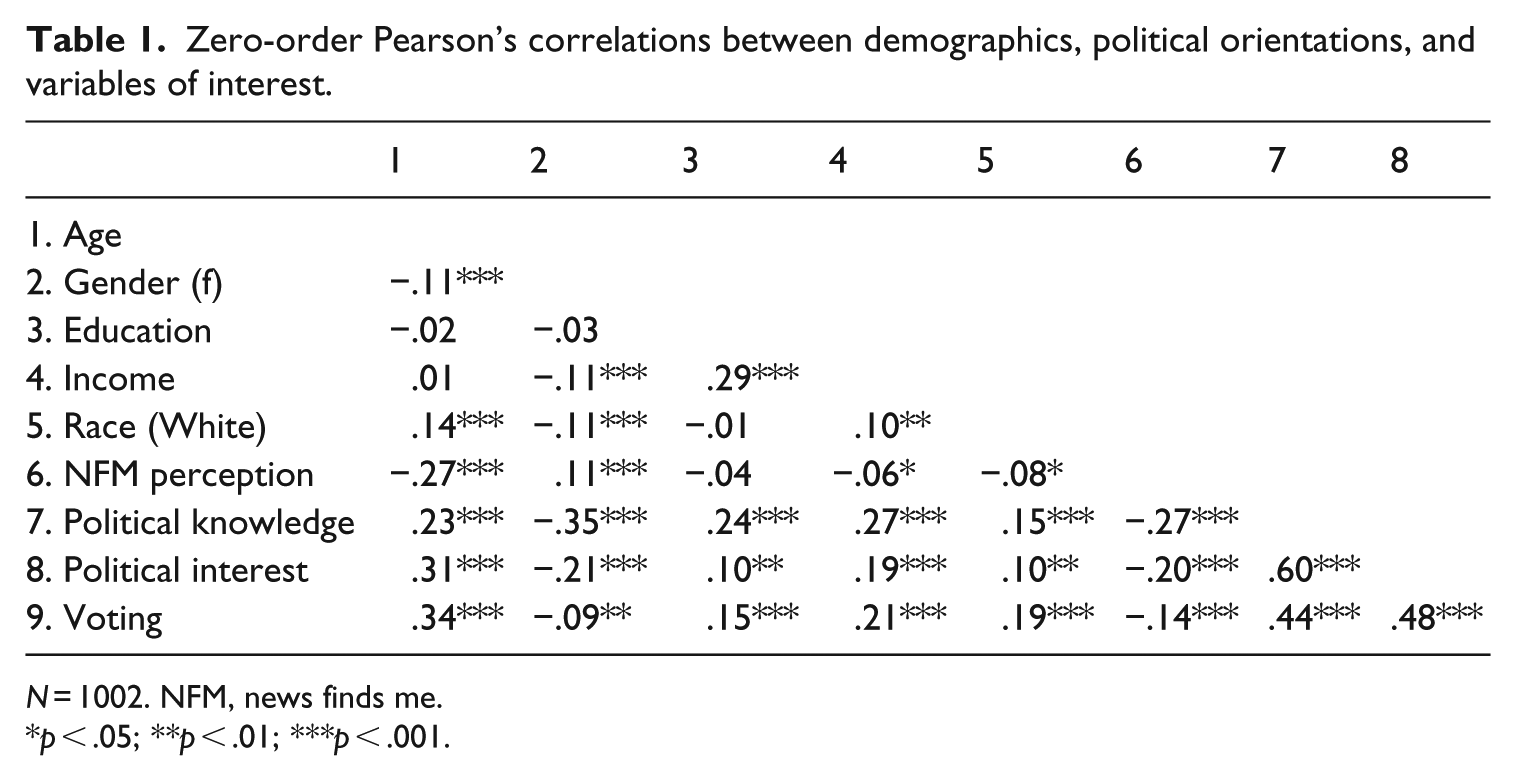
Pearson’s correlations were employed to examine relationships between demographic characteristics and the variables of interest (Table 1). To answer the hypotheses and research questions, a series of regression analyses were conducted. First, a lagged ordinary least squares (OLS) regression was used to examine the effect of NFM perceptions in Time 1 (Wave 1, W1) on political knowledge in Time 1 (W1), interest in politics in Time 1 (W1), and voting in Time 2 (Wave 2, W2). Second, panel survey data allowed for an autoregressive test that accounts for the effects of political interest and knowledge in Time 1, on the same relationships in Time 2. The best predictor of future behavior is past behavior, and therefore the modeling strategy tests knowledge and interest measured at Time 1 as predictors of the same variables at Time 2 (autoregressive design). These tests provide a more rigorous result. Finally, a parallel mediation path model was employed to test the mediating effects of political knowledge and political interest on the NFM perception and voting. Mediation analysis used the PROCESS macro, Model 4 in SPSS (Hayes, 2013). 3
Zero-order Pearson’s correlations between demographics, political orientations, and variables of interest.
N = 1002. NFM, news finds me.
p < .05; **p < .01; ***p < .001.
Results
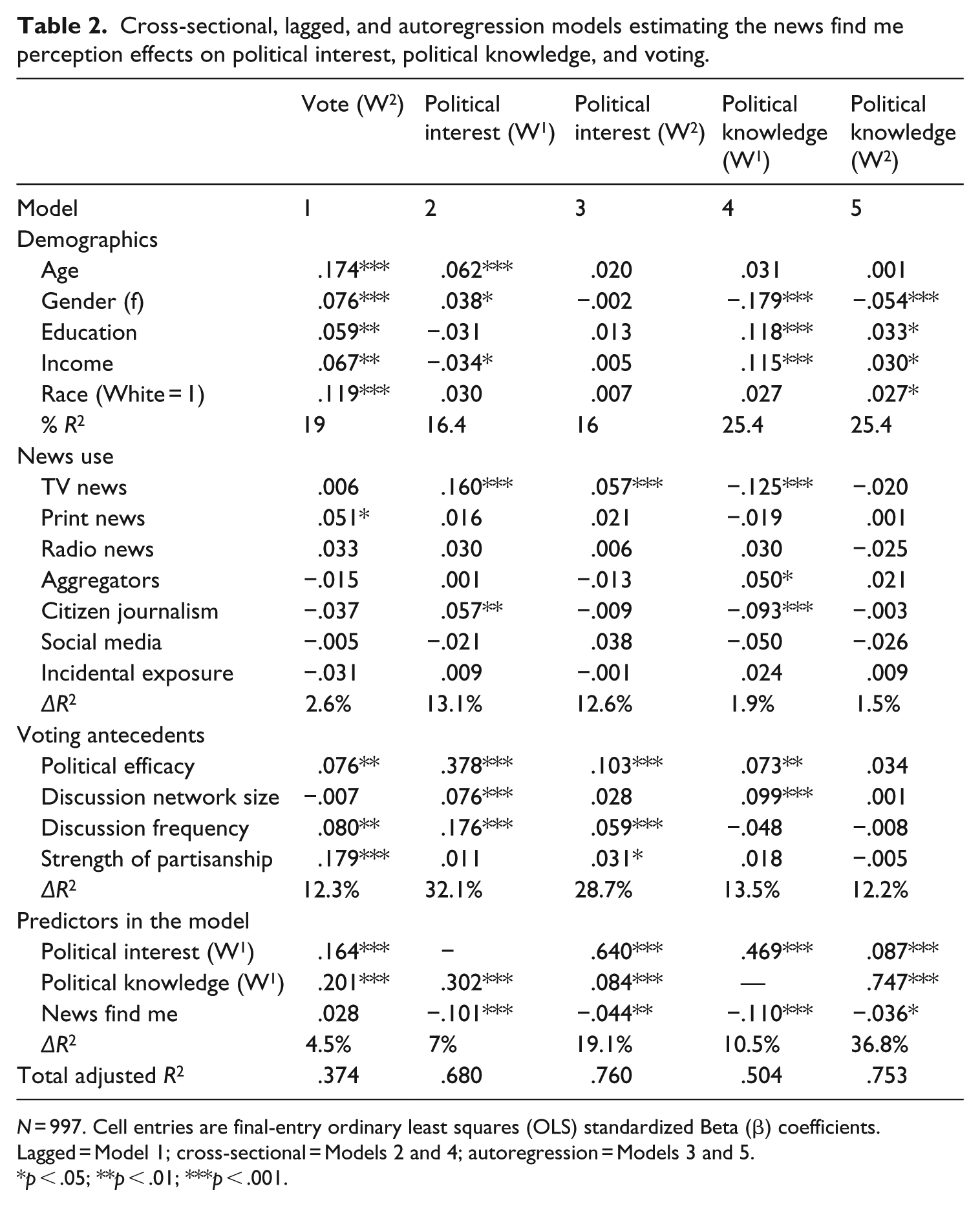
According to the correlation tests (Table 1), the NFM perception is associated with younger adults (r = –.27, p < .001), women (r = .11, p < .001), and those who report lower incomes (r = –.06, p < .05). As expected, NFM is also positively associated with social media for news (r = .44, p < .001) (Table 2) and incidental exposure to news (r = .33, p < .001), while there is no relationship with television or newspaper use. The positive relationship between both political knowledge and voting (H1), and political interest and voting (H2), were confirmed in the OLS regression models (Table 2). Political knowledge (W1) was the strongest predictor of voting (W2) in the model (Model 1; β = .201, p < .001), thus confirming H1. Political interest (W1) was almost as powerful of a predictor (β = .164, p < .001). As the resources model of voting predicts, other positive, statistically significant predictors of voting (W2) include age, education, income, and race (R2 = .19), reading printed newspapers (β = .051, p < .05), and political antecedents (R2 = .12) (total model R2 = .374). Consistent with decades of findings on voting behavior, demographics, political knowledge, and political interest are powerful predictors that an individual will report he or she has cast a ballot.
Cross-sectional, lagged, and autoregression models estimating the news find me perception effects on political interest, political knowledge, and voting.
N = 997. Cell entries are final-entry ordinary least squares (OLS) standardized Beta (β) coefficients. Lagged = Model 1; cross-sectional = Models 2 and 4; autoregression = Models 3 and 5.
p < .05; **p < .01; ***p < .001.
The second set of research questions and hypotheses addresses the effects of the NFM perception on political attitudes and behavior. In the cross-sectional framework, NFM perception was negatively related to political knowledge (W1) (H3) (Table 2, Model 4; β = –.110, p < .001). The more one believes that the news will find them, the less knowledgeable they tend to be about basic actors, rules, and events in public life (total R2 = .50). As with voting, the strongest predictor that one will be informed about public affairs is political interest (β = .469, p < .001). The NFM perception is also negatively associated with political interest (W1) (H4) (Table 2, Model 2; β = –.102, p < .001). Thus, those that hold the perception about being informed through their networks tend to be less interested in politics in general. Those that are interested in politics tend to be older, male, watch TV news, and have higher levels of political efficacy and knowledge (total model R2 = .68).
The negative effects of NFM perception held in the autoregression analysis for both knowledge (W2) (Model 5; β = –.036; p < .05) and political interest (W2) (Model 3; β = –.044, p < .05), providing some statistical support for the idea that NFM leads to lower levels of political knowledge and less interest in politics over time (Table 3). Note that regression coefficients in the autoregressive models (Models 3 and 5) for many of the explanatory variables decrease, since much of the variance is explained by the autoregressive variables (political interest [W1], Model 3; political knowledge [W1], Model 4).
Indirect lagged and autoregressive effects of news find me perception on voting through political interest and knowledge.

Path estimates are unstandardized coefficients. Indirect effects derived from the mediation model in Figure 1. Bias-corrected confidence intervals based on bootstrapping to 10,000 samples. Asterisks (*) represent a statistically significant indirect effect at the 95% interval, as the interval does not contain zero.
The NFM perception (W1) is not directly related to voting (W2) (RQ1) (β = .028, p = .34) in the OLS model (Table 2, Model 1). The final research question (RQ2) asked whether there was an indirect effect of the “NFM” perception on voting, through political knowledge and political interest. In the parallel mediation model (Figure 1), political interest and knowledge are included as mediators between the NFM perception (W1) and voting (W2). The figure shows both the direct path, and indirect paths based on OLS regression models. Results are reported as unstandardized regression coefficients. Concurrent with the OLS regression models in Table 2, the NFM perception (W1) is negatively associated with both political knowledge (W2) and political interest (W1). As expected, both interest in politics (W1), and knowledge of current affairs and political institutions (W1) are positively associated with voting (W2). The NFM (W1) perception had no direct relationship with voting (W2) (Figure 1).
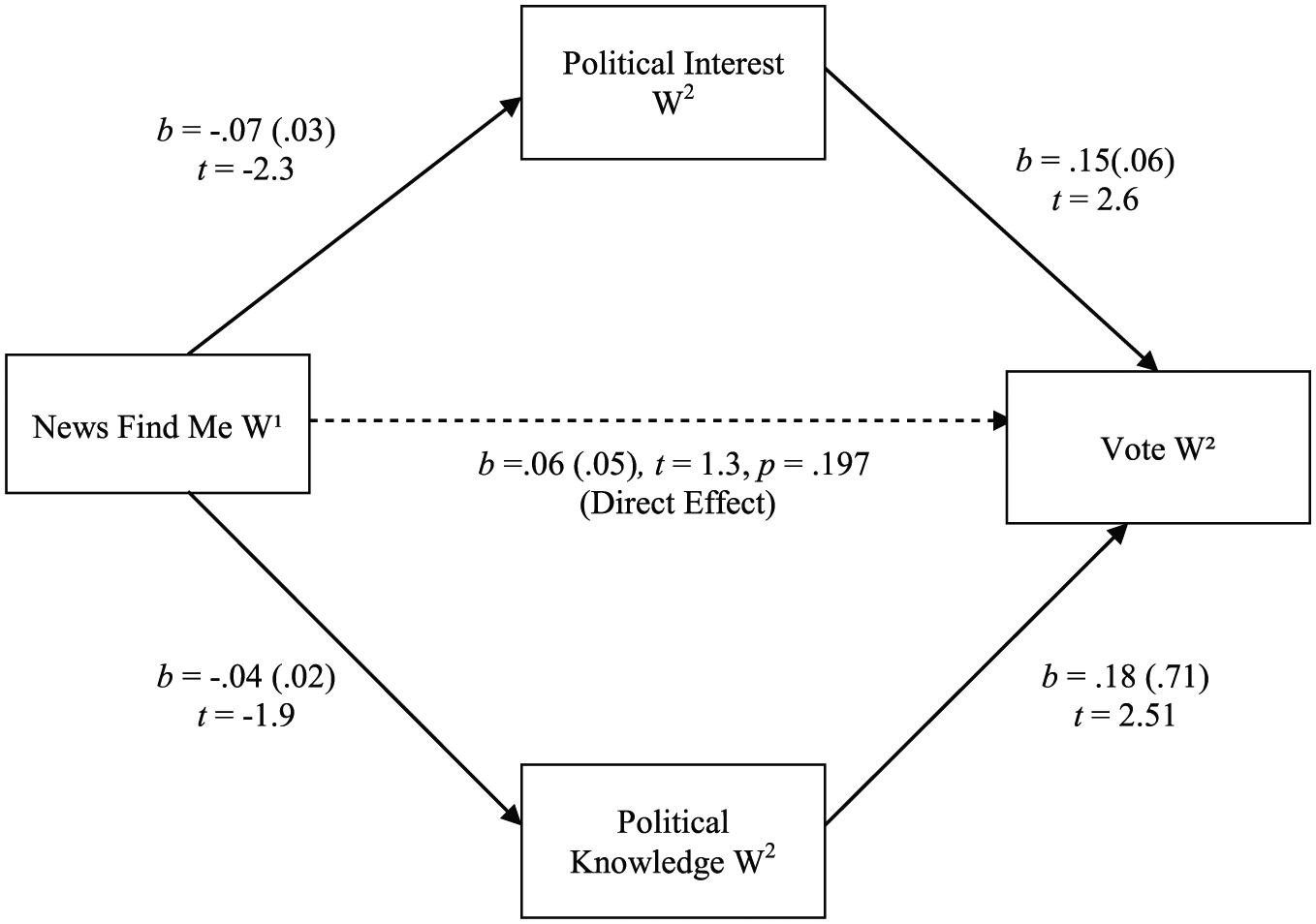
Indirect effects of the news finds me perception on political interest, knowledge, and voting.
The indirect paths show a negative, compounding effect of “NFM” perceptions on voting (Table 3). In other words, the direct, negative impact of this perception on political knowledge and interest leads one to be less likely to vote in the future. The indirect path estimate (Table 3) shows the negative, statistically significant effect of the NFM perception (W1) on voting (W2) through political knowledge (W2), point estimate = –.008, confidence interval (CI) = [–.024, –.0001]. The indirect effect through political interest (W1) is also negative, and statistically significant (point estimate = –.009, CI = [–.04, –.003]). The presence of statistically significant mediation effects, even after controlling for demographics and political knowledge and interest in Time 1, provides support for an indirect, negative relationship of the NFM perception on electoral behavior. Even without a direct effect between voting and NFM perceptions, path models can still detect the presence of indirect, mediated effects (see Hayes, 2013). 4
Discussion
This study explored the potential effects of the NFM perception on attitudes toward democratic norms and values. We tested the NFM perception with respect to traditionally pro-democratic benchmarks: political interest, political knowledge, and participating in elections. Results affirm previous findings on the importance of knowledge and interest in determining voting habits (H1; H2). In contrast, NFM perceptions are inversely related to political interest and political knowledge (H3; H4). These findings were confirmed in autoregressive tests. That is, by isolating the effects of political interest and knowledge in Time 1, we are able to make a stronger argument for the continued, negative impact of NFM perceptions on pro-democratic attitudes in time. Political knowledge and interest mediate the relationship between NFM and voting, suggesting that the NFM effects are indirect, but strongly associated with a turn away from participation in institutionalized politics.
No direct relationship between NFM perceptions and voting was found. However, and more importantly, we find evidence for robust negative relationships between NFM perceptions and both political knowledge and interest. These negative relationships, in turn, seem to remove, or at least decrease, pro-social behaviors that often precede participation in democratic life. In other words, the negative associations between NFM and political knowledge and interest also decrease the likelihood one will cast a ballot. This lack of knowledge and interest in politics then serves as a barrier to the most basic form of political participation. Displacement of surveillance uses suggests that, within time, individuals eventually lack the informational resources and interests needed to make informed choices, or to actually make any choice whatsoever. Similarly, the linear relationships might be explained by the idea that NFM impacts political “drive.” That is, NFM perceptions lead to a decline in the political energy and fuel to get mobilized.
There are at least two explanations for these negative effects. First, reliance on the social networks for political information makes individuals increasingly reliant on the political profile of their particular social network. Unless politics are central to the identity of the network, it is unlikely that algorithmic and self-curated information filters will provide an opportunity for rich and diverse exposure to political information. Conversely, people may be more likely to believe information or sources that are otherwise false. In addition, politics are rarely a topic of central concern within social networks (Bisgin et al., 2012). This is partly because the demands of maintaining social ties might over-ride political concerns. It also may be because other activities, like entertainment or social bonding, are more important to users.
NFM perceptions imply a shift in the long-held assumptions about how surveillance uses of mass media operate. Based on the correlation results (Table 1), younger adults, women, non-Whites, and those who report lower incomes are more likely to hold NFM perceptions. In both the resources and civic norms paradigms, historically marginalized groups tend to participate in politics at lower levels. NFM perceptions may help explain the participation gap. If NFM perceptions lead to a false sense of awareness of one’s civic sophistication, increased reliance on personal filters for information is likely to disproportionately favor those who are already involved.
This study has some limitations. First, self-reported survey measures can be prone to measurement error. Second, the two items measuring voting are limited in important ways. First, no major election took place between waves. Thus, we were unable to take full advantage of the panel design (i.e. autoregressive test for voting) and make no claims of causal relationships. Second, some scholars correctly note that the social desirability of voting items inflate reports. However, the social desirability bias in voting items is debatable (see Krosnick, 1999). Based on the two-item average used in this study, 55% of respondents reported voting often in national and local elections. This is roughly consistent with national voter turnout rates for presidential elections (United States Election Project, 2014). This study was also conducted before widespread knowledge of disinformation campaigns. NFM may have a role in the trust in or effects of fake news or propaganda campaigns. Future work should explore the connections between following disinformation campaigns and the NFM perception.
We also lack a deeper understanding of what drives the NFM perception. We know that these individuals tend to be younger and rely more on social media for news. However, it is unclear what the media content preferences are for these groups. What kinds of news content (e.g. popular topical news, in-depth reporting, recommended stories) leads to the patterns of self-delusion implied by the NFM perception? This cannot be explained by a simple preference for entertainment. It is more likely that the large bubble of social media content that mingles news, entertainment, social interaction, and so on generates an overall perception of being up to date. People are up-to-date with what happens in the social network, with important issues to them, and ultimately, they believe it is the same with public affairs news.
The effect of the NFM perception may be particularly relevant for young people. This group displays higher levels of the NFM perception than their older counterparts. It is possible that this generation will become increasingly isolated from institutionalized politics. In fact, voter turnout around the time of data collection (2014 Midterm elections) was the lowest recorded for adults aged 18–29 at 20% (CIRCLE, 2014)—though initial results from 2018 midterms suggest this may not be the whole story. More effort needs to be taken, in classrooms and within the news media, to better socialize youth toward civic norms, like voting and consuming hard news. This is an enormous challenge, particularly because an overreliance on social media may act as a barrier to informing the public at large. Voting is one of the most important diagnostics for the health of a democracy. Media has had an historical role in informing the public about political issues, and this role fuels voting behavior and participation in civic life (for an example on multiple societies, see Gil de Zúñiga et al., 2018). Perceptions that the news will find us without effort may alter this relationship, for the worse. Thus, future studies should explore how this new reality is shaping citizenship. This study was a modest but important step in that direction.
Footnotes
Funding
The author(s) received no financial support for the research, authorship, and/or publication of this article.
