




Abstract
The use of new media platforms has been evident in social movements at local, regional, and international levels. Many studies have shown that these platforms are tools to mobilize resources, facilitate coordination and information sharing, and access a wider audience. These studies, however, have been situated in the periods when the movements rise and peak, giving little attention to the use of such platforms in the post-movement phase. Based on interviews and participant observation of a peace movement in Ambon, Indonesia, this research found that the peace movement actors use Facebook, Twitter, Path, WhatsApp, SMS, and mobile phones for maintaining existing relationships, reanimating memories, keeping up with current movements, amplifying ongoing movements, and sharing new grievances. The platforms provide the actors with opportunities to sustain their existing networks. Hence, the movement persists and influences later movements. The findings offer the potential to better understand the continuity and change of technologically enabled social movements.
The use of new media platforms in social movements, such as mobile phones and social media, has been prevalent at both national and international levels. The Arab Spring and Occupy movements have attracted scholars from various disciplines to unravel the political contexts, networks, and structures that enabled them (Castells, 2015), documenting substantial use of the platforms toward attaining the immediate goals of the movements and reaching out to a wider audience. At the national level, the platforms were variously used for sharing information among UK student movement actors (Hensby, 2016), for mobilizing participants in a Singaporean protest against immigration policies (Pang and Goh, 2016), and for articulating the political interests of Indonesian activists (Lim, 2013). A common feature of these studies is that they are focused on the periods when the movements are on the rise and at their peak. During these two episodes, the platforms help the actors organize the movements, mobilize support and resources, share information, and coordinate actions. Therefore, the movements become more visible to the public and can attract more supporters (Bennett and Segerberg, 2012).
Missing from these previous studies is an understanding of the use of these platforms in the later period of movement abeyance (Taylor, 1986). The studies seem to suggest that such use is limited to the call to action and coordination during the movements’ climax, the usefulness stopping once the immediate goals of the movements have been achieved. In fact, a platform such as social media leaves persistent traces online (boyd, 2010). Information that the actors previously shared is retrievable, and the platforms become an online repository of resources which can be used for organizing later movements (Whittier, 2004). Recent studies have given little attention to the ability of such platforms to provide actors with a continuous connection to others and with past and present movements.
This article investigates the use of new media platforms after a movement recedes. Investigating this specific phase may reveal the continuity of technologically enabled social movements (Gerbaudo, 2014), and thus has the potential to extend the current studies that have focused solely on ascending and peak episodes (Tilly and Tarrow, 2015). Specifically, this study asks, “how do actors use new media platforms after a social movement declines?”
Answering this question shows promise for inspiring ways of managing technologically enabled social movements. More than 400 digital movements occurred from 2010 to 2012 (Edwards et al., 2013). Attention has only been given to the tip of these movements, and little is known regarding their continuity. Understanding the use of new media platforms in the post-movement phase demonstrates how to maintain existent networks and keep online grievance sharing alive. After a movement achieves its immediate goal, these platforms provide the actors with a persistent network. However, without a continuous effort to keep the actors engaged in conversation about issues that matter to society, the network will only become a repository of past movements. Put simply, the network needs to be galvanized over time to preserve its function as a force for change.
Studying a movement that has passed through its ascending and peak episodes and is entering its descending episode is necessary for answering the question at hand. It provides the opportunity to observe different uses of new media platforms and allows for understanding the changes and continuity of the movement, including whether it is episodic or sustainable over time. The Ambonese peace movement falls into this category. It is a movement which reflects a determined agency that the actors exercise to defuse violence, and in which new media platforms have played roles in both its rise and fall.
Case
The European and Middle-Eastern spice traders brought Christianity and Islam to Ambon, Indonesia in the 16th century. During the Dutch colonial era, religion was used to divide the Ambonese society. The Dutch imposed policies favoring Christians in administrative positions and replaced the communal living with a village system, sowing segregations in the society (Sholeh, 2013). The segregations widened as Muslims from Buton, Bugis, and Makasar immigrated to Ambon. The Christians viewed that there was a systematic effort to convert Ambon from a Christian to a Muslim land, whereas the Muslims perceived that the Christians had ruled Ambon for a long time (Qurtuby, 2016). The conflict between the two religious communities occurred from 1999 to 2012, with a period of détente from 2005 to 2010 (Braithwaite, 2013).
Rumors and provocations colored the conflict, circulating via pamphlets and bulletins (Bubandt, 2008). Radio stations promulgated religious sentiments to the listeners, while fax machines were used to raise funds (Lim, 2005). The Internet expedited the spread as one religious community used websites to promote hatred for the other religious community (Brauchler, 2003). SMS and Blackberry Messenger (BBM) were among the tools that enabled rumors and unverified information to metastasize, escalating tension between the two communities (ICG, 2011).
However, social media and mobile phones were also substantially used for preventing violence in 2011. For example, Peace Provocateur Movement actors, comprised youth, and religious leaders, used Twitter to counteract incorrect information that the mass media would spread about the locations and causes of violence. The actors took pictures from these locations, then uploaded them to social media to clarify rumors and incorrect information (ICG, 2012). Facebook became a means to disseminate stories about positive relations between Christians and Muslims during the time of violence, and to convey peaceful narratives that the mass media had neglected to cover during the conflict (Manuputty et al., 2014).
Ambon has entered a post-conflict period. The peace actors have shifted to mitigating the repercussions of the conflict, such as deep religious segregation and economic and social deprivation. They have been focused on preventing youths from engaging in high-risk violent behaviors such as joining motorcycle gangs and consuming alcohol excessively. Paparisa Ambon Bergerak, previously Ambon Bergerak (Ambon moves forward), was one of the movements intending to achieve these purposes. It was initiated by environmental groups, local artists, and bloggers in 2007 following the end of the initial period of conflict. When the conflict recurred in 2011, many of the actors joined the Peace Provocateur movement.
The actors involved in the Peace Provocateur movement organized Save Aru and Save Ema movements after the conflict ended. Facebook and Twitter helped the movements advocate the indigenous Aru for rejecting an opening of sugarcane plantations and to demand the local government for improving education and health facilities in Ema Village. The actors reactivated the networks initially developed when the peace movement was ongoing to mobilize the resources necessary for succeeding the subsequent movements. This study focuses on the use of new media platforms after the Peace Provocateur movement successfully defused violence in the 2011 Ambon conflict. The case shows that the use changed as the movement entered new episodes.
Literature
The use of new media platforms is not limited to the ascending and peak episodes, but also continues after social movements achieve their immediate goal or become less active (Lim, 2018). This use is inseparable from the time when the movements ascend and peak. The actors may subsequently use the platforms to coordinate times and places to gather and meet, to raise new political grievances, to share banter and nostalgia, and to stay connected with others after the movements subside. In other words, the use of the platforms marks the overall cycle of the movements (Tarrow, 1991, 1995). The actors even can use the platforms to maintain emotional ties as the movements enter an abeyance (Taylor, 1986).
What is shared while movements are ongoing remains stored online despite the movements’ ebb and flow (boyd, 2010). The actors can revisit political grievances, pictures and updates, and information related to the organization of the movements in the post-active phase. This can stimulate the expression of new grievances and facilitate assessment of the strategies employed in previous movements (Bagguley, 2002). Social movements often have a historical basis, in which a previous one leaves a legacy to the next as the actors discover new concerns and goals over time (Koopmans, 2006). New media platforms make it easier to retrieve the legacy and to use it to organize later movements when the existent actors’ movement participation wanes because new chapters of their lives require more attention (Giugni, 2004).
Sharing memories and nostalgia is evident in the studies situated in the post- movement phase. Through gatherings and meetings, the past experience is brought forward into the present to maintain relationships with others (Gongaware, 2010) and to preserve emotional bonds (Collins, 2005). Remembering the events, times, and places where they protested, engage with authorities, and recruited participants are some of the kinds of nostalgic memories that are called to mind, these shared experiences providing sustenance for continuing the movement (Courtheyn, 2016). For example, one Guatemalan human rights movement has persisted for more than two decades as the actors’ relationships remain solid. They maintain their comradeship through social gatherings, regular meetings, and commemorating their activism at the places where they used to protest the government (Bosco, 2001, 2006). While providing evidence for the persistence of relationships, these studies do not focus on the use of new media platforms in the post-movement phase.
When movements are in abeyance, the platforms are useful for reanimating face-to-face interactions, seamlessly connecting them online, and vice versa. For example, political discussion on social media platforms can be a continuation of conversations which occurred earlier at a canteen or café (Vromen et al., 2015). In this sense, social media platforms have become a place where users are able to develop a deeper connection as they interact continuously (Oldenburg, 1989). Therefore, the platforms do not only provide actors with chances to share and seek information, but also an emotional gratification from interacting with others.
The platforms become places where greetings, updates, and personal matters are communicated. The boundary between sharing movement-related and personal-related information is thin, and indeed there is a synergy between the two (Ling, 2008). In this sense, the actors’ emotional tie sustains their movement participation over time, as both types of information are fluidly shared after one another (Goodwin et al., 2002). A platform initially used for movement coordination can then become an opportunity for exchanging mobile numbers and common interests, from which friendships and emotional bonds that last over time may arise (Stoddart and Tindall, 2010). A Facebook group used for sharing information regarding plans, places, and contacts for organizing a movement can then become a platform for sharing updates and other information the actors deem relevant after the movement descends.
The platforms allow new grievances to arise from the feelings embedded in the actors’ friendships and to transform them into a subsequent, collective goal. The actors’ persistent connection with one another keeps the glow of the movement alive as they articulate new concerns, rage, and hope for a better change (van Stekelenburg and Klandermans, 2013). Their sense of togetherness makes it easy to turn such emotions into actions that facilitate resource mobilizations, information sharing, and coordination to attain the goal (Jasper, 1998). The platforms help the actors relive the movement by offering the opportunity to reactivate their connections and utilize them to recast post-movement concerns.
The foregoing discussion helps this study in answering the question on how the Ambonese peace actors use the platforms after the movement successfully defused the 2011 conflict. The actors continue using the platforms to maintain their relationships and subsequent movement participation despite changes in their lives in the post-movement phase. The platforms are used for reanimating movement experience through sharing movement related information, personal matters, and nostalgia. Understanding the use of the platforms in the post-movement phase, which is linked to their use in the ascending and peak episodes, has the potential to unravel the continuity of technologically enabled social movements (Tufekci, 2017). This can help to clarify the large body of literature which has previously been devoted to studying the use of the platforms while movements are ongoing, which may have implied that such use is episodic rather than sustained.
Method
To build rapport and gain trust, initial contact was made with a key peace provocateur movement actor in late 2014, who was able to suggest contacts for subsequent interviews to be conducted over three periods of fieldwork from 2015 to 2017. In total, 55 actors were interviewed; among these, 25 actors were involved directly in the 2011 conflict prevention movement, and 20 of these continued their participation in later movements. Their average age was 34 years old. They had been students, clergy, freelancers, public servants, a lecturer, and journalists when participating in the movement.
The actors were recruited online and offline. Online recruitments were conducted after the key actor befriended the author on Facebook and then added him to Filterinfo, a secret Facebook group which the peace movement actors used during the time of violence in 2011. A list of potential respondents was derived from the group membership, and then 18 accounts were contacted via Facebook messenger. Emails and mobile phones were used to reach out to the actors who were unresponsive to initial messages. Offline recruitments were conducted by (a) asking those willing to be interviewed to suggest others they deemed relevant to this research and (b) recruiting actors that the author met at community events (Patton, 2002).
Interviews were intended to explore the actors’ use of new media platforms after the conflict prevention movement receded. The questions included, for example, to what extent do you use new media platforms to stay connected with other actors? What do you usually talk with them about? These types of questions helped to identify the uses and topics that the actors shared on the platforms (Flanagan, 1954). The interviews took place at coffeehouses, restaurants, and work-places, and were in the Indonesian language with a substantial influence of Malay-Ambon and local dialects.
Both offline and online observation supplemented the interviews. Offline observation took place when the author interacted with the actors in person. Some of them passed on greetings from other actors who had met with the author. On other occasions, they showed contents of their WhatsApp or Facebook messenger group chats. Online observation was carried out as the author befriended the actors on Facebook, allowing seeing their status updates, posts, and comments (Kozinets, 2002). The actors were aware of the author’s role as a researcher when exchanging short chats and questions on WhatsApp and Facebook messenger. This was also a way for maintaining relationships with the actors after the periods of fieldwork were complete (Musante and DeWalt, 2010).
Interview transcripts were read multiple times to understand the actors’ experience. Fieldnotes were used to complement this first step of data analysis, keeping the transcripts in context. If further clarification was needed, the relevant actors were contacted via social media and mobile phone. The proposed research question guided later steps of the analysis such as data grouping and coding (Charmaz, 2006). Taxonomy analysis was employed to dissect the use of new media platforms after the conflict prevention efforts had ended (Spradley, 1980), resulting in the five themes reported in the proceeding sections.
Findings and discussion
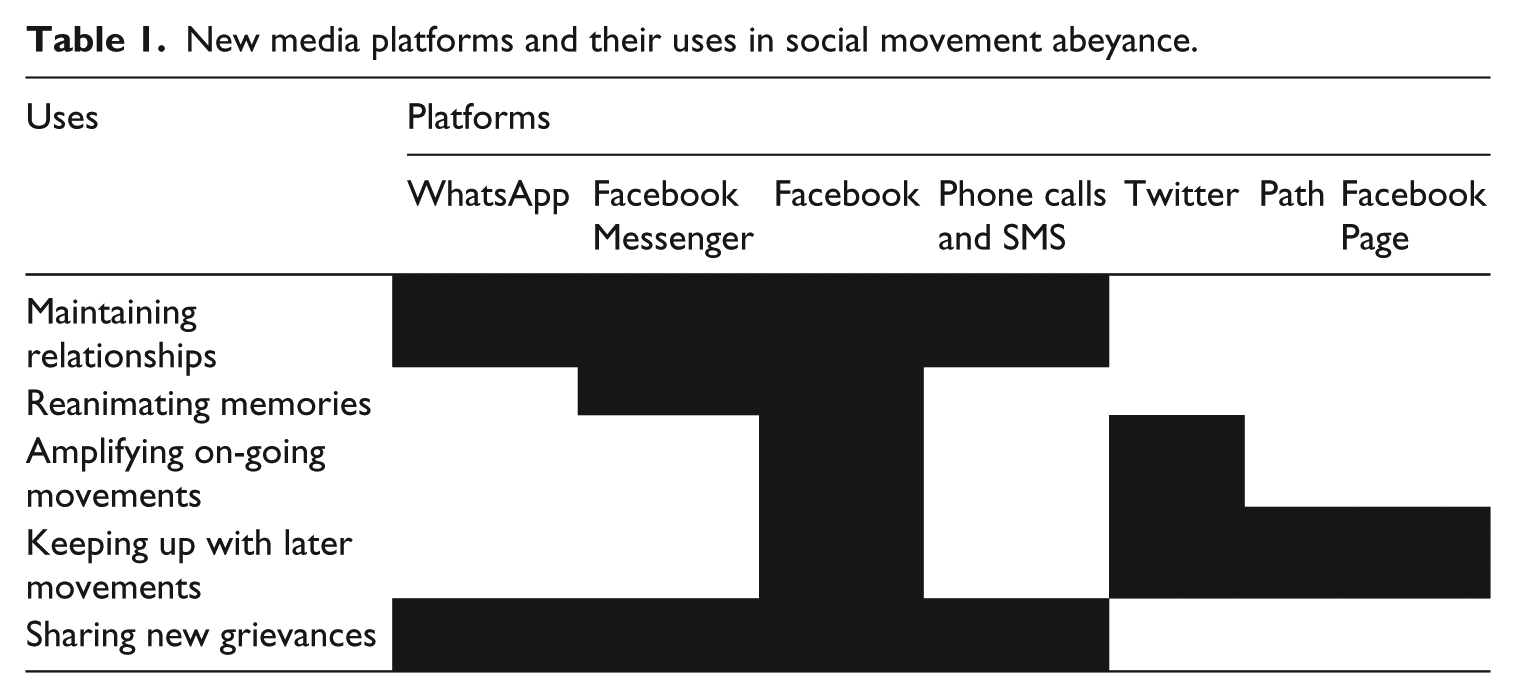
The Ambonese peace movement actors used new media platforms for maintaining relationships, reanimating memories, amplifying ongoing movements, keeping up with later movements, and sharing new grievances after the movement successfully defused violence in 2011–2012. Using the platforms for such purposes helped maintain the actors’ connection with the network that initially developed when dealing with a very critical and tense situation. The network was then used for supporting the movements that followed the demise of that initial conflict. Table 1 summarizes the use of the platforms.
New media platforms and their uses in social movement abeyance.
Maintaining relationships
The actors used the platforms to maintain relationships with others and with external networks in the post-movement phase. The platforms were the means of staying in touch with other actors who remained in Ambon, and those had moved elsewhere. Banter, social support, and personal matters were some of what the actors shared using these platforms. Wes (36), the creator of the Filterinfo group, exemplified the use of WhatsApp for maintaining existing relationships with other actors: [We talked] on a WhatsApp group. This is a means to remain connected, a capital for us to consciously maintain existing relationships and to make Ambon better. I am not looking for projects or things like that but triggering a rational discussion to achieve a common goal. (Wes, interview)
Wes’ comment points to the role of this WhatsApp group for maintaining post-movement relationships. The group was created as a means to catch up with other actors as they moved on from the movement. They shared with each other about personal challenges such as relationship and family problems and financial difficulties in order to receive mutual support. Together with these was banter related to memorable events that the actors witnessed during the conflict. The actors recalled a rumor that an American submarine was coming to attack Ambon, which had circulated when the conflict was at its peak. The actors laughed at the fact that the Ambonese discussed and circulated the rumor. Although seeking clarification for the rumor from those living in the bay area was easy, no one thought of doing so. The actors found this situation funny as realizing how little they knew about what to do back then.
Wes’ comment also suggests that maintaining post-movement relationships was important for keeping the aspiration to improve Ambon alive. Those with prior friendships became closer while engaging in conflict prevention activities such as checking conflict locations and gathering information from the borders. Simultaneously, new friendships developed as a common goal to bring peace to Ambon bonded the actors emotionally. After the movement, many actors moved elsewhere and were occupied by work and family matters; the aspiration to better Ambon subsided, as such reasons needed more attention. Maintaining contact via the WhatsApp group reminded them of the friendships, their comradeship when defying the military, and the collective aspirations they had held as they started new families, permanent jobs, and relocated. These life changes led to many becoming less able to participate in the movements that followed the end of the 2011 conflict.
The platforms were also used for staying in contact with external networks that initially developed during the conflict prevention movement. The networks remained relevant as reflected in its ability to help mobilize resources and information for supporting post-conflict movements. Yeso (30), a member of Filterinfo group, explained, We shared what we have done with friends outside Ambon [via social media]. We had a very strong relationship with people from ICT Watch in Jakarta and most community groups in Java. Our relationship with them was great because they had known our works. (Yeso, interview)
Yeso’s comment refers to the use of Facebook and Twitter as the means of staying connected with external networks such as not-for-profit organizations, donor agencies, and community groups outside Ambon. Such networks first helped the conflict prevention movement achieve its immediate goal and then supported other movements that followed. For example, information and communications technology (ICT) Watch, a Jakarta-based non-governmental organization with a focus on the use of information communication technology for social change, helped bring funds to organize activities intended for improving the affinity of youth with new technologies and creating an environment that was supportive for nurturing creativity in post-conflict Ambon.
Social media platforms also facilitated the actors in mutually sharing information with the external networks that were relevant to the efforts toward socially and economically rebuilding Ambon after the conflict. Facebook and Twitter were essential to bridging the information gap between community groups in Java and Ambon. The community groups located in Javanese cities such as Yogyakarta, Bandung, and Jakarta were considered better developed, especially those working in arts, music, and creative industries. Keeping in touch with the members of these community groups could, for example, update Ambonese artists with current trends and demand for creative products while allowing them to share their works and use of indigenous motifs in contemporary apparels and art.
The use of these platforms enabled the actors to maintain their movement participation despite changes in their life circumstances. Post-movement life could constrain them from direct participation in later movements, and the social media platforms provided a way to navigate temporal and spatial constraints that emerged in post-movement life; thus, the actors could continue to participate in the movements. While work and family commitments impeded the actors from direct involvement in the movements, these platforms offered the chance to stay up-to-date and support the movements remotely. Following relevant Facebook pages and accounts, retweeting, commenting, and sharing information related to the movements online demonstrated the actors’ persistent participation in the post-movement phase.
The network that initially developed in previous movements continued to be used to support the later movements. The platforms facilitated the actors in maintaining relationships, and over which both information related to the movements and personal matters were shared over time. The networks also became a space for sharing new grievances, such as discontent toward public policies and political affairs. These forms of contact kept the network active; hence, they had the potential to trigger later movements as they reflected on the success of the prior movement in attaining its goals.
To put these findings in a larger context, for any group to persist it needs to have a central core ideology. This can shift with time, and thus there needs to be a way to maintain it. In the case of the Ambonese peace actors, their ideology was developed through their interactions when mediating the conflict, which then formed a sense of group identity (Berger and Luckmann, 1966). The original crisis situation has passed, there is a need to somehow maintain the ideology and identity of the group if it is to remain active and viable. This is made difficult by the change in the actors’ life circumstances and the fact that they are sometimes geographically distant from one another. Against this, social media platforms allow the actors to cultivate their common past and their shared experience, allowing them to continue to maintain their ideology and the group identity over time.
Reanimating memories
Post-movement new media use was instrumental to allow the actors to reanimate collective memories they had gathered through participating in the conflict prevention movement. The actors recalled critical situations, the actions taken, and their interactions with others when addressing these situations. Their recollection of those moments persisted over time despite the movement having ended and their biographies having changed. A thread on Facebook echoed just the following,

Source: Al’s Facebook as of 17 November 2017.
The above thread illustrates the use of new media platforms for reanimating moments that the actors shared during the conflict prevention movement. The Facebook update, posted on 11 September 2016, reminded other actors of the birth of the Peace Provocateur movement. On that day they had coordinated acts, provided and obtained information regarding violent locations, and counteracted rumors when violence peaked. The comment thread showed that the actors recalled the time when they witnessed an outbreak of violence between Christian and Muslim communities while other actors constantly sought updates on the conflict situation before going to the locations to collect evidence. The actors reanimated memorable moments such as being awakened by a call for checking conflict locations, seeking a safe meeting point and giving and receiving updates of rumors that spread in both religious communities. Facebook played a role in allowing the actors to bring such recollections forward despite the difficulty of interacting in person after the movement ended.
It is worth mentioning that Facebook was also the means for scaling-up the lessons they had learned through their movement experience. Online, the actors shared their reflections on these memories and their relevance to present day situations. The efforts of preventing violence and promoting peace in the long term needed work to sustain as suspicion, prejudice, and misconception from one religious community to another was still pervasive at the grassroots level despite the dissipation of violence in Ambon. The strategies and tactics employed for defusing violence and overcoming its repercussions were worth sharing with the wider community to mitigate the risk of violence recurring. The actors believed that their experience could be extrapolated to overcome the rise of religious-based violence at the regional and national levels. The social media platforms offered an avenue for widely disseminating the tactics, strategies, and lessons they learned from preventing violence.
The actors used Facebook for disseminating the lessons they learned from organizing the conflict prevention movement. Their experience could be relevant to the recent development of peace and conflict in a larger context. Religious tribalism and conservatism threatened the state of social harmony as politicians used religion and race to galvanize religious fanaticism and ethnocentrism in their constituents, from which violence often arose as competing views clashed. The experience that the actors gained from preventing violence in Ambon was transferable to resolving cases of religious-based violence in other parts of Indonesia such as Java, Palu, and Papua. Sharing the experience on Facebook thus had the potential to both sustain peace in Ambon and benefit other cities that faced similar challenges. This finding suggests that the platforms enable a movement to be sustained by giving the actors a tool for aligning their experience with those of others who are dealing with similar challenges in other places. Thus, the movement has the potential to affect others as the actors’ experience is emulated to address such challenges.
In a wider context, the use of the platforms in the movement abeyance affords movement actors the chance to reanimate collective memories, although their locations have scattered and their life priorities have changed since the movement declined. Sharing the memories gained from participating in the movement is gratifying for the actors as they move on with their post-movement lives. Their emotional bond lingers, and may resurface as they gather and commemorate the memories regularly (Bosco, 2001). Remembering days when they had only one priority, such as preventing violence, and having become part of something bigger than themselves is pleasant in later times when they must shift their focus to family needs and fulfill other responsibilities. Looking back on such memories provides the actors with a common topic on which to converse, which can facilitate more meaningful relationships to grow (Stoddart and Tindall, 2010) and thereby sustain their network over time.
Amplifying on-going movements
The use of new media platforms during the 2011 conflict prevention movement left legacies for the movements that followed. The network that the actors initially developed during the movement remained active afterwards, thus making it easier for later movements to gain support from a wider audience. The network was used for articulating societal changes that the actors deemed relevant for bettering Ambon after the conflict. Rif (27), a member of Filterinfo group who continued participating in the post-conflict movements organized by Paparisa Ambon Bergerak, explained, When friends organized community events, we shared the information, so more people could know. The perk of having friends from Paparisa is access to powerful social media effects … We have been seen as having a very strong social media base since the September 11 (the first day of 2011 violence). What comes from Paparisa is like a revelation, considered true and trustworthy by people outside Ambon. (Rif, interview)
This comment points to the legacy of social media use from the previous movement to the later. Successfully preventing violence and promoting peace, the actors used social media to support issues that the later movements advocated. Many of those behind the birth of Paparisa Ambon Bergerak had been involved in the conflict prevention movement. The actors who lived both in and outside Ambon remained connected with each other, as reflected in their support to Paparisa. In 2013, Paparisa organized the Save Aru movement, which demand that the government reject the requests of palm companies to operate on Aru island, which they believed would destroy the ecosystem and threatened the life of the indigenous Aru.
The actors used social media platforms to reactivate the existing network in order to influence the decision of the national government. Former conflict prevention actors residing in Ambon campaigned for the Save Aru movement in person through various tools such as music, poetry, and community events, as well as sharing information online. Those residing outside Ambon reshared posts online and reached out to their contacts in Jakarta and Java such as journalists, donor agencies, and community groups to increase the impact of the movement. These contacts had recognized the previous work of the actors in defusing the 2011 violence, and therefore were willing to help mobilize resources, share the information with a wider audience, and assist in accessing relevant policy makers. Through these efforts the Save Aru movement achieved its immediate goal, as the government rejected the palm companies’ applications to operate on Aru.
Keeping up with later movements
The use of new media platforms for keeping up with the movements that followed the peace movement was evident among actors who had moved to other locations. After the conflict ended, several actors relocated to cities in Java island such as Jakarta, Yogyakarta, Surabaya, Salatiga, and in neighboring islands such as Sulawesi and Seram, for family, school, and work reasons. Apri (31), who moved to Yogyakarta for graduate school, explained his use of Facebook to follow later movements: I follow the movements [on Facebook] in order to keep myself informed of what they are up to. For example, I learned that Paparisa received a fund from the government. I need to know about it, so I can assess whether it is useful just for Paparisa or the rest of Ambon. If it only benefits the government or sustains the life of Paparisa, we need to rethink it. (Apri, interview)
Social media platforms were the means for actors who lived outside Ambon to seek information about the movements that followed the peace movement. In this case, Paparisa Ambon Bergerak received government funding to organize workshops and provide youth from all backgrounds with a common place to meet. Monitoring the work of Paparisa online was a way to ensure that the funds benefited society rather than just individuals or groups. Following Ambon Bergerak’s Facebook page gave information about community events, new concerns, and collective actions that Paparisa organized using the funds.
The platforms were also a means to find answers for questions from people who lived outside Ambon. Ina (30), residing in Jakarta, said, I did not know until I heard about it [Paparisa] from Path. “Oh, there is Paparisa now, what is that?” and then read it more on Facebook. I keep myself updated so can address questions from people in Jakarta. (Ina, interview)
Ina used both Path and Facebook extensively to follow the latest developments of social movements in Ambon. Having moved to Jakarta for work reasons, she had not earlier been aware of the emergence of Paparisa. She first heard of it on Path and then followed its page on Facebook in order to get updates on its activities. For example, when Paparisa organized a workshop on the use of social media for promoting unexplored tourist destinations in Ambon she followed the updates online, allowing her to learn more about the destinations. She was thereby able to spread the information to her social circle in Jakarta. Staying connected to later movements in Ambon via social media was also a way to be able to respond to inquiries from external parties. Ina and a couple of actors who resided in Jakarta were asked by a Google Indonesia representative to share about the works of Paparisa and other community groups that had emerged in post-conflict Ambon. These two examples show how social media platforms afforded the actors who resided outside Ambon the ability to stay up-to-date with later movements, hence enabling them to continue supporting such movements.
The present finding demonstrates that the use of these platforms shifts during and after a movement. When the movement rises and peaks, the platforms facilitate the actors in coordinating and mobilizing the necessary resources for achieving movement goals. In the post-movement phase, the platforms serve as a means to widen the impact of the movement on society by telling success stories of achieving these goals, which has the potential to inspire other members of the society to seek change and provide them with relevant strategies and tactics for achieving it. The platforms can also be used for framing the movement in the wider context to keep it relevant to current situations.
Sharing new grievances
The platforms were used for sharing new grievances which emerged following the end of the conflict prevention movement. The grievances varied from issues related to national politics to local policies. Discontent toward the local government’s lack of accountability toward bettering Ambon was apparent. The actors felt that the city had fallen behind socially and economically compared with other cities in Eastern Indonesia, but the government seemed to impose policies that were counterproductive to the interests of the Ambonese. Noel (31) commented, I stay connected with Wes, Ron, and Al via Facebook … Recently Al updated his Facebook status with news on the recruitment of new public servants. The government will bring more teachers from outside Ambon while the potential of the people of Ambonese was still significantly unabsorbed. We also discussed other things such as the government’s policy on making Ambon as the city of music. How can we make it happen without government assistance? If the government wants to make it, don’t only talk, prove it. (Noel, interview)
This comment points to two new grievances that the actors shared in post-conflict Ambon. First, they deemed it wrong to be importing teachers from other regions to Ambon when many local teachers were still inadequately utilized. This initiative would undermine the quality of local talent and complicate existing problems in the local education system. Many local teachers held temporary employee status, and were underpaid and overworked despite being as capable as those from other regions as well as having a strong understanding of local needs. The initiative would decrease their likelihood of being promoted as public servants or gaining better job security. This therefore reflected the government’s failure at utilizing the potential of local talent to advance the education sector.
Second, the local government’s commitment to implement the slogan of Ambon as “City of Music” was questionable. Little action had been taken to address chronic challenges that the local musicians had to deal with, such as difficulties in organizing music concerts because of limited representative space and copious red tape in getting permits. Music schools and festivals were rare, seeming contradictory with the intention of the slogan to promote the local music industry and musicians. Growing weary of the government’s empty promises, the actors looked for ways to implement the slogan independently. Attending music events at local cafés and in the streets, promoting music online, and encouraging members of community groups to circulate information of the events and buy the music were some alternatives for making the slogan a reality without relying on government assistance.
With this in mind, the use of the platforms in the post-movement phase helped trigger other movements, as old and new grievances crystalized into new goals toward making necessary changes. The grievances shared in the previous movement shaped the emergence of the new ones. The problems and solutions that the later movements offered were rooted in the previous. The platforms eased the actors’ ability to retrieve old grievances and connect them with the new ones, making it feasible to assess whether the old grievances had been addressed and whether the new grievances complemented or contradicted them.
For example, the long-standing grievances related to tardiness in the education sector and that the government had been slow in improving the quality of education intermingled. These crystalized into a collective action to address extant educational problems such as poor infrastructure and the low literacy rate. Several actors began to work with non-governmental, religious, and charity organizations to educate underserved children and areas. They believed that improving access to education was imperative to both enhance the quality of local human resources and prevent the Ambonese from being lured to conflicts because of illiteracy and being ill-informed.
Broadly, this finding suggests that the use of the platforms is not limited to the ascent and peak times of social movements. As the movements descend, the actors maintain their networks through their use of social media platforms. The platforms facilitate the actors in mobilizing support for later movements and helping new movements to rise. This finding corroborates the fact that social movements do not die out, but evolve and have potential to influence other movements (Tilly and Tarrow, 2015; Whittier, 2004).
Conclusion
This research has addressed the question of how actors utilize new media platforms after a social movement descends. The use is a continuation of its use during the earlier phases of the movement. The platforms allow the actors to maintain relationships, reanimate memories, amplify ongoing movements, keep up with later movements, and share new grievances. In a broader sense, the platforms allow the actors to develop and maintain their common ideology. Thus, the ongoing use has the potential to trigger later movements as the network of friendships and resources, initially emerging during the rise and peak episodes, remains active and is used for supporting later movements. Their use in sharing new concerns preludes the later movements as these grievances crystalize into a new collective goal.
It seems there is a cycle of abeyance that makes technologically enabled social movements sustainable (Holland and Cable, 2002). The movements achieve their immediate goals, then enter a period of abeyance as reflected in their decreasing activism. However, the platforms offer the actors the opportunity to maintain their common ideology and continue to share collective memories and grievances. The dormancy of the movement gradually passes as the actors’ interactions trigger new concerns and goals, from which later movements may arise. The platforms enable the actors to quickly express anger and discontent toward the current state of social affairs (Jasper, 1998). As the emotions shared on the platforms develop into action, the movement resurfaces and the already established networks are reactivated in order to mobilize resources necessary for achieving the new goals.
Maintaining a common ideology is critical to prevent the movement from dissipating during the period of abeyance. The actors’ interaction on new media platforms allow the ideologies to persist as memories gained collectively from participating in past movements are shared regularly, opening the opportunity to articulate new grievances with those still holding on the ideology. As the actors scatter geographically and their commitments to the movement change, the platforms facilitate the maintenance of the ideology remotely. Hence, the aspiration to enact change and a willingness to support ongoing and later movements persists amid such changes in the actors’ life circumstances. The movement can be in abeyance, but a sustainable ideology has the potential to give rise to the emergence of other movements.
In such a setting, finding out how leaders, followers, and intermediaries play their diverse roles in creating a critical mass that can invoke new grievances and then crystalize them into a common goal is pivotal to reviving a movement. Certain types of actors play substantial roles in creating an environment that helps the network persist after it becomes less active. Scholars have pointed out that technologically enabled movements are comprised of individuals who are connected to a common goal and can automatically escalate activities once achieving a critical mass (Bennett and Segerberg, 2013). Still, the role of leaders in facilitating the sustaining of such movements is central. Major movements often start from a small group of like-minded actors who have the ability to communicate their grievances to the public and call for action (Gerbaudo, 2014).
Further research may focus on change in the types of information that actors share during and after movements. There is the possibility that they initially share primarily movement-related information when the movements are on the rise, and later share more personal information as the movements descend. Such change can be a proxy for the development of the actors’ interpersonal relationships. This can raise the question of the conditions that enable such change, how the change may differ between those with and without prior interactions, and to what extent the movement helps expand the actors’ networks over time.
Footnotes
Acknowledgements
The author would like to thank Prof Rich Ling at Nanyang Technological University and Prof Ariadne Vromen at University of Sydney for reviewing the earlier version of this article.
Author’s Note
Abdul Rohman is now affiliated with RMIT University Vietnam.
Funding
The author(s) received no financial support for the research, authorship, and/or publication of this article.