



Abstract
Social media are recognized as important outlets for youth political expression, yet the affordances of different platforms may shape the forms and styles of expression that young people deploy. In order to gain a deeper understanding of the ways social media affordances shape youth voice, this article examines young people’s political expression on the popular app musical.ly in the context of the 2016 US presidential election. Employing quantitative and qualitative content analysis on 1651 youth-created videos, we examine how young people use platform affordances, political hashtags, and memetic dimensions to convey a range of expressive political practices. In particular, through the analysis of content, form, and stance, our research illuminates how social media afford collective political expression for youth, by allowing them to deliberately connect to an assumed like-minded audience with similar beliefs through the use of shared symbolic resources.
In the heated context of the 2016 US presidential election, much attention has been paid to social media as outlets for political expression. While most of the focus has been on Facebook and Twitter as platforms for sharing news and political opinions, these sites should not remain the exclusive places to look at to understand everyday political expression. Young users, in the United States and abroad, are moving away from these mainstream platforms (Pew Research Center, 2018), while other lesser-known social media are gaining traction. A prominent example is the social media app musical.ly, 1 with over 200 million users and 13 million videos uploaded daily (Robehmed, 2017). In spite of its immense popularity with youth (Rettberg, 2017), musical.ly is extremely under-researched and has not been considered in relation to youth civic life. The question of platform choice matters in terms of political expression: different platforms enable different modes of expression, shaped by their affordances, as well as individual proclivities and group norms (Highfield, 2016; Lane et al., 2018; Maia and Rezende, 2016; Renninger, 2015; Stromer-Galley et al., 2015; Thorson et al., 2014).
The aim of this study is to further understand youth political expression on social media platforms popular with this demographic, as shaped by platform affordances and the use of memetic media for collective political expression. Specifically, we ask, how do musical.ly users, working with the available affordances of this platform, employ the memetic dimensions of content, form, and stance (Shifman, 2013) to collectively express political statements?
In line with research showing meaningful political expression in non-political digital spaces (Bennett, 2008; Highfield, 2016; Jenkins et al., 2016; Kligler-Vilenchik & Literat, 2018; Literat & Kligler-Vilenchik, 2018), this article considers how social media afford collective political expression for youth, by allowing them to deliberately connect to an assumed like-minded audience with similar beliefs through the use of shared symbolic resources. Illustrating the process of collective political expression, our work helps illuminate the range of expressive political practices on musical.ly, showing how the same platform affordances can be deployed to make contrasting political statements through the strategic use, reuse, and transformation of shared media resources (Shifman, 2013).
Social media as a key site for youth political expression
While social media platforms have enabled citizens to share the most ordinary aspects of their everyday lives, these spaces are also important sites for political expression (Lane et al., 2018; Mor et al., 2015; Thorson et al., 2014). As Highfield (2016) claims, “social media afford the opportunity for different groups, including citizens […] to contribute to, discuss, challenge and participate in diverse aspects of politics in a public, shared context” (p. 10).
Political expression is recognized as an important activity for the democratic citizen, as a way to clarify one’s own political views (Eliasoph, 1998), as well as a precursor toward other political acts (e.g. Penney, 2015). In that sense, political expression is a subset of political participation, understood as “practical, do-able activities, where citizens can feel empowered” (Dahlgren, 2009: 81). Especially for youth, voicing their political views is conceived as an important component of citizenship (Bennett, 2008). At the same time, considering political expression as a form of “participation” may mask the fact that power balances may be unevenly distributed among actors. Carpentier (in Jenkins and Carpentier, 2013) thus suggests the need to conceive of different “participatory intensities,” considering the level of power and agency users are endowed with (p. 3).
Young people’s propensity for self-expression is facilitated by their abundant use of social media, which enables them to self-express on a variety of issues, including politics (Kligler-Vilenchik, 2017; Lane et al., 2018). However, social media are not a neutral canvas; rather, they may shape political expression in myriad ways. For example, on mainstream social media such as Twitter or Facebook, context collapse (Marwick and boyd, 2010) may make young people apprehensive about unknown and merged audiences. Such concerns may lead youth to see Facebook as a site that is not appropriate for political expression, and as a result to self-censor (Thorson et al., 2014). These responses toward political expression on social media build on a general hesitancy toward political talk in the United States (Eliasoph, 1998) and may be culturally dependent (see, e.g. Mor et al., 2015).
Thus, “social media” have to be further unpacked. Both conceptually and empirically, the affordances of different platforms have been found to shape the ways users express themselves and participate (Maia and Rezende, 2016; Stromer-Galley et al., 2015). In speaking about affordances, we follow Gibson (1986) in considering what the environment “offers the animal, what it provides or furnishes, either for good or for ill” (p. 127). Use of the term has made significant conceptual progress over the past decade, stressing that affordances are not simply design features but emerge from the interaction between a technology’s design and how users employ it (Evans et al., 2016).
Social media affordances which may shape users’ political expression include the degree of profile anonymity, the ease of tailoring one’s audience, and the visibility of comments (Renninger, 2015). However, digital affordances also influence political expression styles. Examining YouTube, blogs, and Facebook, Maia and Rezende (2016) found that affordances related to anonymity and homophily affected the style of online political expression, especially regarding the use of foul language. However, beyond these factors, the authors found that online norms of platforms further shape expression. For example, on Facebook, the perception of homophily discouraged a reflective position on one’s political views. They conclude that “a combination of online platform affordances, norms and participants’ expectations form the conditions necessary to create mutual respect in the digital environment” (p. 136). This is an important reminder that affordances shape, but do not determine, modes of political expression.
Collective political expression, political hashtags, and memetic media
While social media affordances have been shown to shape political expression, we are particularly interested in processes of collective political expression. Building on the definition of political expression offered by Velasquez and Rojas (2017: 2–3), we conceive of collective political expression as “communications expressing a specific opinion on current events or political processes, or disseminating information relevant to the interpretation of those events or processes” while deliberately connecting to an assumed like-minded audience with similar beliefs through the use of shared symbolic resources.
We understand the concept of collective political expression as being characterized by three key features: the assumption of an imagined audience with similar beliefs and the ability to communicate with that audience; the deliberate nature of adding one’s voice to an existing wider conversation, thus connecting to that imagined audience; and the use of shared symbolic resources that makes this allegiance visible. Collective political expression as thus conceived can occur in a myriad of contexts, including pre/non-digital ones (e.g. voicing one’s political opinions at a public rally or spray-painting a “Make Love Not War” graffiti). However, we would argue that digital media, and specifically social media, ease and enable collective political expression through some of their affordances—for example, through the hashtag.
Hashtags were created as a bottom-up feature by Twitter users before being formalized by the platform, yet have become a central way for social media users to connect to existing topics, to gain visibility for their own expression, and to coordinate shared action (Thorson et al., 2016). Hashtags have been recognized as important tools for political expression that can help boost visibility and draw public attention (Highfield, 2016). For instance, analyzing the asexual community’s use of Tumblr, Renninger (2015) shows how hashtags enable marginalized groups to find each other and consolidate their “(counter)public discussion” (p. 1524). Examining the People’s Climate March, Thorson et al. (2016) illustrate how hashtags can emerge spontaneously and be picked up by users bottom-up or can be sponsored by political organizations and other elites. In some cases, hashtags can also be “collectively hijacked,” when their original meaning is altered or opposed, creating a “discursive, affective and thereby ideological struggle” over meaning (Jackson and Foucault-Welles, 2015: 948). Importantly, hashtags can create a space of shared visibility, which is a key component for the success of connective action (Bennett and Segerberg, 2012). However, hashtags can also gather together multiple orientations around the same topic. That is, users of the same hashtag imply a will to speak to each other, but they do not necessarily say the same thing.
In our context, we conceive of the hashtag as an important affordance for collective political expression, as it enables users to deliberately connect to an assumed like-minded audience with similar beliefs. Methodologically, hashtags enable selecting a corpus that is intentionally collective (Jackson and Foucault-Welles, 2015). We thus use the hashtag as a methodological tool, constructing a dataset for analysis (see also Gal et al., 2016; Highfield, 2016; Jackson and Foucault-Welles, 2015; Shifman, 2018). As we will show, users of hashtags connect to each other by deploying shared references, shared media content, or shared genres. In this way, we argue that some hashtags can create a memetic corpus (Gal et al., 2016) that can be usefully analyzed using frameworks for understanding memetic media (Shifman, 2013, 2018).
While the concept of a meme—as a unit of culture that spreads through various imitative forms—dates back to Richard Dawkins (1976: 8), Internet memes are understood as “units of popular culture that are circulated, imitated, and transformed by Internet users, creating a shared cultural experience” (Shifman, 2013: 367) and spanning various formats. While memes are often constructed in relation to a certain pop culture unit, groups of memes can be more widely conceptualized as bound by specific “quiddities”: “recurring features that are unique to each family and constitute its singular essence” (Segev et al., 2015: 419). Quiddities can include concrete components like objects, characters, and actions, but also abstract ones such as phrases. Like phrases, hashtags can serve as an abstract quiddity tying together a related memetic corpus (see Shifman, 2018 for an analysis of political hashtags constructing memetic corpora). Moreover, as we will show, within a wider memetic corpus tied together by a hashtag, we can find specific memes tied together by other quiddities (e.g. actions and sound bites).
In theorizing the connections within a memetic corpus, Shifman (2013) suggests examining memetic variability through an analysis of content (the themes, ideas, and ideologies embedded in the text), form (the composition of the message), and stance (the “communicative positioning of the addresser,” p. 369). Like previous quantitative (Segev et al., 2015) and mixed-methods (Gal et al., 2016) studies, we are interested in “the degree of variability” (Gal et al., 2016: 1701) within memetic corpora. Thus, through an analysis of the memetic dimensions of content, form, and stance, we assess how young people use the available affordances of a particular social media platform to express political stances within two hashtags associated with contrasting political views, illuminating how social media afford collective political expression.
Methodology
Our research site is the app musical.ly (now renamed TikTok), a free video-sharing mobile app launched in 2014, that lets “musers” record, edit, and post short looping videos. The app is particularly popular with youth: musical.ly claims that most users are aged 13–21 (Robehmed, 2017), though many are under 13, the app’s official age limit (Herrman, 2016). musical.ly initially became popular for sharing lip-synching videos (due to the feature of recording original video over popular audio tracks), yet has since diversified to include many types of videos (Rettberg, 2017). As musical.ly has limited search capabilities, hashtags are an important affordance to create visibility and boost attention (see Highfield, 2016). While the most popular hashtags are ones around trending challenges (e.g. #DabChallenge), genres (e.g. #comedy), or self-promotion (e.g. #featureme), political hashtags were a significant phenomenon on musical.ly around the 2016 election. Our research design uses hashtags to create our dataset while also illuminating their use as a key affordance, in addition to the other musical.ly affordances we analyze.
To highlight the range of expressive political practices on musical.ly, we looked for hashtags associated with divergent political positions (e.g. #makeamericagreatagain, #gotrump, #trumptrain, #trump2016 for pro-Trump views; #notmypresident, #fuckdonaldtrump, #lovetrumpshate, #dumptrump for anti-Trump views). We then selected the largest hashtag with a clear orientation on each side: #makeamericagreatagain (1375 videos) and #notmypresident (2600 videos). In doing so, we do not assume that mere use of the hashtag clearly aligns with a specific political orientation, but acknowledge variability: hashtags can be used to present different ideological gradations, as well as be used ironically (to present the opposing view) or strategically (to gain attention).
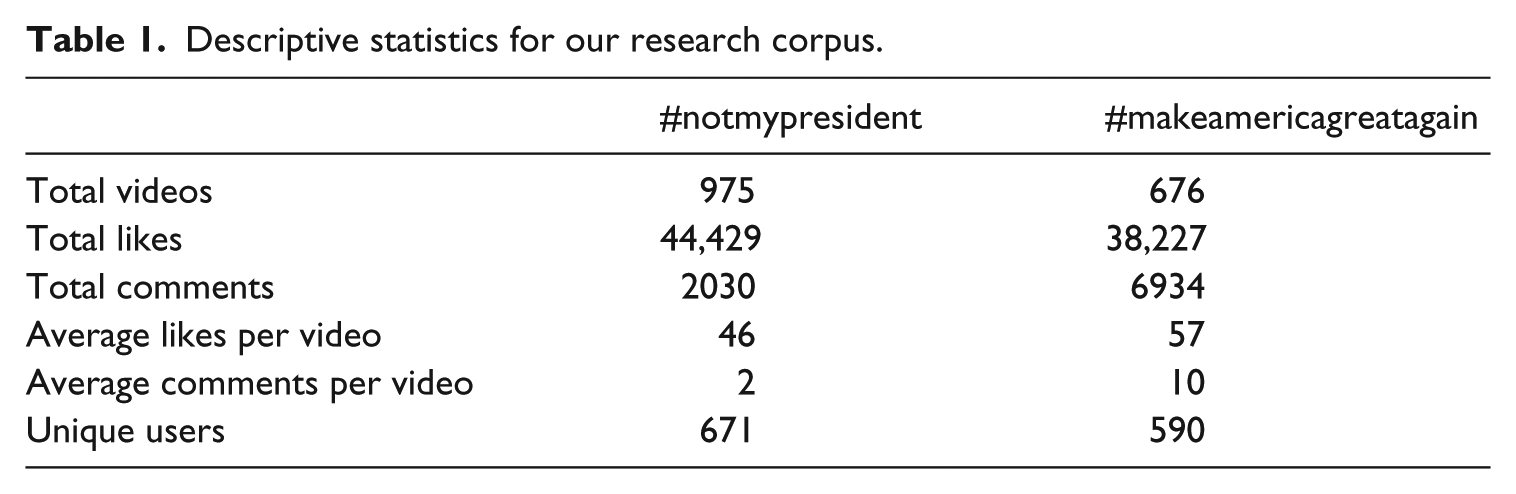
Omitting videos that have been set as private, our research corpus consisted of all publicly shared videos that use these two hashtags: #notmypresident (975 publicly shared videos) and #makeamericagreatagain (676 publicly shared videos). The data (N = 1651) were collected in January 2018, prior to the 1-year anniversary of Donald Trump’s inauguration. While musical.ly does not specify upload dates, we can infer based on the context of these hashtags that #makeamericagreatagain videos were posted both before and after the election, whereas #notmypresident videos were posted after the election in reaction to Trump’s win. In general use, the popularity of both hashtags peaked in the immediate aftermath of the election (Google Trends, 2018). A comparison of the hashtags (Table 1) shows that #notmypresident is larger in terms of the number of videos and users, though #makeamericagreatagain shows greater user engagement through average likes and comments. 2
Descriptive statistics for our research corpus.
We have received Institutional Review Board (IRB) approval for this research. Although all videos in our corpus were shared publicly, special precautions are needed when dealing with content produced and shared by minors (Livingstone and Third, 2017). We thus anonymized usernames and did not include any screenshots where users are visible. Neither specific videos nor comments are searchable within the app.
To examine how affordances and memetic variability shape collective political expression, and to understand how hashtags constitute memetic corpora by connecting related media artifacts, we employ a mixed-methods design combining quantitative and qualitative content analysis. For the quantitative coding process, we developed a detailed codebook for variables reflecting the three memetic dimensions identified by Shifman (2013): content, form, and stance (Appendix 1). Here, we build on a similar approach for coding other memetic corpora like meme families (Segev et al., 2015) and YouTube videos (Gal et al., 2016). Coding categories emerged during the initial qualitative overview of the data and were consolidated during two pilot reliability tests.
For content, we coded for videos’ political orientation, for explicit political message, and noted frequently used audio and visual content that recurred across the hashtags. For form, we coded for the different audio and video genres employed on musical.ly, as emerged from the data (i.e. for audio: using existing music, existing speech, original audio, or mixes; for video: lip-synching, creating original footage [with face visible or hidden], using found footage, or mixing these). Finally, for stance, we coded for participation structures (identity-related labels) and keying (ironic use of the hashtags). Taken together, these aspects help us get at memetic variability—the degree to which different units in the corpus differ from each other, both stylistically and ideologically (Gal et al., 2016).
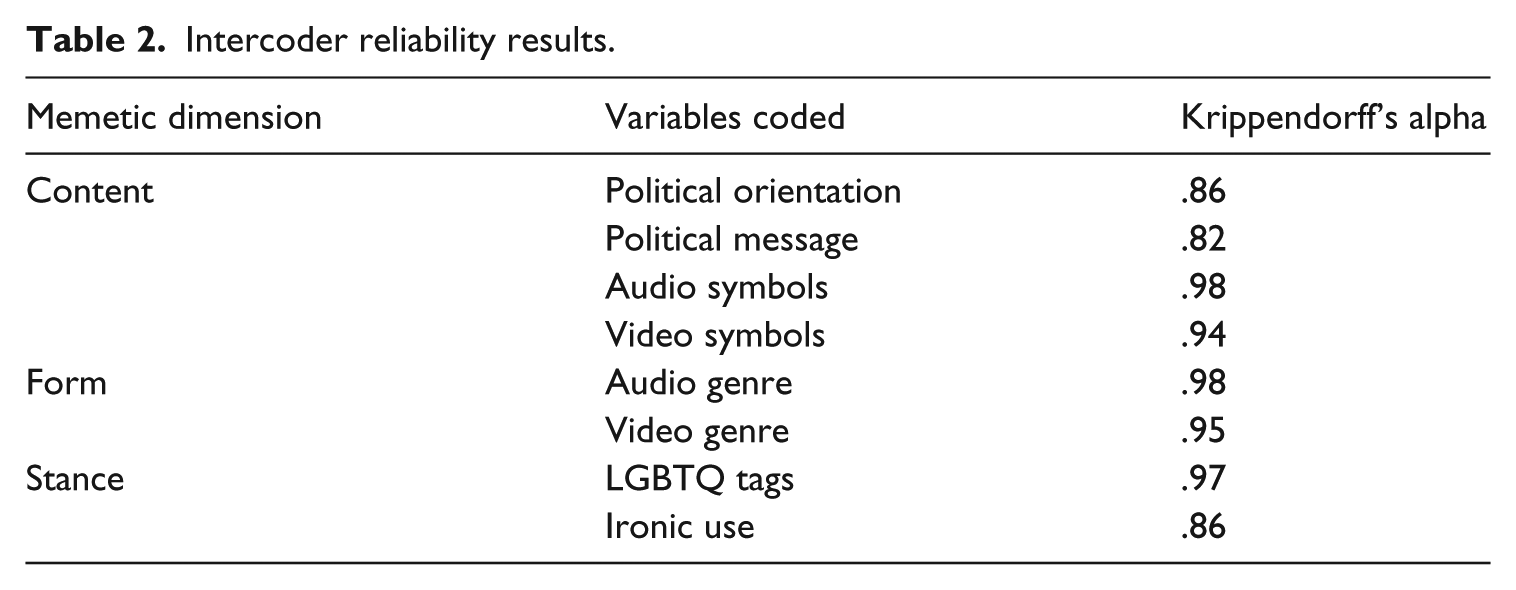
After continuously refining our codebook, we conducted an intercoder reliability test on 20% of the sample (N = 364). We assessed intercoder reliability through Krippendorff’s alpha coefficient (Krippendorff, 2004), a conservative index considered highly rigorous. While even a cut-off level of α = .67 is considered acceptable, Krippendorff (2004) suggests an alpha of .8 and above. As Table 2 shows, the agreement among coders ranged between α = .82–.98 for all variables coded, indicating very good agreement rates among the two coders. Once reliability had been established, the rest of the sample was divided for coding.
Intercoder reliability results.
Next, the videos were analyzed qualitatively to understand how collective political expression played out in terms of key themes, ideological variability, expressive choices, and use of platform affordances, as well as a contextualized understanding of stance. Our qualitative analysis also included examining the content of comments on videos, noting both typical and unusual comments and exchanges.
The two components of the research complement each other. The theory-based quantitative content analysis allowed us to deconstruct the musical.ly videos into disparate features (Gal et al., 2016; Shifman, 2013) in order to understand the content, form, and stance of youth collective political expression on social media. The qualitative analysis allowed us to look at the videos holistically and understand them in their respective contexts. Moreover, this mixed-methods approach facilitated a deep contextualized understanding of how youth use and combine specific platform affordances to express collective political affiliations.
Analysis of the hashtags by memetic dimensions: content, form, and stance
Content
One of the structural patterns tying together a memetic corpus is that aspects of content—ideas and ideologies conveyed by texts—are commonly reproduced throughout the memetic network (Segev et al., 2015). Within each hashtag, strong thematic similarities were exhibited among the videos, with a clear key theme emerging for each: thus, the two hashtags constitute two separate memetic corpora. The focus underlying #makeamericagreatagain was on Trump’s persona, while for #notmypresident, the main theme was one of protest.
The memetic corpora constructed by the hashtags vary not only ideologically, in terms of political orientation, but also in the fact that one represents support of a (now victorious) candidate, whereas the other is a protest slogan that directly opposes a current leader. Importantly, these differences are contextual; hypothetically speaking, the patterns of expression (e.g. candidate veneration vs opposition) might have been reversed if the election turned out differently. However, our interest here is in the ways in which musical.ly facilitates the voicing of both of these political discourses/positions, beyond and despite ideological and thematic contrasts.
The focus of #makeamericagreatagain videos on Trump’s persona is clearest in the 143 videos (21% of this hashtag’s corpus) in which musers enacted Trump by lip-synching audio excerpts of his speeches. Indeed, #makeamericagreatagain users employed speech excerpts significantly more than #notmypresident users (for audio genres, χ2(3, N = 1651) = 184.70, p < .0013—see Figure 2). The most popular Trump excerpt to enact was from one of his campaign speeches, in which he introduces himself (“I’m Donald Trump”), followed by three seconds of silence, and then “Thank you, thank you” to sounds of vigorous clapping. This excerpt, which appeared 44 times in #makeamericagreatagain videos, enacted by boys and girls of various ages, seems to convey the message that simply being Donald Trump is what it’s all about.
Other Trump lip-synch videos explored specific aspects of his public persona. Trump was conveyed here as a role model, with musers seemingly enjoying performing him and taking up his charisma. The most popular of these lip-synch videos used an audio excerpt from Trump’s campaign launch speech, called “I’m Really Rich!,” which refers to a hypothetical negotiation in which Trump won’t cede to anyone’s demands: “I don’t need anybody’s money. I’m using my own money. I’m not using the lobbyists. I’m not using donors. I don’t care. I’m really rich.” This excerpt appeared 17 times in #makeamericagreatagain videos. A popular exemplar was posted on election day by @rainfischer, a boy of around 12, standing in his kitchen in a Trump T-shirt and cap, performing the speech with exaggerated hand gestures and dramatic pauses. Enacting these popular speech excerpts—“I’m Donald Trump, Thank you” or “I’m really rich”—can be understood as specific memes, which constitute a subset of the larger memetic corpus of #makeamericagreatagain on musical.ly.
The sense of wanting to be like Donald Trump or seeing him as a role model was also reflected in the lyrics for songs used by musers, like the song Donald Trump by rapper Upchurch, the chorus of which ends with “And I’m always winnin’ like I’m Donald Trump,” or the lyrics for Donald Trump by Mac Miller: “Look at all this money! Ain’t that some shit? / Take over the world when I’m on my Donald Trump shit.” Importantly, emulating Trump included some more concerning acts too, as in a video where several teenagers in a high school grab at each other’s genital regions to reenact “grab them by the pussy.”
In #notmypresident videos, the key theme was one of protest, reinforcing the link between youth social media use and political protest (Valenzuela et al., 2012). This was most pronounced in videos of original footage taken at post-election marches or rallies. A total of 68 videos (7% of the hashtag corpus) depicted these physical protests from musers’ perspectives. The video descriptions emphasized acts of witnessing: “this was what it was like to make History today in DC.” Many users specified that it was the first time they participated in a protest, including both large-scale national events like the Women’s Marches in Washington, D.C. and also rallies in small towns. In these local contexts, some #notmypresident videos used musical.ly to mobilize others to attend protests (“be there. its gonna be around 10”). The soundtracks chosen by musers matched the protest theme: for instance, @vikkifeinberg chose Survivor by Destiny’s Child over pictures depicting her with pussyhat-donning friends at an anti-Trump rally, while @rtay4423 filmed himself holding protest signs to the soundtrack of Nicky Minaj’s Fly (“I came to win, to fight, to conquer, to fly”), with the description “do i look protest ready?”
Rettberg’s (2017) analysis of musical.ly stresses the significance of gestural expression on the platform. In #notmypresident videos, a particularly popular gestural expression was flipping off (i.e. showing the middle finger) to the camera: this act appeared in 117 (12%) #notmypresident videos, compared to four times in #makeamericagreatagain videos. As Segev et al. (2015) show, actions are the most frequent quiddity tying groups of memes together—thus, flipping off can be seen as a recurring action meme within the #notmypresident memetic corpus. In combination with the selected soundtrack (especially the two most popular songs, Not My President and FDT [Fuck Donald Trump]), this obscene gesture conveyed a strong reaction against the newly elected president (see Figure 1). Other collective expressions of protest consisted of gestural acts like shredding, burning, or otherwise destroying images of Trump or his campaign merchandise, as in the first example in Figure 1.

Examples of flipping off as a gestural expression of protest in #notmypresident videos.
A minority of videos on both sides (40, or 4.1%, of the #notmypresident videos and 43, or 6.3%, of the #makeamericagreatagain videos) were not explicitly political, meaning that the hashtag was the only explicitly political component in the video. A pertinent example is @_im_lee_.789_, a young girl who posted very popular videos lip-synching pop songs but tagged them #makeamericagreatagain, as well as other non-political tags (e.g. #badgecomedy and #thenextidol). Her six videos in our corpus were all in the top 11 most popular for #makeamericagreatagain. These videos can be seen as attempts to use the tagging affordances of the platform to simply boost attention (Highfield, 2016). This different use of the hashtag also illuminates the variability within the corpus, showing that not all #makeamericagreatagain or #notmypresident videos express a clear political position. At the same time, we do not want to minimize users’ agency: using a political hashtag on a non-political video may also be an indirect way to show affiliation with a collective identity.
Form
While the videos associated with the two hashtags differ markedly in their content, in terms of form—understood as the “physical incarnation of the message, manifested both in visual/audible dimensions specific to certain texts, and in more complex genre-related patterns organizing them” (Segev et al., 2015: 420)—they also show strong similarities.
For both hashtags, the affordance of audio choice was an important element for political expression, as songs, speeches, sound bites, or recorded sound added another layer of meaning to the videos. For example, #makeamericagreatagain users employed songs emphasizing a patriotic or American identity, such as Made in America (Toby Keith), God Bless the U.S.A. (Lee Greenwood), or The Star-Spangled Banner. In contrast, expressing their reaction toward the elected candidate, #notmypresident musers chose songs like American Idiot (Greenday), Loser (Beck), Fuck You (Lilly Allen), or March of the Resistance (Star Wars theme). While their song choices conveyed different meanings, users of both hashtags employed musical.ly’s affordance in a similar way: using pop culture artifacts as the “raw materials” to create political messages salient to their audiences (see Jenkins et al., 2016).
In fact, our data showed that not only the same affordances but sometimes the very same media content could be used by users of both hashtags to convey their respective political views. A strong example is an excerpt from Barack Obama’s victory speech upon his 2012 reelection: “It doesn’t matter who you are, or where you come from […] It doesn’t matter whether you’re black or white […] gay or straight, [loudly:] you can make it here in America!” This audio excerpt was used in 25 #notmypresident videos and 24 #makeamericagreatagain videos. #Notmypresident users lip-synched the words in an often solemn or emotional valence, sometimes adding their commentary in the description (e.g. “still proud to be an American, despite trump”; “#defendDACA”). Interestingly, #makeamericagreatagain videos did not employ the excerpt ironically, but presented it as a statement they too stand behind, perhaps due to its “American dream” connotation. This patriotic connection was exemplified by a young #makeamericagreatagain muser lip-synching the lines while brandishing a small American flag.
A different example is Donald Trump’s speech sound bite “We need to build a wall.” This appeared 19 times in #notmypresident and 23 times in #makeamericagreatagain, but was deployed in very different ways. #makeamericagreatagain users lip-synched “we need to build a wall” as a show of support, for example, @paranormal_fool lip-synching the line while proudly donning a Trump T-shirt. In contrast, #notmypresident users’ most common reaction was flipping off to the camera in response to this sound bite. Some also used that audio with their own critical text (e.g. “He is sooooo stupid #notmypresident #HateTrump”; “if you support trump, unfollow”).
Beyond these similarities, users of the two hashtags relied to different extents on certain types of audio and video in support of their political statement. Thus, users of the two hashtags differed in their use of audio genres (χ2(3, N = 1651) = 184.70, p < .001; see Figure 2). A post hoc analysis based on adjusted standardized residuals showed differences between the two hashtags in all audio categories, meaning that users of the two hashtags relied to differing extents on the use of existing speech, existing audio, original audio, or a mix of these categories. For video genres (χ2(4, N = 1651) = 61.95, p < .001), there were significant differences in three of the five video categories, meaning that users of the two hashtags differed in the extent to which they used original lip-synch footage, original non-lip-synch footage, or original footage without a visible face (see Figure 3).

Audio genre (percentage of total videos) for each hashtag.
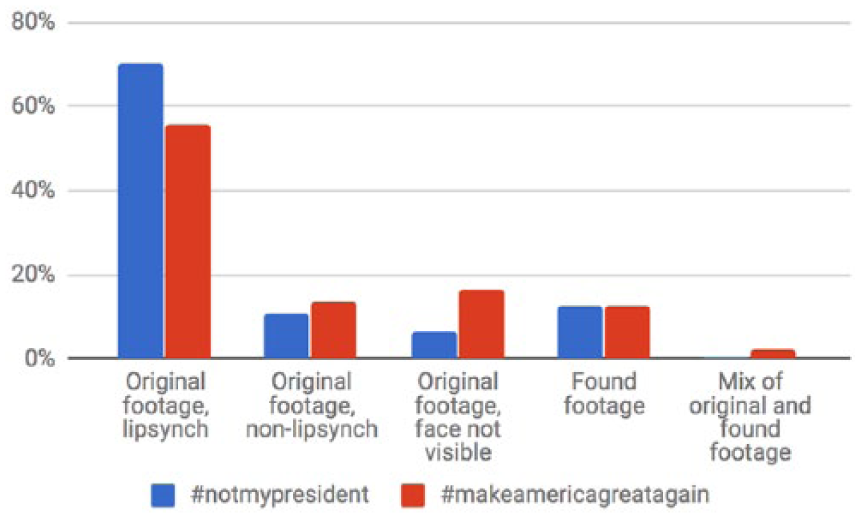
Video genre (percentage of total videos) for each hashtag.
These different media choices were driven by hashtag users’ respective messages and themes, as illustrated under the content dimension. Specifically, in terms of audio, #notmypresident hashtag users—emphasizing themes of protest and dissent—made more relative use of (often protest-related) existing music and mixed music with original recorded audio, 4 whereas #makeamericagreatagain hashtag users, emulating Trump and celebrating his persona, made more relative use of existing speech (overwhelmingly, Trump’s) and original recorded audio. In terms of video genres, #notmypresident hashtag users created more lip-synch videos, while #makeamericagreatagain users recorded more original videos (e.g. talking into the camera or creating short skits). Moreover, #makeamericagreatagain users posted more original videos where their face was not visible, but was outside of the frame or hidden by digitally animated or physical masks. In terms of digital animation masks, the “face filter” feature allowed users to choose from a range of animated faces, including ones that users commonly employed to represent Trump and Clinton (see Figure 4). The increased use of masks for #makeamericagreatagain users, usually ones depicting Trump, can be seen as another way to impersonate him, but may also be an attempt to conceal oneself. In light of these audio and video use patterns, the similarity of form within each hashtag illustrates significant connections between the videos and is further testimony to the ways in which the two hashtags constitute different memetic corpora.
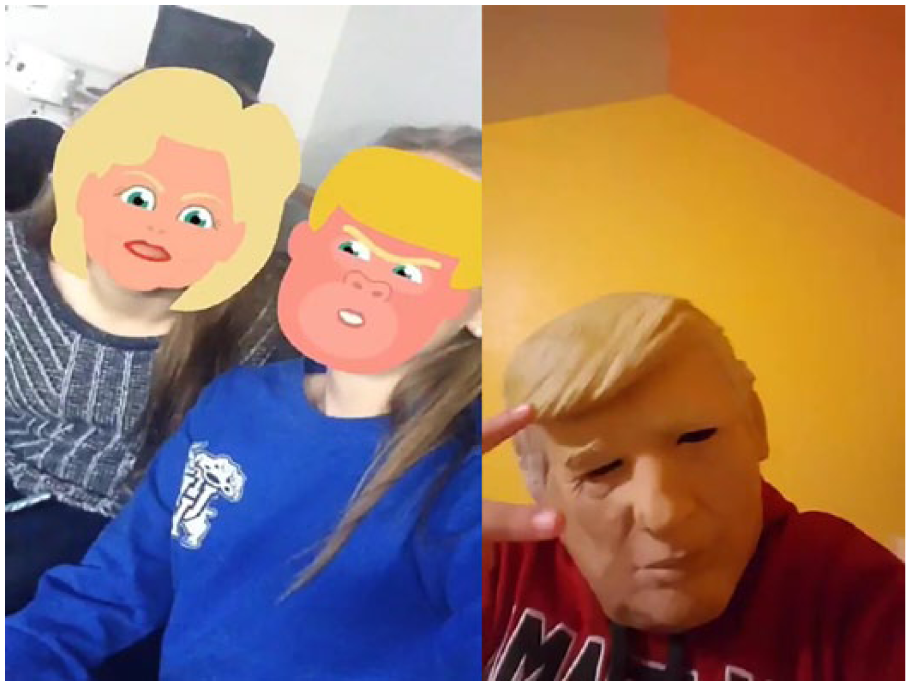
Use of digital masks (on the left, for Hillary Clinton and Donald Trump) and physical masks (on the right, for Donald Trump) in #makeamericagreatagain videos.
Stance
Under stance, referring to the “communicative positioning of the addresser” (Shifman, 2013: 369), we begin by exploring participation structures in the two hashtags. Age, as well as gender, sexuality, and race, emerged as highly salient dimensions.
Both hashtags included very young users, that is, elementary school children. Commenters on both hashtags used the age argument to attack others or disparage their political stances, for example, for #makeamericagreatagain, “what do you know? you’re 8 years old” or “shut up, i saw your profile and you’re 10,” and for #notmypresident, “you’re like 14 why would we listen to you”; “im old enough to vote so my opinion matters more than yours.” Age is regularly used as a marker of hierarchy for children, yet here this clashes with the context of democratic political expression, in which every individual is entitled voice.
Users of both hashtags employed identity markers to undergird their political views, though in the case of #notmypresident, these were mostly in relation to sexuality and ethnicity, while for #makeamericagreatagain, they were about class and lifestyle/culture. A significant proportion of #notmypresident users identified themselves as LGBT+ (309 videos, or 31.7% of the #notmypresident sample, contained LGBT+-identifying tags in the descriptions vs only 0.6% of the #makeamericagreatagain sample). Many of these videos included emotional, fearful reactions to the election or pleas for help, hope, or solidarity. A powerful example is @jacob.marisco’s #notmypresident video, which consisted of a slideshow of photos depicting their female-to-male transition. The description read, “I’m transgender and proud, trump can’t take my rights away.”
Other #notmypresident videos addressed implications for racial minorities and immigrants. Notable examples include @goddess_kalista05’s lip-synch of the song White Privilege II (tagged “#blacklivesmatter#whiteprivilage#notmypresident#[middle finger emoji] #black”). Similarly, @threepiggiesarehome, a Hispanic muser, added #iamamerican to her video description, and several musers lip-synching in Spanish used #DACA and #defendDACA as hashtags alongside #notmypresident.
For #makeamericagreatagain users, dominant identity markers included ‘country,’ ‘redneck,’ and ‘white.’ These were expressed in different combinations, for example, in usernames such as @countrygirl_blondie19, @redneckcountryavery, @sowhitetrash, and @calebthewhitekid. However, a few #makeamericagreatagain usernames highlighted minority identities, as in @asianfromchina and @africangoddess—though these were the exceptions.
In addition to identity markers, other stance features also underscored the collective nature of political expression within hashtags. Especially in #notmypresident, video descriptions frequently included the phrase “inspired by [@username],” to denote affiliation with similar political videos on musical.ly. Combinations of hashtags were also often reproduced across videos: for instance, the series “#notmypresident#lovetrumpshate#shook#stopbullying #musicallys#musicals#daca#lipsync” appeared, in the same order, across many videos.
As previously discussed, seeing hashtags as a form of collective expression does not assume all hashtag users convey the same ideology. In terms of keying, Shifman (2013) considers “the tone, or modality, of the internal framing of discursive events as formed by their participants” (p. 369). This includes ironic keying. Thus, acknowledging the potential for hashtag hijacking (see, for example, Jackson and Foucault-Welles, 2015; Thorson et al., 2016), we coded videos for ironic use, identifying videos that conveyed an opposite ideological stance. Ironic use within the hashtag is an important marker of ideological variability within the corpus. Here we found significant differences between the hashtags (χ2(1, N = 1651) = 45.06, p < .001): ironic use was very rare in #notmypresident videos (2.5%, or 24 videos, were ironic, of which 23 were created by one user) versus 10.2% (69 videos) in #makeamericagreatagain. In ironic #makeamericagreatagain videos, users hijacked the hashtag, like @ellie.redhair who, to the sound of Trump’s “Make America Great Again,” gestured “no” and wrote: “Trump isn’t doing anything for this nation lol.” Others put #makeamericagreatagain on anti-Trump memes like “Donald Trump was elected … RUN!!!” or “I’m moving to Canada.”
In terms of the “tone and style of communication” (Shifman, 2013: 367), #notmypresident videos were characterized by serious somber keying, and in terms of communicative functions, often fulfilled emotive functions oriented toward the addresser and their emotions (Shifman, 2013). Examples include @natrenton12’s video, filmed in her kitchen, where she is holding back tears while addressing the “Rainbow [LGBT+] community” in light of the election results. Emotive communication was also expressed in the meta-text: hashtags like #crying, #sad, or #shook came up often in #notmypresident videos. In contrast, #makeamericagreatagain videos were more lighthearted, with a lot of fooling around and a general atmosphere of having fun. The emotive function often consisted of conveying happiness about Trump winning, such as @daddycons smilingly dancing to the Trumpetts’ Trump Train song, with the caption “When ur too hyped trump won!”; @gallinak06 writing, “Look who won!! Yay!” to the song “Hi Hater” by Maino; or @punk_papi showing a slide saying, “trump won assholes yaaaaa.” Some of the more serious videos of this hashtag evoked patriotic sentiments, evidenced by the frequent use of American flags (our data showed 23 American flags for #makeamericagreatagain vs 3 for #notmypresident). Such stark tonal contrasts illustrate the wide range of expressive possibilities enabled by musical.ly’s affordances.
In considering videos with a conative function, “oriented toward the addressee and available paths of actions” (Shifman, 2013: 367), a pertinent question to explore is the relation between political expression and other forms of political action (Penney, 2015; Valenzuela et al., 2012). Both video corpora speak to this relationship. #makeamericagreatagain videos, many of which were filmed before the election, mostly highlighted voting as the key act for the democratic citizen. @skye_is_fly, a well-known (non-political) muser with over 500,000 fans, created a mashup of herself singing “I voted!” and tagged the video #makeamericagreatagain. Some of her fans, who didn’t necessarily know her political views, criticized her candidate choice, but there was general consensus around voting, as exemplified in this comment: “Guys, don’t be mean to her because she voted for Trump. As Americans we are allowed to vote for who we want and shouldn’t be judged for it.”
For #notmypresident videos, filmed after the election, conative functions took the form of a pronounced emphasis on protest and activism. In addition to the aforementioned marching and protest videos, notable was @vanessacyruss’ video, consisting of a screenshot of her signature on an anti-Trump petition on change.org. Commenter @prancingpenny responded, “thank you i just signed it i will be spreading it around.” Significantly, for many musers, creating musical.lys and sharing them was seen as important political action. For instance, @millalzarounian33 wrote about her #notmypresident video: “this is my first form of protest.” Liking and sharing were presented as pathways for action, or ways to show support, highlighting the sense of collective political expression (e.g. “like/comment if you agree”; “like for Trump and comment for Hillary”). This was clear in @lia_jadeisqueer’s video plea on #notmypresident: “I’m about to start protesting to get my LGBT rights back. […] So help me, like this video, share on social media, comment, tag me […] Stand up for yourself.”
Discussion
This research illuminates emergent forms of political expression embraced by young people today, focusing on musical.ly as a social media platform that is particularly popular with this demographic (Robehmed, 2017), yet is vastly understudied (Rettberg, 2017), particularly as a site for political expression. Our analysis shows the myriad ways in which young people use, mix, and subvert the affordances of the platform to collectively express political stances in ways that are often surprising to adult audiences (see Jenkins et al., 2016).
Through this analysis, our work contributes to a deeper understanding of how social media affords collective political expression—understood as deliberately connecting to an assumed audience with similar beliefs by making use of shared symbolic resources. Our analysis exemplified the act of connecting to an imagined audience by adding one’s voice to an existing wider conversation. In our case, this was done primarily through hashtag use. By tagging one’s video with #makeamericagreatagain or with #notmypresident, users were not only self-expressing but also becoming part of a larger discourse. The hashtags created a space of shared visibility, where one could connect with like-minded audiences and also be visible to other audiences with different views. The assumption of an audience with similar beliefs is facilitated by the visibility and popularity of hashtags identified with certain political views. Of course, the hashtag represents a broad allegiance, a “big tent” (Thorson et al., 2016) within which there is variability and many gradations in the expression of a similar political view (e.g. showing protest by flipping off vs by burning images of Trump). As an important methodological and conceptual point, musical.ly may include many other videos that support or dissent toward Trump, but by choosing to tag their videos with these two major, most visible hashtags, these users were constructing and expressing an allegiance with a wider audience. In contrast to concerns about context collapse on mainstream platforms like Facebook, employing collective political expression on musical.ly (through the use of these hashtags) enables users to speak to a like-minded audience, perhaps making it easier to convey non-consensual political views. While we cannot capture users’ intentions, we read the use of hashtags in this context as a deliberate and strategic move (Jackson and Foucault-Welles, 2015). Importantly, we must also highlight what our sample doesn’t show us: the content of those users who employed these hashtags but also chose to set their videos as private.
Moreover, within each of these hashtags, we saw the use of shared symbolic resources that make their allegiance visible. The hashtags themselves are shared symbolic resources: political slogans that appeared in the corpus not only to tag the videos but also on protest signs, songs, and campaign merchandise. Moreover, within each of the two hashtags, using similar music (sometimes the very same song, as for #notmypresident, sometimes a genre, like patriotic songs for #makeamericagreatagain), the same speech excerpts (eg. “I’m Donald Trump … Thank you”), or the same gestures (like flipping off) were all resources that enabled musers to express—through content, form, and stance (Shifman, 2013)—a shared political statement.
Of course, the different contexts surrounding the two hashtags—celebration versus indignation, campaign-slogan versus protest-chant—created contrasts between the corpora, which our mixed-methods design was able to illuminate both quantitatively and qualitatively. However, more significantly, our analysis shows how, despite these differences, users of both hashtags employ musical.ly’s affordances and conventions in very similar ways—for example, overlaying pop culture music (be it patriotic music or angry rock) on original filmed content (be it celebrating or protesting Trump’s win) to help convey a political message that will resonate most with one’s (respective) imagined audience.
Thus, while the two hashtags constitute two different memetic corpora, they can also be seen as part of a larger corpus, for example, “election-related musical.ly videos.” This is particularly apparent when musers use the very same media content (e.g. Obama’s “you can make it here in America” or Trump’s “build a wall” excerpts), even though they make opposite political claims. In that sense, both hashtags can be seen as speaking a broader shared language, “the language of the platform,” one that facilitates conversation between them—and indeed, in comment sections, we do see interaction across political differences. It is therefore important to stress that assuming a like-minded audience with similar beliefs does not necessarily mean that collective political expression is solely directed toward that audience. In collective political expression, adding one’s voice to existing conversations both depends on and contributes to the shared visibility of various political stances (Bennett and Segerberg, 2012). While aligning with one, there is the possibility to speak to both.
Our study also contributes to the understanding of the relationship between hashtags and memetic content. In our case, the political hashtags serve as abstract quiddities, like phrases (Segev et al., 2015), each tying together a memetic corpus (Gal et al., 2016; Shifman, 2018). However, beyond that, within each memetic corpus we found the use of more specific memes, tied together by various quiddities (e.g. actions such as flipping off). Our research also identifies a new kind of quiddity in addition to those identified by Segev et al. (2015): using the same sound bite (such as “You can make it here in America”), which can be overlaid with a different recorded video. This is a quiddity specific to video modality, and particularly to the musical.ly platform, which affords the easy overlaying of audio and video.
Understanding how social media afford collective political expression has important implications for political participation more widely. In interview-based research, participants often see continuities between “symbolic action” on social media and other traditional forms of participation (Penney, 2015). Building a collective identity is identified as an important precursor for political mobilization, and studies have shown how social media may enable political mobilization (e.g. Valenzuela et al., 2012) often based on broad, but hazy, collective identities (Bennett and Segerberg, 2012). In our data, we saw some attempts for political mobilization based on these broad hashtags, for example, sharing information about local protest marches through #notmypresident or calling to vote for Trump in #makeamericagreatagain. While future research can further examine how such hashtags might act as precursors for political mobilization, the collective expression that occurred within these two hashtags exemplified the importance of the visibility of like-minded others, as afforded by political hashtags.
At the same time, while our findings illuminate how social media facilitate and amplify youth political expression, it should not be uncritically celebrated. We must be cognizant of the different power structures and “participatory intensities” that characterize participation (Literat et al., 2018; Jenkins and Carpentier, 2013). As musical.ly asserts ownership over youth-created content and shapes creation and circulation through its affordances, there are significant power imbalances between the platform and its users. For example, platforms can choose to limit search by hashtags, as Instagram did with a list of banned hashtags: hashtags that were explicitly sexual, fascist, or racist could be included by users, but searching for them would not return results (Highfield, 2016: 24). On musical.ly, too, certain hashtags, considered vulgar, are hidden from searches. Moreover, there are imbalances between users themselves, given their varying levels of popularity, with implications for how loud and far their civic voice travels. In some ways, the hashtag serves to counteract this by allowing less-prominent users to attach themselves to salient trends and thus gain attention and voice.
Finally, this research is grounded in the specific context of musical.ly as it existed in 2016–2018. While musical.ly’s successor, TikTok, has kept these same affordances, it is yet unclear whether TikTok may shape expression in different ways (given, for instance, the decreased emphasis on music, suggested by the new name) and may therefore also create a different landscape for political expression. Future research should examine these dynamics in additional social media platforms, to comparatively illuminate how different affordances shape young people’s political expression. For example, a comparative investigation of youth-created political content on TikTok versus YouTube and Instagram (currently, the leading social media platforms among youth demographics; see Pew Research Center, 2018) would not only highlight the specificity of each platform’s affordances but also help crystallize a cross-platform understanding of youth collective political expression.
Footnotes
Appendix 1
Acknowledgements
The authors would like to thank Limor Shifman and Nathan Walter for their conceptual and methodological assistance, as well as the three anonymous reviewers, whose constructive comments and suggestions were very helpful in strengthening this article.
Funding
The author(s) disclosed receipt of the following financial support for the research, authorship, and/or publication of this article: The research reported in this article was made possible by a grant from the Spencer Foundation (#201900088). The views expressed are those of the authors and do not necessarily reflect the views of the Spencer Foundation.
