




Abstract
Theoretical and empirical evidence suggests disparate racial impact frames may lead to selective sharing on social media and result in differential retransmission rates across racial groups. In this online study, we (1) examined reported exposure to and sharing of content about race on social media among Black, White, and “Other” race/ethnicity college students (N = 150); (2) experimentally tested how exposure to news story previews with control, implicit, or explicit disparate racial impact frames affected subsequent sharing intentions; and (3) explored reasons students provided for their intentions to share/not share the stories. Black students reported more exposure to and sharing of content about race on social media. Few participants cited discrimination in open-ended responses explaining sharing/non-sharing intentions. Nevertheless, despite holding story topic and source constant, disparate racial impact frames resulted in differences in sharing intentions among Black and White students, demonstrating these frames can influence selective sharing intentions.
Media coverage helps shape the public and policy agenda (King et al., 2017; Protess and McCombs, 2016), but how people are getting their news is changing. Social network sites (SNS) are an increasingly common way that Americans—especially young adults—are exposed to news (Matsa and Shearer, 2018). While traditional media is characterized by more centralized and professionalized gatekeepers, with SNS, individuals in the network serve as decentralized gatekeepers (Meraz and Papacharissi, 2013). A person’s social network, along with SNS features, can affect exposure; even young adults who do not intentionally seek out news are incidentally exposed (Rosengard et al., 2014).
Increased intentional and incidental exposure to news via SNS underscores the importance of understanding information diffusion in social networks and its contribution to communication and social inequalities (Southwell, 2013). When people in different social groups have differential access, exposure, or responses to mediated messages that could help to address social issues, these communication inequalities can in turn affect demographic disparities (Niederdeppe et al., 2013; Viswanath, 2006). Communication inequalities and selective exposure are especially relevant in the current social media environment given platform opportunities for customization and concerns about SNS’ role in race-related disinformation campaigns and filter bubbles that can promote social polarization (e.g. Pariser, 2011; Sunstein, 2001 but also see Fletcher and Nielsen, 2017).
Much of the research in the selective exposure paradigm has focused on selective exposure and attention (i.e. seeking out and attending to information) and looked at it in the context of political partisanship (e.g. Bakshy et al., 2015; Stroud, 2010). Some research has examined selective sharing based on whether information being shared supports the sharer’s political worldview (Barberá et al., 2015; Shin and Thorson, 2017). However, race is an intertwined and enduring demographic fissure in the United States that influences worldview (Hutchings and Valentino, 2004). Scholars are increasingly recognizing that racial, ethnic, and national identities have received short shrift in selective exposure work (Wojcieszak and Garrett, 2018). There is evidence that race (Appiah et al., 2013; Knobloch-Westerwick et al., 2008) and racial identification (Schieferdecker and Wessler, 2017) intersect with selective exposure to shape media diets. Yet, published research that specifically examines selective sharing based on race and how it relates to news frames with racially relevant content is scarce.
This study examines race and selective sharing among young adult college students, a demographic that has historically been central to social movements and catalyzing social change (e.g. Astor, 2018). By selective sharing, we mean an individual choosing to share or not share information with their network on social media (Shin and Thorson, 2017). Selective sharing implies that perceptions of the sharer in conjunction with message content affect the sharing decision. We focus on news messages that constitute communication about disparities (Niederdeppe et al., 2013), specifically disparities in outcomes that disproportionately affect and disadvantage racial minorities. Policies with disparate impact are those that may appear neutral (e.g. voter ID restrictions, using policing to raise revenue for government, and zero-tolerance policies in schools), but nevertheless have unequal effects on social groups—such as racial groups—due to structural factors, including institutional racism and discrimination. News about disparate racial impact, therefore, represents mass communication about disparities in outcomes. Prior research finds that frames that emphasize disparate racial impact can affect policy support for issues such as voter ID laws (Wilson and Brewer, 2016) and criminal justice reform (Hetey and Eberhardt, 2018).
In this study, we use a survey experiment combined with analyses of open-ended responses to explore whether, given equal exposure to news about the same topics from the same sources, news frames that emphasize disparate racial impact are likely to result in racial differences in selective sharing. Below, we present theoretical and empirical evidence arguing for differential racial patterns in exposure to and sharing of content with disparate racial impact frames. Our primary focus is on Black students and White students, but we include students from other racial groups for comparative purposes.
Race and exposure to disparate racial impact frames
For Black Americans, being a visible minority has historically made that aspect of identity especially salient in shaping self-identity (McGuire et al., 1978). Such identity salience is particularly likely for subordinated minorities where the focus is often on comparison to a dominant normative group (Pratto and Stewart, 2012). Coverage of disparate racial impact has typically focused on the Black community and Black disadvantage because news stories tend to frame intergroup social comparisons in terms of Black disadvantage rather than White advantage (Gandy and Li, 2005). When a negative outcome is emphasized as producing worse outcomes for Black communities in news coverage, these intergroup social comparison frames reinforce the entitativity of the racial group (Campbell, 1958) by reinscribing race as a consequential social construct, as well as positioning it vis-à-vis shared understandings about racial hierarchies in the public sphere (Kahn et al., 2009). Specifically, these frames reflect social facts rooted in historical legacies rather than being due to biological differences; Black Americans tend to be comparatively worse off than other groups, including other minority groups, in the United States across a variety of life domains (Stanford Center on Poverty and Inequality, 2017).
In a recent study of perceptions of online content, communication about systematic racial inequalities and disparities (e.g. being informed about higher suspension rates for minority students and unfairness in healthcare for minorities) was characterized as vicarious exposure to “racist reality” and loaded as a subcomponent of online vicarious racism—racism experienced via mediated sources rather than firsthand (Keum and Miller, 2017). Racial intergroup social comparison frames have been seen as stigmatizing deficit frames that can inadvertently add to cumulative disadvantage (particularly those that emphasize minority disadvantage, rather than majority group privilege) (Gandy, 2009), a crucial step for raising awareness as a precursor to meaningful social and policy change (Mazzocco, 2017), and as a potentially ineffective and polarizing communication strategy (Robert Wood Johnson Foundation, 2010; Williams and Purdie-Vaughns, 2016). These characterizations are not necessarily mutually exclusive. The contested nature of race in society means that audience reception and interpretation of reasons for racial status differences and differences in outcomes are contingent on prior audience understanding of race and race relations in conjunction with any proffered media (i.e. news) frame (Price and Tewksbury, 1997; Scheufele, 1999). To the extent that identity affects what race-related media frames mean personally and socially, it is likely to affect selective sharing and information retransmission of news about disparate racial impact. Thus, it is important to explore how the “social” aspect of social networks affects communicative selectivity surrounding retransmission of news on SNS, particularly in coverage whose core argument can be read as communicating about race-related intergroup comparisons to raise awareness about social inequalities.
Intentional exposure
Several theoretical frameworks argue that race affects intentional exposure to media content about race due to its identity relevance. Reinforcing spirals theory posits that use of media content that aligns with social identity, such as race, results in greater salience of that social identity and associated values and attitudes, which in turn leads to selection of media that is congruent with the primed identity (Slater, 2007). Social identity gratification approaches specifically predict that Blacks, especially those with strong racial identification, will avoid negative or stereotypical portrayals of Blacks (Abrams and Giles, 2007). However, a person’s interpretation of disparate racial impact frames as positive or negative is likely to be intertwined with their understandings of race, race relations, and racial identity. Thus, media selection (i.e. relating to selective exposure) and subsequent frame interpretations (i.e. relating to selective attention and perception) are likely to be at least partially linked to racial socialization and identity. Other theoretical frameworks based on racial distinctiveness predict a more general appetite for news that is relevant to one’s racial group when one is a racial minority (Knobloch-Westerwick et al., 2008). Racial distinctiveness is particularly relevant for Black college students at predominantly White universities because they are in an integrated offline environment where race stands out as a distinguishing feature. Moreover, there is evidence that Black college students seek out and pay more attention to news online that is ostensibly about Blacks (Knobloch-Westerwick et al., 2008), regardless of whether the story appears to be positive or negative (Appiah et al., 2013).
Building on these tendencies, in the current social media context, exposure among Black students to media that addresses race would be expected to be intensified for several reasons related to intentional and incidental exposure. First, there is the ability for individuals to intentionally seek out content based on identity and subscribe to (e.g. like and follow) those sources (i.e. via customization). While Blacks and other minorities have historically sought out culturally relevant news through ethnic newspapers and alternative media, online forums like “Black Twitter” and culturally relevant SNS sites and pages within SNS platforms provide greater opportunities to follow both traditional and non-traditional sources of culturally relevant news, uninhibited by geographic location (Brock, 2012). This would make it easier to find these sources of information. Furthermore, unlike daily or weekly print publications and television before cable news, social media offers a constant stream of news and commentary, and thus greater opportunity for incidental exposure.
Incidental exposure
Although some prior research suggests that those with strong racial identification may be particularly interested in Black-oriented media (Appiah, 2004), even those who may not personally identify strongly are likely to be incidentally exposed due to racial homophily (McPherson et al., 2001; Mollica et al., 2003). On average, Black Americans would be expected to have a higher concentration of online social ties to other Black Americans due to kinship and more opportunities to form offline relationships in a society that continues to reflect a legacy of de jure segregation. This offline propinquity, along with racial homophily, increases the opportunity for online incidental exposure due to social network ties among Blacks (Wimmer and Lewis, 2010). If Blacks intentionally seek out and share content that is about race more often than Whites as is suggested by reinforcing spirals theory, distinctiveness theory, and social identity gratification approaches, people connected online to those networks should have a greater chance of exposure to that content. Since Black students are on average more connected to other Black people (Wimmer and Lewis, 2010), they should be overall be more exposed to content about race than Whites by virtue of their online ties being more likely to post it.
Selective sharing and the networked audience
In selective exposure, the focus is often on how identity-relevant aspects for an individual, including worldview, align with media content. However, in thinking about exposure’s counterpart—how content might affect sharing on social media—the perceived audience and the social network likewise would be expected to be a factor. Many of the most common social media platforms, such as Facebook and Twitter, are designed in ways that encourage not only recirculation of old events via time collapse (Brandtzaeg and Lüders, 2018) but also blurring of audience via context collapse (Marwick and boyd, 2011).
Context collapse potentially affects sharing, particularly when the imagined audience is perceived as heterogeneous with regard to how they may interpret and respond to the shared content that a person otherwise agrees with and would share. There is evidence that Americans are polarized along not only ideological (Pew Research Center, 2017) but also racial lines when it comes to race and questions of racial discrimination (Pew Research Center, 2016). If disparate impact frames are considered polarizing and constitute conflict frames, they may be less likely to be shared (Valenzuela et al., 2017). There is some evidence that people are particularly reticent to share potentially controversial information with family and friends (Matthes et al., 2018). Some people may agree with a message, but nevertheless may be reluctant to share a message that goes against perceived sentiment of some in a social network for fear of social repercussions for oneself (Moy et al., 2001; Noelle-Neumann, 1974; Neubaum and Krämer, 2017, but also see Fox and Holt, 2018).
Sharers may also consider repercussions for others in their network. Applying Heider’s balance theory to a networked masspersonal context, sharing such information may be perceived as likely to elicit SNS dissonance and expose divides between friends or family who hold opposing views on controversial issues, thus affecting sharing decisions in networks that are perceived as heterogeneously aligned on a given issue (Glynn et al., 1995). Conversely, in networks that are perceived as already overall accepting of a particular message, such as agreement that racial disparities exist and are due to discrimination, sharing would be expected to be facilitated by perceived network norms. Based on the empirical evidence, Black Americans are more likely to hold these views than White Americans (Pew Research Center, 2017), who are on average less aware and less receptive to such views (Mazzocco, 2017; Pratto and Stewart, 2012). Ethnic minorities may also be more likely to see information that is framed as disadvantaging their salient ingroup identity as relevant to both themselves and to others in their network, as well as more likely to find a receptive audience where the message reinforces social connections and group identity rather than eliciting dissonance among important others. These factors could result in a higher concentration of similar messages among people connected to those networks.
Empirical evidence for differential exposure to and sharing of content about race
There is already some empirical evidence that Blacks are exposed to and share more content about race on social media. In a 2016 study conducted by Pew Research Center, 64% of White social media users said content about race was rare or nonexistent for them online (Anderson and Hitlin, 2016). Conversely, 68% of Black social media users reported exposure to at least some content on race and race relations. Importantly, Blacks in the study also reported posting more about race and race relations on social media. Hispanics reported levels of exposure and sharing that fell between levels reported by Black and those reported by Whites (Anderson and Hitlin, 2016). When researchers examined the kinds of content that generated tweets, they found that current events—including high-profile violent deaths of African Americans and responses to those events—and more general discussions of discrimination were catalysts for posts on social media (Anderson and Hitlin, 2016). We therefore expected that Black college students in our sample would report more exposure (H1) and posting (H2) of content about race compared with their White counterparts and that other racial groups would fall somewhere between.
To our knowledge, no experimental studies have tested whether there are differences in selective sharing intentions on social media based on inclusion of disparate racial impact frames in news. However, the research has important implications for those who are concerned with communicating about disparate impact and gaining public support for policy change. Disparate racial impact is a frame that is important to investigate because it seeks to causally link racial disparities to structural upstream factors, thus shifting the focus from personal behavior to policy impact and raising awareness of the need for institutional changes. Theoretical and empirical evidence suggests that frames that emphasize disparate impact for minorities would be expected to lead to selective sharing and differential retransmission rates based on race, with potential downstream implications for information exposure within online social networks, issue awareness, and policy support for topics that are predominantly framed in that way. We used an experimental approach to explore whether, given equal exposure to news about the same topics from the same sources, frames that emphasize disparate impact are likely to affect information diffusion online. Our focus is specifically on whether news frames that discuss disparate racial impact implicitly in a colorblind manner (e.g. via class and geographic cues) (Hurwitz and Peffley, 2005; White, 2007), or via explicit racial cues, influence intentions to share news stories on social media based on the race of the sharer.
The between-subjects experimental design allows us to disentangle selective exposure from selective sharing and assess whether the message frames affected sharing intentions in a way that suggests differential racial diffusion of news due to selective sharing. We hypothesized, News that highlights explicit disparate racial impact would result in race of the sharer emerging as a factor in sharing intentions among college students such that explicit disparate racial impact frames would lead to fewer White and more Black students intending to share the stories (H3). Because implicit frames afford a greater latitude of interpretation on the part of audiences and rely on greater prior knowledge and exposure to particular schemas that link the topics to racial impact, we asked (RQ1) Will race of the sharer emerge as a factor in sharing intentions among college students when disparate racial impact is implicit?
To understand salient factors in the sharing process, we analyzed open-ended responses that participants provided. The open-ended responses allow us to examine which story topics students said they intended to share and factors that students believe influence their sharing. We asked (RQ2a) Which stories did students intend to share and (RQ2b) what reasons did students give for their intentions to share? The responses also enable us to examine why students did not intend to share the stories, an understudied focus in the literature on SNS news sharing (Kümpel et al., 2015); What reasons did students give for not sharing the stories (RQ3)? Finally, we examined whether disparate racial impact frames led students to mention discrimination or differential treatment in their answers on why they would or would not share a story (RQ4).
Method
Study participants were recruited at a large predominantly White US university following IRB approval in Spring 2017. Students received course credit in exchange for their participation in this online study hosted by Qualtrics. After consenting, participants were randomly assigned to one of four experimental conditions: no exposure, control, implicit racial impact, and explicit racial impact. Assignment to the conditions was stratified by race. Students in the control, implicit racial impact, and explicit racial impact conditions were shown a mock news feed with four news story previews adapted from real news coverage. They were then asked whether they would share any of the stories on social media and why or why not. The survey collected demographic information prior to the experimental study and questions about participants’ exposure to and posting of content about race after primary study outcomes had been collected. Afterward, students were debriefed. Because the no-exposure condition is not relevant for our current research questions, participants in that condition were excluded from the analysis, as were four students who reported having taken the survey previously.
Sample
The final sample (N = 150) was classified as non-Hispanic White (n = 63), non-Hispanic Black (n = 49 Blacks), or “Other” (n = 38) (e.g. Asian, Hispanic/Latino, Middle Eastern, American Indian/Alaska Native, and multiracial students) based on self-reported racial identification. The sample was 73.3% women and had mean age of 20.27 years (SD = 1.67). A majority self-identified as Democrats (n = 100), which is unsurprising since it was a predominantly female, college-age sample, and a majority of the participants were non-White. The remainder identified as Republicans (n = 23), or Independents/Other (n = 27).
Stimuli
Each of the four article previews in the mock news feed included a stock photograph without people, an article headline, and a summary lede that reflected areas of disparate impact from prior literature (e.g. health, criminal justice, voting access, and school discipline disparities). Only the lede differed across conditions. Example stimuli are in Appendix A in Supplementary Material. We anticipated race would be a predictor of sharing intentions when the majority of the story ledes highlighted that low-income Blacks and minorities (explicit race cue) were disproportionately impacted by a policy (i.e. voter ID restrictions, “policing for profit” to raise revenue for government, and zero-tolerance policies in schools) and that race might also emerge as a factor when poor/low-income people in racialized geographic areas (implicit cue) were reported to be disproportionately impacted. To make the experimental manipulation less obtrusive, a lead poisoning story preview that did not mention disproportionate impact was held constant across conditions.
Measures
Demographics and prior behavior
We measured relevant demographic and behavioral factors, including self-reported race, political party identification, and prior exposure to and sharing of posts about race. The latter two items were from the Pew study (Anderson and Hitlin, 2016). The exposure item asked, “Thinking about the different types of posts you see within your social media, approximately how many would you say are about race or race relations?” The sharing item asked, “Thinking about the things you personally post or share on social networking sites, approximately how many would you say are about race or race relations?” Response options for both questions were most, some, only a few, and none. These items allowed us to compare our college sample reported exposure to posts and sharing behavior for content about race to a national adult sample.
Intention to share on social media
After reading a set of four news previews, participants were asked, “Would you share any of these articles on social media?” If they answered “no,” they were asked to provide a reason why they would not share the stories. If they answered “yes,” they were asked which stories they would share and why.
Analysis
Quantitative analyses were conducted in IBM SPSS Statistics 24 and Stata 13. We used Fisher’s Exact Test (specifically, the Fisher–Freeman–Halton exact test in SPSS for matrices larger than 2 × 2 that have small expected cell sizes) to examine whether implicit and explicit racial impact frames rather than topic resulted in racial differences in sharing intentions and χ2 for the overall test of racial differences in exposure and sharing behavior within conditions. We tested interactions and controlled for political identification using logistic regression in Stata.
Analyzing open-ended responses is useful to obtain a descriptive answer on a phenomenon from respondents’ own perspective that one cannot generally acquire through closed-ended questions (Popping, 2015). We analyzed the open-ended responses by relying on a mix of a priori coding categories based on the message frames and a grounded approach that utilized constant comparison methods to develop coding categories and explore emergent themes (Bradley et al., 2007; Ryan and Bernard, 2003). Based on the experimental frames, we established a priori codes for mentions of discrimination or differential impact on a social group. In addition, we coded the four stories students said they would share. Coders were blind to conditions when developing the codes and when coding the open-ended data. The final coding categories, illustrative examples, and corresponding intercoder reliability are summarized in Appendices C and D in Supplementary Materials. Several coding categories did not meet intercoder reliability cut-offs; these tended to be categories that appeared rarely. Following coding, we analyzed the code frequency by condition for major coding categories and for the a priori codes based on experimental condition. We present findings and frequencies for categories with Krippendorff alphas above .70 (Lacy et al., 2015).
Results
Based on the theoretical and empirical studies about race, and exposure and sharing of content about race, we had anticipated that Black college students in our sample would report more exposure (H1) and posting (H2) of content about on SNS compared with their White counterparts, and that figures for other racial groups would fall between Blacks and Whites. Our findings were similar to the Pew findings in that a higher proportion of Black students reported high exposure and posting of content about race than their White counterparts (see Table 1). While 37.5% of Black students reported that “most” of the posts they personally see on social media were about race, the figure was 28.9% for “Other” races/ethnicities and 14.3% for White students. Similarly, over a quarter (27.1%) of Black students said “most” of what they post is about race, compared with 13.2% for “Other” races/ethnicities and 4.8% for Whites. Overall, H1 and H2 were supported. There was no significant relationship between experimental condition and level of prior sharing of content about race on social media, indicating that randomizing on this key variable was successful. However, prior sharing of content about race was significantly associated with intending to share in the two disparate racial impact frame conditions, but not the control condition, lending validity to the study measures (Appendix B in Supplementary Material).
Prior exposure to and sharing of posts about race on social media.
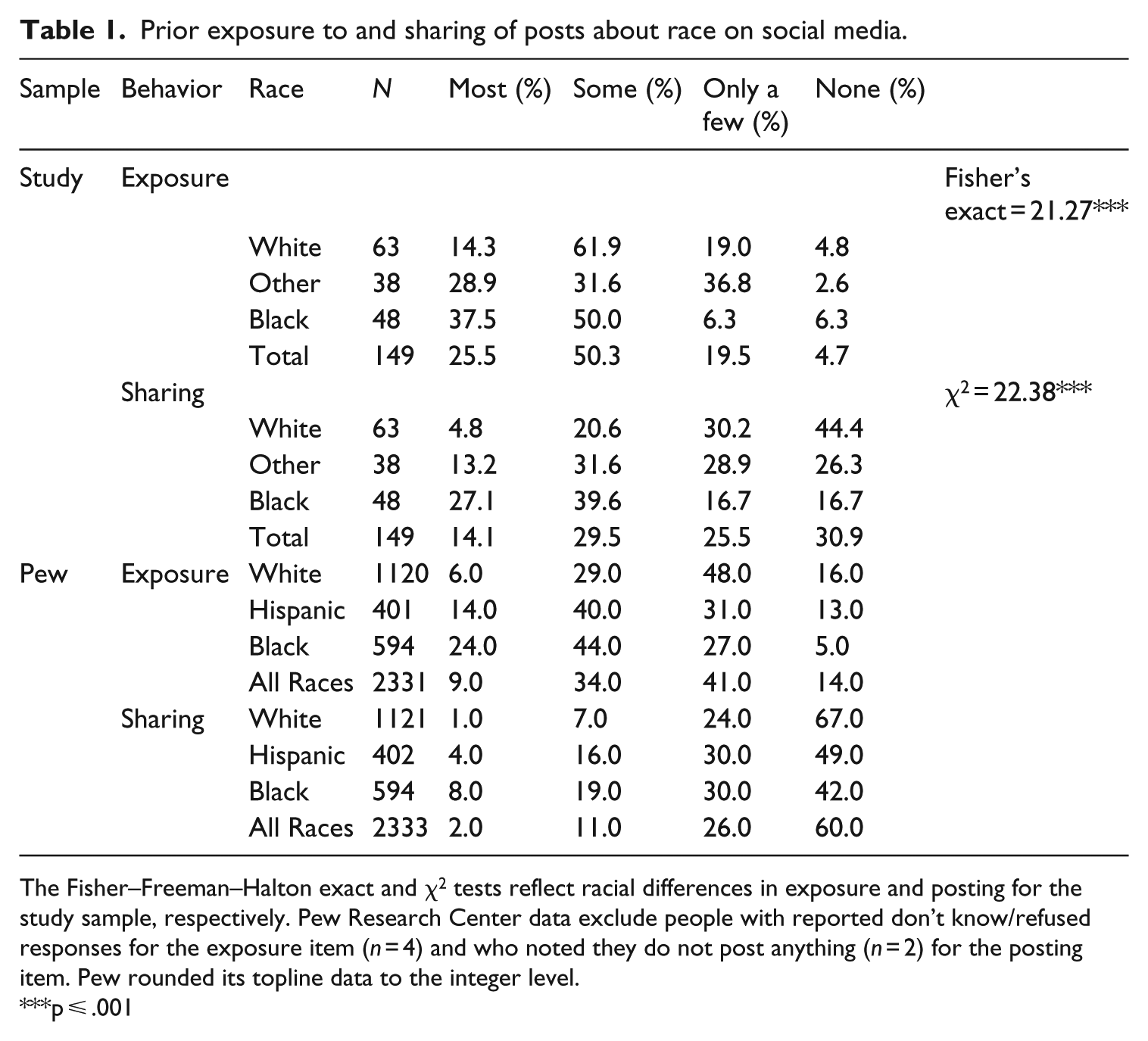
The Fisher–Freeman–Halton exact and χ2 tests reflect racial differences in exposure and posting for the study sample, respectively. Pew Research Center data exclude people with reported don’t know/refused responses for the exposure item (n = 4) and who noted they do not post anything (n = 2) for the posting item. Pew rounded its topline data to the integer level.
p ⩽ .001
For H3, we hypothesized that the explicit disparate racial impact frame would result in race of the sharer emerging as a factor in sharing intentions among college students. Overall, 57 (38%) participants said they intended to share at least one story on social media. There were no significant differences between racial groups in intention to share the stories in the control condition. However, for the explicit condition, we saw statistically significant differences between racial groups in intention to share. Specifically, while 30% of White students and 50% of Black students said they would share at least one story in the control condition, in the explicit disparate racial impact frame condition, 18.0% of White students and 64.7% of Black students intended to share. We had also asked (RQ1) whether race of the sharer would emerge as a factor in sharing intentions among college students when the impact was implicitly racial. For the condition where there was an implicit disparate racial impact frame, a smaller proportion of White (14.3%) and a greater proportion of Black (78.6%) students intended to share at least one story than in the control condition. The disparate racial impact frames showed racially “polarized” or differentiated selective sharing intention patterns for news stories (see Table 2), providing support for H3.
Differential intentions to share news stories on social media.

Statistics for racial differences by frame condition use the Fisher–Freeman–Halton exact test due to cell sizes with expected counts of less than 5. However, the pattern of statistical significance is the same for χ2 tests. The overall racial difference main effects used a χ2 test.
p ⩽ .05; ***p ⩽ .001.
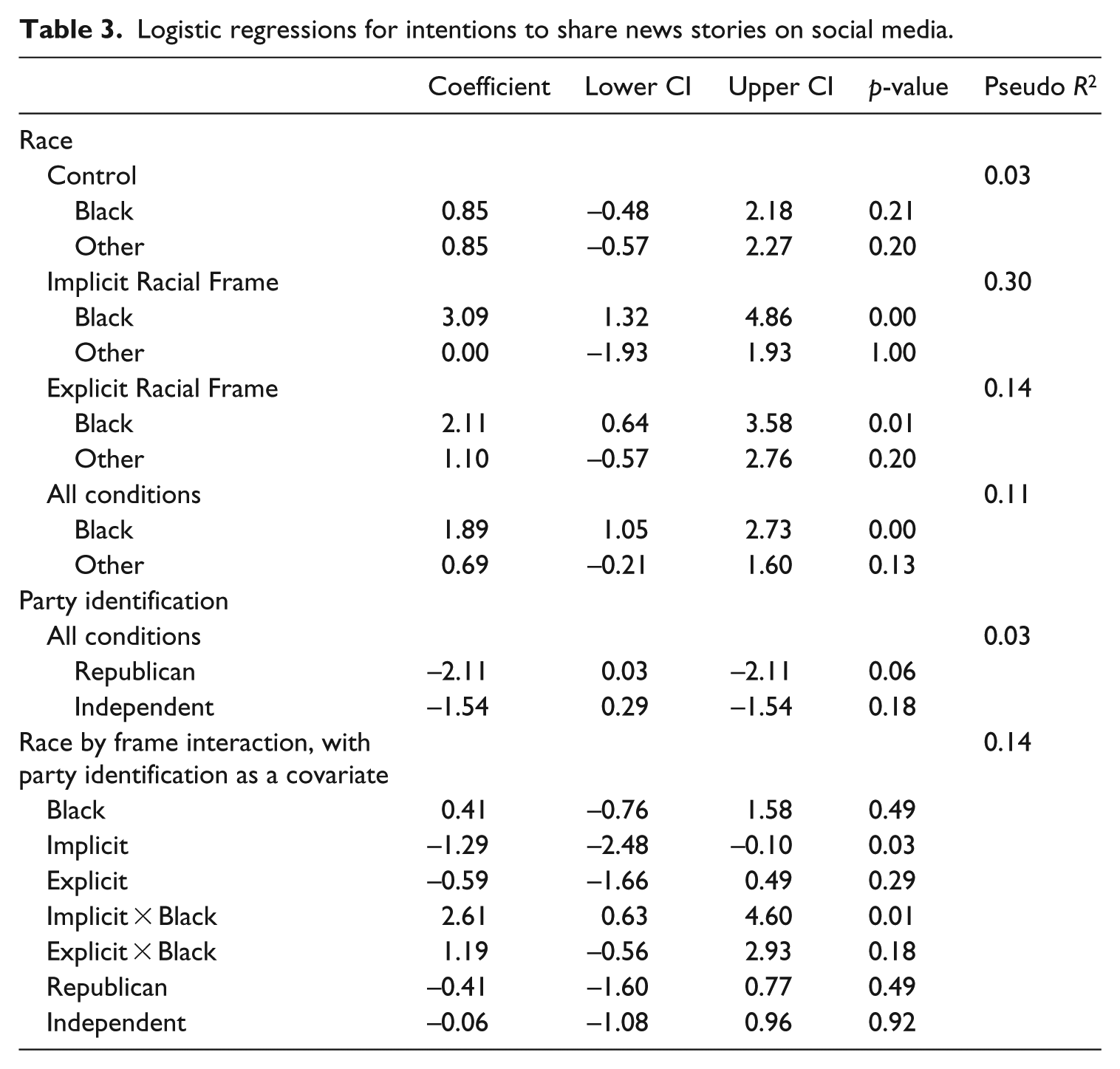
The chi-square analysis provides statistical evidence for a racially differentiated pattern of sharing in the explicit and implicit conditions that is not present in the control condition. However, it does not test whether there is an interaction between race and frame in the disparate impact frame conditions, nor does it control for political identification, a common moderating variable in selective exposure and sharing analyses. Follow-up analyses with logistic regression showed that while Blacks were more likely to intend to share the stories in the disparate impact frame conditions than Whites, only the implicit frame condition was significantly different from the control in the interaction analysis (see Table 3). The interaction was significant regardless of whether political identification was a covariate or not.
Logistic regressions for intentions to share news stories on social media.
To gain insight into our dichotomous selective sharing outcome measure, we examined the open-ended responses. For those who intended to share the news stories, we had asked (RQ2a) which of the stories they intended to share. Among those who intended to share at least one story, 33.3% specifically cited the story on zero-tolerance in schools in their responses. When considered in combination with the 29.9% of students who said they would share all of the stories, over half of students who planned to share a story indicated they would share the zero-tolerance story. Nearly a quarter (24.6%) specifically said they planned to share the policing for profit story; fewer singled out the voter ID (8.8%) and lead testing (10.5%) stories.
RQ2b asked what reasons the students in our sample gave for their intentions to share at least one story. Ninety-three percent (n = 53) provided a reason for sharing a story. Nearly three-quarters (73.7%) cited reasons related to the article content or story topic, including its importance, relevance, interest, and the need to raise awareness or educate about the issue(s) (see Appendix C in Supplementary Material). Some students mentioned discrimination or differential treatment, including a desire to raise awareness of discriminatory practices, but this was relatively uncommon (10.5%). Students referred to themselves (15.8%) others (19.3%) or both self and other (19.3%) in explaining their reasons for sharing stories.
We also asked what reasons students gave for not sharing the news stories (RQ3); 92.5% (n = 86) provided a reason. Over half (55.9%) said they did not share or post on social media generally, or did not post particular types of content (e.g. not posting news, articles, or political content) (see Appendix D in Supplementary Material). Roughly 40% of participants who did not intend to share a story mentioned or evaluated story content or made reference to the story topic. Reasons referenced students’ own judgments about story content (e.g. not interesting, relevant, and of dubious credibility) and considerations about how others would receive them. A few students did not feel knowledgeable enough about the story or source to share the content, noting questions about credibility or potential to spread incorrect information. A few students felt those who were interested would seek it out on their own or otherwise be exposed so there was no need to raise awareness. Some students raised concerns about how posting might negatively affect themselves or others in their social network, touching on self-presentation concerns and concerns about reactions of those in their networks (7.5%). Students did not mention race or focus on how the issues in the stories might affect specific groups. However, some did generally note that the stories would not be relevant or interesting to people in their SNS network (e.g. followers and friends). Most made reference to self (71.0%) or self and others (11.8%); few students mentioned just others (3.2%) in their rationales for not sharing.
RQ4 asked whether disparate racial impact frames led students to mention discrimination or differential treatment in their open-ended responses. No participants spontaneously mentioned discrimination in the control conditions. Only those who planned to share stories and were in the implicit and explicit conditions mentioned discrimination or differential impact in open-ended comments. Thus, there were small, discernable descriptive differences in rationales provided for sharing that aligned with the experimental conditions.
Discussion
In this era of increased exposure to news on SNS, selective exposure and sharing are increasingly relevant to understanding communication inequalities and its implications for social inequality. In this study, we examined racial differences in exposure to and sharing of content about race on social media among college students using three complementary approaches. Building on prior research, we first confirmed racial differences in reported prior exposure and sharing of content about race among college students. Second, we disentangled selective exposure from selective sharing using an experimental approach to explore whether, given equal exposure to news about the same topics from the same sources, news frames that implicitly or explicitly emphasize disparate racial impact are likely to affect selective sharing and therefore have implications for online information diffusion and communication inequalities. Third, we examined open-ended responses that students gave for why they intended to or did not intend to share the stories.
Our findings in combination with the extant literature provide some support for the idea that frames that highlight implicit or explicit disparate racial impact are likely to result in racially differentiated news diffusion on SNS. Specifically, we found that Black students report both seeing and posting more content about race on social media. As with national data, “Other” race/ethnicity students saw and posted an intermediate amount and White students saw and posted the least. We then demonstrated that when the same topics (voter ID restrictions, policing to raise revenue for government, and zero-tolerance policies in schools) from the same news source featured implicit or explicit disparate racial impact frames, a larger proportion of Black students compared to White students said they intended to share the news stories on social media. Prior research has found that Whites are less likely to report being exposed to information about race and race relations (Anderson and Hitlin, 2016). This study adds to the communication literature by providing evidence that selective sharing is likely to result in racially differentiated retransmission of news about disparate racial impact. This implies less opportunity for subsequent incidental SNS exposure for White students and more opportunity for Black students to be exposed to these kinds of frames, particularly students who are in comparatively racially homogeneous networks online.
A number of students who said they did not intend to share the story explained that they generally did not post on social media or were selective about the genre or type of content they posted. Some considered the content irrelevant or uninteresting. Explanations provided by students suggest that they considered their own evaluations about the stories and sources, how others in their network would evaluate the stories and them for sharing the content, and their own knowledge about the stories. The focus on the imagined audience of followers, friends, and family by some students provides support for the idea that perceptions of others in the social network can be a driver of selective sharing. At the same time, students’ consideration of how content related to their own preferences suggests self-relevance also plays a role. Comments related to knowledge and raising awareness also points to how initial topic familiarity and perceptions about its social relevance may translate into communication gaps and differential knowledge gain in social networks via selective sharing (Southwell, 2013). Raising awareness appeared in rationales for both sharing and not sharing stories. In the latter case, the rationale was that there was no need to raise awareness via sharing the stories. Few students explicitly mentioned racial discrimination in explaining their selective sharing intentions. Students only mentioned discrimination in rationales for sharing the stories and only in the conditions where disparate racial impact frames were present. Despite this, disparate racial impact frames resulted in racially “polarized” or differentiated selective sharing intention patterns for news stories as evidenced by race being a predictor of sharing, particularly in the implicit disparate impact condition. Interestingly, the findings suggest that a colorblind approach to framing disparate racial impact may nevertheless result in racially differentiated sharing, possibly even to a greater extent than more explicit racial frames.
Although this study contributes to the literature, it has limitations. First, this is a modestly sized student sample from a single university and is predominantly women. We did not find gender differences in intentions to share or in prior sharing of content about race, however. The fact that a national sample showed a similar pattern of exposure and posting in self-reported survey results suggests that the findings might extend beyond the college sample; however, future research should test whether these findings replicate and generalize. Our figures for exposure to content about race in our college samples were overall descriptively higher than the comparable Pew national adult data for both exposure and sharing. This could be because students are living in a comparatively geographically integrated campus environment, thus providing more opportunities for interracial ties and more exposure to content about race online. It could also stem from age-based cohort differences (Kümpel et al., 2015). The role of age and network heterogeneity in exposure to and sharing of content about race should be explored in future research.
Another limitation is that the measure for selective sharing used is in this study is general and does not differentiate between particular kinds of social media. Context collapse, audience heterogeneity, and SNS dissonance concerns may matter less for relatively private SNS (e.g. WhatsApp and Snapchat), as well as instant messaging options on platforms such as Facebook that are more interpersonal, and theoretically, more private in nature. However, distinctions about sharing on particular platforms based on privacy considerations were not something that emerged as a theme when students were given an opportunity to elaborate on their reasons for sharing or not sharing in open-ended responses. Furthermore, online communications and affordances such as persistence and ease of copying digital materials mean that there is the always the possibility of “platform collapse” wherein communications intended for limited audiences via a particular platform (or features in a platform that limit publicness) can easily be transformed into another format and spread on more public SNS platforms or settings. Nevertheless, future research could explore whether the findings replicate across platforms with distinct constellations of affordances.
Future research should also test whether similar patterns of selective sharing are observable in actual behavior on social media (e.g. by incorporating an opportunity to share the story) since this study and the Pew survey on exposure to and posting of content about race are based on self-report and are non-longitudinal in nature. It is also worth noting that we asked about intentions to share articles based on article previews similar to those on news feeds. However, few students brought up not having read the full articles in their reasons for not sharing the stories. Furthermore, although we included a variety of kinds of issues that represent disparate impact, there are other topics which could produce a different pattern of results. Understanding how other racial/ethnic groups respond to disparate impact frames for their own racial group and for other minorities would help to extend the current findings. It was not feasible to explore non-Black minority racial/ethnic groups in a disaggregated way due to the sample size. Future studies could also consider other, more nuanced measures of racial identity and racial identification, as well as more formally examine perceptions of and formation processes involving social online networks and the role that plays in selective sharing.
Finally, we did not test frames that might suggest White disadvantage or disparate impact. As demographics change making the United States a so-called “majority–minority” nation, news outlets may increasingly focus on issues that are framed as disproportionately and negatively affecting Whites and portray White Americans or particularly classes of White Americans as a disadvantaged minority. It is possible that we would see an increased racial salience and relevance of racial identity for White students, as well as shifts in exposure to and sharing of posts about race as a result. Future studies should be sensitive to changing demographics and sociopolitical shifts that affect identity and its intersection with selective exposure and sharing.
In conclusion, this study adds to the literature that examines the nexus between social identity and selective sharing and has important implications for those who wish to raise awareness about racial disparities and racial equity. Specifically, our study indicates that when topics are implicitly or explicitly framed in terms of disparate racial impact, that this framing is likely to affect who sees and shares those stories and result in more racially differentiated sharing online. While this study moves the literature forward by contributing to an understudied aspect of the selective exposure and sharing paradigm by examining selectivity in the context of race and identity, future work should test these findings in studies with behavioral data online and further explore theoretical mechanisms and processes that contribute to this selective sharing.
Supplemental Material
Selective-Sharing-NMS-6-11-19-supp-materials-correction – Supplemental material for Selective sharing on social media: Examining the effects of disparate racial impact frames on intentions to retransmit news stories among US college students
Supplemental material, Selective-Sharing-NMS-6-11-19-supp-materials-correction for Selective sharing on social media: Examining the effects of disparate racial impact frames on intentions to retransmit news stories among US college students by Cabral A Bigman, Marisa A Smith, Lillie D Williamson, Arrianna M Planey and Shardé McNeil Smith in New Media & Society
Footnotes
Funding
The author(s) disclosed receipt of the following financial support for the research, authorship, and/or publication of this article: This research was supported by the Funding Initiative for Multiracial Democracy at the University of Illinois at Urbana-Champaign, USA. The content is solely the responsibility of the authors and does not necessarily represent the official views of the university.
Supplemental material
Supplemental material for this article is available online.

Author biographies
References
Supplementary Material
Please find the following supplemental material available below.
For Open Access articles published under a Creative Commons License, all supplemental material carries the same license as the article it is associated with.
For non-Open Access articles published, all supplemental material carries a non-exclusive license, and permission requests for re-use of supplemental material or any part of supplemental material shall be sent directly to the copyright owner as specified in the copyright notice associated with the article.
