




Abstract
Digital Internet-distributed audiobooks are a surprising game changer in digital publishing. In recent years, audiobooks have moved from being a peripheral by-product of the printed book into the centre of digital publishing and reading, but are typically still ignored in publishing studies. This article raises the voice of the audiobook by giving it a privileged status in the current transformations of book publishing caused by digitization. We present an original model of the digital audiobook circuit, which is based on interviews and knowledge from the Danish market as part of a global industry, which makes it possible to reflect and adjust according to national variations. The model is framed by theoretical discussions of values and dynamics within the digital audiobook circuit in general.
Keywords
Introduction
Digital Internet-distributed audiobooks are undergoing what has been described as an ‘audiobook revolution’ or an ‘audiobook boom’ in many countries throughout the world. Numbers have exploded in relation to sales, revenues and library loans (Association of American Publishers (AAP), 2017; Bog- og Litteraturpanelet, 2017), and the quietness with which these changes have been taking place in the public realm has been remarkable. So, in spite of the fact that the audiobook is a medium of sound, it has until recently been a ‘silent revolution’, and this quietness also includes academic research, where publications on audiobooks are remarkably rare. 1
The definition of an audiobook is not clear-cut. In this article, we define an audiobook as an audio recording of a (previously or simultaneously) published written book, performed by a narrator who could be the author, a professional actor or an amateur, or a synthetic voice (Have and Pedersen, 2016). Our interest in audiobooks in this article is also delimited to fiction and non-fiction intended for the consumer market and everyday reading. Thus, in this article, we do not deal with educational audiobooks or audiobooks used in pedagogical or artistic contexts. A third delimitation is our focus on only Internet-distributed digital audiobooks, which means that we exclude earlier formats like CDs, cassette tapes and records. This is a rather restricted definition of digital audiobooks, but necessary, when we later in this article present a simple generic model of the audiobook circuit in relation to institutionalized, digital publishing.
One could ask if it even makes sense to call an audiobook a book, since it is fundamentally different from the printed book in terms of technology, aesthetics and use. However, we insist on the bookishness of the audiobook both because of the printed source and because it is included in the institutionalized literary context constituted by authors, publishers, bookstores, libraries and so on. It follows from our definition that we in this article exclude recordings of texts as well as audio narratives without a coexisting written book – formats that in other contexts would count as audiobooks. However, we are aware that born-audio formats may herald the future of the audiobook’s development as the initiatives Storytel Originals and Audible Originals exemplify.
This article wishes to raise the voice of the audiobook by giving it a privileged status in the current transformations of book publishing circuits caused by digitization, moving it from the periphery to the centre of digital publishing. In previous publications, we have discussed the digital audiobook in relation to media, users and experiences. In the present article, our aim is to shift our attention from the mediacy and use of audiobooks to the production and distribution part of the circuit. With a point of departure in rewriting existing models of communication circuits of the book (Robert Darnton, 2007 [1982]; Ray Murray and Squires, 2013), we want to map, describe and discuss the different actors in the production, distribution and usage of audiobooks. As Ray Murray and Squires argue, digitization in book publishing has introduced new actors and created new paths in the circuit. This development has replaced traditional models with more complex models. In spite of the inevitable role of the audiobook as an increasingly prominent actor in the book publishing circuit today, no model has yet included audiobooks. With that as our aim, we must also face the fact that a fixed map of audiobook production and distribution does not exist, since it is constantly changing with new players emerging, and only a few growing very fast, while many are closing down. The variation between technologies, institutions and business models across countries also makes it impossible to draw one map that covers all. Publishing circuits may vary significantly between nations and cultures. This also counts for audiobook publishing.
In this article, we will cover the Danish circuit, but we will discuss it in relation to available knowledge, primarily about the Norwegian and American markets as described by Colbjørnsen and the American Audiobook Publishers Association (APA). As one of the only accessible sources, APA regularly conducts surveys and statistics about the development of audiobooks on the American audiobook market, which of course must be read considering the interests of the association. We historically see significant variation in business logics and formats even within the Scandinavian countries. Nevertheless, we address the circuit in a way that makes it possible to reflect on and adjust to other national systems as well. We also frame the presentation of the circuit by more general theoretical discussions of the audiobook that are not limited geographically.
The first section, ‘The silent revolution’, discusses the development and the status of the audiobook as an international success, which can be explained by technological development and new target groups and situations for reading, and we argue that the audiobook has been a surprising game changer in digital publishing. This leads to a presentation of ‘The audiobook circuit’, where we introduce a model of the audiobook circuit from author, production and distribution to usage and audio reading. The model takes its point of departure in Ray Murray and Squires’ (2013) model of digital publishing and it builds on knowledge about other audio industries, like the music industry.
To ‘equip’ the prototyped actors of the model with actual practice in the field, we have carried out qualitative research interviews with managers in the Danish audiobook industry. These interviews gave us an insight into the complexity of the empirical field compared with the prototyped categories of the model and the variations of actors within the same category. They made us aware of overlapping and conflicting interests and tasks and the ongoing response to legislation modifications, and, not surprisingly, how economy is the overall driving force for most development in the field.
To discuss the dynamics between the different values and market mechanisms, the presentation of the circuit model is followed by a discussion section expanding the two-dimensional model towards a third dimension of cultural and economic contextualizing aspects. We focus on the interplay between business actors, changing market conditions and new conditions for reading, while explaining how the digital audiobook has influenced the dynamics of the publishing field.
Thus, this article is guided by the following questions: why is the audiobook revolution silent? How can we include the audiobook actors in a publishing circuit? What new knowledge can we gain from such a model when discussing digital audiobook publishing in general – from the perspective of business logics, literary values and technological developments?
The silent revolution
While digital publishing in general and in particular ebooks have received a lot of attention, the audio book industry’s digitization processes have gone largely unnoticed. (Colbjørnsen, 2013: 16)
We use the metaphor ‘silent revolution’ of the audiobook to accentuate the point made by Colbjørnsen in the quote above as well as pointing to the fact that the digital audiobook has gone from being a peripheral by-product of the printed book to an important player in the general circuit.
In recent years, audiobooks have received coverage in global newspapers with headlines such as ‘The Fastest-Growing Format in Publishing: Audiobooks’ followed by the words ‘Smartphones and multitasking have stoked an explosion in audiobooks. Publishers, spotting a juggernaut, are expanding their offerings and enlisting star narrators’ and ‘The digital revolution that flummoxed the music, movie and publishing industries has given rise to a surprising winner: the audiobook’ (Maloney, 2016). These quotes illustrate how the popularity of digital audiobooks is surprising news. However, taking the affordances of the digital audiobook into account, it should not be surprising, because the audiobook offers fundamentally new ways of reading which are suitable for the technologically advanced modern reader who appreciates the convenience of reading while commuting, training or relaxing (Have and Pedersen, 2016). And this group has made the audiobook attractive in the commercial market.
We experience that the audiobook boom attracts more and more public attention in countries like the United States, England and the Scandinavian countries, and in that sense, the audiobook as a commercial phenomenon is not that silent anymore. However, we also experience a devaluation of audiobooks among more classical publishing houses and librarians. Regarding cultural values, the audiobook is still not considered well suited for proper reading, and this normativity does not conflate with the attention that audiobooks receive at the commercial market.
While the market of e-books is decreasing these years, numbers have ‘exploded’ in relation to audiobooks – both in relation to sales, revenues and library loans. The latest revenue numbers (2017) from the US and Danish publishers, respectively, show a positive development of 32.9% in Denmark and 26.2% in the United States. Similar numbers appeared the years before (AAP, 2017; Bog- og Litteraturpanelet, 2018).
The British media sociologist John B. Thompson argued back in 2010 that a hidden revolution has been taking place in the book industry: ‘a revolution in the process rather than a revolution in the product. The final product may look exactly the same, but the process by which it is produced is fundamentally different’ (p. 321, italics in original). But the unexpected boom in digital audiobooks is certainly also a revolution in the frontend where the product meets the users and not just a revolution in the digitized backend process, as Thompson argues. He also points to the fact that literature has been digital since the 1980s on the production side, with authors writing books on personal computers as well as in relation to publishing management (cf. Hayles, 2013). In continuation of this, Hjarvard and Helles (2014) said that ‘Today digitization is entering the last steps in the book’s life circle: The distribution and reading of books’ (p. 36). This is another example of how e-books and e-readers like Kindle and iPads are what researchers studying digital literature typically refer to, even though the audiobook made literature both electronic and digital long before there was something called an e-book.
So, digitization is not a new phenomenon when it comes to audiobooks. That ‘last step’ mentioned by Hjarvard and Helles was taken – presumably unnoticed – many years ago in the audiobook circuit where the digital compact disc made audiobook reading digital already in the 1990s. Håkon Havik from the Norwegian streaming service Ordflyt ventured in the beginning of the century from e-book to audiobook business, and as he said in an interview with Colbjørnsen (2016: 216), audiobooks are more ‘digitally mature’ than e-books.
The commercial audiobook industry in Denmark emerged from the non-commercial and state-supported national library for people with reading disabilities (today called Nota), serving pedagogical and remedying aims. But as a result of the digital revolution of the audiobook, another main target group has quickly emerged: the technologically advanced modern reader who appreciates the convenience of reading audiobooks in a busy everyday life. Colbjørnsen differentiates between laggards and innovators, but instead of describing them as two separate user groups with a negative and a positive label, respectively, we would prefer to argue for an amalgamation of these groups. There are several examples in the history of technology of how tools for disabled people improve the performance and add value to the everyday life of the non-disabled, for instance, in connection with sports. Given that smartphones are becoming a common ubiquitous item and audiobooks are becoming increasingly trendy and innovative, people with impaired vision, people with dyslexia and Nota can be seen not as laggards but as first movers and innovators as users and producers. From this perspective, the introduction of the digital audiobook in everyday life has an important democratizing effect on people with reading difficulties when their practices become trendy.
Audiobooks are also interesting in relation to age, because the users are generally much younger than the readers of printed books and more equally distributed between the genders (Anderson, 2017). As mentioned in the annual report of AAP, there is a big youth movement going on when it comes to audiobooks where 48% of all listeners are under the age 35. Their study shows that that age distribution of ‘grown up audiobook-users’ is almost completely similar to the age distribution of the general American grown up population (AAP, 2017). All recent reports from the United States and Denmark show that digital audiobooks today are an integrated routine in many people’s everyday life (e.g. AAP, 2017; Anderson, 2017; Bog- og Litteraturpanelet, 2017, 2018). Audiobooks make reading more mobile than ever before and broaden the scope for reading.
The conventional circuit of digital publishing
In their 2013 article ‘The digital publishing communications circuit’, Ray Murray and Squires revise Robert Darnton’s (2007 [1982]) influential historical model of the communication circuit of the book, investigating the shift from print and paper to digital formats and new business models. They propose a redrawing of the circuit model as the digital perspective creates disruptions in the historically relatively consistent publishing circuit of the book (Figure 1).

Digital publishing communications circuit (Ray Murray and Squires, 2012).
Darnton’s canonized article from a book-historical perspective offers a model of the circuit surrounding the production, distribution and consumption of books during the 18th century, and a number of the actors in his model are re-enacted in Ray Murray and Squires’ model for digital publishing. For instance, the role of the literary agent seems to be re-enacted or partly substituted by new types of relationships: The traditional value chain, which traces the trajectory of intellectual property from author to reader, and where publishing activities such as editorial, marketing and design are all performed by the single entity of the publisher is being disrupted and disintermediated at every stage. (Ray Murray and Squires, 2013: 3)
Ray Murray and Squires’ model of digital publishing is an update of Darnton’s original model. His model has both been influential and widely discussed, criticized and revised. Most critics acknowledge the importance and impact of the model, however, revisions have been proposed, for instance, by McDonald (2006) who points to the fact that the model, focusing on functions of the circuit, needs a more elaborated Bourdieu-inspired theoretical framework to illustrate the hierarchic or vertical dimensions of the circuit, reflecting the political, value-related and economic interests that are crucial to the publishing context (McDonald, 2006). Also, Adams and Barker (1993) revise the model in terms of emphasizing the concrete life cycle of the book.
Ray Murray and Squires aim is to add a digital perspective to the historical discussions and to Darnton’s model. However, they do not include other formats than the e-book; for instance, we do not find any references to or reflections on audiobooks or books as apps. Neither do we find that the role of the reader is sufficiently covered in their article. To read an e-book, an audiobook or a printed book are essentially different activities, which points to the need to develop a model that is media sensitive.
The new relationships between authors and publishers as well as between authors and readers contribute to that value chains, and gatekeeper functions are being renegotiated, affecting both the intellectual properties and economic models of publishing, as we will shortly return to in our discussion.
Analysing the audiobook circuit
The following analysis is built primarily on four new interviews carried out in spring 2018 with managers in the Danish audiobook industry and three older interviews that we conducted 2013–2014 in connection with an earlier research project.
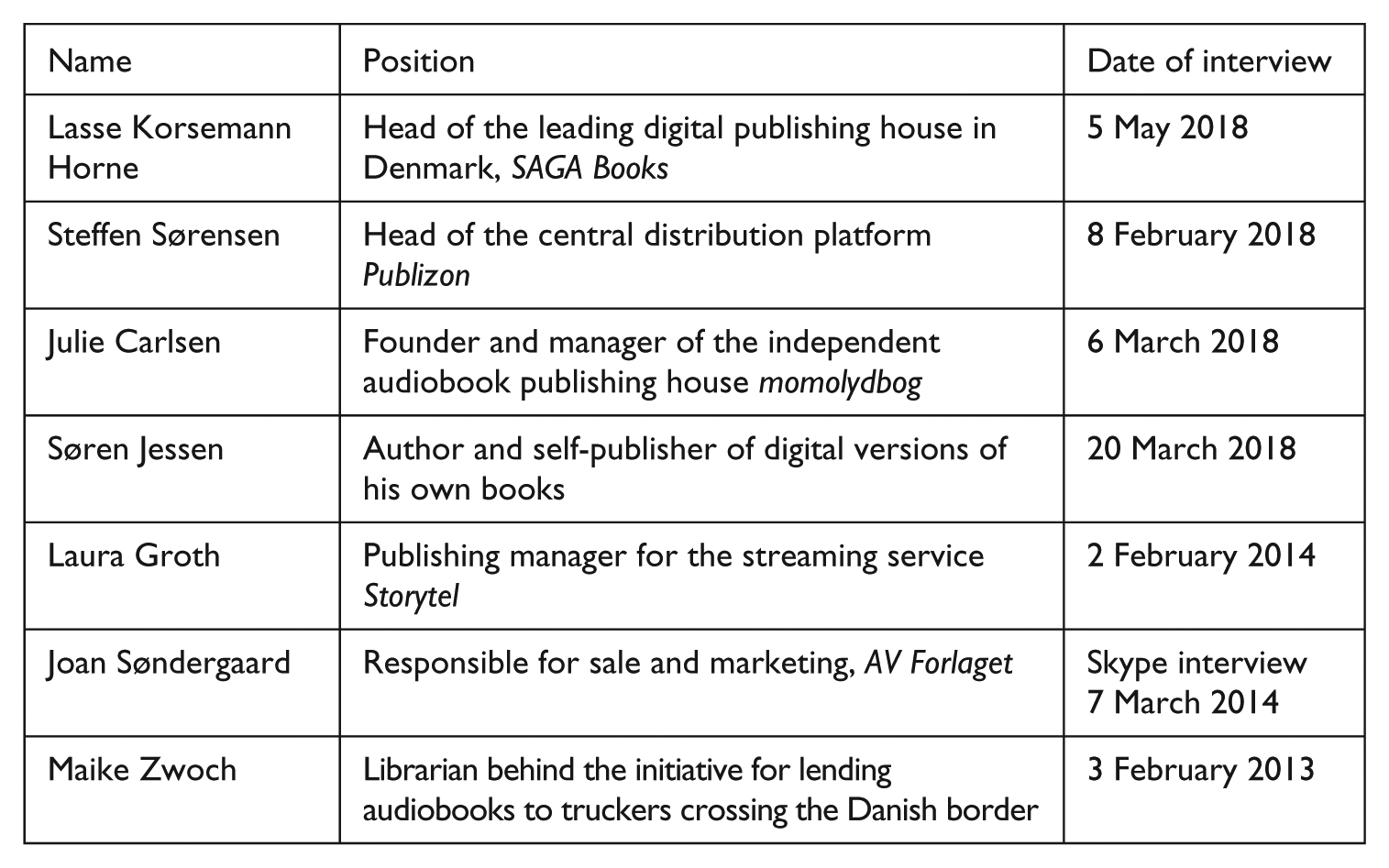
Apart from these interviews, we have been in continuous dialogue with the Danish Public Library’s digital platform eReolen, which also has informed our study. The analysis is not least informed by various documents from the daily news and newsletters from the industries and associations that we have collected during the study. Given that we have been doing research on digital audiobooks since 2011, we have also gained a lot of non-systematically collected knowledge both from Denmark and internationally: different public and private agents, authors, performing narrators and various users and readers who differ in terms of gender, age, nationality and background. All these information add in different ways to the picture of the audiobook circuit presented in the models below.
Because of the national variations of the markets, we first bring a simplified, generic model, Figure 2, that to some extent might cover most countries. In Figure 3, we have equipped the model with examples from the Danish context to be able to go in more detail with concrete, individual examples. In Figure 3, we partly name actors of the circuit as specific companies and institutions informed by the interviews conducted in a Danish context.
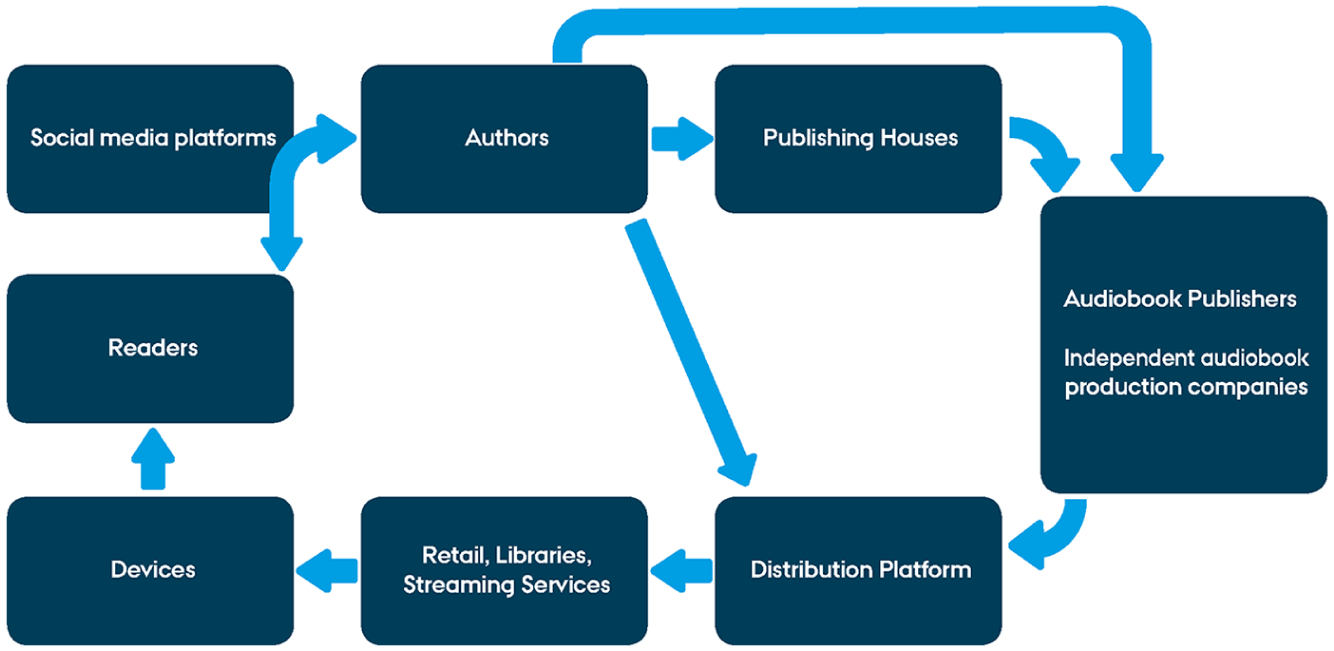
A generic model of the circuit for digital, Internet-distributed audiobook publishing.
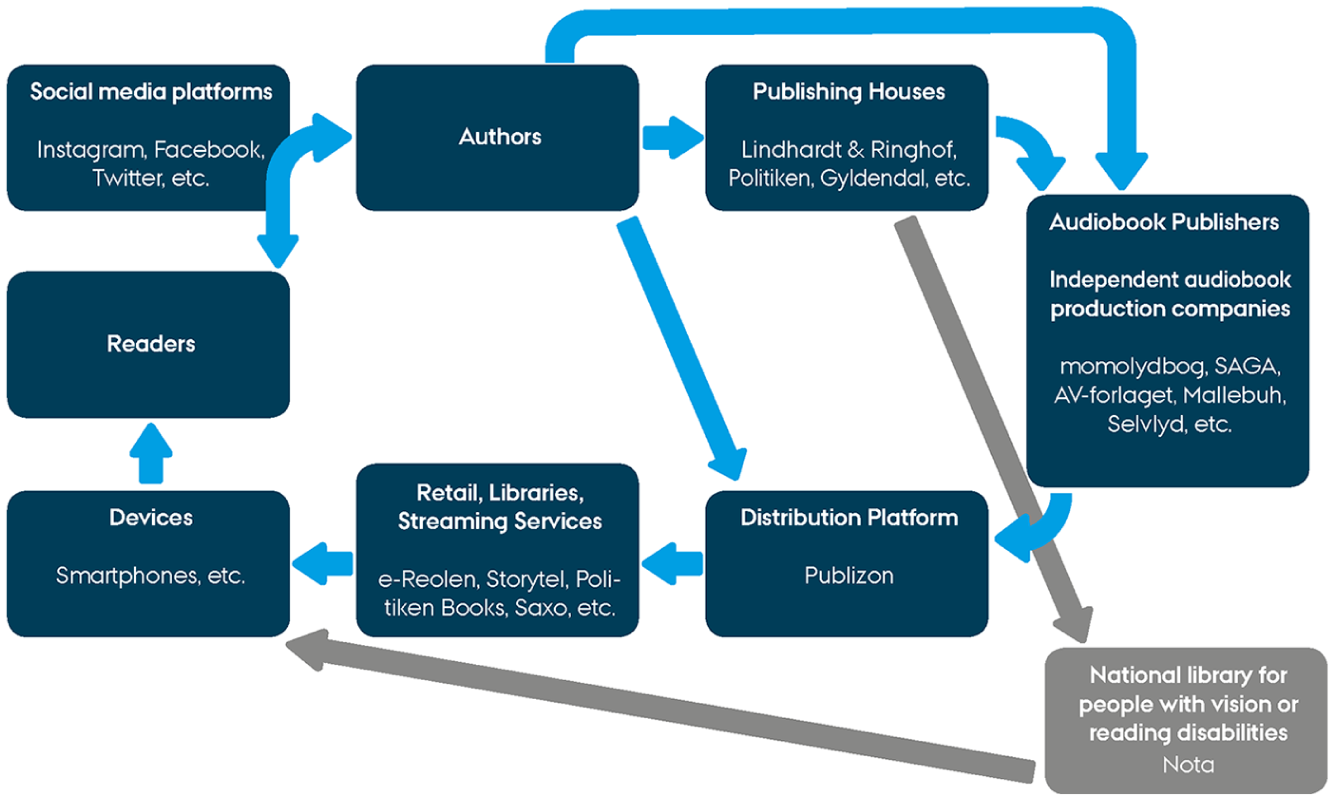
The circuit for digital, Internet-distributed audiobook publishing with examples from the Danish system.
A simple tour through the model begins with an author writing a book. This book is typically sent to a publishing house like Lindhardt og Ringhof or Politiken, which is in charge of the production of the audiobook – either through their own subdivision for digital publishing (SAGA or Politiken Books) or by outsourcing the production directly to an independent audiobook publisher or a recording company like Selvlyd or AV Forlaget. Some authors exclude the publishing houses and go directly to an independent audiobook publisher like momolydbog, or they might even establish their own audiobook company like Søren Jessen has done, producing and narrating his own books from his company Mallebuh. But common to all digital audiobooks produced in Denmark for the (commercial) market is that they are uploaded to the central distribution platform Publizon, where retailers, streaming services and libraries can get access to and choose titles and then make them accessible from their own channels and platforms. Publizon requires, and thereby secures, that the quality and standardized formats are updated in relation to the devices and software of the end users.
The Danish market for audiobook retail is dominated by the streaming service Storytel, which recently bought their rival company Mofibo, and online bookstores like Saxo. In Denmark, the public library’s platform for digital audiobooks, eReolen, is a serious provider of free audiobooks for both streaming and downloads and to some extent disrupts the free commercial market. But for many authors, eReolen is a steady source of income, because they are paid per stream in the current agreement.
The primary device for listening to audiobooks is currently the Internet-connected smartphone, which most people carry around anyway. This technology is one of the reasons why listening to digital audiobooks has become a widespread success internationally. People usually listen to audiobooks through earbuds or headphones. It is significant for audiobooks, compared with other devices for reading, that you can use the same technology as other digital audio media like radio, podcasts and music.
The circuit ends with the users, listeners or readers, as we referred to them in the model above. We will not go into detail with reader segments or profiles here, since we have described audiobook users and their motivations and situations for listening to audiobooks in a previous study (see Have and Pedersen, 2016: chapter 6). But as mentioned above, the average audiobook reader is much younger than the reader of printed books and more equally distributed between the genders.
The last element we have placed in the circuit is social media platforms, which, like in many other cultural fields, offer platforms for author–reader contact and communication, enhancing the reading experience and facilitating feedback to the author.
Beneath the main circuit, we have placed Nota, the Danish national library for people with impaired vision and people with dyslexia. It is marked with the colour grey to signal that it is not an integrated part of the commercial market for everyday audiobook reading, but still influences it by offering its own state-supported sub-circuit. Publishers are obligated to offer their titles to Nota, which produces the audiobooks and offers them directly to the users (approved members of Nota), thereby internally taking over the traditional channels of the market. Many countries have similar remedying institutions, and depending on the number of people who have privileged access to digital audiobooks through these publicly financed sources, it is considered anti-competitive by the actors of the free market.
The information from our sources is not as clear-cut as the model appears to be. It is complex and ambiguous, and we will try to include some of this complexity in the following elaboration on the model, pointing to new aspects of the ecosystem regarding audiobook publishing as well as underlining the conflation of roles in the circuit.
Rethinking the role of the authors
One of the striking new aspects of the digital publishing circuit is connected to the fact that the production means have become commonly available, which means that in principle, you can publish your own books and hereby disrupt the traditional circuit of the publishers as cultural gatekeepers. In terms of the audiobook, we do have concrete examples of authors producing and publishing their own books as audiobooks (Søren Jessen, Josefine Ottesen), and it has become clear from our interviews that authors today are more aware of copyright issues concerning the audiobook edition when engaging with the big publishing houses.
We find many examples of the author acting as the performing narrator of his or her own books, which means that the author can take on an intensified and possibly also a stronger communicative role and build a closer relation to the readers and the literary community.
As accentuated by Ray Murray and Squires (2013: 5), the author–reader contact in connection with both audiobooks and printed books gains a new position through the existence of social media platforms like Facebook, Twitter and Instagram. These media enhance the author–reader contact far beyond the book, and in some aspects also replace the role of the literary agent – a role that emerged at the end of the 19th century acting as an author–promoter.
The author–reader contact seems to become even more intimate when the audiobook version of a novel is read by the author. Barack Obamas bestseller and rewarded audiobook Dreams From my Father (2005) and Michelle Obamas Becoming (2018) are both international examples of this tendency.
In a Danish context, the case of the author Leonora Christina Skov provides an interesting example of this. In December 2017, Skov published the autobiographical novel Den der lever stille (The one living quietly). The audio version of this novel was read by Skov and published simultaneously with the e-book and the printed book. Audiobook versions of previous novels by Skov were read by professional narrators, for instance, the actor Maria Stokholm. Den der lever stille became a success in the Danish market, and the audio version was emphasized for its fine diction and the intense effect of the author performing the autobiographical story. Parallel to her success, Skov has engaged in discussions and replied to comments on her Instagram profile, where she on a daily basis reports from her professional and, to some extent, private life – a ‘persona’ that mediates between the writer as a private and a public figure. On 10 September 2018, she had 24,800 followers, and she patiently takes the time to answer almost every single comment from the readers and followers of her profile. As a result of the commercial success of Den der lever stille, she performed and republished her four previous novels into audiobooks in the spring of 2018. It seems likely to suggest that the audio version both economically and qualitatively has become a more significant player for this specific writer. In an interview, she pointed to the fact that she only recently discovered the potential of the communicative aspects and advantages of the audiobook (Kulturmagasinet Gejst, 2018).
The example indicates that publishers and authors seem to have realized that the audiobook is an important contributing factor to achieving commercial success. And an example of how the audio version of a single title can influence an authorship afforded by social media platforms.
Established publishing houses under pressure
In relation to publishers, there seems to be a similar need to rethink their roles regarding the audiobook circuit. The large companies are getting bigger and even more influential. Global media players like Amazon, Google and Apple have presented new forms of digital reading, audiobook interfaces and storage, and they are gaining more and more power on the Danish audiobook market.
However, more and more small press publishers are emerging, also as international players who can create quite strong, small press literary profiles (Ray Murray and Squires, 2013). There are different models regarding audiobook production; some large publishing houses have their own audiobook company (Gyldendal Lyd), while other publishers order their products from freelance audiobook publishers. Today, a number of books are released simultaneously in a printed version, an e-book version and an audiobook version, which means that the decision to produce an audiobook version in some cases is made early in the publishing process. When signing contracts with authors, most publishers make sure to obtain the distribution rights to both digital and analogue audiobooks. Traditionally, the rights to produce the audiobooks have been sold to dedicated audiobook publishers. However, in the wake of the audiobook boom and digitization of audiobooks, there seems to be a tendency for publishers to retain the rights to all published editions of the books. In addition to this, many publishers are now buying (back) the rights to audiobooks so that they can publish them digitally. When we interviewed the head of momolydbog, it became clear that they encourage the authors to try to retain the copyrights to the audiobook version. But that is close to impossible at the moment, and therefore, momolydbog are forced to do primarily old novels/classics that are no longer governed by Danish copyright law.
Some of Danish audiobook publishers are owned by the publishing companies themselves, while others are independent audiobook publishers (e.g. Biblioteksmedier and AV Forlaget, Lydbogsstudiet.dk, Den Grimme Ælling). Therefore, it is not uncommon that an audiobook is produced by Den Grimme Ælling for the publishing house Gyldendal, for instance. Lindhardt og Ringhof is in the process of digitizing and publishing their entire catalogue through their own digital publishing company SAGA Books – something that was unthinkable just 5 years ago. Their self-proclaimed mission is to make all books accessible and to protect the literary cultural heritage (SAGA Books’ official webpage).
The process of finding the performing narrators is sometimes outsourced to the production company, and according to our interview with Lasse Korsemann Horne from SAGA Books, most of their audiobooks are curated by the audio production company Lydbogsstudiet.dk; however, important commercial titles are curated by SAGA themselves, suggesting a specific performing narrator for a specific title. In that sense, SAGA Books uses the curating of specific audiobooks to develop and maintain their brand (Ray Murray and Squires, 2013: 10).
However, it is possible for an audiobook publisher to obtain the rights to an audiobook. The audiobook publisher Den Grimme Ælling has long been buying old master recordings of audiobooks and has continuously been acquiring digital rights and digitizing relevant titles for publishing. When recording new audiobooks, Den Grimme Ælling uses home studios, enabling the speakers to work from home. This way they have been able to drastically reduce the costs associated with producing a new audiobook.
The heterogeneous field of audiobook production and publishing
Some audiobook publishers, for instance, Altfortalt and momolydbog, produce and sell audiobooks, which means that they serve as publishers, distributors and retailers. When it comes to audiobook publishers, we need to distinguish between large companies and small recording studios that build on a niche production or whose identity is based on promoting a higher standard for performing audiobooks. An example of this is the Danish audiobook publisher momolydbog, which has a declared aim of producing audiobooks of a high artistic standard. The company was established as a reaction towards audiobook reading wage levels at the big publishing houses that normally do not include time for preparation – that is, you are not paid to read a novel beforehand. Momolydbog uses well-known actors, who are paid for reading the book before they record it, and a director is hired for each recording. The performing narrators at momolydbog pick the titles themselves according to interest, and the group functions as a collective where they act as each other’s directors. They have benefitted from the fact that digital technology has become easily accessible and have their own audio production facilities and an audio technician as part of the collective, and in that sense the small press. The different audiobook publishers might have different agendas regarding the use of authors, actors or other performing narrators, and the aspect of quality standards for which type of voice they prefer for which books as well as standards for the technical and design parts of the recording seems crucial in their productions.
The status of amateurs doing audiobooks, such as on the international free public domain LibriVox, is an interesting case in relation to the question of self-publishers, reformulating the role of the established publishers as cultural gatekeepers, which we will return to in the concluding part of the article. You might expect that when a number of audiobook listeners also act as performing narrators, they become more qualified listeners as well as producers. From our interviews, we got the impression that momolydbog rejected a (large) number of self-publishers and in that sense acted (a lot) like gatekeepers in terms of the quality of the books they wanted to produce and perform, whereas SAGA Books seemed to have a strategy aimed at challenging or disrupting the idea of the publisher as a cultural gatekeeper, well knowing that other publishers had a totally different view of this, maintaining the conception of the publisher as a qualitative, cultural gatekeeper.
Another option for publishers (or authors publishing independently) is to contract with an audiobook production company like Selvlyd to produce the audiobooks. Selvlyd does not publish the audiobooks but provides the services needed to produce the books: studios, technical expertise, speakers and editing (Selvlyd official webpage).
The practice of independent audiobook publishers indicates that the editorial role of the publishers is changing. Both self-publishers and amateurs can propose and record audiobooks; however, still small press publishers, like momolydbog, are important players, maintaining more narrow connoisseur communities, appreciating the dramaturgical quality of a well-prepared actor doing the performing narration.
The distribution platform in the core of digital publishing
Whether the authors/publishers decide to use a production company or go through an audiobook publisher, they will need a distribution platform to distribute the digital audiobooks.
The question of formats appears to be important as the technical formats for playing and storing sound are continually changing, which means that audiobook publishers may be faced with more complex technical issues and decisions than book publishers, digital or not. In Denmark, updated and standardized formats are secured through a central distribution platform called Publizon for all Danish digital publishing. Authors and publishers upload their digital audiobooks and e-books to PubHub, and Publizon distributes the books to streaming services like Storytel and eReolen as well as online retailers and libraries.
The online bookstore Saxo also has its own digital (self-)publishing platform called Saxo Publish where authors can publish their work independently of a publisher (in the traditional sense) for free. The author then gets a certain percentage of the earnings – much like they would though a traditional publisher, but in this case, the authors get to keep all the rights to the audiobooks. In addition to publishing the works, Saxo offers professional services in which the authors can purchase: audiobook production (through Riisound), editing, advice, cover work and so on.
New forms of retail and platforms
With respect to the commercial actors of the audiobook circuit, the streaming services are of special importance. More and more people subscribe to streaming services, such as Audible or Storytel (in 2017 Storytel had 503,900 international subscribers), and some through their cell phone subscription (Telmore offers this as a larger package deal of newspapers, HBONordic, TV2Play and Bookmate). In addition, e-bookshops, iTunes, Amazon and Saxo are important commercial players for streaming in Denmark.
The libraries also use streaming services, which in Denmark are free of charge. Through eReolen, you can download three titles per month, both e-books and audiobooks. Financial models for this area have become increasingly complex, as in 2016, the big publishers in Denmark, such as Gyldendal chose to withdraw their titles from eReolen due to excessive costs, arguing that the success of eReolen became an anti-competitive factor for Gyldendal. On one hand, the libraries experience increasing success in relation to the audiobook. On the other hand, this success costs them a lot of money since they pay the copyright holders for each stream. This might be why the libraries kept relatively quiet about the high number of audiobook streams through eReolen.
The audiobook boom is one of the factors pointing towards a changed role for the libraries in general. The libraries find themselves in a transition phase where they experience a decrease in the number of loans of physical books, which means that they need to rethink their own role and obligations in the direction of an experience economy landscape. The number of author events at the physical library has generally increased, and this tendency helps strengthen the connection between the author and the reader, as the meeting between the book and the reader has changed to also include the immaterial meeting of a digital audio file or an e-book as well as live events with the authors and further engagement on social media platforms. It is our impression from taking part in seminars with eReolen that there seem to be an internal discussion going on regarding the status of the audiobook as on one side thinking of the audiobook as the current competitive advantage of literature and, on the other side, there still seem to be an implied normativity regarding that the audio version of literature is not as suited for deep reading as the printed book.
Users and their everyday devices
As regards the reader, it seems necessary to rethink Ray Murray and Squires’ model. In terms of digital reading, readers are not just readers; they are listeners and users of electronic devices through different sensorial outputs and in a number of new contexts. This is particularly striking when dealing with audiobooks, as you can read while being engaged in other activities: cycling, running, doing housework and driving a car. We, therefore, need a media-sensitive model for reading which considers sensorial differences between reading a printed book, an e-book or listening to an audiobook. Reading an audiobook can create mobile reading experiences including the body as a mediating factor of engaging in the text as well as the surroundings can take part in the reading experience on new terms (Have and Pedersen, 2016). The connection between device, reader and retailer has already been enhanced by Ray Murray and Squires (2013): ‘Through their choices of reading device, readers form strong bonds with retailers and distributors’ (p. 14). However, at least two aspects might need to be elaborated on in more detail. First, the audiobook is based on sound media technology that makes the audiobook circuit special and differs from the book publishing circuit developments. Second, the smartphone offers a number of different services, which makes it a medium of convergence of different formats and different audio media (Jenkins, 2008), including the possibility of switching between an e-version and an audio version of the same book, offered by Amazon’s feature ‘Whispersync for Voice’, for instance. Digital publishing creates a more direct access to the new roles of the reader, for instance, as a reviewer, increasing the possibilities of direct contact with the author. The review function offered by digital platforms reproduces the role of the literary critic on a smaller scale, making it possible to engage with other readers. When readers of audiobooks emphasize specific performing narrators, they contribute to changing the values of the literary circuit, shifting the power balance between the author and the performing narrator.
The investigation of use, consulting literary sociology, focuses relatively unambiguously on consumption more than on the qualitative aspects of the reading experience as such. Therefore, it seems like the importance of the technological developments and changes in business models in relation to the reading experience has not been sufficiently reflected upon. These aspects are also part of negotiating the qualitative cultural values of the market and form part of the transformation of how literary values and hierarchies are considered.
Discussing a third dimension behind the model
The presentation of the different agents of the audiobook circuit, from author and publishers to distributors and end users, shows that these agents are not islands but interdependent and always acting in a specific context. But from a general point of view, the analysis of the circuit also leads to more theoretical discussions of values and dynamics within the market which are more or less explicit in our material. To illustrate these values, we will walk the same path as Thompson (2010) and Hjarvard and Helles (2014) who studied digital publishing but without mentioning the audiobooks. In Figure 4, we add a third dimension to the model of the audiobook circuit, which makes it possible to identify significant (may be even conflicting) dynamics that can be analytically productive in understanding the position and status of digital audiobooks in the literary field today.
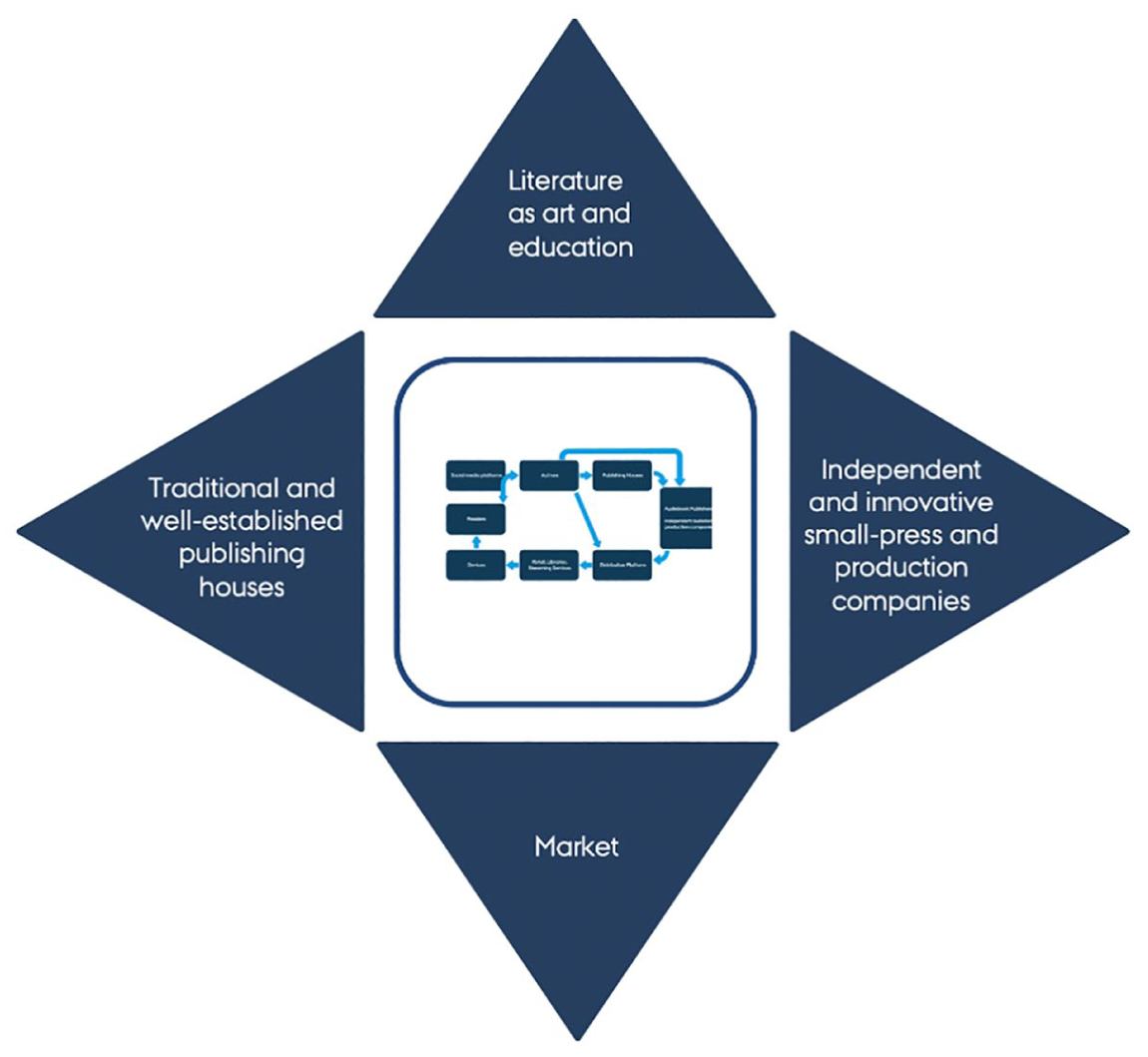
A third dimension of value orientations influencing the audiobook circuit.a
Both John B. Thompson and Hjarvard and Helles pick up on Pierre Bourdieu’s terminology when discussing the publishing industry. Thompson (2010: 5) describes five key capital forms in the publishing: economic capital, human capital, social capital, intellectual capital and symbolic capital. All are vital to the success of a publishing company but do not necessarily point in the same direction (Thompson, 2010: 9). For instance, economic capital and symbolic capital do not go hand in hand: ‘Publishers are not just employers and financial risk-takers: they are also cultural mediators and arbitrators of quality and taste’ (Thompson, 2010: 8).
A similar approach was taken in a study of the changes in the Danish publishing industry caused by digitization (but without mentioning the audiobook as a part of that) done by Hjarvard and Helles (2014). Based on interviews with 10 people representing different actors in the Danish publishing industry, they suggest a model that we have adapted with some changes to illustrate the dynamics of the audiobook circuit at a more general, theoretical level.
We have translated the business studies concepts brownfield and greenfield from Hjarvard and Helles’ model into ‘the traditional well-established publishing houses’ on one side and ‘the independent small press companies’ on the other side, representing the more innovative and evolutionary part of the market in relation to both small independent audiobook publishers and new technological developments. The other ax represents the span between the market prioritizing the commercial logic of selling books and earning money, in addition to an orientation towards the literary and educational quality of reading (in Hjarvard and Helles’ model, this orientation point is called Cathedral).
In our study, we both see a centralization towards the big publishing houses that finally have acknowledged that they need to have their own audiobook publishing department, as well as a decentralization where specialized independent audiobook publishers and streaming services develop – often overlapping with podcast and radio settings.
Momolydbog has been able to maintain a strong symbolic capital. They are an example of how the accumulation of symbolic capital has more value than economic profit. The small company of con amore actors, who in Julie Karlsen’s words love the well-presented oral narration, has been able to build up a strong symbolic capital, which, however, makes it difficult to cover the expenses and make a proper profit. Other publishers publish certain authors, genres and titles – not because of the economic profit but because they accumulate symbolic capital by doing so. Some audiobook publishers prioritize a low-budget product as a compressed mp3 file and with a performing narrator who is reading the book for the first time – or may be an even cheaper synthetic voice replaces the human voice. These products are oriented towards the economic market and not towards the symbolic capital of hi-fi and aesthetic quality. An interesting prediction made by Lasse Korsemann Horne is that in the very near future, the quality of synthetic voices will be of such a quality that it will be difficult to distinguish it from a human voice. This makes it possible for users to choose their favourite voice as the performing narrator, and it is also a chance for valued and popular actors from momolydbog to patent their voices as models for the synthetic voices.
The dynamics between economy and aesthetic quality and between the big publishing houses and small companies are interesting to follow in a currently very unstable market for digital audiobooks. We have learned that the negotiations regarding who holds the copyrights to the audiobook version of a manuscript are a decisive factor in terms of who earns the money as well as the level of quality. As the revenues for audiobooks are increasing, these rights have become an economic resource in which the authors might negotiate more actively in the future.
The traditional well-established publishing houses like Lindhardt og Ringhof, Politiken and Gyldendal have acknowledged (some of them rather late) that they need to have their own department for digital publishing, which causes a centralization and makes it more difficult for independent audiobook publishers to enter the market. However, big audiobook publishers like SAGA Books for Lindhardt og Ringhof are still dependent on the know-how of audio production companies and professional recording studios, since audio media only recently have become a serious part of their interests.
Another example of small press initiatives, challenging the traditional publishing houses, is the Danish author Søren Jessen. Long before, audiobooks were of commercial interest he insisted on retaining the digital rights to his own books. He made his own recording studio and his own publishing company Mallebuh, uploading his digital editions directly to Publizon. That model makes him able to make money from his audiobooks – in his case, especially from library streaming via eReolen.
As an overall threat to both the business models of traditional publishing houses and small independent publishers, we have international players like Amazon. These giants are also preventing small industries from trying new initiatives. As the managing director of the Danish Publishers Association has expressed: ‘When you have the threat of a big global player, many don’t dare plunge into something new because they’ll lose their investment the moment the big player arrives’ (Hjarvard and Helles, 2014: 61). This quote indicates that the Danish audiobook market is holding its breath waiting to see what happens when Amazon in earnest penetrates the Danish market.
Like other kinds of publishing, audiobook publishing serves two markets: a market for content (the authors and the performing narrators) and a market for customers (the users/readers) (Thompson, 2010: 11). Being a small language market and a society defending democratic values and free access to education, knowledge and literature, the Danish market is generally characterized by strong public regulation. But these aims are hard to meet in a globalized market with dynamics increasingly pulling towards the pole of the market in the model above.
The values of art and education as have for a long time only existed in relation to audiobooks being a medium for disabled people, serving pedagogical and remedying aims. The fields of literature and education have, until the past few years, rejected audiobooks as a valid part of mainstream publishing in Denmark, which partly explains the delay of initiatives for technological innovations and preparation for competition with global giants like Amazon. Compared to printed books, the audiobook has been considered as entertainment and a lazy and passive way to read (Kozloff, 1995). We still observe such resistance to this medium, especially from some academics and authors who still see the audiobook as a lowbrow variant of the printed book. These ideas are currently changing. Skov’s resistance to the format changed when she realized the unique benefits from publishing in audio, and this year, as the first academic publisher seriously embracing audio, Princeton University Press announced the audiobook list PUB Audio, which will systematically publish a mix of new and recent backlist titles in audio.
Conclusion
Audiobooks are a surprising game changer in digital publishing today. The use and sales of audiobooks have been rapidly growing during the last decade, and the industry has recently begun to realize the economic potential of this medium. E-books never disrupted the publishing industry, as many expected it would. Instead, audiobooks have proven to be the real winner of digital publishing, as formulated in the Wall Street Journal. Audiobooks have moved from the periphery into the centre of digital publishing and can no longer be overheard by either business actors or publishing studies
By introducing a model for the audiobook circuit, we are able to supplement existing models, studies and theories with the layer of audiobooks. The model is not exhaustive but offers a point of departure in the current situation for future studies. Based on specific actors in the Danish system, our model goes more into detail than the models offered by Darnton and Ray Murray and Squires. Still we hope that it also reflects the more general picture of the international audiobook business and can be used for discussions of similarities and differences between systems across countries.
The technological circumstances of the production and use of audiobooks are fundamentally different from analogue and digital printed books, but similar to the music and podcast industries. The publishing industry can, therefore, learn a lot from the recent history of the digital music industry, which has dealt with the challenges of copyrights, endless digital copies, the logics of global streaming services and artists who have to earn their money from live performances and not from the music – challenges that publishers, libraries and authors are facing right now.
The audio layer of digital publishing has provided publishers with radically new media and new means of distribution, which largely appeals to modern media users. Audiobooks have expanded the field of publishing and reading towards new areas and situations, making all kinds of literature ubiquitous in modern everyday lives in line with music and radio listening. As we have argued in this article, audiobooks are a surprising game changer in digital publishing, and has moved from being a peripheral by-product of the printed book into the centre of digital publishing and reading.
As an audio media sharing technology through the whole circuit with other audio media, it might be more correct to put the audiobook in centre between two cultural industries, namely book publishing and audio recordings (music, radio, podcasts). This position in-between fields is on one hand (and on the user side) making audiobooks a particular smooth way of reading in an everyday life. On the other hand, it is also a clash that disrupts traditional structures of publishing as the audio industry is colliding with the traditional publishing industry in terms of technological and cultural values which might explain the hesitation towards this medium from the established publishing houses (and in invisibility of audiobooks in academic research). Audiobooks are fundamentally different from the printed book but its existence is still dependent on the institutionalized book circuit constituted by authors, publishers, bookstores, libraries and so on. New relations emerge through the revolution of audiobook publishing, and the quietness is slowly getting rowdier, and as a consequence roles are renegotiated and floating, adding to the complexity of the field of digital publishing and challenging existing cultural value hierarchies.
Footnotes
Funding
The author(s) received no financial support for the research, authorship and/or publication of this article.
Notes
Author biographies
