




Abstract
Although a great deal of research has examined the potential negative effects of Facebook, studies also show that Facebook use can lead to various positive effects. This study builds on this positive effects scholarship: together, the two studies presented herein aim to provide an understanding of the inspirational content available on Facebook and the way social media users in the United States encounter, recall, and interact with this content. Results from the quantitative content analysis in Study 1 show that inspirational Facebook posts contain similar frequencies of hope and appreciation of beauty and excellent elicitors when compared with other forms of media and social media. Results from the national survey conducted in Study 2 show that social media users are most often inspired by portrayals of kindness and overcoming obstacles and that Facebook users did not report different sharing behavior as compared with users of other social media sites.
Keywords
Scholars have recently turned their attention to exploring how experiences with media might promote greater social connectedness, well-being, and human flourishing (see Reinecke and Oliver, 2016). For instance, scholars have recently begun exploring self-transcendent media content (see Oliver et al., 2018); others refer to such content as “inspirational” (e.g. Tsay-Vogel and Krakowiak, 2016). Inspirational content can readily be found across a variety of media sources, including social media platforms like Facebook. On these platforms, “good news” stories, film clips of motivational speeches, moving religious quotes, photos of beautiful landscapes and sunsets, and the like can be found easily. And it is clear that users take notice: more than half of all American adults (53%) report having been inspired by something they saw on social media, with younger adults reporting being inspired at much higher rates (67.3%) (Raney et al., 2018). However, to date, little attention has been paid to the contents of inspirational posts on social media and user reactions to and interactions with these posts. With so many American adults reporting inspiration after exposure to these posts, it is important that we understand the kinds of content they might be encountering and the specific content they find inspiring. Furthermore, exploring the ways that users of the largest social network in the world, Facebook, might respond to these posts with regard to sharing would help us to understand the spread of this kind of content online, especially in comparison to other social media sites.
To address these issues, two studies were conducted to examine how so-called “inspirational” social media content might lead to positive emotional effects and well-being among its users. Specifically, Study 1 presents a quantitative content analysis of inspirational Facebook posts with the goal of understanding the types of content social media users might encounter in their daily lives. Study 2 then presents the results of a national survey aimed at understanding the types of inspirational content social media users in the United States actually encounter and recall, helping us to understand the extent to which different inspirational content may leave an enduring impression. It also explores whether Facebook users encounter and interact with this content differently than users of other social media platforms, such as Twitter, Instagram, and Pinterest. Together, these two studies aim to provide an understanding of the kinds of inspirational content available on Facebook and the way social media users in the United States encounter, recall, and interact with this content.
Self-transcendent emotions and media content
The range of content that is posted, shared, liked (or mocked), and commented upon on Facebook is vast, and the emotional valence of this content varies widely. Indeed, in a social media world where content varies so extremely, some posts are more likely to elicit positive emotions than others. As one example, scholars have begun exploring the positive emotional responses to self-transcendent media content (see Oliver et al., 2018). Self-transcendent content prompts audience members to recognize in themselves elements of shared humanity and their own potential for moral beauty, that is, their own potential to behave in morally virtuous ways (see Diessner et al., 2008 for a discussion of moral beauty). Examples of moral beauty include kindness, charity, and self-sacrifice, among other behaviors (Pohling and Diessner, 2016), and experiences with self-transcendent media provide insight into the human condition by shifting the focus from mundane concerns to an increased interconnectedness with others and higher causes. The content is referred to as “self-transcendent” because it is thought to elicit self-transcendent emotions.
Self-transcendent emotions are unique among emotions in that they promote and encourage an “other-praising” viewpoint (Algoe and Haidt, 2009). Emotions in general—even positive ones—are fundamentally self-focused because they involve an assessment of one’s current state and signify the importance of the corresponding elicitor to one’s personal goals (e.g. Shiota et al., 2014). In contrast, self-transcendent emotions direct individuals toward matters greater than the self and daily concerns (Haidt and Keltner, 2004). That is, unlike most other emotions that can turn one’s attention inward, self-transcendent emotions direct attention outward.
Several emotional experiences have been identified as self-transcendent, and recent research has demonstrated how media content can elicit them. For instance, elevation is the feeling of being uplifted in response to moral beauty or virtuous acts. Several studies have demonstrated how certain content from “traditional” media (e.g. film, television) can elicit elevation (Oliver and Bartsch, 2011; Oliver et al., 2012). Another self-transcendent emotion is gratitude, which is described as the feeling one experiences when benefiting from another’s intentional actions, promoting a desire to connect with the benefactor or repay the kindness. Research shows that specific representations and themes in film can elicit gratitude (Janicke-Bowles et al., 2018). Awe is the amazement elicited by perceptually vast stimuli, which exceed a person’s ordinary frame of reference. Players of video games report experiencing awe with certain titles (Possler et al., 2018). Admiration is the feeling of appreciation elicited by witnessing achievement or extraordinary skill. In a study on social sharing on LiveJournal (a blogging website), Rodriquez Hidalgo et al. (2015) found that blog commenters’ responses to positive content contained stronger feelings of admiration than negative content. Each of these emotions—along with an appreciation of beauty and excellence (ABE), hope, and spirituality—direct a person’s frame of reference away from the self toward others and are, thus, categorized as self-transcendent emotional experiences.
These experiences are particularly important because they promote the development of trait transcendence (Peterson and Seligman, 2004), which is the disposition to seek and to make connections with things higher or greater than the self. Trait transcendence is associated with a universalist perspective, reflecting a self-in-other and other-in-self orientation (Oliver et al., 2018), and this “others-praising” perspective of trait transcendence is manifest through four basic types of behavior (Peterson and Seligman, 2004): an active ABE, demonstrating gratitude, enacting hope, and practicing religiousness/spirituality. Thus, as one models these behaviors, she/he both displays and develops trait transcendence, which can lead to greater psychological wellbeing, altruism, and helping (Peterson and Seligman, 2004). That is, prosocial and altruistic behaviors can result from the development of trait transcendence, which can occur through the experience of self-transcendent emotions. Our interest is how social media content might promote those experiences.
Study 1: quantitative content analysis of inspirational Facebook posts
A few recent studies have examined the specific portrayals and representations that might elicit self-transcendent emotional experiences within television, film, and online video content identified as “inspirational” by audiences, creators, and content providers (Dale et al., 2017a, 2017b). These studies examined elicitors of self-transcendent emotions, which include behaviors and experiences that can evoke specific emotions, in this case, ABE, gratitude, hope, and religiousness. These researchers found that elicitors associated with hope (such as individuals overcoming obstacles) and an ABE (such as nature and vastness) were present across all forms of content at a particularly high rate. Using a similar approach, Rieger and Klimmt (2019) found that “#inspirational” and “#meaningful” Tumblr memes contained similarly frequent depictions of elicitors of hope, ABE, and moral beauty/virtue. Such research is valuable because it (1) illuminates if and how specific actions and situations known to elicit self-transcendent emotions in the material world are present in popular media content, which (2) can then inform subsequent studies examining the particular positive effects of such representations on audiences. The purpose of Study 1 is to further explore self-transcendent content on social media by applying a similar quantitative content analysis approach as used by Dale et al. (2017a, 2017b) to examine Facebook posts. To better understand the nature of this content, posts from 50 leading “inspirational” Facebook pages were analyzed. Two primary research questions guided the analysis:
RQ1a. How frequently do elicitors of self-transcendent emotions appear in “inspirational” Facebook posts?
RQ1b. To what extent are elicitors of self-transcendent emotions co-present in the posts?
In addition to the content itself, Dale et al. (2017b) examined how the presence of self-transcendent elicitors predicted the popularity of online videos. Viral videos contained more depictions of hope than non-viral videos, indicating that popularity might be tied to specific self-transcendent depictions. Similarly, Ji et al. (2018) found that the presence of inspiration-oriented words predicted how long a newspaper article remained on one of The New York Times “most shared” list. In addition, Berger and Milkman (2012) reported that positive—specifically, “awe inspiring”—content predicted virality among newspaper articles more than negative content. Together, these studies suggest that the specific depictions and portrayals may predict the popularity of media content. However, it is not known how or if this is the case with social media content.
On Facebook, users can observe the popularity of a post based on two major pieces of information: the likes/reactions to a post and the number of shares. When interacting with these posts, individuals may choose to like or react to a post (i.e. indicate love, laughter, surprise sadness, or anger), or they may choose to share a post with their own friends/followers, which contributes to a post’s share count. Varis and Blommaert (2015) argue that these two actions are distinct in that liking/reacting to a piece of content involves interacting with or responding to the content directly, whereas sharing “reorients this statement towards one’s own community” (p. 35). Both reacting to a post and sharing it can cause it to appear more frequently in friends’ newsfeeds, and thus both of these actions contribute to virality. However, Varis and Blommaert (2015) compare liking/reacting to a post to viewing a video on YouTube, whereas they argue that sharing contributes to virality in a different, more direct way. For the purposes of this study, we are most interested in exploring popularity as reflected by likes/reactions to posts because this most closely aligns with the measure of virality as operationalized in the YouTube content analysis by Dale et al. (2017b) (i.e. the view count on YouTube videos). However, because virality can be reflected in multiple online metrics, we are using the term “emotional reactions” to distinguish these likes/reactions from the broader concept of virality. Therefore, the following research question was explored:
RQ2. Does the presence of elicitors of self-transcendent emotions predict emotional reactions (i.e. likes/reactions) to the Facebook posts?
Study 1 methods
Content sample
To identify appropriate content, we used a Google search to compile a list of blog posts, online articles, and news reports on “inspiring” content across Facebook. These web pages primarily contained lists of inspirational Facebook pages and were found using the search terms “inspiring/inspirational Facebook (walls/accounts).” The first page of Google results for each search term was examined, and each website was checked for relevance to the topic (i.e. the extent to which the content was consistent with the conceptualization of inspirational presented in this article). Examples of some of the lists include “25 of the Most Inspirational Pages on Facebook” and “Uplifting Facebook Accounts to Inspire Every Day.” Duplicate links that appeared across searches were included only once, and the final list contained 13 unique lists of Facebook pages. These lists contained information about 108 unique public Facebook pages. These pages were targeted because they serve as the source for content frequently reposted and shared by users, and their presence on lists of “most inspirational Facebook pages” suggests that they are easily accessible to those interested in this type of content. Researchers recorded information about each page, including the total number of page likes and follows, and the 50 pages with the highest totals were included in the sample.
Data were collected using Netvizz (Rieder, 2013), a tool that extracts textual and nontextual posts, as well as the associated emotional reaction metadata (i.e. likes and reactions) for each post, from publicly available Facebook pages. Moreover, it grants access to historical posts authorized by the page owner or administrator via Facebook’s application programming interface (API). To maximize the volume of data for the project, a census of Facebook posts (from 1 January 2016 to 1 January 2017) was extracted from each of the 50 pages, resulting in 37,028 unique posts. A sample of 10% of the posts (n = 3702) were randomly selected for analysis. Once the coding process was completed, a split-half technique was used to determine whether the 10% was an adequate sample size. Results 1 indicated that the same conclusions could be drawn from both halves of the sample; thus, the sample size was verified as adequate (Krippendorff, 2019).
Coder training and procedures
The content was analyzed by two teams of coders. Due to the extensive nature of the codebook, the variables were divided roughly in half between the teams. Team A (one graduate student and the lead author (K.R.D.)) coded all of the variables associated with ABE and hope. Team B (two graduate students and the K.R.D.) coded all of the variables associated with gratitude and hope. Thus, reliability analyses for the variables in Team A were calculated using the coding of two individuals while the reliability analyses for Team B were calculated using the coding of three individuals. The K.R.D. served as a coder for all of the variables to ensure consistency in coding across the groups.
Individual Facebook posts served as the unit of analysis. The text, images, video stills, and links were all coded as part of each post. Coders were instructed to only code the manifest content of each post (i.e. links were not followed, videos were not viewed). Thus, the focus of the analysis was the content immediately visible to a user scrolling through Facebook.
The coders underwent extensive training on the codebook over the course of 3 months as part of a different study examining online videos (AUTHORS). Upon completion of that project, the coders then underwent an additional training session using the same codebook on Facebook posts, which occurred as a group. After this training session, coders practiced coding Facebook posts that were in the census dataset but not included in the final sample. Coders practiced coding five sets of 100 posts and met to discuss discrepancies between practice coding. Following in-depth discussions, comparisons, and debriefing of the practice coding (which included discussions on topics such as how to handle video content and the photos that appear with links), each researcher independently coded a randomly selected 10% of the posts in the final sample (n = 371). Krippendorff’s alphas are reported below for each variable. Given the strong intercoder reliability, researchers then each coded half of the remaining sample. Coders were given roughly two and a half months to complete the divided coding. During this process, coders discovered that 266 of the posts originally included in the sample had been deleted from Facebook. Additional Facebook posts were randomly selected from the full sample to replace those posts so that a total of 3702 active posts were coded.
Codebook
The coding system for this analysis was developed by Dale et al. (2017b), based on the discussion of self-transcendent emotions and trait transcendence in Peterson and Seligman (2004), which identifies four behavioral manifestations of transcendence: ABE, gratitude, hope, and religiousness/spirituality. Previous research has shown that online media content contains depictions of known elicitors of these behavioral manifestations as well as portrayals of individuals enacting these behaviors (Dale et al., 2017b). The first of these two portrayals, the known elicitors, are referred to as direct elicitors and consist of elicitors that can inspire self-transcendent emotions. For instance, watching an incredible athlete excel in their sport might elicit feelings of appreciation of excellence or seeing someone perform an act of kindness might elicit feelings of gratitude. The second type of portrayal involves an individual or character enacting one or more of these behaviors manifestations of transcendence and are referred to as modeled elicitors. For instance, a character might show unrelenting optimism and hope, which could cause someone viewing this media content to feel hopeful as well. As a result, both direct and modeled elicitors are included in this content analysis.
The coding scheme consists of 20 elicitors of self-transcendent emotions, conceptually grouped under the four behavioral manifestations: ABE, gratitude, hope, and religiousness (see Peterson and Seligman, 2004). Each group included a modeled elicitor (i.e. corresponding action displayed by a character such as a character demonstrating hope or gratitude) and conceptually similar direct elicitors. All elicitors were coded as present (1) or absent (0) in each post. In addition, posts could contain multiple elicitors. For instance, in a post with a photo of a beach with text reading “I’m thankful for the ocean,” both nature and gratitude would be coded as present. For examples of each elicitor, see Table 1.
Frequency of elicitors in Facebook posts (n = 6008 from 2981 sampled posts).

ABE: appreciation of beauty and excellence.
ABE elicitors
The modeled elicitor of ABE was coded as present when a post included a demonstration and/or appreciation for beauty and/or excellence, such as expressions of awe, wonder, or admiration (Krippendorff’s α = .90). Direct elicitors within this category included another’s accomplishment (α = .91), architecture (α = .89), art (α = .83), music (α = 1.0), nature (α = .78), and vastness (α = .85). 2
Gratitude elicitors
The modeled elicitor of gratitude (α = .92) was coded as present any time a post included thankfulness. Direct elicitors for this category included birth/new life (α = .72), positive end of life/death experiences (α = .86), gifts (α = .92), and kindness (α = .85). Positive end of life/death experiences were conceptualized as instances where someone embraces their last living moments, positively reflects on their life before passing, and/or where their death led to a positive outcome for others (e.g. another person surviving because of organ donation). This is conceptually grouped as an elicitor of gratitude because watching someone handle a positive end of life/death may lead to feelings of gratitude for one’s own life. Cheating death was also included in the original coding scheme, but no variability was observed in the reliability sample. Thus, cheating death was not analyzed.
Hope elicitors
The modeled elicitor of hope (α = .91) was coded as present any time a post included a positive future-orientation or hopefulness. Direct elicitors for this category included encouragement (α = .83) and overcoming obstacles/perseverance (α = .96).
Religiousness/spirituality elicitors
The modeled elicitor of religiousness/spirituality (α = .78) was coded as present when a post expressed religiousness, faith, or spirituality. Direct elicitors for this category included religious symbols (α = .86) and religious traditions (α = .90).
Study 1 results
Of the 3702 total Facebook posts analyzed, 2981 (80.5%) contained at least one elicitor. Of these posts, 1169 (39.2%) contained only one elicitor. The single post with the most elicitors contained eight. In all, 6008 elicitors were coded across the 2981 posts containing elicitors, for an average of 2.01 elicitors per post. Of the 6008 elicitors present, the category with the largest proportion was ABE (51.6%), followed by hope (31.5%), religiousness/spirituality (8.5%), and gratitude (8.5%).
To explore RQ1a, the frequency of each of the 20 elicitors was analyzed individually (see Table 1). Nature was the most commonly included elicitor, appearing in 43.9% of the posts. Encouragement was the next most frequently included, in 36.3% of posts, followed by art (18.1%) and vastness (14.7%). The least common elicitor was positive end of life/death, appearing in only 0.3% of posts. Also infrequently appearing were music (0.4%) and birth/new life (0.7%).
To explore the co-presence of elicitors (RQ1b), we first summed the direct and modeled elicitors within each of the four conceptual groupings (following the analyses of Dale et al., 2017b). Doing so allows us to gain a better understanding of the kinds of elicitors that may appear in tandem in Facebook posts. For instance, a post showing hope may also include religiousness, or a post demonstrating gratitude might include a photo of a nature scene. ABE elicitors had the highest frequency of co-presence with other elicitors (see Table 2), likely due to the high presence of nature across the sample. Hope was also frequently seen paired with other elicitor categories. The proportion of co-present elicitors was similar across all categories; for instance, gratitude appeared in 12.4% of the posts that featured an ABE elicitor, 12.1% of the posts featuring elicitors of hope, and 14% of the posts featuring elicitors of religiousness. Similar even distributions were observed for all categories, revealing no discernable pattern of co-present elicitors.
Percentage of posts depicting co-present elicitors.
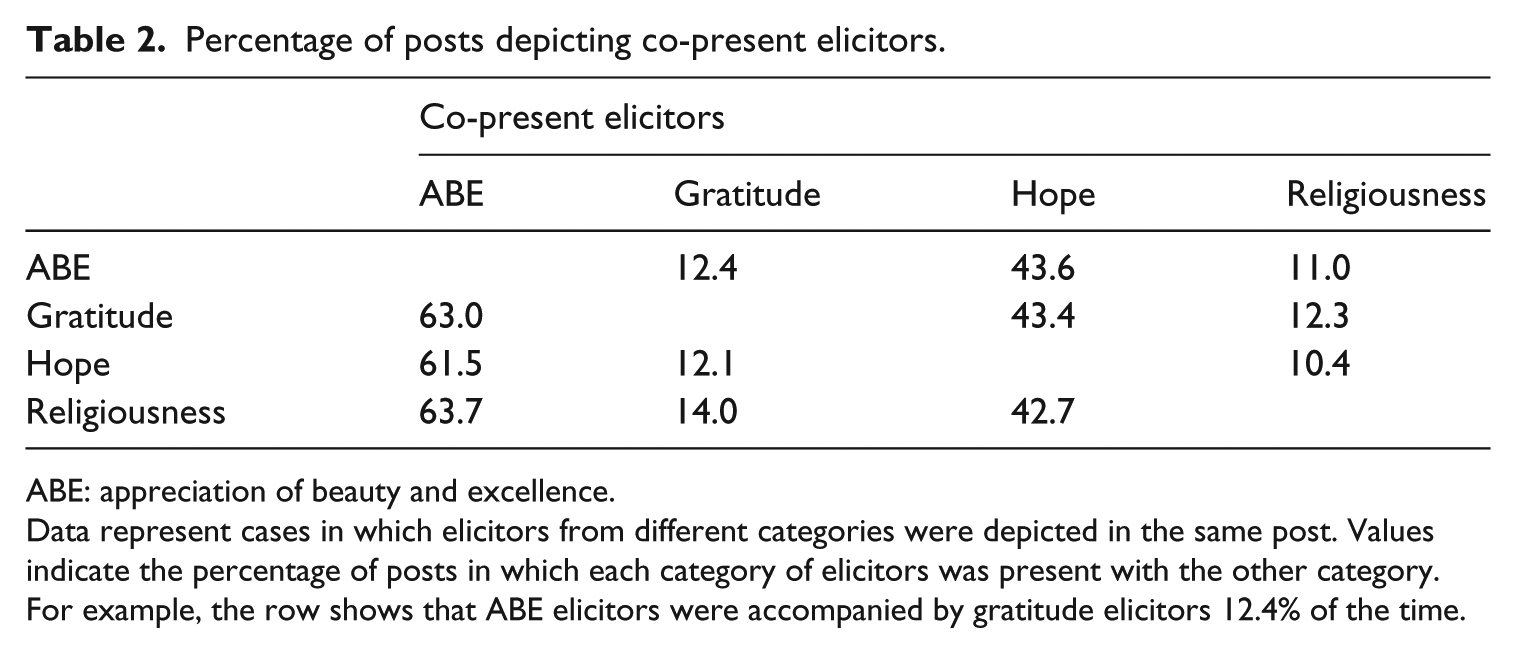
ABE: appreciation of beauty and excellence.
Data represent cases in which elicitors from different categories were depicted in the same post. Values indicate the percentage of posts in which each category of elicitors was present with the other category. For example, the row shows that ABE elicitors were accompanied by gratitude elicitors 12.4% of the time.
The relationship between the presence of elicitors and emotional reactions (RQ2) were explored with a series of regression analyses. Emotional reaction was measured by combining the number of likes and the number of reactions (e.g. love, sadness, shock) for each post, yielding an as-comprehensive-as-possible view of user reactions to a post. The posts ranged from 9 to 1,871,184 total reactions (M = 23,890.38 SD = 62,890.25). In addition, we controlled for the length of time a post had been online, measured in number of days from the date posted until the final day of data collection (15 February 2017): range = 45 to 412 days, M = 222.66, SD = 108.26.
Four multiple linear regression models—one for each conceptual group of elicitors—were analyzed. The first procedure predicted the total number of emotional reactions based on the number of ABE elicitors present and the length of time the post was posted. A significant regression was found (F2,3699 = 7.15, p = .001, R2 = .004). The number of ABE elicitors (β = .05, p = .001) significantly predicted emotional reactions, while length of time posted did not (β = −.04, p = .07). Next, emotional reactions were regressed on the number of gratitude elicitors present and the length of time posted. A significant regression was again found (F2,3699 = 10.23, p < .001, R2 = .005), with gratitude elicitors (β = .07, p < .001)—but not time (β = −.02, p = .09)—significantly predicting emotional reactions.
The third procedure investigated hope elicitors. The overall regression was significant (F2,3699 = 3.5, p = .03, R2 = .001), with the number of hope elicitors (β = .03, p = .058) and length of time posted (β = −.03, p = .052) both marginally significant predictors. The fourth regression examined religiousness elicitors and the length of time posted. This regression was not significant (F2,3699 = 1.75, p = .17, R2 = .001).
Finally, a multiple linear regression procedure examined emotional reactions with the total number of elicitors present and the length of time posted. A significant regression was found (F2,3699 = 11.49, p < .001, R2 = .006). The total number of elicitors (β = .07, p < .001) significantly predicted emotional reactions, while the length of time posted did not (β = −.03, p = .06).
Study 1 discussion
This study systematically analyzed inspirational posts on Facebook, the world’s largest social media platform. In many respects, the results mirror those reported in recent studies of inspiring YouTube videos (Dale et al., 2017b), films and television programs (Dale et al., 2017a), and Tumblr memes (Rieger and Klimmt, 2019). Across the media landscape, inspirational media content seems to be characterized by a particularly high concentration of self-transcendent emotional elicitors associated with hope and an ABE (especially, nature). In the present analysis, more than one third (36.3%) of all posts across our sample contained depictions of encouragement (hope elicitor). Although elicitors of hope were frequent in the previous analyses of inspirational media content, their presence—in particular, the direct elicitor encouragement—in Facebook posts was unusually high in comparison.
The high frequency of encouraging posts could be due to multiple reasons. First, common and readily available lists of inspirational Facebook pages were used to generate the initial list of pages to examine. It is possible that such lists (e.g. “10 Most Inspiring Facebook Pages You Should Be Following”) may be biased toward encouraging content. All pages listed were included in our selection process, but it is still possible that the initial list was somehow skewed toward encouraging pages. The second reason may be because users actually find encouraging posts to be particularly inspirational. The pages selected for inclusion were extremely popular, ranging in followers from 385,937 to more than 17.6 million (M = 3,299,403.62, SD = 3,931,788.65) and ranging in likes from 392,397 to more than 18 million (M = 3390010.56, SD = 4030273.24). It may be that Facebook users are drawn to encouraging content and find posts that elicit hope to be particularly inspirational. If this is true, creators of inspirational content would do well to include encouraging messages in order to reach their audiences. However, additional research is needed to determine if this is the case.
A third reason for the high frequency of encouragement on Facebook (relative to other mediums) may be that the platform’s heavy reliance on user-generated content simply provides a forum for encouraging media content more so than other outlets. That is, the platform enables users to create and share whatever content they desire, and it may be that encouraging content is the specific form of self-transcendent content most likely to be created and posted/shared. Although YouTube also allows for user-generated content in a way that traditional television and film do not, it is still primarily a video-based platform. Facebook posts, however, often include non-video content. Although video content is certainly present, Facebook posts, photos, and links provide a different way to share content that might inspire. Thus, perhaps the high presence of encouragement in posts is also the result of a difference in design affordances (i.e. the differences in platform design and user capabilities between sites).
Nature was also frequently present in the Facebook posts, similar to findings from previous content analyses. In this study, 1626 (or 43.9%) posts contained images of or references to nature. Many posts contained high-quality images of nature with text over them. An exploratory glance 3 at the qualitative descriptors in the data (captured but not systematically reported herein) show an overwhelming number of photos of water and/or beaches (n = 441), of trees and forests (n = 264), of mountains or mountain ranges (n = 150), or of stars (n = 203). These photos rarely had anything to do with the text over them. For instance, one post included a photo of a forest with the text “leadership is the art of getting someone else to do something you want done because he wants to do it.”
Although the high level of nature present in these posts is similar to past results, the reason that nature is present in Facebook posts may be different. In previous research on video-based media, the researchers reported that nature was coded as present even when it was simply a setting (Dale et al., 2017b). While the same is true of the Facebook posts (nature was coded as present if it was shown or discussed at all), the high level of nature may have been more intentional with Facebook. Creators of this content had great flexibility when choosing photos to include in their posts. Although we cannot know for certain if nature photos were chosen for their “inspirational capability,” the high rate of selection appears deliberate. Future research should explore the reasoning behind such decisions to better understand the “construction of inspiration.”
The results also showed that presence of self-transcendent emotional elicitors significantly predicted emotional reactions, such that more elicitors were associated with a greater number of likes/reactions. It is important to note, though, that the number of emotional reactions is likely tied more to quality of elicitors than quantity. The vast majority (92.7%) of posts contained three or fewer elicitors, and 76.9% contained only two or fewer. This suggests that content creators are primarily including only a small number of elicitors in any given post at one time. Nevertheless, as with past studies, the current one again demonstrated that the presence of specific elicitors of self-transcendent emotions seems to increase the popularity of content.
At the same time, it is not yet known whether some elicitors are more influential—either in terms of the activation of emotions or popularity—than others. Furthermore, this content analysis did not distinguish between elicitors seen in the text of the posts, those portrayed in photos, and those that appeared in some combination of both. Social media platforms offer a unique opportunity for text and photos to regularly coexist. Other media sources are designed such that one form of content is often the only form available (e.g. television and movies primarily focus on visual images) or where one form is more dominant (e.g. newspapers that are heavy on text that rarely include images). However, with social media, many posts contain both text and images, and it may be that some elicitors are more influential in specific forms. Perhaps nature elicitors primarily appear in photos because it is easier to convey the beauty of nature through a visual image, or perhaps text is a more common way of describing someone overcoming obstacles due to the ability to provide additional backstory. Future research should examine the possibility that elicitors may lead to different effects based on how they appear in a post.
Furthermore, specific content may have differential effects when encountered across different sources of media content. For instance, users may find certain representations more inspirational when encountered on Facebook compared with the same content featured on a television show. People may use Facebook to seek out encouraging posts, while they may use film to seek out stories of kindness. Furthermore, users may have different expectations when it comes to inspiring social media content compared with other platforms. In short, although Study 1 provides insight into the types of inspirational content available on Facebook, it cannot tell us information about the way that users actually encounter, recall, or interact with this content.
In light of this limitation, Study 2 aimed to explore the specific ways that individuals encounter and use various forms of inspirational social media content in their daily lives, providing a more complete picture of the actual user experience.
Study 2: survey of inspirational social media use
Although the findings reported in Study 1 provide an important step forward in understanding the types of self-transcendent content social media users may be exposed to, they tell us nothing about the experience of social media users themselves. These results also cannot tell us whether users are actually inspired by the kinds of content that are commonly found. In Study 2, the results of a two-wave national survey of US adults are reported in an effort to better understand how individuals use Facebook and the kinds of social media content they find inspirational. Furthermore, this study seeks to explore how the content users find inspirational on social media compares with inspirational media content from other media sources and how their sharing of that content through Facebook may differ from sharing through other social media platforms. As a result, the following research questions guided our analyses:
RQ3. What kind of content do social media users find inspiring?
RQ4. How do the themes of inspirational social media content differ from those found in other media?
The results of Study 1 showed that specific content in posts may be associated with emotional reactions, such that the presence of more self-transcendent emotional elicitors led to more likes and reactions. However, questions still remain regarding these issues. On Facebook, one factor that can influence reactions is the extent to which individuals share posts from other Facebook pages. In addition, social media users might share different types of information on different sites. For instance, past research indicates that Twitter users are more likely to share “hard” news stories (e.g. foreign policy) on the platform, while Facebook users tend to share “softer” news (Kalsnes and Larsson, 2018). However, to date, the sharing patterns of inspirational news stories across platforms has not been explored. Thus, the following research question was interrogated:
RQ5. Of those who report being inspired by media content, do individuals who use Facebook as their primary social network report different sharing behavior than those who use other social networking sites?
Study 2 methods
Procedure and sample
The questionnaire was designed by the authors and the research staff of Public Religion Research Institute, a non-profit, non-partisan organization that conducts research on values, religion, and public life. Participants were randomly drawn from the AmeriSpeak panel operated by NORC at the University of Chicago, which is a probability-based panel that is representative of the adult population in the United States. A total of 2016 adults completed the survey (51.6% female), primarily using a self-administered, online design (n = 1784 or 88.49%). An additional 232 responses were collected by professional interviewers via telephone, under the direction of NORC. Data were collected in the first quarter of 2017. The same individuals completed a related survey in 2016; the social media platform use item described below was collected in the earlier wave.
Survey responses were weighted to represent the current US population. This was accomplished by first calculating panel base weights for every household based on the probability of selection from the NORC National Frame and then assigning these household-level weights to each eligible adult in every recruited household. The sample demographics were then balanced to match the US population parameters for age, gender, race, ethnicity, education, housing type, and telephone usage. An analysis of the National Health Interview Survey was used to develop the telephone-usage parameter. The US Census Bureau’s Current Population Survey was used to develop all other weighting parameters. An iterative proportional fitting process was used for the sample weighting, which simultaneously balanced the distributions of all variables. In addition, weights were trimmed to prevent individual interviews from influencing the final results too much. All subsequent analyses were calculated with the weights applied to the dataset. The design effect for the surveys was 1.9 (Wave 1) and 2.0 (Wave 2), and the margin of error was ±2.5% and ±3.1%, respectively, (95% confidence level).
Females comprised 57.4% of the sample; 64.8% of participants were White, non-Hispanic; with 15.0% Hispanic; 11.7% Black, non-Hispanic; and 7.9% other or mixed race. Participants ranged in age from 19 to 94 (M = 47.76, SD = 17.50). In terms of age, 20.2% were between 18 and 29 years, 25.0% were 30–44, 26.6% were 45–59, and 28.3% were 60 or older. Nearly one-third of the participants had completed a bachelor’s degree (32.4%), while 25.7% had completed some college, 29.6% had a high school degree or equivalent, and 12.3% had not completed high school. A plurality of participants were married (49.5%), with 24.0% having never been married, 15.5% divorced or separated, 6.0% living with a partner, and 5.0% widowed. Finally, 34.6% of respondents identified as Democrats, 32.7% identified as Independents, and 25.3% identified as Republicans.
Measures
The survey instrument was designed for a large, multi-faceted project; only a few variables germane to this study have been analyzed and are reported herein. First, participants responded to items about media content they found inspiring: “Thinking about the last time you felt moved, touched or inspired while [using social media, watching television, watching a movie], what was it about the [content] that MOST moved you? The most important character in the [content] . . .” Participants selected from a set of nine inspirational content themes previously identified (Raney et al., 2018): overcame an obstacle or demonstrated perseverance; experienced a tragedy, illness, or loss; showed kindness to another person; demonstrated exceptional skill, achievement, or made a discovery; saw or witnessed something of natural beauty; experienced love, bonding, or connection; displayed gratitude or thankfulness; felt joyful about life; and other.
Next, sharing behavior was measured using a single item in which participants noted whether or not (“Yes,” “No,” or “Don’t know”) they shared the most recently encountered media contents “with a friend or family member in any way.”
Finally, participants indicated which social media platform they most often used from a list including Facebook, Twitter, LinkedIn, Pinterest, Google Plus, Tumblr, Instagram, Vine, and YouTube. Participants were able to select up to two different options.
Study 2 results
Of the respondents in this survey, 34.9% reported having felt moved, touched, or inspired while using social media in the week prior to the survey; 17.9% in the previous month; and 10.2% in the previous 6 months. Another 22.3% reported never having felt moved, touched, or inspired while using social media. By way of comparison, 41.9% reported having been inspired while watching television in the week prior to the survey, 25.8% in the previous month, 14.4% in the previous 6 months, and 2.8% never. In terms of film, 31.2% reported having been inspired in the prior week, 29.9% in the previous month, 19.4% in the previous 6 months, and 3.0% never.
Isolating responses from the youngest age group alone, a different pattern emerges; 36.6% reported having felt moved, touched, or inspired while using social media in the prior week; 28.5% while watching television; and 19.7% while watching a movie. In other words, fewer young adults reported having been recently inspired while consuming traditional forms of entertainment, but the percentage of young adults experiencing self-transcendence from social media exposure was similar to that of other age groups (38.9% of adults ages 30–44, and 36.1% of those ages 45–59). Perhaps as to be expected, individuals ages 60 and older were the least likely to report being inspired via social media during the previous week (28.9%).
To explore RQ3, responses to the inspirational content theme item were examined (see Table 3). Participants were most often inspired by social media content depicting kindness to another person (11.7%), followed by posts where someone overcame an obstacle or demonstrated perseverance (8.9%); posts that showed someone experiencing love, bonding, or connection (8.7%); and posts displaying gratitude or thankfulness (8.6%). This pattern of themes was similar across gender (kindness: 14.0% for females, 9.1% for males; overcoming obstacles: 11.3% for females, 6.3% for males; love: 11.2% for females, 6.0% for males; gratitude: 8.9% for females, 8.3% for males). Females also reported that inspirational social media content contained portrayals of feeling joyful about life at a higher rate (10.6%).
Percentage of respondents reporting each theme as most prominent in inspirational content.

When examined by age, gratitude was seen most frequently among those in the 18–29 age range (14.4%), followed by feeling joyful about life (13.5%), overcoming obstacles (12.6%), and finally kindness (11.4%). For those in the 30–44 age range, kindness was the most common (12.5%), followed by portrayals of tragedy, illness, or loss (11.2%), love (10.1%), and overcoming obstacles (9.0%). Those in the 45–59 age range were most similar to the overall sample, with 14.3% reporting that the content depicted kindness, 10.9% depicted overcoming obstacles or perseverance, 7.6% depicted gratitude, and 7.3% depicted love. Finally, for those who were 60 or older, an equal percentage of respondents said the content contained depictions of kindness and love (8.4% each), followed by gratitude (5.6%) and feeling joyful about life (5.4%). These results show reveal generational differences in the types of social media content that inspires.
RQ4 examined inspirational content across media forms. As Table 3 indicates, participants reported different rates of inspirational content themes across social media, television, and movies. Kindness was the most reported inspiring theme from social media but not television shows or movies. Only 10.0% of participants reported that kindness was the primary theme in inspirational movie content, and 15.0% reported the same for television shows. In contrast, 18.5% of participants said that inspiring television shows and 21.4% said that inspiring movies primarily contained themes related to overcoming obstacles or perseverance; this was the case for only 8.9% of the social media users.
Of participants who felt moved, touched, or inspired by media content, 61.0% shared it with a friend or family member; 38.8% did not. In order to explore RQ5, a chi-square test of independence was performed to examine the relationship between Facebook use and the sharing of inspirational or moving content. No difference was observed between Facebook users (59.1% of 1342 respondents shared content) and users of other social media sites (62.1% of 243 shared) with regard to reported sharing behavior: χ2(1) = .79, p = .39.
Study 2 discussion
The results of Study 2 show that the majority of users have been inspired at some point by social media content (76.5%), with 34.9% reporting this being the case within the past week. This suggests that social media content may be a common source of inspirational content in the daily lives of users. These results provide an important step forward in understanding the overall effects of social media use on well-being by providing a more complete picture of the types of positive content that influences social media users.
The most commonly reported theme of inspirational social media posts was kindness, followed by overcoming obstacles/perseverance, human connection, and gratitude or thankfulness. Young adults reported seeing inspirational content containing depictions of gratitude and joy about life at higher rates than other age cohorts. This may be due to differences in the types of content that is available to this age range on social media, or it may be due to differences in taste or motivations for media consumption. For example, Oliver and Raney (2011) found that younger audiences had a higher hedonic media motivation than older audiences. These findings could explain the differences between age groups in Study 2, and future research could further explore if individuals in different generations find similar content to be inspiring, or if they find certain themes more poignant, touching, or moving.
In addition, content depicting individuals overcoming obstacles and/or persevering was mentioned less frequently for social media posts than for these other forms of media. One possible explanation for this discrepancy is that Facebook users may find themselves less inspired by portrayals of overcoming obstacles/perseverance on social media compared with other forms of media. It is possible that social media users enjoy different kinds of inspirational content across different media, with kindness particularly popular among Facebook users. It is also possible that Facebook is a more effective medium for conveying certain content compared with others. For instance, stories of overcoming obstacles might be more inspirational when seen in a movie compared with a Facebook post because movies allow for greater story development across time. However, it is also possible that people report being inspired by posts containing depictions of individuals overcoming obstacles/persevering less frequently on social media than with other forms of media simply because these portrayals appear relatively less frequently. In fact, the results of the content analysis in Study 1 showed that only 3.9% of posts contained depictions of individuals overcoming obstacles and/or persevering, suggesting that social media users may come across this type of inspirational content less often than other kinds of content. Future research should examine whether individuals actively choose to use social media to seek out different inspirational content themes or whether the difference in themes reported in Study 2 may be due to the difference in the frequency of these themes across different mediums.
Despite the small number of instances of overcoming obstacles/perseverance reported in the Study 1 content analysis, participants in Study 2 reported this as a common theme in inspirational Facebook posts. Similarly, both kindness and gratitude themes were mentioned by participants at a higher rate than one would expect given Study 1 findings (kindness appeared in 6.5% of the posts, gratitude in 4.6%). Yet, more than twice as many people listed kindness as a theme (11.7%) compared with those who recalled something of natural beauty (4.1%, despite 43.9% of the posts containing nature in Study 1). The apparent discrepancies in the presence of inspiring elicitors in social media posts and the nature of content themes reported to be inspiring may suggest that certain elicitors are more inspiring than others in general or at least across different media forms. It may be that social media portrayals of overcoming obstacles are more moving than images of nature and are somehow more likely to be recalled by viewers later. Future research should explore why some elicitors that appeared less frequently across Facebook are recalled at a higher rate than those that appeared more often.
The results of Study 2 also show that Facebook users do not share inspirational posts at different rates compared with other social media users. While different social media platforms have platform-specific affordances, sharing behavior seems not to be impacted by these differences in design. This may be due to the fact that it is this sharing of content that makes social media platforms inherently “social.” It may be that some users are simply more likely to share content than others, regardless of the platform, rather than that individuals are more likely share content on one platform compared with another. Future research might also explore whether inspirational content is shared at different rates than funny, negative, or informative content. Previous research by Clayton et al. (2018) found that individuals reported higher levels of sharing intention for an inspirational video compared with a funny one. Based on these results, we might suspect that inspirational content is shared at higher rates, regardless of the platform. Yet, future research is warranted to further explore sharing behavior of different content across different social media platforms.
Second, future research should examine how encountering inspirational content affects, and is affected by, other neutral or negative content present at the same time. On Facebook, the news feed feature that allows users to see the posting and interaction activity of their friends contains stories that vary widely in valence. One might see a post from a friend about the death of a beloved pet followed by a national story of an octogenarian graduating from college after years of dreaming of an education. This back and forth between unexpected negative news and unexpected inspirational content may influence the effects of social media use. It could be that one valance of content is stronger than the other (e.g. stories of moral beauty are more impactful than negative stories). It may also be that the volume of positive versus negative stories matters (e.g. one negative story may outweigh the positive effects of three inspirational stories). Future research should determine whether the varied makeup of Facebook content matters when considering the impact of randomly encountering inspirational posts.
Concluding thoughts
This project systematically explored both the content and consumption of inspirational content on Facebook. As with any study, the current one has its limitations. One may be the selection protocols used to generate the list of inspirational Facebook pages in Study 1. Every effort was made to ensure a variety of pages were included, but it may be that only certain types of content are included on such lists. Therefore, other, no-less-popular forms of inspirational content may have been omitted. In addition, there is no guarantee that the Study 1 posts were actually interpreted as inspirational by users. However, the pages sampled were popular among many users, suggesting that at least some find the content to be inspirational. Second, content posted to public Facebook pages—required by the data-scraping tool—likely makes up a small portion of content that users find on their (private) news feeds. Using other forms of data collection will help future researchers examine a more representative sample of the self-transcendent content actually viewed by most users. With regard to Study 2, the content themes measured only the most recent instance of inspiration with the various media platforms. It is possible that the most recent instance was atypical for some individuals, thus impacting the representativeness of the findings. However, the large sample size (n = 2016) should mitigate these possible effects to some extent.
Despite these limitations, these two studies provide a systematic look at inspirational Facebook content and the way that social media users actually recall, encounter, and share it. Together, the studies provide new insights into the content billions of users around the world are exposed to on a daily basis. As more and more people include social media as a part of their daily media diets, and given that exposure to that content can happen anywhere and at any time, it is imperative for media scholars to continue to investigate the possible positive role that social media content may play in promoting well-being and human flourishing.
Footnotes
Authors’ note
Jerrica T Rowlett is now an assistant professor at Georgetown College.
Funding
The author(s) disclosed receipt of the following financial support for the research, authorship, and/or publication of this article: The author(s) received financial support from the John Templeton Foundation for the research, authorship, and/or publication of this article.
