



Abstract
This study aims to test the third-person effect (TPE) in the perception of Internet privacy risks. Support was found for a TPE model suggesting that users report greater perceived Internet privacy risks on others than on themselves, based on a sample (N = 613) from Amazon MTurk. In particular, the differential perception of Internet privacy risks between self and others increased people’s willingness to recommend protective measures to others but decreased their willingness to adopt protective measures themselves. Moreover, social distance, perceived Internet privacy knowledge, negative online privacy experiences, and Internet use activities emerged as significant predictors of TPE perceptions about Internet privacy risks. Study findings indicated that third-person perception is one of the major barriers inhibiting the adoption of privacy protection measures. The antecedents of TPE perceptions detected here provide valuable implications about how to enable Internet users to protect their privacy security.
Internet privacy security is a growing concern worldwide. Internet changes the presentation, exchange, and storage of private information. People leave countless digital footprints on social media, e-commerce websites, search engines, emails, and other service providers. The emergence of Internet provides convenience for social interaction, business, and entertainment, but also allows motivated offenders to collect millions of private account details in seconds, using advanced hacking programs, which poses risks to privacy security (Li et al., 2010). The major negative consequence of online privacy invasion involves monetary loss. According to the Federal Bureau of Investigation’s (FBI) Internet Crime Complaint Center, the reported financial loss of Internet scams was more than US$1.42 billion in 2017 (Internet Crime Complaint Center, 2017). Another consequence of privacy invasion involves relational conflicts. The unauthorized access to personal accounts can result in inappropriate comments and postings that may spur conflicts with online contacts, damage to users’ reputation, and loss of social opportunities (e.g. Zittrain, 2008; Chen et al., 2016).
Previous studies found that even though some Internet users expressed high privacy concerns, they are still willing to disclose private information in exchange of the benefits of social interaction and online shopping (Norberg et al., 2007; Young and Quan-Haase, 2013). Some rational Internet users assess the privacy risks cognitively and adopt the protective measures accordingly (Millham and Atkin, 2018). However, some other users simply believe that they will not encounter negative privacy experiences, while others are more likely to be victims (Li, 2008; Millham and Atkin, 2018). The biased optimistic perception can result in people’s decreased intention to adopt protective measures and increase their privacy risks in the future.
In communication studies, such optimistic perception is termed the third-person effect (TPE). Originating from traditional mass media research, TPE holds that people often perceive greater negative media content will have greater impacts on others than on themselves (Davison, 1983). Extending TPE into the perception of Internet privacy risks, people tend to believe that others are more likely to be impacted by privacy threats (Cho et al., 2010; Lo and Wei, 2002). TPE perceptions of Internet privacy risks can be a major barrier for Internet users to adopt protective strategies. Notably, research suggests that the adoption rate of Internet protection practices is relatively low (Millham and Atkin, 2018; Author). To facilitate people’s adoption of privacy protective measures, it is important to identify the magnitude of TPE perceptions, the antecedents of TPE perceptions, and its impacts on the decision to adopt privacy protective measures.
Drawing from TPE theory, this study develops a three-stage model containing (1) five antecedents of TPE perceptions of Internet privacy risks—social distance, undesirability of Internet privacy risks, prior negative privacy experiences, perceived knowledge about privacy security online, and consumption of online sources about Internet privacy threat; (2) TPE perceptions of Internet privacy risks; and (3) behavioral intention to adopt privacy protection measures themselves and recommend it to others. This study contributes to Internet studies theoretically in three ways. First, this study introduced TPE theory in the domain Internet privacy research. Second, testing the association between TPE perceptions and behavioral intention helped explain why people refuse to adopt privacy protection measures. Third, five antecedents of TPE were examined in novel ways, which contributed to the theoretical development of TPE. The findings of this study can provide valuable implications about how to narrow down the TPE perceptions and increase people’s willingness to adopt privacy protection measures.
Literature review
TPE theory and conceptualization
TPE theory was developed in the context of conventional mass media. Davison’s (1983) seminal research detected that college students held distinct perceptions of media effects on self and others. Respondents reported greater perceived influence of political and commercial advertisements on others than on themselves. At the core of this research is the perceptual component of TPE, which entails that people perceive greater media influence on others than on self (Davison, 1983). As Davison (1983) noted, media viewers often think that media messages do not have a sizable effect on “me” and “you,” but have a strong effect on “them.”
Multiple studies have found support for the perceptual component of TPE. For instance, a meta-analysis conducted by Paul et al. (2000) documented 32 studies that support the existence of TPE in the contexts of pornography, political news, violent media content, and video games. The early TPE studies primarily focused on the negative media content on conventional mass media. Extending TPE into Internet studies, researchers found that people perceive greater negative impacts of Internet pornography on others than on themselves (Lee and Tamborini, 2005; Lo and Wei, 2002, 2005; Wu and Koo, 2001).
Critical to this study is the very limited extension of TPE into Internet privacy studies. In fact, only three empirical studies have examined TPE perceptions of Internet privacy. Debatin et al. (2009) found that, even though people are concerned about Internet privacy, they are still willing to upload large amounts of personal data online because they often ascribe related privacy risks to others. While this finding is suggestive, that study utilized qualitative interview methods and did not test TPE in a rigorous manner. Two survey studies have tested TPE perceptions of Internet privacy (Cho et al., 2010; Li, 2008). Cho et al. (2010) found that Internet users who believe they have strong control over privacy security tend to believe that others are more vulnerable to online privacy risks. In another study, Li (2008) found that respondents with stronger computer skills and knowledge perceive themselves to have greater control over their Internet privacy, while others cannot protect privacy security effectively. A limitation of these two studies is that the causes of TPE perceptions were uncertain.
This study tested the perceptual component of TPE in the context of Internet privacy by asking the respondents how they estimate Internet privacy risks on self and others. Based on the TPE dynamics outlined above, it is expected that perceived risks on others are greater than on self. More formally:
H1. People perceive greater Internet privacy risks on others than on self.
The behavioral component of TPE holds that biased perceptions of media effects can lead people to develop behavioral intentions to counteract negative media influences (Jeffres et al., 2008). Davison (1983) argued that individuals tend to think they can resist the influence of negative media content while others are likely to be impacted. Researchers found that, when people possess high TPE perceptions, they tend to support restrictions on such media content, but refuse to change their own media use habits (Jeffres et al., 2008; Paul et al., 2000; Wu and Koo, 2001; Xu and Gonzenbach, 2008; Youn et al., 2000).
Prior research about behavioral component of TPE focuses on behavioral intentions to support media censorship (Paul and Shim, 2006). Governments played a central role in developing content rating systems and enforcing censorship policies. In contrast, Internet privacy protection relies on individuals’ objective judgment of privacy risks and selection of appropriate defensive measures (Li, 2008). When TPE perceptions of Internet privacy risks are high, people are likely to overestimate Internet privacy risks on others; this, in turn, increases one’s intention to recommend online privacy protection measures to others. Moreover, when individuals possess lower TPE perceptions, individuals are likely to be aware of privacy risks and willing to enhance privacy protections themselves. Based on this logic, we posit that
H2. TPE perceptions of Internet privacy risks positively predict the willingness to recommend the privacy protection measures to others.
H3. TPE perceptions of Internet privacy risks negatively predict willingness to adopt online privacy protection measures by oneself.
Antecedents of TPE
In addition to the direct test on TPE theory, it is important to identify the antecedents of TPE perception. Empirical tests on the antecedents of TPE perceptions can yield insight on how to lower biased perceptions and facilitate individuals to use protective measures effectively.
Social distance
Social distance reflects the perceived difference between individuals with different backgrounds (Karakayali, 2009). The magnitude of the disparity between self and others increases with social distance. Researchers attribute this phenomenon to a person’s uncertainty toward unfamiliar people (Paek et al., 2005; Schreiner et al., 2018). Prior research found that, when others are perceived as distant, the self-others perceptual gap increased (Andsager and White, 2009). When comparing oneself to close friends, TPE perceptions diminished significantly (Lee and Park, 2016). A major limitation of existing research on social distance involves the lack of systematic empirical measurements. For instance, researchers assume that college respondents consider other students in the same school to be closer than residents living in another state (McLeod et al., 1997). However, college students from another state may perceive residents from their home state as closer than the students at the focal university.
Given this limitation, this study introduced Bogardus’ social distance scale to measure the social distance of others. Developed in 1933, the scale was improved by subsequent studies (Parrillo and Donoghue, 2005). This scale was originally designed to measure the perceived acceptance of ethnic groups in US society, which reflects the varying closeness between self and others. The social distance scale contains seven categories, including close relatives by marriage, close personal friends, neighbors on the same street, co-workers in the same occupation, citizens in my country, only visitors in my country, and people outside the country. In this study, “others” are divided into the aforementioned seven categories, as defined by the social distance scale. Our framework assumes that TPE perceptions of Internet privacy risks increase with social distance.
H4. Social distance positively predicts TPE perceptions of Internet privacy risks.
Undesirability of Internet privacy risks
Undesirability of media content is another predictor of TPE perceptions. Undesirability reflects the extent to which media messages are rejected by viewers (Jensen and Hurley, 2005). The magnitude of TPE perceptions is influenced by the undesirability of media messages (Lim, 2017). When a media message is perceived as undesirable, people tend to believe that they are less influenced by such messages and others are more likely to be influenced (Boyle et al., 2008). For example, previous research found that people who played violent video games often believed that the game violence will not influence themselves but will increase other gamers’ verbal and physical aggressiveness (Boyle et al., 2008). When media content is perceived as desirable, the TPE perceptions of media content tend to be reversed. For instance, researchers found that, after watching anti-smoking advertisements, respondents reported that such advertisements influenced themselves more than others (Henriksen and Flora, 1999). The major limitation of previous research is that researchers simply assume the undesirability of media messages (e.g. smoking is undesirable), instead of measuring this empirically (Chock, 2006; Chock et al., 2007). Media users can hold different perceptions on the same media messages. For example, active news readers consider news from prestigious news agencies as desirable, while non-active readers cannot tell the quality of news (Eveland and McLeod, 1999).
This study provides empirical measures of the undesirability of Internet privacy risks to assess people’s perceptions about the severity of privacy invasion risks. People’s perceived undesirability of privacy threats varies due to differences in Internet skills and use experiences. Those perceiving a highly undesirable Internet privacy risk are expected to exhibit high TPE perceptions. More formally:
H5. Undesirability of Internet privacy risk positively predicts TPE perceptions of online privacy risks.
Perceived knowledge of Internet privacy risks
Personal features (or characteristics) are also expected to operate in the TPE. One such feature is perceived knowledge, which indicates an individual’s familiarity with an issue (Nunes et al., 2011). Individuals acquire knowledge from media, education, and personal experiences. People who are highly involved in a topic tend to think that others are more influenced by media messages because of their limited knowledge (Xie and Johnson, 2015). For instance, people who believe they are more knowledgeable about certain products think that others’ purchase decision is likely to be influenced by advertisements (Eisend, 2017).
Researchers have noted that perceived knowledge—and not actual knowledge—predicts TPE perceptions (Salwen and Dupagne, 2001). Lasorsa tested respondents’ actual versus perceived political knowledge of the US–Soviet Union conflict. He found that subjects who perceive themselves to be knowledgeable about the US–Soviet Union conflict also believe that the general public could be easily fooled by a fictional program depicting Americans under Soviet occupation. Similarly, another study found that the higher the perceived knowledge, the more likely people perceive themselves as superior to others (Salwen and Driscoll, 1997).
In this study, perceived knowledge refers to one’s perceived understandings of Internet privacy risk issues, such as virus attacks, hacker attacks, identification theft, credit card theft, privacy invasion, and online insults. A person with high perceived knowledge is expected to attribute the risks to others, which increases TPE perceptions of Internet privacy risks. Based on the theory and literature reviewed above, we posit that
H6. Perceived knowledge of Internet privacy risks positively predicts TPE perceptions of Internet privacy risks.
Negative online privacy experiences
Another focal antecedent of TPE perceptions is negative online privacy experiences. Negative online privacy experiences refer to one’s suffering of identity theft, financial loss, and relational conflicts in the past (Blinded-In-Press-Citation; Debatin et al., 2009). The misuse of personal financial accounts by others can lead to monetary loss, whereas unauthorized access to a person’s social media account can cause relational conflicts with online contacts. Internet users who have experienced privacy loss before tend to be highly aware of online privacy risks. People form an understanding of the world via their estimation of prior experiences (Cho et al., 2010). People often use personal experiences to predict future decisions and behaviors. Prior negative experiences lead people to believe that they are no better than others (Helweg-Larsen and Shepperd, 2001).
Similarly, in the context of the Internet, one’s perceived Internet privacy risks increase with the negative online privacy experiences. For instance, researchers found that the experiences of information stolen and unauthorized access to personal SNS (social networking sites) accounts resulted in increased awareness of information disclosure (Chen et al., 2016). People who personally experienced privacy loss tend to understand that online privacy risk is real and relevant to themselves (Metzger and Suh, 2017; Petronio, 2002). The current framework incorporates five types of privacy invasions: (1) online theft of financial assets, which results in monetary loss and other conflicts (Chen et al., 2017); (2) reception of spam emails, which entails soliciting information from unknown sources (Wainer et al., 2011); (3) unauthorized access to online personal accounts, such as SNS, which results in improper postings on personal accounts and relational conflicts with friends (Chen et al., 2017); (4) experiencing of online harassment; and (5) reception of unwanted friend invitations (Kenneally and Claffy, 2010). Based on the literature and TPE dynamics outlined above, we posit that the negative online privacy experiences are negatively associated with TPE perceptions. More formally:
H7. Negative online privacy experiences negatively predict TPE perceptions of Internet privacy risks.
Internet use
Given that the accumulation of knowledge is a longitudinal process, frequent media viewers tend to think that other non-active viewers lack the ability to judge media messages (Stefanita et al., 2018). The biased perceptions of other media users can heighten TPE perceptions. Support for the association between media uses and TPE perception was found in studies of traditional mass media, but not the Internet (Jeffres et al., 2008). Similar to traditional media, people use the Internet to follow-up on news reports or watch streaming videos. The difference is that the Internet provides a tremendous amount of media information for users to choose. Users tend to be involved in frequent information exchanges and develop Internet skills through daily use. Active users’ proficient Internet skills may thus enhance their belief that they will not experience negative online encounters.
This study operationally defines Internet use in terms of two online activities that could influence Internet privacy perceptions: online information searches and online news consumption. Online information searches refer to the use of Internet to seek useful information relating to Internet privacy. Online news consumption refers to Internet users’ viewing of textual, audio, and video news reports on the Internet about Internet privacy issues. The more users engage in online information searches and news consumption, the more likely they are to understand Internet privacy risks, which in turn, increases TPE perceptions of Internet privacy risk. Based on the theory and literature reviewed above, then, we posit that
H8. Internet use positively predicts TPE perceptions of Internet privacy risks.
Methods
Sampling
The survey data were collected through Amazon Mechanical Turk in November of 2016. Amazon MTurk (www.MTurk.com) is a novel crowdsourcing survey platform service that contains a participant compensation system and several hundred thousand subscribers worldwide, which allows researchers to design survey research, recruit participants, and collect numeric data (Buhrmester et al., 2011). Each respondent to this study who completed the questionnaire received US$3. The sample size of this study was 613. Respondents were required to complete all survey items prior to submission; hence, no missing values were recorded. Past research suggests that data derived from MTurk samples differs little from traditional samples (Paolacci et al., 2010)—particularly in terms of reliability (Buhrmester et al., 2011)—and are thus comparable in quality to those conventional data sources (Horton et al., 2011).
This study measured a set of socio-demographic variables as control variables, including age, sex, education, ethnicity, household income, and employment status. The average age of respondents was 35.69. More than half of respondents were male (54.16%). The ethnic distribution is as follows: Non-Hispanic Caucasian (74.71%), Hispanic (7.50%), Asian (7.50%), African American (7.34%), and other race/mixed race (6.04%). The majority of respondents reported household income between US$20,000 and US$60,000, which is representative of the US population. Most respondents received some college education; responses included college graduate (40.95%), some college (31.16%), graduate degree (8.97%), technical school (7.67%), high school graduate (10.77%), some high school (0.33%), and some grade school (0.67%) (see Table 1).
Descriptive statistics of control variables.
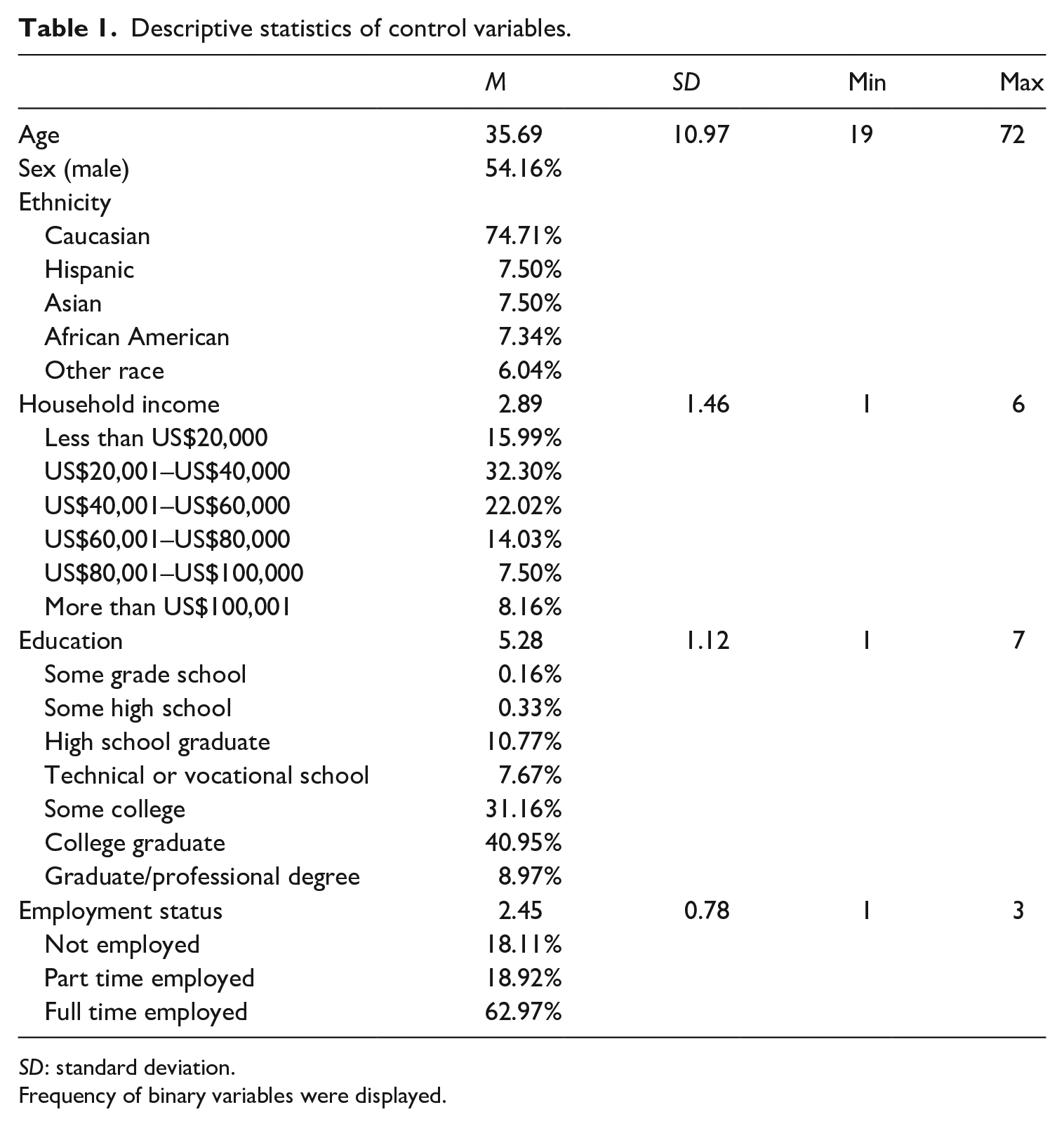
SD: standard deviation.
Frequency of binary variables were displayed.
Measurements
Perceived Internet privacy risks
Adapted from prior measurements on TPE (Cho et al., 2010; Li, 2008), perceived Internet privacy risks were measured with two items. Perceived Internet privacy risks on self was measured with “How much do you think your Internet privacy is at risk?” Responses ranged from 1 (no risk at all) to 7 (great risk). The measurement of Internet privacy risks on others was as follows: “How much do you think other people’s Internet privacy is at risk?” The responses were measured on a seven-item scale, ranging from 1 (no risk at all) to 7 (at great risk). In this composite this, “others” refers to general others. Respondents reported higher perceived Internet privacy risks on others (M = 5.59, SD = 1.15) than on themselves (M = 5.03, SD = 1.40). Then, the TPE perception of Internet privacy risks (M = 0.55, SD = 1.03) was computed by gauging perceived risks on others and then subtracting perceived risks on themselves.
Willingness to recommend privacy protection measures to others
A single item was used to measure respondents’ willingness to recommend privacy protection measures to others. Responses were measured on a seven-item scale, ranging from 1 (not at all likely) to 7 (highly likely). More than of half of the respondents (63.62%) claimed that they were somewhat willing to recommend privacy protection measures to others (M = 5.09, SD = 1.37).
Willingness to adopt privacy protection measures for oneself
A single item was used to measure respondents’ willingness to adopt privacy protection measures for themselves. Responses were measured on a seven-item scale, ranging from 1 (not at all likely) to 7 (highly likely). More than half of respondents reported a willingness to adopt privacy protection measures themselves (M = 5.00, SD = 1.47).
Social distance
Based upon the social distance scale, this study divided “others” into the following seven categories: (1) close blood relatives or relatives by marriage, (2) close personal friends, (3) colleagues in the same organization, (4) people in the same occupation or the same educational level, (5) citizens and permanent residents in your country, (6) visitors in the United States, and (7) people outside of the United States. A lower score represents closer social connection. Respondents were asked to rate the perceived Internet privacy risks on each of the seven categories of “others.” The responses were given on a seven-item scale, ranging from 1 (no risk at all) to 7 (at great risk). The results are presented in Table 2.
Descriptive statistics of independent and dependent variables.
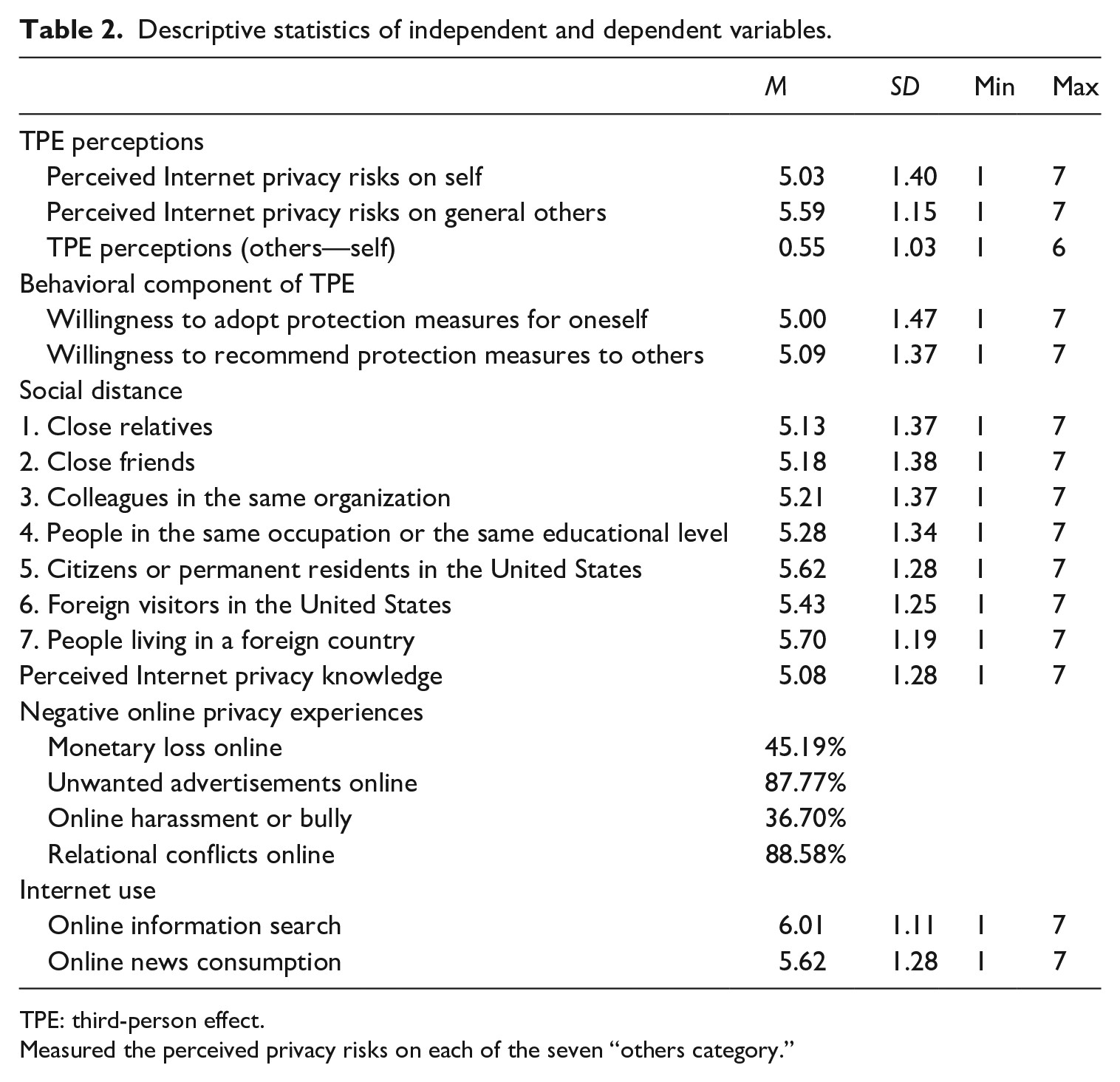
TPE: third-person effect.
Measured the perceived privacy risks on each of the seven “others category.”
Undesirability of Internet privacy risks
Adapted from previous studies (Crossler, 2010; LaRose and Rifon, 2007; Mohamed and Ahmad, 2012), undesirability was measured to reflect the perceived severity of Internet privacy risks. The four items included are listed as follows: (1) I believe that losing information privacy through Internet would be a serious problem, (2) having online identity stolen through Internet would be a serious problem, (3) losing photo privacy online would be a serious problem, and (4) unauthorized access into personal accounts, such as social networking sites, personal financial account, would be a serious problem. Responses were given on a 7-point Likert-type scale, ranging from 1 (strongly disagree) to 7 (strongly agree). A composite variable was computed by averaging the four items. The scale reliability was satisfactory (α = .83). The majority of respondents agreed that cyber-attacks impose a great risk to Internet users’ personal data security (M = 6.13, SD = 0.93).
Perceived Internet privacy knowledge
Adapted from prior research (Li, 2008), six items were used to measure perceived Internet privacy knowledge. The seven questions included perceived understandings about virus attacks, hacker attacks, identification theft, credit card theft, privacy invasion, and online insult. The responses were given on a 7-point Likert-type scale, ranging from 1 (do not know anything) to 7 (know very much). The six items were averaged to compute a composite variable of perceived knowledge. The reliability of the scale was satisfactory (α = .93). The average value of perceived knowledge was 5.08 out of 7.
Negative online privacy experiences
Adapted from previous studies, this study used four items to measure negative online privacy experiences (Blinded-In-Press-Citation; Cho et al., 2010). The items included monetary loss online, receiving unwanted advertisements online, online conflicts caused by the unauthorized access to personal online accounts, and the experiences of online bully and harassment (Kenneally and Claffy, 2010). Respondents were asked to recall each type of prior negative experience (Yes = 1, No = 0). More than 90% of respondents reported at least one type of privacy loss on the Internet, 45.19% of respondents reported the experiences of monetary loss online, 87.77% of respondents received unwanted advertisements online, 36.70% of respondents were harassed or bullied online, and 88.58% of respondents experienced online conflicts caused by the unauthorized access to personal online accounts.
Internet use
This study measured two types of Internet use—online information search and news consumption. Online information search refers to the use of the Internet to look for answers and useful information about Internet privacy issues. Online news consumption represents reading and viewing of online news in different platforms—such as web portals, news websites, social media, and blogs—relating to the Internet privacy invasions. The respondents were asked to report the frequency of each type of Internet use, ranging from 1 (never) to 7 (very often).
Statistical procedure
Using STATA 13.0, t tests were computed to compare the means of the perceived Internet privacy risks on general others and self (H1). To test the effect of social distance on TPE perceptions, the TPE perceptions of seven categories of “others” were tested using repeated measures of analysis of variance (ANOVA) (H4). Consistent with prior studies, TPE perception was computed by ascertaining perceived Internet privacy risks on general others and subtracting the perceived Internet privacy risks on self (Blinded-In-Press-Citation; Gunther and Hwa, 1996). Then, a multi-stage structural equation model (SEM) was used to test the proposed model. The model consists of three stages: (1) four antecedents of TPE perceptions (excluding social distance), (2) TPE perceptions, and (3) intention of behavioral responses. Control variables were added into each cross-stage path. Chi-square, comparative fit index (CFI) and root mean square error of approximation (RMSEA) were used to measure the overall model fit.
Results
t test on perceptual component of TPE
H1 posits that perceived Internet privacy risks are greater on others than on self. This study used a two-sample t test to examine the TPE perceptual gap (t = 13.33, p < .001) between self and general others. The results indicated that perceived risks on general others were significantly higher than perceived risks on self. Hence, H1 was supported.
Repeated measures of ANOVA
H4 posits that TPE perceptions should increase with social distance. The results of repeated measures ANOVA supported the assumption that TPE perceptions increase with social distance, F = (1, 5.243), p < .001. The one exception is that the score of Group 5 is greater than Group 6. H4 was thus partially supported.
SEM
The remaining hypotheses were tested using structural equation modeling. The model fit was satisfactory (χ2 = 24.11; RMSEA = .026; CFI = .969). The SEM results are presented in Figure 1.
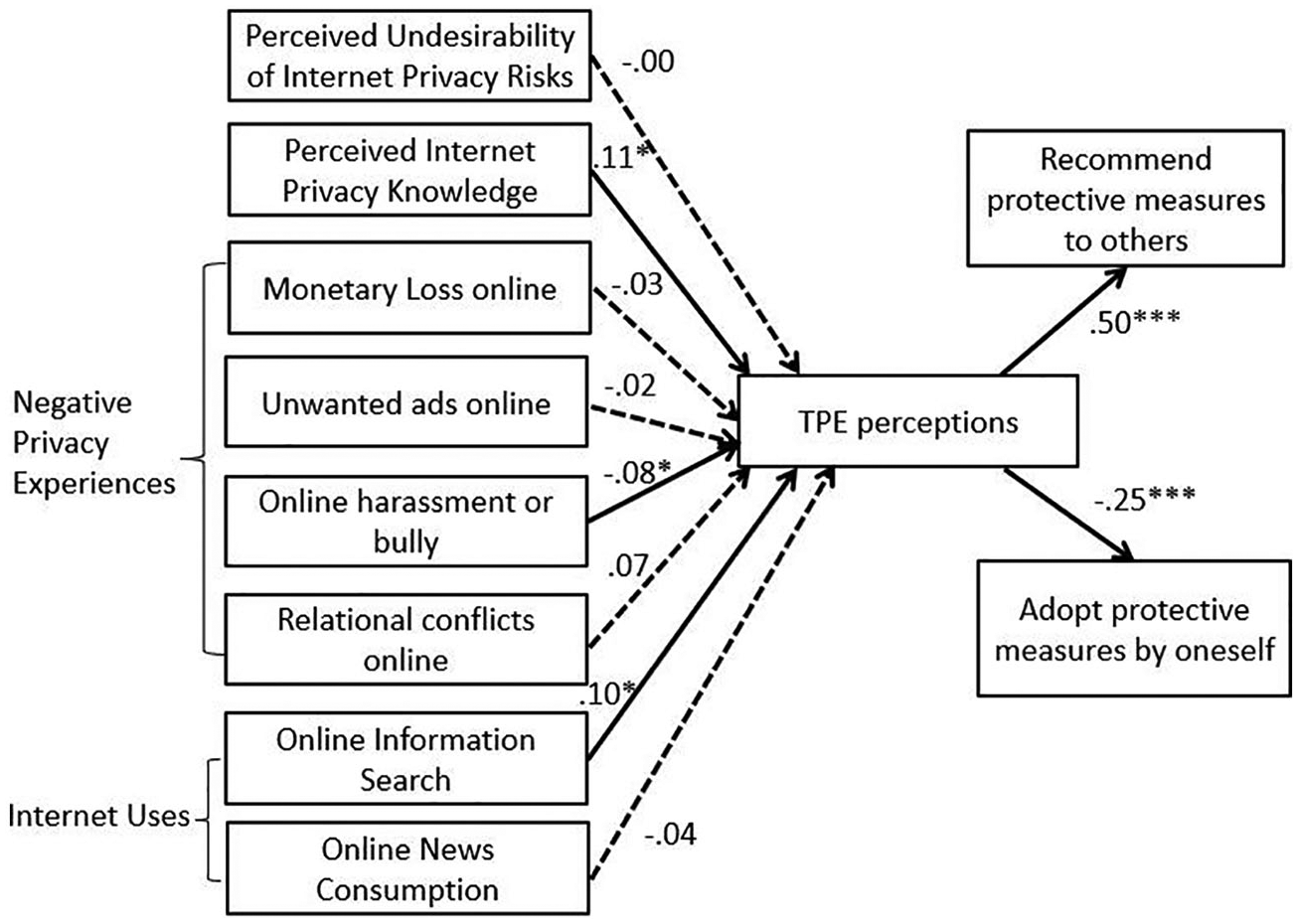
Results of SEM.
H2 posits that TPE perceptions of Internet privacy positively predict willingness to recommend privacy protection measures to others. The effect was positive and significant (β = .50, p < .001) across models (see Figure 1). Hence, H2 was supported. According to H3, TPE perceptions of Internet privacy should be inversely related to willingness to adopt privacy protection measures for oneself. Holding the control variables constant, the effect was negative and significant (β = –.25, p < .001) (see Figure 1). Hence, H3 was supported.
H5 postulates that undesirability of Internet privacy risks is positively associated with TPE perceptions of Internet privacy risks. As can be seen in Figure 1, the effect of perceived undesirability (β = –.00, p = .92) was not significant (Figure 1). H5 was thus rejected.
H6 posits that perceived Internet privacy knowledge is positively associated with TPE perceptions of online privacy risks. Model testing indicated that the effect of perceived knowledge was positive (β = .11, p < .05) (see Figure 1). H6 was thus supported.
H7 contends that prior negative online privacy experiences lead to the decreased TPE perception of Internet privacy risks. As can be seen in Figure 1, the effect of the experiences of online harassment or bullying was significant (β = –.08, p < .05), whereas the effects of the other three types of negative experiences—monetary loss online (β = –.03), receiving unwanted advertisements online (β = –.02), and online conflicts caused by unauthorized access into person accounts (β = .07)—were not significant. Hence, H7 was partially supported.
H8 holds that Internet use is positively associated with TPE perceptions of Internet privacy risks. This study tested two types of Internet use, including online information searches and online news consumption. The online information searches positively influenced perceptions of privacy risks (β = .10, p < .05), whereas the effect of online news consumption was not significant (β = –.04) (see Figure 1). H8 was partially supported.
In addition to the hypothetical framework, we also tested the effects of Internet uses on the perceived knowledge of Internet privacy risks by adding these two paths into the model. The results indicate that online information search positively predicted perceived knowledge (β = .16, p < .001), whereas the effect of online news consumption was not significant.
Discussion
This study aimed to deepen the understandings of perceived Internet privacy risks from the perspectives of TPE theory. The past decade witnessed the exponential growth of cyber-attacks, ranging from stolen online accounts to monetary losses via Internet scams. For individual Internet users, privacy protection can be as easy as changing passwords frequently, avoiding posting sensitive information, clearing browser cookies regularly, and leaving or not accessing suspicious websites. However, the fact is that users tend to underestimate the risks and refuse to take the protective measures (Debatin et al., 2009).
The question of how Internet users perceive Internet privacy risks is a crucial but under-examined one. To address this gap, this study tested how (1) users construct differential judgments of themselves versus others, (2) TPE perceptions influence behavioral intentions to adopt the Internet privacy protection measures and/or recommend these measures to others, and (3) social distance, undesirability of Internet privacy risks, negative online privacy experiences, perceived Internet privacy knowledge, and Internet use influence TPE perceptions of Internet privacy.
Perceptual component of TPE
This study reveals that user develop distinct perceptions when evaluating threats to online privacy. Specifically, people perceive greater privacy risks for others than for themselves. The results supported the TPE in general, suggesting that biased perceptions prevail in Internet-based media environments. TPE theory was developed by Davison in 1983, a period when television and newspapers were the dominant media. Thirty years since the initial findings of TPE, the media environment has changed dramatically, but TPE perceptions still persist. This finding provides two valuable contributions to TPE theory. First, the variety of features in today’s Internet-based media did not lead to objective judgments of media effects, even though the online sources create opportunities for media consumers to acquire knowledge on various topics. Second, the powerful operating systems of the new media technology create an illusion that users can control privacy security online effectively. However, the fact is that hackers can easily break through the defense systems and collect the users’ personal information.
Behavioral component of TPE
The behavioral component of TPE proposes that TPE perceptions of media effects encourage behavioral intentions to counteract negative media influence (Davison, 1983). This study found that TPE perceptions of Internet privacy risks positively predict people’s willingness to recommend the Internet privacy protection measures to others, and negatively predict their willingness to adopt the protective measures themselves. Unlike media censorship, which is primarily the responsibility of the government, the behavioral intentions of Internet privacy protection reflect people’s individual reactions to potential online privacy threats. The Internet efficacy and the proficiency of protective measures exert great influence over the outcomes of privacy security online. Study findings reveal that TPE perception of Internet privacy risks is one of the major barriers to adopt protective measures. Those who possess high TPE perceptions believe that they have already built effective defense mechanisms for personal data online, or that they are not at risks for privacy invasions. The consequences of these biased beliefs entail the continuation of risky online activities and refusal to update protective measures.
Similar to the pornography censorship studies, this study found that TPE perceptions positively predict willingness to recommend protection measures to others. When media content is considered as negative, people oppose the content and are more likely to recommend protective measures to their personal contacts. Interpersonal communication appears to be a valuable channel for enhancing online privacy protection. In cyber security campaigns, the use of mass media can satisfy the population-level market demand, but viewers often do not pay attention to the programs nor receive immediate feedback (Randolph and Viswanath, 2004). To increase the adoption of privacy protection measures, security trainers should make strategic use of interpersonal and mass communication channels to resolve user confusion and concerns.
Antecedents of TPE perceptions
Prior TPE studies relied on the assumption of social distance through predefined groups (McLeod et al., 1997). This study used an established scale to test the association between TPE perceptions and social distance, finding that TPE perceptions of Internet privacy risks generally increase with social distance. There is only one exception: TPE perception of Group 5 (citizens or permanent residents of the United States) is greater than Group 6 (visitors in United States). One reasonable explanation is that respondents may perceive international travelers—who can afford the long-distance trip stateside—as rich, well-educated, and better off than the average US resident. Respondents may also believe that the majority of visitors in the United States came from developed countries, where strict privacy rules were applied.
In particular, when asked to estimate perceptions held generally by US citizens and those outside of this country, people may find it difficult to define who these “others” are. A foreigner could be an engineer from a developed country, or a refugee living in the camps of an underdeveloped area. Study results indicated that people tend to engage in downward comparison when others are perceived as distant. This finding provides important implications for cyber security professionals. One key to successful training messages design is to use examples that are closer to the audiences. In this case, campaigners need to examine the backgrounds of the audiences first and then design personalized training messages to engage the audiences.
This study also provides an empirical test of the undesirability of Internet privacy risks. Overall, more than 90% of respondents reported a high undesirability score, indicating that they are aware of online privacy risks. Consistent with prior study (Eisend, 2017), when the subjects (Internet privacy risks) of people’s judgments is perceived as undesirable and antisocial, people were found to pronounce TPE perceptions. However, the effect of this undesirability score on the size of self-others perceptual gap was not significant. One reason could involve the flawed measurement items employed here, which did not specify privacy risk archetypes. When asked to evaluate privacy invasions, some respondents may think about loss of an SNS account, whereas others may consider the case of monetary loss. Another explanation is that, although individuals are aware of the privacy threat online, they would voluntarily trade their privacy for convenience and specific services. If people perceive that online disclosure benefits associated threats, TPE perception is likely to diminish. Thus, the undesirability score alone cannot determine the size of TPE perception.
Consistent with prior studies addressing conventional mass media (e.g. Henriksen and Flora, 1999), this study finds that perceived Internet privacy knowledge positively predicts TPE perceptions. People with high perceived knowledge tend to be confident in dealing with privacy threats online, even if their perceptions of Internet privacy may not be accurate. With the advancement of technology, the knowledge of Internet privacy is likely to be outdated soon. Routine use of Internet-based technology exposes people’s online information frequently. If the existing perception is wrong, people cannot identify the potential risks and are more likely to be victims of future privacy attacks.
Another antecedent addressed involves negative online privacy experiences. This study found that experiences of being harassed or bullied online are positively associated with respondents’ TPE perceptions of Internet privacy risks. This finding suggests that the negative online privacy experiences increase awareness of privacy risk online, which is consistent with prior studies (Cho et al., 2010). This study found that more than 90% of respondents experienced at least one of the following privacy invasions online: (1) monetary loss, (2) reception of unwanted advertisement, (3) relational conflicts caused by unauthorized access into a personal account, or (4) online harassment or bullying. Moreover, the other three types of negative privacy experiences—monetary loss, relational conflicts, and reception of unwanted advertisement—did not impact respondents’ TPE perceptions about Internet privacy risks. One reasonable explanation is that people are becoming increasingly dependent on the Internet to shop, search for information, and maintain interpersonal connections, which lowers their perceived privacy risks on self and others equally.
A final intriguing antecedent addressed by this study involves Internet use. We tested the effects of two types of Internet use relating to the development of Internet privacy risks knowledge. This study found that the one type of Internet uses—online information searches—positively predicts TPE perceptions of Internet privacy risks. Compared with news readers, the information searchers online are more likely goal-oriented individuals. Internet users who search information online frequently tend to be knowledgeable about Internet privacy risks, which may increase TPE perceptions of Internet privacy risks. Each of these points represents a significant contribution to our understanding of Internet privacy risks and TPE theory and valuable implications to improve their cyber security education.
Limitations
Regarding study limitations, the MTurk sample may not be as representative as a random sample, since it only includes individuals who are registered on MTurk. MTurk provides a reasonably cost-effective approach to reach Internet users. However, to generalize the research finding to the overall Internet user population, future studies should utilize random sampling. Second, this study tested people’s perceived Internet privacy risks in general without specification of Internet platforms. Perceived privacy risks on self and others and behavioral intention to use protective measures were measured with single-item questions, which may not fully reflect the complexity of privacy risk perceptions. For instance, the level of concern about SNSs and financial accounts can differ. Future research should explore the differential perceptions on different online spaces. Third, we measured Internet uses with frequency of online information search and news consumption, which failed to capture such online activities as social media uses and online shopping. Future research should address other types of Internet uses. Third, the data used are cross-sectional samples of course cannot be used to test casual relationships. Future research should use longitudinal data to explore the cognitive process of threat appraisal and coping appraisal.
Footnotes
Funding
The author(s) received no financial support for the research, authorship, and/or publication of this article.
