




Abstract
This study examines how low-income African-American older adults, one of the groups most vulnerable to misinformation online, assess the credibility of online information. In examining this, we conducted both face-to-face interviews and a survey and then analyzed how their digital media use, demographics, self-efficacy, and involvement with particular topics were associated with their credibility assessments of online information. Our results suggest that education and topic involvement are statistically significant factors associated with assessments of message content and source credibility. Moreover, for our respondents, assessments of content credibility, as opposed to those of source credibility, were far more challenging. This research is one of the few studies examining online information credibility assessments made by low-income minority older adults. Theoretical and practical implications of our results are discussed in the context of misinformation, credibility assessment, and the digital divide.
Introduction
Discussions of the creation, spread, and potential consequences of “fake news” have dominated news cycles around the world (Allcott and Gentzkow, 2017; Bessi and Ferrara, 2016; Ghenai and Mejova, 2018; Thomas et al., 2018). For example, ahead of the 2020 presidential election, fabricated websites about Democratic presidential candidates and phony claims about political issues are major problems in the United States, which was already hit by Russian disinformation campaigns during the 2016 elections (Otis, 2019). This phenomenon is also observed in the area of health with social media becoming primary channels for spreading inaccurate information about vaccines and amplifying anti-vaccine movements (Rutschman, 2019). Given the importance of informed citizens in maintaining a healthy democracy, educational institutions and civic organizations have enhanced offerings in digital and information literacy, particularly directed at evaluating online information credibility and using fact-checking sites (Anderson and Rainie, 2017; Connaway et al., 2017; Tharoor, 2018).
While scholarly and policy discussions on the topic are growing (Allcott and Gentzkow, 2017; Bessi and Ferrara, 2016; Ghenai and Mejova, 2018; Thomas et al., 2018), there is still a lack of attention to how this phenomenon is affecting those traditionally lagging behind in terms of digital access and literacy (Perrin, 2015; Polizzi, 2017; Smith, 2014a). In this age of digital communication technologies, digital access and information literacy are inherently intertwined as much valuable information is available online and relevant fact-checking tools are largely provided digitally. Among those particularly disadvantaged in the issue of misinformation are low-income African-American older adults—a group with low levels of digital access and use even when compared with similar age groups of other racial and income groups (Jaeger et al., 2012; Perrin, 2015; Seo et al., 2019; Smith, 2014a).
Against this backdrop, this study examines how low-income African-American older adults perceive information online and go about verifying such information. Specifically, we analyze how their digital media use, self-efficacy regarding online activities, and involvement in and familiarity with a chosen topic are associated with their assessment of online information in terms of message and source. In examining these issues, we adopt a mixed-methods approach combining interviews and survey research with low-income African-American older adults residing in a metropolitan city in the Midwest. Quantitative survey data from 125 low-income African-American older adults are triangulated with post-survey interviews with a total of 15 participants to permit a more nuanced interpretation of the survey data.
This research is one of the few studies examining online information credibility assessment by low-income minority older adults, arguably one of the most vulnerable groups to misinformation online. In this sense, this research addresses literature gaps in the areas of misinformation, credibility assessment, and digital divide. Theoretical and methodological approaches used in this study should be helpful for future research studies that examine perspectives on online information credibility and procedures of verifying online information among other vulnerable populations. Practically, this study provides guidance as to which areas to focus on and how to prioritize resources in offering online information assessment education to low-income African-American older adults and other vulnerable groups.
Literature review
Minority older adults and digital media use
There are several important factors that influence people’s adoption and use of the Internet and social media. According to a recent report describing demographic characteristics of non-Internet users in the United States (about 11% of the population), education, age, geography, income, and race affect Internet use (Anderson et al., 2018). Specifically, low-income African-American older adults with less than a high school degree were found to be least likely to use the Internet (Anderson et al., 2018).
Age has been consistently an important factor in explaining digital adoption and use. Compared with younger generations, older adults show lower adoption/use rates of the Internet and social media (Perrin, 2015; Pew Research Center, 2019; Smith, 2014b). As of 2019, 73% of those aged 65 or older reported utilizing the Internet in comparison to 100% of 18–29-year-olds, 97% of 30–49-year-olds, and 88% of 50–64-year-olds (Pew Research Center, 2019). In understanding older adults’ adoption and use of digital technologies, it is important to recognize different skills, activities, and attitudes among them rather than treating them as a homogeneous group (Francis et al., 2019; Quan-Hasse et al., 2018). For example, based on a survey of older adults aged 65 or older in Switzerland, Friemel (2016) found that a significantly smaller proportion of the older adults in the age group of 85 or older used the Internet regularly as compared to those aged 65–84 (especially the 65–74 age group). This “grey divide” was also found in a study of US older adults that showed that both Internet use and broadband adoption dropped significantly around age 75 (Smith, 2014b). Similar patterns were found in a study of urban older adults in the United States (Cresci et al., 2010) and a nationwide survey of Swedish older adults (Olsson et al., 2019). These disparities in online access and use (i.e. first- and second-level digital divide) can lead to inequalities in the offline benefits gained through Internet use (i.e. third-level digital divide; Van Deursen and Helsper, 2015).
Socio-economic status is another important factor in this, as both income and education correlate positively with levels of digital adoption and use for older adults (Hargittai and Dobransky, 2017; Hunsaker and Hargittai, 2018; Smith, 2014b). In terms of race and digital media adoption/use, African Americans are more likely to access the Internet through library computers than Caucasian Americans, as they are less likely than their Caucasian counterparts to own a computer or have high-speed Internet at home (Grace et al., 2017; Perrin, 2017). The increasing availability of mobile devices enables more convenient Internet access to those unable to afford a desktop or laptop computer (Perrin, 2017). About 63% of low-income African Americans are owners of a smartphone, similar to smartphone ownership among low-income groups of other races. However, the smartphone ownership rate among low-income African Americans is lower than that among higher income African Americans or other racial groups (Perrin, 2017).
Moreover, studies show that low-income African-American older adults are less skilled in online information use and credibility assessment compared with other demographic groups, posing an important digital divide challenge in the United States (Horrigan, 2017; Riley, 2018). According to Riley (2018), low-income African Americans are also less likely than higher income individuals to be digitally competent and understand pitfalls in technology use. Similarly, Horrigan (2017) found that those who are White, well-educated, and higher income individuals tend to be more confident in using digital technologies. In this sense, low-income African-American older adults are one of the most disadvantaged groups in terms of digital communication technologies and use of online information. This study focuses on low-income African-American older adults in examining online information assessment issues among a vulnerable population.
Assessing credibility of online information
Previous research shows those over 65 years old are more likely to share misinformation through Facebook, even when controlling for education, ideology, and partisanship (Guess et al., 2019). In analyzing their sharing of misinformation online, it is important to understand what motivates them to spread such information and how they assess credibility of information encountered online—a central issue in this article.
While there are still disagreements as to definitions of credibility, it has been generally considered as a multi-dimensional concept covering trust, reliability, accuracy, and believability (Appelman and Sundar, 2016; Gaziano and Mcgrath, 1986; Newhagen and Nass, 1989; Tandoc et al., 2018). In recent years, credibility research has begun to examine effects of the message separately from the presenter or platform of distribution (Appelman and Sundar, 2016) and distinguish the assessment of content experienced online from that of other media types (Flanagin and Metzger, 2007). The variety and amount of information found online can lead to an increasingly difficult experience in discerning what is credible and what is not, placing greater responsibility on the individual to make more informed content decisions (Flanagin and Metzger, 2007).
Tandoc et al. (2018) examined a new process for identifying and delineating misinformation from other content. Drawing on previous studies of credibility research, Tandoc et al. speculate that this process of authentication for news content on social media takes place within two levels: internally and externally. Internally, audiences make judgments on the source and content of the message and rely on themselves for guidance. These traits include one’s wisdom, instinct, and previous experiences of the topic to aide in their evaluations. Though not as common within the results, news audiences also relied on the levels of popularity for a story (such as Facebook “likes”). Tandoc et al. argue that if news consumers were still unsatisfied after this period of internal reflection, they would resort to seeking external sources of validation (either intentionally or passively) and through interpersonal (friends and family) or more institutional means (such as an official news or fact-checking site). Previous research suggests that users with higher social media self-efficacy are more likely to depend on external sources of validation. Based on a survey of adult Internet users in the United States, Hocevar et al. (2014) found that self-efficacious social media users tend to rely more on others’ opinions on social media in evaluating information online as well as being more trusting of information shared through social media, compared with social media users with lower self-efficacy.
Flanagin and Metzger (2007) explored different credibility assessments (site overall, sponsorship, and message content) among varying typologies of online content (news, commerce, special interest, and blogs). Their study showed that the genre or type of website dictated the credibility assessments for participants. News sites, in particular, were deemed most credible in terms of the sponsor and message categories tested. News and e-commerce sites were also distinguished from blogs and other personal sites as a class unto their own. In addition, familiarity or experience with a site in relation to a specific genre was found to bolster the credibility results for e-commerce sites. Design elements for the site were also found to raise credibility levels for unfamiliar web destinations, even matching levels of those familiar to participants. The study also found that sponsor credibility of notable organizations transferred to their online representations.
Another relevant aspect to assessing credibility of information is the ability to distinguish factual statements that are confirmable (factual) from opinion or those statements that are not testable due to an absence of credible evidence (Merpert et al., 2018). Based on an online survey-based experiment with 3500 participants on the ability to identify checkable statements within a faux political speech, Merpert et al.’s study found that younger, university-educated males were most equipped to correctly evaluate statements from the speech. Interestingly, the study found that an added educational module on how to evaluate political statements did bolster participants’ ability to distinguish between factual and non-factual statements. The participant’s political affiliation and ability to identify the politician within the speech also marginally improved the participant’s success rate.
One potential means of helping people navigate within this new media landscape is the emergence of fact-checking websites. Coming into fruition within the last decade, fact-checking websites were established to promote greater public understanding, serve as a check on elected officials, and evaluate the accuracy of political statements and other types of information (Young et al., 2018). However, in terms of their perceived credibility by the public, fact-checking sites have faced challenges in an environment of political partisanship. According to Jarman (2016), the effectiveness of fact-checking sites was found to be dependent on belief in the correction made and whether it conformed to one’s political ideology. Similarly, Amazeen et al. (2018) found credibility evaluations for fact-checking websites were significantly bolstered when the participant’s partisan-held-beliefs matched the fact-checking correction, as compared to opposing viewpoints. This would seem to mirror the experience of many cable news viewers, with ideologically congruent media found to reinforce existing attitudes and beliefs, while other viewpoints were discarded (Wojcieszak et al., 2016). Indeed, even when a fact-check is presented and accepted by readers, the credibility of correction and the website can continue to suffer in the long term.
Digital literacy and health misinformation
Online credibility assessment is one of the primary areas covered under digital literacy (Cordell, 2013; UNESCO, 2018; Walton, 2016). In general, digital literacy refers to the ability to identify, evaluate, create, and use information or other content through digital technologies (Cordell, 2013; UNESCO, 2018; Walton, 2016). That is, digital literacy covers cognitive aspects of assessing online information as well as technical skills of using technologies. According to the American Library Association Office for Information Technology Policy’s Digital Literacy Task Force, those who are digitally literate “possess the variety of skills—cognitive and technical—required to find, understand, evaluate, create, and communicate digital information” and are able to “interpret search results and judge the quality of the information retrieved” (Cordell, 2013: 179). A UNESCO (2018) report also states that digital literacy covers competencies in evaluating and managing data, information, and digital content. That is, those with higher levels of digital literacy are expected to have better abilities in online information assessment.
While discussions of misinformation online have primarily focused on political topics (Berinsky, 2017; Weeks, 2015), misinformation in health is no less consequential (Broniatowski et al., 2018; Tan et al., 2015). Though misinformation in health has existed for centuries, public health and medical studies scholars have long warned of potential adverse effects of digital technologies in spreading misinformation in health (Crocco et al., 2002; Eysenbach and Jadad, 2001; Kata, 2010). Assessing the use of information on health by consumers in the early days of the digital age, Crocco et al. (2002: 2869) contended that misinformation poses potential risks that can “emanate from the use of irrelevant or inaccurate information or from misunderstanding relevant and valid information.” Latest developments in digital technologies have exacerbated the proliferation of misinformation in health (Belluz, 2017; Broniatowski et al., 2018). For example, advanced techniques using artificial intelligence and automated bots are utilized to multiply and spread information rapidly (Broniatowski et al., 2018).
Social media platforms are fertile grounds for falsehood to be shared and circulated as they remove temporal and geographical barriers and facilitate expanded access to information on health (Bode and Vraga, 2015; Chen et al., 2015; Fernández-Luque and Bau, 2015; Syed-Abdul et al., 2013). Stefanidis et al. (2017) analyzed the effectiveness of countering incorrect information in real time on Twitter. The study, using the Zika virus as a backdrop the research, presented false information on the origins of Zika on Twitter. Participants in the treatment conditions were presented with a corrected response (a fact check) to the false Zika information through the Centers for Disease Control (CDC), the CDC and an anonymous Twitter user, the Twitter user alone, or the Twitter user followed by a CDC response. Participants in the control condition were taken to a non-Zika story. The study found that a response from the CDC had a significant ability to reduce misrepresentations of Zika, followed closely in effectiveness by a response from the Twitter user and then the CDC. The authors call for more governmental bodies to correct misinformation when seen on social media platforms.
In addition, research shows that underserved populations often have lower health literacy. For example, Christy et al. (2017) conducted a survey of 415 participants’ ages of 50–75 to examine underserved and racially/ethnically diverse populations for levels of health literacy in relation to colorectal cancer. The study found that men who were unable to work, identified as a racial minority, and had stronger religious beliefs were more susceptible to having lower health literacy levels. Moreover, getting health information or connecting with medical providers online is particularly important for older adults as they are more likely to deal with health-related issues (Seo et al., 2017, 2019). Against this backdrop, this study used a health news story in understanding survey participants’ assessment of online information. Specifically, we examine the following research questions.
Research questions
RQ1: What are key sources of information for low-income African-American older adults?
RQ2: What mechanisms do low-income African-American older adults use to assess information online?
RQ3: How are low-income African-American older adults’ digital media use, self-efficacy regarding online activities, demographic characteristics (age and education), and involvement in and familiarity with a chosen topic associated with their assessment of online information in terms of content credibility (RQ3a), source credibility (RQ3b)?
Methods
To answer the research questions, we used a mixed-method approach combining a quantitative survey and qualitative interviews. Participant identification, recruitment, and data collection procedures are described below. All research procedures were approved by the Institutional Review Board of the authors’ university.
Overview of participants and procedures
Our study participants were low-income African-American older adults residing in a metropolitan city in the Midwest. Participants were recruited through a senior center that serves about 500 low-income African Americans who are 55 years or older. 1 To promote the research study, we distributed flyers and announced survey and interview sessions at events held in the senior center. In addition, we used a snowball sampling approach by asking study participants to refer their friends, who are members of the community center, to our study sessions.
Survey sessions were held at the computer lab of the community center, which is equipped with 20 laptop computers and chairs along with four large desk tables. When each participant arrived at the computer lab, the participant was asked to read and sign a consent form before answering the survey questions. Given the group’s varying levels of comfort and expertise with computers, we used a paper survey with participants reading the news story through a laptop in the computer room. A total of 125 low-income African-American older adults completed the survey in fall 2018. Specific demographic characteristics of the participants are described in the “Results” section.
In addition to the survey, we conducted a total of 15 face-to-face interviews with members of the senior center to gain in-depth insights into low-income African-American older adults’ digital media use, assessment of information online, and familiarity with online information assessment tools such as fact-checking sites. These interviews were conducted after the survey to understand more fully why they answered the survey the ways they did. We stopped recruiting participants for additional interviews when our initial data analysis indicated that participants’ responses generated no new information, which indicated theoretical saturation of data (Fusch and Ness, 2015). That is, we ended data collection once our data revealed that “depth as well as breadth of information [had been] achieved” (O’Reilly and Parker, 2013: 192). Each interview was conducted in a conference room at the senior center and lasted between 30 minutes and an hour.
Measurements
The survey questionnaire contained a total of 23 questions (22 close-ended questions and 1 open-ended question). The survey questions were aimed at understanding the participant’s sources of information about local events, along with assessment of credibility of a health news story in terms of content (message and argument) and source (author and website). Other questions in the survey asked about the participant’s familiarity with and involvement in the topic, digital media use, self-efficacy, and demographic information. More information on each variable under study is provided below.
Information source
With regard to primary information sources for local events, the participant was asked to rate on a scale of 1 (not important at all) to 7 (very important), how important different information sources were for them in obtaining information regarding events or issues concerning the city. The types of information sources presented to them were local television channel, local radio station, local newspaper, email newsletter, Internet search, social media/mobile apps, the city government website, community centers, church, family and friends, and other.
Assessment of content and source credibility
In understanding survey participants’ assessment of information online, we used a health news story. As discussed in the “Literature Review” section, we chose a health topic, as low health literacy among underserved populations is a major concern and health information is particularly relevant for older adults who are more likely to deal with health-related issues (Christy et al., 2017; Seo et al., 2017). During the survey session, each participant was asked to evaluate the story in terms of message credibility, argument quality (content credibility), and credibility of the author and website (source credibility). In measuring perceived message credibility, each participant was asked to rate how useful, accurate, and believable the story was (Appelman and Sundar, 2016). In understanding perspectives on the argument quality of the story, we asked each participant to rate how informative, helpful, and persuasive the story was (Bhattacherjee and Sanford, 2006). Participants were also asked to evaluate the website and author of the article based on fairness, bias, trustworthiness, being factual, and telling of the whole story (Gaziano and Mcgrath, 1986). For each aspect, a 7-point semantic differential scale was used (e.g. 1 = unfair, 7 = fair). Cronbach’s alpha values for message credibility, argument quality, author credibility, and website credibility index were .83, .93, .90, and .89, respectively. Table 1 shows measurement items for credibility assessment used in this study.
Measurement items for credibility assessment.

Self-efficacy concerning digital technologies
Self-efficacy plays an important role in people’s online activities or health information seeking (Hocevar et al., 2014; Luszczynska et al., 2005; Luszczynska and Schwarzer, 2003; Zullig et al., 2011). In this study, self-efficacy related to online information verification was measured through the following five questions: (1) I will be able to achieve most of the goals that I have set for myself when searching information online about a topic that I am interested in; (2) When facing difficult tasks while searching information online, I am certain I will accomplish them; (3) In general, when searching information online, I can obtain outcomes that are important to me; (4) When searching information online, even when things are tough, I can perform quite well; and (5) When thinking about searching information online, I am confident that I can perform effectively on many different tasks (Luszczynska et al., 2005; Luszczynska and Schwarzer, 2003). Cronbach’s alpha of the self-efficacy index was .96.
Topic involvement and familiarity
To measure the participant’s personal involvement with and perceived relevance of the story, the participant was asked to rate how important, valuable, meaningful, beneficial, significant, appealing, and essential the story was (Zaichkowsky, 1985). Cronbach’s alpha of the topic involvement index was .95. Each participant was also asked how familiar they were with the topic of the story, whether they have read the story before, and whether they are likely to share the story with their friend or family.
Demographic and media use characteristics
To understand participants’ demographic characteristics, we asked about their age, gender, race, highest degree earned, and employment status. The survey also included a set of questions related to the participant’s use of digital devices. Specifically, each participant was asked how much time they spend online generally, on social networking sites such as Facebook, and on searching information online. In addition, we asked whether they had taken a computer class at the community center or other places. We created an index variable of education by using the Manhattan Distance method with the highest degree earned and computer class participation variables (Szabo, 2015).
Health news story
The health news story used in this survey was featured on Neon Nettle, which is listed on the Misinformation Directory by FactCheck.org as one of the primary websites that post “deceptive content” (FactCheck.org, 2017). Snopes, one of the leading fact-checking sites, described the story as “a deceptive and factually challenged blog post on an anti-vaccination website” (Kasprak, 2018). Under the headline of “Harvard Study Proves Unvaccinated Children Pose No Risk,” the story claimed recommended vaccines cannot prevent transmission of disease because “they are not designed to prevent the transmission of infection” or because “they are for non-communicable diseases.” The story concluded that people who have not received vaccines “pose no higher threat to the general public than those who have.”
Results
A total of 125 low-income African-American older adults completed the survey. Of them, 15 participants were asked to attend a follow-up one-on-one interview session where we discussed their digital media use and perspectives on information verification in-depth.
Table 2 shows a summary of demographic characteristics of the survey participants. All participants identified themselves as Black or African American. More women (65.3%) than men (34.7%) participated in the survey, reflecting the gender ratio of the senior center community. The mean age was 71 (M = 71.35, SD = 7.08) with the youngest and oldest participant being aged 55 and 90, respectively. The minimum age requirement of the senior center is 55 years. Those ages between 65 and 74 accounted the majority of the survey participants (57.6%), followed by people ages 75–84 (24.0%), ages 55–64 (14.4%), and those ages 85 or older (4.0%). In terms of highest degree earned, 40.8% reported they had completed high school, 30.4% some college but no diploma, 14.4% bachelor’s degree, 8.8% master’s degree, and 5.6% less than high school. About 55.2% of the participants said they took a computer class either at the senior center or some other place.
Demographic characteristics of survey participants.

N = 125. All participants identified themselves as Black or African American.
Post-survey interview participants included nine females and six males with eight of them having completed high school and four college graduates. Seven of them reported taking a computer class at the senior center or other community centers and another eight said they never had taken a computer class.
Information source and digital media use (RQ1)
Research Question 1 was related to information source and digital media use by low-income African-American older adults. When asked which information source they use in getting information about local events, local television station was most popular (M = 6.16, SD = 1.23). This was followed by family and friends (M = 5.82, SD = 1.60), church (M = 5.65, SD = 1.71), Internet search (M = 5.02, SD = 2.07), local radio station (M = 4.98, SD = 2.08), local newspaper (M = 4.85, SD = 2.13), and social media (M = 3.75, SD = 2.15).
All participants in this study had experience of using the Internet. In terms of time spent online on a daily basis, 43.2% of the participants said they spend between 1 hour and less than 3 hours online on a daily basis; 16.8% said less than an hour; 11.2%, 3 hours less than 5 hours; 6.4%, 5 hours less than 7 hours; and 4.8%, 7 hours or more. About 17.6% said they had not used the Internet at all in the past month. When asked specifically about information search online, 37.6% said 1 hour less than 3 hours; 28.8%, less than an hour; 21.6%, said not at all; 6.4%, 5 hours less than 7 hours; 3.2%, 3 hours less than 5 hours; and 2.4%, 7 hours or more.
Our interview data show that this group generally use the Internet to search information about things to do and places to go or to access Facebook to get updates from their children or about grandchildren. Playing games is another important activity that those using the Internet like to do. One 72-year-old woman participant who reported using the Internet every day said, “Usually in the morning, I get up and I go to check Facebook and see what my grandkids and kids are doing.” This is in line with previous research findings that show that older adults use social media platforms such as Facebook primarily to view family and friends’ timelines and photos or to play games (Ancu, 2012). In addition, African Americans and other racial/ethnic minority members are more likely than White Americans to use Facebook for entertainment and social support purposes (Ancu, 2012). With regard to checking news and information online, the participant said, “Sometimes, if there is something really exciting in the news, I might go and check New York Times, Wall Street Journal, or Huffington Post sites. Or if I missed The View, I might go and check them.”
Online information assessment by low-income African-American older adults (RQ2)
The second research question concerned how low-income African-American older adults go about assessing information online. In answering this question, it is important to understand general perspectives of low-income African-American older adults regarding information online. One of our interview questions asked whether participants believe the information they encounter online is generally reliable. Interview participants’ responses on this differed depending on whether they have prior computer classes that covered online information assessment issues. Those who attended such workshops offered at the senior center or a local library said reliability of online information depended on credibility of the website, author, and other aspects related to content. A 65-year-old woman interviewee who attended the weekly computer class at the senior center for a year said, I know to verify if it [the information] is not [reliable]…Especially on email. If I get something I am not sure about, I know how to put the cursor over that to see if that is really the person that sent that. I learned that in the first class. I rely on the people that it comes from. If I get information from a source I am not familiar with, I usually don’t even fool with it. I usually depend on the people and if I know who they are.
Most low-income African-American older adults interviewed for this research suggested that their family members or friends are important sources in discussing credibility of information they encounter online. A 72-year-old female member of the senior center said, “I have my brother and my good friend. We have telephone calls. My brother is kind of like a historian and we have discussions with each other basically.” Watching talk shows is another important way for them to gauge information. The participant said, I do a lot of talk shows and we both talk and compare. Like Rachel Maddow because she is factual. She is factual and that is the main thing. And then I listen to the rest of them and the rest of them are opinionated.
Effects of digital use, self-efficacy, topic involvement on credibility assessment (RQ3)
Our third research question asked how low-income African-American older adults’ digital media use, demographic characteristics (education and age), self-efficacy regarding online activities, and involvement in and familiarity with a chosen topic are associated with their assessment of online information in terms of content credibility (RQ3a) and source credibility (RQ3b). A series of regression analyses were conducted to examine the research question, and the analysis results are shown in Table 3. Each of the variables analyzed was measured by multiple items, and a composite index variable was then used to test the relationships. The mean of the measurement items was used as the value of the index variable.
Results of multiple regression analyses.
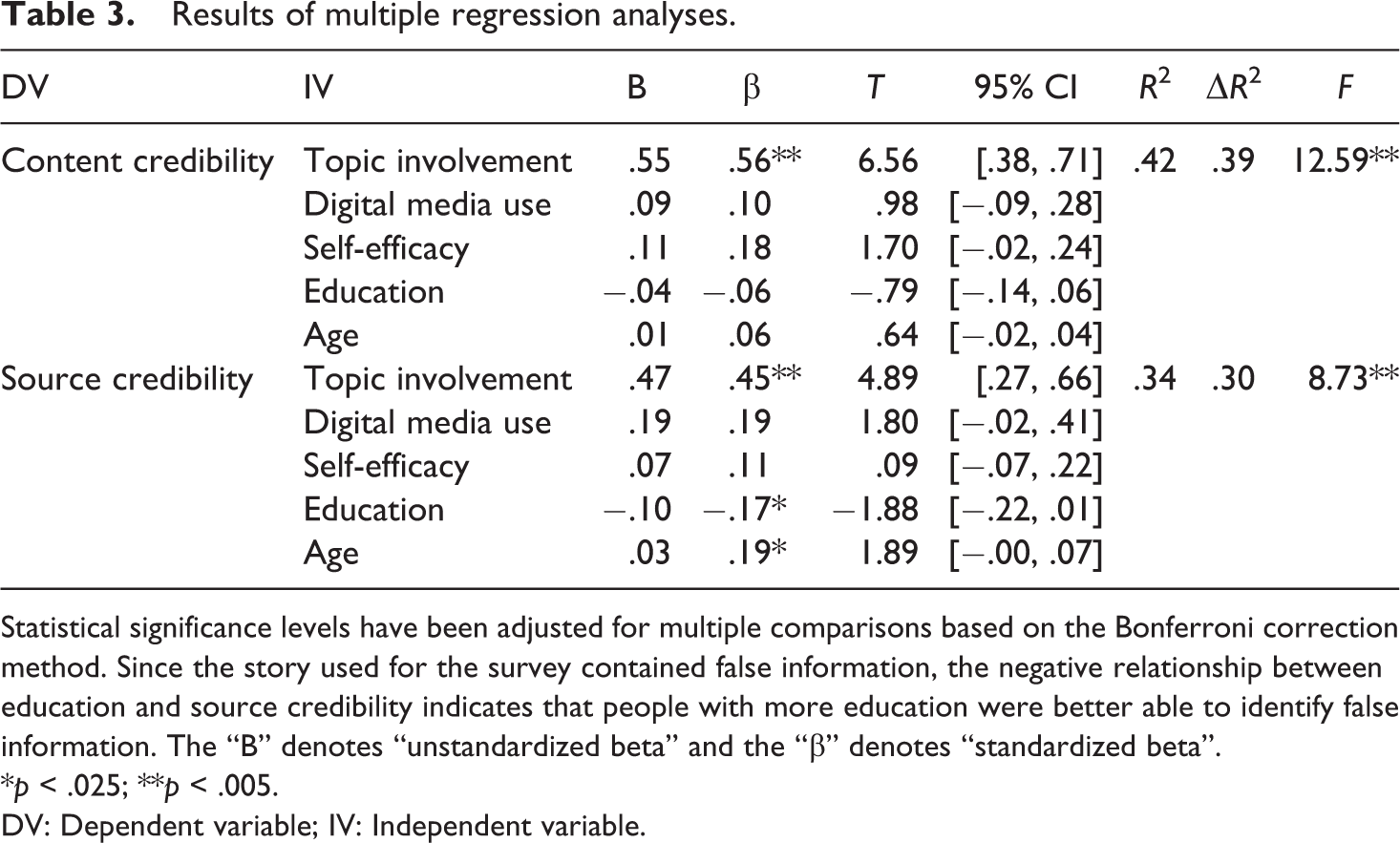
Statistical significance levels have been adjusted for multiple comparisons based on the Bonferroni correction method. Since the story used for the survey contained false information, the negative relationship between education and source credibility indicates that people with more education were better able to identify false information. The “B” denotes “unstandardized beta” and the “β” denotes “standardized beta”.
*p < .025; **p < .005. DV: Dependent variable; IV: Independent variable.
In terms of content credibility, there was a positive relationship between topic involvement and perceived content credibility. That is, the more the participant reported being involved in the topic, the more highly the participant rated the content credibility of the story (β = .56, t = 6.56, p < .005). 2 Online media use, self-efficacy, age, and education were not associated with the content credibility variable. Since the story used for the survey contained false information, the results show that those who are more personally involved in the topic were more likely to trust false information on the topic.
Topic involvement (β = .45, t = 4.89, p < .005), age (β = .19, t = 1.89, p < .025), and education (β = −.17, t = −1.88, p < .025) were associated with perceived source credibility. It is important to note that the level of education, which was measured by both their highest degree earned and attendance in a computer class, was negatively associated with perceived source credibility. The result suggests that those with more education are better able to identify false information. As was the case with content credibility, those with higher involvement with the topic were more likely to rate the story credible. In addition, older participants gave higher scores for the credibility of the source. This suggests the importance of offering information literacy workshops for low-income African-American older adults, as it provides a way of helping them better discern misinformation.
Discussion
According to a Pew Research Center report, more than 60% of US adults said, “fabricated news stories cause a great deal of confusion about the basic facts of current issues and events” (Barthel et al., 2016). In addition, 20% said that they have “shared a made-up news story knowingly or unknowingly.” As more citizens rely on digital media for news and information, it is important that broader segments of the society be better equipped to assess credibility of information online. In this sense, this study examined issues related to online information use and assessment of online information credibility by low-income African-American older adults, one of the most digitally disadvantaged and underserved populations. This is one of the first studies that examine misinformation assessments among this particular population. Our mixed-methods approach of combining a survey and interviews with low-income African-American older adults offer several important scholarly and practical implications.
Scholarly implications
The results from the study highlight the importance of offering digital skills and information literacy education to digitally disadvantaged groups such as low-income African-American older adults. When we analyzed the effects of topic involvement, self-efficacy, digital media use, age, and education on study participants’ assessment of content and source credibility, those who had higher education scores were more likely to accurately assess the credibility of the information presented to them during the survey. In particular, they were better able to discern credibility of the information source (source credibility measured by author credibility and website credibility). Even if participants were not aware of the news website used in the story, those who had a higher education score were better able to identify cues of credible or not-so-credible websites.
Overall, the finding is in line with previous research showing that more highly educated people are better able to discern credibility of information (Merpert et al., 2018). It is important to note that in this study, the education variable was measured by both highest degree earned and attendance in a computer class where information literacy was addressed. The educational attainment and class attendance variables on their own were not significantly associated with credibility assessment. Only when the two were combined, there was a significant relationship. This finding offers important insights on future research on information assessment. Our study suggests that more efforts are needed to take into account their non-degree continuing education to strengthen citizens’ abilities to better assess information. As was the case with Merpert et al.’s (2018) study that found an added education module helped participants better distinguish between factual and non-factual statements, our study shows that participation in a computer class that addressed information literacy aspects is important and relevant. Based on our interview data, those who attended computer classes at the senior center other community centers were better able to more accurately respond to the question on what to look for to determine credibility of information online. For example, those never attended computer classes often failed to consider multiple cues in assessing the credibility of the news story used in this survey. A 70-year-old woman participant, who never attended a computer class, said, “it says it is a Harvard study, so it is a reliable source.” The news story used in this study presented claims that the research on vaccination was done by someone who was once affiliated with Harvard University. In addition to the salience of the source, whether the information presented was in line with their existing belief influenced how they assessed its credibility. A 72-year-old man said, Well, I think it is real. But you know it depends on what you believe and what you don’t believe. I tell you one vaccination I have never had, the flu. I am 72 years old and never had the flu in my life.
It should be also noted that the effect of education on participants’ assessment of content credibility was not significant. Content credibility—measured by message credibility and argument quality in this study—is arguably more difficult to discern than source credibility. This is especially the case, as sites that spread misinformation are getting better at mimicking content structure of reputable news or information pieces. This finding highlights the importance of separating messages from platforms or presenters of information in studying credibility assessment of online information (Appelman and Sundar, 2016).
In approaching information literacy for low-income African-American older adults, it is important to understand effects of other variables on credibility assessment. This study found that the higher topic involvement the participant demonstrated, the more likely the participant assessed the false story credible. This was the case for both content credibility and source credibility. Our post-survey interviews helped us understand thought processes behind their assessment of the news story. For example, in evaluating the credibility of the story, a 69-year-old woman participant discussed her daughter’s experience in this. The participant said, “It is interesting that the story is there because my daughter decided not to have my youngest grandbaby vaccinated because they say it is more dangerous and doesn’t really protect them from anything.” She added that she believes that the story is accurate because “it has been in the news a lot. I have been hearing about this from other places, TV news, Internet and so on.” She said she has paid attention to the topic due to her grandchildren. The result should be a cause for concern for those who are involved in enhancing information literacy, as it suggests that when they are more interested and involved in a topic, they are potentially more likely to fall victim to misinformation that is in line with the person’s viewpoint. More scholarly research should be conducted to provide a more nuanced understanding of this and other related topics.
Policy implications
The results from this study should also be helpful for practitioners or policymakers who work on supporting low-income African-American older adults. In a practical sense, the finding showing the importance of computer education in more accurately assessing credibility of information emphasizes that community organizations should proactively reach out to low-income African-American older adults and help them understand how to navigate the increasingly complex web of information online more safely and securely. In particular, an educational program designed to help low-income minority older adults better access content credibility is important, as this study found that online content credibility assessment is an area most members of this group saw as extremely important yet found very challenging. While most educational resources are available online, low-income African-American older adults lack digital access and skills compared with similar age groups of other racial and income groups (Jaeger et al., 2012; Perrin, 2015; Smith, 2014a). Close collaborations between senior centers and higher education institutions are important in this.
This study should also be helpful for those who work in reducing negative effects of misinformation in society. A lot of resources have been invested in developing computational approaches for combating “fake news” or other types of misinformation. This approach is important and useful. At the same time, it is important to take steps to ensure that a broader segment of the population is more information and digital literate. A central question for this approach should be identification of those most likely to be affected by misinformation online. Groups most vulnerable include people who possess limited resources to learn the new skill sets required to safely navigate the rapidly growing digital landscape. However, these are the people often ignored in discussing solutions to the misinformation problem. Supporting our most vulnerable groups in this area is essential. In doing so, practitioners should take into account important roles family members play with regard to both information exposure and information credibility assessment. Our interviews show that family members are important sources of information for underserved minority older adults. For example, a 72-year-old woman said her brother “knows everything” and she relied on him with regard to information credibility assessment. In designing a digital and information literacy program, policy makers and practitioners should expect close social ties to work both positively and negatively when it comes to assessing information credibility.
Finally, the findings from the study should also be helpful for scholars and practitioners who work to mitigate negative consequences of health-related misinformation that has emerged as a major challenge in many different countries (Belluz, 2017; Bode and Vraga, 2015; Broniatowski et al., 2018; Chen et al., 2015; Fernández-Luque and Bau, 2015). The survey participants in our study evaluated an article on a health topic, specifically anti-vaccination, and our findings show that those who exhibit higher levels of topic involvement were more likely to rate the false story credible. Therefore, it would be important to develop tailored digital and information literacy workshops for those who demonstrate high involvement but low knowledge in specific health issues. This tailored strategy is particularly relevant, given that older and underserved populations are more likely to fall victim to misinformation in health and that health is a significant topic among older adults (Christy et al., 2017; Seo et al., 2017).
Limitations and future research
Recruiting a large number of participants from a marginalized population for a research study is challenging, to say the least. We were able to obtain complete survey responses from 125 low-income African-American older adults and combined our survey with 15 face-to-face interviews. Still, a small sample size increases the likelihood of a Type II error—a false negative where results fail to reject the null hypothesis when it is not true. In addition, the generalizability of the findings to a larger group of low-income African-American older adults is limited, as we used a purposive sample (a non-probability sample) for this study.
Future research could study a broader group of low-income African-American older adults by including those residing in other cities or states. A study involving a larger group of participants with a random sampling approach would enable more generalizable findings. In addition, an intervention research study of offering computer/information literacy workshops and examining changes in participants’ perspectives on and abilities in assessing credibility of online information over time will be helpful. Finally, observational research, in addition to surveys and interviews, will enable a more holistic understanding of this group’s use of digital media and information assessment.
