




Abstract
Daigou, literally translated as buying on behalf of, is a Mandarin term that refers to a form of personalised transnational trading activity, which is generally characterised by practices of purchasing locally manufactured products overseas and reselling them to consumers in China via international courier services. This article examines Chinese international students’ digital labour invested in daigou and their use of social media, particularly WeChat, in running their personal enterprises. Through the analytical lens of ‘boundary’, the article reveals how daigou activities involve sustained crossing and reconstructing boundaries of privacy through selective self-disclosure of personal information. This study contributes to the empirical literature on international students’ everyday use of digital media by highlighting their work practices in the digital age. Conceptually, the case study of daigou suggests overlapping spaces between various forms of digital labour and the relevance of ‘unproductive’ labour which constitutes a necessary dimension of online work.
Keywords
Introduction
Walking out of the bustling Aēsop 1 store in the Melbourne Central Shopping Centre, Qin (25, male) and I were about to visit the supermarket on the lower ground level to do some more shopping. He walked slowly behind me and was attentive to his mobile phone, so I stopped to wait for him. Qin said sorry and explained to me that he was sending a photo on Weixin (hereafter, WeChat), 2 a Chinese instant communication and social media app. It was a photo of him holding the skincare product that he just bought (Figure 1), and he was sending it to the client who requested the purchase from China 3 a couple of days ago. Qin was asked to do this in order to verify that he actually bought it in Australia. This was very common, he said, as his customers always wanted to confirm the authenticity of what they received.
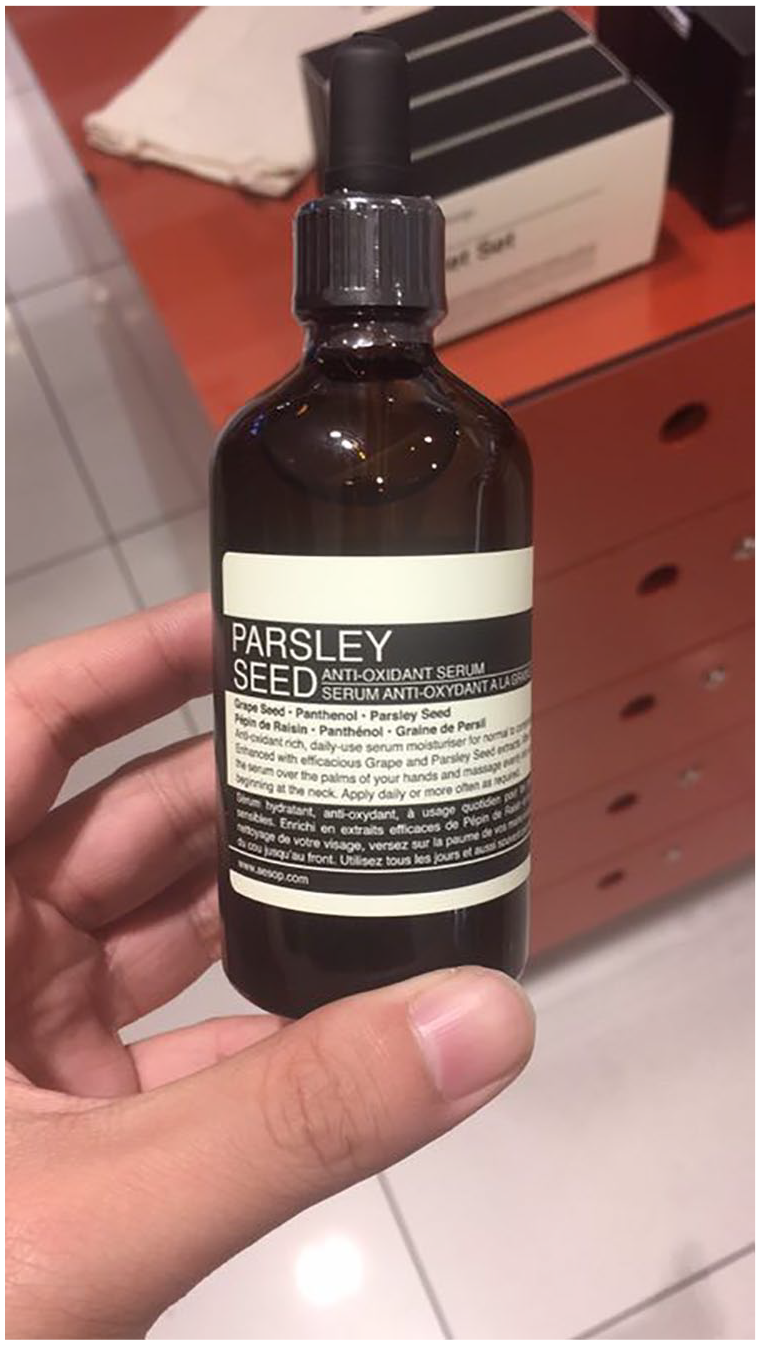
Qin’s photo of the skincare product.
Obviously, Qin was not shopping for himself. He was, instead, on a regular daigou excursion with a long list of ‘orders’ to complete before the end of the day. Daigou, literally translated as buying on behalf of, is a Mandarin term that refers to a form of personalised transnational trading activity, which is generally characterised by practices of purchasing locally manufactured products overseas and reselling them to consumers in China via international courier services. There are a wide range of sought-after commodities, from infant formula to nutritional supplements, from woollen products to high-end luxury goods. Although the market size of the daigou industry is difficult to calculate, it is evident that many companies now depend on it as a crucial channel to stimulate and maintain sales and share prices (Xiao and Mantesso, 2019).
Daigou-ers – people who run such businesses – often live outside China. They make a profit by charging a commission or a reasonable extra in addition to the total cost of commodities and international shipping. There are now reportedly around one million daigou-ers across the globe (Parker, 2018). This number is reasonably an underestimation given that many of these activities are carried out on a casual and non-commercial basis. While there is no official record, many among the vast number of daigou shoppers today are Chinese international students and new migrants studying and living overseas, like Qin, with ready access to locally manufactured goods (Xiao and Mantesso, 2019).
As can be seen from Qin’s story, the contemporary operation of daigou relies heavily on the use of Chinese digital media in communicating with clients and completing transactions. In this, the social media app WeChat plays an indispensable role in the many aspects and stages of daigou. In 2011, Chinese tech giant Tencent launched the game-changing product, WeChat, which soon surpassed QQ to become the one with the largest number of monthly active users (Tencent, 2017). Released as a mobile instant messaging and social media application, WeChat now incorporates various critical features to enable more than interpersonal conversations and content sharing, but also mobile payment, digital gaming and taxi booking among others. Of all these features, two have become the key components of everyday sociality (Figures 2 and 3): Chats (private or group conversations) and Moments (朋友圈, pengyouquan). It is in the Moments section that user-generated content is shared in textual or visual format and made accessible to the online networks, akin to the functions of Facebook Timeline and News Feed. For the Chinese daigou-ers in this research, both Chats and Moments have been tactically mobilised to cultivate customer relations.

Interface of WeChat: Chats.
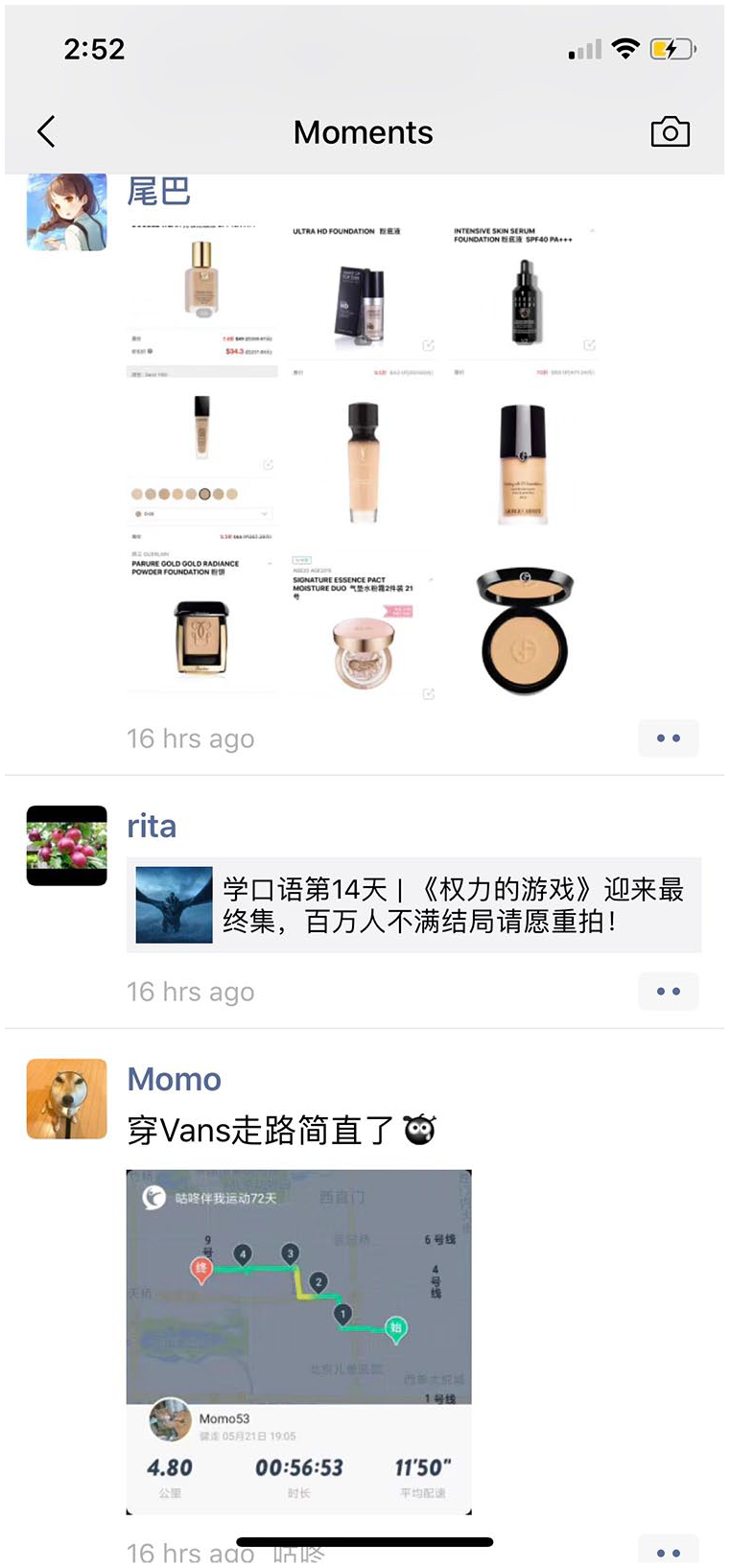
Interface of WeChat: Moments.
In this regard, Chinese student daigou-ers are ‘digital workers’ whose online operation of their personal businesses is composed of various labouring activities. This article analyses the socioeconomic phenomenon of daigou by focusing on the forms of digital labour invested in Chinese student daigou-ers’ use of social media for running their personal enterprises. I argue that online labour in daigou entails persistently crossing and constructing boundaries between the personal and professional realms. More specifically, in the everyday digital routines of daigou, personal details and private information are being organised and mobilised, on the one hand, to forge trust with customers for the purpose of profit-making; and, on the other, to retain a sense of privacy in response to the side effects of online productive activities.
Previous research on international students’ digital experiences has emphasised the important role of the Internet and social media for student adaptation and adjustment in foreign contexts. Most studies have inquired into how online relationships sustained through social media have become everyday information sources that have contributed to students’ well-being in the receiving countries (Chen and Ross, 2015; Saw et al., 2013; Sin and Kim, 2013) or provided emotional and practical support for their cross-cultural adjustment (Gomes et al., 2014; Kim et al., 2009; Lim and Pham, 2016). Similar to other migrant groups, therefore, overseas students are no longer uprooted but remain ‘connected’ in the digital age (Diminescu, 2008).
Despite the valuable research concerning digital media’s connective potential, this scholarship has paid insufficient attention to how digital connectivity is capable of producing new (and transnational) work spaces for international student migrants, who are more than educational subjects (Gomes et al., 2014). Rather, they ‘shape a mix of identity from a larger portfolio of socially defined choices’ (Marginson, 2014: 10) during their overseas sojourn. In Australia, for example, holding a student visa allows most international students to work up to 40 hours per fortnight during semester, and unlimited hours during semester break. Consequently, international students were found to have been an active but vulnerable part of workforce in the receiving society (Baas, 2010; Marginson et al., 2010; Martin, 2017; Nyland et al., 2009; Robertson, 2013). Questions then arise: Do international students work in and through digital spaces? In what ways are they engaged in these alternative workplaces? What are the various implications of such digital labour and work? This article answers these questions by providing a nuanced case study of Chinese international students’ digital labour invested in daigou.
Labour in the digital age
The contemporary ‘spatial unfixing of work’ (Graham et al., 2017: 136) provokes new forms of economic participation and value-creating activities. Indeed, work today could ‘take place outside the strict framework of workplace and wage labor’ (Casilli, 2017: 3934) and may often collide with personal life and leisure activities (Kücklich, 2005). Most notably, the expanding use of Internet and digital platforms has provided the technological infrastructure for novel labour relations, such as e-commerce and the platform economy. Consequently, digital labour, which ‘designates value-adding activities performed by humans on Internet platforms’ (Casilli, 2017: 3934), is on the rise. A prominent feature of these digitally enabled forms of labour is their ‘immaterial’ nature (Lazzarato, 1996), denoting ‘labor that produces an immaterial good, such as a service, a cultural product, knowledge or communication’ (Hardt and Negri, 2000: 292). Digital labour is thus less discernible as it can blend with mundane consumption and socialising practices.
Scholarly approaches to ‘digital labour’ have been diverse and the concept is one ‘with an astonishingly uneven deployment’ (Duffy and Schwartz, 2018: 2976). Critical scholars have revealed the unpaid and exploitative nature of digital labour in post-Fordist capitalism (Fuchs, 2014; Postigo, 2016; Scholz, 2012; Terranova, 2004). Users of the Internet generate online content which is commodified and transformed into significant profits for Internet companies – activities that may not ‘feel, look, or smell like labour at all’ (Scholz, 2012: 2). As Terranova (2004) put it, these forms of free labour are ‘part of a process of economic experimentation with the creation of monetary value out of knowledge/culture/affect’ (p. 79). Such an approach dismisses the discursive hype on the liberating and advanced digital economy to critically identify and understand unrecognised labour.
By contrast, other scholars emphasise the voluntary, active and participatory aspects of online labour – highlighting it ‘as an opportunity to explore creativity and synergies between media industries and consumers’ (Postigo, 2016: 334). This perspective attends to the enabling and empowering potential of digital media platforms in supporting creative cultural work. Baym (2015), for example, discussed musicians’ online ‘relational labor’, which refers to their ‘regular, ongoing communication with audiences over time to build social relationships that foster paid work’ (p. 16). Although this form of labour is not directly paid, it is a necessary skill and prerequisite for paid work and career development. The strategic aspect of digital labour has become an everyday, essential element of a growing number of occupations (Abidin, 2015, 2016; Cunningham and Craig, 2017; Marwick and boyd, 2011).
The third strand of research focuses on novel employment practices and relations as a result of emerging digital labour platforms and the gig economy. These studies have pointed to the ambivalent outcomes of such development (Graham et al., 2017), both empowering those with limited access to local, traditional job opportunities and creating new risks and problems that may further marginalise digital labourers (Berg, 2016; D’Cruz and Noronha, 2016; Lehdonvirta, 2016). Others, however, foreground the strategies adopted by platform labourers to cope with institutional control and regulation. As a notable example, Sun (2019) explored how workers for food delivery platforms in China are more than ‘simply passive entities’ as they ‘have generated alternative ways of using and making sense of [platform] algorithms’ (p. 310). In this sense, the relationship between platforms/customers and the workers is not purely regulative, but potentially subversive.
Despite the differing emphases, recent scholarship has seen increasing attempts to shed light on the non-exclusive and potentially overlapping relationships between these approaches. Cirucci (2018) has helpfully identified social and institutional levels of digital interactions on social network sites, which becomes an effective point of departure in understanding the co-existence of exploitative and participatory forms of digital labour. Similarly, Sun’s (2019) work revealed how delivery workers’ platform labour also involves creative and cultural work for the purpose of managing and circumventing the system. This study adds to this ongoing line of inquiry by situating the digital labour invested in daigou at the intersection of the various forms of labour discussed above.
Moreover, this article considers another form of labour that has largely eluded scholarly attention – what I call ‘unproductive labour’. Previous studies have analytically prioritised the productive aspect of digital labour. That is to say, empirical research so far has explicitly addressed ‘labour’ in a sense that it only refers to those activities that directly create value and lead to personal or institutional profit-making. Consequently, what remains under-examined is the kind of online work that aims at managing the various implications of productive labour. How, for example, have these unproductive forms of labour become an integral component and outcome of digital work? This article interprets and analyses Chinese international students’ digital labour, both productive and unproductive, in daigou through the conceptual vocabularies of ‘boundary’ and ‘boundary work’. It illuminates how unproductive labour in the form of privacy boundary construction and maintenance has become essential because the profit-making activities for daigou have resulted in the (sometimes unwanted) convergence of personal and professional relationships.
Method
Research data for analysis in this article was drawn from a 15-month, two-stage ethnographic study of Chinese international students’ everyday use of social media. In this study, I conducted participant observation in both the physical places – including university campuses, international student events, workplaces and so on – and the online spaces of social media that Chinese international students frequent. The first stage of the fieldwork, which lasted from March to August 2016, mostly involved engaging with the international student communities and events in Melbourne. I joined and actively participated in online discussions and observations of Chinese international student matters across social media platforms. In the second stage of the fieldwork between February and October 2017, I conducted one-on-one, semi-structured interviews with 28 Chinese international students who were either enrolled in universities in Melbourne or who had recently graduated but were staying in Melbourne for work. The purpose of these interviews was to understand, from their perspectives, how and why they used social media in particular ways. In addition, I observed their everyday lived experiences and online postings and interactions on social media to supplement the interview data.
Such research methods allowed me to highlight both the nuances of online environments and practices as well as the offline material forces that speak to the ‘virtual world’. More specifically, this study seeks to capture ‘the micro-workings of mediated interactions’ and the digital environments as being embedded within multiple online and offline contexts (Madianou, 2017: 109). Increasingly, Internet researchers have taken into consideration the ‘contexts from which these [online] activities emerged’ (Hine, 2015: 35; see also Miller and Slater, 2000; Silver, 2000). As such, online and offline spaces are construed as mutually constitutive and interconnected, and this has opened up new methodological approaches to understanding the affordances of the Internet and other new media technologies.
As well, recent empirical changes in the technological landscapes of information and communication technologies (ICTs) have further blurred the boundary so that ‘we are increasingly engaging with a reality in which the physical and virtual are merged to some degree’ (Hinton and Hjorth, 2013: 126). A useful ethnographic approach towards exploring the relationships between the so-called online and offline contexts is Burrell’s (2009) conceptualisation of the field site as a ‘network’ which ‘incorporates physical, virtual, and imagined spaces’ (p. 181). Burrell (2009) highlighted the usefulness of ‘following’ as a strategy, through which ‘the field site transitions from a bounded space that the researcher dwells within to something that more closely tracks the social phenomenon under study’ (p. 181). In this sense, a field site becomes a coalesced space in which the physical and the virtual come together. It is through this methodological lens that I probe into Chinese international students’ daigou activities in this article.
WeChat affordances and the rise of daigou
Admittedly, daigou is not a new phenomenon. Transnational flows of people are often in tandem with the global circulations of goods and products. Chinese international travellers such as flight attendants, international students and migrant workers have been the pioneers of daigou. In recent years, the landscape of daigou has altered in response to the rise of social media platforms. This development has significantly lowered the threshold of doing daigou, by allowing for a wider reach of potential clients and the transformation of the ways for running a business. In this sense, the rise of daigou is largely attributed to the technological ‘affordances’ of contemporary social and digital media in China.
Originally a concept in the field of ecological psychology, the notion of affordance is increasingly adopted by media and communication scholars to understand ‘social media interfaces and the relations between technology and its users’ (Bucher and Helmond, 2018: 235). In other words, it highlights the close relationship between the materiality of social media technologies and environments and social relations and structures (Ellison and Vitak, 2015). A helpful conceptualisation in relation to this study is the categorisation of high-level and low-level affordances (Bucher and Helmond, 2018: 239). The former emphasises the general features of social media technologies, whereas the latter designates distinctive attributes of specific platforms.
With respect to daigou, social media platforms afford personalised connections between individuals and communities. The abstract, high-level conditions of social media allow for the sharing and accessing of daily updates and information (boyd, 2011), which is crucial for the cultivation of trust and rapport. Unlike e-commerce platforms in China (e.g. Taobao), which are also commonly used for daigou activities, social media platforms foster a variety of interpersonal relationships and provide the users a glimpse into each other’s everyday life.
But, why WeChat? For one thing, the widespread use of WeChat among Chinese populations predicts the convenience of reaching potential customers. For another, the platform’s unique technical features define what and how users can do with it and yield a set of ‘social affordances’ (Wellman, 2001). The incorporation of multiple services – such as private chats, timeline, subscription accounts (SAs), mobile payment and social gaming – has created a super-app that penetrates every aspect of people’s daily life. In a transnational context, the ‘informational, interpersonal and instrumental’ affordances of WeChat have been found to facilitate engaged communication for transactional purposes (Zhang and Wang, 2019: 61). As Zhang and Wang (2019) have specified, ‘WeChat’s internally mediatised structure between its private chat, timeline content and its semi-public SA content’ is crucial in supporting a ‘diasporic space’ where social interactions unfold (p. 64).
In the case of daigou, WeChat’s Moments timeline function allows student daigou-ers to broadcast business-related information to their networks. They normally initiate business attempts through established personal networks on WeChat, such as their friends and families. Many will briefly inform their online contacts by posting the QR codes of their daigou accounts in WeChat Moments, with the hope that their friends would contact them to purchase Australian products. They also kindly request the online contacts to spread the word out to their own networks. Interested customers are then expected to add the students on WeChat as ‘friends’ for product information. In so doing, Chinese international students gradually build up their client base to expand their businesses.
The help of Chinese international students’ families and friends in China to introduce customers is critical to the initiation of their daigou businesses. Apart from the convenience associated with it, it helps foster a sense of trust between the students and their clients. As Sun (24, male) clarified,
No matter how close you are with someone on WeChat, it would still be better if you had physically met this person. I’m not saying that my parents are very good friends with these potential customers, but they have met each other. They know where you are, what you are doing. That’s enough. It’s better than any other promotions on WeChat.
The mobilisation of Chinese international students’ ‘strong ties’ (Granovetter, 1973) with families and friends adds a certain degree of credibility to these online enterprises. Rather than putting too much effort into promoting through their own social media accounts, it is more efficient to target those they already know or the online contacts that have been established within their networks.
Clearly, trust is a key element of daigou. As Jian (24, male) told me, the reason that many Chinese clients chose personal daigou-ers, that is, those who actually live overseas and sell products directly to customers, was not because these products were unavailable in China. In fact, a large number of online stores on China’s e-commerce platforms provide a wide range of overseas commodities from various countries. However, they tend not to trust these platforms because ‘they have deeply-rooted beliefs that there are counterfeits on these platforms, and they cannot distinguish whether these products are counterfeits or not’. Indeed, media coverage of China’s rising e-commerce market over the past decade has critically responded to this phenomenon by pointing out the vast number of counterfeits found in online transactions. Consequently, many consumers in China still prefer a personal daigou-er who actually lives overseas with easy access to ‘authentic’ products.
While the personal networks on WeChat play an important role in building an initial degree of trust, other clients often need more evidence of product authenticity. This is particularly the case when businesses expand, and existing relationships are no longer sufficient to build and sustain the required degree of trust. For this reason, the operation of daigou often requires extra labour to digitally interact with clients in order to maintain and reinforce trust and loyalty. For example, most daigou routines are composed of regular visual and textual advertisements on WeChat (Figures 4–6). In order to boost sales, advertisements are posted on a daily basis, or even multiple times per day.

A daigou advertisement on WeChat.
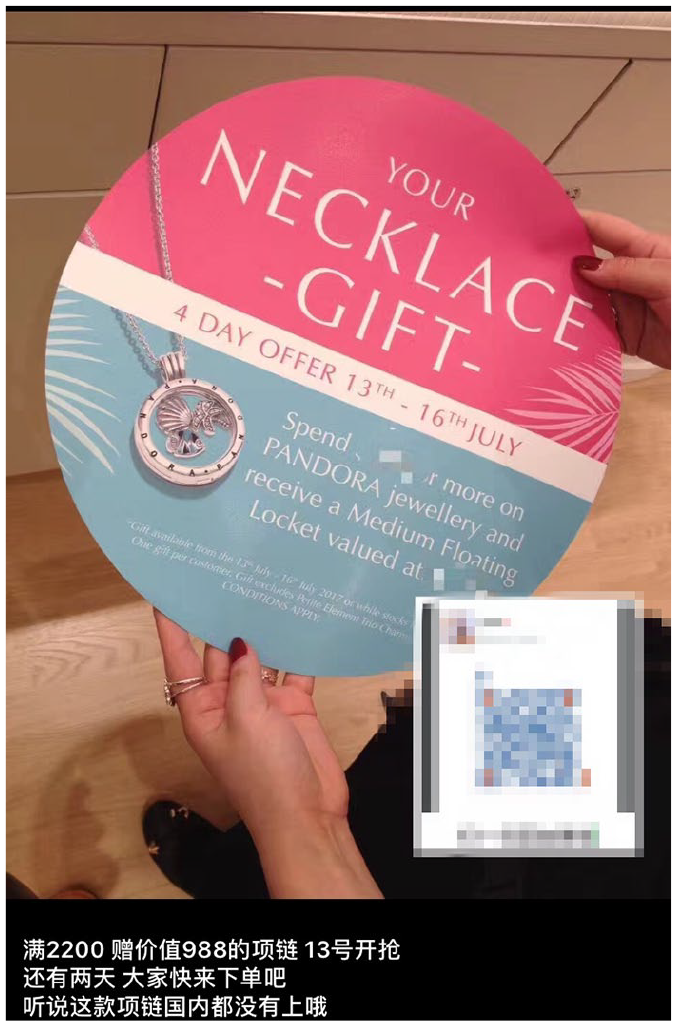
A daigou advertisement on WeChat.

A daigou advertisement on WeChat.
Consequently, rather than a separate domain of life, the activity of daigou and its associated online activities are blended with some overseas Chinese students’ everyday personal use of social media. WeChat, originally a tool predominantly for communicating with families and friends, is also capable of incorporating business networks that are less intimate compared with kin relationships. For the student daigou-ers, using WeChat thus involves regular shifts between personal and business modes and, as a consequence, makes it challenging to maintain the boundaries between the two realms. As such, the labour invested in daigou has increasingly problematised Chinese international students’ everyday ‘boundary work’ (Nippert-Eng, 1996) between the professional and personal terrains.
Boundaries are essential to our everyday social interactions and relationship management. Most obviously, we behave differently in differing social contexts. Such a division, according to Erving Goffman (1959), exemplifies the performative nature of everyday-life encounters. In our everyday social life, we continuously cross boundaries to engage with different groups of people or to retreat from interactions. In these interactions, different audiences, or sets of relationships, are present, resulting in different versions of the presented self. This scenario is further complicated by the popularisation of digital communication technologies, which have created new spaces for social relations and interactions. Studies have discussed how Internet and social media users are attentive to the virtual existence of audience (boyd and Heer, 2006; Ellison et al., 2006), similar to face-to-face interactions. Despite the physical absence of interactants, the imagined dimension of audience in online environments also shapes how people behave and perform their identities. As Quinn and Papacharissi (2018) helpfully identified, social media users carry out ‘boundary work’ to manage the performance of their identities across multiple audiences. In this sense, interpersonal relationships on social media are not only about being connected; more importantly, they involve and require users’ ongoing labour to manage and negotiate these relationships by setting up and removing interpersonal boundaries. In what follows, I closely analyse how my participants make use of the different functions of WeChat to carry out online boundary work for daigou.
Privacy as resource: digital labour and online boundary work
As an alternative employment option for Chinese international students in Australia to cope with marginalisation in the local job market (Martin, 2017: 891), daigou involves daily digital communication with clients in different forms. To gain customer trust, they must provide evidence to demonstrate that the products they sell are genuine, as Qin does. In some cases, clients’ belief in the authenticity of products is premised upon my participants being real students studying in Australia. Being international students differentiates them from other e-store owners on Taobao, whose identities are barely known, and sometimes suspicious. Therefore, revealing and reinforcing their identity as international students in Australia to their customers remains an important task throughout their practices of daigou on WeChat.
A common strategy is to regularly publicise their personal life in Moments to those who are interested in purchasing commodities from them. The information covers a wide range, including different aspects of their everyday social and campus life. Through strategic self-disclosure, they emphasise the fact that they actually live and study in Australia. Also, these bits and pieces of everyday life add a personal touch to the daigou-customer relationship, so that the customers would consider themselves as friends to the daigou-ers. Xintian (19, female), for example, constantly posted her reviews of cosmetics products in WeChat Moments, which were accessible to all her daigou customers. In so doing, she tried to prove to them, in a very subtle way, that she actually lived in Australia and used the products that she sold, persuading her clients that she was a very ‘reliable’ (kaopu) daigou-er. Besides this, she also occasionally disclosed herself in daigou advertisements, demonstrating that she purchased these products in person thereby shortening the emotional distance between her and her clients (Figure 7).

Xintian’s post of herself in daigou advertisements.
Similarly, Sun actively, and selectively, posted fragments of his life in Melbourne, showing his study and everyday experiences. According to him, anything related to ‘here’ would work. It is the ‘hereness’ embedded in the personal information disclosed that matters in fostering trust between participants and their clients. WeChat’s geolocation feature is often mobilised to reinforce their identity as overseas students, which is crucial for building a trusting relationship. Personal information as such is now mobilised as ‘commodity’, which is an essential part of their online practices for daigou. Clearly, the customers are not necessarily their friends and thus do not normally have access to these personal details. In a sense, much of the information shared with the customers technically belongs to the realm of personal life, bespeaking a certain aspect of the private self.
New media research has pointed to the phenomenon of ‘context collapse’ as a result of the co-presence of multiple audiences in a social media environment (Marwick and boyd, 2011). Context collapse, according to Marwick and boyd (2011), refers to the processes by which social media platforms ‘collapse multiple contexts and bring together commonly distinct audiences’ (p. 115). The once single relational context in which interactions take place in a face-to-face environment has become difficult to maintain on social media platforms. What exemplifies the online practices of daigou-ers, however, is a particular mode of context collapse – what Davis and Jurgenson (2014) referred to as ‘context collusion’, which means ‘the process whereby social actors intentionally collapse, blur, and flatten contexts, especially using various social media’ (p. 480). In this sense, rather than a natural outcome of social media’s technological configuration, context collapse is also a type of voluntary practice among social media users.
The strategy of ‘context collusion’ denotes how Chinese student daigou-ers have redefined and crossed the boundary of privacy to develop trust and rapport with their clients. By taking advantage of WeChat’s timeline service, they intentionally bring down the boundary between personal and professional networks to maintain and develop their relationships with daigou customers in China, most of whom they have never met in person. Despite the participatory and creative nature of this form of labour, much of it remains unpaid and labour-intensive. This is particularly the case when WeChat users have been found to be exploited by Tencent ‘to obtain huge profits from selling users’ attention to advertisers and/or developing paid services based on the application’ (Peng, 2017: 276). In this sense, institutional and social interactions (Cirucci, 2018) co-exist in daigou-ers’ digital practices and co-constitute the profit-making dimension of digital labour.
Moreover, the act of sharing personal information is often not a one-off occurrence. Chinese daigou-ers must continuously maintain their credibility by tactically curating a profile of Moments posts on WeChat. That is, the boundary-crossing practices described above need to be ongoing and consistent so that the students’ credibility is sustained. This is because the Chinese international students’ customer base is constantly changing. As Karen (25, female) explained,
Most customers, when they first add you on WeChat, they won’t talk to you. They will first go to your Moments page and read what you have posted. Then they will set up the relationship of trust by themselves. If they already see you posting photos of your life in Australia, 80 percent will trust you already before talking to you.
Karen’s explanations suggest the importance of persistent sharing which generates a complete and intact online profile of the student daigou-er. More importantly, it indicates the relevance of how boundary crossing occurs. Instead of explicitly sharing their personal life for a commercial purpose, Chinese students need to do it subtly and tactically, often in a continuous (and unpaid) manner, so that their identities are revealed in a more ‘natural’ way. The intentional act of constantly publicising their personal life in a conspicuously unintentional manner reinforces their identity as real students, thus enhancing their credibility. Rather than feeding information to the customers, therefore, what sometimes is more effective is ‘to be socializing rather than brazenly self-promoting’ (Baym, 2015: 19).
Although the time and effort spent in this form of digital labour is not monetarily rewarded, it is a necessary component of their business and everyday work experiences. While it would be an exaggeration to treat these student daigou-ers as celebrities or influencers, their online labour of privacy boundary crossing resembles that of Internet ‘microcelebrities’ (Senft, 2008) who often intentionally disclose many aspects of their personal life to create ‘the illusion of “backstage”, giving the impression of uncensored glimpses into the lives’ (Marwick and boyd, 2011: 140). Similarly, Chinese student daigou-ers actively foster a sense of ‘perceived interconnectedness’ (Abidin, 2015) between them and their customers by disclosing a version of the private self. In this sense, rather than building real intimate relationships, they strive to create the mirage of being honest and candid to their clients, just like their friends on WeChat. For this purpose, the boundaries of privacy are reconstituted to meet the economic needs of the students while private selves are being crafted and manufactured for public ends.
Besides cultivating closeness, personal information is also utilised to enhance their influence upon customers. This is evident in Karen’s description of her plan to upgrade her business:
My idea is that you don’t sell a product; you sell the lifestyle of Australia. They will think, if you post something every day . . . okay, I’m having a brunch. I’m having an afternoon tea with my friends, which Chinese people normally don’t do. They [Australians] will just eat barbecue on the street, something like that. . . . And then your posting is like, every Aussie is wearing this Pandora. So Chinese people might think, I don’t need this product, but this kind of lifestyle makes myself feeling really cool.
As can be seen, Karen used fragments of her personal life in Australia to subtly mould her clients’ perceptions of the products that she sold, directing them to link these products with a different, but often desirable, way of life. Through these online identity performances, Chinese international students like Karen are capable of ‘successfully annexing individuals’ unique personalities and life experiences to commercial products through visual and discursive narratives’ (Zhang, 2017: 194). In certain ways, this aspect of online labour resonates with the discussion of platform labour in China (e.g. Sun, 2019). Although not similar to digital labour platforms, WeChat plays as an intermediary that connects consumers and labourers. This makes the daigou-ers contractors who are technically subject to the requests and orders of clients. That said, they have demonstrated abilities to manoeuvre around, or even invert such a relationship by exerting influence on their clients. Chinese student daigou-ers’ relationships with buyers in China are not purely commercial and contractual. They have endeavoured to persuade customers to treat them as personal connections who are trustworthy, and whose opinions are reliable.
Privacy as regulation: labour to (re)construct boundaries
In this part, I analyse a different form of labour which often eludes the attention of digital labour scholarship – the labour to manage the consequences of digital work. To be involved in daigou means the convergence of online personal and professional relationships. While the labour of disclosing personal information to customers is a common strategy for the purpose of gaining trust, and ultimately, making transactions, the presented ‘private life’ is intentionally crafted for the clients. In other words, practices of daigou do not mean undifferentiated sharing of their personal life, but careful management of the digital materials that they choose to make visible to this specific group of people who are barely ‘friends’ to them. Privacy still matters. For this reason, student daigou-ers categorise the publicised materials into different types, and only a certain type of information is appropriate to be shared with their customers, in order to retain a sense of privacy.
Most notably, Chinese international students often group their WeChat connections into different categories by assigning a tag to people of the same sort, such as ‘friends’, ‘family’ and ‘daigou’. In so doing, they manually divide their personal and professional relationships, which consequently lead to differentiated self-presentation strategies. That is, when they post something in WeChat Moments, they choose to make it visible to a particular type, or types, of contacts, while blocking access to the content for the others. During my interview with Tina (20, female), she showed me how she has tagged her WeChat contacts. Tina created five categories in total, of which one was named ‘daigou’ and had around 100 contacts in it. When she posted product information, she blocked all the other groups of contacts so that only her customers could see the content.
For some others, the management of their relationship with customers is realised through creating a separate WeChat account particularly for the business. Daigou-ers use this professional account to have all the interactions and communications with their target customers. Accordingly, they curate a particular profile for this account that consists of visual posts about both product information and selected aspects of their daily life. By doing so, they strive to keep daigou distinct from personal life by limiting business networks to a closed circle for easier management. The significance of this strategy is implied in Karen’s negative experience of not having a separate daigou account:
When I started, I just wanted to earn some money, that’s it. But then I realised I’ve given up something, especially when you get some really annoying customers. Sometimes the customers will be very condescending . . . Sometimes they wouldn’t consider the time difference and they would just contact you so late at night.
As a consequence of doing daigou without a separate account, Karen had trouble dealing with ‘annoying’ buyers. Running and switching between two WeChat accounts, in this sense, has given Chinese international students more freedom and flexibility in better controlling the rhythm of their lives when engaged in a transnational (and trans-temporal) business.
Admittedly, the two accounts are not mutually exclusive. Both accounts contain exhibitions of personal information about the student. However, the personal materials for the daigou account are highly selective, following certain rules and principles. Some information seems to be too ‘personal’ to be shared with customers. For example, photos with their significant others such as parents or partners rarely cross the boundary into the business account. In addition, emotionally charged content such as expressing feelings of anger or sadness can hardly be seen on the business account as it renders these students less professional and less reliable. This could be similarly observed in how Twitter users set up boundaries in their online interactions by ‘strategically concealing information, targeting tweets to different audiences and attempting to portray both an authentic self and an interesting personality’ (Marwick and boyd, 2011: 122).
At the same time, some posts for daigou look too ‘professional’ to be posted on the personal account. For example, many posts targeting daigou customers adopt a caring and personal tone, personalising business relationships. Ironically, such a performance of ‘care’ can rarely be seen among the personal posts that are available to students’ friends and families, even if they are supposedly more intimate. That is, despite the commercial nature of daigou relationships, the content publicised to this network may look more personal compared with that posted to their friends and families. A caring tone, paradoxically, may be seen as too professional or unnatural in a personal environment. In this sense, the boundary between the two accounts, and subsequently the terrains of personal and professional lives, is maintained through the differentiated content shared with different audiences. Yet, the nature of the ‘personal’ and the ‘private’ also becomes problematised as the students constructed multiple versions of their online self. Such a paradoxical performance of caring and intimacy attests to Chinese international students’ boundary practices in managing their personal and professional relationships on social media, as a result of their digital labour invested in daigou.
This latter aspect of content differentiation is amplified as most of the student daigou-ers prefer not to post any daigou-related content on their personal accounts, further pointing to the importance of retaining privacy boundaries. When asked the reason for doing so, Sun told me:
I never post product information on my [personal] account. The reason is that it’s not worth it if I do this on my main account. What if they (my friends) don’t like it? . . . If I post a lot about daigou here (in the personal account), it may seem to them that I’m taking advantage of our friendships.
Sun’s concern about the possibility that over-exposure of daigou content on his personal account would compromise his relationships with real friends is commonly expressed by many of the student daigou-ers that I met during fieldwork. On the one hand, they expect to utilise their personal networks, including friends and family members, to expand their customer base at the inception of their businesses, intentionally blurring the boundary between personal and commercial relationships. On the other hand, they are careful with such practice in order not to conduct the business at the cost of jeopardising their personal relationships.
The analysis in this part denotes the student daigou-ers’ online ‘boundary work’ to ‘segment’ personal life from work (Nippert-Eng, 1996). Aside from profit-making, boundary practices are also found in their labour to retain a sense of privacy in face of collapsed social contexts on social media. Overall, Chinese student daigou-ers’ online labour entails simultaneously crossing privacy boundaries for the purpose of paid work and reconstructing boundaries to balance personal and professional lives. Rather than not caring about privacy on social media, they manage their information disclosure and concealment within a ‘constellation of audience dynamics, social norms, and technical functionality’ (Marwick and boyd, 2014: 1063). The co-presence of both productive and unproductive forms of labour in daigou is emblematic of the variegated (inter-)personal implications induced by an increasing participation in the digital and creative economy.
Conclusion
Through the analytical trope of boundary, this article has provided a detailed account of Chinese international students’ digital labour in daigou. The technological properties of social media permit creative labour through which online networks are commodified and maximised. To excel in their daigou businesses, Chinese international students in this research skilfully utilised personal information to deliberately cross the boundaries between the professional and personal terrains. Specifically, practices of daigou involve the curation of publicly private selves for the purpose of fostering trust with customers. At the same time, the invested digital labour also entails the maintenance and reconstruction of privacy boundaries by carefully managing the materials that the student daigou-ers shared on social media. They selectively posted information to customers, screening out the content that may be too personal or that displayed too much emotion. Similarly, some ‘personal’ content designed for customers can barely be shared with their real personal connections. In so doing, they created distinct digital personas that catered to different audience groups. Moreover, the relevance of boundary was manifest in Chinese international students’ attempt to avoid or minimise posting daigou-related content on their personal accounts, and to avoid advancing their businesses at the expense of friendships.
From this, we could glimpse into the complexity of Chinese international students’ online work experiences and their skilful digital labour practices. The article has highlighted the various possibilities provided by digital media technologies for student migrants in transnational spaces. Conceptually, I have critically engaged with and developed the notion of digital labour by emphasising the overlapping spaces between different forms of labour. As discussed in the article, Chinese student daigou-ers’ online labour of boundary crossing is exemplary of how unpaid, participatory and platformed types of labour converge. This article, therefore, contributes to the ongoing scholarly attempts to foreground the interconnections between labouring activities. Moreover, it calls for more attention to the unproductive dimension of digital labour – that is, the much needed efforts to cope with the various consequences of work online rather than to directly make profits. In the form of boundary making, unproductive labour in daigou allows for the construction and maintenance of personal spaces for Chinese students. Because of and in order to sustain their participation in the digital economy, this boundary work has been found to be inevitable and necessary. Therefore, an explicit focus on both dimensions of digital labour holds potential for capturing the multivalent experiences of digital workers.
Footnotes
Funding
The author(s) received no financial support for the research, authorship and/or publication of this article.
