



Abstract
Greta Thunberg’s meteoric rise from lonely school striker in August 2018 to global icon is one of the most remarkable political phenomena in recent decades, and one full of paradoxes. Thunberg started out with no resources, a child of 15 with limited experience and a history of Asperger’s. Thunberg’s iconic performance seems to have been able to turn these weaknesses into strengths. To understand how this happened, we must situate her analysis within the social media ecology. Two things distinguish this environment from previous phases: iconic protagonists now have wide degrees of control over their own performance, and audiences are no longer mere receptors of iconic performance, but active co-performers. Greta Thunberg is one of the first major political icons to have been fully formed within the new social media ecology. This article provides the first systematic analysis of this dynamic.
Greta Thunberg’s meteoric rise from lonely school striker in August 2018 to global icon and Nobel Peace Prize favorite a year later is one of the most remarkable political phenomena in recent decades. In a series of new survey data from climate protests around the world, she stands out as the major source of inspiration and role model for many of today’s activists (de Moor et al., 2020: 23). Her leap to the world stage has been reflected in no less than two front pages of Time magazine, speeches to the United Nations (UN) and World Economic Forum, condescending Twitter attacks from US President Donald Trump, huge mural paintings in the cities of San Francisco and Bristol, and more than three million followers on Facebook. Greta Thunberg has clearly captivated (and infuriated) audiences all over the globe to an extent where she is now the very moral and political embodiment of today’s struggle against climate change.
Her iconic career is in many ways paradoxical. It has occurred with an extreme speed that stands in staggering contrast to her limited economic and organizational resources in the early phases of her activism, which she started entirely on her own at the age of 15. Orchestrating the Fridays for Future protests and popularizing the school strike protest repertoire into a genuinely global phenomenon is an astonishing achievement at that age. If we add to this that Greta Thunberg is diagnosed with Asperger’s and suffered through periods of bullying and eating disorder before becoming an activist in 2018, it hardly sounds like a recipe for global iconicity. Thunberg’s performance (Alexander, 2006a, 2017), however, seems to have been able to turn these adversities into strengths. To understand how this has happened, we must situate her performance within the social media ecology (McLuhan, 1962; Postman, 1985). Iconic performance is, ultimately, a communicative relationship between protagonist and audience. Today’s media ecology shapes this relationship in numerous ways that profoundly alter the conditions of iconic processes: With its radically decentered communication flows (Castells, 2009; Keane, 2018; Waisbord, 2018), iconic protagonists now wield a much larger degree of control over their performance. At the same time, the audiences of the performance are no longer mainly receptors and applauders, but active co-performers (Bayerl and Stoynov, 2016; Boudana et al., 2017; Bruns, 2008; Olesen, 2018].
The point is not that these conditions produce global icons. To the contrary, the rarity of genuine iconic processes clearly indicates that agency and performance matter. Why and how some performances generate audience resonance, while others do not is indeed still the major puzzle for students of iconicity (Alexander, 2006a, 2017). To analyze Greta Thunberg as an icon, then, requires us to look carefully at her performance: what she does and says, and how she appears. Yet I follow media ecologists (McLuhan, 1962; Postman, 1985) in insisting that her performance cannot be separated from the media environment in which it takes place. In particular, I emphasize how the current social media ecology (a) lowers the cost of initiating performances, (b) accentuates visual representation, (c) creates intimacy between protagonist and audience, (d) draws in new and increasingly young audiences, and (e) distributes communication across several media platforms. Greta Thunberg provides a highly compelling, but surprisingly understudied, case to trace the effect of these new dynamics on political iconic processes. While there is a sizable sociological body of work on iconic performance (Olesen, 2015; Alexander, 2006a, 2017; Alexander et al., 2012; Alexander and Jaworsky, 2014), there are not yet systematic attempts at combining this literature with insights from social media theory. In offering the first detailed analysis of Greta Thunberg’s iconicity in the social media ecology, the article hopes to stimulate such an agenda.
Iconicity and the social media ecology
Jeffrey Alexander (2006a) defines performance as “the social process by which actors. . .display for others the meaning of their social situation” (p. 32). This is not mere spectacle, but an attempt to convince. “In order for their display to be effective,” writes Alexander, “actors must offer a plausible performance, one that leads those to whom their actions and gestures are directed to accept their motives and explanations as a reasonable account.” Performance, in Alexander’s theorization, is operative in all aspects of politics, but is mainly applied to iconic political leaders such as Mao Zedong, Martin Luther King, and Barack Obama (Alexander, 2006a, 2017; Alexander and Jaworsky, 2014). I define a political icon as an individual with high public visibility who has come to embody a political cause or movement for a large group of people, and who commands significant emotional and moral attachment from their audiences (Olesen, 2015). Political icons serve as unifying symbols that create coherence, visibility, and motivation in and around social movements (Linklater, 2019). Iconicity is forged around deep-seated binaries such as good-evil, right-wrong, pure-dirty (Alexander, 2006b). Icons are viewed by their audiences as legitimate representative of the positive side of these codes. The concept of iconic performance is key here because such legitimacy is something earned by the icon through their acts and personal qualities. Protagonists who acquire iconic status must display a willingness to take on considerable personal risks and to sacrifice narrow self-interest in the pursuit of goals that concern societies and their values and aspirations (Olesen, 2015; Prestholdt, 2019). The demonstration of moral purity is a key element in this process. The awarding of iconic status can only proceed when no doubts can be raised concerning the protagonist’s pro-social motivations. Any suspicion of ulterior motives such as pecuniary rewards, power advantages, and other self-interested behavior contains a risk of derailing the iconic process (Olesen, 2020).
While these qualities remain central to successful iconic performance, the existing literature on icons and performance seems to build on a classical theatrical model of action and reaction, of stage and audience that is increasingly out of sync with the realities of the social media ecology. The most wide-ranging changes concern the decentering of public spheres and their communicative flows, as well as a profound rewriting of the relationship between producers and audiences toward what Bruns has coined “produsage” (increasingly interactive relations between producers and users in communication) (Boudana et al., 2017; Bruns, 2008; Keane, 2018; Waisbord, 2018). We can identify this shift in at least five domains.
(a) Social media reduce the cost of setting up activist performances. Bennett and Segerberg (2012) point out how social media lower the importance of classical organizations in mobilizing individuals to engage in political action. They describe this as a shift from collective to connective action. The latter term suggests how political mobilization can occur through the activation of the vast inter-personal networks that we are part of via our activities and presence on social media. Just as today’s activist and iconic performers are no longer dependent on the scarce resource of legacy media attention, they are able to initiate performances without the backing of organizations or other major resource carriers.
(b) One distinguishing feature of social media is the ease with which communicative interventions can be accompanied by visuals (French, 2014). The implications for iconic processes are twofold. In contrast to the pre-digital era, where visual representation depended strongly on the choices of legacy media and journalists, today’s protagonists are able to organize their own visual self-representation. The same dynamic implies that visual self-representation is rendered increasingly uncontrollable with the advent of new means of “produsage” (Bruns, 2008). Amateur-driven memes, Photoshops, and even so-called deep fakes re-contextualize and remediate (Bolter and Grusin, 1999) visual representation to construct new meanings (negative or positive) around “originals” (Boudana et al., 2017).
(c) Social media reduce the “distance” between producers of content and their audiences. This is notable in the world of celebrity culture where social media sustain para-social relationships with illusionary intimacy (Rojek, 2016). This dynamic increasingly extends to the political domain, where politicians build relationships with voters by sharing personal stories and details on social media (Enli and Skogerbø, 2013). If we accept iconicity as a performative process, these developments imply that the “stage” on which the protagonist performs is radically different from the pre-social media era. Remaining within the metaphor, protagonists are now able to invite audiences onto the stage, or at least create the illusion that they are. This is perhaps most visible on Facebook, Twitter, and Instagram, where users can comment on posts and potentially enter into dialogue with protagonists and other users.
(d) What is involved here is not simply a reconfiguration of the stage-audience dynamic, but of the audience itself. In the time when political communication revolved around newspapers and television, audiences were predominantly adult. Social media has increasingly included youth and even children in the information circuit (Newman et al., 2015; Xenos et al., 2014). This is not to say that children and youth did not participate in communication before the advent of social media, nor that they were unable to mobilize before this time. As shown by Rodgers (2020) and Bartoletti (2003), children’s activism has a deep history, with numerous cases of successful media resonance. What is new is that its dependence on traditional media has lessened and that its global diffusion potential is now almost unconstrained due to the networked character of contemporary communication (Bennett and Segerberg, 2012).
(e) The diversity of audiences now potentially involved in iconic performance also indicates how it now occurs on several media platforms simultaneously. Returning to the stage metaphor, it has become untenable to conceive of this in the singular. Platforms such as Twitter, Facebook, and Instagram offer very different communicative and self-presentation affordances, with some focused around visuals (e.g. Instagram) and others on debate (e.g. Facebook). Despite the growing importance of social media, legacy media remain important sites of iconic performance. Social and legacy media interact in numerous ways, where newspaper articles are posted and discussed on social media and debates and controversies on social media filter into newspaper and television reporting (Chadwick, 2013).
Together, these five aspects comprise a situation where iconic protagonists have wide control of their own performance and where their audiences are centrally involved in the process as co-performers. It is also a genuinely global process of visibility and diffusion where the co-performing audience, at least potentially, participates from everywhere. The claim here is not of a radical, social media–induced newness. Prestholdt (2019), for example, shows how Che Guevara’s iconicity in the 1960s and 1970s was both global in nature and forged through audience usage and interpretation. Rather than constituting a fundamental break with the past, social media accelerate and amplify these dynamics. The acceleration and amplification are, however, significant enough to justify a rethinking of the relationship between iconic processes and the media ecology. Apart from the points addressed above (a–e), which generally point to facilitative conditions, the social media ecology is also notable for its counter-iconic dynamics. In a public sphere where journalists and editors have lost their gatekeeping function, iconic performances are constantly subject to attack and critique, with amateurs and professionals attempting to disturb them through hate speech, denigration, and trolling (Hannan, 2018). To reiterate a point made in the introduction, the social media ecology does make iconic processes easier or more prevalent. The “success” of iconic performance always depends on the actions and qualities of the protagonist (Alexander, 2006a, 2017). The ambition of the coming analysis is precisely to trace this interplay between Greta Thunberg’s performance and the social media ecology in which it is embedded.
Performance and co-performance in Greta Thunberg’s iconicity
Researching performance and co-performance in Greta Thunberg’s iconicity requires a multi-faceted methodological approach. The material can be roughly divided in two parts: Greta Thunberg’s performances and the co-performing reactions of the audience. The first component comprises Greta Thunberg’s speeches, her book publications, selected posts on Twitter and Facebook, and documentary photographs. The audience-related material covers mainly comments on Thunberg’s posts on Twitter and Facebook and other audience reactions. These include both supportive and negative counter-iconizing reactions. In the case of comments on Thunberg’s Twitter and Facebook posts, I have opted to exclude the names of posters in order not to expose individuals against their wishes or expectations.
Watching a movement begin (on Twitter)
With the school strike, initiated on 20 August 2018 in front of the Swedish parliament in Stockholm, Thunberg popularized a performance and protest repertoire (Tarrow, 1998) with deep historical roots (Rodgers, 2020). Thunberg has described how her school strike was particularly inspired by pupils refusing to go school following the Marjory Stoneman Douglas High School shootings in February 2018 (Thunberg, 2019a). As she struggled to find anyone willing to accompany her, she decided to initiate the strike on her own. Thunberg’s loneliness, however, did not last for long: “The first day, I sat alone from about 8.30am to 3pm, the regular school day. And then on the second day, people started joining me. After that, there were people there all the time” (quoted in Watts, 2019). This rapid transformation from lonely school striker to inspirator and activist entrepreneur with a following is at least partly attributable to social media-driven connective action (Bennett and Segerberg, 2012). Thunberg describes how the first thing she did “was to post on Twitter and Instagram what I was doing and it soon went viral. Then journalists and newspapers started to come” (quoted in Watts, 2019). In her first tweet from 20 August 2018, Thunberg (2018a) angrily remarked,
We children rarely do what you tell us to do, we do as you do. And since you grown-ups don’t give a damn about my future, neither will I. I school strike for the climate until election day [9 September].
The reaction was immediate, with several tweets expressing support and some asking to join her. Reflecting Twitter’s word limits, the exchanges are brief and practical. In one of the first responses, a user replies, “Greta, you are awesome! I am a politician for the @The Feminists and attend high school. Can I come and school strike with you?” Thunberg’s response is quick and matter of fact: “Absolutely! Outside Parliament during school time,” and, in a later tweet to her supporters, “Anyone can sit down in front of their local councils.” The rapid response clearly reflected how Thunberg’s timing of her school strike with the upcoming national election in Sweden presented a favorable political opportunity moment. With the issue of climate change high on the agenda, the strike resonated with many Swedes’ growing concern with the environment.
Reading through these tweets is, literally, to watch a movement begin. The early crowd joining in is a motley one, consisting of youth and adults, politicians, cultural personalities, and “ordinary” people. These early tweets also give a strong taste of the counter-iconizing reactions that have followed Thunberg throughout her iconic career: “How to explain to her that nothing is going to change, but that she should go back to school” is just one among numerous tweets expressing disapproval of the fact that she was cutting classes. Another recurring theme links Thunberg to her mother, famous Swedish opera singer Malena Ernman: “I feel sorry for Greta who is being so brainwashed by her mother,” one tweeter writes, while others suggest that her school strike strategically coincided with her family’s publication of a book describing their daughters’ struggles with mental disorders (see below for more detail): “Will you be allowed to [go] back to school,” one tweeter thus asks sarcastically, “when your mother has published her book?” (the book was published on 23 August 2018).
Despite the negativity, the early Twitter response was overwhelmingly positive. Over the following days and weeks, more and more people joined. On the last day of the strike, on 8 September, “altogether 1,000 children and adults sit with Greta,” while “media from several different countries report live . . .” (Ernman, 2020). The interactive, hybrid dynamic between social and legacy media (Chadwick, 2013) is obvious here: attention is created through Twitter, but the movement gains momentum and wider public appeal through expanding newspaper and television coverage. According to Malena Ernman, this first wave of the school strike concluded with what is probably Thunberg’s first public speech. As if foreseeing the coming global resonance and the power of social media to spread her message, she says, “ am going to speak in English now. And I want you to take out your phones and film what I’m saying. Then you can post it on your social media” (quoted in Ernman, 2020).
While going it alone can be an powerful factor in iconic performance (I discuss this in more detail below), it is also potentially limiting if not propped up by resources and some degree of organizational backing. Thunberg had neither to begin with. Yet the connective power of social media made such adverse preconditions less debilitating (Bennett and Segerberg, 2012), or put differently, it enabled a fast-paced inflow of resources (in the form of skilled supporters, etc.) that were not tied to specific organizations, funds, or parties. This resource flow eventually led to the formalization of the Fridays for Future platform, but this is, precisely, a platform rather than an organization, a networking site with contact information, protest statistics, and information resources, and entirely run by volunteers. Fridays for Future’s (2020) own statistics have documented no less than 108,000 strike events in 7500 cities and 228 countries since 2018. This staggering diffusion of the school strike repertoire within the span of just a year and a half is perhaps the strongest example to date of what can be accomplished with limited initial resources in the social media ecology. Thunberg’s impact on climate activism within the Fridays for Future movement is a general one, but most pronounced among children and young people. In a recent survey from the September 2019 climate protests, data reveal that a notable 40% of young participants refer to Greta Thunberg as a significant inspiration for their participation (de Moor et al., 2020: 23). The reaction from young people at least partly stems from Thunberg’s presence on several social media platforms including Twitter, Facebook, and Instagram. These platforms enable younger age groups to access political communication to an extent that was not available in an age when newspapers and television, catering primarily to adult audiences, dominated the communication landscape. Since the school strike repertoire is a performance so evidently directed at children and youth, the ability to inspire and mobilize emulating co-performance was strongly facilitated by the access to “alternative” communication flows of social media.
Future framing and the reluctant child activist
As opposed to other icons (Malala Yousafzai, for example), Thunberg’s protest carried little physical and legal risk, occurring as it did in a fully democratic country with extensive rights and protections. Iconicity often emerges from the drama that unfolds when the bodies of “weak” individuals are exposed to the raw power and violence of the state or other “systems of authority” (Olesen, 2015; Snow and Soule, 2009). Thunberg also entered into a dramatic relationship with the state, but in an almost reversed manner: instead of provoking the ire of the system, her iconic performance rather sought to expose the state’s inertia and apathy. In one of her earliest transcribed speeches from 24 November 2018, Thunberg (2018b) outlines what has become a red thread in her interventions, linking the school strike with the system’s inability and/or unwillingness to act decisively against climate change: “. . . what is the point of learning facts in the school system, when the most important facts, given by the finest science of that same school system, clearly mean nothing to our politicians and our society?”
The dramatic plot of the performance becomes one where an active and concerned citizen desperately tries to make the system listen and react. While this intervention may not involve risk in Thunberg’s case, it does entail sacrifice. Thunberg and the millions of school strikers who have followed her example engage in a unique form of future framing where the present is infused with a sense of imperative acuteness in light of the impending future catastrophe of climate change: “Why,” Thunberg (2018b) asks rhetorically, “should I be studying for a future that soon will be no more?” Sacrificing education, and other normal routines, becomes a way of impressing on a lethargic political system the critical phase in which humanity finds itself. Iconicity in some ways resembles celebrity, but it works on a different logic. While it is acceptable for pop stars and other celebrities to actively seek fame and attention, iconic protagonists cannot aggressively seek such status. Their performances must demonstrate reluctance, a sense that the protagonist accepts a difficult task on behalf of a collective despite doubts and personal sacrifice. This dramatic element has special credibility when the protagonist is a child. This theme is nowhere more effectively conveyed than in Thunberg’s (2019b) speech at the UN’s Climate Action Summit in New York, 23 September 2019. “This is all wrong,” she opens, clearly emotionally affected. “I shouldn’t be up here. I should be back in school on the other side of the ocean. Yet you all come to us young people for hope. How dare you?” Children and young people, in other words, are forced to do the political work that adults ought to be doing while children ought to go to school.
That children and young people need to step into this role bears out the imperative nature of the fight against climate change. It plays on an emperor’s new clothes theme in which children are able to see through the deceptions of adults. The child is “pure,” not (yet) caught up in the contrived world of adults (and especially politicians) who are unable to see the bigger picture because of their economic and political self-interests. “We are in the beginning of mass extinction,” Thunberg proclaims later in the speech, “and all you can talk about is money and fairy tales of eternal economic growth.” The world of adults is corrupted and only children and young people acting with a kind of moral purity can expose the truth. While Thunberg does not say so directly, it is clearly an interpretive line picked up and developed by her co-performing audiences on social media, in particular in the commentary tracks of her Facebook page. There is an almost para-social, confessionary tone in many of the comments. The commentary track on Thunberg’s Facebook post of the UN speech (6100 comments) is full of responses from adults who praise her for “having the bravery to do what so many adults refuse” to do or concede that “We grownups should all be ashamed. We are the ones who are supposed to protect future generations, and we have so far failed.”
Iconization processes are obstructed if it appears that a protagonist pursues personal economic or power interests. These suspicions can more readily be removed from the equation when the protagonist is child. Nevertheless, other counter-iconization wedges have appeared in their place, where Thunberg’s identity as a child is precisely what is turned against her. These counter-iconic interventions are found throughout the commentary and dialogical affordances of the social media platforms that Thunberg uses. In particular, counter-iconizers portray her as a tool in the hands of adults. “Most do not want to understand,” says one comment to Thunberg’s Facebook post of her 23 September speech at the UN Climate Action Summit, “that this child is instrumentalized and manipulated. She is a puppet of the lobby and the elites.” The elites that are referred to in these reactions include the left, the Democrats, George Soros, and Bill Gates. As discussed in the preceding section, the elite connection is consistently legitimated with reference to Thunberg’s parents, who are portrayed as part of the cultural elite, reducing her to “a hysterical child with abusive parents.”
This counter-iconizing drive has been so pervasive that the iconic protagonist herself has felt compelled to publicly correct it. In a lengthy Facebook post from 11 February 2019, Thunberg (2019b) is adamant that “there is no one ‘behind’ me except for myself. My parents were as far from climate activists as possible before I made them aware of the situation.” She also makes it clear that she is “not part of any organization. I sometimes support and cooperate with several NGOs that work with the climate and environment. But I am absolutely independent and I only represent myself.” Independence is not just political, but financial, she underlines: “. . . I do what I do completely for free, I have not received any money or any promise of future payments in any form at all” (see also Rodgers, 2020: chapter 6). These exchanges take place outside the remit of legacy media. Just as the negative comments are a pervasive feature of the dialogical affordances of Thunberg’s social media platforms, her effort to counter them also occurs through these communicative circuits. In the opening to the post, Thunberg consequently calls on her Facebook followers to “help me communicate this to the grownups who lie about me and family.” The 292,000 likes, 32,000 comments, and 219,000 shares that this post has drawn so far are a powerful testament to the mobilizing capacities of the social media ecology in the ongoing negotiations over her iconic meanings.
Metamorphosis and catharsis
Iconic performances are permeated by narratives of resistance and ordeals and how these are overcome by the protagonist (Olesen, 2020). The power to act against these forces stands out as all the more impressive when the protagonist is a child. A child and school pupil is subject to restraining authority in ways that adults are not and, in addition, is limited in experience and resources. Thunberg, then, not only started her strike in the absence of supporters and resources, as discussed earlier, but also against her parents’ wishes:
When I told my parents about my plans they weren’t very fond of it. They did not support the idea of school striking and they said that if I were to do this I would have to do it completely by myself and with no support from them. (Thunberg, 2019a)
For a 15-year-old to proceed under these rather unconducive circumstances is a powerful performance that demonstrates a degree of moral and political determination that sets her apart from the large majority of her age group.
This lack of support in the early phases was not the only obstacle she had to overcome. Thunberg and her family have been open about her Asperger’s diagnosis, and on her Twitter and Instagram accounts she even introduces herself as a “17 year old climate and environmental activist with Asperger’s.” While her diagnosis has been used against her by counter-iconizers, it only makes her accomplishments even more impressive in the eyes of her co-performing supporters, a testament to her willingness and ability to overcome severe personal challenges in the quest for justice. In a series of tweets from 31 August 2019, Thunberg (2019c) herself has portrayed her diagnosis as a positive resource and “a superpower.” Elsewhere (Thunberg, 2019a) she even links her adoption of the school strike repertoire with her diagnosis: “. . . if I would have been ‘normal’ and social I would have organized myself in an organisation, or started an organisation by myself. But since I am not that good at socializing I did this instead.” She does, however, also acknowledge how her diagnosis has limited her. The August 2019 tweets describe a personal journey, a kind of metamorphosis, or even catharsis, through becoming an activist:
Before I started school striking I had no energy, no friends and I did not speak to anyone. I just sat alone at home with an eating disorder. All of that is gone now, since I have found a meaning, in a world that sometimes seems shallow and meaningless. (Thunberg, 2019c)
Using her personal social media stages to draw up this contrast between her situation before and the girl now berating world leaders with a stern, determined look is a vivid performative demonstration of the ordeals that she has had to face to transform herself into the global icon Greta Thunberg.
This dramatic contrast in the creation myth of Greta Thunberg is under continuous construction. In March 2020, the Thunberg family published a co-authored book (Thunberg et al., 2020) detailing Greta’s struggles with eating disorders, depression, and bullying (the book’s title, Our House is On Fire, alludes to a speech held by Thunberg at the World Economic Forum in Davos in January 2019, which she opened with these words). Before being diagnosed with Asperger’s, the book recounts, the family went through periods of deep frustration where Thunberg more or less stopped eating and teetered on the brink of psychiatric hospital admission. During this time Thunberg began to tell her parents about systematic bullying at her school. “It’s like a movie montage,” her mother recalls, “featuring every imaginable bullying scenario. Stories about being pushed over in the playground, wrestled to the ground, or lured into strange places” (Ernman, 2020).
Thunberg’s parents put their careers more or less on hold in the effort to turn things around and gradually, Thunberg began to recover. Her “return” to life was accompanied by a growing awareness of environmental and climate problems. Malena Ernman describes how Greta increasingly berated her parents for not paying enough attention and leading climate-unfriendly lifestyles (frequent flying, etc.). In Ernman’s account, Greta’s insistence acquired an almost prophetic character: “She saw what the rest of us did not want to see. It was as if she could see our CO2 emissions with her naked eye. The invisible, colourless, scentless, soundless abyss that our generation has chosen to ignore.” The first climax in this process comes with her decision to school strike in August 2018. As discussed earlier, her initiative rapidly catches on. While she struggles at first to adapt to this new situation, Thunberg increasingly embraces it. “Greta’s energy is exploding,” her mother recalls. “There doesn’t seem to be any outer limit, and even if we try to hold her back she just keeps going.” Becoming the activist Greta Thunberg, in other words, is as much a personal as a political trajectory, shredding off the years of loneliness, depression, and bullying to formulate a new role for herself: weakness and limitation transformed to strength and opportunity.
Thunberg’s openness about her diagnosis and personal struggles have invited numerous expressions of intimacy and emotion, many from people recounting their own personal struggles with autism, and so on, or telling Thunberg to ignore the counter-iconizing haters that turn her diagnosis against her. In the comments on the third (12,600 retweets and 159,700 likes) of the three tweets Thunberg posted on 31 August, one poster tells her that “You are a Superpower and we love you for it . . . You are beautiful and don’t let anyone tell you otherwise,” while another tells her not “to listen to the disgusting immature adults who are so threatened by your passion.” Binarily coded expressions of intimacy and emotional attachment such as “passion,” “love,” “beautiful,” “sweet child,” and “dear child” are recurring in the co-performing audience responses to Thunberg’s posts and speeches.
Photogenicity and visual plasticity
Many of the iconic meanings of Greta Thunberg, and perhaps most starkly the weakness–strength binary discussed above, are inscribed on the photographic documentation of her early school strike. In what is reportedly the first photograph of the school strike (dated 20 August), taken by Swedish photographer Adam Karls Johannson, Thunberg is seen sitting against the walls of the Swedish parliament with a homemade sign with “School strike for the climate” (Skolstrejk för klimatet) written on it. Even though power here is inert and impersonal, the contrast between the lone, frail individual and the “system of authority” (Snow and Soule, 2009) is nonetheless striking. The contrast is amplified by the fact that the person in the photograph is a child. The sign with “school strike” suggests that Thunberg is a pupil, just as the schoolbag and water bottle underline her identity. Her bodily appearance exudes childlike frailty, with its diminutive size, her legs pulled up, and shoes pointing toward each other. Beside her, a stone holds down a modest stack of leaflets describing who she is and why she is striking. The original sign has become a key prop in Thunberg’s performance, appearing with her in the original Swedish in the countless protest events she has taken part in since 2018, its emblematic character imprinted on the range of Thunberg merchandise, from cups and T-shirts to smartphone covers, that is now available. There is a significant literature around iconic images of suffering children (e.g. Hariman and Lucaites, 2007; Olesen, 2018). In this research, the child is often a relatively passive victim of violence (e.g. the Napalm Girl during the Vietnam War, Alan Kurdi). Greta Thunberg’s physical appearance and imagery retain some of the moral power of the child’s frailty and innocence, but at the same time subvert it into an active stance where she takes charge of her own destiny, and where her frailty becomes a sign of extreme courage and heroism as it is symbolically thrust against an “opponent” of much superior size (Klapp, 1948) (Image 1).

Greta Thunberg at the Swedish Parliament, 20 August.
The photograph (and other similar ones from the first strike days) has become central in the iconizing creation myth. According to Adam Karls Johannson (personal correspondence, 19 March 2020), the photograph was “discovered” with some delay and did not achieve major impact until about a year after it was taken. The renewed focus followed an online article on the first anniversary of Thunberg’s school strike by Ingmar Rentzhog (2019), CEO and founder of the Swedish climate organization We Don’t Have Time, which profiled the uncut version of Johannson’s photograph (Johannson was working as a part-time photographer for We Don’t Have Time when he took the photograph after having gone to the site of Thunberg’s protest together with Rentzhog on 20 August 2018, some of the first to do so).
The photograph’s (re)circulation occurred on the wave of protest that was taking shape in August and September 2019 in the lead-up to the UN’s Climate Action Summit in New York on 23 September. During this time, the photograph often appeared in a constellation with photographs of major street protests around the world. The dramatic plot in these stories, many of them told via Twitter, was the incredible change in just about a year from one lonely school striker to an estimated six million protesters all over the world. “I find this picture so incredibly moving,” Louise McDonald (2019) wrote in a tweet (225,000 likes and 58,000 retweets), copying a cut version of Johannson’s original photograph: “This is @GretaThunberg aged 15, sat alone outside the Swedish Parliament Aug 2018—the first school strike. In just 1 year, she’s created a wave that will change the whole world. Never underestimate the power of one young person.” The impact of the photograph is evident in responses to McDonald’s tweet, with one calling it “a bit of a Rosa Parks moment” and another confessing that “I had a little weep this morning when they said on the radio that Greta’s first protest was alone.” In a world of social media, the iconic process is constantly unfolding, recharged, and redirected by the co-performing intervention of lay audiences. It is notable in these processes that the lines between producers and audiences constantly shift. In the above tweet, McDonald is both audience and producer: a “recipient” of Johannson’s original photograph, she produces new, potentially iconizing meanings around Thunberg by re-contextualizing it in another temporal and political situation through a kind of creation myth for the global climate movement. This process does not stop with the tweet, but continues through the 1500 comments it has generated since its publication.
The role of photographs in the new media ecology is not limited to the meaning work around “originals.” The co-performing participation of the audience is perhaps nowhere more evident and creative than in the re-mixing, cartooning, and photo-shopping of photographs (Boudana et al., 2017). Many of these are circulated on Twitter and Instagram and take the form of memes that employ photographs of Thunberg in new, often humorous contexts. With her braided hair and Swedish origin, the comparison with Astrid Lindgren’s Pippi Longstocking, a children’s literature favorite with superpowers and a distaste for authority, is an obvious one to make, for example. Thunberg’s physical appearance is in general photogenic and visually plastic, lending itself eminently to visual reproduction and caricature. Her braided hair her gives her a distinctive look, while her facial expression combines an innocent and mild childishness with a penetrating and serious stare that corresponds well with her iconic persona: a “vulnerable” child on a mission that requires enormous moral and mental strength, carrying the burden that adults ought to be carrying for her, a visual embodiment of the slogan that has come to capture the new child- and youth-driven struggle against climate change: “No one is to too small to make a difference” (this is also the title of Greta Thunberg’s (2019d) book, which collects her best known speeches) (Image 2).
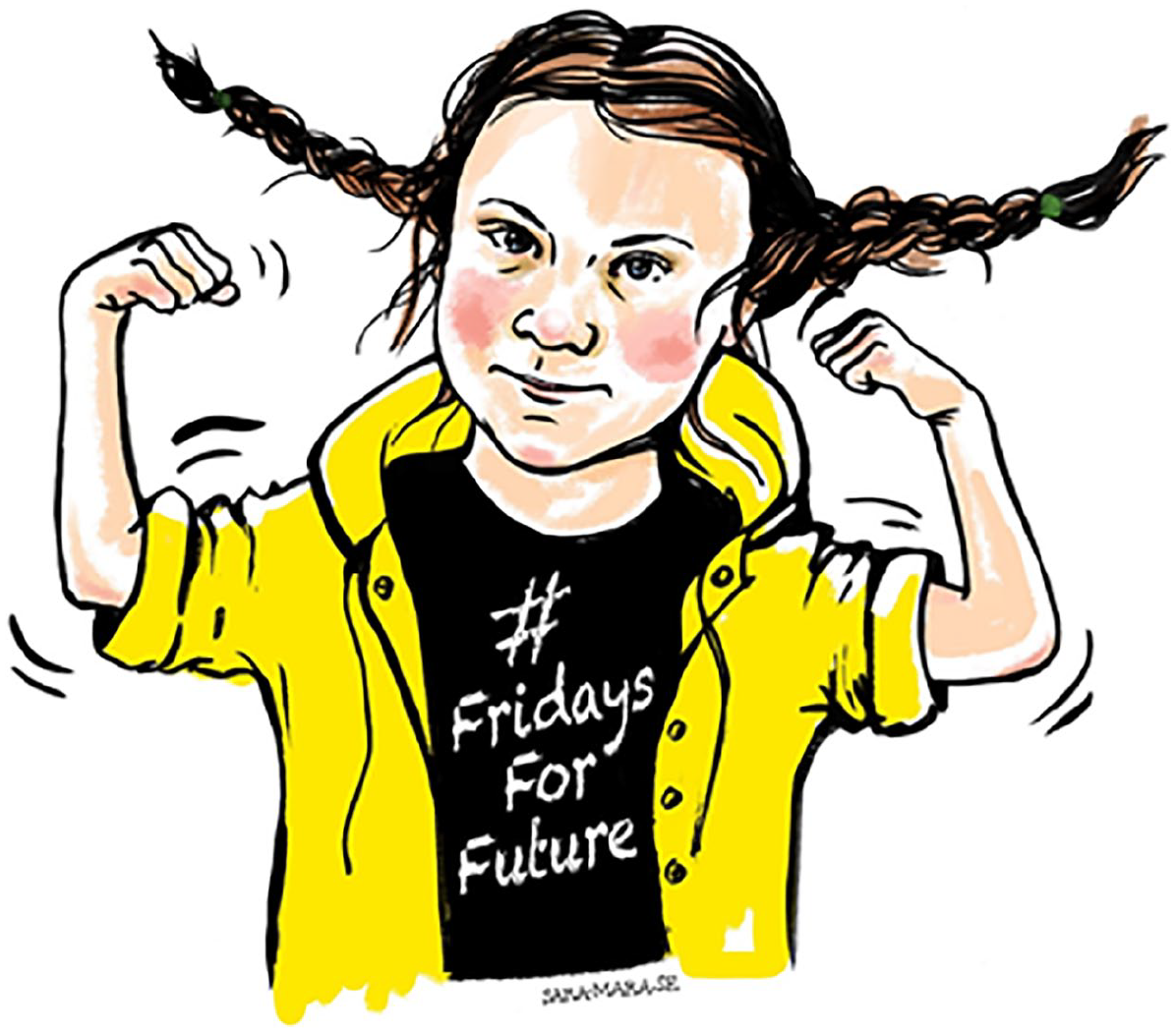
Greta Thunberg cartoon by Sara Mara.
Visually, Thunberg has become strongly associated with the yellow raincoat she was first seen wearing on rainy days during her initial school strike in August 2018 (the first yellow raincoat photograph was probably Michael Campanella’s from 28 August, available on Getty Images). Since then, Thunberg has appeared in the raincoat on numerous protest occasions, just as it has become a defining visual feature of murals, graffiti, and merchandise. In Sara Mara’s image above the yellow raincoat blends with the Pippi Longstocking reference while making another inter-iconic gesture to Howard Miller’s famous WWII “We can do it” poster (personal correspondence, 23 March 2020). The raincoat regularly appears on the many murals and graffiti paintings that can be found in cities all over the world, including major ones in Bristol (by Jody Thomas in 2019) and Istanbul (by Dheo and Pariz One in 2019). 1 Thunberg’s use of the yellow raincoat during those rainy days in August was likely never a strategic, dramatic choice, but a practical, mundane one. That it has become such a recognizable visual prop in her iconic performance is largely the uncontrolled result of the many co-performing lay interventions that have consistently associated it with her. Thunberg has worn the coat on many subsequent protest occasions around the world. While we do not of course know the rationale behind these choices, she is likely well aware of its resonance, suggesting, again, a genuinely co-productive relationship between audience and icon.
Discussion and conclusion
Greta Thunberg’s remarkable iconic career has occurred despite a series of conditions that in many ways seem incompatible with the resonance she has created: a lack of resources and support to begin with, being “only” a child, and dealing with an Asperger’s diagnosis. While I do not claim that the social media ecology has somehow turned these limitations on their head, I do contend that it has enabled a different kind of iconic dynamic where some weaknesses may be neutralized or even transformed into advantages. Recent icons such as Malala Yousafzai and Edward Snowden were catapulted to the global stage by highly dramatic events. Thunberg’s career, in contrast, started modestly, alone, with a cardboard sign, and with her own bodily presence and school strike performance as her main resources. This began to change the moment she alerted the world to her strike via Twitter on the first day. If perhaps not generating an explosion of interest, that tweet was enough to set in motion a process that would grow exponentially over the coming months.
The point here is not that a single tweet did it all. The tweet would have been useless if it had not been for Thunberg’s performance. This included, as noted above, the popularization of a protest repertoire linked to her child identity (the school strike), but also a simple, condensed message (“. . . since you grown-ups don’t give a damn about my future, neither will I”), a symbolically charged choice of location (the Swedish parliament, up to a national election), and a highly recognizable and reproducible visual appearance. But just as the tweet would not have made an impact without the performance, the opposite is probably also true. Despite the advantages of the performance, Thunberg could have been sitting by herself for a long time if she had had to rely on passers-by, word of mouth, and legacy media coverage for the diffusion of her message. Legacy media did become an important part of the equation, but only after the movement had already started to gain momentum without their intervention.
While social media helped overcome Thunberg’s initial lack of resources and organizational backing, they also facilitated a re-coding of the apparent limitations and pitfalls in the fact that she is “just a child.” Above all, social media have enabled Thunberg herself to take a great deal of control over her performance, adeptly acquiring a presence on a multiplicity of platforms such as, most notably, Twitter, Facebook, and Instagram. Against the flood of charges that she is a naïve child being manipulated by adults or that she should leave it to the grown-ups to deal with the serious politics of climate change, she has mobilized her three million Facebook followers to counter the accusations. Her speeches and social media posts consistently employ the “I shouldn’t be up here” frame to demonstrate that in fact she has no desire to be “more” than a child, but that she, and her generation with her, is being forced into political action by the passivity of adults. Had her performance been dependent on legacy media for its diffusion and visibility, her freedom to introduce an undistorted youth voice to the debate on climate change would have been significantly constrained. After all, legacy media are run by adults and for adult audiences. Social media not only allowed Thunberg to circumvent the gatekeeping functions of legacy media, but it also offered a direct communication channel to child and youth audiences that have traditionally been excluded from the flow of political communication and for whom Thunberg’s child/youth identity and school strike performance carry special credibility and mobilizing force.
Social media communication is a path-breaking form of communication because it provides new degrees of co-performing reciprocity and intimacy in the relationship between iconic protagonist and audience. The ability to comment on Facebook and Instagram posts enables audiences to express the emotional sentiments and attachments that I defined as crucial in the forging of iconicity. The systematic use of binarily coded terms such as “dear,” “sweet,” “good,” and “hero” in the commentary tracks of Thunberg’s Facebook and Twitter posts demonstrates the ongoing emotional involvement of lay audiences in the creation of Thunberg’s iconicity. Thunberg herself has also invited such intimacy, perhaps most notably in her performative openness on Facebook and Twitter about her Asperger’s diagnosis, eating disorders, and experiences with bullying. When these weaknesses are communicated in the broader context of her no-bullshit approach to world leaders, they are recoded into strength: for most of us, it inspires an almost larger-than-life awe that a child who has carried this heavy burden has now taken the world stage with such confidence and determination.
Her visual representation backs this analysis of strength-weakness. The various photographs documenting the early days of the school strike where Thunberg sits alone at the Swedish parliament have become staples in her creation myth and in the visual vocabulary of memes, cartoons, graffiti, murals, and other artwork that have emerged around her. The photographs of the lonely Greta Thunberg are used contrastively against photographs of mass protest to demonstrate the immense mobilization that has occurred since August 2018 and to bring home the point that “no one is too small to make a difference.” The early school strike photograph and other Greta Thunberg characteristics such as her braided hair and yellow raincoat are all elements in a highly creative, co-performing amplification of her iconicity that takes place on social media platforms such as Facebook, Instagram, and YouTube.
This latter observation suggests what is perhaps the most pertinent insight emerging from the integration of iconic performance theory and social media ecology theory: that iconic performances can no longer be conceived of through a simple, classical stage-audience metaphor. On the one hand, it is true, as I argued above, that iconic protagonists have a greater deal of control over their performance. On the other hand, it is equally obvious that this freedom is highly shared. This is evident not only in the way Thunberg’s lay supporters actively co-perform her iconization through comments, intimacy, and visual productions, but also in the active counter-iconizing dynamics that occur on the very same platforms where Thunberg and her supporters communicate. As a whole, the radically democratized media ecology renders iconic processes unpredictable, uncontrollable, and complex as audiences are increasingly involved in meaning negotiations. Even if it has been a central tenet of this article that the new media ecology of social media alters the conditions for iconic processes, this emphasis on complexity and decentralization more than suggests that its shaping properties are not determinative. In the end, iconic status still depends on performance. Yet I hope that it has also been made clear that the social media ecology requires us to think about such performance in new, more interactive and co-productive ways. The social media ecology may not have “created” the icon Greta Thunberg, but it is difficult to imagine that it would have unfolded in the same way and with the same degree and kind of resonance in its absence.
Footnotes
Funding
The author(s) received no financial support for the research, authorship, and/or publication of this article.
