



Abstract
On Twitch.tv, the gaming-oriented live streaming platform, users interact by sharing and viewing gameplay and participating in live chats. Negativity in online gaming is often explored on a large scale using broad categories. This study offers a nuanced look at Twitch.tv communities dedicated to the Dark Souls game series to examine the descriptive and injunctive community norms surrounding both aggressive negativity and ambiguous negativity, which involves interactions where the valence is not obvious and must be interpreted based on community-specific meanings and rules. This study systematically analyzed excerpts of chats and stream recordings of 22 live streamed sessions. It found ambiguous negativity was prevalent in cases of cursing, game jargon, banter, spam, and sarcasm. Aggressive negativity was rare but manifested in exclusionary language and banter gone too far. The response of community members and collective acceptance or rejection of such negativity was not clearly defined.
Twitch.tv is one of the most recent and popular examples of spectatorship and social gameplay in gaming history. Twitch.tv enables online interaction between streamers, or players who broadcast live videos of themselves playing games, and audiences of gamers who are interested in watching others play. The service has gained immense popularity during recent years: by 2014, it reached fourth place in peak Internet traffic in the United States (Conners and Breslau, 2014), and in 2018 had 140 million unique monthly viewers (Smith, 2018). Because the viewership is often live, Twitch.tv viewers can be compared to the active, engaged spectators of live sporting events (Cheung and Huang, 2011; Esbjörnsson et al., 2006). More intimate than cheering for professional athletes, Twitch.tv spectators can engage in social interactions with one another and the streamer. Thus, Twitch.tv facilitates Internet-based spectatorship while it retains characteristics of arcade or living room spectatorship (Recktenwald, 2018). Twitch.tv data scientist Danny Hernandez (2016) claims, “it replicates the experience of watching your friend play from their couch.” As a social medium, Twitch.tv combines elements of both spectatorship and nearly real-time interactions among players and fans.
Unfortunately, with online interactions comes the possibility of toxicity, which includes behaviors that create an unpleasant environment as well as negative comments and insults. The prevalence of negativity in interactions within and outside of games is a problem facing the gaming industry and its associated fan communities (Moore, 2018). The purpose of the present investigation is to extend prior research and explore this important issue by studying the prevalence and enactment of ambiguous and aggressive negativity in Twitch.tv live chats.
This study focuses on the idea of ambiguous negativity, or interactions on Twitch.tv that could potentially be construed as toxic. This includes traditional markers of negativity (e.g. spamming, swearing) and negativity found in the interaction among spectators (e.g. banter). Past literature on computer-mediated communication suggests the terms used to describe negative behaviors, such as flaming and trolling, are not conceptually distinct or applied consistently (Cook et al., 2018; Cruz et al., 2018). Such behaviors are often not as negative once evaluated in context (Cruz et al., 2018), which suggests it helps to study specific interactions in context to make sense of negativity (Hardaker, 2010). Furthermore, online communities have their own jargon (Marvin, 1995), which is specific to the game and hard for outsiders to understand (Cook et al., 2019). This study examines actual interactions in the context of the platform and community when trying to describe and categorize potentially negative behaviors, demonstrating the integral role of bottom-up community understanding in message interpretation.
This study considers the intersection of community norms and ambiguous negativity through the concepts of social affordances, which suggest that usage patterns are shaped by a combination of features and user practices (Bardner, 2001; Morschheuser et al., 2017), and the Social Identity Model of Deindividuation Effects (SIDE), which focuses on group identification in explaining negativity in low-cue online environments (Chen and Wu, 2013; Seering et al., 2017). This study sought to focus on the community surrounding a single game series to provide in-depth contextual understanding. The game series (i.e. Dark Souls) is a different genre that offers different types of community interactions compared to the competitive online games typically studied in flaming research (e.g. Blackburn and Kwak, 2014; Cook et al., 2019). It is an appropriate site for studying ambiguous negativity because it is iconic and genre-defining, and its trademark difficulty has elicited varied and controversial responses. This project conducted a qualitative study of live chat interactions on the platform to document, define, and unpack ambiguous negativity on Twitch.tv and offer a deeper understanding of how users interact with each other, while providing a context for understanding aggressive negativity.
Online community enabled by social affordances
Virtual (or online) communities are distinct from in-person communities because members tend to perceive less influence over fellow members than do members of in-person communities (Blanchard, 2007). However, they are still more than just groups of people interacting on an online platform; they have a sense of community, which involves constructs like identification and exchanging support (Blanchard, 2007). Twitch.tv communities surrounding particular streamers have those qualities and constitute virtual communities. The perception and enactment of identification and support are enabled by social affordances, or “the relationship between the properties of an object and the social characteristics of a given group that enable particular kinds of interaction among members of that group” (Bardner, 2001: 2). Design features of a platform can shape affordances to enable stronger group identification and social norms (Morschheuser et al., 2017), demonstrating the connection between the identification component of virtual communities and the norms as a focus of this study.
In a study of Twitch.tv, Blight (2016) elaborates that virtual communities enable connection through belonging reinforced by boundaries, personal investment, and a common symbol system. Channel-wide restrictions such as explicit rules posted by streamers and implicit norms manifested in group behaviors are examples of such boundaries that reinforce belonging and identification with particular channel communities. Furthermore, features like unique subscriber-only emotes for channels are an example of a shared symbol system that reinforces this sense of community membership and identification. These symbols of membership are monetizable; five of the seven ways to monetize Twitch.tv channels identified by Johnson and Woodcock (2019) provide the contributor publicly visible indicators of community status. This is similar to the way viewers of the Korean live streaming platform AfreecaTV were described by Yu et al. (2018) as declaring their loyalty to their favorite streamer through gifting. Streamer and audience’s discussions of shared experiences with the game and with the particular channel in the past, their acknowledgment of one another, live chat cheering in intense situations, and interactive behaviors such as gifting subscriptions suggest ongoing social integration and support. All these features point to the formation of virtual communities on Twitch.tv channels enabled by social affordances.
Similar to social features in some online games (Türkay and Adinolf, 2019), the Twitch.tv platform affords users the ability to experience presence, communication, and interaction with other live chat participants. When watching a stream, viewers are aware that the video and chat messages are happening live, giving them the sense of presence and witnessing events as they unfold, similar to spectators of live sporting events. Communication manifests in chat and being able to @mention other viewers or the streamer so they know they are being addressed specifically. Raiding, gifting, and moderation enable other forms of interaction beyond chatting. Gifting allows viewers to buy prepaid subscriptions for others, supporting them by giving them access to exclusive community perks. Streamers’ ability to host the stream of another streamer and to invite their viewers to “raid” allows for interaction between channels, often within the larger fan community of a particular game. In addition, the platform allows streamers to appoint moderators to monitor the chat and ban problematic users. Moderators enforce boundaries and support members by counteracting inappropriate behavior.
Online communities, toxicity, and norms
The concept of toxicity involves any behaviors that create a hostile and unwelcoming environment, and is similar to the idea of flaming, which is “offensive, rude and abusive language,” including insults and threats (Hwang et al., 2016). It is also related to conceptualizations of trolling, which is often used as “catch-all term for any number of negatively marked online behaviours” (Hardaker, 2010: 224). Past research on flaming and trolling can help frame discussions of ambiguous and aggressive negativity in contemporary gaming. Hardaker (2010) suggests flaming is in response to something, such as a threat, while trolling is done provocatively or for its own sake. The traditional ways of classifying impoliteness based on sender intent and recipient interpretation become not only difficult but even nonsensical when explaining behaviors such as trolling. Cook et al. (2019) use the term “verbal trolling” as a super-category containing such behaviors as offensive and exclusionary language, repetition, and “flame-like statements designed to infuriate the other party” (p. 295). The definitions of many online negative behaviors have been applied somewhat loosely and inconsistently (Cook et al., 2018; Cruz et al., 2018). Henceforth, I will use “flaming” and “negative behavior” when reviewing past findings on the aforementioned behaviors as they relate to online community norms. However, I will propose my own categorization of ambiguously negative behaviors informed by past categorizations and focusing on the actual online interactions when attempting to describe them (Hardaker, 2010) and evaluate which constitute aggressive negativity (i.e. true hostility).
According to the SIDE model (Postmes et al., 1998), flaming is not predicted by anonymity as much as by deindividuation, or the tendency of low-cue environments to blur individual differences and strengthen social identity. Social identity has been conceptualized as community members having knowledge of the group they belong to and attaching value and emotional meaning to their membership (Suh and Wagner, 2013). Anonymity increases the likelihood that those with a salient social identity will adopt group norms (Postmes et al., 2001). This is relevant to Twitch.tv where, apart from the streamer on camera, community members don’t know each other’s identities. The SIDE model has been used to explore negative online behavior; Chen and Wu (2013) show that cheating can be considered part of group norms and its prevalence is affected by group identification. Pertinent to the present investigation, the relationship between social identity and adoption of group norms makes it possible for negative behaviors to be normative (e.g. Suh and Wagner, 2013). This was confirmed in an experimental setting, where prior online comments affected the verbal aggressiveness of subsequent comments (Rösner and Krämer, 2016). Injunctive norms, especially publicly posted rules, may also influence the audience and reduce negative behavior. Managerial control, which is similar to moderation (i.e. the ability to review posts, send warnings, and withdraw memberships), may curb negative behavior, although research suggests its effectiveness in doing so in recreation-focused communities is lower (Suh and Wagner, 2013).
Applying the SIDE model to in-game chats, Cook et al. (2019) found polarized conversations and negative emotions. They concluded that verbal aggression could constitute “an attack on a person’s identity, even in the context of a game” (Cook et al., 2019: 310). Such a game-related or fandom-related identity might also be salient in other contexts like live streaming. Although the SIDE model has not been applied to the live streaming context, findings related to flaming in Twitch.tv live chats show that viewers conform to group norms in their responses to moderation. In the context of Twitch.tv, Seering et al. (2017) examined whether moderation, operationalized as banning users who post negative/problematic messages, was effective in regulating the community and fostering a more positive environment on Twitch.tv live chats. It was shown to be effective, at least in the short run: banning problematic users discouraged users from posting similarly negative messages. Moderation is one way the community polices its norms to foster interaction consistent with those norms, and its effectiveness is consistent with SIDE.
There are also platform-specific and channel-specific norms on Twitch.tv that challenge a simple classification of negative behaviors, for example, spamming and pranking. Seering et al. (2017) note that attitude toward spam differs between channels: “in some cases it can even be compared to the type of cheering that happens at sporting events” (p. 114). In a close analysis of yearlong observations of a single Twitch.tv streamer, Karhulahti (2016) concluded that while pranking and trolling performances are traditionally construed as negative, there can be social systems and situations where such behaviors are encouraged, and that these behaviors “can be considered extensions of our natural play instinct” (p. 11). Karhulahti states that Twitch.tv is a favorable environment for the development of such “alternative social systems,” which makes increasingly difficult for the parties involved (i.e. streamers, audiences, moderators) to determine what constitutes ethical behavior (p. 11).
In Twitch.tv live chats, Seering et al. (2017) also examined example-setting, defined as the likelihood of subsequent comments to imitate the behavior of an earlier comment, and found it to be effective in regulating the community and fostering a more positive environment. Examples within the live chat itself could be considered a form of norm-building; positive chat behaviors increased the likelihood that subsequent messages show similar behaviors, especially if the initial message came from users perceived as having more authority (Seering et al., 2017). The streamer, being the content creator and center of the community, has the most authority. Therefore, participants in the live chat might imitate the example streamers set through utterances in the broadcast, positive or negative. Such an adoption of the streamer’s example in an online environment where viewers are anonymous would be consistent with Postmes et al.’s (2001) assertion that social identity salience leads to higher adherence to group norms. Previous research on flaming in online contexts has shown that adherence to subjective norms is a predictor of flaming (Hwang et al., 2016), verbal aggression (Rösner and Krämer, 2016), and cheating (Chen and Wu, 2013).
This project’s research focus
This study categorized ambiguously negative behaviors and examined the degree to which they constituted aggressive negativity (i.e. were toxic, aggressive, or hostile), in the context of Twitch.tv live chats. Past research has focused on describing toxic language (Kwak and Blackburn, 2015) and testing out automated ways to detect toxicity (Murnion et al., 2018). Seering et al.’s (2017) Twitch.tv live chat analysis used spam as the basis of defining anti-social messages, operationalized as messages that contain many emotes, capital letters, or symbols. Neutral messages were those that ended in “?” and positive messages were those that contained singular smiling emoji. While such approaches are helpful for large-scale analysis, when it comes to specific interactions and individual messages, hostility is more nuanced than just spam and curse words. This study argues that not all spam, swearing or trolling is hostile, and the line between acceptable banter and insults can be blurry (Cruz et al., 2018). Therefore, a fine-grain understanding of ambiguous and aggressive negativity requires taking the context and community norms into consideration. For these reasons, the umbrella term “ambiguous negativity” will be used here to include all these loosely defined behaviors, while also indicating their context-dependent valence. For the purposes of this investigation, “ambiguous negativity” comprises interactions whose meaning and valence are not unanimously interpretable due to their context-dependence and the fact that community rules and norms determine what is acceptable, and those rules and norms can be misunderstood or misinterpreted by outsiders. This project was guided by four research questions:
RQ1. What are the norms of communication in Twitch.tv live streams and accompanying live chats related to games from the Dark Souls series?
RQ 2. What are the common communicative practices that fit into the category of “ambiguous negativity”?
RQ 3. How do participants express disapproval for non-supported communicative practices (e.g. calling others out, reporting, moderation)?
RQ 4. Which practices that fit into the category of “ambiguous negativity,” might be easily misunderstood by outsiders (e.g. acceptable practices interpreted negatively, or unacceptable practices interpreted positively)?
Justification for the games and the focal community
The Dark Souls series of role-playing games is suitable for this analysis due to its difficulty and its importance to the gaming industry as a whole. Limiting this investigation to one game series sought to eliminate the effects of the differences between the fan communities of different games and genres, which is crucial when studying virtual community norms. Competitive and team-based games such as League of Legends (e.g. Blackburn and Kwak, 2014; Cook et al., 2019) and Star Craft II (e.g. Thompson et al., 2017) are suitable to study the prevalence of verbal aggression in in-game chats. Compared to competitive games, role-playing games, where the majority of streamed gameplay involves a single player, are less likely to elicit other-directed verbal aggression. Such games enable distinct types of community interactions where ambiguous negativity manifests in different and hitherto unstudied ways.
The Dark Souls series is also appropriate for studying ambiguous and aggressive negativity due to the controversial ways in which people respond to its difficulty and to the special status it holds to gaming as a whole. The series is known for its high level of difficulty and the core fanbase of the series has even been accused of elitism and toxicity for their treatment of new or inexperienced players who struggle with aspects of the game (Worrall, 2016). Such behavior usually happens outside of the game (e.g. forums, wiki comment sections) since the Dark Souls series offers limited in-game options for interaction with other players. The Dark Souls series is also iconic, holding a special place in gaming as a whole (Dahlen, 2018). It has a set of distinctive game design choices, including the level of challenge that requires persistence; the level design that enables players to explore an interconnected world that loops back to the center point; the unusual approach to multiplayer; the unique mode of story delivery where there is a rich story to be found, but it isn’t delivered to the player if they don’t go looking for it (Riser, 2016). Since the first installment of the series, these choices have given the Dark Souls series a unique look-and-feel that inspired other developers and spawned homages and imitations (Cladwell, 2017). The first installment of the series, which pioneered this style, is considered “genre-defining.” Just like the “roguelike” genre is used to describe games with features resembling the 1980 game Rogue (McHugh, 2018), gaming websites today use the term “souls-like” for games resembling Dark Souls (Caldwell, 2017). This special genre-defining status makes the series a compelling analytical choice over other challenging role-playing games that followed in its wake.
The Dark Souls communities surrounding streaming channels on Twitch.tv represent a unique space to study ambiguous negativity. The interaction differs from Dark Souls-related discussions online, like community forums on Steam and comments under wiki-s, where negativity and elitism are expressed toward inexperienced players who may struggle with the game. What makes interactions on Twitch.tv unique is that rather than focusing on objective advice, people are more open to sharing their frustrations and difficulties with particular parts of the game, discussing and normalizing such experiences instead of disregarding them.
Method
The data were collected between 15 February and 21 March 2019, between 15:05 CST and 18:45 CST. Popular streaming and viewing times (TwitchStats.com, Accessed 15 February 2019) were used to get a more representative sample. For each video, the top-viewed unique stream of Dark Souls content, in English, with a unique content creator (where possible) was selected. Recordings were around 10 minutes long and included the videos and accompanying live chats. Twenty-two (N = 22) videos were recorded from 20 unique streamers, who were 90% male. The live viewers ranged from 84 to 14,619. Eight recordings came from Dark Souls, six from Dark Souls II, and eight from Dark Souls III.
Coding and analysis
First, ambiguous negativity excerpts were selected from the video recordings. Ambiguous negativity was operationally defined as any segment of streamer speech or live chat interaction that met any of the following criteria: (a) containing traditional markers of negativity (e.g. swearing); (b) containing traditional markers of online negativity (e.g. spamming, writing in all caps) (Seering et al., 2017); (c) being obviously aggressive or hostile (i.e. potentially hurtful to the audience or a subset of it, such as by being racist or sexist) (Cook et al., 2019); or (d) being potentially hostile given a surface-level understanding of the community (e.g. sarcasm or teasing), similar to Hardaker’s “mock impoliteness” (2010: 217). All individual messages and sequences of multiple messages that fit the criteria were transcribed and analyzed (Nexcerpts = 189).
The selected excerpts were described using contextual notes about the video where I applied my understanding of the fan community (see supplemental materials) and tagged behaviors using exploratory coding. When making a judgment for hostility, aggressive negativity was operationalized as speech or chat that is hostile or hurtful toward (a) the intended recipient (e.g. being mean-spirited or rude) or (b) the direct or implicit audiences (e.g. stereotypes about certain social groups, regardless of whether or not those groups are present in the chat), while the rest (e.g. light-hearted teasing, swearing as frustration toward one’s own performance) was not considered aggressive negativity. The tagging process was iterative, reviewing examples multiple times and adding new tags as necessary.
Results
There were three layers of analysis. The first layer of analysis involved behaviors that would be most easily apparent to newcomers or a data-driven quantitative approach (e.g. spam). The second layer looked at dialogic and relational behaviors which gain meaning only in the context of the relationships and dynamics between the participants, such as banter and trolling. The third layer explored ambiguous negativity in the meta-discourse, including the topics people talked about, and the issues and sore points that emerged from those. Nine published rule sets by the streamers were considered because they represented the streamers’ public statements of their channel rules, and as such add insight to the explicit norms.
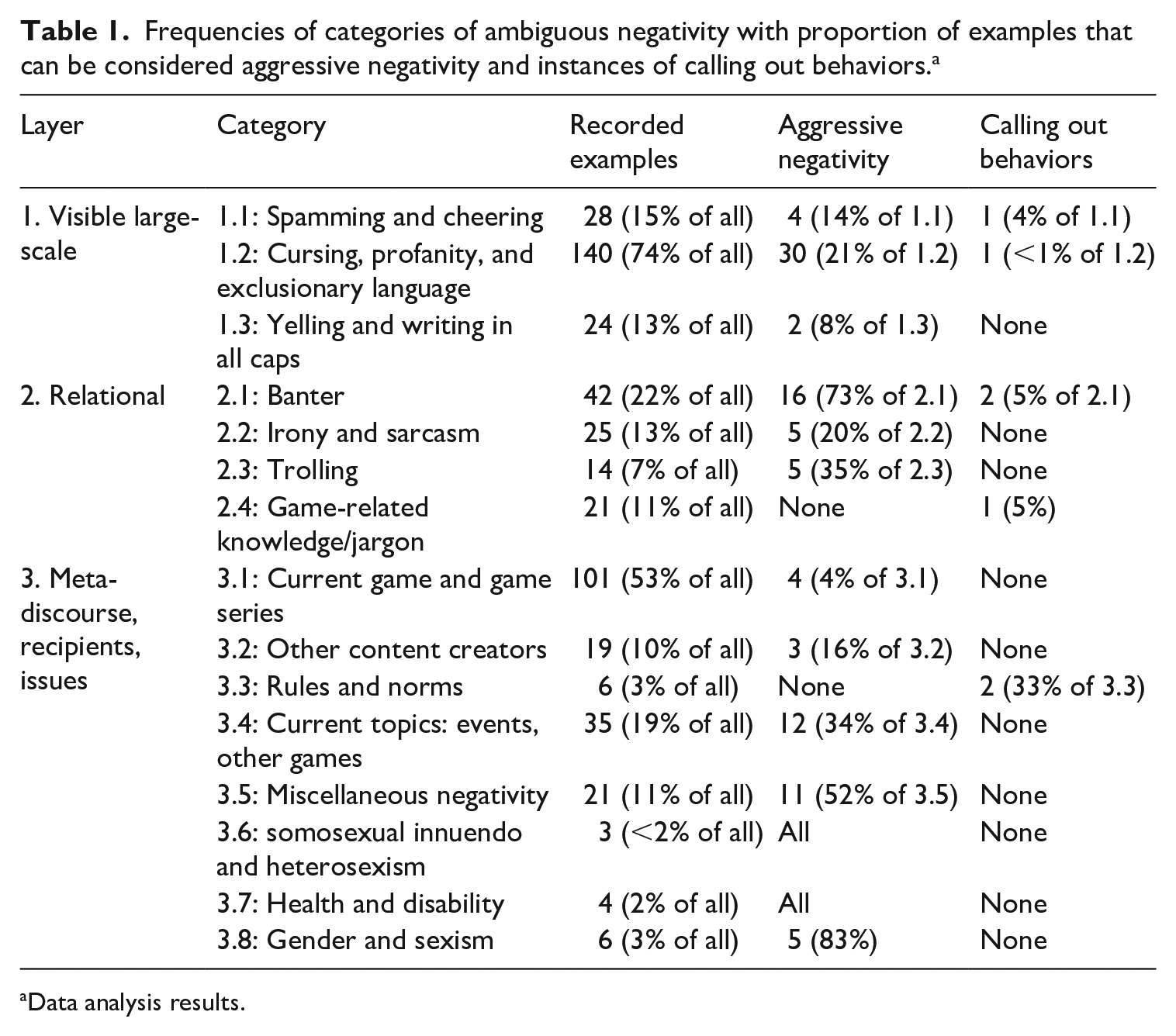
In the following sections and in Table 1, I report the frequencies of the categories of behaviors I identified based on their prevalence among excerpts. Thus, they are not intended to be an accurate estimate of the frequencies of these behaviors in live chats as a whole because I only transcribed examples that already had ambiguous negativity. They also do not represent the volume of messages related to each behavior because individual example segments also differed in content, some featuring singular instances of the behavior, others having up to dozens. Example segments were tagged with one or more categories based on their content, but the frequencies were calculated separately by category. Table 1 summarizes the frequencies of all recorded examples in each category featured in the layers, including the ones that were coded, but not discussed.
Frequencies of categories of ambiguous negativity with proportion of examples that can be considered aggressive negativity and instances of calling out behaviors. a
Data analysis results.
Analysis layer 1: context-independent ambiguous negativity
Spamming and cheering
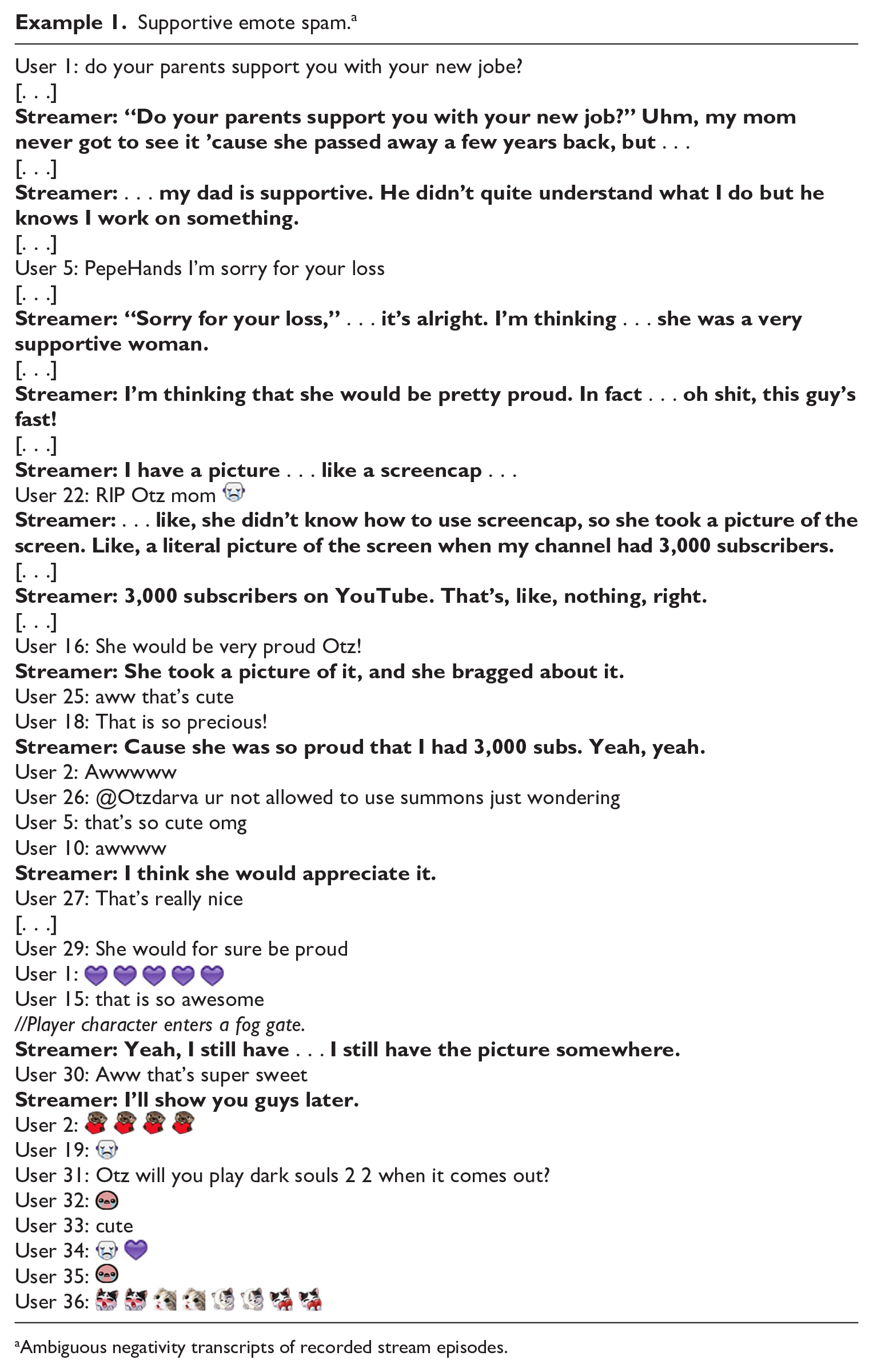
Instances of repeated sending of the same emotes or textual phrases in the recordings were tagged as spam. During this study, injunctive community norms against spam were not observed save for one rule set; spamming appears to be normal or encouraged. Few examples featuring spam were aggressively negative, and 36% were definitely supportive, such as cheering the streamer on or supporting them during negative in-game events.
Example 1 features a streamer playing Dark Souls II while answering questions from chat. The segment has multiple examples of spam. As with any spam, this can be misinterpreted as negative, but in this case it was supportive. Specifically, a user asked the streamer whether his parents supported his occupation. The streamer told a personal story of his deceased mother’s support. The response was a flood of overwhelmingly positive and supportive messages, as well as spamming positive emojis like cute faces and hearts.
Supportive emote spam. a
Ambiguous negativity transcripts of recorded stream episodes.
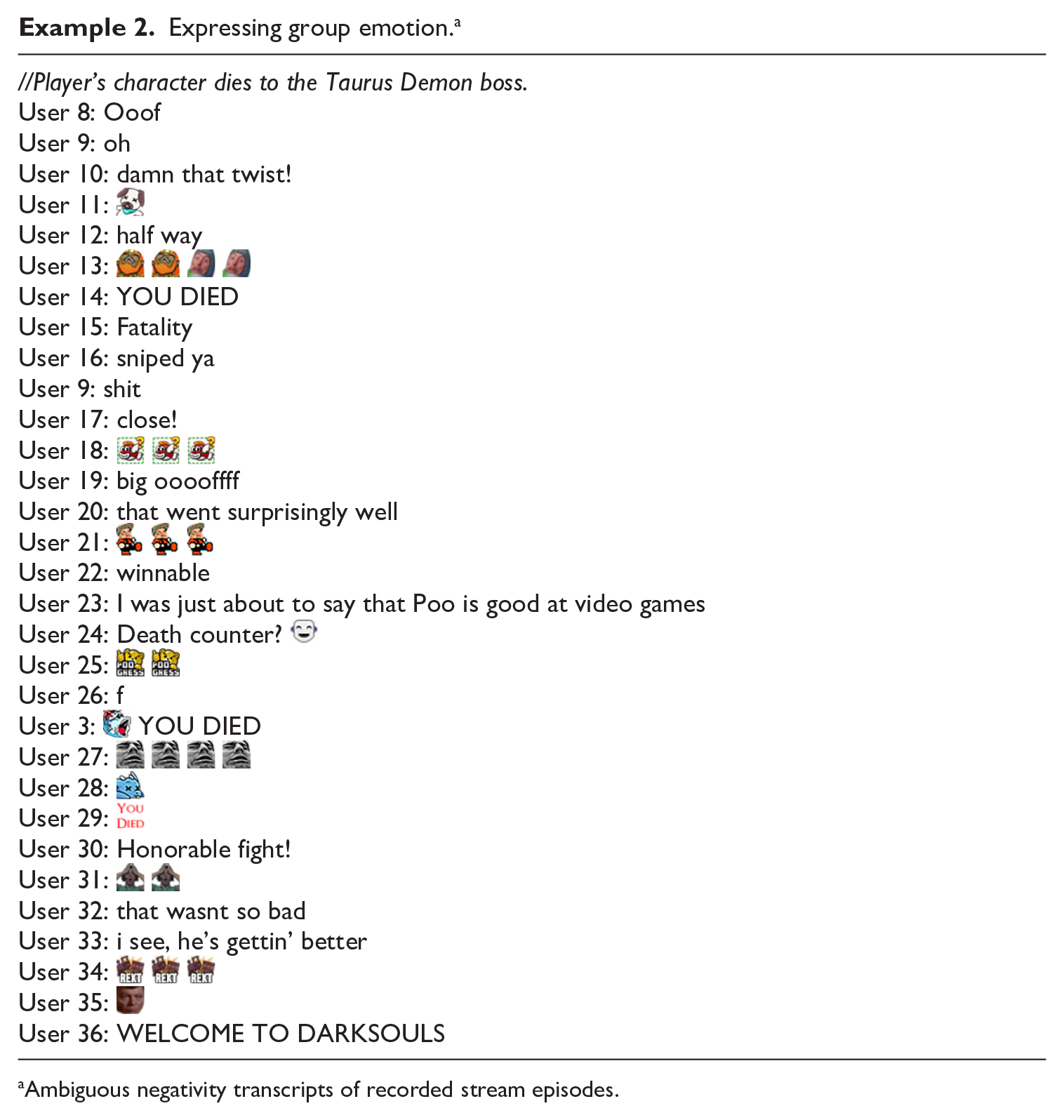
When multiple users sent the same or similar messages and emotes related to an on-stream event, the example was tagged as cheer/group emotion. A lot of these instances were supportive, just one was called out as negative. Example 2 features an expression of group emotion. This happened during a first-time playthrough. The streamer died attempting to defeat a boss in Dark Souls and the chat reacted. It was mostly an expression of group emotion with emote spam wherein users were reacting to the death of the streamer’s character. Interpreted in this context, the “YOU DIED” messages are not aggressively negative; they are a reference to the way Dark Souls indicates death, with huge red letters on the screen. The “oof” messages respond to the streamer, who reacted with a verbal “oof.” These comments are supportive with banter elements and not aggressive negativity.
Expressing group emotion. a
Ambiguous negativity transcripts of recorded stream episodes.
Overall, spamming and cheering were more normative than anti-normative. There was only one channel where rules prohibit spamming, and even that channel was not spam-free. Except for that rule, there weren’t injunctive norms explicitly prohibiting or requiring it. Based on the descriptive norms of what was practiced, these behaviors seemed common and acceptable, with emotes being the most frequent expression. Whether through singular emotes or emote spam, it was normative to react to on-stream events with appropriate emotes. Contrary to conceptualizations of spam as an unwanted behavior that should be discouraged (Seering et al., 2017), spamming was overwhelmingly non-hostile and not aggressively negative. Seering et al. (2017) suggested spamming could be positive or encouraged on some Twitch.tv channel communities, a claim reaffirmed by the positive and normative expressions of spam in Examples 1 and 2.
Cursing, profanity, and exclusionary language
Examples featuring curse words or themes associated with profanity, by the streamer or chat participants, were tagged as cursing/profanity. This category was the most common type of ambiguous negativity (see Table 1). None of these instances were called out, which suggests the lack of injunctive norms against cursing. Only one rule set mentioned this, referring to “aggressive” swearing, which suggests other-directedness and hostility. This rule would not apply to the most common way curse words were used in chats. Its prevalence suggests that the descriptive norms accept or even favor cursing. Example 3 showcases the way cursing is often used positively: the streamer and audience thank User 1 for the gifted subscriptions using words, lots of hearts, surprised emotes, and “pog,” which is used to express excitement or surprise at (in-game) achievement. The majority of the examples with cursing expressed frustration at the game or certain in-game events, or used curse words positively (e.g. the phrase “fucking nice” from Example 3).
Expressive non-hostile cursing. a

Ambiguous negativity transcripts of recorded stream episodes.
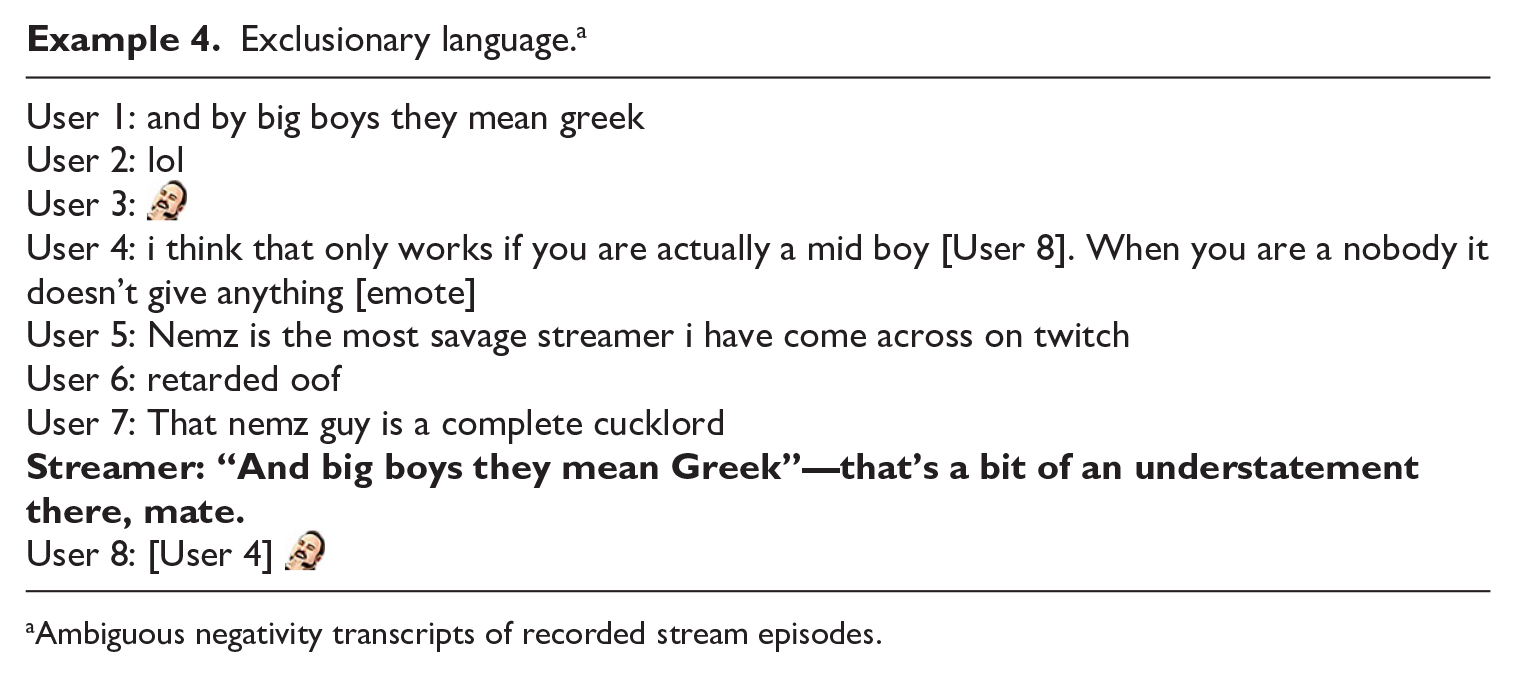
There are words and phrases that create a hostile environment regardless of the intent of the person using them. A separate subcategory called exclusionary language was created to encompass such derogatory language or curse words that create a hostile environment regardless of intent; instances of this category were considered aggressively negative. This included mocking accents, sexist comments, and derivatives of the word “cuck.” Example 4 features exclusionary language. The streamer and another content creator are referred to by abbreviations of their usernames. It is unclear where User 6’s remark is directed, so it might be directly hostile, or harmful in general. Based on what User 5 said in context, and based on the streamer’s lack of reaction, User 7’s remark might be banter accepted by the community, but is exclusionary nonetheless. Sarcastically or not, the word is used to imply weakness and is indicative of toxic masculinity.
Exclusionary language. a
Ambiguous negativity transcripts of recorded stream episodes.
Based on an examination of live chats, while there were no explicit injunctive norms against such behavior (i.e. no one called it out when it occurred), it was not descriptively frequent. However, five of nine posted rules prohibited exclusionary language. These norms seemed to differ across streams, as most of exclusionary language examples (including Example 4) came from just two recordings. Outside of these two recordings, this category (e.g. inappropriate jokes, other exclusionary messages) was infrequent.
Analysis layer 2: dialogic ambiguous negativity
This section focuses on dialogic ambiguous negativity that emerges in the way participants relate to each other and only becomes apparent with context. There was overlap between categories since many messages represented multiple categories at once.
Banter
Teasing or rough remarks that playfully make fun of others but are ultimately well-meaning were tagged as banter. It is often difficult or impossible from an outsider’s perspective to discern whether these remarks are intended or interpreted as negative or not. This strengthens the reasoning for having banter as a category for ambiguous negativity as it is easy to mistake for aggressive negativity. There were two instances of responses to banter that might represent calling out the behavior. In Example 5, the streamer is doing a speedrun and the users are critiquing his gameplay. It seems the commentary is related to his overall performance thus far. This was the start of the recording, so more context wasn’t available, but it appears the streamer’s performance was not ideal. Out of context, it might seem like User 1 and 2 are being mean to the streamer, but that is unlikely considering the streamer’s friendly response. He replies with humor and doesn’t mind the criticism. Critiquing isn’t out of place in speedrunning because speedrunners constantly try to optimize their performance, so it is possible for their mistakes to be commented on. It seems as if User 3 thinks that User 2 goes too far and calls them out. Without significant follow-up, the entire excerpt is more likely banter. The initial response seems like calling out, but just continues the banter, and everything is friendly and acceptable. Based on the light-heartedness and infrequency of these instances, there aren’t injunctive norms against banter. Banter is frequent enough to say that it is normative in terms of descriptive norms.
Banter and calling out. a
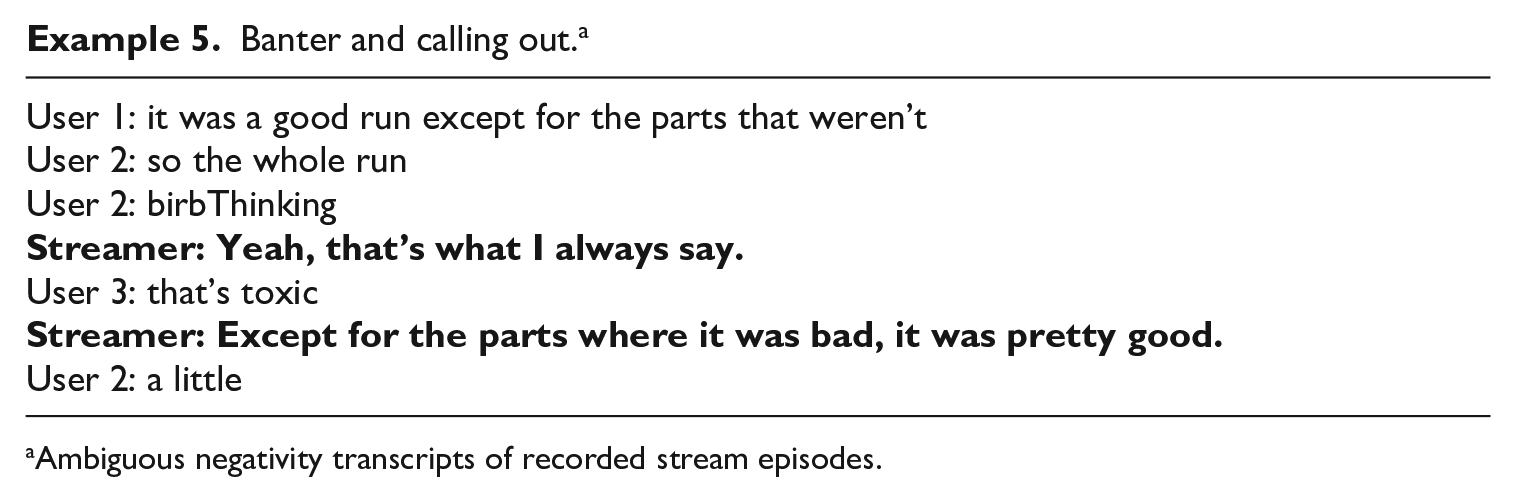
Ambiguous negativity transcripts of recorded stream episodes.
Irony and sarcasm
Messages that feature irony in either lighthearted or bitter remarks were tagged as irony/sarcasm. In Example 6, irony was used in a friendly way during a charity stream with commentators and huge viewership. The speedrunner has his own channel and is known by the community. In a donation segment read by the commentators, people are commenting on the speedrunner’s performance, saying “Git Gud.” This is a memorable phrase in any Dark Souls community. It is an alternate spelling of “get good” often used toward players who complain about the difficulty. In this case, the phrase is used in a humorous way; the speedrunner is already well known as skilled in the community. The commentators also use irony when talking about his current good performance: Covetous Demon is actually known as an easy boss. Both the donation message and the commentators’ comments use friendly irony that could be interpreted as aggressively negative without this context.
Irony, friendly. a
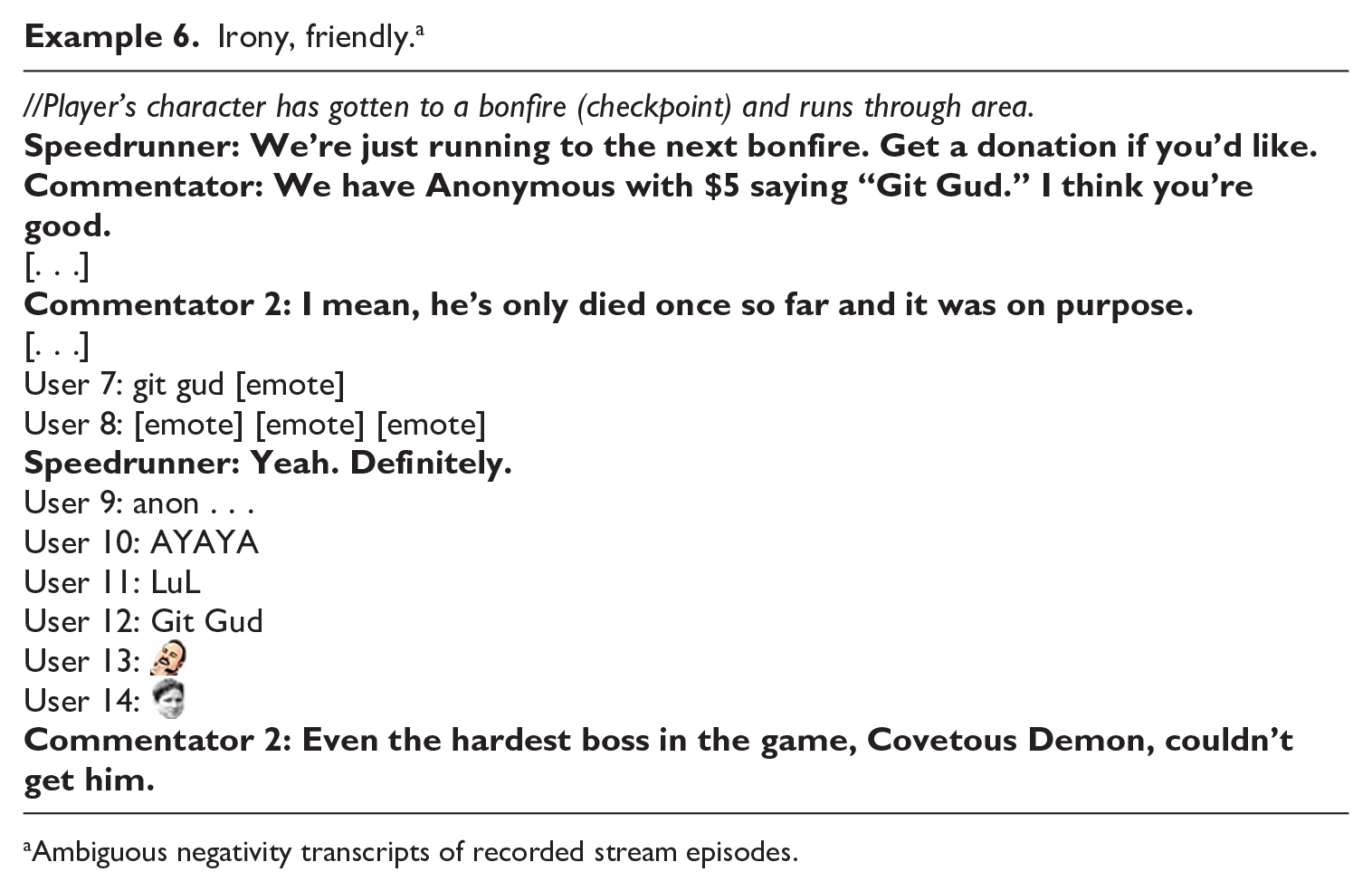
Ambiguous negativity transcripts of recorded stream episodes.
Irony was never called out, probably because the content, rather than the use of irony, makes something negative. There are no injunctive norms against the use of irony or sarcasm. The descriptive norms based on the prevalence of these instances suggest they are neutral behaviors, not discouraged but not very common.
Trolling
Messages or pranks intended to provoke or incite were tagged as trolling. Two of the instances resembled “copypasta,” a type of trolling I had encountered before as a Twitch.tv viewer. Copypasta are annoying and/or nonsensical segments of text that users sometimes spam in chats to troll; they seem more common in chats with a large volume of participants, as opposed to the more niche Dark Souls streams.
The low prevalence of trolling might be shaped by the lower chat participant numbers. In terms of descriptive norms, trolling is not frequent. In terms of injunctive norms, trolling was not called out. It is hard to draw a definitive conclusion from so few instances because the prevalence of references to related behaviors in channel rules suggests that the behavior is or has been problematic. Of the nine channels that had published rule sets, one had a general rule against trolling, one had a rule against copypasta in particular, and five had rules against unapproved or unsolicited links, which can also be used to troll. It is possible that the behavior is acceptable in some of the other channels that don’t feature such rules.
Analysis layer 3: the meta-discourse of ambiguous negativity
This section looked at what the users were talking about, where the ambiguous negativity was coming from, and where or at whom it was directed (including how that might be specific to Dark Souls-focused spaces). The analysis focused on the way users talked about other streamers on Twitch.tv, channel rules and norms, and issues of exclusionary talk.
Other content creators
It seemed that streamers and their audiences often knew each other. Streamers participated in the live chats and discussions of other streamers. In Example 7, Nemz is another streamer known by the community who is visiting the current live chat. Users have noticed his presence and are asking him about the then-upcoming game Sekiro: Shadows Die Twice, a title by the developers who created the Dark Souls series, rumored at the time to have similar gameplay features. His reply refers to the fact that some famous streamers are granted early access to games to create visibility and hype.
Visiting another streamer’s chat. a
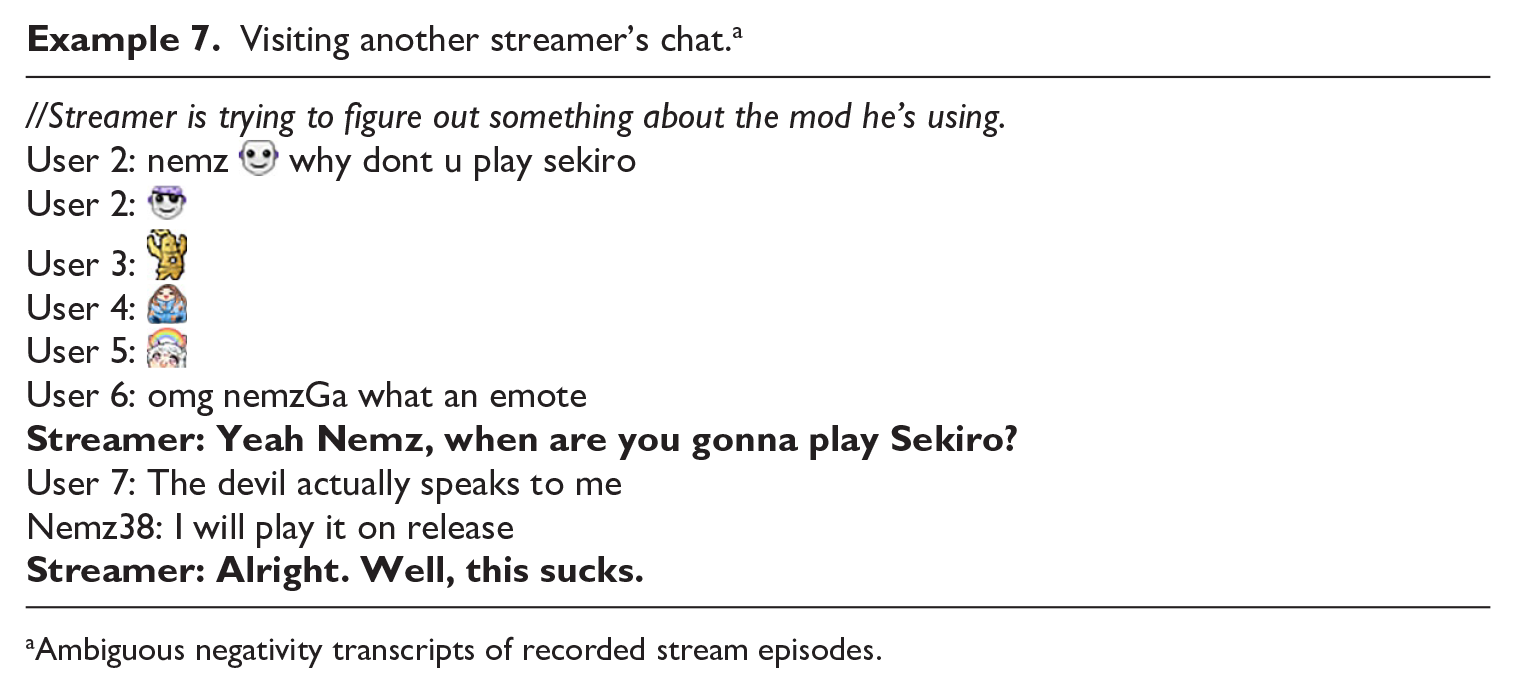
Ambiguous negativity transcripts of recorded stream episodes.
Chat visits and cross-references support the idea of the existence of a larger Dark Souls community on Twitch.tv in addition to the communities centered around specific streamers. With few exceptions that community is generally supportive. The niche nature Dark Souls might contribute to this by encouraging streamers (and their audiences) to be more aware of and supportive toward one another, rather than undermining each other. Streamers visit and raid other streamers’ chats, and it is likely that viewers know and watch multiple different streamers from the larger community.
Rules and norms
Rules and norms were rarely a topic of discussion in the recorded examples. When it comes to enforcing norms, very few examples featured someone getting called out or norms otherwise visibly policed. Example 8 comes from a first-time playthrough. User 3 and User 5 are reinforcing the rules of the stream. User 1’s question was called out because it might give the streamer hints or spoilers. The surprise they are referring to here are mimic and trap chests, a staple of the Dark Souls series, where objects look like treasure chests, but upon interaction turn into monsters or reveal concealed traps. The players are not aggressively negative when they hush User 1, they are just protecting the rules. User 6 offers to answer the question privately, showing a positive attitude.
Calling out, first-time playthrough. a

Ambiguous negativity transcripts of recorded stream episodes.
Published channel rules frame conversations and provide a basis for injunctive norms. Out of the 20 recorded channels, 9 had published rules, and all rules had some framing regarding general civility. Five of them had rules against exclusionary comments. Five had rules against posting unsolicited links, trying to avoid their use as a potential form of trolling. Three prohibited discussing divisive topics like politics or religion. Three had rules against spoilers and backseating, specifically to facilitate first-time playthroughs, contextualizing the example above. Other values were also articulated in individual rules, such as respecting the moderators and the streamer, and avoiding chat behaviors like excessive caps lock, copypasta, spam, or non-English languages. The mentions of caps lock, spam, and copypasta confirm that the first layer was correct in identifying them as categories.
Exclusionary talk
While they had low overall prevalence, the excerpts did show instances of problematic language that could contribute to a toxic environment and was considered aggressively negative. Some common problematic areas these streams shared with other gaming communities and online discourse as a whole include heterosexism, language of health and disability, and sexism (each appeared in 3% or fewer of the excerpts).
The presence of homosexual innuendo and heterosexism reflected the general gaming community’s reputation for exclusionary language (Meunier, 2012). Another behavior was language related to health and disability—for instance, using “cancer” as a descriptor for annoying challenges, or using “retarded” as an insult (Example 2). Though not directed at people with disabilities, using language this way is inherently mocking and dismissive of the conditions it is meant to describe. Inequitable references to gender and sexism appeared on the channels of male streamers when talking about in-game female characters, as well as on one female streamer’s channel, addressing her.
Based on the low prevalence of problematic language, there are no descriptive norms favoring it. The sample did not see anti-exclusion norms enforced injunctively. The streamers’ rule sets suggest injunctive norms against them exist.
Discussion
This study looked at one subset of Twitch.tv live chat communities and the way they have built norms for behavior in these spaces facilitated by the affordances of the platform. The qualitative analysis of the present investigation suggests the majority of the ambiguous negativity observed was not exclusionary or hostile—it did not constitute aggressive negativity. The remainder that was aggressive negativity (e.g. inappropriate jokes, other exclusionary messages) was not heavily represented. Instances of such negativity could be found in banter gone too far or exclusionary insults or language. The problematic issues of toxic masculinity, heterosexism, and sexism which appeared in these Dark Souls streams are shared with other gaming communities and online discourse as a whole.
The possible interpretations are twofold. On one side, negativity can be seen anywhere, and these communities are no exception: Taylor (2018) states, “harassment is a common problem in game live streaming, and affects both variety and esports streams in devastating, powerful ways” (p. 221). It is a Twitch.tv-wide issue and a broader issue in gaming (Fox and Tang, 2017). There did not appear to be something about Dark Souls streams that encourages it or makes it overly prevalent. Game-specific references and insider knowledge allowed participants to understand meanings that outsiders might miss out on, but that was not a source of aggressive negativity; in fact, when interpreted in context, those were usually less (rather than more) negative than they might appear. The problematic themes that came up on the third layer of analysis matched more closely with broader social issues, rather than game-specific ones, as can be seen in the examples of exclusionary language (see Example 4). Exclusionary language was often prohibited by streamers in their published rule sets and was descriptively rare (<3% of all excerpts). Streamers used their communicative affordances to discourage exclusionary language via the rule sets, and chat viewers rarely used such language toward others.
On the other side, despite explicit rules, it was extremely rare to see the behaviors called out when they occurred. One way to understand this is to consider Twitch.tv as an ephemeral medium, the streams are often not permanently recorded, and the text not stored. Thus, not responding immediately leaves the remarks unchallenged; there is no going back and revising or revisiting the fleeting interaction. When rules related to avoiding spoilers were broken during first-time playthroughs, users intervened, suggesting they cared about enforcing those rules. Though both are anti-normative, chat participants barely call others out for exclusionary language, and moderators rarely interfere. Even few instances of exclusionary language that go unchallenged could shape descriptive norms similarly to the way, consistently with the SIDE model, verbal aggressiveness in prior comments was associated with verbal aggressiveness in subsequent comments (Rösner and Krämer, 2016), or by showing people they could get away with it, despite being hurtful.
The way people act in these cases depends on how people feel they should respond to aggressive negativity, such as by ignoring negativity so as not to give violators the satisfaction, or by trying to shape their space by calling out people who behave inappropriately. Choosing which approach to take depends on the individual, as well as the way they perceive their own role within the community. Those perceptions can be shaped by group norms, but most channels had no explicit stance on this. The ones that did ranged from the passive “Please argue elsewhere” (Zazztrain, 2019) to the proactive “We hold each other accountable for this stuff” (AdamKoebel, 2019). These rules give community members different degrees of agency, implying how active they can be in shaping the community.
Although there is a general Dark Souls community on Twitch.tv, there are also differences between individual channels. The expectation that communities centered around different streamers would differ from each other was supported for both rule sets and observed behavior. There was an uneven distribution of ambiguous negativity among channels. This was visible for ambiguously negative behaviors that were not interpreted as clearly negative, such as spam, as well as for aggressive negativity, including the problematic behavior of using exclusionary language. The majority of the instances of exclusionary language came from just two recordings with five instances each, while the other 20 streams recorded had two or fewer instances, including seven that had none. In fact, all the aggressively negative cross-references between streamers came from a single streamer, whose sampled stream also had more exclusionary language than any other. The way streamers chose to shape their spaces through their communicative affordances that let them publish rules and talk to viewers also varied by channel. The rule sets had different priorities in terms of choosing what to include from among things like prohibiting unsolicited links, to banning divisive topics, to addressing things like self-promotion, or warning about the maturity of the conversations held. Some chats contained abundant emote spams, while one chose to prohibit them in the rules. All these findings are consistent with Seering et al.’s (2017) suggestion that chat norms vary by channel.
Ultimately, the streamer has a very significant impact on users’ experience of that community. Guarriello (2019) showed that streamers’ labor of building engagement features not only a personal brand and persona, but also trying to relate and respond to viewers in authentic ways. Their roles in shaping the interactions on their channel cannot be understated; distinct community norms were quite evident here. Tuning in to Otzdarva and the majority of other streamers might feel like entering a lighthearted but sincere conversation with a friend (see Example 1), while tuning in to some of the channels that were more prone to aggressive negativity feels like entering a space governed at the whims of a school bully—popular with his group, sarcastic, and volatile. Audience members choose not only the topic to tune into, but also the person to deliver it; Dark Souls streamers differentiate themselves with their personality and interaction style as much as with the type of content they stream. Thus, to say that aggressive negativity is uncommon and anti-normative is inaccurate: depending on the channel, hostility and exclusionary language might be virtually nonexistent, or they might be near-normative and prevalent. By articulating some rules and not others, streamers may decide what brands of ambiguous negativity or hostility to prohibit and which ones they can accept. This points to the crucial role that the audience can play in curbing aggressive negativity in gaming. This study showed that individual viewers’ role in responding to aggressive negativity might vary across communities and might not be clear even to viewers themselves, yet Seering et al.’s (2019) work on community moderation suggests that this role is an important one. While there is a push toward automated or commercially delegated moderation, particularly as communities grow larger, Seering et al. (2019) argue for the importance of community moderation to retain the “social nuances of moderation” (p. 1434) that it uniquely provides. Whether by volunteering as moderators or by being active and responsive participants, with their insider understanding of these social nuances, viewers are in a unique position to influence their communities positively in a way automated algorithms and commercial moderators cannot.
Limitations and future directions
This study has several limitations. The variability in the viewership was large and could have affected the way people behaved in ways that were not captured by the research questions and analysis. The majority of the recordings involved a single player format, which could have affected the types of negativity encountered, because competing could induce different responses when compared to challenging oneself. Each community will manifest ambiguous negativity differently, so other communities might feature categories that were not encountered in this study at all, while lacking other categories altogether. This is consistent with the context-dependency of ambiguous negativity. This study builds on prior research on negative online behaviors by incorporating existing inconsistently applied concepts (Hardaker, 2010) under the umbrella term of ambiguous negativity while acknowledging their variable valence and context-dependence (Cruz et al., 2018).
This method also offered advantages for identifying community norms and understanding ambiguous negativity. Prior research has asserted the importance and viability of bottom-up approaches to identifying and describing negative online behaviors (Cook et al., 2018, 2019). Background knowledge of a community and insider-informed transcription of contextual ambiguous negativity allows the researcher to zoom in on those behaviors they want to explore. The layered analysis gradually builds understanding of what matters to communities. This focused and tiered approach could be applicable to other contexts (e.g. different platforms) or communities (e.g. fans of other games or other media).
Supplemental Material
sj-pdf-1-nms-10.1177_1461444820978999 – Supplemental material for Navigating ambiguous negativity: A case study of Twitch.tv live chats
Supplemental material, sj-pdf-1-nms-10.1177_1461444820978999 for Navigating ambiguous negativity: A case study of Twitch.tv live chats by Teodora Mihailova in New Media & Society
Footnotes
Author’s note
This manuscript is part of the author’s MA thesis, and portions of the manuscript were presented at the National Communication Association Conference in 2019.
Funding
The author(s) received no financial support for the research, authorship, and/or publication of this article.

Supplemental material
Supplemental material for this article is available online.
Author biography
References
Supplementary Material
Please find the following supplemental material available below.
For Open Access articles published under a Creative Commons License, all supplemental material carries the same license as the article it is associated with.
For non-Open Access articles published, all supplemental material carries a non-exclusive license, and permission requests for re-use of supplemental material or any part of supplemental material shall be sent directly to the copyright owner as specified in the copyright notice associated with the article.
