



Abstract
Adolescents commonly make new social connections online that sometimes result in face-to-face meetings. Despite potential benefits, risk-focused discourse dominates public debates and shapes information shared by sources important for adolescents—news media, preventive programs, peers, parents, and teachers. Our study examines how information about face-to-face meetings from these sources relates to adolescents’ risk perception and engagement in such meetings. Using a sample of 707 Czech adolescents (aged 11–16 years, 46% male), we analyzed these effects for male and female adolescents to reflect the gendered nature of the risk-focused discourse. Male adolescents’ risk perception was not affected by information from any source. Female adolescents’ risk perception was negatively affected by information peers with prior experience with face-to-face meetings but not by other information sources. Female adolescents also perceived face-to-face meetings as riskier in general. We discuss gender differences and the limited impact of information sources on risk perception and provide practical recommendations.
Keywords
Interacting with people known only from the Internet and then meeting these people face-to-face are viewed as risky for adolescents (Holmes, 2009; Smahel et al., 2020). This perception is fueled by media representations of “online predators” and “online pedophiles,” which frame people from the Internet as dangerous (Dedkova, 2015; Marwick, 2008). Previous research mainly focused on examining the psychological, social, and Internet-use factors that influence adolescents’ likelihood to engage in face-to-face meetings with people they know from the Internet (e.g. Mýlek et al., 2020; Van den Heuvel et al., 2012). In this study, we consider the discourse surrounding this issue and provide an additional perspective centered on the adolescents’ perception of risk. We examine how getting information about face-to-face meetings with online acquaintances from different sources (i.e. news media, preventive programs, peers, parents, and teachers) influences the adolescents’ risk perception of face-to-face meetings and, in turn, their likelihood of engaging in this activity. Because the discourse is strongly gendered (e.g. Mascheroni et al., 2014), we examine these effects separately for male and female adolescents. Our approach yields valuable information about the sources that shape adolescents’ perceptions and behavior. These have important practical implications, especially for preventive efforts. Furthermore, the association between risk perception and engagement in face-to-face meetings has not yet been studied. Thus, our study enriches the current literature and deepens our understanding of adolescents who connect with new people on the Internet and then meet with them face-to-face.
Online socializing and its benefits
Interacting with unknown people on the Internet and meeting these online acquaintances face to face in offline settings are not uncommon among today’s adolescents. The EU Kids Online 2020 report, which focused on 19 European countries, shows that between 23% (Italy) and 57% (Norway) of youth aged 9–16 years reported having online communication with a previously unknown person. Between 5% (France) and 25% (Serbia) of them have also gone to a face-to-face meeting with somebody they knew only from the Internet (Smahel et al., 2020).
Online communication and social networking platforms provide adolescents with opportunities to creatively showcase and advance their psychosocial development (Livingstone and Helsper, 2008). The main opportunity of interacting with new people over the Internet comes from the possibility to form relationships with people outside adolescents’ social circle and location. Adolescents can benefit from these opportunities through cultivating interests not shared by their existing friends, discussing issues they are hesitant to talk about with their family or friends, finding romantic partners, and exploring their sexuality (Borca et al., 2015; Pascoe, 2011). Socializing online may be particularly beneficial for adolescents who struggle with socializing offline (e.g. because of social anxieties) (Livingstone and Helsper, 2007; McKenna et al., 2002) because online communication grants them greater control over their self-presentation and allows them to manage their privacy (Nesi et al., 2018). Taken together, interactions with new people from the Internet may help adolescents achieve the main developmental tasks in adolescence—forming identity, establishing new friendships, and developing intimacy and sexuality (Steinberg, 2008).
Risk-focused discourse
Despite these benefits, the potential risks of online socializing tend to be emphasized in public debates (boyd et al., 2009; Holmes, 2009). Such risk-focused discourse is rooted in the common fear that children and adolescents are likely to become targets of “online predators” or victims of “cyber-grooming” (i.e. the practice in which adults befriend children online and lure them to a face-to-face meeting to abuse them, often sexually; Madden et al., 2012; NSPCC, 2020; Pew Research Center, 2020). In the risk-focused discourse, “online predators” are commonly portrayed as older unattractive males who lie to adolescents about their identity and motives and manipulate or coerce adolescents to a face-to-face meeting (boyd et al., 2009). Despite sexual and physical abuse of youth being more frequently perpetrated by people known to the victims (e.g. Barajas and Smith, 2017; Wolfe, 2007), the discourse emphasizes a threat from “strangers” (i.e. people not known) and often disregards potential threats from people in the adolescent’s vicinity (Jewkes and Wykes, 2012). Although similar fears exist for “offline” pedophiles, online environments tend to raise more concerns (Williams and Hudson, 2013).
This risk-focused discourse seems to be at the intersection of several more general moral panics that fuel it (i.e. disproportionate public reactions to perceived threats to moral order; Cohen, 2002). The “stranger danger” panic presumes that contact with anyone unfamiliar is a potential threat and often portrays “strangers” as likely perpetrators of child sexual abuse (Jewkes and Wykes, 2012). Then, there is the “media panic” (i.e. moral panic concerning the usage of a new medium), which emphasizes the dangers of Internet use. It is strongly focused on children and adolescents as the early adopters of new media (Drotner, 1999; Haddon and Stald, 2009). Finally, the discourse is also linked to anxieties about sex and sexuality among adolescents, which tend to be magnified in news media (boyd, 2014; Chmielewski et al., 2017).
Some authors point out that specific pieces of media can trigger moral panics—for example., the TV show To Catch a Predator focused on “online predators” on MySpace (Marwick, 2008) or the TV program Catfish focused on the issue of fake identities in online dating (Mascheroni et al., 2014). A recent example is the Czech film Caught in the Net, which features adult actresses posing as 12-year-old girls and portrays their encounters with “online predators” (Klusák and Chalupová, 2020). The film was debated extensively in the news media (Anopress, 2020) and inspired a similar film in Germany (RTL, 2021). Undoubtedly, the moral panic surrounding youth’s online socializing is still present in the current media discourse.
Some concerns of the risk-focused discourse are understandable. The Internet makes people more available to contact, and online communication allows for better control over one’s anonymity and self-presentation (Nesi et al., 2018). Thus, the Internet provides the opportunity to contact adolescents and to misrepresent one’s identity more easily. Moreover, there are documented cases of youth victimized by people they had met online (Dedkova et al., 2014; Wolak et al., 2004).
However, concerns about online predators seem to be inaccurate and exaggerated. The portrayal of an “online predator” does not match empirical evidence. In most cases, the adolescents victimized by a person they first met online had accurate information about their identity and motives (Dedkova, 2015; Wolak et al., 2004). Furthermore, the offenders were usually not “strangers”; instead, the victims mostly knew them from offline contexts (Wolak and Finkelhor, 2013). Victimization by people from the Internet is also not particularly prevalent. Only a small percentage of prosecuted sexual offenses against minors include an online component (Wolak et al., 2009), and online grooming is much less common than abuse by someone known to the child offline (Livingstone and Smith, 2014). Current research also reveals that a vast majority of adolescents who met face-to-face with someone they knew from the Internet reported feeling happy after the meeting (between 52% in Slovakia and 86% in Romania), and only a small proportion felt fairly or very upset (less than 5% in all countries except 11% in France) (Smahel et al., 2020). The nature of such upsetting experiences varies from uncomfortable (e.g. awkward and boring) but normal situations in adolescent dating to situations where adolescents were seriously harmed or abused (Dedkova et al., 2014). Thus, the risk of victimization by online acquaintances should not be taken lightly. Nevertheless, the nature and scope of this risk are commonly misrepresented and exaggerated in the prevailing discourse.
Adolescents’ risk perception and engagement in face-to-face meetings
The risk-focused discourse affects how children and adolescents perceive and talk about interactions with people from the Internet. This is evidenced by qualitative data from nine European countries, which show that children’s and adolescents’ understanding of “online strangers” tends to reflect the stereotypes, language, and framing used in news, entertainment, and educational media (Mascheroni et al., 2014). We argue that this happens via institutional and social agents that are important for adolescents (i.e. different providers of information related to face-to-face meetings with people from the Internet). The risk-focused discourse influences how face-to-face meetings are perceived and described by the public (Haddon and Stald, 2009), including media producers, prevention professionals, and people in the adolescents’ vicinity (e.g. parents, peers, teachers), who, in turn, influence the adolescents’ perceptions. We specifically focus on two aspects of this effect: first, on the adolescents’ risk perception of face-to-face meetings with people from the Internet, and second, on the behavior—their engagement in these meetings.
Adolescents’ risk perception of a particular activity changes their willingness to engage in the activity. Research based on a cognitive approach to risk-taking behavior suggests that adolescents tend to weigh the perceived positive and negative consequences and their respective likelihood before engaging in potentially risky behavior. When the perceived negatives outweigh the positives, they do not engage in the behavior (Boyer and Byrnes, 2009; White et al., 2018). This perspective is supported by research in which children and adolescents who perceived online risks as more severe were less likely to participate in behaviors such as looking for intimate contacts online or sexting (Teimouri et al., 2018). Similarly, adolescents who perceived online sexual behavior as riskier were less likely to engage in it in the following 6 months (Baumgartner et al., 2010). This longitudinal study also provides evidence of causality. Risk perception predicted engagement in online sexual behavior, but the reverse effect (i.e. behavior predicting risk perception) was not detected (Baumgartner et al., 2010). Thus, we expect that different information sources will indirectly influence adolescents’ likelihood to engage in face-to-face meetings with people from the Internet.
Moderating role of gender
The discourse regarding face-to-face meetings with people from the Internet is strongly gendered, and it may impact male and female adolescents differently. Female adolescents are stereotypically viewed as more vulnerable and more likely to fall prey to “online predators,” who are typically portrayed as men (Mascheroni et al., 2014). This seems to be part of more general rhetoric because female adolescents are more likely to be portrayed as powerless victims in other online scenarios (e.g. sexting; Korkmazer et al., 2019). It also ties in with the anxieties over adolescent sexuality, primarily focused on female adolescents (boyd, 2014; Chmielewski et al., 2017). As the risk-focused discourse is directed primarily at female adolescents, male adolescents might perceive the potential risks as less relevant. Hence, we expect information sources to have a greater impact on female adolescents’ risk perception than male’s risk perception.
The effect of adolescents’ risk perception of engagement in face-to-face meetings may also depend on their gender. Harris and Miller (2000) point out that men and women are socialized to react differently to perceived danger. While men are expected to rely on their strength and be active in resolving dangerous situations, women are expected to be more passive and avoid dangers (Harris and Miller, 2000). This is supported by research suggesting that male adolescents participate in “risky online behaviors” (including face-to-face meetings with people from the Internet) more often than female adolescents largely because of their higher sensation seeking, that is., the tendency to do dangerous things for fun or to participate in activities even though they are dangerous (Notten and Nikken, 2016). Both male and female adolescents may participate in face-to-face meetings because they are seeking thrilling experiences. Yet, male adolescents may be more likely to engage in face-to-face meetings, even though they perceive them as risky. In other words, we expect the relationship between risk perception and engagement in face-to-face meetings to be weaker for male adolescents.
Information sources that influence risk perception and engagement in face-to-face meetings
In the following section, we argue that different information sources influence adolescents’ risk perception differently. First, we focus on two institutional sources—news media and preventive programs on Internet safety. Second, we discuss three social agents that are particularly important for adolescents—peers, parents, and teachers.
Institutional influences
News media play a crucial role in propagating the risk-focused discourse regarding adolescents’ interactions with people from the Internet. Accounts of adolescents getting harmed when they meet a person on the Internet tend to receive widespread attention and spark debates about adolescents’ online safety (Marwick, 2008). For adolescents, such news stories can be influential sources of information (Cernikova et al., 2018). This is further evidenced by adolescents’ tendency to reference specific cases portrayed in the news media when discussing face-to-face meetings and to provide personalized accounts of cases that received media attention (Mascheroni et al., 2014), suggesting that they internalize news media discourse. Thus, we expect adolescents who obtained information about face-to-face meetings from the news media to perceive such meetings as riskier, making them less likely to engage.
Educational and preventive programs focused on Internet safety are another important source of information. A review of several such programs shows that while they do not propagate the stereotypical depiction of online predators as older men preying on young children, they mostly fail to explain the relative rarity of online predators and commonly advise adolescents to never meet in person with someone they met online (Jones et al., 2014). Some also argue that because of the lack of quality research in this area, many programs may be based on panic-driven recommendations (Wurtele and Kenny, 2016). While this likely does not apply to all preventive programs, in general, they can make adolescents aware of the potential risks of meeting people from the Internet. Thus, preventive programs may increase adolescents’ risk perception of meeting a person from the Internet.
Social influences
Apart from more institutionalized sources, adolescents also gain information from advice, attitudes, and the experiences of people in their vicinity: their peers, parents, and teachers. The social influence of other people’s risk perceptions is evidenced by recent experimental studies. When confronted with other’s risk evaluations of a situation, children and adolescents were likely to change their own risk perceptions accordingly (Knoll et al.,2017, 2015).
Peers’ risk evaluations seem to have a particular impact on adolescents’ own risk perceptions (Knoll et al., 2015). There is a lack of quantitative evidence on how risky adolescents perceive face-to-face meetings to be. However, as already noted, the media portrayals of online predators shape youth’s discourses regarding this issue. Children and adolescents not only adopt rhetoric from the media, but they also commonly amplify and personalize it (Mascheroni et al., 2014). Therefore, we expect that hearing from their peers about face-to-face meetings with people known from the Internet will increase adolescents’ risk perception of this activity.
Peers with prior experience may, however, influence adolescents’ perceptions in the other direction. One explanation for the media’s effect on adolescents’ discourses is that adolescents often lack firsthand experience with these meetings and thus base their risk evaluation on external sources (Mascheroni et al., 2014). However, a significant portion of adolescents have experienced face-to-face meetings with people from the Internet, and most of them reported feeling happy afterward (Smahel et al., 2020). These adolescents will likely provide positive portrayals when discussing their experiences with peers, thus decreasing the perceived risk. Moreover, research on risky sexual online behavior demonstrates that adolescents who perceive such behavior as more common among their peers are more likely to participate in it themselves (Baumgartner et al., 2010). Taken together, adolescents who hear about face-to-face meetings from peers who had already participated in them might consider them as less risky. Therefore, they should also be more likely to engage in face-to-face meetings.
Parents and teachers. The risk-focused discourse regarding face-to-face meetings with people from the Internet also influences adults whom adolescents often encounter, such as their parents and teachers. In the European Union, 46% of parents reported being very worried, and 14% rather worried that their child may become a victim of cyber-grooming (European Commission, 2008). Similarly, 63% of American parents reported being concerned that their child might become a target of online predators (Pew Research Center, 2020). Furthermore, educational materials for parents often exaggerate Internet-related risks, especially those about “online strangers” (Wurtele and Kenny, 2016). Consequently, parents often posit rules or advice against talking or meeting people from the Internet as part of their parental mediation efforts (Livingstone and Helsper, 2008; Symons et al., 2020), especially in past years when parents tend to place more stress on children’s safety, both online and offline (boyd, 2014). To our knowledge, there is not much evidence on how teachers perceive meetings between adolescents and people from the Internet and whether these perceptions differ from those of parents. However, considering that teachers are exposed to the same media as parents, it is reasonable to expect the same effect. To some extent, this assumption is supported by a qualitative study of 21 Taiwanese high school teachers who perceived their students to be too young to handle such social interactions (Chou and Peng, 2007), which is consistent with seeing such interactions as risky. Thus, we propose that adolescents who receive information about face-to-face meetings from their parents (or adult relatives) or teachers perceive these meetings as riskier.
Current study
To our knowledge, neither the effect of public discourse on adolescents’ risk perception of face-to-face meetings with people known from the Internet nor the effect of risk perception of adolescents’ engagement in such meetings has been quantitatively studied before. Yet, this knowledge is crucial to understanding the mechanism through which the media representations of online risks can affect adolescents’ behavior.
Considering the prevalent media representations of this issue, we expect that adolescents who received information about face-to-face meetings from the news media, peers without prior experience, parents, teachers, and preventive programs will have a higher risk perception and thus a lower likelihood of engaging in such meetings. Furthermore, we expect adolescents who received information from peers who have firsthand experience with face-to-face meetings to have a lower risk perception and be more likely to engage in such meetings.
Furthermore, our study examines the moderating role of gender. Since the discourse surrounding this issue is strongly gendered, gender is a critical characteristic in determining the expected effect. Specifically, we expect information sources to impact female adolescents more strongly than male adolescents. Similarly, we expect the negative effect of risk perception on the likelihood to engage in a face-to-face meeting to be stronger for female adolescents because of the socialized gender differences in reactions to risks.
Previous research shows that adolescents’ age and the amount of time they spend online increase their likelihood of meeting somebody from the Internet (e.g. Mýlek et al., 2020). This is likely because older adolescents are more motivated to widen their social circle, and adolescents who spend more time online have more opportunities to meet new people (Mýlek et al., 2020). Therefore, we control for the effect of these variables.
Method
Sample
We used data from a survey of 1031 Czech adolescents (Mage = 14.08, SD = 1.44, 46% male) which covered a wide range of topics related to their ICT (information and communications technology) usage and other aspects of their online experience. The final analysis sample included 707 adolescents, aged 11–17 years (M = 14.23, SD = 1.36, 42.4% male), with valid responses on exogenous variables in the model. Most cases were excluded because they answered Don’t know (n = 217) or Prefer not to answer (n = 56) to the question regarding information sources. The remaining cases had missing values in other predictors. Compared to the adolescents who were included in the analysis, those excluded were younger (M = 13.74, SD = 1.55, t(520) = −4.84, p < .001, d = −0.34) and more often male (53.7% male, χ2(1, N = 1031) = 11.36, p = .001, φ = .11).
Data were collected from 32 schools (i.e. 72 classes) in the South Moravia region of the Czech Republic between April and June 2019. We randomly selected the schools from a list of 497 eligible schools while ensuring proportional representation of elementary, vocational, and grammar schools. We kept contacting schools until the project’s aim to collect data from 1000 respondents was met. Eighty-three schools declined participation primarily for pragmatic reasons (e.g. they only teach grades 1–5, lack of time). No school declined participation explicitly because of the survey’s subject matter.
Before data collection, we obtained signed informed consent from participants’ legal guardians and verbal consent from the participants. The questionnaire was filled out online in school in the presence of a research assistant. The project was approved by the institutional review board of our institution.
Measures
Out of the following measures, the question about engagement in face-to-face meetings was asked first to ensure that adolescents’ responses were not affected by measurement of risk perception. Items about risk perception and information sources were positioned further in the questionnaire. See Table 1 for descriptive statistics of continuous variables.
Continuous variables: descriptive statistics and independent t-tests (male vs female).

SD: standard deviation.
Face-to-face meetings with an unknown person from the Internet were assessed by a single Yes/No question from the EU Kids Online IV survey (i.e. In the past year, have you ever met anyone face-to-face that you first got to know on the Internet?). Only participants who had experienced online interaction with an unknown person from the Internet (i.e. Have you ever had contact on the Internet with someone you have not met face-to-face before?) were asked about face-to-face meetings. We distinguished between adolescents who have (“Yes” to both questions) and have not (“No” to either question) experienced a face-to-face meeting. In our sample, 27.7% of adolescents (6.5% missing values) reported such a meeting. There was no difference between female (28.0%) and male (27.3%) adolescents (χ2(1, N = 661) = 0.15, p = .704).
Risk perception of face-to-face meetings with people from the Internet was measured by three items: “Meeting with someone I know only from the Internet is dangerous” (RP1); “Nothing good can come from meeting someone from the Internet” (RP2); and “If my friend went to a meeting with someone from the Internet, I would be worried about them” (RP3). Participants responded on a four-point scale (1 = not true, 4 = very true). The scale exhibited adequate internal consistency (α = .74).
Information sources were assessed by asking participants to indicate from which sources they received information about face-to-face meetings with unknown people from the Internet. Participants provided a Yes/No response to six items: Peers, who themselves met face-to-face with someone from the Internet; Peers, who have never met someone from the Internet face to face; Parents or other adult relatives; Teachers at school; Educational or preventive programs, lectures, or videos; and News media (e.g. broadcast news, newspapers, documentaries). Most adolescents had received information from multiple sources (M = 2.91, SD = 1.55). Two or more sources were reported by 78.6%, one source by 15.8%, and no source by 5.5% of adolescents. The number of information sources did not differ by gender (t(610) = −1.06, p = .290). See Table 2 for relative frequencies.
Information sources about face-to-face meetings: relative frequencies and chi-square tests (male vs female).

FtF: face-to-face.
Time spent online was indicated by stating the time spent on the Internet during a regular weekday on a nine-point scale (1 = little or no time, 9 = about 7 hours or more).
Results
To test our expectations, we estimated a multigroup mediation model in Mplus v. 8.4, using the WLSMV estimator. We used gender as the grouping variable and risk perception as the mediator between information sources and experienced meetings. The model included eight predictors—six information sources and two controls (i.e. age, time spent online). We tested the direct effects of all of the predictors on risk perception (latent variable), their indirect effects on engagement in a face-to-face meeting, and the direct effect of risk perception on engagement in face-to-face meetings. We used FIML to handle missing values in endogenous variables.
The measurement model was just identified, so model fit could not be assessed using traditional fit indices. However, all indicators loaded on the risk perception factor with loadings above .4 for both genders (see Figure 1).
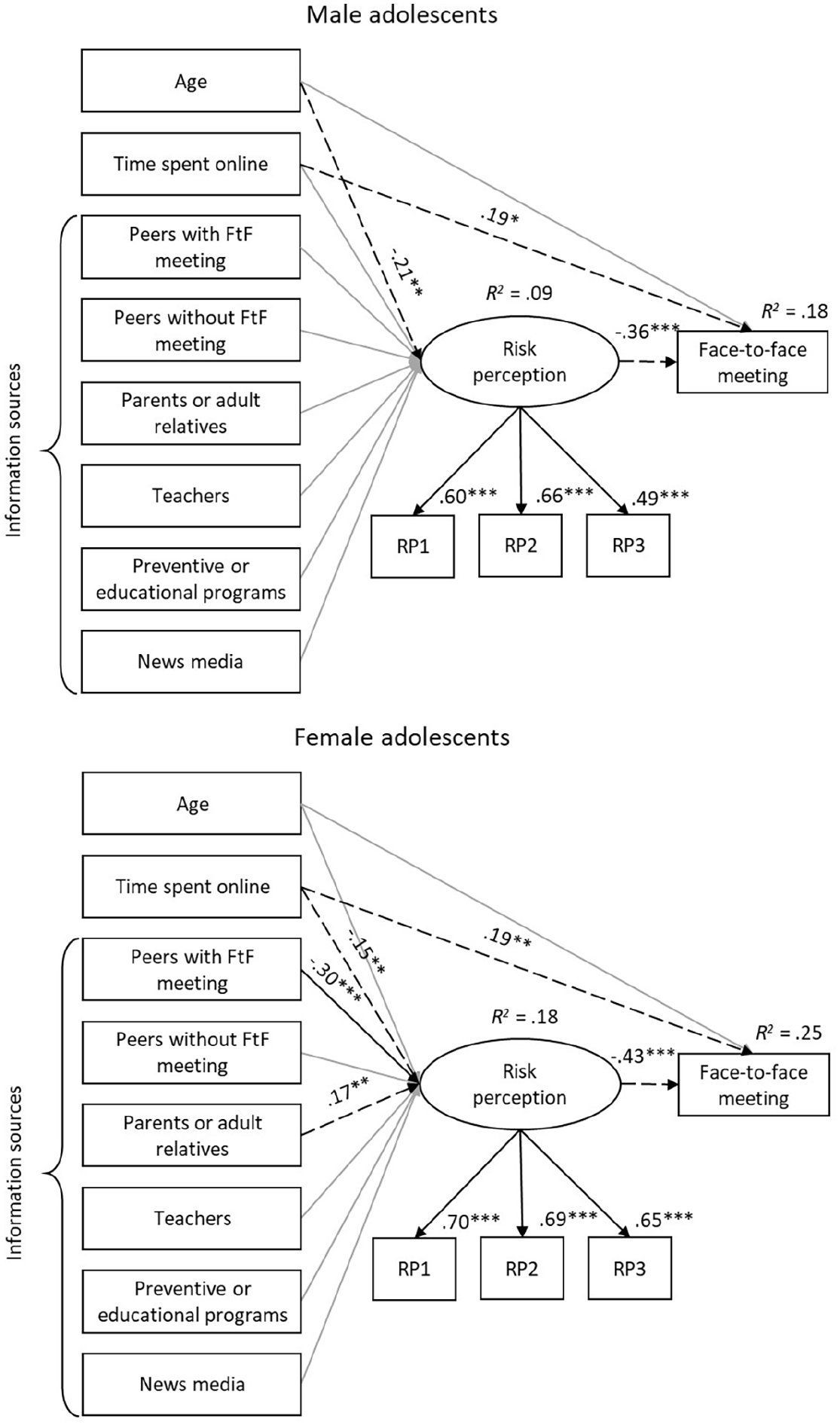
Structural models of changes in risk perception and the likelihood of engagement in face-to-face meetings for adolescent boys and girls (N = 707).
The structural model fit the data well (
We analyzed gender differences by testing the invariance of path coefficients across the two groups as described by Wang and Wang (2019). For every effect, we used the Wald test to assess the difference between an unconstrained model and a model where the effect was constrained to be equal across genders. See the results of these tests in Supplemental Appendix A.
Our results show two significant direct effects that applied to all adolescents, regardless of gender. For all adolescents, more time spent online increased their likelihood of engaging in a face-to-face meeting, and higher risk perception decreased this likelihood. Although the effect of risk perception might seem larger for female adolescents, the gender difference was not significant for risk perception (χ2 = 0.08, p = .778) or time spent online (χ2 = 0.01, p = .924). Contrary to our expectations, learning about face-to-face meetings from peers who have not experienced a face-to-face meeting, teachers, preventive programs, and news media did not significantly influence adolescents’ risk perception in either group.
We observed significant gender differences in one direct effect and one indirect effect (mediated by risk perception). First, learning about face-to-face meetings from peers who have experienced such a meeting decreased the risk perception for female adolescents but had no effect on male adolescents (χ2 = 5.57, p = .018). Second, receiving information from these peers also indirectly increased the likelihood of engaging in face-to-face meetings for female adolescents but had no indirect effect for male adolescents (χ2 = 5.23, p = .022). These results provide only limited support for our expectation that different information sources influence female adolescents more strongly than male adolescents.
We observed several mostly weaker effects that are complicated to interpret. For male adolescents, higher age directly decreased their risk perception and indirectly increased their likelihood of engaging in face-to-face meetings. For female adolescents, more time spent online decreased their risk perception and receiving information from parents increased their risk perception. Indirectly, more time spent online increased female adolescents’ likelihood of engaging in face-to-face meetings, and receiving information from parents decreased this likelihood. However, none of these effects was significantly different from the corresponding nonsignificant effect in the other gender group. Therefore, these effects are inconclusive, and we do not interpret them further.
Outside of the tested structural model, an independent t-test showed that female adolescents have a higher risk perception of face-to-face meetings than male adolescents (t(705) = −6.58, p < .001, d = −0.52).
Discussion
We conducted this study to understand better how receiving information from different sources impacts adolescents’ perceptions of how risky it is to meet in person with someone they know only from the Internet. We also examined how these perceptions relate to adolescents’ engagement in such meetings. There are two key findings of this research. First, contrary to our expectations, most sources of information about face-to-face meetings do not seem to have a pronounced impact on adolescents’ risk perception. Second, there are important gender differences. Female adolescents consider face-to-face meetings to be riskier than male adolescents, and their risk perceptions are more affected by peers who have prior experience with such meetings.
Several findings of our study apply to all adolescents, regardless of gender. Our results imply that receiving information about face-to-face meetings from information sources that are likely to propagate the risk focus discourse (i.e. news media, preventive programs, peers without prior experience with such meetings, parents, and teachers) does not influence how risky adolescents perceive these meetings to be. This goes against our expectations, which were based on the notion that risk-focused discourse about these social interactions propagates through the perceptions of institutional and social agents who influence adolescents’ risk perception (Knoll et al., 2015; Mascheroni et al., 2014). This is especially interesting regarding parents as they often use parental mediation strategies directly aimed at interactions online (Symons et al., 2020) although research results regarding engagement and effectiveness of parental mediation are inconsistent (see boyd and Hargittai, 2013; Eastin et al., 2006; Livingstone and Helsper, 2008). Our study may point to the limited effect this mediation strategy might have on children. A possible explanation is that these information sources rely on risk-focused and alarmist messaging (Haddon and Stald, 2009). Jones et al. (2014) contend that too broad or overly conservative messaging in preventive programs tends to be dismissed by adolescents as unrealistic or patronizing. This highlights one of the major negative consequences of moral panics—although the alarmist rhetoric may be driven by genuine concerns about youth’s safety, it may alienate adolescents and stifle a more nuanced discussion. Thus, to reach and engage adolescents, it is necessary to provide accurate and balanced discourse that focuses on the possible benefits and potential risks. A complementary explanation is that the media panic surrounding this issue is so prevalent that differentiating the independent effects of these sources becomes complicated. If all sources reproduce the same rhetoric, forming a “common knowledge,” the specific source becomes inconsequential. This may be true for this study’s cultural context, where moral panics regarding stranger danger, adolescents’ sexuality, and media panic are strongly present. It would be interesting to conduct a similar study in a different context, where, for instance, the media panic is less pronounced (e.g. in countries with less prevalent ICT use) or where this issue is portrayed with more balance.
In line with our expectations, the riskier adolescents perceive face-to-face meetings with people from the Internet to be, the less likely they are to engage in them. These results are consistent with the cognitive approach to adolescent risk-taking, which poses that adolescents consider the potential risks and benefits (Boyer and Byrnes, 2009; White et al., 2018). The pronounced effect of risk perception also demonstrates that it plays an essential role in explaining why some adolescents engage in face-to-face meetings while others do not. Yet, the effects of risk perceptions are scarcely studied in online risks (there are exceptions; for example., Baumgartner et al., 2010). We encourage scholars to use this perspective, especially when studying online behaviors that entail both opportunities and risks (e.g. sexting), and to focus on disentangling what other factors lead to perceiving interactions with new people online as more or less risky.
The negative effect of risk perception on engagement in face-to-face meetings did not differ between male and female adolescents. This goes against our expectation that women tend to avoid possibly risky situations because of gendered socialization (Harris and Miller, 2000) and warrants further examinations of gendered reactions to risks.
Gender differences
While male adolescents seem to be unaffected by learning about face-to-face meetings from any studied information source, the risk perception and behavior of female adolescents are influenced by one of them: peers who have prior experience with such meetings. In line with our expectations, these peers’ accounts make female adolescents perceive these meetings as less risky. Thus, hearing about peers’ experiences, which are mostly positive or neutral (Smahel et al., 2020), can counterbalance the impact of moral panics. Peers with prior experience also had the strongest effect on female adolescents’ risk perception. There are two possible explanations. First, adolescents with prior experience may be perceived as the most credible source of information precisely because they have had this firsthand experience. Second, as Knoll et al. (2017) suggested, when another person’s evaluation of risk subverts someone’s stereotypical expectations, it may have more of an impact on their risk perception. Considering the widespread risk-focused discourse surrounding face-to-face meetings, hearing about positive experiences from a trusted source may be unexpected for female adolescents and thus have more of an impact. This also explains the absence of a similar effect for male adolescents. As the risk-focused discourse is often targeted at female adolescents (Korkmazer et al., 2019; Mascheroni et al., 2014), peer accounts of positive or neutral experiences are likely not as unexpected for male adolescents, making such accounts less impactful.
Getting information from peers with prior experience also indirectly increases female adolescents’ chances of engaging in face-to-face meetings. This is in line with research that demonstrates that perceived peer involvement makes adolescents more likely to participate in risky online sexual behavior (Baumgartner et al., 2010). Similarly, the perceived norm regarding friend requests from people never met offline was the most important predictor for accepting such requests among adolescents (Heirman et al., 2016). However, peer norms may not be the only mechanism explaining this effect. Juxtaposed with the risk-focused discourse, peer accounts of face-to-face meetings (even those commonly viewed as harmful, for example, involving intimate contact with an adult) may seem like an exciting opportunity or alluring “forbidden fruit” to sensation-seeking adolescents.
In line with our expectations, female adolescents perceived face-to-face meetings as riskier than male adolescents. We based these expectations on the notion that the discourse surrounding this issue is often explicitly focused on females (Korkmazer et al., 2019; Mascheroni et al., 2014), and consequently, males may perceive this online risk as irrelevant. Looking from a different perspective, female adolescents may also face additional social risks when engaging in face-to-face meetings. In peer discourses, female adolescents who interact with new people online are often viewed as behaving provocatively or doing so for popularity and, thus, as partially responsible for the potential harmful outcomes (Mascheroni et al., 2014). This is a part of a more general narrative well documented in the sexting literature. Investigations of peer discourses, preventive programs, and news media consistently show that female adolescents are commonly portrayed as responsible for potential adverse outcomes of sexting because they chose to engage in it. Notably, the same responsibility is usually not placed on male adolescents (Draper, 2012; Karaian, 2014; Ringrose et al., 2013). Consequently, female adolescents might feel that if something bad happens during a face-to-face meeting, it would be harder for them to find support, and they would also risk tarnishing their reputation. To complicate the issue further, both in our sample and in many countries across Europe, a similar percentage of male and female adolescents went to a face-to-face meeting (Smahel et al., 2020). Female adolescents may see more benefits in this activity that balance out perceived risks. Therefore, we invite future investigation of the perceived benefits and gender differences in motivations for engaging in face-to-face meetings.
Crucially, the differences in risk perception do not seem to correspond to how face-to-face meetings usually play out for female and male adolescents. The gender differences in how adolescents felt after face-to-face meetings are small and inconsistent (Smahel et al., 2020). In other words, the empirical evidence suggests that gender alone is not a strong predictor of how a face-to-face meeting goes. Thus, while we do not advocate for increasing the risk perception of this activity, we believe relevant discourses should include messages targeted directly at male adolescents and put less responsibility on female adolescents. Scholars who employ feminist and intersectional perspectives argue that the tendency to responsibilize female adolescents connects to neoliberal and patriarchal conceptions of accountability and breed victim-blaming (Chmielewski et al., 2017). While a detailed discussion of these sociopolitical connections is beyond this study, they invite further research of cross-cultural differences.
Limitations and future research directions
The current study has several limitations. First, though we provide evidence and argumentation for what type of messaging we can expect adolescents to obtain from different information sources, we did not directly measure the content of the information received. More robust measurements of the messaging would be welcomed. Second, our study focuses solely on adolescents’ risk perception. Future studies should address the perceived benefits of this activity to better understand the overall role of adolescents’ perceptions. Third, participants excluded from the analysis sample were younger and disproportionately male. Consequently, younger adolescents and male adolescents were slightly underrepresented in our analysis sample, limiting the generalizability of the current findings. Most participants were excluded because they responded “Don’t know” to the question about information sources. It seems likely that they did not recall what the specific sources of information were. Finally, the cross-sectional design of our study does not allow for strong causal interpretations. Although we used theoretical argumentation to interpret our results, studies using longitudinal designs would help test causality.
Future research should examine adolescent’s motivations for engaging in face-to-face meetings, especially in relation to gender. More information on how adolescents create their risk perception would also be welcome. We suggest a qualitative investigation with adolescents of different ages. The role of other relevant concepts, for example, adolescents’ sensation seeking, views of privacy and privacy management, relationship with parents, or mediation strategies their parents employ, should also be examined.
Conclusion
To our knowledge, this study is the first to quantitatively examine the influence of risk perception on adolescents’ engagement in face-to-face meetings with people they know from the Internet. It demonstrates that risk perception is an essential factor that explains why some adolescents engage in this behavior while others do not. Notably, information from the news media, preventive programs, and social agents mostly does not affect adolescents’ risk perception, especially for male adolescents. We believe that this is because they often propagate risk-focused discourse, which is plagued with inaccuracies and exaggerations. Adolescents likely discount such messaging as not credible, patronizing, and repetitive. Since the discourse is concentrated on female adolescents and male adolescents are much less responsibilized by risk discourses in general, male adolescents may also deem the prevalent messaging irrelevant. The intense focus on female adolescents may also prompt unnecessary Internet-use restrictions, provide grounds for victim-blaming, and leave male adolescents unprepared for potential risks.
Our results should not be interpreted as evidence that all preventive efforts are futile. However, to reach adolescents and protect them from harm without stifling the opportunities the Internet provides for their social development, they should provide accurate information based on research evidence and adolescents’ accounts and discuss both the risks and benefits of online socializing.
Supplemental Material
sj-docx-1-nms-10.1177_14614448211014823 – Supplemental material for Information sources about face-to-face meetings with people from the Internet: Gendered influence on adolescents’ risk perception and behavior
Supplemental material, sj-docx-1-nms-10.1177_14614448211014823 for Information sources about face-to-face meetings with people from the Internet: Gendered influence on adolescents’ risk perception and behavior by Vojtěch Mýlek, Lenka Dedkova and David Smahel in New Media & Society
Footnotes
Funding
The author(s) disclosed receipt of the following financial support for the research, authorship, and/or publication of this article: This work has received funding from the Czech Science Foundation, project no. 19-27828X.

Supplemental material
Supplemental material for this article is available online.
Author biographies
References
Supplementary Material
Please find the following supplemental material available below.
For Open Access articles published under a Creative Commons License, all supplemental material carries the same license as the article it is associated with.
For non-Open Access articles published, all supplemental material carries a non-exclusive license, and permission requests for re-use of supplemental material or any part of supplemental material shall be sent directly to the copyright owner as specified in the copyright notice associated with the article.
