



Abstract
The last couple of years have seen an uptick of different technological forms presented as mediators of human/nonhuman interaction, and these developments have been accompanied by an increase in scholarly interest. Here, we engage with the human urge to enter into communicative exchanges that implicate “other” entities, but we also wonder what is at stake, analytically and ethically, in these mediated communicative acts. Following an approach informed by work in the environmental humanities as well as science and technology studies and media studies, we explore three sites of (ostensible) encounters between humans and nonhuman others—plants and animals—and argue that while certain technological mediations can facilitate human “noticing” by rendering nonhuman others sense-able, it does not follow that such interventions open up a space where participants can meaningfully respond to each other.
Keywords
Introduction
In 2010, toy manufacturer Mattel introduced a product called Puppy Tweets that consisted of three items: a dangling sensor with a microphone that attached to a dog collar, a USB receiver, and proprietary software that connected data generated by the product to Twitter. The ostensible point of Puppy Tweets was to reinforce the bond between dog owners and their dogs through text messages while they were apart or, in the words of the product copy, to “connect with your pet over the Internet” (Mattel, 2010). In so doing, Puppy Tweets situated the fantasy of technology bridging the communicative gap between species as its core conceit. Despite this promise, the subjectivity that it actually “offered” was nothing more than serial canned catch phrases. In other words, while Puppy Tweets customers were under no illusions that tweets from the product represented their dogs’ actual thoughts, the expectation was that tweets could act as a representation of specific actions that, over time, would provide further insight into the nature of their dogs’ lives. But, when it became clear that messages from the device were disconnected from specific sensor data, the point of the device was rendered moot in the eyes of those who bought it, and the product was discontinued 1 year after its release.
While Puppy Tweets was conceived and marketed as a toy, recent years have seen an uptick of other instances of different technological forms, from Tinder profiles (Dwyer, 2017) to Twitter-enabled feeders (Thornhill, 2012), also presented as mediators of human/nonhuman intimacies. Here, we focus on three cases of (ostensible) encounters between humans and nonhuman others—plants and animals—to explore how digitally mediated, short-form communication mutually implicates human and nonhuman entities in communicative exchange. Humans’ urges to enter into affective and communicative exchanges that implicate “other” entities are worthy of serious consideration, especially in a time of political and planetary peril. But we also wonder, what is at stake, analytically and ethically, in a communicative act such as emailing a tree? Given that “other” species introduce additional layers of complexity for communication—humans may wish to interact, but the interlocutors “themselves” are not on offer, as they are mediated by digital interfaces and “separated” by species boundaries—what are the meaningful elements of these communicative acts, epistemically and morally?
Following an approach informed by work in the environmental humanities as well as science and technology studies (STS) and media studies, we argue that while certain technological mediations can facilitate human “noticing” by rendering nonhuman others sense-able, it does not follow that such interventions open up a space where participants can meaningfully respond to each other, one where interlocutors are situated and open to unanticipated outcomes (Rose, 2000: 175). Put differently, whereas placing “natural” entities in a central role in communicative exchange is potentially a way to cultivate a basis for cross-species care, this placement can also facilitate humans’ proclivities to other, dominate, and control representation as a result of the limitations in mediated, trans-species translation, and the effects this type of technological mediation has on the perceived agency of other species.
Rendering others sense-able
How are mediating technologies implicated in humans’ ability to take note of and perhaps even enter into some sort of communicative exchange with “other” living entities? In the last few years, disciplines within the humanities and social sciences have increasingly paid attention to the different ways in which humans co-become with others; that is, the complex and varied forms through which living entities become in consequential relationship with others (Kirksey and Helmreich, 2010; Tsing, 2015; Tsing et al., 2017; Van Dooren, 2014). As Van Dooren et al. (2016) note, this line of inquiry—which usually coalesces around the idea of “multispecies entanglements” or “multispecies assemblages”—is premised on detailed practices of attentiveness that enable humans to note and meaningfully respond to nonhuman others. Grounded in the idea of a curious and entangled “passionate immersion” in the lives of nonhumans (Van Dooren et al., 2016: 5), the argument is as follows: in order to understand how different, nonhuman, lifeforms are implicated in the livelihood of humans, we must first actively and seriously notice them in their otherness. This becomes ever more urgent if we attempt to care for them as a response to the present profound planetary degradation marked by mass extinctions and large-scale destruction of ecological communities. Because “paying attention can and should be the basis for crafting better possibilities for shared life,” the authors argue for new modes of taking account of those enigmatic others who cannot be “represented or rendered knowable or sensible within any available mode of understanding” (Van Dooren et al., 2016: 16, 17).
Recent work in STS demonstrates that different forms of technological mediation can be construed as such a “mode of taking account,” particularly through the work of scholars who have paid close attention to the relations between scientists and novel technologies, as well as the representations of nature they co-produce, to provide nuanced accounts of these interactions. Stefan Helmreich (2007: 622), for example, has referred to the assemblage of a diving submarine and the scientists inside it as a cyborg, “a combination of the organic and technical kept in tune and on track through the self-correcting dynamics of visual, audio and tactile feedback.” Assessing changes in ocean sensing technologies that have replaced research aboard ships with programming undersea vehicles from remote labs, Jessica Lehman (2018) challenges common narratives that characterize remote sensing as “technologies of abstraction”; she suggests that they can open up a host of new meaning-making practices and sensing relations between scientists and the ocean. In these cases, it is easy to appreciate the mediating role of technology since the underwater realm is not one humans can inhabit unattended. In fact, this intense presence of technological mediation (in this case, via remotely operated vehicles or ROVs) has led Helmreich (2009) to suggest that marine scientists’ “remote sensing” should be reworded as intimate sensing given that, in the process of sensing the deep-sea through remote technology, they feel a direct body-to-body connection with the sensing technologies themselves and the ROVs work to alter their very sense of selves and identities.
The ocean’s inaccessibility makes clear the fundamental role that technology plays in making the sea sense-able which, together with human apprehension and guidance, creates new knowledge. But this is also the case for spaces more traditionally inhabited by humans: Mickey Vallee (2018) argues that, in using new autonomous recording devices to listen to bird sounds at a rate more complex that human audition can process, anthropocentric perspectives and modes of reasoning are diminished, and new spatialized intimacies between researcher and researched are opened up. Similarly, Jennifer Gabrys (2016) discusses the use of wireless sensor networks to study environmental phenomena and believes that such a practice gives way to the co-emergence of agencies with a generative capacity for worldmaking. Indeed, there occurs a “tuning” process whereby the scientists involved come to register not only new beings or becomings but also new matters of concern altogether.
These instances signal that technologies in the form of sensors on plants or seals, as well as email addresses—namely, those on which this article particularly focuses—could function as serious modes of taking account of those qualitatively different nonhuman forms of life with whom we are always already entangled. In this context, we are centrally concerned with how the implicated nonhuman selves (Kohn, 2013) and humans might enter into a technologically mediated communicative exchange. Phenomenologist Alfred Schütz (1951: 92) theorized that the prerequisite for all possible communication was a “mutual tuning-in relationship,” something that entails a “sharing of the other’s flux of experiences in inner time, [a] living through a vivid present in common.” Consequently, one of the questions animating this work is whether certain technological forms, through their translated output—in this case, text—can perform as “modes of taking account” that facilitate a communicative “tuning-in.”
Before moving forward, however, we need to raise a critique that appears, if briefly, in the same work that asks for new modes of attentiveness: what if those enigmatic others do not want to be represented or rendered knowable? (Van Dooren et al., 2016). Technological mediation can aid in establishing regimes of perception that can de-center humans and incorporate nonhumans in meaningful ways and, in so doing, it can inform how one might better respond to another—how one might better care for another. Yet these technological mediations are laden with values that complicate the nature of the nonhumans’ (re)presentation, while their very enfolding in these communicative acts holds the potential to reify hierarchical power relations. 1
Implicating mediatic others
The goal of this piece is not to reveal how city trees, Antarctic seals, or art world houseplants organize and communicate their experiences, but rather to plumb the implications of humans’ enrollments of these entities into communicative exchanges. At this juncture, it is useful to retrieve the work of scholars who have critically looked at such tangling of nonhuman others, particularly as we consider that rendering nonhuman others knowable and making sense of them through specific frames is not the sole purview of science but also what sits at the core of media practices.
Indeed, some have exposed the problematic ways in which nonhuman others—more commonly, animals—are captured and represented by media, particularly, though not exclusively, through photography and film (see Brower, 2011; Chris, 2006; Mills, 2017; Mitman, 2012; Molloy, 2011; Smail, 2016, among many others). This research has shown the systematic othering and silencing of the reality of nonhuman animals who are depicted within frames of power relationship that see them as symbols, entertainment, pets, pests, prey, food, danger, machines, or other according to human convenience (Cole and Stewart, 2014). It has also explained how “secretive” behavior, which refers to animals behaving in a manner suggestive of their not wanting to encounter other species (including humans), is normally interpreted as “a challenge to be overcome with the technologies of television” (Mills, 2010: 196), thus disavowing others species’ rights to privacy.
Like the zoo cages that worked to render the enclosed animals as marginal (Berger, 1972), the frames that the aforementioned authors explore (and that are utilized in popular or mainstream media representations) present nonhuman others as living objects to be looked at and are thus part of a narrative that ultimately casts them as resources for the reassertion of the supposed inevitability of the human as category (Mills, 2017). Certainly, critically unveiling how humans contend with nonhuman others through modes that exert power over them and their bodies is part of other literatures, particularly that of animal studies. For example, Shukin (2009) and Nibert (2017) have pointed out how animals are entangled with and oppressed by capital; Cudworth (2014) and Kim (2015) have explained how they are entangled in the constitution of race, gender, class, and other human differences; and Nelson (2018) showed how they are entangled in scientific practice. While we recognize that there is a broader context in which human–nonhuman relations operate, we share Molloy’s (2011: 13) assertion that discourses that abound in popular media are centrally instrumental in “sustaining a range of constructions of animals that are connected, appropriated or co-opted by other systems of production and so play a role in the normalization of particular practices and relations.” Thus, our focus here lies on the implications of the animal and plant imagery and narratives that are articulated in three cases that, although different in their nature and in the publics involved, could be construed as “popular” in their accessibility.
Yet, while we analyze trees, seals, and plants as part of the content transmitted through these “popular” digital interfaces, we also pay attention to those technological infrastructures as media in themselves. The concept of “media” has been significantly broadened recently from technologies and uses of mass communication to processes and places that entail faculties of transmission, recording, and connecting (Parikka, 2010), to agents in the production of space, knowledge, and power (Berland, 2009). Of particular importance here is Peters’ (2015) work, in which he turns to a more elemental understanding of media that sees it as something both natural and cultural, atop which lies the more common understanding of media as the means by which meaning is communicated. In so doing, he takes the idea of media further to include something other than humans and defines it as something other than vehicles that mark human meaning and intention—namely, as infrastructures of being and forms of life, the material habitat through which we are.
In this sense, Peters’ presentation of media as that which is in the middle, as that which crafts existence, brings us back to the point with which this article began and enables us to argue that those technologies that function as “modes of taking account” can be read as media that communicate being. If the modes in which we understand the world (Barad, 2007) and speak the world (Foucault, 1972) determine and delimit what is in the world, then the “mediums” through which we implicate others to render them sense-able to us mediate a communicative process of disclosure of being that requires a “tuning-in.”
As a cautionary note, we are not denying the “realness” or materiality of those nonhuman others we come to “notice” or with whom we enter into a communicative exchange; “[t]hey are first and foremost themselves, despite the many meanings we discover in them” (Cronon, 1996: 55). Rather, the ways in which we describe them and understand their presence are always entangled with our own values and assumptions. Thus, the mediatic technologies and digital platforms we focus on here constitute “yet another value-laden lens through which we encounter that deeply material yet equally intrinsically cultural realm” (Altrudi, 2020).
But, herein lies the tension. We must contend with the fact that, as “everywhere animals disappear” (Berger, 1972: 261) still, nonhuman others are likely to continue to become manifestable to people as media renditions. Moreover, we are likely going to engage with nonhuman others such as animals through popular representations that, for the most part, de-animalize them as they erase any trace of their materiality and physical habitat (Berland, 2019). In what follows, we turn to consider recent examples of humans enrolling “others” into communicative exchanges that, by relying on different technological mediations, claim to facilitate interspecies “connections.”
Interspecies communication
In this article, we conduct a close reading of multiple sites of interspecies communicative exchange, using textual descriptions of the sites we have collected from media and press accounts to sketch the contours of the mediatic assemblages. But we also use these texts as a jumping-off point for considering how these exchanges might implicate interlocutors, taking textual traces as invitations to affective and embodied experiences, and reflecting on the potentials of these communicative acts to cultivate response and even intersubjective tuning in and mutuality (Rose, 2000; Schütz, 1951). All descriptions of interfaces are accompanied by both available corpora of text and descriptions of the experiences and communicative exchanges humans could “expect” from nonhuman interlocutors. We interpret these texts both as pointers to idealized, even stylized, and sensationalized representations of “interspecies communication” as well as prompts for users and analysts to reflect on the possibilities for “communication” these interfaces afford.
After collecting several examples of short-form interspecies communication enabled by digital communication technologies, we selected the sites below because they offered distinct variants of the general phenomenon and thus created a useful range of situations. In the three instances that follow, very different nonhuman others are enrolled, from city trees and household plants to wild seals. At the same time, equally very different human audiences are entailed, from city residents and scientists to art museum visitors. Yet they all reveal humans’ desire to communicate with members of other species through short-form technological mediations.
“Dear 1037148, . . . I love you. Always and forever”
Melbourne, Australia, has more than 77,000 trees valued at around $800 million AUD, an impressive urban forest that is considered so critical in the maintenance of a healthy environment that the city actively manages its public tree population (“Tree management—City of Melbourne,” n.d.). Moreover, given the significant challenges that Melbourne is facing due to anthropogenic urban heating, the city developed an Urban Forest Strategy in 2012 to provide a strategic framework for the evolution and longevity of the city’s urban forest (“Urban Forest Strategy—City of Melbourne,” n.d.). Since one of the Strategy’s aims is to increase canopy cover from 22% to 40% by 2040, the city has a thoroughly planned tree-planting program and a plan to care for the current tree population, many of which are approaching the end of their “useful” life as a result of a combination of age, stress of extended drought, extreme heat, and water restrictions.
To extend their reach in a timely manner, the city assigned individual identification numbers and email addresses to each of its 77,000 trees so that residents could send emails to report trees that had been vandalized or were in a severe state of decline (Dunn, 2015). To implement this, the city council created “Urban Forest Visual,” an interactive urban forest map (accessible at http://melbourneurbanforestvisual.com.au/, see Figure 1) allowing users to locate the specific tree of interest and click to email it. While the email program and Urban Forest Visual tool have been available since 2013, intermittent news coverage continues to the present day (see Keady, 2015; LaFrance, 2015; Tan, 2015 and Travers, 2018). Extensive media interest in the project stems from the fact that, although implemented with the intention of making it easier for citizens to report issues with trees, residents (and others) began instead to email love letters and casually “chat” with trees. Reportedly, over 3000 emails from all around the world had been sent to individual trees by 2015, “all confessing their love for trees in Melbourne” (Dunn, 2015).

Screenshot of “Urban Forest Visual” online tool that Melbourne residents and others can use to locate and email trees.
Based on what has been made publicly available, the majority of the emails sent seem to treat the trees as ciphers for human concerns and meanings. For example, a user wrote, “Hi Tree, are you worried about being affected by the Greek debt crisis? Should Greece be allowed to stay in the European Union? Regards, Troy.” In other cases, the message is similarly marked by human concerns, but exhibits recognition of the condition of nonhuman other of the interlocutor, something that is also perceived as a barrier to true communication. User F wrote, Dear Green Leaf Elm, I hope you like living at St. Mary’s. Most of the time I like it too. I have exams coming up and I should be busy studying. You do not have exams because you are a tree. I don’t think that there is much more to talk about as we don’t have a lot in common, you being a tree and such. But I’m glad we’re in this together. Cheers, F.
Interestingly, “the tree” “replied” and tailored the answer to match its being a tree by wishing the user well in the exams and stating that “[r]esearch has shown that nature can influence the way people learn in a positive way.”
Likewise, another Melbourne resident wrote, “Chinese Elm 1030595 . . . (or can I call you Dale??), I am stuck inside and am so jealous of you soaking up the sun. You seem to be having a ball out there today. What did you get up to on the weekend?” To which “Dale” replied, “Dale . . . I like it. Sorry that you are stuck inside. I am really enjoying stretching my stomata and giving my chloroplasts a good workout. I spend the weekend well-hydrated and preparing for the summer ahead. You?” Finally, there are other emails that make references to previous encounters: “Dear 1028612, You are my favorite tree, even when you make me stoop over during my morning run when you grow too big. Love M.” Similarly, another resident wrote, “I used to think you were the Magic Faraway tree when I was a child. Now that I’m an adult, I still look forward to seeing you as I come around the bend after a tedious crawl down Hoddle Street. A loyal friend always waiting to say hello.”
This case of the corresponding Melbourne trees presents an interesting first site to think about “interspecies communication.” Above, we stated that a communicative act entailed a tuning-in, something that in turn presupposed a meaningful “noticing” of the interlocutor. Therefore, do the email addresses assigned to these trees constitute a mode of taking account of nonhuman others that permits a meaningful tuning-in? Equally, can those little green dots in the “Urban Forest Visual” be construed as infrastructures of being?
At face value, by lending them visibility in an easily accessible digital form, the email addresses and green-to-orange dots are enabling human users to notice these trees. Put differently, they seem to be crafting existence, “coding” life into entities that, although very much alive already in Melbourne, might have gone unnoticed not just to human residents of the city but to humans living elsewhere. This raised awareness becomes more significant when considering the original motive of this campaign—to promote practices of care. In this sense, letting communicative acts and attunement occur in a digital realm where the affection and emotion that these trees clearly elicit are valued could support the crafting of ethical responses and reform the treatment of nonhumans (something that ecofeminism has long argued for, see Adams and Donovan, 1996).
However, does this digitally mediated interaction include attentiveness to the trees in their otherness or otherwise promote a “tuning-in” that enables sharing the other’s flux of experiences? In its original proposition, the email addresses were supposed to communicate to other human beings the message that a particular tree needed immediate attention. If a Melbourne resident were to do this, then she has already noticed the tree; in fact, she has tuned into its present existence enough to notice that the tree in question needed to be cared for. Thus, while the emails and the visual renditions of these trees as modes of taking account might communicate existence, they do not “augment the human sensorium” (Van Dooren et al., 2016: 10) to meaningfully reconfigure our engagement with nonhuman others.
Likewise, as the text “exchanged” between parties evinces, the discourses implied in this site sit squarely within a representational tradition that tends to frame nonhuman others as something to be looked at or consumed as entertainment. In these text-based communications, the residents of Melbourne and others are making trees meaningful for other humans, and in so doing the entities become flexible symbols that can be made to appear as good listeners, tireless workers, beautiful friends, or wise elders. Furthermore, the fact that trees have “replied”—meaning that members of the Melbourne city team took the time to reply to a handful of emails as tree impersonators—renders the situation even more questionable, as the trees’ embodied uniqueness and difference is effaced, translating their being into a code of human communication in order to be enacted upon. In this process of imprinting sameness into the tree so that it can become noticeable, the “real” tree vanishes and we are left with the simulacrum of a tree-passing human that can only speak as a tree through the language of the human-made, natural sciences.
Although the repurposing of the deployed technological mediation caught the Urban Forest and Ecology Team by surprise, they continue to run the program because it is “a great engagement tool for the public and a way for people to connect to natural features in the landscape” (Travers, 2018). Yet in practice, this “tool” (re)situates the trees in a virtual space as green-to-orange dots in a reductive move that not only erases any corporeal trace of the entities rooted in place but also removes them from their physical Umwelt (von Uexküll, 2010). Therefore, while these trees might have awakened certain fascination or stirred emotions in people, they have, in effect, been rendered marginal as de-contextualized, playfully accessible, and interactive digital beings who appear in these visual and textual representations “with no space but the interface” (Berland, 2019: 130). In this context, the enrollment of the trees into these void communicative exchanges has arguably more dire or direct implications because these media infrastructures and renditions do more than just fail at opening space for a meaningful communicative exchange or curious immersing into another’s world. Instead, the advancement of this program as a tool for humans to “connect to natural features in the landscape” demonstrates once more that the material violence of rendering falls more heavily on the nonhumans’ lives (Shukin, 2009) as these email exchanges have not increased the pairs of eyes and hands caring for the still-aging trees in Melbourne.
“The Internet of seals”
The Marine Mammals Exploring the Oceans Pole to Pole (MEOP) project uses data “gathered” and transmitted by seals—two species, elephant and Weddell—to understand oceanic conditions, including water temperature and salinity levels. According to Smithsonian Magazine, the seals are not the “subjects” of study, but rather, research assistants (Patel, 2018). Outfitting seals with sensing technology and small radio transmitters atop their heads, scientists can gather information about conditions where the seals swim and dive. This project has been tracking data transmitted by seals since 2004, and the collected data are openly available on a database administered by an international team of researchers (MEOP, n.d.) (Figure 2). These data have been used in several published oceanographic research papers, and MEOP has also received much popular press. This case relates to the themes in this article by offering an opportunity to tease out how a sensing assemblage and a nonhuman interlocutor might differ.

World map showing distribution of vertical profiles of temperature and salinity collected by seals available in MEOP database (November 2017 version) (MEOP, n.d.). Courtesy MEOP, http://www.meop.net.
A 2015 article in The Guardian states, “Such research is only possible thanks to the combination of cheap sensors and ubiquitous connectivity which allows [biologists] to build low-cost sensors that can ‘tweet’ data from the heads of elephant seals, via satellites” (Kobie, 2015). Electronic tracking devices have been in use since the 1960s but recent technological changes, from miniaturized tags to an expanded surveillance and communication infrastructure, have enabled the acquisition of an unprecedented amount of detailed data about the movements of individual organisms, giving rise to the emerging field of “movement ecology” (Benson, 2012). The image of “tweeting” seals suggests that they are not invisible sources of data “tracked” by human scientists (Benson, 2012), but rather are implicated as expressive interlocutors. Write-ups of MEOP’s activities invariably include photographs of the “tweeting” seals, who are presented in undeniably charismatic ways (see Figure 3). The seals’ transmissions are not actually on the Twitter platform, but this description circulates regularly as a way to explain their transmissions.
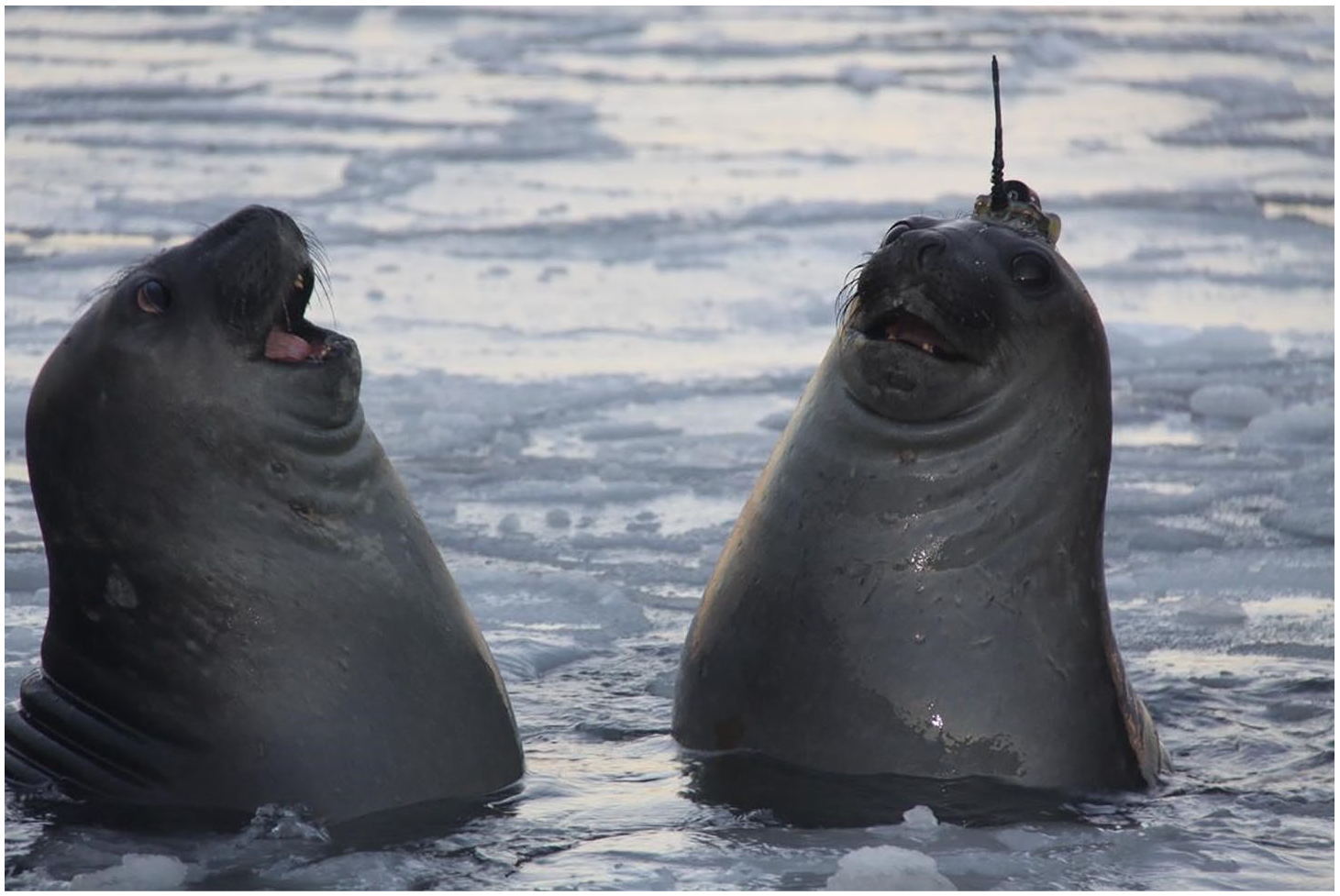
Two elephant seals, one with a sensor/transmitter. Courtesy Clive McMahon/MEOP, http://www.meop.net/meop-portal/pictures/clive-mcmahon/img_2558.html.
The seals are consistently represented as communicative collaborators. According to 2018 popular press, “[The seals’ diving] skills made them the perfect partners for collecting temperature data at the seafloor. Researchers had not collected any winter data in this region because the conditions are too harsh for humans” (Patel, 2018, emphasis added). Mike Fedak, a seal biologist with vast experience in animal tagging, added, “We could see that seals dive at these extreme depths and go these vast distances. These animals go where we can’t” (Patel, 2018, emphasis added). A vivid description of how seals come to “participate” in this research details how scientists approach and dart the animals, then affix antennae and sensing equipment to the sedated animals. The epoxied equipment stays on the seal’s head until its next molt, when it is shed along with the animal’s fur and skin. Although the process of tranquilizing the animal in order to affix its sensor is presented as filled with thrilling drama (Patel, 2018), news stories also emphasize that the present process is “safe [and] non-disruptive,” especially compared to fitting animals with radio collars (Kobie, 2015; see also Benson, 2010).
MEOP is especially public-facing, called upon to speak to matters of anthropogenic climate disruption (how warmer and cooler ocean waters circulate, for instance), international scientific collaboration, and open data. Seals are presented as not only “non-disrupted” but active (voluntary) collaborators and communicants, willing to go the extra mile to transmit information about conditions “where the humans can’t go.” The seals are not detected or sensed by electronic equipment, but rather transformed into (bio)sensors that also “communicate registers of animal-based environmental sensation and inhabitation” (Gabrys, 2016: 83). Photographic images of seals accompanying these stories rely on their expressive faces to convey communicative partnership with humans, and in the above photo, the appearance of inter- and intra-species sociality. This communicative exchange is portrayed as a non-invasive adjunct to seal experience that may even “help” the seals, as the sensors not only collect climate data, but information about the animals: how long they spend diving or at the surface, where they migrate to and so on. In the aforementioned The Guardian article, seal biologist Fedak explained, We can see what kind of water they are in when they get fat, for example, and where they are doing well and what kind of water masses they do well in . . . We’re actually trying to get information that will help us be better protectors of what the seals require from the ocean as well. (Kobie, 2015)
Thus, this interaction is framed as mutualistic, rather than extractive.
For the purposes of this analysis, a stream of data from environments that seals traverse (that humans do not) does provide something of the seals’ experiences. Without knowing seal subjectivity, we can note that this data stream is not a continuous subjective experience, as the sensor/transmitters are programmed to collect data only from 1500 m or deeper, and to degrade/diminish the frequency of data gathering and transmission over time in order to maximize device battery life (Kobie, 2015). We also do not know whether seals “think” in terms of depth, salinity, and temperature, though undoubtedly these factors have biological effects on them and on the other species to which their survival is tied.
If we take seriously that the seals’ transmissions originate in places where humans cannot go, we discern a hint of meaningful difference. The seals’ habitat is something like a medium itself (following Peters, 2015), and the seals’ movement generates input for sensor equipment. Their movement through their environment is turned into mediated sensing data: emergent sensory relations are articulated across humans, nonhumans (seals), environments (their aquatic habitat), and devices (transmitters, sensors, and satellite systems).
And yet, the Guardian article closes by asking, “who among us wouldn’t wear a silly hat to fight back against climate change?” (Kobie, 2015). This sounds an ambiguous note: the seals have been presented as active interlocutors, but in this telling, neither scientists, science journalists, nor the reading public is required to commit to a robust sense of seal subjectivity or agency. The seals’ communication is translated as a silly, degraded spectacle, whose contribution is secondary to that of the (active, knowledge-producing) scientists. If seals perform childlike charisma in clownish hats, do they elicit a meaningful “tuning-in” and response-able relation? We suggest that the seals, humans, oceanic environment, sensing data, and transmitting and receiving equipment combine to form an assemblage, with the attendant possibility for co-emergence of agencies. But the possibility for intimate exchange and co-emergent agency may be heightened by accepting that transmissions of sensory experience and subjectivity are not only remote but somewhat inaccessible. Perhaps ironically, the “tuning in” process here may generate more capacity if the assemblage preserves respect for otherness and inaccessibility.
“Giving voice to our silent everyday companions”
“Botanicalls” was originally developed in 2006 by Kate Hartman, Kati London, and Rebecca Bray at New York University’s Interactive Telecommunications Program (“About,” n.d.), with the stated goal of “[opening] a new channel of communication between plants and humans, in an effort to promote successful inter-species understanding.” To do so, the prototype took sensor data from plant soil and turned it into “given visual and aural clues using common human methods of communication” (“About,” n.d.). Although there are two versions of Botanicalls, Botanicalls Classic, where humans and plants could “exchange” phone calls, and Botanicalls, where the plants could “send” tweets, the overall project had three stated goals:
Keep the plants alive by translating the communication protocols of the plants (leaf habit, color of foliage, droop, etc.) to more common human communication protocols (email, voice phone calls, digital visualizations, etc.).
Enhance people’s connection to plants, and explore the ways plants help humans, how caring for a shared resource can create a sense of community, and how natural life is a valuable counterpoint to our technical environment.
Maintain a sense of humor at all times.
Botanicalls Classic attempted to achieve these goals through two types of one-way telephone calls. In the first case, a call was placed “from” the plant to a person, asking for “human help” in the form of watering the soil. This took place when moisture sensors in the soil sent data to an Arduino board which fell below a certain threshold of “dryness,” at which point the system would trigger a pre-recorded phone call requesting watering. If the plant was watered but the soil wasn’t moist enough, the system would trigger a follow-up call. After watering, the plant would call to “thank” its owner. The second case entailed a call from a person “to” the plant, where the person was given the option of learning about any of the 12 different plants that were part of the Botanicalls network. Each plant was “botanomorphized,” given a “voice” that matched its “personality.” For example, a spider plant was given a “friendly, bubbly, and generous” voice because it is fast-growing with easily replanted offshoots, while the Scotch Moss “has a fake accent and is a touch crazy” because it is neither of Scottish origin or a moss (“Classic Botanicalls: The Plants,” n.d.). The plants’ “accents” were important to the Botanicalls Classic team, because the project was “meant to educate people about the habits and needs of plants so that they might better understand how to care for them” (“Classic Botanicalls: The Plants,” n.d.; Figure 4).

Picture of the plants that were given voices according to personalities inspired by their biological characteristics.
The second iteration of Botanicalls replaced the telephone with Twitter and eliminated the “personalization” of the plants’ voices. Instead of phone calls from specific plants, Botanicalls evolved into a do-it-yourself (DIY) kit that could be used on any plant. Upon set-up, the plant would send a tweet that said “Please water me” when it was “thirsty,” and one that said “thanks” after it was watered. Botanicalls was acquired as part of the 2011 “Talk To Me” exhibit at the Museum of Modern Art (MoMA) in New York, and then as part of MoMA’s permanent collection later that same year.
Botanicalls is framed as “giving voice” to houseplants, who are positioned as “our silent everyday companions” (MoMA—Talk to Me—Botanicalls, n.d.). It attempts to foment interspecies communication by taking communication “signals” from the plants and “translating” them into human forms of communication. Here too, the technological intervention is working to render these plants sense-able. In fact, the sensors and phone calls in one instance, and the sensors and tweets on the other seem to be communicating more than just mere existence as they are also disclosing qualitative information about the plants’ hydrological needs in real time. But does this constitute or lead the way to a “passionate immersion” into the other’s world?
Because the sensors only measure soil moisture, that becomes the parameter that is used as the proxy for a plant’s needs. That information is then coded into words assembled in prerecorded audios or tweeted messages. While these translations may be effective in that they clearly transmit a message that might lead to a tangible caring practice, they also narrow our understanding of the plant as a qualitatively different entity that, in its distinct own way, was already “communicating” dehydration through drooping, discolored, or falling leaves. In Botanicalls’ first iteration, although the use of human-like voices may attribute some agency to these plants by transforming them into lively characters, this practice ultimately undermines the plants’ difference by reducing them to mere cartoonish personalities, and thus fails to elicit a greater sense of agency (Scott, 2009). In the second iteration, choosing to anchor the communicative exchange in written speech might be precluding “perceptive engagements built up through environmental inhabitations” (Gabrys, 2016: 90).
Finally, the understanding fomented here is mostly one way, from plant to human. Again, it could be argued that watering the plant is a meaningful response to a nonhuman other that springs from an active noticing of or “tuning-in” to that other enabled by those sensors and their translated, written outputs. But, while this could initially be considered a “successful” technologically mediated form of communication from human to plant, the form of communication from plant to human—the phone calls and tweets—are manufactured by other humans, even if humorously so (like in the case of the Melbourne trees). In both cases, the trees’ emails and the plants’ tweets enable a noticing that simultaneously relegates the physical, situated materiality and being of the emitting entities to a secondary stage; as the emails and tweets become the subjects, the trees and plants move over to become the direct objects.
Thus, while Botanicalls may certainly encourage humans to care more regularly for their plants, what the plants “receive” as communicative signals from humans is far from clear. Similarly, whereas this mediated plant/people intimacy could be construed as an event of “involution,” understood as an experimental encounter where different beings involve themselves in one another’s lives (Myers, 2017), the question remains of how reciprocal this capture is.
Conclusion
The sites explored in this article present opportunities for reflection on the entailments of short-form interspecies communication enabled by digital platforms. A recurring pattern that permeates these attempts at human–nonhuman communication is that they ultimately fail to foster a communicative act that goes beyond the disclosure of existence; that is, the digital interfaces employed here might be performing as “modes of taking account” that allow humans to register the presence of others, but this arguably perfunctory noticing does not guide attention to how the interlocutors become in consequential relationship with each other. Certainly, meeting the seals and plants on their own grounds, or facilitating intermittent moments of connection that account for multispecies entanglements in a way that centers difference between all the entities involved is not among these projects’ stated objectives. Yet while the technologies were not explicitly designed to facilitate sharing subjectivity across species, a lack of intent is meaningless if technologies are likely to reify certain power relationships. In each of these cases, and to varying degrees, there is an implicit notion that other living creatures should make themselves available to humans and perform according to human standards.
As mentioned, our goal here is not to reveal how city trees, Antarctic seals, or art world houseplants organize and communicate their experiences, but rather to plumb the implications of humans’ enrollments of these entities into communicative exchanges. Put differently, it focuses on the human subjects’ mediated experiences with environments and nonhumans. In this sense, these sites reveal humans’ desire to communicate with members of other species, though it is unclear what the outcome of these exchanges is. To be sure, finding a tree on a map and “connecting” to it via email might motivate a human user to search for that tree and visit it “in real life.” Similarly, becoming better protectors of the seals based on information their sensors collect, or watering a plant after getting a tweet, can signal a meaningful attunement to the fact that all the entities involved “share one another’s flux of experiences in inner time” (Schütz, 1951: 92).
And yet such short-form, text-based exchanges can easily privilege the roles of humans as knowers and actors. Crucially, these representations of communication also guide expectations about communication, and implicitly, artifact design. In the three instances discussed here, different nonhuman others are unilaterally enrolled into human-created, technology-enabled situations that fail to make space for trees, seals, and plants to perceive back. Although seemingly expanding our perception of nonhuman others by disclosing existence, the technologies employed here virtually transpose these entities into a digital space dislodged from their own physical medium. In so doing, the specific practices that these cases encourage do not especially lend themselves to the establishment of regimes of perception that substantially include nonhumans, but rather work to reify a hierarchical relation of humans as subjects and nonhumans as objects to be consumed as some form of resource. In this sense, then, they could be argued to be sophisticated forms of representation masquerading as communication; that is, human forms of representation that draw on these plants and animals to enact narratives of empathy and morality within frames of power relations that continue to place them as resources for human consumption.
It is not our intention to dismiss digital technologies’ potential to mediate a communicative act where the human and nonhuman interlocutors are equally implicated, especially because such interaction may be a step toward forging forms of care and solidarity that respect and respond to difference (Arvin et al., 2013). On one hand, we have seen that, by thinking of them as that which is in the middle, technological mediations can perform as modes of taking account that facilitate a “passionate immersion” into the other’s world or give way to entirely new, more complex sensing networks. On the other hand, these interfaces are implicated in attributions of interactivity and communication that belie fundamental (if not binary) differences between human and nonhuman entities. 2 Considering that it is not possible to directly, physically experience or engage with all nonhuman others (not that this should be a prerequisite to create a more sustainable world), human ways of life will continue to be largely populated with digital renditions. But we must bring to the fore the fact that these are standing in for—that is, representing—real, yet quickly vanishing, entities. Therefore, we cannot afford to not continue to interrogate “how we habitually think about media, technology, and the conjoining and differences of animal and nonorganic life” (Parikka, 2010: xiv).
In this vein, we situate this work as a contribution that does precisely that, and that extends an invitation to continue to demand more from popular, digital renditions of nonhuman others. Ethical “dialogue” with others must allow for some form of exchange, where an outcome is not foreordained; mere representation must not stand in for interrelation. Even if digital spaces where nonhuman others can perceive back (to engage or ignore us, on equal footing) are still hard to fathom, we can nonetheless strive for platforms or similar mediated forms that offer an appreciation of others not as things to be merely looked at, but as agentic, qualitatively different entities with whom we are already entangled in complex relations that exceed dyadic and hierarchical dynamics.
Footnotes
Acknowledgements
This project has received funding from the European Union’s Horizon 2020 research and innovation programme under the Marie Skłodowska-Curie grant agreement No 801215 and the University of Edinburgh Data-Driven Innovation programme, part of the Edinburgh and South East Scotland City Region Deal.
Funding
The author(s) disclosed receipt of the following financial support for the research, authorship, and/or publication of this article: was supported by funding from the European Union’s Horizon 2020 research and innovation programme under the Marie Skłodowska-Curie COFUND grant agreement TRAIN@Ed: ‘Transnational Research And Innovation Network At Edinburgh’ (Project 3618771) and the Edinburgh and South East Scotland City Region Deal Data-Driven Innovation Initiative.
