



Abstract
Building on prior studies suggesting that social media can facilitate offline political participation, this study seeks to clarify the mechanism behind this link. Social media may encourage social learning of political engagement due to their unique affordances such as visibility (i.e. once-invisible political activities by others are now visible on social media feeds). By analyzing a two-wave survey conducted before the 2016 presidential election in the United States, this study tests a theoretical model in which observation of others’ political activities on social media inspires users themselves to model similar political behaviors, which foster offline political participation. Autoregressive models show that the link between political observation and activities on social media is stronger among users surrounded with similar others and politically homogeneous networks. The results highlight the need to cultivate engaged citizenship norms for individuals’ political activities on social media to be carried over to participation beyond the realm of social media.
Social media are deeply ingrained in many people’s lives. More than three-quarters of Americans are on social media, and the majority of them check platforms such as Facebook, Instagram, and Snapchat on a daily basis (Perrin and Anderson, 2018). This widespread adoption of social media holds important implications for how citizens consume news and political information, and engage in politics. On social media, not only can people be incidentally exposed to political news from diverse perspectives (Heiss and Matthes, 2019; Park and Kaye, 2020; Weeks et al., 2017), but can also engage in politics in new ways, primarily by expressing themselves (Bond et al., 2012; Kwak et al., 2018). Scholars have examined whether social media could open up opportunities for their users to participate in politics beyond the realm of social media. Meta-analyses of prior studies suggest that while social media can facilitate offline political participation, the mechanism behind this positive link can be further clarified (Boulianne, 2015, 2020; Skoric et al., 2016, see also Halpern et al., 2017).
This article examines the potential for social media to facilitate social learning of political engagement by applying the social media affordances approach to the political arena (Bandura, 1977, 2008; Davis and Chouinard, 2016; Evans et al., 2017; Treem et al., 2020; Treem and Leonardi, 2012). For example, due to social media’s visibility affordance, on social media feeds, individuals can now observe once-invisible political activities by other users such as expressing a political view, following a political candidate or RSVPing for a political event (Ellison and Vitak, 2015; Vitak et al., 2011). That is, social media users can learn ways in which to engage in political activities that are socially appropriate and technically possible from a larger pool of their social media networks, beyond their immediate, physical environments.
By analyzing a two-wave national survey conducted prior to the 2016 presidential election in the United States, the current study tests a theoretical model which predicts an indirect pathway from observation of other users’ political activities on social media to offline political participation through political activities on social media by users themselves. We further examine whether the link between political observation and activities on social media depends on network characteristics (i.e. network similarity and political homogeneity) in light of prior scholarship (Bandura, 2008; Kwak et al., 2018; Levitan and Visser, 2009). Also, we investigate whether this pathway to offline participation emerges only among individuals who have developed and reinforced certain citizenship norms possibly through observing other users’ political activities and engaging in political activities themselves on social media (boyd, 2014; Lee et al., 2013; see also McDevitt and Chaffee, 2002 for political socialization). Specifically, we focus on the concept of engaged citizenship norms which are related to citizens’ political autonomy and the idea that good citizens should be informed about and take part in politics (Dalton, 2008); once developed, these norms should guide people’s political behaviors across social media and offline contexts. In doing so, we provide a more holistic theoretical picture of how social media can facilitate offline political participation.
Literature review
Social media affordances and social learning of political activities
The current study first tests the possibility that social media can facilitate social learning beyond people’s immediate, physical environments. Social learning theory suggests that people can learn by observing other people’s behaviors, and that human learning is not confined to the direct experience of people’s own actions and consequences (Bandura, 1977, 2008). 1 People are not born with extensive knowledge and skills. Rather, people use vicarious capability—the ability to learn from their environment—and engage in social learning to expand their knowledge and skills (Bandura, 2008). While previously, people could only engage in social learning within their immediate environments (e.g. family members or close friends), the popularity of mass media has expanded the boundaries of social learning beyond people’s immediate environments (Bandura, 2008).
This article examines the potential for social media, like mass media, to allow social learning of political engagement by considering the social media affordances approach in the political arena. Coined by Gibson (1977), affordances have emerged as a keyword and useful analytic tool in a range of fields involving communication technology (Davis and Chouinard, 2016; Evans et al., 2017). Affordance was defined as the “multifaceted relational structure … between the technology artifact and the actor” (Faraj and Azad, 2012: 254). Building upon this perspective, Evans et al. (2017) defined affordances as the “multifaceted relational structure between an object/technology and the user that enables or constrains potential behavioral outcomes in a particular context” (p. 36). In conceptualizing affordances, the dynamic relationship between the technology and the user is essential, as the particular materiality of the technology and the user’s subjective assessment, abilities, practices, and so on facilitate or restrain possible outcomes (Davis and Chouinard, 2016; Evans et al., 2017; Faraj and Azad, 2012; Hutchby, 2001). Rather than a technologically deterministic approach to understanding the outcomes of technology use, the affordances approach acknowledges the ways in which technology can request, demand, allow, encourage, or refuse the user from taking certain actions under different circumstances and contexts (Davis and Chouinard, 2016). Simply put, affordances are the “possibilities for action” when a user interacts with a technology (Evans et al., 2017: 36; see also Treem et al., 2020). Although there is some lack of definitional clarity around the term (Nagy and Neff, 2015), affordances can still be a useful analytic tool, providing a holistic perspective toward individual users and technology. This is because affordances consider not only “what individuals can do with” a technology but also what a technology allows users to do with it (Treem et al., 2020: 48). Treem and Leonardi (2012) identify four important affordances of social media—visibility, persistence, editability, and association—in the context of organizational communication, and suggested that within organizations, social media enable social learning to take place, resulting in better performance. In this section, we review these four social media affordances as they relate to the social learning possibilities of political engagement.
First, visibility affords social media users to make their once-invisible behaviors, knowledge, preferences, and network visible to other users including immediate audiences as well as third-party actors (Treem et al., 2020; Treem and Leonardi, 2012). Visibility also allows users to easily locate previously invisible pieces of information (Ellison and Vitak, 2015). For example, on social media, political preferences can be made readily visible on profiles, and various forms of political engagement (e.g. support for a political candidate or group, views on political issues, participation in political events, voting) are visible through photos or status updates consisting of text and/or hyperlinks (Halpern et al., 2017). Before the advent of social media, it was more difficult for people to observe and socially learn how others engage in politics, except for those in their immediate environments such as their family or close friends. On social media, users can conveniently see other users’ political activities through tools such as Facebook’s News Feed and Twitter’s timeline. Importantly, individuals in one’s social media network are likely quite large and diverse, as social media allow users to maintain large networks including those that might have gone dormant otherwise and distant friends from different parts and times of their lives (Hampton et al., 2012).
For instance, Burke et al. (2009) demonstrated Facebook newcomers’ social learning of photo sharing from their Friends, using server-level data. They have argued that the four sub-functions of social learning, including attention, retention, reproduction, and possibly motivational processes, are enabled on Facebook, particularly on the News Feed where Friends’ activities on Facebook are aggregated and displayed. This feed allows users to attend to [attention] and remember Friends’ activities [retention], and possibly perform the same photo-sharing activities [reproduction]. Note that motivational processes and accompanied rewards/punishment were not taken into analysis in this study although we suspect that visible reward metrics in social media environments (such as “likes” or “hearts”) make the reward/punishment function more salient for viewers. According to Burke et al. (2009), an increase in visible Friend photo activity predicted more contribution from newcomers. Perhaps the visibility of Friends’ activities afforded by social media allowed newcomers to socially learn what activities were technically possible as well as socially acceptable on Facebook, and led newcomers to engage in more photo-sharing themselves. A few prior studies on lurkers showed that these users who witnessed others’ communication without visibly contributing still gained significant value (Cranefield et al., 2015). It remains a question whether social media’s visibility affordance can also help facilitate the spreading of political activities in social networks.
Second, social media afford users to make their communications persistent; users’ communications are recorded and archived (Ellison et al., 2015), meaning that they are preserved in the original form to be accessible and visible at a later time (Treem and Leonardi, 2012). Persistent communication and activities on social media are available to consume across time and locations (Evans et al., 2017). Because much of the content on social media platforms is persistent, users can more selectively present themselves (Ellison et al., 2015) or use the platforms as their digital diaries (Vitak and Kim, 2014). In terms of sub-functions of social learning, users may remember some of their networks’ political activities on social media [retention] after having observed them in feeds [attention], thus inspiring them to model similar behaviors [production]. If users wish, they can browse and access other users’ activities in their original forms unless these users have deleted or edited them. Of course, retention and attention are magnified when users see the same post repeatedly in their feed, as is often the case when a comment receives new comments, likes, favorites, or other endorsements, especially from shared Friends or contacts.
Third, turning to the editability of social media affordances, in asynchronous communication environments, users can spend as much time and effort as they wish in creating and recrafting messages before the messages are posted and viewed by other users (Treem and Leonardi, 2012; Walther, 1993). Even after the messages become visible to other users, the poster can still modify or revise the message (Rice, 1987). Users can give much thought before sharing their political views or showing support for a political party or candidate, possibly providing information of better quality (Cho et al., 2009).
Finally, the established connections between individuals and pieces of information as well as connections among individual users represent the association affordance (Treem and Leonardi, 2012). For example, regarding associations between individuals, Facebook users have reciprocal relationships (“Friends”) while Twitter and Instagram users can follow and be followed by other users independent of one another. Also, social media users may connect themselves to pieces of political information by “liking” certain news stories or adding their perspectives in comments on shared news items (Halpern et al., 2017), which are likely to be visible to their networks. This association affordance may allow users to more easily identify other users with certain expertise (Ellison et al., 2015), for example, political sophistication. Users’ networks reshape what kinds of political information, viewpoints, and activities they are exposed to on site (Ellison and Vitak, 2015), which opens up the possibility of social learning about political engagement on social media.
Taken together, we predict that social learning of political engagement can take place on various social media platforms due to the affordances of social media. For instance, according to a study focused on college students’ use of Facebook, 40–70% of respondents reported observing others performing 8 political activities out of 12 available activities (Vitak et al., 2011). Observation of Friends’ political activities on Facebook was positively related to respondents’ own performance of such political activities. Thus, we hypothesize the following:
H1: Political observation on social media (Wave 1 [W1]) will be positively related to political activities on social media (W1).
From political observation to activities: importance of network characteristics
We further examine whether the hypothesized positive relationship between political observation and political activities on social media is moderated by users’ social media network characteristics such as similarity and political homogeneity. 2 For one, socially learned behaviors are likely to be conducted if individuals perceive the model of the observed behaviors to be similar to them (Bandura, 2008). While observing the model’s behavior, individuals tend to judge whether they have the ability to accomplish the observed behavior by comparing themselves with the model. If individuals think that they are similar to the model and thus have the capability to successfully imitate the behavior, they will become more motivated to exhibit the observed behaviors. According to a social influence study on Facebook, users were more likely to express voting after they received social messages involving the I Voted button from their Friends rather than an informational message encouraging voting (Bond et al., 2012). The effect was stronger if the social message came from a close friend (Bond et al., 2012) who tended to be socially similar to users themselves (McPherson et al., 2001).
H2a: The relationship between political observation (W1) and political activities on social media (W1) will be positive for individuals with the highest levels of network similarity (W1). This relationship will decline in magnitude as network similarity (W1) decreases.
Also, individuals tend to socially learn behaviors when the model receives a reward rather than a punishment (Bandura, 2008). On social media, users may seem to be rewarded for their political activities when they receive feedback that is positive, encouraging, and supportive as opposed to receiving dismissive feedback or getting into political fights (Pingree, 2007; Vraga et al., 2015). It is possible that social media users who are surrounded with politically like-minded others on social media observe their network’s political activities followed by mostly pleasant outcomes (Gil de Zúñiga et al., 2014; Kwak et al., 2018; Levitan and Visser, 2009; Mutz, 2006). This observation of positive reinforcements may encourage them to actually engage in political activities themselves on social media (Bandura, 2008).
H2b: The relationship between political observation (W1) and political activities on social media (W1) will be positive for individuals with the highest levels of political homogeneity (W1). This relationship will decline in magnitude as political homogeneity (W1) decreases.
From social media observation to offline participation: The role of citizenship norms
The relationship between types of social media use and political participation outside of social media has been a topic of continued investigation. Prior studies suggest that various political activities on social media might have spillover effects on offline political participation although general social media use or incidental exposure to political information on social media may not. For example, general Facebook use had no effect on traditional political participation in a field experiment (Theocharis and Lowe, 2016). Incidental exposure on social media reduced news consumption on traditional and online media (Park and Kaye, 2020) and had negative effects on high-effort digital participation in a panel study among individuals with low levels of political interest, although it had positive effects on low-effort digital participation (Heiss and Matthes, 2019). However, there is cross-sectional evidence that offline participation was positively predicted by Facebook users’ performance of political activities (Vitak et al., 2011) as well as political expression on Facebook (Ferrucci et al., 2020). Furthermore, panel studies demonstrated that social media users became politically active offline (Strömbäck et al., 2018), and, in particular, political expression on social media had positive effects on offline political participation (Gil de Zúñiga et al., 2014; Kwak et al., 2018) possibly through political efficacy (Halpern et al., 2017) and message effects on senders (Pingree, 2007). Meta-analyses also showed that informational and expressive use of social media positively predicted political engagement outside of social media platforms (Skoric et al., 2016; see also Boulianne, 2015, 2020).
In light of the prior scholarship, we expect to find that political activities on social media (W1) will have a positive effect on offline political participation (W2). We attempt to further clarify the conditions under which activities contained in social media may lead to behaviors outside of social media by considering citizenship norms people develop over time. That is, the positive over-time relationship between social media political activities and offline political participation might depend on the degree to which individuals have developed or reinforced certain citizenship norms. Norms are characterized by a “shared belief that persons ought or ought not to act in a certain way” (Gibbs, 1965: 589). In the context of social media, norms are formed primarily by observing how others have used a platform; social media users can then either reinforce or challenge the norms, as they use the platform themselves (boyd, 2014). Norms of social media are collectively created and are shaped by networks in that users influence one another. In a focus group study of college student Facebook users, participants noted that they observed other users’ behaviors to learn how to behave on Facebook (McLaughlin and Vitak, 2011), suggesting that norms of social media could be developed through social learning.
In the political context, norms that guide people’s political behaviors are called citizenship norms, a “shared set of expectations about the citizen’s role in politics” (Dalton, 2008: 78). Young people are politically socialized to develop citizenship norms primarily from their immediate offline environments such as family, school, and civic institutions (Lee et al., 2013; McDevitt and Chaffee, 2002). While democratic norms guide individuals to be active in their civic and political life, emerging evidence suggests online pathways to participation which complement existing offline pathways. Specifically, the influence of family, school, and peers offline on political participation was indirect through online news consumption and political expression (Lee et al., 2013).
In understanding individuals’ political engagement on social media and, more importantly, its connection to offline political participation, we focus on one type of citizenship norms, engaged citizenship norms. Dalton (2008) distinguished engaged citizenship norms from duty-based citizenship norms that involve social order norms. Engaged citizenship norms are related to citizens’ political autonomy in that good citizens should be adequately informed about and participate in politics (Dalton, 2008). The concept of engaged citizenship norms may find its roots in Dahl’s (1998) idea of meaningful democratic participation where access to information, discussion of politics with other citizens, and understanding of others’ views are critical.
Citizens increasingly report that they have engaged citizenship norms, and they partake in alternative means of participation that are often self-expressive such as contacting and working with collective groups, and partaking in boycotts or contentious actions (Ingelhart and Welzel, 2005). Because political activities on social media also tend to be self-expressive in nature (Kwak et al., 2018; Vitak et al., 2011), it is possible that some social media users cultivate engaged citizenship norms over time through observing others’ political activities on social media and actually engaging in similar political behaviors themselves (see boyd, 2014; Shulman and Levine, 2012; Vitak et al., 2011). Importantly, we predict that if individuals with a strong sense of engaged citizenship norms participated in lightweight political activities on social media, these activities would then be carried over to more traditional forms of political participation, outside of social media. This is because these individuals likely have deeply reflected on the issue at hand before politically expressing themselves on social media (Cho et al., 2009). Also, they would want to be consistent with their expression on social media (Gil de Zúñiga et al., 2014; Pingree, 2007), and fundamentally, norms should guide people’s behaviors (Gibbs, 1965).
H3: The relationship between political activities on social media (W1) and offline political participation (W2) will be positive for individuals with the highest levels of engaged citizenship norms (W2). This relationship will decline in magnitude as engaged citizenship norms decrease (W2).
Method
Data
The current study analyzes a two-wave national online survey conducted prior to the 2016 presidential election in the United States using data collected from a Qualtrics online panel. Demographic quotas were applied for age, gender, and education to ensure that the sample closely resembled the American population according to the 2015 American Community Survey (ACS) by the U.S. Census Bureau. W1 respondents were 48.7% of males and 51.3% of females (ACS: 48.6% males and 51.4% females) with a median of 47 years of age (ACS: 45–54 years of age). W1 respondents were slightly more educated than the ACS data with a median educational attainment for those who were 25 years old or older being college graduates (ACS: some college). Specifically, 13% of W1 respondents held an advanced degree, 31.2% held a Bachelor’s degree, 17.9% held some college or associate degree, 29.6% were high-school graduates, and 8.4% were high-school incompletes. W1 respondents’ median household income was US$50,000 to below US$75,000, similar to that of ACS, US$53,889.
Although there are ongoing debates regarding the quality and validity of non-probability national samples, political survey results from non-probability panels are found to be mostly consistent with those from representative population samples (see Callegaro et al., 2014 for a review). To ensure the quality of responses, we included two attention-check questions in the survey. Our dataset did not include respondents who failed any attention-check questions.
Data for W1 were collected between 6 and 17 October 2016. A total of 1348 individuals completed W1. Data for W2 were collected just before the election on 8 November, between 1 and 8 November 2016. A total of 895 W1 respondents completed W2, resulting in a retention rate of 66.4%. All analyses were limited to the 725 respondents who reported they used any social media such as Facebook or Twitter in the past 14 days in W2, because our predictor and mediator variables require individuals to use social media.
Measures
Political observation on social media
To measure political observation on social media, respondents were asked, “In the past 30 days, how many times did you see people in your network do the following on the social media platform you used most frequently?” The six political activities included the following: post a link to news about politics or the election; post a photo, video, or meme about politics or the election; post their own opinion or experiences about politics or the election; comment on someone else’s post about politics or the election; follow or like a political candidate or group; and RSVP for a political event (see Vitak et al., 2011). Response options ranged from 1 (never) to 6 (every day). A composite index was calculated by averaging six items (W1: M = 3.41, SD = 1.54, α = .92).
Political activities on social media
Respondents were asked, “In the past 30 days, how many times did you engage in the activities below on social media?” The same six political activities 3 and the same six-point-scaled response options for political observation on social media were used (W1: M = 2.17, SD = 1.36, α = .92).
Network similarity on social media
Respondents were asked, “On the social media platform you used most frequently, how many individuals would you estimate are similar to you?” Response options ranged from 1 (none) to 5 (all) (W1: M = 3.14, SD = .96).
Political homogeneity on social media
Respondents were asked, “On the social media platform you used most frequently, how many individuals would you estimate support the same presidential candidate as you?” Responses were measured using a five-point scale, ranging from 1 (none) to 5 (all) (W1: M = 3.18, SD = .99).
Engaged citizenship norms
Respondents were asked to rate how much they agreed with the following four statements: To be a good citizen, how important is it for a person to be active in voluntary organizations; to be active in politics; to form his or her political opinion; and to support people who are worse off than themselves? (Dalton, 2008).
Response options ranged from 1 (not at all) to 5 (extremely). A composite index was calculated by averaging four items (W1: M = 3.17, SD = .91, α = .78, W1: M = 3.09, SD = .96, α = .79).
Offline political participation
Respondents were asked to report how many times in the past 14 days they engaged in the following six activities in person: attended a political meeting, rally, or speech; circulated or signed a petition for a candidate or political issue; contacted a public official; posted a political sign, banner, button or bumper sticker; volunteered for a political campaign; and donated money to a political party, candidate or apolitical action committee. A composite index was calculated by averaging six items (W1: M = 1.36, SD = .88, α = .94, W2: M = 1.35, SD = .92, α = .95)
Control variables
Demographic control variables included sex, age (in years), education, and income. 4 In addition, we controlled for variables related to news and politics such as news media use (W1: M = 3.44, SD = 1.12), political interest (W1: M = 3.36, SD = 1.27), internal political efficacy (W1 M = 3.44, SD = 1.30), external political efficacy (W1 M = 3.19, SD = 1.36) and strength of partisanship 5 because they might relate to the independent, mediating, and dependent variables that are of a political nature (Halpern et al., 2017). In addition, two social media-related variables were controlled for: relational use of social media (W1: M = 4.57, SD = 1.60) and social media network size (W1: M = 213.48, SD = 264.83). 6
Analysis
To test the theoretical model of the dual moderated mediation (Figure 1), we used the SPSS macro PROCESS model 21 utilizing ordinary least squares regressions (Hayes, 2013). Our model takes advantage of the panel survey design, and in the analyses, W1 levels of both engaged citizenship norms and offline political participation were controlled for. The results demonstrate the extent to which the independent variables predict over-time changes in the dependent variables (e.g. Gil de Zúñiga et al., 2014).

The theoretical model.
Results
We begin by testing H1, which predicted that political observation on social media (W1) would be positively related to political activities on social media (W1). To test this, we regressed W1 social media political activities on W1 political observation on social media while controlling for various control variables (Table 1, first column). We found support for H1; W1 political observation on social media positively predicted W1 social media political activities (b = .28, SE = .03, p < .01).
Predicting political activities on social media (W1) and offline political participation (W2).
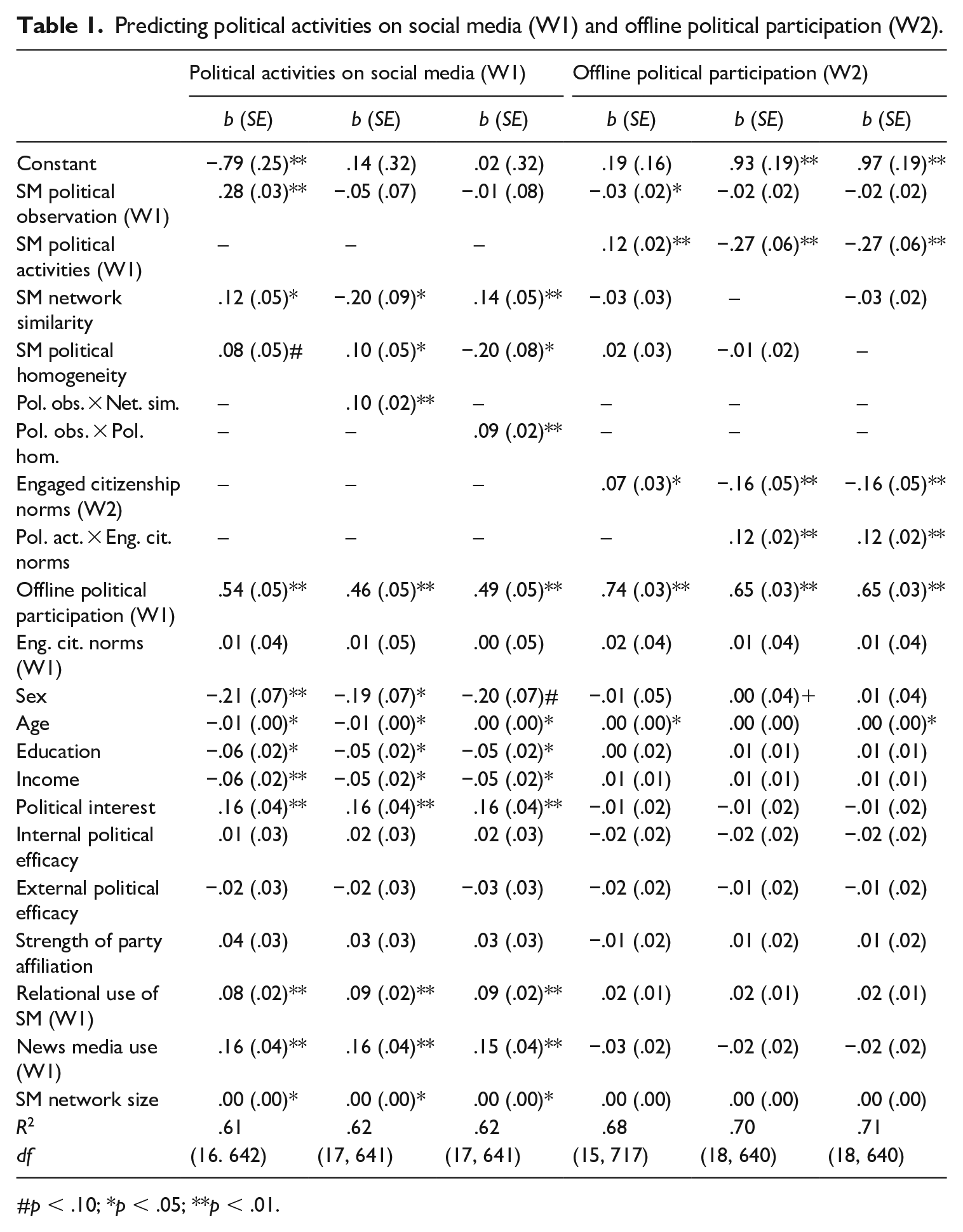
p < .10; *p < .05; **p < .01.
We then examined H2a, which predicted that the relationship between political observation (W1) and political activities on social media (W1) would be positive for individuals with the highest levels of network similarity (W1), and this relationship would decline in magnitude as network similarity decreased (W1). To test this, we added the interaction term between W1 social media political observation and W1 network similarity (Table 1, second column). The interaction was positive and significant (b = .10, SE = .02, p < .01). To probe the interaction, we followed up with a simple moderation analysis. We used the “pick-a-point” procedure and set up the value of the moderator to one standard deviation below the mean, mean, and one standard deviation above the mean (Hayes, 2013). The positive relationship between W1 political observation and W1 political activities on social media declines in magnitude as network similarity decreases, for example, from b = .17 (.03) for individuals with low network similarity of 2.19 (i.e. “only some” individuals on one’s social media are similar to them) to b = .37 (.03) among individuals with high network similarity of 4.11 (i.e. “most of” individuals are similar to them).
Similarly, H2b predicted that the relationship between political observation (W1) and political activities on social media (W1) would be positive for individuals with the highest levels of political homogeneity (W1), and this relationship would decline in magnitude as political homogeneity decreased (W1). To test H2b, we added the interaction term between W1 political observation on social media and W1 political homogeneity (Table 1, third column). The interaction was positive and significant (b = .09, SE = .02, p < .01). To better understand this interactive relationship, we again followed up with a simple moderation analysis. The positive relationship between W1 political observation and W1 political activities on social media declines in magnitude as political homogeneity decreases, for example, from b = .19 (.03) for individuals with low political homogeneity of 2.23 (i.e. “only some” individuals on one’s social media support the same candidate as them) to b = .36 (.03) among individuals with high political homogeneity of 4.19 (i.e. “most of” individuals support the same candidate as them).
The third hypothesis predicted that the relationship between political activities on social media (W1) and offline political participation (W2) would be positive for individuals with the highest levels of engaged citizenship norms (W2), and this relationship declines in magnitude as engaged citizenship norms decrease (W2). We first examined the simple relationships between the predictor variables and W2 offline political participation without the interaction term (Table 1, fourth column). W2 offline political participation was positively predicted by both W1 political activities on social media (b = .12, SE = .02, p < .01) and W2 engaged citizenship norms (b = .07, SE = .03, p < .05).
When added to the model, the interaction between W1 political activities on social media and W2 engaged citizenship norms was positive and significant (b = .12, SE = .02, p < .01); the results were the same when the two first-stage moderators, network similarity and political homogeneity on social media, were controlled for, respectively (Table 1, fifth and sixth columns). To better understand this interaction, we again followed up with a simple moderation analysis. The strength of W1 political activities on social media’s effect on W2 offline political participation depends on W2 engaged citizenship norms when W1 network similarity or political homogeneity is controlled for, respectively. W1 political activities on social media have positive effects on W2 offline political participation among individuals who have developed medium (b = .09, SE = .02, 95% confidence intervals (CIs) = [.05–.14]) or high levels of engaged citizenship norms in W2 (b = .20, SE = .03, 95% CIs = [.15–.26]) while W1 engaged citizenship norms were controlled for. However, W1 political activities on social media have no effects on W2 offline political participation among individuals with low levels of engaged citizenship norms (b = −.02, SE = .03, 95% CIs cross zero).
Overall, we find support for the dual moderated mediation when W1 network similarity is the first-stage moderator (b = .012, SE = .004, 95% CIs = [.005–.021], full indices of conditional moderated mediation in Table 2) as well as when W1 political homogeneity is the first-stage moderator (b = .010, SE = .004, 95% CIs = [.004–.019], full indices of conditional moderated mediation in Table 3). 7
Index of conditional moderated mediation by network similarity.
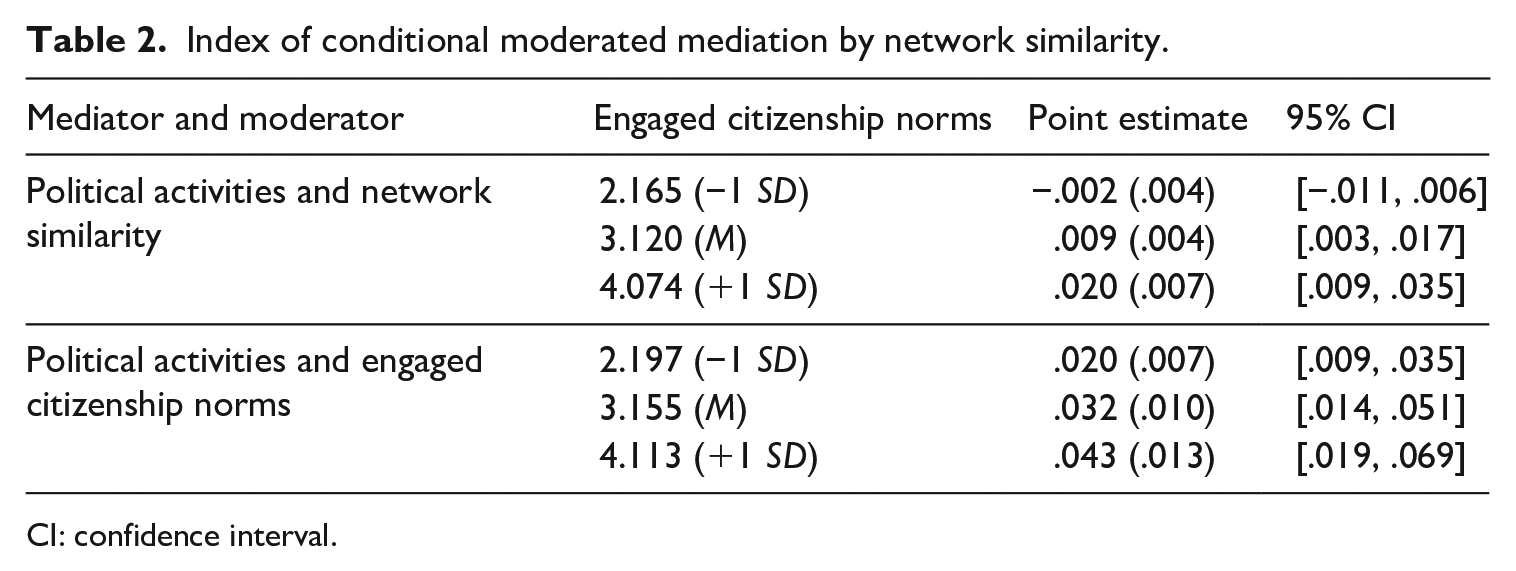
CI: confidence interval.
Index of conditional moderated mediation by political homogeneity.
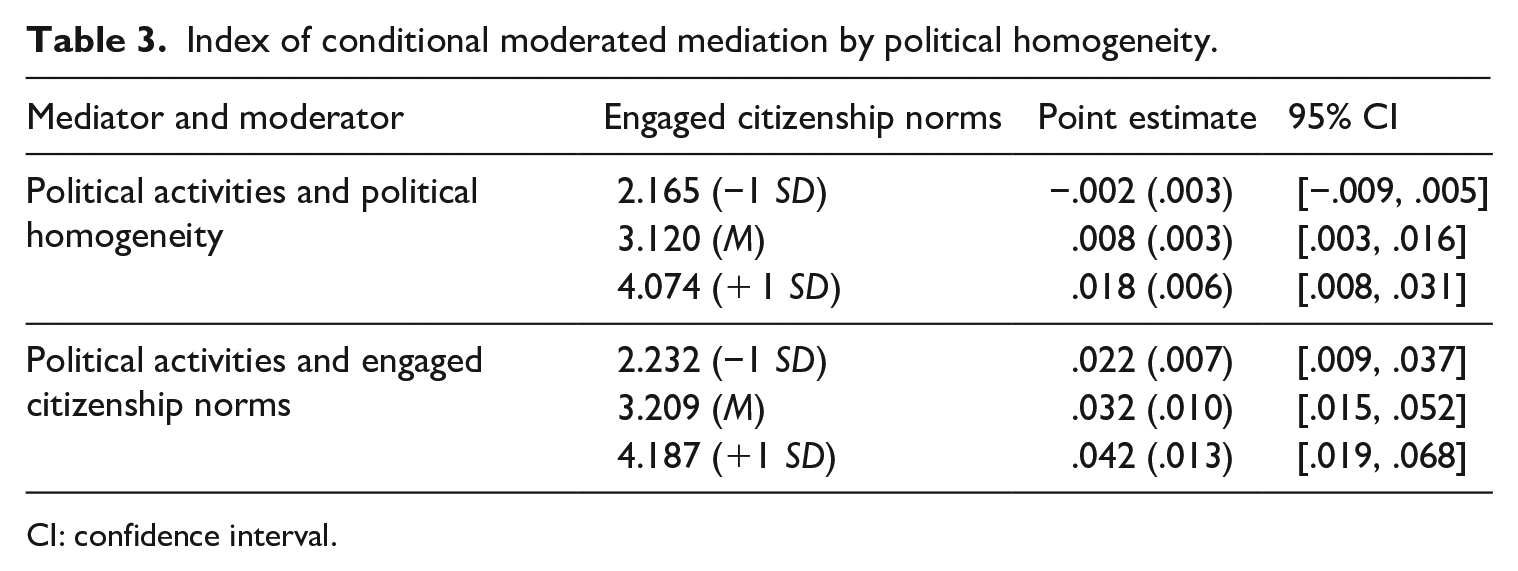
CI: confidence interval.
Discussion
Building on prior scholarship on social media and political participation (Gil de Zúñiga et al., 2014; Halpern et al., 2017; Skoric et al., 2016), the current study seeks to advance our theoretical understanding of how social media facilitate offline political participation by clarifying the mechanisms and conditions. To this end, we first empirically investigate the potential for social media to encourage social learning of political engagement by applying the social media affordances approach (Bandura, 1977, 2008; Davis and Chouinard, 2016; Evans et al., 2017; Treem and Leonardi, 2012; Velasquez and Quenette, 2018). Social media’s visibility affordance, for instance, allows users to observe political activities by others on social media feeds, and learn how to politically express and engage in a way that is socially acceptable and technically possible on social media (Ellison and Vitak, 2015; Treem et al., 2020). Analyses of a two-wave survey conducted prior to the 2016 presidential election in the United States suggest an indirect pathway from political observation on social media to offline political participation through political activities on social media by users themselves. Importantly, political observation and activities on social media are carried over to offline political participation only among individuals who have developed or reinforced engaged citizenship norms (Dalton, 2008; Ingelhart and Welzel, 2005; Lee et al., 2013). This finding highlights how norms fundamentally guide people’s behaviors (Gibbs, 1965) and individuals wish to be consistent with what they have expressed across different contexts (Pingree, 2007).
First, we find support for the link between political observation and political activities in the context of social media. The more frequently individuals observe other users’ in their networks engage in political activities, the more likely they are to engage in political activities themselves on social media. This positive relationship is found to be stronger if users are surrounded by more similar others or politically homogeneous networks. These results are in line with prior scholarship on social learning theory, which found that the effects tended to be larger when people perceived the person whom they were observing (i.e. the model) to be similar to themselves. In such cases, people tend to be more motivated to exhibit the observed behavior, thinking that they have the capability to successfully imitate the model’s behavior (Bandura, 1977, 2008). In addition, it is plausible that social media users surrounded with politically like-minded others, compared with those in heterogeneous networks, observe other users’ political activities followed up by mostly desirable outcomes such as likes, favorites, and comments that are supportive (Gil de Zúñiga et al., 2014; Kwak et al., 2018; Levitan and Visser, 2009; Vraga et al., 2015). Witnessing models’ receiving such positive reinforcements may encourage individuals to actually imitate modeled behaviors (Bandura, 2008), which in this case is engaging in political activities on social media themselves.
This speculation involving homogeneous networks, positive reinforcements, and political activities on social media merits future investigation. Perhaps analyses of server-level trace data would shed more insight into the specific role played by observation of feedback such as comments, likes, and other positive reactions in politically like-minded networks (e.g. Burke et al., 2009). It would be worth noting the mechanisms are likely quite complicated given the social media algorithms that determine what users see are heavily influenced by click activities including comments, likes, and reactions. If such positive feedback follows political activities in mostly homogeneous networks, algorithmic processes may mean that these political activities are more likely to appear in other users’ feeds, which our findings suggest would increase the chances that observers actually engage in political activities themselves. In this case, there appears to be a virtuous cycle of observing and engaging in political activities within politically homogeneous social networks.
Our findings on the social learning potential of political activities on social media have important implications for different groups, notably people with politically heterogeneous networks and young people. First, the positive link between political observation and activities on social media is stronger for people with politically homogeneous networks, meaning that they will be mobilized more on social media. However, this could also be concerning for the health of democracy considering that people in homogeneous networks may be in isolated informational spaces, which the literature describes as filter bubbles (Pariser, 2011); they will likely not gain the benefits of hearing diverse viewpoints such as increased tolerance, deliberation, and political knowledge but strengthen existing attitudes (Kim & Kwak, 2017; Levitan and Visser, 2009; Mutz, 2006). On the contrary, social media users in politically heterogeneous networks will be less likely to socially learn to engage in political activities and expression (Kwon et al., 2015), although perhaps they may learn other competencies, such as tolerance or deliberation skills. There appears to be tradeoffs of heterogeneous networks that involve deliberation and participation (see also Mutz, 2006), which merit further investigation.
Second, the results may appear especially useful for young people who tend to be apathetic to politics, yet use social media more intensively than do older adults (Perrin and Anderson, 2018; Vitak et al., 2011). Once young adults are on social media, they may be inadvertently exposed to their friends engaging in various political activities. They may think these activities, for example, sharing news articles or political memes, look socially desirable—more so if these activities are followed by many positive reactions. In the likely cases where young adults perceive their social media networks to be similar to themselves, they will be very likely to actually engage in political activities themselves on social media. This overall experience of observing and engaging in political activities on social media may well cultivate and reinforce engaged citizenship norms among young adults (boyd, 2014; McLaughlin and Vitak, 2015), which is essential for engaged citizenship beyond the realm of social media. This study’s findings build upon prior research on online pathways to participation among the youth, highlighting the importance of news consumption and political expression online (Lee et al., 2013). Yet, this online pathway to participation complements the existing offline pathways involving the influence of family, school, and peers on political participation (Lee et al., 2013). In future research, it would be worthwhile to include additional—perhaps earlier—opportunities to socially learn about and develop citizenship norms outside of social media.
The current study is limited in a few ways. First of all, the measures used in this study relied on self-reported survey data. Due to respondents’ imperfect recall, self-reported measures of social media use might not be the most accurate measures (Prior, 2009). Second, this study relied on a non-probability sample from online panels, and data collection took place in the context of the 2016 presidential campaign in the United States, a particularly polarizing one. For one, our use of a non-probability sample may limit the generalizability of the findings to a wider population (see Callegaro et al., 2014). This holds true although age, gender, and education quotas were applied in an effort to ensure that this study’s sample closely resembles the American population. Also, in terms of the timing, although presidential elections only occur every 4 years, and the 2016 election was the latest one, our findings should be replicated with more recent data. This is because social media platforms and practices can change over time. Yet, we believe the findings hold theoretical and practical significance because our model is theoretically derived and thus durable; for example, social media still afford visibility, persistence, editability, and association, which can encourage social learning of political engagement among their users. Finally, network characteristics were measured using one item, and the network similarity measure was rather generic. Future research could use more granular network measures, and should refine the similarity measure to specifically gauge various demographic similarity involving age, gender, race, and education. Extensions such as these will help researchers better discern which aspects of network similarity drive social learning.
Considering the limitations of this study, it would be worthwhile to collect more longitudinal data from a probability sample in the context of midterm election campaigns or non-election years. This may help further clarify causal directions among political observations, political activities on social media, and offline political participation, as they relate to engaged citizenship norms. 8 Also, self-reported survey measures can be corroborated with other datasets, including behavioral data from experiments or server-level trace data (e.g. Burke et al., 2009).
Analysis of social media data may be especially useful for the following future research that builds on this study. First, we have speculated that individuals in politically homogeneous social networks would be more likely to observe their networks’ political activities followed by positive reinforcement on social media. In future research using server-level trace data, positive reinforcement such as the number of likes, encouraging comments, and reactions like love and wow could be directly measured. Second, it would be worthwhile to examine the role of the algorithm, specifically which content it selects to prioritize, in the context of social learning of political engagement on social media. In February 2016, Facebook introduced a variety of reactions in addition to likes and comments, and announced that it would prioritize content with active interactions (e.g. comments, comment replies, and shares) over passive interactions (e.g. likes and clickthroughs) to appear in News Feeds. The introduction of reactions may help further social learning of political engagement on social media because this opens up the possibility for more interactions. Social media users likely have different reactions to political content, so the wider range of reaction options—for example, clicking like, love, and wow buttons, disapproving or questioning the content by using angry or sad buttons, or laughing at it with a haha button—may increase engagement with political content. If such political content and activities with active interactions could be prioritized to appear in News Feed, becoming more prominently visible and accessible than other content (Treem et al., 2020), this may further facilitate the potential of social learning of political activities on Facebook. Relatedly, it would be beneficial to conduct cross-platform analyses with a focus on the available activities, norms, and algorithms that may vary across different social media sites. 9
By applying the affordances approach to the political context, the current study demonstrates social media’s potential to encourage social learning of political engagement, particularly among users surrounded with similar others and politically homogeneous networks (Bandura, 1977, 2008; Davis and Chouinard, 2016; Treem and Leonardi, 2012). In this sense, the current study documents the significant value that can be derived from the often overlooked, non-visible forms of participation (e.g. observing others’ activities without initial contribution) due to social media’s affordances such as visibility (Cranefield et al., 2015; Treem et al., 2020). Notably, political activities on social media are then carried over to offline political participation only among individuals with engaged citizenship norms (Dalton, 2008; Ingelhart and Welzel, 2005; Lee et al., 2013). The results shed light on future civic education program and policy interventions, and highlight the need to cultivate citizenship norms and democratic values (see Kim & Pasek, 2020) along with social media literacy skills. Despite social media’s potential to encourage social learning of engaged citizenry, we have also witnessed serious problems involving mis- and disinformation (e.g. Jones-Jang et al., 2020). Given the efficacy of the affordances framework for understanding social media communication processes, one potentially fruitful approach to literacy efforts is to structure them around affordances. For instance, in terms of visibility, users can understand whether they share false information, and it can be visible to other users beyond their immediate audience. Mindful of this possibility, users can take advantage of the editability affordance of social media, spending as much time and effort in writing, fact-checking, and editing their posts before posting them. These efforts will help to maximize social media’s potential to encourage social learning of engaged citizenry.
Footnotes
Authors’ note
All authors agreed to the submission and the article is not currently being considered for publication by any other print or electronic journal.
Funding
The author(s) disclosed receipt of the following financial support for the research, authorship, and/or publication of this article: This study was funded in part by the Howard R. Marsh Center for the Study of Journalistic Performance at the University of Michigan.
