




Abstract
Labor platform scams are an opportunity to integrate scholarship about governance across social media and labor platforms. Labor platforms have borrowed governance mechanisms from social media to cultivate trust among users and remove problematic content. However, while these platforms may share governance strategies, labor platforms mediate employment relationships between workers and clients with different amounts of power. Based on a multistakeholder ethnography of carework labor platforms, online careworker forums, and interviews, this study describes scams on carework labor platforms. Labor platforms narrate workers into the role of technology consumers, constricting their own obligations to workers. Workers’ explanations of scams vary, with some contesting and others aligning with platform narratives. Some workers seek support in online forums, which remediate the harm of scams for some but also enroll workers in unpaid labor. These scams challenge the assumption of antagonism between the interests of workers and platform companies and highlight the consumerization of work.
Introduction
In the past decade, online labor platforms have emerged that connect workers with clients to do many different types of online and in-person tasks, providing services such as driving, copy-editing, photography, and care work. Like other types of platforms, labor platforms have developed strategies to define and combat users’ misuse of their sites. From harassment between users to “gaming” algorithms to gain more visibility or jobs, digital labor scholars have examined these practices and platform responses to them (Petre et al., 2019). However, scams perpetrated by opportunistically exploiting sociotechnical features of labor platforms have been relatively absent from this emerging literature.
Labor platforms have borrowed sociotechnical features from both online marketplaces and social media platforms that preceded them, such as eBay and Facebook. Using crowdsourced governance mechanisms, including “red flags,” profile photographs, and real name policies, online labor platforms cultivate trust between users. While labor platforms may share governance strategies with social media and marketplace platforms, unlike other platforms that govern relationships between formally equal stakeholders, labor platforms manage workers (Citron and Pasquale, 2014). This article investigates scams as a case of contested governance on carework labor platforms which occur across a diverse field of actors, including online worker groups. Scams provide a prism through which to understand the ways many different stakeholders shape the meaning of platform labor.
The COVID-19 crisis has exacerbated an existing crisis of care in the United States. As schools continue to open and close for in-person learning, more parents are turning to online carework platforms to look for in-home childcare. As Care.com has reported “triple-digit” increases in people looking for care and tutoring, care platforms appear to be among the technology companies positioned to excel through a pandemic-induced financial slump (Zumbach, 2020). However, care platforms are underrepresented in both scholarship and larger public debates about online labor platforms. This lack of attention, coupled with a nearly exclusive focus on the relationship between workers and platform companies, limits our ability to analyze the role of the many different stakeholders that shape our system of reproductive labor and also platform-mediated work broadly.
Literature
Scams, spam, and online “misbehavior”
Early Internet studies scholarship investigated the role of digital media in underground and informal economies. From email scams to the Silk Road, scholars of digital media were early to point out the ways the Internet challenged the ability of institutional powers to control the terms of online exchange (Dibbell, 1999; Gehl, 2016). While scams and spams used to be synonymous, they are now decoupled in our online experience (Burrell, 2012). This shift has followed alongside the increasing “corporatization” of the web and the expansion of platforms’ “walled gardens” into more of our online experiences (Van Dijck et al., 2018). As corporate control over the terms of online engagement through platforms sanitizes and homogenizes online experience (see Lingel, 2020), there have been fewer studies of digital media’s involvement with fraud and spam operating along the edges of corporate platforms.
Brunton (2015) argues that spam is the dark side of online communities and that throughout the history of the Internet, spammers and community members have struggled over its meaning. Spammers exploited the indeterminacies of the Internet to draw people’s attention, while community builders struggled to define and contain these attempts. As the uses and meanings of the Internet changed, so did spammers’ tactics, and community builders’ attempts to control them, illuminating the struggle over the changing meanings of the Internet itself. Spam therefore reveals different actors’ definitions of “authentic” and correct uses of technology.
Scams on carework labor platforms threaten careworkers’ ability to find work. However, their analytical value extends far beyond the immediate negative consequences. Scams are a “boundary object” of platform labor, meaning that although they mean different things to different sets of actors, they still allow these actors to work together without coming to a consensus about the meaning of the object (Bowker and Star, 2000). This study illustrates that the contested meaning of scams among different stakeholders illuminates larger shifts in the meaning of platform-based work.
User vulnerability to scams
Not all users are equally susceptible to being scammed online. Scholars of Internet skills have measured individual abilities to detect and respond to scams (Gainsbury et al., 2019). Research on inequalities in Internet skills suggests that privileged users are more likely to reap benefits of Internet use and avoid risks like online scams (Litt, 2013). These studies largely conceptualize users’ vulnerability to scams as a problem of individual skills or choices to engage in risky online behaviors.
However, marginalized Internet users may be more often confronted with scams and be particularly sensitive to their harms. People who access broadband at community institutions, like libraries, were exposed to digital tracking and targeting through the use of “privacy poor, surveillance rich” websites and services (Gangadharan, 2015: 608). Racially or socioeconomically marginalized people are more sensitive to the threats they faced from the intertwining of their online and offline lives, such as the risk of identity theft (Madden, 2017). These studies suggest that marginalized groups are not more vulnerable to scams because they are deficient in their technical knowledge, but because they face more exposure and higher consequences for becoming ensnared by online scams.
Careworkers in the “gig” economy
Domestic workers, including nannies, babysitters, and other in-home care providers, are a fast-growing and highly marginalized population of workers in the US. Paid domestic work is an often-cited example of “invisible work,” because of its social devaluation, low pay, and legal disenfranchisement (Ehrenreich and Hochschild, 2004). The domestic workforce is dominated by immigrant women, many of whom work without legal documentation (National Domestic Workers Alliance (NDWA), 2012). As a workforce facing multiple, intersecting axes of exploitation, domestic workers are an important population to understand in connection with online scams.
Careworkers often rely on a patchwork of job-hunting strategies, including word-of-mouth referrals, online job boards, and community-based online forums and email lists (Ticona et al., 2018). Within this fragmented environment, online care platforms have expanded the market for in-home care. The largest of these, Care.com, launched in 2006, and as of 2019, had 11.5 million registered worker profiles in the United States and $192 million in revenue (Care.com, 2019). Employers use care platforms to place job listings and workers create online profiles to highlight their skills, experience, and availability. Workers and clients contact each other through an in-platform messaging system. Despite the increasing importance of digital platforms to careworkers, there are few studies examining carework labor platforms (see Ticona and Mateescu, 2018, 2020).
Platform governance: the politics of flagging
As Internet users, careworkers using labor platforms are subject to the governance of platforms. Like social media platforms, labor platforms have largely been left to govern the content that appears on their sites. Social media platforms outsource content moderation to users and utilize underpaid contractors to comb through content through the use of flagging mechanisms (Roberts, 2019). The flag is a ubiquitous content moderation mechanism across the web. However, “a flag is not merely a technical feature: it is a complex interplay between users and platforms, humans and algorithms, and the social norms and regulatory structures of social media” (Crawford and Gillespie, 2016: 411). Along with “like,” “share,” and upvote and downvote buttons, flagging relies on users to perform governance labor. Platforms can remove flagged content, relying on “community norms” to legitimate decisions about controversial content. Flagging is therefore a technical mechanism and a powerful symbol for tech platforms in conversations about governance with external regulators, leveraged to maintain self-regulation.
Labor platforms borrow mechanisms from social media to crowd-source governance. However, social media sites and labor platforms have several key differences that leave open questions for labor platform governance. Social media platforms use flags to govern content posted by users who constitute a rhetorically constructed “community” of discourse, where users are situated in formally equal relationships, meaning that users’ flags should all carry the same weight. However, labor platforms govern two distinct sets of users, clients, and workers, who navigate two separate sides of the platform. Through the case of scams, this study investigates the different meanings of carework labor platforms’ efforts at self-governance across workers, platforms, and other stakeholders.
Labor platform governance: beyond algorithmic management
Platforms are information intermediaries that link many different groups of stakeholders (Gillespie, 2010). Although platforms mostly govern themselves, the mechanisms of governance entwine many different stakeholders including platform companies, users, advertisers, paid content moderators, lawmakers, regulators, and others (Gorwa, 2019). However, scholars of labor platforms have so far only considered issues of platform governance as they relate to worker control, or in battles over legal classification (see Rogers, 2018, for exceptions, see Chen and Qiu, 2019; Graham et al., 2017; Irani, 2015). Meaning that the ways labor platforms construct their role within a field of stakeholders have not yet been fully explored.
Many labor platforms govern workers through “algorithmic management,” using information selectively revealed and concealed to encourage workers toward decisions that benefit platforms and meet client demands (Lee et al., 2015). They exploit “information asymmetries” to control workers' behaviors (Rosenblat and Stark, 2016), leading many to question the classification of some platform workers, like ridehail drivers, as independent contractors (Dubal, 2017).
Online care platforms distinguish themselves from other on-demand labor platforms by pointing out that they do not control work activities, but only facilitate connections between workers and clients. Care.com’s former CEO compared the company’s “marketplace” to hiring platforms like Indeed, which bring employers and job applicants together online (Grind et al., 2019). While care platforms do not directly manage work tasks, they classify and sort workers to manage risk for clients, using “actuarial,” as opposed to algorithmic, management to control workers (Ticona, 2020).
While only some labor platforms govern by controlling the execution of tasks, all govern by leveraging cultural narratives to define their services. Online care platforms act as “cultural entrepreneurs” that shape parents’ and careworkers’ expectations (Ticona and Mateescu, 2018). Similarly, Uber does cultural governance when they leverage their self-definition as a technology company with users, rather than as an employer, to shape regulation (Rosenblat, 2018). Uber does this by arguing in court and elsewhere that drivers are legally closer to consumers of their app than employees of their company.
However, platforms do not unilaterally dictate culture. Labor platforms are embedded in relationships with many stakeholders, and situated within specific labor markets, each with distinct occupational and regulatory histories. These various stakeholders may contest, resist, or support platform efforts, pushing and pulling meanings in multiple directions. In this way, labor platforms shape culture to define themselves for diverse publics but do not do so in a vacuum. Combining insights from scholarship that examines governance on both labor and social media platforms, this study extends the analysis of labor platform governance beyond the worker versus platform dichotomy to examine the cultural construction of scams.
Networked support in platform labor
Online occupational groups have played an important role in organizing and regulating everyday experiences with platform work (Gray et al., 2016; Irani and Silberman, 2013; Martin et al., 2014; Schwartz, 2018). Wood et al. (2018) found that for online freelancers, social media groups helped workers highlight potential scams and organize for better conditions.
However, online worker groups are not always sites of resistance against platform companies. Platform workers are a heterogeneous population, relying on the income earned from platforms at different levels, and with different investments in platform work (Cameron, 2020; Schor et al., 2020). When diverse groups of workers gather online, there may be both resistance against and alignment with platform company directives. Based on a multistakeholder ethnography of carework platforms and online worker groups, this study draws together the literature from the governance of social media platforms and labor platforms to examine conflict about the meaning of scams.
Data and methods
This research is part of a larger ethnographic examination of the field of online carework platforms, including in-depth interviews with care workers, a regulator, observations of online occupational groups, and content analysis of material from carework platforms, including marketing and recruitment materials, app- and web-based platforms, public statements, and other company-produced discourse. The methodological approach of this analysis reflects an inductive approach typical in ethnographic work (Christin, 2020; Lingel, 2017). After initial interviews with careworkers, the author and another research collaborator selected the three most widely used platforms, Care.com, UrbanSitter, and SitterCity, and conducted ethnographic observations on these three platforms. Interviewees were recruited through local nanny agencies, Craigslist, and e-mail lists. Initial interviewees invited members of the research team to join local and national Facebook groups, wherein researchers conducted subsequent ethnographic observations. The ubiquity of scams in the experiences of careworkers’ job searches challenged initial recruitment. Early interviewees expressed doubts about participating because it, “sounded like a scam.”
Researchers conducted interviews with 42 careworkers in New York City, Atlanta, and Washington, DC, who seek work through online platforms. Interviews were conducted in person and via Skype. Interviewees received their choice of $20 in cash or an equivalent online gift card. Interviews were recorded, with permission, and transcribed. Transcriptions were coded, along with all other materials, according to methods of content analysis (Corbin, 2007).
Subsequently, the author returned to company-produced materials related to fraudulent job postings. By following hyperlinks, the author found several online blog posts and a video created by the Federal Trade Commission (FTC) about “nanny and caregiving job scams,” which led to an interview with a senior FTC official.
Findings
Anatomy of a scam
Veteran careworkers and those with years of experience searching for carework jobs online developed a sense of the common features of fraudulent job postings. These features are remarkably consistent and were mentioned in 63% of interviews. Oftentimes, postings will describe a family that is “moving to your area” from another state or another country and looking for help preparing their new home and care for a child upon arrival. The scammer will usually offer a salary far above regular rates, attracting new workers who are unfamiliar with standard pay rates. Like other Internet scammers, they often attempt to elicit sympathy or build trust by describing a disabled or sick child (Burrell, 2012). Once “hired,” careworkers receive a fraudulent check from the scammer, framed as an advance payment or to buy supplies. This check is made out for a large amount, and scammers request that the careworker deposit the check, buy the requested supplies, and send the remainder back through a money order. The scam takes advantage of laws that require banks to make funds from checks available before they can verify them. When the careworker sees the funds appear in their bank account, they wire the “excess funds” to the scammer (Fletcher, 2020). Once the bank identifies the check as fraudulent, funds are removed from the careworker’s account. Wire transfers are frustratingly untraceable for law enforcement, and after the transfer is sent, there is little that can be done to track the stolen money. Karen, a veteran nanny, explained the basic outline of this scam, which she had encountered in her online job hunt: . . . a person claimed that they were coming into town. They were moving from another state . . . Classic scenario . . . they want your information up front . . . so they can get to paying you. Fortunate enough . . . I could read between the lines even before they [Care.com] told me that you’re dealing with a scammer . . . if you are not paying attention and you’re out of work . . . You can get caught into a lot of stuff that can mess you up . . . I can usually tell because I’ve been in this line of work for so long . . . If they start above the hourly rate . . . That puts up my red flag immediately.
While Karen avoided them, others do not. There are numerous news reports of careworkers being ensnared by scams (Finney, 2015; Hogan and Petitte, 2016). While no interviewees admitted to losing money to a scam, many had gotten their hopes up before realizing they were being lured into a scam. An interviewee told us about a job she was interviewing for that contained several of the hallmarks Karen described above. The interviewer shared the information we had learned from other careworkers. These scams use consumer money transfer services such as MoneyGram and Western Union, putting them under the regulatory authority of the FTC. Money transfer frauds originating from care websites were a prominent source of these complaints to the FTC (FTC official, 2019, personal communication).
Online care platform scams have a relatively predictable formula. They are formally regulated by the FTC, which has pursued actions against the consumer money transfer services that facilitate these crimes. However, as the following sections will illustrate, the meaning of these scams is contested among different stakeholders, which shapes the attribution of responsibility for regulating them in different ways.
“Bad actors”: defining and governing scams
Care.com’s discourse took a unified approach in describing scams as a problem of “bad actors” online. On their website, in blog posts hosted on the site and in frequent e-mails sent to workers, Care.com explains that “scam messages are often sent through job posting sites,” and gives workers a list of “red flag language,” including many of the key features of scams above. In automated e-mail messages sent to workers, the platform warns that “there has been an increase in online fraud and scams across the Internet” and that “staying vigilant will help you avoid being scammed” (Care.com, 2019, personal email communication).
Platform discourse also emphasizes individual responsibility, not only in avoiding scams but also by encouraging workers to cut off communication and report scammers to the platform (see Figure 1). Like many social media platforms, Care.com’s interfaces feature a red-flag button that workers and clients use to report content that violates the platform’s terms of service. However, workers are also rated on the promptness with which they respond to messages from clients through the platform, and these metrics are displayed on their profiles. Several workers reported that they had continued conversations with people they had identified as scammers to maintain their ratings. Platform discourse aimed at an audience of careworkers emphasizes individual responsibility surrounding scams in a way that conflicted with the practices careworkers followed to maintain a good reputation on the platform. In addition to performing the labor of crowdsourced scam detection for platforms, workers are also encouraged to report scams they experience to the FTC (see Figure 1).

Care.com, Information for careworkers on how to report a scam.
It is important to note that email messages, information on the website, and blog posts dedicated to scams are exclusively oriented to care workers. Clients receive very little information about scams. Care platforms provide many posts and tips for clients on safety-related concerns such as vetting and screening prospective careworkers, making it possible to compare the ways that platforms frame safety-related concerns differently for audiences of careworkers and clients. Care.com provides information on their website about “safety” that is oriented to an audience of both workers and clients. On their website’s landing page about safety, which contains separate links for resources oriented toward “families” and “caregivers,” Care.com emphasizes their own vigilant governance, assuring all users that they monitor content on the site, and that these safety measures “deter bad actors from coming back” (Care.com, n.d.). While messages about scams directed exclusively at workers emphasize workers’ individual responsibility for detecting and reporting scams, those directed to a combined audience of workers and clients emphasize the company’s more active role in governance and reinforce the platform’s definition of scams as aberrations or “monsters” within their systems, which are the result of bad individuals, and not systemic sociotechnical vulnerabilities (Bowker and Star, 2000: 304).
Other care platforms took a more sociotechnical approach to frame the problem of scams to workers, emphasizing slightly different aspects of their own and workers’ responsibilities in this process. In their guidance to workers, UrbanSitter (2020) emphasizes the company’s active role in governing scams and took a more collaborative approach, stating “UrbanSitter wants to prepare the sitters on our platform with the knowledge and tools to flag [inauthentic] users to our Support Team so that we can conduct an internal investigation and take the appropriate next steps.” Addressing the context of the COVID-19 crisis, SitterCity took a similar approach, first describing the company’s use of “predictive analytics, machine learning, and regular qualitative review processes,” while also giving tips on how to identify scams (SitterCity, 2020). Neither company directed workers to report scams to the FTC.
For their part, FTC materials also frame scams as the fault of bad actors but avoid locating responsibility with individual workers, care platforms, or with the money transfer services that facilitate these scams. A blog post and video on their website characterize scammers as organized groups using care platforms to “find people to rip off” (see Figure 2; Kando-Pineda, 2018). The FTC recommends reporting scams to the “job site” and through the agency’s consumer complaints system. Their advice uses directed language to warn workers, “don’t send money. . .” but does not suggest that workers are solely responsible for their own protection. The FTC was the only entity, besides workers, to suggest that workers search online for others with experiences with scams. Many of our interviewees mentioned reporting scam postings to the platform, but none reported to the FTC.
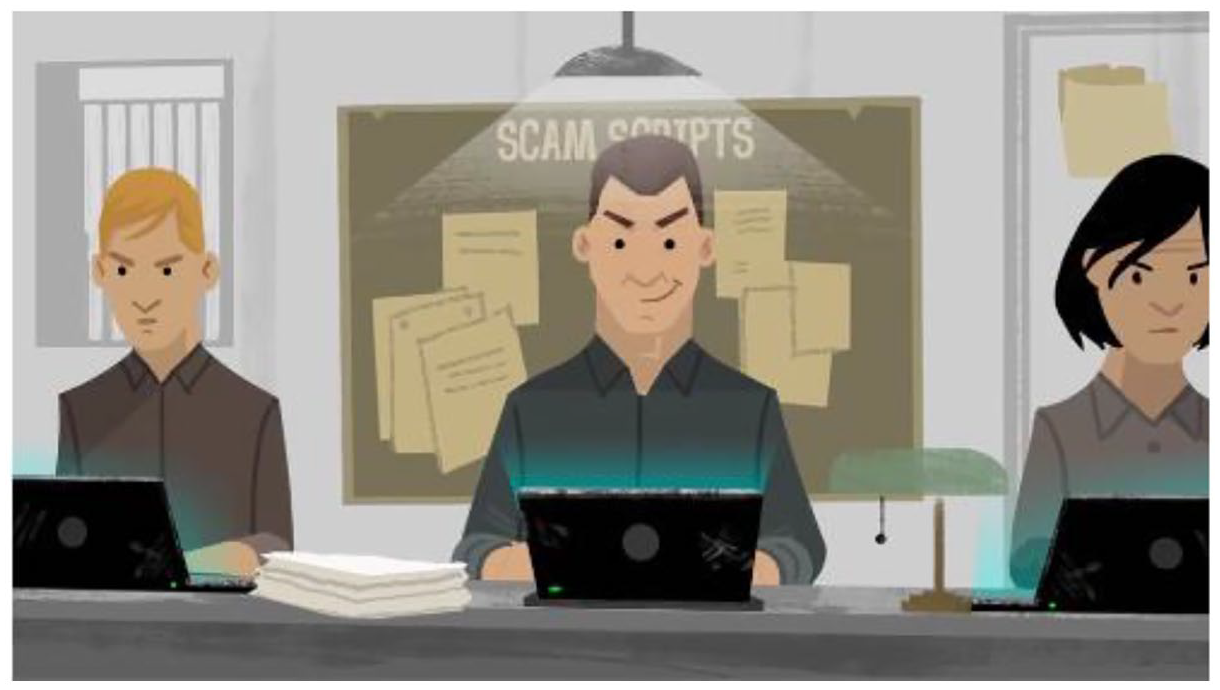
FTC video, “Staying away from Nanny and Caregiving job scams.”
Care platforms constrict their responsibility for exposing workers to scams by casting scammers as “bad actors” that are seeking to victimize workers and other people across the web and either shifting responsibility onto workers or casting themselves as collaborative partners with workers in solving the problem of scams on their sites. Petre et al. (2019) termed the ways that platforms cast themselves as neutral or good actors in the fight to preserve “authentic” content while casting others as bad actors, “platform paternalism.” This study extends these findings to understand additional actors in the platform ecosystem, including clients and regulators. These findings also point out that narratives from different actors reinforce one another, or maybe used strategically to limit platforms’ obligations to workers.
Workers’ theories of the problem of scams
Despite their shared annoyance and frustration with scams, careworkers took different positions on platforms’ role in regulating scams. Three different orientations characterize workers’ stance toward platforms: (1) platforms are protective; (2) platforms are neutral, but flawed in dealing with scams; and (3) platforms are irresponsible and expose workers to scams and dangerous people. Rather than constituting a general orientation toward all platforms, workers would often use different orientations to describe different platforms, depending on their impressions of them.
The first orientation workers took to describing the relationship between platforms and scams was that platforms play a protective role and actively work to shield workers from scammers. This orientation usually emerges in comparison to other forums. Sarah, a nanny who was a member of a local Facebook group that connected parents with careworkers, described an instance when a parent contacted her on Facebook for childcare and she requested that he book her through Care.com because, Care.com will . . . weed out people that are scams or fake . . . I’ve had them send me e-mails saying a profile is fake. They realized that I had contact with this profile, so they let me know that they did take it down, which is nice. Otherwise I could’ve been in pretty serious trouble.
Sarah preferred that clients use Care.com because of the company’s past governance efforts. This led her to feel confident that the platform was actively screening for scams and other potential dangers. This orientation views platforms as the most positive of the three, but it also suggests a vision of platform responsibilities that goes beyond what platforms and regulators describe.
The second orientation emphasizes that care platforms are generally neutral but face technical problems eliminating scams and regulating content. Workers using this orientation emphasized the logistical issues of removing fraudulent posts. Angela, an experienced careworker, explained that she used to use Care.com but had recently felt like it was easier for her to find work in other ways: I can do a babysitting job far easier by word of mouth than I would with Care.com . . . Between the fake profiles . . . sometimes these positions are outdated. They need to go through all the postings and see the ones that are outdated. I’ll see something that’s like 60 days old . . . It’s time consuming, it’s old posts, some scams, some fake people. The time it takes for them to update it, is like snail pace . . . it’s too slow for me.
While Angela felt that care platforms were responsible for solving the problem of scams, it was largely a technical problem that led to inefficiency, not a dereliction of duty, or an intentional money-making scheme, as it was for the workers taking a more oppositional stance. As described above, this explanation largely aligns with platform explanations of scams and their role in regulating them.
The last and most oppositional orientation was that care platforms expose workers to potentially dangerous people. Coral signed up for Care.com early on, between 2008 and 2009, and explained that, I would get phone calls and it would be like, “Hey, I need you to watch my kid.” And then I’d be like, “Um, no? I’m not doing that.” It was almost like a vessel for bad things to happen to people. I mean, I just got a really weird feeling. It was like almost putting a magnet on your car that’s like, “Call me!” . . . I was just like, “This is creepy. I’m deleting this app because it was scary . . .”. And I’ve heard stories . . . There’s some sickos . . .
By making her information too publicly accessible, Coral felt that the platform was “creepy” and put her and other careworkers into contact with potentially dangerous strangers. Coral was a member of many online groups for nannies, and despite her decision not to use labor platforms, still assisted others in the groups in their questions about scams. Sometimes, careworkers would generalize these actions by scammers to Care.com itself. Kate, a relatively inexperienced nanny, said “I’ve heard people talking [online] about it in the past, like ‘Oh, Care.com is a sham. You’ve got to be careful in there’ . . . they’re just like selling our phone numbers or something.” In this view, platforms’ complicity in the problem of scams leads workers to label the platforms themselves as scams, or worse, to speculate as Kate did, that selling their information to scammers was a part of the platform’s business plan.
Careworkers regularly have accounts on multiple platforms, searching for work through several at the same time. Some nannies took different orientations to different platforms. Karen, the veteran nanny quoted above, felt SitterCity was protective, while Care.com exposed her to dangerous people. Comparing the two, she explained that on SitterCity, “there aren’t so many people on there . . . and I appreciate them monitoring the site, making sure it didn’t get too out of control . . . I didn’t feel like I was alone and exposed to too many people that could cause me harm.” On Care.com, she described getting more responses to her applications, but felt that she had to have her guard up in screening every response herself to judge whether or not it was legitimate saying, “It was just very uncomfortable [on Care.com].” This led her to keep her profile on SitterCity and delete her profile on Care.com. Karen felt that SitterCity was a protective partner in her job hunt (“I didn’t feel like I was alone”), and that the large membership of Care.com “exposed” her to potentially harmful people. Karen’s combination of approaches illustrates an underlying similarity between the most positive and most oppositional approaches; both are animated by the expectation that platforms should be protective. However, the oppositional approach points to the belief that platforms are not fulfilling this obligation toward workers.
Despite the ubiquity of scams, careworkers interpret them in distinct ways. Although they are ideal types, each of these orientations exhibits a distinct “folk theory” of platform governance (Eslami et al., 2016). Workers’ folk theories are drawn from their everyday experience (Toff and Nielsen, 2018) and shape their affective relationships with platforms (Myers West, 2018). In their alignment or opposition to the platform’s own definition of this problem, these explanations illustrate that the meaning of scams is not self-evident but contested among several groups of stakeholders within the platform ecosystem. Furthermore, these findings demonstrate that, even when interests are aligned in a general sense, because careworkers, platform companies, clients, and regulators would rather get rid of scams, differences in the role workers thought platforms played in governing scams shape the ways they allocate responsibility.
Sensing scams: community remediation in online groups
From job postings, to the pay offered, to the language or information exchanged in follow-up messages, careworkers develop a finely honed “sixth sense” for spotting what they identified as scam posts. While much of this learning happened on their own, it does not occur in isolation. For many careworkers, online forums on Facebook and other social media platforms played an important role in their socialization to the norms of the profession, and the tell-tale signs of scam job postings.
Careworkers develop a set of criteria for identifying suspicious job listings, as Shontay, an Atlanta-based nanny explained, “I’ve been doing these apps for a while, so I kind of sense when something’s not right . . .” As Elle, a New York-based nanny explained the ways jobs listings are written tip her off, “some listings sound scammy. There was one woman who was like, ‘I have seven kids’ and the description was off . . . it didn’t seem real.” Others were sensitive to the language that prospective clients used in their messages to them. Gloria, an elder careworker, was suspicious of messages that were too long, or formal, explaining, “I mean some of them are really obvious . . . this one guy . . . I’d ask a question and he would send a . . . page email, I’m like what the fuck’s that? . . . he’s making everything so formal . . . using all these big words . . .” Whether through suspicious requests, grammar, or atypical family descriptions, the ubiquity of scams on carework platforms led to careworkers’ suspicion of anything outside of the norm.
Some careworkers mentioned becoming familiar with the hallmarks of scams on their own, through years of experience looking for work on this platform and others, but many referenced learning these telltale signs in online occupational forums. These online groups vary widely, with some hosting tens of thousands of members around the world, and others local to specific neighborhoods. Robin learned about scams through a local online group. While she had nearly a decade of experience as a nanny, she noted the benefits of the groups for helping less experienced nannies investigate potential scam job postings: I think especially for nannies who are younger . . . or don’t know any better, that they can post like, “Is this real? Is this not real?” Then, the more experienced nannies can reply like, “Anytime they say that they’re deaf and they can’t talk on the phone that’s a sign that it’s a scam.”
Robin uses a common scam trope, a disabled parent or child, to describe how online groups help inexperienced nannies develop a sense for scams. This type of mentoring flips the typical narrative of younger, savvier digital technology users helping older users. In this case, less experienced nannies are targeted for online scams because they are unfamiliar with industry norms. Online groups allow more experienced and often older careworkers to mentor younger members of the profession.
In one large international online forum for careworkers, posts asking for help with potential scam job postings occur regularly, between three and five times each month in the past year, each post sparking between 20 and 100 replies. The original poster will often post a screenshot of a conversation between themselves and a prospective client and ask the group if they see any “red flags” or if the job is “too good to be true.” Replies will include practical warnings to stay away and cut off communication as well as humorous replies meant to make fun of the scammer and express frustration with the frequency of scams on online platforms. There is frequent use of emojis to express frustration and laughter, as well as encouragement to “mess” with scammers by making outrageous demands for pay, or by making up “sob stories” of their own to “scare them off from messaging.” While these responses are often in jest, careworkers using platforms are aware that not responding to each message might lower their ratings, and “scaring” scammers off with bogus messages of their own may protect their hard-won online reputations.
Robin described the enjoyment and burden of this free digital labor performed as a member of her local Facebook group, saying I just feel bad I can’t help out more, it’s funny but also so sad, there’s so many of those posts . . . I just don’t have time to be sitting on Facebook all day . . . .sometimes I feel like we should name the group, “Is this a scam?.”
Online worker groups played an important role in mediating workers’ encounters with scams. Several interviewees mentioned learning about the hallmarks of scams through their participation in these groups, suggesting that they may play an important role in socialization into the expectation that scams are a frustrating, but ultimately expected part of finding carework jobs online. These threads rarely located responsibility with platforms but focused on preventing immediate harms. Therefore, while online worker groups may facilitate labor organizing in some conditions, they may not always play this role, and it may be more accurate to understand them as mediating, rather than necessarily improving workers’ experiences.
Discussion
The consumerization of work
The gig economy did not start with online labor platforms. Since the mid-1970s, workers in both high- and low-wage work have dealt with the rise of flexibility and casualization in job duration and the individualization of risk and responsibility for job success (Kalleberg and Dunn, 2016). In their current form, many have described online labor platforms as a regrettable, but predictable extension of decades-long shifts in employers constricting their responsibilities to workers and speeding up the shift of these risks from firms to workers (Ravenelle, 2019).
Digital media scholarship can aid our ability to see how these shifts toward greater precarity are not only extensions of broader issues in paid labor but also connected to shifts in media ecosystems, such as the shift between users and producers. Scholars of “digital labor” have pointed to the ways that “Web 2.0” recruited Internet users to become content producers, allowing social media companies to exploit the free labor of users for profit (Jarrett, 2015; Terranova, 2000). These shifts have been largely understood as parallel transitions. However, this analysis has demonstrated the many ways that labor platforms and social media platforms are using the same playbook. Labor platforms borrow governance mechanisms from social media platforms, including crowdsourced detection of inappropriate content. Carework labor platforms rely on the knowledge of experienced careworkers, including their sense for local pay rates, normal interview processes, and requests from clients, which allow them to participate in crowdsourced scam detection on behalf of platforms. This free labor is a form of “discounted labor,” meaning that it is a poorly recognized and compensated, yet crucial task that plays an important role in organizational processes (Gregg, 2011). Much like social media platforms, labor platforms rely on careworkers’ free labor to govern their sites. Carework platforms are indeed a part of wider shifts toward precarious work, but the issue of scams illustrates the necessity of other scholarly literature in fully understanding platforms’ effects on work.
These findings also add to our understanding of precarity by pointing to the ways that platforms’ pushes toward a consumer model of work do not necessarily require a shift in meaning for workers, clients, regulators, or other platform stakeholders. This study showed the ways that workers and regulators are enrolled in these shifts, even when those actors’ own constructions of scams varied, or were even at odds with platform narratives. For example, regardless of whether or not they felt platforms were helping or harming them, workers were still largely responsible for performing free scam detection labor, from the time spent vetting the veracity of postings, to assisting other careworkers by assessing suspicious jobs in online groups. Or, the way that care platforms enroll the FTC in the narrative that it is the responsibility of careworkers themselves, as consumers of the platform, to protect themselves from scams, rather than the platform’s responsibility, as an employment intermediary, to prevent them. In this way, platforms act as “permissive potentates,” by delegating parts of the labor process to workers, clients, and other stakeholders (Vallas and Schor, 2020: 281). Indeed, the success of this shift toward considering careworkers as consumers of platforms may be partially explained by the fact that it acts as a “big tent” that permits many different interpretations of this work.
The permissiveness of this consumer model could be particularly insidious for efforts to gain recognition for platform workers’ rights. Platform-based workers have successfully organized around many issues, from inclusion into minimum wage laws, to misclassification (Woodcock and Graham, 2019). However, a consistent hurdle to demanding better conditions for platform-mediated work has been that workers are heterogenous, lacking a common occupational identity or dependence on the work for income (Schor et al., 2020). This study illustrated that while workers held different orientations, all saw platforms as playing an active role. This suggests that organizing platform-based workers based on their shared risks, rather than shared identity, might create avenues for future organizing. This strategy has been successfully pursued by movements against student loan debt, which have mobilized a diverse coalition of people who do not share a common identity, but, nevertheless, face the same exposure to the financial risks of immense debt (Martin, 2020). As platforms extend long-standing shifts in risks from employers to workers, creating diverse pools of workers with different attachments to platform-mediated work, organizing workers around the issue of scams could help secure important worker protections.
This study has a number of limitations that point the way toward future research. This study was not able to ascertain variation in the volume of scams across different care platforms, which could be important given their different approaches to governance. This study was also not able to ascertain whether there are systematic differences between careworkers who do and those who do not use care platforms. While careworkers who use platforms in their job searches are likely to be more vulnerable to scams, they may be less exposed to other harms faced by those using more traditional avenues for job-seeking. In addition, the role of clients in dealing with scams is underexplored in this analysis. Future research taking a comparative approach between different populations of workers, and that incorporated clients’ perspectives could further clarify these issues.
Conclusion
In a recent online “townhall” for careworkers, Tim Allen (2020), Care.com’s CEO described rooting out scams as his “personal vendetta mission” and reassured workers that they were “not on their own.” The COVID-19 crisis has prompted unprecedented demand for in-home childcare. Despite their increasing importance, carework platforms are relatively absent from scholarship and larger public discussions about platform labor. Scammers use platforms, as well as money transfer services, to steal money from careworkers. Through an ethnographic examination of the major stakeholders in the struggle to define and combat these scams, this study argues that the interpretation of scams by different actors reveals the role of platforms in the consumerization of work. This article illustrates the ways that carework labor platforms borrow from social media platforms, in both the mechanisms of governance, and in efforts to redefine their users.
Carework platforms are key parts of a labor market that straddles formal and informal economies, involving an array of institutional actors, as well as heterogeneous populations of workers. Studies of the relationship between labor platforms and workers often focus on the antagonistic relationship between workers and platform companies. However, as this area of scholarship evolves, it is important to see antagonism as only one of many possibilities for understanding the politics of platforms among a diverse array of actors. By examining the different actors that construct the field of platform-based carework, it becomes easier to see platforms as subject to different kinds of pressures and support from both allies and adversaries within sociotechnical systems.
The contested meaning of platform governance around the issue of scams is an opportunity to bridge the literature on social media and labor platforms. Social media platform scholarship is essential to a more holistic understanding of the many stakeholders enrolled in historic shifts in risk away from firms and clients and toward workers. This study found that, although all actors were interested in eliminating scams from labor platforms, approaches among different actors varied, leading to both conflict and alignment over the meaning of scams and the allocation of responsibility for governing platform labor. These findings demonstrate the necessity of an approach to labor platforms that examines the ways various narratives about platform work are constructed among a diverse set of actors.
This study makes a case for building bridges between scholarship on social media and labor platforms. As the “influencer economy” grows, and microcelebrities produce social media content for income (Duffy, 2017), it is increasingly obvious that the distinction drawn between labor and social media platforms is more of an analytical than empirical one. However, the literature on labor and social media platforms has been largely disconnected. This study shows the utility of bringing together the literature on social media and labor platforms, especially around the issue of governance.
Footnotes
Acknowledgements
The author would like to thank research participants for sharing their time and stories, two anonymous reviewers, Alexandra Mateescu, Jessa Lingel, Alexandrea Ravenelle, and the National Domestic Workers Alliance.
Funding
The author(s) disclosed receipt of the following financial support for the research, authorship, and/or publication of this article: This work was supported by the Robert Wood Johnson Foundation [grant number 74434] and the National Science Foundation [grant number 2038507].
