




Abstract
Although collective efforts are essential to fight COVID-19, public opinion in the United States is sharply divided by partisan attitudes and health beliefs. Addressing the concern that media use facilitates polarization, this study investigated whether social and traditional media use for COVID-19 information attenuates or reinforces existing disparities. This article focuses on two important areas where the public is highly polarized: partisan affect and vaccine attitudes. Contradicting the filter bubble claim, our survey (n = 1106) revealed that social media use made people less polarized in both partisan affect and vaccine hesitancy. In contrast, traditional media use made people more polarized in partisan affect. These findings corroborate the growing evidence that social media provide diverse viewpoints and incidental learning.
Polarization has been a defining social concern in the United States and other countries for the past several decades (Iyengar et al., 2019). Under the COVID-19 crisis, concerns about polarization grow, noting that the pandemic is often politicized and thus exacerbates group conflicts as well as reinforces existing beliefs (Bird and Ritter, 2021; Green et al., 2020; Hart et al., 2020). Given that a society’s ability to effectively respond to a health crisis depends on citizens’ united minds and collective behavioral efforts (Kahan et al., 2011), partisan conflicts and sharp divisions in health beliefs raise extra hurdles to combat the pandemic (Pew Research Center, 2020a).
Some media scholars and social commentators have pointed out that emerging media systems have accelerated opinion polarization, and such concerns are amplified during the COVID-19 pandemic. Amid a rapidly changing novel crisis, people increasingly turn to media outlets for up-to-date information (Dixon and Clarke, 2013). A recent study found that individuals get information about COVID-19 from fragmented media sources and such different media uses led to divergent perceptions and behaviors related to the pandemic (Chung and Jones-Jang, 2021).
Among the diverse media sources, we have a particular interest in the role of social media in polarization during the COVID-19 pandemic. The literature has presented continuous concerns about the link between social media use and polarization (Bakshy et al., 2015; Pariser, 2011; Stroud, 2011). For instance, earlier research has suggested that homogeneous networks or algorithmic decisions based on past online activities may create filter bubbles or echo chambers where citizens’ existing attitudes tend to be reinforced without hearing the other side (Bennett and Iyengar, 2008; Pariser, 2011; Stroud, 2011). While these earlier concerns still stand during the COVID-19 pandemic where politicized and unverified misinformation about health issues spreads among like-minded networks, researchers began to call for a more nuanced approach. For example, recent empirical evidence suggests that social media allow users to learn diverse viewpoints through incidental exposure and that algorithm-driven filter bubble claims are somewhat exaggerated (Bakshy et al., 2015; Beam et al., 2018; Lee and Xenos, 2022; Lu and Lee, 2019; Nanz and Matthes, 2020; Weeks et al., 2017). Other studies also questioned the differential role of diverse social media platforms in contributing to polarization (e.g. Cinelli et al., 2020; Yarchi et al., 2021).
As such inconsistent views warrant further investigation in this line of research, the current study aims to clarify whether social media use indeed amplifies polarization during the COVID-19 pandemic. To set a comparison point for the role of social media use in polarization, this study also examines the (de)polarizing role of traditional media. Traditional media outlets such as TV, cable channels, radio, and newspapers may convey more politically tinged, one-sided views than social media where at least some friends and followers display diverse political spectrums. By exploring these two media platforms, we can elucidate the unique role of different information sources. This article addresses this matter in two contexts: affective partisan polarization and vaccine hesitancy. Note that the former embraces more long-standing and abstract-level attitudes, but the latter taps into more concrete and behavior-oriented attitudes that are constructed responding to the specific social situation. By looking at two related but distinct-level realms, we seek to provide increasing confidence in the interpretation of our reported findings. In addition, two areas suffer from growing public divide. Defined as the tendency of partisans to dislike, distrust, and discriminate against people from the opposite party, affective partisan polarization poses a significant threat to collective public health efforts, including the response to the COVID-19 (Druckman et al., 2020). At the same time, citizens’ attitudes toward the COVID-19 vaccines are also severely divided (Grenier, 2020), presenting impending challenges to vaccination programs.
Using a national survey in the United States (n = 1106), this article contributes to the literature in several aspects. First, we provide meaningful evidence that can speak to the hotly debated topic—whether social media use adds more to the ongoing opinion polarization. Second, this article distinguishes the roles of social media and traditional media in polarization over the COVID-19 crisis. By investigating these two media separately, we attribute our findings to the unique role of each media, not to the increasing exposure to information about COVID-19 in general. Third, while prior studies have focused on a single issue to examine polarization (Druckman et al., 2020; Hart et al., 2020), we aim to increase confidence in the interpretation of our findings by presenting two analyses in different domains, affective partisan polarization and vaccine attitudes, both of which suffer from deepening public cleavage during COVID-19.
Literature review
Attitude reinforcement hypothesis versus counterclaims
As the digital media environment has increased the audience’s control and choice over media content, selective exposure research has garnered enormous attention over the past two decades. Some researchers declared a new era of minimal effects (Bennett and Iyengar, 2008), indicating that selective media exposure to agreeable views will lead to attitude reinforcement without producing sizable attitude change. Research indicates that exposure to like-minded views reinforces existing attitudes, resulting in greater polarization (Dylko et al., 2018; Stroud, 2011). Concerns have suggested that such an imbalanced media diet harms deliberative democracy, facilitating lack of tolerance and open minds at the individual level as well as polarization and fragmentation at the society level (Bennett and Iyegnar, 2008; Shin, 2020; Stroud, 2011).
Analyzing large-scale Facebook digital trace data, Facebook researchers (Bakshy et al., 2015) examined the extent to which users encounter attitude-consistent or counter-attitudinal views. The study identified three mechanisms that facilitate selective exposure, including individual choice, homogeneous networks, and algorithmic decisions. However, there have been contrasting views regarding each mechanism; while many scholars supported the attitude reinforcement hypothesis, other media researchers have pushed back against the notion of echo chambers and filter bubbles, calling for a more sophisticated approach to examine the role social media plays in terms of polarization.
The first point of debate is whether people make conscious choices for pro-attitudinal content. Some studies suggest that individuals selectively choose attitude-consistent content to avoid potential cognitive discomfort and to maintain self-esteem or social identities (Jang, 2014; Knobloch-Westerwick, 2012). The reinforcing spirals model proposes that media effects and selection mutually influence each other and create reinforcing spirals over time (Slater, 2015). The model suggests that the reinforcing processes are notably accelerated in the presence of social change, conflict, and salient identity cues.
However, other studies argued that users do not always avoid counter-attitudinal information (e.g. Garrett et al., 2013). Evidence also suggests that the selection of media content is determined by many other factors besides the similarity between users’ existing views and media content. Survey data from 12 countries show that digital information consumption is not primarily driven by ideological consistency but by other historical, economic, and political factors (Fletcher et al., 2020). In a similar vein, users obtaining news from Facebook were more likely to be exposed to both pro- and counter-attitudinal information, eventually resulting in decreased polarization (Beam et al., 2018). Moreover, other content features such as social metrics (i.e. number of likes or shares) or information utility are known to function as powerful cues that override ideological preferences (Chung, 2017; Messing and Westwood, 2014).
The next competing arguments are about whether people compose largely homogeneous networks on social media. Research found that the user network is the most powerful driver limiting cross-cutting exposure (Bakshy et al., 2015). According to this study, the likelihood of cross-cutting exposure on social media is substantially reduced from 45% to 24% (liberals) and from 40% to 35% (conservatives) due to their homogeneous networks compared to random networks. Another line of research indicated that to maintain popularity on social media, users tend to engage in politically safe discussions with like-minded individuals (Miller et al., 2015).
However, a different line of research indicates that users in the current information environment are afforded increasing opportunities to encounter diverse viewpoints (Beam et al., 2018; Kobayashi, 2020; Lu and Lee, 2019). Studies found that Facebook users do not typically choose friends based on their political similarity (Kim and Lee, 2016), and at least 20% of users’ networks display opposite political identities (Bakshy et al., 2015). Given that social media users often have hundreds of friends online, it is hard to assume that their social networks fully consist of ideologically homogeneous users.
Furthermore, other scholars posited that social media platforms are distinct in their features/affordances and thus may facilitate or inhibit cross-cutting exposure to varying degrees. For instance, Facebook may offer fewer opportunities for cross-cutting exposure than other social media platforms given its heavy reliance on users’ self-curated social networks and the algorithm that prioritizes congenial content (Nahon, 2016). Proposing the “expression, news, and discussion (END)” model, Settle (2018) explained how specific affordances of Facebook (e.g. political content presentation, identity maintenance design, social feedback) are associated with political polarization. In contrast, on Twitter or YouTube, users can follow accounts without joining a community and interact with users who are not in their network of friends and peers (Yarchi et al., 2021).
The third debated point is whether social media algorithms exclude counter-attitudinal information. With the advent of social media, some researchers provide platform-driven explanations for the mechanism of selective exposure. For example, a recent experiment found that YouTube algorithms recommend videos that reinforce viewers’ existing political opinion (Cho et al., 2020). This approach stresses the role of social and algorithmic filters through which social media curates information to users. Overall, this approach views the current media environment as fostering polarization by creating a filter bubble where people live in their own personalized world without having to interact with people with different views (Pariser, 2011).
In contrast, other studies suggest that algorithms may present a broader range of perspectives as compared to when users actively select information (Bakshy et al., 2015). This view highlights the possibility of incidental learning, whereby social media users happen to be exposed to fresh or opposite ideas posted by other users or fed by algorithmic filters (Nelson and Webster, 2017; Yamamoto and Morey, 2019). Exposure to a wider range of opinions is related to weaker attitudes or attitudinal ambivalence (Hmielowski et al., 2017). The mechanism of incidental learning largely relies on social media users’ passive information consumption. One report on social media use indicates that users often obtain information not through active information-seeking but through clicks while “doing other things” online (Gottfried and Shearer, 2016). Similarly, researchers suggest that the multitasking nature of online behavior fosters passive information consumption. Evidence shows that multitaskers do not have sufficient cognitive resources to selectively seek out attitude-consistent information and avoid attitude-challenging information (Jang, 2014).
Affective partisan polarization
Affective partisan polarization, commonly referred to as hostility toward political outgroups, is conceptually rooted in social identity theory. The theory posits that individuals consider themselves representative members of broad social, cultural, and political groups (Tajfel et al., 1979). Party identification, typically categorized as Democrat or Republican in the United States, has functioned as a key group identity associated with a host of attitudinal and behavioral consequences (Iyengar et al., 2019; Mason, 2018). When citizens identify with a party, they automatically categorize people, values, and ideas into us (in-group) against them (out-group), accompanied by positive or negative feelings. Affective partisan polarization is commonly conceptualized and operationalized as the gap between positive feelings toward individuals’ preferred parties and negative feelings toward their opposing party (Druckman et al., 2020). Before our primary investigation regarding the role of the media, we hypothesize that the degree of affective partisan polarization depends on individuals’ political identities. Thus, this study anticipates that those with stronger liberal (conservative) views are more likely to exhibit stronger favoritism toward Democrats (Republicans) and hostility toward Republicans (Democrats).
H1: Political identities will lead to in-group and out-group partisan bias (affective polarization).
Although antagonism between the two political groups in the United States is nothing new, concerns have mounted that affective polarization worsened during the COVID-19 pandemic (Druckman et al., 2020; Iyengar et al., 2019). Prior research showed that when feeling threatened by emerging rival ideologies or conflicting external events, partisans tend to consolidate their collective identity through selective exposure (Esses et al., 2002; Slater, 2015). Some scholars assert that social media in particular have become a battleground for such partisan echo chambers during this pandemic (Uscinski et al., 2020). For example, a series of conspiracy theories such as COVID-19 being a ploy to defeat Donald Trump in the 2020 presidential election or to control society have been widely circulated among conservative social media users. In such a setting, social media use may reinforce existing partisan sentiment and thus amplify hostility toward political opponents.
However, other scholars argue that greater use of social media is not necessarily associated with faster growth in partisan polarization. For instance, Boxell et al. (2017) found a greater increase in polarization among the groups who are less likely to use social media (e.g. older than 65), implying a limited role of social media in explaining political polarization. Furthermore, a recent experimental study found that social information exchange in an egalitarian network makes partisans less polarized (Becker et al., 2019). The finding suggests that in an egalitarian social network where new ideas and opinions can emerge from anyone in the group, partisans tend to adopt a moderate opinion. Other research also showed that users relying on Facebook for news tended to be exposed to cross-cutting views and show less extreme views (Beam et al., 2018). Here, social media provide users with opportunities for incidental learning (Nelson and Webster, 2017).
In this light, we focus on the moderating role of social media use in affective polarization by investigating whether the proposed relationship in H1 between political identities and affective polarization becomes strengthened or weakened as social media use increases. As the literature provides strong theoretical reasonings for both arguments, we present two competing hypotheses as H2a and H2b.
H2a: Social media use for COVID-19 information will reinforce the relationship between political identities and affective partisan polarization (H1).
H2b: Social media use for COVID-19 information will weaken the relationship between political identities and affective partisan polarization (H1).
To set a comparison point for the role of social media use in affective polarization, this study also examines the (de)polarizing role of traditional media. Without examining the role of traditional media, it is difficult to disentangle whether social media use or the quantity of information about COVID-19 is the factor that facilitates affective polarization.
Some argue that traditional media would not trigger affective polarization because the content selection and publication would show a less partisan slant due to the journalistic norm of objectivity (Harcup and O’Neill, 2017; Phillips, 2015). However, others claim that such journalistic values are less pronounced in the current media landscape where partisan content is known to attract a larger audience (Hamilton, 2004). A recent study found that conservative media reported numerous rumors and conspiracy theories about COVID-19 in an attempt to underestimate the pandemic and undermine efforts to properly address the risk (Jamieson and Albarracín, 2020). As these contrasting views about the role of traditional media have relatively insufficient theoretical frameworks, we ask the following research question:
RQ1: Does traditional media use for COVID-19 information strengthen or weaken the relationship between political identities and affective polarization?
Divides in vaccine attitudes
Citizens’ attitudes toward the COVID-19 vaccines have been severely polarized, with growing divisions between those who long for the vaccines and those who do not (Grenier, 2020). What mainly drives such divides is antivaccine sentiments that have been around since the UK doctor Andrew Wakefield proposed links between MMR (measles, mumps, and rubella) vaccinations and autism in the 1990s. Extending their existing distrust in MMR vaccines, anti-vaxxers have promulgated various rumors and conspiracy theories about COVID-19 vaccines (Wallis, 2020). False claims such as COVID-19 vaccination being used to implant a microchip to track people or that RNA-based vaccines will alter a recipient’s DNA are just a few examples. Antivaccine sentiments could have lethal consequences, as the efficacy of the vaccine is contingent on widespread and timely vaccination.
As in the case of affective polarization, we aim to examine how divided vaccine attitudes are reinforced or weakened depending on the use of social and traditional media. To do so, we need to establish a reasonable cognitive link as a baseline relationship in the vaccine context. While there could be a variety of factors contributing to vaccine attitudes, a central tenet of antivaccine sentiments has long been a misguided belief that MMR vaccinations cause autism (Salmon et al., 2015; Smith and Graham, 2019). Thus, we decided to use the cognitive link between prior misguided vaccine beliefs and current/future vaccine hesitancy as a target relationship.
One thing to note is that we did not make the link specifically about COVID-19 (e.g. misbeliefs about COVID-19 vaccines) for a reason. Although numerous false claims about COVID-19 vaccines have emerged, most of them remain as mere misinformation or rumors. There has been no empirical evidence that misbeliefs about COVID-19 vaccines shape vaccine hesitancy. Rather, scholars have indicated that a misguided belief about MMR vaccinations and autism has served as one of the most visible causes of vaccine hesitancy (McKeever et al., 2016; Salmon et al., 2015; Smith and Graham, 2019). Taken together, we expect that those who hold stronger misbeliefs about the link between vaccines and autism are more likely to show vaccine hesitancy in general. This cognitive link will serve as a baseline relationship that is either strengthened or weakened through media use during the pandemic.
H3: Misbeliefs about the link between vaccines and autism lead to vaccine hesitancy.
Supposing that existing vaccine misbeliefs are an important factor in predicting COVID-19 vaccine hesitancy (Reynolds, 2020), two opposite predictions can emerge concerning how people’s attitudes toward vaccines change when confronting the circumstances of the pandemic. On the one hand, the unprecedented timescale of vaccine development and production may further fuel vaccine hesitancy among those who already hold mistrust in vaccines. Anti-vaxxers assert that a rushed vaccine would be improperly tested and thus have safety issues (Rivière, 2020). On the other hand, as public fear has grown with increasing death tolls of COVID-19 and vaccines have been eagerly anticipated as the most effective way to end the pandemic, those who once rejected vaccines may reconsider their stance (Reynolds, 2020).
Admitting these two possible scenarios, we focus on how social and traditional media play different roles in the processes. Vaccine opponents have an outsized presence on social media (Jang et al., 2019; Smith and Graham, 2019) and actively spread fears about COVID-19 vaccines. For example, soon after the approval of Pfizer/BioNTech’s COVID-19 vaccine in the United Kingdom, anti-vaxxers on social media paralleled the vaccine to thalidomide, which resulted in thousands of birth defects in the 1960s (Dupuy, 2020). Such antivaccine arguments can be amplified by bots and state-sponsored trolls (Broniatowski et al., 2018). This may place vaccine opponents in an echo chamber, leading them to believe in a false consensus and reinforcing their pre-existing vaccine attitudes.
However, another notable trend is the movement of provaccine counterparts on social media. For example, on Twitter, many people are putting energy into debunking or refuting antivaccine claims (Burki, 2020), if not directly promoting COVID-19 vaccines. These actions are distinguishable from previous vaccine debates in which vaccine proponents were not visible on social media (McKeever et al., 2016). The balance between antivaccine and provaccine information on social media may help anti-vaxxers correct their misunderstanding about the vaccine and be less concerned about it. As in the context of affective partisan polarization, contrasting views about the role of social media show strong theoretical claims. Hence, we present two competing hypotheses.
H4a: Social media use for COVID-19 information will reinforce the relationship between misguided vaccine beliefs and vaccine hesitancy (H3).
H4b: Social media use for COVID-19 information will weaken the relationship between misguided vaccine beliefs and vaccine hesitancy (H3).
There could be similar contrasting expectations for the role of traditional media. On the one hand, media coverage of COVID-19 vaccines may not be particularly polarized given the important role of the vaccine in ending the pandemic. For instance, although antivaccine sentiments are often associated with conservative stances (Jamison et al., 2020), major conservative media covered leading Republican figures’ (e.g. Mike Pence) COVID-19 vaccination, which was aimed to boost public confidence in the safety of vaccines. On the other hand, conservative media have consistently created doubts about the vaccine and frequently spotlighted isolated adverse reactions to the vaccine without much context (Darcy, 2020). In this light, we propose the following research question:
RQ2: Does traditional media use for COVID-19 information strengthen or weaken the relationship between misguided vaccine beliefs and vaccine hesitancy?
Method
Participants
This study relied on a national survey conducted in the United States. A total of 1106 online panels from the research company Dynata participated in the survey. Using the stratified quota, this study sample mirrors the US population as reported by the 2017 American Community Survey (ACS; American Community Survey, 2017). The median age was 44.4 in this study and 46.7 in the 2017 ACS. Our sample included 52.9% female participants, while 51.4% of the ACS sample was female. The median income category in this study was US$50,000–US$74,999, and the 2017 ACS reported US$57,652 as the median income. The median education level in our study was “2-year college degree including current students,” which was similar to the “some college, no degree” in the ACS survey.
Although the debate about nonprobability national sampling is still underway, the literature indicates that survey results are largely identical in nonprobability panel data and representative population samples (for a review of the validity of online panels, see Callegaro et al., 2014). The respondents were asked to complete an online questionnaire to measure their media use for COVID-19 information, in-group/out-group affect, political identities, vaccine beliefs, vaccine hesitancy, and demographic information. The survey and sampling procedure was approved by the Institutional Review Board of the researcher’s institute.
Measures
Affective polarization
We used an established measure of affective polarization, which was calculated as the difference between the feeling thermometer scales for Republicans and Democrats (see Haddock et al., 1993). Respondents were asked to rate their overall feelings toward Republicans and Democrats on a scale ranging from 0 to 100. We then subtracted the thermometer score for Republicans from that for Democrats (M = 6.30, SD = 56.40, range = −100 to 100). It should be noted that high levels of polarization should be represented by the values close to −100 and close to 100, whereas values around 0 should indicate low levels of polarization.
Political identities
Political identities were assessed on a 7-point scale ranging from 1 = Very conservative, 7 = Very liberal, M = 3.78, SD = 1.74).
Vaccine hesitancy
We measured vaccine hesitancy through two Likert-type scale items: “I am concerned about serious adverse effects about vaccines,” “I intend to receive any vaccination that my health care provider recommends in the future” (reverse coded; 1 = Strongly disagree, 5 = Strongly agree; M = 2.60, SD = 1.17, r = .65).
Misguided vaccine beliefs
We measured respondents’ pre-existing vaccine beliefs about vaccine and autism using two items adapted from the literature (Jones-Jang and Noland, 2022). As most anti-vaxxers before the COVID-19 pandemic have focused on child vaccine risks related to autism, we assessed respondents’ perceived vaccine risks about autism (Salmon et al., 2015) “Vaccines can cause autism” and “Vaccines can increase the risk of developing autism” (1 = Strongly disagree, 5 = Strongly agree; M = 2.21, SD = 1.21, r = .84).
Social media use
Respondents were asked, “How often have you used social media (e.g. Facebook, Twitter, Instagram, and YouTube) to get information about Coronavirus?” (1 = Never, 5 = Very often; M = 2.75, SD = 1.52). We also measured the use of individual social media platforms (Facebook, Twitter, Instagram, and YouTube) separately and ran analyses with them. Since the results of our moderation analyses were almost identical across platforms, we did not include individual results in this article.
Traditional media use for COVID-19
Respondents were asked, “How often have you used national TV, radio, and/or newspapers to get information about Coronavirus?” (1 = Never, 5 = Very often; M = 3.43, SD = 1.36).
Results
Analytic approach
This study employed a bootstrapping approach with the PROCESS macro for our primary investigations (Hayes, 2017). As we tested the model with two moderating variables, we employed Model 2 for our moderation analyses. As our investigation tapped into two domains, we ran separate analyses for each. Political identity and vaccine beliefs were entered as independent variables, and affective polarization and vaccine hesitancy were entered as outcome variables. Media use variables (i.e. social media and traditional media use for COVID-19 information) were included as two moderators. We are particularly interested in whether the slope of existing links (e.g. relationship between political identity and affective polarization) becomes steeper or flattened among heavy social/traditional media users. Steeper slopes indicate the reinforcement of existing cognitive links, and flattened slopes indicate moderated cognitive links. The analysis controlled for age, gender, education, household income (for all hypotheses and RQs), and political identities (only for H3, H4a-b, and RQ2).
Hypothesis tests
This study first hypothesized that individuals show affective polarization based on their political identities (H1). That is, those with stronger liberal (conservative) views are more likely to exhibit stronger favoritism toward Democrats (Republicans) and hostility toward Republicans (Democrats). We then examine whether these partisan biases are strengthened or weakened through social media and traditional media use for COVID-19 information (H2a, H2b, and RQ1). We also hypothesized that individuals’ existing misguided vaccine beliefs predict their vaccine hesitancy (H3) and explored whether social media and traditional media uses reinforce or weaken the link (H4a, H4b, and RQ2). The results are summarized in Table 1.
Predicting affective polarization and vaccine hesitancy
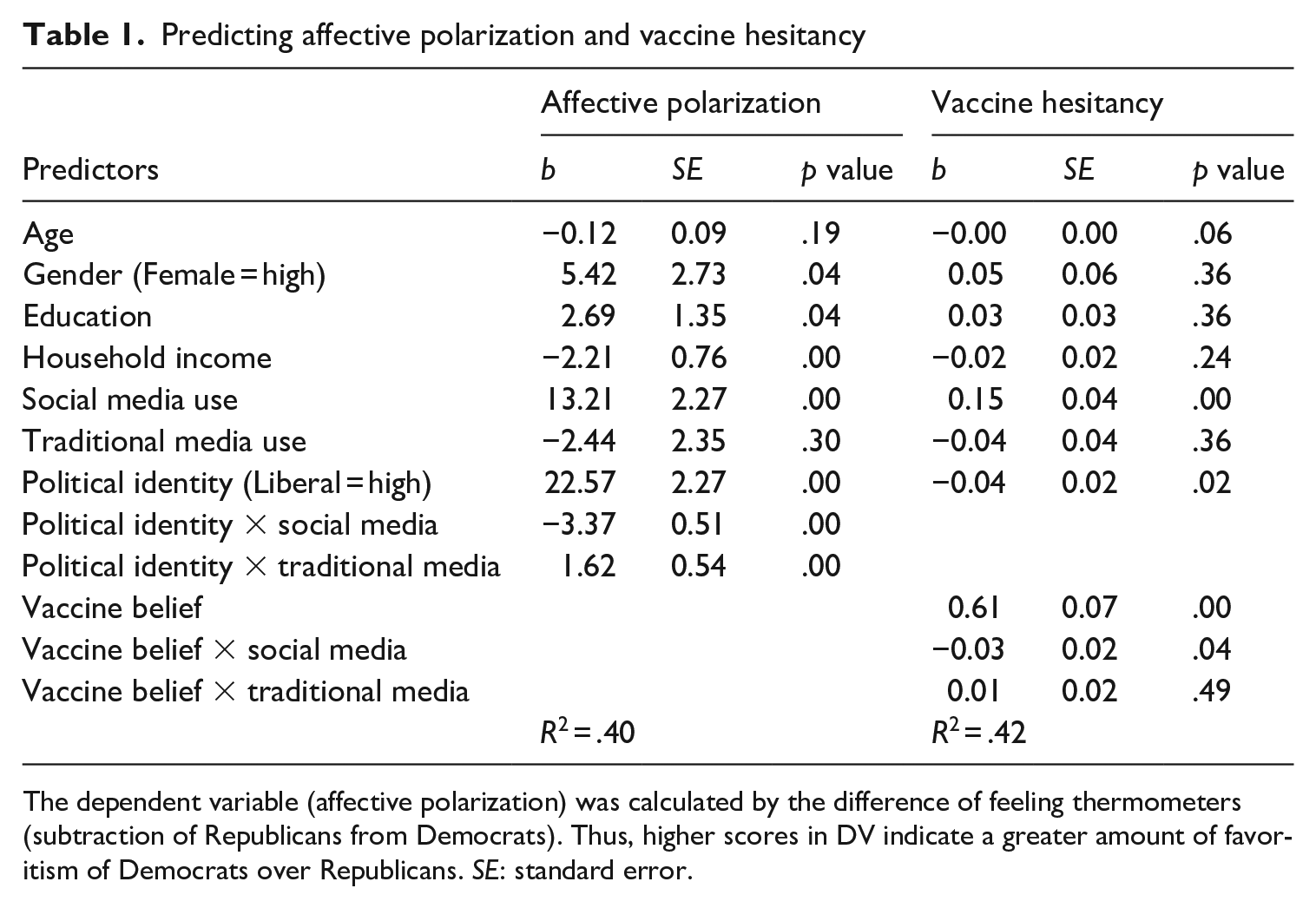
The dependent variable (affective polarization) was calculated by the difference of feeling thermometers (subtraction of Republicans from Democrats). Thus, higher scores in DV indicate a greater amount of favoritism of Democrats over Republicans. SE: standard error.
Confirming our expectation (H1), the results show that individuals show strong affective polarization based on their political identities after controlling for age, gender, education, and household income. In a nutshell, the stronger individuals’ political identities, the greater their in-group/out-group affect differences (i.e. affective polarization, b = 22.57, SE = 2.27, p < .001). Next, in addressing the polarizing or depolarizing role of media use on COVID-19, we investigated the statistical significance of two interaction terms, political identities × social media use and political identities × traditional media use. The results indicate that both interaction terms were significant but in opposite directions. Supporting H2b but rejecting H2a, social media use for the COVID-19 weakens the relationship between political identities and affective partisan polarization (b = −3.37, SE = 0.51, p < .001). Figure 1 on the left illustrates this pattern, showing that the slope is significantly steeper among light social media users than among heavy social media users for COVID-19. In contrast, traditional media use amplifies the relationship (b = 1.62, SE = 0.54, p = .003). As seen in Figure 1 on the right, heavy traditional media users display more affective partisan polarization based on their political identities than light traditional media users.
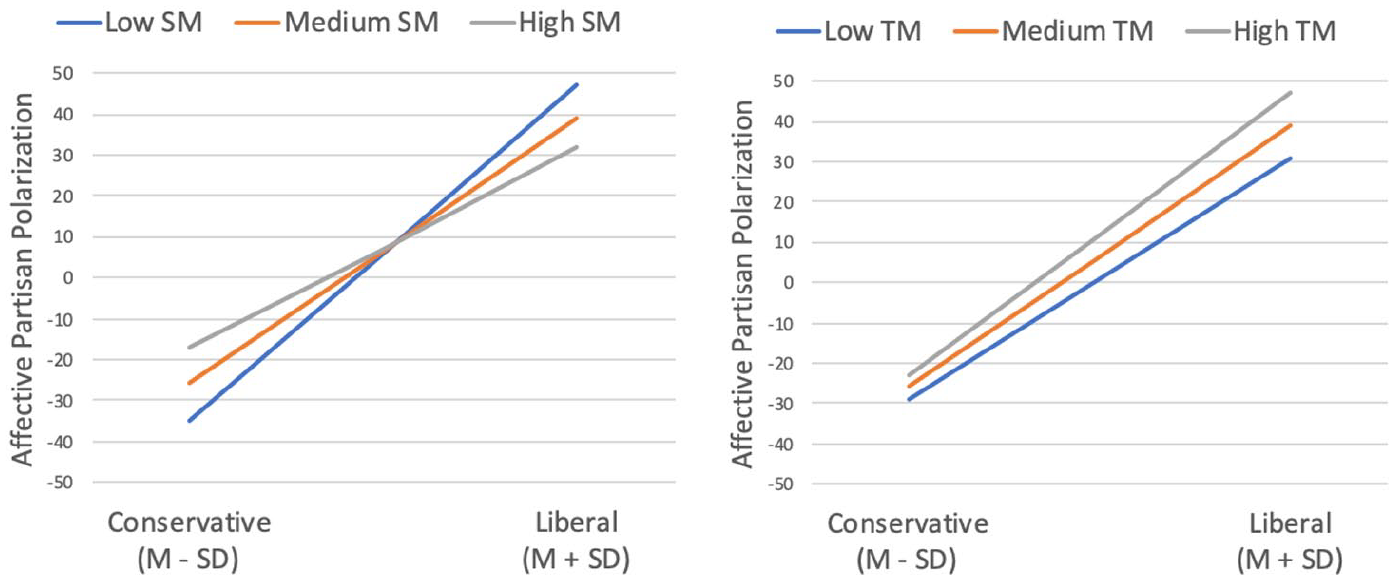
Predicting affective polarization by social media (SM) and traditional media (TM).
We found similar results for the vaccine data. The results show that individuals express vaccine hesitancy based on their pre-existing vaccine beliefs after controlling for age, gender, education, household income, and political identities. The stronger one’s belief in the link between vaccination and autism, the stronger one’s resistance to vaccines (b = .61, SE = .07, p < .001). Thus, H3 was supported. In exploring the moderating role of social media (H4a and H4b), the results suggest that the interaction term of vaccine belief and social media is significant (b = −.03, SE = .02, p = .04), which supported H4b but rejected H4a. Figure 2 on the left illustrates this relationship. In contrast, as shown in Figure 2 on the right, the interaction term with vaccine belief and traditional media (b = .01, SE = .02, p = .49) was not significant.
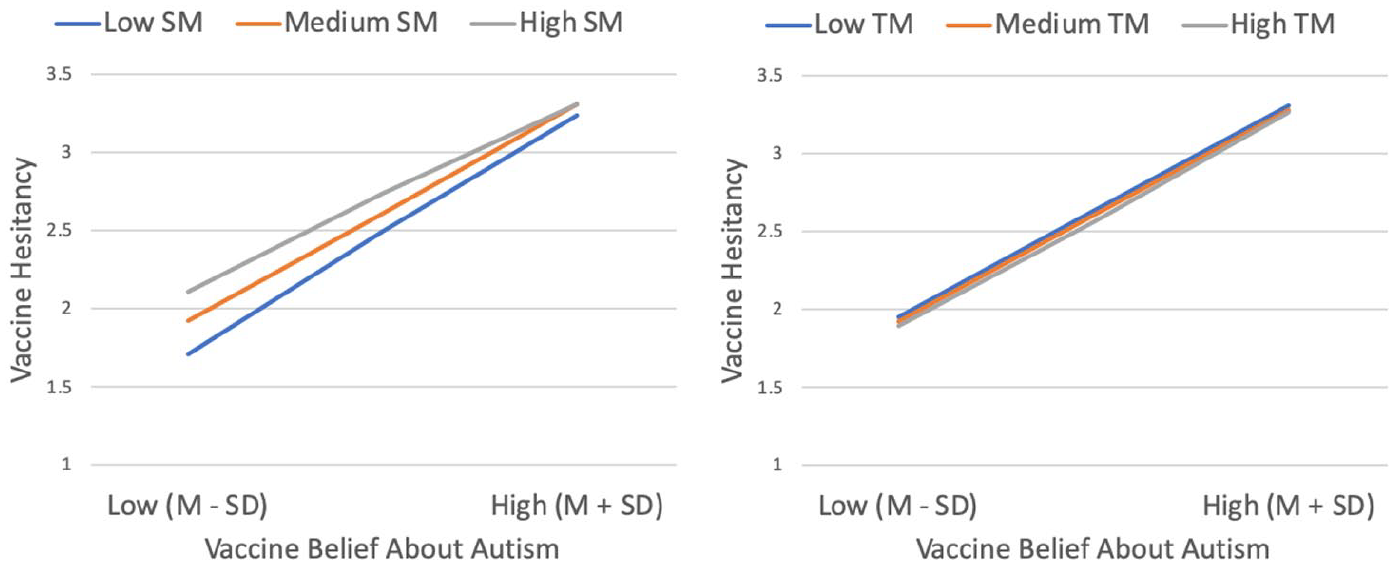
Predicting vaccine hesitancy by social media (SM) and traditional media (TM).
Discussion
In light of heightened concern that social media use during the COVID-19 pandemic is further sharpening public division (Druckman et al., 2020; Hart et al., 2020; Pew Research Center, 2020a), this study examined whether social media use is associated with the polarization process by strengthening individuals’ existing cognitive links. We also examined the role of traditional media in making it comparable to the role of social media.
We used two existing cognitive links as baseline tendencies that could be related to media use. The first link indicates the well-known political tendency that individuals discriminate against outgroups based on their political identities (affective partisan polarization). Another link is that individuals with misguided beliefs about the effect of MMR vaccines on autism are more likely to show vaccine hesitancy. While these two links represent baseline tendencies based on pre-existing beliefs, the domains have practical importance. The public divide in the two domains can significantly harm efforts against the current pandemic.
We then examined the moderating role of social media in these relationships. Contrary to prior claims that social media should be blamed for polarization in society (Pariser, 2011; Stroud, 2011), our results show that the link between political identities and affective partisan polarization weakens as social media use for COVID-19 information increases. Similarly, the link between misguided beliefs about child vaccines and vaccine hesitancy weakens as social media use for COVID-19 information increases. These findings highlight the positive aspect of social media use, supporting the claim that ideological segregation on social media is “overestimated” (Barberá et al., 2015: 1531).
Although our survey data did not allow us to specify the mechanism through which social media weaken the existing cognitive link, it is worth addressing possible mechanisms for future research. The extant literature offers three possible explanations. First, incidental exposure to diverse information on social media alleviates attitude reinforcement and polarization in online communication (Lu and Lee, 2019; Nelson and Webster, 2017). Studies indicate that social media users come across news incidentally while “online doing other things” (Gottfried and Shearer, 2016: 6). Recent research shows that users report significant learning outcomes through incidental exposure to political news (Nanz and Matthes, 2020). The findings suggest that once incidentally encountered information is found to be relevant, users engage in effortful information processing. Incidental exposure to unexpected information may thus have depolarizing outcomes.
Second, in deciding to click and learn information on social media, users may prioritize other information over the (mis)match between media content and users’ existing beliefs. For example, research has shown that social media users rely more on social cues, such as the number of likes and comments than the political affinity of information (Chung, 2017; Messing and Westwood, 2014). In addition, other researchers theorize that individuals are hardwired to pay attention to information that challenges rather than supports their views when evaluating potential risk (Jang, 2014; Shoemaker, 1996). Hence, individuals may be significantly attracted to new, unusual information in selecting information about COVID-19 or vaccines. Even when the new information conflicts with their existing beliefs about ideologies or vaccines, individuals may seek wider exposure out of a need to reassess the present danger.
Finally, it is likely that information presented by algorithms provides a wider range of viewpoints than information actively selected by users (Bakshy et al., 2015). A large-scale study using Facebook digital trace data concludes that like-minded exposure occurs mostly due to users’ psychological orientation to avoid different views, but cross-cutting exposure is widely available through algorithms (Bakshy et al., 2015). This study also suggests that users’ social networks are not as homogeneous as we think. Although our findings cannot further explicate the underlying mechanism of how social media use mitigates polarization, these possibilities deserve further investigation for a better understanding of the depolarizing effect of social media during the COVID-19 pandemic.
Although our results in both the political and health domains consistently showed the potential depolarizing role of social media, some may argue that this is not because people get information about COVID-19 from social media, but because they receive more information about COVID-19 regardless of the media platforms. To reject this possibility, we also examined the (de)polarizing role of traditional media. If the amount of information matters, not the platforms, both social and traditional media uses regarding COVID-19 should have shown the same directional pattern. However, we found opposite roles in the two media. According to our analyses, social media weakened the cognitive link in both domains, but traditional media either strengthened the link (in affective partisan polarization) or had no impact (in vaccine hesitancy).
It is worth noting that the use of traditional media for COVID-19 information accelerates affective partisan polarization. It is possible that traditional media users tend to be frequent customers of specific partisan news outlets. As these partisan media outlets increasingly convey politically tinged information and opinions, the habitual use of these outlets may reinforce in-group favoritism and out-group hostility (Lelkes et al., 2017; Stroud, 2011). In media use practice, social media users may encounter diverse views more easily on one media platform, but it could be more difficult for traditional media users to obtain information across multiple channels representing a wide range of political spectrum.
Nevertheless, we did not find a polarizing role of traditional media in the context of vaccine hesitancy. This nonfinding in the vaccine context may be attributed to the possibility that traditional media or even partisan sources do not promote consistent positions on vaccines. For example, while liberals in general tend to be more favorable toward vaccination than conservatives, Vice President-Elect Kamala Harris questioned vaccine safety during the presidential campaign (Kelly, 2020). As political elites and partisan media do not signal crystallized, consistent opinions about vaccine issues, it may be difficult to expect to see the significant role of traditional media one way or the other.
This study offers important practical implications for combating the pandemic. While the partisan division and polemic views on vaccines pose substantial obstacles to efforts to end the pandemic, our findings suggest that social media may function as an effective tool to mitigate such divisions (Centers for Disease Control and Prevention [CDC], 2021; Pew Research Center, 2020a). The message to take away from this study is thus positive, particularly given citizens’ increasing reliance on social media for political and health information (Pew Research Center, 2016). Taking advantage of this finding, governments, health organizations, and social media practitioners should consider how their social media agendas (e.g. vaccination programs) can attract dissenters’ attention. As social media exposure typically occurs through spontaneous and incidental clicking behaviors, it may be helpful to use social and recommendation cues that increase the perceived credibility of the message (Chung, 2017; Messing and Westwood, 2014).
Several limitations of this study should be noted. First, although the consistent results of the social media’s depolarizing role in the two domains increase the generalizability of the findings, it is still questionable whether the findings are generalizable to contexts outside the United States. Some expressed concerns that the United States may be an extreme case where media and public opinion are overly polarized (Bos et al., 2016; Kubin and von Sikorski, 2021).
Second, although we review possible explanations of social media’s (de)polarizing role, our survey data did not allow us to pinpoint specific working mechanisms. Previously, Bakshy et al. (2015) who had access to Facebook big data reported that the Facebook algorithm was not the primary factor of echo chamber. Similarly, Yarchi et al.’s (2021) research looked at the degree of polarization across social media platforms and unexpectedly found that Twitter showed a greater level of polarization than Facebook. However, the study was not able to disentangle the primary causal mechanism of such polarization as well. As it is challenging to distinctively measure incidental exposure and exposure based on algorithms through self-reported data, future research using digital trace data should examine this issue.
Third, although we believe that our findings illustrate important snapshots about the (de)polarizing role of social media, the cross-sectional analysis does not allow us to rule out the possibility of a reverse-direction influence such that the reinforcement of existing relationships (e.g. deepening affective partisan polarization) may decrease the motivation to use social media. While we do not rule out this possibility, there has been little research or theory to support this claim so far. On the contrary, a recent work (Osmundsen et al., 2021), which analyzed both social media behavioral data and self-reported data, concluded that partisan polarization (in the United States) was the primary psychological motivation behind information sharing (both real and fake news) on social media. Thus, although our data cannot directly demonstrate causal directions, our findings combined with other literature may suggest that one way is more plausible than the other way round. Future efforts should include long-term data to draw increasing causal inferences.
Finally, we measured pre-existing vaccine beliefs related to autism as an anchor point to test our second set of hypotheses, because most prior anti-vaccine movements have been rooted in such misguided beliefs. However, some people, especially nonparents, may possess misguided vaccine beliefs not based on child vaccines but from something else. Future research should incorporate broader factors that shape vaccine beliefs.
Conclusion
While partisan polarization has reached high-level records (Pew Research Center, 2019), there are concerns that media use and presentation of the COVID-19 pandemic may aggravate polarization. Responding to this concern, this study examined the role of media in strengthening or weakening existing cognitive links. The findings indicate that social media do not aggravate but alleviate polarization in both contexts, including partisan polarization and vaccine hesitancy. These are at odds with earlier filter bubbles or echo chamber claims that social media exacerbate intergroup relations and attitude reinforcement (Pariser, 2011; Stroud, 2011). Given that social media outlets function as important channels through which many people get information about COVID-19 (Pew Research Center, 2020b) or future health crises, these findings offer some relief to those concerned with increasing polarization surrounding public health issues. This study also has practical implications: If managed well, social media could be an effective tool for government or health organizations to reach a wide range of audiences for unbiased education or communication during health crisis.
Footnotes
Declaration of conflicting interests
The author(s) declared no potential conflicts of interest with respect to the research, authorship, and/or publication of this article.
Funding
The author(s) received no financial support for the research, authorship, and/or publication of this article.
