



Abstract
This research explored how a virtual reality (VR) public service announcement (PSA) in a first-person perspective (vs non-VR PSA scripts: first-person perspective-taking, non-perspective-taking) impacted attitudes toward the PSA and attitudes toward people experiencing homelessness. Participants first reported their attitudes toward people experiencing homelessness. Seven days later, participants watched or read a PSA about the life of a person experiencing homelessness and reported their attitudes toward the people experiencing homelessness and the PSA. We explored how psychological processes (telepresence, empathy, reactance) related to persuasion. Results showed viewing or reading any of the PSAs led to more favorable attitudes toward the target group. The VR PSA was the most likely format to induce telepresence and empathy and the least likely to induce reactance. Attitudes toward the VR PSA were more positive than toward the script PSAs. Overall, our study provides insights into the effectiveness of VR and narrative formats for persuasion.
Keywords
Introduction
In today’s complex media environment, media channels from print to digital to video to virtual reality (VR) present different affordances, which can change audiences’ interpretation of and reaction toward the same message content. For example, VR has been described as the ultimate “empathy machine” (Barbot and Kaufman, 2020) because the technology can simulate telepresence, a feeling of “being there” in real or imagined environments, allowing users to experience the scene and event together with the characters (Van Kerrebroeck et al., 2017). VR also affords perspective-taking, so users can experience vivid sensory information while they “step into the shoes” of the character on screen (Ahn and Bailenson, 2011). With the help of immersive environments generated by VR technology, people can easily experience a situation in the first-person perspective with empathy, affecting helping behaviors in real life (Ahn et al., 2013). A meta-analysis of VR studies found that VR experiences promoted empathy across a range of groups (e.g. elderly, victims of domestic abuse; Martingano et al., 2021). Because VR can evoke long-term empathy (Herrera et al., 2018), and empathy can influence people’s willingness to help others (Bagozzi and Moore, 1994), VR could be an effective carrier for public service announcements (PSAs).
While previous research has shared the benefits of VR for persuasion, we also consider potential negative effects, such as reactance. The immersive virtual space and perspective-taking in the narrative messages could induce reactance (Fransen et al., 2015). Few studies have explored how reactance interacts with perspective-taking, especially in narratives and immersive environments. Not all issues featured in PSAs will uniformly elicit empathy from the media viewer. Some issues, such as homelessness, may garner widespread support (e.g. Tsai et al., 2018), but individuals still vary in public attitudes (Phelan et al., 1995; Tsai et al., 2017) and ways to address the problem (Tsai et al., 2018). Homelessness (i.e. people who lack housing; Phelan et al., 1997) continues to be a social issue with some stigma attached to the label “homeless,” yet there is possibility for attitude change with exposure to the topic (Lee et al., 2010). Therefore, we chose homelessness and attitudes toward people experiencing homelessness as our issue.
We were interested in knowing if different kinds of exposure—first-person perspective and first-person perspective in VR versus a third-person perspective—could help build empathy and more favorable attitudes toward people who are experiencing homelessness. Given the power of VR to induce emotional empathy and compassion (Martingano et al., 2021), we examine the relative effectiveness of VR to promote prosocial attitudes through a PSA, and we explore the underlying persuasion mechanisms behind this effect, illustrating the roles of telepresence, psychological reactance, and empathetic responses.
Literature review
VR and telepresence
VR has been defined as “a real or simulated environment in which the perceiver experiences telepresence” (Steuer, 1992: 76). Telepresence is positively associated with persuasion, including favorable attitudes (i.e. Cauberghe et al., 2011; Suh and Lee, 2005), feelings for branded content (e.g. Daugherty et al., 2005; Nelson et al., 2006; Shen et al., 2019), attitudes toward advertising (Spielmann and Mantonakis, 2018), increased positive thoughts about the content (Cauberghe et al., 2011), and increased enjoyment in a VR news story (Van Damme et al., 2019). The theoretical mechanism for enhanced persuasion via telepresence could be enacted through the more positive feelings generated because of the immersion and vividness associated with telepresence (Steuer, 1992). As VR can elicit a more compelling sense of telepresence than can other media (Chen and Yao, 2021; Van Damme et al., 2019), we predict that
H1. The VR version of the PSA will elicit higher levels of telepresence than the script (first-person perspective, objective) versions of the PSAs.
We expect that the VR-mediated environment will evoke feelings of telepresence, which will be positively related to attitudes toward the featured content (i.e. the greater sense of telepresence evoked from the PSA, the more favorable attitudes to the PSA content and the social issue). We expect these relationships to hold, irrespective of narrative conditions.
H2. The perceived levels of telepresence will be positively related to (a) attitudes toward the PSA and (b) attitudes toward the social issue (homelessness and people experiencing homelessness).
Perspective-taking and VR
Perspective-taking, which is the process of imagining the world from another person’s point of view, is an intervention technique that has been used to reduce stereotypes and negative attitudes (e.g. Galinsky et al., 2005; Oh et al., 2016). When people take others’ viewpoints, they tend to lose self-awareness and take on the feelings and perspectives of that character (Cohen and Warlop, 2001). Different forms of traditional perspective-taking can have a powerful impact on fostering prosocial attitudes and reducing stereotyping (Shih et al., 2009). Traditional perspective-taking relies on imagination to put oneself in another person’s shoes, and it can be a complex cognitive task (Myers et al., 2014). Individuals may differ in their abilities and motivations to engage in such activities (Gehlbach, 2004).
The new affordances (e.g. telepresence) of VR technology provide a novel way to facilitate perspective-taking by allowing the user to experience vivid information in the virtual environment (Ahn and Bailenson, 2011; Ahn et al., 2013). As VR can offer a more tangible experience, perspective-taking in VR may require less cognitive effort than the traditional perspective from mental simulation (e.g. Vescio et al., 2003). West and Bruckmüller (2013) found that the perceived difficulty of perspective-taking tasks may have a significant influence on participants’ motivation and ability to truly feel the world from other people’s point of view. Following this finding, VR may help people who have low empathy traits or who hold resistant attitudes to the target character to engage in the content and alter their attitudes.
Perspective-taking VR can create the sensation of embodiment, where audiences see themselves as a part of the VR experience (Shin, 2018). Users who embody avatars in VR perceive character actions as their own (Shin, 2018) and believe VR components are part of their own bodies (Laha et al., 2016). This virtual experience is associated and stored with existing memories, which may then be recalled and activated when people encounter similar situations in real life (Barsalou, 2009). Therefore, if individuals experience a person who is experiencing homelessness in VR, they should be able to better understand people who are experiencing homelessness, which would reduce prejudice. Furthermore, people who are in the immersive virtual environment tend to be less “present” in the physical world as they almost receive no “cues” from the physical world; they may feel less self-aware when engaging in perspective-taking tasks via VR, which has been linked to increased persuasion effects (Millar and Millar, 1996).
In sum, VR has the potential to intensify the effectiveness of traditional perspective-taking and has an additive effect, thus achieving more favorable results for persuasion. To test this prediction under the context of attitude change toward people who experience homelessness, we hypothesize that
H3. Participants will have more positive attitudes toward people experiencing homelessness after they watch the VR PSA from a first-person perspective as compared with their initial attitudes toward the people experiencing homelessness.
H4. The first-person VR PSA will yield the greatest attitude change toward people experiencing homelessness as compared with the first-person perspective script PSA, followed by the objective script PSA.
Perspective-taking and empathy
Some research has shown a positive relationship between perspective-taking and prosocial behaviors and attitudes (Baston et al., 1997; Oh et al., 2016), but there is still no agreement on the mechanism behind the findings. Studies have shown that people are more engaged when taking a character’s viewpoint and adopting the character’s intention, which typically results in experiencing the emotion of empathy (Hartung et al., 2016). Empathy, a person’s ability to feel within or in another person’s feelings (Langfeld, 1967), has been identified as an important mechanism in persuasive communication (e.g. Batson et al., 1997), including response to PSAs. Empathy includes experience sharing and mentalizing (Zaki, 2014). Experience sharing describes the observer’s tendency to take on the sensory and affective states they encounter in targets (Gallese, 2003), which is more relevant to the affective mechanism, whereas mentalizing refers to observers’ ability to draw inferences about targets’ situations (Zaki, 2014), which is more connected to the cognitive mechanism.
In addition to perspective-taking, immersion can also enhance empathy (Mar and Oatley, 2008). Some researchers proposed that becoming absorbed by VR can stimulate empathy and then increase a user’s overall positive evaluation of the issue (Schutte et al., 2017; Shin, 2018). Ahn et al. (2013) found that VR-embodied experiences led participants to voluntarily spend more time helping persons with color-blindness compared to individuals who had only imagined being color-blind. In another study, viewers who were exposed to VR content for a social cause felt a higher level of presence, and they were more likely to feel empathy and donate their time and money to the cause as compared with those who viewed the content in standard video form (Kandaurova and Lee, 2019). Results of a meta-analysis of the effects of VR on empathy (Martingano et al., 2021) showed that the empathy derived from a specific VR experience can transfer beyond the content to generalized, relevant targets, “for example, a VR experience about a single child refugee is likely to increase empathy toward all child refugees” (p. 7).
Scholars have found that exposure to PSAs can stimulate empathy, which influences people’s willingness to help others (e.g. Sar and Southwell, 2005). Herrera et al. (2018) also showed that a perspective-taking VR is an effective tool for increasing the level of empathy. Thus, it is expected that a first-person perspective VR PSA about homelessness should have better effects on eliciting empathetic responses than a first-person perspective script PSA. Therefore, we predict that
H5. The first-person VR PSA will elicit the highest level of empathy toward people experiencing homelessness as compared with the first-person perspective script PSA, followed by the objective script PSA.
Given that telepresence allows users to feel part of the empathy-evoking mediated experience, it is reasonable to speculate that empathy mediates the relationship between the perceived level of telepresence and prosocial attitudes toward the issue and VR content. Specifically, we predict that the feeling of telepresence induced by the PSA can evoke audiences’ empathic response toward the content (e.g. people experiencing homelessness in our context), and empathy can further lead to prosocial attitudes and more positive attitudes toward the PSA.
H6(a). The impact of telepresence on attitudes toward the PSA will be mediated by empathetic responses.
H6(b). The impact of telepresence on attitudes toward people experiencing homelessness will be mediated by empathetic responses.
Psychological reactance
Though there is ample evidence that perspective-taking has beneficial effects on a variety of social behaviors, there may be some unintended side effects of perspective-taking (Okimoto and Wenzel, 2011; Vorauer, 2013), including inducing reactance, which may produce more hostile attitudes toward the targets of perspective-taking (Berndsen et al., 2018). According to psychological reactance theory, individuals have a basic need for independence (Brehm, 1966). When an individual perceives that the freedoms are threatened by a third party, the individual will become aversively aroused (Fransen et al., 2015). Cikara et al.’s (2011) study found that individuals’ dislike for the target could lead them to resist perspective-taking in the first place and generate negative effects such as reactance. Vorauer’s (2013) research suggested that perspective-taking could activate positive (e.g. empathy) and negative processes (e.g. reactance), which is consistent with Zaki’s (2014) argument about empathy avoidance: when people try to avoid pain from experience sharing, the opposite reactions would be activated.
On the other hand, narrative transportation theory suggests that people have reduced motivation and ability to generate counterarguments when they read a story script from an objective perspective and experience a sense of transportation (i.e. sharing the character’s perspective, emotion, and goals as an observer) (Green and Brock, 2000). With perspective-taking in the narrative, identification may happen such that the viewers will lose self-awareness and take on the feelings, perspectives, and goals of that character (Cohen and Warlop, 2001). In this case, the loss of self-awareness may lead to less motivation to counterargue with the persuasive message and less negative reaction.
In a first-person perspective VR experience, viewers tend to be more present in the virtual world and less present in the physical world. The viewers may feel even less self-aware compared to a first-person perspective narrative message and less likely to be aversively aroused. However, it is difficult for people to ignore the stimuli when they are experiencing the first-person perspective VR. As the stimuli are projected in front of individuals’ eyes, people are forced to stand in the protagonist’s shoes and experience the story from their viewpoint. In this study, people may be reluctant to experience the life of a person who is experiencing homelessness; therefore, reactance would be elicited. Considering some inconclusive findings of the literature, we explore this research question:
RQ1. Which type of PSA presentation (first-person perspective VR PSA, first-person perspective script PSA, objective script PSA) elicits the most psychological reactance?
If psychological reactance has been triggered, it may negatively affect the attitudes toward the target and the source of the threat. Therefore, we anticipate that
H7. The perceived level of reactance will be negatively related to (a) attitudes toward the PSA and (b) attitudes toward people experiencing homelessness.
Attitudes toward the issue and the PSA
We were interested in people’s attitudes toward the PSAs and how these attitudes toward the PSA may impact attitudes toward people who are experiencing homelessness. Some studies show that when people like a PSA, they form positive attitudes toward the message; they will also show more favorable attitudes toward the social issue and beliefs featured in the message (e.g. Dillard and Peck, 2000). This pattern is based on the well-known links between “attitude toward the ad” and “attitude toward the brand” relationship demonstrated in advertising scholarship (e.g. Mitchell and Olson, 1981) where the positive feelings from the message may transfer to the brand. We expect that positive attitudes toward the PSA will increase people’s favorable perception and feelings toward people experiencing homelessness after watching or reading the PSA.
H8. Attitudes toward the PSA will be positively related to attitudes toward people who are experiencing homelessness at time 2 (after participants viewed/read the PSA).
Though some VR studies have compared attitudes between VR messages and two-dimensional (2D) screen messages (e.g. Ahn et al., 2013; Shin, 2018), there is a lack of direct attitude comparisons among perspective-taking VR, perspective-taking text narration, and non-perspective-taking narration. Therefore, we raise this question:
RQ2. Which type of PSA presentation elicits the most positive attitude toward the message?
Method
Participants and stimulus
One hundred and forty students were recruited from a participant pool from a large university in the United States and were given research credit. After data cleaning due to incomplete entries, 114 participants’ data were used (Male = 31, Female = 83, Mage = 20.5, SDage = 1.28).
Participants in all three conditions were exposed to the same narrative. We presented the life story of a woman (Hope) who was experiencing homelessness, either as an 11-minute first-person perspective VR video or as one of two written narrative video scripts with the same content, described in a first-person perspective or with no perspective-taking (objective version). The content focuses on Hope, whose partner suddenly dies, which detrimentally affects Hope’s job performance and ultimately leads to unemployment and homelessness. The narrative of the video was facilitated by conversations between Hope and her friends, her boss, and her own perspectives. At the end of the story, a subtitle advocates for more attention to the social issues of people experiencing homelessness with links for donations to local shelters. The video was filmed as a first-person experience. When participants looked down through the VR headset, they would see Hope’s hands and body, as if they were the character in the video (see Figure 1). The video script used a transcription of the video, with annotations to reveal the main characters, the identity of each character, the place where conversations took place, the characters’ behaviors, and background information. The script preserved vivid information from the video, allowing participants to understand the story and imagine the situation of the characters.
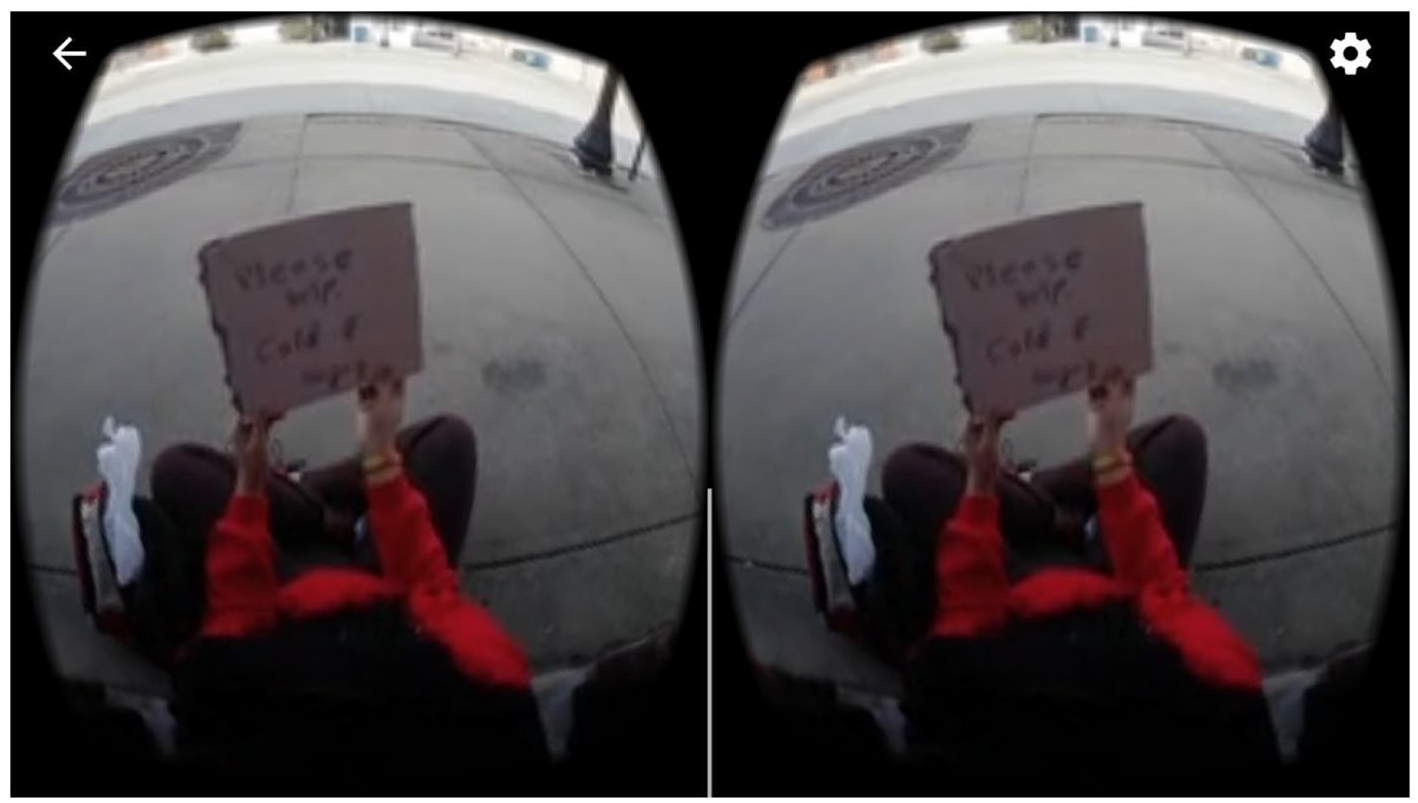
First-person perspective of the VR PSA.
To manipulate participants’ perspective-taking when reading the script, we provided different instructions for first-person and objective conditions. For the first-person perspective, participants read the script as if they were Hope, the main character who becomes homeless. The main character’s name was also changed to “you” to make people assume the perspective easier. This “you” perspective has been used to elicit this same kind of response (Ahn and Bailenson, 2011). For the objective reading condition, we asked participants to read the script objectively (i.e. without a “you” perspective or imagine yourself as the character). Everything else remained the same in the script reading conditions.
Design and procedures
A within-subject repeated-measure (attitude toward people experiencing homelessness session 1 and session 2) experiment across three PSA conditions (first-person perspective VR viewing condition, first-person script reading condition, and objective script reading condition 1 ) was conducted. In the first session (time 1), we measured all participants’ pre-existing attitudes toward people experiencing homelessness. A 1-week delay between the sessions was added to circumvent order effects or demand effects that often occur with repeated measures. At time 2, participants were randomly assigned to one of the three PSA groups. Participants assigned to the VR condition watched the VR PSA on an Oculus Rift 2 headset, in which they experienced the life story of a person experiencing homelessness. The participants who were assigned to the script reading conditions read the instruction before the script. After participants watched the VR PSA or read the scripts, they completed a questionnaire, which assessed their perceived telepresence, empathy, attitudes toward people experiencing homelessness, psychological reactance, and attitudes toward the PSA. The attitude toward people experiencing homelessness items was the same as those posed in the first session but was presented in a different order. Due to the delay between the pre- and post-study and the randomization of the questionnaire, we believe that participants’ responses at each session reflect their genuine attitudes.
Measures
Attitudes toward people experiencing homelessness
Participants’ attitudes toward people experiencing homelessness were measured using 14 items from Phelan et al. (1995) related to “tolerance” (e.g. “hard to understand how anyone becomes homeless”). Responses were combined to create an attitude index: session 1 (pre-attitude, Cronbach’s alpha = .78); session 2 (post-attitude, Cronbach’s alpha = .84).
Attitudes toward the PSA
Attitudes toward the PSA were measured with six dichotomous items (e.g. “I think the video/script is good-bad”; Spears and Singh, 2004), Cronbach’s alpha = .84.
Telepresence
Telepresence was measured using an 8-item scale where participants indicated agreement to statements such as “When the video ended/When I finished reading the script, I felt like I came back to the ‘real world’ after a journey” (Kim and Biocca, 1997) (Cronbach’s alpha = .71).
Empathy
Empathetic response was measured using five 7-point Likert-type questions (Escalas and Stern, 2003; e.g. “While watching the VR video/While reading the script, I felt as though I were one of the characters”) (Cronbach’s alpha = .95).
Empathy traits
Empathy traits were tested by a scale adopted from Beadle et al. (2012; e.g. “I am good at predicting how someone will feel”) (Cronbach’s alpha = .72).
Reactance
Psychological reactance was measured on a 7-point Likert-type scale (Shen and Dillard, 2005), with questions such as “I feel irritated after viewing this video/reading this script” (Cronbach’s alpha = .87).
Results
First, we checked the assumption of normality using a Q-Q plot and found that the values of telepresence, empathy, attitudes, and reactance were normally distributed (see Table 1 for descriptive statistics). Because we have unequal sample sizes (VR condition: 64; first-person script: 25; objective script: 25), homogeneity of variance tests was conducted. Results show that all variables have similar variances across the three groups. Therefore, unequal sample sizes should not be a problem for the analysis of variance (ANOVA) analysis (Keppel et al., 1992). Finally, because individual differences in the predisposition to care for others can influence tendency to engage in perspective-taking (Davis et al., 1994), a one-way ANOVA was conducted to confirm that participants’ empathy didn’t vary significantly across conditions, F(2, 113) = 2.306, p > .05.
Descriptive statistics (mean and standard deviation) for dependent variables in three conditions.

PSA: public service announcement; VR: virtual reality.
H1 proposed that the VR PSA would elicit a higher level of telepresence than the two script versions. We conducted a one-way ANOVA with the three conditions as the factors and perceived telepresence as the dependent variable. There was a significant difference in telepresence among the three conditions: MVR = 4.39 (SD = 1.20), M1st = 3.76 (SD = 0.8), Mobj = 3.60 (SD = 0.78), F(2, 113) = 6.43, p < .01. A post hoc analysis compared the groups’ means, using Scheffé test due to unequal sample sizes. People in the VR group reported significantly higher telepresence than individuals in the objective script (MD = 0.79, p < .01) and the first-person perspective script (MD = 0.62, p < .05) conditions. There was no difference in telepresence between the script conditions; H1 was supported.
Hypothesis 2a proposed that participants’ levels of telepresence would be positively related to their attitudes toward the PSA. Because pre-existing attitudes might influence post-media attitudes toward the stimulus (e.g. Stammerjohan et al., 2005) and gender differences may arise in message response (e.g. Chang and Lee, 2011), we included these variables as covariates. Results revealed a statistically significant positive relationship between telepresence and participants’ attitudes toward the PSAs, ß = .426, t(111) =4.917, p < .001, R2 = .192. When participants’ perceptions of telepresence increased, their attitudes toward the PSAs became more positive. Neither gender (ß = −.084, p > .05) or pre-attitudes (ß = .124, p > .05) were significant in the analysis testing for H2a. H2a was supported.
Hypothesis 2b proposed that participants’ telepresence would be positively related to their attitudes toward people experiencing homelessness at time 2. We included the same covariates (i.e. gender, attitude toward people experiencing homelessness) as in the previous analysis. However, based on the results of the linear regression, ß = .071, t(111) = 1.03, p > .05, R2 = .49, H2b was not supported. Gender (ß = −.015, p > .05) was not significant in the analysis, but pre-attitude toward people experiencing homelessness (time 1) showed a significant and positive result with post-PSA attitudes toward people experiencing homelessness (ß = .693, p < .001).
To explore H3 and H4, a repeated-measure mixed ANOVA was applied to examine the effectiveness of the VR PSA on people’s attitudes toward people experiencing homelessness (time 1 vs time 2) and how attitudes may be different across the three PSA conditions. Time (pre-attitude and post-attitude) was entered as a within-subject variable and groups was entered as the between-subject variable. The result of Box’s test suggested that the variance of the dependent variable (i.e. attitudes) was equal across groups. The results of the mixed ANOVA showed that there was a significant main effect of time on attitudes toward people experiencing homelessness. Participants’ attitudes toward people experiencing homelessness became significantly more positive after exposure to the PSA regardless of the condition, Mpre = 4.23 (SD = 0.80), Mpost = 4.46 (SD = 0.85), F(1, 110) = 12.715, p < .001, in support of H3. There was no significant interaction effect, F(2, 110) = 0.131, p > .05,; there was no difference across the three PSA types (see Table 1 for descriptive data); H4 was not supported.
To test H5, a one-way ANOVA was conducted. The test of homogeneity of variances suggested that the variance of empathy levels was equal across groups. The main effect of condition was significant, F(2, 113) = 5.93, p < .01. Scheffé post hoc test showed that the VR PSA elicited higher empathy levels than the objective script PSA, MVR = 4.48 (SD = 1.62), Mobj = 3.26 (SD = 1.43), p < .01, but there was no significant difference in empathy between the first-person script PSA and the VR PSA (p > .05). Participants who read the first-person script PSA (M1st = 4.38, SD = 1.41, p < .05) also reported higher empathy levels than those who read the objective script PSA; H5 was partially supported.
Hypothesis 6a/b proposed the mediating role of empathy in understanding the role of telepresence on attitudes toward people experiencing homelessness and attitudes toward the PSA. H6a predicted that the impact of telepresence on attitudes toward the PSA could be explained by participants’ empathetic response. We controlled for participants’ pre-existing attitudes, ß = −.130, t(111) = −0.848, p > .05, toward people experiencing homelessness as well as gender, ß = .040, t(111) = 0.136, p > .05, in the mediation analysis; neither of these variables were significant. Regression analysis was used to investigate the hypothesis that empathy mediates the relationship between telepresence and attitudes toward the PSA. Results indicated that telepresence is significantly and positively correlated with individuals’ attitudes toward the PSA, ß = .426, t(111) = 4.917, p < .001, R2 = .192. Telepresence is also significantly and positively correlated with participants’ empathy responses, ß = .874, t(111) = 7.767, p < .001, R2 = .361). Finally, when adding empathy into the model, we found that the positive correlation between telepresence and participants’ attitudes toward the PSA diminished, ß = .260, t(111) = −2.547, p < .05, showing partial mediation. The positive relationship between empathy and participants’ attitudes toward the PSAs remained, ß = .174, t(110)= 2.50, p < .05. The indirect effect was tested using a percentile bootstrap estimation using 1000 samples implemented using the PROCESS macro version 3.3 (Hayes, 2009). The result of this analysis indicated that the indirect coefficient was significant (B = 0.152, SE = 0.068, 95% confidence interval [CI] = [0.157, 0.283]) in support of the mediation. These results demonstrated that the influence of telepresence on attitudes toward the PSA was partially mediated by participants’ empathetic responses of the PSAs, in support for H6a (see Figure 2).

Estimation of the empathy mediation path coefficients: attitudes toward the PSA (all three conditions together).
We created another mediation analysis model following the guidelines above to test H6b, which predicted a similar pattern as H6a but for attitudes toward people experiencing homelessness. As verified earlier, telepresence is significantly and positively related to empathy. However, telepresence was not positively related to attitudes toward people experiencing homelessness, ß = .030, t(111) = 0.441, p > .05. The indirect effect was tested using a percentile bootstrap estimation using 1000 samples implemented using the PROCESS macro version (Hayes, 2009). These results indicated that the indirect coefficient was insignificant (B = 0.026, SE = 0.0385, 95% CI = [−0.503, 0.205]); H6b was not supported.
To explore RQ1, a one-way ANOVA was conducted with the three conditions as the independent variable and reactance level as the dependent variable. The results indicated that there was a significant main effect of condition on reactance, F(2, 113) = 4.23, p < .05,; the Scheffé post hoc analysis suggested that the first-person perspective script PSA (M1st = 2.77, SD = 1.49) elicited a significantly higher level of reactance than the VR PSA (MVR = 2.02, SD = 1.07, p < .05). The first-person perspective script PSA also elicited a significantly higher level of reactance than the objective script PSA (Mobj = 1.91, SD = 1.20, p < .05). However, there was no difference between the VR group and the objective script group (p > .05).
H7a/b predicted that reactance would be negatively related to attitudes toward the PSA and attitudes toward people experiencing homelessness. Two hierarchical linear regression analyses were conducted separately. First, gender and attitudes toward people experiencing homelessness at time 1 were entered in the first block (model 1) and then psychological reactance as the predictor variable was entered in the second block (model 2). Attitudes toward the PSAs were entered as the dependent variable. Neither participants’ attitudes toward people experiencing homelessness at time 1 (ß = .11, p > .05) nor gender (ß = .01, p > .05) was related to their attitudes toward the PSAs. In model 2, the result indicated that the reactance level was not related to (ß = −.11, p > .05) the attitudes toward the PSAs. Therefore, H7a was not supported. To test H7b, the same independent variables were entered with attitude toward people experiencing homelessness at time 2 as the dependent variable. The result of this regression analysis showed that participants’ attitudes toward people experiencing homelessness at time 1 were positively related to their attitudes toward people experiencing homelessness at time 2 (ß = .70, p < .001). In model 2, the level of reactance (ß = −.18, p < .01) and attitudes toward people experiencing homelessness at time 1 (ß = .69, p < .001) were positively related to attitudes toward people experiencing homelessness at time 2. Adding the attitudes toward the PSA resulted in a significant increase in R2, ΔR2 = .033, F(1, 109) = 7.44, p < .01. Gender was not significant in either block. Thus, participants’ reactance was a significant and negative predictor of their attitudes toward people experiencing homelessness at time 2, in support of H7b (see Table 2).
Summary of hierarchical regression analyses.

SE: standard error.
p < .05; **p < .01.
H8 proposed that the attitudes toward the PSA would be positively related to the attitudes toward people experiencing homelessness at time 2. A simple linear regression was conducted. Results show that people’s attitudes toward the PSA were positively related to their attitudes toward people experiencing homelessness at time 2, ß = .213, F(1, 113) = 5.34, p < .05, in support of H8.
To explore RQ2, we conducted a one-way ANOVA to examine how attitudes toward the PSAs differ among the three conditions. There was a significant main effect of groups on attitudes toward the PSAs, F(2, 112) = 5.19, p < .01. Results of a Scheffé post hoc test indicated that individuals’ attitudes toward the VR PSA (MVR = 4.99, SD = 0.97, p < .05) were significantly more positive than individuals’ attitudes toward the first-person perspective script PSA (M1st = 4.36, SD = 1.01, p < .05) and attitudes toward the objective script PSA (Mobj = 4.39, SD = 1.12, p < .05). There was no significant difference between the two script conditions.
Discussion
Our study provides new insights into the persuasive effectiveness of VR as a tool to promote prosocial attitudes through a PSA, how people perceived the PSA itself, and how its effectiveness is different from the PSAs in perspective-taking narrative text formats. We found that participants’ attitudes toward the VR PSA video were significantly more positive than the perspective-taking or objective script PSA. In addition, participants’ attitudes toward people who are experiencing homelessness became more positive after watching or reading any of the PSAs. Participants’ attitudes toward the PSAs positively affected their attitudes toward the target group (people who are experiencing homelessness).
We further explored three factors to examine the underlying persuasive mechanism: telepresence, empathy, and psychological reactance. We found that the first-person VR PSA elicited a higher level of telepresence than either of the story script PSAs. In addition, telepresence was positively related to the attitudes toward the PSA, but not to attitudes toward people experiencing homelessness. As for empathy, both the first-person VR PSA and the first-person perspective script PSA triggered higher levels of empathy than the objective script, and empathy was a significant mediator between telepresence and attitudes toward the PSA. Finally, as for psychological reactance, we found that people in the VR group reported a significantly lower psychological reactance level than people in the first-person perspective script group. Reactance is found to be negatively related to the attitudes toward people who are experiencing homelessness, which is the target presented in the PSAs.
Theoretical contribution and implications
Narratives have a positive effect on persuasion (Green and Donahue, 2011; Green et al., 2003). Previous research found that participants who read narratives showed fewer counterarguments about the persuasive content, displayed more story-consistent beliefs, and had more positive attitudes (Shen et al., 2015; Van Laer et al., 2014). In our study, all conditions with the same narrative story of a person experiencing homelessness improved participants’ attitudes toward people experiencing homelessness, adding another piece of evidence to this line of literature. The persuasive effect of narrative worked across three conditions, regardless of the perspective or media device.
Previous studies have found that first-person perspective-taking results in greater empathic concern for the person in the story than an objective narrative account (Myers et al., 2014). Similarly, we found that both the VR and the first-person perspective condition resulted in greater empathy for the target person experiencing homelessness as compared with the objective condition. Our findings also suggested that perspective-taking facilitated users’ comprehension of the narrative and empathy with the character especially with the help of VR technology, leading to the most favorable attitudes toward the PSA.
While previous research suggested that perspective-taking facilitates users’ identification with characters (Myers et al., 2014), which further reduced counterarguments (Moyer-Gusé and Nabi, 2011), our study found a non-universal effect of perspective-taking on persuasive outcomes. Specifically, participants reported the most positive attitude toward the first-person perspective VR PSA, yet this script garnered more reactance than the objective script PSA. Meanwhile, the VR version of the PSA garnered less reactance than the first-person perspective script PSA. These results convincingly suggest that perspective-taking could be a potential factor for evoking psychological reactance despite narrative immersion. Furthermore, our results show that VR technology may reduce this negative consequence caused by perspective-taking and lead to more empathetic responses.
The non-universal effect of perspective-taking we found could be explained by the Motivated Model of Empathy proposed by Zaki (2014), which illustrates the underlying mechanisms of the circumstances in which users approach versus avoid empathy, or even reactance. This model proposes that empathy is context-dependent and driven by an individual’s motivation. In a context with positive affect, affiliation, and social desirability, users are more motivated to approach empathy. However, people may be motivated to avoid empathy to avoid experiencing negative feelings in the context of suffering. Taking the perspective of a person experiencing homelessness may provide the circumstances in which participants anticipate a context of suffering and are motivated to avoid empathy. Our finding points to a more extreme condition, in which users not only avoid empathizing but also actively take on coping strategies to justify their avoidance, leading to higher reactance.
VR provides vivid sensory information that blurs the boundary between the physical and virtual world, alluring users to perceive a sense of “being there” in a virtual world (Steuer, 1992). An embodied VR experience allows users to take the perspective of a character, further helping them to understand and empathize when they are placed in the same place and close to a character (Shin, 2018). Our study found a positive effect of VR on users’ sense of telepresence. Combining with perspective-taking, users also experience a higher sense of empathy, which explains the effect of telepresence on their positive attitude toward the PSA. Previous research suggested that the embedded design of the VR system may help to overcome the reactance or defensiveness and shift users’ implicit bias (Kaufman and Flanagan, 2015). We provide evidence that complements this proposition. Without the help of VR to comprehend the character, the perspective-taking of a person experiencing homelessness may boomerang and cause reactance when imagining oneself being a person experiencing homelessness, which further leads to more negative attitudes toward the target (i.e. people who are experiencing homelessness).
Limitations and areas for future research
Despite these interesting findings, our study had limitations. Our results didn’t show that perceived telepresence was related to participants’ attitudes toward people experiencing homelessness after watching the PSAs. There might be other variables that influence the understanding of attitudes toward this social issue, such as involvement (Cowan and Ketron, 2019). Our study found that the first-person perspective script PSA elicited stronger psychological reactance than the script with no perspective-taking. However, the first-person perspective VR PSA didn’t exhibit this problem. Previous studies have also shown that upon exposure to a persuasive message, people may experience psychological reactance because persuasive messages are perceived as a threat to freedom (Brehm, 1966). As a result, a boomerang effect may be generated where a receiver behaves in a direction opposed to the one advocated by the message (Hovland et al., 1953). Our study confirmed this finding in print form PSAs with first-person perspective-taking, but we didn’t have enough evidence to explain why VR avoids this issue. It might be the novelty effect of experiencing VR, rather than its unique affordances such as telepresence. It is possible that the repeated use of VR leads to desensitization toward the effects of VR and may lose its power after a few times. Future studies should address this possibility by examining the effects on people with different familiarity with VR technologies. Despite these limitations, we hope that our study inspires future research on VR, social issues, and PSAs.
Footnotes
Author’s note
All authors have agreed to the submission and the article is not currently being considered for publication by any other print or electronic journal.
Funding
The author(s) received no financial support for the research, authorship, and/or publication of this article.
