



Abstract
Although an increasing amount of aggressive and polarized tweets about climate change are being observed, little is known about how they spread on Twitter. This study focuses on how different types of network gatekeepers use aggressive styles and how the styles affect their propagation. The current study employed a computational method and identified 951 influential accounts from 7.25 million tweets about climate change in 2019 and 2020. We analyzed their use of aggression and politicized cues, and the relationship with the volume of retweets. Results showed that even though aggressive tweets were a small portion of the overall tweets about climate change, aggressive tweets were more likely to be politicized and retweeted. Specifically, aggressive tweets from politicians received the most retweets and news media amplified the aggression. The findings of this study build upon the current knowledge of the use of aggression online and provide practical implications for environmental communicators.
Keywords
Climate change has impacted our living environment and caused projected economic and ecological damages. In the face of political challenges against collective efforts to address this ongoing crisis for human beings and the planet, we observe the growing activism and heated online arguments on climate change issues. Social media platforms like Twitter create an informal media environment for using intense, even aggressive ways to discuss climate change. Emotional and uncivil attacks are not uncommon on Twitter, and they often generate large reactions on the Internet. For example, Chelsea Handler (2017) tweeted, “Hey dumbass, global warming doesn’t only mean extreme heat; it means extreme weather. Hot and cold. Maybe buy a thermometer and shove it up your ass.” Bernie Sanders (2019) tweeted, “Donald Trump believes climate change is a hoax. Donald Trump is an idiot.” 1 The uncivil tweets about climate change could result from several causes, including the growing climate change concerns (Mistri and Das, 2020), and the increasingly politicized debates which carry the tradition of using uncivil utterances to attack opponents (e.g. Anderson and Huntington, 2017; Chinn et al., 2020). The choice to use aggressive styles is not always simply due to the emotion of the communicator; it could also be used for the purpose of discrediting the opponents (e.g. Hill et al., 2015; Sobieraj and Berry, 2011), or to persuade audiences (Goovaerts and Marien, 2020).
Despite the fact that Twitter has become an important public venue to spread climate change information and mobilize the public (Stier et al., 2017; Veltri and Atanasova, 2017), a paucity of existing studies explored the extent to which aggressive styles appeared in climate change tweets and how they may facilitate the spread of climate change information on Twitter. Previous studies based on surveys and experiments showed that exposure to messages with aggressive styles may affect one’s perception and response to climate change (e.g. Yuan and Lu, 2020; Yuan et al., 2018). Also, the spread of aggressive messages about climate change on Twitter could raise challenges to reach a public consensus since public opinions and online conversations about the issue are often polarized (Jang and Hart, 2015; McCright and Dunlap, 2011).
To assess the impact of aggressive styles on social media platforms like Twitter, this study aims to understand how aggressive styles are used and disseminated on Twitter, and to what extent they are associated with politicized messages. Particularly, we pay attention to aggressive tweets about climate change from network gatekeepers, defined as entities (people and organizations), that have “the discretion to exercise gatekeeping through a gatekeeping mechanism in networks and can choose the extent to which to exercise it contingent upon the gated standing” (Barzilai-Nahon, 2008, p. 1497). The rationale for studying the use of aggressive styles from network gatekeepers instead of every user is that the use of aggression or transiting aggressive messages could have a significant effect on the audiences’ responses when the communicator is seen as an influencer and distant from the public (Yuan et al., 2019). Moreover, different types of network gatekeepers, including institutional actors (such as politicians and news media) and non-institutionalized actors (the non-expert individuals who do not represent any institutions), may have distinct capacities to leverage the visibility of climate change information on Twitter (van Dijck and Alinejad, 2020). Thus, this study attempts to provide an extensive analysis of aggression in climate change on Twitter with network gatekeepers considered.
Aggression in climate change debate
Climate change is a scientific issue that is politicized and polarized (Chinn et al., 2020). The clash of opinions about climate change shows an increasing presence on social media and may consequently fuel more aggressive climate conversations. Since individuals are likely to process scientific information based on heuristics or mental shortcuts, emotional associations with the tone of a scientific message may affect how the message is perceived (i.e. “this person is mean, and I don’t trust mean people”) (Simis et al., 2016). The use of aggression in climate change messages may not be helpful for the public to process scientific facts.
Rooted in interpersonal communication contexts, aggressive communication is not a new concept. There has been a tradition of using aggressive communication styles to demean competitors in political contexts such as campaign advertisements and rallies (Lau et al., 2007). The increasing trend in polarizing and politicizing scientific issues makes the discussion of science less civil, even though science is rooted in objectivity and neutrality. We define aggressive communication as a style of language that uses intense utterances with a lack of respect and attacks on opponents (Yuan et al., 2018). The concept shares some characteristics with several similar concepts, such as verbal aggression, which describes the intensive language or even profanity used in communication (Johnson, 2012; Mutz and Reeves, 2005); or incivility, which describes more about the ad hominem or uncivil language used to show a lack of respect to a person (Mutz and Reeves, 2005). Different from incivility, aggressive communication often utilizes intensive or emotional language, along with verbal attacks (Yuan et al., 2018).
Previous studies have shown mixed findings on the effects of aggressive communication. On one side, being exposed to aggressive messages would affect how people view the credibility of the communicator (Thorson et al., 2010) and the perceived quality of science messages (Yuan et al., 2019). On the other hand, aggressive attacks on opponents can make the message more entertaining (Mutz and Reeves, 2005), and aggressive messages in political campaigns can be more memorable and stimulate the audience’s knowledge (Lau et al., 2007). Also, aggressive message styles may grab more online attention and therefore generate stronger reactions from the audiences (Martel et al., 2021). The mixed effects of aggressive communication are largely based on survey and lab experiments studies. Few studies have investigated the presence of aggressive styles in people’s actual climate change communication. Particularly, on social media platforms like Twitter, it is unknown to what extent users tweet about climate change issues using aggressive styles. Knowing the frequency helps us set an overall understanding of the use of aggressive styles and provides the base data for the following investigations. Therefore, we ask the first research question:
RQ1. How frequent are aggressive styles used in Twitter messages about climate change?
In addition to posting messages with aggressive styles, another feature of social media like Twitter is the interaction among users. Driven by the social sharing mechanism (Oeldorf-Hirsch and Sundar, 2015), users can retweet aggressive tweets and contribute to information dissemination. Although previous studies yield mixed effects of aggressive communication (e.g. Mutz and Reeves, 2005; Yuan et al., 2019), it is worth noting that most of these studies focused on the persuasive outcomes of the message, such as acceptance of the message or adoption of recommended behaviors. It is unclear how aggressive messages would likely be shared via social media networks. In other words, are aggressive messages more or less likely to be retweeted than non-aggressive messages? Although there are no direct indications, some other studies provided useful implications. For example, when it comes to an individual’s motivation to share or retweet online, researchers found that messages that can evoke high-arousal emotion, such as anger or anxiety, are more likely to go viral (Berger and Milkman, 2012). An analysis of over 100,000 political tweets (mentioning gun control, same-sex marriage, or climate change) found that tweets containing moral-emotional words such as “greed,” “shame,” or “fight,” among others, were significantly more likely to be retweeted than those absent of moral-emotional languages, and this effect increased with the number of moral-emotional words per tweet (Brady et al., 2017). This research is valuable as in an increasingly cluttered online space, the messages that are widely disseminated define the conversation.
Meanwhile, we argue that the business model of Twitter may amplify the tweets with aggressive styles. Driven by the attention economy, the platform requires more user attention to maintain its revenue model, and thus its algorithms would amplify the conflicts and dissent of social issues for more attention (van Dijck and Alinejad, 2020). Aggressive content that already received many retweets is likely to be more visible than other less retweeted content. This algorithmic curation further allows the diffusion of aggressive information to happen easily. Considering those potential mechanisms that amplify aggressive tweets, we predict the same effect will occur in climate change contexts as well:
H1. In climate change conversations on Twitter, aggressive tweets about climate change are more likely to be retweeted compared with non-aggressive tweets.
Politicization in climate change discussion
Beyond looking at aggressive styles alone, we argue that politicization in the climate change issue is closely related to the use of aggressive styles. Discussion around climate change has tied closely to political agendas and partisan conflicts. Meanwhile, individuals’ views and opinions on climate change are affected by their political ideology (McCright et al., 2016). Mentions of political cues, such as political elites, political parties, or political ideologies are key characteristics of politicized climate change messages (Chinn et al., 2020). A previous study analyzing online news comments showed that news about political issues, particularly the mentions of politicians with a salient partisan leaning generated more uncivil comments than news about the environment (Coe et al., 2014). In climate change discussions on Twitter, we have reasons to believe political cues co-occur with aggression too. First, Twitter users tend to have a strong interest in politics, the partisans they lean-to, and participate in political discussions (Jungherr, 2016). Participants of online political discussions consider the use of aggressive languages as acceptable behavior and thus show more intention to use aggressive languages (Hmielowski et al., 2014). Second, politics is a crucial root for the antagonism in online climate change discussions. In the United States, public opinion about climate change is polarized between the Republicans and the Democrats (McCright and Dunlap, 2011). Exposure to politicized climate change messages, particularly those from counter-minded groups, is likely to fuel aggressive communications on social media (Chen and Wang, 2022; Kim, 2018). Considering the previous findings, we hypothesize:
H2. Aggressive tweets about climate change are more likely to contain political cues (mentions of politicians, political parties, and political ideologies) than non-aggressive tweets.
In addition, politicized messages may also receive more public attention. One study showed that politicized rhetoric in online news increased the number of user comments, replies, and recommendations, but the intensity of politicized climate change articles reduced this effect (Samantray et al., 2021). However, insufficient studies have fully presented this effect. Therefore, we explore whether politicized cues and aggressive language on climate change messages are likely to create a joint effect on information diffusion.
On one hand, social media users may not share extreme political content likely to avoid conflicts and isolation within their social network (McClain, 2021). Their political information-sharing behavior is selective—particularly users with a strong political identity tend to seek out and share like-minded political content (Weeks et al., 2017). Thus, individuals are likely to share a politicized message as they are likely to echo a sentiment or indicate solidarity (Oliveira et al., 2020). On the other hand, we also have reason to believe that the effect of politicized climate change tweets and retweets is conditioned by the style of the message. Researchers argued that political messages containing more emotional language are more likely to trigger low-cost behavior such as online sharing (Fine and Hunt, 2021). Another study showed that tweets that attacked the opposing candidates during the 2016 US election were effective in increasing retweets (Lee and Xu, 2018). However, we suspect that individuals’ responses might be different in communications about climate change—a science or risk issue, compared with purely political issues. For instance, one study found that liberals are less likely to tolerate aggressive messages about pro-climate change compared (Yuan and Lu, 2020). Considering none of these prior studies would provide a direct implication on the effects between aggressive style and politicized cues, we ask:
RQ2. To what extent do politicized tweets in aggressive and non-aggressive styles about climate change get retweeted, compared with tweets without political terms?
Types of network gatekeepers and the science information flow
Besides looking at the message itself, Twitter integrates multiple types of gatekeepers such as news media, scientists, politicians, advocacy groups, and ordinary people in propagating climate change information and maneuvering the issue’s attention (Thorson and Wang, 2020). Different types of gatekeepers, organizational or individual, political or non-political, news outlets or not, could affect the public’s view (Brulle, 2014) and potential willingness to share about climate change. Observing the dynamics among different types of actors on social media, van Dijck and Alinejad (2020) termed a networked model to explain the flows of scientific information on social media. Based on the networked model, two broad types of network gatekeepers—the traditional institutional actors (e.g. politicians and news media) and the non-institutionalized actors (the ordinary people)—collaboratively filter climate change information on Twitter. Network gatekeepers provide and select certain types of information or news on social media (channeling mechanism and censorship mechanisms). They also add values and opinions in the engagement process (value-adding mechanisms) (Barzilai-Nahon, 2008).
Previous social movement studies on Twitter have shown the importance of non-institutionalized actors in mobilizing public attention to important social issues (González-Bailón et al., 2013; Meraz and Papacharissi, 2013). The non-institutionalized actors, mostly crowdsourced influencers, have limited institutional power but gain a significant number of followers on Twitter. The large follower base of influencers and the social networking sites facilitate individuals’ access to news, as well as opportunities to engage via comment and sharing (Holton et al., 2015). The non-institutionalized actors tended to be brokers (Nahon and Hemsley, 2013) and hidden influencers (González-Bailón et al., 2013), who propagated information across online network communities and contributed to the viral spread of information.
In addition to non-institutionalized actors, traditional institutional actors, in particular, political elites and news media, still play a role in generating, spreading, and amplifying climate change information on Twitter. van Dijck and Alinejad (2020) perceived politicians as the representation of policy-making institutions and news media (including journalists) as the representation of sense-making institutions in the public communication of science. Kirilenko et al. (2015) found that news media outlets are the major source of climate change information on Twitter. Observing the policy debates on climate change on Twitter, Stier et al. (2017) found that tweets from political elites generated a sudden increase in climate change retweets. The impact of political elites is often intense when the discussion of climate change gets politicized.
Different types of network gatekeepers on Twitter play an important role in generating retweets, which creates the diffusion of information on Twitter (Kwak et al., 2010). Therefore, we investigated to what extent network gatekeepers produce climate change tweets with aggressive styles. Specifically, we focus on the following types of network gatekeepers: political elites, other individuals, political organizations (e.g. political parties, intergovernmental organizations), news media, and other organizational actors on Twitter. Empirical findings (Fine and Hunt, 2021; Wang et al., 2020) suggest that these five types of network gatekeepers have different capacities in producing aggressive messages and generating retweets. Analyzing tweets from US senators, Fine and Hunt (2021) found that aggressive messages which attack another individual or group from politicians were significantly more likely to be retweeted than neutral messages; this potentially incentivizes politicians to produce more aggressive messages than they otherwise would. Wang et al. (2020) analyzed tweets about the 2015 United Nations Climate Change Conference (COP21) from news media, government/politicians, other organizations, and individual accounts. They found that tweets from nonprofits and government agencies are more likely to be retweeted than tweets from regular individuals and other organizational accounts. However, few studies compared the role of different gatekeepers in producing and generating shares of aggressive messages. The questions thus become: How would different types of gatekeepers apply aggressive communication in climate change tweets? How would the application of aggressive styles from different types of communicators affect retweets? For instance, organizations and governments tweeting aggressively are likely to receive higher retweet rates, but do influencing individuals receive the same effect? We put forward the following research questions—one explores different types of gatekeepers in producing aggressive tweets and the other focuses on the possible effects on the volume of retweets:
RQ3. How do different types of network gatekeepers (political elites, other individuals, political organizations, news media, and other organizational actors) use aggressive styles in climate change messages?
RQ4. To what extent does gatekeeper type affect the level of retweets of aggressive and non-aggressive messages (controlling the number of followers)?
Method
Data collection
The data collection includes three steps. First, we used a list of aggressive words (Supplemental Appendix B) as Boolean search queries and collected aggressive tweets related to climate change from January 1, 2019, to December 31, 2020, excluding retweets and replies. The purpose of collecting the first data set is to identify the influential accounts that adopted an aggressive language style when tweeting about the climate change issue. We used Brandwatch, a social monitoring tool with access to Twitter Firehose data, to monitor tweets related to the climate change issue and identified 7.25 million original tweets that mentioned “climate change” or “global warming” (as they are commonly used interchangeably). To further distinguish tweets with an aggressive communication style, we used a snowball sampling method to build a list of aggressive lexicons as search queries. We started with a few seed queries (“stupid” OR “dumb” OR “idiot”). Centered on our definition, we selected these seed queries from the stimuli of several studies of aggressive communications (Yuan and Lu, 2020, 2022) and from Greenberg (1976), where aggressive adverbs were assessed on the degree of aggressiveness. Next, we inspected the word clouds of the monthly climate change tweets to collect the most frequently co-occurred aggressive words. We then used those words and the original seed queries as new queries to identify more aggressive words. We replicated the procedure until it gained little marginal effects with new aggressive words. Using the list of aggressive words, we identified a total of 209,049 original tweets that exclude retweets and replies. Although the snowball sampling procedure does not return an exhaustive collection of aggressive words, the approach produces a list of aggressive words that are specific to the data.
Second, we used the data set of aggressive climate change tweets to identify network gatekeepers. One way to capture the network gatekeepers is to identify the number of their followers—the number of users who follow the account. The number of followers is an indicator of the influence of a Twitter account (Romero et al., 2011). We selected Twitter accounts with more than 100,000 followers as network gatekeepers. The cutting point ensures that the identified accounts have an extremely prominent presence on Twitter. This procedure leaves us with 951 accounts. Using Twitter public API, we collected the Twitter profile metadata of each account (e.g. the total followers, friends, profile bio description).
Finally, we built our working data set including tweets that mentioned “climate change” or “global warming” from the 951 influential accounts from January 1, 2019, to December 31, 2020. This data set includes a total of 140,323 tweets from their timeline. We merged this data set with the first (by tweet ID) and second data sets (by account ID). By doing so, the last data set also includes a dummy variable indicating whether each tweet includes an aggressive communication style (T = included/F = Not included) (see post hoc validation in Supplemental Appendix B) and account-level profile data.
Classifying influential accounts
Two trained researchers coded each influential account into (1) organizational/individual accounts and (2) political versus non-political accounts. Specifically, any account owned by a person is an individual account, and any owned by an organization (e.g. Sierra Club) is an organizational account. Political accounts are any organizational or individual accounts that primarily represent or affiliate with government or international intergovernmental organizations (e.g. United Nations). Among the organizational accounts, we further coded whether the Twitter handle was considered news media. With a developed coding theme, we trained two coders using randomly selected 190 accounts (20% of total accounts). After they reached high intercoder reliability of all variables (Organizational/individual: Krippendorff’s alpha = 0.92; political accounts/non-political: Krippendorff’s alpha = 0.70; news/non-news: Krippendorff’s alpha = 0.93), they each coded half of the remaining accounts. Please see the coding scheme in Supplemental Appendix C.
Identifying politicized tweets
To identify whether a tweet is politicized, we referred to two studies that measured the level of politicization in the US news coverage of climate change (Chinn et al., 2020) and Covid-19 (Hart et al., 2020). In both studies, researchers used a dictionary method to count the mentions of words indicating US political parties and political elites. Particularly, the dictionary developed by Chinn et al. (2020) used a list of words such as “republican,” “GOP,” “conservative,” “democrat,” and “liberal.” Hart et al. (2020) built on the dictionary by adding more words such as “Trump, Pence, administration, white house.” However, their dictionaries are based on the context of the United States. Our goal is to identify keywords related to the politicized contents from all the climate change tweets posted by influential accounts, including those tweets related to non-US political elites, parties, and international politics. Thus, extending the dictionary by Chinn et al. (2020) with new words for this study is necessary.
To identify new words, we conducted multiple rounds of topic modeling and manual validity check. Topic modeling is an unsupervised machine learning method for analyzing a large volume of text data. The method reduces dimensions and explores latent topics in the texts that are otherwise undetectable by using human coders (Grimmer et al., 2021). A topic model identifies not only topics, but also words and tweets that are most correlated to each topic.
We first built an initial list of words using structural topic modeling (Roberts et al., 2014). The first structural topic model identified topics related to politics. We manually inspected the words that were most related to those topics and selected words related to the three aspects: (1) political ideology and partisanship; (2) politicians, including leaders of non-US countries; (3) international relations/politics, particularly the conflicting powers between the global south and north in the climate change issue (e.g. China, the European Union, the United States, the United Kingdom).
Then, we automatically coded a dummy variable indicating whether a tweet mentioned those words (1 = include/0 = not include). For those tweets that did not mention words in the initial list, we ran another structural topic model on them and identified any topics related to politics and their most relevant words. We reiterated the process multiple times until topic modeling could identify no topics about politics (see the final list of words in the dictionary in Supplemental Appendix D).
Results
Descriptive results
The Twitter data reflected various events happening between 2019 and 2020. As shown by Figure 1, when looking at the trendline of aggressive tweets about climate change (Figure 1), the volume of aggressive tweets reached four peaks during the North American cold wave when Trump tweeted his denial of climate change (28 January 2019), the 2019 Global Climate change Strike (20–27 September 2019), the Australia Bushfire (7–10 January 2020), and the first 2020 US presidential election debate (29 September 2020). The data also include other events that happened within the 2 years. For example, the global climate change strike before COP25 (2019) and the severe weather in the Northeast (October 7, 2020). Those events did not generate sufficient tweets that formed salient spiked trendlines.
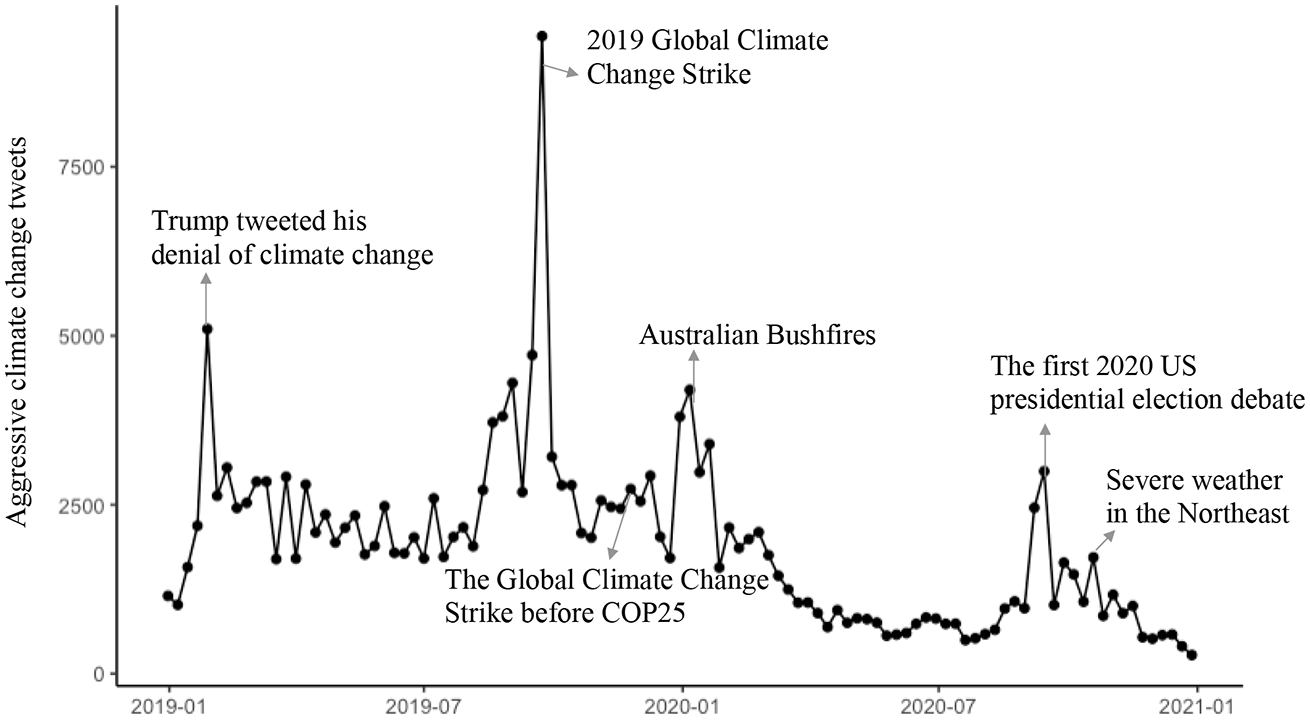
The weekly number of aggressive tweets about climate change.
We manually examined the top 20 tweets that received the most retweets, and we observed that along with political elites like Bernie Sanders, there are individual influencers who also used aggressive styles in tweeting their opinions about climate change. For example, an American conservative influencer Candace Owens tweeted, “Stressful morning. Just found out from @AOC that Adolf Hitler was simply climate change. And that I’m going to like, die in 12 years. She might be the most passionately stupid person to join our government since @MaxineWaters.” The founder of 350.org and environmentalist Bill McKibben posted, “New study: if we stop emissions immediately, Arctic still warms 5 C/9 F by century’s end. We’re not stopping global warming anymore; we’re fighting like hell for a level that civilizations might survive. #ClimateStrike.”
Research questions and hypotheses testing
The first research question focused on the extent to which tweets about climate change adopted aggressive language styles (RQ1). The results of descriptive analysis showed that only a small amount, about 2.88%, of tweets (209,049 out of 7,251,568 tweets that mentioned “climate change” and or “global warming,” excluding retweets and replies) about climate change include aggressive styles.
In the follow-up question, we hypothesized that aggressive tweets about climate change are more likely to receive retweets than non-aggressive tweets (H1). Tweets with aggressive language received higher median retweets (Median = 19, Mean = 75, SD = 4342) than tweets without aggressive language (Median = 10, Mean = 362, SD = 733). Because the data are positively skewed, we used the Kruskal–Wallis test to analyze the data. The results showed the difference is statistically significant (χ² = 257.46, df = 1, p < .01,
Next, we hypothesized that aggressive tweets would include more political cues (mentions of politicians, political parties, and political ideologies) than non-aggressive tweets (H2). The results showed that 51% (n = 1374) of aggressive tweets include politicized cues and only 35% (n = 48,305) of non-aggressive tweets included politicized cues. About 49% (n = 1304) of aggressive tweets and 66% (n = 89,701) of non-aggressive tweets are without politicized cues. A proportion test with Bonferroni adjustment indicates the difference between the two proportions is statistically significant (χ² = 305.02, p < .01). Findings supported H2.
We also examined how politicized cues and aggressive languages have an interacting effect on the number of retweets (RQ2). A negative binomial regression was conducted to explore the interaction between these two factors. The result showed significant main effects on aggressive style (β = 1.07, p < .01), politicized cues (β = .45, p < .01), and a significant interaction between these two (β = .61, p < .01). In other words, politicized cues reinforced the aggressive tweets in generating more retweets. Retweets of aggressive tweets increase by 84% (calculated by exponentiating the coefficient β = .61) when they include political cues, holding other variables constant.
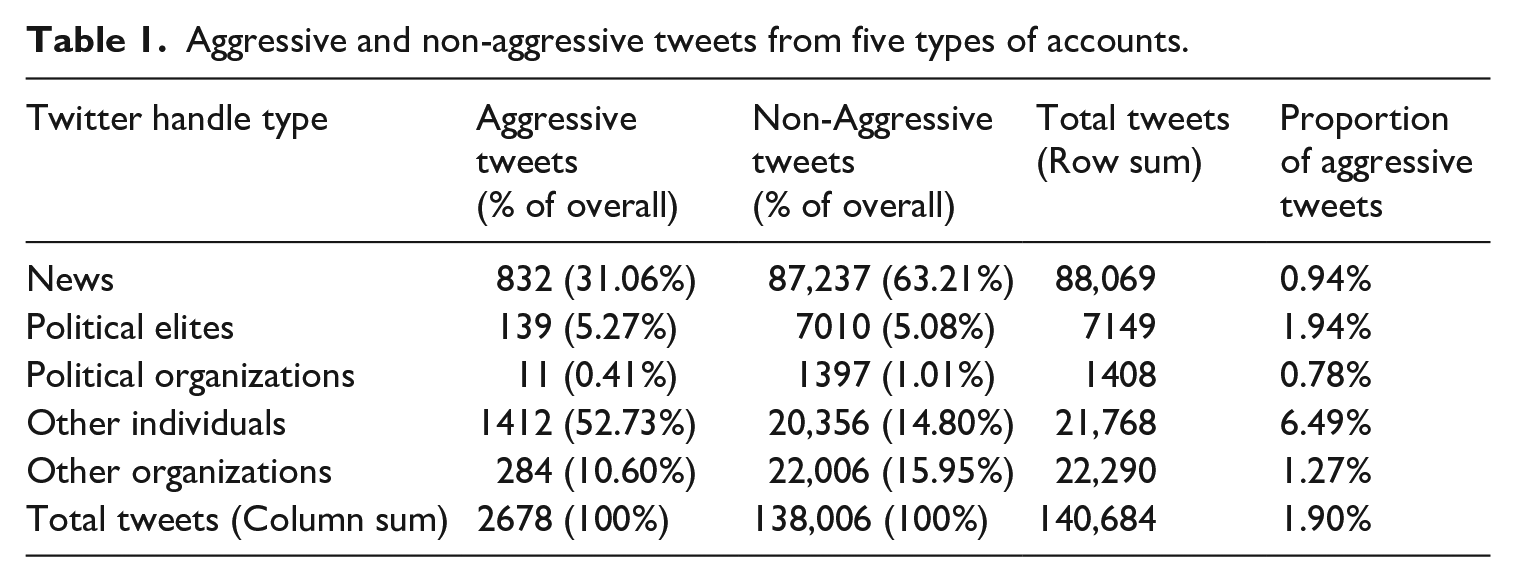
RQ3 focused on the types of network gatekeepers and how they used aggressive styles in climate change messages. A crosstab analysis showed that the top source of aggressive tweets was from other individuals (n = 1412, 53%). News organizations produced the second largest number of aggressive tweets (n = 832, 31%), although they produced the most tweets among all types of actors (n = 832, 31%). Political organizations generated the least number of aggressive tweets (n = 11, 1%).
Out of each type of actor, tweets by individuals have the highest ratio of aggressive tweets (n = 1412, 7%), followed by political elites (n = 139, 2%), other organizations (n = 284, 1%), news organizations (n = 832, 0.94%), and political organizations (n = 11, 0.78%). In addition, we performed a pairwise proportion test to examine whether the rates of aggressive tweets show any statistical difference among various types of accounts. The results showed that there was no significant difference between political elites and news organizations (χ² = 0.24, p = .62), and between other organizations and political organizations (χ² = 2.23, p = .27). The proportion of aggressive and non-aggressive tweets from other types of accounts is significantly different from each other at a .05 level. Table 1 presented the details of how different types of gatekeepers tweeted in aggressive and non-aggressive styles.
Aggressive and non-aggressive tweets from five types of accounts.
RQ4 asked about the extent to which gatekeeper types affect how aggressive and non-aggressive language styles predict retweets. The dependent variable is the count of retweets that shows overdispersion, meaning the conditional variance is much larger than the conditional mean (variance = 887,088, mean = 91). Negative binomial regression is a better model than others to estimate a count variable that is over-dispersed (Hilbe, 2011). Results from negative binomial regression (Table 2) showed that aggressive tweets from political elites are associated with higher retweets than aggressive tweets from other types of accounts (β = 1.52, p < .01). More specifically, retweets of aggressive tweets from politicians are 4.58 times those from accounts that are not political elites, holding other variables constant. On average, aggressive tweets from political elites receive 196 median retweets (Mean = 3307, SD = 18,449), while non-aggressive tweets receive 40 median retweets (Mean = 374, SD = 1875,
Negative binomial regression of the type of accounts and the aggressive languages influencing the number of retweets.
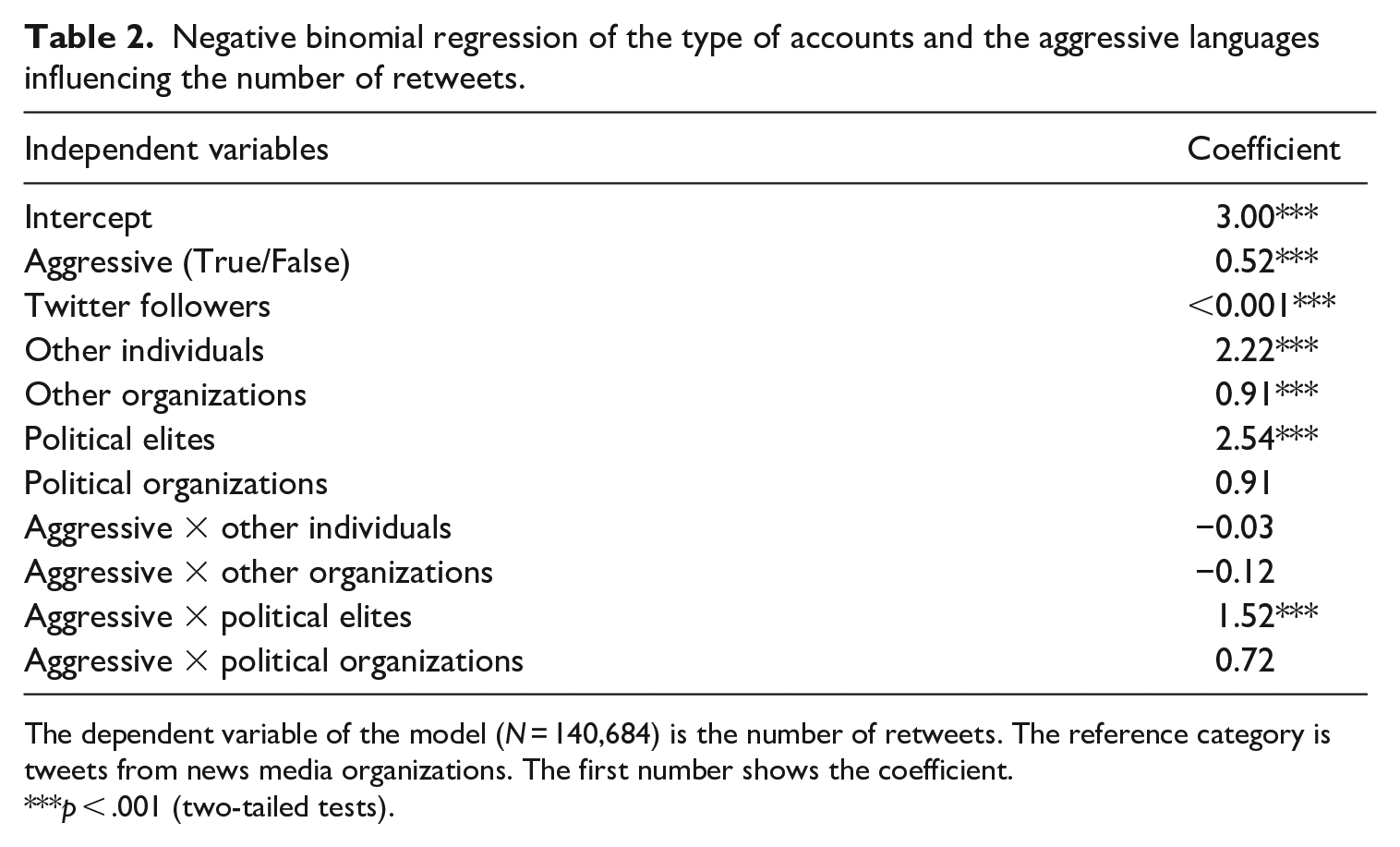
The dependent variable of the model (N = 140,684) is the number of retweets. The reference category is tweets from news media organizations. The first number shows the coefficient.
p < .001 (two-tailed tests).
Discussion
As the climate movement became digitalized, the tension surrounding the debate heightened, leading to emotional, even aggressive outbursts on national social media platforms like Twitter. However, it is unclear how common the use of aggression in climate change messages on Twitter is and the effects of aggressive messages on information diffusion. Our findings showed that in the last 2 years, only a very small number of tweets contained aggressive utterances. Similarly, another study that investigated the tone of climate change messages on Twitter found that the majority of messages have neutral tones (Veltri and Atanasova, 2017). Our findings also showed that aggressive tweets were associated with more retweets than non-aggressive tweets about climate change. Echoing a previous study, where Veltri and Atanasova (2017) found anger is still the most frequently identified emotion in tweets, our finding suggests that aggressive tweets are more likely to spread on Twitter. One possible explanation is that aggression often involves emotional words or verbal attacks on a communication target (Yuan et al., 2018). These words create entertaining effects (Lau et al., 2007) or generate negative arousal emotions such as anger (Berger and Milkman, 2012), which serves as a motivation for individuals to retweet (Metaxas et al., 2015). Compared with non-aggressive messages, highly arousing and emotional messages are more likely to be shared on social media (Berger and Milkman, 2012; Fine and Hunt, 2021; Lee and Xu, 2018). However, other motivations to retweet aggressive climate change messages need to be further tested via experiments.
While the ultimate goal of the climate movement is to pressure governments and industries to take action to address the negative impacts of climate change (Dunlap et al., 2016), mobilizing the public is an important step in the climate movement, where social media sharing can be a powerful tool. It is worth noting that the findings of the current study do not directly indicate whether aggressive climate change conversations can have a direct impact on the ultimate outcome. Some researchers pointed out that sharing is a low-cost engagement behavior (Fine and Hunt, 2021), whereas others argued many negative influences that aggressive styles have on persuasive outcomes. Exposure to aggressive tweets was associated with low trust in source credibility, trust in authority, and more propagation of verbal aggression on social media (Mutz and Reeves, 2005; Yuan and Lu, 2022; Yuan et al., 2018). Therefore, although the proportion of aggression was low, its impact on propagating public sentiment and public understanding of climate change could be large.
Moreover, our findings showed that aggressive words often co-occurred with political cues in tweets about climate change. We found that politicized messages are more likely to be aggressive and are more likely to be retweeted as well. A study that investigated the discussion of climate change on Twitter during an extreme weather event found that incivility is associated with political topics as well (Anderson and Huntington, 2017). Although we predicted that the dialogue of climate change may be different from the dialogue of politics, our findings indicate that politicized and aggressive climate change tweets are more likely to be retweeted, which is consistent with findings in political communication contexts (Fine and Hunt, 2021; Lee and Xu, 2018). One explanation could be that these politicized climate change conversations are more seen as political issues as opposed to science issues. It is worth noting that the results do not suggest causal relationships between aggressive styles, politicized cues, account types, and retweets. Instead, the significant correlations provide directions for future studies to explore the potential causal relationship. In addition, the high standard deviations on the average of retweets in each category suggest that the results are very skewed. In other words, although all the selected gatekeepers have over 100,000 followers, the diffusion impact of their messages varies drastically.
Regarding different types of network gatekeepers who posted aggressive climate change tweets, we found that news organizations were the institutional actors that produced the most aggressive tweets about climate change. We had two observations that may explain this seemingly counter-intuitive finding. First, many aggressive tweets from the news media quoted utterances from politicians or climate change activists. This pattern is common in the mainstream media. For example, Time magazine tweeted: “President Trump called climate change a hoax. Now he’s awkwardly boasting about fighting it.” A tweet from Reuters directly quoted Greta Thunberg: “How dare you? You have stolen my dreams and my childhood.” This observation makes sense because to news media, the use of aggressive language by public figures (often political elites) means news values, such as conflict and controversy, prominence, and impact (Shoemaker and Reese, 2014). Previous studies also showed that news coverage about climate change has focused more on political claims and policy debates than scientific facts (Boykoff, 2011; Chinn et al., 2020).
Second, tweets from news media outlets often summarized their reports using aggressive styles, likely as clickbait tactics to direct traffic to news websites. This pattern is common in tweets from partisan media or some opinion pieces. For example, the US far-right media outlet Breitbart posted a tweet linking to its opinion piece: “What drives the Global Warming Gang’s agenda? Redistribution of wealth by shaking down ‘evil’ rich countries for cash.” This observation echoes a few recent studies in journalism, which revealed that news media have been fishing for attention online (e.g. Lamot, 2021; Tandoc, 2014). The headlines of climate change news (particularly the denial news) often included emotional words like anger and disgust—these news headlines were associated with more user engagement (Xu et al., 2022). Along with these studies, our findings suggest that there should be a nuanced relationship between the types of news media (e.g. partisan media, far-right media), the contexts (quotes from politicians or a news practice) of using aggressive language, and user engagement. Future studies can conduct a content analysis to test the hypothesis.
Previous studies have considered news media as the major source of climate change information for the public (Boykoff, 2011) and a critical determinant for successful climate change advocacy movements (Schäfer et al., 2014). Our findings suggest that the role of news media in climate change communication is perhaps more complicated. On one hand, when news organizations tweeted aggressive messages, it was easier to receive public attention, therefore contributing to the dissemination of uncivil discussion over this topic (Sydnor, 2018). On the other hand, emphasis on political claims and the use of aggressive words did not work toward building public consensus on scientific facts. Particularly, overemphasizing on political conflicts by partisan media could mislead the public and foment increasing polarization concerning climate change.
Although political elites are known for using uncivil languages to attack the other party or competitors (Goovaerts and Marien, 2020), our results showed that it is still less likely to see political elites use aggressive styles compared with other influential individuals on Twitter, such as celebrities, influencers, or advocates. Political elites tend to avoid posting aggressive tweets, perhaps because aggressive styles may damage their perceived credibility (Meltzer, 2015). However, our findings showed that political elites’ aggressive messages are more likely to be retweeted compared with other account types. One possible explanation is that because political elites do not tweet very often in aggressive styles, the public may see their aggressive messages as a violation of audiences’ expectations (Yuan et al., 2018), and therefore find the message more worthy of retweeting. This echoes our earlier finding that political elites are not the main contributors to aggressive tweets. When viewers observe aggressive tweets from political elites, they may be more likely to retweet because it is scarce.
Limitations and future research
This study is an initial attempt to understand aggressive climate change communication on Twitter and leaves room for future studies. First is the generalizability of findings in the current study. Although we considered politicized cues an important factor, we recognize that the politicized content may differ in different countries and our data analysis did not further include the country difference. Future studies can dive into the specific political frames used with aggressive styles based on the research country’s specific political situation. Also, we only analyzed English tweets, but Twitter is an international platform for climate change conversations. Future studies can conduct multilingual analysis to examine whether the effects of aggressive communication styles in climate change vary in different cultural and political contexts. Second, in addition to the number of followers, we only explored the account type and politicized cues as potential factors that influence the retweet rate. Other factors might include the media’s agenda or the attitude toward climate change (pro or anti-climate change). Third, the research team extended the current dictionary method (Chinn et al., 2020) to identify politicized contents in climate change. However, our dictionary may not be exhaustive. More future studies can continue building this dictionary. Another limitation is that our data included more tweets about events that were associated with spikes of aggressive tweets about climate change between 2019 and 2020, such as the 2019 Global Climate Change Strike and the Australian bushfires. Thus, the data might be less representative of other events that did not generate significant surges in aggressive tweets, such as COP25 (United Nations Climate Change Conference in 2019) in Madrid. Our event analysis suggests that the volume of aggressive tweets seemed to be more correlated with certain events, especially when political elites expressed claims about climate change. This could be another hypothesis for future studies.
Conclusion
This study explores the use and the effects of aggressive communication style in the climate change discussion on Twitter. We examined how frequently aggressive communication happened during online climate change debates, and the types of gatekeepers. Findings unveiled the interacting effect between aggressive style and politicized message on the chance of retweets. Practically, the findings shed light on how influential gatekeepers should communicate climate change to maximize the intended effect. Using data mining and computational social science approaches, we developed methods to identify aggressive styles of communication and politicized cues from a large volume of data on Twitter. These methods will benefit future researchers who investigate aggression and politicization in online climate change communications.
Supplemental Material
sj-docx-1-nms-10.1177_14614448221122202 – Supplemental material for More aggressive, more retweets? Exploring the effects of aggressive climate change messages on Twitter
Supplemental material, sj-docx-1-nms-10.1177_14614448221122202 for More aggressive, more retweets? Exploring the effects of aggressive climate change messages on Twitter by Shupei Yuan, Yingying Chen, Sophia Vojta and Yu Chen in New Media & Society
Footnotes
Funding
The author(s) received no financial support for the research, authorship, and/or publication of this article.

Supplemental material
Supplemental material for this article is available online.
Notes
Author biographies
References
Supplementary Material
Please find the following supplemental material available below.
For Open Access articles published under a Creative Commons License, all supplemental material carries the same license as the article it is associated with.
For non-Open Access articles published, all supplemental material carries a non-exclusive license, and permission requests for re-use of supplemental material or any part of supplemental material shall be sent directly to the copyright owner as specified in the copyright notice associated with the article.
