



Abstract
New media literacy (NML) is an emerging construct of great value in a digital age in which information overload threatens the well-being of society. Among the scarcity of available research going beyond a theoretical conceptualization of NML and using structural equational modeling, we explored the influence of NML on media trust, perception of fake news, and fact-checking motivation that underlie the dissemination of unverified information during the COVID-19 pandemic. Challenging the assertion of NML’s absolute effect on mitigating the problem of fake news communication, the components of NML were shown to contribute to the transmission of unverified information among citizens unless the risk of fake news was well understood. The findings suggest that further research is required to fully understand the scope of NML in designing public education, and that the problem of fake news spread may be a social phenomenon that digitalized society must embrace.
Keywords
Introduction
The development of digital technology has greatly changed the way the public consumes and produces information. In particular, the phenomenon of new media is the core feature in this change. “New media” can be defined as socio-cultural environments, supported by network technologies, that assist in digital creation and distribution by the user (Koc and Barut, 2016). With the active use of new media, people can engage in free communication that is both timely and less subject to censorship. The resulting efficiency means that there are fewer benefits in using traditional mainstream media for information acquisition. In short, today’s citizens have an independent digital presence as both consumers and producers of information in new media, which places greater responsibility on individuals for shaping the information landscape.
With this increased responsibility for new media users, the skills for exploring and utilizing new media are increasingly valued. During periods of high uncertainty—such as during the recent COVID-19 pandemic, which has put the health of global citizens at great risk—the negative consequences of fake news spread become apparent. Scholars, government authorities, non-governmental organizations (NGOs), and educators have highlighted the importance of enhancing the literacies of the general public associated with navigating and participating in new media to protect citizens from information disorder. In this context, new media literacy (NML; Chen et al., 2011; Lin et al., 2015) is an emerging concept that encompasses the essential skills that enable new media users to manage the challenges of an increasingly digitalized society. However, due to its relative novelty, there is a lack of empirical evidence for how NML affects the socio-behavioral process of information-sharing behavior. This research aims to explore the effect of NML on cognitive, motivational, and perceptual factors associated with the process of unverified information sharing (UIS) related to COVID-19, which is critical to understanding the spread of fake news during a crisis. This study is conducted in the context of the COVID-19 pandemic, a rare situation in which citizens are generally uncertain and anxious about a topic of high public relevance. Within such a climate, information exchange—including that of fake news—is thought to be more active due to the high level of fact-checking motivation associated with the topic (Apuke and Omar, 2020a; Lee and Lee, 2021). Drawing on both theoretical and empirical findings from the literature on socio-behavioral aspects of dis- and misinformation communication, we built a model addressing the relationships among each component of NML (i.e. functional consumption, critical consumption, functional prosumption, and critical prosumption), perception of fake news, trust in news media, and fact-checking motivation underlying the process of UIS. This study has the potential to contribute to the growing field of new media by offering an alternative perspective in understanding how NML affects fake news sharing behavior through an underlying psychosocial mechanism. By doing so, more effective education strategies can be developed to prevent fake news spread in the future.
New media and NML
Although some scholars focus on a specific domain-based approach in understanding media literacy (e.g. news literacy, digital literacy; Jones-Jang et al., 2019), a recent conceptualization of NML integrates various aspects of dealing with new media. Several features differentiate new media from traditional media; these include its digital nature, interactivity, and user-generated content. More specifically, by expanding on the concept of the “prosumer” (Toffler, 1980)—a person who produces and consumes at the same time—NML examines the areas of consumption, and consumption and production. Thus, NML can be seen as a multidimensional competence that goes beyond specific skills to technical, social, and critical thinking skills that enable technical proficiency, communication and collaboration, digital content creation, and well-being associated with the use of new media.
NML is divided into two dimensions: consumption to prosumption, and functionality to criticality (Chen et al., 2011). Whereas the former reflects the extension of consumer to prosumer as discussed previously, the latter reflects an individual’s ability to question and evaluate media tools and content in addition to accessing and operating them. In other words, functionality encompasses the ability to use new media technologies, and criticality aids in the comprehension and construction of various ideologies within the socio-cultural medium. Thus, four components of NML were formulated based on the intersection of continuums: functional consuming (FC), critical consuming (CC), functional prosuming (FP), and critical prosuming (CP). Lin et al. (2013) suggested a refined version of the framework, wherein 10 fine-grained indicators were presented to elaborate on the NML components. FC is elaborated by two further indicators, consuming skills and understanding, both of which are technical skills required for consuming media content at a textual level. CC is represented by three indicators, analysis, synthesis, and evaluation, which entail abilities to comprehend and criticize messages and integrate viewpoints beyond the textual level—considering genres, subjectivity, and social aspects. FP comprises three indicators: prosuming skill, distribution, and production. Like FC, FP focuses on technical skills to produce, disseminate, and share media content across multiple modalities. Finally, CP is elaborated by two indicators, creation and participation, which refer, respectively, to abilities to create media contents with a critical comprehension and to participate interactively and critically to co-construct and refine one another’s ideas on media platforms—ideas that focus on an individual’s awareness of the socio-cultural values, ideology, and power relations underlying their media participation.
Trust in news media and fake news consumption
The traditional literature on news media is based on the ideology of democracy, which holds that news media assist citizens in becoming informed, independent thinkers (Strömbäck et al., 2020). The prerequisite for that assumption, however, is that the information provided is accurate and self-governing, and that citizens trust and consume the information provided by news media. Recently, research in this field suggests that media trust is decreasing with the transformation to high-choice media environments (Van Aelst et al., 2017). This social phenomenon has brought about a new perspective on the literature examining new media. In particular, the relationship between media trust, non-mainstream media consumption, and exposure to fake news has been the focus of research.
Tsfati and Cappella (2003) investigated the link between mainstream media skepticism and exposure to non-mainstream news (e.g. a political speech on the Internet), and thereby demonstrated that media distrust is positively associated with the consumption of non-mainstream news media through news diets that consist of a larger proportion of non-mainstream news media. Low media trust was shown to play a significant role in the preference for non-mainstream media and the corresponding consumption behavior (Fletcher and Park, 2017; Tsfati, 2010). In the context of discussing fake news, this finding is critical because non-mainstream media sources, such as social media, blogs and digital-born providers, further expose individuals to fake news (Wasserman and Madrid-Morales, 2019), which potentially increases media users’ vulnerability to disinformation (Melki et al., 2021).
Despite this increased vulnerability, evidence suggests that decreased media trust may actually help citizens to become more alert to the presence of fake news. Nelson et al. (2009) found that when people have a low level of trust in media, they are generally more critical in their perception of media messages, which increase their persuasion knowledge (e.g. inference of manipulative intent and skepticism; Friestad and Wright, 1994) toward media content. Attainment of persuasion knowledge could, therefore, heighten media users’ suspicion of media content and the source of the persuasion. In short, although low media trust may expose individuals to more unverified information, it could make users more alert in new media navigation, which is an important quality amid an infodemic. Thus, the current research explores how each component of NML affects UIS through media trust.
Fact-checking motivation in times of crisis
Following the rapid increase in fake news exchange during the COVID-19 pandemic, scholars have started to pay more attention to the public’s motivations for sharing such news. The uses and gratification perspective (Katz et al., 1974) and the psychological framework of rumor spread (Bordia and DiFonzo, 2005), the two dominant theories attempting to explicate motivations for news sharing, universally suggest fact-checking, socialization, and status-seeking/ self-enhancement as underlying motivations for news transmission as a part of social exchange. In particular, fact-checking motivation has been revealed as a prominent factor during crises because citizens are generally uncertain and anxious about the topic of high public relevance (Apuke and Omar, 2020b; Lee and Lee, 2021). Both theories view the acquiring of information through such communication as part of the gratification and problem-solving process aimed at reducing uncertainty associated with the source of crisis (Bordia and DiFonzo, 2004; Introne et al., 2018). Although such a motivation essentially increases the exchange of inaccurate information and even promotes fake news spread, citizens tend to focus on the benefit of being updated with the newest information regarding the topic and forming collective intelligence; in some cases, these benefits enable people to prepare and take effective action in time (Lee and Lee, 2021). Consequently, fact-checking motivation would be a crucial antecedent factor of UIS from the citizens’ perspective in times of crisis and, thus, it would be important to understand the role of fact-checking motivation in the relationship between NML and UIS.
Research model and hypotheses
We propose and test a structural model that investigates multiple relationships among NML components and socio-behavioral variables underlying the process of assessing and disseminating unverified information in the context of the COVID-19 pandemic. The research questions are given below, and the hypothesized structural relationships among these constructs are shown in Figure 1.
RQ1. What role does each aspect of NML competency play in influencing socio-behavioral factors implicated in the literature on dis- and misinformation?
RQ2. What is the structural relationship between the factors indicated in RQ1 in relation to sharing unverified information?
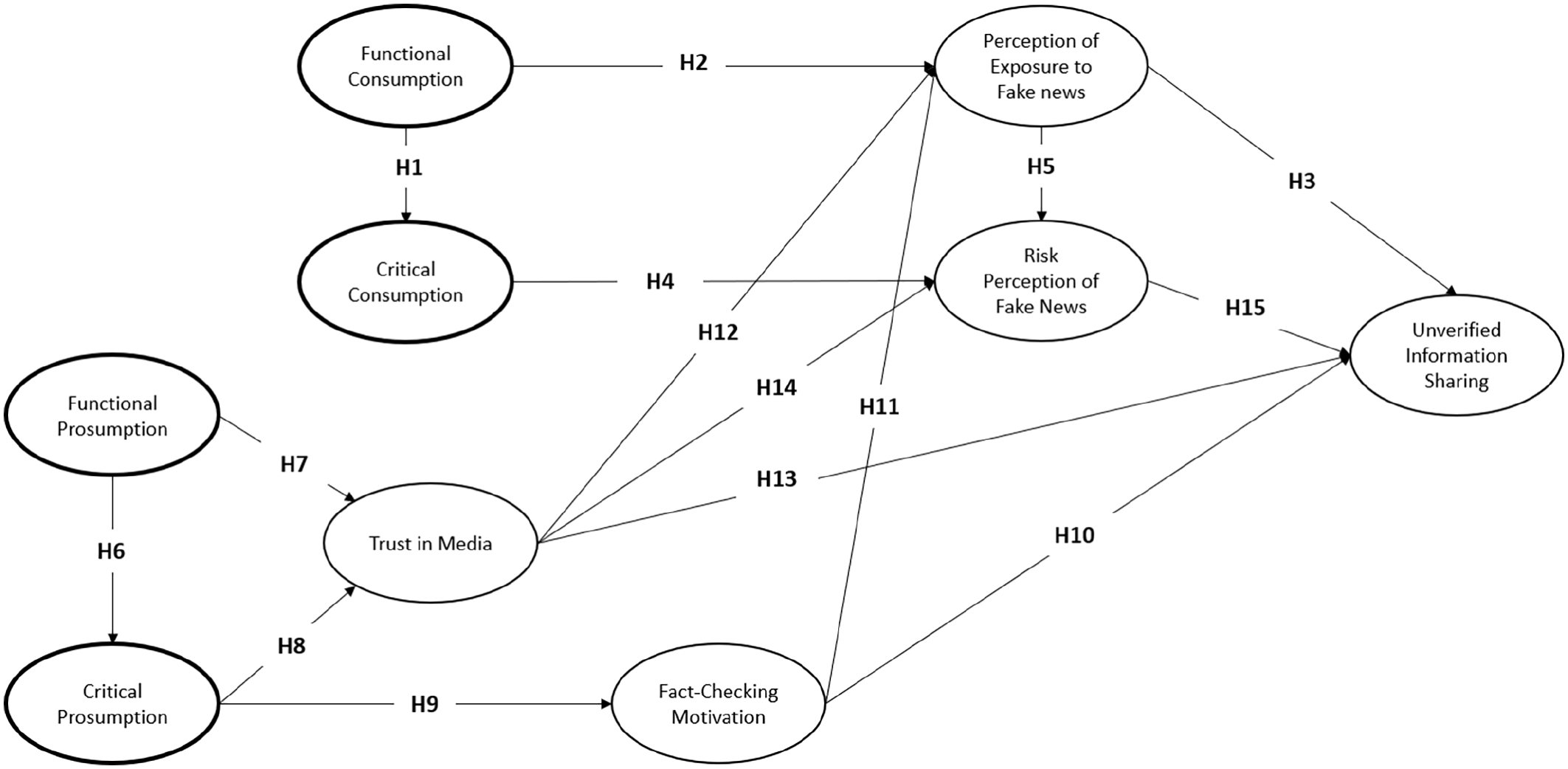
Graphical representation of the research model.
Consumption media literacy (FC, CC) and perception of fake news
Consumption media literacy is the ability to access and perceive media messages, and to use media at different levels. NML further elaborates by dividing these abilities into FC and CC (Lin et al., 2013), which reflects the classification of Internet skills proposed by Van Deursen and Van Dijk (2011), namely medium-related skill and content-related skill. In other words, FC is associated with a more textual level of information processing, whereas CC is related to the contextual level of information processing. According to the concept of NML, for one to advance to contextual information processing, textual information processing requiring basic Internet skills should precede it (Lin et al., 2013). Thus, it can be proposed that CC skill depends on FC skill.
Hypothesis 1: FC increases CC.
As consumption media literacy underlies the intake and processing of information, it plays an important role in the perception of information even in the context of fake news. To date, the literature on fake news perception has largely focused on examining the impact of self-perceived exposure to alleged fake news (Müller and Schulz, 2019; Sängerlaub, 2017) and the perception of the risk associated with fake news (Barthel et al., 2016; Cho, 2019) on behavior toward misinformation, as these perceptual factors have been shown to play important roles in approaches to counteracting information disorder. Relating these two types of perception to the earlier explanation on FC and CC, it could be deduced that the perception of exposure to fake news (PEF) is more closely associated with FC because judging how often one is exposed to fake news does not necessarily involve contextual understanding of fake news; rather, it involves textual perception of the media environment. Furthermore, an individual with higher FC skill is likely to have more experience with new media, which could lead to greater exposure to fake news. Hence, FC skill should positively correlate with PEF.
Hypothesis 2: FC increases PEF.
Without critical insight into the new media environment, which entails comprehending various mixed messages and understanding the way new media is used by a variety of users with different intentions, the level of PEF could be directly reflected in the user’s perceived descriptive norms (Kwan et al., 2015) regarding the exchange of unvalidated information in society. This could result in an overestimation of the degree to which others share unverified news with others in their daily communication (Flynn and Wiltermuth, 2010). Indeed, research has shown that frequent exposure to fake news could lead to a greater acceptance of such information (Del Vicario et al., 2016). Therefore, the following hypothesis could be deduced:
Hypothesis 3: PEF is positively related to the intention of UIS.
However, risk perception of fake news (RPF), such as a judgment on the negative impact of fake news on society, involves an analytical thought process (Ross et al., 2021) and requires a comprehension of embedded meanings of fake news within society while taking into account a news environment that promotes the proliferation of fake news (Sheng et al., 2022). Thus, media users with higher CC are more likely to be well-informed on the risk of fake news. Thus, the following hypothesis could be predicted:
Hypothesis 4: CC increases RPF.
The literature on risk perception indicates that perceived exposure to a risk factor influences perception of the risk associated with it. For instance, if physical proximity to risk factors (e.g. a nuclear facility) increases—thereby increasing actual and perceived exposure to the risk—the risk perception associated with the factors also increases (Keller et al., 2006; O’Neill et al., 2016). According to Keller et al. (2006), physical or perceived exposure to a risk factor impacts on risk perception through availability heuristics (Tversky and Kahneman, 1982). In line with this logic, Lyons et al. (2020) demonstrated that seeing the demographics of fake news consumption can increase perceived prevalence of fake news and risk associated with fake news. Based on what has been discussed, it is conceivable that PEF increases RPF. Thus, we propose the following hypothesis:
Hypothesis 5: PEF results in an increase in RPF.
Prosumption media literacy (FP, CP), trust in media, and fact-checking motivation
In social psychology, trust is an implicit set of beliefs regarding security between two parties, namely that each will refrain from opportunistic behavior and will not take advantage of a situation over the other (Ridings et al., 2002). Thus, trust can be viewed as the foundation of social relationships. In this vein, media trust is closely associated with prosumption media literacy because prosumption literacy comprises the ability to create, distribute, and participate that essentially underlies interaction in the new media environment. This literacy is further divided into two components, FP and CP, which can be differentiated by the dimension of criticality (Chen et al., 2011; Lin et al., 2013), such that CP is built upon FP, with the addition of critical contextual understanding (Van Deursen and Van Dijk, 2011). Thus, we propose the following hypothesis:
Hypothesis 6: FP increases CP.
Based on the criticality dimension, different effects of prosumption media literacy on media trust are expected. FP is a skill focused on the technical facet of creating media content and distributing information. This means that high FP skill indicates flexibility in new media users in the utilization of technology of new media but does not necessarily indicate a capacity for critical insight into the socio-political context of new media. Instead, users who lack critical understanding while possessing advanced FP could account for the frequent use of media content—regardless of platform, and including non-mainstream media sources—without distinguishing them in terms of reliability. Higher interaction with the non-mainstream media sources was shown to lower trust in mainstream media (Melki et al., 2021; Wasserman and Madrid-Morales, 2019), which suggests that FP could promote skepticism toward news media. Based on the discussion, we propose the following hypothesis:
Hypothesis 7: FP decreases trust in media.
In contrast to FP, CP skill focuses on criticality, which refers to an awareness of the socio-cultural values and ideology embedded in participation as a new media user (Lin et al., 2013). Thus, individuals with a high CP component should be advanced in their ability to adapt to diverse communities—respecting multiple perspectives in the social context—and should be able to actively participate in new media as informed citizens by creating and sharing meaningful media content. In particular, as new media users with a good understanding of the context of democracy, high CP users should have a better understanding of the role of news media in society, thus, raising their perceptions of media credibility (Kellner and Share, 2005). Researchers have also shown the link between media literacy education and trust in media, asserting that the criticality aspect of media literacy increases media trust (Kachkaeva et al., 2020). Therefore, we propose the following hypothesis:
Hypothesis 8: CP increases trust in media.
Because CP indicates the skill of active participation with critical and expressive thinking about important socio-cultural issues in new media, the ability to structure and understand relevant knowledge becomes critical (Kellner, 2010). Therefore, behavioral effort to satiate intellectual curiosity becomes an essential sub-feature of CP. Based on this proposition, it is conceivable that CP contributes to fact-checking motivation for spreading unverified information related to COVID-19 during the pandemic. Therefore, we present the following hypotheses:
Hypothesis 9: CP increases fact-checking motivation about COVID-19-related information.
Hypothesis 10: An increase in fact-checking motivation about COVID-19-related information leads to an increase in the intention to share unverified information about COVID-19.
Furthermore, higher fact-checking motivation indicates higher motivation to scrutinize the information at hand. Such an analytical style of thinking could lead to careful observation of media content (Pennycook and Rand, 2019; Ross et al., 2021), which eventually increases skepticism regarding authenticity (Ståhl and Van Prooijen, 2018). Thus, it can be conceived that fact-checking motivation increases PEF due to heightened skepticism toward various media content. We therefore propose the following hypothesis:
Hypothesis 11: Fact-checking motivation increases PEF.
The relationship between trust in media, fake news perception, and UIS
Citizens with a high level of media trust tend to consume more mainstream than other news media (Tsfati, 2010; Wasserman and Madrid-Morales, 2019), which—to a certain extent—prevents them from being exposed to fake news or highly partisan news. Consequently, those with higher trust in media would be less aware of fake news in their daily interactions with new media (Van Der Linden et al., 2020), which in turn could reduce PEF and critical insights into the media environment. Thus, we propose the following:
Hypothesis 12: Media trust decreases PEF.
In addition, the limited experience with fake news of those with high media trust could result in lower persuasion knowledge about the publishers of various media contents (Nelson et al., 2009). Hence, they would be more inclined to accept media messages at face value without considering the intentions behind them (Friestad and Wright, 1994), which could potentially promote the communication of such messages without verifying the information. Therefore, the following hypothesis can be formulated:
Hypothesis 13: Media trust increases UIS.
The concept of trust constitutes the element of risk perception (Strömbäck et al., 2020). Higher trust indicates that one judges the risk posed by the other party to be smaller (Slovic et al., 1991). If we apply this logic to the context of fake news, it is conceivable that higher media trust decreases perceived risk associated with fake news, reflecting general trust in the credibility of media content and its sources. This, however, could be problematic in relation to fake news spread because a decrease in risk awareness could lead to less cautious behavior toward the risk factor (Dryhurst et al., 2020; Reuter and Spielhofer, 2017; Vanlaar and Yannis, 2006), resulting in indiscriminate transmission of unverified information. Thus, it is conceivable that higher RPF may lead to more careful behavior regarding UIS, in the context of fake news spread, due to the recognition of the potential risk of spreading fake information through the interaction (Arias et al., 2008; Reuter and Kaufhold, 2018). Based on this discussion, we present the following hypotheses:
Hypothesis 14: An increase in media trust decreases RPF.
Hypothesis 15: Increased RPF decreases the intention of UIS.
Methods
Participants
A nationwide commercial survey sampling and administration company was contracted to recruit participants and implement Internet-based surveys. Subjects were acquired from existing pools of research panel participants who have agreed to participate in research studies. The compilation of sampling sources helped to ensure that the overall sampling frame was not overly reliant on any particular demographic or segment of the population. The ages of the participants ranged from 20 to 60 years (M = 44.11, SD = 13.77). The participants comprised 500 South Korean residents: 50% of participants were male and 50% were female. In terms of age distribution, five age groups—each with 20% of the participants—were included: 20–29, 30–39, 40–49, 50–59, and 60–69 years.
Procedure
A questionnaire was administered through an online survey platform. Data were collected from October 21 to October 24, 2020 to investigate the psychological factors influencing participants’ use of information, attitudes, and perceptions at the time when information on the COVID-19 virus was less clear. All participants were briefed on the purpose of the study.
Measures
NML
This study employed the 20-item NML scale as used in the research of Yum and Jeong (2019), which is the translated and shortened version of Koc and Barut’s (2016) original scale (see Table 1 for reliability statistics). NML has four components: 5 prompts each for FC (e.g. I know how to use searching tools to get information needed in the media), CC (e.g. I can evaluate media in terms of legal and ethical rules), FP (e.g. It is easy for me to create user accounts and profiles in media environments), and CP (e.g. I can make a contribution to media by reviewing current matters from different perspectives), for a total of 20 prompts.
Reliability of measurements.

PEF
A five-item scale employed in Cho (2019) was used to measure to what extent participants agreed with each statement about the prevalence of fake news in different forms of media and its prevalence in conversation with others (e.g. I often see fake news on the Internet and in print media). A five-point Likert-type scale ranging from strongly disagree to strongly agree was used.
Trust in media
An eight-item scale by Kim and Lee (2018) was administered. Participants were asked to indicate their opinion on how accurate and unbiased the information they encounter through media is on a seven-point Likert-type scale (e.g. Korean media is accurate).
Fact-checking motivation
To measure fact-checking motivation for sharing unverified COVID-19-related information, five items were adopted from previous research (Alexandrov et al., 2013; Cha and Na, 2014; Yum and Jeong, 2019). All questions were measured on a five-point Likert-type scale ranging from strongly disagree to strongly agree (e.g. I share such news with others to obtain more information about the news).
RPF
To measure the perceived adverse effect of fake news, a five-item scale, as in Cho (2019), was used. Participants were asked to evaluate how harmful fake news is to the social and personal sector (e.g. Fake news distorts election results). All five questionnaires were measured on a five-point Likert-type scale ranging from strongly disagree to strongly agree.
UIS
To examine the intention to share unverified COVID-19-related news, a two-item scale from Yum and Jeong’s (2019) research was employed (e.g. I will pass on the information I learned through these news to others; Yum and Jeong, 2019). The prompts probed how likely participants were to share unverified COVID-19-related news with others.
Results
Validation of measurement model
To test the fit of measurement model, confirmatory factor analysis was conducted, and construct validity and reliability indices for each variable are presented in Tables 1 and 2. The model fit analysis reported comparative fit index (CFI) = .913, Tucker–Lewis index (TLI) = .905, root mean squared error approximation (RMSEA) [90% CI] = .054 [.051, .056], and standardized root mean square residual (SRMR) = .054, which were satisfactory. Based on the analysis of the construct validity and reliability of the variables, it was confirmed that the factor load of the measured variable constituting the latent variable was at least .60, and more than .70 in most variables. Furthermore, in terms of reliability, Cronbach’s alpha was above .70 and composite reliability was also above .70 for every variable. Finally, average variance extracted of all the variables was above .50, which indicates satisfactory reliability.
Measurement model fit analysis results.

CFI: comparative fit index; TLI: Tucker–Lewis index; SRMR: standardized root mean square residual; RMSEA: root mean squared error approximation; CI: confidence interval.
Test of structural model
A structural equation model (SEM) analysis was performed to test the significance of model fit and path coefficient. An R program (R Development Core Team, 2012)—specifically, the “lavaan” package (Rosseel, 2012)—was used. First, we derived the scores of the TLI (Bentler and Bonett, 1980), CFI (Bentler, 1990), SRMR (Hu and Bentler, 1999), and RMSEA (Steiger, 1990) to check suitability. The model fit value was obtained by dividing the chi-square value by the degrees of freedom, which confirmed that it was below the standard value (Bagozzi and Yi, 1988). In addition, we confirmed that all of the TLI (.904), CFI (.910), RMSEA (.054), and SRMR (.065) values met the model fit (Kline, 2015). We concluded that the SEM analysis was suitable for this model (see Table 3).
SEM model fit analysis results.

SEM: structural equation model; CFI: comparative fit index; TLI: Tucker–Lewis index; SRMR: standardized root mean square residual; RMSEA: root mean squared error approximation; CI: confidence interval.
A simple correlation matrix is presented in Table 4. The results showed that the relationship between FC and CP (β = .885, p < .001; H1), and FC and PEF was statistically significant (β = .161, p = .001; H2), such that FC positively influences CP, and FC increases PEF in daily life (see Tables 5 and 6 for path analysis and hypothesis testing results). Furthermore, PEF increased UIS as predicted (β = .205, p = .002; H3). Then, we looked at the impact of CC. The influence of CC on RPF (β = .193, p < .001; H4), and PEF on RPF (β = .455, p < .001; H5) were found to be statistically significant. The findings indicate that the more critical new media consumers are, the more they believe that they are exposed to fake news, and the stronger are their perceptions of the negative influence of fake news in society (see Figure 2 for the results of path analysis).
Correlation analysis results.

p < .05, **p < .01, ***p < .001.
Path analysis result.

Hypothesis testing results.
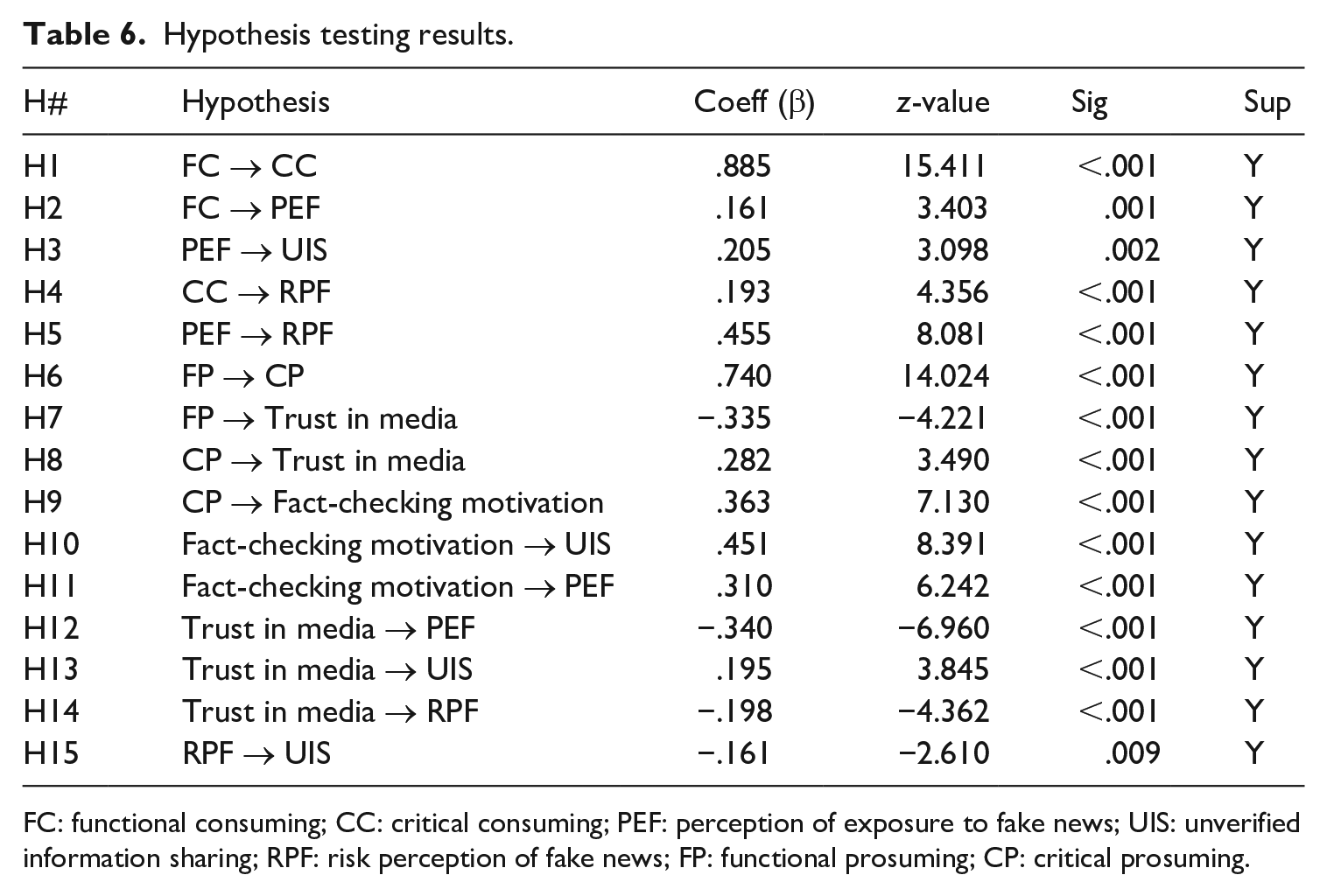
FC: functional consuming; CC: critical consuming; PEF: perception of exposure to fake news; UIS: unverified information sharing; RPF: risk perception of fake news; FP: functional prosuming; CP: critical prosuming.
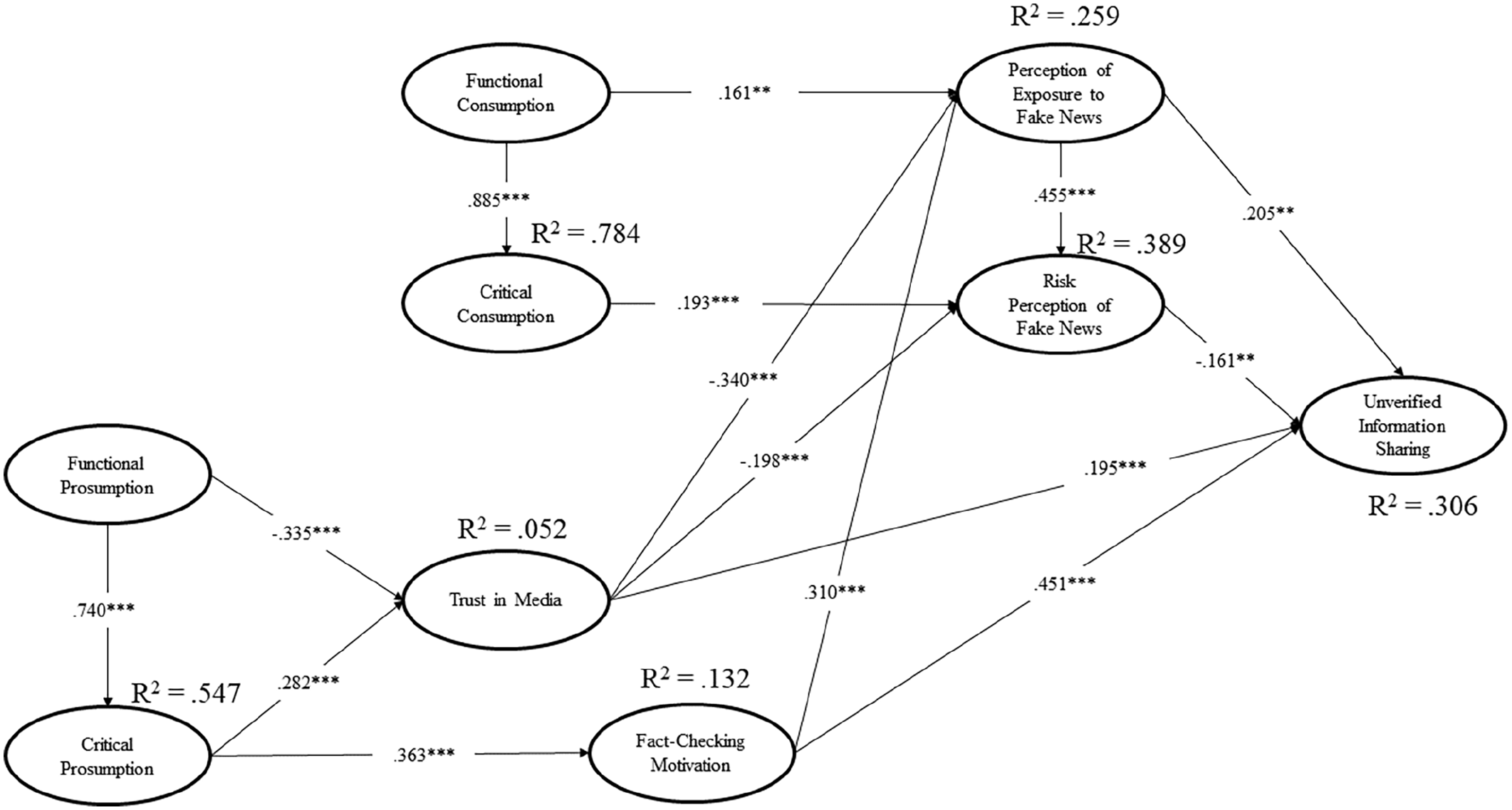
Results of path analysis.
In accordance with the NML concept, FP positively affected CP skill (β = .740, p < .001; H6). The effects of FP (β = −.335, p < .001; H7) and CP (β = .282, p < .001; H8) on trust in media were all statistically significant, such that FP lowered trust in media, whereas CP increased participants’ trust in media. Furthermore, the effect of CP on fact-checking motivation was statistically significant (β = .363, p < .001; H9); CP increased fact-checking motivation. Moreover, fact-checking motivation had a statistically significant effect on the intention for UIS (β = .451, p < .001; H10), confirming that the higher the fact-checking motivation, the greater the behavior of seeking to confirm the facts by sharing the information at hand. In addition, the effect of fact-checking motivation on PEF was statistically significant (β = .310, p < .001; H11), such that the motivation increased PEF.
Finally, the effects of trust in media on PEF (β = −.340, p < .001; H12) and UIS (β = .195, p < .001; H13) were statistically significant, indicating that media trust decreases PEF while decreasing UIS. In relation to risk perception, it was shown that trust in media decreases RPF (β = −.340, p < .001; H14) and RPF reduces UIS (β = −.161, p = .009; H15). In short, RPF has proven to be the most immediate and critical factor contributing to UIS reduction.
Discussion
In line with the concept of NML, CC was predicted by FC, and CP was predicted by FP. Furthermore, our findings suggest that consumption-focused components of NML influence the intention to share unverified information by manipulating perceptions of fake news, whereas prosumption-focused components encompass an additional process of modulating trust in news media to impact on UIS through fake news perception. Finally, motivation to fact-check unvalidated information by sharing the information with others was shown to be an important variable underlying the relationship between CP and UIS, and the perception of fake news.
In our confirmed model, consumption media literacies were shown to influence how individuals perceive fake news, which has crucial consequences for the communication of unverified information: PEF (i.e. textual information) was positively predicted by FC (H2), whereas RPF (i.e. contextual information) was positively predicted by CC (H4; Van Deursen and Van Dijk, 2011), demonstrating positive effects of both FC and CC on the reduction of UIS. More importantly, RPF was shown to be the most immediate contributor to UIS (H15), which indicates the importance of acknowledging the risk of fake news in society. Scholars who investigate the effect of media literacy on fake news mitigation typically emphasize the importance of “cognitive reflection”—the ability to critically appraise and analyze the information at hand—for processing media information (Koltay, 2011; Pennycook and Rand, 2019). Our findings go one step further. According to the concept of NML, cognitive reflection may be best reflected by CC (Chen et al., 2011; Lin et al., 2013); our findings showed that CC increases RPF, in turn, reducing the intention to share unverified information. Thus, our findings demonstrate one way in which cognitive reflection reduces UIS (i.e. by increasing understanding of the risk that fake news poses to society). This indicates the significance of CC in the context of media literacy education for mitigating fake news.
The findings revealed that FP (H7) and CP (H8) differ in the direction of their respective effects on the perception of fake news by exerting reverse effects on trust in news media. Prosumption media literacies are fundamentally linked with the trust factor because they underlie social interaction in new media (Bierhoff and Vornefeld, 2004). However, FP increases suspicion toward mainstream news media, whereas CP decreases suspicion, presumably due to the differences in understanding the function of news media in a democratic society associated with the two literacies. More specifically, higher CP—which is positively associated with socio-political insight—appears to help prosumers appreciate news media in general; it functions as a crucial channel for gaining valuable knowledge for participation in intellectual discourse as active citizens (Kachkaeva et al., 2020). However, FP helps users to understand the basic concept of new media—in which unknown sources of information coexist with credible ones—and this understanding extends to how they view the mainstream media and non-mainstream media without bias. Thus, although CP and FP may both be essential components of NML, they impact on media trust in opposing directions and have opposing effects on the intention to share unverified information.
Our results make a significant contribution to the current literature on news media trust. Media trust has become a topic of great interest along with the rise of new media, which has increased the sources of information available to the public. The conventional view on media trust emphasizes its role in preventing attention being diverted to unknown sources, thereby decreasing exposure to dis- and misinformation and belief in false information (Melki et al., 2021; Tsfati, 2010). However, we had proposed that an increase in trust in media can reduce individuals’ skepticism toward media content due to decreased persuasion knowledge about media messages, thus resulting in reduced awareness of fake news in daily interactions with new media. This proposition was indeed reflected in our findings: trust in media reduces PEF (H12) and RPF (H14), which results in an increased intention of UIS. Moreover, trust in media was also shown to directly increase UIS (H13). These results constitute a noteworthy contribution to the current literature by providing a new perspective on the role of media trust, such that higher media trust may not necessarily protect citizens from the danger of dis- and misinformation; rather, it may contribute to the increase in fake news communication among the general public. Furthermore, one may question whether greater media trust is a trait that should be valued in current society, where the boundary between mainstream and non-mainstream media is becoming blurred due to an increasing number of media outlets reliant on new media technology (Rauch, 2016). Finally, the mainstream media cannot be said to be completely neutral in terms of publication content, for they have been shown to be politically polarized (Tucker et al., 2018). Thus, we believe that the role of news media trust should be re-evaluated while considering various societal and new-media-related factors.
More importantly, CP—which is likely the most critical and representative element of NML, due to the unique feature of new media technologies (Barut and Koc, 2020)—was positively correlated with media trust (H8). Although CP enables new media users to critically participate in new media spaces and create media content embedded with socio-cultural ideologies, our model suggests that it may also catalyze the transmission of fake news among citizens by increasing media trust. One final interesting aspect of CP is that it increases fact-finding motivation about COVID-19-related news for sharing unverified information with others (H9 and H10). As previously defined, CP indicates the skill in active participation and expressive thinking about social–political issues (Kellner, 2010), highlighting the vital need for structuring relevant knowledge. Such a need was represented in our model by increased fact-checking motivation. Furthermore, fact-checking motivation increased PEF (H11), presumably due to an increased readiness to engage in analytical thinking and the resulting suspicion in content scanning, which ultimately contributed to a decrease in UIS (Ståhl and Van Prooijen, 2018). However, fact-checking motivation also directly increases the tendency to share unverified information with others in an effort to gather more information related to the subject. In this regard, previous research on fake news sharing has shown that the ability to identify fake news exists independently of the intention to share fake news (Pennycook et al., 2020), and motivation to share such news is an important contributor beyond belief in fake news. Therefore, although there may be altruistic intentions behind the motivation to share unverified news among those possessing high CP, such motivation may ultimately increase the overall circulation of unverified information among the public. This suggests that the spread of dis- or misinformation may be inevitable in this information age and, therefore, that every citizen must be held responsible for judging the information they consume and be equipped with the necessary skills to do so.
Confirming the research model, it was shown that raising awareness of the risk of fake news is the most crucial component in preventing the sharing of unverified information. Thus, public education aimed at mitigating fake news should focus on spreading awareness of the danger of fake news by presenting actual evidence along with statistics (Keller et al., 2006)—such as death rates and other adverse effects associated with fake news about COVID-19 (Naeem et al., 2021)—showing how the problem of disinformation is severe and prevalent. In this way, both a heuristic and systematic understanding of the risk can be facilitated, which could contribute to more careful communication when using unverified information (Chaiken, 1989). Moreover, while other media literacies could indirectly increase RPF (or even decrease RPF in the case of CP through modulating media trust), CC, which entails critical perception of information, was found to be the most immediate and absolute skill for heightening such perception. Therefore, the aspect of CC should provide a strong basis before proceeding to prosumption literacies to prevent the misuse of new media in the context of disinformation spread. This could also be beneficial in preventing the adverse impact of media trust and fact-checking motivation on UIS as discussed in our results. Thus, it would be essential to dedicate a larger proportion of training to CC in the curriculum of media literacy education.
Limitations and future research
There are several limitations to this research. As it was an exploratory study, we employed a survey to collect self-reported responses. Thus, the results may be subject to certain biases, such as social desirability bias (Caputo, 2017). In particular, questionnaires that examine individuals’ literacies and intentions to share unverified information related to COVID-19 may be sensitive topics in the context of the ongoing pandemic (Igbinovia et al., 2020). Furthermore, our study examined the associations between variables in which cause-and-effect relationships cannot be determined. Thus, future studies could employ a well-controlled experimental study to re-examine these relationships while also controlling for potential effects of unknown parameters. Essentially, our research measured the intention to share unverified information as the outcome variable rather than the actual communication behavior; these may not always correspond (Faries, 2016). However, Mosleh et al. (2020) found that self-reported willingness to share political news in an online survey correlated with actual sharing on Twitter. Future research could build on this model to examine the behavioral outcome by obtaining consent for ID tracking of social media accounts, so that actual social media usage can be investigated in conjunction with survey responses.
The current study was conducted in the context of the COVID-19 pandemic with Korean citizens as participants. Therefore, there is possibility that our findings specifically reflect Korean citizens’ behavior in this crisis. Although this dataset is valuable for a general understanding of behavior during a crisis, it cannot be generalized across cultures or non-crisis periods. Thus, this research should be replicated in different cultures while probing behavior regarding more general information to understand how NML influences the spread of dis- or misinformation among the public and the related variables.
Conclusion
In the age of fake news and so-called “alternative facts,” increasing importance is assigned to the ability to evaluate and determine which media content to accept as credible information: it is already well established that governments are limited in their authority or ability to control the circulation of inaccurate information in media. Thus, there is a great need for specialized education to enhance citizens’ ability to navigate and utilize new media so as to avoid or mitigate the negative consequences of rampant dis- or misinformation. Although NML has been proposed as a suitable literacy, there is a lack of empirical evidence attesting to its influence on the actual mechanism of fake news transmission among the general public. Our study is one of the first to examine the impact of each NML component on socio-behavioral factors associated with the dissemination of unverified information—and, by extension, fake news—in the context of the COVID-19 pandemic. In short, the findings indicate that NML can contribute to a decrease in UIS by increasing RPF. However, our study also suggests that it is likely that the battle against fake news will be long and arduous as our society becomes increasingly digitalized. This prediction highlights the need to equip citizens with balanced NML competencies to protect themselves—and society at large—from the risk of being misled by an increasing number of information sources of questionable veracity.
Footnotes
Funding
The author(s) disclosed receipt of the following financial support for the research, authorship, and/or publication of this article: This work was supported by the Korea Development Institute School of Public Policy and Management. The present Research has also been conducted by the Research Grant of Kwangwoon University in 2022.
