



Abstract
Many innovative forms of media entered the online mediascape and can potentially set public agendas. This study drew on peer-produced news content on Wikipedia and theorized its unprecedented agenda building power within a network of diverse media sources. Adopting the network agenda-setting model, this study collected comprehensive global news coverage and Wikipedia coverage of top US political news events from 2015 to 2020. Time series analysis found that none of the media types (Wikipedia, elite media, and non-elite media) exhibited dominant agenda-setting power, while each of them can lead the agenda in certain circumstances. Wikipedia was a critical agenda setter for other media entities, and it also reflected the public’s collective evaluation of existing news agendas from multiple sources. This article proposed a multi-agent and multidirectional network architecture to describe agenda-setting relationships. We also highlighted four unique characteristics of Wikipedia that matter for digital journalism.
Introduction
A key trend in intermedia agenda-setting research is to identify emerging entities and their unique agenda building power (Vargo, 2018). Understanding what media players, in addition to traditional mass media, influence news agendas can help address the question of “who has agency” in determining public discourse. With the rapid development of digital technologies, literature has demonstrated that many new actors have become part of the mediascape and set public agendas. Some interesting examples include Donald Trump’s Twitter account during the election (Wiemer and Scacco, 2018), the World Health Organization (WHO) Twitter account during coronavirus disease (COVID)-19 (Tahamtan et al., 2022), public relations agencies (Lee and Riffe, 2017), fake news and fact-checkers (Vargo et al., 2018), and even social movement philosophies that can set the agenda of political news coverage (Tarasevich et al., 2019).
In this study, we are drawn by the peer-produced news coverage on Wikipedia and theorize its unprecedented agenda-setting power within a network of agendas contributed by multiple media sources. Wikipedia is an open and online encyclopedia that allows any user to create, edit, and discuss articles freely. It has changed how the publics obtain information on various topics. As the world’s seventh most frequently visited website, 1 the English version of Wikipedia contains more than 6.5 million entries. 2 Beyond its wide popularity as a web search tool, Wikipedia has far-reaching impacts on our informational and social behaviors. For example, its contents are frequently cited by academic journal papers (Mahesh, 2017) and by elite newspapers (Messner and South, 2011). For communication scholars, the socio-political influence of Wikipedia on media and the public deserves further scrutiny.
Our inquiry into the agenda-setting relations between Wikipedia and other media types stems from three theoretical developments that challenged long-held assumptions about online journalism. First, contrary to the assumption about elite media’s hold on news agendas, recent studies have emphasized the rising power of new and emerging media, which diluted elite media’s dominance of news agendas (Groshek and Groshek, 2013; Harder et al., 2017; Meraz, 2009). Thus, Wikipedia could also play a role in setting the global news agenda, just like many other emerging media outlets that are gaining popularity. Second, contrary to the assumption hidden beneath its name as an “encyclopedia,” Wikipedia contains much more than factual knowledge. It is potentially the most comprehensive information repository in our society (Samoilenko and Yasseri, 2014), which presents not only history but also currently developing news stories (Keegan, 2013; Twyman et al., 2017). Thus, Wikipedia partly serves as a news media, or at least a media-like entity, that can potentially build agendas for other media sources. It may even be a powerful agenda setter, due to its high credibility perceived by the public and professionals (Mahesh, 2017). Third, contrary to the assumption of Wikipedia’s content neutrality, its entries may be biased and less than accurate (Greenstein and Zhu, 2018; Samoilenko and Yasseri, 2014). Thus, when Wikipedia covers sensitive or even controversial political events, it is very likely that the presented texts are unbalanced and favor certain sources’ points of view more than others. Moreover, all claims and facts displayed on Wikipedia must fulfill criteria including notability, verifiable and reliable sources, and content neutrality, according to their community guideline. The selection and curation of varied information sources can thus profoundly change the overall Wikipedia agenda. Wikipedia’s susceptibility to external sources’ agendas may reflect its deviation from the core tenet of objectivity and neutrality.
Based on these new theoretical discussions that point to Wikipedia’s potential influence on news agendas and by news agendas, it is interesting to empirically test the agenda-setting relations between Wikipedia and other media types. Also importantly, we aim to explore the direction of that influence—who plays the dominant role and leads others’ agenda?
Adopting the network agenda setting (NAS) model (Vargo and Guo, 2017; Vu et al., 2014), this study explores the often-neglected agenda-setting processes between Wikipedia and traditional mass media types, in particular elite media and non-elite media. It collects comprehensive global news media coverage and Wikipedia coverage representing top US political news events from 2015 to 2020. Using computer-assisted analysis and time series modeling, the research tests the intermedia agenda-setting relations between three media actors (Wikipedia, elite media, and non-elite media) across 19 different issues and 5 different time lags. The NAS modeling approach guided our analysis, which treats the “association” among different issues as the information unit being transferred from one agenda to another. The findings suggested that Wikipedia is both a critical agenda setter for other media entities, and a megaphone that reflects the public’s collective evaluation of existing news agendas from multiple sources. By analyzing the associative issue networks of each media agenda, we depicted the multidirectional and distributed nature of agenda-setting power in the current online mediascape. Emerging technologies’ unique characteristics diluted the dominant role of elite media in setting news agendas. This study contributed to intermedia agenda-setting literature by examining Wikipedia as a peer-produced news media embedded within complex agenda-setting processes. It echoed several prior studies in moving beyond a bidirectional model toward a multi-agent and multidirectional network architecture to describe agenda-setting relationships.
Literature review
Intermedia agenda setting
With the rapid development of digital technologies, new and innovative forms of news media entered online mediascape and inspired researchers to examine the proactive and participatory role of users/audiences in the production and consumption of online news. Scholars have noted that social media users exhibit different preferences for news values and topics when consuming online-native media compared with the traditional elite media (García-Perdomo et al., 2018). The participatory nature of digital technology allowed for more complex and nuanced information gatekeeping processes that challenge the classic monopoly view of elite media’s power in regulating and disseminating the journalistic content (Barzilai-Nahon, 2008).
Against the backdrop of increasingly participatory and networked audiences, this article aims to offer an enrichment to the intermedia agenda-setting theory by explaining the unique role of Wikipedia news collectively produced by online crowds. Intermedia agenda-setting theory generally argues that news agendas not only transfer from the media to the public, but also could spread between different media channels (McCombs et al., 2014). Traditionally, this theory was useful in explaining how elite media outlets influenced smaller news agencies (Lim, 2011; Reese and Danielian, 1989; Roberts and McCombs, 1994), because elite media outlets may provide more credible information for other journalists to cite. Recent empirical studies found that bidirectional relationships may be over-simplified, and the intermedia agenda setting could be nuanced and non-linear effects. For example, a study of the relationships between international elite newspapers and Twitter revealed that elite newspapers influenced Twitter’s agenda on most days, but not during the breaking news period, when Twitter quickly took over the dominant role and influenced elite newspapers’ agendas (Su and Borah, 2019).
This article specifically draws from a recent development of the NAS approach, which used an association network model to understand how our mental cognition structure about an issue can be transferred (Vargo and Guo, 2017). That is, if the news media connects international relationships with domestic elections, then the audiences will also perceive the two issues to be interconnected. The relationships between different issues form an associative network, and that structure of the network can be transferred from the media to the public audience (Guo and McCombs, 2015) and between media outlets (Vargo and Guo, 2017).
There has been fruitful empirical research supporting the NAS approach in that the network salience of issues (i.e. the structural positions of issues) presented in one media type will influence the network salience of issues in another media. A study systematically examined issue networks constructed between newspapers, cable TV networks, radio, and online publications, and NAS models found that the issue agendas of different media channels were highly similar (Vu et al., 2014). Another study of US media organizations found that elite newspapers no longer control the agendas, and emerging online sources became highly important in the mediascape along with other smaller traditional media outlets (Vargo and Guo, 2017).
Several prior studies expanded our understanding of who can set the agenda and provided novel findings about the complicated, interdependent, and intertwined agenda-setting relationships between different players in the media landscape. For example, fake news and fact-checking websites were found to have intricately entwined relationships with online partisan media (Vargo et al., 2018). Key opinion leaders or major social institutions were also considered to be agenda-setting forces, such as WHO during the COVID-19 pandemic (Tahamtan et al., 2022). The current article extends this line of inquiry by introducing the peer-produced news coverage as a part of the online mediascape and explores its impact on intermedia agenda setting.
Newswork on Wikipedia
Ranked as the world’s seventh most frequently visited website, 3 Wikipedia is an open encyclopedia allowing users to create information in an asynchronous, modular, and self-organized manner, which can be summarized as the peer production model (Benkler, 2006; Jemielniak, 2014; Loveland and Reagle, 2013; Reagle, 2010). Scholars praised this novel model as an empowering force because it loosens the experts’ hold on knowledge and democratizes information creation process (Amichai-Hamburger et al., 2008). A less noticeable aspect is that Wikipedia contains rich information regarding breaking news and current events, in addition to factual knowledge (Keegan, 2013). Traditional publication methods prevented Encyclopedia Britannica from updating its articles to reflect significant social changes like the COVID-19 or 2022 Ukraine-Russia conflict. Nevertheless, these events have long and complex Wikipedia pages, co-authored by hundreds or thousands of editors, and receive worldwide viewership (Keegan, 2013).
Trace data (Ahn et al., 2011) and self-reported user surveys (Singer et al., 2017) both demonstrated a substantial viewership preference toward current events, suggesting that Wikipedia editors may be engaging in a unique type of “citizen journalism” (Deuze et al., 2007; Goode, 2009). Citizen journalism refers to newswork performed at the hands of amateurs, such as when users decide to include a breaking news item as a Wikipedia entry and scout information from varied media sources to develop a description of that news event. Even though not everything related to current events on Wikipedia can be characterized as “journalism,” and some routine tasks such as data collection, fact checking, and formatting are common to all subject areas, we mainly focus on two processes related to the (1) peer production of news content and (2) consumption of news on Wikipedia.
The peer production of news on Wikipedia can be analyzed as two combined journalistic processes: gatekeeping and collective editing. To begin with, Wikipedia editors need to engage in “gatekeeping” by carefully selecting which current events are newsworthy. The process of deciding whether to admit a particular news story to pass through the “gates” of a news medium is defined as gatekeeping (Bro and Wallberg, 2014). Gatekeepers, such as traditional journalists and Wikipedia editors, have a unique power to influence audiences by setting news agendas (Keegan, 2013). For Wikipedians, their criteria for newsworthiness were often associated with “sufficient notability” and “international impact” of a news item, which they must be able to prove by relying on external information sources (Keegan and Gergle, 2010). Indeed, Wikipedia contents highly correlate with external news agendas. Margolin et al. (2016) found that Wikipedia’s notability evaluation of political figures is highly predictive of actual election results. Keegan (2019) analyzed the candidates of the 2016 US Presidential campaign and showed that the production and consumption of political information on Wikipedia mirror the dynamics of the election. In addition, The New York Times front page coverage was found to significantly predict the content to be included on Wikipedia front page (Keegan and Gergle, 2010). These studies suggest a potential agenda-setting effect between Wikipedia and external media outlets, because Wikipedia editors must use existing public media agendas to help them determine what is noteworthy and should be discussed.
After determining what should be included, the community actively engages in “editing” practices to provide interpretations of their version of reality based on the available news sources. Many studies have explored how editors monitor and respond to the rapidly changing information environment and organize breaking news content. Editors working on breaking news need to accommodate complex, time-sensitive, and knowledge-intensive tasks (Keegan et al., 2013). Twyman et al. (2017) tracked the pages related to an unfolding social movement, Black Lives Matter. They found that as the movement gained more influence, editors increased their speed of curating content to reflect the social momentum accumulated. In addition, “older” events serving as the background of this movement were hyperlinked and updated (Twyman et al., 2017). Ford (2015) used trace ethnography to track the construction of narratives in the context of the 2011 Egyptian Revolution. Editors utilized varied technical features, such as infoboxes, to arrange spaces in advance and wait for new information to become available. Fairchild et al. (2015) used the Ebola virus epidemic as an example and showed that this Wikipedia page contained detailed time series data that were constantly updated and closely aligned with ground truth data. News production on Wikipedia is a dynamic process closely following the event’s news notability in the mass media and reflects its time sensitivity.
Wikipedia’s agenda-setting impact can also be explained by its popularity among information consumers, including general audiences and professional journalists. For an average reader, Wikipedia is an obvious locus for information seeking and sensemaking following unexpected and highly salient events (Singer et al., 2017). Statistics of Wikipedia pageviews show that the most frequently viewed entries are highly related to the trending news events reported in the media (Vardi et al., 2021). Gozzi et al. (2020) compared the temporal patterns of COVID-19 news articles with Wikipedia search traffic activities. They found that the media coverage linearly predicted the volume of Wikipedia pageviews, showing the public’s reliance on Wikipedia as a go-to information source.
In addition to general audiences, Wikipedia contents are also welcomed by professional journalists, because they perceive it as a neutral and reliable information source (Messner and South, 2011). Among the many possible digital information sources journalists subscribe to (Lowrey and Gade, 2011), Wikipedia was perhaps one of the more reliable outlets. Messner and South (2011) analyzed five important US newspapers over 8 years and found 1486 references to Wikipedia content from these newspapers. Wikipedia was framed predominantly as neutral and positive in these newspapers, indicating that professional journalists are granting agenda-setting influence on Wikipedia by citing it. Referencing. Wikipedia on elite newspapers further creates a self-reinforcing cycle (Lowrey and Gade, 2011)—the more it is cited, the more reliable it becomes in the public perception, and the greater agenda building power it gained.
Research objectives
The above review demonstrated Wikipedia’s unique content production and consumption processes, which are closely entangled with many other players in the digital information environment. The news-related contents on Wikipedia are direct responses to the editors’ evaluation of external information provided by the mass media. It also feeds back into the professional journalism practices and affect the general public’s perceptions of news. This study thus positions Wikipedia as an influential actor within online mediascape, which is an understudied aspect in prior agenda-setting literature. We adopt NAS models to explore the interconnected agenda-setting relationships between Wikipedia and other media types
Specifically, we ask:
RQ1. Which media sources are most important in Wikipedia’s coverage of US political news stories?
RQ2. How do Wikipedia and different types of global media (elite and non-elite) affect each other’s agenda when covering major US political news events?
Data and method
Data sampling
The current study focused on US political news events because English Wikipedia is primarily written by US-based editors, accounting for about 40% of all editors. 4 US major news events were identified as yearly top 10 news stories listed in major media outlets from 2015 to 2020. This step created a starting point of 60 stories across 6 years. Although determining the “top” stories can be somewhat subjective, it matters less which are the exact stories for this study, as long as they generate rich enough data in global media and Wikipedia. Among the 60 events, some were excluded: (1) events that do not have a clear starting or ending point. Certain events, such as Islamic State of Israel and Syria–related stories, were so profoundly influential that they became part of a broader social phenomenon. They stimulate ongoing and long-lasting public discussions beyond the scope of this project’s interest in news agendas. We follow prior studies in keeping a clear and focused time frame for temporal comparison (Groshek and Groshek, 2013). (2) Events that are not directly related to domestic or international politics, such as hurricanes and ceremonial sport events. Wikipedia records these events with more object narrative frames which matter less for agenda-setting research. The exclusion step remained 30 major events.
Next, we determined data collection periods for each event. For evolving stories that had multiple key time points, we select a beginning point and an ending point. For stories that only contain a single-day event, we select a time frame starting from the occurrence day plus 2 weeks, a period long enough for the public and the media to develop this story. Based on these principles, the first author and two Communication major graduate students collectively reviewed each event’s data selection periods.
The global news agenda was derived from GDELT’s Global Knowledge Graph database. (Leetaru, 2015). Its comprehensive documentation of global news coverage from various outlets facilitated data analysis in many prior studies (Vargo and Guo, 2017; Vargo et al., 2018). Two unique advantages of this database justified our adoption of this tool: first, this database collects global news reports in nearly real-time by crawling web news every 15 minutes. There is no substantial delay between news publication time and documentation time in the database. Second, it employs a natural language processing technique to extract key information such as people, locations, and specific topical themes covered in each news story’s texts, right after they were collected into the database. For each event, we searched keywords associated with that event in GDELT to identify the relevant news reports published within the time frames identified above.
Wikipedia agenda was derived by searching for relevant Wikipedia pages using events identified above. Most events have a Wikipedia page dedicated to it. In rare cases, an event may correspond to multiple pages, and we collected all relevant pages to ensure data completeness. Then, all references appended at the end of each page were collected. We used the news stories cited in the reference list as a proxy for the conceptual agenda of each Wikipedia page. The references offered an efficient way of identifying the issues discussed in each page, due to a Wikipedia policy of “no original research” in content writing. 5 That is, all facts and claims that appear on Wikipedia must be directly supported by reliable and published sources. 6 Strict implementation of this rule ensured that Wikipedians do not provide original perspectives and unreliable information. The editors also cannot cite a source to criticize it—the claimed attacks must be based on another reliable and published source. This rule established the critical role of external references in Wikipedia and also helped us bridge the contents contained in the references and the content present in the Wikipedia entry.
Coding for issues
An agenda refers to the main topics presented in a medium or a platform at a given time (Tahamtan et al., 2022). Based on the sampled news stories, we need to code them for specific issues discussed to infer Wikipedia agenda and global media agenda. Following a common practice in literature (Vargo et al., 2018), we adopted the computer-generated themes in GDELT to represent the main topics of discussion. GDELT generated hundreds of themes to cover a wide range of issues, such as Econ-Bankruptcy, Military_Cooperation, and Refugees. GDELT-generated themes were considered to have high compatibility with the way that agenda-setting literature identifies content issues. We followed a validated categorization schema to group the large number of GDELT themes into 19 main issues (Vargo and Guo, 2017). These issues include taxes, unemployment, domestic economy, trade, terrorism, military, international relations, immigration and refugees, healthcare, gun control, drug, police system, racism, civil liberties, environment, party politics, election fraud, education, media, and Internet. Based on this schema, texts of each news story can be projected onto one or more issues.
Coding for media types
This study drew upon an established online news media type framework (Vargo and Guo, 2017) and sorted media sources into elite versus other (i.e. non-elite) media. Prior studies (Meraz, 2009; Vargo and Guo, 2017; Vargo et al., 2018) only considered two newspapers—The New York Times and The Washington Post—in the “elite” type, but this choice may be too narrow for our research design, since Wikipedia users may select information from international news outlets. For this study, it is useful to empirically identify the elite media sources that matter most for Wikipedia community. We thus identified the most frequently cited media domains in Wikipedia sample and found that The Washington Post, The New York Times, and The Guardian, are the top three sources (see Table 1). These three elite outlets (out of 496 total media sources) accounted for 21.6% (472 news stories out of 2188) of total references, showing their substantial impact in Wikipedia writing. Overall, we categorized news outlets into two types: the elite media and the non-elite media. Non-elite media type was operationalized as all sources other than the three elite newspapers.
Top media sources referenced in Wikipedia.
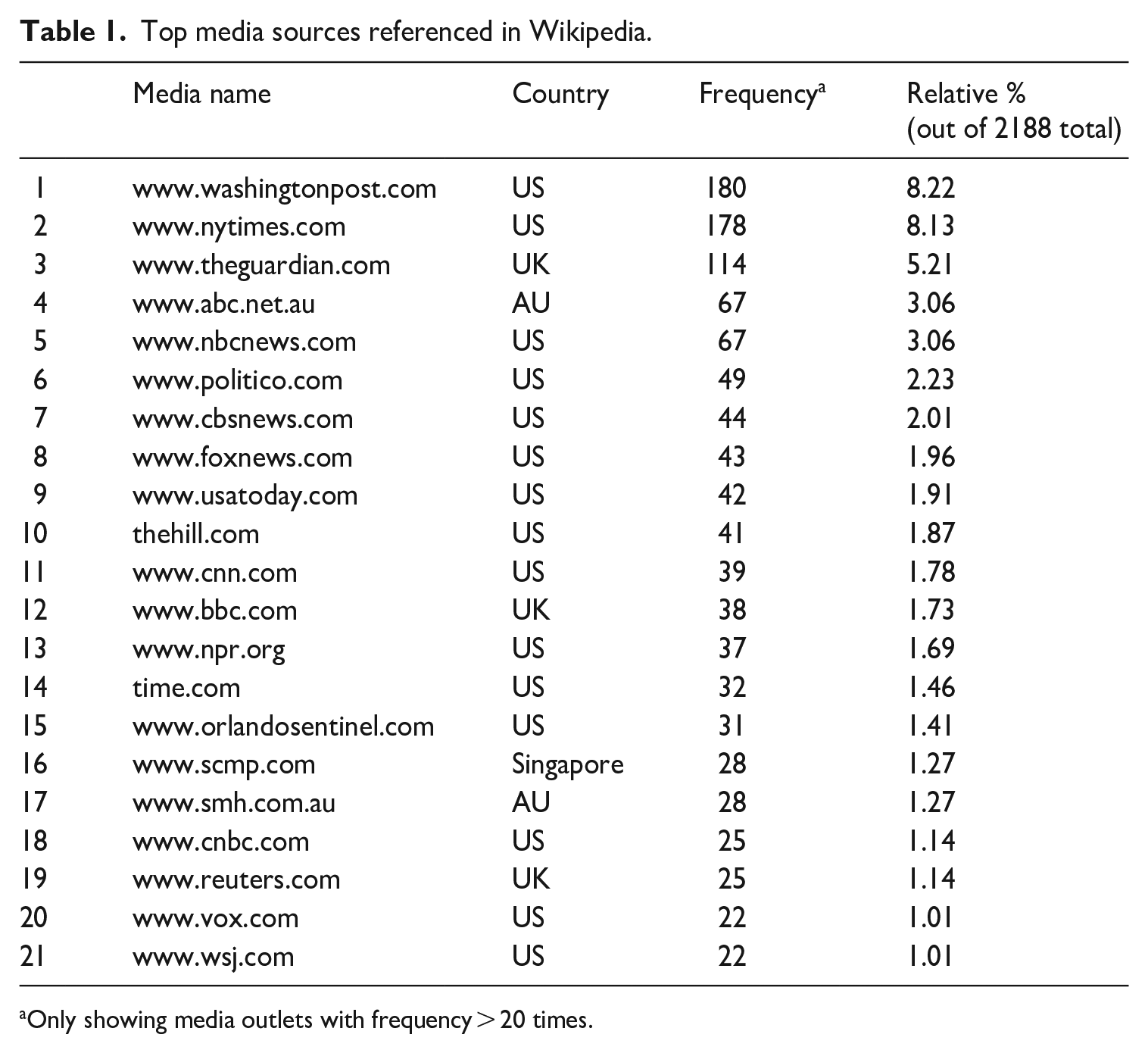
Only showing media outlets with frequency > 20 times.
Constructing issue co-occurrence networks
The idea of an issue co-occurrence network is that when a story contains multiple issues, all possible unordered pairs of issues are considered to have ties. Following the literature (Tahamtan et al., 2022; Vargo et al., 2018), each actor (Wikipedia, elite media, and no-elite media) has an issue co-occurrence network, thus leading to three separate issue networks (agendas). A node in the network refers to an issue, and a tie refers to the co-occurrence relationship between two issues. Each network, quantitatively described as a co-occurrence matrix, includes 19 rows and 19 columns, corresponding to the 19 issues identified above (see Table 2). Each cell value represents how many times the two issues have co-occurred. For example, if an article mentioned gun control, tax, and election fraud together, then all three possible ties add weight of one. Tie weight was a summation of the total number of stories that mentioned the issue pair (e.g. gun control and taxes) at a given time. If a cell associated with “gun control” and “taxes” has a value of 12, that means these two issues have co-occurred 12 times in that matrix. As such, larger cell values reflect more frequent co-appearances of two issues, and vice versa.
Illustration of an issue co-occurrence network.
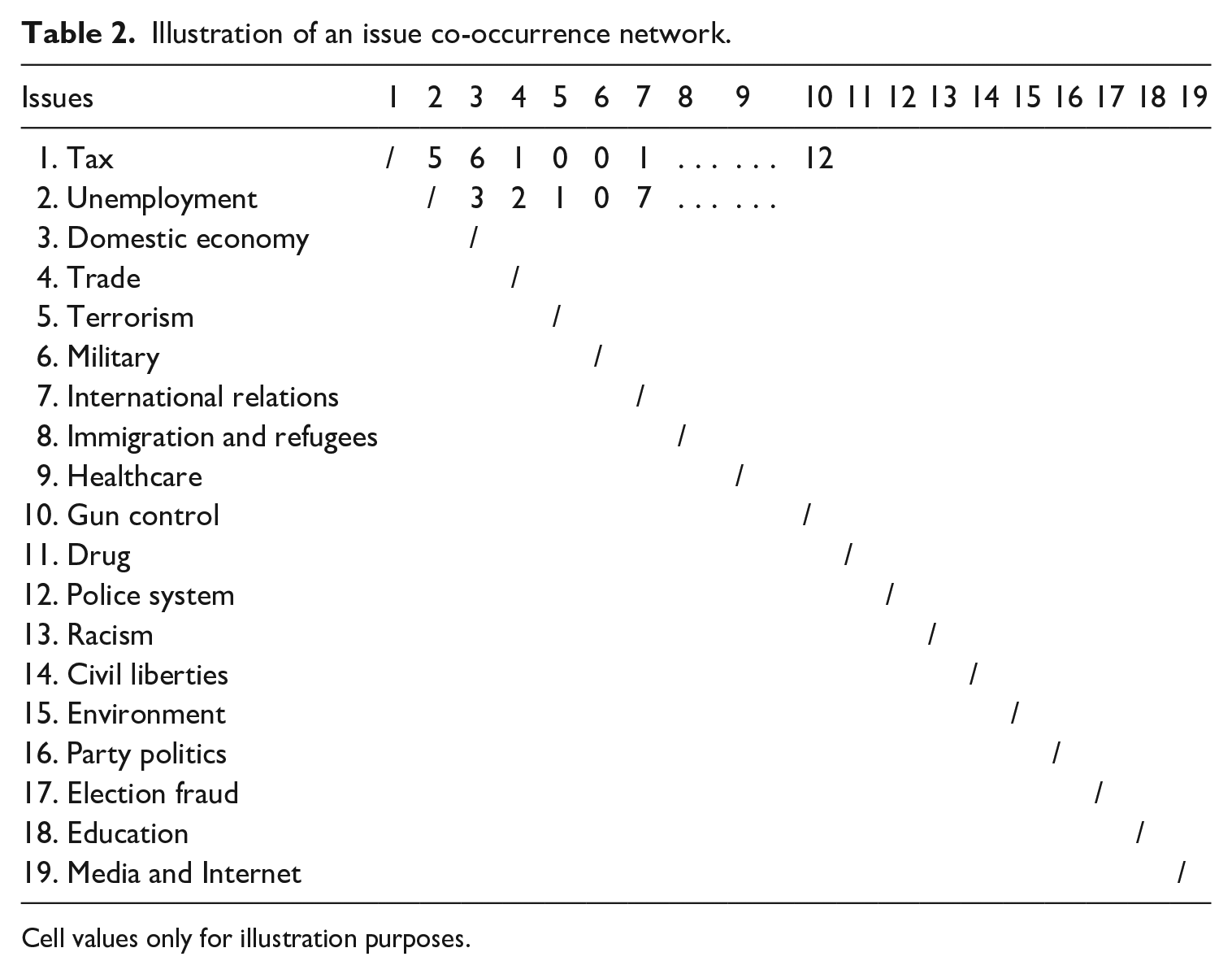
Cell values only for illustration purposes.
Creating time series data
Eigenvector centrality is commonly adopted indicator of an issue’s impact in the networked agenda (Vargo and Guo, 2017). Eigenvector centrality score is a network measure of a node’s relative influence, building on the idea that a node is more central if it is in relation with nodes that are themselves central (Wasserman and Faust, 1994). The importance of a node does not only depend on the sheer number of its connections, but also on the connections’ relative value. A higher eigenvector centrality score indicates that a node is connected to many other important nodes. The centrality scores are then used to construct time series of an issue’s relative importance in the networked agenda. For example, an agenda series of Wikipedia had 19 issues, each associated with an eigenvector centrality. This process is repeated for each day in the sample, and the eigenvector centrality scores of each issue were then treated as time series. In total, we collected 729 days with valid data, meaning that the time series length was 729.
Analysis methods
Two main statistical techniques were used to answer the research questions. The first is a correlational measure of comparing ordinal rankings, Spearman’s rho, which is based on issue salience across media agendas. The ranking was calculated based on the issue’s eigenvector centrality among the 19 issues. A pair of agendas with high correlation indicates high similarity in issue centrality. Prior literature in agenda setting commonly applied this technique to calculate agenda similarities (Groshek and Groshek, 2013; Vargo and Guo, 2017).
The second method, the Granger causality test, is a time-series analysis technique commonly used in literature to understand how agendas influence one another over time (Groshek and Groshek, 2013; Tahamtan et al., 2022; Vargo and Guo, 2017; Vargo et al., 2018). The obtained centrality time series data above (centrality score × media type × day) were entered in time series models. It can be used to analyze if the temporal changes in one time series (an issue agenda) would predict changes in another time series (another issue agenda). X series is said to Granger cause Y series if the current or lagged values of X can help predict the future changes in the Y series, judging by F-test results.
Time lags used in this test were set to five, following prior literature (Vargo and Guo, 2017; Vargo et al., 2018). All tests were run at five lags, that is, 1-day, 2-day, 3-day, 4-day, and 5-day lags, respectively. Prior studies found that different types of media can yield different temporal effects at different lags (Vargo and Guo, 2017), and no “best” lag value applies to all media agendas. We thus tested all five lags to better explore the varying agenda-setting effects over time.
Figure 1 provides an illustration of the major steps in data collection and analysis processes.
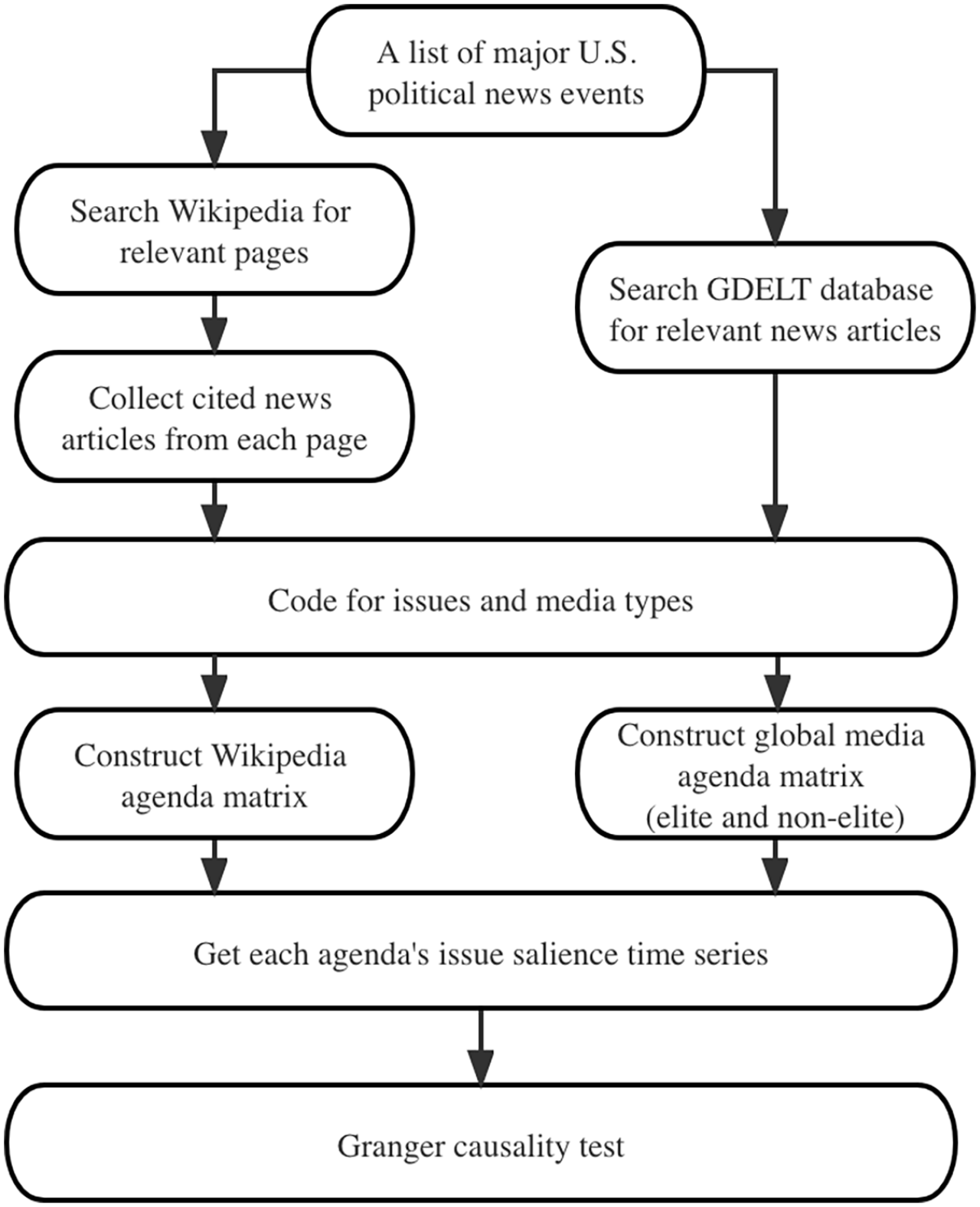
Illustration of major steps in data collection and analysis.
Results
Elite media was frequently cited on Wikipedia
RQ1 asked whether Wikipedia relied on traditional media outlets as information sources, and if so, what were the most important media sources employed by the Wikipedia community. Table 1 presents data on the referencing practices of Wikipedia articles. Traditional elite media accounted for a substantial share of Wikipedia references. This list was primarily made up of the most influential newspapers and broadcasters with a global reputation. Three elite newspapers (The New York Times, The Washington Post, and The Guardian) collectively contributed 472 new items (21.57%) to the total, and the fourth-ranked outlet (www.abc.net.au) accounted for only 3% of all stories. These most referenced media entities originate from the United States, United Kingdom, and Australia, which finding was not surprising because we chose US major political events as the research focus. In the listed media sources, Singapore-based media South China Morning Post was the only exception that did not originate from these countries. In general, English-based elite media sources with traditional influence in professional journalism (Guo and Vargo, 2017) still serve as primary information sources for participatory and citizen-based journalism.
Agenda similarity across media types
Table 3 exhibits the issue salience correlation data when centrality scores were averaged over the data collection period. The resulting 19 issue centrality scores (one score per issue, per media type) were rank-ordered and Spearman’s correlations were calculated between each pair of media types. The results showed that overall, the issue agendas derived from each media type were highly similar, with the lowest correlation score being as high as .95 (between Wikipedia agenda and elite media agenda). The correlation between elite and non-elite was .98, and the correlation between Wikipedia agenda and non-elite agenda was also .98. The high correlations among all three pairings of agendas suggest a consensus among different media types as to issue importance and newsworthiness. The issues that one media type considers to be important are also widely shared by other media types. Wikipedia, as a collective and participatory citizen journalism practice, did not produce content drastically different from the news coverage already provided in the global media landscape. The high similarity of agendas across media types is consistent with many prior studies in intermedia agenda setting (Groshek and Groshek, 2013; Tahamtan et al., 2022; Vargo and Guo, 2017; Vu et al., 2014).
Spearman’s rank-ordered correlation.
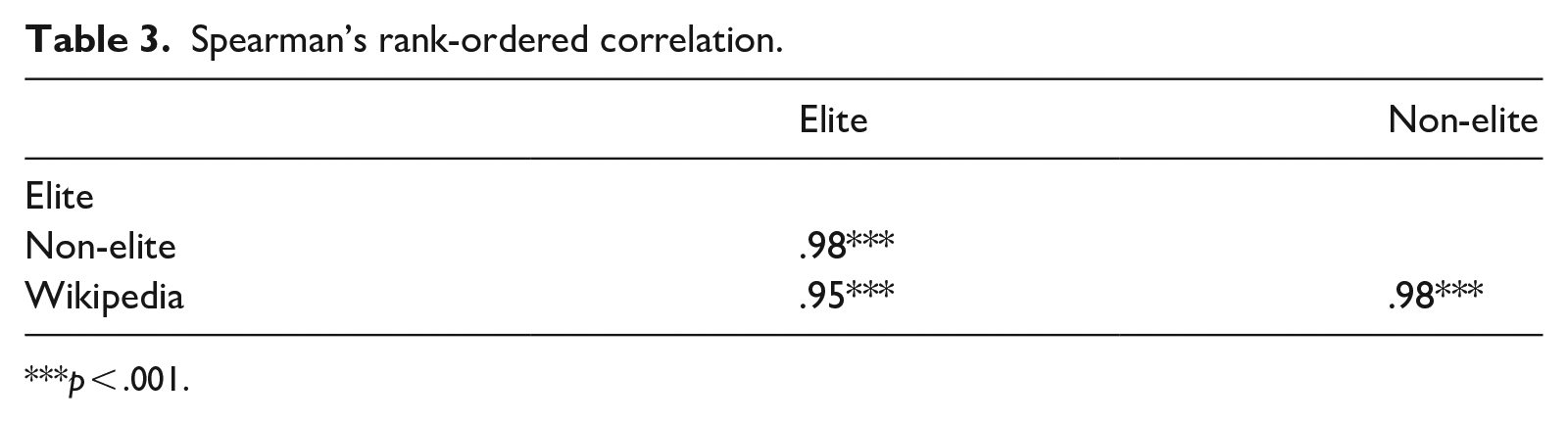
p < .001.
Results of the Granger causality test
This study conducted a series of Granger causality tests by examining whether each of the 19 issues in Wikipedia predicted the future salience of the issue in elite media and non-elite media or vice versa. Together, there were 19 issues × 6 pairings × 5 lags = 570 total Granger causality tests. Each tests for a directed agenda-setting relationship from one medium to another under a specified time lag. Each time series was checked for stationarity assumption before entering the model. All series (19 issues × 3 media = 57) met the stationarity assumption with augmented Dickey–Fuller tests generating p values less than .05.
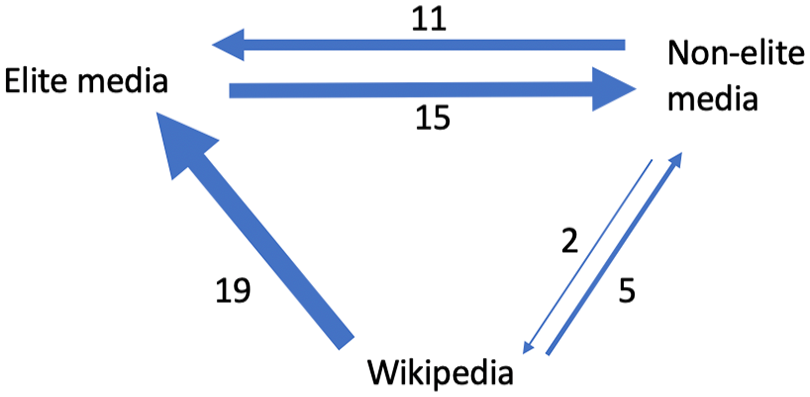
Figure 2 shows the number of significant Granger causality tests out of 95 total possible tests, given the independent and dependent variable series. By performing the Granger causality tests, this study examined if the three agendas obtained from Wikipedia, elite media, and other non-elite media predicted the future issue agendas of each other. Each directed path contained up to 95 Granger causality tests, and if there were no significant outcomes from any of the tests, that path was omitted in the graph.
Significant Granger causality tests.
First, for the pair of agendas between Wikipedia and elite media, Wikipedia’s agendas were found to set (i.e. Granger cause) elite media agenda 19 times, out of 95 possible tests. Elite media did not set any of Wikipedia’s issue agenda. Comparing the agendas between Wikipedia and non-elite media, Wikipedia was found to significantly predict non-elite media’s agenda in 5 tests. In contrast, the other direction of agenda setting from non-elite media to Wikipedia was only significant in 2 times. Comparing the pair of agendas between elite media and non-elite media, elite media significantly predicted non-elite media’s agendas in 15 tests, and non-elite media agendas Granger caused elite media agenda in 11 tests. Among the three pairs of media agendas, only Wikipedia predominantly predicted elite media’s agenda. The other paths, between Wikipedia and non-elite media outlets and between elite and non-elite media, were reciprocal and mutually influential. The networked issue agendas are more nuanced than a one-way relationship.
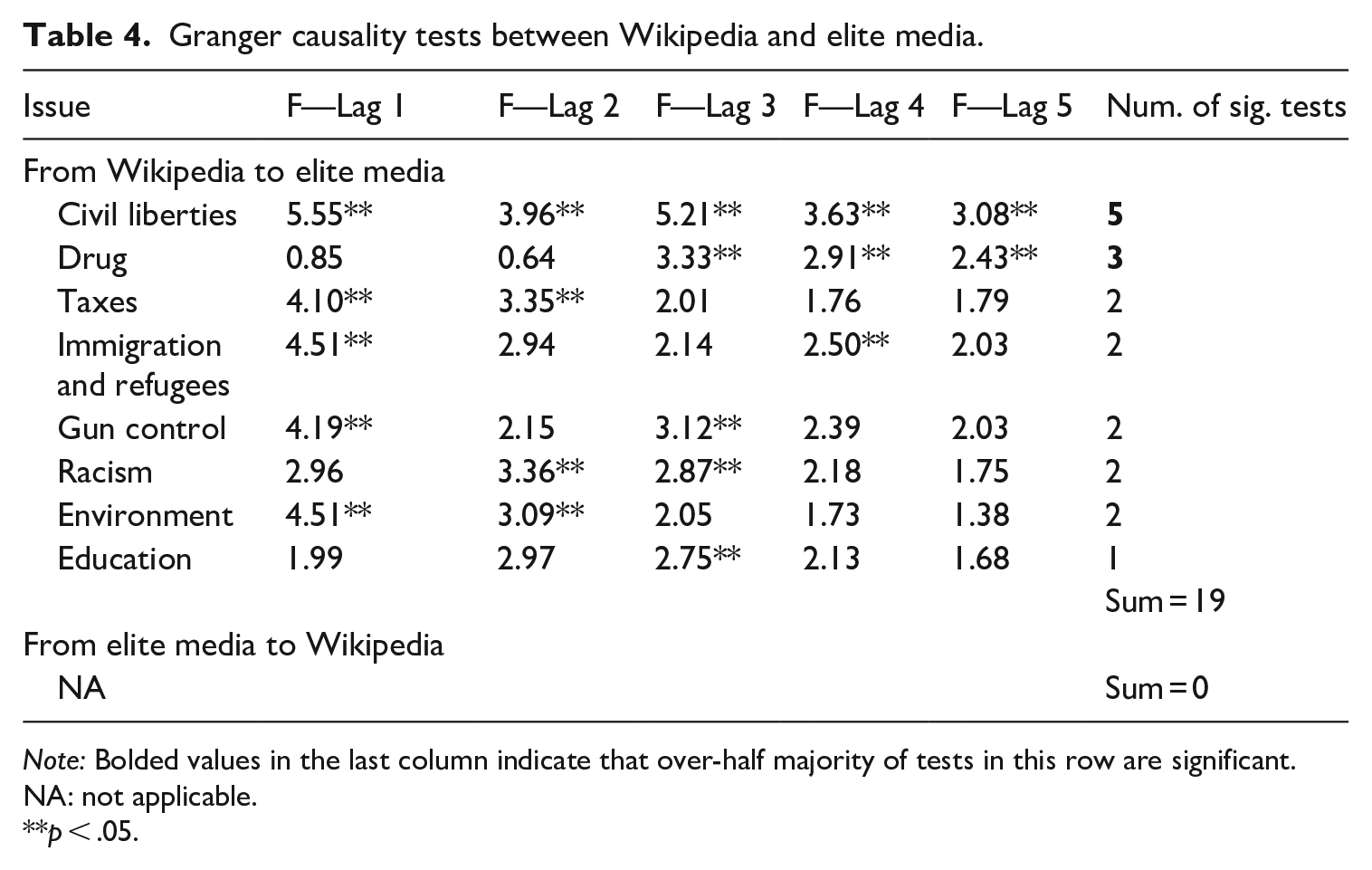
Second, we examined specific issue-level Granger causality test results among the three pairs of agendas. Tables 4 to 6 summarize the list of issues that one medium Granger caused another. If no significant result was returned for that issue, the result was omitted in the table. Table 4 exhibits the agenda-setting effect from Wikipedia to elite media. Eight of the 19 issues had at least one lag that showed a Granger causality relationship. That is, nearly half of the issues in Wikipedia were found to lead elite media issue agendas at least once. Among them, the issue “civil liberties” were significant at all five lags. The issue of “drug” in Wikipedia also significant set the agenda of elite media in three lags out of five total. Although these two issues provided robust evidence that Wikipedia agenda sets the elite media agenda, we could not be overly confident because most other issues did not receive support as strong. The reversed directionality from elite media to Wikipedia received no support because no test on this path was significant.
Granger causality tests between Wikipedia and elite media.
Note: Bolded values in the last column indicate that over-half majority of tests in this row are significant.NA: not applicable.
p < .05.
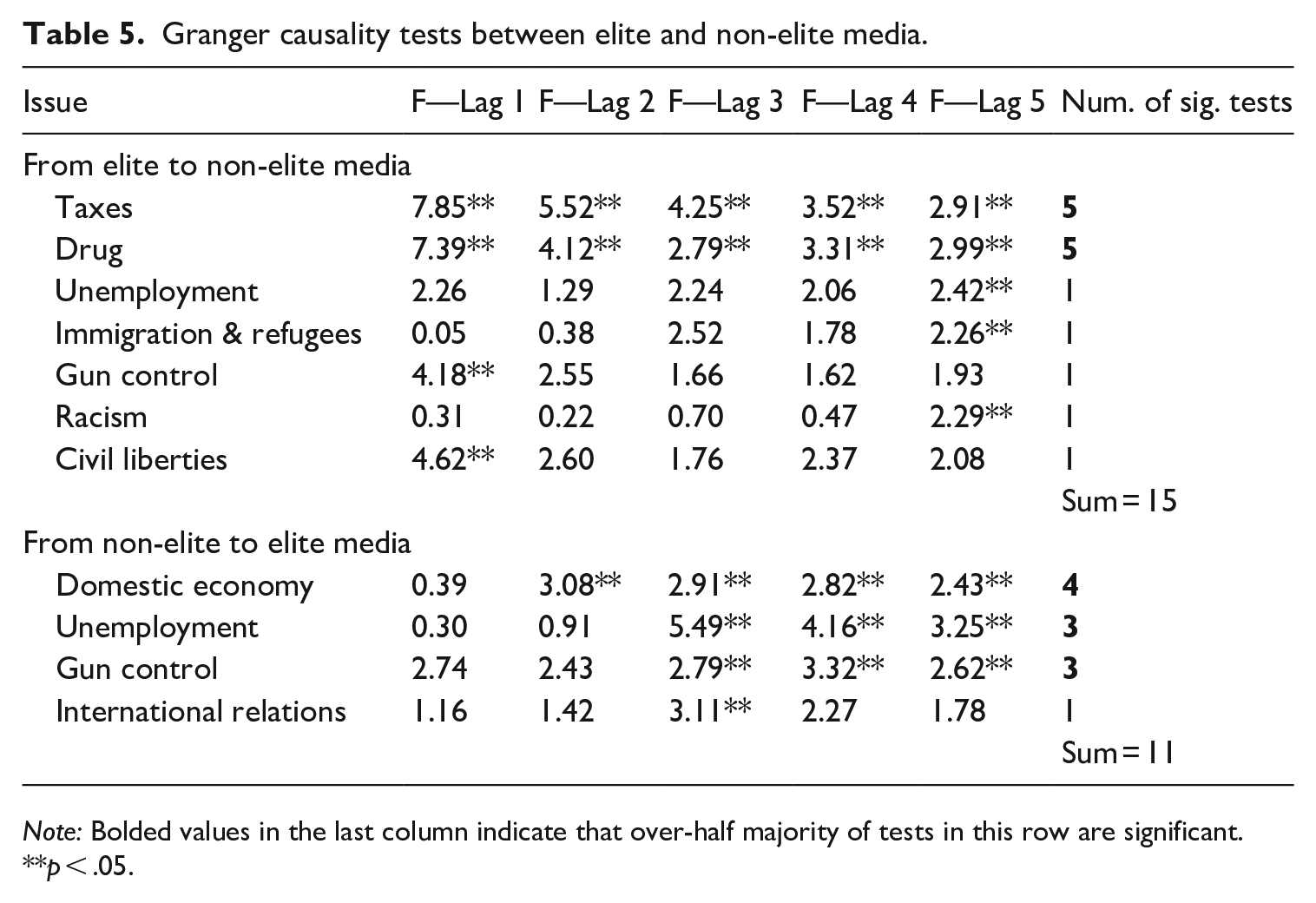
Granger causality tests between elite and non-elite media.
Note: Bolded values in the last column indicate that over-half majority of tests in this row are significant.
p < .05.
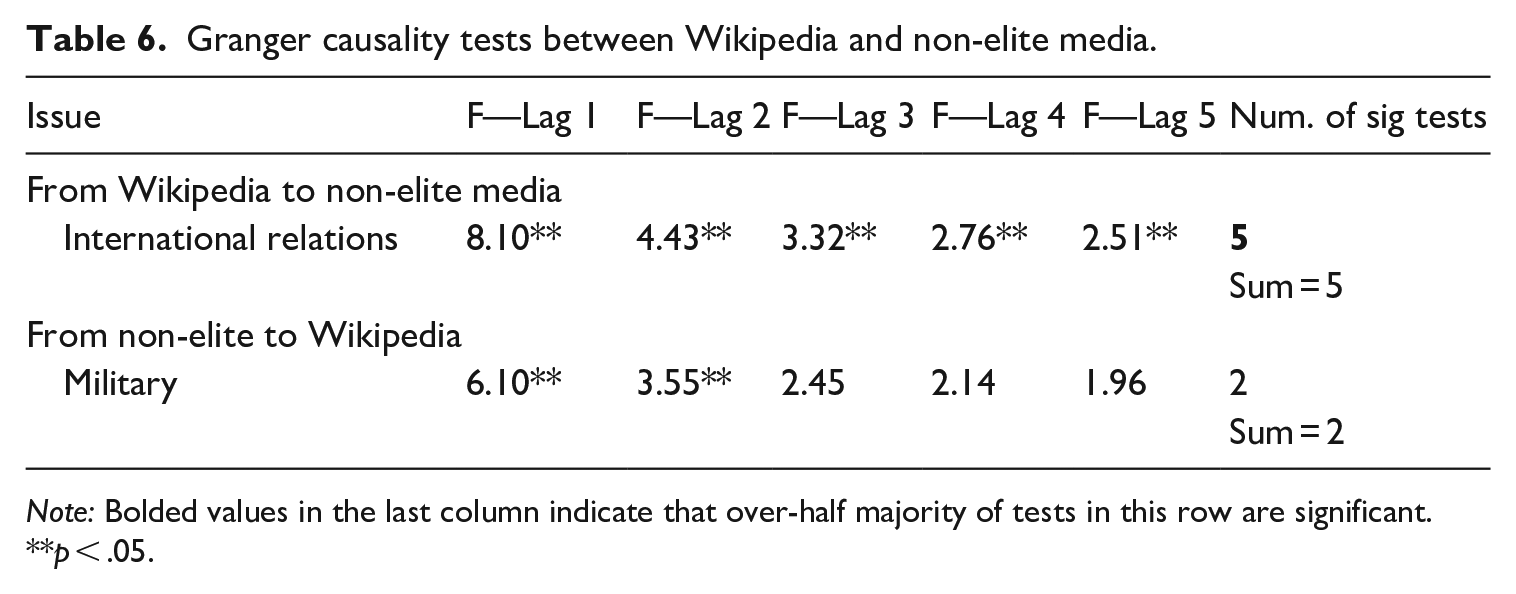
Granger causality tests between Wikipedia and non-elite media.
Note: Bolded values in the last column indicate that over-half majority of tests in this row are significant.
p < .05.
Table 5 shows the agenda-setting effect between elite and non-elite media. For the impact from elite to non-elite media, 7 of the 19 issues tested showed at least one significant lag of Granger causality relationship. “Taxes” and “Drug” are two issues that received full support, since all five lags were significant. Elite media consistently set non-elite media’s agenda in terms of these two issues. On the reverse side, when examining the impact of non-elite media in setting elite media’s agenda, three issues (domestic economy, unemployment, and gun control) were found to robustly (i.e. in more than three lags) support the agenda-setting effect. Overall, the relationship between elite and non-elite media was not a simple one-way relationship. They set each other’s agenda in certain issues, and no medium dominates the relationship between the two.
Table 6 summarizes the agenda-setting effects between Wikipedia and non-elite media. Considering Wikipedia’s impact on non-elite media, the issue of “international relations” was found to significantly and consistently exhibit agenda-setting effect. However, non-elite media’s “military” discussion was found to Granger cause the Wikipedia agenda in two lags. Except these two issues, most other issues found no agenda-setting relationships between Wikipedia and non-elite media.
Robustness check
We further performed two types of robustness checks to ascertain that the central findings—Wikipedia was part of a decentralized agenda-setting network—were not merely observed by chance.
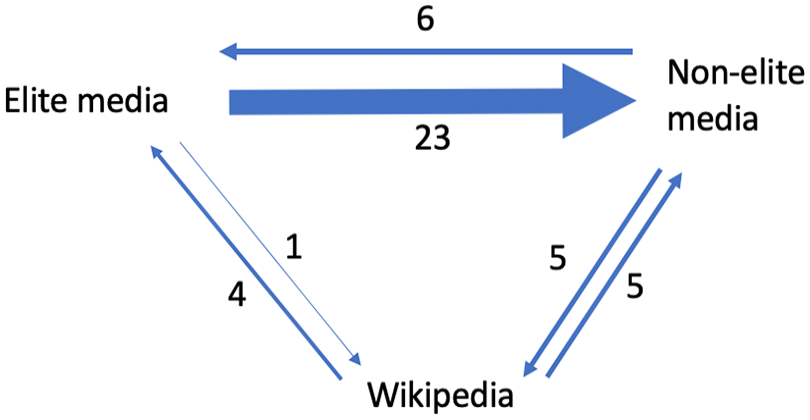
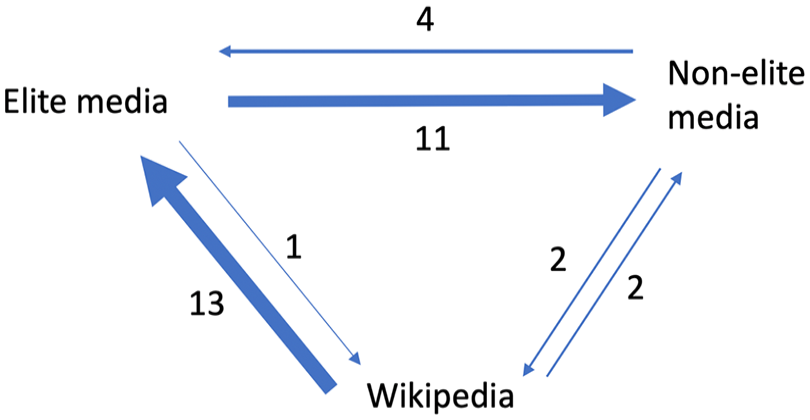
First, two different sub-samples were created by selecting two event clusters—one about US election–related news (Figure 3), and one about gun violence related stories (Figure 4). The analysis procedure followed the steps described above. Figures 3 and 4 present the graph of the agenda-setting networks between the three media types for each subsample.

Robustness Check 1: Granger causality tests for Donald Trump-related event cluster.
Robustness Check 2: Granger causality tests for gun violence-related event cluster.
Second, we rank-transformed the raw eigenvector values and rebuilt the agenda time series, to make sure that the potential interdependence of network metrics does not confound statistical test results. Rank transformation is a recommended approach when the assumption about distribution of probabilities governing the population cannot be proved (Conover, 2012). Figure 5 shows that the agenda-setting networks between the three media types when using rank-transformed data are qualitatively similar to the results reported above.
Robustness Check 3: Granger causality tests with rank-transformed data.
Overall, three different robustness checks showed that the findings were consistent. There was no single dominant player who can set the overall agenda, and that certain media types can set other media agendas under certain circumstances. The patterns obtained from robustness checks provided further evidence that Wikipedia played a key role in setting global news agenda, and other external sources also set its agenda. Contrary to a common belief about the elite’s hold on the global news agenda, elite media does not outperform non-elite media in the agenda-setting network we mapped here.
Discussion
We collected 60 top US news stories from 2015 to 2020 as the data sample and examined the NAS relations between three main entities—Wikipedia agenda, elite media agenda, and non-elite agenda. By conducting agenda correlation analysis (Table 3) and several sets of Granger causality tests (Figures 2 to 5), we identified a multi-agent, multidirectional agenda-setting network among several media entities, which challenged the traditional unidirectional or bi-directional agenda-setting model. Specifically, several observations can be made.
The most important critical source for Wikipedia content is still the elite media sources, especially the elite newspapers that already enjoy an international reputation. The three most frequently cited sources in the Wikipedia sample were The New York Times, The Washington Post, and The Guardian. It defies a common assumption that Wikipedia remains relatively independent from external media agendas’ influence. In addition, we are interested in who sets Wikipedia’s agenda and whether Wikipedia also sets the agenda of external media sources. The rank-order correlation analysis between each media type’s 19 issue centrality scores (averaged for the entire data collection period) found that the agendas of various media entities were qualitatively similar. No agenda is drastically different from other agendas available from other sources. All media pairings scored a correlation equal to or greater than r = .95. We also examined if the 19 news issues derived from Wikipedia news coverage and global news media can transfer their issue salience from one medium to another. The primary study and two robustness check studies consistently revealed that, overall, there was no dominant player that could substantially set the global issue agenda. The global agenda-setting relationships now operate in an interdependent and multi-directional manner among the diverse media entities. Notably, Wikipedia and non-elite media also sometimes set the agenda of elite media on certain topics, showing the increasingly decentralized nature of online media landscape.
We now consider two core questions in agenda-setting research and discuss how our findings shed new light on these classic theoretical inquiries (McCombs, 2005).
From “who leads” to “no one leads”
First, intermedia agenda-setting research has always tried to understand the question of “who leads” in the media landscape. This question used to be important because in the era of mass media, when agenda-setting theory was originally formulated, the dominant media source has a high potential to sway public opinions. The “leader” has the power to manipulate the perceived reality in a society. A general trend observed in recent empirical works suggested the decline of the elite media, which reflects a greater change regarding power re-distribution in online journalism. In 2009, Meraz found that even though elite media (The New York Times and The Washington Post) is no longer the sole influence, it is still a driving force for news agendas. In 2017, Vargo and Guo found that the entire US media agenda could be best explained by online partisan media rather than the elite media. These journalism scholars documented that, over time, elite media’s impact has been on the decline for over a decade and will likely continue to be so.
However, the current analysis did not propose any single player to be a dominant role, instead, we found that no one leads. Neither the traditional mainstream media, nor the peer-produced news contents, can set the majority of agendas (judging by the over-half majority rule). This aligns well with a decentralized view of power in the digital media world, where the monopoly of a few continues to be democratized among different players (Barassi and Treré, 2012; Benkler, 2006). The value will not be easily controlled by a few, and we must use the whole networked web to get a comprehensive understanding of the current agendas and public opinions.
From “agenda leadership” to “agenda network”
Another key question for agenda-setting scholars is that “if the media sets the public agenda, who sets the media agenda?” (McCombs, 2005). It was previously held that elite leadership results from the norms and traditions of news production where journalists routinely look over their colleagues’ shoulders, especially those from the elite press (McCombs, 2005). Thus, agenda leadership stems from the fact that some organizations tend to trust and adopt the high-quality information produced by other sources.
Wikipedia is a different type of platform that offers users the possibility to crowdsource and integrate multiple news agendas, while searching the Web for diverse information sources in an intelligent way. The core tenet of Wikipedia’s openness and equality encouraged editors to accommodate diverse or even contradictory agendas from different external sources. Though not directly tested in the current study, prior literature shed light on how Wikipedia is capable of hosting multiple and even contradictory agendas (Jirschitzka et al., 2017; Rubira and Gil-Egui, 2019). Content analysis of contentious topics on Wikipedia, such as globalization (Rubira and Gil-Egui, 2019) and alternative medicine (Jirschitzka et al., 2017), showed that the community did not strive to resolve the inconsistency between different perspectives and do not develop their own “Wikipedia version of agenda.” The level of authors’ perspective heterogeneity was even found positively predict more balanced article content (Jirschitzka et al., 2017). The plurality of cited references is a symptom of broader social and political information flows that shape our digital environment (Rubira and Gil-Egui, 2019). The editors embraced the multiplicity of agendas crowdsourced from varied organizations and ended up reflecting larger power dynamics at the global level. Thus, instead of searching for a better agenda, Wikipedia remains to be a network of agendas, which partly explained why we do not observe any single entity dominating Wikipedia agenda.
Joining several prior studies (Tahamtan et al., 2022; Vargo and Guo, 2017; Vu et al., 2014), we believe now is the right time to start conceptualizing a multi-agent and multidirectional network architecture to describe agenda-setting relationships, especially if the context involves digital platforms. It should be recognized that the publics’ news consumption has been rapidly moving beyond an “elite media/emerging media” dichotomy toward an interdependent network constituted by multiple media entities. Some of the players in this network may not have even been considered as “media” before, such as Donald Trump (Wiemer and Scacco, 2018) and WHO’s Twitter account (Tahamtan et al., 2022), and Wikipedia in our example. The proliferation of innovative forms of digital technologies will continue to produce big changes in the production and consumption of news content. Any single player’s agenda-setting power will continue to be re-distributed in a decentralized network. Only focusing on bidirectional agenda-setting effects like we used to do will be less fruitful because we must recognize the complex interconnections between a cluster of media entities that co-exist in this agenda-setting network.
Wikipedia on the rise
Given the scholarly consensus that elite media’s power is on the decline, a natural question is, how much power does Wikipedia have in diluting elite media’s agenda-setting influence? From the primary study, along with two robustness checks, our analysis found that Wikipedia may even be more influential to elite media than the other way around. According to results shown in Figure 2 and Table 4, Wikipedia set elite media’s agendas in 19 Granger tests, while elite media did not set Wikipedia agenda even once. Two robustness checks found the same. We now provide four explanations about Wikipedia’s unique agenda-setting role and its implications for the online media environment.
Wikipedia as a megaphone of public opinions
The above comparisons indicated that Wikipedia agendas could often predict elite media’s agenda, and elite media was not as influential as previously expected, despite that fact that they were still frequently cited in Wikipedia. It showed that Wikipedia’s curation of information was an effective way to have the public present their collective opinions about what issues are important to them and what are not. Though elite media still holds the high reference impact, Wikipedia, instead, enjoys a deep level agenda-setting impact because it accurately identified and predicted the issues that are most central for the public discourse. This is not surprising because Wikipedia’s editorial processes were based on the publics’ collective judgment and went through extensive negotiations. We also corroborated previous studies (Keegan, 2019; Margolin et al., 2016) in that Wikipedia contents match or even can predict real-world political activities. Wikipedia’s accuracy in prediction of political reality could be summarized as a megaphone effect of public opinions. It does not create a new agenda; instead, it is a megaphone that amplifies existing agendas and opinions shared by many in the public. Wikipedia was successful in bringing out that shared agenda into concrete forms.
Wikipedia as a concretized marketplace of agendas
Digital media is thought to democratize people because it serves as an open and uninhibited marketplace for different agendas to freely compete (Goldman and Cox, 1996). However, this idea of a digital marketplace of agendas has only been a highly abstract concept because it involves all media sources accessible via the Internet and their mutual influences, which are not easy to measure empirically.
Wikipedia offers a great opportunity to observe this “marketplace of agendas” in a concretized and materialized form, where multiple agendas are stored and recorded on the same platform and re-arranged in a collectively agreed-upon way. Multiple agendas co-exist in this marketplace and even compete for a while as the news events keep developing, and eventually reach a more stable status after extensive negotiations among the community. The term “agenda” used to only represent one party’s perspective, either from an elite newspaper like The New York Times, or an independent blogger. Wikipedia enables interested individuals to freely participate in the discussion about what they deem newsworthy and can accommodate multiple different sources’ agendas in one place. This conversation remains open to all possible agendas because there is no finish point for Wikipedia content publication. The contents could evolve over time if more information becomes available, and if more people want to contribute to the discussion.
Wikipedia as a meta agenda setter
In complex systems, a meta-agent is a special type of agent that can observe other agents’ actions and has the capacity to respond to the observed actions of these agents accordingly. Wikipedia, in this sense, is a meta-agent of news agendas. On one hand, the Wikipedia community observes and absorbs news agendas from multiple media sources. Our analysis showed that both elite media and non-elite media agendas are influential to Wikipedia under certain conditions. On the other hand, the agendas that Wikipedia adopted can sometimes reversely set other media sources’ agendas. The publics’ interpretation of the raw materials and their final presentation of news agendas on Wikipedia accurately predict what issues remain central in both elite and non-elite media for the following days. Thus, Wikipedia is a meta-agent that observes information from other agents and effectively responds to them. This idea defied an assumption in intermedia agenda setting that each agent is playing qualitatively equal roles, though certain players have more substantial power. Identifying Wikipedia as a meta agenda setter, instead of a regular one, adds an interesting broker role in the agenda-setting network and reveals the nuanced differences in the meta-agent’s interactive patterns with other media actors.
Wikipedia as an institution of collective memory
Another interesting characteristic of Wikipedia is that it vividly presents the process of how news becomes history. Collective memory reflects a social group’s collective perception of the past (Neiger et al., 2011). It is a common notion that journalism provided a first rough draft of history (Hammond, 2000), because it presents our current understanding of how the current events will likely be depicted in history (Zelizer, 2008). Wikipedia agenda is not only about news, but also a reflection of our collective memory of these events. It hosts noteworthy stories because it aspires to provide its own readings of the social reality. By drawing from agendas provided by many other collective memory institutions, Wikipedia can be seen as a multivocal open arena for the public to collectively edit the second draft of history based on the diverse first drafts available. The news agendas provided on other media outlets essentially became materials for weaving a collective memory on Wikipedia. Wikipedia readers are also trying to make sense of new events by connecting with prior events, with the help of the hyperlinking function (Twyman et al., 2017). They engage in a unique consumption pattern of “re-interpretation of old information” and building collective memory. By accommodating the latest news events, historical accounts, and relevant socio-political background knowledge, Wikipedia blurs the line between objective reality and subjective collective memory.
Limitations
This study had several limitations. First, though Granger causality tests can identify statistically significant time-ordered relationships between a pair of media agendas, they do not prove strict causality relations. It is a limitation shared by many prior studies using this method, as more accurate manipulation of real-world news environment is difficult. As a quantitative exploration of the agenda-setting effects, we also did not provide further qualitative evidence to provide deeper insights about the causal mechanisms driving Wikipedia editors’ use of external information sources. Second, we did not consider public opinion agenda, especially public opinions shared on social media, because the research questions were mainly concerned with intermedia agendas. It is highly possible that Wikipedia agenda resonates with social media public agenda, as our discussion of the megaphone effect would suggest. Future studies could expand on the social media agenda and test whether the citizen-generated news predicts social media agenda or the other way around. Third, more work could be done in coding for issues and media types with greater accuracy. This study mainly relied on existing categorization schema provided in the GDELT system which used a dictionary-based classification approach. Given the large-scale news data available now, supervised machine learning classifiers may be good tools for future studies needing higher resolution in classifying different media types and content issues. Fourth, the analysis focused on references remained on the page at the time of data collection, and we missed those references that were originally contributed but eventually deleted. Our data could not fully explore the temporal dynamics of adding and deleting references when editors collaborate on the pages. It would be highly interesting to analyze those references that eventually disappeared and to see what content characteristics lead them to be removed as a reference. Fifth, the large data-sets adopted lead to many statistical tests used. As such, Type I error may be inevitable for any given test. Though this article did not find any party being a dominant agenda leader and thus did not reject any null hypothesis (risking no Type I error), we caution readers to make their own judgments when reading the granular test results reported in Tables 4 to 6 about the issue by issue, media by media agenda-setting links. Readers are encouraged to be more conservative if they would like to analyze any specific issue-level agenda-setting link, which is not the focus of the current article.
Conclusion
Exploring the role of Wikipedia news as an agenda setter, rather than only as an online encyclopedia, adds an important dimension to our understanding of how digital journalism works out and how emerging media types negotiate the complex power relationships with existing actors. We presented a “decentralized agenda network” at two levels. For agenda-setting literature, this study joins several prior efforts to advocate for a new agenda-setting architecture—a multi-agent and multidirectional network interlinking various media actors. There will be decreased likelihood for a singular player to dominate the overall agenda network. For information systems literature, we highlight that the platform of Wikipedia is itself an agenda network. It greatly contributed to the power re-distribution of online journalism and turned the traditional debate about “who leads” into an open search of diverse agents and agendas in an agenda network. Traditional thinking about agenda leadership obscured the complex ways in which various information sources, past knowledge, and current events are blended in people’s news consumption behaviors.
Footnotes
Funding
The author(s) disclosed receipt of the following financial support for the research, authorship, and/or publication of this article: This work was supported by Pujiang Talent program [#21PJC079]; Humanities and Social Science Youth Foundation, Ministry of Education of the People’s Republic of China [#21YJC860018]; and SJTU – International Association of Cultural and Creative Industry Research program.
