



Abstract
Token acts of online support, also known as clicktivism, have received much criticism in recent years for suppressing subsequent prosocial behavior. However, whether, when, and why individuals perform less prosocial behavior following these acts remains relatively unknown. To address these questions, we designed a lab experiment in which participants (N = 193) were randomly assigned to engage in public, private, or no act of clicktivism. Consistent with moral self-licensing theory, those who signed an online petition were less likely to donate than those who did not sign any petition. Public clicktivism (compared to private clicktivism) increased donation intentions among those with high impression management tendencies (i.e. high self-monitors). Concerns about one’s moral self-image partially mediated these effects. Theoretical and practical implications of these findings are discussed.
Keywords
Digital platforms have become popular sites for social activism in recent years. Successful online charity movements like the ALS Ice Bucket Challenge, for example, have gathered tremendous global support and raised over 115 million US dollars (Rogers, 2016). Despite these celebrated cases, however, a vast majority of online charity efforts have not been so successful. “The Facebook page of Save Darfur Coalition has 1,282,339 members who have donated an average of nine cents apiece,” Gladwell (2010) writes, pointing to a glaring incongruity between nominal and actual support. Similar conclusions were reached in a field experiment: despite the thousands of “likes,” “shares,” and “comments” on social media, only 30 users pledged any money (Lacetera et al., 2016).
The growing disparity between nominal (e.g. subscriptions, petitions) and more substantive support (e.g. donations, volunteering) highlights the proliferation of a unique avenue of participation on digital platforms. Small acts of token support for social causes through social media or other online channels are referred to, somewhat disparagingly, as “clicktivism” (Shulman, 2009) or “slacktivism” (Christensen, 2011; Morozov, 2009). Clicktivism, at its core, is nothing new. Less effortful forms of activism, such as signing a petition or wearing a pin, have always been more prevalent than giving donations or joining protests, even before the Internet (see Karpf, 2010). What is distinctive with digital technologies, however, is the incredible ease with which token activities could be conducted and the potential for making the act visible to one’s social networks. Literally, it only takes a click.
While some practitioners and scholars advocate online activism as a valuable supplementary strategy for social campaigns (Earl and Kimport, 2011; Freelon et al., 2020; Halupka, 2014; Harlow and Harp, 2012; Hockin-Boyers and Clifford-Astbury, 2021), others have raised concerns about the adverse effects of clicktivism (Guo and Saxton, 2020; Morozov, 2009; Shulman, 2009). Generally, the argument goes, engaging in token acts of support online significantly demotivates actual, more substantive participation. Empirical evidence thus far has been mixed, showing evidence of both positive (e.g. Chou et al., 2020; Kristofferson et al., 2014; Lee and Hsieh, 2013) and negative (e.g. Cornelissen et al., 2013; Lee and Hsieh, 2013) effects of clicktivism on subsequent support for the cause.
This article draws from the moral self-licensing theory (Merritt et al., 2010; Monin and Miller, 2001) to elucidate the conditions and mechanisms of clicktivism effects. Moral self-licensing theory posits that an initial moral act frees the individual from the need to engage in more prosocial behavior (Merritt et al., 2010). Although the theory has typically been used to explain prejudice expression in intergroup contexts (Monin and Miller, 2001), we believe that it can also be applied to online activism contexts. This is because parallels can be drawn in the way that preceding, smaller good deeds can make people feel “secure” in their moral regard (Merritt et al., 2010), thus freeing them to act in less moral ways subsequently (e.g. less prosocial behavior, more prejudiced behavior).
This study also focuses on the interplay between the social observability of the act of clicktivism and, an individual-level moderator, impression management tendencies. We argue that the meaning of a click can be differently perceived by people with different self-monitoring tendencies and lead to differential effects of clicktivism, especially for public acts of clicktivism. Furthermore, we consider two potential mediators relevant to the moral self-licensing framework—perceived success of building a moral impression and the importance of one’s moral self-image (MSI)—to better understand the motivational underpinnings of the behavioral outcomes. By identifying the moderating and mediating mechanisms behind clicktivism effects, this study attempts to reconcile divergent findings in the literature. By highlighting conditions under which moral licensing occurs in a digital environment, our results can benefit practitioners who wish to utilize online platforms for social campaigning or marketing.
Clicktivism and moral self
Clicktivism is defined as an online activity that requires minimal cost, effort, and risk where the purpose is “to raise awareness, produce change, or grant satisfaction to the person involved in the activity” (Rotman et al., 2011: 3). It encompasses multiple kinds of token activities online such as joining a Facebook group, signing online petitions, forwarding text or videos, or clicking on “like” on shared content (Lee and Hsieh, 2013). Scholars have conceptualized these as “digital spectator activities” that involve the lowest level of commitment and effort (George and Leidner, 2019). More recent forms of clicktivism have centered around shocking events that catalyze activists’ use of certain hashtags in their online discussion of issues, giving rise to various forms of clicktivism surrounding the issue. Some of these campaigns have successfully mobilized offline efforts to promote social and cultural change (e.g. “Black Lives Matter” and the “Me Too” movement, Freelon et al., 2020; Hockin-Boyers and Clifford-Astbury, 2021; Li et al., 2021). Studies suggest that perceiving Internet-based actions for social causes to be beneficial is essential to individuals’ engagement in further and offline actions for the cause (Hockin-Boyers and Clifford-Astbury, 2021; Li et al., 2021; Wilkins et al., 2019).
In an attempt to overcome the subjectivity and malleability associated with defining clicktivism based on the level of risk or cost, Halupka (2014) offers a more generalized conceptualization of clicktivism as a form of online political participation that is characteristically spontaneous, noncommittal, nonspecialized, easily replicated, and engages a political object. With this more generalized conceptualization, clicktivism is freed from negative connotations of being a “lazy” form of participation and allows it to be applied to newer developments in technology.
While incorporating an online participatory dimension has increasingly become the default call-to-action in many social campaigns today (Earl and Kimport, 2011; Harlow and Harp, 2012), critics have also raised concerns over the adverse effects of clicktivism. One line of critique is that spontaneous, noncommittal actions online have little, if any, impact. Condemning clicktivism as “the ideal type of activism for a lazy generation,” Morozov (2009: 1) argues that, aside from making people feel good, social media activism, in particular, has “preciously little political impact” (Morozov, 2009: 189). White (2010) similarly warns that after the novelty of online activism wears off, people might come away with a cynical feeling about the impotence of all forms of activism. Empirical work has also highlighted this negative effect. For example, Cornelissen et al. (2013) reported that after engaging in simple, symbolic actions online, such as clicking on a supportive statement for a charity (i.e. “I support UNICEF”), people put in less effort into a subsequent help request for the organization (i.e. number of characters written to generate a creative slogan for the organization).
Moral self-licensing theory (Monin and Miller, 2001) may explain such adverse effects of clicktivism on prosocial behavior. Moral self-licensing theory posits that performing an initial moral action increases the tendency for an individual to perform morally ambiguous behaviors afterward (Merritt et al., 2010; Monin and Miller, 2001). This effect occurs because past good deeds (e.g. behaviors that demonstrate compassion, generosity, or a lack of prejudice) establish moral credentials for a person, freeing them to act in morally dubious ways subsequently (Merittt et al., 2010). In essence, “[c]redentials can turn ambiguity to one’s advantage by discrediting the least flattering of the plausible motivations and, thus, bringing the most legitimate ones to the fore” (Monin and Miller, 2001: 42). In one of the earliest studies, for example, Monin and Miller (2001) showed that individuals who publicly established their egalitarian beliefs by rejecting a series of explicit, sexist statements were more likely to recommend a man for a traditionally male job in a subsequent task—a decision that may have subjected them to suspicions of sexism had they lacked the moral credential.
Moral self-licensing theory has been widely applied to various contexts that allow individuals to establish their moral credentials (though possibly incidental) and make judgments or decisions that are morally ambiguous. It is important to note that to apply the moral self-licensing framework, the subsequent invited act only needs to be of dubious moral character, not morally deviant. Choosing a male candidate for a traditionally male job (Monin and Miller, 2001), for instance, is not morally reprehensible, only morally ambiguous. Others have looked at the effects of recalling past moral actions on subsequent behaviors such as prosocial activities, giving to charity, donating blood, and volunteering (Jordan et al., 2011). A reduced intention to engage in such behaviors is not exactly immoral or deviant per se, but the very fact that there is ambiguity in how these behaviors might be interpreted renders them appropriate for testing moral self-licensing effects:
Applying the moral licensing framework to the context of clicktivism, we first put forth a replication hypothesis that tests the unconditional effects of clicktivism as a form of moral credentialing on donation intentions:
H1: Signing an online petition will decrease the likelihood of subsequent donations for the social cause compared to not signing any online petition prior to donation requests.
Social observability of a click: public versus private clicktivism
Subsequent studies in the moral self-licensing literature have focused on adding theoretical refinements to the theory. For instance, Cornelissen et al. (2013) examined the effects of symbolic acts of support online (e.g. clicking on a supporting statement for a charity) on subsequent efforts expended for the organization. In line with the moral licensing framework, the results suggested that expressing symbolic support online may have adverse effects on more substantive contributions such as donating money or effort. They also clarified, however, that these effects were concentrated among people with high impression management motivations, suggesting a contingency in the applicability of the moral self-licensing explanation. Other factors have also been identified as moderators of the effect. Freelon et al. (2020) argued that when individuals are invested in a specific cause, their online engagement mirrors offline prosocial activities. However, when individuals do not feel strongly about the cause, there is the potential for clicktivism to exhaust individuals’ engagement with the issue. Lee and Hsieh (2013) found that for incongruent social causes (i.e. social causes that do not necessarily line up with one’s values), signing an online petition did nothing—it did not lead to diminished donation intentions—but signing an online petition that was congruent with their values increased the likelihood of donation. The contingencies found in these studies suggest that moral self-licensing effects may not be as uniform and unconditional as was originally conceived.
In the context of clicktivism, the social observability of the act becomes an important consideration. Social observability can be defined as the ability of an act to be observed or noticed by others (Kristofferson et al., 2014). An initial act of token support that is low in observability can be labeled as a private act, while an act of token support that is high in observability can be labeled as a public act. As moral self-licensing works by putting forward a moral image of oneself (Merritt et al., 2010; Monin et al., 2008), whether the act is public (e.g. signing an online petition that is shared on social media) or private (e.g. signing a private online petition) can affect the extent to which one feels “licensed” by this behavior.
On the one hand, public (as opposed to private) acts of token support can activate an awareness of others and our impressions made on others (Leary and Kowalski, 1990). When individuals pay attention to how others view and assess them, behaviors become more strategic with an eye toward the reactions of actual or imagined others (Goffman, 1959; Lavertu et al., 2020; Leary and Kowalski, 1990). Thus, when token behaviors satisfy one’s impression management concerns, self-licensing effects may occur. Conversely, when token behaviors trigger one’s sense of private self, consistency motives may operate leading to an increase in more substantive forms of support (see Ihm and Lee, 2020). Kristofferson et al. (2014) provide support for the consistency effects of private acts of token support. In one experiment (Study 1), the authors found that participants who privately received a pin in support of war veterans were more likely to donate to the cause than those who were asked to display the pin publicly. This effect was replicated (Study 3) for other forms of token support behavior and other forms of subsequent request: participants who privately signed a petition for a local charity were more likely to say they would volunteer for the charity than those who did so publicly.
On the other hand, Lane and Dal Cin (2017) argued and found that highly visible forms of public clicktivism, such as sharing or posting social cause content on one’s social media, can actually lead to greater support as people strive to appear consistent. The authors explain that publicly sharing social cause content to one’s heterogeneous network entails claiming a position or expressing an opinion in a highly visible manner, and since people perceive that their consistency is continuously evaluated by others on social media, this leads to a boost in volunteering intent compared to private sharing.
These contradictory findings regarding public and private clicktivism on subsequent support suggest the need for further theoretical refinements to fully understand when and how clicktivism leads to licensing effects. First, it is possible that not all “public” acts are the same; some public acts may be sufficient to be used and discarded to build one’s moral credentials, but some public acts may follow them along in conspicuous ways signaling commitment and making it difficult to contradict the initial public act. Public clicktivism that relies on social media may be a case in point. Indeed, the moral self-licensing literature notes that initial acts that evidence commitment too strongly rather than merely indicate sufficient progress, may show an opposite pattern of effects (i.e. consistency effects rather than licensing effects; Merrit et al., 2010). Second, public clicktivism effects may be moderated by other factors that were not accounted for by past work. Our study focuses on this latter refinement by focusing on one relevant individual factor, impression management tendency. We argue that since moral self-licensing works by changing the meaning of subsequent, ambiguous acts (Merritt et al., 2010), it may be affected by personality factors that affect the baseline interpretations of both the token and subsequent actions.
Impression management tendency as a boundary condition
This study examines impression management tendency (i.e. self-monitoring) as a boundary condition for public clicktivism. Impression management is “the process by which individuals attempt to control the impressions others form of them” (Leary and Kowalski, 1990: 34). It is ubiquitous as people constantly engage in strategic actions to create and maintain a desired image of themselves (Goffman, 1959). Yet, although pervasive, individuals vary in their concern for their public image, that is, how important they believe others’ impressions of them are. People with higher impression concerns are more preoccupied with their public image, think that it is important across a variety of contexts, and behave responsively to social situations to attain their desired image (Leary and Allen, 2011). On the other hand, those with lower impression concerns think that their public image has little impact on outcomes they care about, that impressions matter only in a small number of situations, and generally expend little effort in managing their impressions (Leary and Allen, 2011).
Past work has examined individual variations in impression management as a potential moderator. Cornelissen et al. (2013) found that individuals with higher impression management concerns were more susceptible to the adverse effects of token symbolic action (i.e. they showed a greater reduction in subsequent assistance or donations), while on those with lower impression management concerns, clicktivism had no impact. The authors explain this in terms of the strategic mindset of high self-monitors: high self-monitors strategically save their effort for more concrete actions once they engage in symbolic action. However, two points need to be addressed in considering these results. First, while high self-monitors generally engage in strategic actions, consistency motives may emerge for high self-monitors, especially when the token support is made public. This can be assessed by examining the role of social observability of online clicktivism. Second, as there can be a spillover effect of the treatment (i.e. clicktivism) on the self-monitoring measure, studies need to replicate these results by measuring self-monitoring tendencies prior to treatment (see Montgomery et al., 2018).
In this study, we propose that for those with high impression management tendencies (i.e. high self-monitors), public (as opposed to private) clicktivism activates an acute awareness of one’s public image and a desire to maintain consistency of their public image. We thus posit a contingent moderation relationship (see Holbert and Park, 2020), in that the effect of public (vs private) clicktivism is expected to hold only for high self-monitors:
H2: Impression management tendency (i.e. self-monitoring) moderates the effect of public clicktivism on donation behavior, such that public (as opposed to private) clicktivism increases donations for high self-monitors.
Exploring the moral underpinnings of clicktivism effects: perceived success of moral impression and moral self-identity
Moral self-licensing theory suggests that licensing behavior occurs when the initial act is perceived to establish one’s moral credentials in the eyes of others. This perception could be tapped by measuring the perceived success in achieving a moral impression. The concept of perceived success in impression management (O’Callaghan and Doyle, 2001; Sharp and Getz, 1996) assumes that people engage in goal-directed behaviors and evaluate the effectiveness of achieving goals. Those who think they have achieved their desired impression will stop future attempts to create that impression. Those who believe that they fall short will continue to perform behaviors that contribute to the goal (Leary and Kowalski, 1990).
Limited research has explored how people evaluate their perceived success in managing public impressions and how it affects subsequent behavior (Leary and Kowalski, 1990), and most available research has focused on how it influences health-related behaviors (e.g. O’Callaghan and Doyle, 2001; Sharp and Getz, 1996). However, given the motivational tendencies implicit in the moral self-licensing model, the concept can be an explanatory factor for clicktivism effects. When a person engages in the act of public clicktivism, individuals may believe that they are, at least in a relative sense, successful in portraying the desired image of being a moral person (White and Peloza, 2009), and this perception of success might account for the reduction in subsequent action. As such, we test the following mediating hypothesis:
H3: The effect of clicktivism on donation behavior will be mediated by the perceived success of achieving a moral impression (PSMI) among high self-monitors, such that engaging in clicktivism increases PSMI which in turn decreases donation intentions for high self-monitors.
Similarly, the centrality of one’s moral identity may also be important in explaining the process. Moral self-identity, or the degree of importance of one’s moral identity to themselves, has been described as a mechanism that motivates moral action (Damon and Hart, 1992; Hart et al., 1998). It is a strong predictor of how likely an individual is to translate their moral beliefs into action (Damon and Hart, 1992). Notably, moral identity can fluctuate according to situational influences (Aquino et al., 2009). For instance, engaging in clicktivism might remind people of their moral traits and convictions, motivating them to act on their moral beliefs and thus compelling them to act consistently with their idea of a moral person (Schnall and Roper, 2012). According to this logic, clicktivism can trigger a heightened sense of moral self-identity and precipitate consistency motives. This is in line with some empirical findings that reported consistency-based effects following private clicktivism, although moral self-identity was not measured (e.g. Kristofferson et al., 2014).
However, an alternative view could be that parallel to perceived success in moral impression (PSMI) management, the emphasis on moral self-identity is lessened after engaging in clicktivism. Instead of clicktivism triggering a heightened awareness of the moral self, it might reduce interest in this notion as one’s moral credentials are met. As there is not enough work done on this concept in the context of online activism, we explore the potential role of moral self-identity as a research question:
RQ1: Does moral self-identity mediate the effects of clicktivism on donation behavior among high self-monitors?
In the following section, we outline the methods used to explore these hypotheses and research questions in an experimental framework.
Method
Participants and study context
A sample of 193 undergraduates from a large public university in Singapore (ages 21–27, Mage = 22.23, SD = 1.23, 52.3% female) participated in a lab experiment for an incentive of $10. The participants were predominantly ethnically Chinese (ethnic Chinese 92.2%, ethnic Malay 1.6%, ethnic Indian 3.6%, and others 2.6%). We also asked a question to assess how much participants used online platforms to learn about social issues. The sample indicated moderate to high usage of online platforms (M = 3.66, SD = 0.99; measured on a 5-point scale). Only undergraduate students residing in Singapore were allowed to participate in the study.
Procedures
Participants were randomly assigned to experimental conditions that prompted one of three behaviors: (1) signing an online petition knowing that this act will be made public (“public clicktivism” condition, n = 65), (2) signing an online petition knowing that this act will be kept private (“private clicktivism” condition, n = 64), or (3) not signing any petition at all (“control” condition, n = 64). Participants completed the experiment in a room on a desktop computer that hosted the online survey containing the experimental materials. They first answered a series of questions about donation importance, impression management tendencies, and preferred social cause (ranking) and were then exposed to different stimuli corresponding to their experimental conditions (public clicktivism, private clicktivism, control). Following the manipulation, participants were asked if they wanted to donate a part of their participation incentive (S$10; equivalent to US$7.56), which served as the measure for donation behavior.
Experimental stimuli: clicktivism manipulation
Participants ranked their support for three pre-selected social causes from an earlier pilot study: elderly care, mental health awareness, and reducing plastic waste. 1 The experimental materials were tailored to reflect each participant’s first-ranked social cause. After answering the ranking question, participants in the two clicktivism conditions were prompted to an external website that invited them to sign an online petition of their first-ranked social cause either publicly or privately. Those in the control condition, on the contrary, were directed to a similar-looking external website that lacked any mention of a “petition”; it merely provided some information about the issue. The information/petition websites were plausible but fictitious websites created for the study (see also Renner, 2017). The websites had a simplistic design that showed the organization name (“One Collective”), the title of the article/petition (e.g. “Making Eldercare leave mandatory in Singapore” or “Petition to make Eldercare leave mandatory in Singapore”), a photo related to the social cause (e.g. an elderly man sitting on the floor of the toilet looking distressed), and some information to provide context. For all three social causes, the content concerned local issues (legislation of eldercare leave, inserting mental health education school curricula, introducing a levy on plastic bags in supermarkets).
In the public clicktivism condition, the website emphasized the publicness of the act by stating that “Your name will be displayed to other petitioners after you sign the petition.” The fictitious names of other signees were also displayed (e.g. “Eunice Tan just signed this petition”) to convince participants that their signing would also be revealed. Once the participant entered their name and email address and clicked “Sign this petition publicly,” the message “You just signed this petition” appeared on the screen. In the private clicktivism condition, the privateness of the act was conveyed by noting that “Information collected will not be released publicly anywhere.” Also, no other signees’ names appeared on the page. The petition was signed by clicking on the button that read, “Sign this petition privately.” Finally, in the control condition, participants were asked to enter their names and email for verification purposes after reading the same content. This was to ensure that the act of clicktivism—which implicates an endorsement of an idea—was manipulated above and beyond the associated action of merely typing one’s name and identifying information. The participants clicked on a button that read, “I have read the article” to continue. Everyone complied with the condition-based invitation to sign the petition or verify their information by providing their names and addresses. In reality, no personally identifiable information was collected from any of the participants. All acts of signing or entering their names and email addresses were merely prescribed to enact clicktivism (or lack thereof).
Coding
The conditions were coded based on the Helmert coding scheme: the first contrast (“any click”) tapped the difference between the control condition and the average of the two clicktivism conditions (i.e. –.667 = control, .333 = private, .333 = public); the second contrast (“public”) tapped the difference between the public versus private click conditions (0 = control, –.5 = private, .5 = public).
Manipulation check
After being exposed to the experimental materials, participants were asked on a 7-point scale: “How public or private was the petition that you were made to sign?” (1 = “very private,” 7 = “very public”). Participants who were instructed to engage in a public act of clicktivism rated the petition as significantly more public than those who performed the private act, Mpublic = 5.62, SD = 1.18; Mprivate = 3.80, SD = 1.48; t(127) = −7.71, p < .001. Thus, the social observability manipulation was deemed to be successful. No manipulation check was done between clicktivism and the control conditions to preserve the natural setting of the experimental conditions (Hauser et al., 2018).
Measures
Donation behavior
The likelihood of monetary donation was used to determine their level of subsequent prosocial behavior. In the post-treatment survey, participants were asked how much they wanted to donate out of their $10 remuneration. They could indicate the desired amount by moving a scrollbar between $0 and $10 with an interval of $0.01. Regardless of their indicated amount, participants still received the full $10 incentive and were debriefed on the purpose of the experiment. The average donation amount was low (M = 2.14, Mdn = 1.00, SD = 2.85) and non-normally distributed (Kolmogorov-Smirnov test statistic = .229, p < .000), due to the high number of participants who did not donate (n = 88). We thus used a dichotomous measure of donation behavior (1 = donated, 0 = not donated; M = 0.54, SD = 0.50) for all analysis.
Impression management tendency
Individual differences in impression management tendency were proxied by asking about self-monitoring behavior. On a 7-point scale (1 = strongly disagree; 7 = strongly agree), participants indicated their agreement with seven items from the self-monitoring scale (Lennox and Wolfe, 1984). Sample items include “I have the ability to control the way I come across to people, depending on the impression I wish to give them,” and “I have trouble changing my behavior to suit different people and different situations” (reverse-coded) (M = 4.62, SD = 0.99). We used a dichotomous version of this scale by dividing participants at the mean (“high self-monitors” M = 0.52, SD = 0.50) as frequently done in self-monitoring research (see, however, Wilmot et al., 2016, for a review of past and current measurement practices of self-monitoring both taxometric and continuous). 2
Perceived success in moral impression
Adapted from Lopes et al. (2004), participants were asked several questions on a 9-point semantic differential scale about how they wanted to be perceived and how they thought they were actually perceived on two dimensions: moral—immoral and ethical—unethical (“want” Cronbach’s α = 0.89, “actual” Cronbach’s α = 0.86). The difference between the wanted and actual perceived moral impressions was calculated to reflect the level of perceived success in achieving a moral impression on others (M = –0.78, SD = 1.14).
Moral self-image
Participants were asked five items adapted from Aquino and Reed’s (2002) moral identity scale (see also Reed et al., 2007). Participants were asked to imagine a person with characteristics like “caring, compassionate, fair, friendly, generous, helpful, hardworking, honest, kind” and visualize what this person—what they would be like, how they would think and act. Then, on a 7-point scale (1 = strongly disagree, 7 = strongly agree), they were asked questions such as “It would make me feel good to be a person who has these characteristics” or “Having these characteristics is not really important to me” (reverse). The average level of moral identity was used for the study (M = 5.82, SD = 1.01, Cronbach’s α = 0.75).
Donation importance
A single question asked how important the participant thought it was to be involved in a good cause by donating to a nonprofit organization (M = 3.11, SD = 0.87). This was used as a covariate in all analyses.
Analytical approach
Correlations among the measured variables are presented in Table 1. Logistic regression models were used to test H1 and H2. To test the moderated mediation model (H3, RQ1), we used the PROCESS macro for SPSS (Model 8, Hayes, 2017).
Correlations among key measured variables.
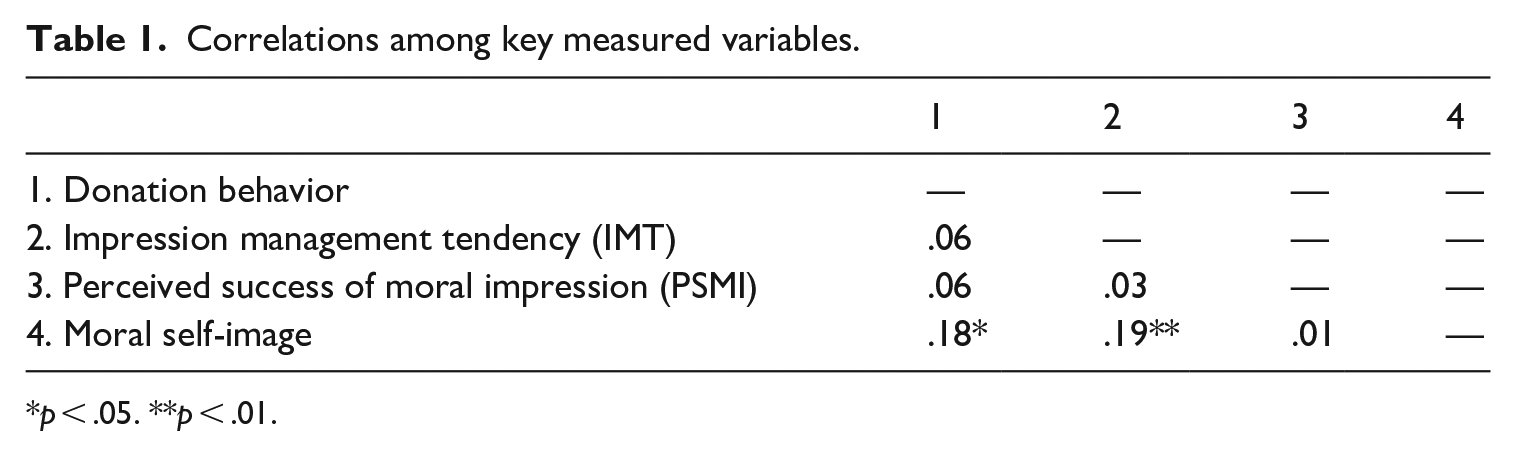
p < .05. **p < .01.
Results
Clicktivism and donation behavior (H1)
Following the original moral self-licensing framework, we hypothesized that any form of clicktivism (vs no clicktivism) would lead to lower levels of subsequent donation behavior in terms of the likelihood of donations (H1). Results supported this hypothesis (see Table 2, Model 1). Clicking on an online petition significantly reduced the likelihood of donating, reducing the odds of donation by a half (logit = −0.71, p = .027, odds ratio = 0.49; H1 supported).
Effect of clicktivism on donation likelihood.
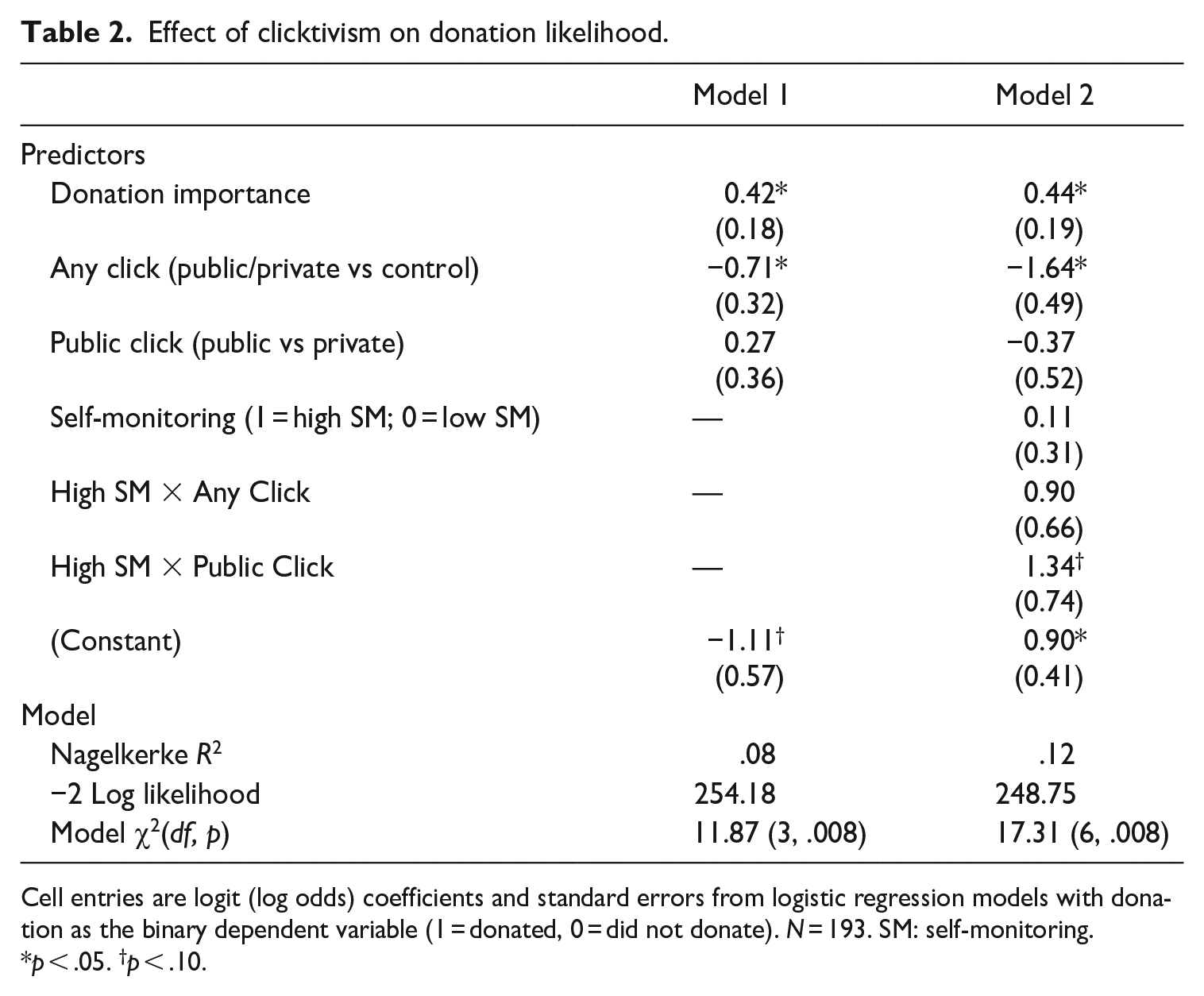
Cell entries are logit (log odds) coefficients and standard errors from logistic regression models with donation as the binary dependent variable (1 = donated, 0 = did not donate). N = 193. SM: self-monitoring.
p < .05. †p < .10.
Impression management tendency as a moderator (H2)
The second hypothesis zoomed in on the effects of public versus private clicktivism for high and low self-monitors to test whether donation behavior is increased with public, as opposed to private clicktivism for high self-monitors (H2). We did not find a significant interaction effect between the social observability of a click (i.e. whether the act was private or public) and impression management tendencies (logit = 1.34, p = .070; see Table 2, Model 2; H2 not supported). However, as the p values approached significance and because the logit coefficients are not directly interpretable, we plotted the conditional probabilities based on the logit coefficients to assess any trends (see Figure 1). We note that these are only exploratory interpretations of heuristic value. Among low self-monitors, the difference in probability of donation between private (48%) and public clicktivism (40%) was not significant (logit = 0.37, p = .469); for high self-monitors, however, public clicktivism (66%) marginally increased the estimated probability of donation as compared to private clicktivism (42%; logit = 1.34, p = .070). 3
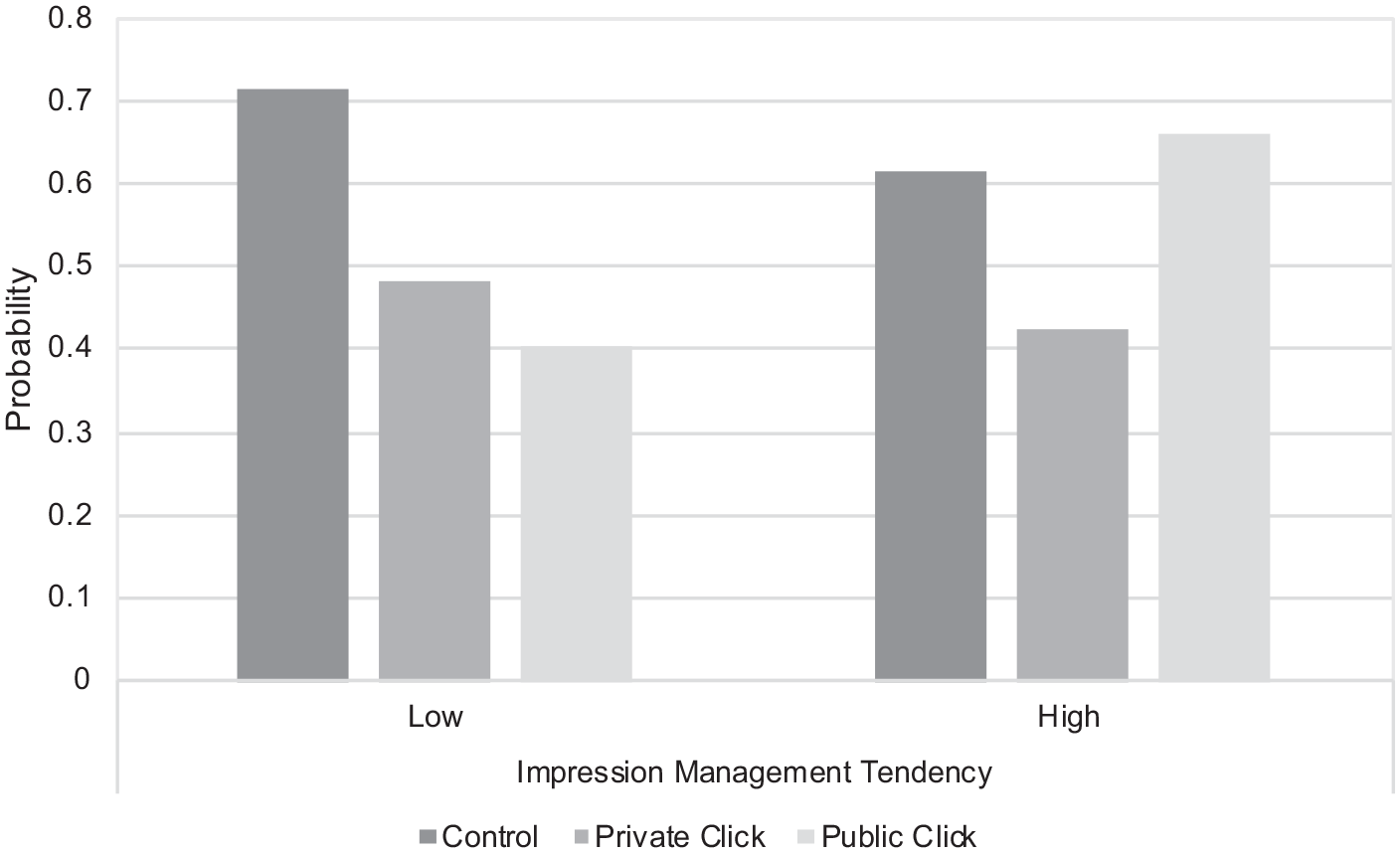
Effect of clicktivism on donation likelihood by impression management tendency. For those with low impression management tendencies (i.e. low social monitors), any kind of clicktivism reduced the probability of donation. For those with high impression management tendencies, public clicktivism did not have this depressive effect. Conditional probabilities were calculated based on estimated coefficients from logistic regression model (see Table 1).
Exploring the mechanisms: perceived success of moral impression and MSI (H3, RQ1)
The third hypothesis (H3) posited that the effect of clicktivism on donation behavior will be mediated by PSMI, such that engaging in clicktivism increases PSMI which in turn decreases donation intentions for high self-monitors. This moderated mediation effect was not significant (see Table 3). Neither the effect of clicktivism (vs control) nor public clicktivism (vs private clicktivism) showed a significant moderated mediation effect via PSMI (any click Index = .02, BootSE = .07, 90% confidence interval [CI] = [–.06, .15]; public click Index = –.04, BootSE = .11, 90% CI = [–.25, .07]; H3 not supported).
Examining the mechanism of clicktivism effects on donation likelihood.
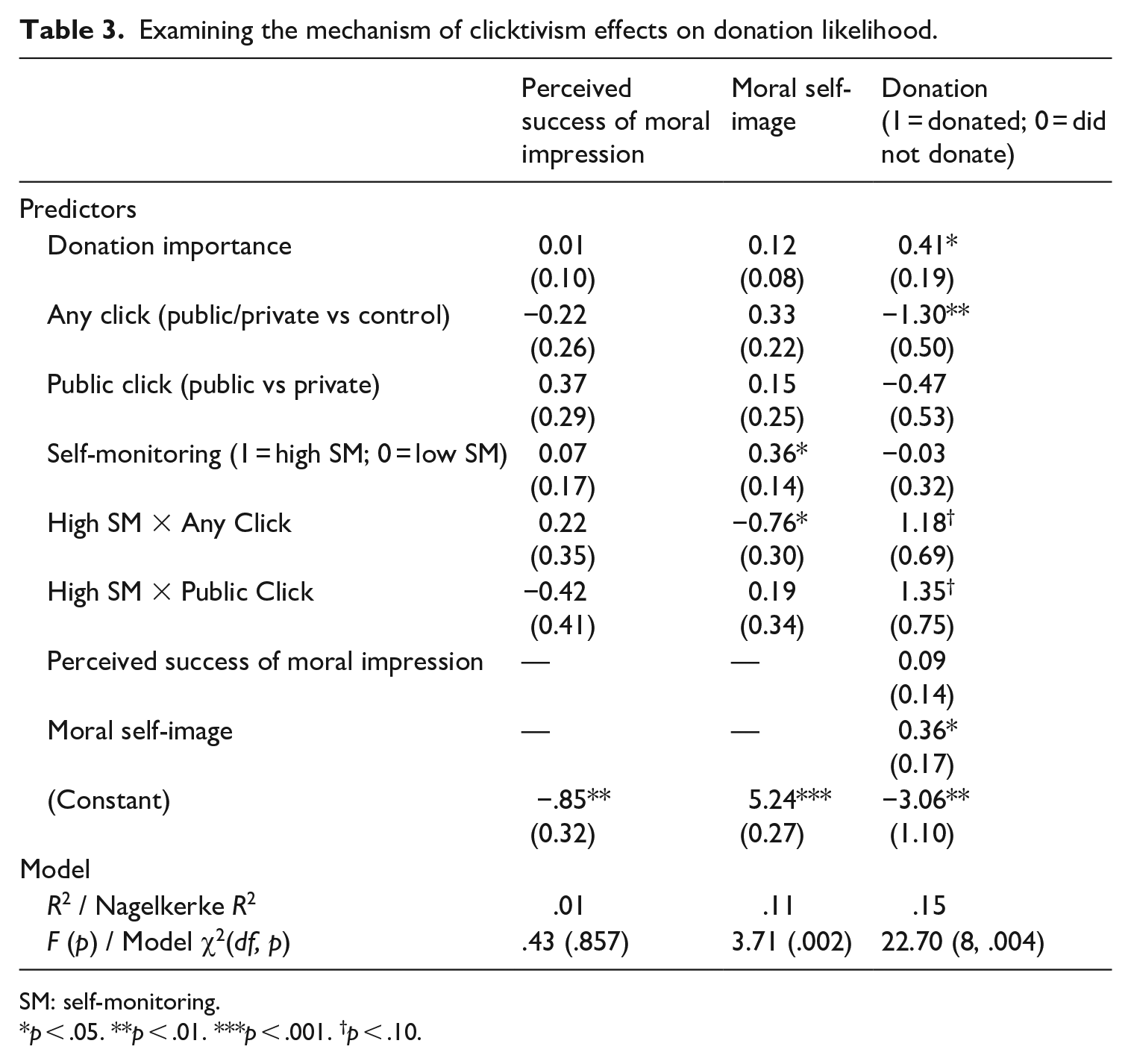
SM: self-monitoring.
p < .05. **p < .01. ***p < .001. †p < .10.
RQ1 asked whether MI explains the effects of clicktivism on subsequent prosocial behavior for high self-monitors. Results showed a significant moderated mediation effect for clicktivism on donation intentions via MI (Index = –.27, BootSE = .18, 90% CI = [–.62, –.04]). For high self-monitors, engaging in clicktivism led to reduced intention to donate through reduced MI (Effect = –.16, BootSE = .11, 90% CI = [–.36, –.02]). For low self-monitors, however, this was not the case (Effect = .12, BootSE = .11, 90% CI = [–.02, .33]). On the other hand, there were no moderated mediation effects for public (vs private) clicktivism via MI (Index = .07, BootSE = .16, 90% CI = [–.13, .38]). These results are summarized in Figure 2.
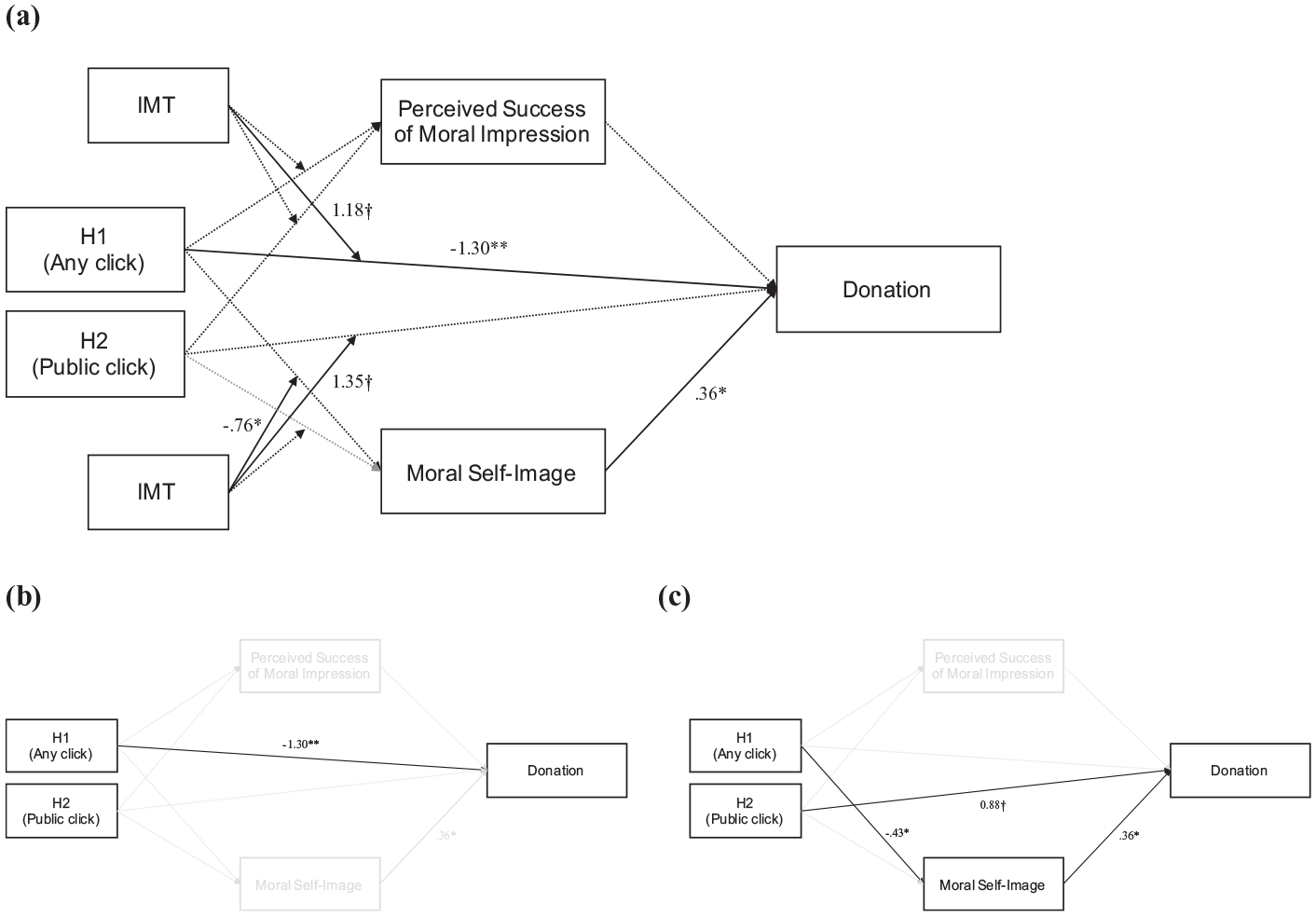
Assessing the mechanisms of clicktivism effects. For low self-monitors, engaging in any kind of clicktivism led to reduced donation, an effect that was not found to be mediated by PSMI or MSI. For high self-monitors, clicking on a petition reduced MSI which was a positive predictor for donation. On top of this indirect effect, high self-monitors were responsive to public click: public clicktivism (as opposed to private clicktivism) increased donation intentions. Note. Donation importance was controlled for in the model: (a) A moderated mediation model of clicktivism effects on donation intention; (b) effects for low self-monitors; (c) effects for high self-monitors.
Discussion
Does clicktivism depress more substantive forms of activism? If so, when are these effects more pronounced? And what might be the mechanisms that produce these effects? The current study examined these questions by experimentally inducing actual clicktivism behavior online and measuring subsequent donation behaviors. Our results showed that clicktivism indeed dampens engagement in subsequent prosocial action; participants who signed an online petition for social causes were less likely to donate money to support the cause. This finding is consistent with predictions that stem from moral self-licensing theory (Merritt et al., 2010; Monin and Miller, 2001), but it is particularly notable as the content was a social cause that the participants reportedly cared about and supported. While our study posited that public (as compared to private) clicktivism would increase donation behavior among high self-monitors but not among low self-monitors, this finding fell short of statistical significance. The findings were in the expected direction with public clicktivism improving donation likelihood compared to private clicktivism only for high self-monitors. Finally, we attempted to uncover mediating mechanisms of these effects by examining the perceived success of establishing a moral impression or the importance of MSI, but our results regarding the mediators were mixed. Each of these findings will be further discussed below.
Theoretical implications
Our results demonstrated that clicktivism, in general, reduces subsequent action, as many observers and practitioners have bemoaned (e.g. Gladwell, 2010; Morozov, 2009). These results (i.e. less donation after engaging in clicktivism) are consistent with predictions from the moral self-licensing framework (Merritt et al., 2010; Monin and Miller, 2001)—the initial “moral” act of clicking on the online petition “freed” the individual from a need to engage in other forms of action subsequently, resulting in lower donation intentions (see also Cornelissen et al., 2013). The contrast between our findings and that of some past work is notable. Kristofferson et al. (2014) reported that any act of token support tends to increase subsequent action, especially when the act is public. This difference may stem from the social causes chosen for the studies. In our study, participants selected a social cause that they supported the most among a list of pre-selected/pre-tested potential issues, and the experimental materials were tailored to the chosen topic. In contrast, past studies have used topics selected by the researchers (e.g. support for veterans, supporting local charity), which may not have been relatable for the participants. Our findings show that when the topic is personally relevant to the participants, any form of clicktivism reduces the potential for further engagement.
We failed to find an interaction effect between the nature of clicktivism (i.e. public or private) and an individual’s tendency to engage in impression management (i.e. self-monitoring) although the findings approached statistical significance in the expected direction. While past work has looked at the social observability of token acts of support as an important boundary condition (e.g. Kristofferson et al., 2014; Lane and Dal Cin, 2017), our findings show some evidence that the effect of public (vs private) clicktivism may depend on individual factors such as one’s social monitoring tendencies. One reason why our results fell short of statistical significance may be due to our weak treatment of public clicktivism. Due to technical challenges, we created a simple platform for public clicktivism instead of simulating a more “socially salient” sort of clicktivism. It is possible that public clicktivism effects for high self-monitors may have been stronger on such a platform.
On the contrary, our attempt to uncover the mediating mechanisms revealed mixed results. According to the moral self-licensing framework (Merritt et al., 2010; Monin and Miller, 2001), satiating the need to put on a moral impression is the key mechanism that brings about the effects. Our study used a direct measure of the success of moral impression management by measuring the difference between the desired and perceived moral image as estimated by the participants after the clicktivism treatment. If the depressive effect of clicktivism occurs through moral licensing, engaging in clicktivism should have increased one’s perception of success in moral impression making, having a negative impact on donation. None of this was found in this study. Clicktivism did not affect our metric of moral impression management success (i.e. PSMI), nor did this impact donation behavior. One possibility is that our measure of satiating one’s moral needs may have been limiting. In particular, one’s moral needs were measured post-treatment immediately before measuring how one is currently perceived. Asking these questions one after another may have contaminated the measure in unexpected ways. Future studies might explore more direct moral impression management measures that are less susceptible to such effects.
While this study established that adverse effects result from clicktivism, more studies are needed to uncover the contingencies and mechanisms behind these effects. Our exploratory analysis involving MSI shows one step in this direction. Results showed that high self-monitors placed a lower emphasis on their MSI after engaging in clicktivism. This reduction in their MSI ultimately lowered the likelihood of donation for this group. Rather than being reminded of moral convictions, high self-monitors appear to lose interest in maintaining their MSI when their moral credentials are met with clicktivism. In this regard, changes in MSI may be one plausible alternative mechanism of how clicktivism dampens engagement in subsequent prosocial action for high self-monitors. Overall, the underlying mechanism of clicktivism remains unanswered, and thus more research is warranted to answer this question clearly.
Practical implications
Our study presents new insights into how a digital environment influences prosocial behavior to help practitioners create more meaningful and effective outcomes for their cause. While clicktivism can be beneficial for raising awareness and garnering immediate online engagement, it can also be detrimental to more substantive forms of engagement. If the objective of an online social campaign is to raise funds, campaigners might choose not to create opportunities for token acts of engagement online as they can deflate more substantive, subsequent actions. If there is a need for gathering petitions online, however, enabling high social observability through specialized features or platforms (e.g. social media) could guard against unwanted deflation effects among those who care about their public image.
Furthermore, as low self-monitoring individuals are less likely to engage in subsequent prosocial behaviors after any clicktivism activities, practitioners can use this knowledge to generate campaigns with calls for action that include both clicktivism and prosocial behavior. For instance, urging individuals to donate first and share their donation behavior with others online subsequently might be a more effective strategy than obtaining petition signatures first and soliciting donations afterward.
Limitations and future directions
This study presents some limitations that should be considered when interpreting the findings. First, our study was conducted in a single Asian country, and the results need to be interpreted with the specific context in mind. Singapore is a small, highly-developed city-state, which is also known to have an underdeveloped and constrained civic culture (Kim et al., 2022; Yuen, 2006). Strong state-driven initiatives and interventions are the norm, while civil society plays a much weaker role (Zhang, 2013). At the same time, Singaporeans value a narrower notion of activism in the form of charity-focused activities, community-based volunteering, and raising awareness for non-political issues (see Zhang, 2013). This unique cultural, moral, and political background of Singapore should be considered when interpreting the study’s findings. While the oversaturated information communication technology (ICT) environment makes Singapore an appropriate context for studying online clicktivism effects, specific socio-political and cultural factors unique to the country could have affected the results. What was the impact of the subdued and underdeveloped civil society climate (Kim et al., 2022; Zhang, 2013)? Did the communitarian value orientations of Singapore (Tan, 2012) amplify the impact of impression management tendencies or public (vs private) clicktivism? Further examinations in more diverse contexts are needed to assess the robustness of these findings.
Second, social desirability issues should be considered. While social desirability bias can affect any study that relies on self-report measures, it is especially a concern for studies on donation behaviors (Louie and Obermiller, 2000) and studies in the context of Asian countries like Singapore (Muthiah et al., 2021; see also Middleton and Jones, 2000). However, contrary to this concern, our participants did not show signs of over-reporting their donation intentions. The average intended donation amount was quite low, and nearly half of the participants declined to donate any amount. This is likely because we measured donation intention in a realistic way compared to studies. Moreover, even if there were any response effects, they would have equally affected participants in the different experimental conditions; thus, the findings would still be intact.
We studied the effects of clicktivism on a sample of college students; it needs to be further examined whether these effects generalize to the larger population. College students are different from the general population as they are typically younger and have more experience with the online environment. Past experiences may serve as a lens through which one construes current behavior (Merrit et al., 2010), and since most forms of online activism occur on social media platforms (e.g. Facebook, Twitter), those with more experience using social media may have been more acutely aware of impression management concerns as compared to the rest of the population. In this sense, the meaning of a click is not the same for everyone, and more studies need to be done to ensure the contingencies and generalizability of our findings.
This study examined one individual factor that moderates the effect of clicktivism on one kind of prosocial behavior, donation. Prosocial behaviors may vary on a continuum that ranges from true altruistic tendencies to egoistic motives (e.g. to obtain approval) (Eisenberg et al., 2016). Also, individuals have variations in motivational tendencies (e.g. prosocial motivation). For example, individuals who possess true altruistic tendencies would more likely engage in subsequent prosocial behaviors regardless of clicktivism activity (i.e. less influenced by moral licensing effect), while those who possess egoistic motives would only engage in prosocial behaviors when the act is deemed beneficial to the self. Future studies would be necessary to determine the effects of motivation tendencies on acts of clicktivism and its effects on moral licensing and prosocial behaviors.
Finally, despite our conscious effort to maximize ecological validity, signing a petition or requesting a donation was conducted in a simulated environment, which may not have perfectly reflected an organic online activism context. Previous studies have established a wide range of clicktivism acts classified as online activism, such as liking or sharing a Facebook post or creating memes to show support (Dookhoo, 2015). Future works could utilize a wider variety of online acts to account for differences across various forms of clicktivism.
Footnotes
Authors’ Note
Nuri Kim and Hye Kyung Kim are Assistant Professors at the Wee Kim Wee School of Communication and Information, Nanyang Technological University (NTU) in Singapore. Si Jin Tan, Wen Hsing Kelvin Wang, and Kheng Hian Ong were undergraduate students at the same institution when this research was conducted.
Funding
The author(s) received no financial support for the research, authorship, and/or publication of this article.
